Demolition of the Kingdome as a GIF, Seattle, Washington, March 26, 2000. (USA Today).
This week thirty years ago was the beginning of the end of my sexist dream of having women recognize me for being “a nice guy.” As I wrote in one of my very first blog posts a decade ago, it was a dream “that had to die.” Precisely because it was a fantasy, a phantasmic display of teenage delusion borne from five years of abuse and oppressive social immaturity. In ’80s parlance, my wack ass had to learn the hard way that I had no game. And, more importantly, that pedestals are meant for smashing with sledgehammers, as people can never live up to their marble or bronze busts.
It wasn’t really women I was trying to impress with my quiet and stoic demeanor. I was all about my second infatuation, Crush #2, my version of Phyllis in the summer of 1987. I’ve outlined in painstaking detail here and in Boy @ The Windowmy obsession with Phyllis and her smile, and my ridiculously stupid attempts to make conversations with her in the three weeks of my various impromptu encounters at the old Galleria in White Plains and on the 40/41 Bee-Line Bus back to Mount Vernon.
But “the end of the lesson,” or at least, the “end of the beginning” of it (to quote both Kevin Costner in The Untouchables (1987) — which I saw at The Galleria twice that summer — and Winston Churchill), began on my brother Yiscoc’s birthday on the fourth Thursday that July.
I walked around for over an hour after I got off the bus at North Columbus and East Lincoln. I must’ve called myself “pathetic” at least a dozen times on that hot and steamy walk. And I was. I didn’t get home to wish Yiscoc a Happy Birthday until after 8 pm, by which time I missed any semblance of a birthday celebration at 616.
Packing up and moving to Pittsburgh — and my freshman year at the University of Pittsburgh — seemed as far away that weekend as it did during my summer of abuse five years earlier. I was no longer sure that this transformational period of my life would actually bear fruit. I thought I was destined to spend the rest of my days alone, ridiculed, emasculated, and otherwise as a piece of trash.
Toppling and destruction of Vladimir Lenin’s statue via sledge-hammer, Berdichev, Ukraine, February 22, 2014. (unknown).
I was seventeen years and barely seven months old when I had those thoughts. I’ve been married for nearly that long, and have a son on the cusp of turning fourteen. There’s no way that Donald 1.0 could have envisioned either of these experiences, much less worked to make them happen. It wasn’t exactly a miracle that I became a boyfriend, fiancé, husband, and father. No, it was an evolution, with a couple of personal rebellions and revolutions mixed in.
The one good thing I did after Phyllis took a wrecking ball to my delusions of feminine perfection was to talk about it with someone who was willing to listen. This time around, a young woman put up with me griping about something I never had, someone whom was never for me to begin with. As many times as I would go on to listen to women of all stripes about their relationship issues, I needed to be on the rueing end of things this one time.
It would take a lot more talking, a bit more learning, and four more years befriending and dating, before I’d completely give up putting women on pedestals entirely. Women may be beautiful, and Black girls may be magic, but none are meant to be worshipped at altars. Like all other anthropomorphized idols, humans on pedestals will always fail us when we delude ourselves into thinking that we need them to be free. Especially when we need them the most, or at least, believe so.
“I took care of my kids! I put food on the table, put a roof over y’all’s heads, put clothes on yo’ back! I did the best that I could, and none of y’all can tell me different…” That’s what my Mom yelled at us the day before Sarai’s funeral seven Julys ago. It was an excited utterance, after she had spent five days in a trance, unable to do as much as eat a piece of toast. We were in the living room of Mom’s flat at 616, me, Mom, Maurice, Yiscoc and Eri, being yelled at over a lifetime of disappointment and frustration. Ours and hers.
Today is my brother Yiscoc’s thirty-sixth birthday. That he’s here at all is a bit of a miracle. Especially with the number of times he ran away from 616 between 1989 (when he was eight years old) and 1994, with his one-time video game addiction, and with muggers and pedophiles out there and all too willing to take advantage of a vulnerable preteen.
I started with Mom, though, for a reason. Her yelling at us was probably meant for me, but it was in response to Yiscoc, who shared a personal secret with her for the first time. Mom’s response was to defend her record as a parent, to tell us that we had no right to judge, critique, or assess her record. That she added, “That’s what you get for…” in response to Yiscoc’s tearful sharing session was shameful and disgusting.
“You’re So Vain” (1972), by Carly Simon, 45 cover, cropped, July 23, 2017. (http://avclub.com).
“But you don’t understand, your Mom was mourning the loss of her only daughter,” would be the response of Mom-defenders everywhere. To which I say, really? Your Mom’s response is to push four of your five living children away with a tirade? One where she says, “this fucked up, piece of shit life I helped set up for all of you was the best I could do, and if you don’t like it, that’s on you, and you can kiss my Black ass!” Would that really be acceptable under any circumstances, much less during a week of mourning?
Yiscoc ran away from home, hung out with several wrong crowds, and dropped out of Mount Vernon High School a year and a half before he could have completed his coursework. Seventeen years later, and Yiscoc still doesn’t have his GED (the last two times, he failed the social studies portion of the exam — ain’t that a kicker!). I’m not laying all of this at my Mom’s feet. But Yiscoc’s adult life wasn’t exactly set up for success by his growing up years. The normative permanence of systemic racism on the one hand, and domestic violence, welfare poverty, and the 616 fire of 1995 that left Yiscoc and my other younger siblings temporarily homeless on the other, would make any kid itching to run away.
A second younger brother has now reached the second half of his thirties. Yiscoc’s the same age I was eleven and a half years ago, when I began working on Boy @ The Window in earnest. One of the things I figured out in writing such a torturous book was that I blamed myself for so many of my parents’/legal guardian’s failures and sins. I had blamed myself for not putting an end to the domestic violence at 616 since I was twelve, for not doing enough to support Mom and my younger siblings since I went away to college at Pitt in 1987. I also came to understand how much Mom deflected, defended, and denied when it came to her parenting, especially when we called on her to do more than find temporary shelter, meager food options, and threadbare clothing. Mom was and remains one of the vainest and unaffectionate people I have ever known — vain, insecure, and likely clinically depressed.
I also know that Mom has passed these traits down to each of us. I’ve been dealing directly with them for three decades. I’m not sure Yiscoc has ever peered behind his mask long enough to see Mom lurking in the shadows, warts and all. If he has or ever will, it has been or will be an ugly sight. But if we are truly attempting to rebuild and remake ourselves, it is a sight we must endure. A painful process of honesty, soul-searching, revelation, and admitting that on some level, we’ve fucked up, and been fucked up, by life, oppression, and parenting.
Happy Birthday, Yiscoc. Know that despite everything, I do love you. I hope that this next year brings you closer to the person you want and need to be.
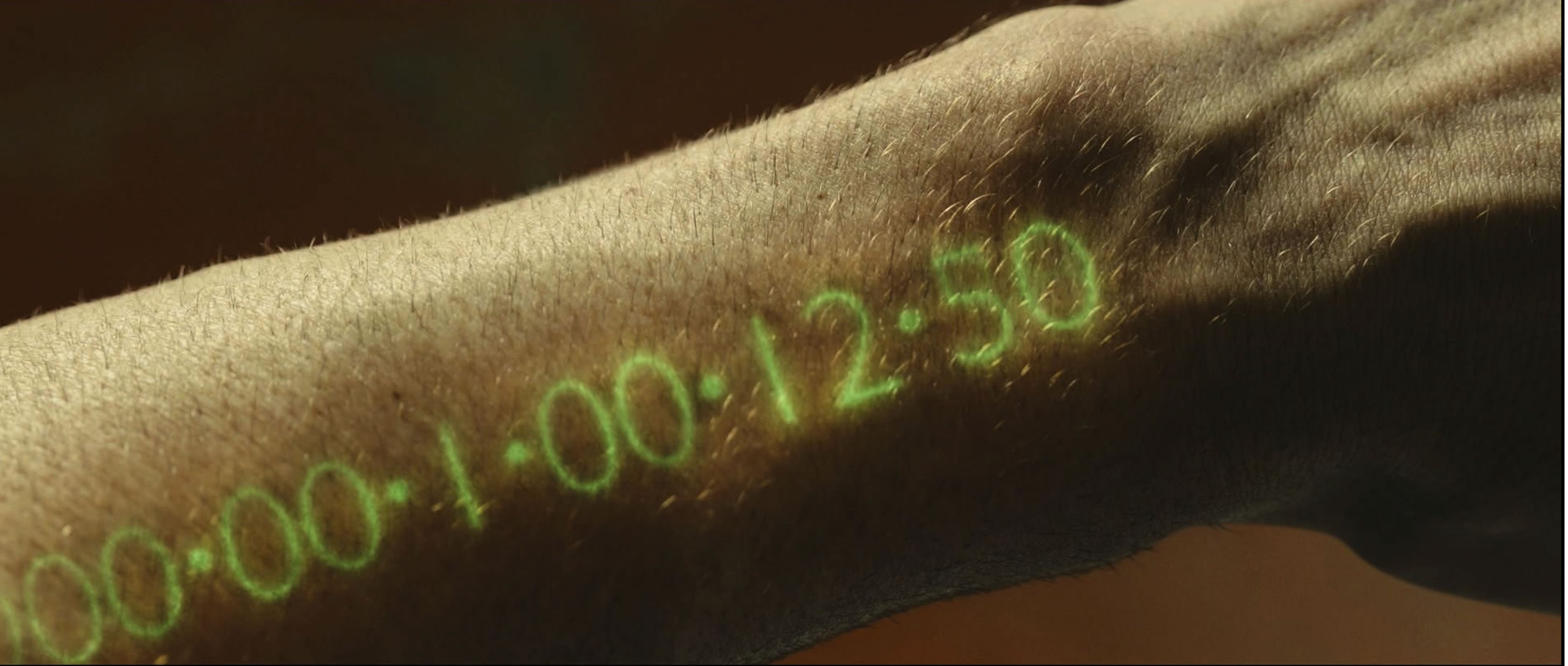
Time, money, debt, yoke = same difference, from screen short from movie In Time (2011), October 27, 2011. (http://collider.com/in-time-review/).
This week in July thirty years ago, I took out the first of what would be a series of student loans. Loans that would help cover eight of my ten years of undergraduate and graduate studies at the University of Pittsburgh and Carnegie Mellon University. In three-and-a-half-months, I will be ending my twentieth year paying off those loans. If I had to do it all over again, I may have stayed in New York State to take advantage of the TAP award (need-based financial aid). That way, I wouldn’t have needed to borrow for my undergrad. But given my near desperation for wanting to escape grinding poverty, 616 and my family, Mount Vernon, New York, and the stigma that was my life living there among hostile and indifferent classmates, teachers, and neighbors, borrowing $2,625 on July 16 of ’87 didn’t seem so bad.
Yep, my first subsidized/unsubsidized Stafford student loan was a modest one. It was a set maximum based on the old laws limiting student borrowing (especially for college freshmen) three decades ago. I remember thinking to myself, “How the heck am I gonna pay this back?,” as I went through an hour of phone calls between Pitt’s financial aid office and Marine Midland Bank (now part of HSBC). The latter was where I had my first bank account, where I had deposited $500 of scholarship money from Mount Vernon’s Afro-Caribbean Club. That’s how little I knew about the process – I went with a bank that didn’t exist outside of New York State to work with a school in Western Pennsylvania!
Because I wasn’t yet eighteen, I needed my Mom to co-sign my loan. Because my Mom didn’t have collateral, she needed to add two relatives who did have assets to my first loan. In the end, Mom chose my maternal grandmother Beulah and my great-great-aunt in Seattle Inez (who just happened to be Johnny Gill’s great or great-great grandmother — didn’t know it at the time) as relatives with collateral who could be on the hook if I or she ever defaulted on our future payments. Of course, Mom didn’t actually seek permission from my then sixty-year-old grandma in rural Arkansas or my better-off, octogenarian, great-great aunt for this sign-off. Apparently, Marine Midland didn’t care, either. And that’s how it was for the next four years, having relatives whom I had never met (and in the case of great-great aunt Inez, who died at 101 years old in the early ’00s, would never meet) as collateral for my loans.
I’d also take out the smaller Perkins Loan for my undergraduate time at Pitt, an additional $2,000 per year, for three of my four years there. In all, I’d borrow more than $16,000 in four years, with a high of $4,000 in Stafford Loans in my junior year, 1989-90.
It bothered me every time I had to re-up for student loans. Not just because of the false notion of American individualism, the idea that I shouldn’t need anyone’s help to go earn a degree. It bothered me because I feared, sometimes to the point of nightmares, that I’d never be able to pay this money back.
Graduate school at Carnegie Mellon and the loosening of the student loan rules and amounts under President Clinton in 1994 made things better and worse. I barely borrowed my first two and a half years of grad school at both Pitt and CMU, to the tune of $1,800 in all. CMU paid me so little as a grad student that I had little choice if I ever planned on eating more than one meal a day but to borrow. And that’s how most of my borrowing occurred between January 1994 and January 1997, to either have to supplement my meager stipend (before the year of my Spencer Dissertation fellowship). Or, to use the funds to help support my dissertation research, the travel to/from and living arrangements while in DC in 1994 and 1995. Unlike many of my graduate school colleagues (especially the ones working on professional master’s degrees or a law degree), I didn’t use my loans to go on extended weekends to Bermuda or to take summer vacations in the Grand Caymans.
Of course, I graduated in May ’97, and lo and behold, I couldn’t find full-time work. And with the exception of the months of July, August, and September 1998, I wouldn’t have full-time or full-time equivalent work until I left Pittsburgh for work in the DC area in the summer of 1999. But, my consolidated student loans through the dispensations of Sallie Mae never took that into account when my first payment became due Thanksgiving Week 1997. I was able to get a reduced payment of $20 per month for the first two years. I didn’t default, but it made paying off my student loans that much harder. It didn’t help that Sallie Mae had locked in my interest rate at eight percent, retroactive to July 1987, and unchangeable under any circumstances. Even with consumer interest rates the way they have been for the past decade.
Relationship between lenders and payees, July 27, 2015. (http://forbes.com).
Flush or not, full-time or underemployed or somewhere in between, the student loan payments, deferments, and forebearances have been non-stop for two decades. Even credit card companies will leave folks alone if they make regular minimum payments. Not so with student loans or with Sallie Mae (now Navient, which must mean assholes in financial aid-speak). Despite everything I’ve been through financially over the years, I finally paid off the original principal of my consolidated student loans about two years ago. Great. It still means that I have left another decade of payments on accumulated interest before I can be forever free of this nearly endless cycle.
Here’s the real thing that I think I’d do over again, that should be done about this corrupt and serfdom-like process. Sixteen, seventeen, or eighteen years old is way too young to be making financial decisions that I or anyone else will have to live with for four decades or more. Even deciding to serve in the military isn’t a decades’ long commitment (unless one chooses to re-up or goes to officer’s school). At the very least, no one under twenty-one should have to commit themselves to debt peonage, including student loans. As for me, working thirty hours a week on or off campus between 1987 and 1997 to cover costs and necessities would’ve been preferable to this iron collar.
The real problem, of course, is that adult learners are taking out many of these loans these days. Even though they may be old enough to know better, they aren’t experienced enough. Lumina Foundation and other organizations have concentrated on “financial literacy” as the way out. This is wrong-headed, as it does nothing to change this financially enslaving system. Really, it would take free and significantly-reduced undergraduate tuition to do the trick. But where’s the fun, profit, and human misery in that?
Réunion Island’s (French department, off Madagascar) Piton de la Fournaise, lava flow, February 26, 2005. (Samuel A. Hoarau via Wikipedia). Released to public domain via CC-SA-3.0.
Today I am thirty years removed from my Mount Vernon High School graduation. Yay me (and 500+ others, I suppose)! But at forty-seven and a half years old, this also means I’m in my late forties, older than the age of many of my teachers on the day I wore my cap and gown on Memorial Field.
What I am still young and old enough to remember is the distance between me and my classmates, acquaintances (since I really didn’t have any friends back then), and family. Putting up a good front, a mostly blank front with an occasional laugh or smile, was what I did in public back then, enough to make it appear I wasn’t an outcast. Except that I was. But it wasn’t just the silent-treatment folks who reminded me that I was nothing and meant nothing to them within days of the MVHS graduation. I felt it, knew it, and wanted to escape it, every single day back in ’87.
There have been at least two high school reunions since Thursday, June 18, 1987. One was in September 1997, way too early to do a get-together from where I sit. Not to mention, I was coming off of three months of post-PhD unemployment, and wouldn’t have wanted to spend money I didn’t have to impress people with whom I could’ve never shared good times a decade earlier. The other was five years ago, a more appropriate frame for a reunion, but it was part of a group of reunions between 1985 and 1989 (or more even). I barely knew half my classmates in the Class of ’87, a couple dozen from ’86, and a few from ’85 and ’88. All together, it would’ve felt like a room full of strangers to me.
But at thirty or more years, would I want to go to a reunion now or in the future? I really don’t know. Part of the problem with reunions is the same problem I had in Humanities and in MVHS. I would have to fit someone’s predetermined mold or role. If I went in as Donald Earl Collins, would anyone actually remember me or acknowledge me as my true self? Could I be Donald Earl Collins the writer or historian or educator? Could I be the disillusioned Christian, the anti-racist American, or the middle-aged athlete who does yoga and can still hit threes despite my IT-band issues? Or, will I just fall into my role as the super-smart but enigmatic loser, the wack-ass weird mofo that scores saw me as three decades ago?
I know one thing my ex-mates wouldn’t see me as — a father (after all, today is Father’s Day). I guarantee you, some of the folks in my class took bets as to whether I was straight, gay, asexual, or if I’d have sex with another human before the Rapture! Yet I’ve been married for more than seventeen years, and a father for almost fourteen. Much longer than I was ever in high school, Humanities, or Mount Vernon’s public schools. This is what makes me old and keeps me young. Family, love, parenting, and making pancakes, bacon, and eggs for Sunday brunch.
Memorial Field in complete disrepair, locked up (and like me in 1987, locked out), April 2, 2017. (Mark Lungariello/The Journal News).
The day of graduation in 1987 was a trip in itself, between an 87-year-old graduating with our class, the sudden hugs and immediate ostracisms that occurred, the triple-H evening in polyester in the middle of Memorial Field, and my father’s drunken attendance. It was a clash of White Italian Mount Vernon, Black elite Mount Vernon, and stereotypically ghetto Mount Vernon, with a splash of affluence, Afro-Caribbean, and other Mount Vernons. That’s what made it a strange ceremony, a last look at my hometown’s population as a teenager, good and bad.
There’s someone on Facebook who runs the page “I grew up in Mount Vernon.” My former classmate frequently blocks or admonishes participants for negative posts or negative portrayals of Mount Vernon. His defense: he wants the page to be “a place of positivity.” It’s his page, and he should be able to do what he wants with it (within reason). However, “positivity” is not the same thing as “positive posts only.” You should be able to generally like Mount Vernon and occasionally discuss issues affecting people in town that aren’t positive ones. Like poverty. Like the need for more social justice activism and more political participation. Like the need for a donut shop on par with the former Clover Donuts.
Bill Cosby in midst of his “Pound Cake” speech (with Rev. Jesse Jackson in background), NAACP 50th Anniversary of Brown decision gala, Washington, DC, May 17, 2004. (http://blackpast.com).
Really, I find this “I grew up in Mount Vernon” Facebook page yet another example of how a privileged group of folk get to frame a conversation for people who can’t or won’t speak for themselves. Middle-class, one-way-thinking, Black respectability politics folk whose Christian ethics blind them to history, racism, poverty, misogyny, homophobia/heterosexism, and other -isms and -obias that affect their neighbors. The page is smug, elitist, and exclusionary. I rarely look at the page, and I’ve posted to it maybe three times in seven or eight years. “I grew up in Mount Vernon” is a reminder that I share little in common with these Mount Vernonites, even as my socioeconomic and educational status has changed over the years.
As a father, though, I am reminded about the need to protect and to nurture, balanced with the need to give my son room to grow and learn. I may not be able to stop a cop from exercising his/her lethal racism with a badge, but I can prepare my son as best I can to be in public anyway. When it comes to Mount Vernon, MVHS, or any future reunion I may decide to attend, maybe, just maybe, my ex-classmates should be as ready to see all sides of me. At least as much as I have granted that their version of Mount Vernon is one that is real for them, if not for me and many others.
Me at Prom Dinner, White Plains, NY, May 21, 1987. (Suzanne Johnson neè DeFeo).
I can say with absolute honesty that I have never rolled, smelled, or smoked a joint. No weed, not ever, as I approach my late forties. I have, however, gotten a contact high on at least a dozen occasions, over the past thirty years. Heck, I’ve probably been high a few times off of burnt oregano and gasoline fumes, as infrequently as I’ve exposed myself to endorphin catalysts in my life.
My first contact high happened in the vestibule of 616 East Lincoln Avenue, on the night of my senior prom, the third Thursday in May ’87. As with all things in my life at seventeen, this was unexpected, uncomfortable, and underappreciated on my part. I had just called to find out when the limousine was coming to pick me up before swinging across town to pick up the other four people with whom I was to ride. I had done myself up as well as my sinewy bean-pole ass could. With my father’s funds, I rented a well-fitting tux with a white shirt and peach cummerbund. I’d bought my friendly date Dara a white carnation, matching the once pinned on my tux jacket. My idiot stepfather tied my peach bow-tie. Unusual for me, I lotioned myself from head to toe, greased my hair down, and otherwise made sure I smelled as clean as a Carolina pine forest. Not that I usually smelled bad, but I couldn’t look like a po’ boy tonight.
It was almost 6:30 pm before I walked downstairs to wait for the limo. Right on the steps leading into the vestibule were my C-building neighbors and two guys I didn’t recognize. They were all smoking joints, and the smoke had filled a good portion of the semi-enclosed lobby leading to the front doors. My elementary school classmate Valerie was in this group, across the lap of one of the unknown young men, all as he felt up Valerie’s ass like it was his own. Part of her thong underwear was visible, as Valerie’s boyfriend gave one of her butt cheeks a good slap while she giggled. Her brother Ernie was also there, fully blazed up, apparently without a care in the world. I don’t think he went by Ernie by ’87, though. He was a low-level drug dealer at this point, and had bulked up a bit over the previous couple of years, to protect himself in his line of work, I guessed.
Ernie asked me if I wanted a puff. I said, “Naw, man, I’m fine.” Him and his sister and crew just laughed like I told the funniest joke. But I knew why they were laughing. In the half-minute or so of standing around waiting for the limo, I was already high. So much so that I didn’t sound like the proper English-speaking teen I often was in public. I sounded like one of them, in slow motion even to me. A full hydro hit would’ve left me ready to do anything else other than go to the prom.
The limo arrived, and not a moment too soon. Even though I’d been in the lobby and vestibule less than two minutes, even I could smell that the weed was a bit stronger than my deodorant, lotion, and cologne combined. The one guy already in the limo with me asked if I was “okay.” I knew what he meant. “I just have a contact high, that’s all,” I responded.
I would’ve hated to admit this thirty years ago, but I needed to be a little high and a little more relaxed, and not just that prom night. It actually helped to be under the influence, even though the contact high only lasted for thirty or forty minutes. By that time, I had noticed that the non-alcoholic drinks in the back of our limo were alcoholic. My date and a couple of the guys, after they became little buzzed, asked me how I knew. I said, maybe for the first time in public, that, “I know from experience. My father’s an alcoholic.”
White Castle, 550 East Fordham Road, Bronx, NY, circa 2015. (http://zomato.com).
In between, me, my date Dara, classmates Allison and Gina, and two MVHS upperclassmen now in college, went to White Plains for the prom dinner and dance, then to Midtown for Copacabana on West 34th, and somewhere around 2 am, for the White Castle on Fordham Road in the Bronx. I didn’t get home until 3 am.
I went to the prom mostly because I didn’t want to look back at my time in high school years later and feel regret about not attending. But the fact is, other than a feigned attempt at social protest during the prom dinner, there was little particularly memorable about the event. Not the rubber chicken or overcooked salmon. Not the music or the overextended small talk. Nor should I have gone on a friendly date to the prom. I should’ve either found someone I did like to go out with, and months earlier, gone in solo, or not gone at all.
But really, the main event for me prom night occurred in the two minutes before I walked out to get into the limo. I didn’t want to smoke weed, feel up a one-time classmate, or risk years of imprisonment in New York State. But even in the midst of a living hell, sometimes it’s best to relax a little. I have five 616 folks to thank for that reminder.
Show art from SyFy’s 12 Monkeys (the home of alternative timelines), March 2016. (http://syfy.com).
Mother’s Day Week 1997 was one of triumph, betrayal, and deep self-reflection, helping to shape my last two decades. On that fateful Sunday, I finished preparing my transparencies for the overhead projector that I would need to use for my job talk on multiculturalism, race, and education at Teachers College the next day. My then-girlfriend Angelia came over around 1 pm, helped me pack as we talked about the job, my research, her missing me for the next few days, and my wishing I could take her with me to New York. Then we called a cab, went out to Pittsburgh International Airport, and I boarded my 6 pm flight bound for La Guardia.
The next day, that second Monday in May 1997, went well despite barely six hours of sleep (a typical night for me now). I met with Teachers College faculty, graduate students, a department chair, an assistant dean, and the dean. I gave my all-important job talk, fielded questions, and otherwise felt that I brought my heat in this potentially life-changing interview. By 4 pm, it was over, I was exhausted, but I was more than content. I figured I made myself a tough out at worst, and gave myself a real chance at this assistant professor job at best.
I spent the night in Manhattan at the Hotel Beacon, and ordered room service, instead of going out to Barnes & Noble or Tower Records. I had to rest up before going to see my family at their temporary apartment in Yonkers. Refreshed and with my old blank-faced-Donald mask on, I checked out and took the 1 train up to Van Cortlandt, then the Bee-Line bus into Yonkers, where my Mom and younger siblings had been living for a year and a half.
My sister Sarai (1983-2010) in Mom’s cap-and-gown, May 14, 1997. (Donald Earl Collins).
Tuesday was Mom’s graduation day from Westchester Business Institute. After ten years of on-and-off-again enrollment, Mom had finished her associate’s degree in accounting. I was really happy for her. That day from 10 am on was about getting Mom and Maurice, Yiscoc, Sarai, and Eri cleaned up and ready for the long bus trip up Broadway to White Plains, Westchester County Center, and hundreds of other WBI graduates. Of all of us, I think my sister Sarai had the best time. After Mom tossed her cap in the air (and caught it), Sarai begged to put on Mom’s graduation digs. My fourteen-year-old sister walked around for the rest of the night as if she had graduated from college!
Wednesday was a difficult day. I had a noon-ish flight to catch out of La Guardia back to the ‘Burgh, as my own PhD graduation was four days away. Though Mom and I agreed that I didn’t have the funds to fly her out and put her up in Pittsburgh, I didn’t agree that my teenager siblings (all between nearly eighteen and thirteen at this point) couldn’t watch over themselves for two or three days. “Are you kiddin’?,” Mom said when I suggested this, and added, “the kids would tear this mutha up while I’m gone.”
But then, as I was getting packed up to do the Bee-Line Bus, 1 train to Times Square, Shuttle to Grand Central, and cab to LGA, Mom said something that made me happy we decided she wouldn’t be at my graduation. “You know, you were in school so long, you could’ve had another high school diploma.” The scorn with which she said it, it was like someone suddenly stabbed me in the stomach. It was the first time I truly saw Mom’s vanity, possibly even, her jealousy. After I said my goodbyes, promising my brother Maurice that I’d come to his Mount Vernon High School graduation in June, Mom’s sentence of sneering envy was all I thought about on the trip back.
“Maybe it’s a good thing you didn’t invite your mom,” Angelia said after I told her about Mom and her brooding behavior Wednesday evening. “But, this means she will have never seen me at any graduation, seen where I’ve lived the past ten years, seen how hard I worked,” I cried. Angelia got up from her dining room table, walked around to my side, sat in my lap, and gave me a hug. I’m so glad she didn’t let go, and let me cry myself out on her shoulder and chest for a few minutes.
I woke up in Angelia’s bed Thursday morning, having slept past 9 am. It was the most sleep I’d had in five days. I was remarkably refreshed. I rarely stayed over at Angelia’s because the back of her third-floor flat was practically an urban wildlife reserve, between the raccoons, squirrels, pigeons, cardinals, blue jays, rabbits, and the occasional deer. Not this morning. They seemed to know I needed not to hear them that morning.
The next three days were a blur. I ran around Pittsburgh and Carnegie Mellon and Pitt saying formal goodbyes to a few colleagues and former professors, something I wouldn’t have had time for if Mom had been in Pittsburgh with me. Angelia and I spend most of Saturday with her mommy, and then with my friend Laurell, Laurell’s sister Naomi, and their charge Archie. It would be the only time anyone from my Humanities days would witness me graduate with one of my Pittsburgh degrees.
That Sunday, May 18, was going to be a scorcher of a day. I was to be on stage as part of the tent-revival-as-graduation ceremony at CMU (as they did for all the PhD graduates). But there was no way I’d wear a full suit. So I compromised. I put on a shirt and tie under my gown, wore my baggy basketball shorts for bottoms, and put on shoes and dress socks to complete this goofy yet comfortable picture. I marched across the stage and shook Peter Stearns‘ hand, as he was the dean of humanities and social sciences at CMU then. Too bad I didn’t say what I thought about his fast food approach to teaching and learning to him in that moment.
But, after that first ceremony, the individual and group pictures, a bunch of folks had to leave. Laurell, Naomi, and Archie had to get back to Virginia for yet another week of school — that’s what happens between two school teachers and an eighth-grader for graduation attendees. My friends Ed and James had errands to run, and Angelia’s mom had some church-related affairs to get to. So, for the moment, it was just me and Angelia, walking from CMU to The University Club, by Pitt’s Thackeray Hall.
We get there, in this quiet room, with seven burgundy diploma holders, sitting on a table that staff had covered in this dark blue velvet cloth. My now former advisor, Joe Trotter, arrived a few minutes later. I’d only seen him once in the six months since he finally approved my dissertation, ending what had been a two-year ordeal of betrayal, slights, and threats while writing my 505-page tome. Yet, all I was thinking was, “Why are we doing the departmental ceremony in a building in the middle of Pitt’s campus?”
CMU leather diploma album, May 17, 2017. (Donald Earl Collins).
Steve Schlossman, the history department chair, was this ceremony’s emcee. He introduced each of us, our research, any awards we may have won, and our dissertation advisors, all as he handed us our doctorates. I was second on the list to go up and receive my diploma, shake hands with Schlossman and Trotter. I did say a few words, mostly about hard work and perseverance. “With God and faith, and of course, my girlfriend Angelia, even though that word ‘girlfriend’ hardly defines who you are to me, I wouldn’t be standing here right now. Thank you.” That was how I ended my three-and-a-half minute speech.
There was a small reception afterward, and like most CMU ceremonies I’d been a part of since 1993, this one was nearly blindly boring. Except that my friend James did show up and gave me a pat on the back and a handshake. Except that my dear friend and mentor Barbara Lazarus came and gave me a big hug. Except that Angelia had insisted on taking pictures of me from the time I got up to get my degree until the moment we left.
We were out around 6:30 pm. It had rained and poured, as thunderstorms had rolled through during the second ceremony. I wish Mom could’ve been there, seen what I had seen, felt what I was feeling. But, knowing what I knew now, the personal triumph that this graduation day was couldn’t be diminished. I had long since stopped living for what Mom wanted me to be — a sounding board, a babysitter, an extra source of income. For the first time, I no longer felt guilt about not going back to New York after my undergraduate years at Pitt, ready to bail my family out of poverty on a $25,000-a-year salary. For the first time, I realize Mom’s burdens were never mine to carry.
Twenty years ago on this date, I took the call that would help define my last two decades professionally. It was a call from Teachers College, Columbia University. I had made a final cut of interviewees “out of more than 300 applicants,” for a tenure-track assistant professorship in the history of education, the administrative assistant to the ed foundations department chair’s office had told me. It was my first post-PhD job call, one at the time that I hoped would be the only one I’d need.
It wasn’t my first interview for an academic position, though. That distinction went to Illinois State University, in April ’94. Two of their history professors were at the American Educational Research Association annual meeting in New Orleans, screening applicants for a lecturer and a non-tenured assistant professor position. I dared not tell my advisor Joe Trotter or anyone else about the screening invite. I went, I met the two youngish professors, both of whom told me to finish my PhD before applying for another job, because they thought my work “too promising” for non-tenure-stream positions. I had also interviewed for two education nonprofit positions, both in Pittsburgh, and both only offering me only a few thousand more than the US Postal Service offered me in ’92, when my name for a job finally came up.
Now I had gotten a call from one of the most prestigious education schools in the world. A school within the same university that wanted to hire a private investigator ten years earlier because they didn’t want to give a poor Black kid a four-year free-ride. Despite the irony, I was happy, nervous, and apprehensive. I was happy for the opportunity, nervous about my prospects, and apprehensive about the possibility of moving back to New York. But, most important, I was also burned out emotionally and psychologically from the dissertation process, though not as burned out as I would become in the six weeks that followed.
The interview itself three weeks later was one of the best I’ve ever done for anything. I gave my job talk on multiculturalism and Black education, and for once, professors and graduate students in the audience didn’t look at me like I was speaking Vulcan. I actually had fun on that eight-hour interview day. As much fun as eight hours of scrutiny and answering the same questions over and over again could bring.
But, I remained apprehensive. Because I knew that I had a lot of big decisions ahead if I didn’t get this position, and just as many or more if I did.
Could I pay rent or eat through the summer if I didn’t get the job? Should I go groveling back to Carnegie Mellon, so that I could teach the required World History course for the 1997-98 school year? Could I pick up an adjunct gig at Pitt, Duquesne, or one of the other universities for next year, or what if it’s already too late to reach out? Could I get help from Bruce Anthony Jones, or beyond my dissertation committee, people like Barbara Lazarus, in securing my future? These were the normal questions that an army of PhDs in fields like history faced every single year.
For me, though, the idea of being an assistant professor twelve miles from where I grew up and thirty blocks from one of the buildings I helped my alcoholic father clean made my brain twist in knots. Heck, Teachers College had put me up at the Hotel Beacon on Broadway, between 74th and 75th Street, just three blocks from a high-rise me, my older brother Darren, and my father had cleaned the carpets and floors of regularly between 1984 and 1986. Did I really want to go back to a place with so many bad and embarrassing memories?
Plus, it wasn’t just my past I worried about. Living in subsidized faculty housing wasn’t ideal for me and my soon-to-be-wife. My younger siblings could reach me by catching the 1 or 2 train, and with the recent fire at 616 and the trauma that had caused, their visits were likely to be a regular part of my routine. I had given Mom something like $5,000 in the three years before the possibility of this job, as a graduate student. As a professor, she would likely expect me to do so much more.
Charging Bull of Wall Street (or a false god), cropped, January 19, 2016. (Sam Valadi/Flickr, via http://www.atlasobscura.com/)
Looking back, if Teachers College had offered me the job and I’d of course taken it, I likely wouldn’t have earned tenure. Oh, I would’ve been a fine classroom professor, and most of my students would’ve liked, loved, or learned from me. But between me having not dealt with my Mount Vernon/NY past, my Mom and siblings and family issues, and trying to turn my dissertation into a book and churn out academic pieces, I would’ve needed psychotherapy after three or six years. But Teachers College rejected me two months later. It supposedly came down to me and one other person.
This is what academia does to its own. With too few tenure-stream jobs and way too many qualified candidates, each job interview or job earned becomes magnified, to the point where taking a position can close as many doors as receiving a rejection for a job. Combine that with the false gods of meritocracy and academic freedom, and you have a recipe for a world of competitive disappointment. Academia is a world full highly educated people working for working-class wages but with elitist expectations of themselves and of those lucky few with tenure-stream positions. Add race, class, gender, family, and intersectionality to this brew, and it’s a wonder more of us don’t experience depression or some other mental illness.
I wouldn’t have been able to write this twenty years ago, even if I subconsciously suspected or consciously knew this to be true. I was tempted by the brass ring, only to find it was really a rusty old nail bent to look like something valuable.











 Notes from a Boy @ The Window