• About Me
  • Other Writings
  • Interview Clips
  • All About Me: American Racism, American Narcissism, and the Conversation America Can’t Have
  • Video Clips
  • Boy @ The Window Pictures
  • Boy @ The Window Theme Music

Notes from a Boy @ The Window

~

Notes from a Boy @ The Window

Tag Archives: Domestic Violence

How I Met My Son

31 Sunday Jul 2016

Posted by decollins1969 in 1, Boy @ The Window, Christianity, culture, Eclectic, Hebrew-Israelite, Jimme, Marriage, Mount Vernon New York, Politics, Pop Culture, race, Religion, Youth

≈ Leave a comment

Tags

616 East Lincoln Avenue, 9/11, Abuse, Amadou Diallo, Baggage, Black Masculinity, Burden of Success, Child Abuse, Darren Gill, Domestic Violence, Eri, Family Intervention, Father-Son Relationship, Humanities, Maurice, Maurice Eugene Washington, Misogyny, Mother-Son Relationship, Noah, Parenting, Penguins, Poverty, Self-Reflection, Siblings, Teenager, Yiscoc


Noah's birthday cake, Cheesecake Factory Original Cheesecake, adorned with candles, July 30, 2016. (Donald Earl Collins).

Noah’s birthday cake, Cheesecake Factory Original Cheesecake, adorned with candles, July 30, 2016. (Donald Earl Collins).

My son turned thirteen yesterday. That sentence by itself speaks volumes. That I have a son, that he’s reached an age where he’s in the midst of puberty, with a discernible personality, with a set of abilities and potential for developing more talents. Wow! Noah loves art, anime, and apples. He’s a classic contrarian who’s just beginning to realize that he has academic and athletic talents. He’s mostly observant, thoughtful, and independent thinking enough to deal with this crazy world outside our home. That he’s managed to get to this point without me messing him up with my own baggage as his father. To me, that’s not just amazing. That’s a miracle.

As late as the early spring of ’02, a half-year before me and my wife conceived our one and only egg, I had some doubts about ever being a dad. But those small doubts mattered little compared to where I’d been the summer and fall of ’01. I wasn’t dead set against becoming a parent. I just felt that in this dangerous, chaotic, racist, oppressive world, how could I be so selfish as to bring a child into this life?

Daddy Emperor Penguin with baby penguin, accessed July 31, 2016. (National Geographic via http://pinterest.com).

Daddy Emperor Penguin with baby penguin, accessed July 31, 2016. (National Geographic via http://pinterest.com).

I wasn’t just thinking of Amadou Diallo or the aftermath of 9/11. This wasn’t just about the expense of raising a kid. Mostly, it had to do with growing up as the second of six, but with ALL of the responsibilities of a first-born Gen-Xer watching over four siblings ten to fourteen years younger than me, not to mention my wayward older brother. It was the trauma of living through eight years of abject, unrelenting poverty with an abusive asshole of a bully who frequently threatened my and my Mom’s existence. It was having to swallow shit from all of my legal guardians about my lack of observable Black testosterone coursing through my brain cells. Add going through a magnet program from middle school to high school and going to the University of Pittsburgh to this baggage. What I was by twenty was a hopeful but yet emotionally exhausted human being.

So, I was never someone who had this American evangelical desire to get married or have kids (which is also a passion connected to Whiteness, by the way, to propagate their numbers, but not just). Even when it was obvious that me and my wife were heading toward marriage by 1998, I was more against having kids than in favor of the idea. I was still occasionally sending money to my Mom and my siblings to help them out, and taking trips to 616 to put out figurative fires. I had changed enough diapers, made enough bottles, dressed, lunched, dinnered, and laundered enough for my siblings to say “I’m good” when it came to having my own child.

But when my youngest brother Eri beat me to the punch by siring his own kid with his high school girlfriend at seventeen in the spring of ’01, I lost it. I couldn’t sleep soundly for months. I listened to my Mom complain week after week about him and his post-high school dropout future. My brothers Maurice and Yiscoc weren’t doing much better. My family was a cyclone of a disaster, and nothing I had done to blaze a trail for them since 1982 had done much good.

This was when I decided to do my intervention, to go after both my Mom and my siblings. Not so much out of anger, and yes, I had enough anger to keep my current iPhone powered for three days. No, this was a combination of righteous indignation and, well, love. I did my due diligence to dig into my Mom’s life with a few questions that I already knew the answers to, about when and how it all went so wrong for us all. And then I did the intervention, in January ’02, right after the birth of my only nephew.

Only later did I realize the intervention I did was really for me. Only later did I figure out that the 616 intervention had freed me from my self-imposed burden to help lift my family out of poverty. The constant anguish and exhaustion I felt when dealing with my family went away in the weeks after the intervention, and I was able to get a good night’s sleep for the first time in months, maybe years.

Noah in portrait, May 16, 2016. (Donald Earl Collins)

Noah in portrait, May 16, 2016. (Donald Earl Collins)

That’s when I was ready to do my part in the miracle of conception, childbirth, and parenting. Giving myself that permission and then having the recognition of the baggage I carried going in has made fatherhood and parenting much easier (not easy, just much easier) than it would’ve been if I had done like Eri or followed Phil Knight’s “Just Do It” advice.

It’s hard to really be passionate about having a child when nearly all your free time with family between the ages of twelve and thirty-one has been to participate in raising kids. Since my little egg arrived thirteen years ago, though, I’ve reserved my parenting for him. I’m the father penguin in -100°F temps, braving blizzards in eighty-mile-an-hour winds to see my son through. I think it’s paid off so far.

Fife and Shalom

12 Tuesday Jul 2016

Posted by decollins1969 in 1, Boy @ The Window, culture, Eclectic, eclectic music, Hebrew-Israelite, Mount Vernon New York, music, New York City, Pop Culture, race, Religion, Youth

≈ Leave a comment

Tags

A.B. Davis Middle School, Black Male Identity, Black Masculinity, Chorus, Domestic Violence, Fife, Judah ben Israel, Manhood, Maurice Eugene Washington, Mentoring, Music Lessons, Oppression, Poverty, Pulaski Day Parade, Summer of Abuse, Tamrin, Trombone, Type 2 Diabetes, William H. Holmes Elementary


Civil War-era wooden fife, May 19, 2004. (Kevin Saff/National Parks Service via Wikipedia). In public domain.

Civil War-era wooden fife, May 19, 2004. (Kevin Saff/National Parks Service via Wikipedia). In public domain.

One thing I never discussed here or in Boy @ The Window were the handful of “leisure” activities I had during the Hebrew-Israelite years. The world in which we lived back in the ’81-to-’84 period had precious few resources and even less room for things like summer camps, overseas travel, baseball games, amusement parks, or even a free impromptu rap battle at Van Cortlandt or Hartley Park. Heck, the Kool cigarettes’ music series that sponsored “Teddy Pendergast” or “Rufus and Chaka Khan” in those days might as well have been a trip to see the World Cup in France compared to our pitiful roach-and-belt circumstances.

One of my idiot stepfather Maurice’s Hebrew-Israelite friends, though, did provide a free service for us males in ’81 and ’82. His name was Tamrin. He was a heavy-set dude, probably about five-foot-eight, maybe 120 or 125 kilos (between 245-260 pounds), and likely in his late-thirties. Unlike so many of the Hebrew-Israelite men I had the curse to meet in those naiveté-shattering years, Tamrin had a lighter touch. His idea was to put together a boy’s band of fifes, drums, bugles, and other marching instruments to lead us Hebrew-Israelites in marches through the street of Mount Vernon, as well as temple sites in the Bronx, in Harlem, and in Brooklyn (specifically, Bed-Stuy and Flatbush, if memory serves). Even at twelve, I knew how ridiculously uncool that idea sounded.

That was his plan, anyway. So off and on, between August ’81 through the second week in July ’82, Tamrin gave me and other kids music lessons to play overly bombastic marching band music. These were the kind of joyless songs which one was mostly likely to hear at Moscow’s May Day parade of soldiers and nuclear missiles than hear anywhere in ancient Israel. I was picked out because I had musical training in my immediate pass. I played the trombone in fifth grade. Or rather, I had six months of trombone-playing lessons at William H. Holmes ES before my music teacher had a heart attack and died in March ’80. I sang in chorus all through sixth, seven, and eventually, eighth grade. I could read music, though I struggled in transition between half-notes and quarter-notes.

Pulaski Day Parade on Fifth Avenue in Manhattan, October 6, 2013. (http://www.posteaglenewspaper.com).

Pulaski Day Parade on Fifth Avenue in Manhattan, October 6, 2013. (http://www.posteaglenewspaper.com).

So Tamrin would come over about twice a month, usually on Saturday afternoons, and spend a couple of hours with me playing the fife. (Can you imagine that? A twelve-year-old, kufi-wearing Donald playing such a small and delicate reed instrument? Really? Really!) Tamrin took us to the Pulaski Day Parade down in Manhattan the first Sunday in October ’81 to see how the pros do the fife-and-drum thing. The costumes I found fascinating, but I dreamed of food, not of marching around with fife.

Once Mom’s already pitiful funds got down to a disposal income of $5 per day — that was in December ’81 — Tamrin didn’t come around as much. Though he wasn’t getting paid much, I think he still expected $10 per lesson. Still, he came around even when he wasn’t getting paid, though it was only once a month during the ’81-’82 winter. That’s when I noticed, though just barely, that Tamrin had diabetes. His fingers had swelled during the winter, and he moved slower, too.

From mid-April to the beginning of July, Tamrin was around nearly every Saturday for an hour at a time, working with me on marching while playing fife, polishing up fife-ful flourishes, and getting me to learn more bombastic music. There were a couple of times I played with the other preteen and teenage Hebrew-Israelite kids. They seemed about as cool with this fife-and-drum band as I was with having an abusive stepfather.

And that’s who stopped my participation in Tamrin’s pet project. After my summer of abuse began in earnest on July 6, ’82, Tamrin came around that Saturday, July 10. I played my fife to some music, but the knot on my head, the bruises to my left cheek and jaw, and my busted lip would’ve been obvious to any observer in the week after Maurice tried to beat me into submission. I kept playing my music, but I knew that Tamrin and Maurice were jawing at each other about something or other, hopefully not me. All I know was, that was Tamrin’s last time working with me to play the fife. I’d continue to see Tamrin at temple. But that second Saturday in July ’82 would be the last he’d come over to 616 to teach me terrible music for the fife.

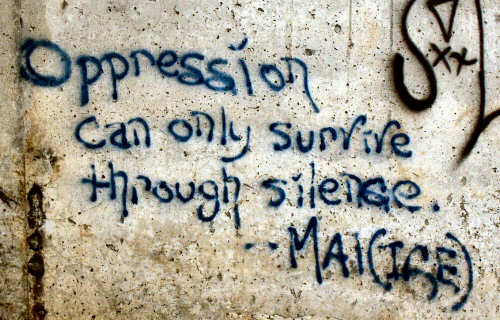
Oppression graffiti, January 15, 2013. (Students for Liberty via http://genderlitutopiadystopia.wikia.com).

Oppression graffiti, January 15, 2013. (Students for Liberty via http://genderlitutopiadystopia.wikia.com).

Did I play a good fife? Tamrin thought so. Compared to my Hebrew-Israelite comrades, I’m pretty sure I did. But like with so many things Hebrew-Israelite during those years, it was a bitter march to nowhere. The fife was part of a Hebrew-Israelite physical and spiritual gulag that put me into more chains, rather than freeing me to be me. Despite Tamrin’s intentions, the idea of molding me and others into men in conditions that would make most “men” contemplate homelessness or running away was a ridiculous pipe-dream.

That Tamrin was likely the only adult male in the Hebrew-Israelite camp who saw Maurice for the lying, abusive, womanizing asshole he was made me realize not everyone in this world was against me. But in a religion that when practiced helped oppress me and others more than the outside world, what was any Tamrin to do?

Afrocentrists, Evangelicals, Hebrew-Israelites and the False Revolution

28 Monday Mar 2016

Posted by decollins1969 in 1, Academia, Boy @ The Window, Carnegie Mellon University, Christianity, culture, Eclectic, Hebrew-Israelite, Mount Vernon New York, Patriotism, Pittsburgh, Politics, Pop Culture, race, Religion, University of Pittsburgh, Youth

≈ Leave a comment

Tags

Afrocentric, Afrocentricity, Authentic Blackness, Authority Figures, Black Action Society, Child Abuse, Covenant Church of Pittsburgh, Cross of Gold (1896), Dick Oestriecher, Domestic Violence, Estelle Abel, Evangelical Christianity, Frances Cress Welsing, Frederick K.C. Price, Gospel of Prosperity, Hoteps, Jack Van Impe, Judah ben Israel, Karl Marx, Kenneth Copeland, Kufi, Marxism, Maurice Eugene Washington, Molefi Asante, Neo-Marxists, Ostracism, Prosperity Gospel, Racism, Rapture, Religion, Wendy Goldman, William Jennings Bryan


Kenneth and Gloria Copeland, Believer's Voice of Victory television broadcast, November 23, 2011. (Carpetsmoker via Wikipedia). Released to public domain via CC-SA-3.0.

Kenneth and Gloria Copeland, Believer’s Voice of Victory television broadcast, November 23, 2011. (Carpetsmoker via Wikipedia). Released to public domain via CC-SA-3.0.

For nearly all of my life folks with even a kernel of authority have tried to convince me that there was one right way to live, one true path to liberation. Mostly religion has been the means through which others have attempted to box me in, although ideologues around Marxism, Afrocentricity, and Capitalism have all been in my figurative kitchen over the years. And like any well-meaning human being, at times I tried real hard to adapt myself to these right ways of thinking, of living out the one correct way to live. Only to fail, or rather, to recognize that none of these ways are the one right way, unless you are a closet right-winger, a conservative (non-ideological) wearing revolution-esque clothing.

My introduction to this madness began with my years as a Hebrew-Israelite, from April ’81 to April ’84 (although I wore my kufi until September ’84). That any parent could suddenly impose a new religion on their kids without explanation is abusive enough. When combined with vague notions about the Lost Tribes of ancient Israel and the wearing of clothes that set us apart culturally while in the middle of puberty, it was a forced societal ostracism. Even still, I tried to live by these strictures. “Remember the Sabbath day and keep it holy.” Eat kosher food, don’t use Ivory soap, shop only at Black or Hebrew-Israelite stores, avoid “unclean issues of blood.” But the physical abuse and poverty that came with being a Hebrew-Israelite in the Judah ben Israel madhouse of contradictions at 616 made me despise anything involving Hebrew-Israelite pretty much for all time.

Molefi Asante speech, Philadelphia, PA, September 13, 2014. (AP photo/file).

Molefi Asante speech, Philadelphia, PA, September 13, 2014. (AP photo/file).

Fast-forward a few years to the early 1990s, to the rise of Afrocentricity and the Afrocentric ethos. After three and a half years of being around Hebrew-Israelites, these kente-cloth wearing fools made me weary more times than not of their exclusionary our-way-or-no-way Blackness. Molefi Asante and the late Frances Cress Welsing were just the tip of a much larger iceberg in search of revolutionary “authentic” Blackness. From the Afrocentric undergrads who hijacked the Black Action Society leadership at the University of Pittsburgh in 1991 to folks who picked arguments with me for “sounding White” while I was in grad school, I saw them the same way I saw my now idiot ex-stepfather and the obnoxious Estelle Abel from my high school days. They were well-meaning but stupid. As far as I was concerned, they thought that their words alone would foster a revolution, that being Black meant turning one’s back on the world while also indirectly embracing an ethnocentric capitalism. Or at least, a Black American collective individualism, otherwise known as an “Afrocentric cool.”  I could not, I would not, exchange one form of oppressive uplift in Hebrew-Israelites for the shiny fool’s gold that mostly represented the Afrocentrists.

The neo-Marxists I met in Pittsburgh throughout the 1990s were no better. For all their revolutionary rhetoric, theirs was a world of theoretical activism, of scholarly examples of past oppression. Most of them didn’t know poverty and didn’t comprehend oppression beyond their own limited experience. Most of all, they couldn’t find a connection between American racism and class oppression if I gave them an industrial strength magnet. The fact that most of them hadn’t read Franz Fanon, W. E. B. Du Bois, Eric Williams, C. L. R. James, Anna Julia Cooper, Zora Neale Hurston, Derrick Bell, Angela Davis — but could quote Karl Marx the way Hebrew-Israelites could quote the Torah and Afrocentrists could quote Asante and Welsing — I found troubling. That’s putting it nicely. I found it contemptuous that folks who didn’t know my experience or who would all but refuse to read folks who written about experiences like mine would expect my allegiance to an ideology that was never meant for people who look like me.

The evangelical Christian part of my life was literally the last of the major dogmas to go. It was the hardest for me because I literally had given my life to Jesus in the midst of the whole Hebrew-Israelite crisis, Easter Sunday ’84. With my Mom coming down the same path by the late-1980s, it made it easier to not interrogate my Christianity as thoroughly as I would excoriate Afrocentrists and Marxists in graduate classes and in articles and papers a decade later. But even at nineteen, I realized that the Van Impe’s weekly predictions of the Apocalypse were as ridiculous as Welsing’s exulting of the magical properties of melanin. Or, for that matter, a fake Balkis Makeda cautioning against the use of Ivory Soap among her Hebrew-Israelite flock because of a dream she had.

Grant Hamilton cartoon for Judge Magazine on William Jennings Bryan's "Cross of Gold" speech, Democratic National Convention, Chicago, July 9, 1896. (Wikipedia). In public domain.

Grant Hamilton cartoon for Judge Magazine on William Jennings Bryan’s “Cross of Gold” speech, Democratic National Convention, Chicago, July 9, 1896. (Wikipedia). In public domain.

I went along to get along for years, until the hypocrisy of evangelical Christianity’s Gospel of Prosperity became too much. They took the metaphor of William Jennings Bryan’s cross of gold and actually went literal and nuclear with it. Somehow being Christian now meant blind patriotic allegiance to anything US and fully supporting capitalism, and yet an exclusionary separation between “true” evangelical Christians and the rest of the world. Especially on Rapture Day.

The last time I sat comfortably in a pew was in January ’97, although I’ve been to churches of various denominations dozens of times since. I still believe in Jesus, the life and the death and even the resurrection. But I don’t believe in most who claim to represent him, yet turn around and ignore the vulnerable standing right in front of them, making weak claims around individualism and poverty in the process.

In so many ways, evangelicals, Marxists, Afrocentrists, and Hebrew-Israelites are more alike than different. They all insist on a singular path, a quintessential truth. While some aspects of their thinking are appealing, I find accepting their bullshit in entirety poisonous to my spirit, mind, and gastrointestinal tract. There still may well be a revolution or even a rapture, but it won’t be because of any of these groups.

Holiday Traditions (really, not having any)

12 Saturday Dec 2015

Posted by decollins1969 in 1, Boy @ The Window, Christianity, culture, Hebrew-Israelite, Marriage, Mount Vernon New York, My Father, Pittsburgh, Pop Culture, race, Religion, Work, Youth

≈ Leave a comment

Tags

616, 616 East Lincoln Avenue, Abuse, Chanukah, Chiropractor, Christmas, Domestic Violence, Family, Giving, Haves and Have-Nots, Holiday Traditions, Maurice Eugene Washington, Mom, Mother-Son Relationship, Poverty, Receiving, Suicide, Womanizing


Christmas Holiday and Traditions Around The World ornament bulb, December 12, 2015. (http://johnseville.benchmark.us).

Christmas Holiday and Traditions Around The World ornament bulb, December 12, 2015. (http://johnseville.benchmark.us).

At my chiropractic appointment yesterday morning, my bone-cracking doctor of fourteen years and I got into a discussion of our holiday plans over the next couple of weeks. Her and her family will visit with extended kin in Virginia, while we’re heading to Pittsburgh to see my in-laws. During our conversation, my chiropractor brought up some of the family traditions she’s preserved with her handful of Christmases with her young daughter and two sons. Traditions like Danish pork roast for dinner, ornaments and other hand-me-downs from her grandparents and other ancestors as part of trimming the tree.

“I wouldn’t know anything about traditions. Matter of fact, there were eight years growing up where we didn’t even celebrate Christmas,” I said, with no forethought about what her reaction might be.

“Oh, I’m so sorry,” my chiropractor said in a quiet yet somewhat shocked tone, as if I’d ruined the Christmas spirit for her kids.

“That’s what happens when you go up in poverty,” I said apologetically, realizing that I might have cost my chiropractor some peace of mind this holiday season.

Even at nearly forty-six, I can still say things without thinking, causing others to have to think more than they normally would. Sometimes, it’s without intent or malice, sometimes it’s because I don’t give a crap what people may think. Regardless, it’s certainly not because I want people to feel sorry for me or to give me a hug.

The truth is, the only holiday traditions I have come either from my wife or her family or were born out of my circumstances. Like making super-sweet, two-packs of Fruit Punch Kool-Aid and mixing it with either ginger ale or Sierra Mist for either Thanksgiving or Christmas. Or getting our son’s Christmas presents ready for him without him knowing the night before. Or me making some holiday/birthday cake for me and us (since my birthday is two days after Christmas). And often going to a soup kitchen, homeless shelter or other venue to give away clothes, toys, money, my time in knowing that no matter how I might feel about my life, plenty others have it much worse.

The truth is also more complicated than simple poverty. Up until my eighth birthday in ’77, my Mom and me and Darren (with either my father or my idiot stepfather) celebrated Darren’s birthday, Christmas and my birthday as separate or nearly separate events. Some of my best times growing up were those days. Then, when the hyperinflation of the late-1970s kicked in — along with a second marriage and two more mouths to feed — Christmases ’78 and ’79 consisted of a fake two-foot table tree, a new shirt or sweater and a new pair of slacks. There were no birthday celebrations for me.

A contemporary Candelabrum in the style of a traditional Menorah. United Kingdom, Chanukah service, December 2014. (Gil Dekel; http://www.poeticmind.co.uk; via 39james via Wikipedia). Released to public domain via CC-SA-4.0.

A contemporary Candelabrum in the style of a traditional Menorah. United Kingdom, Chanukah service, December 2014. (Gil Dekel; http://www.poeticmind.co.uk; via 39james via Wikipedia). Released to public domain via CC-SA-4.0.

Between Christmas ’80 and Christmas ’88, we didn’t even have the fake dwarf tree. Of course, four of those years we were Hebrew-Israelites. But there is this holiday known as Chanukah that also occurs in December, in which Torah believers celebrate the Festival of Lights with eight days of gifts and giving. But these were also the worst of our poverty-stricken years, and we could barely afford one candle for the menorah, much less eight or nine. The best gift I got those years was my idiot stepfather being out the apartment at 616 and on the prowl for other victims for his fast-talking nonsense about making money and living a godly way-of-life. I also attempted suicide on my fourteen birthday, not exactly a tradition worth repeating.

Finally, in December ’89, we had our first Christmas at 616 with my Mom having divorced my now idiot ex-stepfather. She bought a fake full-sized tree. I bought my four younger siblings gifts big and small for the holiday. My mom even made me a Duncan Hines chocolate cake with vanilla icing for my twentieth birthday that year. We didn’t have much, but what we did that year meant so much as we moved into the 1990s.

In all of my adult Christmases, I’ve actually only done one in Pittsburgh prior to our trip coming up in eleven days. It was Christmas ’98. That week, perhaps the only important tradition I’ve ever been a part of began. I moved in with my then girlfriend Angelia, mostly as a cost-cutting measure, partly out of love and concern for our respective futures. We’ve been living together and celebrating the holidays ever since!

Aside

Leaving Mount Vernon

26 Wednesday Aug 2015

Posted by decollins1969 in 1, Boy @ The Window, Christianity, culture, Eclectic, eclectic music, High Rise Buildings, Jimme, Mount Vernon High School, Mount Vernon New York, music, My Father, New York City, Pittsburgh, Politics, Pop Culture, race, Religion, University of Pittsburgh, Work, Youth

≈ Leave a comment

Tags

"Emotion (Ain't Nobody)" Remix (2014), "Swimming Pools (Drank)" (2012), Child Abuse, College, Domestic Violence, Emotions, Family, Kendrick Lamar, Leaving, Loneliness, Maverick Sabre, Moving, Pitt, Politics of Respectability, Poverty, Respectability Politics, Self-Awareness, Self-Discovery


I left for Pittsburgh and for the University of Pittsburgh on this day/date twenty-eight years ago, my first trip on my own. It was my first trip out-of-state since my Mom took me and my brother Darren on a bus trip to Pennsylvania Amish country in June ’78, nine years earlier. At 5:51 am on the last Wednesday in August ’87, with my older brother Darren’s help — and with my Mom and three of four younger siblings watching us from the living room window — I packed my luggage, Army sack, and two boxes of bedding and materials into a Reliable Taxi. We headed for East 241st to meet up with my dad. From there, we took the 2 Subway all the way to Penn Station, with enough time to board and get all of my stuff on the 7:50 am Pennsylvanian train to the ‘Burgh. For the second time in a row, my dad was sober, and gave me a glassy-eyed hug and shoulder squeeze. Darren was both sad and happy to see me go.

Amtrak's Pennsylvanian train pulling out of Altoona, PA station, heading east for Philly, NYC, uploaded February 2013. (Dustin F.; http://www.northeastrailfans.com/).

Amtrak’s Pennsylvanian train pulling out of Altoona, PA station, heading east for Philly, NYC, uploaded February 2013. (Dustin F.; http://www.northeastrailfans.com/).

I’ve gone over the trip to Pittsburgh and my transformation from a seventeen-year-old with the pent-up emotions of someone who hadn’t left May 31, 1982 behind throughout my eight years of blogging and through my memoir. I’ve written about moving on to Pittsburgh before. What I haven’t really written about fully is how I thought and felt in leaving Mount Vernon, New York behind. The short answer is, I was somewhere between terrified, joyous, embittered, and sad to go, and all at once.

I was terrified. It was my first trip on my own, to a city I’d never been to before, to a university I never visited prior to saying yes. I could meet people who might catch on that I was someone who had spent the previous six years with few acquaintances, much less friends. I was hopeful, but had zero idea what to expect.

But I really was happy to leave. Between my decade living at 616, the abuse, the poverty, the Hebrew-Israelite years, the constant ridicule, the years in Humanities, the constant work of watching after Mom, my dad, my siblings, I was through. Throw in a summer of obsession with and emasculation by Phyllis, and five years of realizing that I needed to get out, and going to Pittsburgh was a no-brainer. Heck, if I’d been a bit smarter about my application process, I could’ve just as easily applied to the University of Washington, Stanford, Northwestern, Georgetown, Michigan, University of Toronto and UPenn and almost certainly gotten in. It didn’t matter where I was going, really. I just needed to go and find my myself, and my education with that.

That last year or so in Mount Vernon had let me know that even with an academic scholarship (after a private investigation) from Columbia, staying would’ve been a huge mistake. Between the silent disdain and snickering of Black teachers at Mount Vernon High School around my sullen presence and the whole Estelle Abel episode at the end of four years of torment. Add to that the years of Black middle class folk talking at me about how my life was so much better because they marched or protested somewhere before I was conceived, or because they prayed for me. Add to that this insistence that I “give back to the community.” As if Black Mount Vernon had given me anything but a hard way to go since I was knee-high to a boil weevil.

Viewing and wake service for Heavy D, Grace Baptist Church, Mount Vernon, NY, November 17, 2011. (Mike Coppola/Getty Images; https://cbsnewyork.files.wordpress.com/).

Viewing and wake service for Heavy D, Grace Baptist Church, Mount Vernon, NY, November 17, 2011. (Mike Coppola/Getty Images; https://cbsnewyork.files.wordpress.com/).

As I saw it, the only difference between the vapid, seething facade of White liberalism among paternalistic White Mount Vernonites and the false smiles and frequent excoriations of Mount Vernon’s Black middle class was skin color. They drank deep from swimming pools full of what we now call respectability politics, born out of a need to be good examples to the world, like Kendrick Lamar described in “Swimming Pools” (2012). (Pour up [drank], head shot [drank]…faded [drank]). This isn’t the same as doing the right thing at the right time or speaking truth to power. You make money, wear nice clothes, drive a nice car, stand up straight, look a White man in the eye while firmly grasping his hand. And apologize for not being as assimilable as you pretend. It was 100%, USDA-approved bullshit, and it smelled like it a lot of days, too.

I was sad to leave, too. There was a part of me that still wanted to fit in, out of loneliness, if nothing else. I still liked Clover Donuts and some of the breakfast places on the South Side. I longed for some sort of acceptance, an acknowledgment that I was a real person, even though that would’ve required being around real people at 616, and in Humanities, and in the rest of Mount Vernon. I knew that I’d miss the close proximity to The City. I’d put my hopes and dreams in a place in which I knew I couldn’t afford to stay, literally and figuratively. That longing would come to haunt me in the coming year, but I’d eventually learn, I could always visit New York.

On Kicking My Damsel-in-Distress Syndrome

07 Saturday Mar 2015

Posted by decollins1969 in 1, Boy @ The Window, Christianity, culture, Eclectic, Hebrew-Israelite, Jimme, Marriage, Mount Vernon New York, My Father, Pittsburgh, Politics, Pop Culture, Religion, Youth

≈ Leave a comment

Tags

"Ballerina Wendy", Atlas, Burdens, Child Abuse, Chivalry, Crush #1, Damsel-in-Distress, Damsel-in-Distress Syndrome, Domestic Violence, Father-Son Relationship, Feminism, Love, Misogyny, Misty Copeland, Mother-Son Relationship, Pitt, Resentment, Sexism, Wendy, Womanism


Chivalry with a suit blazer,   March 7, 2015. (http://genius.com)/

Chivalry with a suit blazer, March 7, 2015. (http://genius.com)/

This week marked thirty-three years since the fight that led to a crush that led to me falling in love for the first time, via a ballerina in training. The three-month period between March and June ’82 shaped how I dealt with teenage girls and women between the time I turned twelve and my mid-thirties. The crush on “Ballerina Wendy” and its mutation because of my stepfather’s knocking out of my Mom in front of me helped shaped my feminism, my womanism and my sexist damsel-in-distress syndrome.

Wonder Woman, October 30, 2012. (http://tvequals.com).

Wonder Woman, October 30, 2012. (http://tvequals.com).

It was the beginning of my damsel-in-distress syndrome. Though it was triggered by the Memorial Day incident, my damsel-in-distress syndrome had been latent for years. I was in fact a mama’s boy, tempered by living at 616 and in Mount Vernon. I’d always been enamored by strong, athletic women (or at least, actresses with that role), going back to Lynda Carter as Wonder Woman. Yet I’d also been surrounded by sexism and misogyny, from my father calling my Mom a “Black bit'” since I was four to my stepfather’s constant quoting of the Torah to justify his laying of violent hands and feet on my Mom.

What I did in response was to help my Mom in every way I could, and in ways I never should’ve. Calling up Con Ed and Ma Bell to pay the electric and telephone bills. Listening to years of conversations about her failed marriages, about my father’s alcoholic failings, about her bills, about the burdens we as her children had put on her. Washing clothes for the house every weekend from October ’82 through August ’87 and anytime I was home for the summer and for the holidays once I went off to college. Going to the store as many as five times in a single afternoon and evening because my Mom forgot that she needed diapers or cigarettes. Hunting my father down for money even on weekends I didn’t want to be bothered because we were out of food for my younger siblings. Taking a fist-filled beating here or there from my stepfather to take the pressure off of my Mom. Promising my Mom that after I finished my degree, I’d come back to New York to work and help her out financially.

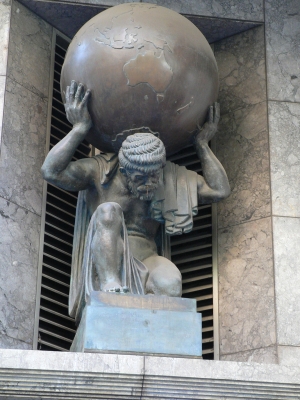
Atlas supports the terrestrial globe on a building in Collins Street, Melbourne, Australia, October 9, 2006. (Biatch via Wikipedia). Released to the public domain.

Atlas supports the terrestrial globe on a building in Collins Street, Melbourne, Australia, October 9, 2006. (Biatch via Wikipedia). Released to the public domain.

On that last promise especially, I reneged. I changed my major from computer science to history, and decided to stay at Pitt, to go to graduate school, to earn a PhD, to start writing, both in the academic world and a bit as a freelancer, to teach for a living. It was the basis, I think, for her falling out with me in ’97, and why our relationship remains limited.

My Mom was hardly the only woman in my life in which I wanted to assist. Some of my Pitt friends can certainly attest to this fact, that sometimes I was there to help too often. To the point where once I realized I was overburdened or when that other person had become too reliant on me, it pretty much killed that friendship. Either way, I was angry, and sometimes felt used, while some of my Pitt friends were either confused or angry themselves.

I’ve had to learn over the years to say no, even to my wife, when I realized that one too many logs on the fire will actually put that fire out. It started with everything high-tech. Every computer glitch, every printer error, every Internet issue, and I was there like Clark Kent, ready to help. But by the time I hit thirty-five, I was just too tired and felt too burdened to be that on all the time. I finally stopped helping my wife with her tech issues. I stopped offering to help, and have only interjected when the issue actually affects all of our equipment.

The irony is, my wife is a stronger person than my Mom, stronger in many ways than how I perceived Wendy as a person so many years ago. It’s not as if my wife doesn’t need or appreciate the help. But, as I’ve learned over the years, too, sometimes, help is just emotional support, a hug or a joke. Or, when I’m ready to, simply listening without feeling the need to use a quadratic equation to solve the problem.

American Ballet Theater soloist Misty Copeland in a promotional photo via her Under Armour ad deal, January 30, 2014. (Under Arnour via Huffington Post).

American Ballet Theater soloist Misty Copeland in a promotional photo (cropped) via her Under Armour ad deal, January 30, 2014. (Under Arnour via Huffington Post).

Damsel-in-distress syndrome, as chivalrous as it is, can also be extremely sexist, for both women and men and girls and boys. It means constantly attempting to help people who may or may not want your help, especially in cases where it is clear that they may need help. It means taking on emotional and psychological burdens that otherwise should only belong to the person you’re trying to support. It means, sadly, providing advice and knowing answers and solutions that may not be answers or solutions at all.

The Memorial Day ’82 incident with my mother changed what was an otherwise innocent crush and love into something contradictory even as it became more meaningful. It made me appreciate women who could and can kick some ass, whose strength would be obvious to all. And it made me think women who weren’t like that — women like my Mom — needed constant help from people like me. Wendy defended herself thirty-three years ago. My Mom tried and couldn’t. Life and strength for us, male and female and transgender, though, has never been that simple. And though I have saved quite a few damsels in distress over the years, it isn’t my eternal burden to carry.

The Comedy of a Tragic Upbringing

10 Saturday Jan 2015

Posted by decollins1969 in 1, Academia, Boy @ The Window, Christianity, culture, Eclectic, Hebrew-Israelite, Jimme, Mount Vernon High School, Mount Vernon New York, Movies, My Father, New York City, Politics, Pop Culture, race, Religion, Youth

≈ Leave a comment

Tags

616, 616 East Lincoln Avenue, Alchemy, Alcoholism, Autobiography, Child Abuse, Comedy, D.L. Hughley, Dave Chappelle, Domestic Violence, Eddie Murphy, Evangelical Christianity, Father-Son Relationships, Fatism, Ghetto Klown (2014), John Leguizamo, Lewis Black, Mother-Son Relationship, Neglect, Physical Violence, Playwright, Poverty, Psychological Abuse, Respectability Politics, Richard Pryor, Rodney Dangerfield, Routines, Stand-Up Comedy, Tragedy, Transmutation


John Leguizamo playing 'Abuelo' in Tales from a Ghetto Klown, PBS Arts Festival, July 2012. (http://www.pbs.org).

John Leguizamo playing ‘Abuelo’ in Tales from a Ghetto Klown, PBS Arts Festival, July 2012. (http://www.pbs.org).

Over New Year’s weekend, I watched John Leguizamo’s HBO comedy special Ghetto Klown (2014), based on one of his one-man autobiographical Broadway shows. I don’t think of Leguizamo as funny in the same way I think of Lewis Black or Dave Chappelle or Eddie Murphy. The sweet spot for me in terms of what is funny or not funny is a routine that makes me think for a second or two, not just laugh out of sheer expectations for a funny delivery or line. Otherwise, I’d think of D.L. Hughley as a great comedian, instead of as a vile one with equally vile opinions on race and culture.

Leguizamo’s hardly the funniest comedian. But then again, he’s always been more than one thing. He’s essentially a playwright, an actor, and comedian, which means Leguizamo’s a very elaborate storyteller. In most of his work, a nonfiction storyteller. I’ve seen some of his other one-man work before. With Ghetto Klown, though, I saw and felt the sense of tragedy and regret that I hadn’t seen in his other plays and specials. Especially when it came to his family — specifically his father — and his closest friends.

When Leguizamo went through his routine about how his mother and father were upset with him about he had portrayed them in his plays as somewhat selfish and oftentimes neglectful and abusive, I understood. I’ve only written one book about my life, and my Mom and dad have both been offended by the idea that I could write about them without their permission or blessings. Leguizamo used them as bits for his comedy and Broadway stage routines for years. That’s a lot of courage, and it’s a lot of tragedy to expose, too.

Transmutation of lead bars into gold, March 2013. (http://quazoo.com).

Transmutation of lead bars into gold, March 2013. (http://quazoo.com).

I’ve thought about it a few times over the past fifteen years. What if I decided to do a stand-up routine that included elements of my upbringing? How would I do that? How would I make domestic violence and child abuse and poverty funny?

I’d start with my father, who I’d call Jimme and my father interchangeably, since that’s been the nature of our relationship for forty-five years. I’ve been able to imitate his language, his drunken stupor, his evil meanness and off-kilter mannerisms since I was fifteen. It would be easy enough to do all of his “po’ ass muddafucka…” insults in bar scenes, all while getting robbed and beaten up by other alcoholics.

I could also do my now deceased ex-stepfather Maurice, especially his constant threats to put me in the hospital or kill me. “Watch dat base in yo’ voice, boy, ‘fore I cave yo’ chest in!,” he started saying to me once my voice changed with puberty. I could imitate Maurice when he weighed over 400 pounds and wore size-54 Fruit-of-the-Loom briefs around 616, with enough fat and dinginess to make me wanna puke.

I could even imitate my Mom, at least on the threatening front. If I argued with her too long about something important that she didn’t want to talk about (like paying bills, for instance), she’d tell me, “Shut up o’ I’ma gonna cut the piss out of you.” Or I could run around a stage singing at the top of my lungs to evangelical Christian music while also acting like my younger brothers, who’d get into knockdown fights in the living room while my Mom was in her spiritual zone.

The fact is, some of the best comedy grows out of tragedy. It may not be funny to the respectable middle class types or the respectability politics types. They both would prefer people “forget about” their pasts and “just move on,” as if these issues are taboo. But you can’t be a very good comedian or writer without confronting your upbringing in some way.

Richard Pryor doing stand up, posted August 11, 2014. (http://deadline.com).

Richard Pryor doing stand up, posted August 11, 2014. (http://deadline.com).

I attempted at times in Boy @ The Window to inject some sarcasm or comedy in many of the tragic scenes in the book. Because they reflecting my thinking in the moments in which they occurred, whether in ’82 or ’88. The few people who commented on this aspect of the memoir didn’t like the comedy or the language. It was because they couldn’t reconcile the mild-mannered version of myself that I presented to the world in high school or in academia with the way in which I grew up.

Watching Leguizamo in Ghetto Klown reminded me of what I learned in watching Rodney Dangerfield (who himself was sexually abused and neglected by his parents growing up) and Richard Pryor (the son of an active and neglectful prostitute) over the years. We all have baggage and demons to deal with every day of our lives. We ignore that past and those evils at risk to ourselves and every person we’ve ever loved. We must turn the tragedy of our upbringing into something that isn’t just a cancer of pain. Be it through storytelling, autobiography, even the kind of comedy that those whose lives were much more stable growing up can appreciate but can never fully understand.

← Older posts
Newer posts →

Boy @ The Window: A Memoir

Boy @ The Window: A Memoir

Places to Buy/Download Boy @ The Window

There's a few ways in which you can read excerpts of, borrow and/or purchase and download Boy @ The Window. There's the trade paperback edition of Boy @ The Window, available for purchase via Amazon.com at http://www.amazon.com/Boy-Window-Donald-Earl-Collins/dp/0989256138/

There's also a Kindle edition on Amazon.com. The enhanced edition can be read only with Kindle Fire, an iPad or a full-color tablet. The links to the enhanced edition through Apple's iBookstore and the Barnes & Noble NOOK edition are below. The link to the Amazon Kindle version is also immediately below:

scr2555-proj697-a-kindle-logo-rgb-lg

Boy @ The Window on Amazon.com: http://www.amazon.com/Boy-The-Window-Memoir-ebook/dp/B00CD95FBU/

iBookstore-logo-300x100

Boy @ The Window on Apple's iBookstore: https://itunes.apple.com/us/book/boy-the-window/id643768275?ls=1

Barnes & Noble (bn.com) logo, June 26, 2013. (http://www.logotypes101.com).

Boy @ The Window on Barnes & Noble: http://www.barnesandnoble.com/w/boy-the-window-donald-earl-collins/1115182183?ean=2940016741567

You can also add, read and review Boy @ The Window on Goodreads.com. Just click on the button below:

Boy @ The Window

Twitter Updates

Tweets by decollins1969
  • RSS - Posts
  • RSS - Comments

Archives

  • June 2025
  • April 2023
  • September 2022
  • August 2022
  • July 2022
  • June 2022
  • May 2022
  • April 2022
  • March 2022
  • January 2022
  • December 2021
  • November 2021
  • October 2021
  • September 2021
  • August 2021
  • July 2021
  • June 2021
  • April 2021
  • March 2021
  • February 2021
  • January 2021
  • December 2020
  • November 2020
  • October 2020
  • September 2020
  • August 2020
  • July 2020
  • May 2020
  • April 2020
  • March 2020
  • January 2020
  • December 2019
  • November 2019
  • August 2019
  • July 2019
  • June 2019
  • May 2019
  • April 2019
  • March 2019
  • February 2019
  • January 2019
  • December 2018
  • November 2018
  • October 2018
  • September 2018
  • August 2018
  • July 2018
  • June 2018
  • May 2018
  • March 2018
  • February 2018
  • January 2018
  • December 2017
  • November 2017
  • October 2017
  • September 2017
  • August 2017
  • July 2017
  • June 2017
  • May 2017
  • April 2017
  • March 2017
  • February 2017
  • January 2017
  • December 2016
  • November 2016
  • October 2016
  • September 2016
  • August 2016
  • July 2016
  • June 2016
  • May 2016
  • April 2016
  • March 2016
  • February 2016
  • January 2016
  • December 2015
  • November 2015
  • October 2015
  • September 2015
  • August 2015
  • July 2015
  • June 2015
  • May 2015
  • April 2015
  • March 2015
  • February 2015
  • January 2015
  • December 2014
  • November 2014
  • October 2014
  • September 2014
  • August 2014
  • July 2014
  • June 2014
  • May 2014
  • April 2014
  • March 2014
  • February 2014
  • January 2014
  • December 2013
  • November 2013
  • October 2013
  • September 2013
  • August 2013
  • July 2013
  • June 2013
  • May 2013
  • April 2013
  • March 2013
  • February 2013
  • January 2013
  • December 2012
  • November 2012
  • October 2012
  • September 2012
  • August 2012
  • July 2012
  • June 2012
  • May 2012
  • April 2012
  • March 2012
  • February 2012
  • January 2012
  • December 2011
  • November 2011
  • October 2011
  • September 2011
  • August 2011
  • July 2011
  • June 2011
  • May 2011
  • April 2011
  • March 2011
  • February 2011
  • January 2011
  • December 2010
  • November 2010
  • October 2010
  • September 2010
  • August 2010
  • July 2010
  • June 2010
  • May 2010
  • April 2010
  • March 2010
  • February 2010
  • January 2010
  • December 2009
  • November 2009
  • October 2009
  • September 2009
  • August 2009
  • July 2009
  • June 2009
  • May 2009
  • April 2009
  • March 2009
  • February 2009
  • January 2009
  • December 2008
  • November 2008
  • October 2008
  • September 2008
  • August 2008
  • July 2008
  • June 2008
  • May 2008
  • April 2008
  • March 2008
  • February 2008
  • January 2008
  • December 2007
  • November 2007
  • October 2007
  • September 2007
  • August 2007
  • July 2007
  • June 2007

Recent Comments

decollins1969's avatardecollins1969 on No Good Teaching Deed Goes…
Mary Rose O’Connell's avatarMary Rose O’Connell on No Good Teaching Deed Goes…
Lyndah McCaskill's avatarLyndah McCaskill on The Raunchiest of Them Al…

NetworkedBlogs on Facebook

NetworkedBlogs
Blog:
Notes From a Boy @ The Window
Topics:
My Life, Culture & Education, Politics & Goofyness
 
Follow my blog

616 616 East Lincoln Avenue A.B. Davis Middle School Abuse Academia Academy for Educational Development AED Afrocentricity American Narcissism Authenticity Bigotry Blackness Boy @ The Window Carnegie Mellon University Child Abuse Class of 1987 CMU Coping Strategies Crush #1 Crush #2 Death Disillusionment Diversity Domestic Violence Economic Inequality Education Family Friendship Friendships Graduate School Hebrew-Israelites High-Stakes Testing Higher Education History Homelessness Humanities Humanities Program Hypocrisy Internalized Racism Jealousy Joe Trotter Joe William Trotter Jr. K-12 Education Love Manhood Maurice Eugene Washington Maurice Washington Misogyny Mother-Son Relationship Mount Vernon High School Mount Vernon New York Mount Vernon public schools Multiculturalism MVHS Narcissism NFL Pitt Pittsburgh Politics of Education Poverty President Barack Obama Race Racial Stereotypes Racism Relationships Self-Awareness Self-Discovery Self-Reflection Sexism Social Justice Teaching and Learning University of Pittsburgh Violence Whiteness Writing

Top Rated

Blog at WordPress.com.

  • Subscribe Subscribed
    • Notes from a Boy @ The Window
    • Join 103 other subscribers
    • Already have a WordPress.com account? Log in now.
    • Notes from a Boy @ The Window
    • Subscribe Subscribed
    • Sign up
    • Log in
    • Report this content
    • View site in Reader
    • Manage subscriptions
    • Collapse this bar
 

Loading Comments...