• About Me
  • Other Writings
  • Interview Clips
  • All About Me: American Racism, American Narcissism, and the Conversation America Can’t Have
  • Video Clips
  • Boy @ The Window Pictures
  • Boy @ The Window Theme Music

Notes from a Boy @ The Window

~

Notes from a Boy @ The Window

Category Archives: Politics

Thanks, Away From Home

27 Tuesday Nov 2018

Posted by decollins1969 in 1, Academia, Boy @ The Window, Christianity, culture, Eclectic, Mount Vernon New York, Movies, Pittsburgh, Politics, Pop Culture, Religion, University of Pittsburgh, Youth

≈ Leave a comment

Tags

American University, Away From Home, Beverly, Depression, Family, Financial Woes, Food, Friends, Grinding Poverty, hunger, Kindness of Strangers, Loneliness, Malnourishment, Melissa, Pitt, Ron Slater, Thanksgiving


Thank You — paying it forward, March 3, 2017. (Catlane/iStock; http://digital.vpr.net/)

Yet another Thanksgiving has come and gone. The holiday is problematic for so many reasons, between the erasure, cultural exploitation, and dehumanizing mythology of indigenous Americans and the climate-change-defying national pig-out that begins every late-November Thursday, and continues for weeks afterward, year after year. But the fact that the days off around Thanksgiving gives us worker bees time to spend with family, friends, and those we seriously like and love can’t be ignored.

Sure. At least for those of us who have such people in our lives with whom to share our time off from work, school, and life’s constant treadmill. My American University students reminded me of the allegedly normal ritual of returning home to eat and spend time with family, et al., this past week. Half of them contacted me to let me know they weren’t going to attend the two classes immediately before Thanksgiving, even after learning I wasn’t granting them an excused absence for the holiday week. All so that they could have a few extra days away from the stresses of higher education and the classroom. I envied them, just an iota, if only because they presumably had good reason to spend time with their families and loved ones. I also figured that not everyone in my class was going home to a welcoming environment, or really, going home at all.
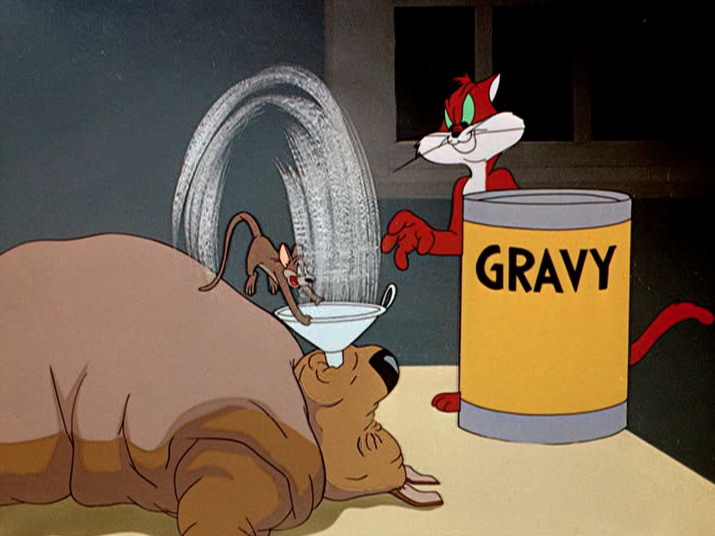
“And this time, we didn’t forget the gravy” Looney Tunes “Chow Hound” episode of bullying, greed, and gluttony, originally aired June 16, 1951. (WB; http://tralfaz.blogspot.com/).

That last one was certainly the case for me during my student days. Growing up the way we grew up, in Mount Vernon, at 616, a good Thanksgiving was one where we had a regular meal to eat. Even before the Hebrew-Israelite years of 1981-84, our Thanksgivings weren’t seven-course eat-a-thons. We were lucky if my Uncle Sam came over to eat with us (which after 1978, was pretty rare), and we didn’t spend time around my Mom’s friends once we dived into being Black Jews and fell into grinding welfare poverty.

After I went off to the University of Pittsburgh in August 1987, I only came home to Mount Vernon and 616 one time for Thanksgiving, three months later. My Mom made the biggest Thanksgiving meal I’d seen her make since 1975. I remember mostly the mashed potatoes and gravy. But it wasn’t a family affair, not really. I was home mostly because I had grown used to the well-worn grooves of poverty, abuse, and adult-level responsibilities that had been my life since the fall of 1982. The food, while the first home-cooked meal I’d eaten in three months, was an escape from my normal attempts at escape.

Twelve months later, after six weeks of depression, getting over my Phyllis obsession, a semester of graduate school-like concentration, a summer of unemployment, a week of homelessness, and three months of financial woes and malnourishment, Thanksgiving 1988 had arrived. Between Ron Slater, Beverly, and finally having enough money to not worry about eating or bills for the first time in almost a year, it felt weird, only having gratitude as my companion for a few years.

But life got even weirder for me, as my friend Melissa had invited me to her father’s house for Thanksgiving. This was not a date of any kind, certainly not from my perspective. I think that Melissa sensed how rough my year had been, knew that I wasn’t going home to New York to see family, and did the Christian thing of looking after one’s neighbors. This even though things weren’t exactly great for her and her father at the time. Melissa’s father was an ailing contractor in his early sixties. I really don’t remember much about that Thanksgiving in terms of the food. I think there may have been dinner rolls or candied yams. What I do remember is the two-and-a-half hours I talked with Melissa and her father, about politics, the “Stillers,” Christianity, and Pitt. It was the most thankful holiday I’d ever experienced, and my first Thanksgiving seeing what Thanksgiving was like for family members who enjoyed each other’s company.

It was the first of seven straight Thanksgivings either spent with friends like Melissa, Howard, Kenny, the Gants and their families, or by myself. The “by myself” Thanksgiving was in 1990. It was a cold and rainy day, where I did nothing but watch football, made myself two double cheeseburgers, and found a nearly usable director’s chair outside a vintage furniture gallery in East Liberty. Even then, folks looked out for me. The next day, two of my older Swahili classmates swung by my apartment to bring me Thanksgiving leftovers. They brought me cornbread, dinner rolls, ham, turkey, mashed potatoes, dressing and stuffing, greens, and candied yams with marshmallows. I had tried to say no, but neither of the women would let me. It was really hard for me not to cry while being thankful for such generosity.

It seems like it’s been a lifetime since those naive and cynical days, where I didn’t trust anyone in my life. The bout with homelessness and the financial straits that followed changed my life in ways that I notice even today. Even with the years of working long hours and fighting for my career as a writer and an educator, I realize that I wouldn’t be here doing any of what I’m able to do today without the kindness of strangers and friends, the ability to weigh, sift, and analyze myself and my past or the sense that God had a purpose for me, a reason for living and being. Even after 30 years, I have this and so much else to be thankful for.

Black Women, Feminism, and Writing on My Mind

25 Saturday Aug 2018

Posted by decollins1969 in 1, Academia, Boy @ The Window, Christianity, culture, Eclectic, Politics, Pop Culture, race, Religion, Youth

≈ Leave a comment

Tags

Black Feminism, Brittney Cooper, Chimamanda Ngozi Adichie, Colson Whitehead, Derrick A. Bell, Erica Armstrong Dunbar, Ijeoma Oluo, Interrogation, Intersectionality, Kiese Laymon, Misogynoir, Misogyny, Mona Eltahawy, Morgan Jerkins, Ona Judge, Patricia J. Williams, Roxane Gay, Self-Reflection, Social Justice, Tressie McMillan Cottom, Women of Color, Writing


“This is what a Black Feminist looks like” t-shirt, August 24, 2018. (http://youtube.com).

It’s been a different last year and a half for me as a reader. With the exception of Colson Whitehead’s Underground Railroad, a woman of color has been the author of every book I’ve read since January 2017. Keep in mind, Cora is the main character in Whitehead’s latest masterpiece, so it’s been since Walter Mosley’s last Leonid McGill mystery that I’ve read a book with a Black man as a protagonist.

This wasn’t a deliberate decision, at least at first. It started with me catching up on law professor Patricia J. Williams‘ critical race theory works from the 1990s, especially The Alchemy of Race and Rights (1992). I fell in love with the book, and found it in so many ways better than anything I’ve ever read from Derrick Bell. Williams is simply a better writer and storyteller, even as Bell hit all the right notes in his incredible allegories. Both have informed my Al Jazeera and Washington Post articles over the past year.

Then I started reading Roxane Gay at the end of last summer. I was going to do both Bad Feminist and Hunger, but after reading through the first chapters of Hunger, my wife ended up reading it and telling me about it in detail. I did the same for her with Bad Feminist. There was quite a bit of overlap on the personal side of things from both books. But boy can Gay write, and edit, and edit, and edit some more! Every word she must’ve put through an acid test, quenched in cold water like a samurai sword, then reheated, cooled, and polished for months on end. In recent years, only Whitehead and Kiese Laymon have polished sentences the way Gay does in her books. I felt her hurt, disappointment, anger, laughter, and intellect throughout. After reading it, even in places where I disagreed, I felt like Gay left me with so much to chew on as a sexist feminist heterosexual Black man.

I picked up Brittney Cooper’s Eloquent Rage in May. It was after reading Tressie McMillan Cottom’s Lower Ed and Chimamanda Ngozi Adichie’s Americanah in early 2018. Cottom’s book is so important, especially in understanding that higher education is far from some idealistic and lofty intellectual enterprise. It is lightly regulated capitalism, plain and simple, and not just among the for-profits, either (more on this at some future date). Cottom makes a generous use of rational-choice theory in her assessment of the limited range of decisions poor Black men and especially African American women living with poverty have in choosing for-profits for certificates and degrees, and for borrowing tens of thousands of dollars.

The book shines when Cottom touches on the journeys of the students she interviewed as part of her research. But like most scholars, Cottom’s writing didn’t bridge the divide between important work and compelling writing. I’m sure that this is an unfair assessment. But given the importance of Cottom’s sociology of education work and the stories involved in it, I wanted more direct interrogation of the systemic sexism and misogyny (even misogynoir) embedded in the enrollment practices of for-profit colleges and universities. I wanted more of Cottom’s personal journey (and not just her professional one). I’m sure, though, that Cottom gave her best, and it was more than what I could typically get out of text genuinely attempting to move beyond the academic’s gaze.

Adichie’s work was disappointing. Not because Americanah isn’t reasonably well written. It’s just too long, too centered on Ifemelu (about ninety percent of the book is from her perspective, when the blurbs make it seem a bit more even between Ifemelu and Obinze), and too self-centered, smug, and elitist. I felt all of the meanings of outsider embedded in Americanah to be sure. As a American Black man, I’ve been an outsider even among other heterosexual Black males most of my life. Adichie doesn’t allow for her main character to interrogate her outsider status, though. As a result, Ifemelu related to her American boyfriends in the most superficial of ways, as if they were perfect robotic representations of neurotic Americans. She related to the world as if she was somehow above it all, both in the US and Nigerian contexts. I guess heterosexism was as acceptable in Ifemelu’s world as it has been in Adichie’s comments in the past couple of years. I must admit, though. Adichie can write sex scenes and scenes of trauma in emotionally demanding and touching ways. But not with the precision of Whitehead and Gay, and not with the intellectual awareness of Cottom.

So when I picked up Cooper’s Eloquent Rage, I was expecting to be fighting with myself over boredom and a glut of words. I was so happy to be so wrong! Right from the first paragraph, Cooper was throwing fastball’s like Nolan Ryan and Vida Blue, or rather, hitting first-serve aces like Serena and Venus Williams. Cooper had me at “[t]his is a book by a grown-ass woman written for other grown-ass women. This is a book for women who expect to be taken seriously and for men who take grown women seriously. This is a book for women who know shit is fucked up.” She welcomed me in and said, “hit this 130 mph serve, brotha!” I couldn’t stop reading until I finished the book. I understood so much the struggles she described and the choices she and others made as Black women. I felt her pain, her joy, her anger, and yes, her rage throughout. I regularly interrogate my -isms as is. But Cooper helped me reach another level in Eloquent Rage (all premature hints at Beyoncé’s superhero feminism aside).

After Cooper, I made the deliberate decision to read more feminists of color this summer. I read Morgan Jerkins‘ This Will Be My Undoing and found her a wonderful writer on her coming of age with her own Black feminism, if a bit too young (I am middle-aged, after all). I finally read Mona Eltahawy’s Headscarves and Hymens and wanted to beat up every man she and the women she interviewed encountered over the years. It was compelling (if at times uneven) reading, and it left everything in question regarding the West, Islam, the Arab world and misogyny. There were no sacred cows with Eltahawy. She even addressed her relative privilege in addressing the latticework of gender, LGBT, and sexual oppression in Egypt, Saudi Arabia, the UK, the US, and elsewhere in the world. I wish I had gotten to her book three years ago, when it first came out.

I snuck in Erica Armstrong Dunbar’s book on Ona Judge, Never Caught. I’d been wanting to read it since I heard Dunbar talk about it on WAMU’s The Kojo Nmandi Show Valentine’s Day 2017. Plus, I decided to assign it for my upcoming African American History to 1877 this semester at American University. Dunbar puts the use of narrative nonfiction writing to the test in Never Caught. I can only imagine what my academic historian colleagues would think, as most of their writing is the equivalent of a pressed protein bar made of unflavored soy powder and coated with ground mealworms. Although Dunbar provides many more questions than answers around the inner thoughts and everyday actions of George and Martha Washington eventual escaped slave, I did sense that Dunbar was converting research into a form of textual humanity. So much so that when the moment for Judge to escape came, I said, “Yes! Yes! Yes!” Dunbar compelled me not to be too excited, though. For “Judge knew that…She would transform from a trusted house slave for the most powerful American family to a criminal, guilty of stealing her own body away from her owners.” (p. 112).

Embedded in Dunbar’s narration are the issues I’d been reading about for the past year. Misogyny, misogynoir, enslavement, rights to one’s own body, intersectionality, American history and its mythologies, and the long legacy of American racism, still very much alive in 2018, as it was in 1789 and 1796. To be sure, Dunbar lacks Gay’s precision, and the passion found everywhere with Cooper and Eltahawy is more subdued in Dunbar’s work. But the latter is only true if readers choose to ignore the smoldering billows throughout.

I finished up this month with Ijeoma Oluo’s So you want to talk about race, a primer on basic do’s, don’ts, and don’t-give-ups, regarding starting and sustaining conversations on race and racism in an American context. After the previous reads, I hoped for more, but there wasn’t any more for me to mine as a reader. There were several points, though, where a more careful edit would have made this a clearer read. As a blogger for the past eleven years, I have no room to talk regarding editing. Then again, I presently do not have an agent or editors looking over my work, either.

My biggest criticism (which actually isn’t a criticism) is that the book is geared toward the White man or White woman who believes themselves to be a liberal, colorblind non-racist. Because this is Oluo’s stated intent, her book reads as if I’m an outsider to my own topic. The compelling personal issues with which Oluo contends around race and intersectionality (specifically, Black feminism and relative privilege) aren’t well treated until the last quarter of the book. As someone who once help manage a national social justice fellowship program, I wasn’t expecting to learn anything particularly new about starting and sustaining conversations on race and racism. I hoped, though, to learn more about Oluo, to find her writing more impassioned, to see her use real punch in bringing to bear the reasons that race conversations quickly devolve into White accusations of “reverse racism.” The elements are there, but weren’t mined in sufficient quantities to make this book more than a “Race/Racism Conversations for Dummies,” I’m afraid, for me.

That’s not to say that nothing resonated at all. Oluo early on hits at a theme common to everyone I’ve read over the past eighteen months. That need to find one’s true, authentic voice. Those moments when the people you know now find your writer’s voice too loud, too demanding, and too impractical.

I also started writing. I…started saying all the things that everybody around me had always said were ‘too negative,’ ‘too abrasive,’ and ‘too confrontational.’ It did not go over well. My white friends…some of whom I’d known since high school, were not happy with the real me. This was not the deal they had struck. Yes, they would rage over global warming and yell about Republican shenanigans, but they would not say a word about the racial oppression and brutality facing people of color in this country.

I’ve found this and so much more to be true in my own writing journey. Thanks to all of you who’ve helped make me feel younger, my feminism fresher, and confirmed so much I’ve found wrong (and right) with myself and the world.

Charlatans United

20 Monday Aug 2018

Posted by decollins1969 in 1, Boy @ The Window, culture, Eclectic, Mount Vernon New York, New York City, Pittsburgh, Politics, Pop Culture, race, Religion, University of Pittsburgh, Work, Youth

≈ Leave a comment

Tags

American Racism, Black Women, Charlatans, False Accusations, Law Enforcement, Long-Term Unemployment, Maurice Eugene Washington, Misogynoir, Pitt, Rape, Respectability Politics, Rev. Al Sharpton, Stepfather, Summer of 1988, Tawana Brawley, Trust, unemployment


The Rev. Al Sharpton, et al., at a press conference providing an update regarding the Tawana Brawley rape case, Queens, NY, 1988. (http://www.wbur.org/; AP)

If I have to pick a point in my life where I began to realize how hypocritical humans could be, my second summer after high school would be such a time. The long, hot summer of ’88, of nearly 50 consecutive days of highs in the Triple-H (hot, hazy, and humid) 90s in New York and its immediate suburbs. It was my first summer after starting college at the University of Pittsburgh, and if it weren’t for sheer determination, it would have been my only year at Pitt.

News wise, there were two local events that dominated my summer of unemployment in Mount Vernon and The City. One was the Tawana Brawley story. Between the end of November of the previous year and the end of June, the Rev. Al Sharpton and his entourage used the bully pulpit of the fourth estate to generate outrage and consternation regarding the alleged rape of one Tawana Brawley. A month or so before her sixteenth birthday, good samaritans found Brawley outside an apartment building in which her family had once lived, lying in a garbage bag, covered in dog feces and with racial slurs written on her body. Brawley had been missing for four days.

There wasn’t much agreement on anything else beyond these facts. Brawley claimed that three White men had repeatedly raped and sexually assaulted her, including a local police officer, then later denied being raped, but remained adamant about other forms of sexual assault. At one point, a cop who had recently killed himself was a suspect in the alleged Brawley rape. At another point, Sharpton and company accused the Dutchess County Assistant DA Steven Pagones of being one of Brawley’s three rapist (he later sued Brawley and Sharpton for defamation). Sharpton claimed throughout to believe Brawley, but others in his group later disclosed that the blowhard had his own doubts about Brawley’s story a few weeks after agreeing to represent her in the public eye.

Wappingers Falls is in Dutchess County, just two counties north of Westchester County and Mount Vernon, a hour-and-thirty-minute drive from Manhattan (give or take). After Eleanor Bumpurs and Michael Stewart, I rarely believed authority figures regarding their crime reportage. But by June, I also realized that not everything is a conspiracy, and that even racists can occasionally be on the right side of the law. I learned, above all else, that Sharpton was a charlatan. He used Brawley’s true life story of familial abuse and misogynoir and fear of more abuse to raise his profile on the New York and national stage. Especially in this case, as Brawley’s mother and stepfather took a dim view on Brawley’s time out with boys, a view shared by Whites all too willing to see Black girls and women as over-sexualized playthings.

If Brawley wasn’t raped or sexual assaulted, she was certainly abused physically and psychologically. It was bad enough that her name was out there and known (a violation of her rights as a potential rape survivor), especially since Brawley was still a minor. It was bad enough that there was a significant racial gap, where six out of every seven Whites polled believed she was lying (versus only half of African Americans polled). That Sharpton put Brawley’s name in the public arena for months with additional and unsubstantiated accusations? He took advantage of her for months, adding another layer of abuse to this teenager’s life. It’s practically unforgivable. And no, Sharpton’s work to get Trayvon Martin’s murder in 2012 the attention it and he deserved and his self-serving eulogy at Michael Brown’s funeral in 2014 do not make up for his original media sins.

The other charlatan I had to deal with that summer was my idiot stepfather and another one of his get-rich-quick schemes. He had spent nearly all of 1988 unemployed and lying around at 616, between losing his car salesman job and burning out the engine of his green 1976 Cadillac Coupe de Ville. It made my summer at 616 almost unbearable. I hadn’t spent this much time around the asshole since my summer of abuse.

In July and August, Maurice had the wonderful idea of starting his own limo service. One of our neighbors on the second floor had moved from driving a limo to starting his own service over the previous eight years. Maurice wanted in.

As I wrote in Boy @ The Window:

Afterward, Maurice went to his once well-off friend, who had survived a three-year period of very local and very public court battles and prison time over alleged incidents of child abuse and molestation at her daycare in Mount Vernon. The woman and her husband were financially ruined in the process, even though neither of them were directly involved in the incidents that occurred at the daycare. Somehow Maurice managed to get $1,000 out of his friend for his limo idea, likely some of the last money she lent anyone before her death in 1989. It’s more likely that “Hebrew-Israelite” Maurice bought lobster tails and moo shu pork at a Chinese restaurant with the money than attempted in any way to use it as collateral to get the downstairs neighbor to give him a shot at driving a limo.

By this time 30 years ago, I had already had my fill of hucksters between Sharpton and Maurice. Their misogyny, their need to use others, their harebrained ideas for fortune and fame. Maybe that’s why I never bought my stepfather’s act when he was dating my mom as a seven-year-old. Maybe that’s why I never, ever, found 45 appealing from the first time I read about him in the New York Daily News in 1984.

Coming From Where I’m From

30 Monday Jul 2018

Posted by decollins1969 in 1, Boy @ The Window, culture, Eclectic, eclectic music, Jimme, Mount Vernon New York, music, My Father, New York City, Politics, Pop Culture, race, Youth

≈ Leave a comment

Tags

"Comin' From Where I'm From", "Money Earnin' Mount Vernon, "Why I Don't Understand the Black Affluent Class", Al B. Sure, Al Jazeera, Anthony Hamilton, Audre Lorde, Civility, Denzel Washington, Elitism, Histrionics, Inferiority Complex, Narcissism, Respectability Politics


A week and a half ago, I received an email from a reader in response to my latest Al Jazeera piece, “Why I Don’t Understand the Black Affluent Class.” She congratulated me on the article, and agreed with most of my sentiments in the piece. She also revealed that she had spent a decade living in Mount Vernon, NY.

It turned out that this reader lived five blocks from me during my Boy @ The Window years, right off East Lincoln Avenue! Part of my follow-up included, “[m]aybe our paths crossed, maybe they didn’t. But I’m sure my growing up years helped shape some of what went into my Al Jazeera piece from last week.”

I was mildly excited that someone from Mount Vernon had read one of my mainstream articles, and not just the blog. But, even with some shared ideas and a common point of reference, the reader’s response actually reflected some of what I critiqued in the article. She agreed that “Money Earnin’ Mount Vernon” had helped shape my views around the buying in of a relatively materially privileged class into White patriarchial and supremacist ideas like civility and respectability politics. Then she immediately veered toward identifying the great Mount Vernonites — “Denzel Washington, Al B Sure, Heavy D, Sidney Poitier, etc.”

What is it about smaller cities not blessed with the narcissistic largesse of a New York, L.A., or DC that causes people to fall back on the “but we have successful people from here, too” trope? Not only is this not necessary. It points to a sense of competing for attention and importance in a way that can be a bit unseemly, a way of countering a negative narrative from a crowd of self-centered media elites with one that’s just as narcissistic and needy.

The fact is, pick a spot on a map where at least 1,000 people live, and guess what? Someone rich and/or famous either grew up there or lived there for a time. Even if those individuals aren’t nationally known, one can guess that they’re known in that region or state. Dean Martin’s from Steubenville, Ohio. The opera singer Leontyne Price is originally from Laurel, Mississippi. Mr. “The Price Is Right” Bob Barker is from Darrington, Washington. Stand-up comedian Lewis Black’s from Silver Spring (where I’ve lived for nearly 20 years now). I bumped into former NFL player and sports broadcaster Ahmad Rashad at my local pizza shop in 1989. Heck, the Black feminist lesbian poet Audre Lorde worked for years at Mount Vernon Public Library. None of this could possibly change how I saw my original home base, not in 1976, not in 1987, and certainly not in 2018.

It’s not that I didn’t know the Delaney sisters lived off South Columbus Avenue, or that Stephanie Mills had a house somewhere between Mount Vernon High School and the Mount Vernon-Bronxville border. But what did that really mean to my day-to-day when I was going from one end of Mount Vernon to the other for groceries, for piece of mind, and sometimes, to avoid more physical and emotional abuse at home? How did knowing that a classmate was in a scene on the soap opera General Hospital change the fact that I still needed to hunt down my alcoholic father on Friday for enough money to cover the cost of my AP English exam? What did Al B. Sure or Heavy D’s success in the 1980s have to do with my striving for a college education, or my five days of homelessness in 1988? Nothing, of course, absolutely nothing.

It’s good to know that there are notable people, Black, Afro-Caribbean, African, Latino, Nuyorican, Italian, male, female, transgender, gay, lesbian, bisexual, dead, old, young, and alive, from Mount Vernon. But a community doesn’t hang its hat on notable people or the rich and successful. Its lifeblood is the ordinary, of activists, artists, and educators, students and librarians and postal workers, the grandparent here, the friend of the family there, who takes a real interest in your development and success. For that reason, Denzel doesn’t really matter to me. I can’t tell you how I feel about Albert Brown night and day, because I’ve hardly given his music a thought since Quincy Jones’ 1989 album Back on the Block (the song “The Secret Garden” makes me gag). Sidney Poitier living in Mount Vernon for a time? And?

For me, for better and for worse, it was the crossing guard at the corner of Esplanade and East Lincoln when was at William H. Holmes. Or, it was my mom and dad’s friends (drinking buddies, really), Ms. Pomalee, Ida, Callie Mae, Lo, and Arthur. Or, it was my mom’s Mount Vernon Hospital friends, especially Billie. It was my Uncle Sam. It was Ms. Griffin, Mrs. Shannon, Mrs. O’Daniel, Mrs. Bryant, my school teachers before Humanities and Meltzer. Whatever lessons I learned about aspirations, civility, and respectability politics, and the idea that these ideas aren’t all good or set in stone, they helped me in that process. These were the people who mattered to me outside of 616 and off the street of Mount Vernon.

On Wet Rags and Crocodile Tears

30 Saturday Jun 2018

Posted by decollins1969 in 1, Boy @ The Window, culture, Eclectic, Mount Vernon High School, Mount Vernon New York, Pittsburgh, Politics, Pop Culture, race, University of Pittsburgh, Youth

≈ Leave a comment

Tags

Academia, Allison Ettel, Black Feminism, Brittney Cooper, Caitriona Balfe, Claire, Crocodile Tears, Femininity, Feminism, Hypermasculinity, Kyle Stephens, Legitimate Tears, Lifetime, Misogyny, Outlander, Pitt, Racism, Ruby Hamad, Sexism, Shay Stewart Bouley, Wet Rags, White Women's Tears, White-Girl Tears, Workplace Issues


The tears of Allison Ettel, a.k.a., #PermitPatty, NBC’s The Today Show (cropped), June 26, 2018. (http://bet.com).

I’ve been thinking about this post for a while, probably for at least two years. But it does help when others closer to the subject write about it as well. Between @ProfessorCrunk Brittney Cooper’s chapter “White-Girl Tears” in her hard-hitting Black feminist primer Eloquent Rage (2018), @blackgirlinmain Shay Stewart Bouley’s recent blog post “Weapon of lass destruction: The tears of a white woman,” and Ruby Hamad’s piece in The Guardian, “How white women use strategic tears to silence women of colour,” what can I really add? (Everyone who believes in feminism and wants to support women of color writers ought to read these essays, by the way). Oh, just the idea that men of color deal with White women’s/girl’s tears as well. And that some of us have been just anti-sexist enough to recognize how our Whiteness and patriarchal-dominated society privileges and legitimizes such tears, often to our detriment.

Over the years, I’ve taken to calling those who cry over the least amount of adversity and stress wet rags, and those instances in which sobbing becomes a central theme “wet-rag episodes.” This started for me in the late-1990s, when my then girlfriend (now wife of eighteen years) would spent upwards of 12 hours of her Saturdays watching Lifetime movies (some of which were originally NBC, ABC, or CBS specials, before the dominant return of reality TV in the double aughts). At first, I did a play on Lifetime‘s slogan back then, “Lifetime: Television for Women,” adding, “not for men” whenever the tag line appeared during commercials.

But Lifetime is an addiction, if you sit there long enough watching the ups and downs of romances, the constant threat of stalkers, date rape, teenage pregnancy, and drugs, and the upbeat endings and vindication at the end of every two-hour movie. What I noticed most of all, though, were the waterworks. Everyone from Lynda Carter to Lindsay Wagner, from Elizabeth Montgomery to Jaclyn Smith could cry at the sound of a book drop!

Cartoon character from Fairly Odd Parents crying an ocean of tears (cropped), June 30, 2018. (http://fairlyoddfanon.wikia.com).

Admittedly, I cry very easily while watching emotional and gut-wrenching scenes. I cried when I saw Viola Davis take on Denzel Washington’s character in Fences (2016) over his years of cheating and his secret family. Especially when Davis blew a snot bubble in the middle of the scene. I was through for the next three minutes!

With Lifetime movies, though, I stopped crying for these White women over the twists and turns in their lives. I watched one scene in one movie where the main character broke out and cried at her dining room table in her laid-out, five-bedroom home when she realized she only had $10,000 left in her bank account. I didn’t just laugh. I howled. As someone for whom poverty and financial struggles have been a constant companion, having that much money in any account at any time has always been a time of celebration. “You shouldn’t laugh. Poverty is relative,” Angelia said while also laughing. “No, it isn’t. She’s a wet rag!” I responded. I’ve spent a good portion of my career proving this point, too.

That scene took me back to so many wet-rag episodes in my life. Like when my high school valedictorian classmate cried angry tears over a 67 on an English essay exam our junior year, losing 25 points because she didn’t underline James Baldwin’s book title Notes from a Native Son in her essay. I didn’t feel sorry for her, Ms. 5.45 GPA, not one bit (it’s all in Boy @ The Window).

Or, during my second year in grad school at Pitt, when a student in one of my US History to 1877 sections tried to proposition me to raise her C- average. When that didn’t work, a fountain of tears poured out. I handed her a tissue, but said, “Your tears in no way are a substitute for studying and working harder in this class.” She didn’t exactly give me 5’s on her evaluations of me in the course at the end of that semester.

Ten years later, I had White women as co-workers and students who could cry about almost anything. My one-time boss Ken blamed me for making a former co-worker cry because I refused to take her “I hope you had a wonderful vacation!” the week after 9/11 in stride. Yeah, sure. It was a week in which I was stuck in Atlanta for four days after a one-day work trip and had to take Greyhound for 15 hours back to DC, not knowing if my older brother was dead or alive. I said as much to my co-worker, and she ran away from me crying.

A student in my History of American Education Reform graduate course cried when I refused to change her grade from an A- to an A. I was in the middle of explaining how she could revise her research paper and still end up with an A. It was just before Thanksgiving, and until that moment, I had thought that this was one of the best courses I’d ever taught, with one of the best group of students I had had in one of my courses. Her sudden sobbing actually pissed me off. I tried not to show it. But I did say, “What are you crying about? There’s nothing about your standing in this course for you to be crying about.” I said it in a tone that I’d only find again once my son became a preteen.

Caitriona Balfe as Claire wailing over the loss of Jamie and the Battle of Culloden, July 9, 2016. (http://www.bookbub.com).

It’s to the point now that I don’t even watch wet-rag shows anymore, at least once the character becomes one. For example, I watched the split first season of Starz’s Outlander with Caitriona Balfe as Claire, and found it mostly enjoyable. Until she began turning on the waterworks in practically every episode. My wife continues to watch, but laughs every time I ask, “What happened on Wet Rag this week?”

I know that White women and White girls, like all human beings, have plenty good reason to cry. Every time I saw video of Kyle Stephens‘ sentencing-phase testimony about what convicted rapist and felon Larry Nassar starting doing to her when she was five years old, I cried for her and with her. Trauma and tragedy are good reasons to cry, wail, sob, and weep. But, so many wet-rag tears are drop-of-the-hat, crocodile tears. About getting caught in lies, about making racist and anti-poverty and anti-women-of-color statements that don’t go over well, about anything that would otherwise paint them as narcissistic and not-so-smart brats.

While I know I don’t have as difficult a row to hoe as so many women of color in the public sphere, one thing I know I’m not allowed to do in a hyper-masculine world of Whiteness and patriarchy is cry. I got hit with the f-bomb so many times growing up, from Black boys, Black men, and Black women, and faced threats of violence as a result. I would’ve been recommended for psychotherapy if I had ever cried over an A-, and been laughed at for complaining about my workplace conditions. Women of color can lose careers over their tears. Black boys and men have lost their freedom and lives over them. One isn’t less damaged over the delegitimization of our tears, but the damage can be differential, depending on gender, class, sexual orientation, and the level of toxic hyper-masculinity surrounding you.

That is why I can’t stand wet rags. Their tears fill the world with concern and fear, and marginalize and dehumanize the rest of us. I have no sympathy for crocodile tears. I don’t know if I’ve ever had sympathy for them.

ICE is America’s Gestapo, the White House the Waffen SS

18 Monday Jun 2018

Posted by decollins1969 in 1, Boy @ The Window, Christianity, culture, Eclectic, Mount Vernon High School, Movies, Patriotism, Politics, Pop Culture, race, Religion, Youth

≈ 2 Comments

Tags

45, Abetting, American Indian Boarding Schools, Asylum, Children in Detention, Fascism, Fugitive Slave Act, Gestapo, ICE, Immigration, Jane Crow, Kidnapping, Kizzy, Leslie Uggams, Migration, Poverty, Roots, Secret Police, Separating Families, SS, State Violence, Systemic Racism, Trump, US Immigration and Customs Enforcement, Waffen SS, Welfare, Xenophobia


Two pictures: ICE raid to arrest foreign nationals. February 6, 2017, (Charles Reed/ICE; http://amsterdamnews.com); Gestapo in midst of a raid, circa 1939-40. (http://www.encyclopediaofukraine.com). Both in public domain.

I may have developed my sense of thinking on the issue of inclusion and migration from the ostracism I experienced via the cool class of Black classmates from Mount Vernon High School. Maybe. Maybe not. But, it was on this date 31 years ago that the Class of 1987 graduated. And, within minutes of us tossing our mortar-board caps in the air, people who were the “cool ones” in the graduating class began ignoring my greetings and staring through me like I was invisible whenever and wherever I saw them. A silent treatment that I went through for two summers with this group.

This is not unlike the way the media and this 45 presidency deals with most marginalized Americans and the daily indignities and atrocities from which they suffer. Especially those who migrate without papers and those would-be-migrants and asylum-seekers. The amping up of a policy that separates parents from children at the US-Mexico border is nothing short of kidnapping and taking hostages. However, the policy isn’t entirely new, and the media coverage of it until a week and a half ago was scant. President 45 and his minions had truly believed that they could keep something like this under wraps, because undocumented migrants and asylum-seekers have no representatives, no voice, and no support among many Americans.

The cries of outrage across this country have proven them partly wrong. Still, the “cooler” — really, crueler — class of Americans, White, White privilege, White patriarchy, Whiteness-is-always-right-thinking Americans (which unfortunately also includes Americans of color) remain all for body snatching. They have either been silent or have made some lame-ass excuses for fuckery worthy only of superficially-cool high school graduates.

I’m reminded of the first time I saw America’s cruelty in kidnapping kids and tearing apart families. For me, it started with Roots in 1977. I watched through Kunta Kinte’s  capture and Middle Passage across the Atlantic, his arrival in colonial Virginia, and later, the selling off of his daughter Kizzy to a slave owner who raped and impregnated her with Chicken George. Kizzy (played by Leslie Uggams) never saw her father alive again (she’s somehow able to visit her father’s grave, though), and her mother Bell is sold off to some Deep South plantation.

Leslie Uggams as Kizzy Kente in Roots (screen shot), 1977. (http://roots.wikia.com).

At seven, I cried at least three times watching this. At ten, when I saw all of this a second time, I cried and got angry. Especially at Sandy Duncan’s character, Missy Anne. Because Kizzy had the audacity to have a boyfriend and attempted to help him escape, Missy Anne shunned Kizzy and put up no protest as her father sold off her childhood playmate. And I learned that this is how nice people do people like me, especially the times when we need their help the most.

Later, I learned about the Fugitive Slave Laws. I learned how Congress, starting in 1793, passed a series of laws making it possible for every White American to act as a secret police. Whites were on the lookout for runaway African slaves in places as far-flung as Charleston, South Carolina, Bangor, Maine, Buffalo, New York, and, by the 1850s, Arizona Territory and California. The assumption of African enslavement was so pervasive that thousands of free and freed Blacks could end up being sold and re-sold into slavery, merely because some random White person wanted to make an extra $10 in the 1830s (12 Years a Slave comes to mind here).

Later, I’d learn about the Trail of Tears, Indian Removal, and the long, bitter march of indigenous peoples onto reservations between the late-1820s and 1890. A population of perhaps three million Native Americans reduced to 250,000 by the time of the 1900 Census. All federal policies as the US Army executed them. All so that mining interests could get to gold and coal, all so that railroads could be built. In the process of assimilating “the savages,” the federal government also snatched thousands of Native American children from their tribes and families and put them in boarding schools. With White families all too willing to teach them to forget about their long and proud histories, languages, and peoples.

But before learning all this, I also learned through my mom’s years on welfare just how easy it could be for a government and willing neighbors to have children and parents separated. More than once, a social worker swung by in the years between 1983 and 1990 to inspect my younger siblings, to make sure there wasn’t a man in the house, to ensure that my family’s deep poverty was real. More than once, a neighbor would threaten to call Social Services on my mom (and at least once, on me when I was a teenager) because my four younger sibling kept up too much noise. The policies that now comprise what some experts call “Jane Crow,” of separating allegedly neglectful and abusing parents (mostly Black women) in the name of protecting children, were very much alive and well during my teenage and early adulthood years. Because of course, poverty in America to the point of needing a few dollars and some Food Stamps is illegal.

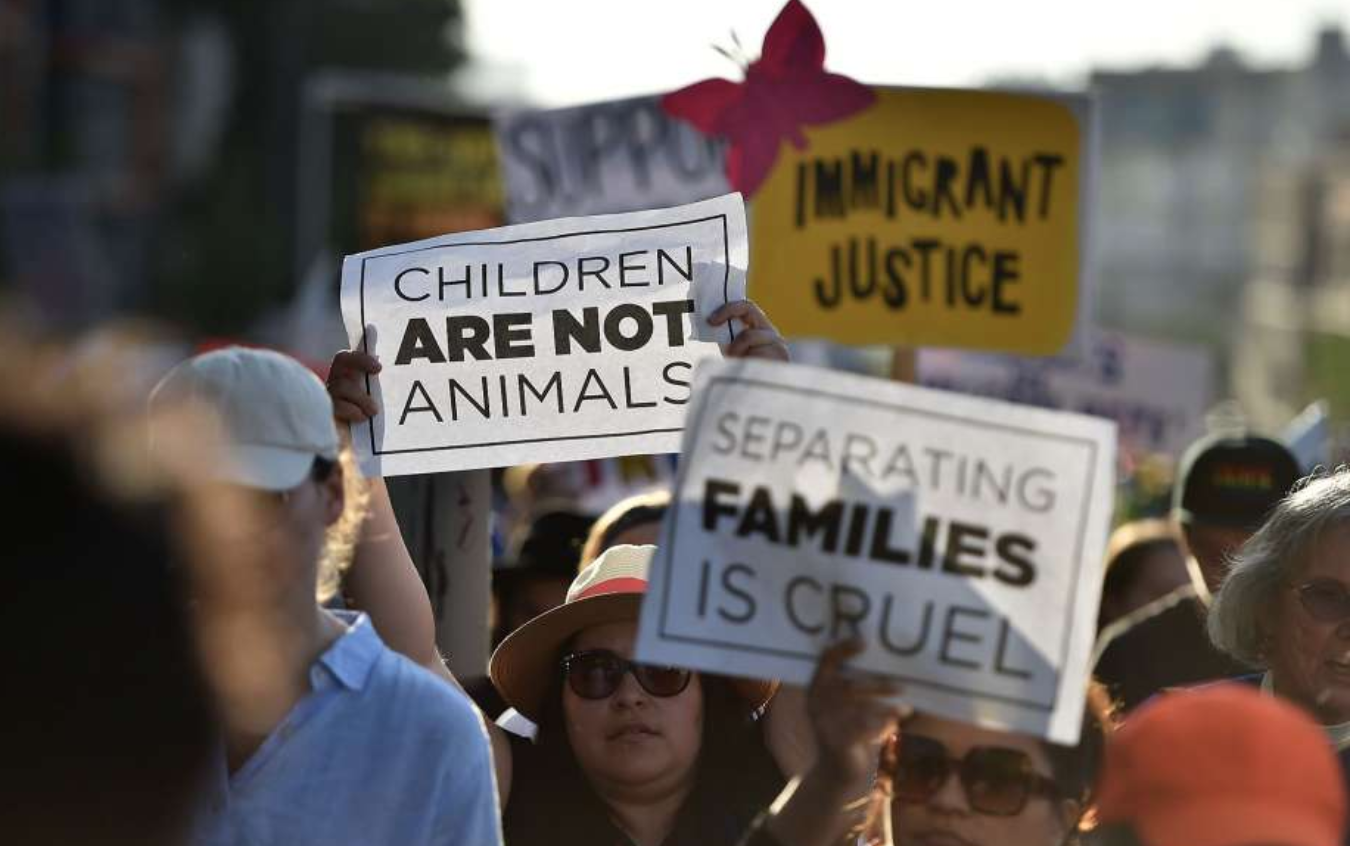
Signs and protesters at “Families Belong Together March,” Los Angeles, June 14, 2018. (Robyn Beck/AFP/Getty Images).

With all this history of breaking up families to control African slaves, free Blacks, Native Americans, and poor people, why would the sudden ramping up of separating children from their parents at the US-Mexico border surprise anyone? It doesn’t surprise me. ICE has been brazen in their modern-day execution of its Fugitive-Slave-Act-esque charge to “round up all the illegals.” The White House has 45 and an army of minions who spend every waking moment of every day figuring out ways to quash dissent and foment support for policies that would make the US a Whites-only country.

But for all this to work, there have to be millions of Americans willing to help them. And there are. Some out of pure ignorance, some out of willful ignorance and denial, and some because they are racist sociopaths. All, though, are fully steeped in the idea that America would be better off if Whites remain the majority, if White men and White women sire most of America’s kids, and if all the Black and Brown people submit to their rule and oppression with bright smiles.

People, America isn’t becoming a fascist state. For so many of us, America has always hung in the balance between freedom and fascism. Fascism for Americans of color, and freedom for good, Christian-as-racism White folks. This. Is. America.

Mrs. Bryant and the Beginning of Donald 1.5

03 Sunday Jun 2018

Posted by decollins1969 in 1, Boy @ The Window, Christianity, culture, Eclectic, Hebrew-Israelite, Mount Vernon New York, Politics, Pop Culture, race, Religion, Youth

≈ Leave a comment

Tags

Diversity, Education, K-12 Education, Lessons, Mrs. Bryant, Mrs. Della Bryant, Public Speaking, Self-Determination, Self-Doubt, Sixth Grade, Teaching and Learning, William H. Holmes Elementary, Writing


A bright blue sky, just before the long storm, February 19, 2011. (http://www.photos-public-domain.com). In public domain.

We’ve reached the end of yet another school year, number 32 for me overall, between my twenty-two years between kindergarten and doctorate and my son’s ten years of K-9 (this doesn’t included the 13 years of overlap, in which my primary job has been as an instructor, or my wife’s two years of grad school). The end of sixth grade was not particularly violent. But it was a rough transition to nearly eight years of bumps, bruises, grinding poverty and psychological torture, and a constant struggle for my true self.

The one strong and calming influence in the midst of this gathering storm system was my sixth grade teacher at William H. Holmes ES, Mrs. Della Bryant. She was the fourth of my four Black teachers between first grade and middle school. Mrs. Bryant was as important to me on the cusp of becoming a teenager as Ms. Griffin was to my grounding as a student in first grade, and the crush I had on Mrs. Shannon in third. Because Mrs. Bryant didn’t just aspire for us to do well and get A’s. She wanted us to think big picture, and not just about high school or college. Mrs. Bryant encouraged us to think in larger, worldly terms, to take politics and religion and literature and the stuff of intellectuals seriously.

She indulged us, especially me and my then best friend Starling. So many times that year, Mrs. Bryant allowed us to debate current event topics in class, whether we had sufficient facts or not. The Iran hostage crisis, the 1980 election cycle and why Ronald Reagan would be worse than President Jimmy Carter (no one in our class played devil’s advocate), the legality of Israel unilaterally bombing an Iraqi nuclear weapons centrifuge site.

Those were among the moments I lived for in Mrs. Bryant’s class that school year. I lived for them not just because I liked showing off my knowledge. I already knew I was smart. I spent the following year saying “I am the smartest kid in the whole world!” to myself, and occasionally, to Humanities classmates who made me feel inferior.

No, those debates weren’t about my raw analytic power and great ability to remember. They were about discovering what I thought I knew about a topic, understanding what I didn’t know, and being able to articulate it all without losing my thoughts in the ether. And in all that, I discovered parts of myself. My forthrightness. My New York-style sarcasm. My sense of righteous anger. My ability to summarize a situation in order to derive or intuit possible responses, even solutions.

That was what Mrs. Bryant with her light but steady touch helped me get to in sixth grade. A sense of enlightenment that could survive the false gods of Hebrew-Israelite-ism, the false father of my then idiot stepfather “Judah ben Israel” née Maurice Washington, and the fallacy that I had any control over my world.

But that wasn’t all Mrs. Bryant helped me do that year. She encouraged me to take on other projects, especially contests. Like posters for Dental Health Month, or participating in Election 1980 activities, and journaling and writing down my thoughts about virtually everything. Mrs. Bryant did me the honor of having me introduce our graduation speaker at the end of sixth grade, nearly 37 years ago. It was a two-minute speech, but it was also in front of a couple hundred people. I don’t think I’ve even been as nervous being on radio or television. Most of that stuck with me for years, somehow surviving through years of crumpled neglect.

Mrs. Bryant was the one who shepherded me into the Humanities Program, something that I’d only heard about once before, inadvertently through Brandie Weston (who was a student at Pennington-Grimes) the year before. With my grades and test scores, I probably could’ve made into the Grimes Center a year or two earlier. That is, if my teachers Ms. Pierce and Mrs. O’Daniel had thought of me that way. But in the big scheme, it wasn’t that important. Mrs. Bryant did think of me that way, and went out of her way to say as much. “Mrs. Bryant’s encouragement, her insistence that I was ‘one of the best students’ she ‘ever had,’ made sixth grade a joyful time,” I wrote in my memoir.

Now, despite Mrs. Bryant, I wasn’t prepared for going to school every day with 150 other know-it-all’s, many of whom would never have to worry about Con Edison bills being overdue or having no food to eat for three or four days at time. Or, the constant threat of domestic violence and abuse at home. Heck, between Humanities’ decided demographic affluence and ideological Whiteness, I doubt that most of my eventual classmates worried about anything other than getting A’s until puberty took full hold.

As I wrote in Boy @ The Window, “Mrs. Bryant never warned me that Humanities would be overwhelming because my social skills outside of Holmes were as well developed as a spoiled seven-year old’s.” I simply didn’t handle the transition from a 98-percent-Black elementary school to the mostly White Humanities program very well. Then again, with so much going wrong at home, I didn’t handle much of anything well in the 16 months after sixth grade.

But one thing I carried from my year with Mrs. Bryant was that I could survive and succeed despite it all. To observe and listen, and not just speak off the cuff. To be patient, and keep working. Frankly, it was likely because of teachers like Mrs. Bryant that I discovered my first superpower, my ability to think, remember, and write. And in that discovery, bury the pains of earlier abuses that would’ve surely killed me (or at least, led to a successful suicide) by the time I turned fourteen. Mrs. Bryant, wherever you are, and whatever you’re up to, I say, with love, many, many thanks!

← Older posts
Newer posts →

Boy @ The Window: A Memoir

Boy @ The Window: A Memoir

Places to Buy/Download Boy @ The Window

There's a few ways in which you can read excerpts of, borrow and/or purchase and download Boy @ The Window. There's the trade paperback edition of Boy @ The Window, available for purchase via Amazon.com at http://www.amazon.com/Boy-Window-Donald-Earl-Collins/dp/0989256138/

There's also a Kindle edition on Amazon.com. The enhanced edition can be read only with Kindle Fire, an iPad or a full-color tablet. The links to the enhanced edition through Apple's iBookstore and the Barnes & Noble NOOK edition are below. The link to the Amazon Kindle version is also immediately below:

scr2555-proj697-a-kindle-logo-rgb-lg

Boy @ The Window on Amazon.com: http://www.amazon.com/Boy-The-Window-Memoir-ebook/dp/B00CD95FBU/

iBookstore-logo-300x100

Boy @ The Window on Apple's iBookstore: https://itunes.apple.com/us/book/boy-the-window/id643768275?ls=1

Barnes & Noble (bn.com) logo, June 26, 2013. (http://www.logotypes101.com).

Boy @ The Window on Barnes & Noble: http://www.barnesandnoble.com/w/boy-the-window-donald-earl-collins/1115182183?ean=2940016741567

You can also add, read and review Boy @ The Window on Goodreads.com. Just click on the button below:

Boy @ The Window

Twitter Updates

Tweets by decollins1969
  • RSS - Posts
  • RSS - Comments

Archives

  • June 2025
  • April 2023
  • September 2022
  • August 2022
  • July 2022
  • June 2022
  • May 2022
  • April 2022
  • March 2022
  • January 2022
  • December 2021
  • November 2021
  • October 2021
  • September 2021
  • August 2021
  • July 2021
  • June 2021
  • April 2021
  • March 2021
  • February 2021
  • January 2021
  • December 2020
  • November 2020
  • October 2020
  • September 2020
  • August 2020
  • July 2020
  • May 2020
  • April 2020
  • March 2020
  • January 2020
  • December 2019
  • November 2019
  • August 2019
  • July 2019
  • June 2019
  • May 2019
  • April 2019
  • March 2019
  • February 2019
  • January 2019
  • December 2018
  • November 2018
  • October 2018
  • September 2018
  • August 2018
  • July 2018
  • June 2018
  • May 2018
  • March 2018
  • February 2018
  • January 2018
  • December 2017
  • November 2017
  • October 2017
  • September 2017
  • August 2017
  • July 2017
  • June 2017
  • May 2017
  • April 2017
  • March 2017
  • February 2017
  • January 2017
  • December 2016
  • November 2016
  • October 2016
  • September 2016
  • August 2016
  • July 2016
  • June 2016
  • May 2016
  • April 2016
  • March 2016
  • February 2016
  • January 2016
  • December 2015
  • November 2015
  • October 2015
  • September 2015
  • August 2015
  • July 2015
  • June 2015
  • May 2015
  • April 2015
  • March 2015
  • February 2015
  • January 2015
  • December 2014
  • November 2014
  • October 2014
  • September 2014
  • August 2014
  • July 2014
  • June 2014
  • May 2014
  • April 2014
  • March 2014
  • February 2014
  • January 2014
  • December 2013
  • November 2013
  • October 2013
  • September 2013
  • August 2013
  • July 2013
  • June 2013
  • May 2013
  • April 2013
  • March 2013
  • February 2013
  • January 2013
  • December 2012
  • November 2012
  • October 2012
  • September 2012
  • August 2012
  • July 2012
  • June 2012
  • May 2012
  • April 2012
  • March 2012
  • February 2012
  • January 2012
  • December 2011
  • November 2011
  • October 2011
  • September 2011
  • August 2011
  • July 2011
  • June 2011
  • May 2011
  • April 2011
  • March 2011
  • February 2011
  • January 2011
  • December 2010
  • November 2010
  • October 2010
  • September 2010
  • August 2010
  • July 2010
  • June 2010
  • May 2010
  • April 2010
  • March 2010
  • February 2010
  • January 2010
  • December 2009
  • November 2009
  • October 2009
  • September 2009
  • August 2009
  • July 2009
  • June 2009
  • May 2009
  • April 2009
  • March 2009
  • February 2009
  • January 2009
  • December 2008
  • November 2008
  • October 2008
  • September 2008
  • August 2008
  • July 2008
  • June 2008
  • May 2008
  • April 2008
  • March 2008
  • February 2008
  • January 2008
  • December 2007
  • November 2007
  • October 2007
  • September 2007
  • August 2007
  • July 2007
  • June 2007

Recent Comments

decollins1969's avatardecollins1969 on No Good Teaching Deed Goes…
Mary Rose O’Connell's avatarMary Rose O’Connell on No Good Teaching Deed Goes…
Lyndah McCaskill's avatarLyndah McCaskill on The Raunchiest of Them Al…

NetworkedBlogs on Facebook

NetworkedBlogs
Blog:
Notes From a Boy @ The Window
Topics:
My Life, Culture & Education, Politics & Goofyness
 
Follow my blog

616 616 East Lincoln Avenue A.B. Davis Middle School Abuse Academia Academy for Educational Development AED Afrocentricity American Narcissism Authenticity Bigotry Blackness Boy @ The Window Carnegie Mellon University Child Abuse Class of 1987 CMU Coping Strategies Crush #1 Crush #2 Death Disillusionment Diversity Domestic Violence Economic Inequality Education Family Friendship Friendships Graduate School Hebrew-Israelites High-Stakes Testing Higher Education History Homelessness Humanities Humanities Program Hypocrisy Internalized Racism Jealousy Joe Trotter Joe William Trotter Jr. K-12 Education Love Manhood Maurice Eugene Washington Maurice Washington Misogyny Mother-Son Relationship Mount Vernon High School Mount Vernon New York Mount Vernon public schools Multiculturalism MVHS Narcissism NFL Pitt Pittsburgh Politics of Education Poverty President Barack Obama Race Racial Stereotypes Racism Relationships Self-Awareness Self-Discovery Self-Reflection Sexism Social Justice Teaching and Learning University of Pittsburgh Violence Whiteness Writing

Top Rated

Blog at WordPress.com.

  • Subscribe Subscribed
    • Notes from a Boy @ The Window
    • Join 103 other subscribers
    • Already have a WordPress.com account? Log in now.
    • Notes from a Boy @ The Window
    • Subscribe Subscribed
    • Sign up
    • Log in
    • Report this content
    • View site in Reader
    • Manage subscriptions
    • Collapse this bar
 

Loading Comments...