• About Me
  • Other Writings
  • Interview Clips
  • All About Me: American Racism, American Narcissism, and the Conversation America Can’t Have
  • Video Clips
  • Boy @ The Window Pictures
  • Boy @ The Window Theme Music

Notes from a Boy @ The Window

~

Notes from a Boy @ The Window

Category Archives: Mount Vernon New York

A Diarrhea Football Sunday

23 Sunday Nov 2014

Posted by decollins1969 in 1, Boy @ The Window, culture, earth, wind & fire, Eclectic, High Rise Buildings, Jimme, Mount Vernon New York, My Father, New York City, Pop Culture, Sports, Work, Youth

≈ Leave a comment

Tags

616, 616 East Lincoln Avenue, Come-From-Behind Victory, Coping Strategies, Diarrhea, East Rutherford New Jersey, Football, G/I Tract, Gastrointestinal Illness, Giants, Giants Stadium, Kansas City Chiefs, New York Giants, NFL, Phil Simms, Pizza Shop, Pressures, Sicilian Pizza Pie, Stress, Stressors, Zeke Mowatt


Porthcawl, Wales takes a battering from a fierce Atlantic storm, February 5, 2014. (Getty Images, via http://www.express.co.uk).

Porthcawl, Wales takes a battering from a fierce Atlantic storm, February 5, 2014. (Getty Images, via http://www.express.co.uk).

I’m probably going to disgust a few of you who read this post. I promise I won’t go into a slurry of detail about this particular experience. It’s just that after years of gastrointestinal issues, I’ve learned a thing or two about triggers and coping strategies that may be helpful to folks.

Haagen-Dazs specialty milkshakes (my son had the $7 cookies and cream yesterday), November 23, 2014 (posted June 10, 2011). (http://www.qsrmagazine.com/).

Haagen-Dazs specialty milkshakes (my son had the $7 cookies and cream yesterday), November 23, 2014 (posted June 10, 2011). (http://www.qsrmagazine.com/).

This weekend thirty years ago, I learned for the first time that my body handled stress in a unique and painful way. I should’ve been aware of this much sooner than a month before my fifteenth birthday, and should’ve figured out how to counteract this long before my mid-thirties. I’d seen signs of it. The mugging I suffered from when I was nine in ’79. The recent broken toilet incident at 616. My inability to drink a chocolate milkshake from Carvel’s without the need to find a bathroom within forty-five minutes of my first sip.

But it wasn’t until the Sunday after Thanksgiving ’84, November 25th, that I recognized the link between the constant stress I felt and my G/I tract issues. It was a brisk late November day, like so many that time of year. The Giants were playing a big game in East Rutherford, against the Kansas City Chiefs. With a 7-5 record at the time, the Giants were fighting with both the Cowboys and Redskins for playoff position. They’d been on a roll of late, having won three of their previous four, including one on the road against Danny White’s Cowboys.

That’s what I thought about as the 1 pm game time approached. It wasn’t the only thing on my mind, though. It had been a long and stressful couple of months prior to this semi-break of a Thanksgiving weekend. This stretch included arguments with my Mom, including one in which I almost moved out. It included incidents with my teachers, especially Ms. Zini. It also included too many weekends of tracking down my father for money — including money that he owed us for working down in the city with him since the end of September. And washing clothes, and grocery shopping, and watching after Maurice, Yiscoc, Sarai and Eri, and cleaning the apartment.

Somewhere in all of this, I must’ve picked up a stomach bug, from either my younger siblings or from something I ate. At least that’s what I thought at the time. The toilet became my constant companion throughout that afternoon, as a stepfather-free Sunday gave me and my older brother Darren the opportunity to watch the Giants game without interruption. That was, except from my stomach.

Flour water in a jar, November 23, 2014. (Donald Earl Collins).

Flour water in a jar, November 23, 2014. (Donald Earl Collins).

I really didn’t know why I’d been on the toilet five times in two hours, but between that and Phil Simms’ lousy play in the first three quarters of the game (three interceptions, no touchdown passes), I felt really ill. My Mom suggested that I should drink flour water to settle my stomach. “Yuck” was the only thing I thought of her idea. The flour water thought had crossed my own mind, too though.

After Kansas City scored to take a 27-14 lead with a bit more than ten minutes left, I finally had an idea much more pleasant than flour water. I hadn’t eaten all day, and barely anything the night before. So I took five dollars of my Jimme money and went down the street to the local pizza shop. I order a slice of Sicilian with extra cheese. As thick as this shop made their Sicilians, I figured that would plug up my intestines.

While I waited for them to warm up my slice, I listened to the Giants game, which they had on their TV in the back of the shop. Simms had rallied the team and driven them down the field for a touchdown by the time I paid for my Sicilian slice. That actually lifted my spirits a bit.

I was hurting, so I didn’t wait. After I walked out of the shop, I took two big bites of my slice to see if it would help. By the time I made it to the front of 616, I let out a gigantic belch, and then my stomach, which had felt like a nor’easter in the middle of the Atlantic Ocean for hours, had finally calmed.

A good-looking Sicilian slice (my shop would've wrapped it in aluminum, though), November 23, 2014. (http://slice.seriouseats.com).

A good-looking Sicilian slice (my shop would’ve wrapped it in aluminum, though), November 23, 2014. (http://slice.seriouseats.com).

After I made it back upstairs to our place, the Giants had the ball again with less than three minutes in the game. They were driving on the Chiefs’ side of the field, in a two-minute drill. As I sat, ate and belched, Simms actually drove all the way down field for game-winning touchdown, a short pass to Zeke Mowatt. They won the game 28-27! I was stunned!

I learned a lot on that diarrhea football Sunday. For me, even watching a football game was stress-inducing. That sleeplessness and running myself down, the pressures of 616 and school, the pressure I put on myself, all manifested physiologically in my G/I tract. Sometimes escaping into comfort food, being pleasantly surprised by success, even someone’s else success, could calm my stomach. Sometimes not. Becoming fully aware of how my body responded to stress, though, would turn out to be a blessing, saving me from many moments of embarrassment over the years.

Bill Cobsy, The Nexus of Father Figure and Power Corruption

20 Thursday Nov 2014

Posted by decollins1969 in 1, Boy @ The Window, culture, Eclectic, Jimme, Marriage, Mount Vernon New York, My Father, Pop Culture, race, Youth

≈ Leave a comment

Tags

"Pound Cake" speech, Bill Cosby, Conrad Bain, Culture of Poverty, Diff'rent Strokes (1978-86), Education, Father Figures, Hypocrisy, Imperialism, Jell-O, Misogyny, NBC, Racism, Rape, Robert Reed, Sexual Assault, The Brady Bunch (1969-74), The Cosby Show (1984-92), Violence


Jell-O Pudding Pops ad with Bill Cosby, circa 1983, November 20, 2014. (http://pinterest.com).

Jell-O Pudding Pops ad with Bill Cosby, circa 1983, November 20, 2014. (http://pinterest.com).

In the aftermath of my Mom’s second divorce in September ’89, she would sometimes engage me in conversations about manhood and fatherhood. It was as if she didn’t think of me as a man in really any sense at all. This despite years of handling adult responsibilities and running interference between her and my now ex-stepfather Maurice.

George Michael, "Father Figure" video screen shot, 1988. (http://vevo.com).

George Michael, “Father Figure” video screen shot, 1988. (http://vevo.com).

One Christmas holiday day in ’90, we were sitting in the living room at 616 watching a rerun of The Cosby Show on NBC, then the most popular show on the most popular network in the US. My Mom asked me, “If you could pick your father, you’d want it to be Cosby, right?” I stared blankly at my Mom, wondering where the heck that question came from. I didn’t say anything. But my Mom took that as me thinking, “Yeah, he would’ve been a great father for you.”

At the time, I certainly thought that Bill Cosby would’ve been an entertaining father, if I’d been lucky enough to have a near-billionaire as my dad. What I really wanted was my father, Jimme Collins, to get himself sober, to be lucid enough to talk to now that I was in my twenties. Beyond this, I didn’t give Cosby or my Mom’s question and comments much thought.

Over the years, I’ve watched TV dads come and go, frequently with some tragedy or controversy. Robert Reed of The Brady Bunch (1969-74) fame comes to mind, with his in-the-closet status and his early death from colon cancer and HIV complications. So too does Conrad Bain, because of the backlash Diff’rent Strokes (1978-86) received as a result of its dated way of treating issues such as race and poverty with his character Phillip Drummond as the father to two Black kids, not because of his personal life. But Bill Cosby as Dr. Heathcliff “Cliff” Huxtable, an obstetrician and gynecologist (talk about irony) and father of four daughters and one son, became for many “America’s Dad,” a title that the media has celebrated recently in the wake of The Cosby Show‘s thirtieth anniversary of its first airing earlier this fall. He was supposed to be above reproach.

Bill Cosby in midst of his "Pound Cake" speech (with Rev. Jesse Jackson in background), NAACP 50th Anniversary of Brown decision gala, Washington, DC, May 17, 2004. (http://blackpast.com).

Bill Cosby in midst of his “Pound Cake” speech (with Rev. Jesse Jackson in background), NAACP 50th Anniversary of Brown decision gala, Washington, DC, May 17, 2004. (http://blackpast.com).

I’ve long been disappointed with Cosby, though. For his culture-of-poverty arguments against welfare mothers, crack babies and pregnant teenagers. For his frequent need to chastise Blacks living in poverty for not knowing “proper moral behavior” (this from a person who purportedly holds a doctorate in education from the University of Massachusetts). Not to mention his double-standard on monogamy.

Now even the oblivious set has become aware of the growing number of accusations from women who’ve said that Cosby had allegedly committed rape and other forms of sexual assault going back at least thirty-two years. I’ve been aware of these accusations and rumors for nearly twenty years, in the wake of Cosby’s son Ennis’ death in ’97. I hoped that these accusations were false ones at first. Who would want to believe that “America’s Dad,” the Jell-O Pudding and Pudding Pop Man, was also drugging and raping women in his spare time?

I think what we need to recognize the most, maybe even more than systemic racism or our culture of imperialism and violence, is that this society of ours is somewhere between an oligarchy and a plutocracy. Bill Cosby’s stance on race, community and morals has only mattered because of his fame and fortune, not because of his expertise and certainly not because of his professional experience. Bill Cosby’s a comedian, an actor, a philanthropist and a philanderer, and perhaps a rapist as well. Americans all too frequently fall for the facade of father figures and others whom seem to say what we want to hear. When all those with power and money really want to do is to wield that power and money to their own capricious and narcissistic ends.

Last Gasps, Anita Baker’s “Sweet Love,” and My ’86 Mets

26 Sunday Oct 2014

Posted by decollins1969 in 1, Boy @ The Window, culture, Eclectic, eclectic music, Mount Vernon High School, Mount Vernon New York, music, My Father, New York City, Pittsburgh, Pop Culture, race, Sports, University of Pittsburgh, Youth

≈ 1 Comment

Tags

"Sweet Love" (1986), 1986 World Series, Alcoholism, Anita Baker, Bill Buckner, Billboard Pop Chart, Cameo, Child Abuse, Club Nouveau, Coping Strategies, Domestic Violence, Drug Abuse, Giants, Grammys, Hip-Hop, Joe Morris, Living Vicariously, Mets, Mookie Wilson, R&B, Rap, Rapture album, Singing, Super Bowl XXI, WFAN


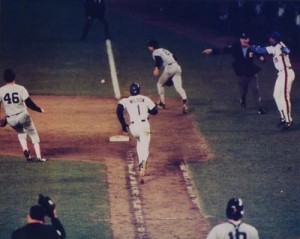
The Mookie Wilson-Bill Buckner connection, Game 6, 1986 World Series, Bottom 10th, Shea Stadium, Queens, NY, October 25, 1986. (http://halloffamememorabilia.net).

The Mookie Wilson-Bill Buckner connection, Game 6, 1986 World Series, Bottom 10th, Shea Stadium, Queens, NY, October 25, 1986. (http://halloffamememorabilia.net).

Sunday, October 26, 1986 was part of a great three days for me, perhaps the three best days during my Boy @ The Window years. My Mets had pulled off a miracle. They survived being within a strike of losing the ’86 World Series because Mookie Wilson put a ball between Boston Red Sox 1st baseman Bill Buckner’s rickety legs the night before. Anita Baker’s “Sweet Love” was #1 or #2 on the R&B charts and was near the top of Billboard’s Top 40 on this day twenty-eight years ago. Within the next thirty-eight hours, my Mets would complete the comeback, and win their second (and last, to this point anyway) World Series after falling behind 3-0 through the first six innings. Meanwhile, my Giants would run through the Deadskins at home in East Rutherford, NJ, as Joe Morris rushed for 185 yards in a 27-21 victory, on their own march to a championship title.

GoGurt, Yoplait's squeeze -in-mouth, portable yogurt, October 26, 2014. (http://freehotsamples.com).

GoGurt, Yoplait’s squeeze -in-mouth, portable yogurt, October 26, 2014. (http://freehotsamples.com).

My coping mechanisms were at their peaks, though, and had nothing else to do but crash down into the Earth. It was also my senior year in high school, a time of too many AP courses, too many college-going pressures, too many haters and doubters among my classmates, and too much of the grinding poverty and chaos that was living at 616. Within two weeks of my Mets, my Giants and Anita Baker’s first big hits, I’d discover my idiot stepfather’s pornography collection, nearly got set up with a prostitute because of my father, and face humiliation at the hands of my AP Physics teacher David Wolf and his boss Estelle Abel for the first time.

It took me almost two years to recover from the happenings of the mid-fall of ’86. In the process, I faced betrayal, ostracism, humiliation, broken-heartedness, and homelessness, but somehow managed to not make every song and every Mets and Giants (and Knicks and Rangers) victory a vicarious signpost for my own life. It helped that I started to think of Pitt — if not Pittsburgh — as my home, with concerns beyond living and dying with my New York teams and with relatively unknown but talented music artists.

Giants' RB Joe Morris running through Deadskins again, RFK Stadium, Washington, DC, December 7, 1986. (http://sikids.com).

Giants’ RB Joe Morris running through Deadskins again, RFK Stadium, Washington, DC, December 7, 1986. (http://sikids.com).

I learned other things along the way, too. That my Mets and Giants weren’t the perfect teams I thought they were. Between the alcohol and drug issues of Darryl Strawberry, Dwight Gooden, Len Dykstra, Lawrence Taylor, Kevin Mitchell, not to mention their and other teammates’ domestic violence issues, it was obvious to me that talent and winning were more important than living by a consistent code. Listening to the new 24/7 sports radio station WFAN when it began its run in the summer of ’87 showed me the hearts and minds of most fans. They obviously weren’t using sports as a coping strategy for dealing with the emotional grind of poverty and threats of abuse and domestic violence at home. Mostly White and male, their constant barrage of vitriol and disparaging racial commentary about my favorite athletes at that time — Mike Tyson in particular — actually made me wary of White sports fans for years afterward.

I also learned that with artists like Anita Baker and Luther was really the last gasp of R&B as I’d known it to be in the US. R&B was already too much like ’80s pop and a bit too mixed up with rock at times, but with Cameo’s “Word Up” and Club Nouveau’s cover of Bill Withers’ “Lean On Me,” R&B was already beginning its merge with hip-hop, and not in a good way, either. Yeah, there were some exceptions, like Levert, or Regina Belle, but the process of R&B devolving into some Yoplait GoGurt version of itself — with Autotunes, bad rap lyrics and worse rhyme spitters, and assembly-line hip-hop beats — had already begun.

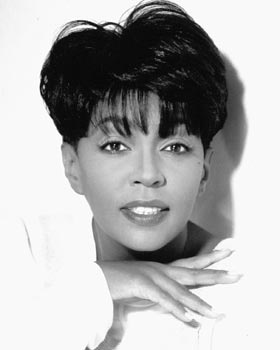
Anita Baker, Rapture phase, circa 1986. (http://projects.latimes.com).

Anita Baker, Rapture phase, circa 1986. (http://projects.latimes.com).

Some of you may say, R&B’s still alive in the US, specifically in our churches, but that’s not true, thanks in large measure to Kirk Franklin. His work in the ’90s made it so that it’s taken longer for jazz to catch on in bands and choirs than rap and hip-hop. No, if you want to find R&B with actual singers these days, try the United Kingdom of Great Britain, try France, try Senegal, try Nigeria. But don’t try the US. Nicki Minaj is no Aretha, no matter how imaginative her videos and her clothes. For that matter, Iggy Azalea’s no Teena Marie, as the former doesn’t understand the difference between cultural appropriation and authenticity. Hip-hop sprang in part from the roots and branches of R&B, but like a parasitic vine, it has cannibalized those roots.

Still, it’s good to remember days like the ones I lived through twenty-eight years ago, with Anita Baker in my ear, my Mets in victory formation, my Giants lined up right beside them. Those days are gone, like the coping strategies I used to get through every one of those days. Not to mention the R&B that was more a part of my life than the hip-hop that my contemporaries were supposedly raised on.

A Weak Legacy: The Acts of the Civil Rights Apostles at 50

24 Friday Oct 2014

Posted by decollins1969 in 1, Academia, Boy @ The Window, culture, Eclectic, eclectic music, Mount Vernon New York, Politics, Pop Culture, race, Work, Youth

≈ Leave a comment

Tags

"The Way It Is" (1986), AERA, American Educational Research Association, Brown Lecture, Brown v. Board of Education (1954), Bruce Hornsby and The Range, Civil Rights Act of 1964, Class Inequality, Color Bar, Derrick Bell, Inequality, Jesse B. Semple, Legacy, Mother-Son Relationship, Poverty, Racial Inequality, Racism, Symbols, The Acts of the Apostles, Voter Disenfranchisement, Voting Rights Act of 1965


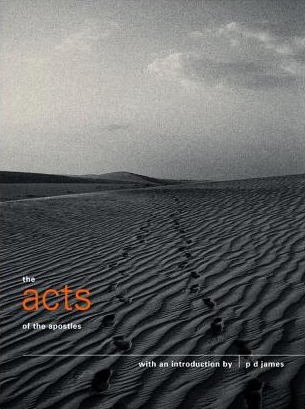
The Acts of the Apostles (book cover), 1999. (http://books.google.com).

The Acts of the Apostles (book cover), 1999. (http://books.google.com).

Yesterday evening, I attended the eleventh annual Brown lecture hosted by the American Educational Research Association at the Ronald Reagan Building here in DC. The great scholar James Anderson talked for about an hour about the connections between voter disenfranchisement and state policies that created systems of educational inequality for Blacks as part of the Jim Crow era. Anderson wondered aloud that with the recent efforts to restrict voting and with the Supreme striking down Section 4(b) (and essentially Section 5) of the Voting Rights Act of 1965 if this meant a return of gross educational inequality on the basis of race and class in 2014. As if the trends of inequality only rise and fall with well protected or unprotected voting rights. Voting rights enforcement is a good barometer, but hardly the only one. The last twenty years of high-stakes testing and corporate education reform provide evidence of a trend of educational inequality that has occurred despite and (in many cases) precisely because of voter participation across all racial lines.

The following, though, is my full response, to Anderson, AERA and all of those in legacy-celebration mode with the Brown decision and the Acts in 2014 and 2015. What was true in 1964 and 1965 remains true fifty years later. The Civil Rights and Voting Rights Acts have been much more lightbulbs on a symbol of real progress — the Civil Rights Movement — than it has been an actual marker of progress. At least for those poor, Black and of color. For Whites, though, the Acts have been the sign of a post-racial America without having to work at it or talk about it. But for the adults I grew up around in Mount Vernon, New York in the 1970’s, there was a lingering hopefulness about race relations and racial equality in America that is absent these days. I don’t know if I felt it because of Archie Bunker and All In The Family or because of all those reproductions I saw of the late Martin Luther King, John F. Kennedy and Robert F. Kennedy together in the same painting over so many living-room mantles when I was six years old. Yet no matter how down or how out, so many poorer Blacks I knew back then had hope for a brighter present and future.

Jesse Jackson, an Obama election sign, and the American flag -- three symbols in one picture, July 2008. (http://plus.google.com).

Jesse Jackson, an Obama election sign, and the American flag — three symbols in one picture, July 2008. (http://plus.google.com).

It wasn’t as if they contemplated Title VII of the Civil Rights Act or Section 2 of the Voting Rights Act at the disco house parties my mother would take me and my older brother to, playing with other kids while the adults danced away their troubles. No, it was the idea that finally, Blacks who looked like us could pry open a door and get an opportunity to succeed in America. Or, to quote The Jeffersons‘ theme song, to “gettin’ our turn at bat.” It didn’t matter to them that the Civil Rights Act, even with all its enforcement teeth, would benefit White women and those lucky enough to be part of Black middle class more than us poor Black folk. Or if the Voting Rights Act could be thwarted by gerrymandering and state decisions to make voting harder for us. The Acts crystallized hope, symbolized a chance, however small, for a better education, a better job, and a better life, for themselves and their families.

The adults in my life were putting on a good face, though, as I came to realize when I was a preteen. My mother had once held the hope that me and my older brother would “make it” by going to college and finding “good-paying jobs.” But by the start of the Reagan Revolution, she no longer spoke in such lofty terms. My mother was hardly alone. By 1979, Blacks like Florence Grier in Bob Blauner’s oral history book Black Lives, White Lives (1989) were saying, to “tell you the truth, I’m not hopeful that we’re going to progress in the eighties as fast as we progressed from the sixties to the seventies.”

Polling back then also reflected this sense of frustration about race and over racial discrimination among Blacks, in contrast to the White sentiment that America had move beyond its racist past. In March 1981, ABC News and The Washington Post conducted their first combined poll on the state of race relations in the US. While 73 percent of Blacks in the poll saw “deep rooted continuing racial problems and blame them on discrimination…only 46 percent of the Whites agreed.”

First page of the Civil Rights Act of 1964 (bent and warped), July 8, 1964. (http://www.ourdocuments.gov/document_data/pdf/doc_097.pdf). In public domain.

First page of the Civil Rights Act of 1964 (bent and warped), July 8, 1964. (http://www.ourdocuments.gov/document_data/pdf/doc_097.pdf). In public domain.

The hopes and aspirations that the Civil Rights Act symbolized have eroded with the Act itself, and are all but absent for younger generations of Americans. An MTV and David Binder Research poll from early 2014 found that 48 percent of White millennials believe anti-White discrimination is as significant as discrimination against people of color, while 65 percent of the people of color they polled believe that Whites have more opportunities for success. Even my own eleven-year-old son reflects this trend. “People were more stupid back then,” my son said to me recently while we talked about the Civil Rights Movement and White resistance to integration, as if racial inequality ended with the movement.Thanks in no small part to the success of the neoconservative movement in declaring the death of racism in the 1980s and 1990s, the generation born after 1981 does not see the federal government as the catalyst for a better life or as a leveler of any playing field.

Bruce Hornsby and The Range’s lyrics from their hit “The Way It Is” summed up the weaknesses of the Civil Rights Act and its legacy well, for us in 1986 as well as today:

Well, they passed a law in ’64

To give those who ain’t got a little more

But it only goes so far

Cause the law don’t change another’s mind…

Nor, apparently, does it create a lasting legacy of racial equality and social mobility.

Can Family and Friends Ever Understand The Why Behind a Memoir?

20 Monday Oct 2014

Posted by decollins1969 in 1, Boy @ The Window, culture, Eclectic, Jimme, Mount Vernon New York, My Father, Pop Culture, race, Religion, Work, Youth

≈ Leave a comment

Tags

"Dirty Laundry", Catharsis, Charles M. Blow, Child Abuse, Core Friends, Extended Family, Family, Father-Son Relationships, Fire Shut Up in My Bones (2014), Friends, Memoirs, Mother-Son Relationship, Neglect, Poverty, Sexual Assault, Sexuality, Writing


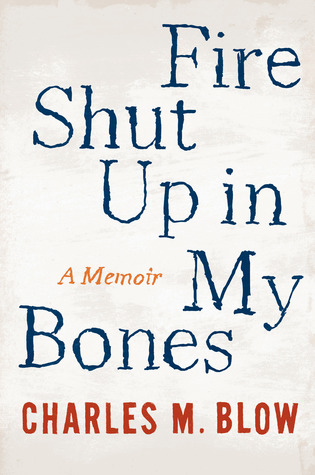
Front cover, Fire Shut Up in My Bones, Charles M. Blow, September 23, 2014. (http://goodreads.com).

Front cover, Fire Shut Up in My Bones, Charles M. Blow, September 23, 2014. (http://goodreads.com).

I started reading New York Times columnist Charles M. Blow’s memoir Fire Shut Up In My Bones two weeks ago. Like many who have read it, I have found it a good read, a revealing read, even a powerful read at times. I have been able to put it down, though. Mostly because as someone who’s recently written a memoir about my own painful and trying experiences with abuse and neglect, about confusion, distrust and occasional rage, Blow’s book has been a reminder of how difficult it was for me to relive those experiences enough to write them down in words and revise them into a book of my own.

Still, as I do intend to finish Fire before the holidays, I do have a couple of questions. One is really basic. Had Blow ever heard of the Kinsey Report (1948), the first one about the sexual experiences and habits of men, particularly gay and bisexual men, prior to turning thirty? The one thing I learned from reading this report twenty years ago is that there’s a lot of gray between heterosexual, gay and bisexual. That you can be heterosexual, and still have a small level of attraction to those of your same gender simultaneously.

256 shades of gray (cropped), October 20, 2014. (http://cs.dartmouth.edu).

256 shades of gray (cropped), October 20, 2014. (http://cs.dartmouth.edu).

But this is a minor question, more about his curious road to understanding his sexuality — not to mention my own road — than it is about Fire itself. My second question is a much more important one. How have Blow’s family and friends received his book since he decided to write it? How have they received Fire in the months since he announced it was coming out in September? How have they received him and Fire since it officially hit the shelves last month?

If his immediate and extended family was/is anything like mine (and from reading Fire so far, it is), then my best guess is their reaction’s been mixed at best. In the year since I released Boy @ The Window in paperback, my siblings have liked the book, but my mother and father haven’t exactly been happy about me writing it. My mother hasn’t said one word about Boy @ The Window since I put it out last year. Nor did she ask any questions about the book in the six and half years that I toiled in writing and rewriting it.

My father, meanwhile, showed interest in the book right from the moment I told him I planned to write Boy @ The Window. That was, until the paperback edition came out during the holidays last year. At that point, he said, “I don’t wanna talk to you no more.” We’ve talked several times since, but he’s still pissed with me about including him in my memoir, even though I never hid this from him at any point in the process.

Among my friends, most of my core group has bought and read Boy @ The Window. Most have given me positive feedback, some very extensive. Yet I found myself mildly surprised how few friends outside of this core group have bought or read the book. I take that back. Actually, I’m surprised by the negative feedback I’ve gotten from folks who’ve claimed to be friends of mine, who’ve never read a word of Boy @ The Window. But this feedback hasn’t been about the memoir. It’s really about their wanting to deny facts about me or about them that they’ve assumed are in Boy @ The Window, as if my job in this instance was to only be truthful when it felt good for them.

Dirty laundry in a basket, October 20, 2014. (http://plus.google.com).

Dirty laundry in a basket, October 20, 2014. (http://plus.google.com).

My platform is tiny when compared with Blow’s, so I imagine that the reaction to Fire in terms of both praise and condemnation has been more extreme, even as the praise has been much more public. I suppose if I was the perpetrator whom sexually assaulted Blow, I’d likely want to shut him up. I’m not so sure that anyone in his family, proud of him as they may be, wants what they’d likely consider “dirty laundry” out there for anyone to read. You don’t grow up in a family as traditional as Blow’s and expect everyone to be alright with their character’s characterization in a bestseller.

This I do know, and I suspect Blow has known for a while, too. That writing a memoir like Fire isn’t about seeking revenge or outing family secrets per se. Bottom line — it ain’t about the proverbial you! In some respects, as cathartic as writing a memoir like my Boy @ The Window or Blow’s Fire may be, it’s not so much about the authors,’ really, at least after the tenth edit.

There are so many stories that never see the light of day, because the fire for telling them burned out a long time ago. Or the window became a rubber room or a jail cell. It’s about telling a story that needs to be told, regardless of whether family’s happy about it, or whether some of your friends can relate to it or not. Because there’s always, always, an audience who needs to read it, hear it, see it and learn from it themselves.


Teaching Migration, In Song

17 Friday Oct 2014

Posted by decollins1969 in 1, Academia, Boy @ The Window, culture, Eclectic, eclectic music, High Rise Buildings, Jimme, Marriage, Mount Vernon New York, music, My Father, New York City, Politics, Pop Culture, race, Religion, Upper East Side, Upper West Side, Work, Youth

≈ Leave a comment

Tags

"(Sittin' On) The Dock of the Bay" (1968), "Living For The City" (1973), African American History, Africana Studies, Arrested Development, Black Boy (1945), Black History, Black Migration, Bruce Springsteen, Cities, Gil Scott-Heron, Gladys Knights and The Pips, Great Migration, Isabel Wilkerson, James Grossman, Joblessness, John Mellencamp, Kate Bush, Land of Hope (1989), Marvin Gaye, Mary Patillo, Migration, Nas, Nicholas Lemann, Nina Simone, Otis Redding, Peter Gabriel, Poverty, Richard Wright, Stevie Wonder, Teaching and Learning, The Promised Land (1991), The Warmth of Other Suns (2010), Tracy Chapman, Tupac, Urban America, urban blight


Stevie Wonder and Wonderlove, live performance of "Living For The City," circa 1974.  (http://youtube.com).

Stevie Wonder and Wonderlove, live performance of “Living For The City,” circa 1974. (http://youtube.com).

If I ever had the chance to teach a course specifically on the history of Black migration in America, I already know what books I’d use. Isabel Wilkerson’s The Warmth of Other Suns (2010); Nicholas Lemann’s The Promised Land (1991); James Grossman’s Land of Hope (1989); Mary Patillo’s Black Picket Fences (1999); even Richard Wright’s Black Boy (1945) and Maya Angelou’s I Know Why the Caged Bird Sings (1969). All have moved beyond the statistics of some seven or eight million Blacks moving from the rural Jim Crow South to America’s cities, North, Midwest, West and South for the first three-quarters of the twentieth century.

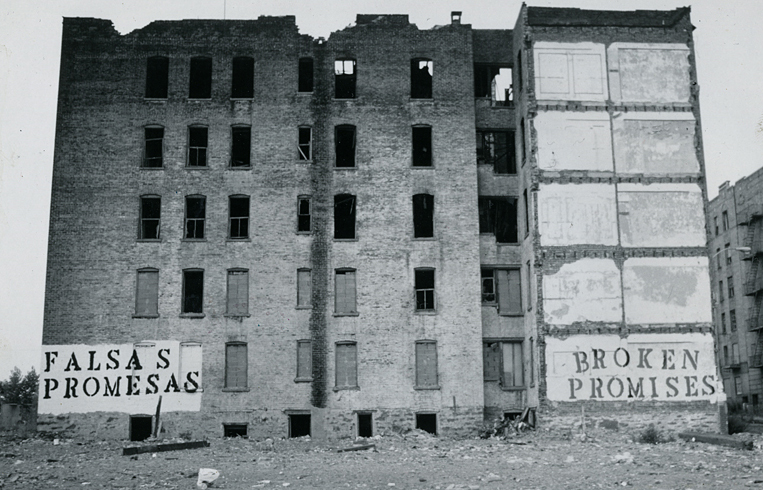
Falsas Promesas Broken Promises, taken by John Fekner, Charlotte Street Stencils, South Bronx, New York. 1980. (Liftarn via Wikipedia). Released to public domain via CC-SA-3.0.

Falsas Promesas Broken Promises, taken by John Fekner, Charlotte Street Stencils, South Bronx, New York. 1980. (Liftarn via Wikipedia). Released to public domain via CC-SA-3.0.

But that wouldn’t be near enough to communicate the range of emotions, the psychological states and the pressures that these people faced in leaving their homes for the not-so-bright lights of America’s big cities, not to mention what they faced in the days and years after they arrived. I should know. I’m the nearly forty-five year-old son of a mother originally from Bradley, Arkansas (population 500) and a father from Harrison, Georgia. They moved to New York City in the ’60s (specifically, the Tremont section of the Bronx), then to the South Side of Mount Vernon, New York (just outside the Bronx), hooked up, and sired me and my older brother Darren between December 1967 and January 1970.

That short summary is hardly the story, though. For me — like with so many other things in my life — music tells the story, emotions and psychology beyond what words on a page alone can approximate, but not fully duplicate. Music communicates the stories, emotions and psychology of those who migrated and stayed (or didn’t) in cities across the US better than Census data or a hypothesis on proletarianization. I wanted music from my own lifetime (or at least, within a few years of it) — not just folk songs or Blind Willie Johnson or Duke Ellington — music that fit my family’s transition from migration to our current times of racism and urban poverty.

Easily the top two songs on my list to play in class would be:

Trade ad for Otis Redding's single "Try a Little Tenderness," January 7, 1967. (Viniciusmc via Wikipedia/Billboard Magazine, page 7). In public domain).

Trade ad for Otis Redding’s single “Try a Little Tenderness,” January 7, 1967. (Viniciusmc via Wikipedia/Billboard Magazine, page 7). In public domain).

1. Otis Redding, “(Sittin’ On) the Dock of the Bay,” (1968), released after Redding’s death in a plane crash in Madison, Wisconsin; and

2. Stevie Wonder, “Living For The City,” (1973).

Both songs run the full emotional and psychological gamut. From hopefulness to oblivion, from delusion to despair, from rage and anger to resignation. The melancholy of Redding’s “It’s two thousand miles I roamed/Just to make this dock my home” (in reference to the distance from Georgia to San Francisco Bay) juxtaposed with Wonder’s bitterness and anger:

“His hair is long, his feet are hard and gritty
He spends his life walkin’ the streets of New York City
He’s almost dead from breathin’ in air pollution
He tried to vote but to him there’s no solution…”

It communicates so much beyond the lyrics and liner notes, a reminder for those of us who find America and its cities unforgiving today just how relentless it must’ve been for our parents and uncles and aunts and grandparents forty or more years ago.

There are other songs that I’d put on this playlist. Some are directly related to Black migration, some try to bridge the gap between the abundance of music on “the ghetto” and urban poverty and chaos and the lack of music from my own lifetime on migration.

3. Gladys Knight and the Pips, “Midnight Train to Georgia” (1973).
4. Marvin Gaye, “Inner City Blues” (1971).
5. Gil Scott-Heron, “95 South (All of The Places We’ve Been)” (1977).
6. Tracy Chapman, “Fast Car” (1987).
7. Nas (featuring Olu Dara, his father), “Bridging the Gap” (2004).

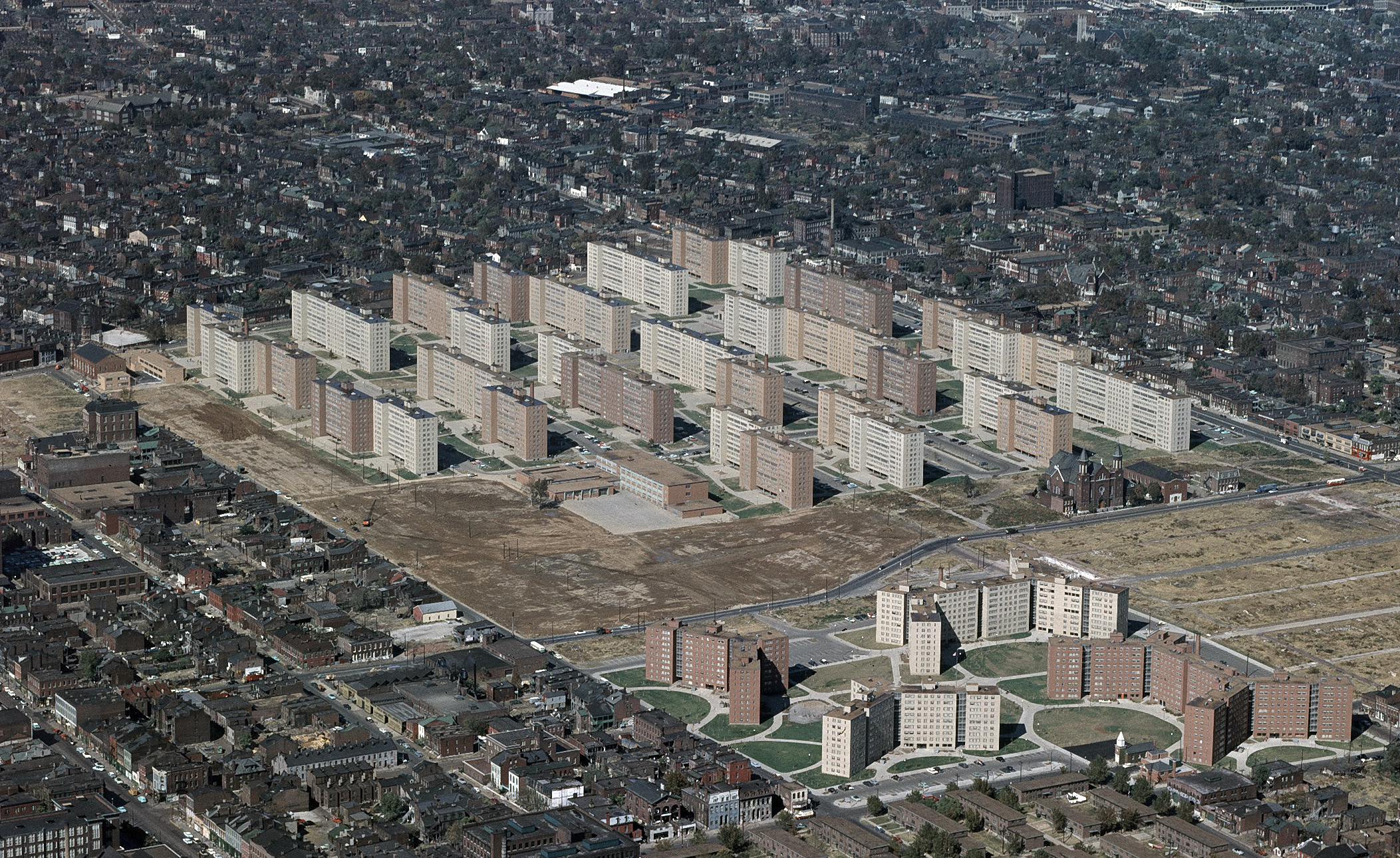
Pruitt–Igoe public housing projects, St. Louis, Missouri, circa 1967. This late-1950s "urban renewal" project was built, but  failed and was razed in the 1970s. (Cadastral via Wikipedia/US Geological Survey). In public domain.

Pruitt–Igoe public housing projects, St. Louis, Missouri, circa 1967. This late-1950s “urban renewal” project was built, but failed and was razed in the 1970s. (Cadastral via Wikipedia/US Geological Survey). In public domain.

That most of these songs come from the period between 1967 and 1974 isn’t an accident. It was the height of the Civil Rights Movement, combined with the Black Power Movement and the “Black is Beautiful” campaign, the beginning of the White backlash against civil rights — including Dr. Martin Luther King, Jr.’s assassination — and the Anti-War Movement was in full swing. It was a good time to take a look at the present and recent past to reconnect with hopes and dreams in the midst of the nightmare of urban poverty.

After ’73 was the beginning of the dance and disco era, as well as a focus on the urban, on crime, on drugs, on poverty  — but not in a “let’s try to solve it” kind of way. This was where rap, hip-hop, some R&B and early forms of what we now call neo-soul picked up, with little reflection on this once prominent past.

Still, there would be some honorable mentions for this migration course, music that could evoke some aspect of the Black migration, of the hope that took a downward turn, of the poverty and joblessness that have permeated America, Black and White and Brown, since the ’70s.

8.  Arrested Development, “Tennessee” (1992).
9. Tina and Ike Turner (and Credence Clearwater Revival), “Proud Mary” (1970).
10. Nina Simone, “The Backlash Blues” (1967).
11. NWA, “Straight Outta Compton” (1989).
12. Tupac, “Cradle 2 the Grave” (1994).
13. John Mellencamp, “Pink Houses” (1983).
14. Bruce Springsteen, “Born In The U.S.A..” (1984). [the song’s release was thirty years ago this month, by the way]
15. Peter Gabriel and Kate Bush, “Don’t Give Up” (1986)

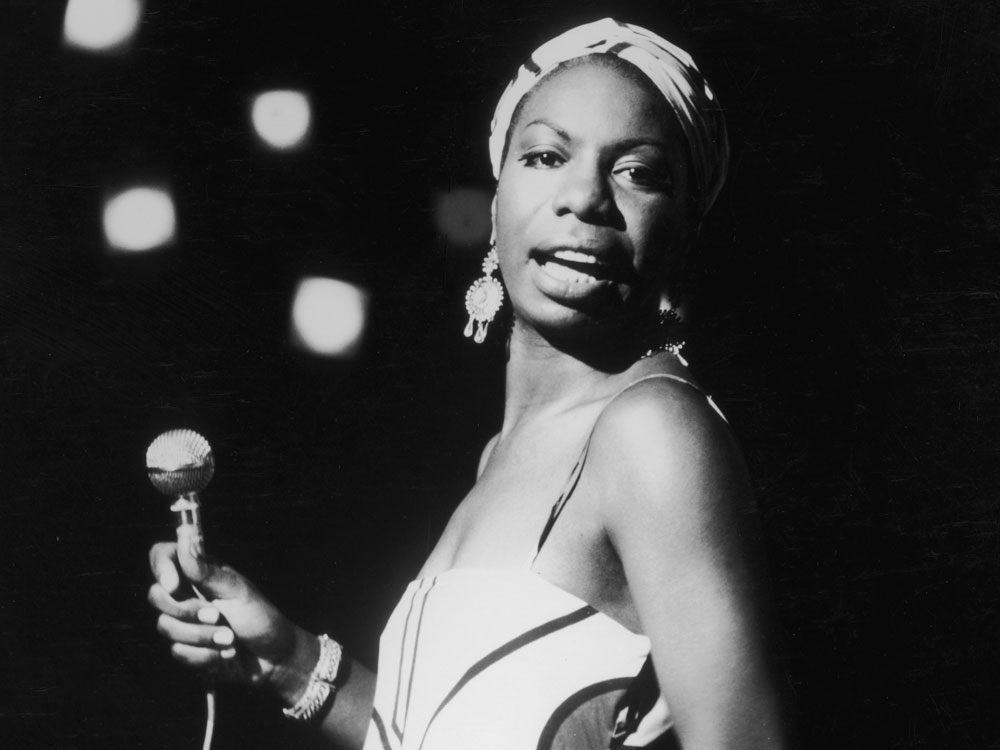
Nina Simone performs at a concert in 1964. (http://npr.org, via Hulton Archive/Stringer/Getty Images).

Nina Simone performs at a concert in 1964. (http://npr.org, via Hulton Archive/Stringer/Getty Images).

Through music, I’d hope to have a course and discussion about Black migration that reaches beyond the words origin and destination, that migration has merely been a physical manifestation of a difficult and seemingly unending cultural and spiritual journey in the US. That Black migration can also easily include the parallel journeys of those of the African or Afro-Caribbean diaspora, not to mention those from Latin America.

For me, though, a course like this would be a personal foray into all the things that have made me who I’ve been for nearly four and a half decades — a person better than the sum of America’s parts and racist, sexist, homophobic and evangelical assumptions.

“Stupid Atheist” Meets Truly Stupid Christian

06 Monday Oct 2014

Posted by decollins1969 in 1, Boy @ The Window, Christianity, culture, Eclectic, Mount Vernon High School, Mount Vernon New York, Politics, Pop Culture, race, Religion, Youth

≈ Leave a comment

Tags

Acting, Activism, AP American History, AP US History, Arrogance, Atheism, Atheists, Christianity, Contradictions, Doing, Evangelical Christianity, Faith, Giving, Hope, Hypocrisy, Jay Sekulow, Mary Zini, Masturbation, Pat Robertson, Prayer in Schools, Stupidity, Teenage Angst, Teenagers, Televangelism, Televangelists, Trust, World History


Screenshot from HBO show The Leftovers title sequence, September 5, 2014. ( yU+co via http://news.creativecow.net). Qualifies as fair use under US copyright laws -- low resolution and relevance to subject matter.

Screenshot from HBO show The Leftovers title sequence, September 5, 2014. ( yU+co via http://news.creativecow.net). Qualifies as fair use under US copyright laws — low resolution and relevance to subject matter.

I’ve written about Mary Zini and our classroom incidents before, here and in Boy @ The Window. It’s been thirty years since she was my tenth-grade World History teacher. Yet most of what I remember from this class has little to do with Plato, NATO, or anything in between. It’s mostly Zini’s condescending personality, my new Christian arrogance, and that people’s personalities and actions are often walking and talking contradictions.

It was the beginning of October ’84 when we had our first incident. It occurred after what was the first of an endless cycle of fill-in-the-bubble Scan-Tron exams.

Screen shot 2014-10-05 at 5.59.18 PM

Honestly, I had no idea at that moment why I said what I said. I supposed that a summer of Jay Sekulow and the American Center for Law and Justice, all via Pat Robertson and The 700 Club had done the trick in making me a one-time prayer-in-public-schools advocate. I knew that Zini was raised a Catholic, so on some level, didn’t that make me a stupid Christian for calling her a stupid “atheist?”

That incident was also the beginning of seven months of starting to figure out how to be me and be a follower of Christ at the same time. I approached it the same way I approached how to be me in my first few months of seventh grade and Humanities at A.B. Davis Middle School in the fall of ’81. With the naiveté of a child, the hubris of a teenager, and the callousness of a human with alien superpowers.

Jay Sekulow lecturing, Regent University, December 15, 2006. (Juda Engelmayer via Wikipedia). Released to public domain via GFDL.

Jay Sekulow lecturing, Regent University, December 15, 2006. (Juda Engelmayer via Wikipedia). Released to public domain via GFDL.

It was evident in my outward actions. I packed my red-pleather-covered King James Bible every day. For school. For Subway trips down into Midtown Manhattan when me and my older brother Darren worked for our father Jimme. For when we washed clothes every Saturday or Sunday at the laundromat on the Mount Vernon-Pelham border (it’s a yoga studio now). The Bible was my constant companion, my shield protecting me from this mad world of almost bottomless sin.

In the process, I read everything from Genesis to Revelations at least twice. (some books, like the Gospels, as many as four times). I learned a lot from  reading all sixty-six books of the Old and New Testaments. That the Israelite God Yahweh was stern and pretty unforgiving. That Jesus was a radical, not just spiritually, but politically as well. And that Paul was not exactly the most enlightened of the apostles when it came to women, children and slaves.

Mostly what I learned was that readings and understanding The Bible wasn’t like living out my beliefs at all. I was still a teenager, a fifteen-year-old living in the midst of welfare poverty, at 616 with an abusive womanizer, a wounded mother and a gaggle of siblings between the ages of eight months and five-and-a-half years. Not to mention my alcoholic cuss-factory of a father that I had to hunt down for money nearly every weekend. What all that meant was feeling lust for a young woman one minute, hate toward my idiot stepfather Maurice the next, and imitating Jimme’s slurred language and mannerisms the minute after that.

This new walk was very confusing, so much so that I often hid my emotions in much the same way I’d already been doing to protect myself from yet another abuse episode with Maurice. My emotions couldn’t stay bottled up, though. I frequently humped my way to sleep once our living room at 616 had become my bedroom during and after the months in which Balkis Makeda had lived with us.

Screen shot 2014-10-05 at 6.06.59 PM

By the spring of ’85, when Zini granted me her full support in getting me into AP US History for eleventh grade (this despite my 84 average in her class at the time), I was flabbergasted. I couldn’t stand being in the same room with Zini much of the time. Yet she did for me what few in my life had done — she opened up a door for me to walk through, albeit a relatively small one.

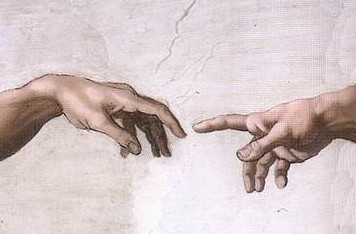
Hands of God & Adam, fingers about to touch, Sistine Chapel ceiling, Vatican, Michelangelo, 1508-1512 (via Wikipedia). In public domain.

Hands of God & Adam, fingers about to touch, Sistine Chapel ceiling, Vatican, Michelangelo, 1508-1512 (via Wikipedia). In public domain.

What did it all mean? That devoutness is meaningless without action, without giving and receiving, without trust, without taking risks. That even supposed atheists can act and give in ways that should shame many arrogant Christians. That Christianity isn’t a transactional relationship or process, but a journey with many pitfalls and lots of contradictions along the way. That who I/we say God is, well, at best an infinitesimal guess, because God and this universe is so much more that I as a human male living in the context of Western culture can only begin to understand.

Most of all, I had just begun to learn that spiritual liberation wasn’t supposed to be a yoke, but an opening to see the world and myself stripped bare of narrative and pretense. A strict adherence to the principles of Pat Robertson would bring me no closer to enlightenment and no further out of poverty than wishing on a star or avoiding cracks on Mount Vernon’s blue-slate sidewalks. Work, trust, opportunities, and not just Romans 8:28, was the beginning of the key for me.

← Older posts
Newer posts →

Boy @ The Window: A Memoir

Boy @ The Window: A Memoir

Places to Buy/Download Boy @ The Window

There's a few ways in which you can read excerpts of, borrow and/or purchase and download Boy @ The Window. There's the trade paperback edition of Boy @ The Window, available for purchase via Amazon.com at http://www.amazon.com/Boy-Window-Donald-Earl-Collins/dp/0989256138/

There's also a Kindle edition on Amazon.com. The enhanced edition can be read only with Kindle Fire, an iPad or a full-color tablet. The links to the enhanced edition through Apple's iBookstore and the Barnes & Noble NOOK edition are below. The link to the Amazon Kindle version is also immediately below:

scr2555-proj697-a-kindle-logo-rgb-lg

Boy @ The Window on Amazon.com: http://www.amazon.com/Boy-The-Window-Memoir-ebook/dp/B00CD95FBU/

iBookstore-logo-300x100

Boy @ The Window on Apple's iBookstore: https://itunes.apple.com/us/book/boy-the-window/id643768275?ls=1

Barnes & Noble (bn.com) logo, June 26, 2013. (http://www.logotypes101.com).

Boy @ The Window on Barnes & Noble: http://www.barnesandnoble.com/w/boy-the-window-donald-earl-collins/1115182183?ean=2940016741567

You can also add, read and review Boy @ The Window on Goodreads.com. Just click on the button below:

Boy @ The Window

Twitter Updates

Tweets by decollins1969
  • RSS - Posts
  • RSS - Comments

Archives

  • June 2025
  • April 2023
  • September 2022
  • August 2022
  • July 2022
  • June 2022
  • May 2022
  • April 2022
  • March 2022
  • January 2022
  • December 2021
  • November 2021
  • October 2021
  • September 2021
  • August 2021
  • July 2021
  • June 2021
  • April 2021
  • March 2021
  • February 2021
  • January 2021
  • December 2020
  • November 2020
  • October 2020
  • September 2020
  • August 2020
  • July 2020
  • May 2020
  • April 2020
  • March 2020
  • January 2020
  • December 2019
  • November 2019
  • August 2019
  • July 2019
  • June 2019
  • May 2019
  • April 2019
  • March 2019
  • February 2019
  • January 2019
  • December 2018
  • November 2018
  • October 2018
  • September 2018
  • August 2018
  • July 2018
  • June 2018
  • May 2018
  • March 2018
  • February 2018
  • January 2018
  • December 2017
  • November 2017
  • October 2017
  • September 2017
  • August 2017
  • July 2017
  • June 2017
  • May 2017
  • April 2017
  • March 2017
  • February 2017
  • January 2017
  • December 2016
  • November 2016
  • October 2016
  • September 2016
  • August 2016
  • July 2016
  • June 2016
  • May 2016
  • April 2016
  • March 2016
  • February 2016
  • January 2016
  • December 2015
  • November 2015
  • October 2015
  • September 2015
  • August 2015
  • July 2015
  • June 2015
  • May 2015
  • April 2015
  • March 2015
  • February 2015
  • January 2015
  • December 2014
  • November 2014
  • October 2014
  • September 2014
  • August 2014
  • July 2014
  • June 2014
  • May 2014
  • April 2014
  • March 2014
  • February 2014
  • January 2014
  • December 2013
  • November 2013
  • October 2013
  • September 2013
  • August 2013
  • July 2013
  • June 2013
  • May 2013
  • April 2013
  • March 2013
  • February 2013
  • January 2013
  • December 2012
  • November 2012
  • October 2012
  • September 2012
  • August 2012
  • July 2012
  • June 2012
  • May 2012
  • April 2012
  • March 2012
  • February 2012
  • January 2012
  • December 2011
  • November 2011
  • October 2011
  • September 2011
  • August 2011
  • July 2011
  • June 2011
  • May 2011
  • April 2011
  • March 2011
  • February 2011
  • January 2011
  • December 2010
  • November 2010
  • October 2010
  • September 2010
  • August 2010
  • July 2010
  • June 2010
  • May 2010
  • April 2010
  • March 2010
  • February 2010
  • January 2010
  • December 2009
  • November 2009
  • October 2009
  • September 2009
  • August 2009
  • July 2009
  • June 2009
  • May 2009
  • April 2009
  • March 2009
  • February 2009
  • January 2009
  • December 2008
  • November 2008
  • October 2008
  • September 2008
  • August 2008
  • July 2008
  • June 2008
  • May 2008
  • April 2008
  • March 2008
  • February 2008
  • January 2008
  • December 2007
  • November 2007
  • October 2007
  • September 2007
  • August 2007
  • July 2007
  • June 2007

Recent Comments

MaryPena's avatarMaryPena on My Day of Atonement/Bitter Hat…
decollins1969's avatardecollins1969 on No Good Teaching Deed Goes…
Mary Rose O’Connell's avatarMary Rose O’Connell on No Good Teaching Deed Goes…

NetworkedBlogs on Facebook

NetworkedBlogs
Blog:
Notes From a Boy @ The Window
Topics:
My Life, Culture & Education, Politics & Goofyness
 
Follow my blog

616 616 East Lincoln Avenue A.B. Davis Middle School Abuse Academia Academy for Educational Development AED Afrocentricity American Narcissism Authenticity Bigotry Blackness Boy @ The Window Carnegie Mellon University Child Abuse Class of 1987 CMU Coping Strategies Crush #1 Crush #2 Death Disillusionment Diversity Domestic Violence Economic Inequality Education Family Friendship Friendships Graduate School Hebrew-Israelites High-Stakes Testing Higher Education History Homelessness Humanities Humanities Program Hypocrisy Internalized Racism Jealousy Joe Trotter Joe William Trotter Jr. K-12 Education Love Manhood Maurice Eugene Washington Maurice Washington Misogyny Mother-Son Relationship Mount Vernon High School Mount Vernon New York Mount Vernon public schools Multiculturalism MVHS Narcissism NFL Pitt Pittsburgh Politics of Education Poverty President Barack Obama Race Racial Stereotypes Racism Relationships Self-Awareness Self-Discovery Self-Reflection Sexism Social Justice Teaching and Learning University of Pittsburgh Violence Whiteness Writing

Top Rated

Blog at WordPress.com.

  • Subscribe Subscribed
    • Notes from a Boy @ The Window
    • Join 103 other subscribers
    • Already have a WordPress.com account? Log in now.
    • Notes from a Boy @ The Window
    • Subscribe Subscribed
    • Sign up
    • Log in
    • Report this content
    • View site in Reader
    • Manage subscriptions
    • Collapse this bar
 

Loading Comments...