• About Me
  • Other Writings
  • Interview Clips
  • All About Me: American Racism, American Narcissism, and the Conversation America Can’t Have
  • Video Clips
  • Boy @ The Window Pictures
  • Boy @ The Window Theme Music

Notes from a Boy @ The Window

~

Notes from a Boy @ The Window

Category Archives: Mount Vernon High School

My Nuanced History as a Historian

16 Monday May 2016

Posted by decollins1969 in 1, Academia, Boy @ The Window, Carnegie Mellon University, culture, Eclectic, Mount Vernon High School, Mount Vernon New York, Pittsburgh, Politics, Pop Culture, race, Youth

≈ Leave a comment

Tags

Ambivalence, AP US History, Career Decisions, Career Development, CMU, Commitment, Editors, Graduate School, Historian, History, Nonprofit World, Nuance, PhD, Self-Discovery, Self-Reflection, Teaching and Learning, UMUC, Writer, Writing


The Road Less Traveled quote, via Robert Frost (with me adding, "but it's not always good to get lost in the woods"), May 16, 2016. (http://www.chicagonow.com).

The Road Less Traveled quote, via Robert Frost (with me adding, “but it’s not always good to get lost in the woods”), May 16, 2016. (http://www.chicagonow.com).

Right now I sit between two important dates in my life. One was a few days ago, the thirtieth anniversary of my triumph on the AP US History exam in eleventh grade. Two will be in two days, the nineteenth anniversary me of graduating from Carnegie Mellon with my PhD in History. Both are signifiers of my achievements, my ambitions, and of my becoming a professional historian. But in the decade after earning my first college credits and the nearly two decades since earning my doctorate, I’ve still had a few lingering questions about where and who I am professionally.

One of those questions I’ve discussed ad nauseam here. Am I a writer who’s also an academically trained historian, or am I a historian first and a writer second? Or, can I be both at the same time? For better and worse, I am always both, but can emphasize one or the other at random, depending on context.

Sliced onion layers, May 7, 2015. (http://www.medicaldaily.com).

Sliced onion layers, May 7, 2015. (http://www.medicaldaily.com).

Other questions, though, have lingered even after spending more than a decade in the nonprofit world and another eight years teaching a full slate of undergraduate history courses. Do I still enjoy teaching history? Does my experience working on real world issues in civic education, social justice, and educational equity cloud how I see myself when I’m lecturing on the Agricultural Revolution or the Middle Passage? How is it possible for me to reconcile myself as a freelance writer who wants to take my academic historian experience, combine it with my other professional and personal experiences, and write about it for editors with little clue about the roads I’ve traveled? Is it even possible to un-layer the onion of my life and write about it to my or anyone else’s satisfaction? And if so, am I still a historian when doing so?

To that next to last question, I think that’s already a yes-no answer. Since 2013, I’ve written articles for publication with newspapers and magazines, and am working on my first new scholarly piece in six years. It’s difficult, to say the least, to explain to an editor what in academia or even among US or African American historians is a settled issue. Editors always believe that any story has two equal and opposing sides, because that’s how most ordinary people see most stories. As an academic historian, I’m trained to see nuance, to know when one side has a stockpile of evidence, while another one has a stockpile of bullshit.

Or, more often, to know that the no man’s land of gray present several or even multiple perspectives on issues like racism, poverty, college retention and graduation, American individualism, or the rigging of the federal election process. That no man’s land, I have found, more often than not scares away an editor, even ones working for intellectual magazines. They think their audience is incapable of getting nuance, when I think that they often reflect their own narrow and elitist view of the world.

Timeline of Europe and the US, March 2015. (http://www.worldhistorycharts.com).

Timeline of Europe and the US, March 2015. (http://www.worldhistorycharts.com).

As for teaching history, I find myself literally bored with the basic facts of any survey or even upper-level history course. To me, history is a panoramic lens through which students and experts can study human beliefs and behaviors in all its glory, ugliness, and ordinary-ness. Understanding how and why a person or a group of people did x, y, or z is much, much, much more important than knowing the exact date a specific event took place or coming up with some interesting but irrelevant fact in the process.

Which was why I began to teach my undergraduate courses with far more discussion and less lecturing than I did when I taught history as a grad student. (I taught a bunch of graduate-level education foundations courses in between my various nonprofit stints between 1997 and 2008.) I decided it didn’t matter if my students had done the readings, hated history, or were tired and ready to nap through three hours of lecture. I will facilitate discussion. I will make sure to make this process one about human interaction. Even when the lack of independent thinking among my students has me near ready to strangle a few of them. Why? Because understanding how people think and why they draw the conclusions they do can be as eye-opening as the knowledge they pull from one of my classes, maybe more so.

So, do I still see myself as a historian, or more as a psychologist or sociologist? Does it really matter how I see myself? Probably not. I just know that after years of teaching, writing, and all of my ups and downs professionally, that I remain two things most of all — a writer and a learner. Those two callings fuel my ability to raise my game, to want to be a better professor, a more expert historian, and an insightful writer. That, I hope, won’t change as I continue my long march toward fifty.

Pitt Graduation Day, +25 Years, +25 Hard Truths

26 Tuesday Apr 2016

Posted by decollins1969 in 1, Academia, Boy @ The Window, Carnegie Mellon University, Christianity, culture, earth, wind & fire, Eclectic, eclectic music, Hebrew-Israelite, Mount Vernon High School, music, Pittsburgh, Politics, Pop Culture, race, Religion, University of Pittsburgh, Youth

≈ Leave a comment

Tags

Bitter Truths, Bruce Anthony Jones, Commencement, Daniel P. Resnick, Disillusionment, Graduation, Hard Truths, Joe William Trotter Jr., Lessons Learned, Marc Hopkins, Mary J. Blige, Meritocracy, Michael Jackson, Narcissism, Pitt, Prince, Regis Welch, Self-Discovery, Trust, U2


Peterson Events Center (where they do all the commencements now) University of Pittsburgh, Pittsburgh, PA, circa 2008. (http://www.rosser.com/).

Peterson Events Center (where they do all the commencements now) University of Pittsburgh, Pittsburgh, PA, circa 2008. (http://www.rosser.com/).

I can’t believed that I’ve lived long enough to make a quarter-century since my end to undergrad at the University of Pittsburgh! It makes me sound old, at least to the twenty-one year-old I used to be. The one who couldn’t decide between a J.D. and an M.A./Ph.D. program. The person who worried that they would have an MA before their driver’s license. The young ‘in who believed that my advanced degree choices would define my career and life more than anything else.

That person was wise beyond his years, and yet stupid at the same time. He believed in the American meritocracy, in the triumph of hard work, talent, and a Christian faith over every obstacle. He believed that any costs incurred on the path to the MA — and later, the PhD — would be covered in the Bank of a Great Career. He believed, most of all, that professors as advisors and mentors would be there to guide his path every step of the way, the trustworthy individuals that most of them had proven themselves to be.

Me & Mark James (Cropped), Pan-African Graduate & Professional Student Association, University of Pittsburgh, February 27, 1993. (Lois Nembhard).

Me & Mark James (Cropped), Pan-African Graduate & Professional Student Association, University of Pittsburgh, February 27, 1993. (Lois Nembhard).

So much of that belief system was poisoned by the e. coli bacteria of academia and by the leaching lead pipes of American -isms. From my trials at Pitt to my tribulations with Joe Trotter, Dan Resnick, and Bruce Anthony Jones. The fact that my entire nineteen years of teaching, consulting, and nonprofit work has been cobbled together out of necessity and constantly changing circumstances, on which ground has rarely been solid. That after eighteen years and six months of payments, and I’m still a decade or so away from paying off student loans I began borrowing seventeen days after graduating from Mount Vernon High School in ’87.

If I had to talk to my twenty-one year-old self now, I’d say, get the MA in history, then get certified to teach at a high school somewhere. Spend the precious moments not in the classroom reaching high school-age students honing your craft as a writer. Jump headlong into putting down in words your experiences growing up, your times as a Hebrew-Israelite and in Humanities. Get that ms turned into a published work. Work hard at understanding the larger issues and contexts that make America the seething contradiction that it has always been, between racism and freedom, individualism and multiculturalism, social control and narcissism. Then, somewhere between the age of twenty-five and thirty, maybe, go back to school and earn that PhD in history, or in education, and take a few social psychology courses focused on personality disorders along the way.

That is the benefit of 20/10 hindsight (I’d say 20/20, but I still see most things at 20/15, and with warp speed at that!), of course. One big barrier I faced twenty-five years ago is a thorough and excoriating understanding of myself and the life I had to live. I remembered so much of my past that I never questioned the things that I’d forgotten. About abuse, physical and sexual. About deprivation, real and imagined. About people, the layers of yellow onions that most sheepishly are.

Unfortunately, I’d learn the most about what I’d forgotten in my forties, well after most people reconnect with the bitterest parts of their past (if any ever dare to). That I know what I know now is in the category of “better late than never.” Some things, though, I needed to know much sooner than 2014 or 2002. Like my discovery of my ambivalence toward academia. Not teaching or publishing per se. But the idea that I could only be taken seriously by publishing scholarly works that mostly would be read by a few dozen colleagues or when I assigned them to my students. I didn’t figure out how to make my ambivalence work for me until I was thirty-seven, and then, with me at mid-career, fighting to move forward.

Chris Farley facing a hard truth, being hit by a 2x4 in Tommy Boy (1995), April 26, 2016. (http://stream1.gifsoup.com/).

Chris Farley facing a hard truth, being hit by a 2×4 in Tommy Boy (1995), April 26, 2016. (http://stream1.gifsoup.com/).

The silver lining is, that if it weren’t for my time at Pitt, I simply wouldn’t be here to write these words at all. The pressures and pollutions of this world would’ve killed me. Or worse still, killed my inspirations and aspirations, rendering my imagination, my sense of what makes a just and wise world, dead. I’d be as bitter as a cup of Italian roast coffee mixed with vinegar and raw horseradish.

I’m sure that even among my more successful colleagues — and even more sure among my less successful ones — their journeys since the halcyon times of undergrad and even graduate school have been bittersweet. That is life. Especially in a nation in which others encourage us to have aspirations beyond the stars, a complete contradiction to that cracked concrete-reinforced reality that is America.

But even if all of the remaining highs in my career and life outnumber the lows by ten-to-one (who knows, right?), two truths are clear. One is that most people who experience any depth of success in their lives tend to remember the lulls and ruts more than their moments at the top of the mountains. Two is that without me having climbed that first mountain, the college degree mountain, I would have a story to tell, but would lack the words to tell it. I would still be living vicariously through the music of others, whether U2, Earth, Wind & Fire, Michael Jackson (RIP), Prince (RIP), or Mary J. Blige. And for me, at least, as genius as they are — alive and dead — I still need to tell my own story.

Prince, circa 2013 concert, April 26, 2016. (Ethan Miller/Getty Images).

Prince (1958-2016), circa 2013 concert, April 26, 2016. (Ethan Miller/Getty Images).

Starting Boy @ The Window, 10 Years Later

09 Wednesday Mar 2016

Posted by decollins1969 in 1, Boy @ The Window, culture, Eclectic, High Rise Buildings, Mount Vernon High School, Mount Vernon New York, New York City, Pop Culture, race, Work, Youth

≈ Leave a comment

Tags

Academy for Educational Development, AED, Friendships, Harold I. Meltzer, Interviews, Lumina Foundation, Memoir, Narcissism, Partnerships for College Access and Success, Sacramento CA, Salutatorian, Sam, Vanity, Vanity Project


Full-length vanity mirror, accessed March 9, 2016. (http://etsy.com).

Full-length vanity mirror, accessed March 9, 2016. (http://etsy.com).

On this week a decade ago, I began work on Boy @ The Window as a memoir. That sentence sounds so definitive and simple. The fact was, I’d been writing the book in my head for nearly three years, and had been doing interviews and other iterations of what would become Boy @ The Window off and on since the fall of ’89. But the first full week in ’06 marked a clear delineation between all of the hemming and hawing over writing the book and the actual process of interviewing former teachers and classmates. For some, though, I was devoting serious time and resources to what they called a vanity project.

I had already interviewed my late former teacher Harold Meltzer twice in ’02, and had done some reaching out off and on between the spring of ’03 and March ’06. It took a work trip to Indianapolis and then Sacramento for me to actually begin the process for real. The trip was about convincing Lumina Foundation for Education to continue funding the college access and retention initiative I was deputy director of after the end of ’06, as well as for me to take oversight over a grantee’s work in Sacramento. It just so happened that about two weeks before the trip, I learned that one of my former classmates, the salutatorian Sam, lived in Northern California. Despite my qualms, I decided to reach out and see if he’d want to meet up and catch up.

Why qualms? Short of a high school reunion, most folks who were outcasts or (really, in my case) misfits aren’t exactly jumping for joy to see people who helped make them feel that way. Sam for me was someone who made me feel as if I had no business being smart, Black, and male. Whether he meant for me to feel that way or not was irrelevant at the time.

The Sacramento skyline, as seen from The Ziggurat in West Sacramento, California (never looked like this in my 3 visits there), October 16, 2008. (J. Smith via Wikipedia). Released via CC-SA-3.0.

The Sacramento skyline, as seen from The Ziggurat in West Sacramento, California (never looked like this in my 3 visits there), October 16, 2008. (J. Smith via Wikipedia). Released via CC-SA-3.0.

The irony was that by the time I’d last seen Sam — the fourth Friday of June ’89 — I no longer saw him as an arbiter of anything, much less someone to aspire to imitate. I realized from a short three-minute conversation that Sam may have had more identity issues than even I had faced in the previous eight years. That it was also the last time that I’d see nearly all of my classmates (I bumped into Wendy ten minutes earlier on this particular walk) prior to working on Boy @ The Window was also interesting, if not ironic.

That and the large amount of work that a book about myself and the worlds I inhabited — in my own mind, in reality at home, with family, with classmates, and throughout Mount Vernon and New York — was on my mind all week long. This was going to be a daunting task, diving deep into my mindset and my past. Dredging up old feelings and conjuring up old conversations that otherwise would best be forgotten.

And of course, meeting up with folks who were never “friends” or “girlfriends” or even often just friendly to me. There was a reason why I only called them “my classmates” or “acquaintances” when talking with family and my actual friends in the years since high school and Humanities. They had been larger-than-life characters in a very stretched out nightmare of a Harry Potter book.

Even with that, I also knew that I needed to meet up with and interview these folks. If only to provide some catharsis or to put myself in a mindset I had abandoned with the last year of the Reagan era. So when Sam said he was okay with meeting up, I didn’t hesitate, and I didn’t kvetch over it.

We ended up talking for nearly three hours, about much more than Humanities or Mount Vernon High School. It was a pleasant conversation. Mostly because I allowed Sam to do what most people do in those situations. I allowed him the opportunity to spin his story, to put his best foot forward about his experiences and his life in the present. I made a point to only press him with questions on the stuff that was most important to me and to Boy @ The Window. After all, between Meltzer, other interviews I had planned, and my own steel-trap memories, I could note glaring contradictions when it came time to write.

Kim Kardashian, another boring vanity project, March 7, 2016. (http://twitter.com).

Kim Kardashian, another boring vanity project, March 7, 2016. (http://twitter.com).

Still, Sam didn’t answer a key question, at least not directly for me. After I answered his question, “What do you think I thought of you?,” I asked him if wanted to correct or add anything to my answer. Sam was the only one I interviewed who dodged the question. That deflection to the burdens of Humanities and high school told me everything I needed to know. It told me that in Sam’s mind, I had been irrelevant, that his occasional put-downs were in fact deliberate.

There are some who have read Boy @ The Window since I put it out in 2013 who’ve said that they found the Humanities and high school parts of the memoir “boring.” I concede that point. Even with interviews and with Facebook, some of my classmates remain either an enigma to me, or more often, there wasn’t much exciting about them as people beyond grinding for A’s to begin with. Ten years ago, I was only beginning to learn this truth.

Second Semester Crunch Time

21 Thursday Jan 2016

Posted by decollins1969 in 1, Academia, Boy @ The Window, culture, Eclectic, Mount Vernon High School, Mount Vernon New York, Pittsburgh, Pop Culture, race, University of Pittsburgh, Work, Youth

≈ 2 Comments

Tags

Academic Preparation, Affirmative Action, Challenge Scholarship, College Board, College Retention, Coursework, ETS, Friendships, Internalized Racism, Internalized Sexism, Perseverance, Pitt, Predictability, Righteous Indignation, SAT, Self-Determination, Self-Discovery, Single-Minded


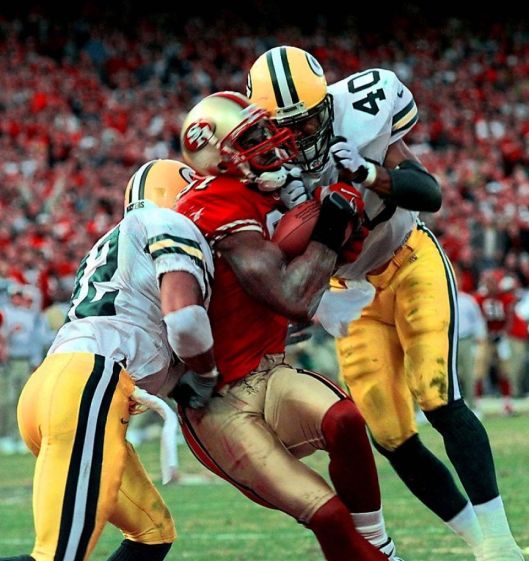
Maybe not a HOF, but a great crunch time catch (literal and figurative) by Terrell Owens, San Francisco 49ers vs. Green Bay Packers, Wildcard Game, Candlestick Park, January 3, 1999. (http://sfgate.com).

Maybe not a HOF, but a great crunch time catch (literal and figurative) by Terrell Owens, San Francisco 49ers vs. Green Bay Packers, Wildcard Game, Candlestick Park, January 3, 1999. (http://sfgate.com).

As this spring semester begins for me at UMUC — a cruel euphemism in January with a windchill around -10°C and a major winter storm approaching the Mid-Atlantic — I’ve reminded myself of the same calendar twenty-eight years ago. As I’ve already noted through my blog and through Boy @ The Window, this was to be a make-or-break semester for me. I had to step up my game at the University of Pittsburgh or go home. And by home, I mean to 616, a place in Mount Vernon, New York that might as well been my burial plot if I had managed to lose my Challenge Scholarship after that Winter Term 1988.

As I wrote in my book

Despite my advisor, I decided to take a full load of classes, balancing two math courses with two history ones, with “rocks for jocks” Geology being the fifth one. The others were Western Civ II, Roman History, Calculus II (the regular one, not Honors), and Logic.

It was to be a sixteen-credit semester. My advisor, a one-time PhD candidate in the History Department at Pitt (talk about life have no coincidences, past, present or future), thought that after my 2.63 first semester, that I had no business making my college schedule more difficult. But after four years of Sylvia Fasulo at Mount Vernon High School, I decided I was through taking advice about taking it easy. I might’ve not known much about my inner self in January ’88, but I knew this much. I was never the guy to take the easy, path-of-least-resistance road in my education. Fact is, I never had the choice of an easy road at any point in my life.

The only obviously easy course of the five I took was Geology 89, and it was only easy because it was a lecture hall course with three multiple choice exams and one textbook. Calc II — with its focus on integrals, volumes, spheres, and other pre-differential calculations — I figured would be easier than Honors Calc I, partly because I excelled on this part of the AP Calculus course the year before (I probably earned my 3 on the AP Calc BC exam on the strength of that work), and partly because this wasn’t an Honors course.

Advanced logic equations, January 20, 2016. (http://www.galilean-library.org).

Advanced logic equations, January 20, 2016. (http://www.galilean-library.org).

Then there was Logic. An ironic choice of a title, since the course didn’t make sense to me from day one. Inductive and deductive reasoning, so the British-born professor told us the first day. With so many symbols and few numbers, how could I consistently deduce an answer to any logic equation? And, what the heck did any of this have to do with being a Computer Science major, anyway?

As for Western Civ II and Roman History, I was surprised how easy I found both courses by the third week, especially after my debacle in East Asian History the month before. But then again, I didn’t miss a single class, I stayed ahead on my readings — and though I knew nearly half of the material going in — and studied as if I’d never been an A student in a history course before.

I had taken the shame of the first semester, the embarrassment of my internalized -isms and imperfections, the anger I directed toward myself, my family, and my idiot dorm mates and let it fuel me. I was on a righteous path of academic vengeance. At least that’s what I thought at the time.

A Planters Peanut Bar, April 25, 2011. (Evan-Amos via Wikipedia). Released to public domain via Creative Commons CC0 1.0 Universal Public Domain Dedication.

A Planters Peanut Bar, April 25, 2011. (Evan-Amos via Wikipedia). Released to public domain via Creative Commons CC0 1.0 Universal Public Domain Dedication.

That sober, almost single-minded focus got me noticed, even though it was my attempt at trying to lay low. I made quite a few friends that semester, most of whom I still call friend today. All of them anywhere between one and twenty years older than me. Call it a sense of maturity, my angered march toward my future, or the sense that I needed to be around folks whose lives had taken at least half as many twists and turns as my own. Whatever it was, I ended up on a path where having a social life would play as much a role in saving my educational future as showing up to all but four lectures in a sixteen-week semester.

I finished that second semester on the Dean’s List with a 3.33 GPA, and a first-year GPA of 3.02. Two A’s (my history classes), an A- in Geology, a B in Calc II, and a C+ in Logic (I did learn a few things even in that course). By the end of April, I was already thinking about switching majors to History. Of more immediate importance was my saving my scholarship for year number two. Not to mention, having friends of any significance for the first time since elementary school.

====================================================

Affirmative action opponents from Supreme Court Justices Antonio Scalia, Clarence Thomas, and Chief Justice John Roberts — as well as Allan Bakke, Jennifer Gratz, Barbara Gruttinger, and Abigail Fisher — all claim that efforts to use the admissions process to bring racial (and gender and socioeconomic) diversity to college campuses is discriminatory. The College Board and ETS cite their statistics to show that the SAT is especially predictive of a student’s performance in the first semester or first year. Anyone working on college retention — especially for underrepresented students — recognizes that nearly half of all students who drop out of college do so after the first two semesters.

Orange Crush can crushed, June 8, 2012. (Susan Murtaugh via Flickr.com).

Orange Crush can crushed, June 8, 2012. (Susan Murtaugh via Flickr.com).

I knew none of this my second semester at Pitt. No one could’ve predicted my first semester’s depression or the single-minded channeling of anger and intellectual resources my second, least of all me. And no, Justice Scalia, college at a school of the stature of the University of Pittsburgh wasn’t too hard for me. It wouldn’t have been too hard for me at any other university for that matter. Life was. And yes, Ms. Gratz and Ms. Fisher, race played a significant role in where I was, where I wanted to be, and how I got there. Just not to your entitled, narcissistic disadvantage.

As for ETS and the College Board, your predictions of my struggles and triumphs based on my 65th percentile 1120 score from October ’86 were more than a bit premature. And not just mine. Fact is, the vast majority of people like me attending predominantly White institutions graduate, whether the campus climate is welcoming or not. However, having a welcoming climate, just as the one I began to discover my second semester, really helps. I guess you couldn’t predict that.

The Cold Light of Grades

05 Tuesday Jan 2016

Posted by decollins1969 in 1, Academia, Boy @ The Window, culture, earth, wind & fire, Eclectic, Jimme, Mount Vernon High School, Mount Vernon New York, My Father, Pittsburgh, Pop Culture, race, University of Pittsburgh, Work, Youth

≈ Leave a comment

Tags

Ann Jannetta, Challenge Scholarship, Continental Airlines, Crush #2, Dean's List, Disillusionment, East Asian History, Financial Aid, General Foods, Grades, Grinding, Homesickness, Humanities, Internalized Racism, Masculinity, Mom, Mother-Son Relationship, MVHS, Newark International Airport, Phyllis, Pitt, Racism, Self-Discovery, Sexism, Stereotype Threat, Travel


University of Pittsburgh after a snow storm, Cathedral of Learning, downloaded January 5, 2016. (http://www.everystockphoto.com).

University of Pittsburgh after a snow storm, Cathedral of Learning, downloaded January 5, 2016. (http://www.everystockphoto.com).

Dateline, Tuesday, January 5, 2016. Exactly twenty-eight years ago on this day and date, I left Mount Vernon and New York for my second semester at the University of Pittsburgh. I sensed, but did not know, that this was a make-or-break time for me as a student and as a person. At least when that day began. I had a 5 pm Continental Airlines flight out of Newark (my last time flying out of there, thank God!), and had plenty of time to kill before catching a cab to East 241st at 2 pm to catch the 2 Subway to 42nd, the Shuttle to Grand Central, and then the Carey Bus to New Jersey.

Then the mailman arrived a bit earlier than I expected, around 12:30 pm. I’d been anticipating and dreading this moment for seventeen days, since Saturday, December 19, the morning of my last final in Pascal.

The day I was scheduled to go back to Pittsburgh was also the day I finally received my grades. I earned an easy A in Astronomy, a B- in Pascal, and a C in Honors Calc. All three of those grades I expected. The C in East Asian History was completely unexpected. My grade point average for the semester gave me a 2.63 to start my postsecondary career. That might’ve been good enough for most folks. But of course not for me. My Challenge Scholarship absolutely depended on me maintaining a minimum 3.0 average at the end of every school year in order for me to stay eligible. That was my wake up call to what I’d allowed Phyllis, and my thoughts of her and me — and of her with me — to do to me. I didn’t even give Mom the chance to see my grades.

Because I was seventeen when my first semester began, my Mom was still the responsible adult and my Mom’s address the primary address for my academic records. This was the first and last time I received my Pitt grades this way.

I was so mad. But I was more disillusioned than angry, especially with myself and my view of the world. I knew I had no margin for error this Winter/Spring semester at Pitt. I needed to raise my overall GPA to a 3.0 or higher in order to keep my academic scholarship for my sophomore year. I could barely afford Pitt as it was, between room and board and books. It wasn’t as if I could depend on Mom and my father to keep sending me money. They had sent a total of $480 my way that first semester. I was still $1,200 behind on my Pitt bill, even with student loans and me working sixteen hours a week.

The days after I got back to my dorm I spent assessing my situation and what to do about it. The first decision I made was to consolidate the funds I managed to secure at the end of December. I had General Foods cover my remaining room and board payments for the school year, increased my Stafford Loan amount for the semester, and marched down to Thackeray Hall. I waited all day to take care of my bills, get my few hundred dollars of leftover cash from all of my aid — all of which I needed for books — and registered for classes. The last part took the most time, and was the hardest to do. The low the second morning of the semester was two below zero, and the high that day was eight above. Fahrenheit, not Celsius. I stood in line outside for over an hour in that weather surrounded by two feet of snow with the occasional winds and snow drifts before getting inside at nine that morning.

But in the moments I had that week, between some quiet time for myself and in discussing my performance with two of my professors (I just couldn’t believe I earned a C in East Asian History!), I realized two or three things. One was that I over-performed, given how depressed I was the last seven weeks of the semester. I missed nearly three out of every four classes in November, and nearly forty percent of my East Asian History class during the entire semester. I went without a textbook for Honors Calc I after someone stole it from my job in the computer labs in the Cathedral of Learning at the end of October. I managed a solid C in the course anyway. It could’ve been much worse.

Two was that my East Asian History professor Ann Jannetta was right. I really was “lucky” to have managed a C in an upper-level history course my first semester of college. I still acted as if I was in Humanities at A.B. Davis Middle School or MVHS, that a C was some indication of low IQ or confirmation that Whites had bigger brains or something. Jannetta was very encouraging. It was the first time any of my professors had made me feel like I belonged in college.

The most important thing I realized, though, was that I couldn’t let anyone or anything get in the way of me bringing my A-game (or A- game, maybe) every semester and in every course. Phyllis didn’t matter. My internalized sexism or what others though of me because of their racism didn’t matter. My idiot classmates or parents didn’t matter. Heck, being hungry, cold, and short on money didn’t matter. All that mattered was my ability to do what I did best back then. Get A’s in bunches when I needed to.

Of course, all these things really did matter. I merely decided to play the game of college that semester with a combination of fear and anger, arrogance and obliviousness. To the tune of a 3.33 and the Dean’s List! Yay me!

But when that semester ended on Saturday, April 30, those demons and distractions resurfaced. Oh, the days before I spent five days homeless and weeks eating tuna fish and pork neck bones!

Fisher v. University of Texas: Supreme Court Takes Up Affirmative Action (Again!)

09 Wednesday Dec 2015

Posted by decollins1969 in 1, Academia, Boy @ The Window, culture, Eclectic, Mount Vernon High School, Politics, Pop Culture, race, University of Pittsburgh, Youth

≈ Leave a comment

Tags

Affirmative Action, Bakke v. University of California at Davis (1978), Delusions of Grandeur, Fisher v. University of Texas (2015; 2012), Gratz v. Bollinger (2003), Grutter v. Bollinger (2003), Justice Antonin Scalia, Justice Clarence Thomas, Narcissism, Plessy v. Ferguson (1896), Racism, Social Darwinism, Stereotype Threat, Supreme Court, Supreme Court decisions


Abigail Fisher, second from right, listens as her lawyer Bert Rein, center, speaks with reporters, Supreme Court, Washington, DC, December 9, 2015. (J. Scott Applewhite/AP; http://msnbc.com).

Abigail Fisher, second from right, listens as her lawyer Bert Rein, center, speaks with reporters, Supreme Court, Washington, DC, December 9, 2015. (J. Scott Applewhite/AP; http://msnbc.com).

I wrote this a bit more than three years ago, when the Supreme Court first heard the case of one Abigail Fisher against the University of Texas admissions policy in October 2012:

Abigail Fisher has joined Allan Bakke, Jennifer Gratz/Patrick Hamacher and Barbara Grutter as part of a list of Whites who have used race as an excuse because they faced a road block for maybe the only time in their lives. The idea that we should have race-neutral college and graduate school admissions policies in a country that’s far from race-neutral shows an enormous sense of unacknowledged entitlement and privilege.

Here’s why. Using myself as an example, I graduated Mount Vernon HS (NY) in 1987, 14th out of 545 students (the top 3% of my class), with a 3.83 GPA on a 4.0 scale, with an 1120 SAT (a 1220 on today’s SAT). I didn’t get into Yale, but was accepted at Columbia and the University of Pittsburgh. Money was an issue, as I ended up going to Pitt because they offered me an academic scholarship, while Columbia offered a private investigator into my father’s finances. Still, my grades would’ve easily knocked Fisher out of contention at UT-Austin, as well as Gratz and Hamacher.

I also think about the two decades I’ve spent teaching high school, college and graduate students. The most consistently obstinate students I’ve taught have been White students who thought they knew more than me. They didn’t get that context always matters when interpreting history, especially something like affirmative action. For those students, for Fisher, et al., and for the Supreme Court, entitlement matters more than context. Facts, circumstances be damned.
Read the Article at HuffingtonPost

I was wrong about one thing in my earlier post. I based my comparison of my SAT score from 1986 on revisions to the standardized test in the 1990s, not in the 2000s, when they added a third section. Based on that, my educated guess for a score in that period would’ve been between a 1850 and 2000 (between the 60th and 70th percentile).

Today, the Supreme Court heard from Fisher’s and the University of Texas’ lawyers — again, about the efficacy of using race as part of a larger formula for achieving demographic diversity in the state higher education system. During today’s oral arguments, the ever-brilliantly racist Justice Antonin Scalia pressed the University of Texas on why they needed to account for race (and apparently, for class as well) in their admissions plan at all, considering the academic issues many Black student face.

Scalia said, “it does not benefit African-Americans to — to get them into the University of Texas where they do not do well, as opposed to having them go to a less-advanced school, a less — a slower-track school where they do well.” He added that “most of the black scientists in this country don’t come from schools like the University of Texas. They come from lesser schools where they do not feel that they’re — that they’re being pushed ahead in — in classes that are too — too fast for them.”

It is fairly obvious that Scalia and at least three other justices (including his intellectual puppet Justice Clarence Thomas) would do away with affirmative action sooner than Scalia and Thomas could suck down two one-gallon tubs of rocky road ice cream. But the veneer of racism, the assumption that Blacks are “too slow” for elite public universities, the Social Darwinist interpretation of higher education? Or assuming that Blacks who go to lesser known institutions, particularly HBCUs are getting a lesser and slower education as a result? Scalia doesn’t know his history, and doesn’t care to know the history of Blacks in higher education at all.

Given the direction the Supreme Court is leaning, it may take a burgeoning Black Lives Matter movement of the scope of the Civil Rights Movement of fifty years ago to reverse this court’s attempt at a twenty-first century version of Plessy v. Ferguson (1896). Let’s not forget, though. There are millions of Scalias and Thomases out there who firmly believe that African Americans — even those with excellent grades, high test scores, and lots of passion and intellectual drive — deserve nothing more than a jail cell, a janitor job, or a bullet to the brain.

But what makes their perspective worse is that Scalia, et. al, are cutting off their collective noses to spite the country’s face. It won’t be just high-achieving African American students losing out if the court curtails or renders race-based admissions policies unconstitutional. A decision like that will hurt millions of White students as well. Not just because segregated higher education could eliminate a diversity of ideas and thinking and will poison the wealth of knowledge and efforts toward a better American society through the benefits of the college experience. It will also mean that Whites like Abigail Fisher will no longer have an easy and vulnerable scapegoat for their educational failures. The Abigail Fishers will be experiencing their own form of stereotype threat. Oh, how will they hold on to their narcissism, their intellectual delusions of grandeur then?

My One Drunk Moment, An Un-Sober Mind

21 Saturday Nov 2015

Posted by decollins1969 in 1, Academia, Boy @ The Window, culture, Eclectic, High Rise Buildings, Jimme, Mount Vernon High School, Mount Vernon New York, My Father, Pittsburgh, Politics, Pop Culture, race, University of Pittsburgh, Youth

≈ Leave a comment

Tags

Antisocial Behavior, Authentic Blackness, Black Masculinity, Blackness, Busch Beer, Coping Strategies, Crush #2, Disidentification Hypothesis, Drunk, Internalized Racism, Invisibility, Jealousy, Lothrop Hall, Misogyny, MVHS, Phyllis, Pitt, Self-Discovery, Self-Loathing, Self-Reflection, Sexism, Underage Drinking


16-ounce "Pounder" can of Busch Beer, November 19, 2012. (http://price2watch.com)

16-ounce “Pounder” can of Busch Beer, November 19, 2012. (http://price2watch.com)

As the son of an alcoholic father (the latter who’s been on the wagon for more than seventeen years now), I have almost always maintained control over my own alcohol intake. I’m always the designated driver, and rarely will I have three beers in one year, much less in one evening. My favorite drink is cranapple juice mixed with Disaronno, followed by Angry Orchard hard apple cider.

I have also always believed that I should be the same person, sober, buzzed, drunk and otherwise. If I’m generally a feminist on my best behavior in the classroom or at work, then I should be the same way at a dive bar on my second screwdriver. My low tolerance for bullshit — including and especially my own — should always be on display.

Both of these strands of how I’ve lived my life met a weekend of contradictions on this day/date twenty-eight years ago. In the wake of my Phyllis (Crush#2) crash-and-burn obsession and subsequent depression, I began hanging out with dorm mates at Lothrop Hall who were already dropping out of college socially by Week 11 of the Fall ’87 semester. That was a mistake of epic proportions.

Lothrop Hall (we lived on the fourth floor in 1987-88), University of Pittsburgh, June 8, 2008. (TheZachMorrisExperience via Wikipedia). Released to the public domain via CC-SA-3.0.

Lothrop Hall (we lived on the fourth floor in 1987-88), University of Pittsburgh, June 8, 2008. (TheZachMorrisExperience via Wikipedia). Released to the public domain via CC-SA-3.0.

My downward spiral was made worse a week earlier with a burglary on a Monday night at the end of October. While I took a bathroom break at the computer lab, someone stole my Calculus textbook. I felt violated, especially since it happened at work. It made me more distrustful of the people I worked with and of Pitt students in general. And after Phyllis’ wonderful response, I all but stopped going to class. I missed most of my classes the month of November, only showing up for exams or if my mood had let up long enough to allow me to function like normal. The weekend before Thanksgiving, I allowed my dorm mates to cheer me up by getting a couple of cases of Busch Beer. These were the Pounder type, sixteen-ounce cans. After getting Mike to get us the cases, we went back to Aaron’s room and started drinking. I downed four cans in fifteen minutes, and was drunk within a half hour. I started throwing around the word “bitch.” Anytime anyone mentioned Phyllis’ name — or any woman’s name for that matter — one of us said the B-word and we’d guzzle down some beer. I was drunk, but not so drunk I didn’t know what was going on around me. That night, my geeky acquaintances started calling me “Don” and “Don Ho,” since I was the life of that illegal party. I would’ve been better off smoking some cheap herb with Todd and Ollie. I recovered from my bender in time to go home for Thanksgiving, but I was in a fog for the rest of the semester.

This was how the end of my 2.63 first semester at Pitt unfolded. But that was hardly the only thing that came out of last weeks of ’87. For a long time, I was angry with myself. About Phyllis. About allowing Phyllis, my dorm mates — anyone, really — affect my emotions, my thinking, and actions over any significant period of time. So for about three months, I put everyone in my life into two categories. Men were “assholes, women were “bitches,” and I was done with humanity. And all by my eighteenth birthday.

I wasn’t just being sexist. I was being downright antisocial. I had internalized issues, about where I fit in this new world of college. I would never be man enough, Black enough, “White” enough, smart enough, athletic enough, or cool enough. At least that’s what I thought in late-November ’87.

Antisocial bumper sticker, November 21, 2015. (http://www.quotationof.com/).

Antisocial bumper sticker, November 21, 2015. (http://www.quotationof.com/).

I look back at that time and realize how stupid I was twenty-eight years ago. To think that I could go out in the world, attend a four-year institution, and not have my assumptions about the world, about people, and about myself challenged. That’s like going overseas to visit some ruins, but never meeting the people who live there (Or, in this case, like rich White Americans doing Sandals and other brown-skinned service-based vacations).

Phyllis and my dorm mates at Lothrop Hall weren’t even the first step of that process. They were the last step of a process of controlling and protecting myself from my years of living in the shadows in Mount Vernon, New York. The coping strategies I had honed for five years to survive 616 and Humanities and MVHS had barely worked. By the end of my first semester, they were completely useless. I came to realize that a strategy to seal myself up from all criticism and praise, to keep humanity out of my life, was doomed to fail. There was no way to keep the world from forming a first impression of me, no matter how many layers of invisibility I attempted to wear. But there was a way to reshape how I saw myself and the world.

← Older posts
Newer posts →

Boy @ The Window: A Memoir

Boy @ The Window: A Memoir

Places to Buy/Download Boy @ The Window

There's a few ways in which you can read excerpts of, borrow and/or purchase and download Boy @ The Window. There's the trade paperback edition of Boy @ The Window, available for purchase via Amazon.com at http://www.amazon.com/Boy-Window-Donald-Earl-Collins/dp/0989256138/

There's also a Kindle edition on Amazon.com. The enhanced edition can be read only with Kindle Fire, an iPad or a full-color tablet. The links to the enhanced edition through Apple's iBookstore and the Barnes & Noble NOOK edition are below. The link to the Amazon Kindle version is also immediately below:

scr2555-proj697-a-kindle-logo-rgb-lg

Boy @ The Window on Amazon.com: http://www.amazon.com/Boy-The-Window-Memoir-ebook/dp/B00CD95FBU/

iBookstore-logo-300x100

Boy @ The Window on Apple's iBookstore: https://itunes.apple.com/us/book/boy-the-window/id643768275?ls=1

Barnes & Noble (bn.com) logo, June 26, 2013. (http://www.logotypes101.com).

Boy @ The Window on Barnes & Noble: http://www.barnesandnoble.com/w/boy-the-window-donald-earl-collins/1115182183?ean=2940016741567

You can also add, read and review Boy @ The Window on Goodreads.com. Just click on the button below:

Boy @ The Window

Twitter Updates

Tweets by decollins1969
  • RSS - Posts
  • RSS - Comments

Archives

  • June 2025
  • April 2023
  • September 2022
  • August 2022
  • July 2022
  • June 2022
  • May 2022
  • April 2022
  • March 2022
  • January 2022
  • December 2021
  • November 2021
  • October 2021
  • September 2021
  • August 2021
  • July 2021
  • June 2021
  • April 2021
  • March 2021
  • February 2021
  • January 2021
  • December 2020
  • November 2020
  • October 2020
  • September 2020
  • August 2020
  • July 2020
  • May 2020
  • April 2020
  • March 2020
  • January 2020
  • December 2019
  • November 2019
  • August 2019
  • July 2019
  • June 2019
  • May 2019
  • April 2019
  • March 2019
  • February 2019
  • January 2019
  • December 2018
  • November 2018
  • October 2018
  • September 2018
  • August 2018
  • July 2018
  • June 2018
  • May 2018
  • March 2018
  • February 2018
  • January 2018
  • December 2017
  • November 2017
  • October 2017
  • September 2017
  • August 2017
  • July 2017
  • June 2017
  • May 2017
  • April 2017
  • March 2017
  • February 2017
  • January 2017
  • December 2016
  • November 2016
  • October 2016
  • September 2016
  • August 2016
  • July 2016
  • June 2016
  • May 2016
  • April 2016
  • March 2016
  • February 2016
  • January 2016
  • December 2015
  • November 2015
  • October 2015
  • September 2015
  • August 2015
  • July 2015
  • June 2015
  • May 2015
  • April 2015
  • March 2015
  • February 2015
  • January 2015
  • December 2014
  • November 2014
  • October 2014
  • September 2014
  • August 2014
  • July 2014
  • June 2014
  • May 2014
  • April 2014
  • March 2014
  • February 2014
  • January 2014
  • December 2013
  • November 2013
  • October 2013
  • September 2013
  • August 2013
  • July 2013
  • June 2013
  • May 2013
  • April 2013
  • March 2013
  • February 2013
  • January 2013
  • December 2012
  • November 2012
  • October 2012
  • September 2012
  • August 2012
  • July 2012
  • June 2012
  • May 2012
  • April 2012
  • March 2012
  • February 2012
  • January 2012
  • December 2011
  • November 2011
  • October 2011
  • September 2011
  • August 2011
  • July 2011
  • June 2011
  • May 2011
  • April 2011
  • March 2011
  • February 2011
  • January 2011
  • December 2010
  • November 2010
  • October 2010
  • September 2010
  • August 2010
  • July 2010
  • June 2010
  • May 2010
  • April 2010
  • March 2010
  • February 2010
  • January 2010
  • December 2009
  • November 2009
  • October 2009
  • September 2009
  • August 2009
  • July 2009
  • June 2009
  • May 2009
  • April 2009
  • March 2009
  • February 2009
  • January 2009
  • December 2008
  • November 2008
  • October 2008
  • September 2008
  • August 2008
  • July 2008
  • June 2008
  • May 2008
  • April 2008
  • March 2008
  • February 2008
  • January 2008
  • December 2007
  • November 2007
  • October 2007
  • September 2007
  • August 2007
  • July 2007
  • June 2007

Recent Comments

decollins1969's avatardecollins1969 on No Good Teaching Deed Goes…
Mary Rose O’Connell's avatarMary Rose O’Connell on No Good Teaching Deed Goes…
Lyndah McCaskill's avatarLyndah McCaskill on The Raunchiest of Them Al…

NetworkedBlogs on Facebook

NetworkedBlogs
Blog:
Notes From a Boy @ The Window
Topics:
My Life, Culture & Education, Politics & Goofyness
 
Follow my blog

616 616 East Lincoln Avenue A.B. Davis Middle School Abuse Academia Academy for Educational Development AED Afrocentricity American Narcissism Authenticity Bigotry Blackness Boy @ The Window Carnegie Mellon University Child Abuse Class of 1987 CMU Coping Strategies Crush #1 Crush #2 Death Disillusionment Diversity Domestic Violence Economic Inequality Education Family Friendship Friendships Graduate School Hebrew-Israelites High-Stakes Testing Higher Education History Homelessness Humanities Humanities Program Hypocrisy Internalized Racism Jealousy Joe Trotter Joe William Trotter Jr. K-12 Education Love Manhood Maurice Eugene Washington Maurice Washington Misogyny Mother-Son Relationship Mount Vernon High School Mount Vernon New York Mount Vernon public schools Multiculturalism MVHS Narcissism NFL Pitt Pittsburgh Politics of Education Poverty President Barack Obama Race Racial Stereotypes Racism Relationships Self-Awareness Self-Discovery Self-Reflection Sexism Social Justice Teaching and Learning University of Pittsburgh Violence Whiteness Writing

Top Rated

Blog at WordPress.com.

  • Subscribe Subscribed
    • Notes from a Boy @ The Window
    • Join 103 other subscribers
    • Already have a WordPress.com account? Log in now.
    • Notes from a Boy @ The Window
    • Subscribe Subscribed
    • Sign up
    • Log in
    • Report this content
    • View site in Reader
    • Manage subscriptions
    • Collapse this bar
 

Loading Comments...