Boy @ The Window, Now in Paperback


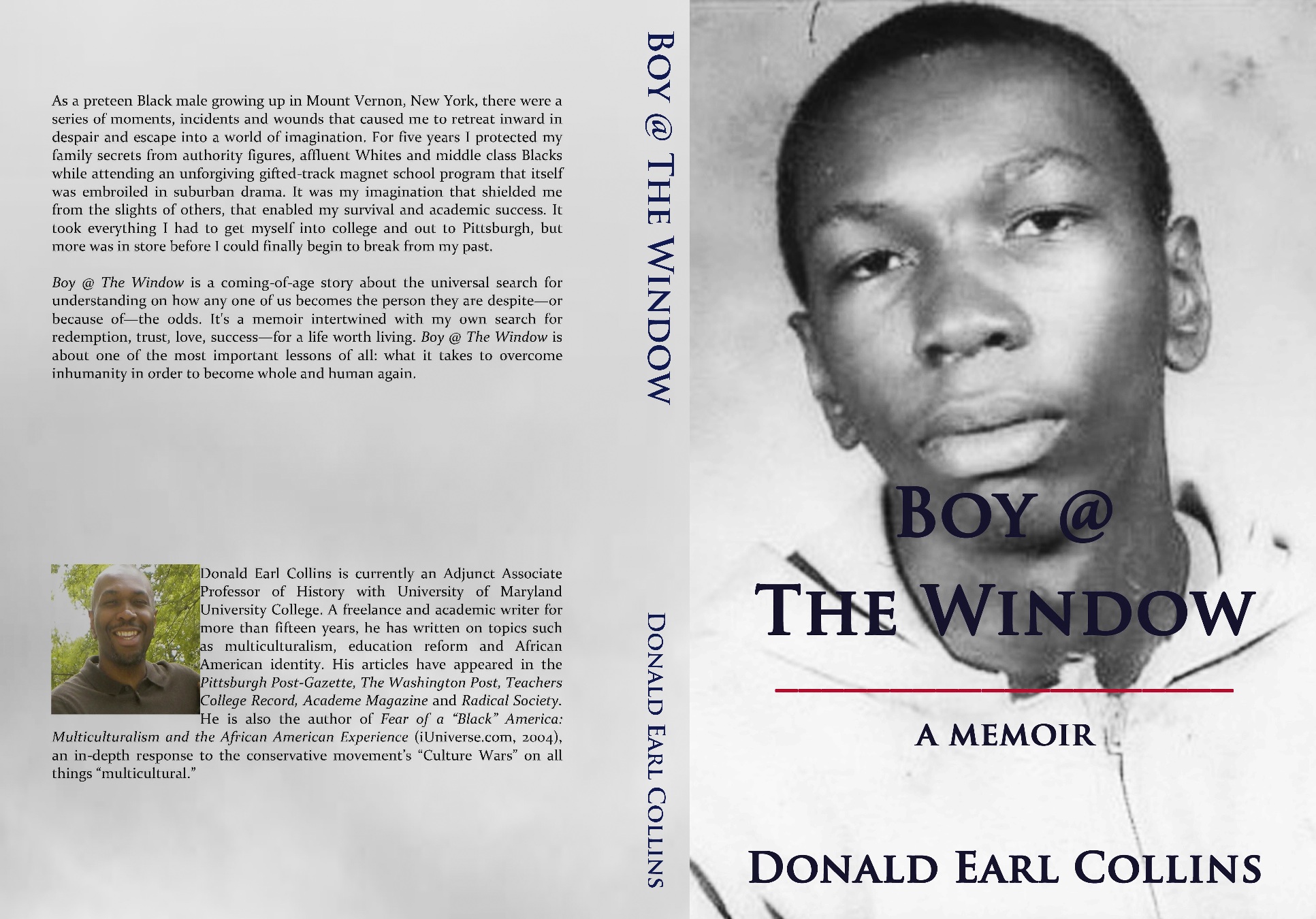
Boy @ The Window, front and back cover, and side, November 11, 2013. (Donald Earl Collins).

Boy @ The Window, front/back cover, and side, November 11, 2013. (Donald Earl Collins).

I have some really good news. My book Boy @ The Window is not just an e-book anymore. I now have a trade paperback edition, out and available through Amazon.com as of yesterday (via http://www.amazon.com/Boy-Window-Donald-Earl-Collins/dp/0989256138/). You can also order and buy Boy @ The Window the old-fashioned way — directly through your local bookstore.

Please take a look, support, buy, read, comment and share. I will post as reviews and opportunities to talk about the book arise. Thanks to all of you who’ve supported my blog and the path to Boy @ The Window over the past six years!

Ambient Hero

Tags

, , , , , , , , , , , , , , ,


Tom Welling as Clark Kent/The Blur (almost Superman) from Smallville series, November 18, 2013. (http://latimesherocomplex.files.wordpress.com/).

Tom Welling as Clark Kent/The Blur (almost Superman) from Smallville series, April 2011. (http://latimesherocomplex.files.wordpress.com/).

In the years between the chronological end of Boy @ The Window (February ’90) and when I began dating my wife (December ’95) of now thirteen and a half years, my relationship life was hit and miss, at times in a silo, and for two of those years, almost completely nonexistent. Grad school took up much of my time and energy, and there were times I barely had the money to catch a bus to campus at Pitt or Carnegie Mellon, much less go out for a dinner and a movie.

It was at the end of ’94, after becoming ABD (All But Dissertation for those not pursuing PhDs) that I felt I finally had the time to take my dating life more seriously. I realized that I’d been separating my sex life from my wanting-a-more-serious-relationship-life. Casual sex was fine, but I still found it more daunting to be in a relationship when I wanted more. So did the women in my life back then.

These realizations came to a head in my relationship with a woman I’ll call AMB for the purposes of this post. I’d known AMB off and on since ’90, as a result of a mutual friend whom I’d worked with during my Western Psych job years. By ’95, she was in grad school herself at the University of Maryland, working on her master’s degree in history. It was a different area in the field, luckily, so no frequent debates about how many historians can dance on the head of a pin.

During that summer and into the fall, we began seeing each other off and on. I found it wonderful at first. After years of grad school, of not even being remotely attracted to anyone who was a historian, I could have a conversation with someone about my doctoral thesis research and about my family at the same time. And all without having to explain it as if I were teaching a class or their eyes glazing over!

But there were issues right from the start. At the time, AMB lived with her mother in Maryland, and with me not owning a car, it was a four-and-a-half-hour trip by bus, longer by train, and costly on a grad school budget if I planned on renting a car. My dissertation research, though, brought me to the DC area frequently. So I visited her in August, October and November, while she came to visit me in July and October as well.

Oscillating balls hitting each other, November 18, 2013. (http://www.burbuja.info).

Oscillating balls hitting each other, November 18, 2013. (http://www.burbuja.info).

There was also the matter of her little one. At the time, I couldn’t have imagined working on an M.A. or PhD with a young son or daughter to raise. And although I admired how AMB was juggling, she was also struggling with this as well. Between her ex and the psychological abuse that came with him, her daughter, her mother and grad school, it was no wonder that our phone conversations could turn from boyfriend-girlfriend to psychologist-client on a dime.

The biggest issue, though, was defining the nature of our more-than-friendship as it began to evolve after July ’95. Depending on the week and what set of friends were around, AMB either introduced me as her “boyfriend” or as her “friend.” The first time this occurred, we were around a group of her U Maryland friends during my October visit, the weekend before the Million Man March. But one-on-one or over the phone, she didn’t slip up. I found it a bit strange, even as someone who didn’t date between December ’92 and October ’94.

Then, on AMB’s last visit with me in Pittsburgh, at the end of October ’95, she did it again, at Hillman Library, among a group of our mutual acquaintances and friends. What really clinched it for me, though, was when she added that I was her “hero.” That was a record scratcher for me. Really? How many lives had I saved? Could I shoot laser beams out of my eyes or phase through walls? After having put two younger women on a pedestal in my previous life (Crush #1 and Crush #2, Wendy and Phyllis — see blog), I couldn’t — no, I wouldn’t — allow someone to do the same to me. Especially someone with much more serious issues in her life than dating and high school.

So when AMB invited her up to her hotel room, I came up, but I definitely wasn’t in any mood for anything other than an explanation. She didn’t really give me one then. And three weeks later, after ditching our date to see the Kiss of the Spider Woman musical (it was playing in Baltimore at the time, headlined by Vanessa Williams) by going to see it with her friends two days earlier (all without telling me in advance), I’d had enough.

Vanessa Williams in Kiss of the Spider Woman poster, circa 1994. (http://geminibroadway.com).

Vanessa Williams in Kiss of the Spider Woman poster, circa 1994. (http://geminibroadway.com).

On this date eighteen years ago, we had a two-hour phone conversation, where I broke up with AMB. I told her that I’d tired of our “oscillating relationship, where I was just a ‘friend’ one minute, and a ‘boyfriend’ the next.” I told her that she needed to figure out herself and her relations with her ex, her daughter and her mother if she really wanted a more meaningful relationship in the future.

I’d broken off relationships before, but not like this. Mostly, I’d just ignore phone calls and email, or say something so sarcastic that the woman would get the message. This was hard. I was destroying AMB’s image of me as a hero, not just agreeing not to kiss or hug her anymore. Or maybe, just maybe, I was doing what a real hero does, which in this case meant not taking advantage of another human being at their most vulnerable.

Bearing False Witness At Work – It Can Hurt

Tags

, , , , , , , , , , , , , , , ,


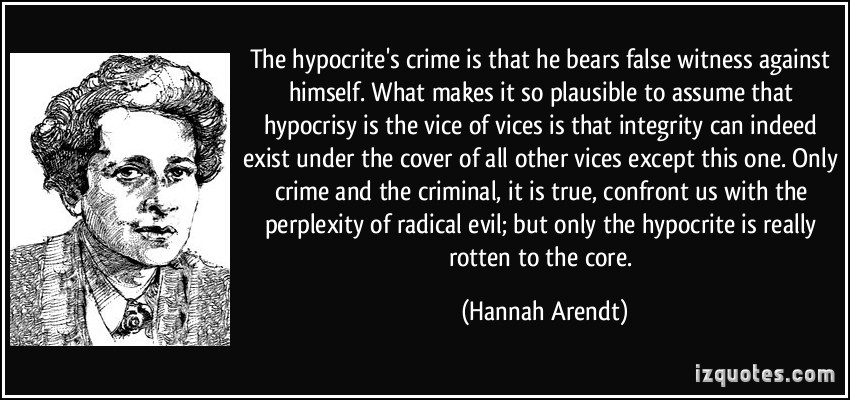
Hannah Arendt on false witnesses, November 16, 2013. (http://izquotes.com/).

Hannah Arendt on false witnesses, November 16, 2013. (http://izquotes.com/).

I’d be remiss if I didn’t at least mention the fact that this week ten years ago, I endured what was the beginning of a three-month period of a hostile work environment (one that was already not-so-optimal to begin with). It was brought on by my then immediate supervisor’s paranoia and jealousy, and intensified by his then undisclosed bipolar disorder. I’ve written about my three years of hell with Ken before on this blog, most notably in “The Messiah Complex At Work, Part 1” from a couple of years ago.

What I haven’t really discussed at all was how I felt about all of this as I went through it. As a man, as a Black man, as a person who believed in social justice, including in a workplace in which we funded social justice projects. I’d only been accused of sexual harassment one other time, by a boss whose best friend had been harassing me at work for the better part of two months, in the early part of ’89. Now, fourteen years later, here was Ken, at an HR meeting he set up, accusing me of saying things that I never said, of thoughts that I never had.

I was already used to being guilty before being innocent. With police. In a public setting, like a supermarket or bookstore. But not at work, and for the most part, not while I was at Pitt or Carnegie Mellon. Why? Because I tended to be at my most guarded while at work back then. In fact, during an exit interview the year before, a former program assistant at New Voices said that I needed to be “more open” at work if a team like ours was ever to reach its full potential. She may have been right. If only I had bosses who were more open, more relaxed, less accusatory, and in Ken’s case, on his meds.

Archie Bunker from All In The Family (1971-78) screen shot, June 2013. (http://www.chicagonow.com/).

Archie Bunker from All In The Family (1971-78) screen shot, June 2013. (http://www.chicagonow.com/).

There are few things worse in one’s job or career than reckless false accusations. Even if proven completely untrue, there are some who’ll choose to look at those accused with less trust and more suspicion. And Ken, for all of his bluster about social justice, had proven himself to be as much of a bigot as former executive director at Presidential Classroom, an openly admitted bigot. He could’ve accused me of insubordination, of wanting his job, of not doing my job well enough. Instead, Ken relied on the whole hyper-sexualized Black male motif, as if my testosterone was dripping right out of my penis, like some animal in heat.

Of course, some of you will say, “He had untreated bipolar disorder. He didn’t know what he was doing. Cut him some slack.” No, I can’t and I won’t. As I’ve noted in another post regarding Ken’s condition, bipolar disorder doesn’t equal insanity or irrational behavior necessarily. I worked for Westchester County Department of Community Mental Health between ’89 and ’92, and for Western Psychiatric Institute & Clinic at Pitt between ’89 and ’91. I became pretty good at understanding the Diagnostic and Statistical Manual for Mental Disorders. I did learn a thing or two from having Dr. Juan Mezzich as a boss while I worked at Western Psych between my junior year and first year of grad school at Pitt. 

Kingda Ka, the world's tallest roller coaster, Six Flags Great Adventure, Jackson, NJ (Exit 7A, NJ Turnpike), September 23, 2006. (Dusso Janladde via Wikipedia). Released to public domain.

Kingda Ka, the world’s tallest roller coaster, Six Flags Great Adventure, Jackson, NJ (Exit 7A, NJ Turnpike), September 23, 2006. (Dusso Janladde via Wikipedia). Released to public domain.

One of the things I learned was that bipolar disorder generally exaggerates existing thoughts and behaviors. The psychosis can often be exasperated by stressful situations. For those with the illness, the highs are way too highthe lows so low that suicidal thoughts can become prevalent. If one tends to be paranoid, the paranoia becomes heightened, as was the case with Ken. Still, even with bipolar disorder, he was acting on his bigoted and paranoia template, there long before bipolar disorder manifested itself in him as an adult.

I understood all of this, even as I went through months of accusations and arbitrary changes to my work schedule. But that didn’t mean that there wasn’t a part of me that felt rage, wanted revenge, wanted to take the physically and emotional stunted twerp and stuff him in a garbage can. Or that I didn’t come to work at AED every day between November ’03 and February ’04 with thought that I should just quit, turn around, go home, watch my newborn son Noah and figure out my next step. Most of all, there were times I wanted to choke Ken until he told the truth, that he was a jealous-hearted bastard who lied about me to HR in order to put me in my place as a Black guy working under a White guy.

But I didn’t. I didn’t because I knew that I was right. I knew, somehow, that things would work out in my favor. I knew that God and the universe would vindicate me. If my life is proof of anything, it’s proof that my truth wins out in the end. Those thoughts dictated my actions and counteracted any feelings of rage or violence I had during those cloudy days. To Jonathan Martin and so many others out there, I think I know how you feel right now. Please hang in there, and hang on to the truth.

October in Portland

Tags

, , , , , , , ,


Panoramic shot of Hawthorne Bridge and downtown Portland, Oregon, October 14, 2013. (http://en.wikipedia.org).

Panoramic shot of Hawthorne Bridge and downtown Portland, Oregon, October 14, 2013. (http://en.wikipedia.org).

I know, I know. It’s November. But this post is still relevant. Five years ago last month, I made one of the toughest career decision I’ve ever faced, and certainly the toughest this side of the twenty-first century. I turned down a job that looked in many respects like a really good fit with my career goals and experiences, a job that on the surface would’ve paid pretty well. My decision to not take this job wasn’t made in a vacuum — this was October ’08, after all, when the US economic slowdown truly became the Great Recession here and around the world. But as it turned out, there are things more important than a higher salary and a job that looks good on a curriculum vitae.

Grantmakers for Education had interviewed me four times in six weeks between August, September and early October ’08. The first three were telephone conversations with various staff members, including the executive director. I already knew of their work through my college access and retention initiative at Academy for Educational Development (AED – now FHI 360). I interviewed for GFE’s program director position, which would’ve made me second or third in charge within the organization. Through interviews and research, I knew that GFE had been around since ’97 as a spin-off from the work of the Council on Foundations — meaning it had some support from the private foundation community. I also knew that they had a total staff of seven people.

But, most important, I knew that GFE’s offices were in Portland, Oregon. It wasn’t a deterrent for me. After all, my wife and I had agreed that any job search of mine would invite the possibility of making a geographic move. The cities, though, had included New York, Philly, Boston, Chicago and Seattle (with some considerations for Toronto and the Bay Area), not Portland specifically. In my mind, Portland, though definitely different from Seattle, was close enough.

By the time I flew out for my in-person interview with GFE on October 2 and 3, ’08, I did feel quite a bit of pressure riding on my interview and the decisions I’d make if offered the job. For one, I’d been privately predicting the economic slide that we now call the Great Recession since ’02. As a result, my consulting work for the second half of ’08 had all but dried up. I was teaching only one class at University of Maryland University College that fall, meaning that we would be going pretty deep into our savings to get through the end of the year. And though Boy @ The Window had attracted the attention of a few literary agents, the Great Recession had affected their businesses and their willingness to take a chance on a not-so-well-known author.
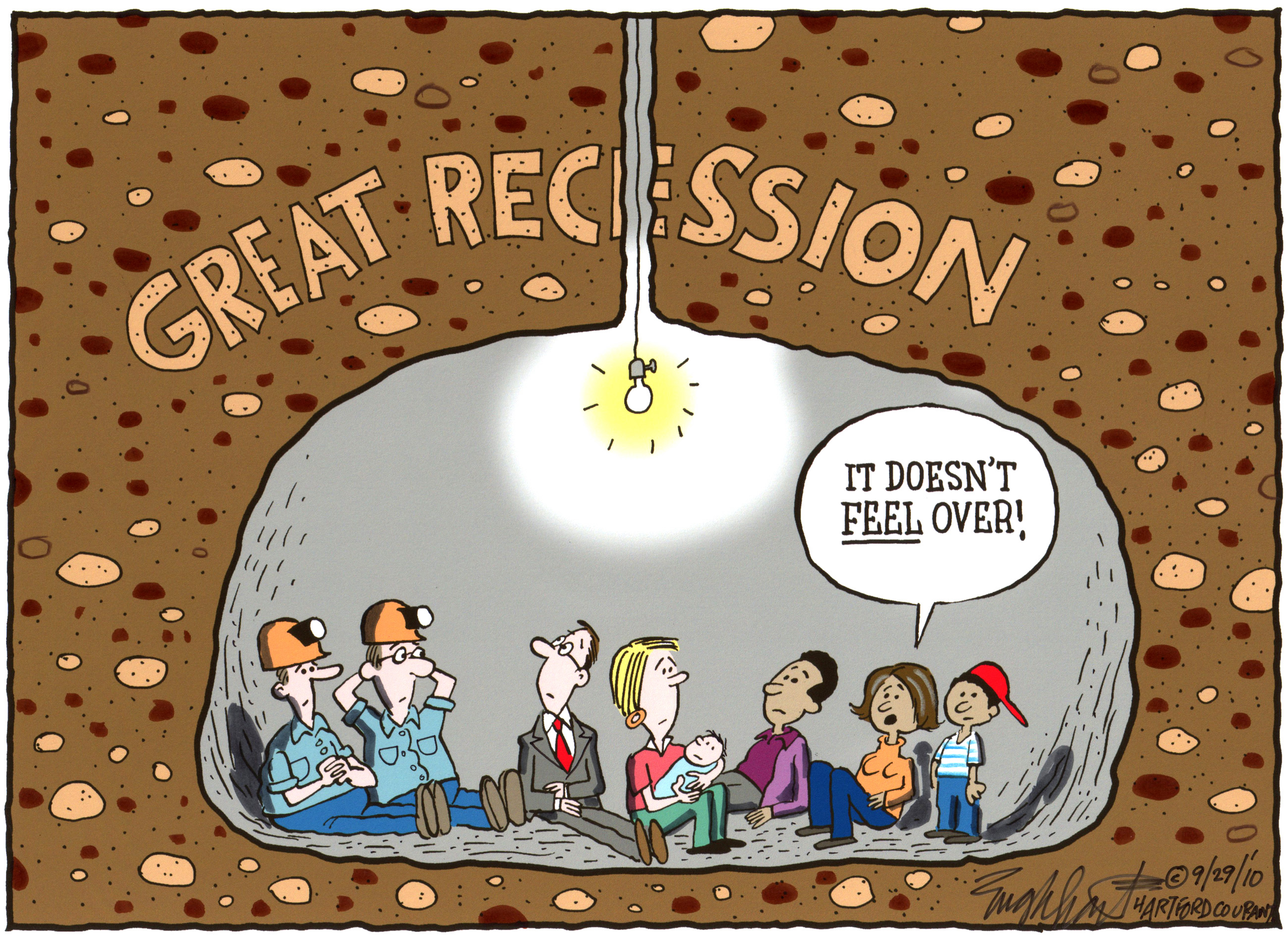
"Great Recession: It doesn't feel over," Bob Englehart, Hartford Courant, September 29, 2010. (http://blogs.courant.com).

“Great Recession: It doesn’t feel over,” Bob Englehart, Hartford Courant, September 29, 2010. (http://blogs.courant.com).

With all that on my mind, it was a wonder that I could focus on anything at all, much less the final interview. Yet I did, and in the process, met with a wonderful staff and found Portland a rather interesting city.

So I wasn’t surprised the following Wednesday that GFE called me to offer me the position. They gave me a low-ball offer, one that was only $5,000 more than I made at my last AED job, and far less than I made as a consultant (at least, when I had work as a consultant). But they did offer $8,000 in moving expenses. We went back and forth on salary and benefits over the next five days.

During that time, my wife and I talked at length about moving to Portland, Noah’s schooling (he was in kindergarten back then), and the negotiations. She finally revealed to me a couple of things I wished she had told me before my third interview. One, she wasn’t interested in moving to Portland (it reminded her too much of Pittsburgh, only without a sizable Black community). Two, she thought that GFE’s small staff and budget would limit my career and put a ceiling on my salary over time.

My wife didn’t want me to take a job and move out there by myself, with her and Noah here in the DC area. Nor did she want me to make a decision based on the momentary whims of the economy or because the job would be a relatively easy one for me. Ultimately, my wife reminded me that I preferred a challenge, work that could be exciting, that paid well, a community with a diverse nature, an organization that offered opportunities for the long-term.

Albert Einstein and his insanity definition, June 2013. (http://liveyourtruelife.org/).

Albert Einstein and his insanity definition, June 2013. (http://liveyourtruelife.org/).

On October 15, GFE came back with their final offer. It was somewhat generous. They increased the salary offer by ten percent, and offered $10,000 in moving expenses. In exchange, my salary would be capped for three years, and they wouldn’t pay into my retirement fund over that period (I’d have to add to it without them matching). They even offered to allow me to work from DC during October and November before moving in December.

Still, reading in between the lines, my wife was right. I could clearly see that if I’d taken this job, my marriage would’ve been over. Maybe not immediately, but it would’ve been a industrial-sized shovel full of dirt toward a buried coffin. The distance would’ve been too great to carry on anything resembling a family. As for my career, I would’ve faced a dead end in the intermediate term — forget about the long-term — financially and otherwise.

So I said “No” to GFE. I stared into the proverbial abyss, knowing that it would be a rough next few months. And it was. But I did pick up several steady consulting gigs in ’09 and ’10. My teaching schedule went from part-time to pretty much full-time by Fall ’10 (still an adjunct contract, though). I made sure that my wife was on board with a job not on our top-cities-to-move-to list before applying.

My decision was as much about finding the right position with the right organization as it was about ensuring the health of my marriage and my family. All have to be in sync on big decisions like this. I’m glad we have that clarity now.

On Maturity and Writing In Text Message Form

Tags

, , , , , , , , , , , , , , , , , , ,


Dulcesita, "i would die for you," November 11, 2013. (http://www.myxer.com).

Dulcesita, “i would die for you,” November 11, 2013. (http://www.myxer.com).

In Boy @ The Window, I have a chapter on my first year at Pitt and the baggage I carried from my last months in Mount Vernon, New York, Phyllis (a.k.a., Crush #2) included. I haven’t discussed Phyllis much in the six and a half years I’ve been running this blog on all things related to my memoir. Mostly because once I got over my crush-turned-internalized-obsession, I realized that she wasn’t really all that as a person. Still, given the number of posts I’ve done on my Mom, my late idiot ex-stepfather Maurice and Wendy (a.k.a., Crush #1), Phyllis does deserve some mention, along with my stumbled-filled transition to manhood that went with the years between December ’85 and August ’88.

A key point for me in this transition was in October and early November ’87. I finally worked up the courage to write Phyllis a note about an incident earlier that summer, one in which she all but emasculated me at the White Plains Galleria. As I wrote in Boy @ The Window:

Crushing walnuts in plastic bag, November 11, 2013. (http://2.bp.blogspot.com/).

Crushing walnuts in plastic bag, November 11, 2013. (http://2.bp.blogspot.com/).

I got the address, bought her a card for her eighteenth birthday, and sat down and wrote her. About how I liked her and wanted to know if she “ever liked me.” I needed to know if she and her sister really were talking about me at the bus stop that day, “one way or the other.” I wanted to know what she thought I needed in order to impress someone like her in the future. Then I added “Happy 18th Birthday!” I sent the card off on the second week in October, just a few days before her birthday.

On the second of November, I got her response. It was in purple ink, with heart shapes and circles for dots over “i”s. Reading her letter was like reading the liner notes off of a Prince album. Like the song “I Would Die 4 U,” Phyllis had decided to limit her English skills to the ’80s equivalent of sign language on paper, a real “revolution” on both their parts. I remember she started, “Thank U 4 your card 2day,” an insult to my intelligence. She would’ve been better off with, “Yo nigga, ’s up wit’ ya sweatin’ me?” She wrote indirectly that she did like me at one point in time, but added “but we’re in college now . . . around lots of nu people” She admitted that I was her and Claudia’s topic of conversation that day, but “I needed 2 get over that.” She hinted that I shouldn’t write her again, and that was it. No apologies, no attempt to understand how I felt…

After Phyllis’ wonderful response, I all but stopped going to class. I missed most of my classes the month of November, only showing up for exams or if my mood had let up long enough to allow me to function like normal. The weekend before Thanksgiving, I allowed my dorm mates to cheer me up by getting a couple of cases of Busch Beer. These were the Pounder type, sixteen-ounce cans. After getting Mike to get us the cases, we went back to Aaron’s room and started drinking. I downed four cans in fifteen minutes, and was drunk within a half hour. I started throwing around the word “bitch.” Anytime anyone mentioned Phyllis’ name – or any woman’s name for that matter — one of us said the B-word and we’d guzzle down some beer.

In today’s world of text messaging, I would’ve found Phyllis’ response so ridiculous that I probably would’ve shared it with close friends and laughed about it for weeks afterward. But as someone with the emotional and psychological maturity of a twelve-year-old in the fall of ’87, Phyllis’ response really, really, really hurt. Her letter shattered the pedestal on which I had placed her, and reaffirmed every negative thing I’d felt about myself for the previous half decade.

Depression image, Carroll College, Counseling Services, November 11, 2013. (http://www.carroll.edu).

Depression image, Carroll College, Counseling Services, November 11, 2013. (http://www.carroll.edu).

It also left me so depressed that I finished that semester with a 2.63 GPA. That, and spending the holidays at 616, made me determined to use the anger I felt toward myself and Phyllis as fuel for the next semester. And even though that worked so well that I made Dean’s List, I still hadn’t really gotten over Phyllis’ rejection by the time the school year was over in April ’88.

It took one last look at that letter — that unbelievably trifling and simple letter — to realize that even under the best of circumstances, Phyllis and I would’ve been a match made only in a mad scientist’s laboratory. I’d never be interested in a human being who talked down to me, as if I was unworthy of anything other than some simple shorthand language. Or in any woman whose expectations of men were about as objectifying as Mike Tyson’s views of women. I realized that I had finally gotten to know the real Phyllis, and in the process, had begun to know the real me, and what I needed to change about myself in order to build a better, 2.0 version of me. With that, like so much from my freshman dorm at Lothrop Hall, Phyllis’ letter became part of my garbage pile.

Honorary Stupidity

Tags

, , , , , , , , , , , , , , , , , , , ,


MLK's "Sincere Ignorance and Conscientious Stupidity saying, November 8, 2013. (http://bitterrealities.wordpress.com )

MLK’s “Sincere Ignorance and Conscientious Stupidity” saying, November 8, 2013. (http://bitterrealities.wordpress.com ).

There are so many things I could say about Richie Incognito and the vocal group of Miami Dolphins and ex-NFL players who’ve been supporting him versus Jonathan Martin over the past six days. That NFL players are Neanderthals. Or that Black players and ex-players like Cris Carter, Warren Sapp and Ricky Williams need their own education on what is and isn’t racism or harassment. Or that ESPN and the NFL Network have pushed this story without bringing a more critical lens to it.

There are two points that emerged this week, though, that bother me more than anything else. The idea that Incognito is more “Black” than Martin. Because Martin doesn’t sound “Black,” doesn’t act out of willful stupidity like “Black” NFL players, because he’s biracial, because he attended Stanford University, because his parents are Ivy League-educated. Last I checked, on and off the field, Martin’s treated as Black, regardless of his “unique” background. And Incognito’s still a White guy, one that threatened his teammate and his family, calling him the N-word on and off the field. Aside from the fact that the idea of a White guy being an “honorary Black” guy is offensive in general (see Maya Angelou’s idiotic praise of neo-conservative President Bill Clinton as “our first Black President” for Exhibit A) there’s this reality. No matter how “Black” Incognito can allegedly act, it’s an act, one which comes out of his Whiteness, and with it, an ultimate sense of cultural superiority.

Richie Incognito, Miami vs Oakland, Oakland, CA, September 16, 2012. (June Rivera via Flickr.com/Wikipedia). Released to public domain.

Richie Incognito, Miami vs Oakland, Oakland, CA, September 16, 2012. (June Rivera via Flickr.com/Wikipedia). Released to public domain.

The other equally disturbing point is that because the NFL locker room is a unique place of hyper-masculinity, that what goes on there isn’t subject to public scrutiny. If that’s the case, why not go back to the days of alcohol in the locker room, where players could shoot up steroids and amphetamines? Or have strippers and groupies in the locker room as well? The NFL locker room, like other work sites, is not a static place, but an evolving one. If it wasn’t, then seventy to eighty percent of the players in it these days wouldn’t be Black, Latino or Samoan. It’s a stupid argument, one exactly like those made by NYPD and LAPD officers, construction workers and White supremacists.

Luckily, there are players and ex-players like Brandon Marshall and Mark Schlereth whose understanding of and sensitivity toward this issue has been exemplary. They are in the minority among the professional athlete and sports world set so far, unfortunately. Martin’s former teammates have unified in their portrayal of him as a villain and traitor and Incognito as the “real nigga” on the football field and in the locker room.

The reason for this should be obvious, at least for those of us with either uncommon sense or with a social justice core. Humanity apparently has no place in the world of sports, especially in football and even more specifically where Black football players are concerned. For owners, front office managers and fans alike, they are merely commodities. Ones that all often criticized for or envied over their salaries and torn down publicly for their sins and crimes. The players and ex-players see themselves as warriors and gladiators, or, in the case of the media savvy, as cut-throat businessmen. None of this allows for any sympathy or empathy for football players who have been genuinely harassed or abused.

Beef cattle on Eefie Hill. North Atlantic in the background, United Kingdom, August 18, 2005. (John Comloquoy via http://geograph.org.uk). Released to public domain via Creative Commons ShareAlike 2.0.

Beef cattle on Eefie Hill. North Atlantic in the background, United Kingdom, August 18, 2005. (John Comloquoy via http://geograph.org.uk). Released to public domain via Creative Commons Share-Alike 2.0.

It has meant that players like Incognito — or in previous generations, Michael Westbrook and Bill Romanowski — have fellow players willing to stand up for their criminal behavior, for in fact creating a hostile work environment. Players who suddenly respond like human beings to a dehumanizing workplace have found and do find themselves shunned by the fraternity. And to quit and air out the dirty laundry? It may well be easier to quit La Cosa Nostra and continue to live than it has been for Martin to quit the Miami Dolphins.

I, for one, don’t expect NFL locker rooms to change as a result of the ongoing investigation of Martin’s harassment allegations, no matter how true they may actually be. But I do suspect that even in the Dolphins’ locker room, there are players who haven’t forgotten their humanity, whose understanding of race and masculinity goes beyond a rap video or the N-word. At the very least, there will be much more to come in the form of dirty laundry, and not just from the Dolphins, either.

My One and Only College Visit Before College

Tags

, , , , , , , , , , , ,


Concordia College, Bronxville, NY, November 5, 2013. (http://concordia-ny.edu).

Concordia College, Bronxville, NY, November 5, 2013. (http://concordia-ny.edu).

One of the many pitfalls of poverty in the midst of striving toward college was that I didn’t do a single formal college visit prior to taking the Amtrak to Pittsburgh in late-August ’87. (Ironic, then, that I’ve been on at least sixty college campuses to teach or lecture, for graduate school, for conferences, talks, interviews and other events in the past quarter-century). The only options for doing any college visits at all while at Mount Vernon High School (NY) were either the schools in the area or to go on the HBCU college visit trips to Howard and Hampton University. I had no interest in applying to an HBCU (which I’ll talk about later), and the prospect of visiting Columbia or NYU never really occurred to me until years later.

But I did have one inadvertent encounter with a college campus prior to arriving at Lothrop Hall on the University of Pittsburgh’s campus in ’87. It was in the fall of ’85. As I wrote in Boy @ The Window:

I discovered something rather interesting about myself toward the end of the year. I understood, maybe for the first time, how much walking and nocturnal self-pleasure had replaced sitting on the radiator at the living room window as my after school and weekend distraction. Walking allowed me to continue to contemplate my future, to make sense of my senseless world. Very early on in my junior year, I went on a Saturday walk straight up Route 22, from East Lincoln and North Columbus. I ended up at Concordia College in Bronxville, a small liberal arts school in the middle of one of the richest towns in America. It was a cloudy and crisp early fall day, those first series of gray days you experience after a long, hot summer. I wore my gray hooded and zippered sweat jacket with my beat-up multi-colored and checkered long-sleeve shirt and some cheap, made-in-Taiwan blue jeans.

Even with that and my tall, Black male self on a mostly White campus, I seemed to blend in. Not a single person looked at me as if I didn’t belong there. Some of the students actually said “Hi” to me, and not that overly enthusiastic greeting, either. I walked across the campus, walked into some of the buildings and walked around some of the empty classrooms. After a bit more wandering around, I ended up at the library. It was surprisingly small, but the books it did have were the kinds I used to like reading. Old and dusty historical texts and subjects of interest only to old writers and historians. I saw students at tables studying or talking softly while studying. Then it dawned on me why the students didn’t automatically assume that I wasn’t a college student. I was dressed like they were, or,I guess, they dressed like me. Sloppy, but not too sloppy. It also dawned on me that you needed a college ID on the campus in case the guards suspected that you weren’t a college student. So I made my way from the campus and trekked back home.

This was my first and only college visit. And though I hadn’t stopped by the admissions office or spoken with a financial aid counselor, my wandering walk gave me much food for thought. The visit reinforced my thinking on what I needed to do in eleventh grade to guarantee both college acceptance and a scholarship. I assumed an academic scholarship, but an athletic one was still in the realm of possibility. I knew, again, that this was my make-or-break year to bring my grades up as far as possible. I had no idea what my class ranking was, but I assumed that I needed to be in the top fifteen or twenty to have my best shot. So I set the largest goal possible – making it to the top ten of my class.

Eddie Murphy (with Rick James), "Party All The Time" (1985) video (screen shot), November 5, 2013. (http://vimeo.com).

Eddie Murphy (with Rick James), “Party All The Time” (1985) video (screen shot), November 5, 2013. (http://vimeo.com).

In the back of my mind, I knew even then that I didn’t want to attend a school with any of my classmates or with any reminders of Mount Vernon. So many of my Black classmates were already talking about attending HCBUs or New York area school. I knew that despite their relative maturity as eleventh graders, I didn’t want to be in classroom settings with the Rick James “Party All The Time” set or with White and Black classmates who thought of me as a caricature of a human being or Black male.

That walk to Concordia reminded me of a simple fact. That my path to college was my path, not to be determined by anyone else, and certainly not the people I didn’t even trust with a smile.