• About Me
  • Other Writings
  • Interview Clips
  • All About Me: American Racism, American Narcissism, and the Conversation America Can’t Have
  • Video Clips
  • Boy @ The Window Pictures
  • Boy @ The Window Theme Music

Notes from a Boy @ The Window

~

Notes from a Boy @ The Window

Tag Archives: Pitt

Grad School & My Most Special Summer Reading List

31 Saturday Aug 2013

Posted by decollins1969 in 1, Academia, Boy @ The Window, culture, Eclectic, Pittsburgh, Politics, Pop Culture, race, University of Pittsburgh, Work, Youth

≈ Leave a comment

Tags

"I Have A Dream" speech, Afrocentricity, Black Culture, Black History, Blackness, Books, Carter G. Woodson, Department of HIstory, Elaine, Graduate School, Higher Education, Joe White, K-12 Education, Malcolm X, March on Washington, Multicultural Education, Pitt, Readings, Self-Discovery, Toni Morrison, W. E. B. Du Bois, Western Psych, Western Psychiatric Institute & Clinic


Just a small sample of the books I read/re-read summer before grad school in 1991, August 31, 2013. (Donald Earl Collins).

Just a small sample of the books I read/re-read summer before grad school in 1991, August 31, 2013. (Donald Earl Collins).

For me, August 28 this week was significant for any number of reasons. It wasn’t just that it was fifty years to the exact day and date that the March on Washington occurred and MLK gave his “I Have A Dream” speech. Or that is was fifty-eight years to the date that White supremacists lynched Emmett Till for allegedly whistling at some flat-butt White girl. This past Wednesday was also twenty-two years to the day and date that I began my first day of graduate school as a master’s student in the University of Pittsburgh’s Department of History.

Of course, I didn’t discuss this earlier this week (it would’ve been incredibly arrogant on my part to bring this up three days ago). My big steps for myself were infinitesimal when in measured comparison to the beginning of the two-year height of the official Civil Rights Movement. But even on an afternoon in which I attended my first course and meeting about teaching/advising assignments for the semester, it did feel like a bit of a triumph. Especially when considering what I had to do that spring and summer to get into the program with funding in the first place.

I didn’t learn that much that day. Except the low contempt Joe White and some of the other professors held toward pedagogy and teaching. “You already know more than your students,” White said as advice to us who’d be TAs that semester. I was lucky to not be among them for my first year. I was a GSA assisting in the advising of history majors, some of whom were my fellow undergrads just a few months before. But even then, I thought two minutes’ worth of advice on viewing students as empty vessels was insufficient training for learning how to lecture and facilitate conversations with upwards of 100 students spread out over several discussion sections each week.

I had other things on my mind at that moment, though, including the relief that I’d survived a summer making $5.20 per hour as a full-time employee with a Western Psychiatric Institute & Clinic project in which the project investigators were far more psychotic than the patients. Aside from that, I thought about how the previous four months had served as my preparation for the White world of grad school.

I’d done a lot of reading that late spring and summer, spurned on by boredom, disappointment in my weirdly evolving friendship with Elaine, and a sense that I needed to read to fortify myself against the neo-Marxists in my eventual field. So I read. I started off with Alex Haley’s The Autobiography of Malcolm X (1965), believe it or not, the first time I’d ever read it. Like so many before me, it made my views of the man less black and white than it had been before. I then picked up W. E. B. Du Bois’ Souls of Black Folk (1903), the first time I’d read that book since I wrote a book report on it for Mrs. O’Daniel’s class in fifth grade. Unsurprisingly, I got much more out of it in May ’91 than I did in May ’80.

I didn’t stop there, as my reading took me on three different tracks in June, July and August. One was the “I didn’t get to read this before” track, as I read Toni Morrison’s Tar Baby, Song of Solomon and Beloved (didn’t understand it then, and still don’t get the big deal about it now). Along with Alice Walker’s The Color Purple, Maya Angelou’s I Know Why The Caged Bird Sings (1969), bell hooks and several others on Black Women’s literature. Then, I decided to go back and reread some James Baldwin and Richard Wright that I’d first read for high school, and added Ralph Ellison’s Invisible Man (1952) to the mix. On the non-literature track, I ended up reading Franz Fanon, Du Bois’ Black Reconstruction (1935) — at least, I put a significant dent in it — Derrick Bell’s And We Are Not Saved (1987), and other writings on Black history and culture (broadly speaking).

But the third track would end up taking me on a path toward my dissertation topic and my first book, Fear of a “Black” America (2004). It started with articles on multicultural education that took me to James Banks’ theoretic constructions of what multicultural education ought to have been, but wasn’t. I also found myself reading books like Jonathan Kozol’s Savage Inequalities (1991), Molefi Asante’s The Afrocentric Idea (1987), Dinesh D’Souza’s Illiberal Education (completely indecipherable in a circular firing squad of a thesis kind of way) and Carter G. Woodson’s The Mis-education of the Negro (1933). I was reading anything that could inform my thinking about K-12 and higher education and how it played the role as both equalizer and oppressor for so many Black folks over the years.

Books, Grad School & Blackness

Books, Grad School & Blackness

It was easily the most reading I’d done on my own since the year before I’d gone into seventh grade, middle school and the Humanities Program. I wanted to read all I wanted to read before spending the next few years drowning my brain in hundreds of books and articles that I’d absolutely need to read as a historian. In the process, I may’ve radicalized myself a bit for the otherwise hum-drum experience of reading mind-numbing accounts of history in which the authors didn’t seem to see their own sense of high-brow White maleness.

And with all of it, I surprised myself. I realized once again that my Black classmates and 616 neighbors were wrong about me not being Black enough. Their “Black” wasn’t my “Black,” of course. But all those books confirmed for me that there were many ways to be Black that folks who didn’t read could barely understand.


Road to My Memoir, Part 2: Multiculturalism

08 Saturday Jun 2013

Posted by decollins1969 in 1, Academia, Boy @ The Window, Carnegie Mellon University, culture, Eclectic, Mount Vernon High School, Mount Vernon New York, New York City, Pittsburgh, Politics, Pop Culture, race, University of Pittsburgh, Youth

≈ Leave a comment

Tags

Ability Grouping, Academic Historian, Academic Writing, Afrocentricity, Barbara Sizemore, Comparative Slavery, Elaine, Humanities, Jeannie Oakes, Joyce Harrington, Keeping Track (1985), Multicultural Education, Multiculturalism, Pitt, Pittsburgh Public Schools, Sociology, Tracking


Why Boy @ The Window, Part 2

Why Boy @ The Window, Part 2

When I wrote about this long path to Boy @ The Window last month, I figured that it would take three posts in all to discuss the path. But the road’s shown itself to be longer — and more convoluted — than I anticipated.

So I never did write my book about being on welfare, dehumanization and welfare policy. I found a much more interesting subject to take up the following year, in the summer of ’90. I decided to take the late Barbara Sizemore’s research methods course in Black Studies that fall, to move beyond my history courses, as I’d already taken enough of them to have fulfilled my major.

I wanted to look at the re-segregation of desegregated schools through tracking or ability grouping, specifically in Mount Vernon’s public schools. The book that brought me to this topic was Jeannie Oakes’ masterpiece Keeping Track: How School Structure Inequality (1985). It had begun to turn my mind away from slavery as a long-term history project (perhaps one I would’ve pursued in doing my master’s papers or doctoral research) and toward history of education and racial inequality.

Oakes’ main argument was that school desegregation was a mixed bag of success and failure precisely because of the fact that with tracking by academic “ability,”disadvantaged Black students and advantaged White students would seldom meet in the same classrooms. That made me think of my still recent experiences with the Humanities Program in middle school and high school. After all, a school district that was three-quarters Black, Afro-Caribbean and Hispanic had a magnet program that was about sixty percent White during my six years in Humanities.

I spent that summer — when I wasn’t working — at Mount Vernon Public Library, NYU’s Bobst Library, and New York Public Library giving myself a stronger background on this topic. I met with the former MVHS Humanities coordinator Joyce Flanagan (who had become Harrington by then) about getting more specific demographic data about the program by class year and school (Pennington-Grimes ES, A.B. Davis Middle School and MVHS). Much of the data had already been destroyed, Harrington confided. The data she did give me, while informative, wasn’t enough to do even a watered down version of what Oakes did for Keeping Track (she interviewed 14,000 students and teachers in all).

I ended up doing my research project on Pittsburgh Public Schools and their International Baccalaureate programs at Schenley and Allderdice HS. It was a solid paper, an easy A compared to my comparative slavery paper for Drescher’s graduate course the semester before. But it wasn’t enough for me.

In the course of building up my knowledge on segregation, suburban schools, urban school districts, and community control, I stumbled onto books about multicultural education. I wanted to learn more, so I took a sociology course my final undergraduate semester on the sociology of race and ethnicity (there weren’t any education courses that focused on either race or multiculturalism at Pitt in ’91).

The turning point came with my friend Elaine, who knew of my interest in the topic. She was the one who had informed me of a growing controversy with New York State’s newly proposed history curriculum, one in which the ideas of multicultural education had played a key role. That work the summer before grad school, that work to understand why there was any controversy at all, led me to finding out more about cultural pluralism and its history. This then led to the role of Black intellectuals and educators in applying cultural pluralism, the differences between multiculturalism, multicultural education and Afrocentricity.

I had my dissertation topic in broad strokes before I’d taken any courses as a master’s student (not counting the comparative slavery class). But in the process of moving from re-segregation and Jeannie Oakes to multiculturalism, I’d moved from a wide-eyed student of everything that related to my life at age twenty to an aspiring academician, a historian of educational and cultural ideas.

I’d taken the first steps to bury myself in academic writing and thinking, without fully understanding why I cared about multiculturalism in the first place. It took me a decade to figure out that the lack of understanding of diversity in Humanities was part of what made it a bittersweet experience for me, an experience that drove me toward multiculturalism as a research topic. It took ten years before I realized that my pursuit of multiculturalism in Black Washington, DC was my way of dealing with my own past without any emotion. Multiculturalism took me further away from the writer (and historian) I wanted to be, even as I earned my doctorate on the topic.

Where Audacity Meets Second-Guessing

25 Saturday May 2013

Posted by decollins1969 in 1, Academia, Boy @ The Window, Carnegie Mellon University, culture, Eclectic, Pittsburgh, Politics, Pop Culture, race, University of Pittsburgh, Youth

≈ 1 Comment

Tags

"A Substance of Things Hoped For", Ambition, Arrogance, Audacity, Boldness, CMU, Courage, Dissertation, Doctoral Thesis, Doubt, Fear, Harold Scott, Multicultural Education, Multiculturalism, Peter Stearns, PhD, Pitt, Racial Determinism, Second-Guessing


Second-guessing to the extreme, May 25, 2013. (http://pualingo.com).

Second-guessing to the extreme, May 25, 2013. (http://pualingo.com).

I’m a great second-guesser of myself (and of others). But I’m especially hard on myself in that department. Even when I know that what I’m doing is the right thing, that I’m taking the right path and proper course of action. I remind myself of what to do, what to say, how to say what I need to say, and even then, I wonder often if my move was to bold, my words too direct, my tone too know-it-all-esque.

Still, there are plenty of times as an adult where I’ve decided to not give in to my second-guessing impulses, to remain bold and aggressive despite the potential problems with a plan. Graduate school at Pitt and Carnegie Mellon was probably the longest time as an adult in which I did little second-guessing, at least when I was awake.

Something happened on my marathon march to the doctorate the week before Memorial Day ’93, one where, for once, someone did my second-guessing for me. And no, it wasn’t Joe Trotter or any of the other usual professorial suspects. This one came courtesy of Harold Scott, an acquaintance (and now friend) who was a visiting professor at Pitt’s GSPIA (Graduate School of Public and International Affairs) at the time. I met with him twenty years ago to discuss my transition from the University of Pittsburgh to Carnegie Mellon’s history department, to glean insights from a recent PhD and a man ten years my senior.

I’d met Harold a few times before, mostly in the context of joint Pitt-CMU gatherings related to issues of racial diversity and retention of grad students of color. Aside from discovering that Harold was an anti-affirmative action baby, the only other thing I knew about him was that he was the first African American to earn a doctorate from CMU’s history department.

Dick Cheney as an example of Pollyanna Principle, March 16, 2003. (http://www.veteranstoday.com/wp-content/uploads/2011/08/cheney.jpg).

Dick Cheney as an example of Pollyanna Principle, March 16, 2003. (http://www.veteranstoday.com/wp-content/uploads/2011/08/cheney.jpg).

So we both asked questions. I learned how Harold suffered at the hands of a mutual leading professor between us and the department, mostly in the form of isolation and arbitrarily bad pay as an instructor once he became ABD. He learned that I had a lot of ambition as a twenty-three year-old doctoral student. My plan at the time was to complete my PhD by the end of ’95, a little more than two and a half years from the date of our ’93 meeting.

Harold laughed, almost hysterically, as I stepped him through all my steps between late-May ’93 and December ’95. He noted that I had at least one year of coursework to complete at CMU before they’d give me their “stamp of approval” to move on to my written and oral comps, much less the dissertation. (Except that I’d already taken my written comps). Most importantly, Harold didn’t understand how I expected to write a doctoral thesis of significant research and girth in little more than a year, assuming that I’d have have to teach at some point, assuming that I had to find literally hundreds of sources.

Then we discussed my dissertation topic specifically. I talked about multiculturalism and multicultural education, about Black Washington, DC and Negro Education Week, about Carter G. Woodson and Alain Locke and W. E. B. Du Bois. I talked about the counter-literature that laid out multiculturalism as either Polyanna or as a mask for Afrocentricity without the Black nationalism that White scholars had ascribed to it.

Somehow in my discussion of the literature, between Arthur Schlesinger and Diane Ravitch, Thomas Sowell and James Banks, and Gary Nash and Cornel West, Harold had but one question. “Are you a ‘racial determinist’?,” he asked. I didn’t know exactly what that term meant, but I already knew what a cultural determinist was. I answered, “Yes and no.” I went on to describe the many situations in which I believed race played a role, if not a dominant role, in American history or culture. That’s not the definition, by the way, as it’s a variant of biological determinism, and very Nazi-like.

That’s when we really began to go back and forth. But I don’t think much of that argument was about racial determinism or where I stood on it at all. I think Harold thought that I was both arrogant and naive. It wouldn’t have been the first time I’ve left that impression, or the last. But yes, at twenty-three, I’d set my sights on a degree, a dissertation and book topic, and a career that I wanted, and had made the decision to not let my over-thinking second-guessing get the better of me. That Harold and others weren’t privy to my process likely made my bold plans and predictions seem ridiculous.

Brett Farve and yet another interception, 2009 NFC Championship Game, January 24, 2010. (Ronald Martinez/http://bleacherreport.com).

Brett Farve and yet another interception, 2009 NFC Championship Game, January 24, 2010. (Ronald Martinez/http://bleacherreport.com).

Yet there was more going on here, much of which wouldn’t become apparent to me until the end of ’95, when I was six chapters into my eight-chapter dissertation. Harold was my warning that the grad school process alone could beat the living hell out of me, that the professors at CMU — White or Black — had an old-fashioned attitude about how long it ought to take someone like me to finish. Harold went through a gauntlet to finish his doctorate in ’90, only to struggle to find work.

In being the second African American to go through the same gauntlet, I eventually realized that my speed and strength of purpose didn’t really matter in the lily-White thinking of the powers that were at CMU. And by the time I started second-guessing my decisions, I practically already had my degree.

What I Didn’t Know (in ’81, in ’97, in ’13)…

18 Saturday May 2013

Posted by decollins1969 in 1, Academia, Boy @ The Window, Carnegie Mellon University, Christianity, culture, Eclectic, eclectic music, Hebrew-Israelite, Mount Vernon New York, Movies, music, Pittsburgh, Politics, Pop Culture, race, Religion, University of Pittsburgh, Work, Youth

≈ Leave a comment

Tags

616 East Lincoln Avenue, Anticipation, Back Stabbers, Bruce Anthony Jones, Child Abuse, CMU, Domestic Violence, Family, Hustling, Joe Trotter, Joe William Trotter Jr., Not Knowing, O'Jays, Pitt, Poverty, Publishing, Success, The Matrix (1999), Welfare Poverty, Wisdom, Writing


Noah with me, January 3, 2004 [he was five months old]. (Angelia N. Levy).

Noah with me, February 28, 2004 [he was seven months old]. (Angelia N. Levy).

What I didn’t know across the past thirty-two years could be another book for me. I assume that would be the case for anyone would could look back across their life and second-guess themselves over that long a period of time. For me, though, the significance of today comes out of my mathematics background. You see, today’s my sixteenth PhD graduation anniversary. Not all that significant, I suppose. Except that I’m as far away from the end of my graduate school days at Carnegie Mellon today as I was from the first days of being a Hebrew-Israelite and watching my family fall into welfare poverty when I graduated in ’97.

100th Commencement Ceremony program, Carnegie Mellon University, May 18, 1997. (Donald Earl Collins).

100th Commencement Ceremony program, Carnegie Mellon University, May 18, 1997. (Donald Earl Collins).

Two things will hurt your success in this life. One is not acting on the things you know you should or must do. I learned that hard lesson from watching my mother make the decision to not make any decisions until it was too late, all while growing up at 616. Two is the enormous danger of not knowing, and therefore, not being able to act or respond to new or damaging situations as they arise. I’ve learned that lesson pretty well, too. Sometimes the hard way, through really bad experiences or decisions I didn’t play out like a game of eleventh-dimension chess. Sometimes through insight, foresight, even divine inspiration, anticipating what I didn’t know ahead of time.

And even with anticipation, you still might not be able to do anything about what you do and don’t know, simply because you’re not in any position to change things. That was especially true in ’81. I knew that my now deceased idiot ex-stepfather Maurice Washington was no good. But when my Mom decided to end her six months’ separation from him, there was nothing I could really do about it. I knew that with inflation rates of 14.5 percent in ’79 and 11.8 percent in ’80 (thank you, Scholastic Weekly Reader) and my Mom income of roughly $15,000 per year that we had less and less to work with at home. Again, not much I could do about that, either. Even paper boy jobs were drying up by the time I turned twelve!

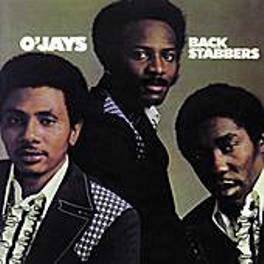
O'Jays Back Stabbers (1972) album cover, November 10, 2011. (Dan56 via Wikipedia). Qualifies as fair use as low-resolution illustration of subject matter.

O’Jays Back Stabbers (1972) album cover, November 10, 2011. (Dan56 via Wikipedia). Qualifies as fair use as low-resolution illustration of subject matter.

What I didn’t know was how quick and violent the shift into poverty would be. What I didn’t know was that Maurice would use his/our conversion as Hebrew-Israelites as justification for abusing my Mom and me. What I didn’t know was that my Mom would have three more kids by this man between July ’81 and May ’84. What I didn’t know was that I would feel so low about the loss of my best friend and my sense of self that I’d attempt to take my own life on my fourteenth birthday, at the end of ’83.

But when I looked back on this in ’97, I mostly thought about the good things that had occurred in the fifteen years between the domestic violence my Mom endured on Memorial Day ’82 and my doctoral graduation ceremony. My independent conversion to Christianity in ’84. Knocking out a 5 on my AP US History exam without ever cracking open Morison and Commager. Overcoming poverty and my lack of self-esteem to build a life at Pitt and in Pittsburgh between ’88 and ’97.

Still, I’d already been wounded, badly. By the things I knew but did nothing about. By those things I could’ve anticipated but my efforts to counteract were insufficient. By those things I couldn’t have known at all. I knew I’d have problems with my “running interference” advisor Joe Trotter coming down the dissertation stretch. Yet because of departmental politics and my need to be done sooner rather than later, I did nothing about this until I was six chapters into an eight-chapter dissertation. I knew my mentor and committee member Bruce Anthony Jones could sometimes be unreliable. Yet I had no idea that he would completely abandon me and his other doctoral students the moment he signed his name to my and their dissertations.

My dissertation's signature page, May 18, 2013. (Donald Earl Collins),

My dissertation’s signature page, May 18, 2013. (Donald Earl Collins),

Most of all, I never anticipated that my Mom would actually be jealous of me, and would spend a whole week with me at 616 and in Pittsburgh doing and saying things to completely disparage what I’d worked so hard for. For me, for her, for my family. That was hard to get over. There are times I’m not sure if I’m entirely over this yet.

What I’m sure of in ’13, though, is what I do know, don’t know, and can only anticipate with the wisdom of experience and wisdom beyond my experience. I know that I love my wife, that there’s a lot in common between her and Crush #1 (for those of you who’ve read Boy @ The Window so far, the implications should be obvious), real and from my own imagination. I didn’t know that I’d have a kid, a son who at nearly ten is both wonderful and perplexing, and hopefully, off to a much better start in life than I ever got. I suspect that one of my references for jobs and consulting gigs has been undermining my efforts over the past five years, and have thus removed her as a reference.

What I don’t know — but can only hope and work like a dog toward — is whether Boy @ The Window will be a success. I’m not sure if quantifying it would help. I sold a thousand copies of Fear of a “Black” America between August ’04 and January ’07, without the benefit of this blog, Twitter, Facebook or the e-book platforms. How long before I sell my first hundred, thousand, 5,000 or more? I have no idea. But as they say, I “must walk the path, not just know it.”

Afrocentricity and the Writing Bug

15 Wednesday May 2013

Posted by decollins1969 in 1, Academia, Boy @ The Window, Carnegie Mellon University, Christianity, culture, eclectic music, Hebrew-Israelite, Mount Vernon High School, Mount Vernon New York, music, Pittsburgh, Politics, Pop Culture, race, Religion, University of Pittsburgh, Youth

≈ Leave a comment

Tags

Africana Studies, Afrocentric Education, Afrocentric Idea (1987), Afrocentricity, Authentic Blackness, Authenticity, Black Action Society, Black Issues in Higher Education, Black Studies, Blackness, Cool, Coolness, Litmus Test, Marc Hopkins, Maulana Karenga, Molefi Asante, Pitt, Temple University, Writing, Writing Bug


A ladybug, often a symbol for the writing “bug,” May 15, 2013. (http://flickr.com). In public domain.

This time two decades ago, I was already a bit desperate for work. In transferring from Pitt to Carnegie Mellon, I’d left myself without any financial coverage for the summer of ’93 (see my post “The Arrogance of Youth, Grad School Style” from June ’12). I had applied for several fellowships, summer teaching gigs, even some nonprofit work. But as of the middle of that May, nothing had come through. I’d already spent $200 on a root canal that occurred on the same day as my written PhD comps at CMU (see my post “Facing the Tooth” from May ’12).

Even before my comps and my surprise root canal, I had talked with my friend Marc about writing a joint article about the false litmus test of Blackness that Afrocentricity had come to represent in our minds. Between Molefi Asante’s students at Temple — not to mention the overtly Afrocentric turn of both the Black Action Society and the Black Studies department (which had changed its name to Africana Studies) in the previous eighteen months — both of us felt we needed to provide an alternate perspective.

On that third Saturday in May (and the day after my comps and root canal surgery), we worked for five hours in putting together what amounted to a 1,200-word opinion piece against the belief system and authenticity test that Afrocentricity (and Afrocentric education) had become. By some folks’ definition, we realized that jazz, Miles Davis and John Coltrane would fail the authentically Black test of a Molefi Asante’s wonderful Afrocentric Idea (1987) and of Maulana Karenga as well.

Frances Cress Welsing's The Isis Papers (1991), [about as authentic as auto-tunes], May 15, 2015. (http://amazon.com).

Frances Cress Welsing’s The Isis Papers (1991), [about as authentic as auto-tunes], May 15, 2015. (http://amazon.com).

Now I’m pretty sure why Marc had problems with Afrocentricity. As a Christian and a jazz aficionado, Marc likely saw Afrocentricity as something somewhere between a misguided way of thinking about Blackness and complete and utter bull crap. His goal was to “add to the debate” and “educate” those who weren’t Asante or Karenga apostles and disciples. A laudable — if somewhat naive about the politics of academia and race — goal.

As for me, beyond the academic superficiality of having a litmus test on what is and isn’t Black, I had at least two unconscious reasons for writing my first crossover piece. One had to do with my sense that too many young folks were all too interested in doing the cool thing and not the right thing. Afrocentricity was cool, just like all rap and hip-hop was cool, just like giving libations to ancestors was cool.

Being cool had always meant following a crowd and seldom saying anything that would dig more than a nanometer beyond the surface. Or saying a critical thing about the cool thing that everyone in the same crowd otherwise takes in without a critical thought. I went to a high school full of people like that, and loathed being around people like that when I’d been a part of the Black Action Society at Pitt.

Unconscious reason number two had something to do with my Hebrew-Israelite days. Again, I gave this zero direct thought during my grad school days. But the given the trauma I’d suffered through during my three years of kufi-dom, it had to affect my thinking about Afrocentricity. The Black folk I knew who were part of the Hebrew-Israelite religion were much more obvious about what they did and didn’t consider Black or kosher. Yet, it was so obvious that they constantly contradicted themselves, in terms of food or music, how they treated their wives or children. Most important for me, though, was the fact that they tried to live separate and apart from other Blacks, yet seemed no more different beyond the kufis, veils and kosher meats from other Blacks (or Jews, for that matter).

I saw Afrocentricity as bullshit, and still see the fact that so many folks who get caught up in this sense of authenticity around Blackness as folks falling for bullshit. If I hadn’t lived as a Hebrew-Israelite between the ages of eleven and fifteen, perhaps I wouldn’t see Afrocentricity this way. If I hadn’t been around the “Party All The Time” folks in high school and the “Black Panther Party” posers at Pitt, maybe Afrocentricity would’ve been more appealing to me.

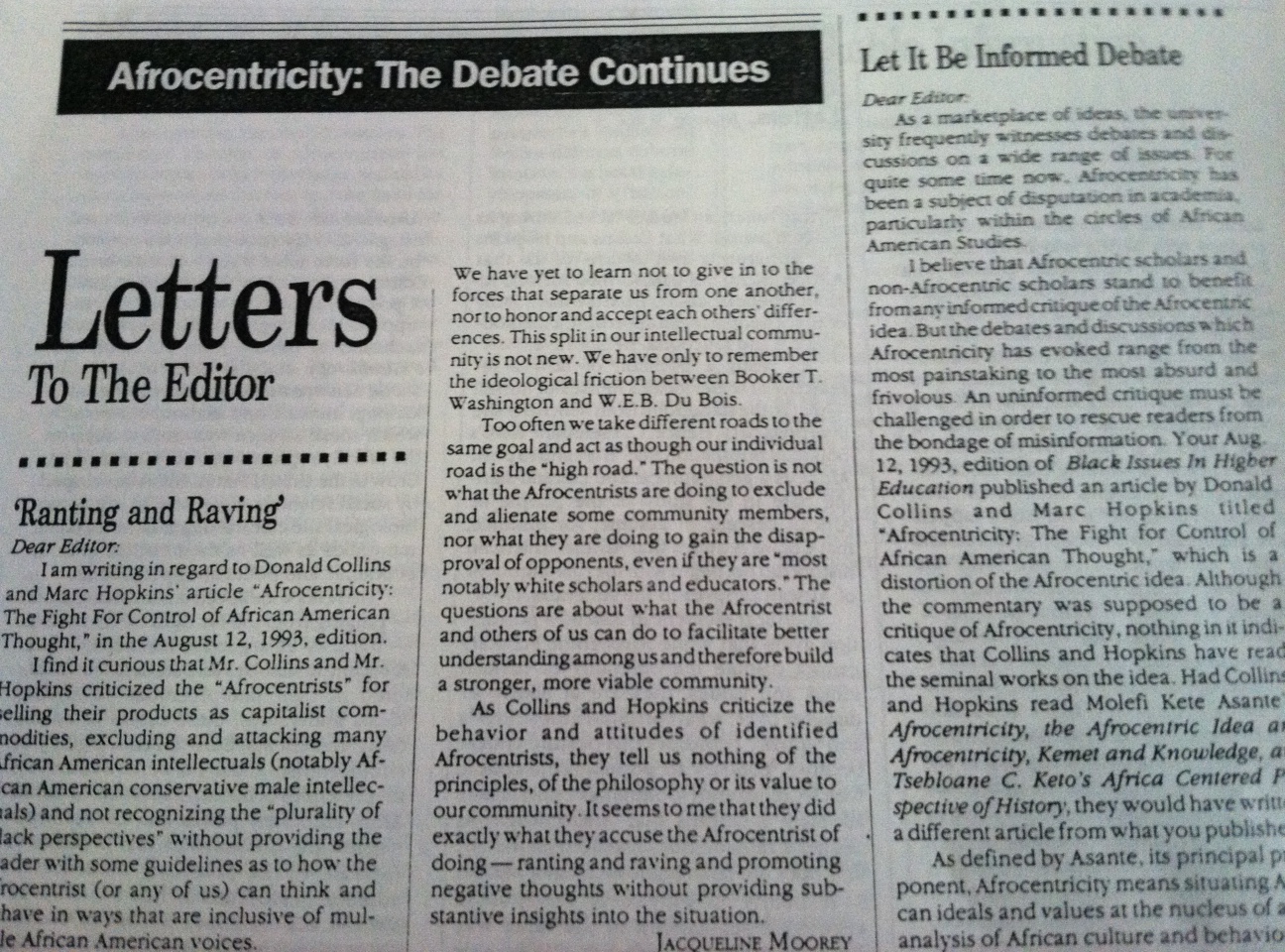
Letters to the Editor, Black Issues in Higher Education, September 9, 1993. (Donald Earl Collins).

Letters to the Editor, Black Issues in Higher Education, September 9, 1993. (Donald Earl Collins).

But at twenty-three years old, I was already tired of the pursuit of coolness and authenticity. That hasn’t changed in the past two decades. I’m sure the letters that called Marc and I “Uncle Toms” after our piece was published in Black Issues in Higher Education were from folks who thought we weren’t cool, and thought they had the answers to life itself.

I wonder how those folks back then would see the academics who believe that hip-hop can explain everything in the social sciences and humanities who are prominent today. Perhaps some of these people today were the Afrocentric followers of twenty years ago. Perhaps not. All I know is, I haven’t stopped writing since that cloudy day in mid-May.

The Road to My Memoir, Part 1: Welfare

07 Tuesday May 2013

Posted by decollins1969 in 1, Academia, Boy @ The Window, culture, Eclectic, High Rise Buildings, Mount Vernon New York, Pittsburgh, Politics, Pop Culture, race, University of Pittsburgh, Youth

≈ Leave a comment

Tags

Academic Writing, Adrian Nicole LeBlanc, AFDC, Case Managers, Case Workers, Criminalization, Discrimination, Emotional Detachment, Irony, Journaling, Journals, Kaaryn Gustafson, Personal Vignettes, Pitt, Public Housing, Racial Stereotypes, Racial Stigmas, Research, Rhonda Y. Williams, Scholarship, Welfare, Writing, Writing Process


Adrian LeBlanc's Random Family (2002) and Rhonda Y. Williams' The Politics of Public Housing (2005), May 7, 2013. (Donald Earl Collins).

Adrian LeBlanc’s Random Family (2002) and Rhonda Y. Williams’ The Politics of Public Housing (2005), May 7, 2013. (Donald Earl Collins).

This isn’t a straight-forward post or series of posts. I didn’t come to Boy @ The Window quickly or easily. I didn’t intend it to be a memoir, even though I’d left myself bread crumbs to turn it into a memoir years ago.

The first time I’d thought about writing a book related to my experiences was at the beginning of my junior year of college, in September and October ’89. Not even three months after my idiot stepfather had left 616 for good, and I was thinking about writing up something about the experience? A bit ambitious I was!

What I did do, though, was somehow find my old scraps of journals about what happened to me when I was twelve before I came back to Pittsburgh and Pitt for the school year. I wrote up additional experiences, about running away from 616 in August ’85, about my Mom’s experience at the feet and fists of my now ex-stepfather, about my time on a drafty Pitt stairwell the year before.

That was painful to write about, so soon after finally being rid of Maurice, too soon, really, for me to fully process it without re-living the experience. So I wrote or rewrote four of these experiences in all, and put them away in one of my Pitt notebooks.

But there was one other experience I wanted to write about, to move from a personal story to one of academic scholarship. It was the experience of my being on welfare from ’83 to ’87, covering on-the-ground perspectives from people like me and my Mom, as well as those of case workers. I thought that it would fill a void in both media coverage and in historical scholarship about the topic of welfare, particularly how it became a racial stereotype and slur.

I thought that by juxtaposing (and that’s the word I used for this back in ’89) the plight of welfare recipients and case workers, that I could show some sense of irony. That so many of the case workers and managers were only a paycheck or two away from being on welfare — and that some of them had been on welfare themselves, at least based on my limited experience — would make for an interesting story. What I hoped to show, ultimately, was the inhumanity of the welfare system itself, pitting people from similar socioeconomic backgrounds against each other because of the mix of welfare as racial and as a form of the undeserving getting their government handouts, of crumbs from America’s table being turned into a political football.

I didn’t say this exactly when I had a conversation about this topic with my former TA Paul Riggs in October ’89. The ideas and many of the sentiments, particularly about “juxtaposing,” “irony,” and “inhumanity,” though, were all part of the conversation. Riggs told me I needed to slow down, that even if I somehow were able to make this topic historical, that I’d need to much more reading on the topic, to divorce myself from my emotions around this topic.

In some ways, my late-twenties mentor was right. It’s hard to do scholarly work on a topic in which you are heavily emotionally invested. The topic wasn’t historical, given that I had just lived it and my Mom and younger siblings were still living it. And I was nineteen after all, and after seven years of seldom writing for any purpose outside of the classroom except letters to former high school classmates and college friends, a book would’ve been a daunting, almost immeasurable task.

That started me on the path to learn how to write like an academic historian, instead of writing out of emotion and irony. One that would delay my writing on anything like Boy @ The Window for the better part of a decade, even as the academic process enabled me to do the interviews and research necessary to put the memoir together.

Luckily, there are three authors whose work over the past decade has covered this topic of welfare, racial stereotypes, inhumanity, criminality and irony. Mostly in ways I would’ve covered it had I had the words and research skills to do this work twenty-four years ago. Adrian LeBlanc‘s Random Family (2002), though a sensational accounting of a Latino family in the Bronx between ’88 and ’01, does provide a glimpse (still MacArthur “genius” Award winner). Rhonda Y. Williams‘ The Politics of Public Housing: Black Women’s Struggles Against Urban Inequality (2005) is her excellent collection of research and personal vignettes about public housing, welfare, Black women and empowerment despite the odds covering the period between the 1940s and the early 1980s (with a bit on the early 1990s). All just before crack cocaine, TANF and the gentrification of previously off-limit poor neighborhoods in a city like Baltimore became bigger themes.

And now there’s Kaaryn Gustafson‘s Cheating Welfare: Public Assistance and the Criminalization of Poverty (2012). She covers in so many ways what I’d once hoped to capture in emotion and storytelling about the stain of welfare as illustrated in policies and politics. Kaaryn’s (I know her from my New Voices days) written a great book, one that I wished I could’ve read or written when I was nineteen.

Kaaryn Gustafson's Cheating Welfare (2012), May 7, 2013. (http://nyupress.org).

Kaaryn Gustafson’s Cheating Welfare (2012), May 7, 2013. (http://nyupress.org).

That wasn’t my path, though I had interests that would include welfare. No, my path was about race, diversity, education and self-discovery, not just about my Mom and family.

Transfer Anniversary

21 Thursday Mar 2013

Posted by decollins1969 in 1, Academia, Boy @ The Window, Christianity, culture, Eclectic, Patriotism, Politics, Pop Culture, race, Youth

≈ Leave a comment

Tags

Academic Politics, Carnegie Mellon, Carnegie Mellon University, CMU, Department of HIstory, Dissertation Completion, Dissertation Funding, Doctoral Completion, Elite Universities, Elitism, Funding, History Department, Joe Trotter, Joe William Trotter, John Modell, Jr., Larry Glasco, Laurence Glasco, Pitt, Pittsburgh, Politics of Academia, Transfer, University of Pittsburgh


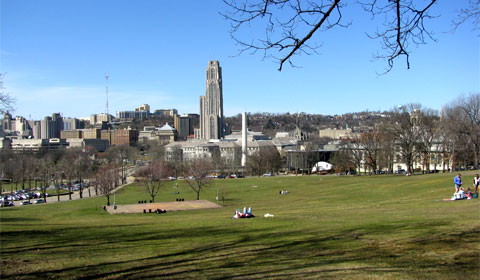
Viewing Pitt's Cathedral of Learning from Carnegie Mellon's mall (with Hamerschlag Hall in foreground), March 29, 2003. (http://post-gazette.com)

Viewing Pitt’s Cathedral of Learning from Carnegie Mellon’s mall (with Hamerschlag Hall in foreground), March 29, 2003. (http://post-gazette.com)

March ’93 was an interesting month for me, to say the least. Just about the biggest thing happening for me that month was my transfer from Pitt to Carnegie Mellon (or CMU) to finish my doctorate. After nearly two years of grad school in the History Department, I knew I needed to leave. Especially with Larry Glasco as my well-meaning but sometimes absentee advisor and with a bunch of professors who never hid their disdain for me as a masters and then a doctoral student. I’d also been at Pitt for six years between undergrad and grad school, most of those focused on history, Black Studies, or education foundations and policy as areas of research.

I knew that Carnegie Mellon wasn’t an ideal situation. I was sure that had I desired, I could’ve applied to and been accepted by doctoral programs as far and wide as NYU, University of Maryland, University of Michigan and other places. All were places where history didn’t simply consist of working-class historians who believed in the supremacy of class and neo-Marxism above all else – race and racism be damned! What I didn’t know, though, was whether those departments would accept my doctoral credits, cutting my coursework time in half. What I couldn’t be sure about was whether I’d be able to move toward PhD comprehensives and my dissertation proposal within a year of enrollment.

See, these were the things that Joe Trotter, my eventual advisor and John Modell, the graduate coordinator for the department, had promised me as part of my deal for transferring across the bridge to CMU. Those promises, along with the idea of working with an enthusiastic professor whose research didn’t seem out-of-date in a department that seemed to fast-track its students toward doctoral completion. That really appealed to me at the time.

Pitt and Carnegie Mellon (with Forbes Quad & Baker Hall included) as seen from Schenley Park, Pittsburgh, PA, March 21, 2013. (http://milliverstravels.com).

Pitt and Carnegie Mellon (with Forbes Quad & Baker Hall included) as seen from Schenley Park, Pittsburgh, PA, March 21, 2013. (http://milliverstravels.com).

When I finally broke it to Larry at the beginning of March that I’d made this decision, he didn’t exactly try to convince me to stay. I think he knew why. An audit of the program in ’98 confirmed officially what I had learned anecdotally over my six years at Pitt. That there were students in the program who’d been ABD (All But Dissertation) since Nixon and Watergate. That fully half of my cohort from ’91 hadn’t even completed their master’s degrees, and only three of us (counting myself) out of twenty-one would ever go on to complete our doctorates. That no Pitt History grad student had obtained substantial research funding from outside the university since my Mom potty-trained me back in ’72-’73. And that politically, the powers that used to be in the department didn’t take my or Larry’s work with me seriously. Even if Larry didn’t see that, I sure did.

Off then, I went. Into the unknown known of CMU, conservative, elite and elitist, not sure if I’d ever be comfortable on the lily-White and honorary-White-as-Asian campus. Still, I reminded myself that Pitt was really only a couple of blocks away at the closest point between the two campuses, that I still had lots of friends and acquaintances there. I also knew, though, that my relationship with Trotter as my advisor would be crucial to my successful navigation of this drab and stuffy world. Too bad I wasn’t clairvoyant!

← Older posts
Newer posts →

Boy @ The Window: A Memoir

Boy @ The Window: A Memoir

Places to Buy/Download Boy @ The Window

There's a few ways in which you can read excerpts of, borrow and/or purchase and download Boy @ The Window. There's the trade paperback edition of Boy @ The Window, available for purchase via Amazon.com at http://www.amazon.com/Boy-Window-Donald-Earl-Collins/dp/0989256138/

There's also a Kindle edition on Amazon.com. The enhanced edition can be read only with Kindle Fire, an iPad or a full-color tablet. The links to the enhanced edition through Apple's iBookstore and the Barnes & Noble NOOK edition are below. The link to the Amazon Kindle version is also immediately below:

scr2555-proj697-a-kindle-logo-rgb-lg

Boy @ The Window on Amazon.com: http://www.amazon.com/Boy-The-Window-Memoir-ebook/dp/B00CD95FBU/

iBookstore-logo-300x100

Boy @ The Window on Apple's iBookstore: https://itunes.apple.com/us/book/boy-the-window/id643768275?ls=1

Barnes & Noble (bn.com) logo, June 26, 2013. (http://www.logotypes101.com).

Boy @ The Window on Barnes & Noble: http://www.barnesandnoble.com/w/boy-the-window-donald-earl-collins/1115182183?ean=2940016741567

You can also add, read and review Boy @ The Window on Goodreads.com. Just click on the button below:

Boy @ The Window

Twitter Updates

Tweets by decollins1969
  • RSS - Posts
  • RSS - Comments

Archives

  • June 2025
  • April 2023
  • September 2022
  • August 2022
  • July 2022
  • June 2022
  • May 2022
  • April 2022
  • March 2022
  • January 2022
  • December 2021
  • November 2021
  • October 2021
  • September 2021
  • August 2021
  • July 2021
  • June 2021
  • April 2021
  • March 2021
  • February 2021
  • January 2021
  • December 2020
  • November 2020
  • October 2020
  • September 2020
  • August 2020
  • July 2020
  • May 2020
  • April 2020
  • March 2020
  • January 2020
  • December 2019
  • November 2019
  • August 2019
  • July 2019
  • June 2019
  • May 2019
  • April 2019
  • March 2019
  • February 2019
  • January 2019
  • December 2018
  • November 2018
  • October 2018
  • September 2018
  • August 2018
  • July 2018
  • June 2018
  • May 2018
  • March 2018
  • February 2018
  • January 2018
  • December 2017
  • November 2017
  • October 2017
  • September 2017
  • August 2017
  • July 2017
  • June 2017
  • May 2017
  • April 2017
  • March 2017
  • February 2017
  • January 2017
  • December 2016
  • November 2016
  • October 2016
  • September 2016
  • August 2016
  • July 2016
  • June 2016
  • May 2016
  • April 2016
  • March 2016
  • February 2016
  • January 2016
  • December 2015
  • November 2015
  • October 2015
  • September 2015
  • August 2015
  • July 2015
  • June 2015
  • May 2015
  • April 2015
  • March 2015
  • February 2015
  • January 2015
  • December 2014
  • November 2014
  • October 2014
  • September 2014
  • August 2014
  • July 2014
  • June 2014
  • May 2014
  • April 2014
  • March 2014
  • February 2014
  • January 2014
  • December 2013
  • November 2013
  • October 2013
  • September 2013
  • August 2013
  • July 2013
  • June 2013
  • May 2013
  • April 2013
  • March 2013
  • February 2013
  • January 2013
  • December 2012
  • November 2012
  • October 2012
  • September 2012
  • August 2012
  • July 2012
  • June 2012
  • May 2012
  • April 2012
  • March 2012
  • February 2012
  • January 2012
  • December 2011
  • November 2011
  • October 2011
  • September 2011
  • August 2011
  • July 2011
  • June 2011
  • May 2011
  • April 2011
  • March 2011
  • February 2011
  • January 2011
  • December 2010
  • November 2010
  • October 2010
  • September 2010
  • August 2010
  • July 2010
  • June 2010
  • May 2010
  • April 2010
  • March 2010
  • February 2010
  • January 2010
  • December 2009
  • November 2009
  • October 2009
  • September 2009
  • August 2009
  • July 2009
  • June 2009
  • May 2009
  • April 2009
  • March 2009
  • February 2009
  • January 2009
  • December 2008
  • November 2008
  • October 2008
  • September 2008
  • August 2008
  • July 2008
  • June 2008
  • May 2008
  • April 2008
  • March 2008
  • February 2008
  • January 2008
  • December 2007
  • November 2007
  • October 2007
  • September 2007
  • August 2007
  • July 2007
  • June 2007

Recent Comments

MaryPena's avatarMaryPena on My Day of Atonement/Bitter Hat…
decollins1969's avatardecollins1969 on No Good Teaching Deed Goes…
Mary Rose O’Connell's avatarMary Rose O’Connell on No Good Teaching Deed Goes…

NetworkedBlogs on Facebook

NetworkedBlogs
Blog:
Notes From a Boy @ The Window
Topics:
My Life, Culture & Education, Politics & Goofyness
 
Follow my blog

616 616 East Lincoln Avenue A.B. Davis Middle School Abuse Academia Academy for Educational Development AED Afrocentricity American Narcissism Authenticity Bigotry Blackness Boy @ The Window Carnegie Mellon University Child Abuse Class of 1987 CMU Coping Strategies Crush #1 Crush #2 Death Disillusionment Diversity Domestic Violence Economic Inequality Education Family Friendship Friendships Graduate School Hebrew-Israelites High-Stakes Testing Higher Education History Homelessness Humanities Humanities Program Hypocrisy Internalized Racism Jealousy Joe Trotter Joe William Trotter Jr. K-12 Education Love Manhood Maurice Eugene Washington Maurice Washington Misogyny Mother-Son Relationship Mount Vernon High School Mount Vernon New York Mount Vernon public schools Multiculturalism MVHS Narcissism NFL Pitt Pittsburgh Politics of Education Poverty President Barack Obama Race Racial Stereotypes Racism Relationships Self-Awareness Self-Discovery Self-Reflection Sexism Social Justice Teaching and Learning University of Pittsburgh Violence Whiteness Writing

Top Rated

Blog at WordPress.com.

  • Subscribe Subscribed
    • Notes from a Boy @ The Window
    • Join 103 other subscribers
    • Already have a WordPress.com account? Log in now.
    • Notes from a Boy @ The Window
    • Subscribe Subscribed
    • Sign up
    • Log in
    • Report this content
    • View site in Reader
    • Manage subscriptions
    • Collapse this bar
 

Loading Comments...