Immigration Assignment & Montgomery County Public Schools

Tags

, , , , , , , , , , , , , ,


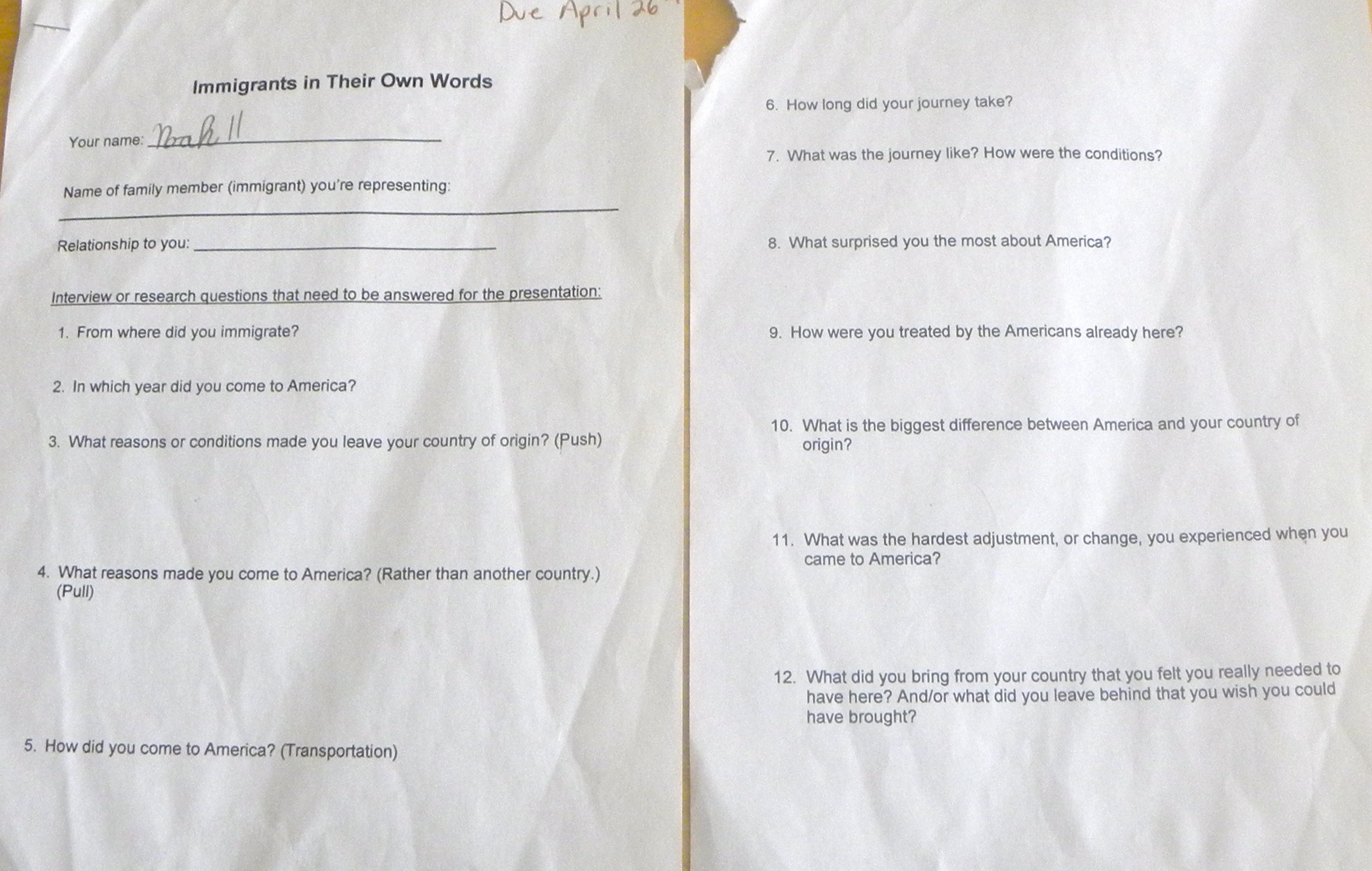
Immigrants In Own Words, Woodlin ES, May 28, 2013. (Donald Earl Collins).

Immigrants In Own Words, Woodlin ES, May 28, 2013. (Donald Earl Collins).

Well, the two-month long ordeal that was my son’s fourth grade immigration/migration segment and assignments concluded at the end of last week. While my son’s teachers at Woodlin ES and administrators at MCPS were well-meaning, this was probably the single worst assignment I’ve seen given by them to my son and his classmates. As I said in my post on this project from earlier this month, teaching undergraduates and graduate students the big and nuanced differences between two enormously important trends in American history is difficult. Teachers with an average understanding (at best) of historical trends and patterns like immigration and migration teaching nine and ten-year olds? That’s an almost impossible task.

It was a thoroughly frustrating assignment to watch my son go through and for me as his helper. It was a terrible set of tasks pedagogically, and just plain bad history, even for elementary school. Their so-called Wax Museum immigration project (they also titled it the 4th grade Legacy Project) called for each student to interview a relative that immigrated to the US. After our complaints, the school modified the assignment to include “a composite of several of your family members, with a mix of fact and fiction to tell the story” (emphasis added). Sorry, but encouraging “realistic” fiction for a big social studies assignment is beyond unacceptable. It shows a complete misunderstanding of US history and proper teaching methods for this subject.

In getting ready for my version of summer academic enrichment for my son (where he can build on his reading, writing and math skills while also doing fun summer camps), I ordered textbooks and other grade-appropriate materials. One of these was the activity workbook for The American Journey textbook, typically US history taught between sixth and eighth grade. I have tons of US history textbooks — I wanted the activities workbook to help guide and calibrate what my son should read and learn without going into every college-level historical nuance.

"An Immigrant's Experience" worksheet from The American Journey activity workbook, May 28, 2013. (Donald Earl Collins).

“An Immigrant’s Experience” worksheet from The American Journey activity workbook, May 28, 2013. (Donald Earl Collins).

When I leafed through the workbook last week, I found a worksheet activity titled “An Immigrant’s Experience.” The worksheet directions asked for students to “[i]nterview someone in your community who immigrated to the United States from another country or research the life of an immigrant to your state.” I realized that the questions from my son’s “Immigrants in Their Own Words” assignment were similar to the ones from this worksheet meant for kids at least two grade levels above his.

That sounds great in some respects, but it’s not. Not really. Not when I considered the fact that this was my son’s (and his classmates’) first real foray into US history at his school. Not when I figured that even this material from Glencoe McGraw-Hill mixed up immigration and migration, and yet the questions were specifically about immigration. These questions were obviously meant to cover either the 1870-1920 period or (in some cases) the period since 1965.

And certainly not when I thought about what my son told me about his teacher’s negative response to changing his assignment questions to specifically reflect migration, in his case, Black migration. Really? I didn’t think that asking his grandmother about what her folks thought about the differences between the US and their home country was an appropriate question.

As part of this social studies segment, my son also had to complete an assignment on waves of immigration, one that listed immigration to the Western Hemisphere in four phases or waves. One being from 1492-1820, then 1820-1890, then 1890-1950, then 1950 to today. This just made me shake my head. The periodization — as we historians call it — was so far off that slaves and conquistadors could be considered immigrants in the same way as Scotch-Irish living in the hills of Kentucky! Apparently MCPS produced this handout in 2001 as part of their social studies focus.

Focus Questions For Waves of Immigration (2001), MCPS, May 28, 2013. (Donald Earl Collins).

Focus Questions For Waves of Immigration (2001), MCPS, May 28, 2013. (Donald Earl Collins).

Now I’ll have to do something I hoped I’d never have to do, at least prior to my son going to high school. I must now correct what my son has been taught in school for the past two months. Good thing, though, that most of what my son learned on this topic will be forgotten by July 4th. It’ll make it easier for me to correct the incorrect.


Where Audacity Meets Second-Guessing

Tags

, , , , , , , , , , , , , , , , , ,


Second-guessing to the extreme, May 25, 2013. (http://pualingo.com).

Second-guessing to the extreme, May 25, 2013. (http://pualingo.com).

I’m a great second-guesser of myself (and of others). But I’m especially hard on myself in that department. Even when I know that what I’m doing is the right thing, that I’m taking the right path and proper course of action. I remind myself of what to do, what to say, how to say what I need to say, and even then, I wonder often if my move was to bold, my words too direct, my tone too know-it-all-esque.

Still, there are plenty of times as an adult where I’ve decided to not give in to my second-guessing impulses, to remain bold and aggressive despite the potential problems with a plan. Graduate school at Pitt and Carnegie Mellon was probably the longest time as an adult in which I did little second-guessing, at least when I was awake.

Something happened on my marathon march to the doctorate the week before Memorial Day ’93, one where, for once, someone did my second-guessing for me. And no, it wasn’t Joe Trotter or any of the other usual professorial suspects. This one came courtesy of Harold Scott, an acquaintance (and now friend) who was a visiting professor at Pitt’s GSPIA (Graduate School of Public and International Affairs) at the time. I met with him twenty years ago to discuss my transition from the University of Pittsburgh to Carnegie Mellon’s history department, to glean insights from a recent PhD and a man ten years my senior.

I’d met Harold a few times before, mostly in the context of joint Pitt-CMU gatherings related to issues of racial diversity and retention of grad students of color. Aside from discovering that Harold was an anti-affirmative action baby, the only other thing I knew about him was that he was the first African American to earn a doctorate from CMU’s history department.

Dick Cheney as an example of Pollyanna Principle, March 16, 2003. (http://www.veteranstoday.com/wp-content/uploads/2011/08/cheney.jpg).

Dick Cheney as an example of Pollyanna Principle, March 16, 2003. (http://www.veteranstoday.com/wp-content/uploads/2011/08/cheney.jpg).

So we both asked questions. I learned how Harold suffered at the hands of a mutual leading professor between us and the department, mostly in the form of isolation and arbitrarily bad pay as an instructor once he became ABD. He learned that I had a lot of ambition as a twenty-three year-old doctoral student. My plan at the time was to complete my PhD by the end of ’95, a little more than two and a half years from the date of our ’93 meeting.

Harold laughed, almost hysterically, as I stepped him through all my steps between late-May ’93 and December ’95. He noted that I had at least one year of coursework to complete at CMU before they’d give me their “stamp of approval” to move on to my written and oral comps, much less the dissertation. (Except that I’d already taken my written comps). Most importantly, Harold didn’t understand how I expected to write a doctoral thesis of significant research and girth in little more than a year, assuming that I’d have have to teach at some point, assuming that I had to find literally hundreds of sources.

Then we discussed my dissertation topic specifically. I talked about multiculturalism and multicultural education, about Black Washington, DC and Negro Education Week, about Carter G. Woodson and Alain Locke and W. E. B. Du Bois. I talked about the counter-literature that laid out multiculturalism as either Polyanna or as a mask for Afrocentricity without the Black nationalism that White scholars had ascribed to it.

Somehow in my discussion of the literature, between Arthur Schlesinger and Diane Ravitch, Thomas Sowell and James Banks, and Gary Nash and Cornel West, Harold had but one question. “Are you a ‘racial determinist’?,” he asked. I didn’t know exactly what that term meant, but I already knew what a cultural determinist was. I answered, “Yes and no.” I went on to describe the many situations in which I believed race played a role, if not a dominant role, in American history or culture. That’s not the definition, by the way, as it’s a variant of biological determinism, and very Nazi-like.

That’s when we really began to go back and forth. But I don’t think much of that argument was about racial determinism or where I stood on it at all. I think Harold thought that I was both arrogant and naive. It wouldn’t have been the first time I’ve left that impression, or the last. But yes, at twenty-three, I’d set my sights on a degree, a dissertation and book topic, and a career that I wanted, and had made the decision to not let my over-thinking second-guessing get the better of me. That Harold and others weren’t privy to my process likely made my bold plans and predictions seem ridiculous.

Brett Farve and yet another interception, 2009 NFC Championship Game, January 24, 2010. (Ronald Martinez/http://bleacherreport.com).

Brett Farve and yet another interception, 2009 NFC Championship Game, January 24, 2010. (Ronald Martinez/http://bleacherreport.com).

Yet there was more going on here, much of which wouldn’t become apparent to me until the end of ’95, when I was six chapters into my eight-chapter dissertation. Harold was my warning that the grad school process alone could beat the living hell out of me, that the professors at CMU — White or Black — had an old-fashioned attitude about how long it ought to take someone like me to finish. Harold went through a gauntlet to finish his doctorate in ’90, only to struggle to find work.

In being the second African American to go through the same gauntlet, I eventually realized that my speed and strength of purpose didn’t really matter in the lily-White thinking of the powers that were at CMU. And by the time I started second-guessing my decisions, I practically already had my degree.

Monkey See, Baboon Do

Tags

, , , , , , , , , , , ,


Monkey See Monkey Do, May 22, 2013. (http://kidsunder7.com).

Monkey See Monkey Do, May 22, 2013. (http://kidsunder7.com).

There are plenty of stories and vignettes that ended up on the Boy @ The Window scrap heap. Most because they weren’t relevant, some because a particular person or character really wasn’t a significant player in the book. In my final set of story revisions (not dialogue revisions) in ’09 and ’10, I operated under the “two or more rule.” If a person or character showed up fewer than two times in the book, I took them out, as they really weren’t as significant as I originally thought.

But in the case of the Sonya story below, it was a tough cut. I wanted to craft a book in which people felt everything I went through while not feeling sorry for me. I think and hope that I did. Though this story contained many elements of what I wanted in the rest of the book, it didn’t quite fit. Still, it serves as a good reminder of how mean even someone as polite (but certainly not always nice) as I am today could be at thirteen.

—————————

“Sonya was major fodder for Alex in eighth grade. She had a short Afro, an ‘au naturale’ to be exact. She wasn’t nearly as polished in maintaining her looks as many of the other girls in 8U. Sonya wasn’t ugly by any stretch. But by her not attempting to beautify herself in any way, she stood out for some in our class. Why would’ve she needed to anyway? She was also well-spoken, intelligent and outgoing, at least at the beginning of the year. Unfortunately for Sonya, my Italian Club classmates Alex, et al. were around to call her all kinds of names, like ‘baboon,’ and ‘monkey.’ I felt sorry for her, but I was also angry with her too. It pissed me off to see her respond to these semi-racist barbs with a blank face or even a smile.

It pissed me off so much that I ended up calling Sonya one of those names by the end of the school year. One day in homeroom, par for the course, Alex and company picked with Sonya again, calling her a ‘baboon’ among other things. She just sat there with that silly ‘Oh well’ smile on her face, as if they were telling her that she should go into professional modeling. Under my breath, I called her ‘monkey,’ and not as a joke. I just couldn’t believe that she was going to sit there like some pre-Civil Rights era Black in the South and take their crap without any response.

Except that I had called Sonya a ‘monkey’ within earshot of her and Alex. She ran out of the room, apparently to the girls bathroom, where she cried for several minutes, I later learned from Allison. I immediately tried to apologize, which Sonya eventually accepted (after my eighth grade science teacher Ms. Mignone and Allison shamed me for what I said). What I said was unacceptable to me, and the rationale was too intellectual for my own good. For Sonya, it simply came down to her looks, not her disposition. I wished that it had never happened, given what I faced from some of my classmates on a semi-regular basis.”

———————————————————-

1990s R&B/hip-hop duo Zhané from their 1994 album cover Pronounced Jah-Nay, May 22, 2013. (http://centrictv.com).

1990s R&B/hip-hop duo Zhané, from 1994 album cover Pronounced Jah-Nay, May 22, 2013. (http://centrictv.com).

The Sonya story has many of those elements, exposing me good, bad and ugly in the process. It’s about race and teenage ignorance and intellect. It’s about stereotype threat on one obvious level and trying to fit in on an unconscious one. It’s about the person I needed to become in high school as well as how I got to be that quiet yet observant person. The story is significant, yet because I only dealt with Sonya for two paragraphs in a 345-page book (in print form), it didn’t make the final cut. Because there are other and more central characters and stories in which stereotype threat and the ugly side of my immaturity both come out, I didn’t include Sonya.

Luckily, I also have a blog, where even scrap-heap stories can find the light of a new day. So, for this week, the thirtieth anniversary of my calling Sonya a “monkey,” I apologize again. I was a baboon for saying it in the first place. And Sonya, I hope you are well!

What I Didn’t Know (in ’81, in ’97, in ’13)…

Tags

, , , , , , , , , , , , , , , , , , , ,


Noah with me, January 3, 2004 [he was five months old]. (Angelia N. Levy).

Noah with me, February 28, 2004 [he was seven months old]. (Angelia N. Levy).

What I didn’t know across the past thirty-two years could be another book for me. I assume that would be the case for anyone would could look back across their life and second-guess themselves over that long a period of time. For me, though, the significance of today comes out of my mathematics background. You see, today’s my sixteenth PhD graduation anniversary. Not all that significant, I suppose. Except that I’m as far away from the end of my graduate school days at Carnegie Mellon today as I was from the first days of being a Hebrew-Israelite and watching my family fall into welfare poverty when I graduated in ’97.

100th Commencement Ceremony program, Carnegie Mellon University, May 18, 1997. (Donald Earl Collins).

100th Commencement Ceremony program, Carnegie Mellon University, May 18, 1997. (Donald Earl Collins).

Two things will hurt your success in this life. One is not acting on the things you know you should or must do. I learned that hard lesson from watching my mother make the decision to not make any decisions until it was too late, all while growing up at 616. Two is the enormous danger of not knowing, and therefore, not being able to act or respond to new or damaging situations as they arise. I’ve learned that lesson pretty well, too. Sometimes the hard way, through really bad experiences or decisions I didn’t play out like a game of eleventh-dimension chess. Sometimes through insight, foresight, even divine inspiration, anticipating what I didn’t know ahead of time.

And even with anticipation, you still might not be able to do anything about what you do and don’t know, simply because you’re not in any position to change things. That was especially true in ’81. I knew that my now deceased idiot ex-stepfather Maurice Washington was no good. But when my Mom decided to end her six months’ separation from him, there was nothing I could really do about it. I knew that with inflation rates of 14.5 percent in ’79 and 11.8 percent in ’80 (thank you, Scholastic Weekly Reader) and my Mom income of roughly $15,000 per year that we had less and less to work with at home. Again, not much I could do about that, either. Even paper boy jobs were drying up by the time I turned twelve!

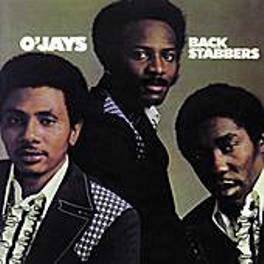
O'Jays Back Stabbers (1972) album cover, November 10, 2011. (Dan56 via Wikipedia). Qualifies as fair use as low-resolution illustration of subject matter.

O’Jays Back Stabbers (1972) album cover, November 10, 2011. (Dan56 via Wikipedia). Qualifies as fair use as low-resolution illustration of subject matter.

What I didn’t know was how quick and violent the shift into poverty would be. What I didn’t know was that Maurice would use his/our conversion as Hebrew-Israelites as justification for abusing my Mom and me. What I didn’t know was that my Mom would have three more kids by this man between July ’81 and May ’84. What I didn’t know was that I would feel so low about the loss of my best friend and my sense of self that I’d attempt to take my own life on my fourteenth birthday, at the end of ’83.

But when I looked back on this in ’97, I mostly thought about the good things that had occurred in the fifteen years between the domestic violence my Mom endured on Memorial Day ’82 and my doctoral graduation ceremony. My independent conversion to Christianity in ’84. Knocking out a 5 on my AP US History exam without ever cracking open Morison and Commager. Overcoming poverty and my lack of self-esteem to build a life at Pitt and in Pittsburgh between ’88 and ’97.

Still, I’d already been wounded, badly. By the things I knew but did nothing about. By those things I could’ve anticipated but my efforts to counteract were insufficient. By those things I couldn’t have known at all. I knew I’d have problems with my “running interference” advisor Joe Trotter coming down the dissertation stretch. Yet because of departmental politics and my need to be done sooner rather than later, I did nothing about this until I was six chapters into an eight-chapter dissertation. I knew my mentor and committee member Bruce Anthony Jones could sometimes be unreliable. Yet I had no idea that he would completely abandon me and his other doctoral students the moment he signed his name to my and their dissertations.

My dissertation's signature page, May 18, 2013. (Donald Earl Collins),

My dissertation’s signature page, May 18, 2013. (Donald Earl Collins),

Most of all, I never anticipated that my Mom would actually be jealous of me, and would spend a whole week with me at 616 and in Pittsburgh doing and saying things to completely disparage what I’d worked so hard for. For me, for her, for my family. That was hard to get over. There are times I’m not sure if I’m entirely over this yet.

What I’m sure of in ’13, though, is what I do know, don’t know, and can only anticipate with the wisdom of experience and wisdom beyond my experience. I know that I love my wife, that there’s a lot in common between her and Crush #1 (for those of you who’ve read Boy @ The Window so far, the implications should be obvious), real and from my own imagination. I didn’t know that I’d have a kid, a son who at nearly ten is both wonderful and perplexing, and hopefully, off to a much better start in life than I ever got. I suspect that one of my references for jobs and consulting gigs has been undermining my efforts over the past five years, and have thus removed her as a reference.

What I don’t know — but can only hope and work like a dog toward — is whether Boy @ The Window will be a success. I’m not sure if quantifying it would help. I sold a thousand copies of Fear of a “Black” America between August ’04 and January ’07, without the benefit of this blog, Twitter, Facebook or the e-book platforms. How long before I sell my first hundred, thousand, 5,000 or more? I have no idea. But as they say, I “must walk the path, not just know it.”

Afrocentricity and the Writing Bug

Tags

, , , , , , , , , , , , , , , , , , ,


A ladybug, often a symbol for the writing “bug,” May 15, 2013. (http://flickr.com). In public domain.

This time two decades ago, I was already a bit desperate for work. In transferring from Pitt to Carnegie Mellon, I’d left myself without any financial coverage for the summer of ’93 (see my post “The Arrogance of Youth, Grad School Style” from June ’12). I had applied for several fellowships, summer teaching gigs, even some nonprofit work. But as of the middle of that May, nothing had come through. I’d already spent $200 on a root canal that occurred on the same day as my written PhD comps at CMU (see my post “Facing the Tooth” from May ’12).

Even before my comps and my surprise root canal, I had talked with my friend Marc about writing a joint article about the false litmus test of Blackness that Afrocentricity had come to represent in our minds. Between Molefi Asante’s students at Temple — not to mention the overtly Afrocentric turn of both the Black Action Society and the Black Studies department (which had changed its name to Africana Studies) in the previous eighteen months — both of us felt we needed to provide an alternate perspective.

On that third Saturday in May (and the day after my comps and root canal surgery), we worked for five hours in putting together what amounted to a 1,200-word opinion piece against the belief system and authenticity test that Afrocentricity (and Afrocentric education) had become. By some folks’ definition, we realized that jazz, Miles Davis and John Coltrane would fail the authentically Black test of a Molefi Asante’s wonderful Afrocentric Idea (1987) and of Maulana Karenga as well.

Frances Cress Welsing's The Isis Papers (1991), [about as authentic as auto-tunes], May 15, 2015. (http://amazon.com).

Frances Cress Welsing’s The Isis Papers (1991), [about as authentic as auto-tunes], May 15, 2015. (http://amazon.com).

Now I’m pretty sure why Marc had problems with Afrocentricity. As a Christian and a jazz aficionado, Marc likely saw Afrocentricity as something somewhere between a misguided way of thinking about Blackness and complete and utter bull crap. His goal was to “add to the debate” and “educate” those who weren’t Asante or Karenga apostles and disciples. A laudable — if somewhat naive about the politics of academia and race — goal.

As for me, beyond the academic superficiality of having a litmus test on what is and isn’t Black, I had at least two unconscious reasons for writing my first crossover piece. One had to do with my sense that too many young folks were all too interested in doing the cool thing and not the right thing. Afrocentricity was cool, just like all rap and hip-hop was cool, just like giving libations to ancestors was cool.

Being cool had always meant following a crowd and seldom saying anything that would dig more than a nanometer beyond the surface. Or saying a critical thing about the cool thing that everyone in the same crowd otherwise takes in without a critical thought. I went to a high school full of people like that, and loathed being around people like that when I’d been a part of the Black Action Society at Pitt.

Unconscious reason number two had something to do with my Hebrew-Israelite days. Again, I gave this zero direct thought during my grad school days. But the given the trauma I’d suffered through during my three years of kufi-dom, it had to affect my thinking about Afrocentricity. The Black folk I knew who were part of the Hebrew-Israelite religion were much more obvious about what they did and didn’t consider Black or kosher. Yet, it was so obvious that they constantly contradicted themselves, in terms of food or music, how they treated their wives or children. Most important for me, though, was the fact that they tried to live separate and apart from other Blacks, yet seemed no more different beyond the kufis, veils and kosher meats from other Blacks (or Jews, for that matter).

I saw Afrocentricity as bullshit, and still see the fact that so many folks who get caught up in this sense of authenticity around Blackness as folks falling for bullshit. If I hadn’t lived as a Hebrew-Israelite between the ages of eleven and fifteen, perhaps I wouldn’t see Afrocentricity this way. If I hadn’t been around the “Party All The Time” folks in high school and the “Black Panther Party” posers at Pitt, maybe Afrocentricity would’ve been more appealing to me.

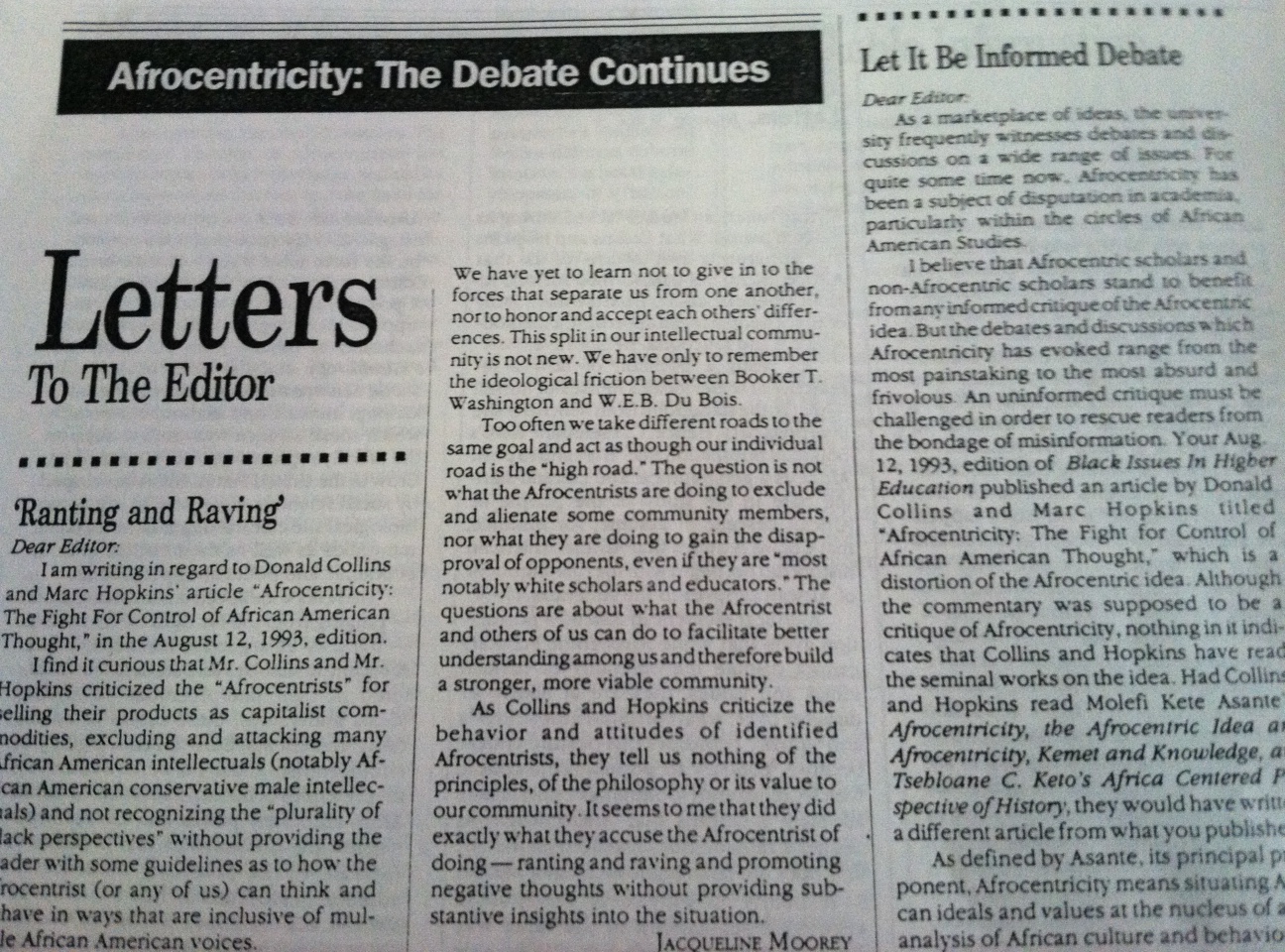
Letters to the Editor, Black Issues in Higher Education, September 9, 1993. (Donald Earl Collins).

Letters to the Editor, Black Issues in Higher Education, September 9, 1993. (Donald Earl Collins).

But at twenty-three years old, I was already tired of the pursuit of coolness and authenticity. That hasn’t changed in the past two decades. I’m sure the letters that called Marc and I “Uncle Toms” after our piece was published in Black Issues in Higher Education were from folks who thought we weren’t cool, and thought they had the answers to life itself.

I wonder how those folks back then would see the academics who believe that hip-hop can explain everything in the social sciences and humanities who are prominent today. Perhaps some of these people today were the Afrocentric followers of twenty years ago. Perhaps not. All I know is, I haven’t stopped writing since that cloudy day in mid-May.

Update on Carnegie Mellon & the “Pope Girl”

Tags

, , , , , , ,


CMU President Jared Cohon's decision on "Pope Girl"-Gate, May 10, 2013. (Donald Earl Collins).

CMU President Jared Cohon’s decision on “Pope Girl”-Gate, May 10, 2013. (Donald Earl Collins).

Outgoing Carnegie Mellon President Jared Cohon sent out a message to CMU alumni/community yesterday afternoon revealing his rather middle-of-the-road, Solomon-esque decision on the anti-pope nudity incident at the Carnival last month. His good yet easily predictable decision: the “Pope Girl” and her male accomplice will face misdemeanor indecent exposure charges from the Allegheny County courts for exposing cross-shaped pubic hairs in their public-mockery-of-Carnival campus march on April 18. But they will face no further disciplinary action from CMU, as what they did fell well within their rights of freedom of expression.

I’m sure the majority of my fellow yet rather conservative CMU alums will take some affront to this decision, but too bad for them. If you can’t hand out condoms while mocking the pope and buggy races with your butt and vagina hairs exposed as an undergrad, then when, pray tell, do you ever plan to break free?

I’m sure this was a difficult decision for President Cohon. He’s got one foot off the campus toward retirement while making a decision that could cost CMU some donors. But as Cohon approaches his last weeks on the job, he’s also likely gained a few new donors for the university, at least of the current generation of CMU students. I will never likely be one of them.

Still, I do look forward to future CMU controversies over students and their freedom of speech and expression. It’s a welcome change from discussions of the silent Republican majority, robotics and military contracts, and alumni who were my age before I was born in ’69.

It’s funny though. Today marks nineteen years since I finished all of my coursework for my CMU History PhD. I thought that was exciting stuff then. Some things are changing for the better.

My Trouble w/ the Lauryn Hill Reaction

Tags

, , , , , , , , , , , , , , , ,


House Speaker John Boehner sobbing in public (again), May 8, 2013. (http://www.goodbye-blue-monday.com/).

House Speaker John Boehner sobbing in public (again), May 8, 2013. (http://www.goodbye-blue-monday.com/).

I am by no means a supporter of our slanted US justice system. It’s all too often slanted against the poor, of color and male. But I can’t sit around and watch folks gnash their teeth over the federal court in New Jersey sentencing her to three months in jail for over $1 million in income tax evasion.

Sure, it’s not fair. Perhaps even very unfair. We must keep in mind the simple fact that the IRS, et al. take years attempting to work with the rich (and yes, Lauryn Hill is a rich person) before putting a case together for the federal courts. It’s not as if the feds immediately swooped in, tasered Hill and then dragged her  through the streets in chains on the way to court. After all, she didn’t file federal or state income tax returns on $2.3 million in income from ’05 through ’09 — for five years! Heck, if Willie Nelson could figure out a way to stay out of federal courts and prison while paying off $17 million in back taxes, then surely Hill could’ve done the same at some point.

Lauryn Hill in court for one of her sentencing hearings, April 22, 2013 (Eduardo Munoz/Reuters). Qualifies as fair use under US Copyright laws, given subject matter and public hearing.

Lauryn Hill in court for one of her sentencing hearings, April 22, 2013. (Eduardo Munoz/Reuters). Qualifies as fair use under US Copyright laws, given subject matter and public hearing.

Those who’ve compared drug-addled celebs like Lindsey Lohan to Lauryn Hill as a case of Black versus While and the criminal justice system are missing a couple of valuable points. One, Lohan’s cases have never been federal, with mandatory sentences included. Two, and this is way more important, the feds tend to be pretty unforgiving once they do bring a case against a rich person for income tax evasion (e.g., Al Capone, Wesley Snipes, Leona Helmsley).

As much as I like Lauryn Hill’s music, I may feel bad for her, but I’m not going to make a federal case out of her serving three months in a federal prison for tax evasion. She’s not Mumia Abu Jamal, Angela Davis, Assata Shakur or even Tupac Shakur. Maybe Hill should’ve heeded lyrics straight from The Fugees, adapted federal government-style: “Ready or not, here [they] come, you can’t hide (uhhhh-huhhh) /gonna find you, and take it slowly…” As for the “find you” part, I also have to misquote Die Hard (1988) here, courtesy of the character Hans Gruber: “when you steal $600, you can just disappear. When you steal [one] million, they will find you, unless they think you’re already dead.”

I’ll take crap for writing this I’m sure. But Hill will be breathing free air again before Columbus Day, if not sooner.