• About Me
  • Other Writings
  • Interview Clips
  • All About Me: American Racism, American Narcissism, and the Conversation America Can’t Have
  • Video Clips
  • Boy @ The Window Pictures
  • Boy @ The Window Theme Music

Notes from a Boy @ The Window

~

Notes from a Boy @ The Window

Category Archives: Work

If I Could Redo Time…

18 Thursday May 2017

Posted by decollins1969 in 1, Academia, Boy @ The Window, Carnegie Mellon University, Christianity, culture, Eclectic, Mount Vernon New York, New York City, Pittsburgh, Politics, Pop Culture, race, University of Pittsburgh, Upper West Side, Work, Youth

≈ Leave a comment

Tags

Alternative History, Angelia, Barbara B. Lazarus, Betrayal, CMU, Graduation Ceremony, Job Talk, Joe William Trotter Jr., Laurell, Mother-Son Relationship, Peter Stearns, PhD Graduation, Pitt, Self-Reflection, Steve Schlossman, Teachers College, Triumph, Westchester Business Institute


Show art from SyFy’s 12 Monkeys (the home of alternative timelines), March 2016. (http://syfy.com).

Mother’s Day Week 1997 was one of triumph, betrayal, and deep self-reflection, helping to shape my last two decades. On that fateful Sunday, I finished preparing my transparencies for the overhead projector that I would need to use for my job talk on multiculturalism, race, and education at Teachers College the next day. My then-girlfriend Angelia came over around 1 pm, helped me pack as we talked about the job, my research, her missing me for the next few days, and my wishing I could take her with me to New York. Then we called a cab, went out to Pittsburgh International Airport, and I boarded my 6 pm flight bound for La Guardia.

The next day, that second Monday in May 1997, went well despite barely six hours of sleep (a typical night for me now). I met with Teachers College faculty, graduate students, a department chair, an assistant dean, and the dean. I gave my all-important job talk, fielded questions, and otherwise felt that I brought my heat in this potentially life-changing interview. By 4 pm, it was over, I was exhausted, but I was more than content. I figured I made myself a tough out at worst, and gave myself a real chance at this assistant professor job at best.

I spent the night in Manhattan at the Hotel Beacon, and ordered room service, instead of going out to Barnes & Noble or Tower Records. I had to rest up before going to see my family at their temporary apartment in Yonkers. Refreshed and with my old blank-faced-Donald mask on, I checked out and took the 1 train up to Van Cortlandt, then the Bee-Line bus into Yonkers, where my Mom and younger siblings had been living for a year and a half.
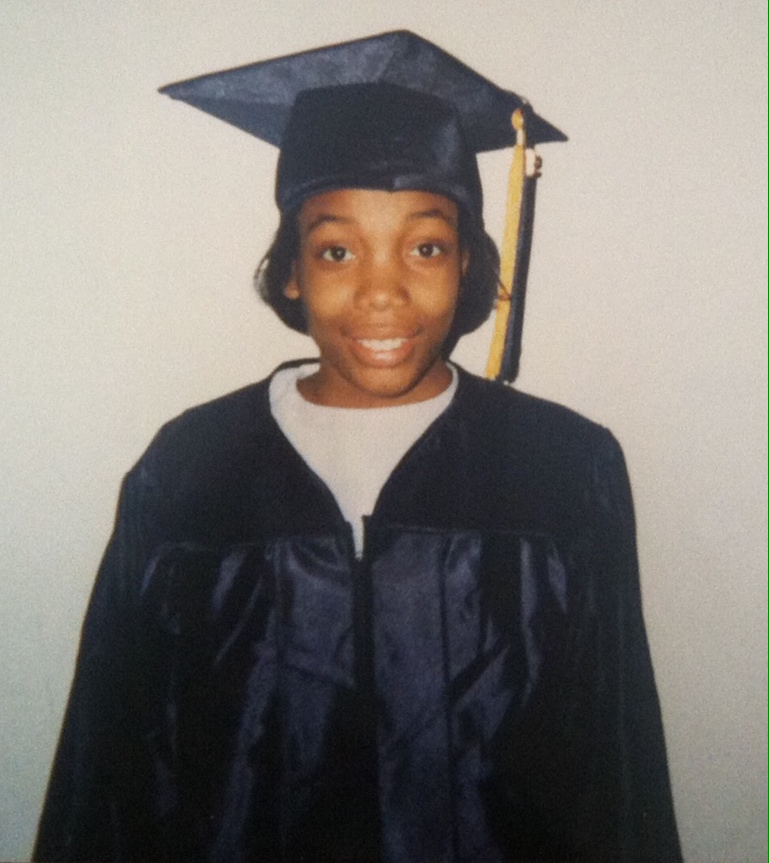
My sister Sarai (1983-2010) in Mom’s cap-and-gown, May 14, 1997. (Donald Earl Collins).

Tuesday was Mom’s graduation day from Westchester Business Institute. After ten years of on-and-off-again enrollment, Mom had finished her associate’s degree in accounting. I was really happy for her. That day from 10 am on was about getting Mom and Maurice, Yiscoc, Sarai, and Eri cleaned up and ready for the long bus trip up Broadway to White Plains, Westchester County Center, and hundreds of other WBI graduates. Of all of us, I think my sister Sarai had the best time. After Mom tossed her cap in the air (and caught it), Sarai begged to put on Mom’s graduation digs. My fourteen-year-old sister walked around for the rest of the night as if she had graduated from college!

Wednesday was a difficult day. I had a noon-ish flight to catch out of La Guardia back to the ‘Burgh, as my own PhD graduation was four days away. Though Mom and I agreed that I didn’t have the funds to fly her out and put her up in Pittsburgh, I didn’t agree that my teenager siblings (all between nearly eighteen and thirteen at this point) couldn’t watch over themselves for two or three days. “Are you kiddin’?,” Mom said when I suggested this, and added, “the kids would tear this mutha up while I’m gone.”

But then, as I was getting packed up to do the Bee-Line Bus, 1 train to Times Square, Shuttle to Grand Central, and cab to LGA, Mom said something that made me happy we decided she wouldn’t be at my graduation. “You know, you were in school so long, you could’ve had another high school diploma.” The scorn with which she said it, it was like someone suddenly stabbed me in the stomach. It was the first time I truly saw Mom’s vanity, possibly even, her jealousy. After I said my goodbyes, promising my brother Maurice that I’d come to his Mount Vernon High School graduation in June, Mom’s sentence of sneering envy was all I thought about on the trip back.

“Maybe it’s a good thing you didn’t invite your mom,” Angelia said after I told her about Mom and her brooding behavior Wednesday evening. “But, this means she will have never seen me at any graduation, seen where I’ve lived the past ten years, seen how hard I worked,” I cried. Angelia got up from her dining room table, walked around to my side, sat in my lap, and gave me a hug. I’m so glad she didn’t let go, and let me cry myself out on her shoulder and chest for a few minutes.

I woke up in Angelia’s bed Thursday morning, having slept past 9 am. It was the most sleep I’d had in five days. I was remarkably refreshed. I rarely stayed over at Angelia’s because the back of her third-floor flat was practically an urban wildlife reserve, between the raccoons, squirrels, pigeons, cardinals, blue jays, rabbits, and the occasional deer. Not this morning. They seemed to know I needed not to hear them that morning.

The next three days were a blur. I ran around Pittsburgh and Carnegie Mellon and Pitt saying formal goodbyes to a few colleagues and former professors, something I wouldn’t have had time for if Mom had been in Pittsburgh with me. Angelia and I spend most of Saturday with her mommy, and then with my friend Laurell, Laurell’s sister Naomi, and their charge Archie. It would be the only time anyone from my Humanities days would witness me graduate with one of my Pittsburgh degrees.

That Sunday, May 18, was going to be a scorcher of a day. I was to be on stage as part of the tent-revival-as-graduation ceremony at CMU (as they did for all the PhD graduates). But there was no way I’d wear a full suit. So I compromised. I put on a shirt and tie under my gown, wore my baggy basketball shorts for bottoms, and put on shoes and dress socks to complete this goofy yet comfortable picture. I marched across the stage and shook Peter Stearns‘ hand, as he was the dean of humanities and social sciences at CMU then. Too bad I didn’t say what I thought about his fast food approach to teaching and learning to him in that moment.

But, after that first ceremony, the individual and group pictures, a bunch of folks had to leave. Laurell, Naomi, and Archie had to get back to Virginia for yet another week of school — that’s what happens between two school teachers and an eighth-grader for graduation attendees. My friends Ed and James had errands to run, and Angelia’s mom had some church-related affairs to get to. So, for the moment, it was just me and Angelia, walking from CMU to The University Club, by Pitt’s Thackeray Hall.

We get there, in this quiet room, with seven burgundy diploma holders, sitting on a table that staff had covered in this dark blue velvet cloth. My now former advisor, Joe Trotter, arrived a few minutes later. I’d only seen him once in the six months since he finally approved my dissertation, ending what had been a two-year ordeal of betrayal, slights, and threats while writing my 505-page tome. Yet, all I was thinking was, “Why are we doing the departmental ceremony in a building in the middle of Pitt’s campus?”

CMU leather diploma album, May 17, 2017. (Donald Earl Collins).

Steve Schlossman, the history department chair, was this ceremony’s emcee. He introduced each of us, our research, any awards we may have won, and our dissertation advisors, all as he handed us our doctorates. I was second on the list to go up and receive my diploma, shake hands with Schlossman and Trotter. I did say a few words, mostly about hard work and perseverance. “With God and faith, and of course, my girlfriend Angelia, even though that word ‘girlfriend’ hardly defines who you are to me, I wouldn’t be standing here right now. Thank you.” That was how I ended my three-and-a-half minute speech.

There was a small reception afterward, and like most CMU ceremonies I’d been a part of since 1993, this one was nearly blindly boring. Except that my friend James did show up and gave me a pat on the back and a handshake. Except that my dear friend and mentor Barbara Lazarus came and gave me a big hug. Except that Angelia had insisted on taking pictures of me from the time I got up to get my degree until the moment we left.

We were out around 6:30 pm. It had rained and poured, as thunderstorms had rolled through during the second ceremony. I wish Mom could’ve been there, seen what I had seen, felt what I was feeling. But, knowing what I knew now, the personal triumph that this graduation day was couldn’t be diminished. I had long since stopped living for what Mom wanted me to be — a sounding board, a babysitter, an extra source of income. For the first time, I no longer felt guilt about not going back to New York after my undergraduate years at Pitt, ready to bail my family out of poverty on a $25,000-a-year salary. For the first time, I realize Mom’s burdens were never mine to carry.

The Cruel Lure of Academia

22 Saturday Apr 2017

Posted by decollins1969 in 1, Academia, Boy @ The Window, Carnegie Mellon University, culture, Eclectic, High Rise Buildings, Jimme, Mount Vernon New York, My Father, New York City, Pittsburgh, Politics, Pop Culture, race, Upper East Side, Upper West Side, Work, Youth

≈ Leave a comment

Tags

Academia, Academic Culture, Academic Jobs, Barbara Lazarus, Bruce Anthony Jones, Burnout, CMU, Contingent Faculty, Faculty, False Gods, Family Issues, job search, Joe William Trotter Jr., Meritocracy, Pitt, Politics of Academia, Publish-or-Perish, Teachers College, Tenure-Stream Positions


Rihanna as Medusa, GQ Magazine cover, December 2013. (http://pinterest.com).

Twenty years ago on this date, I took the call that would help define my last two decades professionally. It was a call from Teachers College, Columbia University. I had made a final cut of interviewees “out of more than 300 applicants,” for a tenure-track assistant professorship in the history of education, the administrative assistant to the ed foundations department chair’s office had told me. It was my first post-PhD job call, one at the time that I hoped would be the only one I’d need.

It wasn’t my first interview for an academic position, though. That distinction went to Illinois State University, in April ’94. Two of their history professors were at the American Educational Research Association annual meeting in New Orleans, screening applicants for a lecturer and a non-tenured assistant professor position. I dared not tell my advisor Joe Trotter or anyone else about the screening invite. I went, I met the two youngish professors, both of whom told me to finish my PhD before applying for another job, because they thought my work “too promising” for non-tenure-stream positions. I had also interviewed for two education nonprofit positions, both in Pittsburgh, and both only offering me only a few thousand more than the US Postal Service offered me in ’92, when my name for a job finally came up.

Burned out 40w light bulb, April 27, 2010. (http://www.iamtonyang.com).

Now I had gotten a call from one of the most prestigious education schools in the world. A school within the same university that wanted to hire a private investigator ten years earlier because they didn’t want to give a poor Black kid a four-year free-ride. Despite the irony, I was happy, nervous, and apprehensive. I was happy for the opportunity, nervous about my prospects, and apprehensive about the possibility of moving back to New York. But, most important, I was also burned out emotionally and psychologically from the dissertation process, though not as burned out as I would become in the six weeks that followed.

The interview itself three weeks later was one of the best I’ve ever done for anything. I gave my job talk on multiculturalism and Black education, and for once, professors and graduate students in the audience didn’t look at me like I was speaking Vulcan. I actually had fun on that eight-hour interview day. As much fun as eight hours of scrutiny and answering the same questions over and over again could bring.

But, I remained apprehensive. Because I knew that I had a lot of big decisions ahead if I didn’t get this position, and just as many or more if I did.

Could I pay rent or eat through the summer if I didn’t get the job? Should I go groveling back to Carnegie Mellon, so that I could teach the required World History course for the 1997-98 school year? Could I pick up an adjunct gig at Pitt, Duquesne, or one of the other universities for next year, or what if it’s already too late to reach out? Could I get help from Bruce Anthony Jones, or beyond my dissertation committee, people like Barbara Lazarus, in securing my future? These were the normal questions that an army of PhDs in fields like history faced every single year.

For me, though, the idea of being an assistant professor twelve miles from where I grew up and thirty blocks from one of the buildings I helped my alcoholic father clean made my brain twist in knots. Heck, Teachers College had put me up at the Hotel Beacon on Broadway, between 74th and 75th Street, just three blocks from a high-rise me, my older brother Darren, and my father had cleaned the carpets and floors of regularly between 1984 and 1986. Did I really want to go back to a place with so many bad and embarrassing memories?

Plus, it wasn’t just my past I worried about. Living in subsidized faculty housing wasn’t ideal for me and my soon-to-be-wife. My younger siblings could reach me by catching the 1 or 2 train, and with the recent fire at 616 and the trauma that had caused, their visits were likely to be a regular part of my routine. I had given Mom something like $5,000 in the three years before the possibility of this job, as a graduate student. As a professor, she would likely expect me to do so much more.

Charging Bull of Wall Street (or a false god), cropped, January 19, 2016. (Sam Valadi/Flickr, via http://www.atlasobscura.com/)

Looking back, if Teachers College had offered me the job and I’d of course taken it, I likely wouldn’t have earned tenure. Oh, I would’ve been a fine classroom professor, and most of my students would’ve liked, loved, or learned from me. But between me having not dealt with my Mount Vernon/NY past, my Mom and siblings and family issues, and trying to turn my dissertation into a book and churn out academic pieces, I would’ve needed psychotherapy after three or six years. But Teachers College rejected me two months later. It supposedly came down to me and one other person.

This is what academia does to its own. With too few tenure-stream jobs and way too many qualified candidates, each job interview or job earned becomes magnified, to the point where taking a position can close as many doors as receiving a rejection for a job. Combine that with the false gods of meritocracy and academic freedom, and you have a recipe for a world of competitive disappointment. Academia is a world full highly educated people working for working-class wages but with elitist expectations of themselves and of those lucky few with tenure-stream positions. Add race, class, gender, family, and intersectionality to this brew, and it’s a wonder more of us don’t experience depression or some other mental illness.

I wouldn’t have been able to write this twenty years ago, even if I subconsciously suspected or consciously knew this to be true. I was tempted by the brass ring, only to find it was really a rusty old nail bent to look like something valuable.

Michael Clayton, My Writing, and 20 Years of Sinai-Wandering

16 Thursday Mar 2017

Posted by decollins1969 in 1, Academia, Boy @ The Window, Carnegie Mellon University, culture, Eclectic, Pittsburgh, Pop Culture, race, Religion, University of Pittsburgh, Work, Youth

≈ 2 Comments

Tags

Academia, Academic Writing, CMU, Dan Resnick, Falsehoods, Gene Clayton, George Clooney, Lies, Michael Clayton, Michael Clayton (2007), Mythology, Pitt, Politics of Academia, Publish-or-Perish, Richard J. Altenbaugh, Scholarship, Sean Cullen, Unwritten Rules, Writing, Writing Career


George Clooney and Sean Cullen in Michael Clayton (2007), March 15, 2017. (http://bbc.co.uk).

My favorite scene from Michael Clayton (2007) is when the title character’s brother Gene (played by Sean Cullen) confronts Michael (played by George Clooney) about the past seventeen years of his career as a fixer.

You got these cops thinking you’re a lawyer. You got these lawyers thinking you’re a cop. You got everybody fooled, don’t you? Everybody but you. You know exactly what you are.

About a year and a half ago, I figured I could insert the words “writer” and “scholar” in those lines, with twenty years of my career(s) for context, and maybe some of the meaning would be correct. I am a writer’s version of Michael Clayton. I’ve got academicians thinking I’m a unscholarly writer, and journalists and editors who think I’ve only written for scholarly audiences. What a mess!

Last year, after receiving a rejection for a version of my article about American narcissism, American racism, and why real conversations on race (whether through Clinton’s Race Initiative or via Ferguson) are all but impossible, I decided no more. I will not seek to submit another scholarly piece to a peer-reviewed scholarly journal ever again. And if asked, unless it’s something I truly feel passionate about, I will say no.

Do not think of this as sour grapes. I have published two full-length journal articles in my career, not to mention a bunch of the standard book reviews, and an op-ed for Teachers College Record in the past. Technically, I am 3-for-11 in publishing academic articles over the past two decades, not great, but hardly abysmal.

My issue is with the elitism and implicit bias that is rampant in the publish-or-perish world of academia. While some folks could argue it is the same in publishing in general, it really isn’t. The unwritten rules in publishing, if not followed, may well still lead to published articles, even if a person is starving and homeless in between. In academic publishing, not following the rules leads to ostracism, and a career dead before it ever begins.

Keep in mind, no scholarly journal pays authors for their articles. It takes about two years to go from submission to publication in most history and education journals. If twenty people read your article, that’s icing on a protein-powder cake. If you aren’t in the tenure-stream, though, it really doesn’t matter how many articles you publish, because it doesn’t provide job stability or security. As a former nonprofit administrator, it scared most of my supervisors whenever and wherever I published, so no benefits there either. For those in tenure-stream positions, it does matter, no matter how crappy the research or how densely unreadable the writing.

After twenty years in the publishing struggle, it’s time to face the truth. I simply wasn’t good enough to publish in academic journals. I’m not talking about my writing ability or research skills. I’m pointing out my eclectic career path, my lack of tenure at an elite university, with few to vouch for me when I was younger and an up-and-comer. My interdisciplinary research on race, on multiculturalism, on education, meant that I was a misfit from day one. Heck, I know for sure in at least one case, a journal editor held my race and age against me.

Sinai Desert, where Moses, the Israelites (and I) wandered for a generation, Egypt, March 9, 2010. (Tommy from Arad via Wikipedia). Released to public domain via CC-BY-SA 2.0.

I know most of the academic writing rat-race is a system of exploitation based in part on fears of joblessness, loss of prestige, and elitism based on class, race, gender, and whether one teaches at an elite university or at a community college. It is based on an academician’s ability to blame themselves and themselves alone for their failings, and not the oppressive publishing system itself. Kind of like the poor blaming themselves for their poverty. Or Whites and Blacks blaming other Blacks for a degenerative culture instead of looking at systemic racism as the real culprit for racial inequality. Academia is very much in and of this wider world of social injustice and oppression, no matter how university presidents attempt to spin it.

Truly, I find the idea of a cold, objective, dispassionate, dense writing style as more serious and scholarly than any other form to be high-grade bullshit. It’s what folks in academia tell each other. Just like many a journalist and editor is a frustrated writer looking for creative and book manuscript-length outlets, many a writer in academia believes their writing (and as often as not, their research) to be much more than it is.

But the biggest issue for me was my elitist and naive attempt to straddle the fence between academic publishing and writing for wider audiences. This living in two worlds began for me during my heady days, my grad school years at both the University of Pittsburgh and Carnegie Mellon. Some of my history professors, like Paula Baker, Kate Lynch, and Joe Trotter, all tried with a considerable amount of frustration to get me to write in more scholarly tones. Others seemed to be fine with my writing style. I had a tone that was too “journalistic,” according to my racial paternalistic professor Dan Resnick, who meant it as an insult.

Between 1997 and 2002, I churned out eight full-length pieces (in the 20-35-page-range) on multiculturalism and Black education/history meant for peer-reviewed scholarly journals, four of them between February and December 1997 alone. None of them were ever published. One, an admittedly ambitious state-of-the-subfield piece on multicultural education and its history in American education, elicited a response from the History of Education Quarterly’s editor-in-chief. He was my one-time professor during my first year of graduate school at Pitt, Dick Altenbaugh. Him and his managing editor met with me for nearly an hour and a half in March 1998.

Some of the meeting was about the deficiencies in my article and in my argument. But most of the time was about my writing style, my ambitiousness, and quite frankly, my age and race. I wrote about some of this in Fear of a “Black” America. Apparently, at twenty-eight, I needed to be in my mid-40s to write a grand essay on multicultural education. Allegedly, I needed long-retired (and in one case, dying) White scholars to support my arguments, no matter what evidence I brought to bear. I needed, most of all, to stop being so ambitious about my work, and stick to more objective, run-of-mill, 181-variations-on-a-theme topics in the education field. Like what Karl Marx or John Dewey would have to say about ability grouping.

I gave up on academic publishing in 2002, at least on the topic of Black education/history and multiculturalism. I tried to write articles on everything from social justice movements to the fallacies of the liberal-conservative construct, on education, poverty and mythology of American social mobility, even on intersectionality. Only, I had worked so hard to make myself more of a scholarly writer. So much so that I now had to relearn how to write for more than fifteen people, and really, to write for myself. It took about a year to drop the 40, 50, and 60-word compound sentences, the use of inappropriately complex language, and the mask of dispassionate objectivity in my writing. Ironically, this was also when I published my first scholarly piece, on multicultural conservatism and Derrick Bell’s “Rules of Racial Standing,” in 2003. I also published my first solo op-ed, in the Washington Post, around the same time.

By this time, I saw myself as a recovering academic. I also had some unfinished personal business, around how I got to my mid-thirties, to this place in my life where I had “made it,” sort of, but I hadn’t escaped my past. This was where the story of Boy @ The Window took over, and why I have a memoir and nearly ten years of blog posts.

But because of my nonprofit work on college access and retention, two professors invited me and my team to submit a piece for publication in their journal. It was a four-person piece with me as the primary author (I wrote about 90 percent of it, so there’s that). The original invite was in June 2007, and the article came out in mid-October 2009. I had stopped working for the Academy for Educational Development, and found writing the article like a strait-jacket and a time-gobbler.

Michael Clayton (George Clooney) and a horse, a moment of truth, screen shot and crop, 2007. (http://chud.com).

After Boy @ The Window in 2013, I decided to write articles for a broader audience again. This time, I made the decision to take my memoir-writing experiences and apply them to my writing. I started writing about K-12 and corporate education reform, the problems in higher education, about racism in the Obama era, about poverty and its connections to race, gender, and current issues. And over the past two years, I’ve published more and reached more people than I could ever have done with an award-winning article in the Journal of American History.

So academia, you win. I give up.

What Do We Tell Them Now?

23 Thursday Feb 2017

Posted by decollins1969 in 1, culture, Eclectic, Patriotism, Politics, Pop Culture, race, Religion, Work

≈ Leave a comment

Tags

45, American Mythology, American Racism, Civic Education, Critical Thinking, Edutainment, High School Students, Hypocrisy, Independent Thinking, Jay Wickliff, Meritocracy, Political Corruption, Presidential Classroom


One version of Presidential Classroom logo, January 27, 2014. (http://congressionalaward.org).

One version of Presidential Classroom logo, January 27, 2014. (http://congressionalaward.org).

In all of my professional work experiences, I’ve had two stints outside of academia and more traditional nonprofit settings in which I worked with high school students. One was during my two summers as a consultant with the Junior Statesmen Foundation, where I co-taught and co-prepared an accelerated version of AP US History for students attending the JSA summer program that Princeton University hosted, in 2008 and 2009. I loved those summers with those students, even though it meant not seeing my family for a few weeks at a time.

The other one was during my time as Director of Curriculum for Presidential Classroom. Presidential Classroom, by the way, was never affiliated with the White House. Nor was it an actual classroom. From 1968 to 2011, it was a civic education program that made money by getting schools and parents to cough off dollars to send their high school kids to Washington, DC for a week. Presidential Classroom’s purpose was for students to learn about how the center of American power works from an up-close-and-personal perspective, to serve as a possible way to inspire teenagers to take up public service as adults. It was so influenced by the exaggerated sense Baby Boomers had of themselves and of their activism that was “the ’60s.”

Except that by the time I came on board as a staff person, those lofty purposes were no longer Presidential Classroom’s raison d’être. Like any small nonprofit, it was trying to make more money and compete successfully in a crowded market. Close Up had caught up with and surpassed the organization ten years before I accepted the position. As my one-time boss reminded our staff of twelve continuously, Close Up cleared 20,000 students through their programs in DC every year, while Presidential Classroom struggled to attract 4,000 students in its programs. The board of directors had decided a few years before my time at Presidential Classroom that the organization’s programming had to be more entertaining, and not just about being on Capitol Hill or asking undersecretaries of state and education cogent policy questions.

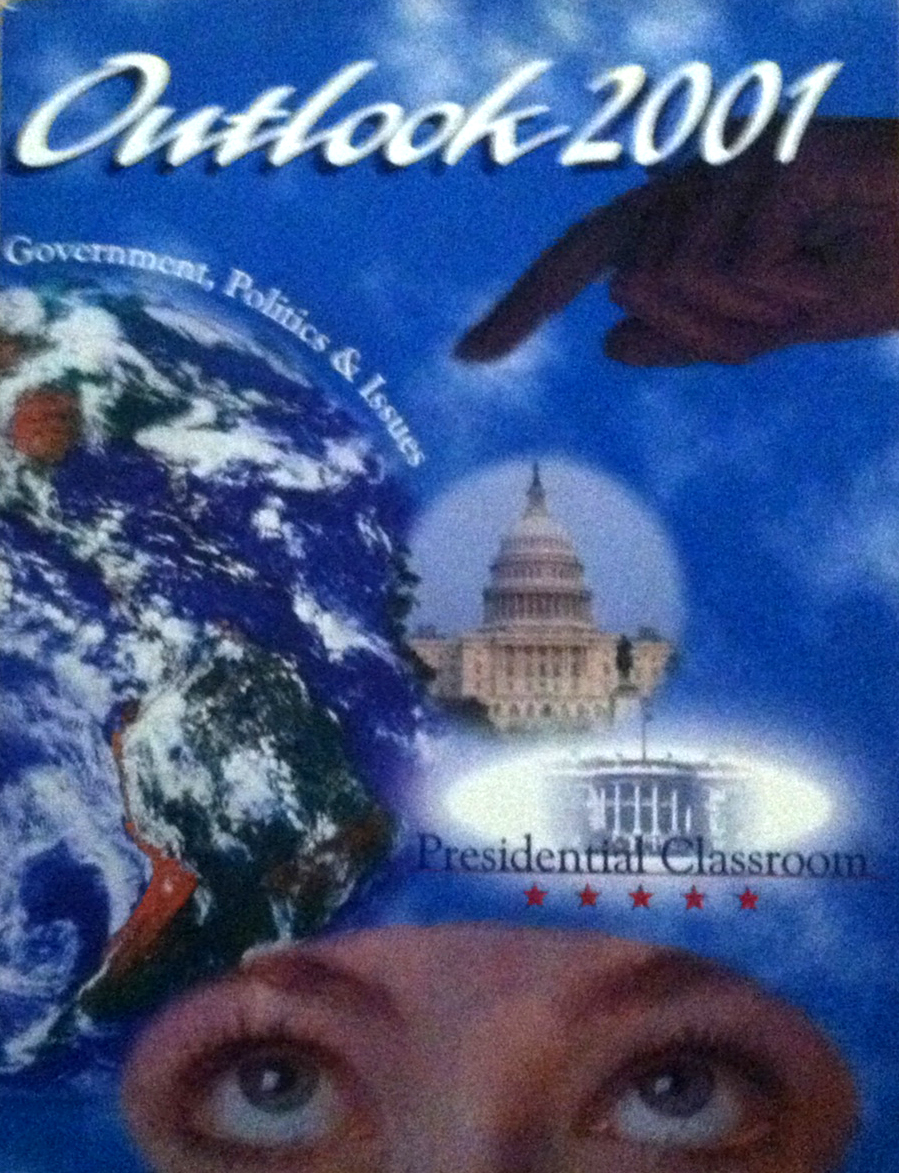
Outlook 2001, my second and last time on the Presidential Classroom annual resource guide, December 1, 2000. (Donald Earl Collins).

Outlook 2001, my second and last time on the Presidential Classroom annual resource guide, December 1, 2000. (Donald Earl Collins).

Across two summer cycles and one winter/spring cycle between June 1999 and December 2000, I worked with high school juniors and seniors as part of what I called “edutainment.” I held up the education end. One of my main jobs before groups of 300-400 students arrived for their week of civic education was to revise the organization’s resource book Outlook. It was my job to cover the various ideological and policy topics of the day using primary and secondary sources in the resource book. Even though the organization only expected me to cover two sides to any policy-based issue or political perspective, I knew that this was too simplistic. I often had three points of view for each topic in the resource book.

It was all to make sure that when the high school students got together to debate each other on immigration reform, reproductive rights, affirmative action, or climate change, they didn’t sound like they just quoted Jack Van Impe or Jimmy Swaggart. It was supposed to help them ask well-thought out questions when meeting with representatives and senators, or during a Q-and-A session with a cabinet member, senior Pentagon official, or an editor from The Washington Post or USA Today.

Unfortunately, what little bit of learning students gained during their week in DC translated into a confirmation of their existing ideas about American politics and civic engagement. Plus, it didn’t help that I was working for Presidential Classroom at the end of President Bill Clinton’s impeachment debacle and throughout the 2000 Presidential Election cycle. Arguments about the articles of impeachment turned into whether Monica Lewinsky seduced Clinton or whether the president used his power to obtain sexual favors from a then-twenty-three year-old intern. Six-year-old Elián González became either a proverbial poster child for “illegals” or a symbol of America’s broken promise as a melting pot. Every White student had a story about their dad or brother being screwed out of a job because of affirmative action, of course without actual evidence.

As for the three branches of government, checks and balances, and the bicameral chamber, or more importantly, the process of how a bill became law, who really cared? The students and some staff were more interested in comedy troupes in Georgetown or attracting more “Orientals” to program than in the distance between how government in DC was supposed to work and the Hill’s sorry-ass reality.

What remains of Presidential Classroom, a broken link on the Miller Center website, February 22, 2017. (Donald Earl Collins).

What remains of Presidential Classroom, a broken link on the Miller Center website, February 22, 2017. (Donald Earl Collins).

As hard and difficult as that job was at the turn of the twenty-first century, it would be impossible now. There’s absolutely no way I could do that Presidential Classroom job in the era of 45. I couldn’t keep a straight face while discussing meritocracy, the distinctions between the Democratic and Republican parties, or in believing that we were really exposing high school juniors and seniors to how Washington actually works. In order to do a proper debate, each group of high school students we had back then would need the full week to just focus on learning how to debate, forget about meeting folks on the Hill or engaging appointees in Q-and-A sessions. We’d have to take away their smartphones and cut off their access to wi-fi and TV to get them to concentrate. Most of all, how could I, how could any of us, have explained the ascendancy of 45 to the presidency without hundreds of center-right parents calling us for weeks afterward complaining about how often we brought American racism to John and Becky’s attention?

If Presidential Classroom existed in 2017, and I found myself unlucky enough to be its executive director, I would forever refocus it away from Capitol Hill. I would have students meet up with policy analysts and lobbyists from K Street, Northwest and the Massachusetts Avenue corridor between D Street, Northeast (the National Republican Committee and the Heritage Foundation) and 18th Street, Northwest (where the American Enterprise Institute, Carnegie Endowment for International Peace, and Johns Hopkins SAIS are located). I would bring in journalists from across the center-right ideological spectrum. But only after I got the so-called liberal ones to admit that their first duty is to sell a story, not objectivity and certainly not truth, and with that, exposing their center-right perspective.

Most of all, I’d show them the rest of DC. The parts of the area that have gentrified in the past twenty years. The parts of Wards 7 and 8 that have concentrated poverty and the ills that result from it. I would introduce them to the nonprofit and social justice organizations that truly give a shit about neighborhood displacement and homelessness, mass incarceration, and political corruption. In all of this, I would want the students to see not only how DC really works, but what good people who care about civic participation and public service must do to put a dent into this out-of-control, money-drenched machine.

A Story of My Life

24 Thursday Nov 2016

Posted by decollins1969 in 1, Academia, Boy @ The Window, Carnegie Mellon University, Christianity, culture, Eclectic, Pittsburgh, Politics, Pop Culture, race, Religion, University of Pittsburgh, Work, Youth

≈ Leave a comment

Tags

American Exceptionalism, CMU, Doctorate, Giving Thanks, Homelessness, Horatio Nelson Stories, Joe Trotter, Pitt, Ron Slater, Scars, Thanksgiving, Thanksgiving 1988


One of dozen of rags-to-riches falsehoods from Gilded Age author Horatio Nelson (1832-1899). (http://www.pavillionpress.com).

One of dozen of rags-to-riches falsehoods from Gilded Age author Horatio Nelson (1832-1899). (http://www.pavillionpress.com).

That one of the not-so-small miracles of my young adult life from ’88 and me completing my dissertation process in ’96 are just a day apart on the November calendar every year is a story unto itself. Between a month before my nineteen birthday and a month before my twenty-seventh, I went from a semester of homelessness, lack of money for food and rent and living in a firetrap to finishing up a doctorate in history. If this were someone else’s story, I’d think that amazing, even almost unbelievable. At the time, I was so worn out and beat up by Joe Trotter, my dissertation committee, and the scars accumulated over that eight-year — really, twenty-year — period, that the idea of seeing myself as an American example of a Horatio Nelson story would’ve likely made me angry enough to spit blood.

Even now, I don’t and won’t see myself as exceptional. That’s that American bullshit about rags-to-riches stories, about being-a-credit-to-my-race tropes, that I’d be subscribing to here. What I really was back then was young and hungry. So young that I was willing to put up with all kinds of people’s baggage, taking near-minimum wage jobs, allowing people to call me out of my name, excusing racist comments and actions. All because I wanted the brass ring, for myself and for my family. I was already hungry, from years in poverty, from years without friendship bonds, from years of people not recognizing my, dare I say, brilliance. I had a chip on my shoulder, but it wasn’t because I was mad. I was after a righteous reckoning.

Two decades removed from those Carnegie Mellon days, and approaching thirty years since Ron Slater and my band of new friends kept me in money and food during Thanksgiving ’88 and beyond, and I am thankful. I am thankful that I am no longer either of those versions of myself. The one too afraid to ask for help, and the one too naive to realize that the America I believed in for so long never existed. I am thankful that I know more about asking for and providing help, about understanding that in this America, help might never arrive, at least when folks most need it. I am thankful mostly that I still have optimism, I still have drive, and I still have people who like and love me enough to remind me that a few of America’s giga-pixels are worth savoring.

Songs in the Key of Life at 40

18 Friday Nov 2016

Posted by decollins1969 in 1, Boy @ The Window, Christianity, culture, Eclectic, eclectic music, Hebrew-Israelite, Jimme, Marriage, Mount Vernon New York, music, My Father, New York City, Pittsburgh, Politics, Pop Culture, race, Religion, University of Pittsburgh, Work, Youth

≈ Leave a comment

Tags

"As", "I Wish", "Love's in Need of Love Today", "Sir Duke", Black Genius, Blackness, Elaine, Growing Up, Love, Pitt, Prescience, Songs in the Key of Life (1976), Stevie Wonder, Uplift, Wendy


Stevie Wonder's Songs in the Key of Life LP/CD cover and sleeve, 1976, 1999. (http://genius.com).

Stevie Wonder’s Songs in the Key of Life LP/CD cover and sleeve, 1976, 1999. (http://genius.com).

In all the nuclear meltdowns in the last weeks of Election ’16 and in the asteroid impact of Donald Trump becoming the 45th president of the United States, I almost completely forgot about one of the modern era’s greatest milestones. At the end of September, Stevie Wonder’s Songs in the Key of Life double-album turned forty years old!

My wife swears that this was Stevie Wonder’s last great production of genius, that virtually all the music he’s done since has either been merely “that’s nice” or complete schlock. But compared to Songs In The Key Of Life, at least 75 percent of the music produced since 1500 CE would be schlock! I mean, between “I Wish,” “Sir Duke,” “Love’s in Need of Love Today,” “Have a Talk with God,” “Village Ghetto Land,” and my all-time favorite, “As,” who could ask for anything more out of an album or an artist?

My fandom for Songs in the Key of Life has occurred over several stages since its release on September 28, 1976. I was nearly seven when the double-album dropped, and my life couldn’t have been messier. Between my Mom and my father Jimme’s rocky and violent divorce process, my own coping with sexual assault, and my Mom getting kidney sick and ending up at Mount Vernon Hospital as a patient for three months. Add to this having babysitters as primary caregivers during that time, and a second-grade teacher who wasn’t exactly sympathetic to Black kids who couldn’t settle down. It was a rough time, maybe even rougher than my Hebrew-Israelite years.

But songs from the double-LP were there, either thanks to WBLS-107.5 FM, or to people blasting songs off 8-tracks and cassette decks out of their cars in South Side Mount Vernon. Or, in the case of hanging out with my dad, because of his drinking buddies playing Stevie Wonder’s songs over and over again. For those first few years, “I Wish” and “Sir Duke” were my favorite songs from Songs in the Key of Life. That was probably because they were the only songs from the set I’d heard in full prior to 1982.

Then, with the Wendy crush/puppy love/mini-love of the spring and summer of ’82, one of the songs my mind conjured up was “As.” The song’s more than seven minutes long, and I barely knew the words “until the rainbow burns the stars out in the sky,” much less the entirety of the poetry of that song, much less its full meaning. But my heart knew how that song made me feel, and for matter, how Wendy made me feel, at least for a time. Once my stepfather Maurice began beating on me, my Mom lost her job, and we slipped into welfare poverty, though, Stevie Wonder’s greatest works slipped from my mind.

Nine years later, and it was my friend Elaine who reintroduced me to Songs in the Key of Life. It was during the spring and summer of ’91, when I both liked and loathed Elaine at the same time. It was also the summer before graduate school at the University of Pittsburgh, and it was like my mind and heart knew I needed to feed myself more than Phil Collins, Anita Baker, PE, and Salt ‘n Pepa. I borrowed Elaine’s set of cassette recordings from the genius’ 2-LP set, and spent parts of April, May, and June walking the 3.4 miles between my place in S’Liberty and my job at Western Psychiatric in Oakland listening to Stevie Wonder. I played Songs in the Key of Life straight through a half-dozen times. But of all the songs, “Love’s in Need of Love Today” and “Have a Talk with God” became two of my favorites. After the potential for a more serious relationship with Elaine faded, I gave her back her cassettes in August.

It would be another fifteen years before I finally got Songs in the Key of Life on CD. It was 2006, and I’d finally gotten me and my wife into the iPod era. Between that and my work on my memoir Boy @ The Window, I wanted to explore what made me me musically over the years. In remembering my Wendy-love days, I literally had to go through every song on Songs in the Key of Life again before I remembered “As” in full. I was shocked that after thirty years and so many other Stevie Wonder songs, that it had remained a melody in my heart and mind. It was in the summer of ’06 that “As” became my favorite song off this all-time great album(s).

Given what had occurred in the US over the past decade, and what has been happening to people of color in the US for as long as I’ve been alive, Stevie Wonder’s music from Songs in the Key of Life is always relevant, always uplifting, always life-affirming. Trust me, with Trump’s ascendancy to the White House, “the force of evil plans” will try “to make you its possession.” And yes, I did think “that love would be in need of love today,” because it wasn’t as if “hate” wasn’t going around “breaking hearts” and bodies during the Obama years.

But I’ll close with this, perhaps the most important stanza from “As.” This, to remind myself and all of you America’s may be in more trouble than ever before, but know that trouble has been with America longer than we’ve had the privilege of Stevie Wonder’s Songs in the Key of Life as genius. Thanks to Wendy, Elaine, my former Mount Vernon neighbors, and unknown New Yorkers, for playing these songs for me over the years, whether they meant to or not.

We all know sometimes life’s hates and troubles
Can make you wish you were born in another time and space
But you can bet you life times that and twice its double
That God knew exactly where he wanted you to be placed
So make sure when you say you’re in it but not of it
You’re not helping to make this earth a place sometimes called Hell
Change your words into truths and then change that truth into love
And maybe our children’s grandchildren
And their great-great grandchildren will tell
I’ll be loving you

Looking Back to My Future

04 Sunday Sep 2016

Posted by decollins1969 in 1, Boy @ The Window, Christianity, culture, Eclectic, Mount Vernon High School, Mount Vernon New York, My Father, New York City, Pittsburgh, Politics, Pop Culture, race, Religion, University of Pittsburgh, Work, Youth

≈ Leave a comment

Tags

616, 616 East Lincoln Avenue, Blair Kelley, Dr. Jack Daniel, Familial Obligations, Forbes Quadrangle, Fordham University, Grit, Homelessness, Hunter College, Pedro Noguera, Pitt, Poverty, Resilience, Ron Slater, Survivor's Guilt, Wesley V. Posvar Hall, What Ifs


The power of "What If?," September 4, 2016. (http://giphy.com).

The power of “What If?,” September 4, 2016. (http://giphy.com).

I don’t “what if” my past moments nearly as much as I used to, thanks in part to one of my first Twitter conversations six years ago. It was with Blair Kelley, a professor and dean at North Carolina State University. I brought up the fact that I sometimes indulged my students’ “What if…?” scenarios regarding slavery and other issues in US history in order to help them find the truth. She said that this was a waste of time, that “What is…?” is already hard enough for students to understand, much less playing out a “What if…?” to get to a “What is…?”

Kelley was right. Students often play the “What if…?” game to deflect from what actually happened, out of potential pain or discomfort with historical truths, or because their conception of history doesn’t allow for humanity and human nature as significant factors. So I stopped humoring my students in fantasies about the South winning the Civil War or Nazi Germany winning World War II in Europe. It hasn’t made my students any happier, but it has made teaching them easier.

As for my own “What ifs…?,” I still think of a few on occasion. Like what if I had gone to college at Columbia or another elite institution instead of Pitt? Or what if I had possessed the courage to act on my crush on Wendy in seventh grade, or not wear my kufi to school during the Hebrew-Israelite years at all? Those can be very good mental distractions when I’m running a 10K or working on a boring set of revisions to an education piece. But they’re also rather silly distractions, with me knowing full well why I did or didn’t do most things, even knowing my thought process at the time they occurred in ’81, ’82, or ’87.

With this weekend being exactly twenty-eight years since my five days of undergraduate homelessness on Pitt’s campus, I have a real “What if…?” scenario to reconsider. What if I hadn’t bumped into my friend Leandrew, who had told me about the dilapidated fire-trap rowhouse he lived in on Welsford? What if I hadn’t met with my landlord Mr. Fu and gotten my 200-square-foot room with a literal hole in the wall so that two rooms could share a single radiator, all for $140 per month (about $285 in 2016 dollars)? What if I had to spend Labor Day weekend on a closed Pitt campus sleeping on that top floor concrete landing in a Forbes Quadrangle (now Posvar Hall) stairwell, where I had already spent three nights?

The mythical 6th-floor landing I slept on for three days (leading out to the roof), Wesley Posvar Hall, September 29, 2013. (Donald Earl Collins).

The mythical 6th-floor landing I slept on for three days (leading out to the roof), Wesley Posvar Hall, September 29, 2013. (Donald Earl Collins).

I already know the answers to these questions. I decided on this after praying about this on Wednesday, August 31 in ’88 while in that stairwell, laying on some of my clothes and my book bag. If I came out of Labor Day weekend without housing, I’d have to take my remaining $300 and go back to New York, to Mount Vernon, to 616. I’d have to drop or withdraw from my courses at Pitt. Maybe, with add-drop still going on, I could have some of my financial aid refunded, after Pitt deducted the $819 I owed them from my freshman year. I could enroll at Fordham or at CUNY’s Hunter College for the Winter/Spring 1989 semester, maybe find work somewhere in the area, and gut it out a few months at 616 with my nonfunctioning family.

I knew then that this was a scenario as ridiculous as Napoleon conquering Russia in the dead of winter. One of the reasons (but not the main reason) I left for the University of Pittsburgh in the first place was to get away from my family, to meet people unlike my Mom, my idiot stepfather, my five siblings at crowded 616, and the asshole Humanities classmates I’d gone to school with every day for the previous six years. I knew I had to have the mental space I needed to find myself, to figure myself out, all in considering whether I even had a future, much less how that future would take shape or how I’d shape myself into a future.

If I had gone with my cockamamie idea, the best case outcome would’ve been me transferring to Hunter or Fordham with my first year’s credits from Pitt, and me making it through a few semesters full-time before becoming a part-time student. I have no idea if I would’ve finished with a degree in history or something else from Hunter or Fordham. But given how exhausted I was each time I went back to Pitt after a summer of paid and familial work, I likely wouldn’t have even considered grad school.

The weight of guilt, survivor's and otherwise, September 2014. (http://www.fumsnow.com/).

The weight of guilt, survivor’s and otherwise, September 2014. (http://www.fumsnow.com/).

Why? I would’ve been at 616. I would’ve been obligated to help out with everything, from dealing with my idiot stepfather before me and my Mom finally forced him out, to providing food, entertainment, and childcare for my four younger siblings. I know this because during my college years, I did come back to 616 to work each summer and during the holidays. Those additional responsibilities were ones I felt obligated to fulfill until I was in my early thirties, and felt most intense when I had to face my family’s poverty head-on.

Keep in mind, this is the best-case outcome. Most likely, I would have stopped going to school all together after my bout with homelessness. I would’ve found part-time or full-time low-wage work, first to help out, then to find a roach trap somewhere in Mount Vernon or in the Bronx, and been relegated to the torture of “What ifs?” around getting a degree and having a better life. Maybe, just maybe, I would’ve been bumped around enough by that rough life to try again, to seek help from the likes of an ombudsman like Ron Slater or a provost like Jack Daniel. But I barely knew how to seek help when I first went about doing it as a homeless and broke-ass student in ’88. Given my mental makeup back then, it would’ve been a monumental task to trust that much after years of low-wage work and unrelenting poverty at 616.

UCLA education professor (although he is so much more than that) Pedro Noguera reminded me of something I’ve come to disdain in recent years. This idea that philanthropists and researchers can use kids and families as experimental subjects on the issue of “grit” or “resilience” is one I find disgusting. The idea that oppression and inequality can be overcome if you or I simply toughen up, grow a thick outer shell and just push through? The idea that with grit and spit and sweat, anyone can just overcome through sheer will power a lack of preparation, a lack of resources, a lack of access to resources, a lack of connections, and a lack of knowledge? Are you kidding me?

Quaker Instant Grits, Super Family Size, September 4, 2016. (http://soap.com).

Quaker Instant Grits, Super Family Size, September 4, 2016. (http://soap.com).

I had just about the best academic preparation anyone could have going into college, and I still came within three or four days of dropping out and heading back to 616. I was staring into the abyss of my future. The only grit I knew that would’ve worked for me on August 31, ’88 would’ve been a gigantic box of Quaker’s Instant Grits. And that was assuming I found a place to live in Pittsburgh so I could buy a pot and cook them. I didn’t want to be resilient. I’d always been resilient. But I didn’t call it that. I called it surviving.

And without help, without knowing how to ask for help, without some occasional divine or quantum-level intervention, my grit, resiliency, or survival up to August 31, ’88, wouldn’t have mattered. Philanthropists, educators, and social scientists need to stop asking individuals, families, and communities in poverty to be part of their test of resiliency as if we’re all rats in their maze. They need to start asking all of us not just how we survive, but what we need to succeed. Then again, they shouldn’t even need to ask. It’s not as if this is a “What if…?” The Great Society and War on Poverty efforts in the 1960s haven’t already provided a roadmap. Go study that!

← Older posts
Newer posts →

Boy @ The Window: A Memoir

Boy @ The Window: A Memoir

Places to Buy/Download Boy @ The Window

There's a few ways in which you can read excerpts of, borrow and/or purchase and download Boy @ The Window. There's the trade paperback edition of Boy @ The Window, available for purchase via Amazon.com at http://www.amazon.com/Boy-Window-Donald-Earl-Collins/dp/0989256138/

There's also a Kindle edition on Amazon.com. The enhanced edition can be read only with Kindle Fire, an iPad or a full-color tablet. The links to the enhanced edition through Apple's iBookstore and the Barnes & Noble NOOK edition are below. The link to the Amazon Kindle version is also immediately below:

scr2555-proj697-a-kindle-logo-rgb-lg

Boy @ The Window on Amazon.com: http://www.amazon.com/Boy-The-Window-Memoir-ebook/dp/B00CD95FBU/

iBookstore-logo-300x100

Boy @ The Window on Apple's iBookstore: https://itunes.apple.com/us/book/boy-the-window/id643768275?ls=1

Barnes & Noble (bn.com) logo, June 26, 2013. (http://www.logotypes101.com).

Boy @ The Window on Barnes & Noble: http://www.barnesandnoble.com/w/boy-the-window-donald-earl-collins/1115182183?ean=2940016741567

You can also add, read and review Boy @ The Window on Goodreads.com. Just click on the button below:

Boy @ The Window

Twitter Updates

Tweets by decollins1969
  • RSS - Posts
  • RSS - Comments

Archives

  • June 2025
  • April 2023
  • September 2022
  • August 2022
  • July 2022
  • June 2022
  • May 2022
  • April 2022
  • March 2022
  • January 2022
  • December 2021
  • November 2021
  • October 2021
  • September 2021
  • August 2021
  • July 2021
  • June 2021
  • April 2021
  • March 2021
  • February 2021
  • January 2021
  • December 2020
  • November 2020
  • October 2020
  • September 2020
  • August 2020
  • July 2020
  • May 2020
  • April 2020
  • March 2020
  • January 2020
  • December 2019
  • November 2019
  • August 2019
  • July 2019
  • June 2019
  • May 2019
  • April 2019
  • March 2019
  • February 2019
  • January 2019
  • December 2018
  • November 2018
  • October 2018
  • September 2018
  • August 2018
  • July 2018
  • June 2018
  • May 2018
  • March 2018
  • February 2018
  • January 2018
  • December 2017
  • November 2017
  • October 2017
  • September 2017
  • August 2017
  • July 2017
  • June 2017
  • May 2017
  • April 2017
  • March 2017
  • February 2017
  • January 2017
  • December 2016
  • November 2016
  • October 2016
  • September 2016
  • August 2016
  • July 2016
  • June 2016
  • May 2016
  • April 2016
  • March 2016
  • February 2016
  • January 2016
  • December 2015
  • November 2015
  • October 2015
  • September 2015
  • August 2015
  • July 2015
  • June 2015
  • May 2015
  • April 2015
  • March 2015
  • February 2015
  • January 2015
  • December 2014
  • November 2014
  • October 2014
  • September 2014
  • August 2014
  • July 2014
  • June 2014
  • May 2014
  • April 2014
  • March 2014
  • February 2014
  • January 2014
  • December 2013
  • November 2013
  • October 2013
  • September 2013
  • August 2013
  • July 2013
  • June 2013
  • May 2013
  • April 2013
  • March 2013
  • February 2013
  • January 2013
  • December 2012
  • November 2012
  • October 2012
  • September 2012
  • August 2012
  • July 2012
  • June 2012
  • May 2012
  • April 2012
  • March 2012
  • February 2012
  • January 2012
  • December 2011
  • November 2011
  • October 2011
  • September 2011
  • August 2011
  • July 2011
  • June 2011
  • May 2011
  • April 2011
  • March 2011
  • February 2011
  • January 2011
  • December 2010
  • November 2010
  • October 2010
  • September 2010
  • August 2010
  • July 2010
  • June 2010
  • May 2010
  • April 2010
  • March 2010
  • February 2010
  • January 2010
  • December 2009
  • November 2009
  • October 2009
  • September 2009
  • August 2009
  • July 2009
  • June 2009
  • May 2009
  • April 2009
  • March 2009
  • February 2009
  • January 2009
  • December 2008
  • November 2008
  • October 2008
  • September 2008
  • August 2008
  • July 2008
  • June 2008
  • May 2008
  • April 2008
  • March 2008
  • February 2008
  • January 2008
  • December 2007
  • November 2007
  • October 2007
  • September 2007
  • August 2007
  • July 2007
  • June 2007

Recent Comments

MaryPena's avatarMaryPena on My Day of Atonement/Bitter Hat…
decollins1969's avatardecollins1969 on No Good Teaching Deed Goes…
Mary Rose O’Connell's avatarMary Rose O’Connell on No Good Teaching Deed Goes…

NetworkedBlogs on Facebook

NetworkedBlogs
Blog:
Notes From a Boy @ The Window
Topics:
My Life, Culture & Education, Politics & Goofyness
 
Follow my blog

616 616 East Lincoln Avenue A.B. Davis Middle School Abuse Academia Academy for Educational Development AED Afrocentricity American Narcissism Authenticity Bigotry Blackness Boy @ The Window Carnegie Mellon University Child Abuse Class of 1987 CMU Coping Strategies Crush #1 Crush #2 Death Disillusionment Diversity Domestic Violence Economic Inequality Education Family Friendship Friendships Graduate School Hebrew-Israelites High-Stakes Testing Higher Education History Homelessness Humanities Humanities Program Hypocrisy Internalized Racism Jealousy Joe Trotter Joe William Trotter Jr. K-12 Education Love Manhood Maurice Eugene Washington Maurice Washington Misogyny Mother-Son Relationship Mount Vernon High School Mount Vernon New York Mount Vernon public schools Multiculturalism MVHS Narcissism NFL Pitt Pittsburgh Politics of Education Poverty President Barack Obama Race Racial Stereotypes Racism Relationships Self-Awareness Self-Discovery Self-Reflection Sexism Social Justice Teaching and Learning University of Pittsburgh Violence Whiteness Writing

Top Rated

Blog at WordPress.com.

  • Subscribe Subscribed
    • Notes from a Boy @ The Window
    • Join 103 other subscribers
    • Already have a WordPress.com account? Log in now.
    • Notes from a Boy @ The Window
    • Subscribe Subscribed
    • Sign up
    • Log in
    • Report this content
    • View site in Reader
    • Manage subscriptions
    • Collapse this bar
 

Loading Comments...