• About Me
  • Other Writings
  • Interview Clips
  • All About Me: American Racism, American Narcissism, and the Conversation America Can’t Have
  • Video Clips
  • Boy @ The Window Pictures
  • Boy @ The Window Theme Music

Notes from a Boy @ The Window

~

Notes from a Boy @ The Window

Category Archives: Hebrew-Israelite

Afrocentrists, Evangelicals, Hebrew-Israelites and the False Revolution

28 Monday Mar 2016

Posted by decollins1969 in 1, Academia, Boy @ The Window, Carnegie Mellon University, Christianity, culture, Eclectic, Hebrew-Israelite, Mount Vernon New York, Patriotism, Pittsburgh, Politics, Pop Culture, race, Religion, University of Pittsburgh, Youth

≈ Leave a comment

Tags

Afrocentric, Afrocentricity, Authentic Blackness, Authority Figures, Black Action Society, Child Abuse, Covenant Church of Pittsburgh, Cross of Gold (1896), Dick Oestriecher, Domestic Violence, Estelle Abel, Evangelical Christianity, Frances Cress Welsing, Frederick K.C. Price, Gospel of Prosperity, Hoteps, Jack Van Impe, Judah ben Israel, Karl Marx, Kenneth Copeland, Kufi, Marxism, Maurice Eugene Washington, Molefi Asante, Neo-Marxists, Ostracism, Prosperity Gospel, Racism, Rapture, Religion, Wendy Goldman, William Jennings Bryan


Kenneth and Gloria Copeland, Believer's Voice of Victory television broadcast, November 23, 2011. (Carpetsmoker via Wikipedia). Released to public domain via CC-SA-3.0.

Kenneth and Gloria Copeland, Believer’s Voice of Victory television broadcast, November 23, 2011. (Carpetsmoker via Wikipedia). Released to public domain via CC-SA-3.0.

For nearly all of my life folks with even a kernel of authority have tried to convince me that there was one right way to live, one true path to liberation. Mostly religion has been the means through which others have attempted to box me in, although ideologues around Marxism, Afrocentricity, and Capitalism have all been in my figurative kitchen over the years. And like any well-meaning human being, at times I tried real hard to adapt myself to these right ways of thinking, of living out the one correct way to live. Only to fail, or rather, to recognize that none of these ways are the one right way, unless you are a closet right-winger, a conservative (non-ideological) wearing revolution-esque clothing.

My introduction to this madness began with my years as a Hebrew-Israelite, from April ’81 to April ’84 (although I wore my kufi until September ’84). That any parent could suddenly impose a new religion on their kids without explanation is abusive enough. When combined with vague notions about the Lost Tribes of ancient Israel and the wearing of clothes that set us apart culturally while in the middle of puberty, it was a forced societal ostracism. Even still, I tried to live by these strictures. “Remember the Sabbath day and keep it holy.” Eat kosher food, don’t use Ivory soap, shop only at Black or Hebrew-Israelite stores, avoid “unclean issues of blood.” But the physical abuse and poverty that came with being a Hebrew-Israelite in the Judah ben Israel madhouse of contradictions at 616 made me despise anything involving Hebrew-Israelite pretty much for all time.

Molefi Asante speech, Philadelphia, PA, September 13, 2014. (AP photo/file).

Molefi Asante speech, Philadelphia, PA, September 13, 2014. (AP photo/file).

Fast-forward a few years to the early 1990s, to the rise of Afrocentricity and the Afrocentric ethos. After three and a half years of being around Hebrew-Israelites, these kente-cloth wearing fools made me weary more times than not of their exclusionary our-way-or-no-way Blackness. Molefi Asante and the late Frances Cress Welsing were just the tip of a much larger iceberg in search of revolutionary “authentic” Blackness. From the Afrocentric undergrads who hijacked the Black Action Society leadership at the University of Pittsburgh in 1991 to folks who picked arguments with me for “sounding White” while I was in grad school, I saw them the same way I saw my now idiot ex-stepfather and the obnoxious Estelle Abel from my high school days. They were well-meaning but stupid. As far as I was concerned, they thought that their words alone would foster a revolution, that being Black meant turning one’s back on the world while also indirectly embracing an ethnocentric capitalism. Or at least, a Black American collective individualism, otherwise known as an “Afrocentric cool.”  I could not, I would not, exchange one form of oppressive uplift in Hebrew-Israelites for the shiny fool’s gold that mostly represented the Afrocentrists.

The neo-Marxists I met in Pittsburgh throughout the 1990s were no better. For all their revolutionary rhetoric, theirs was a world of theoretical activism, of scholarly examples of past oppression. Most of them didn’t know poverty and didn’t comprehend oppression beyond their own limited experience. Most of all, they couldn’t find a connection between American racism and class oppression if I gave them an industrial strength magnet. The fact that most of them hadn’t read Franz Fanon, W. E. B. Du Bois, Eric Williams, C. L. R. James, Anna Julia Cooper, Zora Neale Hurston, Derrick Bell, Angela Davis — but could quote Karl Marx the way Hebrew-Israelites could quote the Torah and Afrocentrists could quote Asante and Welsing — I found troubling. That’s putting it nicely. I found it contemptuous that folks who didn’t know my experience or who would all but refuse to read folks who written about experiences like mine would expect my allegiance to an ideology that was never meant for people who look like me.

The evangelical Christian part of my life was literally the last of the major dogmas to go. It was the hardest for me because I literally had given my life to Jesus in the midst of the whole Hebrew-Israelite crisis, Easter Sunday ’84. With my Mom coming down the same path by the late-1980s, it made it easier to not interrogate my Christianity as thoroughly as I would excoriate Afrocentrists and Marxists in graduate classes and in articles and papers a decade later. But even at nineteen, I realized that the Van Impe’s weekly predictions of the Apocalypse were as ridiculous as Welsing’s exulting of the magical properties of melanin. Or, for that matter, a fake Balkis Makeda cautioning against the use of Ivory Soap among her Hebrew-Israelite flock because of a dream she had.

Grant Hamilton cartoon for Judge Magazine on William Jennings Bryan's "Cross of Gold" speech, Democratic National Convention, Chicago, July 9, 1896. (Wikipedia). In public domain.

Grant Hamilton cartoon for Judge Magazine on William Jennings Bryan’s “Cross of Gold” speech, Democratic National Convention, Chicago, July 9, 1896. (Wikipedia). In public domain.

I went along to get along for years, until the hypocrisy of evangelical Christianity’s Gospel of Prosperity became too much. They took the metaphor of William Jennings Bryan’s cross of gold and actually went literal and nuclear with it. Somehow being Christian now meant blind patriotic allegiance to anything US and fully supporting capitalism, and yet an exclusionary separation between “true” evangelical Christians and the rest of the world. Especially on Rapture Day.

The last time I sat comfortably in a pew was in January ’97, although I’ve been to churches of various denominations dozens of times since. I still believe in Jesus, the life and the death and even the resurrection. But I don’t believe in most who claim to represent him, yet turn around and ignore the vulnerable standing right in front of them, making weak claims around individualism and poverty in the process.

In so many ways, evangelicals, Marxists, Afrocentrists, and Hebrew-Israelites are more alike than different. They all insist on a singular path, a quintessential truth. While some aspects of their thinking are appealing, I find accepting their bullshit in entirety poisonous to my spirit, mind, and gastrointestinal tract. There still may well be a revolution or even a rapture, but it won’t be because of any of these groups.


Holiday Traditions (really, not having any)

12 Saturday Dec 2015

Posted by decollins1969 in 1, Boy @ The Window, Christianity, culture, Hebrew-Israelite, Marriage, Mount Vernon New York, My Father, Pittsburgh, Pop Culture, race, Religion, Work, Youth

≈ Leave a comment

Tags

616, 616 East Lincoln Avenue, Abuse, Chanukah, Chiropractor, Christmas, Domestic Violence, Family, Giving, Haves and Have-Nots, Holiday Traditions, Maurice Eugene Washington, Mom, Mother-Son Relationship, Poverty, Receiving, Suicide, Womanizing


Christmas Holiday and Traditions Around The World ornament bulb, December 12, 2015. (http://johnseville.benchmark.us).

Christmas Holiday and Traditions Around The World ornament bulb, December 12, 2015. (http://johnseville.benchmark.us).

At my chiropractic appointment yesterday morning, my bone-cracking doctor of fourteen years and I got into a discussion of our holiday plans over the next couple of weeks. Her and her family will visit with extended kin in Virginia, while we’re heading to Pittsburgh to see my in-laws. During our conversation, my chiropractor brought up some of the family traditions she’s preserved with her handful of Christmases with her young daughter and two sons. Traditions like Danish pork roast for dinner, ornaments and other hand-me-downs from her grandparents and other ancestors as part of trimming the tree.

“I wouldn’t know anything about traditions. Matter of fact, there were eight years growing up where we didn’t even celebrate Christmas,” I said, with no forethought about what her reaction might be.

“Oh, I’m so sorry,” my chiropractor said in a quiet yet somewhat shocked tone, as if I’d ruined the Christmas spirit for her kids.

“That’s what happens when you go up in poverty,” I said apologetically, realizing that I might have cost my chiropractor some peace of mind this holiday season.

Even at nearly forty-six, I can still say things without thinking, causing others to have to think more than they normally would. Sometimes, it’s without intent or malice, sometimes it’s because I don’t give a crap what people may think. Regardless, it’s certainly not because I want people to feel sorry for me or to give me a hug.

The truth is, the only holiday traditions I have come either from my wife or her family or were born out of my circumstances. Like making super-sweet, two-packs of Fruit Punch Kool-Aid and mixing it with either ginger ale or Sierra Mist for either Thanksgiving or Christmas. Or getting our son’s Christmas presents ready for him without him knowing the night before. Or me making some holiday/birthday cake for me and us (since my birthday is two days after Christmas). And often going to a soup kitchen, homeless shelter or other venue to give away clothes, toys, money, my time in knowing that no matter how I might feel about my life, plenty others have it much worse.

The truth is also more complicated than simple poverty. Up until my eighth birthday in ’77, my Mom and me and Darren (with either my father or my idiot stepfather) celebrated Darren’s birthday, Christmas and my birthday as separate or nearly separate events. Some of my best times growing up were those days. Then, when the hyperinflation of the late-1970s kicked in — along with a second marriage and two more mouths to feed — Christmases ’78 and ’79 consisted of a fake two-foot table tree, a new shirt or sweater and a new pair of slacks. There were no birthday celebrations for me.

A contemporary Candelabrum in the style of a traditional Menorah. United Kingdom, Chanukah service, December 2014. (Gil Dekel; http://www.poeticmind.co.uk; via 39james via Wikipedia). Released to public domain via CC-SA-4.0.

A contemporary Candelabrum in the style of a traditional Menorah. United Kingdom, Chanukah service, December 2014. (Gil Dekel; http://www.poeticmind.co.uk; via 39james via Wikipedia). Released to public domain via CC-SA-4.0.

Between Christmas ’80 and Christmas ’88, we didn’t even have the fake dwarf tree. Of course, four of those years we were Hebrew-Israelites. But there is this holiday known as Chanukah that also occurs in December, in which Torah believers celebrate the Festival of Lights with eight days of gifts and giving. But these were also the worst of our poverty-stricken years, and we could barely afford one candle for the menorah, much less eight or nine. The best gift I got those years was my idiot stepfather being out the apartment at 616 and on the prowl for other victims for his fast-talking nonsense about making money and living a godly way-of-life. I also attempted suicide on my fourteen birthday, not exactly a tradition worth repeating.

Finally, in December ’89, we had our first Christmas at 616 with my Mom having divorced my now idiot ex-stepfather. She bought a fake full-sized tree. I bought my four younger siblings gifts big and small for the holiday. My mom even made me a Duncan Hines chocolate cake with vanilla icing for my twentieth birthday that year. We didn’t have much, but what we did that year meant so much as we moved into the 1990s.

In all of my adult Christmases, I’ve actually only done one in Pittsburgh prior to our trip coming up in eleven days. It was Christmas ’98. That week, perhaps the only important tradition I’ve ever been a part of began. I moved in with my then girlfriend Angelia, mostly as a cost-cutting measure, partly out of love and concern for our respective futures. We’ve been living together and celebrating the holidays ever since!

Aside

What’s Up With These Leftist Labels, Anyway?

05 Wednesday Aug 2015

Posted by decollins1969 in 1, Academia, Boy @ The Window, Christianity, culture, Eclectic, eclectic music, Hebrew-Israelite, Mount Vernon High School, Mount Vernon New York, Pittsburgh, Politics, Pop Culture, race, Religion, Youth

≈ Leave a comment

Tags

"I Am 32 Flavors" (1998), Alana Davis, Anti-Stereotype, Class Struggle, Critical Race Theory, Derrick A. Bell, Dick Oestreicher, Evangelical Christianity, Franz Fanon, Graduate School, Humanities, JD, Karl Marx, Labeling, Labels, Leftist, Liberal, Marxist, Neo-Marxist, Pitt, Rosemary Martino, Stereotypes, W. E. B. Du Bois


Asian woman in nude breaking through a barcode, September 2010. (unknown author/woman, http://www.willeyelisten.com).

Asian woman in nude breaking through a bar code, September 2010. (unknown author/woman, http://www.willeyelisten.com).

Over the years, I’ve grown tired of the idea that my social, cultural, economic and political beliefs could be summed up with one or two words. Like “progressive,” “Communist,” “neo-Marxist,” “leftist,” “liberal,” and/or “Marxist.” Why? Because like so many things American (or in this case, Western), ideologues and intellectuals take the easiest path and slap overgeneralized labels on groups of people without thought, without nuance, and certainly without an understanding of both people and history.

I’ve felt this way about these labels at least since my first year of grad school in the University of Pittsburgh’s MA and PhD programs (1991-92), and likely longer than that. But in that program, I was surrounded by professors and colleagues who were various shades of Marxism. At least that’s what they claimed. More to the point, they claimed that “the class struggle” was the defining feature of both human history and US history. “The class struggle” trumped slavery and America’s racial caste system, the near eradication of indigenous cultures in the US and around the world, it trumped the exploitation and exclusion of women in Western civilizations.

I admit it. It really, really, really pissed me off to be earning my MA and beginning my doctoral work around such ignorant thinkers. They would ask me about my Marxism, and I’d say, “I’m not a Marxist. I’m not a neo-Marxist. I’m not even a Groucho Marxist.” My Pitt grad school colleagues would laugh, sometimes a little too forcefully. My professors, for the most part, ignored me, since I was an African American history student who believed that race intertwined with class to be US history’s defining feature. How scandalous!

It wasn’t that I hadn’t read Karl Marx’s and Frederick Engels’ Communist Manifesto (1848). I read it via Rosemary Martino in twelfth grade, though I can’t remember if I read it for AP English or for her Humanities Philosophy class. I’d also read Marx’s much longer Das Kapital (1867), Frantz Fanon’s Black Skin, White Masks (1952) and The Wretched of the Earth (1961), Du Bois’ The Souls of Black Folk (1903), Ralph Ellison’s Invisible Man (1952), and so many other supposedly Marxist-leaning tombs by the time I’d taken my first full semester of grad-level courses (I took my first grad course my junior year at Pitt).

A basic world political spectrum chart (really, too simple), August 5, 2015. (http://www.endofprejudice.com/).

A basic world political spectrum chart (really, too simple), August 5, 2015. (http://www.endofprejudice.com/).

I just wasn’t that impressed on the Marxism part of things. I mean, I was well acquainted with oppression, exploitation and abuse long before I’d read anything by Marx and Engels, or George Orwell in ninth grade English, for that matter. I had a contrarian Humanities classmate in JD who espoused what I considered even at the time his version of Communist gibberish all through middle school and into our sophomore year at Mount Vernon High School. So how do you label someone a Marxist or Communist who both views it with disdain and didn’t grow up quoting from it? I’d like to know.

This last question, though, is bigger than just my own experience with poverty, race, racism, child abuse, sexual assault, domestic violence, homelessness, cultish religions, and sheer willful ignorance and neglect. Historically, labeling anyone who had radical ideas about the falsities of human civilizations as civilizing the human tendency to spread inequality and oppression to the most vulnerable as Communist is a bit ahistorical, no? So-called leftists or socialists do that with Jesus and Muhammad almost every day. Maybe we should call Karl Marx an original, Asiatic Christian or original Muslim, minus the spiritual component of kneeling before God in prayer.

Portrait of Guy Fawkes (1570-1606), author/date unknown, August 5, 2015. (http://plus.google.com).

Portrait of Guy Fawkes (1570-1606), author/date unknown, August 5, 2015. (http://plus.google.com).

For me, growing up in a striving household that ended up in grinding welfare poverty didn’t make me a Communist. I went through several stages of belief, from my Mom and idiot stepfather Maurice hoisting the Hebrew-Israelite thing on me, to evangelical Christianity, to just plain Christianity, to critical race theorist adherent. I never completely gave up on capitalist democracy, because what would’ve been the point of that? By the time my son was born in 2003, I saw myself more in European terms, as either a Social Democrat or a Christian Democrats, believers in compromises and reforms from within that ameliorate the worst forms of racial, gender and other forms of oppression and poverty.

Yet even that is too big a label to hang on me or others, now and across history. What did people call those who wanted to rid the world of poverty and economic oppression prior to 1848? Or prior to the French Revolution, for that matter? Troublemakers? Radicals? Jacobites? Weird? Lunatics? To be honest, any of these terms fit me better than progressive, liberal, leftist or Marxist. Because ultimately, I don’t believe in any single economic or political belief system crafted by Homo sapiens. They’re all subject to corruption, all subject to be bent by those with the most power and resources.

So, who am I, ideologically speaking? To quote Alana Davis, “I am 32 flavors” and dim sum. Go ahead. Try to figure that out and come up with a label that fits!

Didn’t We Never Have It All

04 Thursday Jun 2015

Posted by decollins1969 in 1, Boy @ The Window, Christianity, culture, Eclectic, eclectic music, Hebrew-Israelite, Marriage, Mount Vernon New York, My Father, New York City, Pop Culture, race, Religion, Work, Youth

≈ Leave a comment

Tags

"Why Women Still Can't Have It All", Anne-Marie Slaughter, Arkansas, Black Migration, Bradley Arkansas, Conservatism, Evangelical Christianity, Hats, Judah ben Israel, Maurice Eugene Washington, Melissa Harris-Perry, Mother-Son Relationship, Mount Vernon Hospital, MSNBC, Perfectionism, Self-Awareness, Self-Loathing, Self-Sufficiency, Self-Worth, Strikebreaker, Tenant Farming, Vanity, Wear and Tear, Welfare, Welfare Poverty, Xenophobia


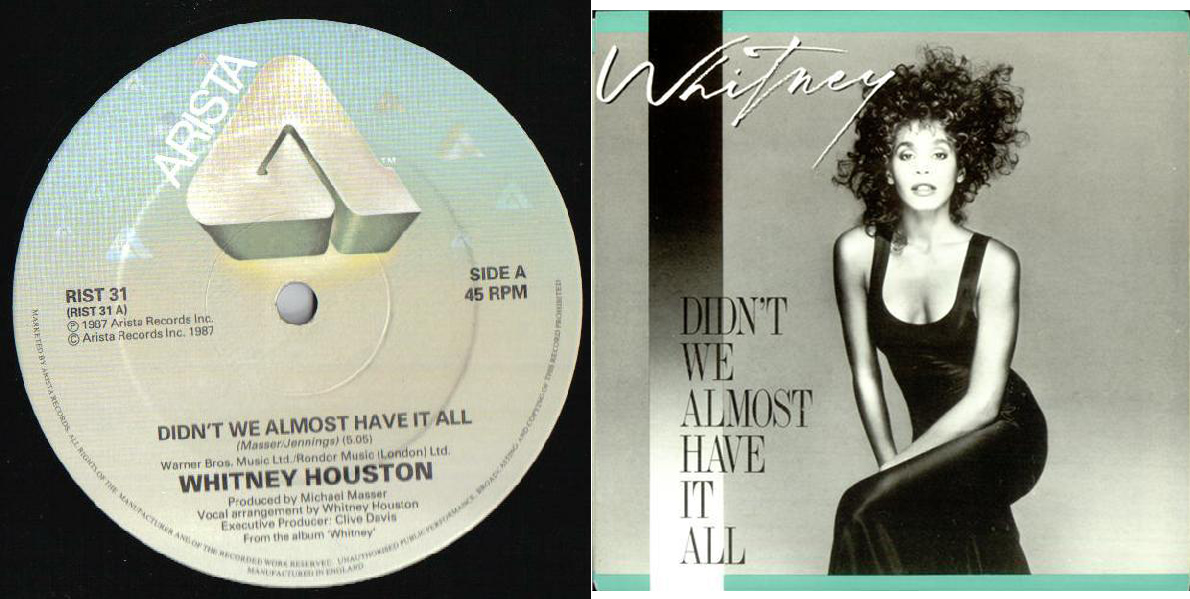
Whitney Houston, "Didn't We Almost Have It All" (released August 1987) Single 45rpm, from 2nd Whitney album (not exactly a favorite), June 4, 2015. (combined/cropped by Donald Earl Collins; http://musicstack.com and http://rapgenius.com).

Whitney Houston, “Didn’t We Almost Have It All” (released August 1987) Single 45rpm, from 2nd Whitney album (not exactly a favorite), June 4, 2015. (combined/cropped by Donald Earl Collins; http://musicstack.com and http://rapgenius.com).

I’ve been thinking about this for nearly a year. It started for me last August. Melissa Harris-Perry had a segment on her MSNBC show regarding the multiple hats women of color have worn over the years in taking care of their families, immediate, extended and non-biological. In response to Anne-Marie Slaughter’s July/August 2012 piece in The Atlantic about “Why Women Still Can’t Have It All,” Harris-Perry and her guests made the point that feminism for women of color has been about far more than having a successful, sexist-free career. That throughout American history, women of color have found themselves wearing multiple hats as primary breadwinners, primary caretakers and primary childrearers, often in ways that traditional feminists don’t discuss or recognize. All without fanfare and with many setback along the way.

What I’ve witnessed and been a part of in my own life reflects much of the conversation that Harris-Perry led on her show. The physical, mental and psychological scars from caring for family, friends and children, while struggling financially and dealing with racism and misogyny often manifests in disease and depression for so many women of color. There’s so much more, though, in terms of how my own mother’s multiple hats and habits led me to so many of my own. All initially to help her, but in the end, helping myself become self-sufficient. Not to mention making myself more understanding of where all the wear, tear and lack of care that wearing so much for so long can lead.

My Mom’s Hats and Habits:

The Anne-Marie Slaughter image of multitasking/wearing multiple hats (just think what this is like for poor, low-income, women of color), February 4, 2015. (ALAMY; http://telegraph.co.uk).

The Anne-Marie Slaughter image of multitasking/wearing multiple hats (just think what this is like for poor, low-income, women of color), February 4, 2015. (ALAMY; http://telegraph.co.uk).

Before I turned thirteen years old, my mother had been far more than my Mom. She’d been a dietary supervisor at Mount Vernon Hospital, just outside New York City, since 1968, the year before I was born. She had been a high school basketball player, a caregiver to her eleven brothers and sisters, and a cotton-picking breadwinner for her family in segregated southwestern Arkansas, an area located in the Red River Valley, part of the larger Mississippi Delta region. She had become our family’s primary breadwinner in the years after she gave birth to my older brother and me. Not to mention a married young woman now living a thirty-minute train ride from Midtown Manhattan, between the Hudson and Hutchinson Rivers, on the border between affluent Westchester County and the Bronx.

Life didn’t treat my Mom too kindly once she married my alcoholic father in 1971. And it actually went from bad to worse as she divorced him for my stepfather in 1978. By then, she had become a cigarette smoker, a one-time adulterer, and an abuse survivor. My Mom did everything she could to shield my older brother and me from her habits and the realities of our tough life in Mount Vernon in the 1970s and early 1980s. But by the end 1982, as I turned thirteen, all the hats my Mom had worn began to fall to the ground. In taking on the role of a strikebreaker, all of our lives would change forever.

In response to concessions made to the union, who left her unprotected, Mount Vernon Hospital cut her from full-time to part-time. My Mom became the besieged one. She was the old woman in the shoe, with six kids — including four under the age of five — and a cheating, abusive, unemployed, sometimes-at-home husband. It was my Mom’s job to take care of us all. Yet no longer was she a breadwinner. My Mom had become one of Reagan’s alleged welfare queens, pulling in $16,600 in AFDC payments per year from April 1983 until I left for college in August 1987. With all of that, I became a hat juggler myself.

Once Her Hats Became My Own:

For a while during my teenage years, my Mom had been my friend, one in which I could usually confide, albeit out of anger and frustration. All while taking on more and more of what had been her duties, including the brunt of her second husband’s rage and fists. I’d become an everyday grocery shopper, a frequent family cook, and a sometimes provider, the last mostly through tracking down my own father for a few extra dollars every Friday or Saturday at one of his favorite bars. Or, by the time I was sixteen, through working part-time. I provided childcare on afternoons, evenings and weekends. I washed clothes with my older brother on Saturdays or Sundays every week without fail from October 1982 on.

Hat stall at a Sunday fair, Amsterdam, The Netherlands, August 31, 2008. (Jorgeroyan via Wikipedia). Released to public domain via CC BY-SA 3.0.

Hat stall at a Sunday fair, Amsterdam, The Netherlands, August 31, 2008. (Jorgeroyan via Wikipedia). Released to public domain via CC BY-SA 3.0.

By the end of high school, I realized too who my Mom wasn’t, maybe for the first time. She wasn’t an encourager, a person who pushed her kids to pursue their dreams. With so many “Are you sure…?” questions my last two years of high school, it’s a wonder I applied to any colleges at all. Mom wasn’t a nurturer either, especially after I became a teenager. My Mom had only said “I love you” to me two times between my twelfth and nineteenth birthdays, including at my high school graduation ceremony in June 1987. She also wasn’t easygoing. Any mistake with money or my time would get a “Serves you right…” sermon about never screwing up.

The Toll Caring For Others Can Take:

All of this has made my Mom a conservatively cautious perfectionist, one living with depression and in constant denial about our shared past. I guess that it was all too much for her, like reaching the Jordan River, but not being allowed to cross it. Our shared experiences had also made me cautious and perfectionistic in my dealings with myself and the world, as I had to wear so many of my Mom’s hats and cross so many of those rivers with her. My mother tried to be all things to me and my older brother especially, and failed more than she succeeded in the process. For that and so many other reasons, despite her mistakes, I love her very much.

It’s been more than twenty-seven years since I moved away for the greener pastures of the University of Pittsburgh. Yet it’s only been in the past decade that I’ve learned to stop striving for perfection in all the things I say and do. It ultimately takes a lifetime to unlearn all the bad habits and prejudices and give up on juggling all the ideas and roles that our parents have put on us. My journey with and without my Mom has been no different. Now that my Mom’s in her late sixties, I just hope that the only hat she tries to wear these days is one to keep her head warm on the coldest of days.

Easter Seder 1995

08 Wednesday Apr 2015

Posted by decollins1969 in 1, Academia, Boy @ The Window, Carnegie Mellon University, Christianity, culture, Eclectic, Hebrew-Israelite, Mount Vernon New York, Pittsburgh, Politics, Pop Culture, race, Religion, Youth

≈ Leave a comment

Tags

Alan, Black Jew, Carl, CMU, East Liberty, Easter Sunday, Hypocrisy, Identity, Jeff, Judaism, Manischewitz, Mogen David, Passover, Pesach, PhD Dissertation, Point Breeze, Raw Horseradish, Redemption, Seder, Self-Reflection, Spencer Foundation, Spencer Foundation Dissertation Fellowship Program, Susannah, Whiteness


Matzo and a cup of wine in a Kiddush cup for first evening of Passover, April 7, 2015. (http://www.timeanddate.com).

Matzo and a cup of wine in a Kiddush cup for first evening of Passover, April 7, 2015. (http://www.timeanddate.com).

Like most of my posts, this is a story of irony, sarcasm and identity. It may be a bit out of time, since the first night of Passover and Easter already occurred last weekend. But it’s still Passover week for those who do more than eat matzos and chicken liver paste with a glass of Manischewitz on the first night.

In all, I have been present, prayed, dined, wined and whined at four Passover Seders. Three of them were during the Hebrew-Israelite years, 1982, 1983, and 1984. All of them involved a roasted leg of lamb, bitter herbs, and chewing down raw horseradish while chugging super-sweet wine to chase away the five-alarm-fire in my mouth, throat and stomach. Endless praises to Yahweh, too many exhortations of Moses, and awkward snorts toward being strangers among strangers in a strange and oppressive land. That was my Passover experience in a lifetime and timeline determined by my Mom and idiot stepfather Maurice, before I turned to Christianity, before I gave up on the idea that I could be from one of the Ten Lost Tribes of ancient Israel.

My fourth Seder, though, came eleven years later, in mid-April 1995. I’d been a Christian for as long as I hadn’t commemorated Passover as part of my religious birthright. I wasn’t sure about the idea of attending this celebration, as it wasn’t even at sundown on that year’s first day of Passover, Saturday, April 15. My friend Carl and his/our respective Carnegie Mellon history grad school mates Alan, Jeff, and Susannah were holding their little Seder on Easter Sunday, April 16, as the first two rented a house together in the Point Breeze (really, the White end of Homewood-Brushton, which asked for a race-based divorce in 1961) neighborhood of Pittsburgh.

Picture of the Henry Clay Frick Mansion, or "Clayton", located at 7200 Penn Avenue, Point Breeze, Pittsburgh, PA, March 21, 2010. (Lee Paxton via Wikipedia). Released to public domain via CC-SA-3.0.

Picture of the Henry Clay Frick Mansion, or “Clayton”, located at 7200 Penn Avenue, Point Breeze, Pittsburgh, PA, March 21, 2010. (Lee Paxton via Wikipedia). Released to public domain via CC-SA-3.0.

They had invited me a week earlier, a few days before my Spencer Foundation Fellowship application went from no-go to a go. I thought about saying no, but generally, I didn’t do anything on Easter Sundays, anyway. Even as a member of Covenant Church of Pittsburgh, the one Sunday I didn’t attend church was Easter Sunday. It the holiest of days, like Passover, and for so many people, the only day all year they attended church. For so many, it was show-off-my-new-spring-clothes day, not Jesus’ Resurrection Day. I didn’t like the overcrowded-ness that came with an Easter Sunday or Christmas service. It smacked of hypocrisy, my own included.

So I decided for one Sunday to attend a Seder prepared by folks who’d only known themselves as Jews both ethnically and religion-wise their whole lives. Except the stern, orthodox, full of bitterness and tears, joy and triumph that were the Seders of my Hebrew-Israelite days was a lighthearted affair. It was as unorthodox a Seder as could’ve expected, with lots of conversation about grad school, about my dissertation fellowship, about life and sports and music in general. No raw horseradish, but lots of chicken liver paste. No Manischewitz, but some Mogen David, along with more traditional red and white wines, and an empty seat for Elijah.

Manischewitz wine, in bottle and a wine glass, September 11, 2012. (http://tabletmag.com/).

Manischewitz wine, in bottle and a wine glass, September 11, 2012. (http://tabletmag.com/).

Carl and Alan, of course, expressed surprise when I did ask questions or make comments. Like about the kosher-ness of eating mashed-up chicken livers, or the differences in taste between the traditional Pesach beverages, or how peanut butter and jelly went well with matzo crackers. Alan, about to be a one-year-and-done CMU history doctoral student, did ask me, “Where did you learn about Passover?” I said, “This is my fourth Seder.”

I knew better than to fully unlock everything I knew about Pesach, Judaism, Jewish history, the Ten Lost Tribes, being a Hebrew-Israelite, and the racial privileging that I had observed growing up in Mount Vernon between “real” Jews and us “weird” (read “not White”) Jews. For a few hours, though, I had to confront a part of my past that I’d all but locked away by the beginning of ’90. Not just locked away. I’d taken everything from between April 13, ’81 and July 23, ’89, wrapped it in Saran Wrap, put that in a Ziploc bag, thrown it in a safe, locked it, and then built a force field to keep out intruders.

I was relieved when I finally left Carl and Alan’s Easter Sunday/Passover Seder and walked back to my apartment in East Liberty. I wasn’t ready yet to take a look back at what I lived through during the Reagan Years. I was all about moving forward, and the previous days and weeks of dissertation research followed by a major-league dissertation fellowship made me feel like the completely different person that I believed I actually was. At least ninety-five percent of the time.

Boy @ The Window Origins: Meltzer Conversations

14 Saturday Mar 2015

Posted by decollins1969 in 1, Academia, Boy @ The Window, Carnegie Mellon University, Christianity, culture, Eclectic, Hebrew-Israelite, Mount Vernon High School, Mount Vernon New York, Pittsburgh, Politics, Pop Culture, race, Religion, Youth

≈ Leave a comment

Tags

Benetton Group, Black Elites, Black Identity, Black Masculinity, Black Migration, Black Washington, CMU, Colorism, Dissertation, Doctoral Thesis, Harold Meltzer, Harper Stewart, Humanities, Hypermasculinity, Inequality, Internalized Racism, Logic, Manhood, Multiculturalism, Personal Insights, Race, Racial Identity, Rationalism, Self-Discovery, Social Injustice, Taye Diggs, The Best Man (1999), Washington DC, X-Men Origins: Wolverine (2009)


X-Men Origins: Wolverine (2009) scene, where Wolverine frees mutants kept as experiments by Colonel William Stryker , March 13, 2015. (http://cdn.collider.com/).

X-Men Origins: Wolverine (2009) scene, where Wolverine frees mutants kept as experiments by Colonel William Stryker , March 13, 2015. (http://cdn.collider.com/).

Of all the tangents I took related to writing Boy @ The Window, the most direct path that got me to write a memoir about the most painful period in my life was through several conversations with my dear teacher, friend and mentor in the late Harold Meltzer. I’ve discussed bits and pieces of some of those conversations here and in longer form in Boy @ The Window. It’s still worth rehashing some of those conversations, at least in terms of what was and wasn’t good advice, as well as in explaining how some of the main themes of the memoir developed over time.

As I wrote in Boy @ The Window, though my “first interview with him was in August ’02,” the first time “we discussed the possibility of me doing Boy @ The Window went back to February ’95.” Meltzer had been retired from teaching about a year and a half, while I was beginning the heavy lifting phase of my doctoral thesis, “living in DC for a couple of months while hitting the archives and libraries up for dusty information. In need of a writing break, I gave him a call on one cold and boring Saturday afternoon.”

It was in response to a letter he sent congratulating me. I’d recently published an op-ed in my hometown and county newspaper, “Solving African American Identity Crisis.” I was writing about issues like using the n-word, hypermasculinity, and internalized racism in the short and, for me at least, dummied down piece. Somehow our discussion of that piece led to a discussion of my classmate Sam. Did I really want to spend an hour and a half talking with Meltzer about Sam and some of my other Humanities classmates and their possible identity issues, considering some of my own serious growing pains — the Hebrew-Israelite years, my suicide attempt, my Black masculinity and manhood issues? Absolutely not!

But I learned quite a bit about how I might want to approach writing Boy @ The Window through that phone call. Not because Meltzer had given me any sage advice, which he didn’t, or because he revealed things to me that I shouldn’t have come to learn during our conversation, which he definitely did.

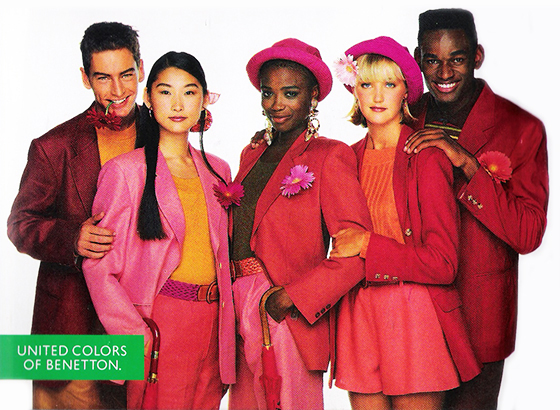
Benetton ad, 1980s, January 2013. (http://fashionfollower.com/).

Benetton ad, 1980s, January 2013. (http://fashionfollower.com/).

No, it was the idea that a lot of the things that I had pursued as a historian and researcher were things that came out of my experiences growing up. Multiculturalism as a historical phenomenon (at least if one linked it to cultural pluralism)? Can anyone say Humanities Program, or, what I used to call “Benetton Group” when we were at A.B. Davis Middle School? Writing about African American identity issues? Obviously related to living in Mount Vernon, the land where any hint of weakness translated into me being called a “faggot” or a “pussy.”

And what about any scholarly concerns with racial and socioeconomic inequality and Black migration? Anyone ever meet my Mom and my father Jimme, 1960s-era migrants from Arkansas and Georgia/Florida respectively? An examination of the Black Washingtonian elite and their looking down upon ordinary Blacks because of their own colorism or the latter’s lack of education? Come on down, Estelle Abel and any number of well-established Black Mount Vernon-ites who never gave me the time of day! As much as academia had been an escape for me, into a world of rationalism and logic, a place of dispassionate scholarship, it was all personal for me, without realizing it until that phone conversation with Meltzer.

Fast-forward to November ’02, the last interview I did with Meltzer before his death two months later. We spent the last couple of hours on that brisk fall Thursday discussing the book idea that would become Boy @ The Window. Meltzer thought that it should be a work of fiction, “based on the real flesh and blood folks in my life, but with different names of course to protect me from any potential lawsuits. He did make me rethink the project from a simple research study of my high school years into narrative nonfiction or a memoir.” 

Screen shot of fictional character Harper Stewart's bestselling novel nfinished Business, from The Best Man (1999), March 14, 2015. (hitchdied via http://s785.photobucket.com/).

Screen shot of fictional character Harper Stewart’s bestselling novel Unfinished Business, from The Best Man (1999), March 14, 2015. (hitchdied via http://s785.photobucket.com/).

Was Meltzer correct? Should I have done a Harper Stewart — played by actor Taye Diggs in The Best Man (1999)? Should I have fictionalized all of my experiences and those of my family, teachers, administrators and classmates? I’m not sure if it would’ve made a difference. Stories of fiction tend to have a tight symmetry to them. Or, the theme of “what goes around comes around” is usually a big one in any novel. You can’t leave too many loose threads or unresolved issues, even if the novel is part of a series. For my purposes, since my life remains a work in progress, a story of relative — not obvious or absolute — success, telling it as fiction would hardly ring true to me, much less to any group of readers.

Whatever else anyone wants to say about the late Harold Meltzer, the dude got me to think about difficult things until I was no longer comfortable in leaving my uncomfortable experiences and assumptions unchallenged. The very definition of a mentor, the very purpose of Boy @ The Window.

On Kicking My Damsel-in-Distress Syndrome

07 Saturday Mar 2015

Posted by decollins1969 in 1, Boy @ The Window, Christianity, culture, Eclectic, Hebrew-Israelite, Jimme, Marriage, Mount Vernon New York, My Father, Pittsburgh, Politics, Pop Culture, Religion, Youth

≈ Leave a comment

Tags

"Ballerina Wendy", Atlas, Burdens, Child Abuse, Chivalry, Crush #1, Damsel-in-Distress, Damsel-in-Distress Syndrome, Domestic Violence, Father-Son Relationship, Feminism, Love, Misogyny, Misty Copeland, Mother-Son Relationship, Pitt, Resentment, Sexism, Wendy, Womanism


Chivalry with a suit blazer,   March 7, 2015. (http://genius.com)/

Chivalry with a suit blazer, March 7, 2015. (http://genius.com)/

This week marked thirty-three years since the fight that led to a crush that led to me falling in love for the first time, via a ballerina in training. The three-month period between March and June ’82 shaped how I dealt with teenage girls and women between the time I turned twelve and my mid-thirties. The crush on “Ballerina Wendy” and its mutation because of my stepfather’s knocking out of my Mom in front of me helped shaped my feminism, my womanism and my sexist damsel-in-distress syndrome.

Wonder Woman, October 30, 2012. (http://tvequals.com).

Wonder Woman, October 30, 2012. (http://tvequals.com).

It was the beginning of my damsel-in-distress syndrome. Though it was triggered by the Memorial Day incident, my damsel-in-distress syndrome had been latent for years. I was in fact a mama’s boy, tempered by living at 616 and in Mount Vernon. I’d always been enamored by strong, athletic women (or at least, actresses with that role), going back to Lynda Carter as Wonder Woman. Yet I’d also been surrounded by sexism and misogyny, from my father calling my Mom a “Black bit'” since I was four to my stepfather’s constant quoting of the Torah to justify his laying of violent hands and feet on my Mom.

What I did in response was to help my Mom in every way I could, and in ways I never should’ve. Calling up Con Ed and Ma Bell to pay the electric and telephone bills. Listening to years of conversations about her failed marriages, about my father’s alcoholic failings, about her bills, about the burdens we as her children had put on her. Washing clothes for the house every weekend from October ’82 through August ’87 and anytime I was home for the summer and for the holidays once I went off to college. Going to the store as many as five times in a single afternoon and evening because my Mom forgot that she needed diapers or cigarettes. Hunting my father down for money even on weekends I didn’t want to be bothered because we were out of food for my younger siblings. Taking a fist-filled beating here or there from my stepfather to take the pressure off of my Mom. Promising my Mom that after I finished my degree, I’d come back to New York to work and help her out financially.

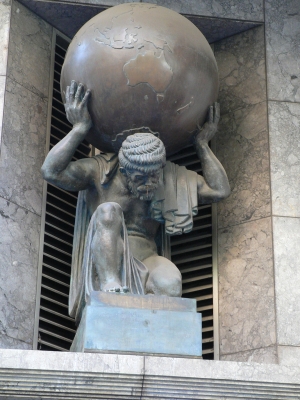
Atlas supports the terrestrial globe on a building in Collins Street, Melbourne, Australia, October 9, 2006. (Biatch via Wikipedia). Released to the public domain.

Atlas supports the terrestrial globe on a building in Collins Street, Melbourne, Australia, October 9, 2006. (Biatch via Wikipedia). Released to the public domain.

On that last promise especially, I reneged. I changed my major from computer science to history, and decided to stay at Pitt, to go to graduate school, to earn a PhD, to start writing, both in the academic world and a bit as a freelancer, to teach for a living. It was the basis, I think, for her falling out with me in ’97, and why our relationship remains limited.

My Mom was hardly the only woman in my life in which I wanted to assist. Some of my Pitt friends can certainly attest to this fact, that sometimes I was there to help too often. To the point where once I realized I was overburdened or when that other person had become too reliant on me, it pretty much killed that friendship. Either way, I was angry, and sometimes felt used, while some of my Pitt friends were either confused or angry themselves.

I’ve had to learn over the years to say no, even to my wife, when I realized that one too many logs on the fire will actually put that fire out. It started with everything high-tech. Every computer glitch, every printer error, every Internet issue, and I was there like Clark Kent, ready to help. But by the time I hit thirty-five, I was just too tired and felt too burdened to be that on all the time. I finally stopped helping my wife with her tech issues. I stopped offering to help, and have only interjected when the issue actually affects all of our equipment.

The irony is, my wife is a stronger person than my Mom, stronger in many ways than how I perceived Wendy as a person so many years ago. It’s not as if my wife doesn’t need or appreciate the help. But, as I’ve learned over the years, too, sometimes, help is just emotional support, a hug or a joke. Or, when I’m ready to, simply listening without feeling the need to use a quadratic equation to solve the problem.

American Ballet Theater soloist Misty Copeland in a promotional photo via her Under Armour ad deal, January 30, 2014. (Under Arnour via Huffington Post).

American Ballet Theater soloist Misty Copeland in a promotional photo (cropped) via her Under Armour ad deal, January 30, 2014. (Under Arnour via Huffington Post).

Damsel-in-distress syndrome, as chivalrous as it is, can also be extremely sexist, for both women and men and girls and boys. It means constantly attempting to help people who may or may not want your help, especially in cases where it is clear that they may need help. It means taking on emotional and psychological burdens that otherwise should only belong to the person you’re trying to support. It means, sadly, providing advice and knowing answers and solutions that may not be answers or solutions at all.

The Memorial Day ’82 incident with my mother changed what was an otherwise innocent crush and love into something contradictory even as it became more meaningful. It made me appreciate women who could and can kick some ass, whose strength would be obvious to all. And it made me think women who weren’t like that — women like my Mom — needed constant help from people like me. Wendy defended herself thirty-three years ago. My Mom tried and couldn’t. Life and strength for us, male and female and transgender, though, has never been that simple. And though I have saved quite a few damsels in distress over the years, it isn’t my eternal burden to carry.

← Older posts
Newer posts →

Boy @ The Window: A Memoir

Boy @ The Window: A Memoir

Places to Buy/Download Boy @ The Window

There's a few ways in which you can read excerpts of, borrow and/or purchase and download Boy @ The Window. There's the trade paperback edition of Boy @ The Window, available for purchase via Amazon.com at http://www.amazon.com/Boy-Window-Donald-Earl-Collins/dp/0989256138/

There's also a Kindle edition on Amazon.com. The enhanced edition can be read only with Kindle Fire, an iPad or a full-color tablet. The links to the enhanced edition through Apple's iBookstore and the Barnes & Noble NOOK edition are below. The link to the Amazon Kindle version is also immediately below:

scr2555-proj697-a-kindle-logo-rgb-lg

Boy @ The Window on Amazon.com: http://www.amazon.com/Boy-The-Window-Memoir-ebook/dp/B00CD95FBU/

iBookstore-logo-300x100

Boy @ The Window on Apple's iBookstore: https://itunes.apple.com/us/book/boy-the-window/id643768275?ls=1

Barnes & Noble (bn.com) logo, June 26, 2013. (http://www.logotypes101.com).

Boy @ The Window on Barnes & Noble: http://www.barnesandnoble.com/w/boy-the-window-donald-earl-collins/1115182183?ean=2940016741567

You can also add, read and review Boy @ The Window on Goodreads.com. Just click on the button below:

Boy @ The Window

Twitter Updates

Tweets by decollins1969
  • RSS - Posts
  • RSS - Comments

Archives

  • June 2025
  • April 2023
  • September 2022
  • August 2022
  • July 2022
  • June 2022
  • May 2022
  • April 2022
  • March 2022
  • January 2022
  • December 2021
  • November 2021
  • October 2021
  • September 2021
  • August 2021
  • July 2021
  • June 2021
  • April 2021
  • March 2021
  • February 2021
  • January 2021
  • December 2020
  • November 2020
  • October 2020
  • September 2020
  • August 2020
  • July 2020
  • May 2020
  • April 2020
  • March 2020
  • January 2020
  • December 2019
  • November 2019
  • August 2019
  • July 2019
  • June 2019
  • May 2019
  • April 2019
  • March 2019
  • February 2019
  • January 2019
  • December 2018
  • November 2018
  • October 2018
  • September 2018
  • August 2018
  • July 2018
  • June 2018
  • May 2018
  • March 2018
  • February 2018
  • January 2018
  • December 2017
  • November 2017
  • October 2017
  • September 2017
  • August 2017
  • July 2017
  • June 2017
  • May 2017
  • April 2017
  • March 2017
  • February 2017
  • January 2017
  • December 2016
  • November 2016
  • October 2016
  • September 2016
  • August 2016
  • July 2016
  • June 2016
  • May 2016
  • April 2016
  • March 2016
  • February 2016
  • January 2016
  • December 2015
  • November 2015
  • October 2015
  • September 2015
  • August 2015
  • July 2015
  • June 2015
  • May 2015
  • April 2015
  • March 2015
  • February 2015
  • January 2015
  • December 2014
  • November 2014
  • October 2014
  • September 2014
  • August 2014
  • July 2014
  • June 2014
  • May 2014
  • April 2014
  • March 2014
  • February 2014
  • January 2014
  • December 2013
  • November 2013
  • October 2013
  • September 2013
  • August 2013
  • July 2013
  • June 2013
  • May 2013
  • April 2013
  • March 2013
  • February 2013
  • January 2013
  • December 2012
  • November 2012
  • October 2012
  • September 2012
  • August 2012
  • July 2012
  • June 2012
  • May 2012
  • April 2012
  • March 2012
  • February 2012
  • January 2012
  • December 2011
  • November 2011
  • October 2011
  • September 2011
  • August 2011
  • July 2011
  • June 2011
  • May 2011
  • April 2011
  • March 2011
  • February 2011
  • January 2011
  • December 2010
  • November 2010
  • October 2010
  • September 2010
  • August 2010
  • July 2010
  • June 2010
  • May 2010
  • April 2010
  • March 2010
  • February 2010
  • January 2010
  • December 2009
  • November 2009
  • October 2009
  • September 2009
  • August 2009
  • July 2009
  • June 2009
  • May 2009
  • April 2009
  • March 2009
  • February 2009
  • January 2009
  • December 2008
  • November 2008
  • October 2008
  • September 2008
  • August 2008
  • July 2008
  • June 2008
  • May 2008
  • April 2008
  • March 2008
  • February 2008
  • January 2008
  • December 2007
  • November 2007
  • October 2007
  • September 2007
  • August 2007
  • July 2007
  • June 2007

Recent Comments

MaryPena's avatarMaryPena on My Day of Atonement/Bitter Hat…
decollins1969's avatardecollins1969 on No Good Teaching Deed Goes…
Mary Rose O’Connell's avatarMary Rose O’Connell on No Good Teaching Deed Goes…

NetworkedBlogs on Facebook

NetworkedBlogs
Blog:
Notes From a Boy @ The Window
Topics:
My Life, Culture & Education, Politics & Goofyness
 
Follow my blog

616 616 East Lincoln Avenue A.B. Davis Middle School Abuse Academia Academy for Educational Development AED Afrocentricity American Narcissism Authenticity Bigotry Blackness Boy @ The Window Carnegie Mellon University Child Abuse Class of 1987 CMU Coping Strategies Crush #1 Crush #2 Death Disillusionment Diversity Domestic Violence Economic Inequality Education Family Friendship Friendships Graduate School Hebrew-Israelites High-Stakes Testing Higher Education History Homelessness Humanities Humanities Program Hypocrisy Internalized Racism Jealousy Joe Trotter Joe William Trotter Jr. K-12 Education Love Manhood Maurice Eugene Washington Maurice Washington Misogyny Mother-Son Relationship Mount Vernon High School Mount Vernon New York Mount Vernon public schools Multiculturalism MVHS Narcissism NFL Pitt Pittsburgh Politics of Education Poverty President Barack Obama Race Racial Stereotypes Racism Relationships Self-Awareness Self-Discovery Self-Reflection Sexism Social Justice Teaching and Learning University of Pittsburgh Violence Whiteness Writing

Top Rated

Blog at WordPress.com.

  • Subscribe Subscribed
    • Notes from a Boy @ The Window
    • Join 103 other subscribers
    • Already have a WordPress.com account? Log in now.
    • Notes from a Boy @ The Window
    • Subscribe Subscribed
    • Sign up
    • Log in
    • Report this content
    • View site in Reader
    • Manage subscriptions
    • Collapse this bar
 

Loading Comments...