• About Me
  • Other Writings
  • Interview Clips
  • All About Me: American Racism, American Narcissism, and the Conversation America Can’t Have
  • Video Clips
  • Boy @ The Window Pictures
  • Boy @ The Window Theme Music

Notes from a Boy @ The Window

~

Notes from a Boy @ The Window

Category Archives: Christianity

The Comedy of a Tragic Upbringing

10 Saturday Jan 2015

Posted by decollins1969 in 1, Academia, Boy @ The Window, Christianity, culture, Eclectic, Hebrew-Israelite, Jimme, Mount Vernon High School, Mount Vernon New York, Movies, My Father, New York City, Politics, Pop Culture, race, Religion, Youth

≈ Leave a comment

Tags

616, 616 East Lincoln Avenue, Alchemy, Alcoholism, Autobiography, Child Abuse, Comedy, D.L. Hughley, Dave Chappelle, Domestic Violence, Eddie Murphy, Evangelical Christianity, Father-Son Relationships, Fatism, Ghetto Klown (2014), John Leguizamo, Lewis Black, Mother-Son Relationship, Neglect, Physical Violence, Playwright, Poverty, Psychological Abuse, Respectability Politics, Richard Pryor, Rodney Dangerfield, Routines, Stand-Up Comedy, Tragedy, Transmutation


John Leguizamo playing 'Abuelo' in Tales from a Ghetto Klown, PBS Arts Festival, July 2012. (http://www.pbs.org).

John Leguizamo playing ‘Abuelo’ in Tales from a Ghetto Klown, PBS Arts Festival, July 2012. (http://www.pbs.org).

Over New Year’s weekend, I watched John Leguizamo’s HBO comedy special Ghetto Klown (2014), based on one of his one-man autobiographical Broadway shows. I don’t think of Leguizamo as funny in the same way I think of Lewis Black or Dave Chappelle or Eddie Murphy. The sweet spot for me in terms of what is funny or not funny is a routine that makes me think for a second or two, not just laugh out of sheer expectations for a funny delivery or line. Otherwise, I’d think of D.L. Hughley as a great comedian, instead of as a vile one with equally vile opinions on race and culture.

Leguizamo’s hardly the funniest comedian. But then again, he’s always been more than one thing. He’s essentially a playwright, an actor, and comedian, which means Leguizamo’s a very elaborate storyteller. In most of his work, a nonfiction storyteller. I’ve seen some of his other one-man work before. With Ghetto Klown, though, I saw and felt the sense of tragedy and regret that I hadn’t seen in his other plays and specials. Especially when it came to his family — specifically his father — and his closest friends.

When Leguizamo went through his routine about how his mother and father were upset with him about he had portrayed them in his plays as somewhat selfish and oftentimes neglectful and abusive, I understood. I’ve only written one book about my life, and my Mom and dad have both been offended by the idea that I could write about them without their permission or blessings. Leguizamo used them as bits for his comedy and Broadway stage routines for years. That’s a lot of courage, and it’s a lot of tragedy to expose, too.

Transmutation of lead bars into gold, March 2013. (http://quazoo.com).

Transmutation of lead bars into gold, March 2013. (http://quazoo.com).

I’ve thought about it a few times over the past fifteen years. What if I decided to do a stand-up routine that included elements of my upbringing? How would I do that? How would I make domestic violence and child abuse and poverty funny?

I’d start with my father, who I’d call Jimme and my father interchangeably, since that’s been the nature of our relationship for forty-five years. I’ve been able to imitate his language, his drunken stupor, his evil meanness and off-kilter mannerisms since I was fifteen. It would be easy enough to do all of his “po’ ass muddafucka…” insults in bar scenes, all while getting robbed and beaten up by other alcoholics.

I could also do my now deceased ex-stepfather Maurice, especially his constant threats to put me in the hospital or kill me. “Watch dat base in yo’ voice, boy, ‘fore I cave yo’ chest in!,” he started saying to me once my voice changed with puberty. I could imitate Maurice when he weighed over 400 pounds and wore size-54 Fruit-of-the-Loom briefs around 616, with enough fat and dinginess to make me wanna puke.

I could even imitate my Mom, at least on the threatening front. If I argued with her too long about something important that she didn’t want to talk about (like paying bills, for instance), she’d tell me, “Shut up o’ I’ma gonna cut the piss out of you.” Or I could run around a stage singing at the top of my lungs to evangelical Christian music while also acting like my younger brothers, who’d get into knockdown fights in the living room while my Mom was in her spiritual zone.

The fact is, some of the best comedy grows out of tragedy. It may not be funny to the respectable middle class types or the respectability politics types. They both would prefer people “forget about” their pasts and “just move on,” as if these issues are taboo. But you can’t be a very good comedian or writer without confronting your upbringing in some way.

Richard Pryor doing stand up, posted August 11, 2014. (http://deadline.com).

Richard Pryor doing stand up, posted August 11, 2014. (http://deadline.com).

I attempted at times in Boy @ The Window to inject some sarcasm or comedy in many of the tragic scenes in the book. Because they reflecting my thinking in the moments in which they occurred, whether in ’82 or ’88. The few people who commented on this aspect of the memoir didn’t like the comedy or the language. It was because they couldn’t reconcile the mild-mannered version of myself that I presented to the world in high school or in academia with the way in which I grew up.

Watching Leguizamo in Ghetto Klown reminded me of what I learned in watching Rodney Dangerfield (who himself was sexually abused and neglected by his parents growing up) and Richard Pryor (the son of an active and neglectful prostitute) over the years. We all have baggage and demons to deal with every day of our lives. We ignore that past and those evils at risk to ourselves and every person we’ve ever loved. We must turn the tragedy of our upbringing into something that isn’t just a cancer of pain. Be it through storytelling, autobiography, even the kind of comedy that those whose lives were much more stable growing up can appreciate but can never fully understand.
For What It’s Worth, My Life Matters, Our Lives Matter

27 Thursday Nov 2014

Posted by decollins1969 in 1, Boy @ The Window, Christianity, culture, Eclectic, eclectic music, Mount Vernon High School, Mount Vernon New York, music, New York City, Pittsburgh, Politics, Pop Culture, race, Religion, University of Pittsburgh, Youth

≈ Leave a comment

Tags

"For What It's Worth" (1970), Bob McCullough, Buffalo Springfield, Darren Wilson, Double-Consciousness, Faith, Ferguson, Michael Brown, Police Brutality, Police Harassment, Racism, Rudy Giuliani, Self-Awareness, Self-Worth, Souls of Black Folk (1903), Systemic Racism, W. E. B. Du Bois, White Vigilantism, White Violence


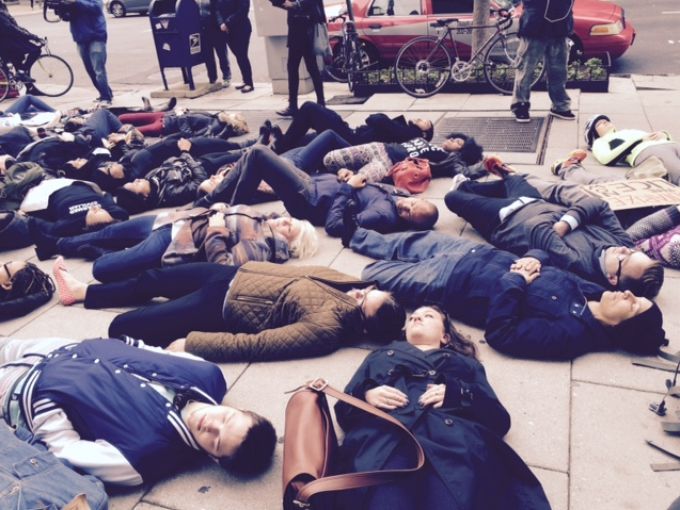
Protestors hold a die-in at 14th and I St NW, Washington, DC, November 25, 2014.  (Andrea McCarren/WUSA via http://www.wusa9.com)

(For What It’s Worth) Protestors hold a die-in at 14th and I St NW, Washington, DC, November 25, 2014. (Andrea McCarren/WUSA via http://www.wusa9.com)

Between Bob McCullough, Darren Wilson, the grand jury in Ferguson, Missouri, the NYPD, Rudy Giuliani, the Cleveland PD, and 100 million other sources, I could easily draw the conclusion that the lives of Americans of color are only worth as much as three cigarillos or a toy gun. Or, with it being 2014, that we’re just characters in a video game in which scared Whites get to kill us for sport or out of spite. Heck, I wouldn’t be surprised if the Ferguson PD allows Wilson to mount Michael Brown’s skull above his mantle after he returns from his long-delayed honeymoon, the poor racist!

But my life, your life, all of our lives are worth more than what any racist asshole or system places on us. I had to learn this lesson a long time ago. It’s the lesson that is the raison d’etre for my blog Notes from a Boy @ The Window, not to mention my book Boy @ The Window. There are literally millions of messages we as Americans of color take in over the course of our lives that for so many, our lives don’t matter. Counterintuitively, it means our lives really must matter. Why would anyone or any system expend so much time and effort excluding people on the basis of race and social status in the first place?

Café Crème cigarillos, Denmark, October 21, 2011.  (PeddderH via Wikipedia). Released to public domain via CC-SA-3.0.

Café Crème cigarillos, Denmark, October 21, 2011. (PeddderH via Wikipedia). Released to public domain via CC-SA-3.0.

Still, learning that I mattered began at home, in Mount Vernon, New York, from folks who treated me every day as if I mattered not at all. Between my Humanities and Mount Vernon High School experiences and the abuse I suffered at home, I didn’t need the additional dimension of police harassment or White vigilantism to remind me that those of us without standing, who refused to conform to acceptable ways of thinking and speaking, were discardable. Maybe that’s why I turned to nondenominational Christianity in the first place. To realize that despite it all, that I mattered to God, to a universe much bigger and much more mysterious and powerful than the fists of my stepfather or the denigration and ostracism I received at school. It all gave me reasons to live.

So when my first encounters with police harassment and White vigilantism did occur (beginning right after my seventeen birthday), I had faith in God, and with that, faith in myself as a foundation from which to draw strength. Whether at Tower Records or in Pittsburgh or in Los Angeles, and regardless of how scared I might have felt during those moments, I remained outwardly calm. I remained myself.

Yes, I was lucky. Maybe my weirdness, my proper speech, my faith, maybe even God and the universe, kept me from getting beat up or shot on sight by police, security guards or by groups of drunken White guys in pickup trucks. But really, by the time Whites (and some Black cops, to be sure) started profiling me in earnest, I had made the decision that I had worth, that my existence, creativity, analytical ability, critical reasoning, all mattered.

It helped that I had victories in my life, big and small and somewhere in between, to draw on, too. Not just my advanced education or my first publications. By the time I’d hit thirty, I’d learned how to love again, to feel again, to write again, to have fun again, to even feel pain and recover again. All of that made my life much sweeter, filled my world with color and sound and texture, with words and deeds that mattered to me and everyone who’d become important to me.

W.E.B. Du Bois in duality (double-consciousness), original picture circa 1903, November 26, 2014. (http://www.storify.com/ozunamartin).

W.E.B. Du Bois in duality (double-consciousness), original picture circa 1903, November 26, 2014. (http://www.storify.com/ozunamartin).

While there are moments that I can go there, because of the likes of Wilson, McCullough and Giuliani, the fact is, I refuse to allow dumb-assed racists to determine my life’s worth. That those folk who devalue the lives of other folk because of their -isms (racism, misogyny, homophobia, imperialism, capitalism) and ish are in fact making their own lives worth less and worthless.

While W.E.B. Du Bois was right about this “peculiar sensation…this sense of always looking at one’s self through the eyes of others,” I don’t think I live my life in a constant state of double-consciousness. If I did, I would’ve jumped off that bridge over the Hutchinson River Parkway long before adulthood. No, up or down, I know my life has meaning, my existence is worth more than a 9mm bullet, that every sentient life matters. And like Michelle Alexander’s talk with her son this week, I’ve made sure that my son knows that his life matters, and should matter, to him, his mother, and to me.

Neoliberals, Neocons, and Other Useless Labels

04 Tuesday Nov 2014

Posted by decollins1969 in 1, Academia, Christianity, culture, Eclectic, Marriage, Patriotism, Politics, Pop Culture, race, Religion, University of Pittsburgh, Work

≈ Leave a comment

Tags

1964 Election, Academic Jargon, Arthur Schlesinger Jr., Barry Goldwater, Classism, Corruption, Cycles of American History (1986), Definitions, Democrats, Election 2014, Fascism, Graduate School, Homophobia, Labels, LBJ, Midterm Elections, Neoconservatism, Neoconservative, Neoliberal, Neoliberalism, President Lyndon Baines Johnson, Racism, Republicans, Richard Nixon, Right-Wingers, Sexism, Silent Majority, Southern Strategy, Time on the Cross (1974)


The Matrix, Path of Neo, November 4, 2014. (http://comic.com).

The Matrix, Path of Neo, November 4, 2014. (http://comicvine.com).

I’ve never really had much patience for technical academic jargon, even in my wide-eyed grad school days twenty years ago. And my patience for terms like post-structuralism, post-modern, neo-Marxist and eschatological has grown government-paper-stock-thin as I’ve approached middle-age. Lately, terms like neoliberal and neoconservative have found their way into my sniper sights, especially with the ’14 midterm elections upon us. These terms may have meant something very separate and distinctive fifty or sixty years ago, but they darn sure don’t now. Except, maybe, to academicians and the elite literati, people who somehow believe that these terms are as useful as food, drink and water.

It wasn’t until grad school at the University of Pittsburgh when I became aware of these terms. Back then, I saw neoliberal or neoliberalism in everything I read about race and economic concerns. Whether it was about Robert Fogel and Stanley Engerman’s ridiculous statistical depiction of slavery in Time on the Cross (1974), or Arthur Schlesinger, Jr.’s work on twentieth-century political shifts in his Cycles of American History (1986), they and the reviewers of their books used the term neoliberal like it was parsley for making pesto.

Neoconservative hasn’t been around as long, a term about a decade younger than it’s post-World War II counterpart. It’s definition has evaded most academicians and the vast majority of lay-folk over the last half-century. Sometimes it’s used interchangeably with conservative or politically conservative, sometimes it’s used in the same sentence as right-wing or the religious right or evangelicals.

Asteroid Eros, a near-Earth object, or NEO, June 16, 2014. (http://jpl.nasa.gov). In public domain.

Asteroid Eros, a near-Earth object, or NEO, June 16, 2014. (http://jpl.nasa.gov). In public domain.

Though it’s definition is elusive, it’s history isn’t. Barry Goldwater’s gigantic loss to President Lyndon Baines Johnson in the ’64 Presidential Election led to a host of disaffected Democrats, old-money Republicans and other political misfits getting together and hatching a plan to dismantle the Democratic Party’s New Deal coalition. They took advantage of the racism and roiling, boiling resentment of Southern Democrats — Dixiecrats, really — toward their party, the federal government and its growing support for Blacks and civil rights. They also took advantage of wealthy Republicans and the ages-old cry of corporations desperate for lower taxes and ever-higher profit margins. All of this came together in Richard Nixon’s ’68 presidential campaign with the Southern Strategy, turning Southern voters from Democrat to Republican. Not to mention with LBJ and Vietnam, the so-called Silent Majority, and their resentment toward rebellious, privileged college students and protestors.

We know it all worked, because fifty years later, to talk of the South as a Democratic bloc today is almost as ludicrous as it was to talk about the South as being ripe for a Republican takeover in ’64. Beyond that, though, with the inclusion of evangelical Christians and other religious and social conservatives came the inclusion of traditional conservatism, neoconservatism, and neoliberalism in the Republican Party, the Democratic Party, and in the US’ cultural mainstream by the late-1980s.

By then, these terms neoliberal and neoconservative had lost their original meaning, if they were really that different in meaning to begin with. The Republicans had married the terms and allowed the coupling to have kids and then grandkids with names like smaller government, deregulation, lower taxes for the wealthy (so-called “job creators”) and for corporations, prison-industrial complex, ending abortion, welfare reform, education reform, and voter disenfranchisement. This combination of war hawks, an unfettered version of free-market capitalism, with low government regulation and taxes on the rich and corporation, combined with high government regulation of nonconformist activities and peoples (people of color, LGBT marriage rights, women’s reproductive rights, everyone who isn’t Christian or Christian-sounding)? I don’t understand why we don’t call it what it really is.

Quote from Henry A. Wallace, Vice-President of the nited States, 1944. (http://meetville.com).

Quote from Henry A. Wallace, Vice-President of the United States, 1944. (http://meetville.com).

Ladies and gentlemen and transgender, what we have in the US today — and have had in increasing measure for more than four decades — is a mild form of fascism, plain and simple. Yes, you can still vote, but the process is rigged from start to finish by greed and corruption and legal barriers to benefit the rich, the greedy and the corrupt. Yes, we have representation, through gerrymandered districts and hundreds of candidates with lined pockets running unopposed. Yes, we still have a Congress, a group who has done nothing to support ordinary Americans without also benefiting the top 1% in more than thirty years. A group who, in recent years, has done next to nothing at all other than raise more money to run for reelection in the past four years. As for the presidency, despite Congress’ control of the purse strings, every president since FDR’s third term has found a way to increase their political power, even as their influence on the legislative branch has decreased.

With all this, I have no use for the terms neoliberal and neoconservative. Not when all roads have led us to oligarchy, plutocracy and fascism.

“Stupid Atheist” Meets Truly Stupid Christian

06 Monday Oct 2014

Posted by decollins1969 in 1, Boy @ The Window, Christianity, culture, Eclectic, Mount Vernon High School, Mount Vernon New York, Politics, Pop Culture, race, Religion, Youth

≈ Leave a comment

Tags

Acting, Activism, AP American History, AP US History, Arrogance, Atheism, Atheists, Christianity, Contradictions, Doing, Evangelical Christianity, Faith, Giving, Hope, Hypocrisy, Jay Sekulow, Mary Zini, Masturbation, Pat Robertson, Prayer in Schools, Stupidity, Teenage Angst, Teenagers, Televangelism, Televangelists, Trust, World History


Screenshot from HBO show The Leftovers title sequence, September 5, 2014. ( yU+co via http://news.creativecow.net). Qualifies as fair use under US copyright laws -- low resolution and relevance to subject matter.

Screenshot from HBO show The Leftovers title sequence, September 5, 2014. ( yU+co via http://news.creativecow.net). Qualifies as fair use under US copyright laws — low resolution and relevance to subject matter.

I’ve written about Mary Zini and our classroom incidents before, here and in Boy @ The Window. It’s been thirty years since she was my tenth-grade World History teacher. Yet most of what I remember from this class has little to do with Plato, NATO, or anything in between. It’s mostly Zini’s condescending personality, my new Christian arrogance, and that people’s personalities and actions are often walking and talking contradictions.

It was the beginning of October ’84 when we had our first incident. It occurred after what was the first of an endless cycle of fill-in-the-bubble Scan-Tron exams.

Screen shot 2014-10-05 at 5.59.18 PM

Honestly, I had no idea at that moment why I said what I said. I supposed that a summer of Jay Sekulow and the American Center for Law and Justice, all via Pat Robertson and The 700 Club had done the trick in making me a one-time prayer-in-public-schools advocate. I knew that Zini was raised a Catholic, so on some level, didn’t that make me a stupid Christian for calling her a stupid “atheist?”

That incident was also the beginning of seven months of starting to figure out how to be me and be a follower of Christ at the same time. I approached it the same way I approached how to be me in my first few months of seventh grade and Humanities at A.B. Davis Middle School in the fall of ’81. With the naiveté of a child, the hubris of a teenager, and the callousness of a human with alien superpowers.

Jay Sekulow lecturing, Regent University, December 15, 2006. (Juda Engelmayer via Wikipedia). Released to public domain via GFDL.

Jay Sekulow lecturing, Regent University, December 15, 2006. (Juda Engelmayer via Wikipedia). Released to public domain via GFDL.

It was evident in my outward actions. I packed my red-pleather-covered King James Bible every day. For school. For Subway trips down into Midtown Manhattan when me and my older brother Darren worked for our father Jimme. For when we washed clothes every Saturday or Sunday at the laundromat on the Mount Vernon-Pelham border (it’s a yoga studio now). The Bible was my constant companion, my shield protecting me from this mad world of almost bottomless sin.

In the process, I read everything from Genesis to Revelations at least twice. (some books, like the Gospels, as many as four times). I learned a lot from  reading all sixty-six books of the Old and New Testaments. That the Israelite God Yahweh was stern and pretty unforgiving. That Jesus was a radical, not just spiritually, but politically as well. And that Paul was not exactly the most enlightened of the apostles when it came to women, children and slaves.

Mostly what I learned was that readings and understanding The Bible wasn’t like living out my beliefs at all. I was still a teenager, a fifteen-year-old living in the midst of welfare poverty, at 616 with an abusive womanizer, a wounded mother and a gaggle of siblings between the ages of eight months and five-and-a-half years. Not to mention my alcoholic cuss-factory of a father that I had to hunt down for money nearly every weekend. What all that meant was feeling lust for a young woman one minute, hate toward my idiot stepfather Maurice the next, and imitating Jimme’s slurred language and mannerisms the minute after that.

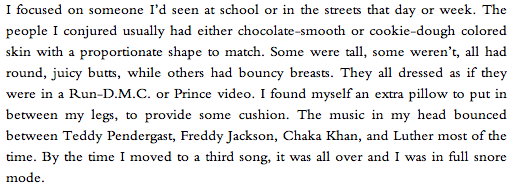
This new walk was very confusing, so much so that I often hid my emotions in much the same way I’d already been doing to protect myself from yet another abuse episode with Maurice. My emotions couldn’t stay bottled up, though. I frequently humped my way to sleep once our living room at 616 had become my bedroom during and after the months in which Balkis Makeda had lived with us.

Screen shot 2014-10-05 at 6.06.59 PM

By the spring of ’85, when Zini granted me her full support in getting me into AP US History for eleventh grade (this despite my 84 average in her class at the time), I was flabbergasted. I couldn’t stand being in the same room with Zini much of the time. Yet she did for me what few in my life had done — she opened up a door for me to walk through, albeit a relatively small one.

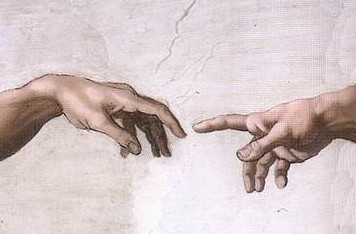
Hands of God & Adam, fingers about to touch, Sistine Chapel ceiling, Vatican, Michelangelo, 1508-1512 (via Wikipedia). In public domain.

Hands of God & Adam, fingers about to touch, Sistine Chapel ceiling, Vatican, Michelangelo, 1508-1512 (via Wikipedia). In public domain.

What did it all mean? That devoutness is meaningless without action, without giving and receiving, without trust, without taking risks. That even supposed atheists can act and give in ways that should shame many arrogant Christians. That Christianity isn’t a transactional relationship or process, but a journey with many pitfalls and lots of contradictions along the way. That who I/we say God is, well, at best an infinitesimal guess, because God and this universe is so much more that I as a human male living in the context of Western culture can only begin to understand.

Most of all, I had just begun to learn that spiritual liberation wasn’t supposed to be a yoke, but an opening to see the world and myself stripped bare of narrative and pretense. A strict adherence to the principles of Pat Robertson would bring me no closer to enlightenment and no further out of poverty than wishing on a star or avoiding cracks on Mount Vernon’s blue-slate sidewalks. Work, trust, opportunities, and not just Romans 8:28, was the beginning of the key for me.

The Long-Term Legacy of Humanities’ Soft-Bigotry

10 Wednesday Sep 2014

Posted by decollins1969 in 1, Boy @ The Window, Christianity, culture, Eclectic, Hebrew-Israelite, Mount Vernon High School, Mount Vernon New York, Patriotism, Politics, Pop Culture, race, Religion, Youth

≈ Leave a comment

Tags

Anti-Intellectualism, Center-Right Nation, Classmates, Colorblind Racism, Conservatism, Controlling the Narrative, Evangelical Christianity, Homophobia, Humanities, Humanities Program, Inferiority Complex, Intellectual Conservatism, Kerry Washington, Lazy Thinking, MVHS, Neil DiCarlo, Olivia Pope, Racism, Respectability Politics, Richard Capozzola, Scandal, School-to-Prison Pipeline, White Privilege, White Resentment, Whiteness, Willful Ignorance, Xenophobia


Ex-Classmates Proverbs

Ex-Classmates Proverbs

This week marks thirty-three years since my first days in the gifted-track Humanities Program, a fairly diverse group of very smart and (some) pretty creative students. Despite the common refrain among administrators of this long-gone program, me and my Humanities classmates weren’t the “crème de la crème” when it came to critical or independent thinking. In recent years, I’ve learned that their views on politics, religion, sports, entertainment, family and so many other things are so typically and sadly American.

Since the creators’ premise for the Humanities Program was to develop the whole person, and not just academic success, it seems to me that the program failed in terms of providing a holistic education. That our parents and other authority figures helped shape the opinions and beliefs we take to adulthood is part of my observation here. The disappointing part for me, though, has been the fact that these opinions have gone unadulterated over the past twenty-five or thirty years.

This isn’t an indictment of everyone I’ve ever known from Mount Vernon, New York, or from Mount Vernon public schools, or from MVHS, or even from my Humanities years. There are more than a few individuals who I am so glad to have reconnected with in person or through Facebook, Twitter and WordPress in the past decade or so. Everyone has the right to their beliefs, their ignorance, their opinions, however ill-informed or illogical. But there are consequences to never challenging one’s own beliefs, ignorance and opinions. Consequences that include victim-blaming, xenophobia, religion-as-politics, respectability politics, jingoist hyper-patriotism and colorblind racism.

What I’ve observed over the past ten or eleven years is that, when taken as a whole, it seems that I grew up around and reconnected with a group whose beliefs and opinions differ so much from my own. So much so that it really strains my memory to think that I grew up there. As my wife said to me on her first visit to Mount Vernon in Christmas ’99, after seeing a burned out Mazda smack-dab in the middle of downtown, “You sure you weren’t adopted?”

You Can’t Go Home Again to a Place That Was Never Home

I suspected some stark differences by the time I started working on Boy @ The Window in earnest in ’06. Any number of the ex-classmates I interviewed expressed opinions that I’d heard long before about “illegals,” about how Mount Vernon was some sort of middle-class haven, about our Humanities class being a faux “Benetton commercial” or a “mini-Fame.”

These were the kinds of opinions I remembered hearing from their parents and our teachers back in the ’80s. The sense of paternalism and entitlement, or the sense that MVHS was dangerous or “a jungle” or full of “animals.” It reminded me that there were many classmates who I’d met in seventh grade who’d transfer to private or parochial school or had enrolled in “better” schools in other districts by tenth grade because their parents were terrified by the so-called dangers of a mostly Black and Latino high school, with poverty and criminality being the unspoken words here.

I’ve faced off with the son of our late former principal Richard Capozzola several times on my blog and on Facebook in the past three years over this very issue, of how MVHS was run like a prison-prep program. His rationale for justifying Capozzola’s anti-Black draconian policies at MVHS consisted of “my dad was a great dad” and that I “wouldn’t have survived a day” at MVHS without his father as principal. The frame of MVHS as a war-zone or prison with students of color assumed to be criminals within this frame, this son of Capozzola couldn’t recognize even if Spock did a mind-meld to give him a dose of the Black experience.

Uncritical Melody, On Mount Vernon and the World

Neil DiCarlo, ex-classmate, right-winger, and one-time candidate for NY State Senate out of Putnam Valley, October 15, 2012. (http://archive.lohud.com/).

Neil DiCarlo, ex-classmate, right-winger, and one-time candidate for NY State Senate out of Putnam Valley, October 15, 2012. (http://archive.lohud.com/).

My observations aren’t limited to race or MVHS per se. Among my former classmates, with everything from affirmative action to Zionism, from political parties to education reform, from immigration reform to religious diversity, so many have views that range from conservative to right-wing. For some, every question can be answered with Leviticus or Ephesians, and any disagreement with a condemnation to Hell. For others, the frame for these issues are a “both sides do it” or “let’s look at both sides.” As if any issue involving climate change or social injustice is an algebraic equation, as if these issues are about finding some preposterous balance, rather than about exploitation or oppression.

But where I’ve found myself most at odds with some of my ex-classmates is the very issue of Mount Vernon itself as a city or a nurturing environment. It’s not as if I’ve never acknowledged the reality that if one didn’t grow up in poverty, or had connections to city politics, church or community leaders, or at least thirty cousins within a mile of your domicile, that Mount Vernon was a pretty good place to grow up. It wasn’t for me. It wasn’t for many people I grew up around.

Yet time and again, as I’ve told my story here and as I began to put Boy @ The Window together between ’06 and ’11, some of my former classmates and a couple of my former neighbors have opined that I have an ax to grind. Yeah, actually, I do, but not about Mount Vernon per se. About the poverty, abuse and ostracism I experienced growing up there, that shaped my experiences there, that authority figures often ignored. In those things, I do have a point that I have and will continue to hammer away at with the sledgehammer I have at my disposal. Too often, my former classmates believe that the only Mount Vernon that should be on public display is the one that emphasizes their raceless or supercool middle-class experience.

Some of My Classmates = Conservative America

Kerry Washington as Olivia Pope from Scandal, a show about damage control, controlling the narrative, September 15, 2011. (http://scandal.wikia.com).

Kerry Washington as Olivia Pope from Scandal, a show about damage control, controlling the narrative, September 15, 2011. (http://scandal.wikia.com).

Even in this, there’s a conservative perspective. One that says, “don’t rock the boat, don’t express a perspective that’s different than the narrative we want to put out to the world.” I know from experience and as an educator that sweeping truth into a dustbin and expressing only acceptable opinions — or acting as if all opinions, when expressed respectfully, are equal to each other — hurts us all, but especially those who are shut out of the conversation. I wish that so many of my ex-classmates had learned this while growing up in Mount Vernon, while in Mount Vernon public schools, while in Humanities with me.

I’ve come around to Morning Joe host Joe Scarborough’s way of thinking. America is a center-right nation, just as the Founding Fathers intended. Or, to be most precise, America’s DNA is one that has always had the “this-is-a-heterosexual-White-man’s-country” mutation baked into it, a gene that morphs to the point of virtual immutability. A fair number of my ex-classmates also have this mutation, which may explain my inability to fit in more than my kufi, Hebrew-Israelite status, or living at 616 in the midst of poverty domestic violence and child abuse.

On Tolerance and Not Wearing My Kufi Anymore

06 Saturday Sep 2014

Posted by decollins1969 in 1, Boy @ The Window, Christianity, culture, Eclectic, Hebrew-Israelite, Mount Vernon High School, Mount Vernon New York, Pop Culture, race, Religion, Youth

≈ Leave a comment

Tags

Acceptance, Discovery Channel, Diversity, East African Jews, Embracing, Genetics, Humanities, Intolerance, Jewish Diaspora, Judaism, Kufi, Multiculturalism, MVHS, Racial Assumptions, Ten Lost Tribes, Tolerance, Yarmulke


Mahatma Gandhi (1869-1948) quote on superiority and tolerance, September 6, 2014. (http://thousayest.wordpress.com).

Mahatma Gandhi (1869-1948) quote on superiority and tolerance, September 6, 2014. (http://thousayest.wordpress.com).

Today’s date marks three decades since I decided to stop wearing my kufi in public, my first day of tenth grade at Mount Vernon High School (NY). It also marked my coming-out party (so to speak) as a Christian and a day of defiance toward both my Mom and my idiot stepfather Maurice Washington (now deceased), all of which is well-documented here and in Boy @ The Window.

What I haven’t spent much time or space writing about was how my one-time classmates received me in terms of my kufi or the Hebrew-Israelite religion during the three years between the start of seventh grade in ’81 and the end of ninth grade in June ’84. Sure, I’ve talked about Alex and the “Italian Club,” kufi battles and other incidents involving my classmates in which bullying or attempts at bullying occurred. How much were these incidents about me, about me being poor and Black, about me being weird and Black, about me and my kufi? It wasn’t always clear.

What was clear was that the vast majority of my classmates, though they may have given me weird looks or quietly snickered, said nothing to me one way or the other about my kufi or my religion. But on that first day of tenth grade, the day I stopped wearing my kufi, my classmates were hardly silent at all.

Screen shot 2014-09-06 at 1.14.44 PM

I wondered most of all about my Jewish classmates, at least the ones who actually practiced Judaism. With Josh as the one exception, they to a person never said a word or asked a single question about my religion or my kufi. This despite the fact that fundamentally, I was an Orthodox Jew between ’81 and ’84. I didn’t get an answer while I was in Humanities or at MVHS. Years later, I interviewed one of my former classmates, whose father was a rabbi at one of the largest synagogues in Westchester County. I asked him about the silence. “I thought nothing of it,” he said, as he’d been “taught to respect other people’s beliefs.”

On some level, I could accept this answer at face value. But even at the moment of the interview, I didn’t find this former classmate’s answer enlightened or satisfying at all. His answer on the surface demonstrates the very definition of tolerance. Yet tolerance through silence is the absolute minimal definition of respect for differences. Tolerance is hardly the same as accepting or embracing differences, defined by taking active steps to understand and empathize with different peoples and cultures. Not to mention taking the extra step of working to protect those people and their differences from the intolerant.

Standing ovation, opera house unknown, May 21, 2012.(http://www.thelmagazine.com).

Standing ovation, opera house unknown, May 21, 2012.(http://www.thelmagazine.com).

I knew on some level even in ’84 that many if not most of my Jewish classmates had remained silent because the idea of Blacks as Jews in terms of religion or genetics was barely in their consciousness. It’s still hard for many Jews I’ve known over the years to accept now, even with a population of Ethiopian and other East African Jews living and working in Israel. It’s difficult to embrace the mosaic that is the Jewish diaspora, even with evidence pointing to communities made up of the descendants of some of the so-called Ten Lost Tribes of ancient Israel living in southern Africa and northern India (as documented by the Discovery Channel in documentaries over the past fifteen years). Me as a kufi and yarmulke-wearing Black teenager practicing Judaism had to be weird and beyond the pale for those classmates.

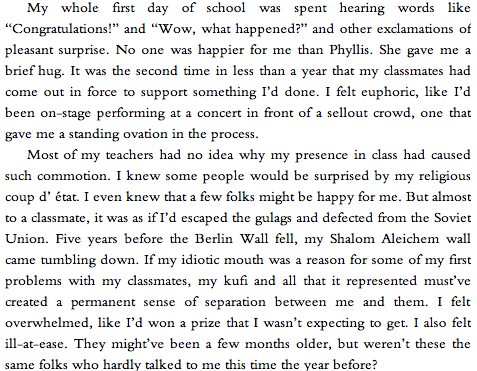
The way the rest of my classmates reacted to the end of my Shalom-Aleichem-days was also an example of minimal tolerance, or really, intolerance. In six years of Humanities, I’d never gotten that many of my classmates to pay attention to me for longer than an answer to a history question unless it was for ridicule or for a presentation or an award. The fact that at least two dozen had something positive to say about my lack of a kufi, or upon further inquiry, my turn to the Christian side, told me all I needed to know about my status with my classmates for the previous three years.

I’m hardly excluding myself from this notion of intolerance. My view of myself as a Christian in those first months after I converted was one that set me apart from Catholics, Baptists, Jehovah’s Witnesses, the Nation of Islam and Jews alike. I didn’t necessarily think or say things about these different religions or the classmates who practiced them. I just ignored those differences while giving every appearance that my nondenominational view of Christianity, my Bible-quoting and toting self, was the only lens through which anyone should view themselves and the world around them. It would be another year before I recognized my own childishness regarding my views of spirituality, religion and tolerance.

A Children’s Crusade

02 Saturday Aug 2014

Posted by decollins1969 in 1, Academia, Boy @ The Window, Christianity, culture, Eclectic, eclectic music, music, Patriotism, Politics, Pop Culture, race, Religion, Youth

≈ 1 Comment

Tags

"Children's Crusade" (1984), 100th Anniversary, Aggression, Colonialism, Culture of Imperialism, Dehumanization, Ethnic Cleansing, Ethnocentrism, First World War, Genocide, Imperialism, Nationalism, Parallels, Religious Nationalism, Settler Colonialism, Sting, The Dream of the Blue Turtles, War, Western Culture, World History, World Powers, World War I


Living among the dead, Flanders, Belgium, most likely during Second Battle of Ypres, April 21-May 25, 1915. (http://www.flandersfieldsmusic.com/).

Living among the dead, Flanders, Belgium, most likely during Second Battle of Ypres, April 21-May 25, 1915. (http://www.flandersfieldsmusic.com/).

World War I reached its 100th anniversary on Monday. One hundred years ago this week, European imperialism, nationalism, and Social Darwinism/scientific racism all led to what was once known as the Great War. It was a war that would leave ten million soldiers, sailors and airmen dead, another seven million civilians dead from military action, malnutrition and disease, and another 23 million wounded in action on both sides.

A British Mark V tank coming out of a trench, France, circa 1917. (Imperial War Museum via http://i.dailymail.co.uk/i/pix/2013/10/05/).

A British Mark V tank coming out of a trench, France, circa 1917. (Imperial War Museum via http://i.dailymail.co.uk/i/pix/2013/10/05/).

That war, a mostly European war of the great world powers, was itself based in the idea that Western culture and technologies would make this a quick and winnable war of dominance, for Germany, Britain, France and possibly Russia. The first war planes, the first tanks, the first submersibles, along with mustard and chlorine gas, nests of machine guns and trench warfare. It’s amazing how small-minded these so-called great powers were a full century ago, and so remarkable that we’ve grown beyond this thinking today!

Actually, not so fast! Our world seems to have learned little from the lessons of the First World War, repeating practices that leave the globe perpetually on the brink of chaos and potentially in peril of annihilation. We’ve seen this with the Second World War, with the Cold War and its myriad proxy wars in the Global South, with post-Cold War aggression in the Balkans, the Middle East, Sub-Saharan Africa, and with US preemptive aggressions in the Muslim world. Ethnocentrism and ethnic cleansing in the name of a religion (or a lack thereof, in a couple of cases) or nationalism has been a part of modern war since World War I.

Poppies in field between Kelling and Weybourne, North Norfolk, England, UK,  June 2002. (John Beniston via Wikipedia). Released to public domain via CC-SA-3.0.

Poppies in field between Kelling and Weybourne, North Norfolk, England, UK, June 2002. (John Beniston via Wikipedia). Released to public domain via CC-SA-3.0.

Imperialism and colonialism and resistance to both in the name of freedom, or too frequently, another form of ethnocentrism and religious nationalism. Name a given nation, and you have some strain of Western imperialism and colonization, resistance and ethnocentrism and nationalism (religious, anti-religious or otherwise) running through their recent history. India, Pakistan, the former Soviet Union, Nazi Germany, the former Yugoslavia, Perón’s Argentina, Pinochet’s Chile, the Khmer Rouge and Cambodia, South Africa and apartheid, Israel and Zionism and settler colonialism, Japan and its military occupation of China, just to name a few. The First World War unleashed these forces this week one hundred years ago, a Pandora’s box that we will need to destroy, for it’s obviously too late to close it.

One of Sting’s songs from his first solo album, The Dream of the Blue Turtles, is titled “Children’s Crusade” (1984). It’s the story of Britain’s blind march into the First World War, the wasting of a generation of youth in the name of the empire, juxtaposed with the UK’s heroin and drug epidemic of the early 1980s.

Young men and soldiers, Nineteen Fourteen
Marching through countries they’d never seen
Virgins with rifles, a game of charades
All for a Children’s Crusade

Pawns in the game are not victims of chance
Strewn on the fields of Belgium and France
Poppies for young men, death’s bitter trade
All of those young lives betrayed

Though not his best work, Sting’s “Children’s Crusade” has made me think more than once about the brutality of humanity and this inherent need to dominate other human beings, as well as the lands and resources for which vulnerable people have been cleansed and displaced. He should update it for 2014 this way:

Midnight in Gaza, Twenty Fourteen
Bombed and shelled hospitals, pawns in the game
Ashes and sackcloth, death’s bitter trade
All of those young lives betrayed

And all for a century-old crusade of nationalistic paranoia, imperialistic abuse, and dehumanizing ethnocentric warfare.

← Older posts
Newer posts →

Boy @ The Window: A Memoir

Boy @ The Window: A Memoir

Places to Buy/Download Boy @ The Window

There's a few ways in which you can read excerpts of, borrow and/or purchase and download Boy @ The Window. There's the trade paperback edition of Boy @ The Window, available for purchase via Amazon.com at http://www.amazon.com/Boy-Window-Donald-Earl-Collins/dp/0989256138/

There's also a Kindle edition on Amazon.com. The enhanced edition can be read only with Kindle Fire, an iPad or a full-color tablet. The links to the enhanced edition through Apple's iBookstore and the Barnes & Noble NOOK edition are below. The link to the Amazon Kindle version is also immediately below:

scr2555-proj697-a-kindle-logo-rgb-lg

Boy @ The Window on Amazon.com: http://www.amazon.com/Boy-The-Window-Memoir-ebook/dp/B00CD95FBU/

iBookstore-logo-300x100

Boy @ The Window on Apple's iBookstore: https://itunes.apple.com/us/book/boy-the-window/id643768275?ls=1

Barnes & Noble (bn.com) logo, June 26, 2013. (http://www.logotypes101.com).

Boy @ The Window on Barnes & Noble: http://www.barnesandnoble.com/w/boy-the-window-donald-earl-collins/1115182183?ean=2940016741567

You can also add, read and review Boy @ The Window on Goodreads.com. Just click on the button below:

Boy @ The Window

Twitter Updates

Tweets by decollins1969
  • RSS - Posts
  • RSS - Comments

Archives

  • June 2025
  • April 2023
  • September 2022
  • August 2022
  • July 2022
  • June 2022
  • May 2022
  • April 2022
  • March 2022
  • January 2022
  • December 2021
  • November 2021
  • October 2021
  • September 2021
  • August 2021
  • July 2021
  • June 2021
  • April 2021
  • March 2021
  • February 2021
  • January 2021
  • December 2020
  • November 2020
  • October 2020
  • September 2020
  • August 2020
  • July 2020
  • May 2020
  • April 2020
  • March 2020
  • January 2020
  • December 2019
  • November 2019
  • August 2019
  • July 2019
  • June 2019
  • May 2019
  • April 2019
  • March 2019
  • February 2019
  • January 2019
  • December 2018
  • November 2018
  • October 2018
  • September 2018
  • August 2018
  • July 2018
  • June 2018
  • May 2018
  • March 2018
  • February 2018
  • January 2018
  • December 2017
  • November 2017
  • October 2017
  • September 2017
  • August 2017
  • July 2017
  • June 2017
  • May 2017
  • April 2017
  • March 2017
  • February 2017
  • January 2017
  • December 2016
  • November 2016
  • October 2016
  • September 2016
  • August 2016
  • July 2016
  • June 2016
  • May 2016
  • April 2016
  • March 2016
  • February 2016
  • January 2016
  • December 2015
  • November 2015
  • October 2015
  • September 2015
  • August 2015
  • July 2015
  • June 2015
  • May 2015
  • April 2015
  • March 2015
  • February 2015
  • January 2015
  • December 2014
  • November 2014
  • October 2014
  • September 2014
  • August 2014
  • July 2014
  • June 2014
  • May 2014
  • April 2014
  • March 2014
  • February 2014
  • January 2014
  • December 2013
  • November 2013
  • October 2013
  • September 2013
  • August 2013
  • July 2013
  • June 2013
  • May 2013
  • April 2013
  • March 2013
  • February 2013
  • January 2013
  • December 2012
  • November 2012
  • October 2012
  • September 2012
  • August 2012
  • July 2012
  • June 2012
  • May 2012
  • April 2012
  • March 2012
  • February 2012
  • January 2012
  • December 2011
  • November 2011
  • October 2011
  • September 2011
  • August 2011
  • July 2011
  • June 2011
  • May 2011
  • April 2011
  • March 2011
  • February 2011
  • January 2011
  • December 2010
  • November 2010
  • October 2010
  • September 2010
  • August 2010
  • July 2010
  • June 2010
  • May 2010
  • April 2010
  • March 2010
  • February 2010
  • January 2010
  • December 2009
  • November 2009
  • October 2009
  • September 2009
  • August 2009
  • July 2009
  • June 2009
  • May 2009
  • April 2009
  • March 2009
  • February 2009
  • January 2009
  • December 2008
  • November 2008
  • October 2008
  • September 2008
  • August 2008
  • July 2008
  • June 2008
  • May 2008
  • April 2008
  • March 2008
  • February 2008
  • January 2008
  • December 2007
  • November 2007
  • October 2007
  • September 2007
  • August 2007
  • July 2007
  • June 2007

Recent Comments

MaryPena's avatarMaryPena on My Day of Atonement/Bitter Hat…
decollins1969's avatardecollins1969 on No Good Teaching Deed Goes…
Mary Rose O’Connell's avatarMary Rose O’Connell on No Good Teaching Deed Goes…

NetworkedBlogs on Facebook

NetworkedBlogs
Blog:
Notes From a Boy @ The Window
Topics:
My Life, Culture & Education, Politics & Goofyness
 
Follow my blog

616 616 East Lincoln Avenue A.B. Davis Middle School Abuse Academia Academy for Educational Development AED Afrocentricity American Narcissism Authenticity Bigotry Blackness Boy @ The Window Carnegie Mellon University Child Abuse Class of 1987 CMU Coping Strategies Crush #1 Crush #2 Death Disillusionment Diversity Domestic Violence Economic Inequality Education Family Friendship Friendships Graduate School Hebrew-Israelites High-Stakes Testing Higher Education History Homelessness Humanities Humanities Program Hypocrisy Internalized Racism Jealousy Joe Trotter Joe William Trotter Jr. K-12 Education Love Manhood Maurice Eugene Washington Maurice Washington Misogyny Mother-Son Relationship Mount Vernon High School Mount Vernon New York Mount Vernon public schools Multiculturalism MVHS Narcissism NFL Pitt Pittsburgh Politics of Education Poverty President Barack Obama Race Racial Stereotypes Racism Relationships Self-Awareness Self-Discovery Self-Reflection Sexism Social Justice Teaching and Learning University of Pittsburgh Violence Whiteness Writing

Top Rated

Blog at WordPress.com.

  • Subscribe Subscribed
    • Notes from a Boy @ The Window
    • Join 103 other subscribers
    • Already have a WordPress.com account? Log in now.
    • Notes from a Boy @ The Window
    • Subscribe Subscribed
    • Sign up
    • Log in
    • Report this content
    • View site in Reader
    • Manage subscriptions
    • Collapse this bar
 

Loading Comments...