• About Me
  • Other Writings
  • Interview Clips
  • All About Me: American Racism, American Narcissism, and the Conversation America Can’t Have
  • Video Clips
  • Boy @ The Window Pictures
  • Boy @ The Window Theme Music

Notes from a Boy @ The Window

~

Notes from a Boy @ The Window

Category Archives: My Father

No Time For Jealousy

30 Friday Sep 2016

Posted by decollins1969 in 1, Academia, Boy @ The Window, culture, Eclectic, Mount Vernon High School, Mount Vernon New York, My Father, New York City, Politics, Pop Culture, race, University of Pittsburgh, Youth

≈ Leave a comment

Tags

616, 616 East Lincoln Avenue, Class, Coveting, Envy, Erika, General Foods, Humanities, JD, Jealousy, Love Canal, Mother-Son Relationship, Mount Vernon Hospital, MVHS, Smorgasbord, Target, Wendy
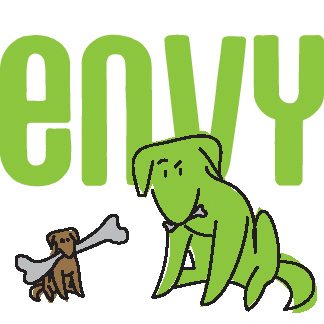

Envy, June 2009. (http://psychologytoday.com).

Envy, June 2009. (http://psychologytoday.com).

There are some emotions and human actions in which I don’t allow myself to partake. I usually don’t follow the herd. I don’t get caught up in what’s popular at the moment, no matter how many cool people in my life are riding the wave. I don’t build someone up in order to tear them down. And I don’t allow myself more than a flash of envy or jealousy.

Sometimes, these choices are rather easy, like with me having never watched an episode of Scandal or Empire. Sometimes, the choice to not virtually excoriate someone is difficult, given the narcissisms and moralisms that make up American culture. Sometimes, my path less traveled is one that has become easier over time. With jealousy, I’ve learned over the past thirty-five years that it’s a waste of time, neurons, and quantum energy to peer into the lives of those allegedly better off.

But this was hardly an easy process. I had so many reasons to be jealous when I was a preteen and teenager. My middle school and high school Humanities years were ones of constant, albeit momentary, jealousy. I was envious of classmates whose parents made more in a month than my Mom made working all year at Mount Vernon Hospital. I felt envy whenever I saw a classmate chow down on a smorgasbord of a lunch every day, especially on all the days I couldn’t eat because I either didn’t have the money to buy lunch or because the Hebrew-Israelite no-pork rule prevented me from eating the Friday grilled ham and cheese sandwich. Jealousy would come along when I’d see the mini-cliques of former Grimes and Pennington Elementary classmates getting along like the best of friends. Or, when my classmates would come to school wearing the latest and best of ’80s fashion while I walked around in sneakers with holes in the bottoms.
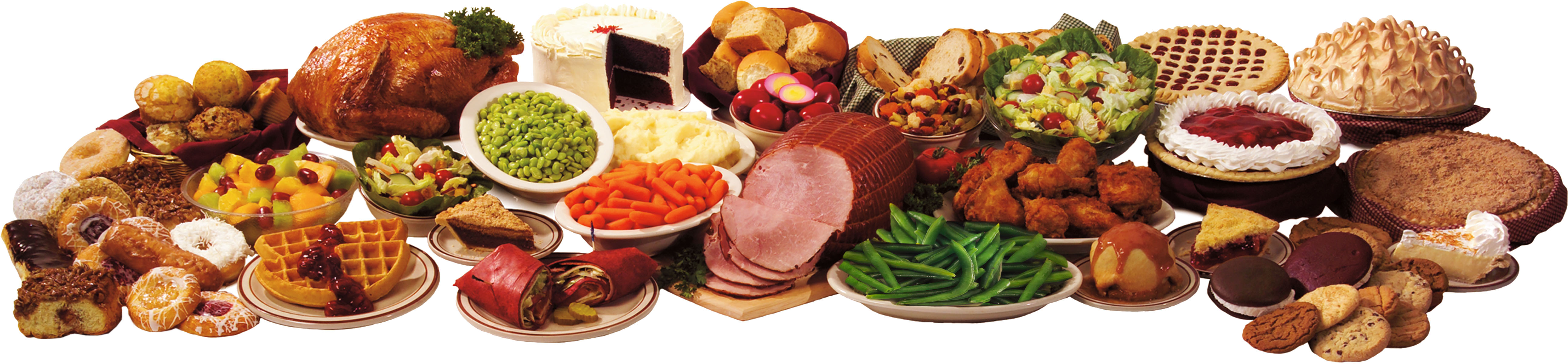
Smorgasbord, from breakfast to dinner, September 2010. (http://web2printexperts.com).

Smorgasbord, from breakfast to dinner, September 2010. (http://web2printexperts.com).

These first bouts with jealousy quickly turned inward toward my own insecurities and inadequacies, and outward toward my parents’ inability to do anything to make my life better materially. For years after the shock of preteen and early adolescent jealousy, I never saw myself as worthy of my classmates, not even worthy enough to befriend someone whose life, though maybe materially blessed, might have been unstable in other areas.

My first realization of seeing myself as being jealous, though, was toward the end of tenth grade at Mount Vernon High School. That’s when my secret first love Wendy and the contrarian one JD had begun to date. I didn’t feel this sense of love or weird emotional trepidation regarding Wendy by the time we were in tenth grade, though. I sensed as early as seventh grade this particular eventuality. No, I was more jealous of the reality that Wendy and JD could connect with each other in a way that I knew for me was beyond my reach. I didn’t really have any friends, so dating would’ve been like building a bridge over the Pacific Ocean by comparison.

But I learned something as well. Because theirs was an interracial relationship, I got a first-row seat to the stares, the whispers, and the occasional ignorant-ass comments from the other high schoolers about them dating. Seeing that, hearing that, made me aware of the fact that jealousy is a dangerous emotion, and give the life of deficits I had to make up, I didn’t have time or gray matter to waste in the matter of woe-is-me-as-outsider in 1985 or in the foreseeable future.

Public Enemy logo (note the crosshairs target), September 30, 2016. (http://twitter.com).

Public Enemy logo (note the crosshairs target), September 30, 2016. (http://twitter.com).

A year later, when I sensed on some level that some of my classmates were actually jealous of me, I balked at the idea. I thought, “I have nothing that anyone should be jealous of.” To me, this was literally true. With some of the cool kids literally laughing at me as I walked by them in the hallways, I couldn’t foresee a situation in which anyone would ever be jealous of me.

And yet I was wrong. My academic success, my fierce insistence to fight isolation by making myself independent of fads, trends, and conventional wisdom, had already made me a target of other’s envy. It wasn’t until the summer after I graduated when a co-worker at my General Foods job, one who was one year behind me at Mount Vernon High School, cut through the psychology for me. Erika cleared up so many things for me about the nature of friendships, relationships, and jealousy. I owe her big time for that, then and now.

Love Canal, suburban community turned EPA Superfund site, circa 1980. (http://buffalonews.com).

Love Canal, suburban community turned EPA Superfund site, circa 1980. (http://buffalonews.com).

Nearly thirty years later, and I am still surprised when I discover that someone is jealous of me. Really, I am. I guess it’s because I operate by the moment-of-envy rule. Meaning that I allow myself to feel jealous, but only for a moment, and remind myself of my own path, my own destination, and the work I must do to get there. After all, I don’t really want someone’s else job, promotion, salary, status, car, or house. That’s their life, and only God truly knows if their life would be one I’d want to have. And then I move on, knowing that the green grass on the other side of the tracks can often obscure the Love Canal underneath. I move on, because there’s always more work to do, for me, my wife, and my son. I move on, because after all these years, that’s all I know how to do.

Looking Back to My Future

04 Sunday Sep 2016

Posted by decollins1969 in 1, Boy @ The Window, Christianity, culture, Eclectic, Mount Vernon High School, Mount Vernon New York, My Father, New York City, Pittsburgh, Politics, Pop Culture, race, Religion, University of Pittsburgh, Work, Youth

≈ Leave a comment

Tags

616, 616 East Lincoln Avenue, Blair Kelley, Dr. Jack Daniel, Familial Obligations, Forbes Quadrangle, Fordham University, Grit, Homelessness, Hunter College, Pedro Noguera, Pitt, Poverty, Resilience, Ron Slater, Survivor's Guilt, Wesley V. Posvar Hall, What Ifs


The power of "What If?," September 4, 2016. (http://giphy.com).

The power of “What If?,” September 4, 2016. (http://giphy.com).

I don’t “what if” my past moments nearly as much as I used to, thanks in part to one of my first Twitter conversations six years ago. It was with Blair Kelley, a professor and dean at North Carolina State University. I brought up the fact that I sometimes indulged my students’ “What if…?” scenarios regarding slavery and other issues in US history in order to help them find the truth. She said that this was a waste of time, that “What is…?” is already hard enough for students to understand, much less playing out a “What if…?” to get to a “What is…?”

Kelley was right. Students often play the “What if…?” game to deflect from what actually happened, out of potential pain or discomfort with historical truths, or because their conception of history doesn’t allow for humanity and human nature as significant factors. So I stopped humoring my students in fantasies about the South winning the Civil War or Nazi Germany winning World War II in Europe. It hasn’t made my students any happier, but it has made teaching them easier.

As for my own “What ifs…?,” I still think of a few on occasion. Like what if I had gone to college at Columbia or another elite institution instead of Pitt? Or what if I had possessed the courage to act on my crush on Wendy in seventh grade, or not wear my kufi to school during the Hebrew-Israelite years at all? Those can be very good mental distractions when I’m running a 10K or working on a boring set of revisions to an education piece. But they’re also rather silly distractions, with me knowing full well why I did or didn’t do most things, even knowing my thought process at the time they occurred in ’81, ’82, or ’87.

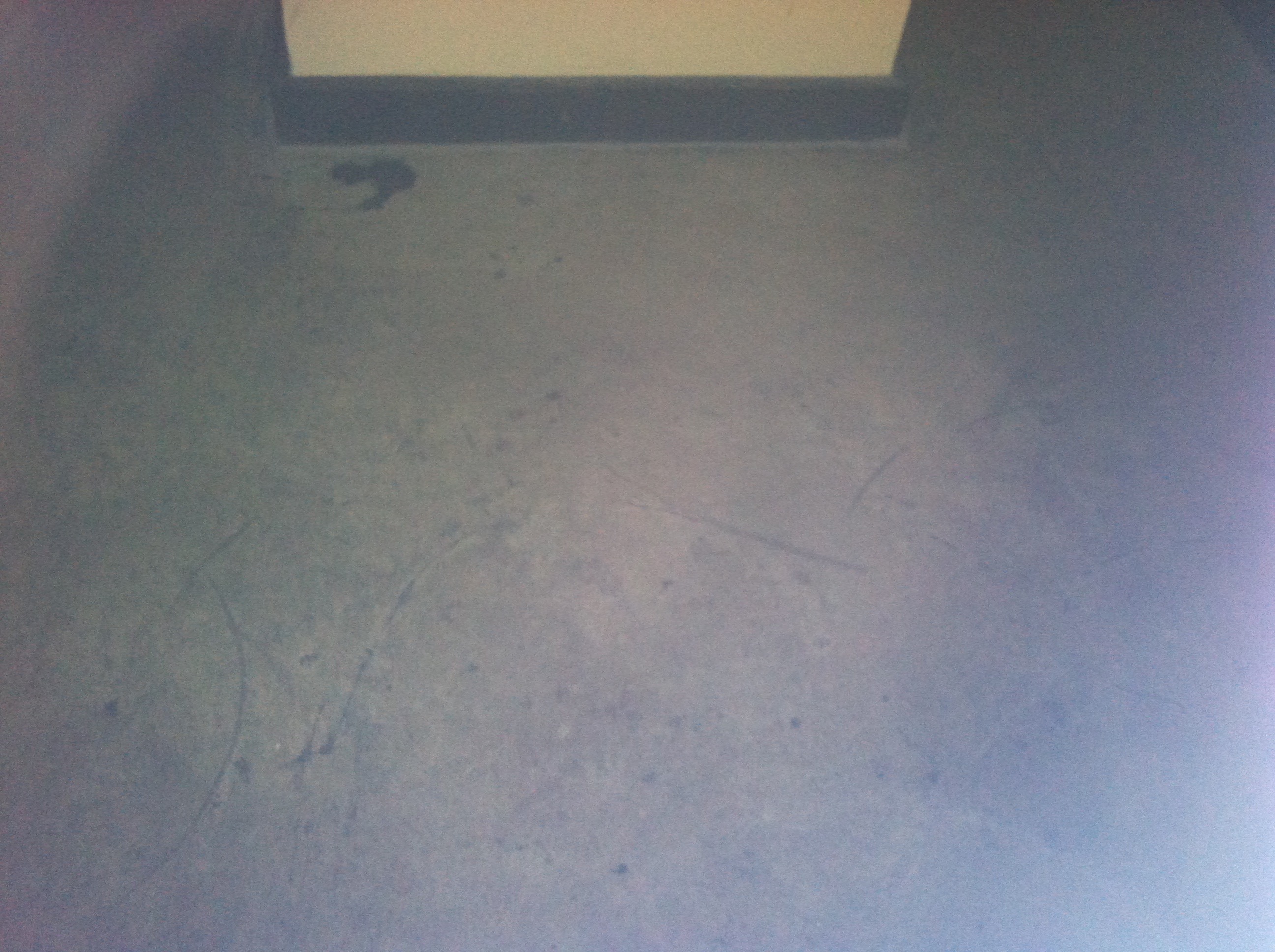
With this weekend being exactly twenty-eight years since my five days of undergraduate homelessness on Pitt’s campus, I have a real “What if…?” scenario to reconsider. What if I hadn’t bumped into my friend Leandrew, who had told me about the dilapidated fire-trap rowhouse he lived in on Welsford? What if I hadn’t met with my landlord Mr. Fu and gotten my 200-square-foot room with a literal hole in the wall so that two rooms could share a single radiator, all for $140 per month (about $285 in 2016 dollars)? What if I had to spend Labor Day weekend on a closed Pitt campus sleeping on that top floor concrete landing in a Forbes Quadrangle (now Posvar Hall) stairwell, where I had already spent three nights?

The mythical 6th-floor landing I slept on for three days (leading out to the roof), Wesley Posvar Hall, September 29, 2013. (Donald Earl Collins).

The mythical 6th-floor landing I slept on for three days (leading out to the roof), Wesley Posvar Hall, September 29, 2013. (Donald Earl Collins).

I already know the answers to these questions. I decided on this after praying about this on Wednesday, August 31 in ’88 while in that stairwell, laying on some of my clothes and my book bag. If I came out of Labor Day weekend without housing, I’d have to take my remaining $300 and go back to New York, to Mount Vernon, to 616. I’d have to drop or withdraw from my courses at Pitt. Maybe, with add-drop still going on, I could have some of my financial aid refunded, after Pitt deducted the $819 I owed them from my freshman year. I could enroll at Fordham or at CUNY’s Hunter College for the Winter/Spring 1989 semester, maybe find work somewhere in the area, and gut it out a few months at 616 with my nonfunctioning family.

I knew then that this was a scenario as ridiculous as Napoleon conquering Russia in the dead of winter. One of the reasons (but not the main reason) I left for the University of Pittsburgh in the first place was to get away from my family, to meet people unlike my Mom, my idiot stepfather, my five siblings at crowded 616, and the asshole Humanities classmates I’d gone to school with every day for the previous six years. I knew I had to have the mental space I needed to find myself, to figure myself out, all in considering whether I even had a future, much less how that future would take shape or how I’d shape myself into a future.

If I had gone with my cockamamie idea, the best case outcome would’ve been me transferring to Hunter or Fordham with my first year’s credits from Pitt, and me making it through a few semesters full-time before becoming a part-time student. I have no idea if I would’ve finished with a degree in history or something else from Hunter or Fordham. But given how exhausted I was each time I went back to Pitt after a summer of paid and familial work, I likely wouldn’t have even considered grad school.

The weight of guilt, survivor's and otherwise, September 2014. (http://www.fumsnow.com/).

The weight of guilt, survivor’s and otherwise, September 2014. (http://www.fumsnow.com/).

Why? I would’ve been at 616. I would’ve been obligated to help out with everything, from dealing with my idiot stepfather before me and my Mom finally forced him out, to providing food, entertainment, and childcare for my four younger siblings. I know this because during my college years, I did come back to 616 to work each summer and during the holidays. Those additional responsibilities were ones I felt obligated to fulfill until I was in my early thirties, and felt most intense when I had to face my family’s poverty head-on.

Keep in mind, this is the best-case outcome. Most likely, I would have stopped going to school all together after my bout with homelessness. I would’ve found part-time or full-time low-wage work, first to help out, then to find a roach trap somewhere in Mount Vernon or in the Bronx, and been relegated to the torture of “What ifs?” around getting a degree and having a better life. Maybe, just maybe, I would’ve been bumped around enough by that rough life to try again, to seek help from the likes of an ombudsman like Ron Slater or a provost like Jack Daniel. But I barely knew how to seek help when I first went about doing it as a homeless and broke-ass student in ’88. Given my mental makeup back then, it would’ve been a monumental task to trust that much after years of low-wage work and unrelenting poverty at 616.

UCLA education professor (although he is so much more than that) Pedro Noguera reminded me of something I’ve come to disdain in recent years. This idea that philanthropists and researchers can use kids and families as experimental subjects on the issue of “grit” or “resilience” is one I find disgusting. The idea that oppression and inequality can be overcome if you or I simply toughen up, grow a thick outer shell and just push through? The idea that with grit and spit and sweat, anyone can just overcome through sheer will power a lack of preparation, a lack of resources, a lack of access to resources, a lack of connections, and a lack of knowledge? Are you kidding me?

Quaker Instant Grits, Super Family Size, September 4, 2016. (http://soap.com).

Quaker Instant Grits, Super Family Size, September 4, 2016. (http://soap.com).

I had just about the best academic preparation anyone could have going into college, and I still came within three or four days of dropping out and heading back to 616. I was staring into the abyss of my future. The only grit I knew that would’ve worked for me on August 31, ’88 would’ve been a gigantic box of Quaker’s Instant Grits. And that was assuming I found a place to live in Pittsburgh so I could buy a pot and cook them. I didn’t want to be resilient. I’d always been resilient. But I didn’t call it that. I called it surviving.

And without help, without knowing how to ask for help, without some occasional divine or quantum-level intervention, my grit, resiliency, or survival up to August 31, ’88, wouldn’t have mattered. Philanthropists, educators, and social scientists need to stop asking individuals, families, and communities in poverty to be part of their test of resiliency as if we’re all rats in their maze. They need to start asking all of us not just how we survive, but what we need to succeed. Then again, they shouldn’t even need to ask. It’s not as if this is a “What if…?” The Great Society and War on Poverty efforts in the 1960s haven’t already provided a roadmap. Go study that!

My Mom’s Migration Story, 50 Years Later

23 Tuesday Aug 2016

Posted by decollins1969 in 1, Boy @ The Window, Christianity, culture, Eclectic, Hebrew-Israelite, Jimme, Marriage, Mount Vernon New York, My Father, New York City, Pittsburgh, Politics, race, Religion, Work, Youth

≈ Leave a comment

Tags

Black Migrants, Black Migration, Bradley Arkansas, Child Abuse, Domestic Violence, Education, Highs and Lows, Insecurities, Intervention, Mary Louise Gill, Mother-Son Relationship, Mount Vernon Hospital, Self-Defense, Self-Reflection, Southern Stigmas, Welfare Poverty


I would be a pretty terrible son and historian to not discuss the fact that this July and August marks fifty years since my mother moved to New York from little ol’ Bradley, Arkansas. For those who think fifty years on anything revolving around race and class is “a long time ago” or “ancient history,” consider the following. At the time Mom moved across the country to Gotham, the Civil Rights Movement had entered its northern, splintered phase, the Voting Rights Act of 1965 was barely a year old, and the very first episode of Star Trek with William Shatner and Leonard Nimoy would air that September.

Bus route my mother took from Bradley, Arkansas to New York City in late-July 1966, August 23, 2016. (http://maps.google.com).

Bus route my mother took from Bradley, Arkansas to New York City in late-July 1966 (highlighted in blue with yellow dots), August 23, 2016. (http://maps.google.com).

On balance, with any neutral but fair eye at all, I’d have to say that Mom’s transition has been more failure than success. Five decades of crisis after crisis, of having a handful of fleeting moments of peace and progress followed by years of abuse, misery, poverty, and sorrow. That could be the summary I’d write about Mom’s fifty years of post-migration experiences in New York and in Mount Vernon.

But, let’s start from the top, through Boy @ The Window:

After drifting a bit after her high school graduation, one of Mom’s first cousins came for a visit to Arkansas in the summer of ’66 and told her that there was good-paying work in New York City. Her cousin lived in the [170s, the Tremont section of the] Bronx, a hotbed of Black migration and West Indian immigration in those years. Without much thought, Mom took a four-day bus trip from Texarkana to New York to what she hoped would be a new life. Given the alternative of tenant farming and generational poverty, New York must’ve seemed like going to heaven.

Mom had it rough long before my father and my older brother Darren and I had come along to be a burden. She lived with her cousin for nearly a year in the Bronx, paying $15 a week for a one-bedroom flat, before good luck turned to bad and then back to wonderful. They had both lost jobs at some factory, but had heard through the other late Black arrivals in the Bronx and Mount Vernon about good paying jobs at Mount Vernon Hospital. When Mount Vernon Hospital hired Mom to be a cook in their dietary department, she and her first cousin went their separate ways living-together-wise. They’d stay in touch until ’78, when Mom’s first cousin moved to Virginia, presumably for work with the Navy.

In the interim, Mom met my father at a juke joint on Mount Vernon’s South Side. It was a place where only Southern Black migrants would be comfortable. They didn’t have to pretend to like the grime, the hustle, the noise, and the taunts that New York and New Yawkers threw at them every day. They could be themselves. They could be shy, apprehensive, even, about their time in a place where everyone joked about their Southern accents and their slow ways. I think that’s what made my father attractive to Mom. Here was someone who made Mom sound much less Southern by comparison. At the same time, my father worked in the city, had a job as a janitor with the Federal Reserve Bank, and knew the Subway better than she knew the route from her one-room flat on Adams Street to Mount Vernon Hospital.

My Mom at 48 years old, Yonkers, NY, December 23, 1995. (Donald Earl Collins).

My Mom at 48 years old, Yonkers, NY, December 23, 1995. (Donald Earl Collins).

Within a year of meeting, Mom gave birth to my older brother Darren. Mom often said that she “wasn’t a teenager” when Darren was born in December ’67, as she had turned twenty six weeks earlier. Yet as I finally pointed out during the intervention fourteen years ago, “But you got pregnant when you were nineteen,” all to let Mom know that the stigma of teenage pregnancy was more about her and her insecurities than it was about what White folks thought, especially back then.

I came along two years later, Mom married my father in ’70, and things started falling apart soon after. Mom never gave herself a chance to live the city, and not just work in it. Mom never gave herself time to grow beyond her insecurities and her vanity about her looks. She never really tried to make her aspirations for joining the Navy or going to college happen. The latter, at least until after I went off to the University of Pittsburgh in ’87.

As I wrote about Mom’s/our family’s fall into welfare poverty by ’83 in Boy @ The Window,

Sixteen years, a dead-end job and two abusive husbands later, Mom must’ve been thinking that Mount Vernon was a hellish pit that got hotter every time she tried to make her and our lives better. With a fourteen-year-old kid in a school for the retarded, a twelve-year-old getting beat up by the second husband, a three-year-old who all but refused to speak because of his abuse, a one-year-old and another one on its way, it was little wonder that she showed about as much affection as an NYPD police officer. The ‘I love you, Donald’ faucet, which was an occasional drip prior to the summer of ’82, was pretty much turned off after that.

Yes, this is all truly sad. There was way too much too soon for Mom. Family, marriage, abuse, poverty, and internalized issues around race, sexism, misogyny, Black masculinity, evangelical Christianity (and the whole Hebrew-Israelite debacle), and all in New York. It would’ve been overwhelming for anyone whose income never saw $20,000 in any year prior to temp work in ’99, and $30,000 until working for Westchester County Medical Center in 2003.

There are so many mistakes Mom made, with me, my siblings older and younger, in choosing mates, and with work. I’ve written about roughly half of them. But, awful or awesome, without Mom’s momentary hope and courage — often the very definition of Black migration, especially to New York — I wouldn’t be here to tell the tale.

A Big Wheel and Recovered Memories, Part Two

06 Saturday Aug 2016

Posted by decollins1969 in 1, Boy @ The Window, culture, Eclectic, Jimme, Marriage, Mount Vernon New York, My Father, New York City, Pop Culture, race, Youth

≈ Leave a comment

Tags

425 South Sixth Avenue, 616, 616 East Lincoln Avenue, Anti-Gay Slur, Big Wheel, c, Chevy Malibu, Dukey, Father-Son Relationship, Heterosexism, Hypermasculinity, Molestation, Mother-Son Relationship, Nathan Hale Elementary, Parenting, Pedophilia, Recovered Memories, Sexual Assault, Signs of Trauma


It took me until three weeks after the sex assault on the Nathan Hale ES playground before I told my parents. Those three weeks are a blur, but not the blur that the incident with the light-skinned teenager and his three friends would become until three weeks before my forty-fifth birthday

At the beginning of August ’76, my Mom and my dad Jimme were having another one of their vicious arguments. It was that Saturday afternoon when I finally learned that my Mom had filed for a divorce the month before. Anyway, I somehow managed to get myself in the middle of that argument. I complained that Darren’s bigger butt had been the final straw for my Big Wheel. It had broken in half after he tried to ride it earlier that week.

“I told him, it says ‘90-lb limit’,”  I said to my Mom (which I pronounced as “ninety lebs”) while pointing at the inscribed warning label on my now broken Big Wheel, crying.

“You broke that shit weeks ago!,” my Mom yelled.

“I didn’t break it. A bunch of kids did,” I said.

“And you didn’t try to stop ‘em?,” Mom asked.

“I did try to stop ‘em. But they took it and one of them stuck a pee-pee in my mouth,” I explained.

“I done told you not to leave the house when I’m not here! That’s what you get for not listenin’!,” my Mom screamed.

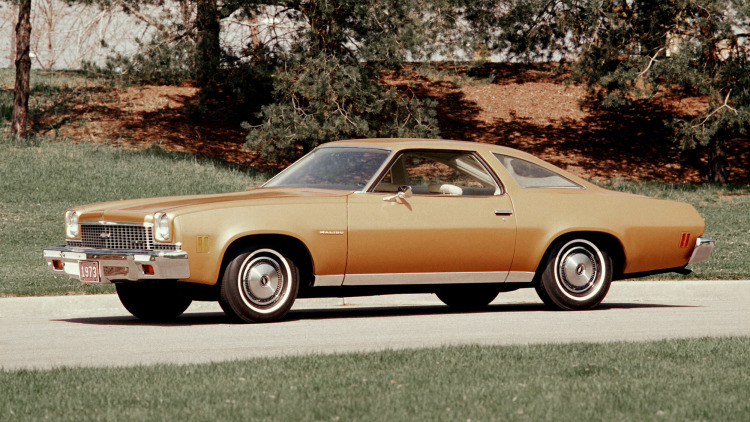
I was so shocked by how angry she was. I was mad, too. I didn’t think. I just ran out the house and out into the middle of the street. I saw a tan Chevy Malibu coming down the street and I just stood there.

1973 tan-ish Chevy Malibu, August 5, 2016. (http://www.autoblog.com).

1973 tan-ish Chevy Malibu, August 5, 2016. (http://www.autoblog.com).

The older, salt-and-pepper bearded and balding Black man didn’t slow down until he realized I wasn’t planning to move. He slammed on the brakes and came to a stop about three feet in front of me. The man put his car in park and got out. He then slammed his driver’s side door really hard, and yelled, “Boy, what’s wrong with you? Are you tryin’ to get yourself killed? Where’s your mama?”

He grabbed me by the back of my chocolate-brown t-shirt and made me show him where I lived. We marched upstairs to the second-floor, where he proceeded to explain my suicidal actions. My Mom then took the older man’s belt and beat me with it in front of him, with Darren and Jimme watching. Afterwards, she said “Thank you” to the older man, and then sent me to bed without dinner. “Don’t you EVER do that again!,” she screamed.

Nine months after that bicentennial summer, we moved across town to 616 East Lincoln, a three-in-one, five-story Tudor-style apartment complex. After a summer camp at Darren’s Clear View School in Dobbs Ferry, we went outside on 616’s grounds for the first time, in August ’77. The kids at 616 and 630 East Lincoln chased us around the vast two-building complex while throwing rocks at us. Scared, we hid behind the big, wooden, dark-brown front door and huddled, hoping that the kids wouldn’t find us.

Instead, a couple of young Black Turks saw us and took us upstairs to my Mom and my eventual stepfather Maurice. The two young men said that they saw us doing “the dukey.” I had no idea what they were talking about. All I knew was that my Mom and stepfather proceeded to whip us as if we’d gone to the grocery store and stolen $100 worth of candy and soda. Both “dukey” and “faggot” were part of my vocabulary — again.

The mind of a child is a strange place. Mine was no different. For years afterward, I’d managed to forget these most painful memories. I managed to bury them without burying all of my other memories, so many memories that I have for the last forty-one out of my forty-five years. I somehow didn’t remember the connections between my Big Wheel, the light-skinned teenager and standing in the middle of South Sixth, waiting to be run over. I didn’t remember my Mom’s response to finding out that her six-year-old son had been sexually assaulted.

It’s ironic. Ironic because I’ve already written my coming-of-age memoir in Boy @ The Window. I spent the better part of a decade researching, writing and revising it before self-publishing it in 2013. I included excruciating details about my family, my Mom, my father Jimme. I included as many relevant and embarrassing events as I could about how I became the person I always wanted to be. And with all that work, I never remembered the moment a teenager forced his penis tip into my mouth.

Buildings/dream in state of collapse, via Inception (2010), August 5, 2016. (http://www.cinemablend.com).

Buildings/dream in state of collapse, via Inception (2010), August 5, 2016. (http://www.cinemablend.com).

I only remembered during the holidays in 2014. One night in early December, I had a really bad trying-to-escape dream — again. This time, though, I remembered the taste of a penis in my mouth, and then I saw the light-skinned teenager. Even in my dream, I said, “That’s him. That’s it.”

After I woke up, a flood of images erupted in my brain. The Chevy Malibu and me standing in the street. Seeing the light-skinned kid who  assaulted me on the playground at 616 on the same day the other kids chased Darren and me around the building while pelting us with pebbles and rocks. The wall of fear that my Mom had on her face when the neighbors told her that they thought Darren and me were “faggots” because we were standing so close to each other that we looked like we were “doing the dukey.”

The now-remembered incident explained so much. My Mom’s constant fear that I’d turn out gay. My father Jimme constantly calling me a “faggat” (as he pronounced it when he was drunk) whenever I stepped out of line or looked at people the wrong way. My Mom giving my one-time idiot stepfather Maurice carte blanche to “turn” me and Darren “into men” through Isshin-ryu karate and draconian physical abuse. Me being terrified at times when around Black guys on the basketball courts or in other social setting. My looking at young women from afar, attainable and yet all but unattainable for me. The sheer desire to save the people in my life from violence and destruction, especially my Mom and Darren, but the inability to do either.

My family’s fear of the mere possibility that I or my brother Darren could be gay drove many of their measures of physical, verbal and emotional abuse. So much so that they ignored all the signs of my actual abuse. Like standing in middle of the street to get run over by a car, were just considered “defiant” or “weird.” Or with me constantly chewing my fingernails right down to nail bed. Or me constantly stuffing sandwiches and other food down into the recesses of my winter coats, having already ripped out the pockets, and leaving the food there. Or the day I stood on Nathan Hale’s playground during recess in May ’77, when I took some string from my red and blue-striped t-shirt, gradually unraveled it, and swallowed nearly a third of it. My Mom figured she could beat the “something’s wrong with you, fool” out of me. My father calling me a “faggat” from the time I turned fourteen was just tough love, not a form of abuse piled on top of abuse.

Now that I remember everything about the physical and the sexual abuse, what do I do next? It’s been forty years since I found out how horrible life could be. It’s not as if I’ll be able to track down and then beat up the light-skinned teenager, who’s now in his early fifties, assuming he’s still alive.

I could start by revising Boy @ The Window. I wasn’t just weird because I wore a kufi, spoke too slowly, or grew up with weird people. I wasn’t just a child of poverty, abuse, and divorce. I was also a sexual abuse victim, all but completely unacknowledged, and yet such a major part of the story.

Forgiving my abuser could be at the top of the list. It would be difficult to be angry at someone whom I’d forgotten about for nearly four decades. But you know what? If I could just punch him in the throat and then knee him in the balls until one fell out and rolled down the street, that would give me some satisfaction.

Mostly, I’m just satisfied that I know my past in full. I already paid the bill. Now that I know what I paid for, I can move forward. I can look at my past, present, and future with more sanity than I thought possible.

Independence Day On The 6’s

04 Monday Jul 2016

Posted by decollins1969 in 1, Boy @ The Window, culture, Eclectic, High Rise Buildings, Jimme, Marriage, Mount Vernon New York, My Father, New York City, Patriotism, Pittsburgh, Pop Culture, race, Sports, Work, Youth

≈ Leave a comment

Tags

1976, 1996, 2006, 7 Train, Adulthood, Coming-of-Age, Dwight Gooden, Escapism, Growing Up, Independence Day, July 4th, Lee Iacocca, Manhood, Metro-North, Mets, New York Mets, Nolan Ryan, Peace, Shea Stadium, Siblings, Statue of Liberty, Subway, Technisort


Shea Stadium (taken from 7 Subway), Flushing Meadows, Queens, NY, September 10, 2008. (Gary Dunaier via http://farm4.static.flickr.com/). In public domain.

Shea Stadium (taken from 7 Subway), Flushing Meadows, Queens, NY, September 10, 2008. (Gary Dunaier via http://farm4.static.flickr.com/). In public domain.

For me, the 6’s are ’76, ’86, ’96, and ’06. For 2016, all I’ve done today is make BBQ chicken legs and thigh (after an hour of so of marinating), corn on the cob, mac and cheese, and New York Style blondies with chocolate chips and walnuts. It’s a rainy 240th anniversary of America’s independence from the United Kingdom of Great Britain, England, Wales, Scotland, and Northern Ireland. About as dreary the Mid-Atlantic and the nation, really, can be during an election cycle.

It wasn’t that way for most of my on-the-6 Independence Days. I’ve talked about my first one, the bicentennial of 1976, the summer of “baseball, hot dogs, apple pie, and Chevrolet.” That Saturday down in a ship and fireworks smoked filled New York Harbor, followed a train ride with my inebriated father to New Haven. I slept more peacefully on that train ride than I probably did at home. At least, until the conductor woke us up to let us know we were in Connecticut. We were lucky the trains in and out of New York were free that day.

Typical Pittsburgh fireworks show for Independence Day, Point State Park, Pittsburgh, PA, July 4, 2014. (http://davedicello.com/).

Typical Pittsburgh fireworks show for Independence Day, Point State Park, Pittsburgh, PA, July 4, 2014. (http://davedicello.com/).

Independence Day/Week 1996 was pretty good, if not as meandering. Me and my future spouse Angelia went to Point State Park in Downtown Pittsburgh to watch the fireworks. For all of the issues that po-dunk Pittsburgh has, bad fireworks shows weren’t one of them. I needed the break, after a spring of turmoil with my advisor Joe Trotter and weeks revised my then 430-page dissertation (I would end up writing seventy-five pages [net] that month while doing a second set of revisions). It rained that afternoon and early evening, but it cleared up at 8 pm, just in time for some excellent fireworks. We perched ourselves where we could see sparkles and artwork over the confluence of the Allegheny, Monongahela, and Ohio Rivers.

Tuesday, July 4th of ’06 wasn’t memorable. It was my first summer working on Boy @ The Window, and I had already began planning my escape from AED and the daily grind of nonprofit work and raising money. I think we had my sister-in-law over.  I made some ribs and chicken, bought dinner rolls and macaroni salad, and talked mostly about my then nearly three-year-old son and his potty training woes. Ah, the boring stability of a more typical middle-class American life!

Of all my Independence Days — on a “6” year or not — one stands out over all the rest. Friday, July 4, 1986. It was the grand re-opening of the Statue of Liberty, courtesy of one-time Chrysler head Lee Iacocca and The Statue of Liberty-Ellis Island Foundation, which had raised hundreds of millions to restore both symbols of American inclusion (via European immigrants, at least) and American freedom to museum-quality glory. My Mom, my idiot stepfather Maurice, and my younger siblings Sarai and Eri went down to Battery Park by Subway and Bee-Line bus to see the grand ships and fireworks for that celebration of the Statue of Liberty at 100 years old.

Dwight Gooden, aka, "Dr. K," Shea Stadium, 1986. (Source/http://itsonbroadway.wordpress.com/2011/05/16/dwight-gooden-aka-dr-k/).

Dwight Gooden, aka, “Dr. K,” Shea Stadium, 1986. (Source/http://itsonbroadway.wordpress.com/2011/05/16/dwight-gooden-aka-dr-k/).

Not so for me and the rest of us. I took me, my older brother Darren, and my then near-seven year-old brother Maurice and nearly five year-old brother Yiscoc to Shea Stadium to watch the Mets play. It was either a 1:05 pm or 1:35 pm start, I don’t remember. What I do remember, though, is that was a beautiful eighty-five degree afternoon, beautiful because it wasn’t particularly humid, and there were no storm clouds to be found that Friday. Dwight Gooden was on the mound for the Mets, starting against the all-time great Nolan Ryan. It was built up to be a duel, and it was.

Keith Hernandez drove in a run in the first, and that was it until the top of the seventh inning, when Dr. K gave up a home run to Kevin Bass. Other than that, fly balls, walks, double-plays, and strikeouts were the order of the day. Lenny Dykstra drove in the game-winning run with a double to right-center field at the bottom of the seventh inning off of a reliever, as Ryan was out after beginning the bottom of the sixth giving up a walk and a hit. Despite giving up five walks and only striking out four, Gooden got a complete-game win, and 30,000 saw the Mets go to 54-21, well on their way toward their World Series title for 1986.

That was already a good day. But it so much better with three of my brothers there, away from 616 and Mount Vernon, hanging out, without an adult to supervise, or rather, abuse us in some way. It was one of the first times I actually felt like a responsible adult. I took the four of us down to the city on Metro-North at the Pelham stop, rode into grimy Grand Central, took the Shuttle train to Times Square, and then the 7 Subway to Shea. Maurice and Yiscoc were so enamored with the trains and the city that it seemed all they did was stare at skyscrapers and out of train windows when we weren’t at the game. Darren, though mostly quiet, at least wasn’t staring off into space plotting some revenge on me for my “5” on the AP US History Exam while doing the Wave.

Shea Stadium, second level, behind visitors dugout, Flushing Meadow, Queens, NY, 2008. (http://www.bloggingmets.com/)

Shea Stadium, second level, behind visitors dugout, Flushing Meadow, Queens, NY, 2008. (http://www.bloggingmets.com/)

It was so cheap to do what we did that day. The four upper-deck, left-of-home plate tickets we bought cost $4 each, but each hot dog was $3, and the sodas were $2. apiece Given my $3.40-per-hour job with Technisort, though, the $50 excursion wasn’t so cheap that I wasn’t thinking about sneaking a Sabrett hot dog from a street vendor in before we got to the stadium. To be sure, the hot dogs at Shea were better than my usual fare on the street or at Gray’s Papaya.

It was probably the best day I had during my Boy @ The Window years. I was with innocent family members, watching my favorite team and one of my favorite players. I was lost in the humongous human mob of New York on a double-whammy of an Independence Day weekend. I slept well that evening, knowing that I’d drawn a 10 am-2 pm shift that Saturday. I planned on buying a new Walkman at the Cross County Mall that Saturday afternoon. A normal weekend for many sixteen-year-olds was a small eye-wall in the chaotic hurricane that was my life back then.

Mrs. Shannon

25 Saturday Jun 2016

Posted by decollins1969 in 1, Boy @ The Window, culture, Eclectic, Jimme, Marriage, Mount Vernon New York, My Father, New York City, Politics, Pop Culture, race, Youth

≈ Leave a comment

Tags

Affection, Crush, Daydreaming, Demographics, Discipline, Expectations, Mrs. Shannon, Nathan Hale Elementary, Neighborhood Schooling, North Side, Puppy Love, South Side, Teaching and Learning, Traphagen Elementary, William H. Holmes Elementary


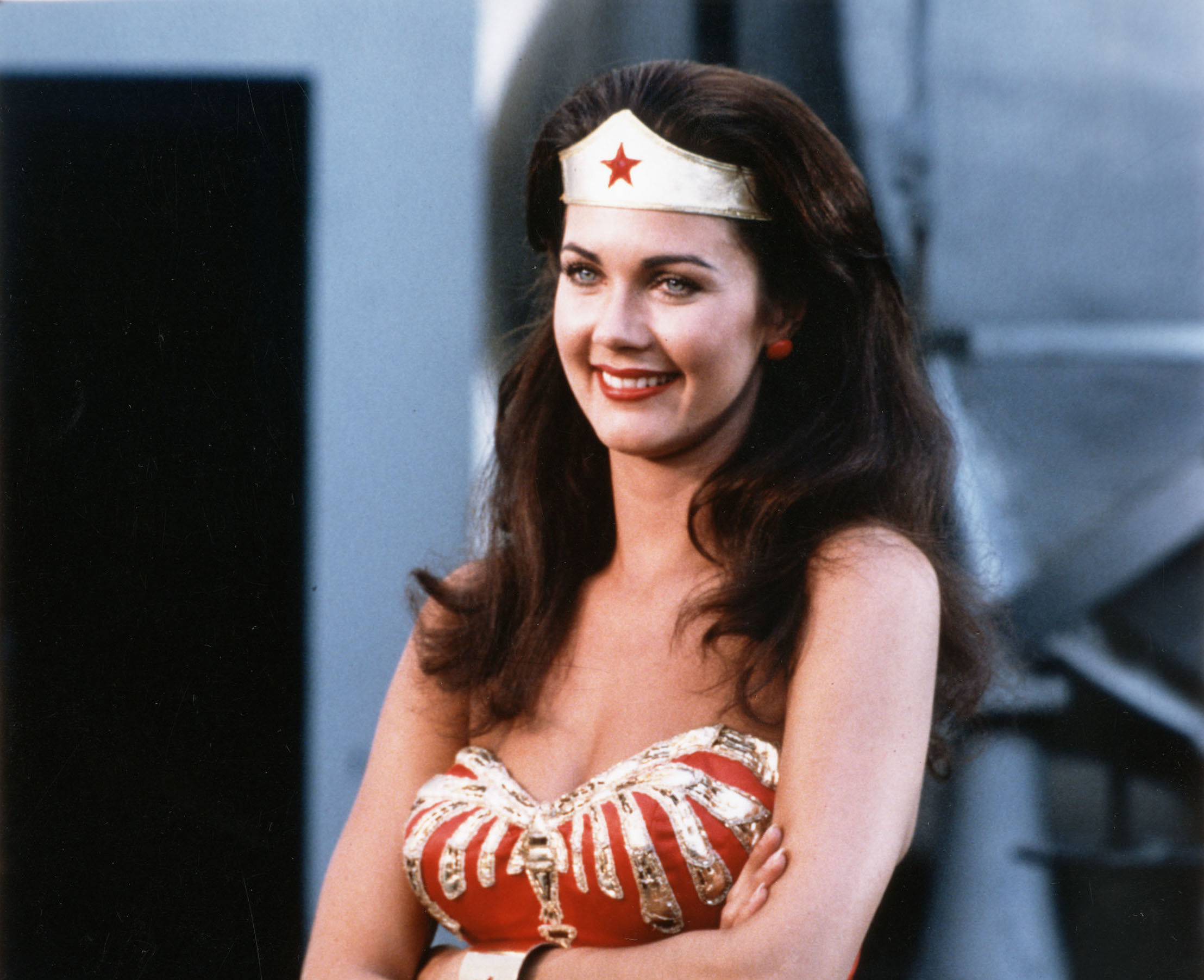
Lynda Carter as Wonder Woman, circa 1976, June 25, 2016. (http://www.moviepilot.com).

Lynda Carter as Wonder Woman, circa 1976, June 25, 2016. (http://www.moviepilot.com).

It’s been nearly four decades since my first teacher crush, maybe really, my only teacher crush. Of course there were a number of teachers I came to adore and love, but not in a child-like, puppy-love way. Ms. Griffin, Ms. Martino, Harold Meltzer, even that tough old bird in Mrs. O’Daniel (R.I.P.) were a few of my favorite teachers before college. (And as a professor, I do make the distinction between teachers and professors, since the former [mostly] work with students more closely, and at a more impressionable age.)

For me it was Mrs. Shannon and third grade at William H. Holmes Elementary, the 1977-78 school year. She was my real-life Wonder Woman, with none of the skills but all of the passion of that goofy ’70s show. Beyond that, she really set me on the path to make education my weapon, my equalizer, even though it would be years before I realized the untruth of this ideal for so many.

Third grade was my transition year from Nathan Hale to Holmes. The two elementary schools were at the opposite ends of Mount Vernon, with Nathan Hale on the predominantly Black and more impoverished South Side, and Holmes on the more middle class and Whiter North Side. Though one school veered toward Pelham and the other toward the Bronx, both were similarly composed of mostly Black and some Latino kids. Interestingly, Mostly White Traphagen ES was technically a closer walk than the seven blocks between 616 and Holmes, but the Board of Education cut off the neighborhood zone right at the northern corner of the East Lincoln-Sheridan Avenue intersection.

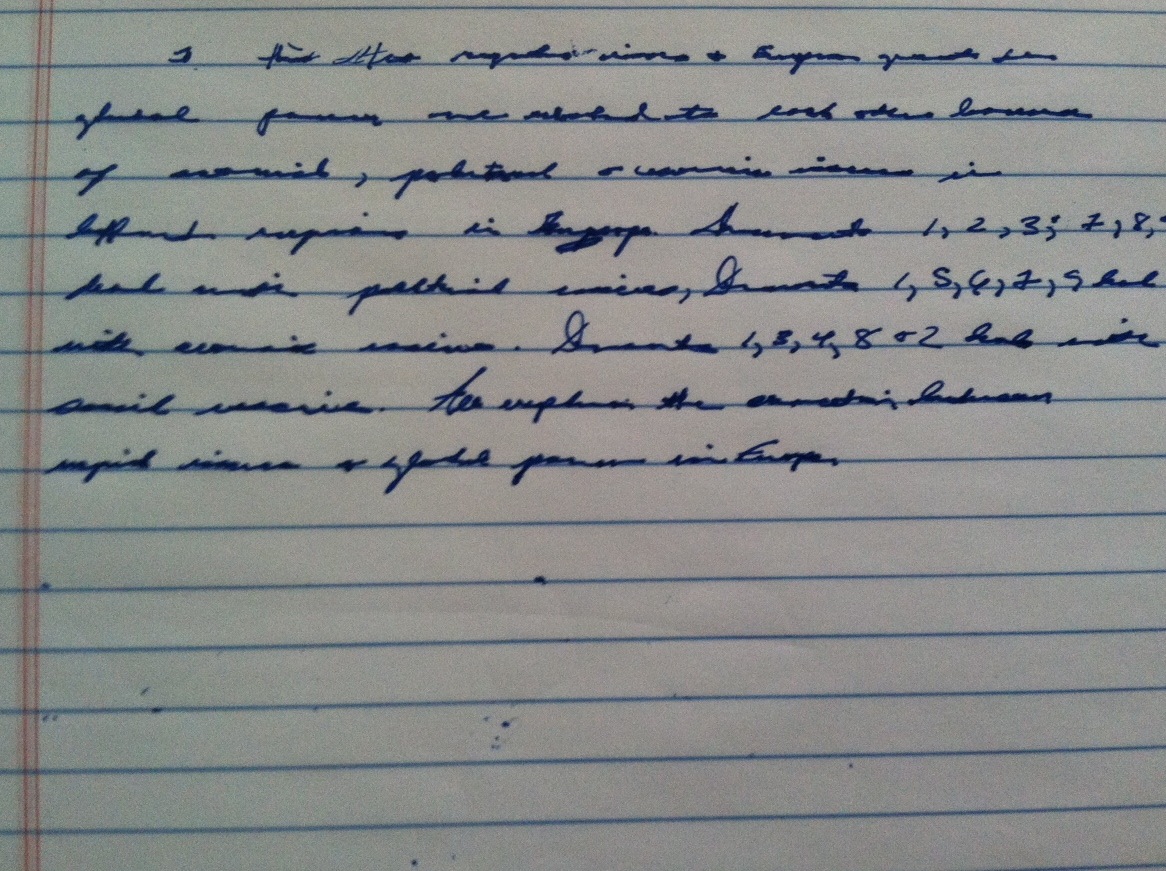
My pretend version of an introduction to a documents-based question essay for AP World History (in my best-worst handwriting), June 21, 2013. (Donald Earl Collins).

My pretend version of an introduction to a documents-based question essay for AP World History (in my best-worst handwriting), June 21, 2013. (Donald Earl Collins).

Despite this zoning, I lucked out. Mrs. Shannon was a young Black veteran teacher, probably between twenty-eight and thirty-three years old at the time. She was full of energy and ideas, and kept all of us on our toes. She even made my first grade teacher Ms. Griffin look lethargic by comparison (and Ms. Griffin was a bundle of energy herself!). She gave out tons of homework, drilled us on spelling, grammar, and all but beat my fingers with a ruler to improve my penmanship (my handwriting is still horrific).

In that year of learning about my new school, my new classmates, and my new neighborhood, I learned a lot from Mrs. Shannon. For one, I learned to read about more than Peanuts comic strips in short picture book form that year. I began to see books not as a burden, but as a window to new worlds, to worlds better than the one in which I lived. I learned, too, the power of multimedia. Mrs. Shannon used the latest in technology, the compact short film strip projector, to show us everything from current events to the rise and fall of ancient Mayan civilization. The screams that came from the tape recorder that came with the film strip made the fall of civilizations scary for me.

But really, after a year of unacknowledged abuse, Mom’s divorce from my dad, moving to 616, and a terrible teacher in Ms. Hirsch, I found myself healing a bit in Mrs. Shannon’s class. She actually hugged us, hugged me even, when it looked like we could use one. She was tough, though, too. I daydreamed so hard during one math lesson that I fell out of my desk chair. I ended up standing in the corner for fifteen minutes while balancing my textbook.

I daydreamed a lot in those days. I usually daydreamed about food, usually Hostess Suzy-Qs (back when they were made with lard) or what we’d have for dinner that evening. As the year progressed, a good portion of my daydreaming was about Mrs. Shannon. I was eight, so mostly it would have been about her face, her smile, her smell, maybe a kiss here, or a hug there. (Back then, I even loved the smell of her lunches, which mostly comprised of cans of tuna fish with the occasional crackers.) She would get frustrated with me, too, because I coasted for most of the year with B’s and C+’s. Mrs. Shannon asked me one, “What are you daydreaming about?” There was no way I could say, “Why, you of course!”

Ice Capades 1978 brochure (with Dorothy Hamill near middle right), June 22, 2016. (http://www.retrospace.org).

Ice Capades 1978 brochure (with Dorothy Hamill near middle right), June 22, 2016. (http://www.retrospace.org).

Still, without Mrs. Shannon, Mom doesn’t go out and spend $300 on the ’78 edition of the World Book Encyclopedia. It was the path that led to my cosmic leap of academic development and use of near photographic memory power. With Mrs. Shannon, I saw the world beyond Mount Vernon and 1978. I could see New York beyond subway and Metro-North rides with my drunk father. I went to the Statue of Liberty and to Madison Square Garden for Ice Capades with her. Without Mrs. Shannon, I wouldn’t have recognized that I had within me any intellectual capabilities to develop. Without Mrs. Shannon, the lessons I barely knew I learned — from Roots to multiplication tables — would have disappeared from my memories.

By the end of third grade, I didn’t want to go to fourth grade and Holmes’ second floor, where the fourth, fifth, and sixth grade classrooms were. I felt like I would never see Mrs. Shannon again. On my way out of her classroom, I gave her one last hug, while she reminded me that I could “always do better” academically. I went home that morning, went into the bedroom I shared with my older brother Darren, and walked into our small walk-in closet. Once there, I shut the door, and cried like a little baby for at least a half hour. The good news was, no one was home that Friday. I cried as if I’d never see Mrs. Shannon again, even though I knew I would. That was thirty-eight years ago this week.

My Muhammad Ali

05 Sunday Jun 2016

Posted by decollins1969 in 1, Boy @ The Window, culture, Eclectic, High Rise Buildings, Jimme, Mount Vernon New York, My Father, New York City, Politics, Pop Culture, race, Religion, Youth

≈ Leave a comment

Tags

"Impact", Blackness, Bonds, Boxing, Closed-Circuit TV, Death, HBO, Legacy, Life, Maurice Eugene Washington, Meaning, Muhammad Ali, Parkinson's Disease, Robert Farmer, Roots (1977), Self-Awareness, Self-Discovery, The Greatest (1977)


Meme of Muhammad Ali quote on "impossible" combined with iconic photo of Ali in 1st Round of first fight with Sonny Liston, February 25, 1964. (Getty Images via Twitter).

Meme of Muhammad Ali quote on “impossible” combined with iconic photo of Ali in 1st Round of first fight with Sonny Liston, February 25, 1964. (Getty Images via Twitter).

There is so much I could say about Muhammad Ali. His greatness. His contradictions. His imperfections and frailness. And all of them would be true. He was both a great man and a deeply flawed man at the same time. But, from 1964 through 1980, Muhammad Ali was the most recognizable person on the planet, with every aspect of his complicated onion on display in every corner of the world.

I have a few childhood memories of Ali’s headier days and nights. One was in ’74. It was the “Rumble in the Jungle” fight between Ali and George Forman. My father Jimme took me and my brother Darren over to his drinking buddy Robert Farmer’s house to watch the fight on closed-circuit TV (yep, Mr. Farmer spent good money on this fight). I do remember seeing bits and pieces of the fight, with Ali using the ropes around the ring like they were a trampoline. But mostly, I remember my dad and Farmer and Lo and others drinking and smoking away while watching the fight. October 30, 1974 was also the night that I learned my first colloquialism, the “rope-a-dope.” I know that the “dope” was Foreman, but I’ve seen lots of people as dopes in the four decades since that fight.

The Rumble in the Jungle poster, October 29, 1974. (Armbrust via Wikipedia). Qualifies as fair use because of low resolution for reproduction.

The Rumble in the Jungle poster, October 29, 1974. (Armbrust via Wikipedia). Qualifies as fair use because of low resolution for reproduction.

I remember watching the “Thrilla in Manila” nearly a year later between Ali and Joe Frazier, either at Mr. Farmer’s place or at a bar, I’m not sure. Again, smoke, drinks, beer cans, sunflower seeds and cigars, all in the midst of two fellas knocking the hella outta each other. My father sure knew how to show his two young sons (I was five and Darren was seven at the time) a good time.

These two fights became vague but embedded memories, perhaps two of the greatest bouts of all time. Although, Jack Johnson-James Jeffries, Joe Louis-Max Schmeling I and II, and Ali (née Cassius Clay)-Sonny Lister also come to mind in terms of historical significance.

But where I remember seeing Ali in a context beyond the right was in this movie The Greatest in May 1977. Believe it or not, my soon-to-be idiot stepfather Maurice took us to see this mediocre docudrama of a biopic on Muhammad Ali’s through 1974. (So I guess I was wrong when I said my stepfather had only done two good things for me growing up). At seven, there was no way I could know how bad the film was, between scenery chewers Ernest Borgnine and James Earl Jones. Still, the movie put those hazy memories from ages four and five in better perspective. After having seen Roots a few months earlier, I was really conscious of the wider world, of race, and of Muhammad Ali’s importance for the first time.

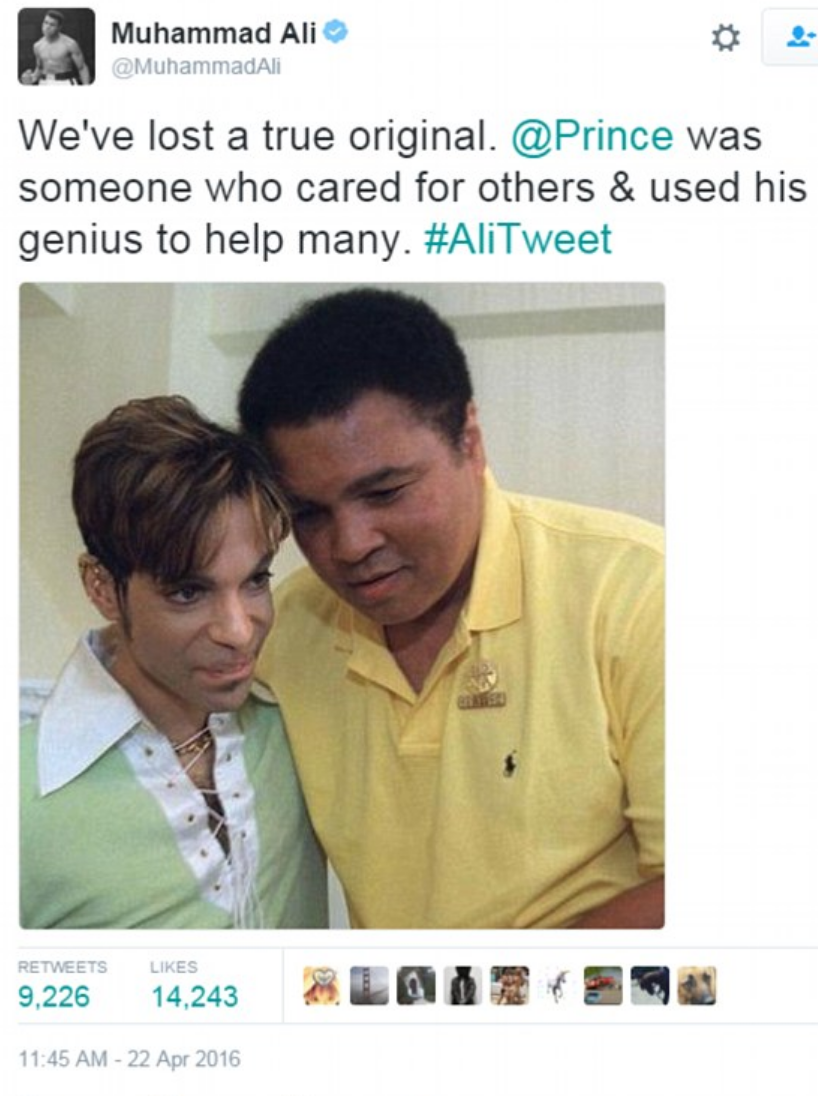
Muhammad Ali tweet re: Prince's death (pic is from their first meeting in 1997), April 22, 2016. (Twitter).

Muhammad Ali tweet re: Prince’s death (pic is from their first meeting in 1997), April 22, 2016. (Twitter).

Unlike Natalie Cole, David Bowie, Prince, and going back before 2016, Michael Jackson, I’ve been expecting Ali’s death for quite some time. His Parkinson’s wasn’t just Parkinson’s, but likely brain damage the likes of which NFL players have come to fear. That it took Ali until 1984 to announce what millions had suspected as far back as 1978 told us that he had taken a long time to come to grips with what would become his second act, his new reality. That Ali became a symbol of philanthropy, activism, and humanitarianism during this second act suggests that his strong will and support system deserves way more credit for the quality of his life than anything he did in the ring.

“Show me a hero, and I’ll write you a tragedy” comes from the 1920 mind of F. Scott Fitzgerald. If he were to write Muhammad Ali’s story, it would likely read as a tragedy. Luckily for us, Fitzgerald isn’t around to do so.

We have glossed over a few things in our millions of small eulogies for Ali this weekend. His sexism and occasional misogyny and abuse, both in words and deeds. His obvious colorism, calling Joe Foreman a “gorilla” and most of his somewhat darker skinned opponents “ugly” as a euphemism for their failure to pass the brown-paper-bag test. His rejection of Malcolm X at the very time when Malcolm needed him the most. Ali in the years between his biggest bouts and his mostly silent second life expressed regret about these -ism words and actions.

Despite this, Ali was still a father, a husband, a Muslim, a three-time heavyweight champion of the world, an author, a poet, an actor, an anti-war activist, a civil rights advocate, a social justice leader, a humanitarian, a hostage negotiator, and a Parkinson’s survivor. Ali was a fighter, in the most panoramic sense of the word. And yes, he was a Black man, in the narrowest and most intersectional senses of that two-word phrase. And all of that made him an icon. RIP.

Striking members of Memphis Local 1733 hold signs whose slogan symbolized the sanitation workers' 1968 campaign, March 1968. (Richard L. Copley/http://dlxs.lib.wayne.edu/).

Striking members of Memphis Local 1733 hold signs whose slogan symbolized the sanitation workers’ 1968 campaign, March
1968. (Richard L. Copley/http://dlxs.lib.wayne.edu/).

← Older posts
Newer posts →

Boy @ The Window: A Memoir

Boy @ The Window: A Memoir

Places to Buy/Download Boy @ The Window

There's a few ways in which you can read excerpts of, borrow and/or purchase and download Boy @ The Window. There's the trade paperback edition of Boy @ The Window, available for purchase via Amazon.com at http://www.amazon.com/Boy-Window-Donald-Earl-Collins/dp/0989256138/

There's also a Kindle edition on Amazon.com. The enhanced edition can be read only with Kindle Fire, an iPad or a full-color tablet. The links to the enhanced edition through Apple's iBookstore and the Barnes & Noble NOOK edition are below. The link to the Amazon Kindle version is also immediately below:

scr2555-proj697-a-kindle-logo-rgb-lg

Boy @ The Window on Amazon.com: http://www.amazon.com/Boy-The-Window-Memoir-ebook/dp/B00CD95FBU/

iBookstore-logo-300x100

Boy @ The Window on Apple's iBookstore: https://itunes.apple.com/us/book/boy-the-window/id643768275?ls=1

Barnes & Noble (bn.com) logo, June 26, 2013. (http://www.logotypes101.com).

Boy @ The Window on Barnes & Noble: http://www.barnesandnoble.com/w/boy-the-window-donald-earl-collins/1115182183?ean=2940016741567

You can also add, read and review Boy @ The Window on Goodreads.com. Just click on the button below:

Boy @ The Window

Twitter Updates

Tweets by decollins1969
  • RSS - Posts
  • RSS - Comments

Archives

  • June 2025
  • April 2023
  • September 2022
  • August 2022
  • July 2022
  • June 2022
  • May 2022
  • April 2022
  • March 2022
  • January 2022
  • December 2021
  • November 2021
  • October 2021
  • September 2021
  • August 2021
  • July 2021
  • June 2021
  • April 2021
  • March 2021
  • February 2021
  • January 2021
  • December 2020
  • November 2020
  • October 2020
  • September 2020
  • August 2020
  • July 2020
  • May 2020
  • April 2020
  • March 2020
  • January 2020
  • December 2019
  • November 2019
  • August 2019
  • July 2019
  • June 2019
  • May 2019
  • April 2019
  • March 2019
  • February 2019
  • January 2019
  • December 2018
  • November 2018
  • October 2018
  • September 2018
  • August 2018
  • July 2018
  • June 2018
  • May 2018
  • March 2018
  • February 2018
  • January 2018
  • December 2017
  • November 2017
  • October 2017
  • September 2017
  • August 2017
  • July 2017
  • June 2017
  • May 2017
  • April 2017
  • March 2017
  • February 2017
  • January 2017
  • December 2016
  • November 2016
  • October 2016
  • September 2016
  • August 2016
  • July 2016
  • June 2016
  • May 2016
  • April 2016
  • March 2016
  • February 2016
  • January 2016
  • December 2015
  • November 2015
  • October 2015
  • September 2015
  • August 2015
  • July 2015
  • June 2015
  • May 2015
  • April 2015
  • March 2015
  • February 2015
  • January 2015
  • December 2014
  • November 2014
  • October 2014
  • September 2014
  • August 2014
  • July 2014
  • June 2014
  • May 2014
  • April 2014
  • March 2014
  • February 2014
  • January 2014
  • December 2013
  • November 2013
  • October 2013
  • September 2013
  • August 2013
  • July 2013
  • June 2013
  • May 2013
  • April 2013
  • March 2013
  • February 2013
  • January 2013
  • December 2012
  • November 2012
  • October 2012
  • September 2012
  • August 2012
  • July 2012
  • June 2012
  • May 2012
  • April 2012
  • March 2012
  • February 2012
  • January 2012
  • December 2011
  • November 2011
  • October 2011
  • September 2011
  • August 2011
  • July 2011
  • June 2011
  • May 2011
  • April 2011
  • March 2011
  • February 2011
  • January 2011
  • December 2010
  • November 2010
  • October 2010
  • September 2010
  • August 2010
  • July 2010
  • June 2010
  • May 2010
  • April 2010
  • March 2010
  • February 2010
  • January 2010
  • December 2009
  • November 2009
  • October 2009
  • September 2009
  • August 2009
  • July 2009
  • June 2009
  • May 2009
  • April 2009
  • March 2009
  • February 2009
  • January 2009
  • December 2008
  • November 2008
  • October 2008
  • September 2008
  • August 2008
  • July 2008
  • June 2008
  • May 2008
  • April 2008
  • March 2008
  • February 2008
  • January 2008
  • December 2007
  • November 2007
  • October 2007
  • September 2007
  • August 2007
  • July 2007
  • June 2007

Recent Comments

decollins1969's avatardecollins1969 on No Good Teaching Deed Goes…
Mary Rose O’Connell's avatarMary Rose O’Connell on No Good Teaching Deed Goes…
Lyndah McCaskill's avatarLyndah McCaskill on The Raunchiest of Them Al…

NetworkedBlogs on Facebook

NetworkedBlogs
Blog:
Notes From a Boy @ The Window
Topics:
My Life, Culture & Education, Politics & Goofyness
 
Follow my blog

616 616 East Lincoln Avenue A.B. Davis Middle School Abuse Academia Academy for Educational Development AED Afrocentricity American Narcissism Authenticity Bigotry Blackness Boy @ The Window Carnegie Mellon University Child Abuse Class of 1987 CMU Coping Strategies Crush #1 Crush #2 Death Disillusionment Diversity Domestic Violence Economic Inequality Education Family Friendship Friendships Graduate School Hebrew-Israelites High-Stakes Testing Higher Education History Homelessness Humanities Humanities Program Hypocrisy Internalized Racism Jealousy Joe Trotter Joe William Trotter Jr. K-12 Education Love Manhood Maurice Eugene Washington Maurice Washington Misogyny Mother-Son Relationship Mount Vernon High School Mount Vernon New York Mount Vernon public schools Multiculturalism MVHS Narcissism NFL Pitt Pittsburgh Politics of Education Poverty President Barack Obama Race Racial Stereotypes Racism Relationships Self-Awareness Self-Discovery Self-Reflection Sexism Social Justice Teaching and Learning University of Pittsburgh Violence Whiteness Writing

Top Rated

Blog at WordPress.com.

  • Subscribe Subscribed
    • Notes from a Boy @ The Window
    • Join 103 other subscribers
    • Already have a WordPress.com account? Log in now.
    • Notes from a Boy @ The Window
    • Subscribe Subscribed
    • Sign up
    • Log in
    • Report this content
    • View site in Reader
    • Manage subscriptions
    • Collapse this bar
 

Loading Comments...