• About Me
  • Other Writings
  • Interview Clips
  • All About Me: American Racism, American Narcissism, and the Conversation America Can’t Have
  • Video Clips
  • Boy @ The Window Pictures
  • Boy @ The Window Theme Music

Notes from a Boy @ The Window

~

Notes from a Boy @ The Window

Category Archives: Movies

Aside

My “-tions” and History as Conjunction Junction

02 Wednesday Sep 2015

Posted by decollins1969 in 1, Academia, Boy @ The Window, Christianity, culture, Eclectic, Mount Vernon High School, Movies, Politics, Pop Culture, race, Religion, Youth

≈ 4 Comments

Tags

American Exceptionalism, American Mythology, AP US History, AP US History Exam, Ben Carson, College Board, Conservatives, Curriculum Framework, Cypher, Educational Testing Service, ETS, Founding Fathers, Harold Meltzer, Joe Pantoliano, Lynne Cheney, Mealy-Mouthed, morison, Morison and Commager, Selling Out, The -tions, The Matrix (1999), WASPs


AP US History curriculum framework and Common Core, July 24, 2014. (Todd Wiseman; http://www.texastribune.org/).

AP US History curriculum framework and Common Core, July 24, 2014. (Todd Wiseman; http://www.texastribune.org/).

So, the College Board and ETS sold out last month to the willfully ignorant, ideologically conservative set, and will mythologize AP US History after all. The tales of the perfectly brilliant Founding Fathers, of great, rich, powerful White men who built this nation with their bare hands, who pulled themselves up by their bootstraps without any help, will be front and center now. AP US History has gone through a re-re-revision of its curriculum guide to spend time providing lessons in blind patriotism, in American civics as great legend, making a generation of already over-tested kids even more ripe for being underprepared for college and beyond. One more instance where providing an opportunity for independent thinking has knuckled under to the profit-motive for two so-called, multibillion-dollar nonprofits.

I wrote about the small scale of the College Board’s middle-of-the-road approach in its second revision of the AP US History curriculum in the Atlanta Journal-Constitution in May, a few months before they showed flexibility to the right-wing nut-jobs. As a historian, professor, educator, writer, and critical thinker, I don’t think I was ever satisfied with AP US History or its mealy-mouthed curriculum. Just because one presents a complex concept that can be difficult to discuss in pleasant language doesn’t change the fact that people and even students will frequently resist that concept. The idea that slavery played a central role in building the economic infrastructure of the US, for instance. That’s hard for most Americans to accept, even with the evidence staring in their faces every single day.

Samuel Eliot Morison and Henry Steele Commager, The Growth of the American Republic, Volume I (unknown edition, but the edition I had access to in 1985), September 2, 2015. (http://www.booksoutofprint.com.au/).

Samuel Eliot Morison and Henry Steele Commager, The Growth of the American Republic, Volume I (unknown edition, but the edition I had access to in 1985), September 2, 2015.

As a student in the late Harold Meltzer’s AP US History class at Mount Vernon High School in eleventh grade back in September ’85, though, I found the once nationally recommended textbook for the course unacceptable myself. It was a textbook people like Lynne Cheney and Ben Carson would’ve loved, and can still be found in many high school classrooms even today. Samuel Eliot Morison and Henry Steele Commager’s The Growth of the American Republic, originally published in 1930, a time when rich WASP males were the only people of US history who counted.

I don’t recall exactly what edition we had, but it was a 1962 version, well-preserved by Meltzer. It was built fundamentally on what we academic historians call consensus history, meaning a unified, singular march toward a better society, a better American republic. Meaning that American Indian removal, slavery, Reconstruction and Jim Crow, the Cult of Domesticity, the anti-immigration movement, the battles between labor and robber barons, got almost no play in the textbook. I was so bored with Morison and Commager that I stopped reading the book after the first eight pages, including the table of contents. I earned my 5 on the AP US History exam anyway.

That’s what the privileged set wants for our kids from pre-K through graduate school. A steady diet of history from a patriotic victors’ perspective, of progress and constant triumph, of narcissistic navel-gazing. But teaching history in the twenty-first century needs to be about more than powerful people, famous places, significant events or even a mass of faceless victims. Add to this the fact that most high schools and many undergraduate programs still teach US, European and most aspects of history around the world as if the subject was a trivia game like Jeopardy or Trivial Pursuit. I know that’s what most of my students would want — although a few would pull their hair out from a well-learned hatred of the subject or from sheer boredom.

What I have done in my US and African American history courses over the years is talk about what I call “the -tions.” Assimilation, civilization, exploration, and gentrification, and especially immigration, industrialization, migration, and urbanization. The -tions represent large-scale processes and patterns that add up to defining themes in history, especially for the past 500 years. After all, history is about people, and what people say, do, and leave behind over the course of their lives. Not just famous, rich, slaveowning individuals who came together to found a country to maximize their own material advantages. But the millions of African slaves and dusky non-WASP European immigrants whom those same WASP males worked to death to build this great nation.

The -tions give us historians the what and how, but not the why people did what they did. This would be where capitalism, sexism, imperialism, racism, and ethnocentrism come into play. The idea of profit, whether for oneself or for king and country, drove the need for cheap labor, and thus, the use of kidnapped African slaves on plantations or starving Irish peasants in northeastern factories. Or, the idea that middle class WASP “ladies” shouldn’t work outside the home or have a say in public life, lest their moral centers become corrupted. 

"Ignorance is bliss" scene screen shot from The Matrix (1999) with Joe Pantoliano as Cypher eating a Matrix steak, September 2, 2015. (http://chicagoboyz.net).

“Ignorance is bliss” scene screen shot from The Matrix (1999) with Joe Pantoliano as Cypher eating a Matrix steak, September 2, 2015. (http://chicagoboyz.net).

I try to channel these ideas through my teaching, in smaller doses in introductory courses, in larger ones in upper-level courses. The majority of my students fight it like my teaching methodology is chemotherapy or like Joe Pantoliano’s character Cypher in The Matrix (1999), desperately desiring to be blissfully ignorant over knowing the full measure of US history. For me, it’s not even about ideology. It’s about truth, about viewing life and history and people with an independent and skeptical lens, as “everybody lies…but we don’t lie all of the time.”

To work through all this may be too much for many. But it’s better than taking the free ride of lazy history that the College Board and ETS are now providing, courtesy of the privileged class.


Aside

American Narcissism, or, “Smiling, Crying, and Celebrity”

10 Friday Jul 2015

Posted by decollins1969 in 1, Christianity, culture, Eclectic, eclectic music, Movies, music, Patriotism, Politics, Pop Culture, race, Religion

≈ Leave a comment

Tags

"Charlie X", "Original Of The Species" (2005), American Narcissism, Captain James T. Kirk, Gordon Ramsey, How To Dismantle An Atomic Bomb (2004), Kitchen Nightmares, Narcissism, Psychic Powers, Self-Aggrandizement, Self-Love, Self-Promotion, South Carolina State Rep. Jenny Horne, Star Trek, Star Trek TOS (1966-69), Thasians, U2, US Foreign Policy, US History, William Shatner


South Carolina Representative Jenny Horne (Republican) speaking on floor of House chamber, Columbia, SC, July 8, 2015. (http://www.slate.com via C-SPAN3).

South Carolina Representative Jenny Horne (Republican) speaking on floor of House chamber, Columbia, SC, July 8, 2015. (http://www.slate.com via C-SPAN3).

There are so many examples of the US as a nation of narcissists that when I step outside of my own narcissism, it literally leaves me with vertigo. I can see narcissism everywhere. In how Americans drive, as if they’re the only car on the road in bumper-to-bumper traffic. I see it in how people walk on sidewalks, as if no one else will ever need space to walk in the opposite direction, or as if everyone wants to walk at a slow, plodding pace. I see it in how we reacted to even minor criticism, as if the comment “this needs revision” equals “you’re a lazy, untalented hack of a writer,” and deserves a response equally personal and nasty.

From U2's "Original Of The Species" (2005) video, from How To Dismantle An Atomic Bomb (2004) album, July 9, 2015. (http://youtube.com).

From U2’s “Original Of The Species” (2005) video, from How To Dismantle An Atomic Bomb (2004) album, July 9, 2015. (http://youtube.com).

One of the better demonstrations of narcissism American style is through our popular culture. From Frank Sinatra to Rick Ross, Mae West to Nicki Minaj, we have a century’s worth of pop culture divas as examples of narcissism at the level of prominent American individuals. The narcissism is so normal that we have benign terms for it, like “self-promotion” or “self-love.” People, especially in the pop culture world, should promote and love themselves, of course. But at what point is narcissism a self-defeating process of “me as triumphant,” “me as the center of the universe,” “me for everyone to like/love more and more?”

A clear-cut example of art imitating life imitating art for me around narcissism would be a Star Trek: TOS (The Original Series) episode. Season 1, Episode 2, September 15, 1966, was the airing of the “Charlie X” episode on NBC. It was the one in which a seventeen-year-old who had been stranded on an alien planet since the age of three was taken up to the Enterprise by a transport ship. Once on the Enterprise, the teenager displayed both petulance and his toolbox of god-like powers, hurting crew members or making them disappear at a whim. All because they either unknowingly insulted him or made him jealous in some way. As one story line summary for the episode reads, “Captain Kirk must learn the limits to the power of a 17-year-old boy with the psychic ability to create anything and destroy anyone.”

Charlie Evans, played by Robert Walker, Jr., Star Trek TOS, Season 1, Episode 2, September 15, 1966. (https://thesouloftheplot.files.wordpress.com/).

Charlie Evans, played by Robert Walker, Jr., Star Trek TOS, Season 1, Episode 2, September 15, 1966. (https://thesouloftheplot.files.wordpress.com/).

The Charlie Evans character became fixated on a female crew member — consistently called “a girl” in 1966 (that wasn’t acceptable even back then) — in one Yeoman Janice Rand. Charlie’s obsession with having her, his dislike for criticism and being told what to do, his inability to check his emotions, his destructive responses, were all based on his needs from moment to moment. Every potential slight, every action that he couldn’t control led Charlie to do some damning things. With his thoughts, Charlie took away Lt. Uhura’s voice, broke Spock’s legs, blinded another crew member, took away one woman’s face, aged another woman, and made one other woman disappear. When Charlie couldn’t win at chess, he melted the chess pieces. “I can make you all go away! Any time I want to!,” Charlie exclaimed at one point in the episode.

Within a scene or two, just before the episode’s climax, Kirk finally said, “Charlie, there are a million things in this universe you can have and a million things you can’t have. It’s no fun facing that, but that’s the way things are.” This was when Charlie was on the verge of taking over the ship and possibly wiping out the Enterprise‘s crew. But then, the Thasians came (the aliens who’d given Charlie his powers in the first place) with their own starship to take Charlie in as one of their own. “We gave him [Charlie] the power so he could live. He will use it – always. And he will destroy you, or, you will be forced to destroy him,” the face of the Thasians said. Then, the Thasians disappeared Charlie to their starship, with Charlie’s final words, “I wanna stay… stay… stay… stay… sta…” lingering on the Enterprise‘s bridge.

Defaced woman, Star Trek TOS, Season 1, Episode 2, September 15, 1966. (http://goodcomics.comicbookresources.com/).

Defaced woman, Star Trek TOS, Season 1, Episode 2, September 15, 1966. (http://goodcomics.comicbookresources.com/).

If this episode doesn’t serve as a metaphor for America as a nation and Americans as 320 million individuals with varying levels of narcissism, I don’t know what does. America has always declared itself at the center of the world, centuries before it became a world superpower. Any affront — real or perceived — has often led to skirmishes and wars, embargoes and removals. America’s relatively short history includes Indian wars, Barbary pirates, the War of 1812, the American Revolution, Manifest Destiny and the Mexican-American War, the Monroe Doctrine, Banana Republics and Cuba, Manuel Noriega and Panama, Beirut and Grenada. The central theme of American history and foreign policy has been to self-aggrandize, to settle scores, to challenge other countries to duels, to take advantage of those in the most vulnerable places in the US and around the globe.

So too has narcissism been a part of ordinary Americans’ lives. Just watch a rerun of Kitchen Nightmares on BBC America or on FOX. Any criticism delivered by soccer coach-chef Gordon Ramsey is received about the same way as a toddler reacts when their favorite toy goes missing. Taunts, tantrums, threats, gnashing of teeth, juvenile guilt and despair.

And, for a moment, there may even be a haunting realization that your intellect and experiences aren’t at the center of the universe. But just for a moment. After all, there aren’t any Thasians to check and balance America’s narcissism. Still, narcissism has a way of using up people and nations. Maybe in a hundred years, maybe in 500, but some time in the future, historians will write about American narcissism the same way many historians write about the gross inequalities of an over-glorified ancient Rome.

Kiss From A Rose – 20 Years On

20 Wednesday May 2015

Posted by decollins1969 in 1, Boy @ The Window, Carnegie Mellon University, culture, Eclectic, eclectic music, Marriage, Movies, music, Pittsburgh, Pop Culture, race, Work, Youth

≈ Leave a comment

Tags

"Kiss From A Rose" (1994/1995), 71B, Angelia, Angelia N. Levy, Batman Forever (1995), Bruce Willis, Carnegie Library of Pittsburgh, CMU, Dating, Die Hard With A Vengeance (1995), Friendships, PAT Transit, Romance, Samuel L. Jackson, Spencer Fellowship, Val Kilmer


Twenty years ago on this date, I re-met the woman who’s now my wife of fifteen years, Angelia on a PAT-Transit bus in Pittsburgh, the old 71B-Highland Park into Oakland. It was an eighty-five degree Saturday afternoon in the ‘Burgh. I decided to treat myself to a movie, Batman Forever (1995), mostly because I knew Val Kilmer was in it. After seeing him act as well as he did in Tombstone, I figured I needed to give it a try. I needed a break, between the euphoria of the Spencer Fellowship and the depression from the fire at 616 that had rendered my family homeless.

So here it was, 3:15 in the afternoon, with me dressed in a blue t-shirt with blue basketball shorts and sneaks. I was standing at the corner of Highland Avenue and Penn Circle South, across from my apartment building, waiting for a bus. The 71B showed up first. I jumped on, sat down on the right-hand side in a front-facing seat. As soon as I sat down, I saw her, sitting right in front of me. It was “Angela with an ‘i’,” Angelia, like that Richard Marx song from ’90.

Seal's second album/CD, Seal (1994): "Kiss From A Rose" re-released as part of Batman Forever (1995) soundtrack in June/July 1995. (http://www.allmusic.com).

Seal’s second album/CD, Seal (1994): “Kiss From A Rose” re-released as part of Batman Forever (1995) soundtrack in June/July 1995. (http://www.allmusic.com).

The thing was, I had a dream that she showed up in the Saturday before this one. I hadn’t seen Angelia in more than two years, hadn’t given her any thought. But it seemed weird that she would just show up a week later in the flesh.

So I said, “Hi Angelia!,” excitedly, wondering what she was doing on the bus. She paused, said “Hi” with the heaviest, stop-bothering-me sigh I’d heard since my high school days. That didn’t deter me. I coaxed out of her the fact that she was pissed off with Carnegie Library because a book she was looking for at the East Liberty branch wasn’t there, even though the catalog said it was. It was a conversation that was one-sided, with Angelia doing most of the complaining.

I listened, and thought, “Yep, same Angelia, same weird Angelia.” But since I was weird also, I kept listening. Finally, she asked me what I was up to. I told her about school, my Spencer Fellowship, my family’s homelessness situation. I kept it brief. I mean, I hadn’t seen her in two years.

By the time we reached Oakland — me to catch one of the 61s to Squirrel Hill to catch the movie, Angelia to walk over to the main branch of Carnegie Library — we exchanged numbers, with Angelia saying, “It was really good talking to you.” I wasn’t so sure about that myself, but at least, she didn’t seem as weird as the woman she was five years earlier.

Screen with Samuel L. Jackson and Bruce Willis from Die Hard With A Vengeance (1995), posted February 28, 2013. (http://chud.com).

Screen with Samuel L. Jackson and Bruce Willis from Die Hard With A Vengeance (1995), posted February 28, 2013. (http://chud.com).

I went to see the movie, but it turned out that it wasn’t out yet. It wasn’t due out for another month! I ended up seeing Die Hard With a Vengeance with Bruce Willis and Samuel L. Jackson. Though much better than Die Hard 2 (1990; one shouldn’t really watch any feature film with John Amos taking up significant screen time, it still sucked, because Willis and Jackson spent half the movie yelling, and Jeremy Irons’ performance didn’t have Alan Rickman’s sense of social irony. I walked home, got together some grub, and through all preconceptions out the window. I gave her a call to tell her about the film mix-up. We ended up talking for more than three hours! It was the first time in a long time I had talked to a woman who wanted to hear what I thought about, well, anything, at least anything outside of sex. It was the start of a beautiful friendship.

A month later, we went to see Batman Forever, and it sucked, just like Angelia said it would. But Seal’s “Kiss From A Rose” didn’t. I bought his CD, though, and not the movie soundtrack!

Merit-hypocrisy in the Air

18 Saturday Apr 2015

Posted by decollins1969 in 1, Academia, Boy @ The Window, Carnegie Mellon University, Christianity, culture, Eclectic, Mount Vernon New York, Movies, Pittsburgh, Politics, Pop Culture, race, Religion, University of Pittsburgh, Work, Youth

≈ Leave a comment

Tags

"Who-You-Know" World, Academia, Ageism, Bruce Anthony Jones, Daniel P. Resnick, Dick Oestreicher, Envy, Hard Work, Hypocrisy, Jay Wickliff, Jealousy, Jelani Cobb, Joe William Trotter Jr., Ken Williams, Meritocracy, Nepotism, New Voices, New Voices Fellowship Program, Nonprofit World, Presidential Classroom, Racism, Wendy Goldman


Meritocracy cartoon, October 29, 2010 (Josh C. Lyman via http://www.clibsy.com/).

Meritocracy cartoon, October 29, 2010 (Josh C. Lyman via http://www.clibsy.com/).

One of the hardest ideals for me to give up on in all of my life has been the idea of meritocracy. Even when I couldn’t spell the word, much less define it or use it in a sentence, I believed in this ideal. It was the driving force behind my educational progression from the middle of fourth grade in January ’79 until I finished my doctorate in May ’97. The meritocratic ideal even guided me in my career, in both academia and in the nonprofit world. Only to realize by the end of ’09 what I suspected, but ignored, for many years. My ideal of a meritocracy is shared by only a precious few, and the rest give lip service to it before wiping it off their mouths, concealing their split lips and forked tongue with nepotism instead.

Being the historian I am — whom people like Jelani Cobb joked about on Twitter as a curse — I am programmed to look back at situations in my own life to look for root causes, to understand what I can do to not repeat my own mistakes, my not-so-well-planned decisions. I’ve thought about my advisor Joe Trotter and my dissertation committee of Trotter, Dan Resnick (husband of education researcher Lauren Resnick) and Bruce Anthony Jones. The biggest mistake I made was in putting this hodgepodge committee of a HNIC advisor, racial determinist and closeted wanderer together to help guide me through my dissertation and then into my first postdoctoral job.

Aaron Eckhart as main character in movie I, Frankenstein (2014), August 12, 2013. (http://sciencefiction.com/).

Aaron Eckhart as main character in movie I, Frankenstein (2014), August 12, 2013. (http://sciencefiction.com/).

Of course, I didn’t know enough about these men to describe them this way, certainly not until I’d graduated and couldn’t find full-time work for more than two years. The signs, though, were there. Trotter’s unwillingness to recommend me for any job before my completed first draft of my dissertation was really complete (it took me two weeks to revise my dissertation from first to final draft). Resnick calling my dissertation writing “journalistic” and saying that my nearly 2,000 endnotes and thirty pages of sources was “insufficient.” Bruce pulling back on his schedule with me even before taking the job at University of Missouri at Columbia in July ’96.

None of this had anything to with my work. It was about me, whether I as a twenty-six year-old had suffered enough, had gone through enough humiliation, to earn a simple letter of recommendation for a job. When Trotter finally decided it was time to write me a letter of recommendation, it was December ’96, and the job was University of Nebraska-Omaha, “subject to budget considerations,” meaning that it could (and it did) easily fall through. Resnick flat-out refused to share anything he wanted to write about me, with all his “confidentiality” concerns, while I wrote all my letters for myself for Bruce. It was a disaster, and none of it had anything to do with the quality of my work as a historian, educator, or academic writer.

The work I ended up getting after Carnegie Mellon was the result of my dissertation, my teaching experiences, and my networking. The idea that I’d earned my spot, though, was still lacking in the places in which I worked. Particularly at Presidential Classroom, where I was the token highly-educated Negro on staff, and working at Academy for Educational Development with the New Voices Fellowship Program. In both cases, I had bosses whose racial biases only became clear once I began working with them. The then executive director Jay Wickliff never cared about the quality of my work or my degrees. Wickliff’s only concern was that I should keep my mouth shut when he acted or spoke in a racist manner.

My immediate supervisor Ken, on the other hand, wanted all the credit for work I did under him, except in cases when he deemed my methods “not diplomatic enough.” Even before his bipolar disorder led him to a psychological breakdown, Ken regularly accused me of gunning for his position, sometimes turning red whenever he heard about my latest publication, teaching assignment or conference presentation. I had to fight to keep my job and to move on within AED in those final months of ’03 and early ’04, a fight that had zero to do with merit.

Dixie Biggs, Lip Service teapot, April 19, 2015. (http://pinterest.com).

Dixie Biggs, Lip Service teapot, April 19, 2015. (http://pinterest.com).

I say all this because the one thing that every one of these folks had in common is their lip service to the belief that hard work and results are the keys to success and career advancement. Yet for every one of them, the merit that I had earned didn’t matter. My relative youth, my age, my race, my heterosexual orientation, even my achievements, either scared them or gave them reason to have contempt for me.

I say all of this because in the past eleven years, I have been very careful about the company I keep, about the mentors I seek, about the friends I make, personally and professionally. I went from not trusting anyone as a preteen and teenager to trusting a few too many folks in my twenties and early thirties. All because I believed that my hard working nature and talent mattered more than anything else. What has always mattered more is who you know, especially in high places like academia and with large nonprofits and foundations. So, please, please, please be careful about the supposedly great people you meet. Many of them aren’t so great at all.

That’s why the idea that academia is a place full of progressive leftists is ridiculous. Yes, people like Dick Oestreicher, Wendy Goldman, Joe Trotter and so many others wrote and talked about progressive movements and ideals while I was their student. But fundamentally, they couldn’t have cared less about the actual human beings they worked with and advised, particularly my Black ass. Their ideals stopped the moment they ended their talk at a conference or wrote the last sentence of a particular book. They only cared about people that they could shape and mold into their own image. And that’s not meritocracy. That’s the ultimate form of nepotism.

Fifty Shades of White People’s Imaginations

15 Sunday Feb 2015

Posted by decollins1969 in 1, culture, Eclectic, Movies, Politics, Pop Culture, race

≈ Leave a comment

Tags

9½ Weeks (1985), Aggrandizement, Body Heat (1981), Bondage, E.L. James, Fifty Shades of Grey book (2011), Fifty Shades of Grey movie (2015), Movie Reviews, Power Trip, Relationships, Self-Glorification, Sex, Symbolism, Whiteness


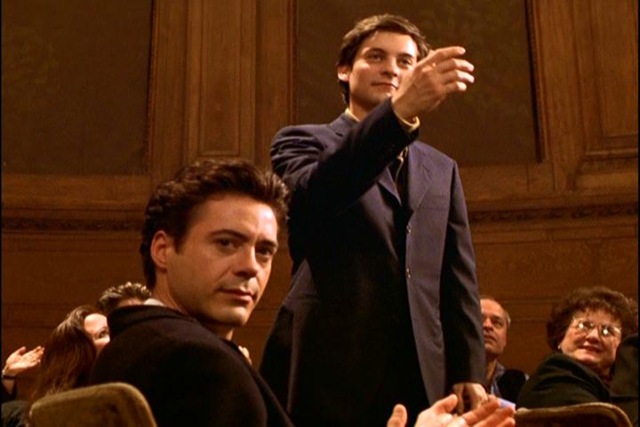
"Take a bow, James" screen shot from Wonder Boys (2000), starring Michael Douglas, Tobey Maguire, Katie Holmes, and Robert Downey, Jr., September 29, 2009. (http://rosekohl.tumblr.com/).

“Take a bow, James!” screen shot from Wonder Boys (2000), starring Michael Douglas, Tobey Maguire, Katie Holmes, and Robert Downey, Jr., September 29, 2009. (http://rosekohl.tumblr.com/).

So far this Valentine’s Day/Presidents Day weekend, Fifty Shades of Grey is making a killing at the box office, over $30 million on its official release on Friday alone. A movie with an estimated twenty-minutes’ worth of sex scenes, coming on the heels of the most successful self-published book in history? Take a bow, E.L. James, take a bow!

Oops, I didn’t mean to go there, Ms. James! Submitting to a bow would likely conform too much to one of the big themes of your book and movie. The idea that a college-educated millennial would play the role of submissive to a business magnate and engage in an unworkable romance, is, well, a theme straight out of Hollywood producer’s ass. Or, rather, a Hollywood porn producer’s average shoot!

Really, between the book, the movie and the reviews, it seems that Fifty Shades of Grey is really about affluent White folks all over the world attempting to be comfortable with what some would call “taboo sex” in the early twenty-first century. It’s like a whole generation of British Commonwealth and American Whites haven’t taken the time to see 9½ Weeks (1985) or Body Heat (1981), or at least, like to pretend that everything that is new is actually new when it’s not. At best, the book is like eating too much cotton candy at an amusement park while drink a fifth of vodka, getting on a roller coaster, and then vomiting on your five year-old (luckily, I didn’t spend money to read it). But really, Fifty Shades of Grey is a symbol of Whiteness played out in power fantasies, hardly sexual at all.

Most Americans (and many affluent Brits and Aussies as well) celebrate books and movies that aggrandize their ability to experience orgasms and overpower each other in relationships. It’s a reflection of a world without consequences, because everyone in James’ world is already on top, and need not fear falling into the real world. Where love, sex, struggle and self-discovery are about much more that belts and chains.

Vicarious Valentine’s Day

14 Saturday Feb 2015

Posted by decollins1969 in 1, Boy @ The Window, Christianity, culture, Eclectic, Jimme, Mount Vernon High School, Mount Vernon New York, Movies, My Father, New York City, Politics, Pop Culture, race, Religion, Youth

≈ Leave a comment

Tags

616, 616 East Lincoln Avenue, Capitalism, Christian Persecution, Commercialism, Crush #1, Interracial Relationships, JD, Love, Lust, Martyrs, Observation Mode, Rita Moreno, Romance, St. Valentine, The Contrarian One, Transactional Relationships, Valentine's Day, Vicarious Living, Wendy, West Side Story (1961)


Fringe Observer 'September,' played by Michael Cerveris, circa 2013. (John Milton via Pinterest.com).

Fringe Observer ‘September,’ played by Michael Cerveris, circa 2013. (John Milton via Pinterest.com).

A couple of alternate titles could be “A Little Ditty About ‘Jack and Diane’,” or “The Legend of Crush #1 and The Contrarian One.” Really, though, I’ve never given much thought to Valentine’s Day, even in dating and marriage, mostly because until I turned twenty-five, I never had money to waste on such an aimless, unbelievably overhyped and commercialized “holiday.”

Few understand that the Catholic holy day of St. Valentine was about a Christian martyred in the midst of a period of Roman persecution under the emperor Aurelian, outside Rome, on February 14, 273 CE. Or that when combined with the St. Valentine’s Day massacre on February 14, 1929, the only heart truly associated with the day has been one punctured by a sword or a bullet, a blood-soaked one. Plus, it’s not as if I need capitalism to tell me whom to show my romantic side, with cards and flowers and chocolate, no less. Still, as a married man, I participate, although not with Western ideals of masculinity and romance in my head, if only to ensure my wife doesn’t feel left out.

But I must rewind about three decades, because while I don’t appreciate the fakery that comes with celebrating some candy-coated version of romance without actually celebrating St. Valentine, I did learn a thing or two about watching relationships bloom from afar. It was around this time thirty years ago that I noticed that Wendy and the contrarian one were dating, whatever that term means in the context of high school. Both would tell me that their relationship only began in high school, but my own recollections dispute that somewhat, if only because they shared roughly the same level of dislike for me during seventh grade!

Bloody woodchipper scene from Fargo (1996), February 14, 2015. (http://youtube.com).

Bloody woodchipper scene from Fargo (1996), February 14, 2015. (http://youtube.com).

The main point is, while for most of my classmates, it would’ve only been obvious in our junior year that Crush #1 and JD were together, I sensed it by the middle of tenth grade. If I’d been the exact same person I’d been during seventh and eighth grade, one head-over-heels in love with Wendy, I would’ve put my heart in a woodchipper, shot it all over a field, gathered it up again, and then put it into a mortar shell to explode into the sky to rain down all over Mount Vernon.

But I wasn’t that person in 7S, and hadn’t been for quite a while. My focus for most of tenth grade had been on living a sin-free Christian life, a transactional relationship with God that consisted of making good things happen for myself by prayer, fasting, and reading my Bible everywhere I went. Between that and my routine of watching younger siblings, washing clothes, tracking down my father Jimme, surviving another year of Humanities, running to the store two or three times every day, and so many other tasks, romance and dating might as well have been in an alternate universe. Even if I did feel envious, it would’ve been over not having money or a car or good food in my belly. Pining over Wendy — or any other girl or woman, for that matter — didn’t fit with any coping strategy that I had to get out of Mount Vernon as soon as my high school diploma and a college acceptance would allow me. At least prior to Crush #2.

What was more interesting to me, and what I knew was more interesting to my classmates, was the fact that Wendy and the contrarian one were dating, and in fact, an interracial couple, one a Black female (or, as some classmates still believed, biracial), the other a White male. I was interested only as an observer of people, because by tenth grade I’d actually grown to like JD and could be around Crush #1 without being conscious of the fact that she used to be my crush. I was interested in that the reactions of the folks at MVHS varied from my own “no surprise here” to dagger-eyed intolerance or head-shaking shame expressed by students across all cliques and most racial lines.

Black and White shortbread (or what President Barack Obama coined a "Unity Cookie" in 2008), July 23, 2007. (Punkitra via http://commons.wikimedia.org). Released to public domain.

Black and White shortbread (or what President Barack Obama coined a “Unity Cookie” in 2008), July 23, 2007. (Punkitra via http://commons.wikimedia.org). Released to public domain.

I’ve certainly known and know plenty of other people involved in interracial relationships and marriages since the spring of ’85. Some where only racial politics and stereotypes mattered, some where love and social justice mattered much more. In the case of my class’ Juliet and Romeo, maybe my crush took advantage of some of the racial politics involved with dating someone White, while my contrarian friend obviously doesn’t prefer blondes, and hasn’t in the years since. From my observer’s perch, though, there was much more to their relationship than racial preferences.

It was the first time I’d seen or heard about any interracial coupling beyond movies like West Side Story (I still love Rita Moreno, even at eighty-three) or in others telling me about them third-hand, after it was already over. To me, it was always a good fit and fitting, despite the racial politics playing out at school, not to mention the identity issues that had to be playing out between Wendy and JD, even unconsciously. What I gleaned from two and a half years of the two of them dating, though, was that they had found a world unto themselves, one which must’ve made MVHS a much easier hellhole to navigate, if nothing else.

My Washington Mission

06 Friday Feb 2015

Posted by decollins1969 in 1, Academia, Boy @ The Window, Carnegie Mellon University, culture, Eclectic, High Rise Buildings, Mount Vernon High School, Mount Vernon New York, Movies, New York City, Pittsburgh, Politics, Pop Culture, race, Work, Youth

≈ Leave a comment

Tags

"A Substance of Things Hoped For", Archives, CMU, Columbia Historical Society, Columbiana Division, DC Public Schools, DCPL, DCPS, Dissertation Research, Esme Bhan, Howard University, Joe Trotter, Laurell, Library of Congress, Living Arrangements, Marya McQuirter, Mission Driven, Moorland-Spingarn, Roxanna Dean, Shepherd Park, Single-Minded, Spencer Crew, Student Loans, Valedictorian


Martin L

Martin Luther King, Jr. Memorial Library, DC Public Library’s main branch, Washington, DC, November 2013 (never looked this nice in 1995). (http://popville.com).

Twenty years ago this week I began the official phase of my doctoral thesis research. But it was much more than reading monographs and finding old papers at the Library of Congress and the Moorland-Spingarn Research Center at Howard University. It was also a long trip, where I would spend the next two months living in Washington, DC, to do my research on multiculturalism and multicultural education, and to find evidence of both in Black Washington, DC and in the segregated DC Public Schools. It was also the first time I’d lived away from Pittsburgh or the New York City area, meaning that I had a new city to get to know.

The trip truly involved my past, present and future, all at once. I spent my first five days visiting with my friend Laurell and her family in Arlington while looking for some temporary housing of my own. I’d eventually run into two Pitt friends and two Carnegie Mellon friends while in DC, and develop at least one new friendship between February 2 and March 24. I talked with my favorite teach in Harold Meltzer during that trip, learning more than I ever wanted to know about some of my classmates and Mount Vernon High School in the process.

7800 block of 12th Street, NW, Washington, DC, July 2014. (http://maps.google.com).

7800 block of 12th Street, NW, Washington, DC, July 2014. (http://maps.google.com).

Mostly though, I split my Washington mission into three phases. Phase one was to find a cheap place to stay. After a day of dealing with Howard University professors-turned-slum-lords in LeDroit Park, I went through the Washington Post to find a series of rented rooms with shared bathrooms and kitchens. Finally, I found a place in Shepherd Park, two blocks south of the DC-Silver Spring, Maryland border. It was a three-story house in a decent neighborhood on 12th Street, NW, with Blair Park, the Silver Spring Metro, and a corner KFC within walking distance. The landlord seemed decent enough, and my basement room came to $95/week with a $100 deposit. Those were the days, before gentrification and the housing boom sent the cost of shelter through the roof!

Phase two of my trip began Wednesday, February 8. I organized my schedule based on going to a number of archives and collecting materials first. I started with the Moorland-Spingarn Collection, which had been picked pretty clean by Henry Louis Gates (via buying collections) and by other, less reputable researchers (many who stole materials). I got to meet and talk with the archivist Esme Bhan about my research, which was wonderful. Still, I wondered how much longer Moorland-Spingarn could stay a reputable venue for scholarly research, with its lack of funding and lack of security from vultures emptying records.

The following week I split between the Columbiana Division at DC Public Library’s main branch, Martin Luther King, Jr. Library between Chinatown and downtown, and the DC Public School Archives on 17th and M. The DCPL portion of my work was an experiment in filtering out the smells and the sights of the homeless and mentally disabled. Not to mention the ability to not use the bathrooms in the building for eight hours at a time. The men’s stalls didn’t have doors, by the way. I spent only three days there, and rushed through gathering background on interviews of Black Washingtonians that the library had conducted back in the early 1980s. It didn’t help I had to deal with a peeping Tom at the old Hecht’s department store, where the bathrooms were much nicer.

Charles Sumner School Museum and Archives, Washington, DC, February 6, 2015. (http://dc.about.com).

Charles Sumner School Museum and Archives, Washington, DC, February 6, 2015. (http://dc.about.com).

I found a gold mine of materials on formal and unofficial education policies regarding DC Public Schools during the Jim Crow period — especially between 1920 and 1950 — at the DCPS archives. But because they didn’t have a working copier, the archivist there allowed me to take original records going back seven decades to the Sir Speedy on M Street to make my own copies. This was in contrast to my three days Presidents’ Day week at the Madison Building of the Library of Congress, where security was tighter in ’95 than at most airports in 2015.

The Library of Congress part of my data gathering was intriguing. If only because their rubber chicken lunches were expensive ($7), and because I found more material on W.E.B. Du Bois, Carter G. Woodson, Kelly Miller, Alain Locke, Anna J. Cooper and Mary Church Terrell there than I did at Moorland-Spingarn. Finally, I ended phase two with the Columbia Historical Society in Dupont Circle and a two-day expedition of finding nothing at the National Archives in DC and in Greenbelt, Maryland.

I spent most of March figuring out what to do with two big boxes’ worth of new materials and writing what would be parts of Chapter 2 and Chapter 3 of my dissertation. In between, I did find time to hang out. With my new friend Marya, who was from DC, but was working on her history doctorate from the University of Michigan. In addition to being plied with vegan options for my delicate gastrointestinal tract and talking about our research, we did joke a bit about the idea of my Joe Trotter and her Earl Lewis actually being friends in any real sense of the word. There was also time to go out to dinner with Laurell, take in a couple of bad movies with my Carnegie Mellon friend Tracie (like Losing Isaiah), and even have a quick lunch with Trotter during his own quick visit to DC.

Terrell Owens hauls in 'The Catch II' from 49ers QB Steve Young, Candlestick Park, San Francisco, CA, January 3, 1999. (Getty files via Toronto Sun, January 10, 2013).

Terrell Owens hauls in ‘The Catch II’ from 49ers QB Steve Young, Candlestick Park, San Francisco, CA, January 3, 1999. (Getty files via Toronto Sun, January 10, 2013).

After seven weeks of living in DC, I took the train up to New York to go visit my family in Mount Vernon for a few days. What was great about those two months was how peaceful everything was. I was three weeks away from becoming a Spencer Fellow and somehow earning the ire of my doctoral advisor. My family was a month away from becoming homeless for the next two and a half years. My borrowing to cover the costs of this first major research trip, I’m probably still paying interest on today. But without this trip, I wouldn’t have begun the process of questioning the direction of my career and life, and I wouldn’t have had the opportunity to finish my doctorate. Being single-minded about a mission isn’t bad or good. It just means ignoring small stuff, some of which can occasionally turn into a festering cesspool.

← Older posts
Newer posts →

Boy @ The Window: A Memoir

Boy @ The Window: A Memoir

Places to Buy/Download Boy @ The Window

There's a few ways in which you can read excerpts of, borrow and/or purchase and download Boy @ The Window. There's the trade paperback edition of Boy @ The Window, available for purchase via Amazon.com at http://www.amazon.com/Boy-Window-Donald-Earl-Collins/dp/0989256138/

There's also a Kindle edition on Amazon.com. The enhanced edition can be read only with Kindle Fire, an iPad or a full-color tablet. The links to the enhanced edition through Apple's iBookstore and the Barnes & Noble NOOK edition are below. The link to the Amazon Kindle version is also immediately below:

scr2555-proj697-a-kindle-logo-rgb-lg

Boy @ The Window on Amazon.com: http://www.amazon.com/Boy-The-Window-Memoir-ebook/dp/B00CD95FBU/

iBookstore-logo-300x100

Boy @ The Window on Apple's iBookstore: https://itunes.apple.com/us/book/boy-the-window/id643768275?ls=1

Barnes & Noble (bn.com) logo, June 26, 2013. (http://www.logotypes101.com).

Boy @ The Window on Barnes & Noble: http://www.barnesandnoble.com/w/boy-the-window-donald-earl-collins/1115182183?ean=2940016741567

You can also add, read and review Boy @ The Window on Goodreads.com. Just click on the button below:

Boy @ The Window

Twitter Updates

Tweets by decollins1969
  • RSS - Posts
  • RSS - Comments

Archives

  • June 2025
  • April 2023
  • September 2022
  • August 2022
  • July 2022
  • June 2022
  • May 2022
  • April 2022
  • March 2022
  • January 2022
  • December 2021
  • November 2021
  • October 2021
  • September 2021
  • August 2021
  • July 2021
  • June 2021
  • April 2021
  • March 2021
  • February 2021
  • January 2021
  • December 2020
  • November 2020
  • October 2020
  • September 2020
  • August 2020
  • July 2020
  • May 2020
  • April 2020
  • March 2020
  • January 2020
  • December 2019
  • November 2019
  • August 2019
  • July 2019
  • June 2019
  • May 2019
  • April 2019
  • March 2019
  • February 2019
  • January 2019
  • December 2018
  • November 2018
  • October 2018
  • September 2018
  • August 2018
  • July 2018
  • June 2018
  • May 2018
  • March 2018
  • February 2018
  • January 2018
  • December 2017
  • November 2017
  • October 2017
  • September 2017
  • August 2017
  • July 2017
  • June 2017
  • May 2017
  • April 2017
  • March 2017
  • February 2017
  • January 2017
  • December 2016
  • November 2016
  • October 2016
  • September 2016
  • August 2016
  • July 2016
  • June 2016
  • May 2016
  • April 2016
  • March 2016
  • February 2016
  • January 2016
  • December 2015
  • November 2015
  • October 2015
  • September 2015
  • August 2015
  • July 2015
  • June 2015
  • May 2015
  • April 2015
  • March 2015
  • February 2015
  • January 2015
  • December 2014
  • November 2014
  • October 2014
  • September 2014
  • August 2014
  • July 2014
  • June 2014
  • May 2014
  • April 2014
  • March 2014
  • February 2014
  • January 2014
  • December 2013
  • November 2013
  • October 2013
  • September 2013
  • August 2013
  • July 2013
  • June 2013
  • May 2013
  • April 2013
  • March 2013
  • February 2013
  • January 2013
  • December 2012
  • November 2012
  • October 2012
  • September 2012
  • August 2012
  • July 2012
  • June 2012
  • May 2012
  • April 2012
  • March 2012
  • February 2012
  • January 2012
  • December 2011
  • November 2011
  • October 2011
  • September 2011
  • August 2011
  • July 2011
  • June 2011
  • May 2011
  • April 2011
  • March 2011
  • February 2011
  • January 2011
  • December 2010
  • November 2010
  • October 2010
  • September 2010
  • August 2010
  • July 2010
  • June 2010
  • May 2010
  • April 2010
  • March 2010
  • February 2010
  • January 2010
  • December 2009
  • November 2009
  • October 2009
  • September 2009
  • August 2009
  • July 2009
  • June 2009
  • May 2009
  • April 2009
  • March 2009
  • February 2009
  • January 2009
  • December 2008
  • November 2008
  • October 2008
  • September 2008
  • August 2008
  • July 2008
  • June 2008
  • May 2008
  • April 2008
  • March 2008
  • February 2008
  • January 2008
  • December 2007
  • November 2007
  • October 2007
  • September 2007
  • August 2007
  • July 2007
  • June 2007

Recent Comments

decollins1969's avatardecollins1969 on No Good Teaching Deed Goes…
Mary Rose O’Connell's avatarMary Rose O’Connell on No Good Teaching Deed Goes…
Lyndah McCaskill's avatarLyndah McCaskill on The Raunchiest of Them Al…

NetworkedBlogs on Facebook

NetworkedBlogs
Blog:
Notes From a Boy @ The Window
Topics:
My Life, Culture & Education, Politics & Goofyness
 
Follow my blog

616 616 East Lincoln Avenue A.B. Davis Middle School Abuse Academia Academy for Educational Development AED Afrocentricity American Narcissism Authenticity Bigotry Blackness Boy @ The Window Carnegie Mellon University Child Abuse Class of 1987 CMU Coping Strategies Crush #1 Crush #2 Death Disillusionment Diversity Domestic Violence Economic Inequality Education Family Friendship Friendships Graduate School Hebrew-Israelites High-Stakes Testing Higher Education History Homelessness Humanities Humanities Program Hypocrisy Internalized Racism Jealousy Joe Trotter Joe William Trotter Jr. K-12 Education Love Manhood Maurice Eugene Washington Maurice Washington Misogyny Mother-Son Relationship Mount Vernon High School Mount Vernon New York Mount Vernon public schools Multiculturalism MVHS Narcissism NFL Pitt Pittsburgh Politics of Education Poverty President Barack Obama Race Racial Stereotypes Racism Relationships Self-Awareness Self-Discovery Self-Reflection Sexism Social Justice Teaching and Learning University of Pittsburgh Violence Whiteness Writing

Top Rated

Blog at WordPress.com.

  • Subscribe Subscribed
    • Notes from a Boy @ The Window
    • Join 103 other subscribers
    • Already have a WordPress.com account? Log in now.
    • Notes from a Boy @ The Window
    • Subscribe Subscribed
    • Sign up
    • Log in
    • Report this content
    • View site in Reader
    • Manage subscriptions
    • Collapse this bar
 

Loading Comments...