• About Me
  • Other Writings
  • Interview Clips
  • All About Me: American Racism, American Narcissism, and the Conversation America Can’t Have
  • Video Clips
  • Boy @ The Window Pictures
  • Boy @ The Window Theme Music

Notes from a Boy @ The Window

~

Notes from a Boy @ The Window

Category Archives: Mount Vernon New York

Didn’t We Never Have It All

04 Thursday Jun 2015

Posted by decollins1969 in 1, Boy @ The Window, Christianity, culture, Eclectic, eclectic music, Hebrew-Israelite, Marriage, Mount Vernon New York, My Father, New York City, Pop Culture, race, Religion, Work, Youth

≈ Leave a comment

Tags

"Why Women Still Can't Have It All", Anne-Marie Slaughter, Arkansas, Black Migration, Bradley Arkansas, Conservatism, Evangelical Christianity, Hats, Judah ben Israel, Maurice Eugene Washington, Melissa Harris-Perry, Mother-Son Relationship, Mount Vernon Hospital, MSNBC, Perfectionism, Self-Awareness, Self-Loathing, Self-Sufficiency, Self-Worth, Strikebreaker, Tenant Farming, Vanity, Wear and Tear, Welfare, Welfare Poverty, Xenophobia
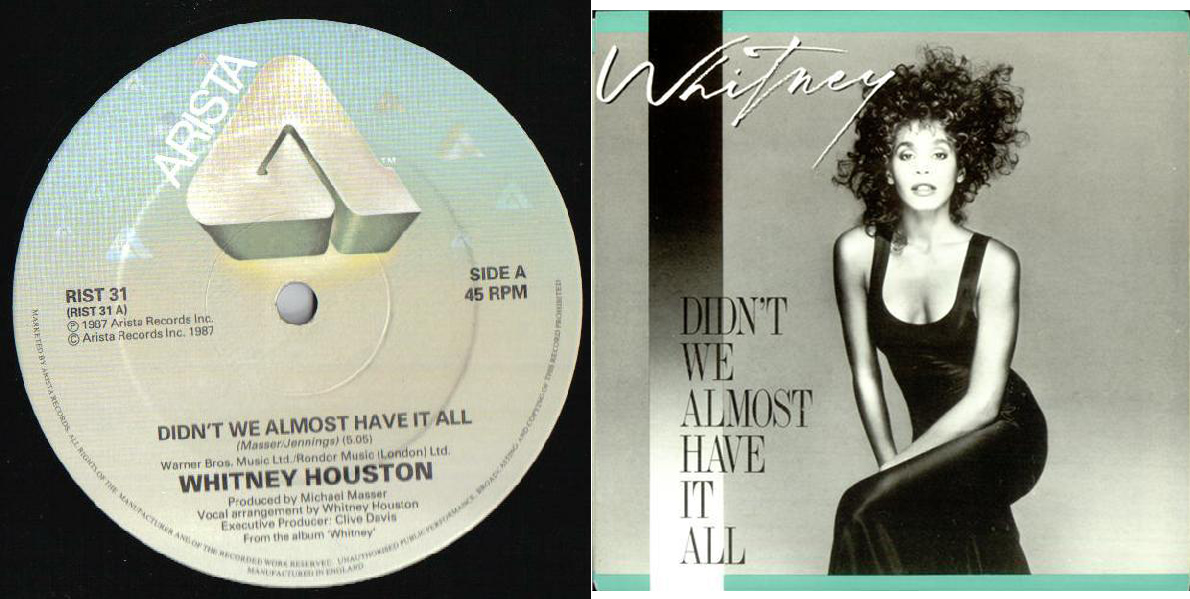

Whitney Houston, "Didn't We Almost Have It All" (released August 1987) Single 45rpm, from 2nd Whitney album (not exactly a favorite), June 4, 2015. (combined/cropped by Donald Earl Collins; http://musicstack.com and http://rapgenius.com).

Whitney Houston, “Didn’t We Almost Have It All” (released August 1987) Single 45rpm, from 2nd Whitney album (not exactly a favorite), June 4, 2015. (combined/cropped by Donald Earl Collins; http://musicstack.com and http://rapgenius.com).

I’ve been thinking about this for nearly a year. It started for me last August. Melissa Harris-Perry had a segment on her MSNBC show regarding the multiple hats women of color have worn over the years in taking care of their families, immediate, extended and non-biological. In response to Anne-Marie Slaughter’s July/August 2012 piece in The Atlantic about “Why Women Still Can’t Have It All,” Harris-Perry and her guests made the point that feminism for women of color has been about far more than having a successful, sexist-free career. That throughout American history, women of color have found themselves wearing multiple hats as primary breadwinners, primary caretakers and primary childrearers, often in ways that traditional feminists don’t discuss or recognize. All without fanfare and with many setback along the way.

What I’ve witnessed and been a part of in my own life reflects much of the conversation that Harris-Perry led on her show. The physical, mental and psychological scars from caring for family, friends and children, while struggling financially and dealing with racism and misogyny often manifests in disease and depression for so many women of color. There’s so much more, though, in terms of how my own mother’s multiple hats and habits led me to so many of my own. All initially to help her, but in the end, helping myself become self-sufficient. Not to mention making myself more understanding of where all the wear, tear and lack of care that wearing so much for so long can lead.

My Mom’s Hats and Habits:

The Anne-Marie Slaughter image of multitasking/wearing multiple hats (just think what this is like for poor, low-income, women of color), February 4, 2015. (ALAMY; http://telegraph.co.uk).

The Anne-Marie Slaughter image of multitasking/wearing multiple hats (just think what this is like for poor, low-income, women of color), February 4, 2015. (ALAMY; http://telegraph.co.uk).

Before I turned thirteen years old, my mother had been far more than my Mom. She’d been a dietary supervisor at Mount Vernon Hospital, just outside New York City, since 1968, the year before I was born. She had been a high school basketball player, a caregiver to her eleven brothers and sisters, and a cotton-picking breadwinner for her family in segregated southwestern Arkansas, an area located in the Red River Valley, part of the larger Mississippi Delta region. She had become our family’s primary breadwinner in the years after she gave birth to my older brother and me. Not to mention a married young woman now living a thirty-minute train ride from Midtown Manhattan, between the Hudson and Hutchinson Rivers, on the border between affluent Westchester County and the Bronx.

Life didn’t treat my Mom too kindly once she married my alcoholic father in 1971. And it actually went from bad to worse as she divorced him for my stepfather in 1978. By then, she had become a cigarette smoker, a one-time adulterer, and an abuse survivor. My Mom did everything she could to shield my older brother and me from her habits and the realities of our tough life in Mount Vernon in the 1970s and early 1980s. But by the end 1982, as I turned thirteen, all the hats my Mom had worn began to fall to the ground. In taking on the role of a strikebreaker, all of our lives would change forever.

In response to concessions made to the union, who left her unprotected, Mount Vernon Hospital cut her from full-time to part-time. My Mom became the besieged one. She was the old woman in the shoe, with six kids — including four under the age of five — and a cheating, abusive, unemployed, sometimes-at-home husband. It was my Mom’s job to take care of us all. Yet no longer was she a breadwinner. My Mom had become one of Reagan’s alleged welfare queens, pulling in $16,600 in AFDC payments per year from April 1983 until I left for college in August 1987. With all of that, I became a hat juggler myself.

Once Her Hats Became My Own:

For a while during my teenage years, my Mom had been my friend, one in which I could usually confide, albeit out of anger and frustration. All while taking on more and more of what had been her duties, including the brunt of her second husband’s rage and fists. I’d become an everyday grocery shopper, a frequent family cook, and a sometimes provider, the last mostly through tracking down my own father for a few extra dollars every Friday or Saturday at one of his favorite bars. Or, by the time I was sixteen, through working part-time. I provided childcare on afternoons, evenings and weekends. I washed clothes with my older brother on Saturdays or Sundays every week without fail from October 1982 on.

Hat stall at a Sunday fair, Amsterdam, The Netherlands, August 31, 2008. (Jorgeroyan via Wikipedia). Released to public domain via CC BY-SA 3.0.

Hat stall at a Sunday fair, Amsterdam, The Netherlands, August 31, 2008. (Jorgeroyan via Wikipedia). Released to public domain via CC BY-SA 3.0.

By the end of high school, I realized too who my Mom wasn’t, maybe for the first time. She wasn’t an encourager, a person who pushed her kids to pursue their dreams. With so many “Are you sure…?” questions my last two years of high school, it’s a wonder I applied to any colleges at all. Mom wasn’t a nurturer either, especially after I became a teenager. My Mom had only said “I love you” to me two times between my twelfth and nineteenth birthdays, including at my high school graduation ceremony in June 1987. She also wasn’t easygoing. Any mistake with money or my time would get a “Serves you right…” sermon about never screwing up.

The Toll Caring For Others Can Take:

All of this has made my Mom a conservatively cautious perfectionist, one living with depression and in constant denial about our shared past. I guess that it was all too much for her, like reaching the Jordan River, but not being allowed to cross it. Our shared experiences had also made me cautious and perfectionistic in my dealings with myself and the world, as I had to wear so many of my Mom’s hats and cross so many of those rivers with her. My mother tried to be all things to me and my older brother especially, and failed more than she succeeded in the process. For that and so many other reasons, despite her mistakes, I love her very much.

It’s been more than twenty-seven years since I moved away for the greener pastures of the University of Pittsburgh. Yet it’s only been in the past decade that I’ve learned to stop striving for perfection in all the things I say and do. It ultimately takes a lifetime to unlearn all the bad habits and prejudices and give up on juggling all the ideas and roles that our parents have put on us. My journey with and without my Mom has been no different. Now that my Mom’s in her late sixties, I just hope that the only hat she tries to wear these days is one to keep her head warm on the coldest of days.

MVHS and Memorial Day Weekend Decisions

25 Monday May 2015

Posted by decollins1969 in 1, Boy @ The Window, culture, Eclectic, eclectic music, Jimme, Mount Vernon High School, Mount Vernon New York, music, My Father, Pop Culture, race, Youth

≈ Leave a comment

Tags

"Voices Carry" (1985), 616, 616 East Lincoln Avenue, Angst, Barron's Regents Exam Test Prep Books, Carol Buckley, Chemistry, DiFeo, Disillusionment, Humanities, Joey Chestnut, Keyboarding, Martino, Mary Zini, Meltzer, MVHS, New York State Regents Exams, Paul Lewis, Self-, Takeru Kobayashi, Teaching and Learning, Teenage Angst, Til Tuesday, Trigonometry, Viggiano


Laurence Fishburne yelling "Wake up!" at end of movie School Daze (1988), December 9, 2009. (screenshot via Tumblr.com). Qualifies as fair use due to low resolution and clarity of picture.

Laurence Fishburne yelling “Wake up!” at end of movie School Daze (1988), December 9, 2009. (screenshot via Tumblr.com). Qualifies as fair use due to low resolution of picture.

Thirty years ago this weekend, I made a couple of decisions that I would take with me for the rest of my days of formal schooling, and still keep in mind for myself when I’m in the classroom as a professor. The decisions I made about my teachers came out of a sense of both malaise and desperation. You see, I was near the end of tenth grade in May ’85, and had figured out months earlier that I had hit the mediocre-and-apathetic-teacher-lottery at Mount Vernon High School that year.

That my Humanities teachers were underwhelming shouldn’t have been a surprise, really. Yet it was. I’ve written here and in Boy @ The Window already about two teachers — Zini for history and Lewis for Chemistry — who either “got on my last nerves” or as an “unimaginative instructor” who lived in “a chain-smoking world.” But I also had an Italian teacher who lost his job in April because of the distractions of owning a car dealership, a Trig teacher who could screw up an equation for me faster than I could quip, “Yeah, right!,” and an English teacher in Carol Buckley who spent most our eighth periods together lying on a couch and asking us to water her plants! The best teacher I had that year was my keyboarding instructor, who spent most of the year congratulating the women in the class who came in typing sixty or ninety-five words per minute.

It wasn’t all their fault. I was fifteen as well, more than a bit rebellious, as nearly every adult authority figure in my life had either abused or neglected me in some way. Yeah, maybe I did take my teenage angst, my lack of belonging, and my troubles at 616 with my Mom, my idiot ex-stepfather and my father Jimme out on them from time to time. I’m sure that’s true. It’s also true that I distracted myself with Humanities and school. I used that forty-two weeks out of each year to throw down academically, to work, to grind, to use my Jedi-mind tricks to take music and movies, arts and sports to absorb knowledge like Takeru Kobayashi and ‎Joey Chestnut at a hot dog eating competition. Those teachers, with their lack of nuance, or in some cases, actual lack of knowledge (and in at least one case, lack of teaching acumen), ruined my standard operating mode.

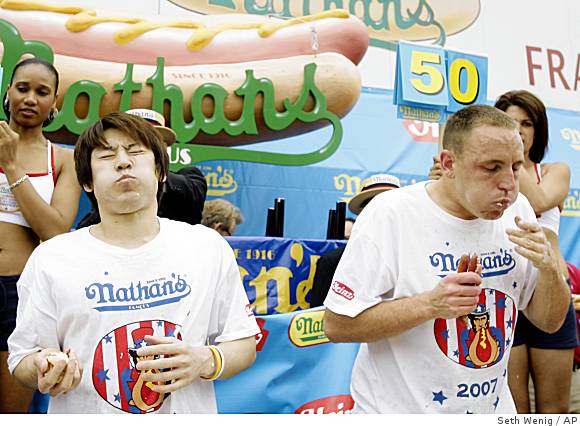
Takeru Kobayashi and Joey Chestnut battle it out at the 2007 Nathan's Famous Fourth of July Hot Dog Eating Contest, Coney Island, Brooklyn, NY, July 4, 2007. (Seth Wenig/AP; http://philly.com).

Takeru Kobayashi and Joey Chestnut battle it out at the 2007 Nathan’s Famous Fourth of July Hot Dog Eating Contest, Coney Island, Brooklyn, NY, July 4, 2007. (Seth Wenig/AP; http://philly.com).

My Memorial Day Weekend ’85 decisions actually began in February. I decided after another week of watching Viggiano mess up another sine, cosine and tangent lecture that I needed to learn how to do Trig properly, which meant on my own. I went to Mount Vernon Public Library, checked out the best Trig textbook I could find, and began working on angles and equations whenever I could squeeze in a spare moment. I bought the Barron’s Trig Regents Exam test preparation book at the end of February, and started working on practice exams in April.

It wasn’t until the week going into Memorial Day Weekend, though, that I had an epiphany about my tenth-grade teachers. Lewis made it so with yet another stream of nonsense.

Lewis went as far as to say, “There’s nothing to worry about” on the subject of organic chemistry. “There will be hardly any organic chemistry on the exam, anyway,” he said. After eight months of listening to his blathering, I thought “That’s it! Whatever he says to do, I’m doing the opposite!” The next time I got money from Jimme, I went out and bought the Barron’s Chemistry Regents exam prep book. It was just before Memorial Day, and I had a month before the exam.

That wasn’t all I decided and did. I really did think that my teachers were incompetent, lazy and arrogant. I simply could no longer trust them, even as I was desperate to trust someone at fifteen. I decided that ultimately, I was my own best teacher and own best barometer of what I needed to learn and why I needed to learn it. I decided that teachers had to earn my trust as a student, that I was no longer going to automatically entrust them with my educational enrichment, no questions asked. I decided that if I really was going to be going to college in a couple of years, that I had to keep my eyes open for individuals I could trust, because by the end of tenth grade, I didn’t trust Humanities as a program and MVHS as a school.

Those decisions turned out to be good ones, even though it also meant few new friends and only a couple of mentors after tenth grade. Luckily there was Meltzer, luckily there was Martino, and luckily, I was only two years from graduating.

Middle School Teachers, Middle School Memories

14 Thursday May 2015

Posted by decollins1969 in 1, Academia, Boy @ The Window, culture, Eclectic, eclectic music, Mount Vernon New York, music, Pittsburgh, Politics, Pop Culture, race, Work, Youth

≈ 1 Comment

Tags

A.B. Davis Middle School, Algebra, Bad Teaching Habits, Duquesne University College of Education, Good Teaching Habits, Humanities, Humanities Program, Life Lessons, MCPS, Middle Schools, Montgomery County MD, Montgomery County Public Schools, Mrs. Mignone, Ms. Jeanne Longerano, Research, Science, Silver Spring Maryland, Sligo Middle School, Teacher Expectations, Teaching and Learning


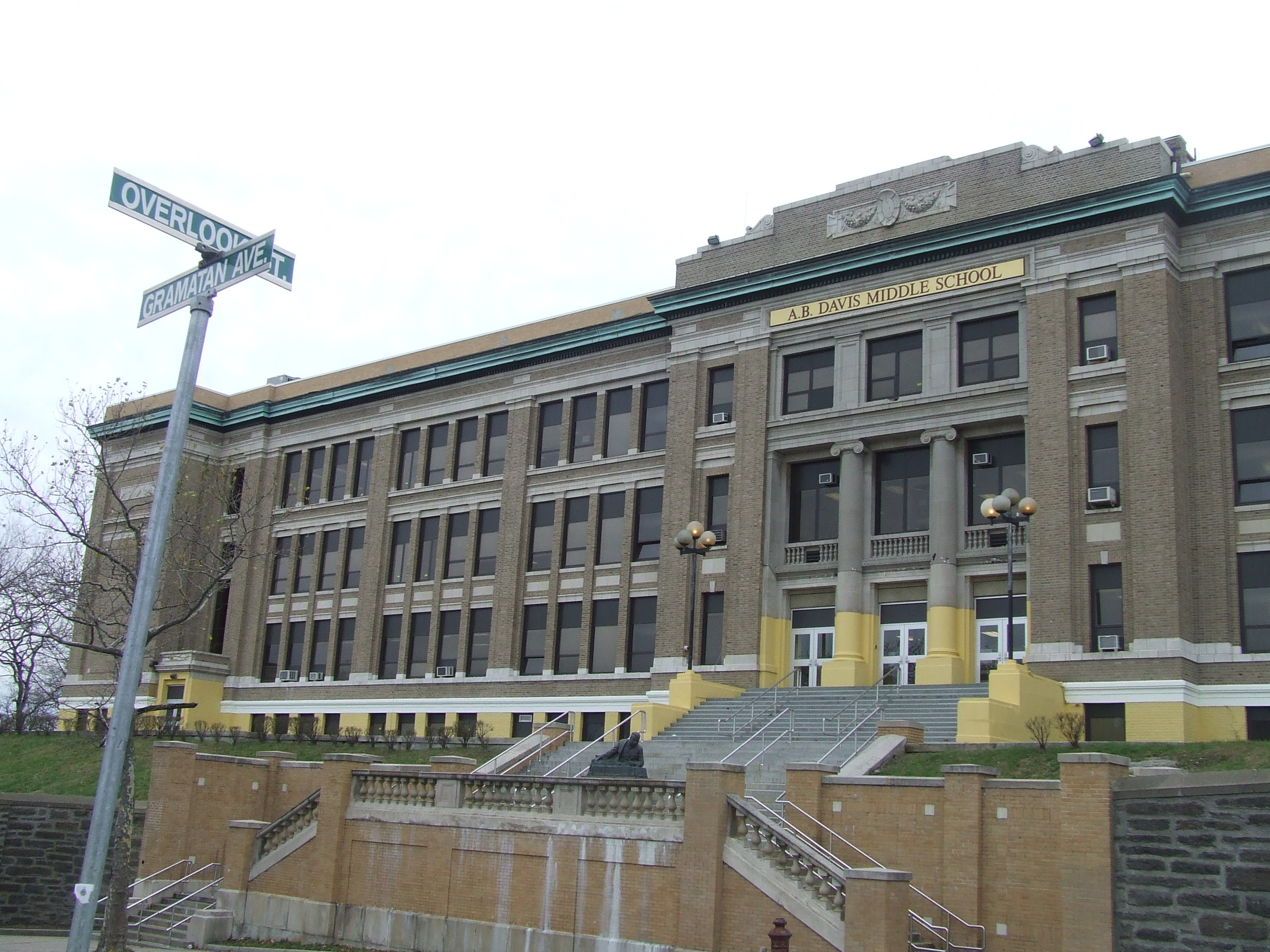
A.B. Davis Middle School, Mount Vernon, NY, November 21, 2006. (Donald Earl Collins). Built in 19226, it used to be Mount Vernon High School before Black migration, the Brown decision and ending some discriminatory ability grouping practices forced the school board to build a new high school after 1954.

A.B. Davis Middle School, Mount Vernon, NY, November 21, 2006. (Donald Earl Collins). Built in 1926, it used to be Mount Vernon High School before Black migration, the Brown decision and ending some discriminatory ability grouping practices forced the school board to build a new high school after 1954.

There’s a reason why much of the recent research on middle schools has called for the elimination of middle schools long-term, that instead, K-5 or K-6 ought to become K-8. It’s a transitional period for kids, one that even with the best of parents, most preteens face mostly unprepared. It’s based on a system that educators and policy makers designed a century ago, when the average student completed their formal education in seventh or eighth grade (only one in five students living in the early twentieth century went on to high school).

The teachers traditionally prepared by schools of education really aren’t prepared specifically for sixth, seventh or eighth grade, but for secondary education. Meaning, teachers either have higher social and emotional expectations of 10-to-14-year-olds than they have prepared for, or they have higher academic expectation of their students than the students have been prepared for, or both. These are among the reasons why middle schools can easily become a black hole for students too young to be dealing with teachers trained really for high school, and a black hole for teachers who simply aren’t as prepared for tweeners and thirteen-year-olds as they like to pretend.

Sligo Middle School, Silver Spring, MD, August 2014. (http://montgomeryschoolsmd.org/).

Sligo Middle School, Silver Spring, MD, August 2014. (http://montgomeryschoolsmd.org/).

Despite the advances in teacher preparation in the past couple of decades, this reality still exists at most middle schools, including my son’s Sligo Middle School in Silver Spring. Common Core, PAARC assessments, a wide variety of fatty lunch options, all make students feel that education matters and yet it really doesn’t. My son has already had a couple of teachers whose first and second instinct for controlling their classrooms has been to yell early and often, to the point where I’m convinced that at least one of his teachers this year had Tourette’s (at least, until we had the school move him out of that class). At least two others could be accused of unconsciously labeling their students, as their expectations of their students have gone unmet.

Through meeting these teachers, I’ve re-recognized something that used to be wrong in my own teaching, back when I first started teaching in Duquesne University’s College of Education in the late-1990s. To have high expectations and standards of conduct isn’t enough. Teachers need to communicate it, through examples, through their lessons, through a rubric, quite frankly, and not just a laundry list of expectation. Simply put, given the age of the students, teachers need to positively and consistently encourage students to meet those expectations, and lay out why these expectations will help them, academically and practically.

I had precisely two teachers at A.B. Davis Middle School in Mount Vernon, New York in the early 1980s who did exactly that. My eighth-grade science teacher, Mrs. Mignone, and my first-year, eighth-grade Algebra teacher, Ms. Jeanne Longerano were the best two teachers I had in two years of middle school Humanities-style. Both were committed to the idea that every student in the classroom deserved their undivided attention, which meant that we as students — even us fidgety ones — had to give our maximum preteen attention to what was happening in the classroom as well. Both had high expectations of us, academically and otherwise. I don’t think I got away with much of anything in their classrooms that 1982-83 school year, not even as much as scratching my pubescent balls because the hair was coming in that year.

I learned a life lesson about internalized racism and having high standards for human decency from Mrs. Mignone at the end of eighth grade. Not to mention, the applications of math to science, and science to history, which I carry with me to this day. From Ms. Longerano, I renewed my love for math, began my technical understanding of computer science (we had a computer science club that she started that year), and had a neighbor that I talked to from time to time. Ms. Longerano had given us such a strong foundation in Algebra that it wasn’t until AP Calculus in twelfth grade when I ran into any serious math troubles again.

In all, though, I had twelve different teachers in two years of middle school. I had an art teacher who was also the Humanities coordinator for A.B. Davis in Doris Mann who graded us on the quality of our art, “not just for trying,” to use her words. I had a seventh-grade science teacher whom I’d based some of the nutty stories I told my son over the years, about him eating raw clams in class or coming in after being sprayed by a skunk that same morning. I had a music teacher in Mrs. Mallory for two years who was flat-out goofy to the point of seriously immature, only to find out years later that she had done her same song-and-dance when she taught second-graders. I had a seventh-grade social studies teacher in Mr. Court who was the teacher who probably made his class the most fun, but not necessarily the most educational.

In contrast, Ms. Simmons (seventh-grade math), Ms. Fleming (Italian), and Dr. Demon Travel (eighth-grade social studies), were teachers who cared more about discipline and/or quick-and-dirty rote memorization than anything else. Simmons actually intimidated me, until one day near the end of the school year, I stood next to her. Only to find that I’d grown two inches, to five-foot-four, and that I was now at least an inch taller than her curly mini-fro. Mrs. Sesay, my homeroom and seventh-grade English teacher, was the opposite, a teacher who had little control over her classroom. Almost every incident of taunting and humiliation I experienced in seventh grade had its origins in 7S homeroom or English first period.

Still, I survived, mostly because of a crush in seventh grade, more maturity in eighth, and two really wonderful teachers in that latter year. I don’t want my son, though, to look back at his middle school years and go “Meh.” Unfortunately, he can already do that for sixth grade. Seventh and eighth will have to be better, even if it means I have to home-school him.

The 8th-Grade History Award Race

06 Wednesday May 2015

Posted by decollins1969 in 1, Boy @ The Window, culture, Eclectic, eclectic music, Mount Vernon New York, music, Politics, Pop Culture, race, University of Pittsburgh, Youth

≈ Leave a comment

Tags

616 East Lincoln Avenue, 8U, A.B. Davis Middle School, Benetton Group, Cool, Demontravel, Dr. Demontravel, Exoticism, Grimes Center for Creative Education, History, History Award, Humanities, Humanities Program, Pennington-Grimes ES, Teaching and Learning


Mikhail Sergeyevich Gorbachev, last general-secretary of the Communist Party, USSR (1985-90), first and last president of the USSR (1990-91), May 6, 2015. (http://biography.com).

Mikhail Sergeyevich Gorbachev, last general-secretary of the Communist Party, USSR (1985-90), first and last president of the USSR (1990-91), May 6, 2015. (http://biography.com).

One of the worst teachers I ever had was my eighth grade history teacher at A.B. Davis Middle School between September ’82 and June ’83. His name was Mr. Demontravel, our American history teacher. Or as he preferred in the last three months of eighth grade, Dr. Demontravel (he had finished his doctoral thesis on the Civil War, on what beyond that, I wasn’t sure, and, given the way he was to me and us, I didn’t care either). Or as I liked to call him throughout that year, “Demon Travel.”

Old Scantron machine, January 24, 2012. (http://www.publicsurplus.com/).

Old Scantron machine, January 24, 2012. (http://www.publicsurplus.com/).

His was a class that sucked the life out of history for most of us. Like most teachers of K-12 social studies or history, it was a dates, names, and places class. Unlike most social studies teachers, his teaching methodology was the epitome of lazy. Every class, five days a week, Demontravel would put up five questions on the blackboard for us to copy down and answer using our textbook. At the end of every two-week period, we’d get a fifty-question multiple choice exam, helping Scantron stay in business.

Demontravel rarely stood up to lecture or do anything else. Lectures for him might as well have been appearances by Halley’s Comet, only the lectures were far less memorable. This process went on unabated for forty-weeks, four marking periods, an entire school year. Calling this boring would only get you into the door of the intellectual famine Demontravel subjected us to in eighth grade.

He wasn’t particularly helpful on the rare occasions when someone did have a question. When a classmate did ask him something, the portly Demontravel would stand up from his desk, which was to our right as we faced the chalkboard, slowly walk toward it, point to a question on the board, tell us in his best Teddy Roosevelt voice what page to turn to in looking for the answer, and then, just as slowly, return to his seat at his desk. Demontravel was truly an unremarkable and boring fifty-something man, virtually bald in all of his pink salmon-headedness, skinny and potbellied beyond belief. His shiny bald head had a Gorbachev-like spot on it.

But there was the fact that there was a prize on the line for us nerdy middle-schoolers—the eighth-grade History Award. “Something I could actually win,” I thought. And Demontravel was the sole arbiter over the award. My favorite and easiest subject was in the hands of this hack of a teacher. That made me downright angry whenever I thought about it.

Post Grape-Nuts cereal at its visual best, with milk, raspberries and blueberries, May 6, 2015. (http://plantbasednutritionlifestyle.com/).

Post Grape-Nuts cereal at its visual best, with milk, raspberries and blueberries, May 6, 2015. (http://plantbasednutritionlifestyle.com/).

I ended up not winning the award, mostly because I correctly corrected Demontravel in front of the whole class one day about key battles of World War I on the Eastern Front. And, also because after he threatened to kick me out of his classroom, I drew a naked picture of his Santa Claus-looking body with a scrotum the size of two Grape-Nuts! Though I drew it in Italian class, I’m sure my counselor told Demontravel about it.

So, 96.4 average or not, I lost the award to my classmate Jennifer, who had a 96.3 average. She was part of what I came to call the “Benetton Group.” They were a group of superficially aware, middle-class-to-affluent folks in the Humanities Program who went through the Grimes Center program (which later became Pennington-Grimes Elementary) together, who thought they were down with the cool and the exotic (with people like Wendy and Brandie being prima facie examples of both). Or, at least, Jennifer acted like she was a part of that group.

She was a bit withdrawn in eighth grade. I never fully understood why. All I knew the first half of the year was that she had set a mark that I needed to beat to have any chance at the history award. By the time I drew my post-modernist interpretation of my lazy, boring-ass history teacher, though, I cared far less about the award and a bit more about this person I only talked to after school, on our walks back to our real lives near the Mount Vernon-Pelham border.

As I wrote in Boy @ The Window:

Screen Shot 2015-05-06 at 12.57.01 PM

I guess Jennifer knew that she would no longer be a part of the grand experiment that was Humanities, the social experience that was integration in a “dangerous” majority of color high school. I bumped into Jennifer a handful of times after eighth grade, between high school and my bachelor’s degree finish at the University of Pittsburgh. Though I have no idea where life has taken her, I must admit, I enjoyed competing with her all eighth grade for an award I knew I’d never get.

Baltimore, A “Riot”? Really?

29 Wednesday Apr 2015

Posted by decollins1969 in 1, culture, Eclectic, High Rise Buildings, Mount Vernon New York, Pop Culture, race, University of Pittsburgh, Youth

≈ Leave a comment

Tags

Baltimore, Civil Unrest, Definitions, Freddie Gray Protests, L.A. Riots, Los Angeles Riots 1992, Media Coverage, Police Brutality, Policing, Politics of Respectability, Race Rules, Respectability Politics, Riots, Rodney King, Rules of Racial Standing, Vancouver Canucks, Vancouver Riots 2011


Screen shot of map of violent incidents in Baltimore near site of Freddie Gray protests on Monday, April 28, 2015. (http://nytimes.com via Twitter).

Screen shot of map of violent incidents in Baltimore near site of Freddie Gray protests on Monday, April 28, 2015. (http://nytimes.com via Twitter).

What happened in Baltimore on Monday wasn’t a riot. Let me repeat that. The violence that broke on in Baltimore a day and a half ago was NOT a riot. Nor was it a referendum on Black violence. Nor was it a microcosm of Black youth as “thugs.” Nor was it “violent clashes between police and protestors,” at least not in any formal sense. It was random violence and vandalism, spread out far enough to be, sadly, a typical week in an impoverished Baltimore neighborhood, as part of larger impoverished and divided city. Period.

Exhibit A of media coverage, Erin Burnett, CNN, April 28, 2015. (http://Gawker.com).

Exhibit A of media coverage, Erin Burnett, CNN, April 28, 2015. (http://Gawker.com).

The Baltimore coverage has been a caustic cocktail so far. One of a media with bipolar disorder, bouncing from ignoring Freddie Gray’s death and the first protests during the White House Correspondence Dinner to wall-to-wall coverage for the past two days. Combine that with the inaction on moving forward with disciplining or arresting the Baltimore PD officers involved in making Freddie Gray paralyzed and dead. Combine that with the Black Respectability Police yammering on as if vandalism is simply an issue of undisciplined youth. Mix that with White columnists and commentators spewing racial stereotypes like a sewer hole. And you get the same numbskull presentation of a situation in which the questions are about how a handful in a community responded in snapshot to years of oppression, neglect, ignoring and ignorance.

Overhead shot of L.A. riots, contrast between South Central LA fires and downtown LA smog, April 30, 1992. (http://latimes.com).

Overhead shot of L.A. riots, contrast between South Central LA fires and downtown LA smog, April 30, 1992. (http://latimes.com).

Twenty-three years ago today, half-a-lifetime ago for me, the L.A. riots began, within a couple of hours of the first verdict in the Rodney King case. You know, the one where that all-White Simi Valley jury made up of retired cops acquitted the police officers involved of all charges. That was a riot, in every sense of the word. It was organized, it was disorganized, it went on for days, it took out whole city blocks, it left 53 dead, more than 2,000 injured, and the police and the National Guard arrested more than 11,000 people.

Watching that unfold was a traumatic experience. It was the kind of experience that should make people — especially in the news business — remember that not every act of violence that occurs during a protest is part of that protest or constitutes a riot. By labeling what happened on Monday in Baltimore a “riot” is insulting to anyone with a long memory. Seven fires, a few clashes, a handful of burned out and bashed in vehicles. Heck, where I grew up, in “Money Earnin'” Mount Vernon, New York, that’s a bad weekend in December ’99. But it’s not a riot.

I’ll tell you what is a riot, though. East St. Louis, Illinois in 1917. The 1863 Draft Riots in New York. Chicago and Washington, DC during the Red Summer of 1919. Detroit in 1943. The 100-plus riots after Dr. Martin Luther King, Jr.’s assassination in 1968. Vancouver, in 2011, after the Canucks lost in the Stanley Cup Finals (again). Chicago during the 1968 Democratic Convention, Seattle during the 1999 World Trade Organization conference. But when White folks destroy property or take lives during widespread and seemingly random violence, it’s either a “protest” or “civil unrest.”

Vancouver Canucks fans riot after team's Stanley Cup Finals Game 7 defeat, June 16, 2011. (Reuters via http://theguardian.com).

Vancouver Canucks fans riot after team’s Stanley Cup Finals Game 7 defeat, June 16, 2011. (Reuters via http://theguardian.com).

I’ll tell you something else. The media, the respectability police, and Whites in denial want nothing more than to make the Freddie Gray killing and the protests a besides-the-point news story. For them, making Blacks look less than human is the story. For them, any imperfection, any violence, any sense of the full range of humanity on display when under systemic oppression, is reason to celebrate. Because it means they can spend another day living in their matrix, where all their racism and race-based privilege is confirmed.

Why Boston U Isn’t For Me, and Shouldn’t Be For You

26 Sunday Apr 2015

Posted by decollins1969 in 1, Academia, Carnegie Mellon University, culture, Eclectic, High Rise Buildings, Jimme, Mount Vernon New York, My Father, New York City, Politics, Pop Culture, race, Upper East Side, Upper West Side, Work, Youth

≈ Leave a comment

Tags

616, 616 East Lincoln Avenue, Academic-Speak, Boston U, Boston University, BU, Checkbox, CMU, Cosmetic Diversity, Disillusionment, Institutional Racism, Jimme, Linda Sarsour, Meritocracy, Nepotism, Office of the Provost, Racism, Rev. Dr. Martin Luther King Jr., Righteous Indignation, Robert Turri Vise, Structural Racism, Suzanne C. Kennedy, Timothy Barbari, Tokenism


The main classroom buildings for the College of Arts and Sciences at Boston University, with the BU East 'T' stop in the foreground, July 18, 2010. (Fletcher6 via Wikipedia). Released to the public domain via CC-SA-3.0.

The main classroom buildings for the College of Arts and Sciences at Boston University, with the BU East ‘T’ stop in the foreground, July 18, 2010. (Fletcher6 via Wikipedia). Released to the public domain via CC-SA-3.0.

Since my first job working for my father in Manhattan in ’84, I’ve probably done over 200 interviews. By telephone, through Skype or WebEx or Adobe Connect, at conferences and in person. Probably about a third of those interviews have occurred with colleges and universities, for academic and administrator-level positions. For the most part, whether the interviews went well or when I didn’t have my “A-game,” my experiences have been pleasant ones. But, after two different interview processes five years apart with Boston University — one in October ’10, the other last month — there is a higher education institution that I will not work for, will not send my son, and will not recommend for anyone I know, under nearly any circumstances.

There are only a few institutions that have been so bad that they’ve moved from my [expletive] list to my permanently-banned-from-my-life list. Even Carnegie Mellon isn’t on the latter list, and I’ve talked about their conservatism and weirdness around diversity before here. But Boston University’s treatment of me as a potential employee, well, it took my breath away without putting me in an NYPD chokehold.

Round 1, Boston University, August-October 2010

Let me rephrase. I was never a “potential employee,” because on the two occasions I interviewed for jobs there, Boston University in the end treated me as a checkmark interviewee. In the fall of ’10, I emerged for them as a candidate for the director of their Washington, DC program. They interviewed me three times: at the American Political Science Association conference in DC in August, at their old DC program headquarters (while also showing me their new one, still under construction) in September, and in person on the main Boston University campus in late October.

For that last interview, they pulled out all the stops. They flew me in, put me up in a nearby hotel the night before, and even took me to lunch. Of course, they also had someone give me a two-hour guided tour of the campus that morning, after one morning meeting, on a day with thirty mile-per-hour winds coming off the Charles River as we walked from one end of the campus to the other. It’s funny. Up until then, I never thought of a campus tour as sinister. But then I realized, if I’m spending two hours during the heart of the workday doing a campus tour with a twenty-four year-old BU grad in forty-five degree weather, what did that mean for my real chances at that job?

My final meeting was with a professor who advised political science and history major in the DC program. That meeting ended at 5 pm on October 22, with which I knew that they were supposed to make a final decision in a week or so. Despite a thank-you email and two follow-up emails, I didn’t hear from Boston University again until November 29. Roberta Turri Vise, the point person for my interview process, didn’t explain why the final decision took more than five weeks. Nor did she explain why after six weeks of correspondence, no response from my requests were returned by her or anyone else in her office.

Round 2, Boston University, January-March 2015

I decided that this was a one-off thing, that with our generation of job searches occurring in a buyer’s market, that some folks really don’t care about being professionals in their dealing with interviewees. Boy was I wrong! Even in a market where people ignore applicant materials and send mass rejection emails without a candidate’s name on it (or worse, with someone else’s name), Boston University claimed a unique crown.

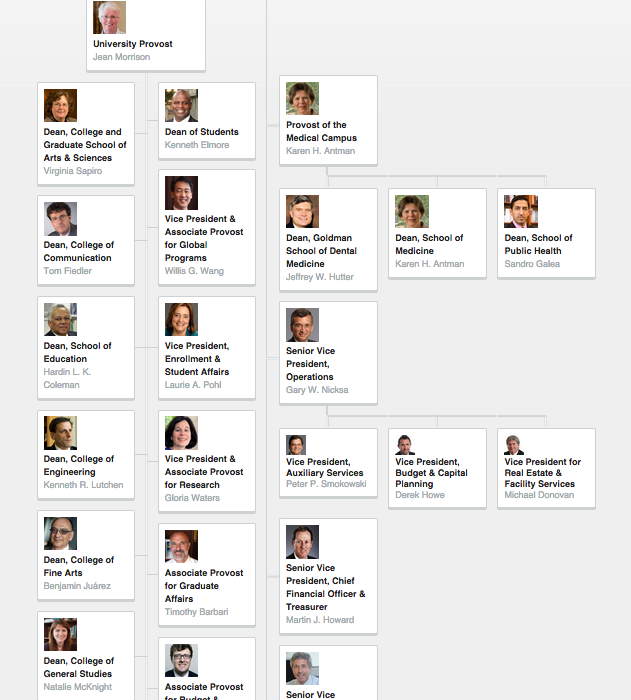
Hierarchy tree of Boston University's leadership team via the Provost's Office, April 26, 2015. (http://www.bu.edu/info/about/admin/).

Hierarchy tree of Boston University’s leadership team via the Provost’s Office, April 26, 2015. (http://www.bu.edu/info/about/admin/).

I interviewed with them again in January and at the beginning of March. This was for a position in their provost’s office, a director position managing undergraduate and graduate fellowship opportunities and advising students via those opportunities. The position was a bit beneath my experience, but they seemed interested, and I already knew from some initial research that it was a new position, so I went ahead and applied for it. My first interview was by telephone, with Suzanne Kennedy, the assistant provost for academic affairs at Boston University. It was a pleasant but underwhelming interview, and I actually didn’t expect a call back. So I kept up with my usual work of teaching, consulting, and looking for more consulting opportunities.

I received an email five weeks later asking me to come up to Boston for a second, in-person interview. I gave it the go-ahead, although the length of time between first interview and correspondence concerned me. So too, did my back and forth with Kennedy’s assistant over travel, as she had initially booked me at times that were very inconvenient for interviewing purposes. Not to mention, the major snow issues that Boston experienced in February.

The interview on March 4 was honestly one of the worst experiences I’ve ever had interviewing for any job. I’m including an interview in which I discovered the place was a sweatshop in Chinatown, during my summer of unemployment in New York in ’88. I had three meetings in all, one over lunch with Kennedy, and two with the two associate provosts at Boston University in academic affairs (one undergraduate, one graduate). Over lunch, the conversation was going well, until I asked the question about the level of diversity with applicant pools for Fulbrights, Trumans, Borens, and Rhodes’ scholarships and fellowships. I kid you not, Kennedy’s eyes literally glazed over as soon as I asked about diversity. Keep in mind, I had asked about socioeconomic diversity — I hadn’t touched racial or gender diversity yet. After lunch, I didn’t see Kennedy again for the rest of the interview process.

My second sign came from my third meeting. I met with Timothy Barbari, associate provost for graduate affairs. It was obvious that Barbari hadn’t even looked at my CV before I walked into his office. The first thing Barbari says to me, with him pushing his body into the back of his chair so far that his attempt to be at ease looked more like a rocket revving to take off — “so, you have a rather interesting CV.” I may not have earned all of my money as an academician, but I’ve been around academic-speak long enough to know that interesting can mean a lot of different things, mostly bad. In this context, interesting meant “not straightforward, not linear in progression, not typical in terms of whom we typically hire.”

I was already feeling a bit like a checkmark or token interviewee by the time I left Barbari’s office for Logan. But after USAirways canceled all their flights to DC that evening due to a snowstorm that wouldn’t drop a snowflake for another twelve hours, it got worse. I notified Kennedy through her assistant that I was stuck in Boston overnight from Logan, and left a message the next morning that the Amtrak to DC was my only option, as more flights had been canceled. No word, not even a “I’m sorry that you have to go through this” response. It wasn’t until mid-afternoon that Friday, nearly a day after I returned to DC, and after a third message about them needing to reimburse me, that I heard from Kennedy’s assistant.

At that point, I wouldn’t have taken the job even if they had offered it to me. As it was, I didn’t hear from Kennedy again until April 7, five weeks after a second interview, and despite a check-in to find out what happened with this director position. It’s this kind of calloused approach that leaves folks shaking their head.

Shaking Off The Dirt

I’ve made a few determinations based on these experiences. For one, if this is the way that treat job candidates who look like me, how well do they pay and treat their service staff, the most vulnerable people on their campus? Not well, at least from what I saw and have experienced. For two, the fact that for both interviews, their top concern seemed to be about competing with “schools across the Charles River” — i.e., Harvard, MIT, Tufts — was somewhere between disconcerting and ridiculous.

An elephant shaking off the dirt, circa 2012. JD Rucker via Pinterest.com).

An elephant shaking off the dirt, circa 2012. (JD Rucker via Pinterest.com).

The fact that with tuition, books, and room and board it would run the average BU student $60,000 per year also told me what I needed to know. Boston University is a place that wants elite status and elite students, and in pursuit of this Pollyanna goal, wants to hire people they feel fit the bill. As long as those people look like everyone else running the university — mostly White, with a few people of color lightly sprinkled in leading positions at the institution. Because Boston University has what activist Linda Sarsour (Twitter, @lsarsour) calls cosmetic diversity, a genuine attempt at diversity across socioeconomic, racial and gender lines is unnecessary, at least for the powers whom run the institution.

Aside from Martin Luther King, Jr., who earned his doctorate in divinity at Boston University in the early 1950s, I’ve known or known of only one person of color with a degree from BU. She was a neighbor at 616 East Lincoln, a few years younger. Based on her description of more than two decades ago, I’d have to say that Boston University has changed for the worst. Like most universities, they seem more interested in prestige and raising money than in fulfilling their mission.

And with that being the case, why send your kid to Boston University? Especially when, for the same amount of money or less, every other school in the Boston area is either better, or at least, cares more about diversity and learning beyond the cosmetic.

Merit-hypocrisy in the Air

18 Saturday Apr 2015

Posted by decollins1969 in 1, Academia, Boy @ The Window, Carnegie Mellon University, Christianity, culture, Eclectic, Mount Vernon New York, Movies, Pittsburgh, Politics, Pop Culture, race, Religion, University of Pittsburgh, Work, Youth

≈ Leave a comment

Tags

"Who-You-Know" World, Academia, Ageism, Bruce Anthony Jones, Daniel P. Resnick, Dick Oestreicher, Envy, Hard Work, Hypocrisy, Jay Wickliff, Jealousy, Jelani Cobb, Joe William Trotter Jr., Ken Williams, Meritocracy, Nepotism, New Voices, New Voices Fellowship Program, Nonprofit World, Presidential Classroom, Racism, Wendy Goldman


Meritocracy cartoon, October 29, 2010 (Josh C. Lyman via http://www.clibsy.com/).

Meritocracy cartoon, October 29, 2010 (Josh C. Lyman via http://www.clibsy.com/).

One of the hardest ideals for me to give up on in all of my life has been the idea of meritocracy. Even when I couldn’t spell the word, much less define it or use it in a sentence, I believed in this ideal. It was the driving force behind my educational progression from the middle of fourth grade in January ’79 until I finished my doctorate in May ’97. The meritocratic ideal even guided me in my career, in both academia and in the nonprofit world. Only to realize by the end of ’09 what I suspected, but ignored, for many years. My ideal of a meritocracy is shared by only a precious few, and the rest give lip service to it before wiping it off their mouths, concealing their split lips and forked tongue with nepotism instead.

Being the historian I am — whom people like Jelani Cobb joked about on Twitter as a curse — I am programmed to look back at situations in my own life to look for root causes, to understand what I can do to not repeat my own mistakes, my not-so-well-planned decisions. I’ve thought about my advisor Joe Trotter and my dissertation committee of Trotter, Dan Resnick (husband of education researcher Lauren Resnick) and Bruce Anthony Jones. The biggest mistake I made was in putting this hodgepodge committee of a HNIC advisor, racial determinist and closeted wanderer together to help guide me through my dissertation and then into my first postdoctoral job.

Aaron Eckhart as main character in movie I, Frankenstein (2014), August 12, 2013. (http://sciencefiction.com/).

Aaron Eckhart as main character in movie I, Frankenstein (2014), August 12, 2013. (http://sciencefiction.com/).

Of course, I didn’t know enough about these men to describe them this way, certainly not until I’d graduated and couldn’t find full-time work for more than two years. The signs, though, were there. Trotter’s unwillingness to recommend me for any job before my completed first draft of my dissertation was really complete (it took me two weeks to revise my dissertation from first to final draft). Resnick calling my dissertation writing “journalistic” and saying that my nearly 2,000 endnotes and thirty pages of sources was “insufficient.” Bruce pulling back on his schedule with me even before taking the job at University of Missouri at Columbia in July ’96.

None of this had anything to with my work. It was about me, whether I as a twenty-six year-old had suffered enough, had gone through enough humiliation, to earn a simple letter of recommendation for a job. When Trotter finally decided it was time to write me a letter of recommendation, it was December ’96, and the job was University of Nebraska-Omaha, “subject to budget considerations,” meaning that it could (and it did) easily fall through. Resnick flat-out refused to share anything he wanted to write about me, with all his “confidentiality” concerns, while I wrote all my letters for myself for Bruce. It was a disaster, and none of it had anything to do with the quality of my work as a historian, educator, or academic writer.

The work I ended up getting after Carnegie Mellon was the result of my dissertation, my teaching experiences, and my networking. The idea that I’d earned my spot, though, was still lacking in the places in which I worked. Particularly at Presidential Classroom, where I was the token highly-educated Negro on staff, and working at Academy for Educational Development with the New Voices Fellowship Program. In both cases, I had bosses whose racial biases only became clear once I began working with them. The then executive director Jay Wickliff never cared about the quality of my work or my degrees. Wickliff’s only concern was that I should keep my mouth shut when he acted or spoke in a racist manner.

My immediate supervisor Ken, on the other hand, wanted all the credit for work I did under him, except in cases when he deemed my methods “not diplomatic enough.” Even before his bipolar disorder led him to a psychological breakdown, Ken regularly accused me of gunning for his position, sometimes turning red whenever he heard about my latest publication, teaching assignment or conference presentation. I had to fight to keep my job and to move on within AED in those final months of ’03 and early ’04, a fight that had zero to do with merit.

Dixie Biggs, Lip Service teapot, April 19, 2015. (http://pinterest.com).

Dixie Biggs, Lip Service teapot, April 19, 2015. (http://pinterest.com).

I say all this because the one thing that every one of these folks had in common is their lip service to the belief that hard work and results are the keys to success and career advancement. Yet for every one of them, the merit that I had earned didn’t matter. My relative youth, my age, my race, my heterosexual orientation, even my achievements, either scared them or gave them reason to have contempt for me.

I say all of this because in the past eleven years, I have been very careful about the company I keep, about the mentors I seek, about the friends I make, personally and professionally. I went from not trusting anyone as a preteen and teenager to trusting a few too many folks in my twenties and early thirties. All because I believed that my hard working nature and talent mattered more than anything else. What has always mattered more is who you know, especially in high places like academia and with large nonprofits and foundations. So, please, please, please be careful about the supposedly great people you meet. Many of them aren’t so great at all.

That’s why the idea that academia is a place full of progressive leftists is ridiculous. Yes, people like Dick Oestreicher, Wendy Goldman, Joe Trotter and so many others wrote and talked about progressive movements and ideals while I was their student. But fundamentally, they couldn’t have cared less about the actual human beings they worked with and advised, particularly my Black ass. Their ideals stopped the moment they ended their talk at a conference or wrote the last sentence of a particular book. They only cared about people that they could shape and mold into their own image. And that’s not meritocracy. That’s the ultimate form of nepotism.

← Older posts
Newer posts →

Boy @ The Window: A Memoir

Boy @ The Window: A Memoir

Places to Buy/Download Boy @ The Window

There's a few ways in which you can read excerpts of, borrow and/or purchase and download Boy @ The Window. There's the trade paperback edition of Boy @ The Window, available for purchase via Amazon.com at http://www.amazon.com/Boy-Window-Donald-Earl-Collins/dp/0989256138/

There's also a Kindle edition on Amazon.com. The enhanced edition can be read only with Kindle Fire, an iPad or a full-color tablet. The links to the enhanced edition through Apple's iBookstore and the Barnes & Noble NOOK edition are below. The link to the Amazon Kindle version is also immediately below:

scr2555-proj697-a-kindle-logo-rgb-lg

Boy @ The Window on Amazon.com: http://www.amazon.com/Boy-The-Window-Memoir-ebook/dp/B00CD95FBU/

iBookstore-logo-300x100

Boy @ The Window on Apple's iBookstore: https://itunes.apple.com/us/book/boy-the-window/id643768275?ls=1

Barnes & Noble (bn.com) logo, June 26, 2013. (http://www.logotypes101.com).

Boy @ The Window on Barnes & Noble: http://www.barnesandnoble.com/w/boy-the-window-donald-earl-collins/1115182183?ean=2940016741567

You can also add, read and review Boy @ The Window on Goodreads.com. Just click on the button below:

Boy @ The Window

Twitter Updates

Tweets by decollins1969
  • RSS - Posts
  • RSS - Comments

Archives

  • June 2025
  • April 2023
  • September 2022
  • August 2022
  • July 2022
  • June 2022
  • May 2022
  • April 2022
  • March 2022
  • January 2022
  • December 2021
  • November 2021
  • October 2021
  • September 2021
  • August 2021
  • July 2021
  • June 2021
  • April 2021
  • March 2021
  • February 2021
  • January 2021
  • December 2020
  • November 2020
  • October 2020
  • September 2020
  • August 2020
  • July 2020
  • May 2020
  • April 2020
  • March 2020
  • January 2020
  • December 2019
  • November 2019
  • August 2019
  • July 2019
  • June 2019
  • May 2019
  • April 2019
  • March 2019
  • February 2019
  • January 2019
  • December 2018
  • November 2018
  • October 2018
  • September 2018
  • August 2018
  • July 2018
  • June 2018
  • May 2018
  • March 2018
  • February 2018
  • January 2018
  • December 2017
  • November 2017
  • October 2017
  • September 2017
  • August 2017
  • July 2017
  • June 2017
  • May 2017
  • April 2017
  • March 2017
  • February 2017
  • January 2017
  • December 2016
  • November 2016
  • October 2016
  • September 2016
  • August 2016
  • July 2016
  • June 2016
  • May 2016
  • April 2016
  • March 2016
  • February 2016
  • January 2016
  • December 2015
  • November 2015
  • October 2015
  • September 2015
  • August 2015
  • July 2015
  • June 2015
  • May 2015
  • April 2015
  • March 2015
  • February 2015
  • January 2015
  • December 2014
  • November 2014
  • October 2014
  • September 2014
  • August 2014
  • July 2014
  • June 2014
  • May 2014
  • April 2014
  • March 2014
  • February 2014
  • January 2014
  • December 2013
  • November 2013
  • October 2013
  • September 2013
  • August 2013
  • July 2013
  • June 2013
  • May 2013
  • April 2013
  • March 2013
  • February 2013
  • January 2013
  • December 2012
  • November 2012
  • October 2012
  • September 2012
  • August 2012
  • July 2012
  • June 2012
  • May 2012
  • April 2012
  • March 2012
  • February 2012
  • January 2012
  • December 2011
  • November 2011
  • October 2011
  • September 2011
  • August 2011
  • July 2011
  • June 2011
  • May 2011
  • April 2011
  • March 2011
  • February 2011
  • January 2011
  • December 2010
  • November 2010
  • October 2010
  • September 2010
  • August 2010
  • July 2010
  • June 2010
  • May 2010
  • April 2010
  • March 2010
  • February 2010
  • January 2010
  • December 2009
  • November 2009
  • October 2009
  • September 2009
  • August 2009
  • July 2009
  • June 2009
  • May 2009
  • April 2009
  • March 2009
  • February 2009
  • January 2009
  • December 2008
  • November 2008
  • October 2008
  • September 2008
  • August 2008
  • July 2008
  • June 2008
  • May 2008
  • April 2008
  • March 2008
  • February 2008
  • January 2008
  • December 2007
  • November 2007
  • October 2007
  • September 2007
  • August 2007
  • July 2007
  • June 2007

Recent Comments

MaryPena's avatarMaryPena on My Day of Atonement/Bitter Hat…
decollins1969's avatardecollins1969 on No Good Teaching Deed Goes…
Mary Rose O’Connell's avatarMary Rose O’Connell on No Good Teaching Deed Goes…

NetworkedBlogs on Facebook

NetworkedBlogs
Blog:
Notes From a Boy @ The Window
Topics:
My Life, Culture & Education, Politics & Goofyness
 
Follow my blog

616 616 East Lincoln Avenue A.B. Davis Middle School Abuse Academia Academy for Educational Development AED Afrocentricity American Narcissism Authenticity Bigotry Blackness Boy @ The Window Carnegie Mellon University Child Abuse Class of 1987 CMU Coping Strategies Crush #1 Crush #2 Death Disillusionment Diversity Domestic Violence Economic Inequality Education Family Friendship Friendships Graduate School Hebrew-Israelites High-Stakes Testing Higher Education History Homelessness Humanities Humanities Program Hypocrisy Internalized Racism Jealousy Joe Trotter Joe William Trotter Jr. K-12 Education Love Manhood Maurice Eugene Washington Maurice Washington Misogyny Mother-Son Relationship Mount Vernon High School Mount Vernon New York Mount Vernon public schools Multiculturalism MVHS Narcissism NFL Pitt Pittsburgh Politics of Education Poverty President Barack Obama Race Racial Stereotypes Racism Relationships Self-Awareness Self-Discovery Self-Reflection Sexism Social Justice Teaching and Learning University of Pittsburgh Violence Whiteness Writing

Top Rated

Blog at WordPress.com.

  • Subscribe Subscribed
    • Notes from a Boy @ The Window
    • Join 103 other subscribers
    • Already have a WordPress.com account? Log in now.
    • Notes from a Boy @ The Window
    • Subscribe Subscribed
    • Sign up
    • Log in
    • Report this content
    • View site in Reader
    • Manage subscriptions
    • Collapse this bar
 

Loading Comments...