
• About Me
  • Other Writings
  • Interview Clips
  • All About Me: American Racism, American Narcissism, and the Conversation America Can’t Have
  • Video Clips
  • Boy @ The Window Pictures
  • Boy @ The Window Theme Music

Notes from a Boy @ The Window

~

Notes from a Boy @ The Window

Category Archives: eclectic music

The Unbearable Whiteness of White Proximity Fuses, Part I

03 Saturday Jul 2021

Posted by decollins1969 in 1, Boy @ The Window, earth, wind & fire, Eclectic, eclectic music, Marriage, Mount Vernon New York, Politics, Pop Culture, race, Youth

≈ Leave a comment

Tags

Coping Strategies, Cross-Racial Adoptions, Crush #1, Eclecticisms, Exoticism, Parenting, Racism, Rebecca Carroll, Wendy, White Proximity


A field of allegedly civilian-friendly land mines (cropped), September 14, 2018. (https://www.popularmechanics.com/military/weapons/a25064634/better-land-mine-us-army-gator/; Andrew Renneisen, Getty Images)

I just finished reading Rebecca Carroll’s diary-esque gem of a memoir, Surviving the White Gaze. It is 313 pages of fearlessness in presenting people as they are, and not as one would like them to be, especially when it comes to parents and parent figures. Like with so many books I’ve read in the past six years, I laughed, I cried, I got angry at Carroll, I got angry for her as well. If you want to learn all the ways not to parent an adopted Black/biracial child in lily-white New Hampshire during Generation X’s growing-up years, then Surviving the White Gaze is definitely for you.

As someone born at the end of 1969, the fact that Carroll is only seven months older than me immediately stood out. And because I often think through time in music, her occasional name-dropping made me think of the eclectic music I grew up around. A Steely Dan reference here, a David Bowie reference there for her. But because of her almost hermetically-sealed experience in everyday proximity to White folk, there weren’t any references to Alice Coltrane or Al Green, Earth, Wind & Fire or Marvin Gaye or Aretha Franklin. My three years of fractured relations to pop culture as a result of the Hebrew-Israelite years (abuse aside) have nothing on Carroll’s growing-up years in endless, toxic whiteness, musically and otherwise.

Still, there are layers to Carroll’s life and book that I do understand because of my own proximity to whiteness growing up, and my proximity to two people who may and may not have benefited from such proximity. One was Wendy, my first true crush, my first real and unrequited love. I commented on this in Boy @ The Window, partly because Wendy brought it up during my interviews with her over two days in 2006, and partly because I observed this behavior first hand over our years in middle school and high school.

A couple of crazy rumors emerged. None of which I could believe in their entirety. One was that she was part White and Black – or ‘mixed’ or ‘Oreo’ as the rumors about Wendy’s background were worded – especially from ___. It was based mostly on sightings of her eventual stepfather, who was White. I thought it was part of the reason some of my affluent White classmates found Wendy interesting. There were times I thought Wendy took advantage of the assumptions made about her at the same time. She was invited to their homes, occasional parties, and was a part of a circle that I called ‘the Benetton Group,’ the true cool of Humanities…

I do not think that either Wendy or Carroll were completely conscious of their desire to take advantage of the exoticism that their white classmates ascribed to them. I think that every child has a desire to be liked, and if the reason is embedded in lighter skin, or othering, or proximity to whiteness, then so be it. Even if there’s a great price to pay in one’s understanding of their identity (or lack thereof), especially later on in life. 

Carroll is extremely clear about how fractured her mirror became as she transitioned from child to teenager to young woman, courtesy of her biological white mother Tess. The kindest way to describe Tess is that she’s a piece of work. Really, I can think of few parents more emotionally and psychologically abusive than Carroll’s biological mother. It’s not like I don’t speak from the experience of having a mom hell-bent to make me and my siblings hypermasculine foot-soldiers for an anti-queer patriarchy and misogyny. Having an alcoholic father and a stepfather that beat me up a few times? I’d still take that over Carroll’s bio-mom Tess, who only saw Carroll as a sexual being or a potential one, at 10 years old, because that’s how Carroll’s bio-mom saw Black men and Latinx men, possibly even Carroll’s half siblings, too. 

Carroll’s adoptive parents weren’t much better, taking a “you’ll figure it out” approach to parenting that fell below the already low bar of GenXers being “latch-key kids” as a result of parents adulting their children at ages 6, 7, 8, and 9. None of them protected Carroll from sexual abuse, or prepared her to understand her Blackness. As Carroll wrote, they tried to “erase” her Blackness. I’d go a step further, though. The three of them attempted to make Carroll raceless, white without being white, an exotic extension of their white-bred lives.
In Cicadas and Graduation Years

02 Wednesday Jun 2021

Posted by decollins1969 in 1, Boy @ The Window, culture, Eclectic, eclectic music, music, Politics, Pop Culture, Youth

≈ Leave a comment

Tags

Cicadas Cycle, Graduation, Growing Older, Growing Up, High School Graduation, Rite of Passage


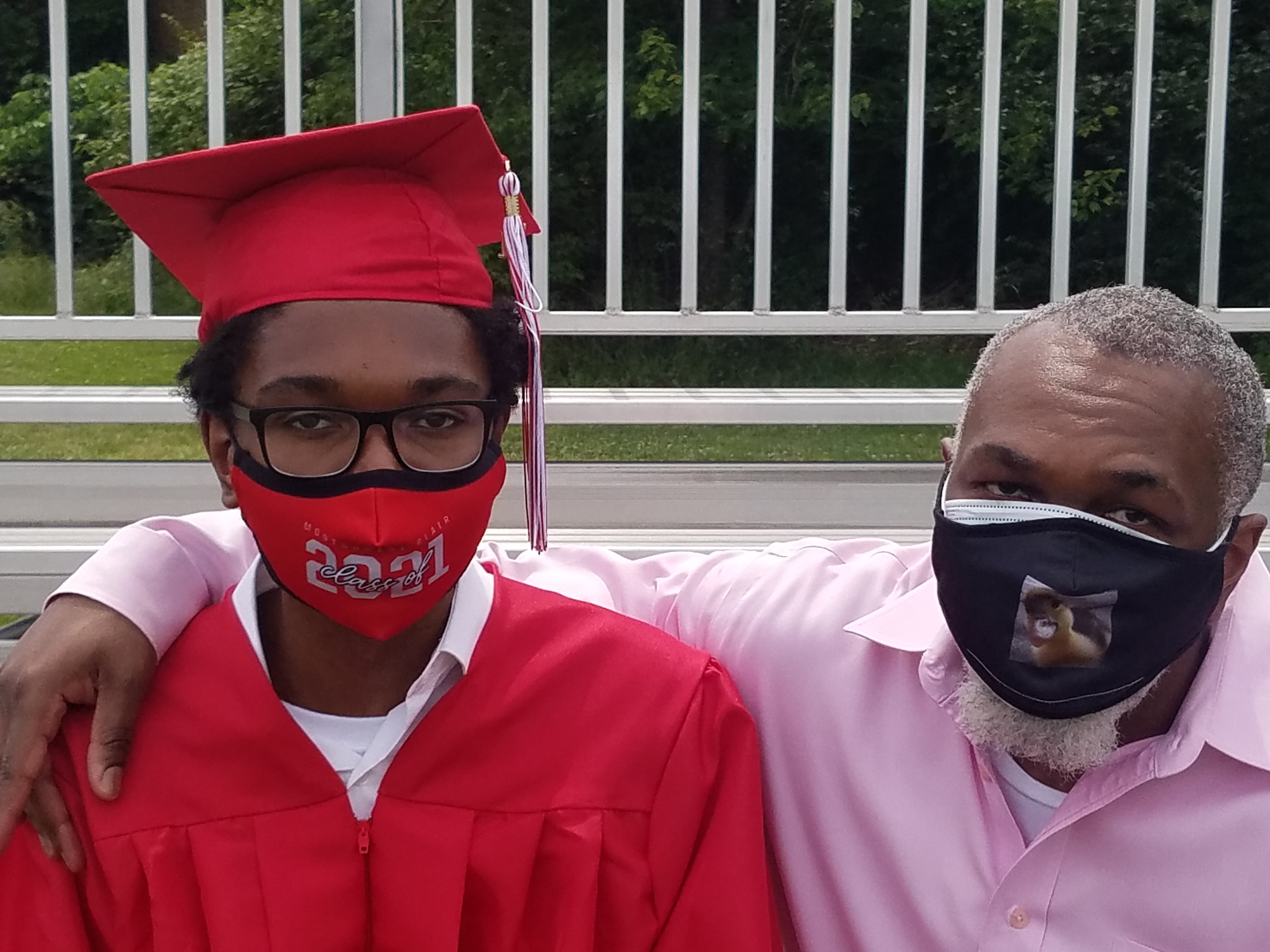
Noah and me, stuck in a post-graduation moment, Montgomery Blair HS, Silver Spring, MD, June 2, 2021. (Angelia N. Levy)

Hard to believe but still true. Today, our son graduates from high school, nearly 34 years after my own high school graduation, or three cicadas cycles (1987, 2004, and 2021). In between has been “my second childhood” of Pittsburgh, undergrad and grad. In between was learning how to be comfortable in my own skin, dating, marrying. In between was my beginning to reject so much of the fear and bs that my parents and idiot guardian and others fed to me. Otherwise there would be no graduation of our soon-to-be 18-year-old son to celebrate, no reason to work to be an example to him about building and walking a path, no misogynoir or misogyny to give up.

I have only been alive for four cicadas cycles (1970, 1987, 2004, 2021), our son in the middle of number two. Most humans in this part of the world don’t get to see more than five cycles (I’d have to make it to 85 to see my sixth cycle, and who knows what the US would be like by then). 

But there’s symmetry here. I was in my first year of life when I likely saw but could not possibly remember my first cicadas. So was our son in the late spring of ‘04. I graduated high school in the middle of the cicadas’ mating season in ‘87. I vaguely remember them. I walked so far and so fast in those days. My headphones and my Walkman were practically glued to my ears and left hip and belt. I may have noticed the unceasing chirring and flying and crunches a time or two. But I walked at Warp Factor 3 or 5 blasting Genesis, White Snake, Whitney Houston, or U2 through your ears down one Mount Vernon street or in Co-Op City or somewhere in between. The cicadas’ were mostly a crunch speed bump on my way to obsessive heartbreak and on my way to college and Pittsburgh.

Our son’s path has been bumpy, and not just because he walks at a tortoise’s pace. He’s not a big fan of school. Nor does he have the fight-or-flight instincts I had when I was his age, well-honed from years of trauma and living in a place where no one cared how broken I was. His musical tastes barely register on the decibel meter. He often claims he likes “nothing,” but I’ve found him bopping to The Brothers Johnson’s “Strawberry Letter 23” and Hall & Oates’ “Private Eyes” and Haddaway’s “What Is Love” in recent years. He apparently does like one indie rock band, Bloc Party, a UK group.

Music has changed so much over the past three cicadas cycles. So has our world. When I graduated nearly 34 years ago, Cameo’s “Candy” and “Word Up,” Geto Boys’ “Mind Playing Tricks On Me,” U2’s “With Or Without You,” Luther’s “Stop To Love,” Europe’s “Final Countdown,” and Whitney’s “I Wanna Dance With Somebody” were the sappy hits of the moment. Yet some songs were subversive, and deliberately so, like “With Or Without You” (who thought this song was about romantic love? — certainly not me!), Genesis’ “Land of Confusion,” and Prince’s “Sign O’ The Times.” And there was the music that as a 51-year-old I’ll admit I knew was wack and lame even at the time, including anything by Glass Tiger or Starship. The cicadas must have loved it when I warped by blasting this schlock.

Our son might not like much music, but it isn’t because we don’t play any at home or in the car. We play the music we grew up around, the music of our adult choices, the music we listened to despite and because of our parents. Blues, gospel, real R&B, rap, hip-hop soul, punk rock, heavy metal, ‘80s pop, ‘90s pop, grunge, jazz, smooth jazz, emo, country (that’s my spouse, definitely not me), and yes, even BTS. All are welcome to the eclectic music party. Maybe that’s why he doesn’t feel the need to pick a genre. Our family is a jukebox, er, iPod, no, um, iPhone and Spotify of sounds. That’s not something a Walkman or 700 billion cicadas can duplicate.

But I also keep in mind two things. One is that from our son’s perspective, JLo’s On The 6, Coldplay’s “Clocks,” even Kanye’s The College Dropout is the growing-up-as-a-zillennial equivalent of The Beatles’ “Let It Be,” Diana Ross & The Supremes’ version of “Ain’t No Mountain High Enough” (Tammi Terrell and Marvin Gaye did the original), and Marvin Gaye’s “Inner City Blues” via his What’s Going On album was for me at 17. It took me years to appreciate the music, understand what it was always trying to say to me. Hopefully, with enough luck and time, our son will get there. Hopefully with enough cicadas cycles, so will our world.

Especially with the second issue. Have you heard the music of the past decade? BTS is fine, but will peak as all glambands do at some point. Between SZA and RZA and Sia and H.E.R. and Lizzo and J. Cole and Lil Nas X (love him, btw) and so many others, I’m longing for the days of Solange. I know, so five years ago. No instruments, no good lyrics, and aside from Lil Nas X and The Weeknd, not much subversiveness, either. A wall of sound that seems indecipherable, like the cicadas this morning. Hopefully, our son will decipher it all, for himself, if not for any of us.

The Start of the “Shalom Aleichem” Years

13 Tuesday Apr 2021

Posted by decollins1969 in 1, Boy @ The Window, Christianity, culture, Eclectic, eclectic music, Hebrew-Israelite, Jimme, Marriage, Mount Vernon New York, music, New York City, Politics, Pop Culture, race, Religion, Youth

≈ Leave a comment

Tags

Boy @ The Window Years, Cults, Family Drama, Friendships, Social Suicide


Primary Names of God in Hebrew, October 2018. (https://www.chabad.org).

This week 40 years ago brought an avalanche of changes to my already unstable world. I wouldn’t have noticed the instability, though. I believed my bubble of Mount Vernon and the NYC was pretty stable back in mid-April 1981. I had friends who I could talk to and debate with all day. I saw my father about once every three weeks. I was starting to get into mainstream popular music, and had some interest in sports. I liked a few girls here and there. I was doing well in school. I was doing well in general, with my stepfather separated from my mother for the previous six months. So well that I’d forgotten my sexual assault trauma from 1976. So well that even the bullies around my block hadn’t tried to stone me to death or beat my face in for nearly seven months.

But Maurice came back as “Judah ben Israel,” and the brief years of worldly enlightenment came to a crashing halt. I tell this story in Boy @ The Window this way:

This was the religion my stepfather converted to after he and Mom had separated. In the period before his return, my stepfather had been working on Mom, attempting to convince her that he was now a good man and could be trusted as the man of our house. He loved Jehovah, had stopped smoking, and had learned how to love himself. And he had changed his name to Judah ben Israel, not legally, mind you. The name literally means ‘Lion of God and of Israel,’ and referred to my stepfather as a royal descendant of Jacob/Israel, the immediate father of the Israelite people. It was in this context that my stepfather gained a sense of himself and control over his world, which was what convinced Mom to end her separation from him.

I was so confused that my brain felt like it was on a carnival ride. Really? This is what we are doing now? We’re still a family? What about my dad?, I thought. But people desperate for an identity that defies the beliefs of White folk often take desperate, cultist measures.

This week 40 years ago, Maurice worked on me and my brother Darren to take this Hebrew-Israelite bullshit seriously, which meant threatening us with ass-whuppins if he found out we weren’t wearing our kufis or yarmulkes at school.

The next step, of course, was our acceptance of the Hebrew-Israelite religion. This wasn’t exactly a process in which free will was involved. Our mother told us that this would be our religion ‘for the rest of our lives.’ Then our stepfather came to explain this ‘way of life’ to us, and we put on our white, multi-holed, circular kufis for the first time. I had no idea what Mom and Maurice had pushed us into. A part of me was on the outside looking in, thinking, This is crazy! But as nutty as this sudden conversion seemed, I convinced myself into acceptance. We were already the children of one divorce, and I wasn’t sure if I wanted to see another one so soon. Darren, to his credit, played along as if being a Hebrew-Israelite was just a role in a school play.

I went to the school the following Monday with my bright white kufi on top of my head for the first time. Talk about committing social suicide! The expressions on my friends’ faces, from completed stunned and disgusted to eyes that revealed what their set faces attempted to conceal. I was immediately an outcast, especially as far as my best friend Starling was concerned. Once I explained to some of them what had occurred the week before, they seemed to get it, even if they kept me at ulna’s length. They still said “Hey Donald. Wassup?” the way they did before.

Not Starling and some of our mutuals. He saw it as my betrayal, not just of him, but of God himself. Such are the inflated egos of children of preacher-men. His weeks of silence led to a fight (which he won) and the end of our two-year friendship.

But the friendships and my within-normal-levels weirdness came to a crashing halt the moment I decided to allow myself to be a canvas my mother and stepfather used to express their eccentric yearnings for identity. It was the worst three and a half years of my life, with child abuse, another sexual assault, the fall into welfare poverty, suicidal ideations and one suicide attempt included.

My brother Darren handled the situation so much better than me. “Darren, to his credit, played along as if being a Hebrew-Israelite was just a role in a school play,” is what I wrote. He only wore his kufi at 616 and whenever he was out and visible to my stepfather’s peeps. Otherwise, the hat was off his head. But then again, Darren attended The Clear View School, where no one would have cared what he wore.

Yes, it is important to remember the past. If only because it is a reminder that, pandemic or not, there have been worse times in my life. I’m so glad that I haven’t worn a kufi in nearly 37 years.

Music of the Dystopia

25 Wednesday Nov 2020

Posted by decollins1969 in 1, Academia, Boy @ The Window, earth, wind & fire, Eclectic, eclectic music, Mount Vernon High School, music, New York City, Politics, Pop Culture, race, Religion, Youth

≈ Leave a comment

Tags

"Cry Freedom" (1997), "Fantasy" (1978), "Land Of Confusion" (1986), "Silent Running" (1985), "Welcome To The Terrordome" (1990), "Zombie" (1995), Afrofuturism, American Dream, Dave Matthews Band, Delusions, Dystopia, Dystopian, Genesis, Mike + The Mechanics, Narcissism, PE, Public Enemy, Self-Reflection, Silent Running (1972), Subversive Music, The Cranberries, The Matrix (1999)


Screen shot, Silent Running (1972) poster, November 24, 2020. (https://www.imdb.com/title/tt0067756/mediaviewer/rm3505217792/).

Music has nearly always been a dreamscape from which I could envision alternative histories, sense multiple futures, uncover possible presents, feel and find my best self.

It has also been a place for revealing the naked, uncomfortable truth of humanity’s existence in real life. If one were to take the music of the late 1960s and first half of the 1970s, the R&B that clearly outlined the combination of migration, poverty, heroin addiction, the Vietnam War, police brutality, unemployment, miserly government social welfare and urban living would be one way to go. If one were to take the eclectic British and Irish pop and rock of the 1980s, those folks illuminated the connections between rising conservatism, austerity meant to cut the social safety net, and the normalization of government oppression, corruption, and infiltration into the private lives of everyday people.

It all adds up to one simple yet very scary truth. Our world, the one in which my mother birthed me, the one in which I have grown up and grown older, has always been a dystopia. That’s it. All this talk of technological innovation, of moral and philosophical advancements, of a post-World War II, West-led democratized, globalized, capitalist meritocracy is simply The Real-Life Matrix pulling the dystopian world over our deluded, narcissistic eyes. And nearly everything in the world of mainstream news and journalism, in everyday national and international politics, in formal education systems, and in every single iota of American and global popular culture.

Except in the occasional and deliberate attempts made by artists and authors to expose the underworkings of this Matrix. I have written far too much about those authors of late, from Sarah Kendzior, Mona Eltahawy, and Leta Hong Fincher to Kiese Laymon, Ta-Nehisi Coates, and Derrick Bell. Truth is, I felt and sensed this truth in music even before I had read Aldous Huxley, George Orwell, or William Faulkner’s short stories about racist White men sleeping in beds for 20 years with the dead bones of their incestuous mothers. Marvin Gaye’s “Inner City Blues {Make Me Wanna Holler),” Stevie Wonder’s “Living For The City,” and Donny Hathaway’s “The Ghetto” brought the dystopian of Black life in the US to my attention long before I knew what the prefix dys- even meant. The contrast between this and the Afrofuturism of Earth, Wind & Fire’s “Fantasy” and “Boogie Wonderland” of the late-1970s wasn’t lost on me, even though it would be nearly 15 years between these songs and my reading of Octavia Butler’s Kindred.


But the 1980s hit me and my family as hard and fast as a government coup in Brazil or in Trump’s version of the US. It’s wasn’t just that it was our apocalypse. It revealed that the American Dream was a nightmare for so many people. It opened up my 100 billion neurons to the possibility that there could be no American Dream, no rise of the West, no Euro-American hegemony over the world without it being a dystopia for billions of people in the US, in Europe, and around the world.

It was also the decade of the Ethiopian famine of 1983-85, “We Are The World,” Bob Geldof and Live Aid, Farm Aid, and protests for South African divestment. So it seemed normal for groups of White guys in bands to write music, play instruments, and belt out lyrics like the ones below from Mike + The Mechanics’ “Silent Running” (1985).

Don’t believe the church and state
And everything they tell you
Believe in me, I’m with the high command

The post-apocalyptic movie of the same title from 1972 was apparently on Michael Rutherford (guitarist of Genesis), et al.’s minds when they decided to work on the lyrics for this song. The idea that someone from the future would communicate with their ancestors in the past to resist the forces of totalitarianism and propaganda in order to preserve the path to a better future? Boy does that sound like the stuff of Octavia Butler, Derrick Bell, Kiese Laymon, and Colson Whitehead (not to mention, Tomi Adeyemi in her Children of Blood and Bone), where ancestors and descendants can somehow have confabs in real life! All in an effort to swap ideas, to conjure up solutions before we understood the problems, to recognize that time is nonlinear, and so are we.

As a teenager who saw more than most that the Reagan Years were part of the dystopian present, and not a return to American greatness, “Silent Running” was refreshing, if also incredibly scary. I was like, if these White guys from the UK and Ireland get it, then why don’t folks in America get it? At least, the folks I saw at school and in running my errands every day.

But it wasn’t just Mike + The Mechanics. A lot of music from the 1980s and 1990s was subversive, including the more obvious Springsteen and the E Street Band’s “Born In The U.S.A.” and John Mellencamp’s “Pink Houses” to KRS-One and Boogie Down Productions, Alanis Morrisette, and The Cranberries. It was just that the less subtle, the Billboard Top 40 hits and the B-side non-hits stood out for their double-meanings. When I stripped away the male bravado, the love and the lust and the loneliness from the repertoire of rap, R&B, hip-hop, and ’80s pop I listened to, the subversive was the remainder.

In my family-level apocalypse and resistance against my stepfather, the subversive helped. In the disconnect between the normalcy of magnet-program-learning among a cabal of Benetton-commercial-wannabes, the undercurrent understanding that this fakery belied a world very much like the one in The Matrix. The lyrics, the synthesizers, the heavy guitar strums and the drum rolls meant something different to me than anyone I knew growing up could imagine.

It wasn’t just “Silent Running” for me, nor something that hit like a sledgehammer like Genesis’ “Land of Confusion” that hit the radio waves my senior year of high school. There were others. For more than a decade, there were others, including:

  • PE, “Welcome to the Terrordome“
  • Sting, “Love Is The Seventh Wave”
  • Dave Matthews Band, “Cry Freedom“
  • The Cranberries, “Zombie“
  • Peter Gabriel, “Biko” and “Shaking The Tree”
  • Des’ree, “Crazy Maze“
  • James Blake, “No Bravery”
  • Seal, “Future Love Paradise” and “People Asking Why”
  • U2, “Bullet The Blue Sky”
  • Arrested Development, “Tennessee”

In the years after I finished my doctorate, I didn’t forget these songs, and may have taken on some more obscure ones by Floetry, Coldplay, U2, Bryan Ferry, Pharcyde, The Fugees, among others, along the way. Popular music has become more vapid and craven and corporate as the leaders in our world have made their taste for a dystopia that advantages them more and more obvious. This position is probably why I can’t find a nod to the dystopian in Rihanna, Cardi B, Chance the Rapper, Rick Ross, Beyoncé, Gary Clark, Jr., or Chris Stapleton (although Solange’s and Missy’s music videos at least contain subversive and dystopian wisps).

This world is the dystopia that has always been. And those of us who talk to ourselves while speaking out at the same time have been trying to get everyone else to see it and sense it all along. I should know. I’ve been talking to myself since my week of homelessness at 18, and speaking out as the world has lurched itself toward calamity for nearly as long.

About That Time at Van Cortlandt Park, and Other Bricks in the Wall…

28 Monday Sep 2020

Posted by decollins1969 in 1, Boy @ The Window, Christianity, culture, Eclectic, eclectic music, Hebrew-Israelite, High Rise Buildings, Jimme, Marriage, Mount Vernon New York, music, My Father, New York City, Politics, Pop Culture, race, Religion, Youth

≈ Leave a comment

Tags

"And The Beat Goes On" (1979), "Another Brick In The Wall (Part 2)", "Good Times", "Love To Love You Baby", "Rapper's Delight", "Take Your Time (Do It Right)", 616, 616 East Lincoln Avenue, Autocracy, Barbra Streisand, Chic, Donna Summer, Frank Sinatra, Friendships, Kool and The Gang, Luther Vandross, New York, Oppression, Pink Floyd, Queen, Repression, SOS Band, Stephanie Mills, Sugar Hill Gang, Teddy Pendergrass, The Clear View School, The Whispers, Tré


Van Cortlandt Park screen shot (parade grounds, cropped), June 4, 2020. (https://www.thisisthebronx.info/a-van-cortlandt-park-living-room-picnic/).

I don’t consider myself to be a seer. Not exactly. I might have gotten a thing or 1,000 predictions correct in my life. But since I usually prefer to expect good outcomes, I do not indulge the dreams I have of destruction, or the muses who conjure the possibilities of apocalypse, whether for me, my family, or at larger scales.

But the last half of 1980 was different for me. I’d come into my own as a kid. I finally had a posse of classmates and friends, between the two Joes, Starling, Chris, Ronald, Vanessa, Eric, Ray Ray, Sean, Lajuan, and Dahlia, among others. I was kicking ass academically, and was on the verge of discovering other talents, including writing. After my last summer camp with Darren at Clear View, and rereading the late Lerone Bennett Jr.’s Ebony Pictorial History of Black America, I understood my Blackness, really and truly, for the first time.

But I chose to see the glass as half full, both for myself and for Black folk in the US. Why wouldn’t I have? Somehow, in the middle of what I call “deep summer,” when the previous school year and the start of the first day of the next school year are about equally far away, it happened. My stepfather Maurice got a call from his music-obsessed friend Dennis (who was also a professional musician, by the way) in the middle of a Sunday afternoon in mid-August about going to some concert in the park in the Bronx. There was no mention of who the headliners were. I just remember playing Peanuts Land with my Matchbox cars and driving down along the shoppes in the nightlife district of the city underneath my bed when Maurice came in and rushed us to get dressed.

Mom, Maurice, Darren, little Maurice, and me. We piled into a cab over to Van Cortlandt Park, where we met Maurice’s friend Dennis. He knew a couple of the headlining people who were playing. I don’t recall tickets, but I do remember flyers everywhere. It seemed like this was a spontaneous gathering, where people somehow knew where to go and where to gather. I remember it being sometime around 7 or 8 pm when the jamming began, with all the music of the late-1970s and 1980. It was mostly an MC mixing a string a songs together, between Chic and “Good Times”, The Whispers’ “And The Beat Goes On,” and Michael’s “Off The Wall.”

But maybe 45 minutes in, three guys got on the stage to do their performance, Sugar Hill Gang, and the crowd of hundreds erupted into a roar as they rapped to “Rapper’s Delight.” They did a bunch of songs beyond the “a hip, hop/the hippie, the hippie/To the hip hip hop/a you don’t stop…” I was into it like everyone else, doing my terrible version of a Michael Jackson dance routine while clapping my hands to the beat. Sometime between 10 and 11, we left, I think, between a cab and Dennis giving Maurice and Mom and little Maurice a ride home. Even Mom looked like she had a good time. It would be just about the last good time we would have as a sort-of-family.

But the music didn’t stop with Van Cortlandt Park or the Sugar Hill Gang. The spring and summer of 1980 was the transition to a new decade of music, as homophobes from New York to Detroit and L.A. had spent the past year killing disco by smashing vinyl and smashing in Toyota Corollas and Datsun Zs. (By the way, for those who are still kicking and screaming over Cardi B and Megan Thee Stallion’s “WAP,” go on YouTube and listen to the late Donna Summer’s “Love To Love You Baby“. It’ll probably make you question the meaning of your false sense of morality.)

Kool and The Gang had crossed over with “Ladies Night,” and were about to walk the fine line between success and selling out with “Celebration.” All summer on the bus back and forth from Clear View with Darren, SOS Band’s “Take Your Time (Do It Right)” was on at least once a day. There was also Teddy Pendergrass, the one, the only, and emerging, Luther Vandross’ “Searching” (yes, not his official solo debut, but), and of course Stephanie Mills with “Never Knew Love Like This Before”. And all that because my father had introduced us to Toni, a new drinking budding of his, herself a professional singer. Not to mention, a couple of bartenders in Mount Vernon and in the Bronx who didn’t mind a 12 and a 10-year-old sitting around on off nights in July and August.

On the AM side of things with 770 AM WABC radio, there was still Billy Joel, Kenny Loggins, Barbra Streisand and her collabs with The Bee Gees, “Guilty” and “Woman In Love.” Frank Sinatra’s “New York, New York” was the second half of the summer of 1980, old and yet new, at least to me.

But as that summer moved into fall and 6th grade, I sensed something was changing, and not for the better. I sensed it in music, more than I did with Jimme’s alcohol abuse and fewer visits, more that even in Mom’s inability to keep food in our stomachs or in her failing marriage with Maurice. The music seemed more sinister, less hopeful, darker somehow. Queen’s “Another One Bites The Dust” somehow conjured “No mas! No mas!” and Roberto Duran giving up against Sugar Ray Leonard that November, the same month Reagan beat a beat down, haggard Jimmy Carter in the 1980 election. The beginning of four decades’ worth of hollow promises to White Americans, millions willing to sell the rest of us to Hell for their macabre pleasure and some tax breaks.

But no song signified the transition of the US for me in 1980 more than Pink Floyd’s “Another Brick in the Wall”. It was likely the first true music video I ever saw, courtesy of my 616 friend Tré, who lived on the second floor. I spent a lot of time hanging with Tré, his older sister Renee, and her friend Stephanie (who I had the tiniest of crushes on, but I digress). It was during the months after Maurice and Mom had separated, with him taking the TV and a month’s supply of mail-ordered meats out of our two freezers. Tré, Renee, and their mother made me feel welcome between that first Saturday in October and when the Hebrew-Israelite bullshit began six months later.

“We don’t need no education. We don’t need no thought control…” It was about much more than strict teachers and social control over students. It was a prediction of a future, my future, our collective futures. That’s what I thought about this time 40 years ago. I had conversations with my classmates about this, about Reagan, about double-digit inflation and unemployment, about the Iran hostage crisis, about the rumors that the US had given Israel nukes, and Israel had, in turn given nukes to apartheid South Africa. “You’re so weird!” they’d say. Or, more often, “You worry too much, Donald!” Only Starling understood. But he expected me to “become one with Jesus,” as if Jesus alone could stop me from worrying about the future.

In short order, the Reagan Years came and gutted the relative economic security of the US, disrupting the shaky gains Blacks had made in the years between 1946 and 1980. Mark David Chapman murdered John Lennon to ring in the holidays, and Blondie’s Debbie Harry badly rapped her way through their January 1981 hit “Rapture” while Mom began to talk about being raptured up for the first time. My family was at the edge of an abyss, a mini-apocalypse that would ultimately transform all of us. It would certainly sidetrack me from my calling as a writer for years to come.

But the world didn’t stop spinning. Nor did life stop handing me days of happiness, of contentment, of miracles and even some joy. It just meant that I would be more cautious, anxious, depressed, worried, on edge. Because America believes itself above reproach, even as it deals in shit and blood, and drags the rest of us into the burgundy-soaked muck with it. The distance between 1980 and 2020 might be 40 years, but with Trump and his army of minions, I might as well be in the same moment. Only, I’m 50 now, and I know much better about listening to my inner voice and my muses.

Who’s Afraid of the Big, Bad P(Vagina)y? Men, in a Word

13 Sunday Sep 2020

Posted by decollins1969 in 1, Boy @ The Window, culture, Eclectic, eclectic music, Mount Vernon New York, music, Politics, Pop Culture, race, Religion, University of Pittsburgh, Youth

≈ Leave a comment

Tags

"WAP", 616 East Lincoln Avenue, Black Feminism, Cardi B, Coming-of-Age, Feminism, Human Anatomy, Hypermasculinity, Masculinity, Maurice Eugene Washington, Megan Thee Stallion, Misogynoir, Patriarchy, Pussy, Self-Awareness, Self-Reflection, Stepfather, Vagine, Vulnerability, Weakness, William H. Holmes Elementary


Layered anatomy of the anatomical male and anatomical female body, June 5, 2016. (https://naturopathicdoctorwizangwira.wordpress.com/).

The first time I became self-aware of myself as a male with male parts was when I was five. At our second-floor flat on South Sixth in South Side Mount Vernon, New York, sometime in the summer of 1975, I walked in on my mother in the bathroom. She had just finished peeing and was wiping herself. All I could do was stare at her vagina area, seeing mostly what wasn’t there. “Maywa,” I said (a mash of my mother’s name Mary with Mom) “what happened to your pee-pee?” My mother explained that she didn’t “have a pee-pee” — without explaining why she didn’t have one. “When I get some money, I’m gonna go to the pee-pee store and buy you one,” I responded.

There are maybe 20 stories growing up where it seems me and my mother both share and end up smiling, with a sense of real warmth and affection, and not just base-level love, and without irony or a hidden sense of jealousy or disdain. The pee-pee story is one of them.

But this is more than just about the time before sexual assault, domestic violence, child abuse, neglect, and a massive slide into poverty changed my sense of the world. It’s about how men learn to fear all things vagina and vagina-related, and how that fear so easily turns us into misogynists and misogynoirists. It’s about how we as men fail to educate ourselves about women, about patriarchy, and ultimately, about who we are and who we need to be to end patriarchy.

A few years after discovering the differences between the anatomically male and the anatomically female, I knew a bit more, in both an intellectual and social sense. I no longer accidentally danced under my mother’s and other older women’s dresses at the parties my mother took us to when I was five and six years old. I guess if you get slapped upside the head enough times, you recognize why acting like you’re playing hide-and-seek with your mother’s dress as a prop might be socially inappropriate.

But that’s not all. By 1978 and 1979, we had World Book Encyclopedia at 616. Once I began plowing through it to learn all I could — and not just as a way to punish my mother for punishing me — I learned even more about the body than any eight or nine-year-old ought to learn on their own. The “Human Body” section contained celluloid slices of the male and female body, which would layer together to form a full body. From bones to muscles, from muscles to blood vessels, from blood vessels to nerves and organs and systems, and then to derma and coverings for orifices.

I remember the reproductive system either being the last or among the last of the sectional celluloids to form a male or female body. I learned about ovaries, testes, scrota, urethras, and vaginas long before I could say these words correctly. This also meant that I understood where babies come from, without fully understanding the drive that led to human reproduction.

A year later, near the end of fifth grade at William H. Holmes ES (I think it was the third week of May 1980), me and my classmate Joe were on our way home (we both lived in the A section of 616). We were talking shit about girls, about boys, about life in general, maybe with a few “yo’ mama” jokes thrown in. Suddenly, Joe hits me with the question, “Have you ever seen a pussy before?” “No!,” I lied, and loudly too. Joe teased me about it, saying, “You can’t even say ‘pussy,’ can you?” I just laughed it off, not knowing what to say, really. Even at ten, I knew enough to know I couldn’t reveal I’d seen my mother’s vagina at five or that I had seen the encyclopedia’s White female rendering of one.

I didn’t use the word at all until June 1988. It was after I escaped yet another attempt by my idiot stepfather Maurice to make me see him as my father through the use of his fists. He ended up falling into a tub of bathwater meant for my youngest siblings Sarai and Eri. What made this even more ridiculous? This was after my first year at Pitt, a year where I knew more than enough about the world, about the predicament at 616, and about myself to recognize I didn’t have to put up with this bullshit. But I slid back into my old role as teenaged man-child anyway.

This was what happened afterward, via Boy @ The Window

All I kept muttering to myself was, ‘I’m a pussy,’ because I still could’ve gone to the cops for his attempted assault. After a couple of minutes, he said, ‘Get this through your head, boy. Me and your mother are happy together, and we’re gonna be together long after you leave here and go out in the world. The world’s a dangerous place, and we’re just gettin’ you ready for it.’
Huh? What? I knew not to laugh right then, but I was laughing at him on the inside. I knew right then that him and Mom would be over sooner rather than later.

Even in that moment, it felt weird to call myself “a pussy.” I never saw myself as weak, or women in general as weak. It didn’t occur to me that I was afraid, not of getting beat up or of being weak. I was afraid that I would never become the person I wanted to become. I was afraid that mfs like Maurice would continue to come at me because they saw the version of me that I presented at 616, the shell that seemed weak, just like how they saw women, just like how they saw anyone with a vagina.

This is the fear of all boys and men unknowingly or fully conscious of the patriarchy, masculinity, and the world, of folks on the verge of misogyny, misogynoir, and hypermasculinity. The fear of being seen by other men and women-as-patriarchy’s-footsoldiers as pussies, weak in body, mind, and spirit, and therefore as exploitable to the point of being used as a punching bag.

This was why there was such a ludicrous outcry over Cardi B and Megan Thee Stallion’s “WAP” last month. The responses weren’t about Christianity and morality. Not really. They were about the need to keep women from freeing themselves and their vaginas from the clutches of patriarchy. The angry gasbags on Instagram and Twitter venting their spleens were expressing their need to keep women and their pussies in a locked box, fully under the control of men and women-as-patriarchy’s-footsoldiers, for use only in case of wanting to make a sanctified baby (especially White ones). Anything short of this total control weakens men, weakens patriarchy, and makes us vulnerable to questioning ourselves.

The truth is, heterosexual men especially are scared because we as a group cannot be as strong as women, queer/transgender women included. None of us can be strong when we refuse ourselves the right of vulnerability, the need to feel feelings aside from anger, rage, and bravado, the courage of solidarity and love, and the humanity of affection with and for others — including for the men in our lives. This isn’t just about men needing to cry when in each other’s presence (although I am more than sure that would be helpful for millions). It’s about the need to connect with the parts of ourselves that we refuse to acknowledge. For most men, it’s as if we are all M1 Abrams tanks, ready to kill and destroy at a moment’s notice.

But as so many Black feminists in my life have reminded me over the years, the vagina is a really strong muscle. After all, the vast majority of humanity has passed through one on the way to being born. It is a muscle that can be strengthened, stretched, and even repaired, something we as a species and world so desperately need. Try as men might, there are no dick exercises in which any anatomical male can do reps with his penis and build strength. At least not yet.

Constantine’s, No Longer Around, Missed Anyway

19 Wednesday Aug 2020

Posted by decollins1969 in 1, Academia, Boy @ The Window, culture, Eclectic, eclectic music, music, Pittsburgh, Pop Culture, race, Religion, University of Pittsburgh, Youth

≈ Leave a comment

Tags

1990s Hip-Hop/R&B, 1990s Rap, Coming-of-Age, Constantine's, Dance, Dancehall, East Liberty, Fights, Grad School Days, Graduate School, Hypermasculinity, Misogyny, Observation, PE, People-Watching, Pitt, Public Enemy, Reggae, Self-Reflection, Sexuality, Voyeurism


The East Liberty CVS on Penn Avenue (where Constantine’s once stood), August 2017. (Itay Gabay via Google Maps).

“Last call for the alcohol!,” the half-bartender, half-bouncer would yell about 20 minutes before the two o’clock closing of the hole-in-the-wall joint that spend a few too many Wednesdays, Fridays, and Saturdays in between the summer of 1991 and January 1995. It was my time “bein’ around my peeps,” sitting around to nurse two or three drinks, dance, people-watch, and occasionally go back home with a patron. It was my time to not think about what I feared, especially God and graduate school. It was my time to forget that I was the second of six kids who had the triple responsibility of father figure, oldest brother, and caregiver. Mostly, it was just a place to allow my horny and bored-with-the-world ass hang out and not be so intellectual and weird all the time.

Constantine’s was where the East Liberty CVS on Penn Avenue in Pittsburgh now sits. It was less than two blocks from where I lived on Penn Circle South, my first on-my-own flat that I didn’t have to share with no one. I have no idea what was there in that rickety and beaten up old one-floor building before Constantine’s. Maybe it had always been a bar or a club, one that had seen better days in the decade or two before I was born. Maybe it was once a hardware store or a dry cleaners. Who knows?

All I knew was, in the month or two after I moved into my Penn Circle South studio apartment, I stumbled onto the place. It would’ve been October 1990, just cool enough for Pittsburghers to start wearing winter gear, Steelers jerseys, and enough Steelers and Pirates pleather and leather to scare a herd of charging bulls. A group of 20-somethings were packing their way through Constantine’s front door. There was a bouncer, I guess, checking IDs to make sure everyone was over 21. Judging by the way some of the youngest women were made up, though, I didn’t think the bouncer was consistently checking folks.

I didn’t go in that day. Too many bills, not enough money, and too many thoughts about What would Mom think? and What temptations would harm my soul? So I forgot about the place for the remainder of my senior year at Pitt.

It wasn’t until I started having problems with my friend E during my first full summer living in the ‘Burgh in ’91 that I started carving out me-time at Constantine’s. I went in on a sweltering mid-June Wednesday, and as would become ritual over the next 3.5 years, the so-called bouncer didn’t check me for ID. The joint was tacky as hell. The tables and chairs on the left were either plastic or plywood, Kelly green or harsh white.

Ving Rhames in Dave (1993), Screen Shot, August 17, 2020. (https://MovieActors.com).

The barstools on the right were of better quality, up against a bar with a prickly middle-aged-looking Black dude who maintained his fresh Ving Rhames-in-Dave (1993) haircut under any and all circumstances serving drinks. He was so mercurial. He could be, “Wassup man? How you be?” one Saturday, and “We don’t serve your kind!” another. One Friday, I ordered a screwdriver (Vodka and O.J.) without any pushback. The next Friday, he was all like, “Muthafucka, just call it a vodka and orange juice! I don’t mix screwdrivers here!”

There was a well-proportioned Black woman who always, always, always, sat in the middle of seven barstools, just to the right of the cash register. She was maybe about five-two, skin the color of mahogany, her hair in a ’90s-style perm or in ruffles. She either wore skin-tight dresses or jeans with a revealing blouse, never danced, and rarely greeted anyone. I figured she was either the gruff bartender’s girlfriend or that Constantine’s was her favorite watering hole. Whatever. She probably could drink the entire group of men (and sometimes women) who hit on her every night under the table and under the concrete foundation, too.

Much of what remember from my Constantine’s outings were the fights. There were so many fights. Fights between two guys over a woman would break out in the middle of the dance floor one Friday or Saturday after another. I once saw a guy beaten until there was a pool of blood in the center of the floor, with a trail of blood leading into the alleyway that led to the side entrance of my apartment building. It wasn’t unusual for women to throw down either, knocking each other out somewhere between PE’s “Can’t Truss It” and Daddy Freddy’s “We Are The Champions.”

Speaking of the music, it was the early ’90s, so the vibe went from New Jack Swing, Babyface and Tony! Toni! Toné! to Jodeci, MJB, and PE, with bits of Kriss Kross, Tribe Called Quest, Naughty By Nature, TLC, Dre, MC Lyte, and LL Cool J thrown in. But it was reggae — specifically dancehall — and gansta rap that was mostly in our ears at Constantine’s for most of my time attending. Shabba Ranks was so big at Constantine’s. So was Patra and Buju Banton and fake raggamuffin Shaggy. Outside of Pitt, I didn’t know African Caribbeans lived in Pittsburgh until I started sipping drinks at Constantine’s.

I also didn’t really know how to dance until I started hanging out at this smoked-filled and slick-floored destination. I went on the floor maybe once every three trips. Sometimes I was more interested in observing than in participating. Sometimes I was too stressed and horny to do anything else but stare at faces, breasts, hips, and asses for a few hours. But I did dance, at least, as best as I could. I used my halfway decent post-up moves from the basketball court as the basis for decent footwork. But, as I began realizing that some of the women wanted to grind, I learned how to do that too.

I had some awkward moments. Like the time my Swahili instructor and I found ourselves at Constantine’s one really warm Wednesday night in the fall of ’91. He had a woman on each arm. All three of them were from Tanzania, not the typical group of Constantine attendees. We greeted each other, and proceeded to ignore each other the rest of the night. Class the next afternoon was pretty much about my and his after-hours habits.

Sometimes I almost got into it with a guy here or a woman there because I looked at them the wrong way, said the wrong thing, sounded too educated or “White,” or because someone’s conversation with me ran on too long. In 1992, one woman laughed at me and kicked me in my rear on my way out the door after I revealed that I was “also working on my master’s” — she obviously didn’t believe me. Until she saw me on campus a week later. After that, I lied, and told folks who asked that I was a “part-time college student.”

I was too young, stressed about grad school and life, and excited and aroused to be scared. I should’ve been. On two occasions, someone threw a large liquor bottle in my direction when I was on my way out of Constantine’s. One other time, I swear, a bullet whizzed past me and into the window of a parked car.

The last time I went to Constantine’s was the beginning of February ’95. I kid you not, they were running the place with a portable electric generator plugged into an outdoor outlet — someone hadn’t paid their Duquesne Light bill. It kept the lights even dimmer than normal. There was no heat. This is a bar in Pittsburgh, before climate change made American winters into the wet season in Guyana. It was 15 degrees Fahrenheit that day, and it felt like it at Constantine’s that night, even with nearly 30 dumbasses like me in the bar that night. I left after 45 minutes.

Three days later, I was in Washington, DC, working on my dissertation project. When I returned at the end of March, Constantine’s was gone, bulldozed to make way for East Liberty’s first CVS.

Truly, if my field had been sociology, cultural anthropology, or social psychology, creative nonfiction writing, my times at Constantine’s would’ve made a great project, with me as subject, too. The misogyny, transphobia, homophobia, and hypermasculinity on display, side-by-side with intersectionality, feminism, sexuality, all in the midst of the beginning of this neighborhood’s gradual shift toward gentrification. It was, well, fascinating. Thankful, though, to not feel that awkward at this stage of life.

← Older posts
Newer posts →

Boy @ The Window: A Memoir

Boy @ The Window: A Memoir

Places to Buy/Download Boy @ The Window

There's a few ways in which you can read excerpts of, borrow and/or purchase and download Boy @ The Window. There's the trade paperback edition of Boy @ The Window, available for purchase via Amazon.com at http://www.amazon.com/Boy-Window-Donald-Earl-Collins/dp/0989256138/

There's also a Kindle edition on Amazon.com. The enhanced edition can be read only with Kindle Fire, an iPad or a full-color tablet. The links to the enhanced edition through Apple's iBookstore and the Barnes & Noble NOOK edition are below. The link to the Amazon Kindle version is also immediately below:

scr2555-proj697-a-kindle-logo-rgb-lg

Boy @ The Window on Amazon.com: http://www.amazon.com/Boy-The-Window-Memoir-ebook/dp/B00CD95FBU/

iBookstore-logo-300x100

Boy @ The Window on Apple's iBookstore: https://itunes.apple.com/us/book/boy-the-window/id643768275?ls=1

Barnes & Noble (bn.com) logo, June 26, 2013. (http://www.logotypes101.com).

Boy @ The Window on Barnes & Noble: http://www.barnesandnoble.com/w/boy-the-window-donald-earl-collins/1115182183?ean=2940016741567

You can also add, read and review Boy @ The Window on Goodreads.com. Just click on the button below:

Boy @ The Window

Twitter Updates

Tweets by decollins1969
  • RSS - Posts
  • RSS - Comments

Archives

  • June 2025
  • April 2023
  • September 2022
  • August 2022
  • July 2022
  • June 2022
  • May 2022
  • April 2022
  • March 2022
  • January 2022
  • December 2021
  • November 2021
  • October 2021
  • September 2021
  • August 2021
  • July 2021
  • June 2021
  • April 2021
  • March 2021
  • February 2021
  • January 2021
  • December 2020
  • November 2020
  • October 2020
  • September 2020
  • August 2020
  • July 2020
  • May 2020
  • April 2020
  • March 2020
  • January 2020
  • December 2019
  • November 2019
  • August 2019
  • July 2019
  • June 2019
  • May 2019
  • April 2019
  • March 2019
  • February 2019
  • January 2019
  • December 2018
  • November 2018
  • October 2018
  • September 2018
  • August 2018
  • July 2018
  • June 2018
  • May 2018
  • March 2018
  • February 2018
  • January 2018
  • December 2017
  • November 2017
  • October 2017
  • September 2017
  • August 2017
  • July 2017
  • June 2017
  • May 2017
  • April 2017
  • March 2017
  • February 2017
  • January 2017
  • December 2016
  • November 2016
  • October 2016
  • September 2016
  • August 2016
  • July 2016
  • June 2016
  • May 2016
  • April 2016
  • March 2016
  • February 2016
  • January 2016
  • December 2015
  • November 2015
  • October 2015
  • September 2015
  • August 2015
  • July 2015
  • June 2015
  • May 2015
  • April 2015
  • March 2015
  • February 2015
  • January 2015
  • December 2014
  • November 2014
  • October 2014
  • September 2014
  • August 2014
  • July 2014
  • June 2014
  • May 2014
  • April 2014
  • March 2014
  • February 2014
  • January 2014
  • December 2013
  • November 2013
  • October 2013
  • September 2013
  • August 2013
  • July 2013
  • June 2013
  • May 2013
  • April 2013
  • March 2013
  • February 2013
  • January 2013
  • December 2012
  • November 2012
  • October 2012
  • September 2012
  • August 2012
  • July 2012
  • June 2012
  • May 2012
  • April 2012
  • March 2012
  • February 2012
  • January 2012
  • December 2011
  • November 2011
  • October 2011
  • September 2011
  • August 2011
  • July 2011
  • June 2011
  • May 2011
  • April 2011
  • March 2011
  • February 2011
  • January 2011
  • December 2010
  • November 2010
  • October 2010
  • September 2010
  • August 2010
  • July 2010
  • June 2010
  • May 2010
  • April 2010
  • March 2010
  • February 2010
  • January 2010
  • December 2009
  • November 2009
  • October 2009
  • September 2009
  • August 2009
  • July 2009
  • June 2009
  • May 2009
  • April 2009
  • March 2009
  • February 2009
  • January 2009
  • December 2008
  • November 2008
  • October 2008
  • September 2008
  • August 2008
  • July 2008
  • June 2008
  • May 2008
  • April 2008
  • March 2008
  • February 2008
  • January 2008
  • December 2007
  • November 2007
  • October 2007
  • September 2007
  • August 2007
  • July 2007
  • June 2007

Recent Comments

decollins1969's avatardecollins1969 on No Good Teaching Deed Goes…
Mary Rose O’Connell's avatarMary Rose O’Connell on No Good Teaching Deed Goes…
Lyndah McCaskill's avatarLyndah McCaskill on The Raunchiest of Them Al…

NetworkedBlogs on Facebook

NetworkedBlogs
Blog:
Notes From a Boy @ The Window
Topics:
My Life, Culture & Education, Politics & Goofyness
 
Follow my blog

616 616 East Lincoln Avenue A.B. Davis Middle School Abuse Academia Academy for Educational Development AED Afrocentricity American Narcissism Authenticity Bigotry Blackness Boy @ The Window Carnegie Mellon University Child Abuse Class of 1987 CMU Coping Strategies Crush #1 Crush #2 Death Disillusionment Diversity Domestic Violence Economic Inequality Education Family Friendship Friendships Graduate School Hebrew-Israelites High-Stakes Testing Higher Education History Homelessness Humanities Humanities Program Hypocrisy Internalized Racism Jealousy Joe Trotter Joe William Trotter Jr. K-12 Education Love Manhood Maurice Eugene Washington Maurice Washington Misogyny Mother-Son Relationship Mount Vernon High School Mount Vernon New York Mount Vernon public schools Multiculturalism MVHS Narcissism NFL Pitt Pittsburgh Politics of Education Poverty President Barack Obama Race Racial Stereotypes Racism Relationships Self-Awareness Self-Discovery Self-Reflection Sexism Social Justice Teaching and Learning University of Pittsburgh Violence Whiteness Writing

Top Rated

Blog at WordPress.com.

  • Subscribe Subscribed
    • Notes from a Boy @ The Window
    • Join 103 other subscribers
    • Already have a WordPress.com account? Log in now.
    • Notes from a Boy @ The Window
    • Subscribe Subscribed
    • Sign up
    • Log in
    • Report this content
    • View site in Reader
    • Manage subscriptions
    • Collapse this bar
 

Loading Comments...