• About Me
  • Other Writings
  • Interview Clips
  • All About Me: American Racism, American Narcissism, and the Conversation America Can’t Have
  • Video Clips
  • Boy @ The Window Pictures
  • Boy @ The Window Theme Music

Notes from a Boy @ The Window

~

Notes from a Boy @ The Window

Category Archives: eclectic music

Head Over Heels

03 Tuesday Dec 2013

Posted by decollins1969 in 1, Boy @ The Window, culture, earth, wind & fire, Eclectic, eclectic music, High Rise Buildings, Mount Vernon High School, Mount Vernon New York, music, Pop Culture, race, Youth

≈ Leave a comment

Tags

"Head Over Heels" (1985), Authenticity, Black Masculinity, Blackness, Crush, Crush #2, December, December to Remember, Phyllis, Self-Discovery, Snow, Snow Showers, Tears for Fears, Walking


http://vimeo.com/29807866

December is both my most and least favorite month of the year. I was born at the end of this month, but only two days after Christmas. I’ve run away from home and been mugged, suicidal and inspired this month. Not to mention burned out and homesick and heartbroken. But I’ve found myself and experienced renewal on this least sunlit of months as well.

Twenty-eight years ago today was the day my crush on Phyllis, a.k.a. “Crush #2” began. It wasn’t a crush of epic love, but it would affect how I viewed myself and the young women in my life for the next two and a half years. As I wrote in Boy @ The Window:

It was the third of December, a cold and frosty Tuesday that would make someone think twice about going outside. It was after school, and I happened to be on my way to the library. I stopped home first to grab a bite to eat, to see if Mom wanted anything from the store after my time at the library, and to listen to some music. The last song I heard before walking out the door was Tears for Fears’ “Head Over Heels,” their third major hit in the US in ’85. The hard tones of their synthesized piano were hypnotic for me. “Head Over Heels” reminded me of my own failed attempts to get past myself when it came to saying more than “Hi” to any woman or girl whom I thought interesting. Besides having a family that I saw as an embarrassment, I simply didn’t have the tools of “cool” necessary to break through with any female. My voice usually cracked under the stress of not knowing what to say, and when it didn’t crack, the slow catch in my voice made everything I said sound like it was deliberately at half-speed. My ineptitude also included my automatically taking anything a girl did say about liking me as if it were a sick and twisted joke.

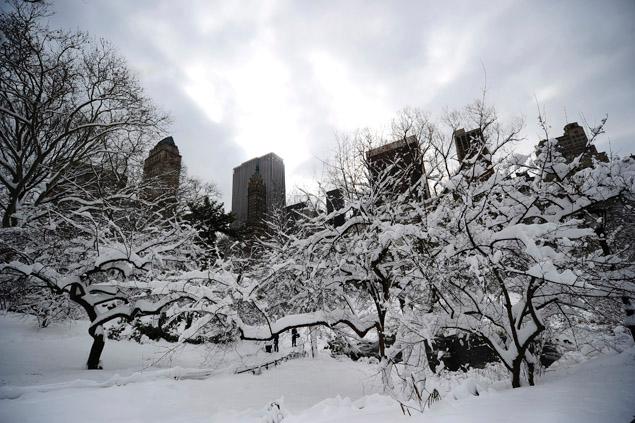
Snow covers trees in Central Park after a storm, New York City, December 28, 2013. (Emmanuel Dunand/AFP/Getty Images via http://www.nydailynews.com).

Snow covers trees in Central Park after a storm, New York City, December 28, 2013. (Emmanuel Dunand/AFP/Getty Images via http://www.nydailynews.com).

That’s what “Head Over Heels” had conjured up in my mind as I walked down East Lincoln toward Lorraine. For whatever reason my thoughts turned to Phyllis. I thought about her smile, her always-wearing-a-skirt style, her standing as a popular student at MVHS. She was always nice to me, always friendly, to the point of being coy about it. The brief flash of Phyllis’ face and smile put a smile on my own as I started singing to “Head Over Heels” out loud. “I wanted to be with you alone, and talk about the weather . . .” was coming out of my mouth in high falsetto as snow started to fall. My thoughts had turned to the cold, the snow flakes and the stark bareness of the wintry landscape as I reached the corner of East Lincoln and Darwood. I was singing “something happens and I’m head over heels . . . don’t break my heart, don’t take my heart, don’t, don’t, don’t throw it away.” Just as was I was about to cross the street, a black two-door Mercury Topaz, circa ’84 or ’85, pulled up, with Phyllis’ mother driving and Phyllis in the front passenger seat. Phyllis’ sister Claudia was in the back. Phyllis mouthed a “Hi” and waved at the same time as the light turned green for their car. What I remember as they pulled away was the smile that she flashed me. It didn’t seem fake. It looked like an I-really-like-you kind of smile to me. I was caught completely off guard!

I spent the rest of the walk to the library debating whether the smile was genuine or a nicety, what the smile meant for her, and how I felt about it. By the time I got to the library, I could only reach one conclusion. I liked Phyllis, and not in an “I like her but only as a friend way.” I liked the girl, simple as that. Those lips and that smile were worth at least a thousand kisses a day!
As I’ve noted in the book and here in the blog, my instincts about Phyllis’ smile turned about to be correct on both counts. Too bad I wasn’t listening to Alexander O’Neal’s “Fake” or Mr. Mister’s “Broken Wings” when I walked out the door to our 616 apartment at 4:30 that afternoon. Still, for that moment, at least, all seemed possible in my little world.

Separating The Musical Wheat From The -ism/-phobic Chaff

25 Monday Nov 2013

Posted by decollins1969 in 1, culture, Eclectic, eclectic music, music, Politics, Pop Culture, race, Youth

≈ Leave a comment

Tags

50 Cent, @BlkLibraryGirl, Biz Markie, Contradictions, Correlation vs. Causation, Freedom of Expression, Freedom of Speech, Geto Boys, Hip-Hop, Hip-Hop Culture, Homophobia, Lil Wayne, Lyrics, Michael Jackson, Misogyny, Music Videos, Ohio Players, PE, Public Enemy, R. Kelly, Racism, Rap, Rape Culture, Rick Ross, Sexism, Twitter, Violence


Separating chaff (left hand) from wheat (right hand), November 25, 2013. (http://www.colourbox.com/preview/).

Separating chaff (left hand) from wheat (right hand), November 25, 2013. (http://www.colourbox.com/preview/).

Back in April, I managed to get myself into a Twitter argument with @BlkLibraryGirl over Rick Ross and Lil Wayne’s releases and the misogynistic, gang-rape-advocating lyrics that came with them. The problem was, she was in the midst of a long rant (which I didn’t realize at the time), and you should never interject into someone else’s Twitter rant unless you’re nodding your head in agreement. At least without going through their entire Twitter timeline first.

In response to another luminary on Twitter, @BlkLibraryGirl tweeted

But it’s not just Rick Ross’s rape lyrics. The entire Hip Hop genre is rape culture. Is somebody going to talk about that?:)

I specifically said that this strain of rape as/is okay is one that has deep roots in American culture, and in African American notions of masculinity specifically, which led to a barrage of tweets from @BlkLibraryGirl about how Rick Ross’ lyrics + ten-year-old Black boys = Black boys thinking that raping Black women is perfectly okay. And that I was okay with these lyrics, too.

Rick Ross, absolutely disgusting, September 30, 2013. (http://cdn.stupiddope.com).

Rick Ross, absolutely disgusting, September 30, 2013. (http://cdn.stupiddope.com).

She obviously not only missed my point. She didn’t care what my point was in the first place. But that’s an issue of the limits of being able to communicate complex ideas and emotions on Twitter, not to mention the larger issue of etiquette. @BlkLibraryGirl is but one example of the steady and growing criticism of rap/hip-hip as the source of all our cultural ills, -isms and -phobias. It’s the idea that a kid will watch a video and listen to lyrics, and with zombie-like reactions, act out the lyrics and the video as if they don’t have a mind and guidance systems in their lives to stop them from being Rick Ross’ and Lil Wayne’s puppets.

For those of you who know me or this blog, the one thing that should be obvious is that while my music tastes are eclectic, my rap music list in particular is a small one. I didn’t like much of the little bit of rap I heard growing up, got into it a bit in the ’87-’97 years, and have liked almost none of it over the past decade. I’ve never liked Jay Z, found 50 Cent to be about a notch and a half above Biz Markie, and still think Eminem is the best lyricist in the game today, despite the fact he is as homophobic and (at times) misogynistic as they come.

So while these fools will never win the Social Justice Music Awards, they do have the right to put out their schlock, to write lyrics filled with hate and angst, to play with tired stereotypes and archetypes in their music and videos. And we have the right to critique, to not buy, to provide ourselves and our kids with the wisdom necessary to see through the smokescreen of big business making big bucks off of rap/hip-hop “artists” who present themselves as little more than stereotypical Bucks themselves.

But let’s also not get carried away here, either. Last I checked, didn’t the rap I listened to in college contain some similar themes? Geto Boys “Gotta Let A Ho Be A Ho” and PE’s “the parts don’t fit” line from one of their raps on their Fear of a Black Planet album (both from ’90) come to mind. What about “running the train” lyrics from the late Notorious BIG or Tupac’s (perhaps the greatest poet/rap lyricist ever) works? How come critics of today’s rap and hip-hop game don’t go after the moguls and producers that make Rick Ross and Lil Wayne possible, folks like Sean “Whatever his nickname is now” Combs, Jay-Z, Sony Music Group or BMI?

Or, given my eclectic tastes, why limit this strain of cultural ugliness to rap and hip-hop? Why not be historical for a moment and go after Prince’s and Rick James’ sexist lyrics of the early-’80s, or the Ohio Players and The Jammers of the ’70s? Or, for that matter, R. Kelly in the ’90s and early ’00s? Why should we even limit this to R&B or hip-hop, as music is a universal — and not a neatly separated — language? What about Jimi Hendrix’s “Hey Joe,” or the White male angst and violence embedded in honky-tonk, hard-core heavy metal and grunge?

Fans protest Michael Jackson's innocence in the child molestation scandal, Paris, France, December 17, 2003. (Rafael Rozendaal via Wikipedia). Released to public domain via Creative Commons 2.0.

Fans protest Michael Jackson’s innocence in the child molestation scandal, Paris, France, December 17, 2003. (Rafael Rozendaal via Wikipedia). Released to public domain via Creative Commons 2.0.

Oh, I get it. Hip-hop’s a globally-dominant cultural and musical phenomenon, which means it could bring tens of millions more folks outside the US into our -isms and -gynys. But, has there ever been an individual in the musical world more culturally transcendent than Michael Jackson? You know, the guy who faced two trials in the ’90s and ’00s over child molestation charges? The man who struggled with identity issues — racial ones  included — for the bulk of his adult life before dying in June ’09? What do we do about the couple of billion people Jackson influenced beyond his lyrics, especially since child molestation must be as common as the common cold?

We should critique and advocate as much as we can over the sexism and misogyny, homophobia and racism, colorism and ignorance contained in the lyrics and videos of artists from Rick Ross, Lil Wayne, Nelly and DMX and so many others. But let’s not act as if this is a new thing, a strictly hip-hop and rap thing. This is an American thing. So why act surprised when it shows up in rap music videos and in lyrics?

As for me, I chose to enjoy Michael Jackson’s music and PE’s other lyrics even in the face of the contradictions between their lyrics and behaviors. I think that most hip-hop lovers — even those impressionable ten-year-old Black boys — will do the same. If I’m wrong, then the Apocalypse has truly arrived.

Shawn of the Dead (2004) pic, as used in Philadelphia Daily News, June 4, 2012. (John Baer).

Shawn of the Dead (2004) pic, as used in Philadelphia Daily News, June 4, 2012. (John Baer).

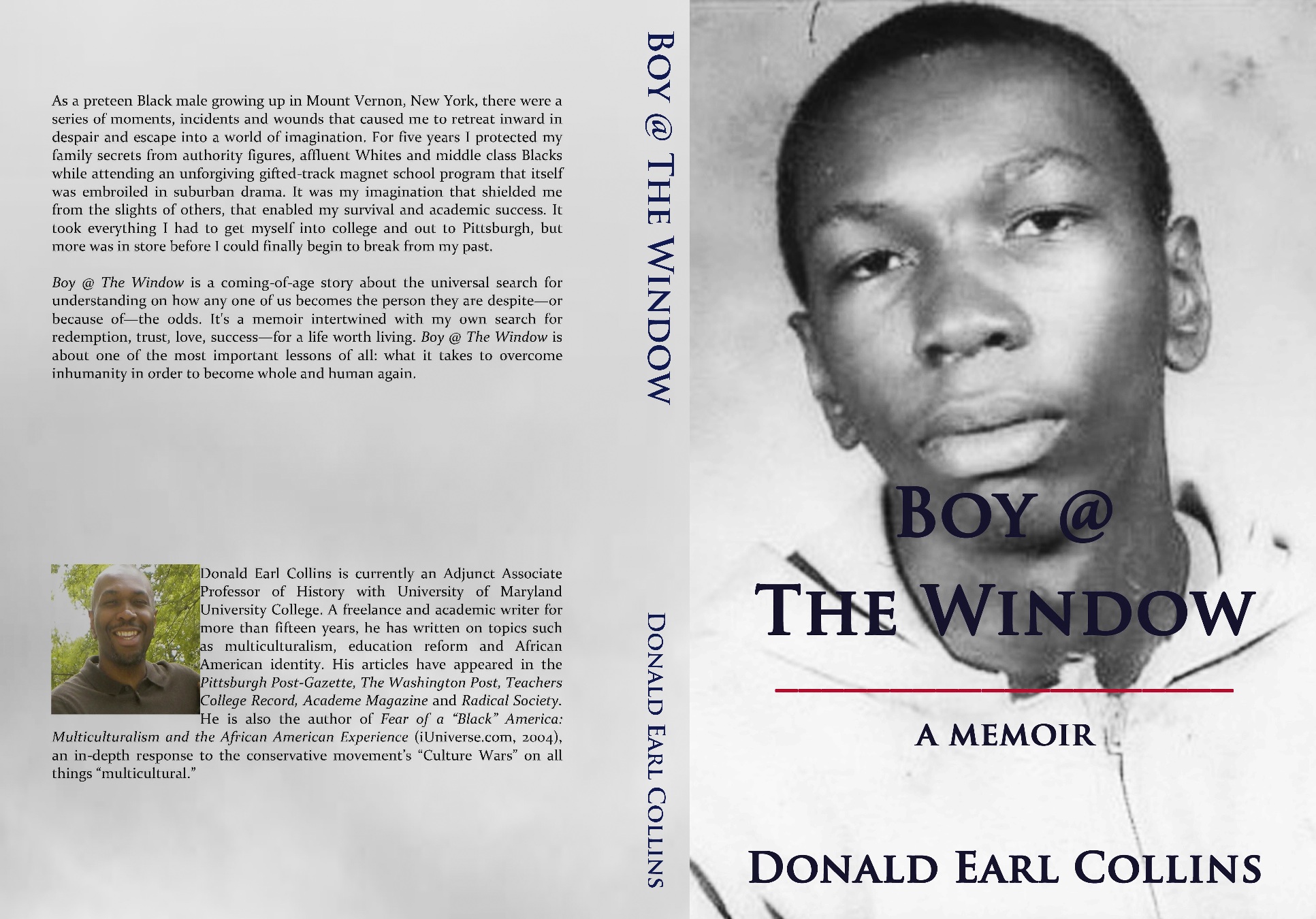
Boy @ The Window, Now in Paperback

20 Wednesday Nov 2013

Posted by decollins1969 in 1, Boy @ The Window, Christianity, Eclectic, eclectic music, Hebrew-Israelite, High Rise Buildings, Jimme, Marriage, Mount Vernon High School, Mount Vernon New York, music, My Father, New York City, Pittsburgh, Politics, Pop Culture, race, Religion, Sports, University of Pittsburgh, Upper East Side, Upper West Side, Youth

≈ 2 Comments


Boy @ The Window, front and back cover, and side, November 11, 2013. (Donald Earl Collins).

Boy @ The Window, front/back cover, and side, November 11, 2013. (Donald Earl Collins).

I have some really good news. My book Boy @ The Window is not just an e-book anymore. I now have a trade paperback edition, out and available through Amazon.com as of yesterday (via http://www.amazon.com/Boy-Window-Donald-Earl-Collins/dp/0989256138/). You can also order and buy Boy @ The Window the old-fashioned way — directly through your local bookstore.

Please take a look, support, buy, read, comment and share. I will post as reviews and opportunities to talk about the book arise. Thanks to all of you who’ve supported my blog and the path to Boy @ The Window over the past six years!

On Maturity and Writing In Text Message Form

11 Monday Nov 2013

Posted by decollins1969 in 1, Boy @ The Window, culture, Eclectic, eclectic music, Mount Vernon High School, Mount Vernon New York, music, Pop Culture, race, University of Pittsburgh, Youth

≈ 1 Comment

Tags

"I Would Die 4 U" (1984), Anger, Black Masculinity, Crush #1, Crush #2, Depression, Disillusionment, Emasculation, Maturity, Objectification, Obsession, Pedestal, Phyllis, Pitt, Prince, Rejection, Sexism, Text Messaging, Wendy, White Plains Galleria


Dulcesita, "i would die for you," November 11, 2013. (http://www.myxer.com).

Dulcesita, “i would die for you,” November 11, 2013. (http://www.myxer.com).

In Boy @ The Window, I have a chapter on my first year at Pitt and the baggage I carried from my last months in Mount Vernon, New York, Phyllis (a.k.a., Crush #2) included. I haven’t discussed Phyllis much in the six and a half years I’ve been running this blog on all things related to my memoir. Mostly because once I got over my crush-turned-internalized-obsession, I realized that she wasn’t really all that as a person. Still, given the number of posts I’ve done on my Mom, my late idiot ex-stepfather Maurice and Wendy (a.k.a., Crush #1), Phyllis does deserve some mention, along with my stumbled-filled transition to manhood that went with the years between December ’85 and August ’88.

A key point for me in this transition was in October and early November ’87. I finally worked up the courage to write Phyllis a note about an incident earlier that summer, one in which she all but emasculated me at the White Plains Galleria. As I wrote in Boy @ The Window:

Crushing walnuts in plastic bag, November 11, 2013. (http://2.bp.blogspot.com/).

Crushing walnuts in plastic bag, November 11, 2013. (http://2.bp.blogspot.com/).

I got the address, bought her a card for her eighteenth birthday, and sat down and wrote her. About how I liked her and wanted to know if she “ever liked me.” I needed to know if she and her sister really were talking about me at the bus stop that day, “one way or the other.” I wanted to know what she thought I needed in order to impress someone like her in the future. Then I added “Happy 18th Birthday!” I sent the card off on the second week in October, just a few days before her birthday.

On the second of November, I got her response. It was in purple ink, with heart shapes and circles for dots over “i”s. Reading her letter was like reading the liner notes off of a Prince album. Like the song “I Would Die 4 U,” Phyllis had decided to limit her English skills to the ’80s equivalent of sign language on paper, a real “revolution” on both their parts. I remember she started, “Thank U 4 your card 2day,” an insult to my intelligence. She would’ve been better off with, “Yo nigga, ’s up wit’ ya sweatin’ me?” She wrote indirectly that she did like me at one point in time, but added “but we’re in college now . . . around lots of nu people” She admitted that I was her and Claudia’s topic of conversation that day, but “I needed 2 get over that.” She hinted that I shouldn’t write her again, and that was it. No apologies, no attempt to understand how I felt…

After Phyllis’ wonderful response, I all but stopped going to class. I missed most of my classes the month of November, only showing up for exams or if my mood had let up long enough to allow me to function like normal. The weekend before Thanksgiving, I allowed my dorm mates to cheer me up by getting a couple of cases of Busch Beer. These were the Pounder type, sixteen-ounce cans. After getting Mike to get us the cases, we went back to Aaron’s room and started drinking. I downed four cans in fifteen minutes, and was drunk within a half hour. I started throwing around the word “bitch.” Anytime anyone mentioned Phyllis’ name – or any woman’s name for that matter — one of us said the B-word and we’d guzzle down some beer.

In today’s world of text messaging, I would’ve found Phyllis’ response so ridiculous that I probably would’ve shared it with close friends and laughed about it for weeks afterward. But as someone with the emotional and psychological maturity of a twelve-year-old in the fall of ’87, Phyllis’ response really, really, really hurt. Her letter shattered the pedestal on which I had placed her, and reaffirmed every negative thing I’d felt about myself for the previous half decade.

Depression image, Carroll College, Counseling Services, November 11, 2013. (http://www.carroll.edu).

Depression image, Carroll College, Counseling Services, November 11, 2013. (http://www.carroll.edu).

It also left me so depressed that I finished that semester with a 2.63 GPA. That, and spending the holidays at 616, made me determined to use the anger I felt toward myself and Phyllis as fuel for the next semester. And even though that worked so well that I made Dean’s List, I still hadn’t really gotten over Phyllis’ rejection by the time the school year was over in April ’88.

It took one last look at that letter — that unbelievably trifling and simple letter — to realize that even under the best of circumstances, Phyllis and I would’ve been a match made only in a mad scientist’s laboratory. I’d never be interested in a human being who talked down to me, as if I was unworthy of anything other than some simple shorthand language. Or in any woman whose expectations of men were about as objectifying as Mike Tyson’s views of women. I realized that I had finally gotten to know the real Phyllis, and in the process, had begun to know the real me, and what I needed to change about myself in order to build a better, 2.0 version of me. With that, like so much from my freshman dorm at Lothrop Hall, Phyllis’ letter became part of my garbage pile.

My One and Only College Visit Before College

05 Tuesday Nov 2013

Posted by decollins1969 in 1, Boy @ The Window, culture, Eclectic, eclectic music, Mount Vernon High School, Mount Vernon New York, music, Pittsburgh, Pop Culture, race, University of Pittsburgh, Youth

≈ Leave a comment

Tags

"Party All The Time" (1985), Black Males, Class of '87, Class of 1987, Classmates, College Visits, Concordia College, Eddie Murphy, HBCUs, Humanities, Rick James, Self-Discovery, Walks


Concordia College, Bronxville, NY, November 5, 2013. (http://concordia-ny.edu).

Concordia College, Bronxville, NY, November 5, 2013. (http://concordia-ny.edu).

One of the many pitfalls of poverty in the midst of striving toward college was that I didn’t do a single formal college visit prior to taking the Amtrak to Pittsburgh in late-August ’87. (Ironic, then, that I’ve been on at least sixty college campuses to teach or lecture, for graduate school, for conferences, talks, interviews and other events in the past quarter-century). The only options for doing any college visits at all while at Mount Vernon High School (NY) were either the schools in the area or to go on the HBCU college visit trips to Howard and Hampton University. I had no interest in applying to an HBCU (which I’ll talk about later), and the prospect of visiting Columbia or NYU never really occurred to me until years later.

But I did have one inadvertent encounter with a college campus prior to arriving at Lothrop Hall on the University of Pittsburgh’s campus in ’87. It was in the fall of ’85. As I wrote in Boy @ The Window:

I discovered something rather interesting about myself toward the end of the year. I understood, maybe for the first time, how much walking and nocturnal self-pleasure had replaced sitting on the radiator at the living room window as my after school and weekend distraction. Walking allowed me to continue to contemplate my future, to make sense of my senseless world. Very early on in my junior year, I went on a Saturday walk straight up Route 22, from East Lincoln and North Columbus. I ended up at Concordia College in Bronxville, a small liberal arts school in the middle of one of the richest towns in America. It was a cloudy and crisp early fall day, those first series of gray days you experience after a long, hot summer. I wore my gray hooded and zippered sweat jacket with my beat-up multi-colored and checkered long-sleeve shirt and some cheap, made-in-Taiwan blue jeans.

Even with that and my tall, Black male self on a mostly White campus, I seemed to blend in. Not a single person looked at me as if I didn’t belong there. Some of the students actually said “Hi” to me, and not that overly enthusiastic greeting, either. I walked across the campus, walked into some of the buildings and walked around some of the empty classrooms. After a bit more wandering around, I ended up at the library. It was surprisingly small, but the books it did have were the kinds I used to like reading. Old and dusty historical texts and subjects of interest only to old writers and historians. I saw students at tables studying or talking softly while studying. Then it dawned on me why the students didn’t automatically assume that I wasn’t a college student. I was dressed like they were, or,I guess, they dressed like me. Sloppy, but not too sloppy. It also dawned on me that you needed a college ID on the campus in case the guards suspected that you weren’t a college student. So I made my way from the campus and trekked back home.

This was my first and only college visit. And though I hadn’t stopped by the admissions office or spoken with a financial aid counselor, my wandering walk gave me much food for thought. The visit reinforced my thinking on what I needed to do in eleventh grade to guarantee both college acceptance and a scholarship. I assumed an academic scholarship, but an athletic one was still in the realm of possibility. I knew, again, that this was my make-or-break year to bring my grades up as far as possible. I had no idea what my class ranking was, but I assumed that I needed to be in the top fifteen or twenty to have my best shot. So I set the largest goal possible – making it to the top ten of my class.

Eddie Murphy (with Rick James), "Party All The Time" (1985) video (screen shot), November 5, 2013. (http://vimeo.com).

Eddie Murphy (with Rick James), “Party All The Time” (1985) video (screen shot), November 5, 2013. (http://vimeo.com).

In the back of my mind, I knew even then that I didn’t want to attend a school with any of my classmates or with any reminders of Mount Vernon. So many of my Black classmates were already talking about attending HCBUs or New York area school. I knew that despite their relative maturity as eleventh graders, I didn’t want to be in classroom settings with the Rick James “Party All The Time” set or with White and Black classmates who thought of me as a caricature of a human being or Black male.

That walk to Concordia reminded me of a simple fact. That my path to college was my path, not to be determined by anyone else, and certainly not the people I didn’t even trust with a smile.

The Road to Boy @ The Window, Part 4: Fear of a “Black” America

26 Thursday Sep 2013

Posted by decollins1969 in 1, Academia, Boy @ The Window, Carnegie Mellon University, culture, Eclectic, eclectic music, music, Patriotism, Pittsburgh, Politics, Pop Culture, race, University of Pittsburgh, Youth

≈ Leave a comment

Tags

Academia, Afrocentricity, Authentic Blackness, Authenticity, Emotion, Estelle Abel, Fear of a "Black" America, Fear Of A Black Planet, Fear of Black Males, Joe Trotter, Multicultural Education, Multiculturalism, PE, Personal Vignettes, Politics of Academia, Politics of Education, Politics of Fear, Public Enemy, Rage, Richard Altenbaugh


FearBookCover3copy

Given that Fear of a “Black” America was my first book, but one based on my doctoral dissertation, and that Boy @ The Window is a memoir, the road from one to the other may not be that obvious with an initial glance. But despite the intellectual, semi-scholarly nature of my book on Blacks and multiculturalism, there are parallel themes that run between Fear of a “Black” America and Boy @ The Window. Perhaps none are more important, though, than the challenge of authenticity, of fitting in, of being able to mesh the complicated onion that I’ve found myself to be over the years.

I think that was why I decided in November ’98 to turn my dissertation “A Substance of Things Hoped For” into a more readable book. Yes, after all that work to write a 505-page thesis, it would’ve been a shame to just let it sit on my then girlfriend’s coffee table, to be used either as a door stop or a base for her doing her nails. Yes, I still had something to prove to academia. That my scholarship as a historian and educator on the issue of multiculturalism was sound. That the conventional academic wisdom around Blacks, people of color and multiculturalism was paternalistic fear-mongering.

Public Enemy, Fear Of A Black Planet (1990) Album Cover

Public Enemy, Fear Of A Black Planet (1990) Album Cover

And in thinking that last part through, I came up with my Public Enemy-inspired title and thread for the first book. It was about fear in many forms. Elite White fears of a majority-people-of-color US within their own lifetimes. Conservative fears of a K-16 education system that included the cultural and historical perspectives of peoples of color, of the poor, of women, of the LGBT, of so many others they’d rather discard. General American skepticism that any Blacks had ever given any thought at all to cultural pluralism, intercultural education, or multiculturalism/multicultural education, at least before White theorists had thought through these ideas first.

Afrocentrists and nationalists who thought of multiculturalism as soft and utterly unrepresentative of the Black experience — or, at least, what they considered an authentic version thereof? That was as difficult a challenge as any I faced in writing both my dissertation and Fear of a “Black” America. So much so that I made a few interesting decisions along the way. I sought out an agent — yes, a literary agent — for the first book, and found one, too (things were so much easier in ’99). I wanted the book to have an impact beyond academia.

In the writing process, I decided to weave the theme of fear, skepticism, willful and inadvertent misunderstandings throughout the 200-page book. All while covering Black intellectual thought about what we now call Afrocentricity and multiculturalism, Black activism and activities around education and Negro History Week, and the so-called Culture Wars of the 1980s and 1990s. All to show that multiculturalism was/is a part of America’s evolution, even if some folks are gnashing their teeth and wearing sackcloth and ashes along the way.

One thing was missing, though, from my six chapters. Me, in a word. Yes, my argument was crystal clear, my evidence was sound, my notes and analysis lined up well enough by the summer of ’00. Yet, as my one-time agent noted, “there’s not enough of you in this manuscript.”  Bottom line: folks weren’t going to buy the book unless I made it more compelling, which meant putting something of me or about me in it.

Fear Book & The Authentic Me

Fear Book & The Authentic Me

So I did. I wrote mostly about my experiences in academia and how they paralleled with some of the critical issues in Fear of a “Black” America. I talked about my Duquesne University students in the College of Education in ’98 and ’99, most of whom were cultural conservatives. I brought up conversations I had with professors skeptical about my scholarship, like Richard Altenbaugh in March ’98 or my former dissertation advisor Joe Trotter in April ’96. I also wrote about my conversation with Estelle Abel over my lack of authenticity as a young Black man in June ’87, having thought about it for the first time in thirteen years. I wasn’t sure if that made Fear of a “Black” America any better, but it made me feel better about my first book.

By the time I’d given my agent the final draft of Fear of a “Black” America in October ’00, I was ready — maybe for the first time in years — to take a look at my life before Pitt, grad school, Spencer Fellowship and becoming Dr. Collins. I wasn’t sure if I wanted to open up the emotional side of that Pandora’s box just yet. But in some ways, I really needed to, precisely because of my experiences with people in grad school at Pitt and Carnegie Mellon. And precisely because of my occasional moments of rage and overreaction, if only because Fear of a Black “America” helped me tap into emotions I didn’t know I had.

On the Insignificance of Saggy Pants & Respectability

20 Friday Sep 2013

Posted by decollins1969 in Boy @ The Window, culture, Eclectic, eclectic music, Movies, music, Politics, Pop Culture, race, Youth

≈ Leave a comment

Tags

Birmingham Church Bombing, Black Elite, Boyz n the Hood (1991), Economic Inequality, Florida A&M University, Hip-Hop Culture, Institutional Racism, John L. Lewis, Jonathan Ferrell, March on Washington, NWA, Police Brutality, Racism, Respectability, Saggy Pants, Thug Life, TLC, Trayvon Martin, Tupac, Violence, White Supremacists


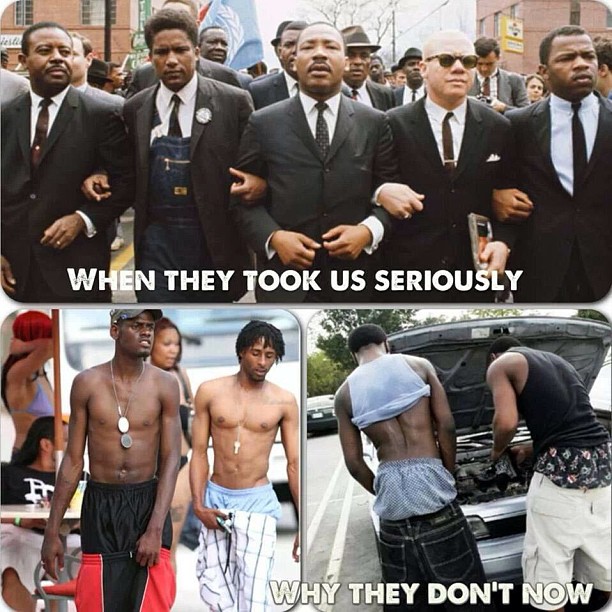
"When They Took Us Seriously/Why They Don't Now" poster, September 20, 2013. (Tim Brinkley/Google +).

“When They Took Us Seriously/Why They Don’t Now” poster, September 20, 2013. (Tim Brinkley/Google +).

In the past month of March on Washington and “I Have A Dream” speech commemorations and Birmingham church bombing dedications, a series of images lamenting rap culture and “thug life” have made their way around the Internet. The one that has stuck with me the most has been the image of the Selma March in 1965 juxtaposed with seemingly random photos of young Black males with saggy pants. The caption reads, “When they took us seriously/Why they don’t now.” Really? White supremacists took respectable Negroes seriously in the ’60s because they marched and wore suits, but don’t take Black males seriously now because of the saggy pants phenomenon? The truth is, they did and didn’t take us seriously then and now, and it has almost nothing to do with pulling our pants up above our boxers.

I have to say, though, that I hate saggy pants. It makes the people wearing them look somewhere between goofballs and idiots. It’s never mattered to me whether White guys or Black guys or college guys or hip-hop divas have worn saggy pants. I didn’t like it when it became a style in the early ’90s, thanks in large measure to NWA and Tupac, TLC and Snoop Dog and a host of other hip-hop/rap artists. I certainly don’t like it now, and would never buy a pair for my ten-year-old son to wear that way. The saggy pants style has been a sad twist on hand-me-downs and poverty as marketable clothes for the hip-hop cool.

But the saggy pants style has never translated for me as embracing a  “thug life” or some devolution of Black culture or American society. It wasn’t life imitating art, ala Boyz n the Hood (1991), Menace II Society (1993) or Clockers (1997). Nor have I ever seen it as something that meant that Whites or the new Black elite could say, “See. These Black folk don’t deserve respect, or health care, or a quality education, or good-paying jobs.” Over the past two decades, I’ve seen it as a style — a bad style, to be sure — but a style that some Blacks (and Whites, Latinos and Asians) have embraced.

Any young Black person who’s striving for higher education, or careers, or their own stereotypical success story in life, will tell you that they don’t wear saggy pants for every time or season. Even those who don’t know learn very quickly that saggy pants aren’t welcome in allegedly more respectable settings. If anything, the prevalence of saggy pants in 2013 has as much to do with the reality that opportunities for education, employment and prosperity remain so out of reach that it really doesn’t matter to many what they wear and where they wear it. There’s no need to code switch if everyone in your world knows the same exact code of cool.

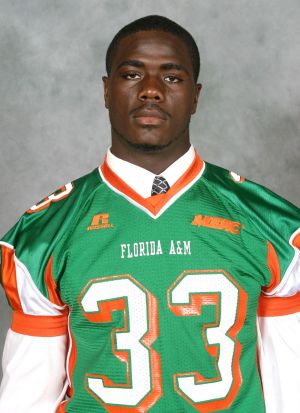
Jonathan Ferrell, Florida A&M football picture, September 20, 2013. (AP/Florida A&M University).

Jonathan Ferrell, Florida A&M football picture, September 20, 2013. (AP/Florida A&M University).

Recent events have made it pretty obvious that it really doesn’t matter what Black males wear. We remain targets for deeply ingrained stereotypes, institutional racism, and pre-emptive White violence. Whether it was Trayvon Martin wearing a hoodie in the rain, or John Lewis wearing a suit in Selma forty-eight years ago, it hasn’t mattered to Whites in fear of the Black boogie man. Florida A&M University graduate and former football player Jonathan Ferrell learned this deadly lesson in North Carolina just a week ago. It doesn’t matter what we wear, at least as far as many Whites and some Black elites are concerned.

Blacks all look the same to them, and looked the same to them in the ’60s. Suits, hoodies or baggy pants, we’re criminals and imbeciles from birth, thugs for life, and a drain on families and American society. This doesn’t mean that any one of us shouldn’t take responsibility for how we act, speak and look in public. I dare say, though, that structural economic issues like unemployment in deeply impoverished Black communities (or crank-infested White ones) won’t be solved with young folk pulling their pants up. We need to stop focusing on the insignificant, because saggy pants and respectability are the trees in this morphing forest of racism and economic inequality.

← Older posts
Newer posts →

Boy @ The Window: A Memoir

Boy @ The Window: A Memoir

Places to Buy/Download Boy @ The Window

There's a few ways in which you can read excerpts of, borrow and/or purchase and download Boy @ The Window. There's the trade paperback edition of Boy @ The Window, available for purchase via Amazon.com at http://www.amazon.com/Boy-Window-Donald-Earl-Collins/dp/0989256138/

There's also a Kindle edition on Amazon.com. The enhanced edition can be read only with Kindle Fire, an iPad or a full-color tablet. The links to the enhanced edition through Apple's iBookstore and the Barnes & Noble NOOK edition are below. The link to the Amazon Kindle version is also immediately below:

scr2555-proj697-a-kindle-logo-rgb-lg

Boy @ The Window on Amazon.com: http://www.amazon.com/Boy-The-Window-Memoir-ebook/dp/B00CD95FBU/

iBookstore-logo-300x100

Boy @ The Window on Apple's iBookstore: https://itunes.apple.com/us/book/boy-the-window/id643768275?ls=1

Barnes & Noble (bn.com) logo, June 26, 2013. (http://www.logotypes101.com).

Boy @ The Window on Barnes & Noble: http://www.barnesandnoble.com/w/boy-the-window-donald-earl-collins/1115182183?ean=2940016741567

You can also add, read and review Boy @ The Window on Goodreads.com. Just click on the button below:

Boy @ The Window

Twitter Updates

Tweets by decollins1969
  • RSS - Posts
  • RSS - Comments

Archives

  • June 2025
  • April 2023
  • September 2022
  • August 2022
  • July 2022
  • June 2022
  • May 2022
  • April 2022
  • March 2022
  • January 2022
  • December 2021
  • November 2021
  • October 2021
  • September 2021
  • August 2021
  • July 2021
  • June 2021
  • April 2021
  • March 2021
  • February 2021
  • January 2021
  • December 2020
  • November 2020
  • October 2020
  • September 2020
  • August 2020
  • July 2020
  • May 2020
  • April 2020
  • March 2020
  • January 2020
  • December 2019
  • November 2019
  • August 2019
  • July 2019
  • June 2019
  • May 2019
  • April 2019
  • March 2019
  • February 2019
  • January 2019
  • December 2018
  • November 2018
  • October 2018
  • September 2018
  • August 2018
  • July 2018
  • June 2018
  • May 2018
  • March 2018
  • February 2018
  • January 2018
  • December 2017
  • November 2017
  • October 2017
  • September 2017
  • August 2017
  • July 2017
  • June 2017
  • May 2017
  • April 2017
  • March 2017
  • February 2017
  • January 2017
  • December 2016
  • November 2016
  • October 2016
  • September 2016
  • August 2016
  • July 2016
  • June 2016
  • May 2016
  • April 2016
  • March 2016
  • February 2016
  • January 2016
  • December 2015
  • November 2015
  • October 2015
  • September 2015
  • August 2015
  • July 2015
  • June 2015
  • May 2015
  • April 2015
  • March 2015
  • February 2015
  • January 2015
  • December 2014
  • November 2014
  • October 2014
  • September 2014
  • August 2014
  • July 2014
  • June 2014
  • May 2014
  • April 2014
  • March 2014
  • February 2014
  • January 2014
  • December 2013
  • November 2013
  • October 2013
  • September 2013
  • August 2013
  • July 2013
  • June 2013
  • May 2013
  • April 2013
  • March 2013
  • February 2013
  • January 2013
  • December 2012
  • November 2012
  • October 2012
  • September 2012
  • August 2012
  • July 2012
  • June 2012
  • May 2012
  • April 2012
  • March 2012
  • February 2012
  • January 2012
  • December 2011
  • November 2011
  • October 2011
  • September 2011
  • August 2011
  • July 2011
  • June 2011
  • May 2011
  • April 2011
  • March 2011
  • February 2011
  • January 2011
  • December 2010
  • November 2010
  • October 2010
  • September 2010
  • August 2010
  • July 2010
  • June 2010
  • May 2010
  • April 2010
  • March 2010
  • February 2010
  • January 2010
  • December 2009
  • November 2009
  • October 2009
  • September 2009
  • August 2009
  • July 2009
  • June 2009
  • May 2009
  • April 2009
  • March 2009
  • February 2009
  • January 2009
  • December 2008
  • November 2008
  • October 2008
  • September 2008
  • August 2008
  • July 2008
  • June 2008
  • May 2008
  • April 2008
  • March 2008
  • February 2008
  • January 2008
  • December 2007
  • November 2007
  • October 2007
  • September 2007
  • August 2007
  • July 2007
  • June 2007

Recent Comments

MaryPena's avatarMaryPena on My Day of Atonement/Bitter Hat…
decollins1969's avatardecollins1969 on No Good Teaching Deed Goes…
Mary Rose O’Connell's avatarMary Rose O’Connell on No Good Teaching Deed Goes…

NetworkedBlogs on Facebook

NetworkedBlogs
Blog:
Notes From a Boy @ The Window
Topics:
My Life, Culture & Education, Politics & Goofyness
 
Follow my blog

616 616 East Lincoln Avenue A.B. Davis Middle School Abuse Academia Academy for Educational Development AED Afrocentricity American Narcissism Authenticity Bigotry Blackness Boy @ The Window Carnegie Mellon University Child Abuse Class of 1987 CMU Coping Strategies Crush #1 Crush #2 Death Disillusionment Diversity Domestic Violence Economic Inequality Education Family Friendship Friendships Graduate School Hebrew-Israelites High-Stakes Testing Higher Education History Homelessness Humanities Humanities Program Hypocrisy Internalized Racism Jealousy Joe Trotter Joe William Trotter Jr. K-12 Education Love Manhood Maurice Eugene Washington Maurice Washington Misogyny Mother-Son Relationship Mount Vernon High School Mount Vernon New York Mount Vernon public schools Multiculturalism MVHS Narcissism NFL Pitt Pittsburgh Politics of Education Poverty President Barack Obama Race Racial Stereotypes Racism Relationships Self-Awareness Self-Discovery Self-Reflection Sexism Social Justice Teaching and Learning University of Pittsburgh Violence Whiteness Writing

Top Rated

Blog at WordPress.com.

  • Subscribe Subscribed
    • Notes from a Boy @ The Window
    • Join 103 other subscribers
    • Already have a WordPress.com account? Log in now.
    • Notes from a Boy @ The Window
    • Subscribe Subscribed
    • Sign up
    • Log in
    • Report this content
    • View site in Reader
    • Manage subscriptions
    • Collapse this bar
 

Loading Comments...