• About Me
  • Other Writings
  • Interview Clips
  • All About Me: American Racism, American Narcissism, and the Conversation America Can’t Have
  • Video Clips
  • Boy @ The Window Pictures
  • Boy @ The Window Theme Music

Notes from a Boy @ The Window

~

Notes from a Boy @ The Window

Tag Archives: Humanities

Road to My Memoir, Part 2: Multiculturalism

08 Saturday Jun 2013

Posted by decollins1969 in 1, Academia, Boy @ The Window, Carnegie Mellon University, culture, Eclectic, Mount Vernon High School, Mount Vernon New York, New York City, Pittsburgh, Politics, Pop Culture, race, University of Pittsburgh, Youth

≈ Leave a comment

Tags

Ability Grouping, Academic Historian, Academic Writing, Afrocentricity, Barbara Sizemore, Comparative Slavery, Elaine, Humanities, Jeannie Oakes, Joyce Harrington, Keeping Track (1985), Multicultural Education, Multiculturalism, Pitt, Pittsburgh Public Schools, Sociology, Tracking


Why Boy @ The Window, Part 2

Why Boy @ The Window, Part 2

When I wrote about this long path to Boy @ The Window last month, I figured that it would take three posts in all to discuss the path. But the road’s shown itself to be longer — and more convoluted — than I anticipated.

So I never did write my book about being on welfare, dehumanization and welfare policy. I found a much more interesting subject to take up the following year, in the summer of ’90. I decided to take the late Barbara Sizemore’s research methods course in Black Studies that fall, to move beyond my history courses, as I’d already taken enough of them to have fulfilled my major.

I wanted to look at the re-segregation of desegregated schools through tracking or ability grouping, specifically in Mount Vernon’s public schools. The book that brought me to this topic was Jeannie Oakes’ masterpiece Keeping Track: How School Structure Inequality (1985). It had begun to turn my mind away from slavery as a long-term history project (perhaps one I would’ve pursued in doing my master’s papers or doctoral research) and toward history of education and racial inequality.

Oakes’ main argument was that school desegregation was a mixed bag of success and failure precisely because of the fact that with tracking by academic “ability,”disadvantaged Black students and advantaged White students would seldom meet in the same classrooms. That made me think of my still recent experiences with the Humanities Program in middle school and high school. After all, a school district that was three-quarters Black, Afro-Caribbean and Hispanic had a magnet program that was about sixty percent White during my six years in Humanities.

I spent that summer — when I wasn’t working — at Mount Vernon Public Library, NYU’s Bobst Library, and New York Public Library giving myself a stronger background on this topic. I met with the former MVHS Humanities coordinator Joyce Flanagan (who had become Harrington by then) about getting more specific demographic data about the program by class year and school (Pennington-Grimes ES, A.B. Davis Middle School and MVHS). Much of the data had already been destroyed, Harrington confided. The data she did give me, while informative, wasn’t enough to do even a watered down version of what Oakes did for Keeping Track (she interviewed 14,000 students and teachers in all).

I ended up doing my research project on Pittsburgh Public Schools and their International Baccalaureate programs at Schenley and Allderdice HS. It was a solid paper, an easy A compared to my comparative slavery paper for Drescher’s graduate course the semester before. But it wasn’t enough for me.

In the course of building up my knowledge on segregation, suburban schools, urban school districts, and community control, I stumbled onto books about multicultural education. I wanted to learn more, so I took a sociology course my final undergraduate semester on the sociology of race and ethnicity (there weren’t any education courses that focused on either race or multiculturalism at Pitt in ’91).

The turning point came with my friend Elaine, who knew of my interest in the topic. She was the one who had informed me of a growing controversy with New York State’s newly proposed history curriculum, one in which the ideas of multicultural education had played a key role. That work the summer before grad school, that work to understand why there was any controversy at all, led me to finding out more about cultural pluralism and its history. This then led to the role of Black intellectuals and educators in applying cultural pluralism, the differences between multiculturalism, multicultural education and Afrocentricity.

I had my dissertation topic in broad strokes before I’d taken any courses as a master’s student (not counting the comparative slavery class). But in the process of moving from re-segregation and Jeannie Oakes to multiculturalism, I’d moved from a wide-eyed student of everything that related to my life at age twenty to an aspiring academician, a historian of educational and cultural ideas.

I’d taken the first steps to bury myself in academic writing and thinking, without fully understanding why I cared about multiculturalism in the first place. It took me a decade to figure out that the lack of understanding of diversity in Humanities was part of what made it a bittersweet experience for me, an experience that drove me toward multiculturalism as a research topic. It took ten years before I realized that my pursuit of multiculturalism in Black Washington, DC was my way of dealing with my own past without any emotion. Multiculturalism took me further away from the writer (and historian) I wanted to be, even as I earned my doctorate on the topic.

Monkey See, Baboon Do

22 Wednesday May 2013

Posted by decollins1969 in 1, Boy @ The Window, culture, Eclectic, Mount Vernon New York, Pop Culture, race, Youth

≈ Leave a comment

Tags

8U, A.B. Davis Middle School, Baboon, Beauty, Bigotry, Humanities, Italian Club, Monkey, Racism, Stereotype Threat, Teenagers, Writing, Writing Scrapheap


Monkey See Monkey Do, May 22, 2013. (http://kidsunder7.com).

Monkey See Monkey Do, May 22, 2013. (http://kidsunder7.com).

There are plenty of stories and vignettes that ended up on the Boy @ The Window scrap heap. Most because they weren’t relevant, some because a particular person or character really wasn’t a significant player in the book. In my final set of story revisions (not dialogue revisions) in ’09 and ’10, I operated under the “two or more rule.” If a person or character showed up fewer than two times in the book, I took them out, as they really weren’t as significant as I originally thought.

But in the case of the Sonya story below, it was a tough cut. I wanted to craft a book in which people felt everything I went through while not feeling sorry for me. I think and hope that I did. Though this story contained many elements of what I wanted in the rest of the book, it didn’t quite fit. Still, it serves as a good reminder of how mean even someone as polite (but certainly not always nice) as I am today could be at thirteen.

—————————

“Sonya was major fodder for Alex in eighth grade. She had a short Afro, an ‘au naturale’ to be exact. She wasn’t nearly as polished in maintaining her looks as many of the other girls in 8U. Sonya wasn’t ugly by any stretch. But by her not attempting to beautify herself in any way, she stood out for some in our class. Why would’ve she needed to anyway? She was also well-spoken, intelligent and outgoing, at least at the beginning of the year. Unfortunately for Sonya, my Italian Club classmates Alex, et al. were around to call her all kinds of names, like ‘baboon,’ and ‘monkey.’ I felt sorry for her, but I was also angry with her too. It pissed me off to see her respond to these semi-racist barbs with a blank face or even a smile.

It pissed me off so much that I ended up calling Sonya one of those names by the end of the school year. One day in homeroom, par for the course, Alex and company picked with Sonya again, calling her a ‘baboon’ among other things. She just sat there with that silly ‘Oh well’ smile on her face, as if they were telling her that she should go into professional modeling. Under my breath, I called her ‘monkey,’ and not as a joke. I just couldn’t believe that she was going to sit there like some pre-Civil Rights era Black in the South and take their crap without any response.

Except that I had called Sonya a ‘monkey’ within earshot of her and Alex. She ran out of the room, apparently to the girls bathroom, where she cried for several minutes, I later learned from Allison. I immediately tried to apologize, which Sonya eventually accepted (after my eighth grade science teacher Ms. Mignone and Allison shamed me for what I said). What I said was unacceptable to me, and the rationale was too intellectual for my own good. For Sonya, it simply came down to her looks, not her disposition. I wished that it had never happened, given what I faced from some of my classmates on a semi-regular basis.”

———————————————————-

1990s R&B/hip-hop duo Zhané from their 1994 album cover Pronounced Jah-Nay, May 22, 2013. (http://centrictv.com).

1990s R&B/hip-hop duo Zhané, from 1994 album cover Pronounced Jah-Nay, May 22, 2013. (http://centrictv.com).

The Sonya story has many of those elements, exposing me good, bad and ugly in the process. It’s about race and teenage ignorance and intellect. It’s about stereotype threat on one obvious level and trying to fit in on an unconscious one. It’s about the person I needed to become in high school as well as how I got to be that quiet yet observant person. The story is significant, yet because I only dealt with Sonya for two paragraphs in a 345-page book (in print form), it didn’t make the final cut. Because there are other and more central characters and stories in which stereotype threat and the ugly side of my immaturity both come out, I didn’t include Sonya.

Luckily, I also have a blog, where even scrap-heap stories can find the light of a new day. So, for this week, the thirtieth anniversary of my calling Sonya a “monkey,” I apologize again. I was a baboon for saying it in the first place. And Sonya, I hope you are well!

Toto’s “Africa” & “Reading” Too Much Into It

02 Saturday Mar 2013

Posted by decollins1969 in 1, Boy @ The Window, culture, Eclectic, eclectic music, Hebrew-Israelite, Mount Vernon New York, music, Politics, Pop Culture, race, Religion, Sports, Youth

≈ Leave a comment

Tags

"Africa" (1982), "The Catch", A.B. Davis Middle School, Africa, C-Town, Dwight Clark, Fever, Football, Herschel Walker, Humanities, Imagination, Joe Montana, NFL, Pelham, Puberty, Racialism, Reading, Self-Discovery, Self-Reflection, Tarzan, The Jungle (1906), Toto, Toto IV, Upton Sinclair, USFL, Whiteness, Writing


Toto's "Africa" (1982) Singles Sleeve, March 1, 2013. (http://eil.com).

Toto’s “Africa” (1982) Singles Sleeve, March 1, 2013. (http://eil.com).

There are as many reasons my musical tastes are eclectic as there are songs that I like and love. I can’t explain it. There’s no way I can explain why I think one song sounds as unimaginative and boring as Drake’s “Started From The Bottom,” while Nickleback’s “If Today Was Your Last Day” has been one of my favorite songs over the past three and a half years.

My imagination could take the corniest song and make it epic, a mantra, my theme music. Even a song like Toto’s “Africa” (’82-’83), a song that could be interpreted as reflecting White racialism as it related to Tarzan movies of a not-so-bygone era. Yet I’ve seen their video, and probably heard the song at least 3,000 times. It ain’t that deep, but it’s still a song I like.

So, a bit of context. My grades in the early Reagan years — especially in ’82-’83, when I was in eighth grade — didn’t at all reflect our family’s slide into welfare poverty, my ongoing issues with my idiot stepfather, my suicidal struggles or my search for a real relationship with God. What I had to lean on, more than my amazing memory or World Book Encyclopedia, my parents or even God, was my imagination.

The Spark of Imagination (via x-ray), March 1, 2013. (http://esquire.com).

The Spark of Imagination (via x-ray), March 1, 2013. (http://esquire.com).

With puberty and what would turn into a ten-inch growth spurt in a span of twenty months, I became enamored with sports. And the sport I became most interested in early on was football. The strike-shortened ’82 NFL season combined with the formation of the USFL and the coming-out party for soon-to-be draft pick Herschel Walker to get my attention. The vicious hits, the acrobatic catches, the powerful throws were things that I’d seen before. I saw them through the lens of an underdog now, a downtrodden member of an abandoned family who wanted to see folks who’d overcome impossible circumstances achieve great things.

The first person who represented that for me in sports was Joe Montana, quarterback for the San Francisco 49ers. The only ending to a football game I’d ever watched was the end of the NFC Championship Game the year before, with the play known as “The Catch.” I didn’t even know who Joe Montana was, even after watching Dwight Clark go up and catch a ball that was only meant for him.

He was the kind of person I wanted and needed to be in order to overcome what I thought was an impossible deficit. As far as I was concerned, I had to score about a hundred touchdowns to go from welfare to college, let alone anything after college. Yet it didn’t stop me from dreaming about rolling out right to the sidelines on fourth down, sucking in Dallas’ defense, and throwing a ball toward the right-side of end zone, toward the back line, just high enough for Clark to catch and Emerson Walls not to.

It was a dream that required some theme music, and luckily for me it was ’83. Michael Jackson’s Thriller had come out at the start of eighth grade, The Police were big, Toto and Rick Springfield were at their peak, and New Edition had put out there first hit, a Jackson 5 remake. All of it gave me something more modern to move forward with, to get silly about, to “march down field” to when I needed to gear up to get an important A. I’d accidentally found a way to escape my life without ever leaving Mount Vernon.

The Jungle (1906), by Upton Sinclair, 1st Edition, March 31, 2011. (GrahamHardy via Wikipedia). In public domain.

The Jungle (1906), by Upton Sinclair, 1st Edition, March 31, 2011. (GrahamHardy via Wikipedia). In public domain.

Demontravel’s and Carraccio’s classes were the first two places in which I applied this approach to my life and studies. In Carraccio’s case, it was the reading and essay assignment for Upton Sinclair’s The Jungle (1906) a muckraking tale of first-generation, Eastern European, Chicago meatpackers who worked and lived in grueling conditions and where some of them gave their lives — and livers — to Swift and other companies. I’d caught a cold, had a fever, was going to the store for Mom, and had just heard Toto’s “Africa” playing at C-Town in nearby Pelham.

The song served as my background music, giving me the energy and drive I needed to finish the book. I read The Jungle in one night, three hundred pages of it in four hours. I think Carraccio gave me a 95 on my essay. She pulled me aside to say, “You know, if you wanted, you could be a really good writer.” It might’ve been the only thing she said that I thought was right on the mark all year.

Yeah, you could say that I was seriously music deprived, didn’t understand the cultural symbolism or archetypes in the song or video, or simply had and have bad tastes. Y’all may be right, too. But for me, Toto’s “Africa” struck the right note, lifted my imagination, and found the goofball within.

Remembering Harold Meltzer

09 Wednesday Jan 2013

Posted by decollins1969 in 1, Academia, Boy @ The Window, culture, Eclectic, eclectic music, Mount Vernon High School, Mount Vernon New York, Politics, Pop Culture, race, Youth

≈ 5 Comments

Tags

AP US History, Bitterness, Confirmed Bachelor, Death, Dedication, Egalitarianism, Eulogy, Friendship, Harold I. Meltzer, Harold Meltzer, Homophobia, Humanities, Humanities Program, Learning, Life, Mentoring, Metropolitan Opera House, Morison & Commanger, Perseverance, Politics of Education, Self-Discovery, Teaching


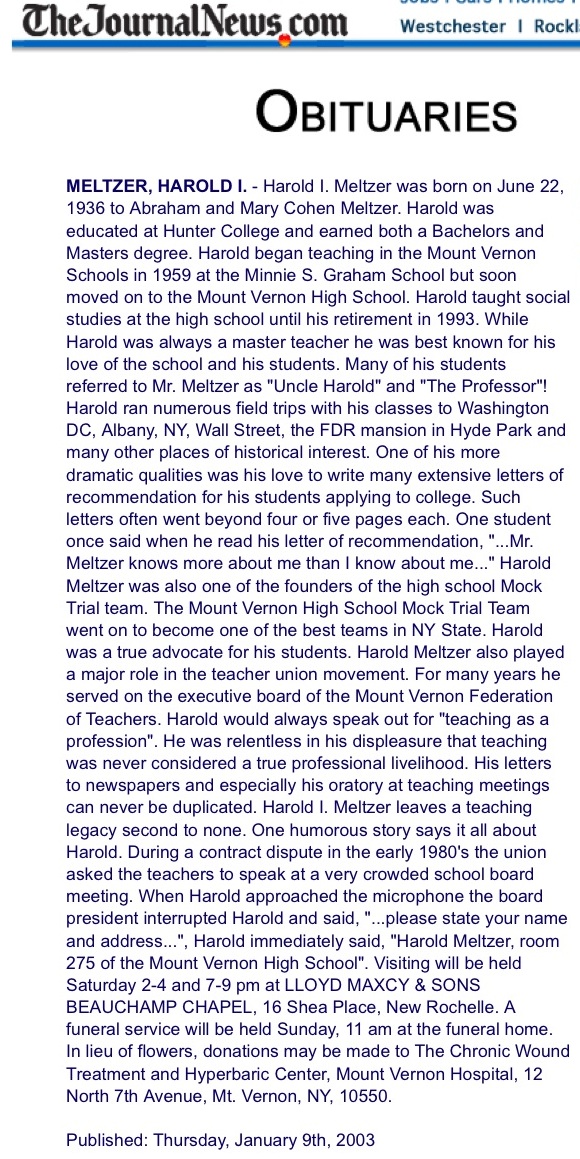
Harold Meltzer obituary (via Frank Pandolfo), January 9, 2003. (Westchester Journal News).

Harold Meltzer obituary (via Frank Pandolfo), January 9, 2003. (The Journal News).

Harold Meltzer, my favorite and best teacher of all, died on January 2, 2003 at the age of sixty-six, ten years ago last week. He was all too young and all too bitter about his years as a history teacher at Mount Vernon High School. But then, dealing with entitled parents and unrepentant administrators in Mount Vernon, New York for thirty-five years would do that to most people. Despite that, Meltzer was a rock, the first teacher since my elementary school years that I genuinely trusted with my family secrets and my inner self. He was the first and maybe only teacher I had in my six years of Humanities who actually seemed like he wanted to teach us (see my post “No Good Teaching Deed Goes Unpunished” from May ’11).

I met Meltzer on our last day of tenth grade, after three days of finals and Regents exams, on June 21, ’85. He had summoned fourteen of us to “Room 275 of Mount Vernon High School,” as the invitation read. We had all registered to take Meltzer’s AP American History class in eleventh grade, our first opportunity to earn college credit while in high school.

Meltzer started off talking to us about Morison and Commager — who I now know as the great consensus historians of the ’50s, until the social history revolution made their textbooks irrelevant by the ’80s — as we sat in this classroom of old history books and even older dust and chalk. Meltzer himself looked to be in his late-fifties (he was actually a day away from his forty-ninth birthday), tall and lanky except for the protruding pouch in the tummy section. His hair was a mutt-like mixture of silver, white and dull gray, and his beard was a long, tangled mess.

Met Logo and A full house, seen from rear of stage, at the Metropolitan Opera House (former bldg, 39th Street), for a concert by pianist Josef Hofmann, November 28, 1937. (National Archives via Wikimedia). In public domain.

Met Logo and A full house, seen from rear of stage, at the Metropolitan Opera House (former bldg, 39th Street), for a concert by pianist Josef Hofmann, November 28, 1937. (National Archives via Wikimedia). In public domain.

The way he spoke, and the way his eyes looked when he spoke made me see him as a yarmulke-wearing preteen on his way to temple. The force with which his words would leave his mouth hit me immediately. As much as I noticed how frequently spit would spew out of Meltzer’s mouth, the rhythm of his speech was slow and sing-song, like an elder or grandfather taking you on a long, winding, roller-coaster-ride of a story. Most of all, I knew that he cared — about history, about teaching, about us learning, about each of us as people. Maybe, just maybe, for some of us, he cared too much.

But for at least for me, Meltzer’s eccentric space in which he told Metropolitan Opera House stories and talked about egalitarianism extended beyond the historical. He was the first teacher I had since before Humanities who’d ask me if things at home were all right, and knew intuitively that things weren’t. He was the first to ask me about how poor my family was and about hunger. And he was the first teacher ever to ask if I had a girlfriend. Needless to say, these questions were unexpected. Yet through these questions, Meltzer had begun to crack my thin, hard wall of separation between school and family.

Because Meltzer cared deeply about reaching students — about reaching me — our student-teacher relationship because a friendship after high school and a mentoring one as well. I wasn’t looking for a mentor, and Meltzer was only being Meltzer. Still, his stories about his battles with MVHS administrators, Board of Education folk, and with upper-crust parents who believed their kids were entitled to A’s just for showing up, were filled with lessons of perseverance, patience, and looking beyond everyday headaches in order to reach people. While this wasn’t a factor in my going to graduate school and spending a significant part of my life as a history professor and educator, these stories have helped me over the years.

1972 Dodge Dart Dark Green (similar to '74 Dodge Dart Meltzer owned when I was at MVHS), December 25, 2009. (http://www.fotosdecarros.com).

1972 Dodge Dart Dark Green (similar to ’74 Dodge Dart Meltzer owned when I was at MVHS), December 25, 2009. (http://www.fotosdecarros.com).

But unfortunately, it was a factor in why Meltzer became embittered and took early retirement in June ’93. The end of the Humanities Program, the intolerance of some administrators toward Meltzer as a “confirmed bachelor,” the lack of decency — forget about gratitude — from many of his most successful students. Those changes, these things, all would take a toll on any teacher who’d stay after school day after day to run Mock Trial, to facilitate study groups, to work on letters of recommendation for students. But no, most of my former classmates who had Meltzer between ’85 and ’87, all they could say was that “Meltzer was weird” or that “I didn’t understand” his lessons.

I’m thankful that I did have Meltzer as a teacher, friend and mentor between ’85 and ’02. I’m thankful that I had a chance to interview him for what is now my Boy @ The Window manuscript in August and November ’02, just a couple of months before he passed (see my post “Mr. Meltzer” from June ’09). I’m glad that despite his physical and psychological pain, Meltzer welcomed me with open arms and answered my questions about his life and his career. I just wish that my former classmates and some of Meltzer’s more cut-throat colleagues had taken the time to really know the man.

We Called Him Mr. Lewis

03 Monday Dec 2012

Posted by decollins1969 in 1, Academia, Boy @ The Window, culture, Eclectic, Jimme, Mount Vernon High School, Mount Vernon New York, My Father, Politics, Pop Culture, race, Youth

≈ Leave a comment

Tags

Arne Duncan, Bill & Melinda Gates Foundation, Chemistry, Cigarettes, Disllusionment, ExxonMobil, Family Income, High-Stakes Testing, Humanities, Low-Income Students, Michelle Rhee, New York State Regents Exam, Nicotine, Organic Chemistry, Politics of Education, Poverty, Steve Perry, Students of Color, Teacher Effectiveness, Tenth Grade, US Department of Education, Wendy Kopp


Screenshot from To Sir, with Love (1967), December 3, 2012. (http://movies.tvguide.com). Qualifies as fair use under US Copyright laws - pic's low resolution/subject matter for blog.

Screenshot from To Sir, with Love (1967), December 3, 2012. (http://movies.tvguide.com). Qualifies as fair use under US Copyright laws – pic’s low resolution/subject matter for blog.

The dumb technocratic class (Wendy Kopp, Michelle Rhee, Steve Perry, Arne Duncan) and the assholes who fund them (Bill & Melinda Gates Foundation, ExxonMobil, US Department of Education) continue to pump out the mantra that effective teachers are the single most important variable in student performance, retention and graduation. This despite a half-century’s worth of research showing that family income was the far more important piece of data.

But even if Kopp, Rhee and Perry’s snake oil somehow turned out to be true, the fact is, the high-stakes testing movement and No Child Left Behind (and now Race to the Top) has turned effective teachers into lab leaders teaching to state-wide tests. Our current K-12 regime makes it so that ineffective teachers can be seen as effective because they’re only concerned with higher test scores, not actual learning. And some of them, not even concerned with that.

About this time thirty years ago, I had a group of wholly ineffective teachers in my tenth grade Humanities classes at Mount Vernon High School (see my posts “Half-Baked Z and Christian Zeal” from September ’10 and “This…Is…Jeopardy” from March ’11). Mr. Lewis was but one example of an unimaginative instructor. He was our Level 1 Chemistry teacher. We started his class in a very tense situation. There were fifty-one students in our class to start the year because the school administrators had failed to hire a new Level 0 (the highest level for the highest of the high-performing students) teacher for Chemistry. Our future valedictorian and other Level 0 folks spent a month protesting to the head of the Science Department, Estelle Abel, about the overcrowding and the mixing of the two levels. It took nearly two months before the situation was resolved. By that time, November ’84, none of us wanted Lewis for a teacher.

His was a class that could be fun and entertaining, but not usually educational. Sometimes our chemistry education came with errors and miscalculations. Perhaps his mistakes piled up because it was seventh period and near the end of the school day. Or maybe we were tired and inattentive.

Marlboro cigarette butts, September 19, 2007. (bachmont via Wikipedia/Flickr.com). In public domain.

Marlboro cigarette butts, September 19, 2007. (bachmont via Wikipedia/Flickr.com). In public domain.

The truth was that Lewis was a teacher with a serious chemical addiction. His was a chain-smoking world. When he opened up the door to the storage room where the test tubes and Pyrex jars were, stale cigarette smoke entered the room. His teeth were a pasty yellow, and they had a film that seemed to build up on them and in his mouth by the time we had him at the end of the day. On more than one occasion, Lewis would get phlegm caught in his mouth while in the middle of one of his lectures. Then he’d pause as he gulped the phlegm, and then he kept going. It was absolutely disgusting.

One day I met with Mr. Lewis after class to discuss my struggles with the material. He was at the front lab table sitting on a stool. In front of him on the table were fifteen Marlboro cigarettes, all lit and neatly lined up in a row. During our ten minutes together, he smoked one cigarette after another, sucking them down so fast that he had to pause to clear his throat from time to time. By the time I left, he’d gone through twelve out of fifteen, and I smelled like I’d been at one of my father Jimme’s bars. I was more than sure that Lewis’ nicotine dependency was a factor in his inability to teach Chemistry to us well (Cigarettes And Coffee, by Otis Redding).

My grades for the year going into the last weeks of the school year had ranged between an unimpressive 70 and an 87. But with the New York State Regents Exam in Chemistry coming up, Lewis was nonchalant in his attempts to prepare us for the Regents. Lewis went as far as to say, “There’s nothing to worry about” on the subject of organic chemistry. “There will be hardly any organic chemistry on the exam, anyway,” he said. After eight months of listening to his blathering, I thought “That’s it!” The next time I got money from Jimme, I  bought the Barron’s Chemistry Regents exam prep book. It was just before Memorial Day, and I had a month before the exam.

Barron's Regents Exams & Answers Chemistry (2011), December 3, 2012 (http://barnesandnoble.com).

Barron’s Regents Exams & Answers Chemistry (2011), December 3, 2012 (http://barnesandnoble.com).

On my Chemistry Regents I scored a 95, the third or fourth highest grade in the school (the highest grades were a 99 and 97 that year). My score raised my final grade in Lewis’ class six points, from a 79 to an 85. My score left me feeling jaded and disillusioned. “Wow,” I thought. “My teachers really don’t know much more than I do!” I knew that a lot of my Level 1 Chemistry classmates didn’t fare so well on the exams, because they believed Lewis when he said that there wouldn’t be much organic chemistry on the exam. By my own count during the exam, between thirty-five and forty of the 100 questions were organic chemistry ones.

It took having Meltzer for AP US History in eleventh grade for me to trust teachers again. I didn’t need anyone to teach tests to me. I needed a teacher who could help me open up a door into myself and into a world I hadn’t explored before. And millions of students — especially of color and from impoverished backgrounds — need teachers free to do that, without the threat of high-stakes tests hanging over them like a boulder.

Coping in the Boy @ The Window World

06 Saturday Oct 2012

Posted by decollins1969 in 1, Boy @ The Window, Christianity, culture, earth, wind & fire, Eclectic, eclectic music, Marriage, Mount Vernon High School, Mount Vernon New York, music, Politics, Pop Culture, race, Religion, Sports, Youth

≈ 1 Comment

Tags

"Owner Of A Lonely Heart", Battlestar Galactica, Battlestar Galactica (2004 series), Coping Strategies, Fantasy, Football, Humanities, Imagination, Inner Vision, Inner World, New York Giants, New York Knicks, New York Mets, Psychology, Self-Discovery, Touré, Who's Afraid of Post-Blackness (2011), Yes


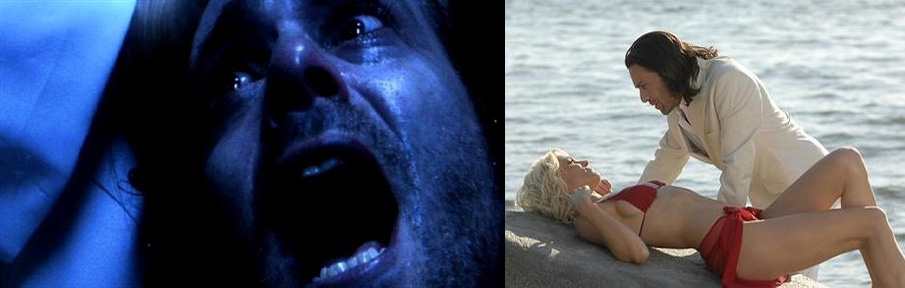
Gaius Baltar tortured/in imagination (merged pics), Battlestar Galactica, October 6, 2012. Qualifies as fair use under US Copyright laws – low res (1st picture) and merged rendering.

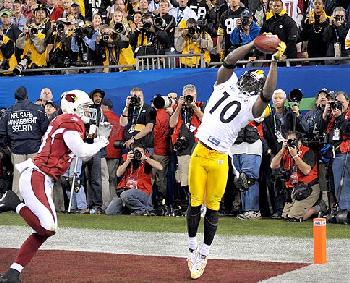
“A wide receiver tiptoeing the sideline of a football field after making an acrobatic catch, barely keeping his left foot in-bounds by tapping his big toe in the two inches of space between the grass and the thick white line in front of him. A note in a song that is so inspiring, so well-balanced between rhythm and harmony, so well sung that the hairs on my neck stand up and my spirit feels like soaring.” This is what I wrote in the first paragraph of the preface (which I need to revise yet again, by the way) to my Boy @ The Window manuscript.

In context, I was writing about the infinitesimal decisions and actions that could’ve added up to success or failure for me growing up in those dismal days and years. But I could’ve just as easily been writing about what imaginations and fantasies went through my head growing up to make my inner world more powerful than anything I saw and experienced in the real world. Much of Boy @ The Window is about how I coped, good, bad and ugly (see my posts “Peanuts Land” from April ’12 and “Mr. Mister’s ‘Kyrie’” from March ’11 for more).

How I coped through imagination, inner projection and fantasy changed during the worst of my preteen and post-puberty years. I went from imagining and acting out an entire city, nation-state and culture in my room to the need for an internal world that couldn’t be taken apart by abuse, poverty and isolation. Ultimately it came for me in the form of the everyday things I either already liked or was on the cusp of liking. I already enjoyed a wide variety of music by the fall of ’82. Once I became a sports fan and occasional sports participant, those images and achievements became part of my inner movie and soundtrack.

It became a partnership that I eventually learned to conjure up at will, that became part of my residual sleeping state, that made the madness of 616, MVHS and Mount Vernon, New York dissolve into background noise.

Santonio Holmes’ Super Bowl XLIII game-winning catch, Tampa, FL, February 1, 2009. (http://bleacherreport.com).

It meant, though, that watching a Mets, Giants or Knicks game or listening to Earth, Wind & Fire wasn’t a simple casual experience. It involved rooting for the underdog, which in turn meant rooting for myself. It included the synching of home runs, touchdown passes and three-pointers to guitar riffs, crescendos and other highlights in a particular song or series of songs. It meant that my imagination became itself a fully dedicated line for coping with stress, checking anger, solving problems, and seeing my world the way I chose to see it, rather than the way my world actually was.

Take one of my favorite songs as a teenager, Yes’ “Owner Of A Lonely Heart” (1983). It wasn’t just the fact that I actually felt lonely and could relate to the song. When I heard the song, I could see myself running a screen play in football, following a group of well set-up blockers all the way to the end zone for a touchdown. I could relate emotionally, because the song was about me as an underdog, because of my unrequited love for Crush #1, because I now knew what a screen pass was. It made existential philosophy easier for me to understand my senior year of high school in my AP English and Philosophy classes.

“Owner Of A Lonely Heart” also reminded me to never “concede my free will,” even when my now ex-stepfather Maurice’s fists met my face and teeth and ribs at fifteen and sixteen. Like a scene from the ’00s Battlestar Galactica involving Gaius Baltar or Caprica Six, I often projected a view of the world I wanted over whatever was going on in reality. Going the mile or so between 616 and the C-Town in Pelham could either be a chance for me to catch a long touchdown pass or for me to figure out to which colleges I should apply.

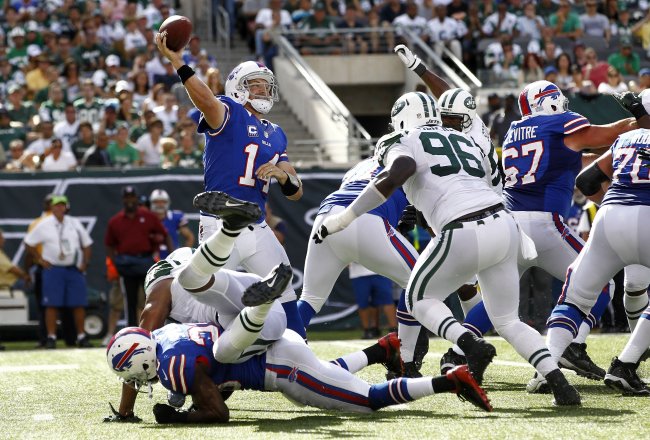
Ryan Fitzpatrick of Buffalo Bills v. NY Jets, in rare protection against blitz while in pocket, October 6, 2012. (http://bleacherreport.com).

Sometimes, if I allowed myself to slip deeply enough, like, in the moments before an exam, I could use a buildup point in the song to bring in an extra blocking tight end to run a max-protect play. I’d snap the ball, send three receivers on one side of the defense, and wait just long enough for one to cross before delivering a perfect pass that allowed my receiver to split the secondary for a long score. All while taking a hit in my right ribs and being knocked down to the turf, just a quarter-second after my index finger’s come off the ball, giving it a smoother spiral rotation while in flight. And so many times, that re-visioning of my world made it so that my natural ability to remember everything and discern many things resulted in very good grades, solid performances, and a balancing act that made life at 616 and MVHS just bearable enough.

I was reminded of how often my mind went down this road by Touré’s Who’s Afraid of Post-Blackness (which I blogged about earlier this week), particularly his chapter on imagination and art, “Keep It Real Is a Prison.” Except that my mind does still go there sometimes. Usually as I’m about to give a speech, or while running a five-miler, drilling a three or driving. Or in writing something for publication, like Boy @ The Window.

School of Dreams (and Nightmares)

10 Monday Sep 2012

Posted by decollins1969 in 1, Academia, Boy @ The Window, culture, Eclectic, Mount Vernon High School, Mount Vernon New York, Politics, Pop Culture, race, Youth

≈ Leave a comment

Tags

A.B. Davis Middle School, Academic Competition, Advanced Placement, Cerritos California, Cheating, College Preparation, Edward Humes, High Ability Students, High Achieving Students, High-Stakes Testing, Humanities, Humanities Program, Magnet Programs, MVHS, Psychological Abuse, School of Dreams, Social and Psychological Development, Starbucks, Whitney High School, Zero-Sum Game


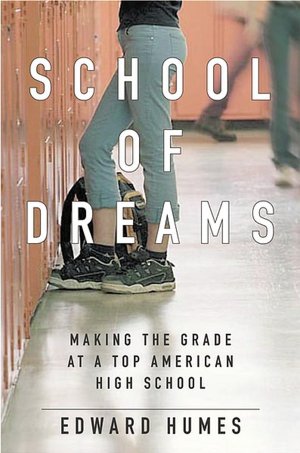
School of Dreams (2003), by Edward Humes, September 9, 2012. (Donald Earl Collins).

Yesterday was the thirty-first anniversary of my first day of seventh grade at A.B. Davis Middle School, my first day in a six-year slog in Mount Vernon public schools’ Humanities Program. The academic pressures that came with being part of a gifted-talented track magnet program were such that the lessons I learned during those years remain with me to this day. The unique lessons about who I was and whom I wanted and needed to become, though, are the kinds of lessons reserved for a memoir, like, say, Boy @ The Window.

But there are other lessons, other issues that anyone who has gone through such a program, is in one, or has kids in one, should heed. Perhaps the best book I’ve ever read about the experiences of high ability students in a gifted track middle or high school has been Edward Humes’ School of Dreams: Making the Grade at a Top American High School (2003). Despite some of the flaws in the Pulitzer-Prize winning journalist and author’s account covering a year in the life of Whitney High School in Cerritos, California, this is a book I’d use in many of my future graduate seminars in US educational history.

A particularly poignant passage was where Humes wrote, the “combination of a school built upon high expectations and a student population whose dominant culture elevates learning to a high priority—and hard work in school to an absolute necessity—makes for a kind of education echo chamber” (p. 340). Humes meant this as a positive comment on the academic culture of a public high school in Southern California.  But it also reflected a constant tension between learning and zero-sum competition.

Starbucks double chocolate chip frappucino, September 10, 2012. (htttp://wwwcoffeespitfire.blogspot.com).

Humes somehow doesn’t fully take stock of this tension beyond the context of the high school in which he embedded himself in 2000-01. There were stories, disheartening stories about seventh graders hitting up Starbucks for coffee before school, during lunch and after school to stay awake. Of parents who shunned their kids’ artistic talent and aspirations in their quest to ensure they earned a degree in a STEM (science, technology, engineering, mathematics) field. Of students taking as many as six AP (Advanced Placement) courses in a single school year, or colluding to cheat on a calculus or physics exam when the pace of study and testing proved to be too much.

Yes, despite this, Whitney has produced thousands of elite college-goers, and 4.0 is the standard, not the exception, that its students shoot for. But now, in an age in which high-stakes testing is the norm, what’s the social and psychological message that we’re communicating to the current crop of K-12 students in the US today?

For me, the best way to answer this question is to look back on my own experience and the experiences of my former Humanities classmates. Based on my own writings and findings, there’s plenty of evidence that intensive academic rigor and competition — like intensive athletic training and competition — will produce excellent students well prepared for college, but not necessarily well prepared for life. Many of my former Humanities classmates (and many of the students Humes tracked and interviewed for School of Dreams) were socially inept, put themselves under constant stress (not to mention experiencing psychological pressures from each other, their parents and teachers) and lacked the deeper critical reasoning skills necessary to make college a worthwhile experience.

The students had a “cram-and-exam” methodology to learning, spending hours learning techniques and concepts and little time in applying them beyond the classroom in the vast majority of their subjects. Often when students discovered a new talent, particularly in writing, the arts or in music, many of their parents pounced into action to admonish teachers for encouraging these developments or to force their kids into their way of thinking about their future. Bottom line: while many of these high-achievers were willing to slit each others’ throats for an A, an AP “5” or an SAT 1600, they hadn’t really made up their minds about who they wanted to be, the talents they wanted to explore, or the world in which they wanted to live.

“Nightmares & Daydreams” episode screen shot, Avatar: The Last Airbender, September 10, 2012. (Donald Earl Collins). Qualifies as fair use under US Copyright laws due to pic’s low resolution.

When I first read Humes’ School of Dreams nine years ago, it forced me to think about these parallels. I realized that if Starbucks was within a mile of either A.B. Davis Middle or Mount Vernon High School in the ’80s, our class alone would’ve spent about $160,000 a year there on coffee and pastries. That most of us were sane enough to only take three or four AP courses my senior year. That our standard for a minimally acceptable SAT score was a 1200. That, instead of kids crying or running away from home for two days over a B, attempted suicides or a turn to crystal meth would’ve been more common. I guess by Whitney’s standards, we would’ve been slackers.

Still, more than a quarter-century since my last Humanities course, with tighter budgets and far more high-stakes testing (see the correlation?), the crush of intense academic competition has made our public schools a poor place for polishing students into well-adjusted young adults. Yes, I know that this is primarily a parent’s responsibility. But then again, public schools are meant to be far more than an octagon ring with No. 2 pencils.

← Older posts
Newer posts →

Boy @ The Window: A Memoir

Boy @ The Window: A Memoir

Places to Buy/Download Boy @ The Window

There's a few ways in which you can read excerpts of, borrow and/or purchase and download Boy @ The Window. There's the trade paperback edition of Boy @ The Window, available for purchase via Amazon.com at http://www.amazon.com/Boy-Window-Donald-Earl-Collins/dp/0989256138/

There's also a Kindle edition on Amazon.com. The enhanced edition can be read only with Kindle Fire, an iPad or a full-color tablet. The links to the enhanced edition through Apple's iBookstore and the Barnes & Noble NOOK edition are below. The link to the Amazon Kindle version is also immediately below:

scr2555-proj697-a-kindle-logo-rgb-lg

Boy @ The Window on Amazon.com: http://www.amazon.com/Boy-The-Window-Memoir-ebook/dp/B00CD95FBU/

iBookstore-logo-300x100

Boy @ The Window on Apple's iBookstore: https://itunes.apple.com/us/book/boy-the-window/id643768275?ls=1

Barnes & Noble (bn.com) logo, June 26, 2013. (http://www.logotypes101.com).

Boy @ The Window on Barnes & Noble: http://www.barnesandnoble.com/w/boy-the-window-donald-earl-collins/1115182183?ean=2940016741567

You can also add, read and review Boy @ The Window on Goodreads.com. Just click on the button below:

Boy @ The Window

Twitter Updates

Tweets by decollins1969
  • RSS - Posts
  • RSS - Comments

Archives

  • June 2025
  • April 2023
  • September 2022
  • August 2022
  • July 2022
  • June 2022
  • May 2022
  • April 2022
  • March 2022
  • January 2022
  • December 2021
  • November 2021
  • October 2021
  • September 2021
  • August 2021
  • July 2021
  • June 2021
  • April 2021
  • March 2021
  • February 2021
  • January 2021
  • December 2020
  • November 2020
  • October 2020
  • September 2020
  • August 2020
  • July 2020
  • May 2020
  • April 2020
  • March 2020
  • January 2020
  • December 2019
  • November 2019
  • August 2019
  • July 2019
  • June 2019
  • May 2019
  • April 2019
  • March 2019
  • February 2019
  • January 2019
  • December 2018
  • November 2018
  • October 2018
  • September 2018
  • August 2018
  • July 2018
  • June 2018
  • May 2018
  • March 2018
  • February 2018
  • January 2018
  • December 2017
  • November 2017
  • October 2017
  • September 2017
  • August 2017
  • July 2017
  • June 2017
  • May 2017
  • April 2017
  • March 2017
  • February 2017
  • January 2017
  • December 2016
  • November 2016
  • October 2016
  • September 2016
  • August 2016
  • July 2016
  • June 2016
  • May 2016
  • April 2016
  • March 2016
  • February 2016
  • January 2016
  • December 2015
  • November 2015
  • October 2015
  • September 2015
  • August 2015
  • July 2015
  • June 2015
  • May 2015
  • April 2015
  • March 2015
  • February 2015
  • January 2015
  • December 2014
  • November 2014
  • October 2014
  • September 2014
  • August 2014
  • July 2014
  • June 2014
  • May 2014
  • April 2014
  • March 2014
  • February 2014
  • January 2014
  • December 2013
  • November 2013
  • October 2013
  • September 2013
  • August 2013
  • July 2013
  • June 2013
  • May 2013
  • April 2013
  • March 2013
  • February 2013
  • January 2013
  • December 2012
  • November 2012
  • October 2012
  • September 2012
  • August 2012
  • July 2012
  • June 2012
  • May 2012
  • April 2012
  • March 2012
  • February 2012
  • January 2012
  • December 2011
  • November 2011
  • October 2011
  • September 2011
  • August 2011
  • July 2011
  • June 2011
  • May 2011
  • April 2011
  • March 2011
  • February 2011
  • January 2011
  • December 2010
  • November 2010
  • October 2010
  • September 2010
  • August 2010
  • July 2010
  • June 2010
  • May 2010
  • April 2010
  • March 2010
  • February 2010
  • January 2010
  • December 2009
  • November 2009
  • October 2009
  • September 2009
  • August 2009
  • July 2009
  • June 2009
  • May 2009
  • April 2009
  • March 2009
  • February 2009
  • January 2009
  • December 2008
  • November 2008
  • October 2008
  • September 2008
  • August 2008
  • July 2008
  • June 2008
  • May 2008
  • April 2008
  • March 2008
  • February 2008
  • January 2008
  • December 2007
  • November 2007
  • October 2007
  • September 2007
  • August 2007
  • July 2007
  • June 2007

Recent Comments

MaryPena's avatarMaryPena on My Day of Atonement/Bitter Hat…
decollins1969's avatardecollins1969 on No Good Teaching Deed Goes…
Mary Rose O’Connell's avatarMary Rose O’Connell on No Good Teaching Deed Goes…

NetworkedBlogs on Facebook

NetworkedBlogs
Blog:
Notes From a Boy @ The Window
Topics:
My Life, Culture & Education, Politics & Goofyness
 
Follow my blog

616 616 East Lincoln Avenue A.B. Davis Middle School Abuse Academia Academy for Educational Development AED Afrocentricity American Narcissism Authenticity Bigotry Blackness Boy @ The Window Carnegie Mellon University Child Abuse Class of 1987 CMU Coping Strategies Crush #1 Crush #2 Death Disillusionment Diversity Domestic Violence Economic Inequality Education Family Friendship Friendships Graduate School Hebrew-Israelites High-Stakes Testing Higher Education History Homelessness Humanities Humanities Program Hypocrisy Internalized Racism Jealousy Joe Trotter Joe William Trotter Jr. K-12 Education Love Manhood Maurice Eugene Washington Maurice Washington Misogyny Mother-Son Relationship Mount Vernon High School Mount Vernon New York Mount Vernon public schools Multiculturalism MVHS Narcissism NFL Pitt Pittsburgh Politics of Education Poverty President Barack Obama Race Racial Stereotypes Racism Relationships Self-Awareness Self-Discovery Self-Reflection Sexism Social Justice Teaching and Learning University of Pittsburgh Violence Whiteness Writing

Top Rated

Blog at WordPress.com.

  • Subscribe Subscribed
    • Notes from a Boy @ The Window
    • Join 103 other subscribers
    • Already have a WordPress.com account? Log in now.
    • Notes from a Boy @ The Window
    • Subscribe Subscribed
    • Sign up
    • Log in
    • Report this content
    • View site in Reader
    • Manage subscriptions
    • Collapse this bar
 

Loading Comments...