Last Dance, The Last Class

Tags

, , , , , , , , , , , ,


The late Donna Summer, album cover, circa 1979, May 9, 2014. (http://digboston.com/).

The late Donna Summer, album cover, circa 1979, May 9, 2014. (http://digboston.com/).

Twenty years ago on this date was my last formal class as a formal student, a grad course at Carnegie Mellon with Kate Lynch on Comparative Urban History. I spent that evening of my last day of classes polishing up a twenty-five page research essay that compared the development of public housing practices in Toronto, Berlin and Chicago. It was too ambitious a paper, especially given that I did all the research for it in the final four weeks of that semester, after spending a week at AERA (American Educational Research Association) in New Orleans presenting on a panel and networking, and two days meeting the Gill side of my extended family for the first time. I just wanted to get it done, though.

I made my final edits to my introduction and argument and to a few of my citations and references just before 9:30 pm that second Monday in May ’94. I was working in a computer lab in Wean Hall, using one of the rare PCs on campus. Rare because Carnegie Mellon had made a ridiculous deal with Apple back in ’83 to be a Macintosh campus — a terrible move if you were using Macs in the 1990s.

Apple Macintosh II Computer, April 15, 2004. (Alexander Schaelss via Wikipedia). Released via GNU FDL/CC-SA-3.0.

Apple Macintosh II Computer, April 15, 2004. (Alexander Schaelss via Wikipedia). Released via GNU FDL/CC-SA-3.0.

Normally I wrote my papers on the University of Pittsburgh’s campus, as my alumnus status gave me access to computers and Hillman Library. Plus, it took Pitt almost a year to shut down my grad school accounts, allowing me to make thousands of copies of materials that I would’ve needed a month’s worth of my stipend to make at Carnegie Mellon’s Hunt Library. And, even after a year of torture and courses, nearly all of my friends and interests remained across the bridge connecting Oakland and Pitt with Schenley Park and the southern end of Carnegie Mellon’s campus.

Once I completed my paper, I walked over to Baker Hall, went up to the second floor, and dropped it off for Lynch to review and grade. It was all over but the dissertation overview defense and the dissertation itself. I was happy, but I was more relieved than happy. The last year of transferring to and doing coursework at Carnegie Mellon had taken a toll on me. For the first time ever, I found myself actually hating classes and school in general. Sure, there were individual teachers and professors I despised. Dr. Demontravel. David Wolf. Estelle Abel. Dick Ostreicher. But not the formal process of classroom learning itself. It took a year of redundant courses at CMU at the insistence of the powers that were to steal that immutable joy of learning from me. At least, temporarily.

I thought about it the next day. My first day of kindergarten was September 8, ’74, which meant that I had experienced twenty school years between the ages of four and twenty-four. For virtually all of my life, I’d been a student, from kindergarten to PhD, between Presidents Nixon and Ford and Bill Clinton. I had done several thousand assignments, hundreds of exams, and dozens of papers and essays. Combining undergrad and grad school, I’d taken fifty-eight (58) courses. It’s a wonder I hadn’t tired of listening to mercurial professors any sooner.

Keep Calm and Hate School poster, May 9, 2014. (http://keepcalmstudios.com).

Keep Calm and Hate School poster, May 9, 2014. (http://keepcalmstudio.com).

I spent the next few days doing something I normally didn’t have time for. I slept in late, took lots of naps, and watched my Knicks play and struggle with the Jordan-less Bulls in the NBA’s second round of playoffs. It would be the most rest I’d have for the rest of ’94.

Two decades later, and I’ve taught nearly as many courses as I took to earn my bachelors, masters and doctorate. I do like the view of a classroom — in-person or virtual — from the instructor’s perspective. But I learned so much about being a teacher, too, from what to do and what not to do, long before my final semesters at Carnegie Mellon. Ms. Griffin, Mrs. Shannon, Mrs. O’Daniel, Mrs. Bryant, Harold Meltzer were great counterbalances to the teachers/professors who were as inspiring as watching paint dry in a desert.
There Are No White Liberals — Really

Tags

, , , , , , , , , , , , , , , ,


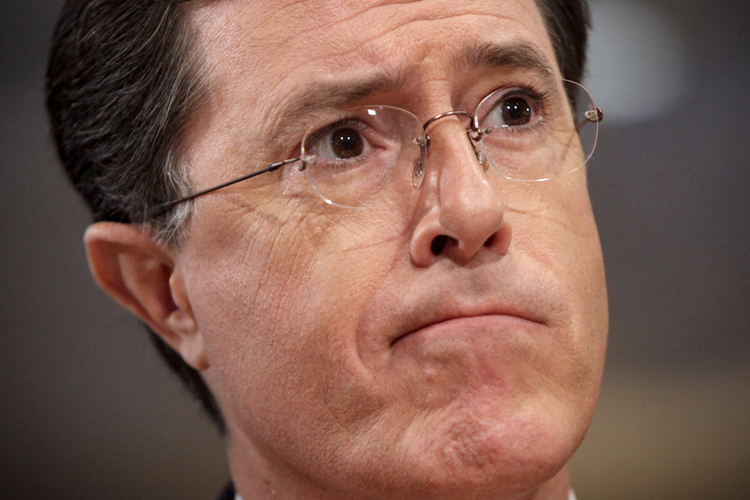
Stephen Colbert meets with members of the Federal Election Commission (FEC), Washington, DC, June 30, 2011. (Yuri Gripas via http://slate.com).

Stephen Colbert meets with members of the Federal Election Commission (FEC), Washington, DC, June 30, 2011. (Yuri Gripas via http://slate.com).

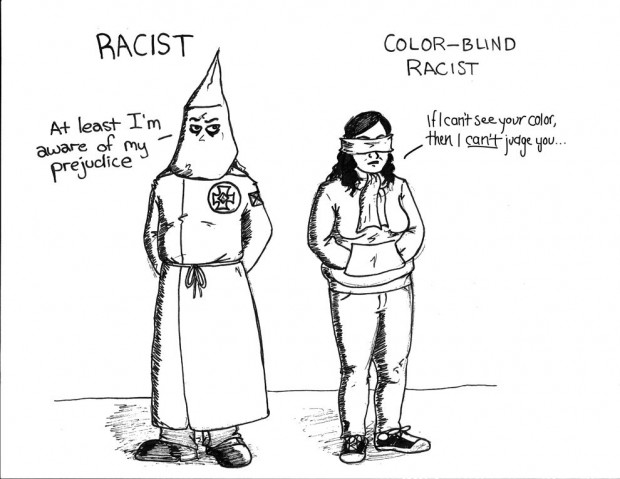
What I’ve learned in recent months from Twitter, Facebook, The Atlantic and The New York Times, from recent Supreme Court decisions, and from attempts to justify oligarchy and bigotry, is the following. That the term “White liberal” is a media falsehood, meant to create a distinction without any significant differences. That most White liberals are “liberal” by default, only because they’re not conservative — or really, reactionary — enough. That most Whites who see themselves as liberal also believe in colorblindness as a racial philosophy or refuse to acknowledge their own privilege of Whiteness and structural racism as major obstacles on the path toward an egalitarian society. And that people who look and write like me can and should be ignored, precisely because I’m Black and underprivileged by default.

There are in fact Whites who do acknowledge the privilege of their own Whiteness, who do understand the gigantic barriers of structural racism, institutional and individual racism. Some of those are leftists, many more, though, are racists who have fully embraced Whiteness as their cloak of superiority. Hence Donald Trump, Donald Sterling (heck, maybe even Donald Duck), Paul Ryan, Cliven Bundy, Tom Perkins, and, if you’re aware of recent racism rows in the UK, Jeremy Clarkson.

There are the rare handful, though, who are leftist enough to have also become active on the anti-racism front. I’m lucky to count quite a few of them as friends, or at least, colleagues. Some of these folks, whether Tim Wise or Mark Naison, Jessie Daniels or Joe Feagin, sure enough, do acknowledge that their rare enlightenment has its limits, that they, too, can and do get it wrong sometimes in discussing race and racism. They even acknowledge that they have Whiteness and other -isms, that they aren’t perfect or in need of a pedestal because they’ve managed to look past their privilege to be radical leftists.

Colorblind racism cartoon, February 27, 2013. (Gabriel Ivan Orendain-Necochea/Daily Sundial via http://sundial.csun.edu).

Colorblind racism cartoon, February 27, 2013. (Gabriel Ivan Orendain-Necochea/Daily Sundial via http://sundial.csun.edu).

That leaves this fairly large plurality of Whites who see themselves as “liberals,” but refuse to realize that they are liberals because they aren’t fearful or hateful enough to be right-wingers. Politically, they’re basically centrists, folks who don’t want to rock the boat on any issues involving social class, social mobility or structural inequality. They may care about a green planet, recognize that evolution is real and climate change is man-made, but will still see racism as an individual issue, and not one baked into the bricks and mortar of our society and its institutions.

These are the media standard “White liberals,” ones who care more about an individual White guy who uses the N-word on TV than they do about a White supremacist terrorist shooting up a community center or a place of worship. In fact, the media and these liberals will all but refuse to use the word “terrorist” in reference to systemic White violence against communities of color or those of different religious backgrounds. They’ll be the ones who’ll start with the sentence, “I don’t care if you’re black, white, green or red…,” as if racism were a simple matter of melanin, and not material and psychological advantages that begin at conception and end well after death. Not to mention, there aren’t any actual “green” or “red” skin-colored humans.

Yet, despite their colorblindness, they couldn’t possibly conceive of Blacks and Latinos smart enough to make it to an elite college without the handout of affirmative action, or of large numbers of people of color in positions of leadership in business and in  politics, or of a feminism without the contradiction of femininity. For that matter, so-called colorblind White “liberals” still find it easy to call race a “card” that people of color pull out only when it’s somehow convenient for us, or lament the need for historically Black colleges and universities or other Black institutions. Some have even argued for a White History Month, which is ridiculous, considering how Whiteness is ever-present (kind of like the way the most religious of Christians think about God).

So, after four and a half decades as a born and bred American, I’ve realized that the average White liberal is not only not a leftist, Marxist or an anti-racist. That not only that the media labels them as “liberals” by default. But that they are as much to blame for our sorry state of affairs regarding race in America as Frazier Glenn Miller, Wade Michael Page, the NYPD, the LAPD, evangelical Christianity and those Southern Democrats who became Republicans between 1964 and 1994.

When Nightmares Go Nuclear

Tags

, , , , , , , , , , , , , , ,


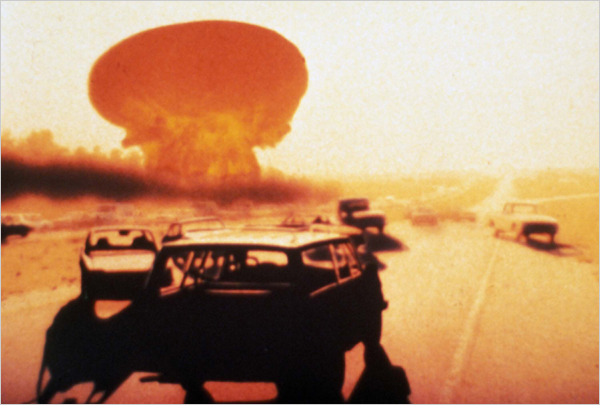
Color version of mushroom cloud over Nagasaki, Japan, August 9, 1945. (http://www.mphpa.org via US Army Air Force). In public domain.

Color version of mushroom cloud over Nagasaki, Japan, August 9, 1945. (http://www.mphpa.org via US Army Air Force). In public domain.

I find myself seeing bright orange, yellow and white lights filling the sky and obscuring everything around me. It doesn’t matter whether I’m above ground, at home, at school or work, or on a Subway platform underground in New York. Once these lights hit, it’s over. I find myself no longer in my body, for it no longer exists. Yet I still have eyes with which to witness. Through a purple haze, the intense heat, literally searing, melting and vaporizing flesh and bone. A shock wave, crushing and churning the world all at once. Spirits once safely in bodies are now on the same plane of this new existence with me, all watching as the light, the heat and the supersonic shock wave tear into our former world. Where do we go from here, as the world is no more?

That’s a milder version of a nightmare that has been with me now off and on for thirty-four years. I’m sure that I was among the hundreds of millions of folks in the West whom dreamt often of a nuclear nightmare. It was during the final phase of the Cold War, with Soviet and American aggressions, Reagan’s presidency, and a renewed arms race. All made the prospect of “99 Luftballons” (1983) and the launch of 1,000 nuclear tipped ICBMs and SLBMs and one billion or more dead a dreadful, gnawing fact that I couldn’t do a damn thing about.

Screen shot from The Day After (November 1983) ABC movie, presumably suburban Kansas City, MO/KS, October 21, 2007. (Stout/NY Times).

Screen shot from The Day After (November 1983) ABC movie, presumably suburban Kansas City, MO/KS, October 21, 2007. (Stout/NY Times).

The very first time I fully understood the dangerous and fatal that defined this world was toward the end of fifth grade, in May ’80. It was an early May Thursday in Mrs. O’Daniel’s classroom at William H. Holmes Elementary in Mount Vernon, New York, a bright, sunny spring day. We were in independent reading mode, and Mrs. O’Daniel had given me permission to read ahead in our social studies textbook, which focused on American history.

We had left off with the Great Depression and all of the suffering that came with it. Of course, this was a collective history, one which didn’t even have the special sufferings of people of color or women in blue boxes — yet. So Whites represented all Americans. This wasn’t something I picked up on in ’80, at least consciously. But luckily, between Lerone Bennett’s edited three-volume Ebony Pictorial History of Black America (1974) at home and Mrs. O’Daniel constantly supplementing our knowledge at school, I was more aware of the deficiencies of textbooks long before I could articulate them.

As I turned the pages and read about the great battles of World War II, the horrors of Pearl Harbor and the gathering of the righteous power of the US to win the war, I suddenly saw something that shook me to my core. It was the picture of the atomic bomb’s mushroom cloud hovering over Nagasaki like death itself. It was in full color, bright and yellow and white, and obviously hot and broiling. The camera shot had managed to capture some of the landscape below, the area surrounding Nagasaki an August summer green. As I read about the 70,000 killed instantly at Hiroshima, an area the size of Mount Vernon completely flattened by a bomb that at its core had only a few pounds of weapons-grade uranium, I was frightened. I could be dead at a moment’s notice, or worse, suffer from radiation burns and sickness, in which case I’d truly be among the walking dead.

But this was only one phase of my nightmare. As things at 616 went from stable to completely out of control, my nuclear nightmares became more frequent. It seemed like there was a nuke for every day of the week during my last year as a Hebrew-Israelite. Watching The Day After on ABC in November ’83 didn’t help matters, but I also couldn’t help myself. I was both repulsed by and attracted to the idea of nuclear annihilation and survival. Maybe because I was already living through one hell of a disaster at 616.

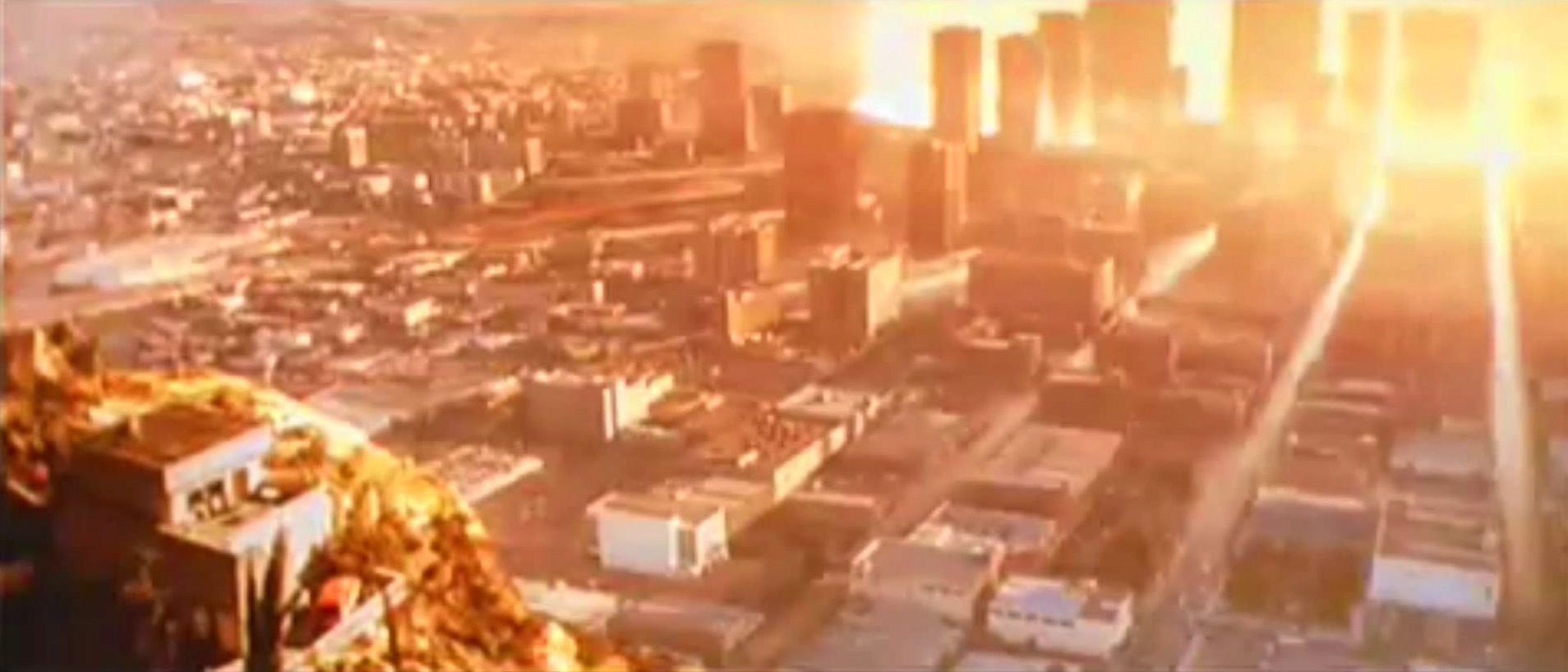
Cropped screen shot of Los Angeles at beginning of nuclear strike, from Terminator 2 (1991), May 3, 2014. (http://youtube.com).

Cropped screen shot of Los Angeles at beginning of nuclear strike, from Terminator 2 (1991), May 3, 2014. (http://youtube.com).

My nuclear nightmares continued at nearly daily pace until after I saw Terminator 2 in June ’91. At that point, I realized that my nightmares weren’t so much about the plausibility of surviving a nuclear holocaust as they were about surviving my own preteen and teenage years. It occurred to me there are worse things in life than dying, and like surviving nuclear war, surviving a violent and unstable childhood like mine has significant side effects. I could be occasionally be up, I was much more frequently down, I could occasionally fly into a rage. And I could have recurring nightmares of me murdering my now dead ex-stepfather. All signs of PTSD.

Realizing this, I took control over my dream world, and managed to push my plutonium-tipped dreams into a box, along with so many things from my decade of evangelistically twisted fire and brimstone from two religions. I still watch end-of-the-world movies, though without the extreme fervor of dream-based certainty of suffering a lingering death. Though I do often find it funny how White fears permeate these movies.

Friendship, Marriage and Falsehoods

Tags

, , , , , , , ,


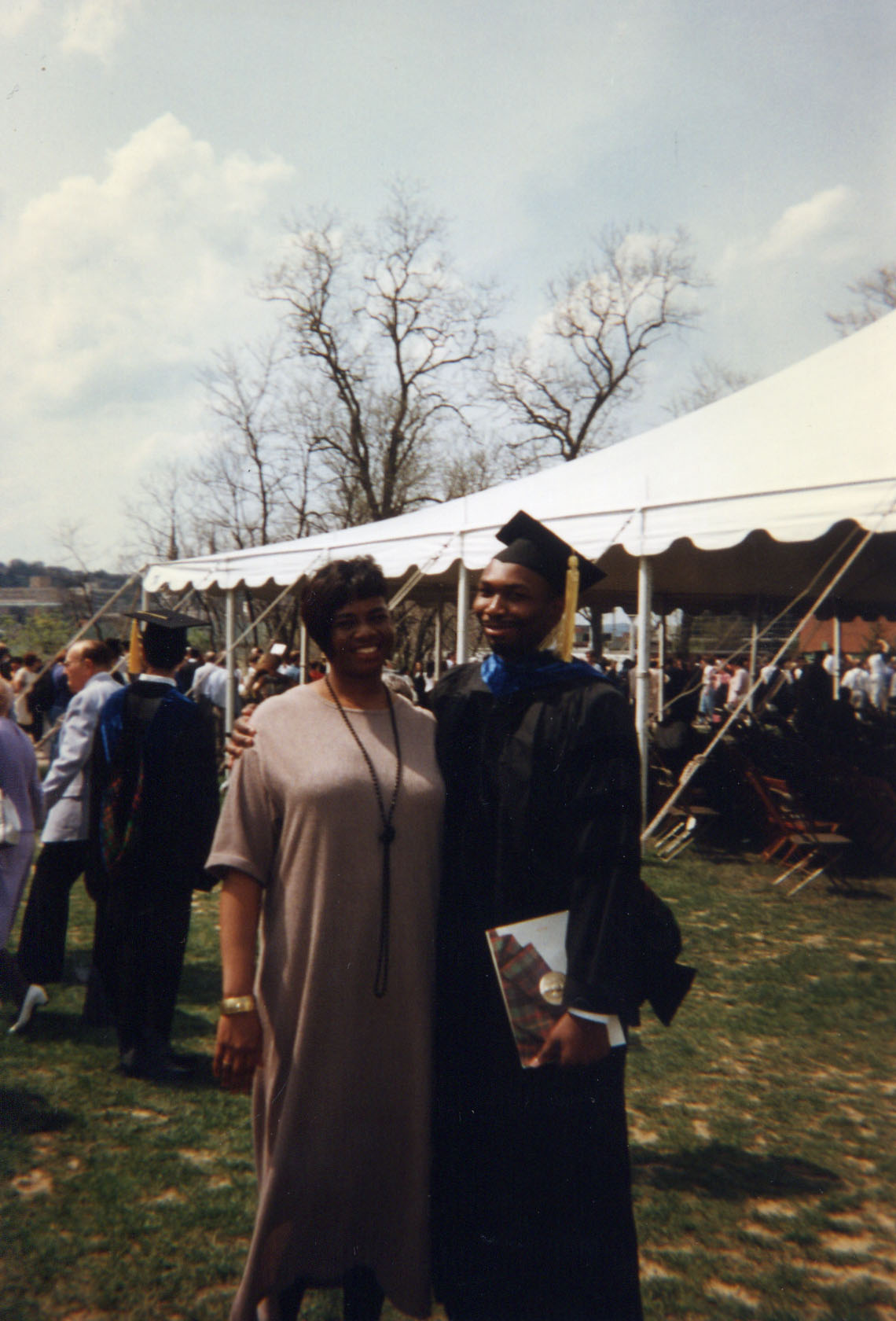
Me and Angelia at my PhD graduation, Carnegie Mellon University, May 18, 1997. (Edward Lomax).

Me and Angelia at my PhD graduation, Carnegie Mellon University, May 18, 1997. (Edward Lomax).

Today marks fourteen years of marriage. Statistically, we’re either a year away from divorce, or on board for a longer roller-coaster-ride of life and love, struggle and stress, revelation and renewal. Either way, it’s already been a great two decades of learning about myself and my wife, about the meaning of love (conditional and unconditional) and the limits of romance, about the real meaning of family and marriage.

Some of you may not believe this, but a marriage of any realness is hard work. We get tired of ourselves, our baggage, our bullshit. Now add another human being to the mix, the person you share most everything with. It can be a emotional meltdown of epic proportions if you’re not mature enough to have a well-honed sense of empathy, not to mention a sense of humor and a sense of when to back off.

I can say from experience that it helps to have been friends long before love, romance, marriage and parenting became part of the bargain. And not just friends, but the best of friends. Without having that, everything else is work without purpose, drudgery and painful struggles with personal and spiritual growth.

One of the many things I’ve learned in the past decade and nearly a half is that marriage itself has been loaded with context, deriving from Western ideas that have their roots in European royalty and the 19th century warping of such ideas for us ordinary folk. Including Whiteness and chivalry, of weird evangelical notions of masculinity and femininity, of patriarchy and high-born expectations. Only to realize that these ideas come out of an era of arraigned marriages, essential contracts to secure bloodlines and power for another generation of the elite classes. Romance, love, the eternal enduring bond between two soul-mates – that was never part of this bargain. But leave it to capitalism to distort a loveless process of procreation into an intense, always-falling-in-love – but without standing in love in the midst of struggle – idea of marriage.

Because of this knowledge, I know, too, that every marriage is different. And because of the unique nature of every relationship, I also know that my relationship with my wife is constantly evolving. Meaning that any ideas of marriage that I had fourteen years ago have been dead for a while. Trust me, this is a good thing. There is no singular road map to a happy and always-in-love marriage – that fairy tale is for the Anna Hathaway/Princess Bride set who remains at the mental age of eight or twelve.

No, a good marriage is about two people working toward similar goals, to a friendship that keeps changing, even if the contours of that friendship become ever more complicated. After all, it’s from that ground of friendship that our love shot up in the first place. Yay, us!

Unbearable Being Of Whiteness

Tags

, , , , , , , , , , , , , , ,


White supremacist and deadbeat grazing fee payer Cliven Bundy at his ranch, Bunkerville, Nevada, April 11, 2014. (Jim Urquhart/Reuters via http://www.newsweek.com).

White supremacist and deadbeat grazing fee payer Cliven Bundy at his ranch, Bunkerville, Nevada, April 11, 2014. (Jim Urquhart/Reuters via http://www.newsweek.com).

There have been few things more disappointing than seeing how frequently the structures, institutions and individuals in this country cut Whites slack for things that would have me out of work, in jail or long dead. If I were a human rights attorney specializing in racial justice, I’d want to take a sledgehammer to my head at least five days a week, every single week, given the ridiculous things that occur and how the mainstream media reports them.

Cliven Bundy is the latest in a long, long, long line of White supremacists whom the media have turned into heroes. Bundy has the distinction of refusing to pay over $1 million in grazing fees for his cattle over a tw0-decade period, even though his cattle grazed on federally-owned land in Nevada. When federal agents came to his ranch to seize his cattle, instead of paying his fees, Bundy and his neo-Nazi/militia buddies brazenly displayed their guns and rifles for the whole world to see. Bundy and company complained that the government had violated their rights as ranchers — rights to an endless free lunch for their cattle, apparently.

The sad truth is, all one would have to do to change the perception here would be to make Bundy and the rest of his master-race-band Black. There would’ve been a shootout, and not necessarily with law enforcement, either. The mainstream media would’ve called them terrorists, militants, anarchists and Black Panther-wannabes. And that would be the end of the story.

Then there’s Ethan Couch, the now seventeen-year-old who ran over and killed four people on a road outside of Fort Worth, Texas, not to mention permanently disabling one of his teenage passengers. A judge sentenced Couch to ten years’ probation, in no small part because a psychologist testified that Couch suffered from affluenza. Affluenza, of course, is the inability to link bad behavior with consequences due to parents inadvertently teaching the lesson that wealth buys the privilege of not having to suffer any consequences. Last I checked, affluenza appears nowhere in the Diagnostic and Statistical Manual for Mental Disorders. 

Affluenza Awareness Poster Child (of character King Joffrey from Game of Thrones), April 24, 2014. (Roflbot via http://disinfo.s3.amazonaws.com/).

Affluenza Awareness Poster Child (of character King Joffrey from Game of Thrones), April 24, 2014. (Roflbot via http://disinfo.s3.amazonaws.com/).

If I did this, even at the age of ten, my Black ass would be in juvenile detention, especially in Texas, and likely transferred to a high-security prison as soon as I started puberty. It wouldn’t have mattered if Dr. Phil himself had testified that I suffered from the poverty pox. I would’ve been treated as close to an adult in the Texas criminal justice system as the system would’ve allowed. The media wouldn’t have whispered a protest, much less bought the poverty pox defense or tried to treat it as a plausible psychological disorder (of course, grinding poverty does result in PTSD for millions, but let’s not tell that to the mainstream loonies).

So I’m tired. I’m tired of employers making excuses for lazy twenty-three year-olds whom happen to be White, saying that “they’re young.” As if someone incompetent and lazy in their work deserves more consideration than a Black man or woman in their mid-twenties because they are White and have a college degree? Ridiculous!

I’m tired of teachers and professors who explain away inconsistencies in someone’s academic record, saying “thery’re brilliant” or “he’s a genius.” Is boredom really an excuse for not working hard or completing assignments? Is a higher SAT score really a justification for ignoring borderline personality disorder or the potential for violent behavior? It is the epitome of arrogance to excuse immoral or criminal behavior on the basis of high analytical intelligence, but I’ve seen it enough times to know that it’s a normal part of Whiteness’ wages.

I’m tired of the mainstream media reporting the ludicrous as normal and the normal as ludicrous as they ignore their own complicity in upholding Whiteness’ wages. Frazier Glenn Miller (Overland Park, Kansas shooting, Jewish community center) and Wade Michael Page (Oak Creek, Wisconsin shooting, Sikh temple) committed acts of domestic terrorism, hate crimes based on Whiteness. But whenever these shootings occur, the mainstream theme talks about mental illness, about whether racism is an illness. Maybe in a couple hundred years, individual racism will be in DSM-XV. What about the structural and institutional racism that ensures the privileges of Whiteness, though?

Frazier Glenn Miller mugshot, April 14, 2014. (European Pressphoto Agency via http://nymag.com).

Frazier Glenn Miller mugshot, April 14, 2014. (European Pressphoto Agency via http://nymag.com).

I’m tired of injustice being called justice. How can a kid in the back of a squad car in Arkansas shoot himself in the head with his hands handcuffed and his arms behind his back (that kind of contortionist act would be a highlight of Cirque de Soleil!)? Seriously? Marissa Alexander shoots a warning shot to ward off her abusive husband and protect her kids, but she can’t use self-defense as her defense? Come on!

I’m really am tired of the bullshit. It’s a wonder sometimes that I don’t have high-blood pressure (except when I’m dealing with incompetent nurses). But hey, the forces of Whiteness still have time to drive me there if I let them.

Why I Waited 9 Months to Watch 12 Years A Slave

Tags

, , , , , , , , , , , , , , ,


Chiwetel Ejiofor in 12 Years A Slave (2013) screen shot, January 17, 2014. (http://blog.sfgate.com/). Qualifies as fair use under US copyright laws -- it illustrates subject of piece.

Chiwetel Ejiofor in 12 Years A Slave (2013) screen shot, January 17, 2014. (http://blog.sfgate.com/). Qualifies as fair use under US copyright laws — it illustrates subject of piece.

I’m usually late to the game. That’s been a running theme in my life since the early ’80s, when, as a result of my Hebrew-Israelite years, I found myself often years behind on pop culture trends. New books, new music, new dance moves, new colloquialisms, new movies. I might as well declared myself as an adult in April ’81, at least as far as the ’80s were concerned. Yet I did catch up, sometimes taking as long as a decade to get a punchline to a joke that my nemesis and classmate Alex made in seventh grade.

But not following the herd has its benefits, too. For one, I’ve gotten to look at things from a fresh perspective (some would even say as an outsider — that’s accurate as well), without succumbing to hype or groupthink about a piece of culture. Waiting also has meant that I’ve often read reviews of movies but managed to miss content-based details and that I’ve read books without forming an opinion based on its popularity ahead of my read (it’s also true about my path to Christianity). Being forced by circumstance to wait has meant that I am less apt to make sweeping declarations like “I grew up on hip-hop” when I in fact grew up with it, not on it like a drug.

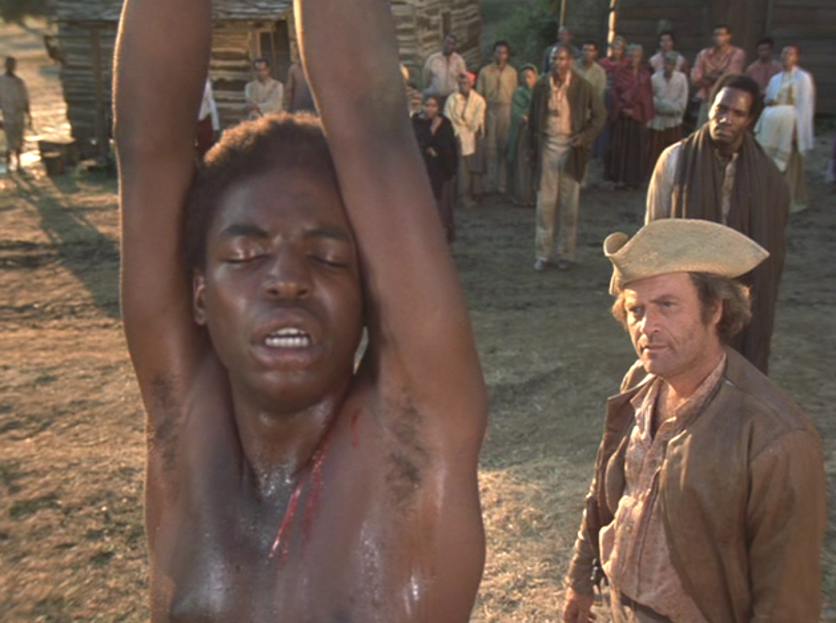
Kunta Kinte being whipped, Roots (1977) screenshot, July 6, 2012. (http://irvine.wikis.gdc.georgetown.edu). Qualifies as fair use under US Copyright laws because of screenshot's low resolution.

Kunta Kinte being whipped, Roots (1977) screenshot, July 6, 2012. (http://irvine.wikis.gdc.georgetown.edu). Qualifies as fair use under US Copyright laws because of screenshot’s low resolution.

With 12 Years A Slave (2013), though, I wanted to see it even before it came out here in the DC area in August. I’d heard about this film for months even before it was out in “select cities” in the US. Between Chiwetel Ejiofor and Michael Fassbender — two supreme British actors — I knew the film would be good. And depressing. And sad. And anger-inducing. And stomach churning. It would be an emotional roller-coaster-ride akin to my introduction to Roots on ABC in February ’77, when I was only seven years old.

So what stopped me from seeing it? My ten-year-old son. I wanted him to see the film with me. But I also knew that he would have a lot of questions. Outside of family and his visits to watch me teach my American and World History classes, my son has had little exposure to race in popular culture in an obvious sense. Most of his friends in our suburban, middle-class Silver-Spring-world are White, and his other Black friends have even less exposure to race than our deliberate injections (or inoculations) for our son.

I decided not to take him to see 12 Years A Slave because it would’ve been two hours of questions in a crowded theater, with those sitting around us ready to strangle us for ruining their watching experience. But I did queue it via Netflix weeks before it came out on DVD, with the expectation that we would watch it during his Spring Break, Easter Week.

As soon as I told my son that we were watching 12 Years A Slave last week, he became whiny and upset. Whiny because his time away from anime and Disney shows would be interrupted with parenting. Upset because of the movie title and its implications. As my son said to me when he was upset, “You made me watch Roots last year!” Well, we watched three hours of it, enough for him to see the sequence of kidnapping, the Middle Passage, slave auctions, running away, rape, whippings, and Kunta Kinte’s foot cut off. I guess the message of slavery and history really did stick with him!

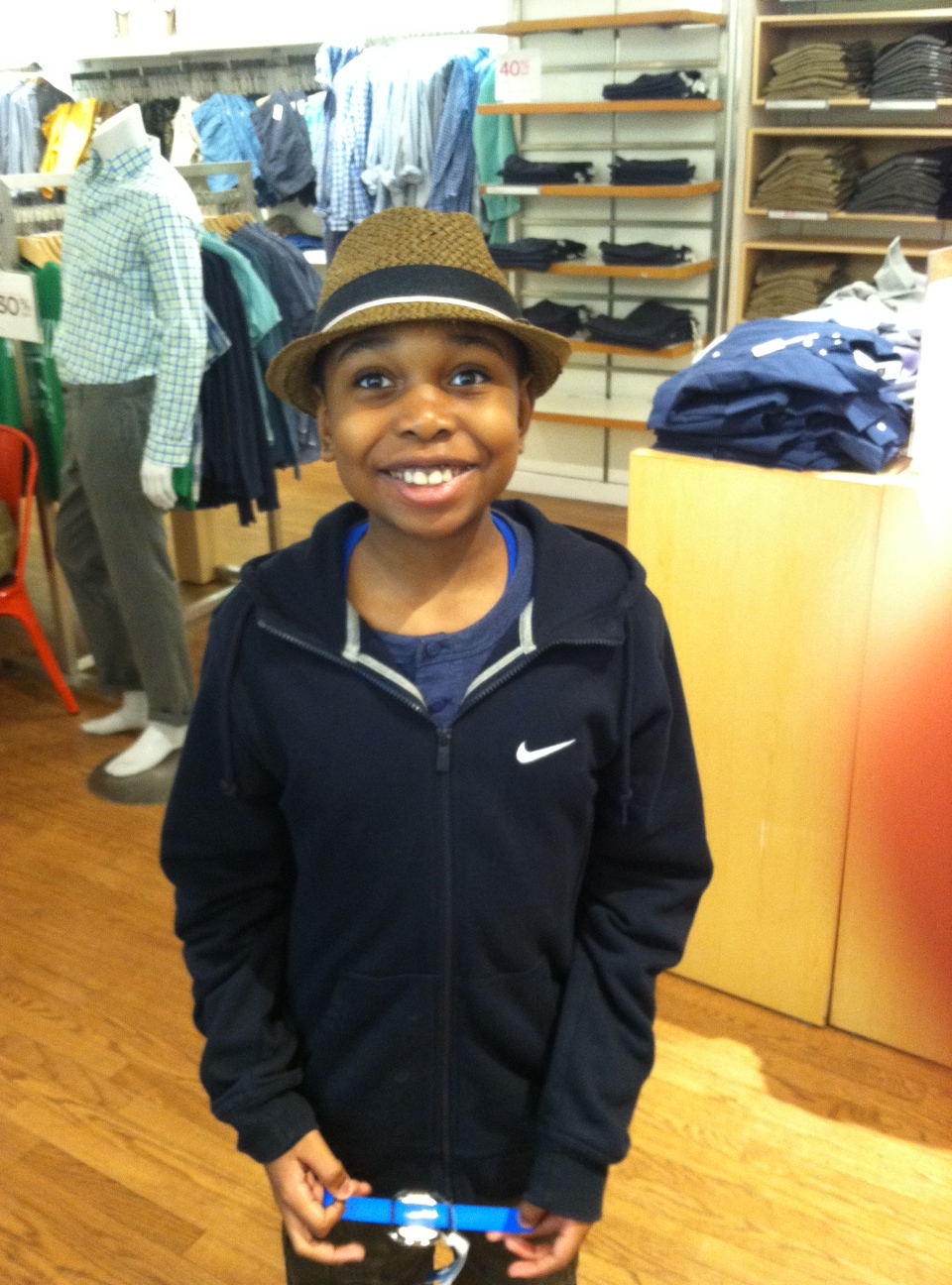
Noah trying to look cool at  The Gap store, Chevy Chase, MD, March 28, 2014. (Donald Earl Collins).

Noah trying to look cool at The Gap store, Chevy Chase, MD, March 28, 2014. (Donald Earl Collins).

We finally sat down and watched 12 Years A Slave Thursday evening. And yes, Noah did have a ton of questions, about Solomon Northrup, about free Blacks, kidnapping, mistreatment and the concept of property, about race, sexual attraction and rape, and about the rule of law. But I was more surprised about two things. One, my son sat through most of the two-and-a-quarter hour film, and only got up twice. Two, he paid serious attention in a way that he hadn’t appeared to in watching serious films before.

Still, my son was more than happy to return to his Nintendo 3DS and the land of Disney shows before bedtime that evening. The fact that he fell asleep right after bedtime, though, made it obvious, at least to me, that we’d given him more thought for food about history, race, and his own heritage.

And though I don’t think the movie was as epic as the hype-meisters have presented it to be, it was a great film, with great acting — I’m not sure if todays American actors could’ve pulled off Ejiofor’s, Fassbender’s or Lupita Nyong’o’s roles. 12 Years A Slave is also an important film, at least in terms of interrogating the meaning of race and inhumanity in this world. I just hope that those messages made it into my son’s conscious thinking. Time will tell, but enlightenment is a journey, not a race.

Boy @ The Window – 1st Anniversary!

Tags

, , ,


Nope, no balloons or streamers for this one, the one-year anniversary since I put out the first e-book version of Boy @ The Window on Amazon Kindle. Yay, me! It’s been a pretty good twelve months, one of a few highs and a bunch of lows in selling and promoting the book, in moving forward with a plan, only to have tossed it aside for a new set of plans for the remainder of 2014 and 2015.

The bit of encouraging news — aside from some royalties for Boy @ The Window so far — is that there are a couple of places reviewing it now (finally), and I’m finally moving along with promoting the book. Beyond that, there are few things tougher psychologically than book promotions. This is why folks hire publicists — emotional distance can be helpful in reaching out to friends and strangers.

But, from the feedback (mostly through email and Facebook) I’ve gotten so far, people really like Boy @ The Window. Trust me, when a reader tells you they couldn’t put the book down once they started to read it, that’s an emotional boost! It’s part of what has enabled me to keep going on this venture into the cyclone of the publishing world.

I’ve planned for attending BookExpo America for the first time at the end of next month in New York. It’ll likely be a gigantic sea of authors, publishers, editors and others looking for an edge. I just hope that it’s worth the money I’m about to spend there.

One thing that I should note, though, as I continue to write on my blog and proceed with Boy @ The Window promotions. There are plenty of posts here that aren’t in the memoir, and plenty of stories in Boy @ The Window that I haven’t posted here. You can get some idea of what’s in the book from reading my posts, but it would be far from a complete picture. Buy a copy. Take it for a spin. It’ll make you laugh and cry, angry and hopeful, and all at times in the same paragraph.