• About Me
  • Other Writings
  • Interview Clips
  • All About Me: American Racism, American Narcissism, and the Conversation America Can’t Have
  • Video Clips
  • Boy @ The Window Pictures
  • Boy @ The Window Theme Music

Notes from a Boy @ The Window

~

Notes from a Boy @ The Window

Category Archives: University of Pittsburgh

Looking Back to My Future

04 Sunday Sep 2016

Posted by decollins1969 in 1, Boy @ The Window, Christianity, culture, Eclectic, Mount Vernon High School, Mount Vernon New York, My Father, New York City, Pittsburgh, Politics, Pop Culture, race, Religion, University of Pittsburgh, Work, Youth

≈ Leave a comment

Tags

616, 616 East Lincoln Avenue, Blair Kelley, Dr. Jack Daniel, Familial Obligations, Forbes Quadrangle, Fordham University, Grit, Homelessness, Hunter College, Pedro Noguera, Pitt, Poverty, Resilience, Ron Slater, Survivor's Guilt, Wesley V. Posvar Hall, What Ifs


The power of "What If?," September 4, 2016. (http://giphy.com).

The power of “What If?,” September 4, 2016. (http://giphy.com).

I don’t “what if” my past moments nearly as much as I used to, thanks in part to one of my first Twitter conversations six years ago. It was with Blair Kelley, a professor and dean at North Carolina State University. I brought up the fact that I sometimes indulged my students’ “What if…?” scenarios regarding slavery and other issues in US history in order to help them find the truth. She said that this was a waste of time, that “What is…?” is already hard enough for students to understand, much less playing out a “What if…?” to get to a “What is…?”

Kelley was right. Students often play the “What if…?” game to deflect from what actually happened, out of potential pain or discomfort with historical truths, or because their conception of history doesn’t allow for humanity and human nature as significant factors. So I stopped humoring my students in fantasies about the South winning the Civil War or Nazi Germany winning World War II in Europe. It hasn’t made my students any happier, but it has made teaching them easier.

As for my own “What ifs…?,” I still think of a few on occasion. Like what if I had gone to college at Columbia or another elite institution instead of Pitt? Or what if I had possessed the courage to act on my crush on Wendy in seventh grade, or not wear my kufi to school during the Hebrew-Israelite years at all? Those can be very good mental distractions when I’m running a 10K or working on a boring set of revisions to an education piece. But they’re also rather silly distractions, with me knowing full well why I did or didn’t do most things, even knowing my thought process at the time they occurred in ’81, ’82, or ’87.

With this weekend being exactly twenty-eight years since my five days of undergraduate homelessness on Pitt’s campus, I have a real “What if…?” scenario to reconsider. What if I hadn’t bumped into my friend Leandrew, who had told me about the dilapidated fire-trap rowhouse he lived in on Welsford? What if I hadn’t met with my landlord Mr. Fu and gotten my 200-square-foot room with a literal hole in the wall so that two rooms could share a single radiator, all for $140 per month (about $285 in 2016 dollars)? What if I had to spend Labor Day weekend on a closed Pitt campus sleeping on that top floor concrete landing in a Forbes Quadrangle (now Posvar Hall) stairwell, where I had already spent three nights?

The mythical 6th-floor landing I slept on for three days (leading out to the roof), Wesley Posvar Hall, September 29, 2013. (Donald Earl Collins).

The mythical 6th-floor landing I slept on for three days (leading out to the roof), Wesley Posvar Hall, September 29, 2013. (Donald Earl Collins).

I already know the answers to these questions. I decided on this after praying about this on Wednesday, August 31 in ’88 while in that stairwell, laying on some of my clothes and my book bag. If I came out of Labor Day weekend without housing, I’d have to take my remaining $300 and go back to New York, to Mount Vernon, to 616. I’d have to drop or withdraw from my courses at Pitt. Maybe, with add-drop still going on, I could have some of my financial aid refunded, after Pitt deducted the $819 I owed them from my freshman year. I could enroll at Fordham or at CUNY’s Hunter College for the Winter/Spring 1989 semester, maybe find work somewhere in the area, and gut it out a few months at 616 with my nonfunctioning family.

I knew then that this was a scenario as ridiculous as Napoleon conquering Russia in the dead of winter. One of the reasons (but not the main reason) I left for the University of Pittsburgh in the first place was to get away from my family, to meet people unlike my Mom, my idiot stepfather, my five siblings at crowded 616, and the asshole Humanities classmates I’d gone to school with every day for the previous six years. I knew I had to have the mental space I needed to find myself, to figure myself out, all in considering whether I even had a future, much less how that future would take shape or how I’d shape myself into a future.

If I had gone with my cockamamie idea, the best case outcome would’ve been me transferring to Hunter or Fordham with my first year’s credits from Pitt, and me making it through a few semesters full-time before becoming a part-time student. I have no idea if I would’ve finished with a degree in history or something else from Hunter or Fordham. But given how exhausted I was each time I went back to Pitt after a summer of paid and familial work, I likely wouldn’t have even considered grad school.

The weight of guilt, survivor's and otherwise, September 2014. (http://www.fumsnow.com/).

The weight of guilt, survivor’s and otherwise, September 2014. (http://www.fumsnow.com/).

Why? I would’ve been at 616. I would’ve been obligated to help out with everything, from dealing with my idiot stepfather before me and my Mom finally forced him out, to providing food, entertainment, and childcare for my four younger siblings. I know this because during my college years, I did come back to 616 to work each summer and during the holidays. Those additional responsibilities were ones I felt obligated to fulfill until I was in my early thirties, and felt most intense when I had to face my family’s poverty head-on.

Keep in mind, this is the best-case outcome. Most likely, I would have stopped going to school all together after my bout with homelessness. I would’ve found part-time or full-time low-wage work, first to help out, then to find a roach trap somewhere in Mount Vernon or in the Bronx, and been relegated to the torture of “What ifs?” around getting a degree and having a better life. Maybe, just maybe, I would’ve been bumped around enough by that rough life to try again, to seek help from the likes of an ombudsman like Ron Slater or a provost like Jack Daniel. But I barely knew how to seek help when I first went about doing it as a homeless and broke-ass student in ’88. Given my mental makeup back then, it would’ve been a monumental task to trust that much after years of low-wage work and unrelenting poverty at 616.

UCLA education professor (although he is so much more than that) Pedro Noguera reminded me of something I’ve come to disdain in recent years. This idea that philanthropists and researchers can use kids and families as experimental subjects on the issue of “grit” or “resilience” is one I find disgusting. The idea that oppression and inequality can be overcome if you or I simply toughen up, grow a thick outer shell and just push through? The idea that with grit and spit and sweat, anyone can just overcome through sheer will power a lack of preparation, a lack of resources, a lack of access to resources, a lack of connections, and a lack of knowledge? Are you kidding me?

Quaker Instant Grits, Super Family Size, September 4, 2016. (http://soap.com).

Quaker Instant Grits, Super Family Size, September 4, 2016. (http://soap.com).

I had just about the best academic preparation anyone could have going into college, and I still came within three or four days of dropping out and heading back to 616. I was staring into the abyss of my future. The only grit I knew that would’ve worked for me on August 31, ’88 would’ve been a gigantic box of Quaker’s Instant Grits. And that was assuming I found a place to live in Pittsburgh so I could buy a pot and cook them. I didn’t want to be resilient. I’d always been resilient. But I didn’t call it that. I called it surviving.

And without help, without knowing how to ask for help, without some occasional divine or quantum-level intervention, my grit, resiliency, or survival up to August 31, ’88, wouldn’t have mattered. Philanthropists, educators, and social scientists need to stop asking individuals, families, and communities in poverty to be part of their test of resiliency as if we’re all rats in their maze. They need to start asking all of us not just how we survive, but what we need to succeed. Then again, they shouldn’t even need to ask. It’s not as if this is a “What if…?” The Great Society and War on Poverty efforts in the 1960s haven’t already provided a roadmap. Go study that!

Everyone Needs A Ferris Bueller

16 Thursday Jun 2016

Posted by decollins1969 in 1, Boy @ The Window, culture, Eclectic, Mount Vernon High School, Mount Vernon New York, Movies, Pittsburgh, Pop Culture, race, University of Pittsburgh, Youth

≈ 2 Comments

Tags

Alan Ruck, Chicago, Comedy, Diversity, Dramedy, Ferris Bueller's Day Off (1986), Friendships, Interventions, Intolerance, John Hughes, Lily-White, Matthew Broderick, Mia Sara, Narcissism, Pitt, Teenage Angst


Mia Sara, Alan Ruck, and Matthew Broderick in Ferris Bueller's Day Off (1986) screen shot, June 16, 2016. (http://www.playbuzz.com).

Mia Sara, Alan Ruck, and Matthew Broderick in Ferris Bueller’s Day Off (1986) screen shot, June 16, 2016. (http://www.playbuzz.com).

This week mark thirty years since the release of the Hollywood hit Ferris Bueller’s Day Off (1986). The movie is mostly known for Matthew Broderick imbuing energy into the title character, taking his best friend Cameron Frye (Alan Ruck played him) and his girlfriend Sloane Peterson (Mia Sara played her) on a joy ride through North Side Chicago while embarrassing his high school principal and avoiding his parents. Going to a Cubs game, insinuating himself into a parade, and otherwise making Chicago pretty lily-White. For most watchers, Ferris Bueller’s Day Off was a John Hughes comedy. Period.

Not so for me. At least once I finally watched the film. Like with most movies made between ’81 and ’87, I didn’t see it when it first came out. With my high school classmates only quoting Ben Stein’s character saying “Bueller?” over and over again, or commenting on the ability of anyone to roam the streets of Chicago so easily between roughly 8 am and 6 pm in the middle of the work week, I had no interest in seeing it. I eventually caught bits and pieces of scenes from Ferris Bueller on cable, but by nearly a decade after the movie first came out, I’d seen maybe fifteen minutes of the film.

It took my eventual wife Angelia to get me to see the movie in ’96. By then, I’d seen other Matthew Broderick films, enough where I was willing to give a comedy on White teen Gen Xer angst a chance. For whatever reason, I realized for the first time Ferris Bueller really wasn’t a comedy. It had plenty of funny moments, but at best it was a dramedy. I even remember saying to Angelia after I watched it, “Are you sure this is a comedy?”

The movie’s not-so-hidden theme is friendship. In this case, how one friend in Ferris Bueller goes above and beyond as a high school senior to save his best friend from a quietly tragic future. In Cameron’s case, one in which he wouldn’t be in charge of the shape of his life. It would either be guided by his domineering father (whom we never see in the movie) or by some future domineering wife. Apparently that was the real reason behind all of Ferris Bueller’s days off from school in the final months of his senior year.

Cameron Frye (Alan Ruck) underwater in pool (literal and figurative), Ferris Bueller's Day Off (1986), June 16, 2016. (http://www.giphy.com).

Cameron Frye (Alan Ruck) underwater in pool (literal and figurative), Ferris Bueller’s Day Off (1986), June 16, 2016. (http://www.giphy.com).

By Bueller and his girlfriend colluding to permit Cameron his first look at a naked female body and performing an intervention through the use of Cameron’s father’s precious classic car, Cameron would somehow recognize the need to break free. That Bueller also got to thumb his nose at authority and hang out with his girlfriend was a bonus, of course. Otherwise, the movie is a zany comedy about playing hooky in the streets of Chicago on the most unlikely of school days in the middle of May.

I certainly didn’t have any Ferris Buellers in my life during my Humanities years. If there were classmates like him, they didn’t shine a light on me. Sure, there was White male angst, Black male angst, teenager angst, middle class angst, and Black and White female angst at Mount Vernon High School. I would assume now that this has been true as long as the concept of teenager and comprehensive high school has existed (about eighty years in all). But to deliberately perform an intervention on behalf of a friend to save them from themselves and their upbringing? I’m sure it happened, just not with me or any of my Humanities classmates.

This realization begs a question. Would a Ferris Bueller have emerged in my life in middle school or in high school if I were from a family of means? All issues aside, the reason why Bueller and Frye were friends probably had as much to do with location as anything else. And with residential segregation also comes income segregation. Money may not have been the reason the two teenagers were friends. Yet with both families firmly in the ranks of the affluent (not one percent, but certainly in the top 10-25 percent), their friendship is more unlikely than a Cubs game and a White ethnic pride parade on the same day. The answer to my question, of course, is no. Diversity without acknowledgement or discussion — whether by race, gender, and/or class — doesn’t exist, leaving the teenage angst that was my experience unresolved until college.

The rainbow flag waving in the wind at San Francisco's Castro District, San Francisco, CA, August 5, 2010. (Benson Kua via Wikipedia). Released to public domain via CC-SA-2.0.

The rainbow flag waving in the wind at San Francisco’s Castro District, San Francisco, CA, August 5, 2010. (Benson Kua via Wikipedia). Released to public domain via CC-SA-2.0.

As for the events in Orlando in the past week, aside from the obvious implications of misogyny, homophobia, racism, and hate/terror, there is another more subtle issue. That people who grow up with angst but minus interventions can easily become disaffected adults. Obviously most of these adults don’t become mass shooters or stalkers who kill. But it does mean that in a society geared toward narcissistic individualism and winning, there are millions out of touch with themselves and lacking empathy (forget about love) for other human beings.

Ferris Bueller’s Day Off is a sense that we all need one friend to intervene in our lives at least one time or for one day. We need that one day, to draw perspective, or maybe even, to find out that we truly need help and healing. My Ferris Buellers didn’t intervene until college at the University of Pittsburgh. They were gay and straight, Christian and Jewish and atheist, old and young, men and women, and Black, White, Brown, and Yellow. They came into my life later than I wanted, but not too late for me.

Lifetimes of Hypocrisy

08 Wednesday Jun 2016

Posted by decollins1969 in 1, Academia, Carnegie Mellon University, culture, Eclectic, Pittsburgh, Politics, Pop Culture, race, University of Pittsburgh, Work, Youth

≈ Leave a comment

Tags

"Hard Habit to Break" (1984), Academia, Academy for Educational Development, AED, Capitalism, Chicago, CMU, Contradictions, Disillusionment, Hypocrisy, Illusions, Ironic, Irony, Leftists, Liberals, New Voices, Nonprofit Organizations, Nonprofit World, Pitt, Progressives, Social Justice, Worker Exploitation, Working-Class History Seminar


Twitter conversation on labor historian job and irony, May 26, 2016. (screen shot Donald Earl Collins).

Twitter conversation on labor historian job and irony, May 26, 2016. (screen shot Donald Earl Collins).

Irony/Ironic is a word that we in the West use a bit too often. It is ironic, for instance, that I left the job insecurity and financial instability of the nonprofit world after a decade, only to find myself part of the unstable world that is academia these days. But it isn’t ironic that nonprofit organizations working for a better world exist only because their leaders have the task of constantly raising money for their work. The best of these leaders make high-six-figure incomes and their nonprofits make billions, in organizations like Educational Testing Service, College Board, and my former organization, Academy for Educational Development. This isn’t an example of irony, at least not just. It’s maybe a contradiction, it’s maybe hypocrisy, it’s maybe even straight-up bullcrap.

A week and a half ago, a colleague became part of a Twitter conversation about a labor historian job at Rutgers University. (Full disclosure: I’d already seen the job a week earlier on Rutgers’ website, so no surprises for me). The job was for a non-tenure track position teaching a 4/3 load (four undergraduate courses one semester, three the other, with no summer courses, at least), the position potentially renewable after one year. The standard teaching load at most four-year institutions is between five and six courses (counting summers) per year. The ironic punch line was that it was the Labor Studies & Employment Relations Department that advertised this position, a department that ought to “know better.”

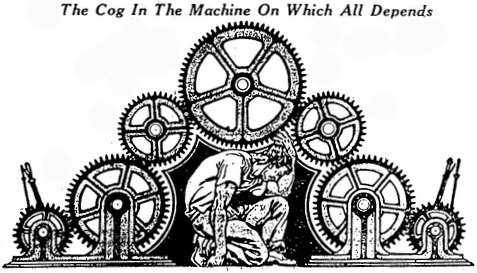
The Cog in the Machine, June 8, 2016. (http://catholicreadingproject.blogspot.com).

The Cog in the Machine, June 8, 2016. (http://catholicreadingproject.blogspot.com).

The problem for me is that this isn’t ironic at all. This department exists within the Rutgers School of Management and Labor Relations. These schools are not exactly incubators for “workers of the world unite” types, and would be most likely to take advantage of the weak job market to hire a labor historian desperately in need of a one-year or more gig. This is naked exploitation to be sure, but I find no irony in this job search at all. This is typical of the majority of jobs in higher education these days.

It is definitely hypocrisy, at least on the level of academia at large. Especially in considering that supposed bastions of liberal ideals (which universities really aren’t — they’re capitalist business enterprises which sometimes house some leftist leaning faculty) have turned the secure work of the professoriate into non-tenured service industry work. That this has coincided with the plunge in the number of full-time positions and in the number of living-wage positions in the US labor force in general is telling. It says that academia is nothing special beyond the expensive education, that it isn’t some sacred place for intellectual exchange and political mobilization. It is as firmly tied to capitalist pursuits as Wall Street and K Street.

I learned this lesson a quarter-century ago, thanks to the working-class history seminars at the University of Pittsburgh and Carnegie Mellon University. Between Dick Oestreicher, Bill Chase, Reid Andrews, Joe Trotter, and Joel Tarr (among others), the level of hypocrisy was enough to make me sick. The distance between what these people wrote regarding leftist movements, ideas, ideals, and exploited workers and how they treated students and colleagues sometimes was breathtaking. It was like the distance between the Terran system (Earth) and Alpha Centauri (roughly 25 trillion miles).

Hammer & Sickle & Pitt Flag [symbolic of Pitt's history department], December 13, 2012. (Donald Earl Collins).

Hammer & Sickle & Pitt Flag [symbolic of Pitt’s history department], December 13, 2012. (Donald Earl Collins).

Sure, it’s all “let’s start a communist revolution” when discussing the 180th nuanced on E. P. Thompson’s The Making of the English Working-Class. But when graduate students wanted to unionize to have their work recognized as workers, then these leftists suddenly became capitalists. “No, you’re not workers,” they said. “You’re students.” In the face of virulent racism, they said, “Get use to it. Shit happens.” Heck, some of these so-called bleeding-heart-liberals were themselves harassing students, exploiting their work for prestige and profit, and playing favorites to promote yes-men and yes-women while keeping others from pursuing their doctorates.

I saw the same distance between noble liberal ideals and center-right realities in my decade in the nonprofit world, mostly working in social justice. Yes, some of the very people who had made it their calling to ameliorate racism and combat injustices were also knee-deep in their own contradictions. Gender-based, race-based, and intersectional harassment wasn’t exactly uncommon. Exploitative labor practices like working two people full-time for the price of one, denying promotions based on gender or racial bias, even paranoia over power within a social justice organization. They all were the usual things I witnessed or experienced in the years between 1997 and 2008.

Wolf in sheep's clothing, a false prophet (a symbol of my ex-stepfather), November 2008. (Source/flickr.com)

Wolf in sheep’s clothing, a false prophet (a symbol of my ex-stepfather), November 2008. (Source/flickr.com)

There is nothing sacred and no safe space for those of us looking for such things. This belief in academia as being so different from the rest of the working world is an illusion cooked up by neo-conservatives who’ve made millions selling the idea that academia is a liberal bastion. We should all look for positions and places in which our work can thrive and we as individuals or even groups of people can grow. Those obviously still exist. But believe me, it’s been years since I thought that academia was a place where being far left-of-center was a good thing. It’s only good if you’re good at acting like this is so. It’s another illusion that others have chosen to create to cover up their hypocrisies. The irony is that people still believe in these ideals anyway.

My Busing Blues

25 Wednesday May 2016

Posted by decollins1969 in 1, Academia, Boy @ The Window, culture, Eclectic, Jimme, Marriage, Mount Vernon New York, My Father, Pittsburgh, Politics, Pop Culture, race, University of Pittsburgh, Youth

≈ Leave a comment

Tags

425 South Sixth Avenue, 616, 616 East Lincoln Avenue, Boston, Busing, Classism, Common Ground (1985), Community, Desegregation Orders, Divorce, Economic Inequality, Educational Equity, Friendships, J. Anthony Lukas, Ms. Hirsch, Nathan Hale Elementary, Ostracism, Racism, School Desegregation, Second Grade, William H. Holmes Elementary, Youth


TFD bus (they're still around?), South Side, Mount Vernon, NY, May 25, 2016. (http://zztalon.tripod.com/).

TFD bus (they’re still around?), May 25, 2016. (http://zztalon.tripod.com/).

Schooling and friendships have been the main theme of my posts this month. I find myself in deeper reflection about my years before the Boy @ The Window years these days. Maybe because I’ve come to realize that those years between ’74 and ’81 were far more influential in how I saw the world than I’d previously given credit.

One issue that I think I’ve had insight into for years before actually becoming an educator is busing. Maybe not so much in relation to school desegregation, though. As a seven-year-old, it would’ve been in terms of friendships and belonging. The only time I faced a no-choice busing situation was my last two and a half months of second grade, between April and late-June 1977. My Mom and Maurice had moved in together and moved me and my brother Darren to North Side Mount Vernon and 616, the house of horrors that would become the central locale of my memoir.

The Soiling of Old Glory, Boston, MA, April 5, 1976. (Stanley Forman/Boston Herald American via Wikipedia). Qualifies as fair use due to historical important of photo and low resolution.

The Soiling of Old Glory, Boston, MA, April 5, 1976. (Stanley Forman/Boston Herald American via Wikipedia). Qualifies as fair use due to historical important of photo and low resolution.

The only thing I knew of busing before the move from 425 South Sixth to 616 East Lincoln was that Darren had been taking a bus to Clear View School in Dobbs Ferry every school day since my first day of kindergarten in ’74. Also, the images in my head from national news on the three main networks about Boston Public Schools and protests in ’74 and ’75. I had no idea in the spring of ’77 that many White and more than a few Black parents were fighting a desegregation order that required widespread busing in Boston. All I knew at the time was that a lot of angry people with signs and bricks and bottles were on my TV screen at the beginning of September almost every year.

My spring of busing was one of misery. Not because Mount Vernon was under any desegregation order, which it was. Mom had made the decision to not disrupt second grade for me by keeping me at Nathan Hale Elementary, the school that we had lived two doors down from prior to our 616 move. The other option was for me to start at William H. Holmes Elementary five months sooner, so that my transition to third grade would’ve been easier. Thanks, Mom.

Even at the time, I wished she had. Mom had been sick for half that school year. She and my father Jimme were in the midst of a nasty divorce. We had already moved. It made no sense for me to continue to go to Nathan Hale Elementary. I couldn’t stand my teacher Ms. Hirsch. She was the only teacher prior to Humanities, and especially Humanities at Mount Vernon HS, who thought of me and other students as essentially kids without a future. Ms. Hirsch was the only teacher prior to my senior year at MVHS who told me that I wouldn’t “amount to anything.” I hated, hated being in her classroom. It was a feeling I wouldn’t have again until David Wolf and AP Physics my senior year, and even then, that feeling only lasted for forty-five minutes, and even then, it wasn’t with me every day.

By the end of second grade, I was without any friends. Not because I did anything weird, which I’m sure I did. The constant disruptions in our living arrangements meant that I no longer played in the playground next to Nathan Hale after school, where I could hang out with other first, second, and third graders. (I was scared to go there by myself otherwise, anyway — this issue, to be continued.) A bunch of my first grade friends from Ms. Griffin’s class had left during the summer of ’76, leaving Winston, a first grader, as my only friend at Nathan Hale. Yeah, I talked to Lauren and one other girl in Ms. Hirsch’s class, but that was pretty much it.

Now and Later candies, made by Farley's and Sathers, October 26, 2010. (Evan-Amos/Vanamo Media via Wikipedia). Released to public domain.

Now and Later candies, made by Farley’s and Sathers, October 26, 2010. (Evan-Amos/Vanamo Media via Wikipedia). Released to public domain.

Taking the bus to and from school for those last fifty days or so of school was torture. Not because kids make fun of me, which they didn’t, or because I was part of some experiment related to desegregation, which I wasn’t. I hated the smell, of bubblegum and Now-&-Laters, of sweat from recess and gym, of exhaust fumes from cars because our little TFD bus wasn’t air-conditioned. Mostly, I couldn’t stand the forty-five minutes or hour that it would take to go from 616 to Nathan Hale, picking up kids all through Mount Vernon along the way.

Fourteen years later, in an upper-level US urban history undergraduate course (my last history class before grad school) at the University of Pittsburgh, one of my required readings was J. Anthony Lukas‘ Common Ground (1985), his Pulitzer Prize-winning book on busing and school desegregation in Boston. There were so many powerful parts of Lukas’ book that piqued my interest. His coverage of parents from all sides of the busing controversy. The sense that school desegregation was a bit of a Pyrrhic victory legally, but not so much culturally, because of the “hearts and minds” issues around race. What struck me, though, was the limited perspective Lukas provided on kids who had to ride these buses between Black, White, and Puerto Rican neighborhoods to get to these schools throughout Boston.

Front cover of Common Ground (1985) by J. Anthony Lukas, September 3, 2014. (http://goodreads.com).

Front cover of Common Ground (1985) by J. Anthony Lukas, September 3, 2014. (http://goodreads.com).

I imagined what it would’ve been like to bus in Boston during my K-2 years. I had it hard enough as a child of abuse and divorce, with a move to an uncertain future, and with at least one teacher who saw me as little more than human garbage. Add screaming and spit-flying from White parents raging over school desegregation? I really could’ve been written off, never having a chance to become a good student, and more importantly, a lifelong learner. Maybe the only lesson I would’ve learned from busing was that Whites against busing have serious high-blood pressure issues. Or, more realistically, that White parents didn’t want me to become friends with their kids.

Either way, Lukas helped me realize, maybe for the first time, how twisted and evil American society would have to be to expose kids to blatant racism and not-so-blatant economic inequalities as demonstrated through busing.

End of the Dorm Room State

30 Saturday Apr 2016

Posted by decollins1969 in 1, Academia, Boy @ The Window, culture, Eclectic, Jimme, Mount Vernon New York, My Father, New York City, Pittsburgh, Pop Culture, race, University of Pittsburgh, Work, Youth

≈ Leave a comment

Tags

25 Welsford Street, 616 East Lincoln Avenue, Computing and Information Systems, Father-Son Relationship, Financial Aid, Freshman Year, Homelessness, La Guardia Airport, Lothrop Hall, Naivete, Pitt, Pork Neck Bones and Rice, South Oakland, Tuna Fish, unemployment, US Air, Western Union


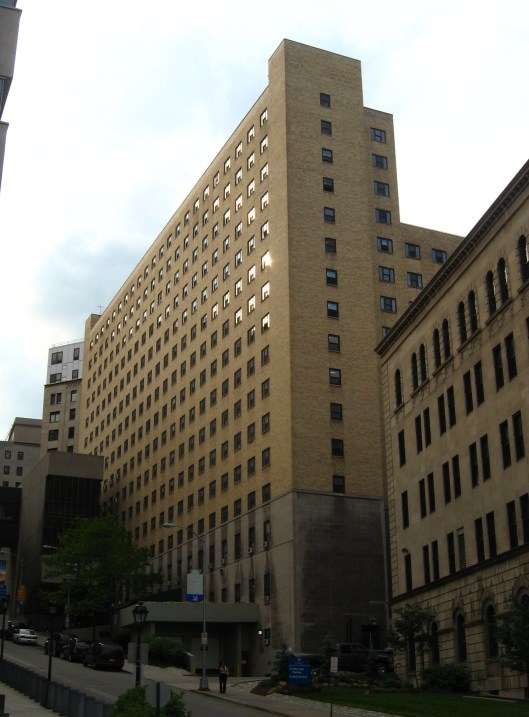
Lothrop Hall (we lived on the fourth floor in 1987-88), University of Pittsburgh, June 8, 2008. (TheZachMorrisExperience via Wikipedia). Released to the public domain via CC-SA-3.0.

Lothrop Hall (we lived on the fourth floor in 1987-88), University of Pittsburgh, June 8, 2008. (TheZachMorrisExperience via Wikipedia). Released to the public domain via CC-SA-3.0.

On this day and date twenty-eight years ago was the Saturday end to my freshman year at the University of Pittsburgh. Like today here in the DMV, it was a cool and cloudy day, a day in which I was tired from the year, but hopeful now that I had survived many of my inner doubts and outward troubles to make it to another fall of courses.

But there was a lot of unfinished business at Pitt. And, no, after my first Dean’s List, it wasn’t my grades. Six weeks earlier that year was March 15. That was the deadline for me to put down a $350 deposit to guarantee a dorm room for next year. Otherwise, I’d have to participate in a lottery for one. And the deadline for that was April 30th.

As of that morning, I had more than enough money to cover my deposit, as I’d gotten paid for my eighty or so hours of computer lab work with Pitt from the month of March. That money was way too late now. I knew that I’d have to go back to New York, to Mount Vernon, to find work for the summer, to have the money I needed to find a place to live for the fall when I’d come back to Pitt.

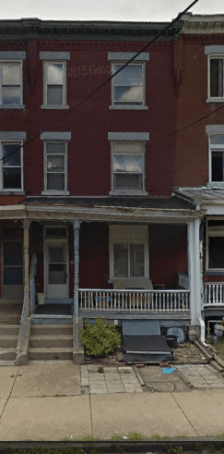
25 Welsford Street, Pittsburgh (where I lived my sophomore and junior years at Pitt), August 2015. (Google Maps).

25 Welsford Street, Pittsburgh (where I lived my sophomore and junior years at Pitt), August 2015. (Google Maps).

It wasn’t like I didn’t ask my parents. Mom didn’t have the money, between my idiot stepfather, my four younger siblings and my older brother Darren. Eight-hundred and fifty dollars of AFDC, food stamps, and WIC per month can only be stretched so far in a place as expensive as the New York metropolitan area. And my father Jimme, well, I let him know a month before the dorm reservation deadline that I needed the money. He said at least twice that he had wired me the funds via Western Union. I checked both times with the check cashing place in North Oakland, only to walk out empty-handed.

The timing just didn’t work out. That’s what I told myself, at least. I’d find a better place to live than Lothrop Hall. Between carousing Pitt basketball players, underaged boozers, the more than occasional tokers, and the terrible cafeteria food, I was probably better off living off-campus anyway.

You can convince yourself of a lot of things in the hours before a US Air flight to La Guardia when you’re staring at 120 days of living at 616 and being in Mount Vernon. Both places where I’d barely fit in before thirty-three weeks of college and relative independence. I was about to reclaim my emotionless role as the eldest son, all but running a house that was never mine to run in the first place. The fact of my questionable residential status as a sophomore at the University of Pittsburgh could wait.

Like with so many things going on in my life that leap year, I was terribly wrong. I found myself unemployed for the summer, homeless in Pittsburgh for five days, and broke and malnourished for most of the Fall ’88 semester. From April 30th to the Tuesday before Thanksgiving, I’d live with financial crisis, without a place to lay my head, and with tuna fish sandwiches and pork neck bones and rice as food for many of those days.

I did make friends my freshman year, and I did have friends my sophomore year, some of whom probably would’ve taken me in had they known about my troubles. But that’s the thing about abuse and poverty and race in a country that purports to be great and yet contradicts itself. You seldom tell anyone about anything bad in your life, out of embarrassment or out of pride, because you don’t want to be the living embodiment of a stereotype. Still, when I hinted about my lack of eats in October and November, my friends and even my classmates did help.

Fast-forward to ’92, the spring my father refused to believe that I knocked off my MA in Pitt’s history program in two semesters. He had told my brother Darren and his drinking buddies for years that he had paid my way through college. I also found out about that bit of Jimme braggadocio that spring.

Bumble Bee Tuna in oil (not water for me - still has been almost 28 years since eating), April 30, 2016. (http://www.upcitemdb.com).

Bumble Bee Tuna in oil (not water for me – still has been almost 28 years since eating), April 30, 2016. (http://www.upcitemdb.com).

When I went over to his place in late June to show him my MA degree, he even tried to tell me how he paid for my BA for four years. “What are you talking about?,” I said.

“My bachelor’s cost $32,000, and my other expenses over four years were another $20,000. In four years, you sent me $480 total,” I yelled, even though my drunk father was only a couple of feet away.

“Naw, naw, naw, I paid, I paid,” my father kept saying, with very little of the confidence than he had displayed before.

The total of my father’s payments for me and college was actually $880, including $480 he Western Union-ed to me my first three semesters. I’d forgotten the $400 I managed to get from him in August ’88 so that I could find a place to live my sophomore year in Pittsburgh. It is true, without that money, and without me surviving my first days in Pittsburgh minus a dorm room, I wouldn’t have finished college. But as a father myself, I’m not sure I’d ever claim credit for that, drunk or sober.

Pitt Graduation Day, +25 Years, +25 Hard Truths

26 Tuesday Apr 2016

Posted by decollins1969 in 1, Academia, Boy @ The Window, Carnegie Mellon University, Christianity, culture, earth, wind & fire, Eclectic, eclectic music, Hebrew-Israelite, Mount Vernon High School, music, Pittsburgh, Politics, Pop Culture, race, Religion, University of Pittsburgh, Youth

≈ Leave a comment

Tags

Bitter Truths, Bruce Anthony Jones, Commencement, Daniel P. Resnick, Disillusionment, Graduation, Hard Truths, Joe William Trotter Jr., Lessons Learned, Marc Hopkins, Mary J. Blige, Meritocracy, Michael Jackson, Narcissism, Pitt, Prince, Regis Welch, Self-Discovery, Trust, U2


Peterson Events Center (where they do all the commencements now) University of Pittsburgh, Pittsburgh, PA, circa 2008. (http://www.rosser.com/).

Peterson Events Center (where they do all the commencements now) University of Pittsburgh, Pittsburgh, PA, circa 2008. (http://www.rosser.com/).

I can’t believed that I’ve lived long enough to make a quarter-century since my end to undergrad at the University of Pittsburgh! It makes me sound old, at least to the twenty-one year-old I used to be. The one who couldn’t decide between a J.D. and an M.A./Ph.D. program. The person who worried that they would have an MA before their driver’s license. The young ‘in who believed that my advanced degree choices would define my career and life more than anything else.

That person was wise beyond his years, and yet stupid at the same time. He believed in the American meritocracy, in the triumph of hard work, talent, and a Christian faith over every obstacle. He believed that any costs incurred on the path to the MA — and later, the PhD — would be covered in the Bank of a Great Career. He believed, most of all, that professors as advisors and mentors would be there to guide his path every step of the way, the trustworthy individuals that most of them had proven themselves to be.

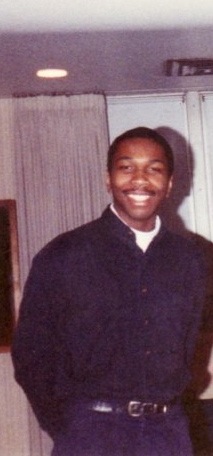
Me & Mark James (Cropped), Pan-African Graduate & Professional Student Association, University of Pittsburgh, February 27, 1993. (Lois Nembhard).

Me & Mark James (Cropped), Pan-African Graduate & Professional Student Association, University of Pittsburgh, February 27, 1993. (Lois Nembhard).

So much of that belief system was poisoned by the e. coli bacteria of academia and by the leaching lead pipes of American -isms. From my trials at Pitt to my tribulations with Joe Trotter, Dan Resnick, and Bruce Anthony Jones. The fact that my entire nineteen years of teaching, consulting, and nonprofit work has been cobbled together out of necessity and constantly changing circumstances, on which ground has rarely been solid. That after eighteen years and six months of payments, and I’m still a decade or so away from paying off student loans I began borrowing seventeen days after graduating from Mount Vernon High School in ’87.

If I had to talk to my twenty-one year-old self now, I’d say, get the MA in history, then get certified to teach at a high school somewhere. Spend the precious moments not in the classroom reaching high school-age students honing your craft as a writer. Jump headlong into putting down in words your experiences growing up, your times as a Hebrew-Israelite and in Humanities. Get that ms turned into a published work. Work hard at understanding the larger issues and contexts that make America the seething contradiction that it has always been, between racism and freedom, individualism and multiculturalism, social control and narcissism. Then, somewhere between the age of twenty-five and thirty, maybe, go back to school and earn that PhD in history, or in education, and take a few social psychology courses focused on personality disorders along the way.

That is the benefit of 20/10 hindsight (I’d say 20/20, but I still see most things at 20/15, and with warp speed at that!), of course. One big barrier I faced twenty-five years ago is a thorough and excoriating understanding of myself and the life I had to live. I remembered so much of my past that I never questioned the things that I’d forgotten. About abuse, physical and sexual. About deprivation, real and imagined. About people, the layers of yellow onions that most sheepishly are.

Unfortunately, I’d learn the most about what I’d forgotten in my forties, well after most people reconnect with the bitterest parts of their past (if any ever dare to). That I know what I know now is in the category of “better late than never.” Some things, though, I needed to know much sooner than 2014 or 2002. Like my discovery of my ambivalence toward academia. Not teaching or publishing per se. But the idea that I could only be taken seriously by publishing scholarly works that mostly would be read by a few dozen colleagues or when I assigned them to my students. I didn’t figure out how to make my ambivalence work for me until I was thirty-seven, and then, with me at mid-career, fighting to move forward.

Chris Farley facing a hard truth, being hit by a 2x4 in Tommy Boy (1995), April 26, 2016. (http://stream1.gifsoup.com/).

Chris Farley facing a hard truth, being hit by a 2×4 in Tommy Boy (1995), April 26, 2016. (http://stream1.gifsoup.com/).

The silver lining is, that if it weren’t for my time at Pitt, I simply wouldn’t be here to write these words at all. The pressures and pollutions of this world would’ve killed me. Or worse still, killed my inspirations and aspirations, rendering my imagination, my sense of what makes a just and wise world, dead. I’d be as bitter as a cup of Italian roast coffee mixed with vinegar and raw horseradish.

I’m sure that even among my more successful colleagues — and even more sure among my less successful ones — their journeys since the halcyon times of undergrad and even graduate school have been bittersweet. That is life. Especially in a nation in which others encourage us to have aspirations beyond the stars, a complete contradiction to that cracked concrete-reinforced reality that is America.

But even if all of the remaining highs in my career and life outnumber the lows by ten-to-one (who knows, right?), two truths are clear. One is that most people who experience any depth of success in their lives tend to remember the lulls and ruts more than their moments at the top of the mountains. Two is that without me having climbed that first mountain, the college degree mountain, I would have a story to tell, but would lack the words to tell it. I would still be living vicariously through the music of others, whether U2, Earth, Wind & Fire, Michael Jackson (RIP), Prince (RIP), or Mary J. Blige. And for me, at least, as genius as they are — alive and dead — I still need to tell my own story.

Prince, circa 2013 concert, April 26, 2016. (Ethan Miller/Getty Images).

Prince (1958-2016), circa 2013 concert, April 26, 2016. (Ethan Miller/Getty Images).

The Temptations of Pizza

12 Tuesday Apr 2016

Posted by decollins1969 in 1, Academia, Boy @ The Window, culture, Eclectic, Mount Vernon New York, Pittsburgh, Pop Culture, race, University of Pittsburgh, Youth

≈ Leave a comment

Tags

Advertisements, Challenge Scholarship, College Applications, College Brochures, Mineo's Pizza Shop (Pittsburgh), National Honor Society, Pitt, Pizza, Sales Pitch, SAT score, Self-Discovery, Self-Reflection, Sicilian Pizza Pie, The 'O'


Pitt logo, the one closest to what was on their brochures in April 1986, April 12, 2016. (http://pitt.edu).

Pitt logo, the one closest to what was on their brochures in April 1986, April 12, 2016. (http://pitt.edu).

It’s been a full thirty years since I received a big envelope in the mail from my future alma mater. No, not that one. It wasn’t the big packet about my life-changing. No, it was their introduction.

It was at the end of a school day, and like clockwork, I went downstairs to check our mail. There it was. It was always news whenever I got mail, at least to me. It was a packet from the University of Pittsburgh, or rather Pitt. It was more the latter because the Pitt logo was gigantic and on the back of the large white envelope.

I opened the packet immediately. I barely began to read the form letter introducing me to Pitt and all of its eclectic buildings, wonderful faculty and staff, and precocious students, when I saw the brochure. On it was writing that formed a circle, something like “Pitt, a world of possibilities” (I say “something like” because I don’t really remember what it said, but that’s what I translated it to mean).

A cheese pizza similar to the one used on that '86 Pitt brochure (only a LOT less orange), April 12, 2016. (http://student.plattsburgh.edu).

A cheese pizza similar to the one used on that ’86 Pitt brochure (only a LOT less orange), April 12, 2016. (http://student.plattsburgh.edu).

The writing circle surrounded a large, traditional, New York-style plain cheese pizza. The background of the brochure was set in Pitt’s traditional medium light blue. With the writing all in white, that pizza pie stood out like it was in 4D. I could smell it, taste it, lick it, eat it at that moment. My sixteen-year-old bean pole ass probably would’ve eaten a slice or two, too, if I hadn’t already planned to go down the street to a pizza shop for a Sicilian slice.

Never mind the letter that mentioned that I had been identified because of my 1050 SAT score from October ’85 and because of my National Honor Society membership. Forget about the fact that I didn’t even know where Pittsburgh was or what kind of city it was. Did I even notice that Pitt was starting a new academic scholarship program to attract more students of color and women to the university?

No, I was focused squarely on this picture of culinary beauty, a pizza after my own stomach, er, heart. I wanted to be at a college where I had an opportunity to eat that pizza, to feel my teeth bite down on that rich combination of tomato sauce, olive oil, basil, oregano, bread, mozzarella, and parmesan. I needed to feel those tidbits fall from the back of my mouth and into my throat before gravitating their way into my waiting stomach, to have that enzymatic orgasm.

But then I remembered the last time I made an academic decision on an empty stomach. That was in May ’81. Right after the Humanities Program had accepted me into their fold for middle school, I had to pick a language. The only choices were between French, Italian, and Spanish. My muy estupido culo picked Italiano over the other two. Why? Because I loved, absolutely loved, spaghetti. I loved spaghetti the way some people love their dogs. That’s not a reason, that’s literally a gut decision! I imagine that I would’ve picked Mandarin Chinese if it had been on the language menu because I loved Papa Wong’s egg rolls and chicken fried rice!

I decided to do some serious background research on Pitt and Pittsburgh before I would even suggest the idea of applying their to anyone. They was only the first college to invite me to apply, after all. I hadn’t planned on going out-of-state. As desperate as I was to leave 616 and Mount Vernon, I pretty much only saw myself applying to schools within 100 miles of New York City, like Columbia or Yale or Concordia College. Obviously I hadn’t yet thought through the places I really wanted to spend four or more years of my life. I just knew I didn’t want to spend most of it under the same roof with my insane family.

*************************

Mineo's Pizza House, Squirrel Hill, Pittsburgh, November 22, 2008. (http://thepodanys.blogspot.com/).

Mineo’s Pizza House, Squirrel Hill, Pittsburgh, November 22, 2008. (http://thepodanys.blogspot.com/).

Fast forward to my junior year at Pitt. At that point, I’d been in Pittsburgh for nearly three years, and had yet to find that elusive New York-style cheese pizza pie they used to lure me to this po-dunk town. Oh, they said the pizza they used in that brochure was from The ‘O’, The Original Hot Dog Shop on Forbes Avenue in Oakland near the Cathedral of Learning for those unfamiliar with Pitt and Pittsburgh. Except their pizza was wack. It was a greasy pile of limp cheapness, with mozzarella that probably came from an arthritic cow, olive oil that was strained from Wish-Bone Italian dressing, and dough made out of Wonder Bread. Since Pittsburgh’s water came from reservoirs or from the Allegheny or Monongahela River, it didn’t come close to tasting like that pizza on the brochure either.

But at the end of ’96, the same month my advisor finally said he’d sign off on my doctoral thesis, I finally found my elusive pizza in Pittsburgh. It was at Mineo’s Pizza on Murray Avenue in Squirrel Hill. I’d probably passed the joint three dozen times in nine years, but never at night. I stopped there with my girlfriend (now wife) Angelia, and we bought a couple of slices. Not only were they good, but they had an added bonus. They specialized in Sicilian pies! After nine years, I finally found a slice of food heaven in Pittsburgh!

← Older posts
Newer posts →

Boy @ The Window: A Memoir

Boy @ The Window: A Memoir

Places to Buy/Download Boy @ The Window

There's a few ways in which you can read excerpts of, borrow and/or purchase and download Boy @ The Window. There's the trade paperback edition of Boy @ The Window, available for purchase via Amazon.com at http://www.amazon.com/Boy-Window-Donald-Earl-Collins/dp/0989256138/

There's also a Kindle edition on Amazon.com. The enhanced edition can be read only with Kindle Fire, an iPad or a full-color tablet. The links to the enhanced edition through Apple's iBookstore and the Barnes & Noble NOOK edition are below. The link to the Amazon Kindle version is also immediately below:

scr2555-proj697-a-kindle-logo-rgb-lg

Boy @ The Window on Amazon.com: http://www.amazon.com/Boy-The-Window-Memoir-ebook/dp/B00CD95FBU/

iBookstore-logo-300x100

Boy @ The Window on Apple's iBookstore: https://itunes.apple.com/us/book/boy-the-window/id643768275?ls=1

Barnes & Noble (bn.com) logo, June 26, 2013. (http://www.logotypes101.com).

Boy @ The Window on Barnes & Noble: http://www.barnesandnoble.com/w/boy-the-window-donald-earl-collins/1115182183?ean=2940016741567

You can also add, read and review Boy @ The Window on Goodreads.com. Just click on the button below:

Boy @ The Window

Twitter Updates

Tweets by decollins1969
  • RSS - Posts
  • RSS - Comments

Archives

  • June 2025
  • April 2023
  • September 2022
  • August 2022
  • July 2022
  • June 2022
  • May 2022
  • April 2022
  • March 2022
  • January 2022
  • December 2021
  • November 2021
  • October 2021
  • September 2021
  • August 2021
  • July 2021
  • June 2021
  • April 2021
  • March 2021
  • February 2021
  • January 2021
  • December 2020
  • November 2020
  • October 2020
  • September 2020
  • August 2020
  • July 2020
  • May 2020
  • April 2020
  • March 2020
  • January 2020
  • December 2019
  • November 2019
  • August 2019
  • July 2019
  • June 2019
  • May 2019
  • April 2019
  • March 2019
  • February 2019
  • January 2019
  • December 2018
  • November 2018
  • October 2018
  • September 2018
  • August 2018
  • July 2018
  • June 2018
  • May 2018
  • March 2018
  • February 2018
  • January 2018
  • December 2017
  • November 2017
  • October 2017
  • September 2017
  • August 2017
  • July 2017
  • June 2017
  • May 2017
  • April 2017
  • March 2017
  • February 2017
  • January 2017
  • December 2016
  • November 2016
  • October 2016
  • September 2016
  • August 2016
  • July 2016
  • June 2016
  • May 2016
  • April 2016
  • March 2016
  • February 2016
  • January 2016
  • December 2015
  • November 2015
  • October 2015
  • September 2015
  • August 2015
  • July 2015
  • June 2015
  • May 2015
  • April 2015
  • March 2015
  • February 2015
  • January 2015
  • December 2014
  • November 2014
  • October 2014
  • September 2014
  • August 2014
  • July 2014
  • June 2014
  • May 2014
  • April 2014
  • March 2014
  • February 2014
  • January 2014
  • December 2013
  • November 2013
  • October 2013
  • September 2013
  • August 2013
  • July 2013
  • June 2013
  • May 2013
  • April 2013
  • March 2013
  • February 2013
  • January 2013
  • December 2012
  • November 2012
  • October 2012
  • September 2012
  • August 2012
  • July 2012
  • June 2012
  • May 2012
  • April 2012
  • March 2012
  • February 2012
  • January 2012
  • December 2011
  • November 2011
  • October 2011
  • September 2011
  • August 2011
  • July 2011
  • June 2011
  • May 2011
  • April 2011
  • March 2011
  • February 2011
  • January 2011
  • December 2010
  • November 2010
  • October 2010
  • September 2010
  • August 2010
  • July 2010
  • June 2010
  • May 2010
  • April 2010
  • March 2010
  • February 2010
  • January 2010
  • December 2009
  • November 2009
  • October 2009
  • September 2009
  • August 2009
  • July 2009
  • June 2009
  • May 2009
  • April 2009
  • March 2009
  • February 2009
  • January 2009
  • December 2008
  • November 2008
  • October 2008
  • September 2008
  • August 2008
  • July 2008
  • June 2008
  • May 2008
  • April 2008
  • March 2008
  • February 2008
  • January 2008
  • December 2007
  • November 2007
  • October 2007
  • September 2007
  • August 2007
  • July 2007
  • June 2007

Recent Comments

MaryPena's avatarMaryPena on My Day of Atonement/Bitter Hat…
decollins1969's avatardecollins1969 on No Good Teaching Deed Goes…
Mary Rose O’Connell's avatarMary Rose O’Connell on No Good Teaching Deed Goes…

NetworkedBlogs on Facebook

NetworkedBlogs
Blog:
Notes From a Boy @ The Window
Topics:
My Life, Culture & Education, Politics & Goofyness
 
Follow my blog

616 616 East Lincoln Avenue A.B. Davis Middle School Abuse Academia Academy for Educational Development AED Afrocentricity American Narcissism Authenticity Bigotry Blackness Boy @ The Window Carnegie Mellon University Child Abuse Class of 1987 CMU Coping Strategies Crush #1 Crush #2 Death Disillusionment Diversity Domestic Violence Economic Inequality Education Family Friendship Friendships Graduate School Hebrew-Israelites High-Stakes Testing Higher Education History Homelessness Humanities Humanities Program Hypocrisy Internalized Racism Jealousy Joe Trotter Joe William Trotter Jr. K-12 Education Love Manhood Maurice Eugene Washington Maurice Washington Misogyny Mother-Son Relationship Mount Vernon High School Mount Vernon New York Mount Vernon public schools Multiculturalism MVHS Narcissism NFL Pitt Pittsburgh Politics of Education Poverty President Barack Obama Race Racial Stereotypes Racism Relationships Self-Awareness Self-Discovery Self-Reflection Sexism Social Justice Teaching and Learning University of Pittsburgh Violence Whiteness Writing

Top Rated

Blog at WordPress.com.

  • Subscribe Subscribed
    • Notes from a Boy @ The Window
    • Join 103 other subscribers
    • Already have a WordPress.com account? Log in now.
    • Notes from a Boy @ The Window
    • Subscribe Subscribed
    • Sign up
    • Log in
    • Report this content
    • View site in Reader
    • Manage subscriptions
    • Collapse this bar
 

Loading Comments...