• About Me
  • Other Writings
  • Interview Clips
  • All About Me: American Racism, American Narcissism, and the Conversation America Can’t Have
  • Video Clips
  • Boy @ The Window Pictures
  • Boy @ The Window Theme Music

Notes from a Boy @ The Window

~

Notes from a Boy @ The Window

Category Archives: Hebrew-Israelite

My Mom’s Migration Story, 50 Years Later

23 Tuesday Aug 2016

Posted by decollins1969 in 1, Boy @ The Window, Christianity, culture, Eclectic, Hebrew-Israelite, Jimme, Marriage, Mount Vernon New York, My Father, New York City, Pittsburgh, Politics, race, Religion, Work, Youth

≈ Leave a comment

Tags

Black Migrants, Black Migration, Bradley Arkansas, Child Abuse, Domestic Violence, Education, Highs and Lows, Insecurities, Intervention, Mary Louise Gill, Mother-Son Relationship, Mount Vernon Hospital, Self-Defense, Self-Reflection, Southern Stigmas, Welfare Poverty


I would be a pretty terrible son and historian to not discuss the fact that this July and August marks fifty years since my mother moved to New York from little ol’ Bradley, Arkansas. For those who think fifty years on anything revolving around race and class is “a long time ago” or “ancient history,” consider the following. At the time Mom moved across the country to Gotham, the Civil Rights Movement had entered its northern, splintered phase, the Voting Rights Act of 1965 was barely a year old, and the very first episode of Star Trek with William Shatner and Leonard Nimoy would air that September.

Bus route my mother took from Bradley, Arkansas to New York City in late-July 1966, August 23, 2016. (http://maps.google.com).

Bus route my mother took from Bradley, Arkansas to New York City in late-July 1966 (highlighted in blue with yellow dots), August 23, 2016. (http://maps.google.com).

On balance, with any neutral but fair eye at all, I’d have to say that Mom’s transition has been more failure than success. Five decades of crisis after crisis, of having a handful of fleeting moments of peace and progress followed by years of abuse, misery, poverty, and sorrow. That could be the summary I’d write about Mom’s fifty years of post-migration experiences in New York and in Mount Vernon.

But, let’s start from the top, through Boy @ The Window:

After drifting a bit after her high school graduation, one of Mom’s first cousins came for a visit to Arkansas in the summer of ’66 and told her that there was good-paying work in New York City. Her cousin lived in the [170s, the Tremont section of the] Bronx, a hotbed of Black migration and West Indian immigration in those years. Without much thought, Mom took a four-day bus trip from Texarkana to New York to what she hoped would be a new life. Given the alternative of tenant farming and generational poverty, New York must’ve seemed like going to heaven.

Mom had it rough long before my father and my older brother Darren and I had come along to be a burden. She lived with her cousin for nearly a year in the Bronx, paying $15 a week for a one-bedroom flat, before good luck turned to bad and then back to wonderful. They had both lost jobs at some factory, but had heard through the other late Black arrivals in the Bronx and Mount Vernon about good paying jobs at Mount Vernon Hospital. When Mount Vernon Hospital hired Mom to be a cook in their dietary department, she and her first cousin went their separate ways living-together-wise. They’d stay in touch until ’78, when Mom’s first cousin moved to Virginia, presumably for work with the Navy.

In the interim, Mom met my father at a juke joint on Mount Vernon’s South Side. It was a place where only Southern Black migrants would be comfortable. They didn’t have to pretend to like the grime, the hustle, the noise, and the taunts that New York and New Yawkers threw at them every day. They could be themselves. They could be shy, apprehensive, even, about their time in a place where everyone joked about their Southern accents and their slow ways. I think that’s what made my father attractive to Mom. Here was someone who made Mom sound much less Southern by comparison. At the same time, my father worked in the city, had a job as a janitor with the Federal Reserve Bank, and knew the Subway better than she knew the route from her one-room flat on Adams Street to Mount Vernon Hospital.

My Mom at 48 years old, Yonkers, NY, December 23, 1995. (Donald Earl Collins).

My Mom at 48 years old, Yonkers, NY, December 23, 1995. (Donald Earl Collins).

Within a year of meeting, Mom gave birth to my older brother Darren. Mom often said that she “wasn’t a teenager” when Darren was born in December ’67, as she had turned twenty six weeks earlier. Yet as I finally pointed out during the intervention fourteen years ago, “But you got pregnant when you were nineteen,” all to let Mom know that the stigma of teenage pregnancy was more about her and her insecurities than it was about what White folks thought, especially back then.

I came along two years later, Mom married my father in ’70, and things started falling apart soon after. Mom never gave herself a chance to live the city, and not just work in it. Mom never gave herself time to grow beyond her insecurities and her vanity about her looks. She never really tried to make her aspirations for joining the Navy or going to college happen. The latter, at least until after I went off to the University of Pittsburgh in ’87.

As I wrote about Mom’s/our family’s fall into welfare poverty by ’83 in Boy @ The Window,

Sixteen years, a dead-end job and two abusive husbands later, Mom must’ve been thinking that Mount Vernon was a hellish pit that got hotter every time she tried to make her and our lives better. With a fourteen-year-old kid in a school for the retarded, a twelve-year-old getting beat up by the second husband, a three-year-old who all but refused to speak because of his abuse, a one-year-old and another one on its way, it was little wonder that she showed about as much affection as an NYPD police officer. The ‘I love you, Donald’ faucet, which was an occasional drip prior to the summer of ’82, was pretty much turned off after that.

Yes, this is all truly sad. There was way too much too soon for Mom. Family, marriage, abuse, poverty, and internalized issues around race, sexism, misogyny, Black masculinity, evangelical Christianity (and the whole Hebrew-Israelite debacle), and all in New York. It would’ve been overwhelming for anyone whose income never saw $20,000 in any year prior to temp work in ’99, and $30,000 until working for Westchester County Medical Center in 2003.

There are so many mistakes Mom made, with me, my siblings older and younger, in choosing mates, and with work. I’ve written about roughly half of them. But, awful or awesome, without Mom’s momentary hope and courage — often the very definition of Black migration, especially to New York — I wouldn’t be here to tell the tale.

Fun Times With Stepfather Maurice

03 Wednesday Aug 2016

Posted by decollins1969 in 1, Boy @ The Window, Christianity, culture, Eclectic, Hebrew-Israelite, Marriage, Mount Vernon New York, Pop Culture, race, Religion, Youth

≈ Leave a comment

Tags

616, 616 East Lincoln Avenue, Child Abuse, Colorism, Immaturity, Internalized Racism, Maurice Eugene Washington, Misogyny, Self-Abuse, Stepfather, Stupid Sayings, Stupidity, Type 2 Diabetes


Male lion eating carcass (the equivalent of fun times with Maurice), August 3, 2016. (Aljameen Alston via http://pinterest.com).

Male lion eating carcass (the equivalent of fun times with Maurice), August 3, 2016. (Aljameen Alston via http://pinterest.com).

Today would be my idiot ex-stepfather’s Maurice Eugene Washington’s sixty-sixth birthday. Maurice died almost four years ago, after a twenty-year losing battle with Type-2 diabetes, kidney failure, hypertension, heart disease, limbs lost, and a host of other ailments included. That, after years of abusing his body with food, much more often than he laid a fist or kick on me or my Mom.

Most of the time these days, I feel far more pity for Maurice than anger. Forgiveness does come with the benefit of some empathy. If only because I know that Maurice had less maturity and more confusion in his heart than a sociopathic misogynist in the middle of puberty. Which, in point of fact, would pretty much describe my ex-stepfather from the time his was fifteen until his death in 2012.

So in the spirit of macabre humor, below are some of Maurice’s favorite stock phrases from my being forced to grow up around him between ’81 and ’89. Most of these made it to Boy @ The Window:

“You and your brother [Darren] are gonna be my brown-skinned servants.”

“Take that base outta ya voice, boy, before I cave yo’ chest in!”

Maurice would sometimes sing his threats, bellowing

‘I’m gonna beat yo’ ass, jus’ like a car burns gas,’ adding, ‘And ya KNOW that!’ at the end

It was something he pulled from the disco group known as the The Jammers.

Whenever I reminded him that he wasn’t my father or whenever I told him that I’d never call him “Dad” again, Maurice would yell

Don’t you EVER say that again, muthafucka! I’ll kill you next time!

Sometimes, he’d threatened to kick me out of 616.

That boy’s defiant. I won’t tolerant it in my house!

Once I passed fourteen, I knew this was an idle threat. Boy, he loved calling me “boy” or “it” when I stood my ground. Maurice had colorism issues long before I ever knew what colorism was.

Or, Maurice would get all Hebrew-Israelite on me and quote from Exodus 20.

Honour thy father and thy mother: that thy days may be long upon the land which the LORD thy God giveth thee.

Even in the midst of busted lips, bruised ribs, and knots on my forehead, I found that last one absolutely preposterous. We owned nothing. This irrational abusive asshole wasn’t my father, and had beaten up my Mom in front of me. Only a god in cahoots with the devil him or herself — or my idiot ex-stepfather — would think that Exodus 20 applied to my situation with this shell of a human being. Mind you, the fool kept quoting this verse to me as late as the week before he broke up with my Mom in ’89!

There is some humor to glean from these, as much as you can find alcohol content in a fresh slice of bacon. I just hope I never say things even in the same galaxy of stupid, demeaning, or threatening to my own son as this idiot said to me growing up.

Sometimes, though, when my son asks, I tell him what it would be like to have an abusive father in the form of Maurice. Sometimes I’ve even imitated how the fool would’ve sounded, and my son will then start to laugh. Luckily, he sees my stories as stories, not the hellish nightmare that my life had once been.

How I Met My Son

31 Sunday Jul 2016

Posted by decollins1969 in 1, Boy @ The Window, Christianity, culture, Eclectic, Hebrew-Israelite, Jimme, Marriage, Mount Vernon New York, Politics, Pop Culture, race, Religion, Youth

≈ Leave a comment

Tags

616 East Lincoln Avenue, 9/11, Abuse, Amadou Diallo, Baggage, Black Masculinity, Burden of Success, Child Abuse, Darren Gill, Domestic Violence, Eri, Family Intervention, Father-Son Relationship, Humanities, Maurice, Maurice Eugene Washington, Misogyny, Mother-Son Relationship, Noah, Parenting, Penguins, Poverty, Self-Reflection, Siblings, Teenager, Yiscoc


Noah's birthday cake, Cheesecake Factory Original Cheesecake, adorned with candles, July 30, 2016. (Donald Earl Collins).

Noah’s birthday cake, Cheesecake Factory Original Cheesecake, adorned with candles, July 30, 2016. (Donald Earl Collins).

My son turned thirteen yesterday. That sentence by itself speaks volumes. That I have a son, that he’s reached an age where he’s in the midst of puberty, with a discernible personality, with a set of abilities and potential for developing more talents. Wow! Noah loves art, anime, and apples. He’s a classic contrarian who’s just beginning to realize that he has academic and athletic talents. He’s mostly observant, thoughtful, and independent thinking enough to deal with this crazy world outside our home. That he’s managed to get to this point without me messing him up with my own baggage as his father. To me, that’s not just amazing. That’s a miracle.

As late as the early spring of ’02, a half-year before me and my wife conceived our one and only egg, I had some doubts about ever being a dad. But those small doubts mattered little compared to where I’d been the summer and fall of ’01. I wasn’t dead set against becoming a parent. I just felt that in this dangerous, chaotic, racist, oppressive world, how could I be so selfish as to bring a child into this life?

Daddy Emperor Penguin with baby penguin, accessed July 31, 2016. (National Geographic via http://pinterest.com).

Daddy Emperor Penguin with baby penguin, accessed July 31, 2016. (National Geographic via http://pinterest.com).

I wasn’t just thinking of Amadou Diallo or the aftermath of 9/11. This wasn’t just about the expense of raising a kid. Mostly, it had to do with growing up as the second of six, but with ALL of the responsibilities of a first-born Gen-Xer watching over four siblings ten to fourteen years younger than me, not to mention my wayward older brother. It was the trauma of living through eight years of abject, unrelenting poverty with an abusive asshole of a bully who frequently threatened my and my Mom’s existence. It was having to swallow shit from all of my legal guardians about my lack of observable Black testosterone coursing through my brain cells. Add going through a magnet program from middle school to high school and going to the University of Pittsburgh to this baggage. What I was by twenty was a hopeful but yet emotionally exhausted human being.

So, I was never someone who had this American evangelical desire to get married or have kids (which is also a passion connected to Whiteness, by the way, to propagate their numbers, but not just). Even when it was obvious that me and my wife were heading toward marriage by 1998, I was more against having kids than in favor of the idea. I was still occasionally sending money to my Mom and my siblings to help them out, and taking trips to 616 to put out figurative fires. I had changed enough diapers, made enough bottles, dressed, lunched, dinnered, and laundered enough for my siblings to say “I’m good” when it came to having my own child.

But when my youngest brother Eri beat me to the punch by siring his own kid with his high school girlfriend at seventeen in the spring of ’01, I lost it. I couldn’t sleep soundly for months. I listened to my Mom complain week after week about him and his post-high school dropout future. My brothers Maurice and Yiscoc weren’t doing much better. My family was a cyclone of a disaster, and nothing I had done to blaze a trail for them since 1982 had done much good.

This was when I decided to do my intervention, to go after both my Mom and my siblings. Not so much out of anger, and yes, I had enough anger to keep my current iPhone powered for three days. No, this was a combination of righteous indignation and, well, love. I did my due diligence to dig into my Mom’s life with a few questions that I already knew the answers to, about when and how it all went so wrong for us all. And then I did the intervention, in January ’02, right after the birth of my only nephew.

Only later did I realize the intervention I did was really for me. Only later did I figure out that the 616 intervention had freed me from my self-imposed burden to help lift my family out of poverty. The constant anguish and exhaustion I felt when dealing with my family went away in the weeks after the intervention, and I was able to get a good night’s sleep for the first time in months, maybe years.

Noah in portrait, May 16, 2016. (Donald Earl Collins)

Noah in portrait, May 16, 2016. (Donald Earl Collins)

That’s when I was ready to do my part in the miracle of conception, childbirth, and parenting. Giving myself that permission and then having the recognition of the baggage I carried going in has made fatherhood and parenting much easier (not easy, just much easier) than it would’ve been if I had done like Eri or followed Phil Knight’s “Just Do It” advice.

It’s hard to really be passionate about having a child when nearly all your free time with family between the ages of twelve and thirty-one has been to participate in raising kids. Since my little egg arrived thirteen years ago, though, I’ve reserved my parenting for him. I’m the father penguin in -100°F temps, braving blizzards in eighty-mile-an-hour winds to see my son through. I think it’s paid off so far.

Fife and Shalom

12 Tuesday Jul 2016

Posted by decollins1969 in 1, Boy @ The Window, culture, Eclectic, eclectic music, Hebrew-Israelite, Mount Vernon New York, music, New York City, Pop Culture, race, Religion, Youth

≈ Leave a comment

Tags

A.B. Davis Middle School, Black Male Identity, Black Masculinity, Chorus, Domestic Violence, Fife, Judah ben Israel, Manhood, Maurice Eugene Washington, Mentoring, Music Lessons, Oppression, Poverty, Pulaski Day Parade, Summer of Abuse, Tamrin, Trombone, Type 2 Diabetes, William H. Holmes Elementary


Civil War-era wooden fife, May 19, 2004. (Kevin Saff/National Parks Service via Wikipedia). In public domain.

Civil War-era wooden fife, May 19, 2004. (Kevin Saff/National Parks Service via Wikipedia). In public domain.

One thing I never discussed here or in Boy @ The Window were the handful of “leisure” activities I had during the Hebrew-Israelite years. The world in which we lived back in the ’81-to-’84 period had precious few resources and even less room for things like summer camps, overseas travel, baseball games, amusement parks, or even a free impromptu rap battle at Van Cortlandt or Hartley Park. Heck, the Kool cigarettes’ music series that sponsored “Teddy Pendergast” or “Rufus and Chaka Khan” in those days might as well have been a trip to see the World Cup in France compared to our pitiful roach-and-belt circumstances.

One of my idiot stepfather Maurice’s Hebrew-Israelite friends, though, did provide a free service for us males in ’81 and ’82. His name was Tamrin. He was a heavy-set dude, probably about five-foot-eight, maybe 120 or 125 kilos (between 245-260 pounds), and likely in his late-thirties. Unlike so many of the Hebrew-Israelite men I had the curse to meet in those naiveté-shattering years, Tamrin had a lighter touch. His idea was to put together a boy’s band of fifes, drums, bugles, and other marching instruments to lead us Hebrew-Israelites in marches through the street of Mount Vernon, as well as temple sites in the Bronx, in Harlem, and in Brooklyn (specifically, Bed-Stuy and Flatbush, if memory serves). Even at twelve, I knew how ridiculously uncool that idea sounded.

That was his plan, anyway. So off and on, between August ’81 through the second week in July ’82, Tamrin gave me and other kids music lessons to play overly bombastic marching band music. These were the kind of joyless songs which one was mostly likely to hear at Moscow’s May Day parade of soldiers and nuclear missiles than hear anywhere in ancient Israel. I was picked out because I had musical training in my immediate pass. I played the trombone in fifth grade. Or rather, I had six months of trombone-playing lessons at William H. Holmes ES before my music teacher had a heart attack and died in March ’80. I sang in chorus all through sixth, seven, and eventually, eighth grade. I could read music, though I struggled in transition between half-notes and quarter-notes.

Pulaski Day Parade on Fifth Avenue in Manhattan, October 6, 2013. (http://www.posteaglenewspaper.com).

Pulaski Day Parade on Fifth Avenue in Manhattan, October 6, 2013. (http://www.posteaglenewspaper.com).

So Tamrin would come over about twice a month, usually on Saturday afternoons, and spend a couple of hours with me playing the fife. (Can you imagine that? A twelve-year-old, kufi-wearing Donald playing such a small and delicate reed instrument? Really? Really!) Tamrin took us to the Pulaski Day Parade down in Manhattan the first Sunday in October ’81 to see how the pros do the fife-and-drum thing. The costumes I found fascinating, but I dreamed of food, not of marching around with fife.

Once Mom’s already pitiful funds got down to a disposal income of $5 per day — that was in December ’81 — Tamrin didn’t come around as much. Though he wasn’t getting paid much, I think he still expected $10 per lesson. Still, he came around even when he wasn’t getting paid, though it was only once a month during the ’81-’82 winter. That’s when I noticed, though just barely, that Tamrin had diabetes. His fingers had swelled during the winter, and he moved slower, too.

From mid-April to the beginning of July, Tamrin was around nearly every Saturday for an hour at a time, working with me on marching while playing fife, polishing up fife-ful flourishes, and getting me to learn more bombastic music. There were a couple of times I played with the other preteen and teenage Hebrew-Israelite kids. They seemed about as cool with this fife-and-drum band as I was with having an abusive stepfather.

And that’s who stopped my participation in Tamrin’s pet project. After my summer of abuse began in earnest on July 6, ’82, Tamrin came around that Saturday, July 10. I played my fife to some music, but the knot on my head, the bruises to my left cheek and jaw, and my busted lip would’ve been obvious to any observer in the week after Maurice tried to beat me into submission. I kept playing my music, but I knew that Tamrin and Maurice were jawing at each other about something or other, hopefully not me. All I know was, that was Tamrin’s last time working with me to play the fife. I’d continue to see Tamrin at temple. But that second Saturday in July ’82 would be the last he’d come over to 616 to teach me terrible music for the fife.

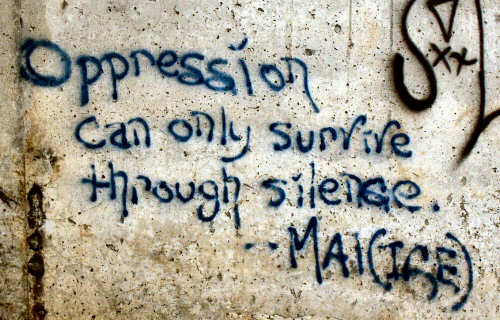
Oppression graffiti, January 15, 2013. (Students for Liberty via http://genderlitutopiadystopia.wikia.com).

Oppression graffiti, January 15, 2013. (Students for Liberty via http://genderlitutopiadystopia.wikia.com).

Did I play a good fife? Tamrin thought so. Compared to my Hebrew-Israelite comrades, I’m pretty sure I did. But like with so many things Hebrew-Israelite during those years, it was a bitter march to nowhere. The fife was part of a Hebrew-Israelite physical and spiritual gulag that put me into more chains, rather than freeing me to be me. Despite Tamrin’s intentions, the idea of molding me and others into men in conditions that would make most “men” contemplate homelessness or running away was a ridiculous pipe-dream.

That Tamrin was likely the only adult male in the Hebrew-Israelite camp who saw Maurice for the lying, abusive, womanizing asshole he was made me realize not everyone in this world was against me. But in a religion that when practiced helped oppress me and others more than the outside world, what was any Tamrin to do?

The Mountaintop of Sixth Grade

22 Wednesday Jun 2016

Posted by decollins1969 in 1, Boy @ The Window, culture, Eclectic, Hebrew-Israelite, Mount Vernon New York, Pop Culture, race, Religion, Youth

≈ Leave a comment

Tags

Arrogance, Hubris, Humanities, Intelligence, Narcissism, Public Speaking, Reggie Jackson, Sixth Grade Graduation, Straight-A Student, William H. Holmes Elementary


William H. Holmes Elementary, Mount Vernon, NY, November 23, 2006. Donald Earl Collins

Thirty-five years ago this week, I finished elementary school. Thirty-five years since I first felt that feeling of reaching the mountaintop, as if I’d accomplished something in my life. Three-and-a-half decades since the last time I was unknowingly naive and unnecessarily arrogant.

It was a finish with a flourish, though. Combined with having become a part of a bizarre religion, I had a new point of view on my life by the time graduation day on Friday, June 26 of ’81 rolled around. My family was now two months into our serving Yahweh, and I was six weeks removed from losing my best friend Starling because of this nutty religion. It was a time in which I felt overwhelmed about my present and immediate future. Yet I acted as if I’d published a book that was both a New York Times Bestseller and a Pulitzer Prize winner. I couldn’t have been more pumped up if I’d been on Walter White’s blue crystal meth from Breaking Bad.

The Sun setting behind the Statue of Liberty, New York, July 4, 2003. (http://science.nasa.gov/).

The Sun setting behind the Statue of Liberty (kind of how I saw my life back in 1981), New York, July 4, 2003. (http://science.nasa.gov/).

But I had some basis for seeing myself as great. As far as I was concerned, I was the unofficial valedictorian of my elementary school class at William H. Holmes Elementary, the ’50s structure next to the big Presbyterian church on North Columbus and East Lincoln Avenue. My teachers had chosen me out of all of my classmates to speak at our graduation ceremony. On that last Friday in June ’81, I served as the opening speaker, introducing the city councilman who served as our keynote. I even wrote the short introduction that I delivered on that wonderful day.

I firmly believed no one in the world was smarter than me. In the three years prior to graduation, I had straight A’s. Still, that paled in comparison to my performance my last year of elementary school. I figured out that I earned an A on forty-eight out of fifty-two quizzes and tests in sixth grade. The lowest grade I earned that year was an 88 on a spelling quiz. I’d won a Dental Awareness Month award for Best Poster and came in second in a city-wide writing contest that included essays from high school students. If anyone had known how big my head had grown that year, they would’ve stuck a pin in my temple just to let the air out.

It wouldn’t have been any funnier if I’d pretended I was Mr. October himself, Reggie Jackson, saying his words, “Sometimes I underestimate the magnitude of me.” I wanted so badly to see myself and to be seen by others as special that I forgot about the work it had taken to move my reading and writing skills up eight grade levels in a little more than two and a half years.

Yankees/Oakland A's/California Angels HOF Reggie Jackson at bat, 1980, accessed June 21, 2016. (AP Photo).

Yankees/Oakland A’s/California Angels HOF Reggie Jackson at bat, 1980, accessed June 21, 2016. (AP Photo).

It was a great day, sunny and low-eighties with cumulus clouds and low humidity. But knowing what life at 616, Mount Vernon and Humanities had in store for me over the next eight years, I should’ve smelled the ozone in the air. I should’ve looked more closely at my sky, to see the flocks of seagulls flying away from the shoreline. I should’ve sensed — and did, on a very low-frequency — the hurricane gaining strength in my life. I chose to ignore it, hoping that I could fake my way through it while resting on my laurels.

To think that it would’ve been another nine years before I felt like I could take on the world again. If someone had told me in June ’81 that I’d have to wait until my junior year at the University of Pittsburgh to have a straight-A semester, I would’ve grabbed a gun and shot myself through the temple with a Colt .45. And I would’ve made sure the bullet I used had a hollow tip. If I’d known that I’d have to wait a full decade to be comfortable with myself as myself in all of my goofiness again, I probably would’ve cried on the spot.

All I can hope these days is that my nearly teenage son can strike a balance between being cool and being cool with himself. I don’t want him spending a decade trying to figure himself out all by himself.

Fights and Friendships

05 Thursday May 2016

Posted by decollins1969 in 1, Boy @ The Window, Christianity, culture, Eclectic, eclectic music, Hebrew-Israelite, Mount Vernon New York, Politics, Pop Culture, race, Religion, Youth

≈ 2 Comments

Tags

"Friends" (1984), "Scream" (1995), 616, 616 East Lincoln Avenue, Child Abuse, Ego Inflation, Friendships, Hip-Hop, Hubris, Humanities, Intolerance, Janet Jackson, Michael Jackson, Rap, Salvation, Shunning, Starling Churn, Teenage Angst, Whodini, William H. Holmes Elementary


My friendship with my one-time best friend Starling ended on this week thirty-five years ago. It was a friendship that “began with a fight and ended with a fight,” as I wrote in Boy @ The Window. The second fight had as much to do with inflated preteen egos as it did with intolerance and ignorance. But that couldn’t be helped, given the way we were, the way our families had been back in the first days of the Reagan Years.

We’d been friends since the last third of fourth grade at William H. Holmes Elementary Most of our conversations the first year or so of our friendship had been about music, politics, history, and other things related to school or pop culture. By the time we reached Mrs. Bryant and sixth grade, a good portion of our conversations turned to Christianity. I guess that this was inevitable. Starling was the “son of a preacher man,” a Southern Baptist pastor. Starling wanted to see me become an official child of God and brother in Christ. My search was one of truth and God, and if Jesus was the one who could get me there then so be it. I didn’t feel the same sense of urgency for water immersion and John 3:16 as Starling did for me.

Back area behind William H. Holmes ES (where my two fights with Starling occurred), Mount Vernon, NY, November 22, 2006 (Donald Earl Collins).

Back area behind William H. Holmes ES (where my two fights with Starling occurred), Mount Vernon, NY, November 22, 2006 (Donald Earl Collins).

The return of my prodigal stepfather Maurice Washington/Judah ben Israel and his bringing the whole Hebrew-Israelite thing to 616 put a temporary end to my Christian enlightenment in April ’81. Him and my Mom had been separated for about six months. During that time, my idiot stepfather had discovered the ways of Yahweh and Torah and alleged that he was a changed man. So we all had to change, to stop eating pork and bloody meats, to start wearing kufis, and to somehow see this fool as our dad.

Starling stopped speaking to me immediately and entirely when I showed up on a mid-April Monday with a white kufi on my head. on the last Friday in March. Our friendship was suddenly over. This was what our second fight was about, our friendship, my bizarre religion and my acceptance of it. At least it was for me.

As I wrote in the memoir,

I guess that Starling at twelve was definitely his father’s son. I could certainly understand Starling’s perspective on this. I’d betrayed him when I came to school and professed that I was a Hebrew-Israelite. Starling had been talking to me for months about becoming a Christian, a Baptist, and now here I was embracing Afrocentric Judaism, similar in many ways to the Nation of Islam and its variants in terms of its racial politics. The practitioners I’d been around tended to see Black Christians as “weak,” out of touch with “their heritage,” and as “worshiping the wrong God.” Starling couldn’t accept this. We ended up in our second and final fight. I was fighting for our friendship, literally. Starling beat me to end it.

I felt betrayed myself. Starling had turned his back on me at a time in which I needed his input the most. I still cared about the same things, thought about the same issues, and wanted someone whom I could banter with about music and politics and religion. But given Starling’s background, even back then I realized that he thought that I was well on my way to hell. Starling and I saw ourselves as adults in many ways, so he assumed that I had made a free-will adult decision for becoming a Hebrew-Israelite when I walked into Mrs. Bryant’s class with a kufi on my head. He had no idea how much I was struggling with my mother and stepfather’s decision to make our family a Hebrew-Israelite one.

Screen Shot from Michael Jackson and Janet Jackson's "Scream" (1995) video, May 5, 2016. (http://www.vidivodo.com).

Screen Shot from Michael Jackson and Janet Jackson’s “Scream” (1995) video, May 5, 2016. (http://www.vidivodo.com).

So I projected the outward appearance of supreme confidence and faith in Jehovah and this slant on the ten Lost Tribes of Israel, to protect myself from being hurt and to see if this whole Hebrew-Israelite thing really was for me. Not a good move going into middle school and the Humanities Program later that year. I had no idea how much worse my life was about to become in the two years between the end of my friendship with Starling and my family’s fall into welfare poverty, bumps, bruises, babies and concussions along the way.

It wasn’t until the end of eighth grade that Starling and I began exchanging “Hi’s” again. Even then, this was often forced. The only conversation I had with Starling after our fight was at the end of ninth grade, with him letting me know that he was moving with his family down South. Starling Churn left with his family for Wilmington, North Carolina in the summer of ’84, still believing I was well on my way to eternal damnation.

That friendship’s rise and fall has helped me understand who friends really are. Ultimately a friend is someone who isn’t a relative but you gravitate toward and have shared interests with, a person who has sympathy and empathy for you and your life. A person who isn’t afraid to tell you when you’re fucking up and who doesn’t shun you when you lose your way. That’s a real friend. I’ve had and still have, thankfully, a core group of ride-and-thrive friends who fit (or at least come close to it) this definition.

Starling and I couldn’t. We were tweeners, after all, and pseudo-intellectual ones with inflated egos from straight-As at that. And in a country that barely tolerates anything other than blind, unthinking Christianity and a false sense of patriotism, maintaining a friendship in the midst of a major religious shift — even a childhood one — was and is nearly impossible.

Pitt Graduation Day, +25 Years, +25 Hard Truths

26 Tuesday Apr 2016

Posted by decollins1969 in 1, Academia, Boy @ The Window, Carnegie Mellon University, Christianity, culture, earth, wind & fire, Eclectic, eclectic music, Hebrew-Israelite, Mount Vernon High School, music, Pittsburgh, Politics, Pop Culture, race, Religion, University of Pittsburgh, Youth

≈ Leave a comment

Tags

Bitter Truths, Bruce Anthony Jones, Commencement, Daniel P. Resnick, Disillusionment, Graduation, Hard Truths, Joe William Trotter Jr., Lessons Learned, Marc Hopkins, Mary J. Blige, Meritocracy, Michael Jackson, Narcissism, Pitt, Prince, Regis Welch, Self-Discovery, Trust, U2


Peterson Events Center (where they do all the commencements now) University of Pittsburgh, Pittsburgh, PA, circa 2008. (http://www.rosser.com/).

Peterson Events Center (where they do all the commencements now) University of Pittsburgh, Pittsburgh, PA, circa 2008. (http://www.rosser.com/).

I can’t believed that I’ve lived long enough to make a quarter-century since my end to undergrad at the University of Pittsburgh! It makes me sound old, at least to the twenty-one year-old I used to be. The one who couldn’t decide between a J.D. and an M.A./Ph.D. program. The person who worried that they would have an MA before their driver’s license. The young ‘in who believed that my advanced degree choices would define my career and life more than anything else.

That person was wise beyond his years, and yet stupid at the same time. He believed in the American meritocracy, in the triumph of hard work, talent, and a Christian faith over every obstacle. He believed that any costs incurred on the path to the MA — and later, the PhD — would be covered in the Bank of a Great Career. He believed, most of all, that professors as advisors and mentors would be there to guide his path every step of the way, the trustworthy individuals that most of them had proven themselves to be.

Me & Mark James (Cropped), Pan-African Graduate & Professional Student Association, University of Pittsburgh, February 27, 1993. (Lois Nembhard).

Me & Mark James (Cropped), Pan-African Graduate & Professional Student Association, University of Pittsburgh, February 27, 1993. (Lois Nembhard).

So much of that belief system was poisoned by the e. coli bacteria of academia and by the leaching lead pipes of American -isms. From my trials at Pitt to my tribulations with Joe Trotter, Dan Resnick, and Bruce Anthony Jones. The fact that my entire nineteen years of teaching, consulting, and nonprofit work has been cobbled together out of necessity and constantly changing circumstances, on which ground has rarely been solid. That after eighteen years and six months of payments, and I’m still a decade or so away from paying off student loans I began borrowing seventeen days after graduating from Mount Vernon High School in ’87.

If I had to talk to my twenty-one year-old self now, I’d say, get the MA in history, then get certified to teach at a high school somewhere. Spend the precious moments not in the classroom reaching high school-age students honing your craft as a writer. Jump headlong into putting down in words your experiences growing up, your times as a Hebrew-Israelite and in Humanities. Get that ms turned into a published work. Work hard at understanding the larger issues and contexts that make America the seething contradiction that it has always been, between racism and freedom, individualism and multiculturalism, social control and narcissism. Then, somewhere between the age of twenty-five and thirty, maybe, go back to school and earn that PhD in history, or in education, and take a few social psychology courses focused on personality disorders along the way.

That is the benefit of 20/10 hindsight (I’d say 20/20, but I still see most things at 20/15, and with warp speed at that!), of course. One big barrier I faced twenty-five years ago is a thorough and excoriating understanding of myself and the life I had to live. I remembered so much of my past that I never questioned the things that I’d forgotten. About abuse, physical and sexual. About deprivation, real and imagined. About people, the layers of yellow onions that most sheepishly are.

Unfortunately, I’d learn the most about what I’d forgotten in my forties, well after most people reconnect with the bitterest parts of their past (if any ever dare to). That I know what I know now is in the category of “better late than never.” Some things, though, I needed to know much sooner than 2014 or 2002. Like my discovery of my ambivalence toward academia. Not teaching or publishing per se. But the idea that I could only be taken seriously by publishing scholarly works that mostly would be read by a few dozen colleagues or when I assigned them to my students. I didn’t figure out how to make my ambivalence work for me until I was thirty-seven, and then, with me at mid-career, fighting to move forward.

Chris Farley facing a hard truth, being hit by a 2x4 in Tommy Boy (1995), April 26, 2016. (http://stream1.gifsoup.com/).

Chris Farley facing a hard truth, being hit by a 2×4 in Tommy Boy (1995), April 26, 2016. (http://stream1.gifsoup.com/).

The silver lining is, that if it weren’t for my time at Pitt, I simply wouldn’t be here to write these words at all. The pressures and pollutions of this world would’ve killed me. Or worse still, killed my inspirations and aspirations, rendering my imagination, my sense of what makes a just and wise world, dead. I’d be as bitter as a cup of Italian roast coffee mixed with vinegar and raw horseradish.

I’m sure that even among my more successful colleagues — and even more sure among my less successful ones — their journeys since the halcyon times of undergrad and even graduate school have been bittersweet. That is life. Especially in a nation in which others encourage us to have aspirations beyond the stars, a complete contradiction to that cracked concrete-reinforced reality that is America.

But even if all of the remaining highs in my career and life outnumber the lows by ten-to-one (who knows, right?), two truths are clear. One is that most people who experience any depth of success in their lives tend to remember the lulls and ruts more than their moments at the top of the mountains. Two is that without me having climbed that first mountain, the college degree mountain, I would have a story to tell, but would lack the words to tell it. I would still be living vicariously through the music of others, whether U2, Earth, Wind & Fire, Michael Jackson (RIP), Prince (RIP), or Mary J. Blige. And for me, at least, as genius as they are — alive and dead — I still need to tell my own story.

Prince, circa 2013 concert, April 26, 2016. (Ethan Miller/Getty Images).

Prince (1958-2016), circa 2013 concert, April 26, 2016. (Ethan Miller/Getty Images).

← Older posts
Newer posts →

Boy @ The Window: A Memoir

Boy @ The Window: A Memoir

Places to Buy/Download Boy @ The Window

There's a few ways in which you can read excerpts of, borrow and/or purchase and download Boy @ The Window. There's the trade paperback edition of Boy @ The Window, available for purchase via Amazon.com at http://www.amazon.com/Boy-Window-Donald-Earl-Collins/dp/0989256138/

There's also a Kindle edition on Amazon.com. The enhanced edition can be read only with Kindle Fire, an iPad or a full-color tablet. The links to the enhanced edition through Apple's iBookstore and the Barnes & Noble NOOK edition are below. The link to the Amazon Kindle version is also immediately below:

scr2555-proj697-a-kindle-logo-rgb-lg

Boy @ The Window on Amazon.com: http://www.amazon.com/Boy-The-Window-Memoir-ebook/dp/B00CD95FBU/

iBookstore-logo-300x100

Boy @ The Window on Apple's iBookstore: https://itunes.apple.com/us/book/boy-the-window/id643768275?ls=1

Barnes & Noble (bn.com) logo, June 26, 2013. (http://www.logotypes101.com).

Boy @ The Window on Barnes & Noble: http://www.barnesandnoble.com/w/boy-the-window-donald-earl-collins/1115182183?ean=2940016741567

You can also add, read and review Boy @ The Window on Goodreads.com. Just click on the button below:

Boy @ The Window

Twitter Updates

Tweets by decollins1969
  • RSS - Posts
  • RSS - Comments

Archives

  • June 2025
  • April 2023
  • September 2022
  • August 2022
  • July 2022
  • June 2022
  • May 2022
  • April 2022
  • March 2022
  • January 2022
  • December 2021
  • November 2021
  • October 2021
  • September 2021
  • August 2021
  • July 2021
  • June 2021
  • April 2021
  • March 2021
  • February 2021
  • January 2021
  • December 2020
  • November 2020
  • October 2020
  • September 2020
  • August 2020
  • July 2020
  • May 2020
  • April 2020
  • March 2020
  • January 2020
  • December 2019
  • November 2019
  • August 2019
  • July 2019
  • June 2019
  • May 2019
  • April 2019
  • March 2019
  • February 2019
  • January 2019
  • December 2018
  • November 2018
  • October 2018
  • September 2018
  • August 2018
  • July 2018
  • June 2018
  • May 2018
  • March 2018
  • February 2018
  • January 2018
  • December 2017
  • November 2017
  • October 2017
  • September 2017
  • August 2017
  • July 2017
  • June 2017
  • May 2017
  • April 2017
  • March 2017
  • February 2017
  • January 2017
  • December 2016
  • November 2016
  • October 2016
  • September 2016
  • August 2016
  • July 2016
  • June 2016
  • May 2016
  • April 2016
  • March 2016
  • February 2016
  • January 2016
  • December 2015
  • November 2015
  • October 2015
  • September 2015
  • August 2015
  • July 2015
  • June 2015
  • May 2015
  • April 2015
  • March 2015
  • February 2015
  • January 2015
  • December 2014
  • November 2014
  • October 2014
  • September 2014
  • August 2014
  • July 2014
  • June 2014
  • May 2014
  • April 2014
  • March 2014
  • February 2014
  • January 2014
  • December 2013
  • November 2013
  • October 2013
  • September 2013
  • August 2013
  • July 2013
  • June 2013
  • May 2013
  • April 2013
  • March 2013
  • February 2013
  • January 2013
  • December 2012
  • November 2012
  • October 2012
  • September 2012
  • August 2012
  • July 2012
  • June 2012
  • May 2012
  • April 2012
  • March 2012
  • February 2012
  • January 2012
  • December 2011
  • November 2011
  • October 2011
  • September 2011
  • August 2011
  • July 2011
  • June 2011
  • May 2011
  • April 2011
  • March 2011
  • February 2011
  • January 2011
  • December 2010
  • November 2010
  • October 2010
  • September 2010
  • August 2010
  • July 2010
  • June 2010
  • May 2010
  • April 2010
  • March 2010
  • February 2010
  • January 2010
  • December 2009
  • November 2009
  • October 2009
  • September 2009
  • August 2009
  • July 2009
  • June 2009
  • May 2009
  • April 2009
  • March 2009
  • February 2009
  • January 2009
  • December 2008
  • November 2008
  • October 2008
  • September 2008
  • August 2008
  • July 2008
  • June 2008
  • May 2008
  • April 2008
  • March 2008
  • February 2008
  • January 2008
  • December 2007
  • November 2007
  • October 2007
  • September 2007
  • August 2007
  • July 2007
  • June 2007

Recent Comments

decollins1969's avatardecollins1969 on No Good Teaching Deed Goes…
Mary Rose O’Connell's avatarMary Rose O’Connell on No Good Teaching Deed Goes…
Lyndah McCaskill's avatarLyndah McCaskill on The Raunchiest of Them Al…

NetworkedBlogs on Facebook

NetworkedBlogs
Blog:
Notes From a Boy @ The Window
Topics:
My Life, Culture & Education, Politics & Goofyness
 
Follow my blog

616 616 East Lincoln Avenue A.B. Davis Middle School Abuse Academia Academy for Educational Development AED Afrocentricity American Narcissism Authenticity Bigotry Blackness Boy @ The Window Carnegie Mellon University Child Abuse Class of 1987 CMU Coping Strategies Crush #1 Crush #2 Death Disillusionment Diversity Domestic Violence Economic Inequality Education Family Friendship Friendships Graduate School Hebrew-Israelites High-Stakes Testing Higher Education History Homelessness Humanities Humanities Program Hypocrisy Internalized Racism Jealousy Joe Trotter Joe William Trotter Jr. K-12 Education Love Manhood Maurice Eugene Washington Maurice Washington Misogyny Mother-Son Relationship Mount Vernon High School Mount Vernon New York Mount Vernon public schools Multiculturalism MVHS Narcissism NFL Pitt Pittsburgh Politics of Education Poverty President Barack Obama Race Racial Stereotypes Racism Relationships Self-Awareness Self-Discovery Self-Reflection Sexism Social Justice Teaching and Learning University of Pittsburgh Violence Whiteness Writing

Top Rated

Blog at WordPress.com.

  • Subscribe Subscribed
    • Notes from a Boy @ The Window
    • Join 103 other subscribers
    • Already have a WordPress.com account? Log in now.
    • Notes from a Boy @ The Window
    • Subscribe Subscribed
    • Sign up
    • Log in
    • Report this content
    • View site in Reader
    • Manage subscriptions
    • Collapse this bar
 

Loading Comments...