• About Me
  • Other Writings
  • Interview Clips
  • All About Me: American Racism, American Narcissism, and the Conversation America Can’t Have
  • Video Clips
  • Boy @ The Window Pictures
  • Boy @ The Window Theme Music

Notes from a Boy @ The Window

~

Notes from a Boy @ The Window

Category Archives: race

On My Own Narcissism

19 Saturday Mar 2016

Posted by decollins1969 in 1, Academia, Boy @ The Window, culture, Eclectic, Mount Vernon New York, Patriotism, Politics, Pop Culture, race, Religion, Youth

≈ Leave a comment

Tags

American Narcissism, Donald Trump, Humanities, Jean W. Twenge, Narcissism, NPD, NPI, Self-Awareness, Ted Bundy, W. Keith Campbell


You are from God, little children, and have overcome them; because greater is He who is in you than he who is in the world.

— 1 John 4:4 (New American Standard Bible)

For those who regularly read my blog, you’ve probably noticed the increased focus over the past year on the issue of American obsession with individualism and its own greatness mythology. At least, the parts of which I’ve roughly translated into a collective American narcissism, or a collective American absorption with itself. It has become the latest idea, my latest potential project, but still too early to tell what, if anything, will come out of this so far. Most Americans remain blissfully unaware of anything that doesn’t involve winners, losers, vicarious living, and America always being seen as #1 at everything (even though in most cases it isn’t).

This post, though, isn’t about how the world’s #1 nation is deeply flawed by a narcissism that runs nearly as deep as the center of a black hole. No, this post is all about me. Really, it’s about the fact that even as I recognize America’s narcissism — both historical and current — that I myself am not inoculated from that narcissism.

Expanding red giant stars will engulf too-close planets before turning into white dwarfs, August 13, 2013. (James Gitlin/STScI AVL via http://www.space.com/).

Expanding red giant stars will engulf too-close planets before turning into white dwarfs, August 13, 2013. (James Gitlin/STScI AVL via http://www.space.com/).

My first bout with narcissism began at the end of elementary school at William H. Holmes in Mount Vernon, New York. It was the spring of ’81. I’d just finished up three years as a straight-A student, been made into a Hebrew-Israelite, came in second for a city-wide essay contest, and been granted the honor of introducing the keynote speaker at my graduation. Even with fighting my best friend Starling, my family’s slow but steady fall into grinding poverty, and the next six years of Humanities in front of me, who wouldn’t have a head as inflated as the Sun at its red-giant stage?

As I wrote in Boy @ The Window

I firmly believed that no one in the world was smarter than me. It wouldn’t have been any funnier if I’d pretended I was Mr. October himself, Reggie Jackson, saying his words, ‘Sometimes I underestimate the magnitude of me.’

It took a year of relative mediocrity while in seventh-grade Humanities for my march toward narcissistic personality disorder to end at the cliff of disillusionment. I wasn’t the “smartest kid in the whole world.” But as I also discovered in my time in this magnet program, neither were any of my classmates.

Perhaps the biggest lesson here was that I was all of eleven and twelve years old when America’s narcissism with individual achievement had caught me in a tangled web of lies and myths. No success or failure or anything in between occurs in a vacuum. No individual’s success happens purely on her or his own, without support, context, and in many cases, an advantage of one sort or another. It took years to learn this lesson, between Humanities and graduate school, the nonprofit world and academia, to learn to give up on the bullshit that is the American meritocracy.

That’s not to say that one can eliminate selfishness (which isn’t the same as narcissism, by the way), or shouldn’t strive for success or a better life for themselves or their kids or their families. But we should always ask ourselves why, in what context, how should we measure our victories, and even if running over others to achieve those victories is the right way to live? Most Americans don’t ask, don’t tell, don’t verify, and don’t think about their lives in this way, because most of us have been taught by this culture that the empathetic lens is a loser’s way of viewing the world.
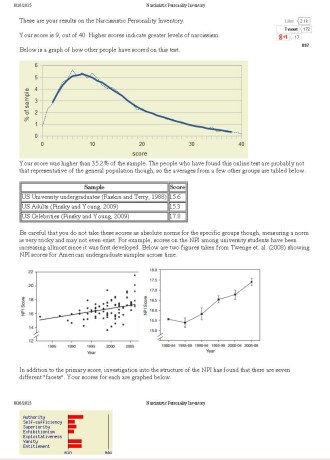
My NPI Score, done August 20, 2015. (http://personality-testing.info/tests/NPI.php).

My NPI Score, done August 20, 2015. (http://personality-testing.info/tests/NPI.php).

I have taken a read — actually, several in the past year — of Jean M. Twenge and W. Keith Campbell’s book The Narcissism Epidemic: Living in the Age of Entitlement (2009). Theirs is a good base to begin to view American society as one so obsessed with individualism that it renders us all anywhere between a little narcissistic to borderline Donald Trumps and Ted Bundys. The psychologists and psychiatrists in this niche have a test for narcissistic personality disorder or NPD, the Narcissistic Personality Index. It consists of 40 questions, seeking to determine whether one is low, medium, or high in narcissism within the index.

I took the NPI last August, and scored a 9 out of 40. It meant that I have some narcissistic tendencies, but only scored higher than 35 percent of those who’ve taken the NPI. I wasn’t even close to being an average American narcissist! Not really a surprise, as those seeking to take such an index are likely less narcissistic than their navel-gazing neighbors.

So, I am in this world and mostly of it, if only because it’s hard to divorce one’s existence from the world in which they live. But I am self-aware enough to know my own narcissism, and empathetic enough to see the narcissism in others.

Great. It still means that as a nation, our narcissism goes as far back as the mind can imagine. It still means that in a couple of centuries, historians will lament about the America that was. Those historians will see a country and a people so busy in building themselves up that they stomped on the oppressed and crushed the downtrodden in the process. A US with so many myths and ideals, but so few attempts at making any of them true.

A Narcissist’s Dream

14 Monday Mar 2016

Posted by decollins1969 in 1, culture, Eclectic, High Rise Buildings, New York City, Politics, Pop Culture, race, Religion

≈ Leave a comment

Tags

Beauty, Bigotry, Christopher Lasch, Donald Trump, Drumpf, John Oliver, Kim K., Kim Kardashian, Last Week Tonight, Mob, Mob Violence, Narcissism, Narcissistic Personality Disorder, NPD, Obsessive Individualism, Racism, Rev. Al Sharpton, Self-Love


Spinning coin (can't make heads or tails of it), March 12, 2016. (http://bestanimations.com).

Spinning coin (can’t make heads or tails of it), March 12, 2016. (http://bestanimations.com).

We’re a nation of narcissists, this is true. Christopher Lasch wrote as much in his bestseller The Culture of Narcissism in 1979. But he was only examining American culture between the end of World War II and the 1970s, the “Me Decade.” Lasch wasn’t looking at obsessive individualism as a unique and historical American trait, one with roots as far back as Jamestown and Henry Wadsworth Longfellow’s poem “Paul Revere’s Ride” (1860). He was looking at how the American obsession with self had evolved into “self-love” and a constant need for either attention or navel-gazing, as evidenced by the rise of pop psychology in the 1960s and 1970s.

Too bad Lasch isn’t around in 2016 to see how far down the rabbit hole America has gone. Between Kim Kardashian-West (at least for the moment) and 2016 GOP presidential candidate Donald J. Trump, it is obvious that we have a national crisis of narcissism on our hands. The two of them are the same side of a two-headed coin. One has traded on their family and beauty in exchange for millions of fans and tens of millions of dollars. The other has built an empire based on his father’s fortune and his brand of self-love. Both have taken advantage of White privilege and class privilege to drive their constant need for fame and attention. And since game knows game, they have both earned themselves an audience of millions who themselves are obsessed with themselves. Or at least, with seeing themselves as successful by living vicariously through the likes of Kim K and The Donald.

The New Material Girl

Kardashian “broke the Internet” again this past week, this time with a tweet that included a “naked” picture of her posing in front of a full-length mirror. I say “naked” only because she redacted her breast and privates, so that while she was naked when taking the picture, it’s not really a naked picture. Obviously Kardashian can do whatever she wants. Anyone with an objective eye can see that Kardashian has as much beauty as genetics and plastic surgery can muster. Anyone who objects to her taking photos of herself in the nude on moralistic grounds is either a prude or a hypocrite, given the number of people who pay attention to her and her brand.

Donald Trump posing with Kim Kardashian at Celebrity Apprentice event, New York, 2010. (Mathew Imaging/WireImage via http://eonline.com).

Donald Trump posing with Kim Kardashian at Celebrity Apprentice event, New York, 2010. (Mathew Imaging/WireImage via http://eonline.com).

Kardashian is a narcissist, and those millions of folks who follow her on Twitter, watch her shows on E!, buy her products and/or jack off to her are narcissists as well. Not because she has maintained a slamming body despite pregnancy, reaching her mid-thirties, or her five-three frame. Kardashian is a narcissist because she embodies most of the clinical symptoms it. According to The Diagnostic and Statistical Manual for Mental Disorders, Fifth Edition (DSM-V), narcissistic personality disorder (under the code 301.81) is “a persistent manner of grandiosity, a continuous desire for admiration, along with a lack of empathy.” In order to determine if a patient may have narcissistic personality disorder (NPD), a psychiatrist must determine if that patient meets at least any five (5) of the nine (9) standards below:

1. A grandiose logic of self-importance (✓)
2. A fixation with fantasies of unlimited success, control, brilliance, beauty, or idyllic love (definitely ✓)
3. A credence that he or she is extraordinary and exceptional and can only be understood by, or should connect with, other extraordinary or important people or institutions (see her collection of friends, lovers: ✓)
4. A desire for unwarranted admiration (✓)
5. A sense of entitlement (✓)
6. Interpersonally oppressive behavior
7. No form of empathy
8. Resentment of others or a conviction that others are resentful of him or her
9. A display of egotistical and conceited behaviors or attitudes (✓)
(American Psychiatric Association, 2013).

It would be hard to know for sure where Kardashian would stand on 6., 7., and 8. without some serious time on a couch or knowing her beyond her public displays of all things herself. Still, it was easy enough to get to six standards without the need for a PhD in psychology or a psychiatric license.

What is worrisome about both Kardashian and Trump, though, is their endless legions of fans and supporters. Kardashian has been peddling herself as Whiteness personified, an entitled upper-class Beverly Hills daughter of O.J. Simpson friend and defense lawyer Robert Kardashian (of Armenian descent) and Kris Houghton-Kardashian-Jenner. Despite the ethnic contradictions, Kardashian’s success has been based in the idea of the glamorous life, the ability to be ostentatious, to rub shoulders, elbows, and other anatomical parts with the rich and famous and the up-and-comers. Between the sex tape with Ray J. that made its way to the Internet and the start of Keeping Up With The Kardashians (both in 2007), her brand of narcissistic Whiteness has been on display now for a full decade. There’s no way that someone whose only job prior to reality TV was as a stylist would be doing this well without the blind support of millions of Americans who have the narcissism, but lack the funds to fuel it.

Damien Meets The Donald

The same is true of GOP presidential frontrunner Donald Trump. He would not be in the position to run against either Hillary Clinton or Bernie Sanders were it not for his four decades in the public eye. Between his casinos, his business ventures (which include numerous failures and five Chapter 11 filings), his immense number of interviews, his three marriages and extramarital affairs, and his NBC TV show The Apprentice (2003-15), Trump’s name is legend. At least for 1990s rap artists and generations of Whites who have bought his books on entrepreneurship in the millions.

Trump, or to go back to the original (thank you, John Oliver), Drumpf, would fulfill all nine standards for narcissistic personality disorder. His constant expressions of misogyny, his equating of Mexicans with rape and criminality, his belief that all protesters need to “get a job,” his insistence that the world is divided between winners and “losers.” All while Trump believes that his very name equals success, no matter the amount of evidence that contradicts his inverted reality. On the 40-point-scale of the Narcissistic Personality Index, Drumpf would likely score between a 38 and a 40, a perfect or near-perfect score. A score, by the way, that no one other than a narcissist would be proud of.

Damien TV series poster, A&E, accessed March 13, 2016. (http://imdb.com).

Damien TV series poster, A&E, accessed March 13, 2016. (http://imdb.com).

Drumpf, though, is a snake-oil salesman who benefited from his father’s slum-lording ways, inheriting a company in 1971 and part of Fred Trump’s $200 million upon the latter’s death in 1999. If Bill Gates isn’t a self-made billionaire, then Drumpf was born two marathons ahead of Gates in the human race for wealth. Yet Trump has presented himself for years as the epitome of Horatio Alger, and to the detriment of millions of Whites who actually believe that Trump’s life is a rags-to-riches story. The bankruptcies don’t matter. The failures of Trump Shuttle, Trump University, Trump Entertainment Resorts, none of that has mattered. All that matters, apparently, is that Trump is a billionaire (no one really knows how much he’s worth; could be anywhere between $250 million and $3.9 billion), and that he promises to “Make America Great Again.”

Unlike Kardahshian, Trump openly attacks anyone who contradicts his narcissistic image of himself and his world. He has for years. The so-called Central Park Five wrongly convicted in the 1989 wilding gang rape case — Yusef Salaam Raymond Santana, Kevin Richardson, Antron McCray, and Korey Wise — can attest to the impact of Trump’s money, one-page ad calling for the death penalty, and narcissism on their lives. Even after the courts overturned their convictions in 2002 and they finally settled their lawsuits against the city for $41 million in 2014, Trump still blamed the five for a crime that they obviously did not commit. “Speak to the detectives on the case and try listening to the facts. These young men do not exactly have the pasts of angels,” Trump wrote in an op-ed for the New York Daily News in June 2014. Apparently, a narcissist who always sees people of color in the worst possible light can never be wrong.

Even with his so-called friends, Trump’s narcissism is beyond the pale. When supposed friend Rev. Al Sharpton disagreed with Trump’s law-and-order stance on Ferguson in 2014, Trump responded with a personal attack during an interview with Fox News. actually addressed their relationship during a Fox News hit last December. “Al’s a con man. He knows it. I know it. Don King knows it, his friend, who I go to with fights with — with Al. And they all know it,” Trump said. He added, Sharpton’s a “professional con man” who has “gotten away with murder.”

We Are The #1s

Should we ever wonder why Trump’s rallies are a who’s who of White supremacy and privilege attracting every form of bigotry, like a nuclear missile fully fueled and ready for launch? Should anyone be surprised that whenever Drumpf blows his dog whistles to his mobs about immigration, the US-Mexico border, yells at a protester, “get them outta here” like a drunk-ass White supremacist, calls President Barack Obama “a disaster,” his audience responds with angry delight? This isn’t just racism, xenophobia, Islamophobia, or misogyny at work. No, this is also a collective obsession with the self, a self that yearns to be like Drumpf in interviews, and on stage at rallies, and in proclaiming the self to be richer, greater, more successful, and more right than every other self.

Donald Trump greets supporters after a rally, Mobile, Alabama, August 27, 2015. (Mark Wallheiser/Getty via http://www.telegraph.co.uk/).

Donald Trump greets supporters after a rally, Mobile, Alabama, August 27, 2015. (Mark Wallheiser/Getty via http://www.telegraph.co.uk/).

It isn’t the fault of the Supreme Court’s Citizens United decision (2010) that Trump is on a glide path toward the GOP nomination this summer. Nor is it the fault of Obama, or Black Lives Matter, or even The Donald himself. No, it is the fault of millions of narcissistic Americans whose billionaire and celebrity worship has trumped all sense of reality.

As psychology professors Jean M. Twenge and W. Keith Campbell noted in their recent book The Narcissism Epidemic: Living in the Age of Entitlement (2009), millions of Americans live in the “land of grandiose fantasy,” with potentially disastrous results (pp. 3-4), like the rise of Trump. Given that March Madness 2016 begins in earnest this week, would anyone really notice if Trump decided to make Kim K. his vice-presidential running mate? She turns thirty-five this October, after all.

Starting Boy @ The Window, 10 Years Later

09 Wednesday Mar 2016

Posted by decollins1969 in 1, Boy @ The Window, culture, Eclectic, High Rise Buildings, Mount Vernon High School, Mount Vernon New York, New York City, Pop Culture, race, Work, Youth

≈ Leave a comment

Tags

Academy for Educational Development, AED, Friendships, Harold I. Meltzer, Interviews, Lumina Foundation, Memoir, Narcissism, Partnerships for College Access and Success, Sacramento CA, Salutatorian, Sam, Vanity, Vanity Project


Full-length vanity mirror, accessed March 9, 2016. (http://etsy.com).

Full-length vanity mirror, accessed March 9, 2016. (http://etsy.com).

On this week a decade ago, I began work on Boy @ The Window as a memoir. That sentence sounds so definitive and simple. The fact was, I’d been writing the book in my head for nearly three years, and had been doing interviews and other iterations of what would become Boy @ The Window off and on since the fall of ’89. But the first full week in ’06 marked a clear delineation between all of the hemming and hawing over writing the book and the actual process of interviewing former teachers and classmates. For some, though, I was devoting serious time and resources to what they called a vanity project.

I had already interviewed my late former teacher Harold Meltzer twice in ’02, and had done some reaching out off and on between the spring of ’03 and March ’06. It took a work trip to Indianapolis and then Sacramento for me to actually begin the process for real. The trip was about convincing Lumina Foundation for Education to continue funding the college access and retention initiative I was deputy director of after the end of ’06, as well as for me to take oversight over a grantee’s work in Sacramento. It just so happened that about two weeks before the trip, I learned that one of my former classmates, the salutatorian Sam, lived in Northern California. Despite my qualms, I decided to reach out and see if he’d want to meet up and catch up.

Why qualms? Short of a high school reunion, most folks who were outcasts or (really, in my case) misfits aren’t exactly jumping for joy to see people who helped make them feel that way. Sam for me was someone who made me feel as if I had no business being smart, Black, and male. Whether he meant for me to feel that way or not was irrelevant at the time.

The Sacramento skyline, as seen from The Ziggurat in West Sacramento, California (never looked like this in my 3 visits there), October 16, 2008. (J. Smith via Wikipedia). Released via CC-SA-3.0.

The Sacramento skyline, as seen from The Ziggurat in West Sacramento, California (never looked like this in my 3 visits there), October 16, 2008. (J. Smith via Wikipedia). Released via CC-SA-3.0.

The irony was that by the time I’d last seen Sam — the fourth Friday of June ’89 — I no longer saw him as an arbiter of anything, much less someone to aspire to imitate. I realized from a short three-minute conversation that Sam may have had more identity issues than even I had faced in the previous eight years. That it was also the last time that I’d see nearly all of my classmates (I bumped into Wendy ten minutes earlier on this particular walk) prior to working on Boy @ The Window was also interesting, if not ironic.

That and the large amount of work that a book about myself and the worlds I inhabited — in my own mind, in reality at home, with family, with classmates, and throughout Mount Vernon and New York — was on my mind all week long. This was going to be a daunting task, diving deep into my mindset and my past. Dredging up old feelings and conjuring up old conversations that otherwise would best be forgotten.

And of course, meeting up with folks who were never “friends” or “girlfriends” or even often just friendly to me. There was a reason why I only called them “my classmates” or “acquaintances” when talking with family and my actual friends in the years since high school and Humanities. They had been larger-than-life characters in a very stretched out nightmare of a Harry Potter book.

Even with that, I also knew that I needed to meet up with and interview these folks. If only to provide some catharsis or to put myself in a mindset I had abandoned with the last year of the Reagan era. So when Sam said he was okay with meeting up, I didn’t hesitate, and I didn’t kvetch over it.

We ended up talking for nearly three hours, about much more than Humanities or Mount Vernon High School. It was a pleasant conversation. Mostly because I allowed Sam to do what most people do in those situations. I allowed him the opportunity to spin his story, to put his best foot forward about his experiences and his life in the present. I made a point to only press him with questions on the stuff that was most important to me and to Boy @ The Window. After all, between Meltzer, other interviews I had planned, and my own steel-trap memories, I could note glaring contradictions when it came time to write.

Kim Kardashian, another boring vanity project, March 7, 2016. (http://twitter.com).

Kim Kardashian, another boring vanity project, March 7, 2016. (http://twitter.com).

Still, Sam didn’t answer a key question, at least not directly for me. After I answered his question, “What do you think I thought of you?,” I asked him if wanted to correct or add anything to my answer. Sam was the only one I interviewed who dodged the question. That deflection to the burdens of Humanities and high school told me everything I needed to know. It told me that in Sam’s mind, I had been irrelevant, that his occasional put-downs were in fact deliberate.

There are some who have read Boy @ The Window since I put it out in 2013 who’ve said that they found the Humanities and high school parts of the memoir “boring.” I concede that point. Even with interviews and with Facebook, some of my classmates remain either an enigma to me, or more often, there wasn’t much exciting about them as people beyond grinding for A’s to begin with. Ten years ago, I was only beginning to learn this truth.

My Inevitable Walkman Era

05 Saturday Mar 2016

Posted by decollins1969 in 1, Academia, Boy @ The Window, Christianity, culture, Eclectic, eclectic music, High Rise Buildings, Jimme, Mount Vernon New York, music, My Father, New York City, Pittsburgh, Pop Culture, race, Religion, University of Pittsburgh, Work, Youth

≈ Leave a comment

Tags

616, 616 East Lincoln Avenue, Black Masculinity, Coping Strategies, Disillusionment, Escape, Escapism, Manhood, Masculinity, Self-Discovery, Sony Walkman, Walking, Walkman


This version was my first Sony Walkman (between May 1987 and June 1988), posted August 28, 2013. (http://ebay.ie).

This version was my first Sony Walkman (between May 1987 and June 1988), posted August 28, 2013. (http://ebay.ie).

This week marks three decades since I finally entered the ’80s technologically, buying my first portable radio/cassette player with headphones. It wasn’t the Sony Walkman — I’d get my first one of those a year later. No, it was a Taiwan-made knockoff that I got at Crazy Eddie’s on 46th and Fifth in Manhattan, on sale for $22, that was my jump into the era of the Walkman. After a year and a half of carrying around a plug-in radio, playing with records on cheap $15 turntables (that cost $130 and much more in 2016), contemplating boom boxes, and having no control over what music I listened to outside of laundromat runs and 616, I found a new way to escape.

As I wrote in my memoir, this new toy was

my passport to another world, a world where I could make anything happen and no one could hurt me. Taking the Subway to go to The Wiz or Crazy Eddie’s or Tower Records was as much a part of mine and Darren’s Saturday ritual as our tracking down of Jimme. I no longer had to wait for WPLJ or Z-100 or WBLS to play the music I wanted to hear. I could buy a cassette tape for as little as six dollars. In the month after I’d bought my Walkman I’d gone out and bought more than twenty tapes. Whitney Houston, Simple Minds, Phil Collins, Sting, The Police, Mr. Mister, Mike + The Mechanics, Tears for Fears, even Sade. All were welcome who could contribute to my all-consuming effort at conquering my courses.

I was tough on my first Walkman, though. I must’ve dropped it a dozen times in two months, as it barely made it to Memorial Day ’86. My second one was a $42 Panasonic, which I bought with my Technisort earnings, and it lasted from July 4th until the end of October. I bought a decent Aiwa knockoff of the Sony Walkman in December, and that one made it to April ’87. before I finally found the $60 I needed for my Sony Walkman the month before high school graduation.

In a span of a year, I would accumulate more than seventy tapes, covering everything from pop and hard rock to rap and R&B, new age and jazz. As anyone who knew me in the spring of ’87 could attest, I carried my tapes with me in my book bag to have at the ready, the same way in which I had toted my Bible everywhere when I became a Christian three years earlier.

I walked everywhere in the Upper Bronx and Southern Westchester County for nearly three and a half years before I bought a Walkman of any kind. But in that window between March ’86 and my college move to Pittsburgh seventeen months later, my walks became much more frequently and much more eventful. I was walking to escape, to find mental space away from the gang of under-five-year-olds that ruled the too-small, two-bedroom space of pain in which I had grown up. I walked to figure out who I was and who I wasn’t, to be angry at my family, at the world, and at myself. I walked to find meaning in a chaotic life and world. I walked because I could wear myself out with warp speed, spin moves and high-falsetto highs, with questions and emotions and sometimes even, some answers, before coming back to 616 and grabbing some sleep. I must’ve have gone on 100 or 150 walks of five miles or more in that year and a half before college.

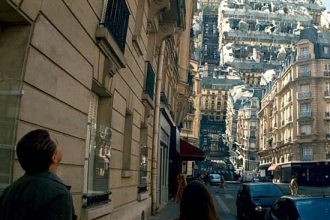
Inception (2010), Paris dream construct screen shot, April 27, 2012. (http://dpmlicious.com). Qualifies as fair use under US Copyright laws because of poor resolution of shot, not intended for distribution.

Inception (2010), Paris dream construct screen shot, April 27, 2012. (http://dpmlicious.com). Qualifies as fair use under US Copyright laws because of poor resolution of shot, not intended for distribution.

That doesn’t even count my more frequent forays into the city, not to do anything or be anything. I wasn’t working for my father anymore, and after he repeatedly called me a “Faggat” in August ’86 and tried to set me up with a prostitute in December ’86, I hardly went to see him at all until the last few weeks before leaving for Pitt. I didn’t even take Darren down to Midtown Manhattan, the Upper West Side, Harlem or Flatbush with me. That’s what I did with the spare hours I started stealing from my Mom on weekends during that year. I’d go down to the city, maybe buy a few tapes at Tower Records on 66th and Broadway (usually not, since most of my tapes came via Terra Haute, Indiana). Sometimes if I had a few dollars, I’d go to MOMA or Radio City or some other place and go into escape/observation mode there. Mostly, I walked and people watched for an hour or so, and then take the long way home between the 2 train, 241st Street and the heart of Mount Vernon.

All the while, my music was on, often at full blast. It was a coping strategy, a pain and stress reliever, my sword and my shield. It took my Phyllis obsession and my freshman year at the University of Pittsburgh to break the link between music, Walkman, and the need to escape. It took the pain of rejection, removal from an anti-Donald environment, and a bout of homelessness to make music about enjoyment and education. When that happened, sometime in ’88, I knew I couldn’t escape anymore.


Marya’s World

28 Sunday Feb 2016

Posted by decollins1969 in 1, Academia, Carnegie Mellon University, culture, Eclectic, Pittsburgh, Politics, Pop Culture, race, Work, Youth

≈ Leave a comment

Tags

Admiration, African American History, Afrocentricity, Black Washington DC, Catherine Lugg, Community Space, Dissertation, Earl Lewis, Friendship, Joe William Trotter Jr., Leisure, Marya McQuirter, Multiculturalism, Public Historian, Research, Saab 900 GLE, Self-Discovery, Self-Reflection, Spencer Foundation Dissertation Fellowship Program, Temple University, University of Michigan, Veganism


Marya McQuirter, circa 2011. (http://twitter.com).

Marya McQuirter, circa 2011. (http://twitter.com).

The most fun part of grad school for me was once I officially began my dissertation research and writing. Especially when I was on the road, or stuck in at the Library of Congress, or meeting folks at conferences or other events. Otherwise, as I’ve written about here many times, it was a single-minded, often solitary pursuit, with known and unknown enemies either trying to put me in a box or rooting for my failure. Really, if a university as a whole could be any less supportive of their students’ success than Carnegie Mellon University, it’s probably a for-profit institution with a nine (9) percent graduation rate.

That’s how my CMU experience had been even before the Spencer Foundation had awarded me my dissertation fellowship in April ’95. But I did take advantage of one generous dispensation by my department chair Steven Schlossman. My becoming ABD within a year of transferring from Pitt to CMU made me eligible for a one-semester sabbatical from teaching to pursue my dissertation research while still on my $4,000-per-semester stipend, starting in January ’95. I made sure to use it, borrowing $4,000 in student loans for that semester as well, so that I could live in DC without living in a box on a corner for a month or two.

That fall, my advisor through one of his colleagues at the University of Michigan had given me the name of a promising doctoral candidate, one who was from DC and also doing her dissertation research on Black DC. I had first called her in October ’94, to learn that her research was on leisure activities and public history in Black Washington, DC in the first half of the twentieth century. It sounded more interesting than my own research on multiculturalism in Black DC, but there were parallels. So many leisure opportunities for Blacks who lived in Uptown communities like U Street and Le Droit Park included public works on Black history, on the connections between Black history and US history. It meant that our projects were actually more connected than not.

Saab 900 GLE, 1st generation (made between 1983 and 1993), UK, May 3, 2012. (SilkTork via Wikipedia). Released to public domain via CC-SA-3.0.

Saab 900 GLE, 1st generation (made between 1983 and 1993), UK, May 3, 2012. (SilkTork via Wikipedia). Released to public domain via CC-SA-3.0.

So once I came down to DC to work like a monk in archives scattered across the area in February ’95, I contacted her. I’d meet her for the first time about three weeks into my eight-week stay in the area, near the end of February. Between my first few days staying with a former high school classmate and meeting a stranger-peer, I had nearly two-and-a-half weeks of eating, sleeping, and drinking dissertation, with a few moments in a shared kitchen listening to older men talk like we were in a barber shop about exploits and life’s lessons.

When we finally met that last Saturday in February, it was a welcome change. It helped that the doctoral candidate had her own car, a used any pretty worn blue-gray, two-door, stick-shift Saab 900 that had seen better days in the 1980s. For her part, despite grad school, the twenty-nine year-old looked younger than my twenty-five years. At five-eight and change, I wouldn’t have to look down at her in order to see the top of her head.

What impressed me the most about Marya, though, was that I could have a conversation with her about my dissertation research without her eyes glazing over, knowing full well that she understood every word coming out of my mouth. Even most of my fellow grad students at CMU and Pitt didn’t really understand my approach to multiculturalism, Black DC and African American history, and education policy. But she got it immediately.

I loved talking to Marya about her research, though. Looking at leisure and the use of space in Black communities for leisure, for everything from reading newspapers and used libraries, to literally how people walked and conversed in public. I found her work, and the way she talked about her work, fascinating. I wondered if I could ever be in love with a topic as much as her. It wasn’t that I didn’t like writing about multiculturalism. I just wasn’t star-crossed over it.

I learned so much not only during my first time hanging out with Marya, but over the next few years. I really didn’t know DC’s neighborhoods and the history of individual neighborhoods until she came along. She introduced me to the Smithsonian’s Anacostia Museum on local Black DC history. She took me to the Washington Historical Society off Dupont Circle, where I found additional materials on Black activities that were educational but outside the formal structure of Howard University and the segregated DC Public Schools.

Smithsonian Anacostia Community Museum, SE Washington, DC, February 28, 2016. (http://www.thecapitalnews.com).

Smithsonian Anacostia Community Museum, SE Washington, DC, February 28, 2016. (http://www.thecapitalnews.com).

She also introduced me to a vegan lifestyle, one that actually seemed sustainable. Matter of fact, when I stayed with Marya for three days in August ’95, I was on a vegan diet. I saw the appeal, but my gastrointestinal tract, well on its way to IBS-land, could only handle but so much in raw fruits and vegetables. Still, Marya introduced me to so many neighborhoods and restaurants, to Ethiopian food in Adams Morgan, to vegan Chinese food in Rockville, to fellow grad students worked on public history dissertations, to young, intellectual DC in general.

Marya also unintentionally helped me see a side of Black thought that I hadn’t seen before. That she survived the Afrocentricity wars at Temple University while earning her master’s there made her tough but also made me weary of discussing my many criticisms of Molefi Asante and his grand entourage of followers. I was so relieved to learn that though she liked some aspects of Afrocentricity, Marya didn’t follow it blindly like so many others I knew in the ’90s. I’d met someone who also marched to the beat of her own drum.

Maybe I would’ve met these folks, made these connections, and gone to these places anyway. Maybe not. But if the former, it would’ve happened much more slowly and cautiously. Marya, for better and for worse, might have been one reason I thought of the DC area as a potential home after more than a decade living and earning degrees in Pittsburgh. Marya McQuirter, though, enriched my life in the years in which I needed it most. I’ve always admired her and her work, and will always see her as a friend.


Black Power Generation

24 Wednesday Feb 2016

Posted by decollins1969 in 1, Academia, Boy @ The Window, culture, Eclectic, Movies, Politics, Pop Culture, race, Religion, Youth

≈ Leave a comment

Tags

Afrocentricity, Alondra Nelson, Angela Davis, Assata Shakur, Authentic Blackness, Authenticity, Black Freedom, Black Panther Party, Black Power, Black Studies, Blackness, Bobby Seale, Community Control, Eldridge Cleaver, Free Breakfast, Harold Cruse, Huey Newton, Kwame Touré, Michael Eric Dyson, Nathan Wright Jr., Peniel Joseph, Policy Brutality, Robin D. G. Kelley, Stokely Carmichael, Whiteness


Black Panther national chairman Bobby Seale, wearing a Colt .45 and defense minister Huey Newton with a bandolier and shotgun, poster, Oakland, CA, 1968. (AP via http://pbs.org).

Black Panther national chairman Bobby Seale, wearing a Colt .45 and defense minister Huey Newton with a bandolier and shotgun, poster, Oakland, CA, 1968. (AP via http://pbs.org).

This year marks a half-century since the official shift of the Civil Rights Era from the traditional Civil Rights leadership of the Black Church toward one of “Black Power.” Between Stokely Carmichael/Kwame Touré’s famous 1966 speech, Huey Newton and Bobby Seale’s founding of the Black Panther Party that October, and riots that began with Watts in L.A. the year before, this was a pivotal year in American and African American history. Of course, as historians and other scholars like Peniel Joseph and Alondra Nelson have illuminated in recent years, while 1966 was a pivotal year, it was not a departure from a long history of the Black freedom struggle, but part a continuity. For Joseph and Nelson (not to mention, Robin D. G. Kelley and Michael Eric Dyson), Black Power was a continuation of radical ideas and actions in order to stand in opposition to American capitalism and racism as an intertwined system of oppression. The roots of which go at least as far back as Black sharecroppers and their union organizing efforts during the Great Depression, if not in fact to the radicalism of Martin Delany of the 1850s.

These wonderful scholars are absolutely right to dump the simplistic narrative of Black Power as a symbol of/departure from the struggle for civil rights or as a philosophy that advocates violence against Whites, especially Whites in law enforcement. They are also more than right to point out how Black Power and the Black Panther Party did way more good on a policy level than most Americans would ever give their leaders credit for. Fred Hampton and Newton and the Free Breakfast for School Children Program that started in Chicago and Oakland between 1969 and 1972. The People’s Free Medical Centers (PFMC), Free Ambulance Service, and other direct community involvement to provide free access to health care and screenings for thousands of impoverished Black families. Free food programs for the destitute.

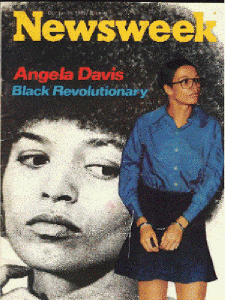
Angela Davis on Newsweek cover after 1970 arrest, October 26, 1970. (http://pinterest.com). Qualifies as fair use due to adjustments for low resolution.

Angela Davis on Newsweek cover after 1970 arrest, October 26, 1970. (http://pinterest.com). Qualifies as fair use due to adjustments for low resolution.

But more than that. The idea that Black communities could work to provide services and opportunities otherwise denied to them by American society was to be a major takeaway from this era of the overall Black freedom struggle. And of course, the idea that police served as an oppressive occupying force, and that Black citizens had every right to defend themselves against police brutality. Though direct armed struggle with law enforcement was in the Black Panther Party toolbox, the notion of policing the police, community control over schools, a community using its available resources, is still more positive than negative. These remain implementable ideas that have and do provide an outlet to the daily grind of racial discrimination and deep poverty in so many parts of the US.

Culturally, the freedom struggle as expressed through Black Power and the Black Panther Party, particularly by leaders like Angela Davis, Assata Shakur, Amiri Baraka, and Kwame Touré, was one of what we know would call Afrocentricity today. This was/is far more than wearing Afros, daishikis, sea shells and beads (or for that matter, black turtlenecks and tight pants). It would mean advocating for and getting universities (both predominantly White universities and HBCUS) to adopt Black Studies programs. It would mean influencing a whole generation of Black artists (the arts, music, and cinema) to adopt a “I’m Black and proud” stance in their work, from Marvin Gaye and the Lost Poets and Gil Scott Heron, to movies like Shaft and that first mainstream miniseries, Roots.

The Black Power Generation (kind of like Prince and The Revolution that tried to incorporate a mesh of messages between 1979 and 1986), for all of the elements that survived Huey Newton and his purges of the 1970s and early 1980s — not to mention their continuing influence in American pop culture, in Black intellectual thought, and in Black movements in general — was hardly perfect. Some, like the late Kwame Touré, promoted Black Power as a sort of authentic Blackness, a kind in which one had to buy all of the options on the table in order to be authentic. The “Uncle Tom” accusation or its equivalent was thrown at Martin Luther King, Whitney Young, Arthur Ashe, and others whose support of Black Power was less that full-throated. Not to mention, the tensions between leaders within the Black Panther Party and among African American intellectuals who attempted to ride the wave of Black Power, as nearly forgotten Black intellectuals Harold Cruse and Nathan Wright, Jr. noted in the late-1960s.

Gemasolar Thermosolar Plant (solar power concentration, converting solar energy to thermal turbine power generation), Fuentes de Andalucía, Seville province, Spain, June 22, 2014. (Wikipedia via http://vice.com).

Gemasolar Thermosolar Plant (solar power concentration, converting solar energy to thermal turbine power generation), Fuentes de Andalucía, Seville province, Spain, June 22, 2014. (Wikipedia via http://vice.com).

That lingering legacy of Black Power is part of its appeal and one of its limits — the ability to redefine ourselves and retell our history in a way that brings nuance and truth. But nuance and truth are not always absolutes. In many respects, Black Power over the generations shares a similarity with Marxist thought and action. Just as Marxism represents a dialectical opposition to capitalist oppression, Black Power has always represented a dialectical resistance to Whiteness and the racist/capitalist oppression that comes with Whiteness. It just doesn’t represent the only form of resistance there is, at least not as Newton, Touré, and others lived their resistance. Black Power is more than resistance, and more than just an amorphous idea standing in opposition to Whiteness. It’s just not the only form of Blackness there is. My own upbringing would be a further testimony to this (to be continued…).

EWF, A Reminder That I Did Have a Childhood

06 Saturday Feb 2016

Posted by decollins1969 in 1, Boy @ The Window, culture, earth, wind & fire, Eclectic, eclectic music, High Rise Buildings, Mount Vernon New York, music, New York City, Pop Culture, race, Religion, Youth

≈ Leave a comment

Tags

EWF, Funk, Hebrew-Israelite, Humanities, Imagination, Jazz, Maurice Eugene Washington, Maurice Washington, Maurice White, Pop, R&B, Self-Awareness, Self-Discovery


Earth, Wind & Fire's All 'N All (1977) album cover, February 6, 2016. (http://www.allmusic.com).

Earth, Wind & Fire’s All ‘N All (1977) album cover, February 6, 2016. (http://www.allmusic.com).

I’m still reeling over Maurice White. Yeah, I still have my Earth, Wind & Fire on my CDs, my iPod, my iPhone, on three laptops and a desktop. Phillip Bailey and White’s brothers-in-arts are still here. Their music will always be with me and with us. But it feels like a little piece of my relative (if not contrived) innocence from my pre-Humanities, pre-Hebrew-Israelite days died with White Wednesday night.

Here’s what I wrote about those days of deliberately-induced blissful naiveté, Earth, Wind & Fire included, in my memoir:

“For me, this boy, this tweener, an active imagination and an even more animated dream life was critical. Living in between the hustle and bustle of “The City,” — Manhattan and the other four boroughs of New York — and the relative quiet of the ritzy suburbs immediately north of it was everything and everyone I knew before the age of twelve. Just three blocks after the elevated 2 Subway line ended at East 241st Street in the Bronx was where “Mount Vernon, New York” began. From the hard concrete sidewalks and green street signs of New York to the crumbling light blue slate and dark blue signs were my only indications that I had truly left the city. This despite the claims of so many I knew that upstate New York began somewhere above 125th or 207th Street in Manhattan. I knew by the time I was twelve that, sleepy bedroom suburb or not, Mount Vernon had more features in common with the Bronx and upper Manhattan than most city folk were willing to recognize.

“My only links to the great metropolis to the south were WNBC-TV (Channel 4), Warner Wolf — with his famous “Let’s go to the video tape line — doing sports on WCBS-TV (Channel 2), and WABC-AM 77 and WBLS-FM 107.5 on the radio. I found the AM station more fun to listen to, but I also liked listening to the sign-off song WBLS played at the end of the evening, Moody’s Mood for Love, with that, ‘There I go, There I go, The-ere I go…’ start. Music had been an important part of my imagination in ’79, with acts like Earth, Wind & Fire, Christopher Cross, Billy Joel and The Commodores. Not to mention Frank Sinatra, Queen, Donna Summer and Michael Jackson’s Off The Wall album. The music also made me feel like I was as much a part of New York as I was a part of Mount Vernon. It left me thinking of the ozone and burnt rubber smell that I noticed as soon as I would walk down into the Subway system in Manhattan. But aside from my occasional slip of the tongue — ‘warda’ for ‘water’ and ‘bawwgt’ for ‘bought’ — I didn’t sound or act much like a New Yawker. Still, I discovered something about New York from afar. I could sneak up to the rooftop of my apartment building, 616 East Lincoln, a five-story complex of three connected brick buildings with Tudor-style facades and a concrete-stone foundation. I’d find the exit to the roof unlocked and see the tops of the Twin Towers floating over some low-lying clouds on an otherwise sunny day. The symbols of the greatest city on Earth seemed to float toward the heavens on those days, and me with them.

“Besides the occasional reminder of life outside of my world, of Mount Vernon, I was the center of my own universe. Mount Vernon was but a stage on which my life played out, a place I hoped would stay this way forever. I was an eleven-year-old who thought that my world was the world. I lived my life like Philip Bailey and Maurice White would’ve wanted me to. I came to see ‘victory in a life [sic] called fantasy’ as my own life, living as if my imagination and dreams could be made into reality. All I had to do was wish it so.”

Because of what I went through during the Boy @ The Window years, I had to learn to get over my idiot ex-stepfather’s abuse to continue listening to Earth, Wind & Fire between ’82 and ’89. The late Maurice Eugene Washington was a fan as well, and I didn’t want us to both like the same music. Who the heck knew what was going on in his head when he heard “Fantasy” or “After The Love Is Gone,” anyway?

All I know is, there won’t be another group like the one Maurice White founded in ’69, the year I was born. All I can do is hold on to my precious Earth, Wind & Fire music, and the imagination that it helped spark. All I can do now is hope that someone can even begin to approach the kind of ethereal and powerfully Black-and-proud mix of music that White, Bailey, et al. were able to construct for nearly a decade. One can fantasize, right?


← Older posts
Newer posts →

Boy @ The Window: A Memoir

Boy @ The Window: A Memoir

Places to Buy/Download Boy @ The Window

There's a few ways in which you can read excerpts of, borrow and/or purchase and download Boy @ The Window. There's the trade paperback edition of Boy @ The Window, available for purchase via Amazon.com at http://www.amazon.com/Boy-Window-Donald-Earl-Collins/dp/0989256138/

There's also a Kindle edition on Amazon.com. The enhanced edition can be read only with Kindle Fire, an iPad or a full-color tablet. The links to the enhanced edition through Apple's iBookstore and the Barnes & Noble NOOK edition are below. The link to the Amazon Kindle version is also immediately below:

scr2555-proj697-a-kindle-logo-rgb-lg

Boy @ The Window on Amazon.com: http://www.amazon.com/Boy-The-Window-Memoir-ebook/dp/B00CD95FBU/

iBookstore-logo-300x100

Boy @ The Window on Apple's iBookstore: https://itunes.apple.com/us/book/boy-the-window/id643768275?ls=1

Barnes & Noble (bn.com) logo, June 26, 2013. (http://www.logotypes101.com).

Boy @ The Window on Barnes & Noble: http://www.barnesandnoble.com/w/boy-the-window-donald-earl-collins/1115182183?ean=2940016741567

You can also add, read and review Boy @ The Window on Goodreads.com. Just click on the button below:

Boy @ The Window

Twitter Updates

Tweets by decollins1969
  • RSS - Posts
  • RSS - Comments

Archives

  • June 2025
  • April 2023
  • September 2022
  • August 2022
  • July 2022
  • June 2022
  • May 2022
  • April 2022
  • March 2022
  • January 2022
  • December 2021
  • November 2021
  • October 2021
  • September 2021
  • August 2021
  • July 2021
  • June 2021
  • April 2021
  • March 2021
  • February 2021
  • January 2021
  • December 2020
  • November 2020
  • October 2020
  • September 2020
  • August 2020
  • July 2020
  • May 2020
  • April 2020
  • March 2020
  • January 2020
  • December 2019
  • November 2019
  • August 2019
  • July 2019
  • June 2019
  • May 2019
  • April 2019
  • March 2019
  • February 2019
  • January 2019
  • December 2018
  • November 2018
  • October 2018
  • September 2018
  • August 2018
  • July 2018
  • June 2018
  • May 2018
  • March 2018
  • February 2018
  • January 2018
  • December 2017
  • November 2017
  • October 2017
  • September 2017
  • August 2017
  • July 2017
  • June 2017
  • May 2017
  • April 2017
  • March 2017
  • February 2017
  • January 2017
  • December 2016
  • November 2016
  • October 2016
  • September 2016
  • August 2016
  • July 2016
  • June 2016
  • May 2016
  • April 2016
  • March 2016
  • February 2016
  • January 2016
  • December 2015
  • November 2015
  • October 2015
  • September 2015
  • August 2015
  • July 2015
  • June 2015
  • May 2015
  • April 2015
  • March 2015
  • February 2015
  • January 2015
  • December 2014
  • November 2014
  • October 2014
  • September 2014
  • August 2014
  • July 2014
  • June 2014
  • May 2014
  • April 2014
  • March 2014
  • February 2014
  • January 2014
  • December 2013
  • November 2013
  • October 2013
  • September 2013
  • August 2013
  • July 2013
  • June 2013
  • May 2013
  • April 2013
  • March 2013
  • February 2013
  • January 2013
  • December 2012
  • November 2012
  • October 2012
  • September 2012
  • August 2012
  • July 2012
  • June 2012
  • May 2012
  • April 2012
  • March 2012
  • February 2012
  • January 2012
  • December 2011
  • November 2011
  • October 2011
  • September 2011
  • August 2011
  • July 2011
  • June 2011
  • May 2011
  • April 2011
  • March 2011
  • February 2011
  • January 2011
  • December 2010
  • November 2010
  • October 2010
  • September 2010
  • August 2010
  • July 2010
  • June 2010
  • May 2010
  • April 2010
  • March 2010
  • February 2010
  • January 2010
  • December 2009
  • November 2009
  • October 2009
  • September 2009
  • August 2009
  • July 2009
  • June 2009
  • May 2009
  • April 2009
  • March 2009
  • February 2009
  • January 2009
  • December 2008
  • November 2008
  • October 2008
  • September 2008
  • August 2008
  • July 2008
  • June 2008
  • May 2008
  • April 2008
  • March 2008
  • February 2008
  • January 2008
  • December 2007
  • November 2007
  • October 2007
  • September 2007
  • August 2007
  • July 2007
  • June 2007

Recent Comments

MaryPena's avatarMaryPena on My Day of Atonement/Bitter Hat…
decollins1969's avatardecollins1969 on No Good Teaching Deed Goes…
Mary Rose O’Connell's avatarMary Rose O’Connell on No Good Teaching Deed Goes…

NetworkedBlogs on Facebook

NetworkedBlogs
Blog:
Notes From a Boy @ The Window
Topics:
My Life, Culture & Education, Politics & Goofyness
 
Follow my blog

616 616 East Lincoln Avenue A.B. Davis Middle School Abuse Academia Academy for Educational Development AED Afrocentricity American Narcissism Authenticity Bigotry Blackness Boy @ The Window Carnegie Mellon University Child Abuse Class of 1987 CMU Coping Strategies Crush #1 Crush #2 Death Disillusionment Diversity Domestic Violence Economic Inequality Education Family Friendship Friendships Graduate School Hebrew-Israelites High-Stakes Testing Higher Education History Homelessness Humanities Humanities Program Hypocrisy Internalized Racism Jealousy Joe Trotter Joe William Trotter Jr. K-12 Education Love Manhood Maurice Eugene Washington Maurice Washington Misogyny Mother-Son Relationship Mount Vernon High School Mount Vernon New York Mount Vernon public schools Multiculturalism MVHS Narcissism NFL Pitt Pittsburgh Politics of Education Poverty President Barack Obama Race Racial Stereotypes Racism Relationships Self-Awareness Self-Discovery Self-Reflection Sexism Social Justice Teaching and Learning University of Pittsburgh Violence Whiteness Writing

Top Rated

Blog at WordPress.com.

  • Subscribe Subscribed
    • Notes from a Boy @ The Window
    • Join 103 other subscribers
    • Already have a WordPress.com account? Log in now.
    • Notes from a Boy @ The Window
    • Subscribe Subscribed
    • Sign up
    • Log in
    • Report this content
    • View site in Reader
    • Manage subscriptions
    • Collapse this bar
 

Loading Comments...