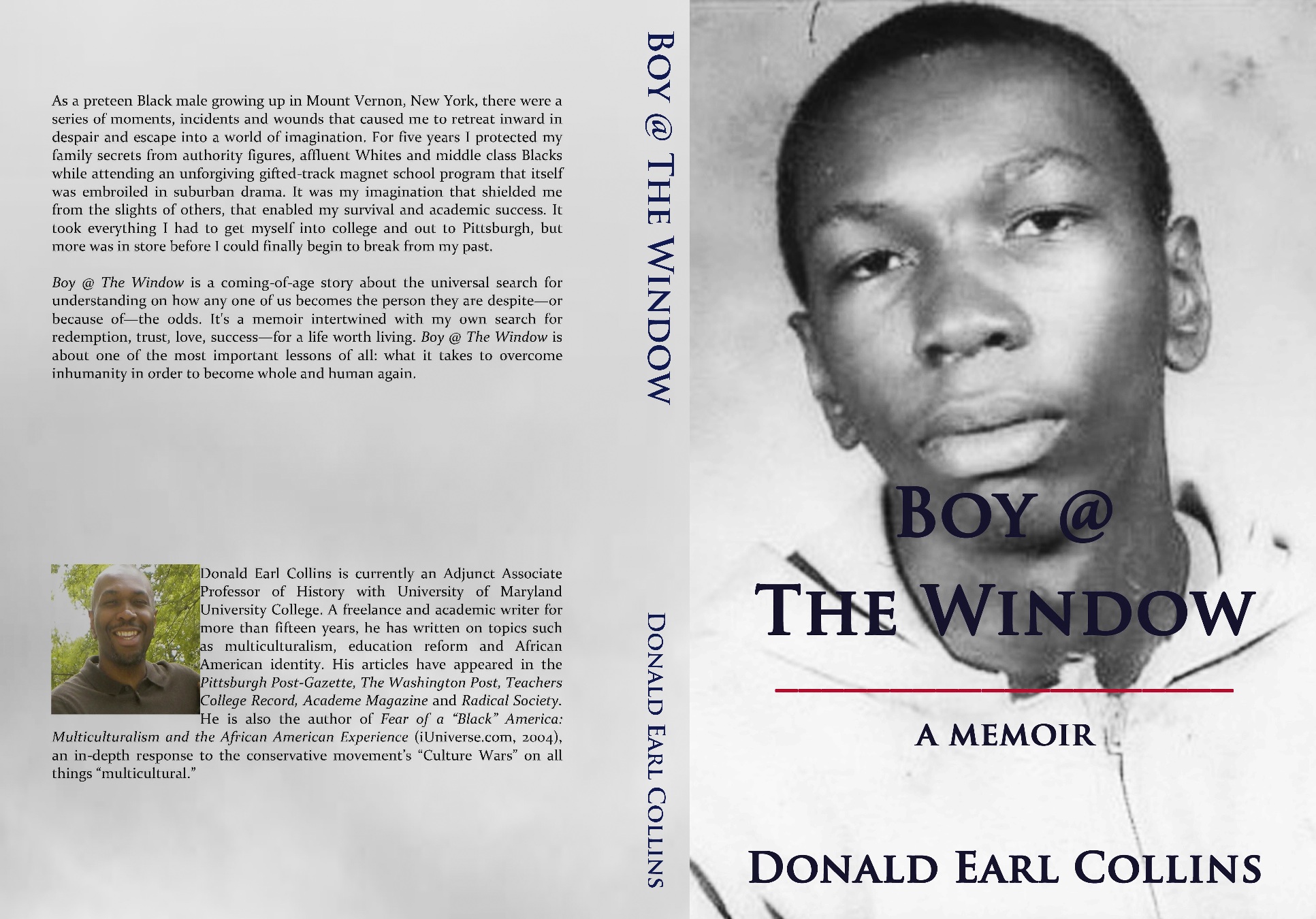
Boy @ The Window, front/back cover, and side, November 11, 2013. (Donald Earl Collins).
I have some really good news. My book Boy @ The Window is not just an e-book anymore. I now have a trade paperback edition, out and available through Amazon.com as of yesterday (via http://www.amazon.com/Boy-Window-Donald-Earl-Collins/dp/0989256138/). You can also order and buy Boy @ The Window the old-fashioned way — directly through your local bookstore.
Please take a look, support, buy, read, comment and share. I will post as reviews and opportunities to talk about the book arise. Thanks to all of you who’ve supported my blog and the path to Boy @ The Window over the past six years!
In Boy @ The Window, I have a chapter on my first year at Pitt and the baggage I carried from my last months in Mount Vernon, New York, Phyllis (a.k.a., Crush #2) included. I haven’t discussed Phyllis much in the six and a half years I’ve been running this blog on all things related to my memoir. Mostly because once I got over my crush-turned-internalized-obsession, I realized that she wasn’t really all that as a person. Still, given the number of posts I’ve done on my Mom, my late idiot ex-stepfather Maurice and Wendy (a.k.a., Crush #1), Phyllis does deserve some mention, along with my stumbled-filled transition to manhood that went with the years between December ’85 and August ’88.
A key point for me in this transition was in October and early November ’87. I finally worked up the courage to write Phyllis a note about an incident earlier that summer, one in which she all but emasculated me at the White Plains Galleria. As I wrote in Boy @ The Window:
I got the address, bought her a card for her eighteenth birthday, and sat down and wrote her. About how I liked her and wanted to know if she “ever liked me.” I needed to know if she and her sister really were talking about me at the bus stop that day, “one way or the other.” I wanted to know what she thought I needed in order to impress someone like her in the future. Then I added “Happy 18th Birthday!” I sent the card off on the second week in October, just a few days before her birthday.
On the second of November, I got her response. It was in purple ink, with heart shapes and circles for dots over “i”s. Reading her letter was like reading the liner notes off of a Prince album. Like the song “I Would Die 4 U,” Phyllis had decided to limit her English skills to the ’80s equivalent of sign language on paper, a real “revolution” on both their parts. I remember she started, “Thank U 4 your card 2day,” an insult to my intelligence. She would’ve been better off with, “Yo nigga, ’s up wit’ ya sweatin’ me?” She wrote indirectly that she did like me at one point in time, but added “but we’re in college now . . . around lots of nu people” She admitted that I was her and Claudia’s topic of conversation that day, but “I needed 2 get over that.” She hinted that I shouldn’t write her again, and that was it. No apologies, no attempt to understand how I felt…
After Phyllis’ wonderful response, I all but stopped going to class. I missed most of my classes the month of November, only showing up for exams or if my mood had let up long enough to allow me to function like normal. The weekend before Thanksgiving, I allowed my dorm mates to cheer me up by getting a couple of cases of Busch Beer. These were the Pounder type, sixteen-ounce cans. After getting Mike to get us the cases, we went back to Aaron’s room and started drinking. I downed four cans in fifteen minutes, and was drunk within a half hour. I started throwing around the word “bitch.” Anytime anyone mentioned Phyllis’ name – or any woman’s name for that matter — one of us said the B-word and we’d guzzle down some beer.
In today’s world of text messaging, I would’ve found Phyllis’ response so ridiculous that I probably would’ve shared it with close friends and laughed about it for weeks afterward. But as someone with the emotional and psychological maturity of a twelve-year-old in the fall of ’87, Phyllis’ response really, really, really hurt. Her letter shattered the pedestal on which I had placed her, and reaffirmed every negative thing I’d felt about myself for the previous half decade.
Depression image, Carroll College, Counseling Services, November 11, 2013. (http://www.carroll.edu).
It also left me so depressed that I finished that semester with a 2.63 GPA. That, and spending the holidays at 616, made me determined to use the anger I felt toward myself and Phyllis as fuel for the next semester. And even though that worked so well that I made Dean’s List, I still hadn’t really gotten over Phyllis’ rejection by the time the school year was over in April ’88.
It took one last look at that letter — that unbelievably trifling and simple letter — to realize that even under the best of circumstances, Phyllis and I would’ve been a match made only in a mad scientist’s laboratory. I’d never be interested in a human being who talked down to me, as if I was unworthy of anything other than some simple shorthand language. Or in any woman whose expectations of men were about as objectifying as Mike Tyson’s views of women. I realized that I had finally gotten to know the real Phyllis, and in the process, had begun to know the real me, and what I needed to change about myself in order to build a better, 2.0 version of me. With that, like so much from my freshman dorm at Lothrop Hall, Phyllis’ letter became part of my garbage pile.
One of the many pitfalls of poverty in the midst of striving toward college was that I didn’t do a single formal college visit prior to taking the Amtrak to Pittsburgh in late-August ’87. (Ironic, then, that I’ve been on at least sixty college campuses to teach or lecture, for graduate school, for conferences, talks, interviews and other events in the past quarter-century). The only options for doing any college visits at all while at Mount Vernon High School (NY) were either the schools in the area or to go on the HBCU college visit trips to Howard and Hampton University. I had no interest in applying to an HBCU (which I’ll talk about later), and the prospect of visiting Columbia or NYU never really occurred to me until years later.
But I did have one inadvertent encounter with a college campus prior to arriving at Lothrop Hall on the University of Pittsburgh’s campus in ’87. It was in the fall of ’85. As I wrote in Boy @ The Window:
I discovered something rather interesting about myself toward the end of the year. I understood, maybe for the first time, how much walking and nocturnal self-pleasure had replaced sitting on the radiator at the living room window as my after school and weekend distraction. Walking allowed me to continue to contemplate my future, to make sense of my senseless world. Very early on in my junior year, I went on a Saturday walk straight up Route 22, from East Lincoln and North Columbus. I ended up at Concordia College in Bronxville, a small liberal arts school in the middle of one of the richest towns in America. It was a cloudy and crisp early fall day, those first series of gray days you experience after a long, hot summer. I wore my gray hooded and zippered sweat jacket with my beat-up multi-colored and checkered long-sleeve shirt and some cheap, made-in-Taiwan blue jeans.
Even with that and my tall, Black male self on a mostly White campus, I seemed to blend in. Not a single person looked at me as if I didn’t belong there. Some of the students actually said “Hi” to me, and not that overly enthusiastic greeting, either. I walked across the campus, walked into some of the buildings and walked around some of the empty classrooms. After a bit more wandering around, I ended up at the library. It was surprisingly small, but the books it did have were the kinds I used to like reading. Old and dusty historical texts and subjects of interest only to old writers and historians. I saw students at tables studying or talking softly while studying. Then it dawned on me why the students didn’t automatically assume that I wasn’t a college student. I was dressed like they were, or,I guess, they dressed like me. Sloppy, but not too sloppy. It also dawned on me that you needed a college ID on the campus in case the guards suspected that you weren’t a college student. So I made my way from the campus and trekked back home.
This was my first and only college visit. And though I hadn’t stopped by the admissions office or spoken with a financial aid counselor, my wandering walk gave me much food for thought. The visit reinforced my thinking on what I needed to do in eleventh grade to guarantee both college acceptance and a scholarship. I assumed an academic scholarship, but an athletic one was still in the realm of possibility. I knew, again, that this was my make-or-break year to bring my grades up as far as possible. I had no idea what my class ranking was, but I assumed that I needed to be in the top fifteen or twenty to have my best shot. So I set the largest goal possible – making it to the top ten of my class.
Eddie Murphy (with Rick James), “Party All The Time” (1985) video (screen shot), November 5, 2013. (http://vimeo.com).
In the back of my mind, I knew even then that I didn’t want to attend a school with any of my classmates or with any reminders of Mount Vernon. So many of my Black classmates were already talking about attending HCBUs or New York area school. I knew that despite their relative maturity as eleventh graders, I didn’t want to be in classroom settings with the Rick James “Party All The Time” set or with White and Black classmates who thought of me as a caricature of a human being or Black male.
That walk to Concordia reminded me of a simple fact. That my path to college was my path, not to be determined by anyone else, and certainly not the people I didn’t even trust with a smile.
Given that Fear of a “Black” America was my first book, but one based on my doctoral dissertation, and that Boy @ The Window is a memoir, the road from one to the other may not be that obvious with an initial glance. But despite the intellectual, semi-scholarly nature of my book on Blacks and multiculturalism, there are parallel themes that run between Fear of a “Black” America and Boy @ The Window. Perhaps none are more important, though, than the challenge of authenticity, of fitting in, of being able to mesh the complicated onion that I’ve found myself to be over the years.
I think that was why I decided in November ’98 to turn my dissertation “A Substance of Things Hoped For” into a more readable book. Yes, after all that work to write a 505-page thesis, it would’ve been a shame to just let it sit on my then girlfriend’s coffee table, to be used either as a door stop or a base for her doing her nails. Yes, I still had something to prove to academia. That my scholarship as a historian and educator on the issue of multiculturalism was sound. That the conventional academic wisdom around Blacks, people of color and multiculturalism was paternalistic fear-mongering.
Public Enemy, Fear Of A Black Planet (1990) Album Cover
And in thinking that last part through, I came up with my Public Enemy-inspired title and thread for the first book. It was about fear in many forms. Elite White fears of a majority-people-of-color US within their own lifetimes. Conservative fears of a K-16 education system that included the cultural and historical perspectives of peoples of color, of the poor, of women, of the LGBT, of so many others they’d rather discard. General American skepticism that any Blacks had ever given any thought at all to cultural pluralism, intercultural education, or multiculturalism/multicultural education, at least before White theorists had thought through these ideas first.
Afrocentrists and nationalists who thought of multiculturalism as soft and utterly unrepresentative of the Black experience — or, at least, what they considered an authentic version thereof? That was as difficult a challenge as any I faced in writing both my dissertation and Fear of a “Black” America. So much so that I made a few interesting decisions along the way. I sought out an agent — yes, a literary agent — for the first book, and found one, too (things were so much easier in ’99). I wanted the book to have an impact beyond academia.
In the writing process, I decided to weave the theme of fear, skepticism, willful and inadvertent misunderstandings throughout the 200-page book. All while covering Black intellectual thought about what we now call Afrocentricity and multiculturalism, Black activism and activities around education and Negro History Week, and the so-called Culture Wars of the 1980s and 1990s. All to show that multiculturalism was/is a part of America’s evolution, even if some folks are gnashing their teeth and wearing sackcloth and ashes along the way.
One thing was missing, though, from my six chapters. Me, in a word. Yes, my argument was crystal clear, my evidence was sound, my notes and analysis lined up well enough by the summer of ’00. Yet, as my one-time agent noted, “there’s not enough of you in this manuscript.” Bottom line: folks weren’t going to buy the book unless I made it more compelling, which meant putting something of me or about me in it.
So I did. I wrote mostly about my experiences in academia and how they paralleled with some of the critical issues in Fear of a “Black” America. I talked about my Duquesne University students in the College of Education in ’98 and ’99, most of whom were cultural conservatives. I brought up conversations I had with professors skeptical about my scholarship, like Richard Altenbaugh in March ’98 or my former dissertation advisor Joe Trotter in April ’96. I also wrote about my conversation with Estelle Abel over my lack of authenticity as a young Black man in June ’87, having thought about it for the first time in thirteen years. I wasn’t sure if that made Fear of a “Black” America any better, but it made me feel better about my first book.
By the time I’d given my agent the final draft of Fear of a “Black” America in October ’00, I was ready — maybe for the first time in years — to take a look at my life before Pitt, grad school, Spencer Fellowship and becoming Dr. Collins. I wasn’t sure if I wanted to open up the emotional side of that Pandora’s box just yet. But in some ways, I really needed to, precisely because of my experiences with people in grad school at Pitt and Carnegie Mellon. And precisely because of my occasional moments of rage and overreaction, if only because Fear of a Black “America” helped me tap into emotions I didn’t know I had.
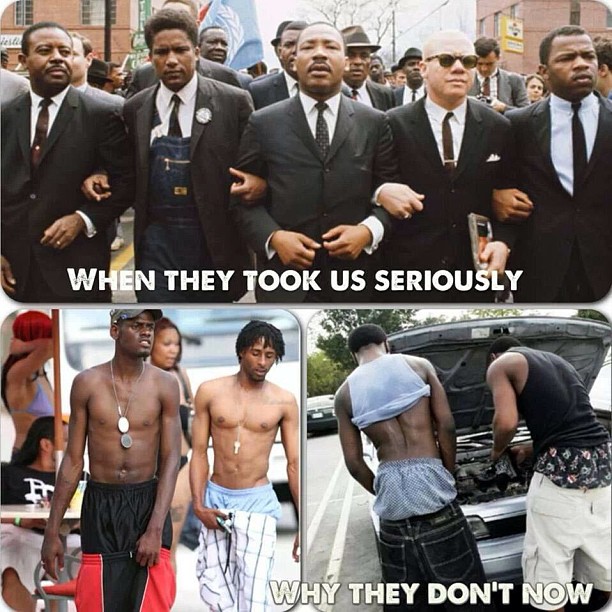
“When They Took Us Seriously/Why They Don’t Now” poster, September 20, 2013. (Tim Brinkley/Google +).
In the past month of March on Washington and “I Have A Dream” speech commemorations and Birmingham church bombing dedications, a series of images lamenting rap culture and “thug life” have made their way around the Internet. The one that has stuck with me the most has been the image of the Selma March in 1965 juxtaposed with seemingly random photos of young Black males with saggy pants. The caption reads, “When they took us seriously/Why they don’t now.” Really? White supremacists took respectable Negroes seriously in the ’60s because they marched and wore suits, but don’t take Black males seriously now because of the saggy pants phenomenon? The truth is, they did and didn’t take us seriously then and now, and it has almost nothing to do with pulling our pants up above our boxers.
I have to say, though, that I hate saggy pants. It makes the people wearing them look somewhere between goofballs and idiots. It’s never mattered to me whether White guys or Black guys or college guys or hip-hop divas have worn saggy pants. I didn’t like it when it became a style in the early ’90s, thanks in large measure to NWA and Tupac, TLC and Snoop Dog and a host of other hip-hop/rap artists. I certainly don’t like it now, and would never buy a pair for my ten-year-old son to wear that way. The saggy pants style has been a sad twist on hand-me-downs and poverty as marketable clothes for the hip-hop cool.
But the saggy pants style has never translated for me as embracing a “thug life” or some devolution of Black culture or American society. It wasn’t life imitating art, ala Boyz n the Hood (1991), Menace II Society (1993) or Clockers (1997). Nor have I ever seen it as something that meant that Whites or the new Black elite could say, “See. These Black folk don’t deserve respect, or health care, or a quality education, or good-paying jobs.” Over the past two decades, I’ve seen it as a style — a bad style, to be sure — but a style that some Blacks (and Whites, Latinos and Asians) have embraced.
Any young Black person who’s striving for higher education, or careers, or their own stereotypical success story in life, will tell you that they don’t wear saggy pants for every time or season. Even those who don’t know learn very quickly that saggy pants aren’t welcome in allegedly more respectable settings. If anything, the prevalence of saggy pants in 2013 has as much to do with the reality that opportunities for education, employment and prosperity remain so out of reach that it really doesn’t matter to many what they wear and where they wear it. There’s no need to code switch if everyone in your world knows the same exact code of cool.
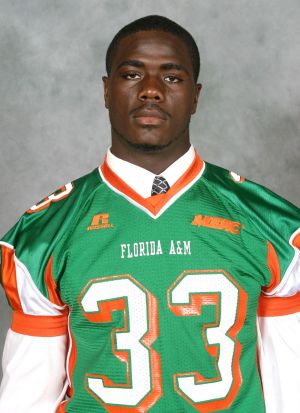
Jonathan Ferrell, Florida A&M football picture, September 20, 2013. (AP/Florida A&M University).
Recent events have made it pretty obvious that it really doesn’t matter what Black males wear. We remain targets for deeply ingrained stereotypes, institutional racism, and pre-emptive White violence. Whether it was Trayvon Martin wearing a hoodie in the rain, or John Lewis wearing a suit in Selma forty-eight years ago, it hasn’t mattered to Whites in fear of the Black boogie man. Florida A&M University graduate and former football player Jonathan Ferrell learned this deadly lesson in North Carolina just a week ago. It doesn’t matter what we wear, at least as far as many Whites and some Black elites are concerned.
Blacks all look the same to them, and looked the same to them in the ’60s. Suits, hoodies or baggy pants, we’re criminals and imbeciles from birth, thugs for life, and a drain on families and American society. This doesn’t mean that any one of us shouldn’t take responsibility for how we act, speak and look in public. I dare say, though, that structural economic issues like unemployment in deeply impoverished Black communities (or crank-infested White ones) won’t be solved with young folk pulling their pants up. We need to stop focusing on the insignificant, because saggy pants and respectability are the trees in this morphing forest of racism and economic inequality.
Literally on this day and date, and at this time twenty-eight years ago, I was at the beginning of a twenty-three hour adventure away from 616, my idiot stepfather (no longer, of course, and recently deceased) Maurice Washington and his abuse, a trek that took me all over Mount Vernon and into both my dreams and fears. As I wrote in Boy @ The Window:
“We got into it over the ‘Dad’ issue again. He told me to do something, and I only said, ‘Okay.’ I didn’t say ‘Okay, Dad,’ and my ‘Okay’ wasn’t exactly enthusiastic. This was the one thing about Maurice that I refused to accept – him as anything other than the leech and bully that he was. He certainly wasn’t my dad, and he gave up the right to be called “stepfather” three years before. Yet he insisted on me calling him “Dad!” I usually walked a fine line between open defiance and acquiescence with him, not referring to him by anything at all. He had no name, no title, no label. Maurice was nothing and meant nothing to me other than the reason I’d eventually have to leave 616. Our incidents had become less frequent only because he worked nights as a security guard and slept during the day. And I stayed home as little as I could when he was around.
“So on the last Sunday of August ’85, we had another round.
“I’m your father, and the Bible says to ‘honor thy father and mother’. . .”
“You’ll never be my father. My father lives at 149 South Tenth Avenue.”
“As long as you live under my roof, you’re gonna call me ‘Dad’.”
“No, I’m not,” I said shaking my head at the same time.
“I’m gonna show you how to respect me, nigga!,” he said as he balled his fists.
“Luckily I had fast feet. He tried to grab me and then hit me at the same time, not a good tactic when you’re significantly overweight and off balance. I slithered past him, got out of his grasp, and dashed down our long hallway to the front door. I ran down the stairs that led to the back dirt courtyard area of 616 and didn’t stop running into I ran into the woods nearby, Wilson Woods. It was a mostly cloudy late summer day, thank God, because I wasn’t in any shape to be bothered with anybody.
“I wound my way through Wilson Woods on its serpentine path toward the southeast side of Mount Vernon. I saw a few folks who recognized me as I walked from the woods toward East Third and South Columbus, but the walk was mostly a blur. I made my way to Jimme’s place on West Third and South Tenth, all the while thinking about the reality of my long-lost childhood and quickly evaporating time as a teenager. Jimme wasn’t home, and I didn’t feel like going on a hunt for him at one of his watering hole after a meandering three-mile walk. So I waited there for a while, maybe an hour or so.
“I made my way past downtown Mount Vernon, up Gramatan Avenue, taking on the hill on which Davis Middle School sits. From there I reached Fleetwood and walked past homes and cars that I thought me and my family deserved but would never own. I likely walked by the homes of some of my classmates without even knowing it. Tudors and townhomes, beamers and Volvos populated this neighborhood. I turned right on Birch Street and headed east, eventually meandering past Pennington-Grimes Elementary. I noted that this was the place where the remaining affluent and most assertive Humanities classmates went to as kids. It made me think for a moment about the reality that when put together, Mom, Maurice and Jimme had no clue about what it was like for me to be in a program like this, with students whose parents owned their own homes or were able to take a vacation overseas. These compadres were more sophisticated than I was, even after four years in the program. Just thinking about it made me clinch my teeth.”
I eventually made my way to Mount Vernon High School, where I spent the night sleeping on the floor in the classroom next to the Humanities coordinator’s office (Joyce Flanagan’s office at the time). I had a morning of meandering, ended up at St. Ursula Catholic Church for three hours of prayer and contemplation about my future. All before going home to my worried (for once) Mom, my dispassionate dipshit of a stepfather, and my uncivilized siblings.
There, around 3 pm that Monday, I just collapsed, in my sometimes bed and bedroom, not knowing I was literally two years away from being on my way to Pitt and Pittsburgh. But I knew for sure that I couldn’t keep running away, either.
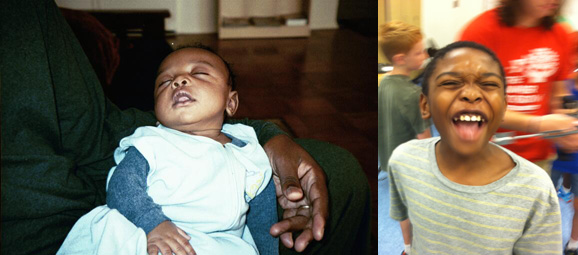
Two different Noahs, nearly 10 years apart, August 21, 2003 and July 26, 2013. (Angelia N. Levy and Donald Earl Collins).
Today my son Noah turns ten! That’s wonderful! But it’s also a reminder of both the passing of my youthful energy and relative innocence and the path toward his adulthood and future.
I note my son’s birthday in both small and big ways. I’ve been playing Coldplay’s “Clocks” incessantly for the past week and a half, because it was the summer of Coldplay when Noah was born. Every HBO promotion of shows and movies that summer had the “Clocks” melody in it, so I couldn’t get away from it even when I wanted to.
Every time I watch the Lord of the Rings trilogy I think for a moment of the summer of ’03 and Noah’s birth, My wife was literally days away from going into labor when we watched it in a marathon session — at home and in the movie theater.
I think of seeing the crown of my son’s matted hair about five minutes before the final push on this day. I think of the fact that I basically floated on happiness and hopes, dreams fulfilled and exceeded in the year before Noah’s birth. I don’t think that I ever felt so much romantic love as the love I felt for my wife and son this time a decade ago.
But I also think of the regrets of my past and the need to ensure that my son doesn’t make the same mistakes I did. To go after what he wants for his life, for his happiness. To not refuse genuine help, friendship or love when offered. To trust with wisdom and discernment, in himself and in others, knowing that some who may call him friend may yet betray that trust. To be content with being a contrarian, but not too content. To allow himself the opportunity of failure so that no early love in his life goes unrequited, and so that even his parents know his mind and heart.
I think, too, of my son’s future, of how we keep him on the path to college, a career and calling that he doesn’t lose sight of or regret later on, of the connections he’ll need to make along the way. And of the money we’ve already spent to get him this far. A quarter million on housing, $80,000 on child care, a paid-off ’04 Honda Element and numerous other expenditures just to get him to fifth grade. With middle school and high school and high-stakes testing, sports and summer camps, more travels for vacation and family visits to come.
I’m exhausted already, and my son’s my only child. But if nothing else, with what’s left of my dwindling youth, I want to make sure that Noah never has to search for faith, for God or wisdom or hope to hold on to. That, at least, I can secure, if nothing else. Through book and other means, all is with him already.






 Notes from a Boy @ The Window