• About Me
  • Other Writings
  • Interview Clips
  • All About Me: American Racism, American Narcissism, and the Conversation America Can’t Have
  • Video Clips
  • Boy @ The Window Pictures
  • Boy @ The Window Theme Music

Notes from a Boy @ The Window

~

Notes from a Boy @ The Window

Category Archives: eclectic music

Fife and Shalom

12 Tuesday Jul 2016

Posted by decollins1969 in 1, Boy @ The Window, culture, Eclectic, eclectic music, Hebrew-Israelite, Mount Vernon New York, music, New York City, Pop Culture, race, Religion, Youth

≈ Leave a comment

Tags

A.B. Davis Middle School, Black Male Identity, Black Masculinity, Chorus, Domestic Violence, Fife, Judah ben Israel, Manhood, Maurice Eugene Washington, Mentoring, Music Lessons, Oppression, Poverty, Pulaski Day Parade, Summer of Abuse, Tamrin, Trombone, Type 2 Diabetes, William H. Holmes Elementary


Civil War-era wooden fife, May 19, 2004. (Kevin Saff/National Parks Service via Wikipedia). In public domain.

Civil War-era wooden fife, May 19, 2004. (Kevin Saff/National Parks Service via Wikipedia). In public domain.

One thing I never discussed here or in Boy @ The Window were the handful of “leisure” activities I had during the Hebrew-Israelite years. The world in which we lived back in the ’81-to-’84 period had precious few resources and even less room for things like summer camps, overseas travel, baseball games, amusement parks, or even a free impromptu rap battle at Van Cortlandt or Hartley Park. Heck, the Kool cigarettes’ music series that sponsored “Teddy Pendergast” or “Rufus and Chaka Khan” in those days might as well have been a trip to see the World Cup in France compared to our pitiful roach-and-belt circumstances.

One of my idiot stepfather Maurice’s Hebrew-Israelite friends, though, did provide a free service for us males in ’81 and ’82. His name was Tamrin. He was a heavy-set dude, probably about five-foot-eight, maybe 120 or 125 kilos (between 245-260 pounds), and likely in his late-thirties. Unlike so many of the Hebrew-Israelite men I had the curse to meet in those naiveté-shattering years, Tamrin had a lighter touch. His idea was to put together a boy’s band of fifes, drums, bugles, and other marching instruments to lead us Hebrew-Israelites in marches through the street of Mount Vernon, as well as temple sites in the Bronx, in Harlem, and in Brooklyn (specifically, Bed-Stuy and Flatbush, if memory serves). Even at twelve, I knew how ridiculously uncool that idea sounded.

That was his plan, anyway. So off and on, between August ’81 through the second week in July ’82, Tamrin gave me and other kids music lessons to play overly bombastic marching band music. These were the kind of joyless songs which one was mostly likely to hear at Moscow’s May Day parade of soldiers and nuclear missiles than hear anywhere in ancient Israel. I was picked out because I had musical training in my immediate pass. I played the trombone in fifth grade. Or rather, I had six months of trombone-playing lessons at William H. Holmes ES before my music teacher had a heart attack and died in March ’80. I sang in chorus all through sixth, seven, and eventually, eighth grade. I could read music, though I struggled in transition between half-notes and quarter-notes.

Pulaski Day Parade on Fifth Avenue in Manhattan, October 6, 2013. (http://www.posteaglenewspaper.com).

Pulaski Day Parade on Fifth Avenue in Manhattan, October 6, 2013. (http://www.posteaglenewspaper.com).

So Tamrin would come over about twice a month, usually on Saturday afternoons, and spend a couple of hours with me playing the fife. (Can you imagine that? A twelve-year-old, kufi-wearing Donald playing such a small and delicate reed instrument? Really? Really!) Tamrin took us to the Pulaski Day Parade down in Manhattan the first Sunday in October ’81 to see how the pros do the fife-and-drum thing. The costumes I found fascinating, but I dreamed of food, not of marching around with fife.

Once Mom’s already pitiful funds got down to a disposal income of $5 per day — that was in December ’81 — Tamrin didn’t come around as much. Though he wasn’t getting paid much, I think he still expected $10 per lesson. Still, he came around even when he wasn’t getting paid, though it was only once a month during the ’81-’82 winter. That’s when I noticed, though just barely, that Tamrin had diabetes. His fingers had swelled during the winter, and he moved slower, too.

From mid-April to the beginning of July, Tamrin was around nearly every Saturday for an hour at a time, working with me on marching while playing fife, polishing up fife-ful flourishes, and getting me to learn more bombastic music. There were a couple of times I played with the other preteen and teenage Hebrew-Israelite kids. They seemed about as cool with this fife-and-drum band as I was with having an abusive stepfather.

And that’s who stopped my participation in Tamrin’s pet project. After my summer of abuse began in earnest on July 6, ’82, Tamrin came around that Saturday, July 10. I played my fife to some music, but the knot on my head, the bruises to my left cheek and jaw, and my busted lip would’ve been obvious to any observer in the week after Maurice tried to beat me into submission. I kept playing my music, but I knew that Tamrin and Maurice were jawing at each other about something or other, hopefully not me. All I know was, that was Tamrin’s last time working with me to play the fife. I’d continue to see Tamrin at temple. But that second Saturday in July ’82 would be the last he’d come over to 616 to teach me terrible music for the fife.
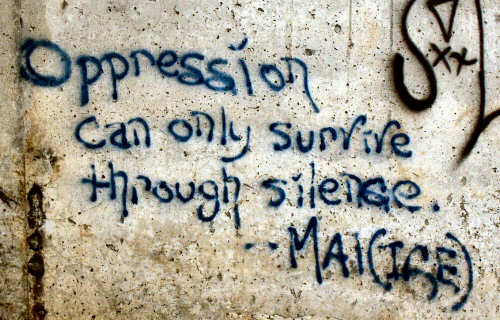
Oppression graffiti, January 15, 2013. (Students for Liberty via http://genderlitutopiadystopia.wikia.com).

Oppression graffiti, January 15, 2013. (Students for Liberty via http://genderlitutopiadystopia.wikia.com).

Did I play a good fife? Tamrin thought so. Compared to my Hebrew-Israelite comrades, I’m pretty sure I did. But like with so many things Hebrew-Israelite during those years, it was a bitter march to nowhere. The fife was part of a Hebrew-Israelite physical and spiritual gulag that put me into more chains, rather than freeing me to be me. Despite Tamrin’s intentions, the idea of molding me and others into men in conditions that would make most “men” contemplate homelessness or running away was a ridiculous pipe-dream.

That Tamrin was likely the only adult male in the Hebrew-Israelite camp who saw Maurice for the lying, abusive, womanizing asshole he was made me realize not everyone in this world was against me. But in a religion that when practiced helped oppress me and others more than the outside world, what was any Tamrin to do?


Fights and Friendships

05 Thursday May 2016

Posted by decollins1969 in 1, Boy @ The Window, Christianity, culture, Eclectic, eclectic music, Hebrew-Israelite, Mount Vernon New York, Politics, Pop Culture, race, Religion, Youth

≈ 2 Comments

Tags

"Friends" (1984), "Scream" (1995), 616, 616 East Lincoln Avenue, Child Abuse, Ego Inflation, Friendships, Hip-Hop, Hubris, Humanities, Intolerance, Janet Jackson, Michael Jackson, Rap, Salvation, Shunning, Starling Churn, Teenage Angst, Whodini, William H. Holmes Elementary


My friendship with my one-time best friend Starling ended on this week thirty-five years ago. It was a friendship that “began with a fight and ended with a fight,” as I wrote in Boy @ The Window. The second fight had as much to do with inflated preteen egos as it did with intolerance and ignorance. But that couldn’t be helped, given the way we were, the way our families had been back in the first days of the Reagan Years.

We’d been friends since the last third of fourth grade at William H. Holmes Elementary Most of our conversations the first year or so of our friendship had been about music, politics, history, and other things related to school or pop culture. By the time we reached Mrs. Bryant and sixth grade, a good portion of our conversations turned to Christianity. I guess that this was inevitable. Starling was the “son of a preacher man,” a Southern Baptist pastor. Starling wanted to see me become an official child of God and brother in Christ. My search was one of truth and God, and if Jesus was the one who could get me there then so be it. I didn’t feel the same sense of urgency for water immersion and John 3:16 as Starling did for me.

Back area behind William H. Holmes ES (where my two fights with Starling occurred), Mount Vernon, NY, November 22, 2006 (Donald Earl Collins).

Back area behind William H. Holmes ES (where my two fights with Starling occurred), Mount Vernon, NY, November 22, 2006 (Donald Earl Collins).

The return of my prodigal stepfather Maurice Washington/Judah ben Israel and his bringing the whole Hebrew-Israelite thing to 616 put a temporary end to my Christian enlightenment in April ’81. Him and my Mom had been separated for about six months. During that time, my idiot stepfather had discovered the ways of Yahweh and Torah and alleged that he was a changed man. So we all had to change, to stop eating pork and bloody meats, to start wearing kufis, and to somehow see this fool as our dad.

Starling stopped speaking to me immediately and entirely when I showed up on a mid-April Monday with a white kufi on my head. on the last Friday in March. Our friendship was suddenly over. This was what our second fight was about, our friendship, my bizarre religion and my acceptance of it. At least it was for me.

As I wrote in the memoir,

I guess that Starling at twelve was definitely his father’s son. I could certainly understand Starling’s perspective on this. I’d betrayed him when I came to school and professed that I was a Hebrew-Israelite. Starling had been talking to me for months about becoming a Christian, a Baptist, and now here I was embracing Afrocentric Judaism, similar in many ways to the Nation of Islam and its variants in terms of its racial politics. The practitioners I’d been around tended to see Black Christians as “weak,” out of touch with “their heritage,” and as “worshiping the wrong God.” Starling couldn’t accept this. We ended up in our second and final fight. I was fighting for our friendship, literally. Starling beat me to end it.

I felt betrayed myself. Starling had turned his back on me at a time in which I needed his input the most. I still cared about the same things, thought about the same issues, and wanted someone whom I could banter with about music and politics and religion. But given Starling’s background, even back then I realized that he thought that I was well on my way to hell. Starling and I saw ourselves as adults in many ways, so he assumed that I had made a free-will adult decision for becoming a Hebrew-Israelite when I walked into Mrs. Bryant’s class with a kufi on my head. He had no idea how much I was struggling with my mother and stepfather’s decision to make our family a Hebrew-Israelite one.

Screen Shot from Michael Jackson and Janet Jackson's "Scream" (1995) video, May 5, 2016. (http://www.vidivodo.com).

Screen Shot from Michael Jackson and Janet Jackson’s “Scream” (1995) video, May 5, 2016. (http://www.vidivodo.com).

So I projected the outward appearance of supreme confidence and faith in Jehovah and this slant on the ten Lost Tribes of Israel, to protect myself from being hurt and to see if this whole Hebrew-Israelite thing really was for me. Not a good move going into middle school and the Humanities Program later that year. I had no idea how much worse my life was about to become in the two years between the end of my friendship with Starling and my family’s fall into welfare poverty, bumps, bruises, babies and concussions along the way.

It wasn’t until the end of eighth grade that Starling and I began exchanging “Hi’s” again. Even then, this was often forced. The only conversation I had with Starling after our fight was at the end of ninth grade, with him letting me know that he was moving with his family down South. Starling Churn left with his family for Wilmington, North Carolina in the summer of ’84, still believing I was well on my way to eternal damnation.

That friendship’s rise and fall has helped me understand who friends really are. Ultimately a friend is someone who isn’t a relative but you gravitate toward and have shared interests with, a person who has sympathy and empathy for you and your life. A person who isn’t afraid to tell you when you’re fucking up and who doesn’t shun you when you lose your way. That’s a real friend. I’ve had and still have, thankfully, a core group of ride-and-thrive friends who fit (or at least come close to it) this definition.

Starling and I couldn’t. We were tweeners, after all, and pseudo-intellectual ones with inflated egos from straight-As at that. And in a country that barely tolerates anything other than blind, unthinking Christianity and a false sense of patriotism, maintaining a friendship in the midst of a major religious shift — even a childhood one — was and is nearly impossible.

Pitt Graduation Day, +25 Years, +25 Hard Truths

26 Tuesday Apr 2016

Posted by decollins1969 in 1, Academia, Boy @ The Window, Carnegie Mellon University, Christianity, culture, earth, wind & fire, Eclectic, eclectic music, Hebrew-Israelite, Mount Vernon High School, music, Pittsburgh, Politics, Pop Culture, race, Religion, University of Pittsburgh, Youth

≈ Leave a comment

Tags

Bitter Truths, Bruce Anthony Jones, Commencement, Daniel P. Resnick, Disillusionment, Graduation, Hard Truths, Joe William Trotter Jr., Lessons Learned, Marc Hopkins, Mary J. Blige, Meritocracy, Michael Jackson, Narcissism, Pitt, Prince, Regis Welch, Self-Discovery, Trust, U2


Peterson Events Center (where they do all the commencements now) University of Pittsburgh, Pittsburgh, PA, circa 2008. (http://www.rosser.com/).

Peterson Events Center (where they do all the commencements now) University of Pittsburgh, Pittsburgh, PA, circa 2008. (http://www.rosser.com/).

I can’t believed that I’ve lived long enough to make a quarter-century since my end to undergrad at the University of Pittsburgh! It makes me sound old, at least to the twenty-one year-old I used to be. The one who couldn’t decide between a J.D. and an M.A./Ph.D. program. The person who worried that they would have an MA before their driver’s license. The young ‘in who believed that my advanced degree choices would define my career and life more than anything else.

That person was wise beyond his years, and yet stupid at the same time. He believed in the American meritocracy, in the triumph of hard work, talent, and a Christian faith over every obstacle. He believed that any costs incurred on the path to the MA — and later, the PhD — would be covered in the Bank of a Great Career. He believed, most of all, that professors as advisors and mentors would be there to guide his path every step of the way, the trustworthy individuals that most of them had proven themselves to be.

Me & Mark James (Cropped), Pan-African Graduate & Professional Student Association, University of Pittsburgh, February 27, 1993. (Lois Nembhard).

Me & Mark James (Cropped), Pan-African Graduate & Professional Student Association, University of Pittsburgh, February 27, 1993. (Lois Nembhard).

So much of that belief system was poisoned by the e. coli bacteria of academia and by the leaching lead pipes of American -isms. From my trials at Pitt to my tribulations with Joe Trotter, Dan Resnick, and Bruce Anthony Jones. The fact that my entire nineteen years of teaching, consulting, and nonprofit work has been cobbled together out of necessity and constantly changing circumstances, on which ground has rarely been solid. That after eighteen years and six months of payments, and I’m still a decade or so away from paying off student loans I began borrowing seventeen days after graduating from Mount Vernon High School in ’87.

If I had to talk to my twenty-one year-old self now, I’d say, get the MA in history, then get certified to teach at a high school somewhere. Spend the precious moments not in the classroom reaching high school-age students honing your craft as a writer. Jump headlong into putting down in words your experiences growing up, your times as a Hebrew-Israelite and in Humanities. Get that ms turned into a published work. Work hard at understanding the larger issues and contexts that make America the seething contradiction that it has always been, between racism and freedom, individualism and multiculturalism, social control and narcissism. Then, somewhere between the age of twenty-five and thirty, maybe, go back to school and earn that PhD in history, or in education, and take a few social psychology courses focused on personality disorders along the way.

That is the benefit of 20/10 hindsight (I’d say 20/20, but I still see most things at 20/15, and with warp speed at that!), of course. One big barrier I faced twenty-five years ago is a thorough and excoriating understanding of myself and the life I had to live. I remembered so much of my past that I never questioned the things that I’d forgotten. About abuse, physical and sexual. About deprivation, real and imagined. About people, the layers of yellow onions that most sheepishly are.

Unfortunately, I’d learn the most about what I’d forgotten in my forties, well after most people reconnect with the bitterest parts of their past (if any ever dare to). That I know what I know now is in the category of “better late than never.” Some things, though, I needed to know much sooner than 2014 or 2002. Like my discovery of my ambivalence toward academia. Not teaching or publishing per se. But the idea that I could only be taken seriously by publishing scholarly works that mostly would be read by a few dozen colleagues or when I assigned them to my students. I didn’t figure out how to make my ambivalence work for me until I was thirty-seven, and then, with me at mid-career, fighting to move forward.

Chris Farley facing a hard truth, being hit by a 2x4 in Tommy Boy (1995), April 26, 2016. (http://stream1.gifsoup.com/).

Chris Farley facing a hard truth, being hit by a 2×4 in Tommy Boy (1995), April 26, 2016. (http://stream1.gifsoup.com/).

The silver lining is, that if it weren’t for my time at Pitt, I simply wouldn’t be here to write these words at all. The pressures and pollutions of this world would’ve killed me. Or worse still, killed my inspirations and aspirations, rendering my imagination, my sense of what makes a just and wise world, dead. I’d be as bitter as a cup of Italian roast coffee mixed with vinegar and raw horseradish.

I’m sure that even among my more successful colleagues — and even more sure among my less successful ones — their journeys since the halcyon times of undergrad and even graduate school have been bittersweet. That is life. Especially in a nation in which others encourage us to have aspirations beyond the stars, a complete contradiction to that cracked concrete-reinforced reality that is America.

But even if all of the remaining highs in my career and life outnumber the lows by ten-to-one (who knows, right?), two truths are clear. One is that most people who experience any depth of success in their lives tend to remember the lulls and ruts more than their moments at the top of the mountains. Two is that without me having climbed that first mountain, the college degree mountain, I would have a story to tell, but would lack the words to tell it. I would still be living vicariously through the music of others, whether U2, Earth, Wind & Fire, Michael Jackson (RIP), Prince (RIP), or Mary J. Blige. And for me, at least, as genius as they are — alive and dead — I still need to tell my own story.

Prince, circa 2013 concert, April 26, 2016. (Ethan Miller/Getty Images).

Prince (1958-2016), circa 2013 concert, April 26, 2016. (Ethan Miller/Getty Images).

The Student-Athlete System and the Exploitation Lens

01 Friday Apr 2016

Posted by decollins1969 in 1, Academia, culture, Eclectic, eclectic music, music, Politics, Pop Culture, race, Sports, Work, Youth

≈ Leave a comment

Tags

"I Got Plenty O' Nuttin'" (1935), Bob Stoops, College Athletes, Ed O'Bannon, Exploitation, Jim Boeheim, Justifications, Kirk Schulz, Mark Emmert, National Collegiate Athletic Association, NCAA, NCAA Division I Football, NCAA Division I Men's Basketball, O'Bannon v. NCAA (2015), Ocsar G. Johnston, Porgy & Bess, Real Sports (HBO), Rhetoric, Sharecropping, Slavery, Student-Athletes, The Business of Amateurs (2016), The Sporting News


NCAA logo, September 4, 2014. (Getty Images/SportingNews.com).

NCAA logo, September 4, 2014. (Getty Images/SportingNews.com).

In July, US District Judge Claudia Wilken gave final approval to a combined $60 million in settlements of former and current college athletes’ claims against the NCAA and EA Sports. The deal granted as many as 93,000 claims of up to $7,000 for the use of college athletes’ images and likenesses in video games between 2003 and 2014. The groundbreaking decision provides student-athletes payments for the fruits of their labor for the first time. But these combined settlements are separate from the O’Bannon v. NCAA case. This main lawsuit against the NCAA’s use of unpaid college athletes remains in limbo. The NCAA asked for and the courts granted a stay, delaying a process that would make every college athlete eligible for some compensation in exchange for universities using their labor.

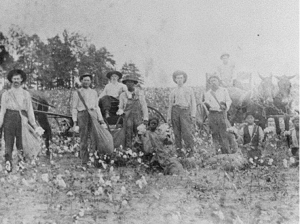
Beyond the response that often compares the NCAA student-athlete labor system to slavery, few have discussed the ways in which the NCAA’s defenders construct their arguments for the status quo. In many ways, the NCAA system isn’t much different from sharecropping. It was an agricultural economic system mostly located in the American South that took advantage of impoverished Whites and Blacks between 1870 and 1980. Both provided meager benefits like room, board, and clothing at an exorbitant cost while reaping huge profits from its workers. One system kept sharecroppers deeply in debt while the other has kept college athletes from profiting off of their work. The carrot in sharecropping was access to land to grow cotton and other crops for a profit at the end of a harvest season, minus landownership and all the necessary tools, seeds, and other necessities for producing those crops. The incentive in the NCAA’s system has been a year-to-year scholarship to cover the cost of a four-year degree, with the remote possibility in a handful of sports to earn enough recognition to become a professional athlete. Minus, until last fall, coverage for books, clothing, food outside of sporting events and practices, and the hours necessary to take advantage of an athletic scholarship. Defenders of both systems fought tooth-and-nail to keep sharecroppers and college athletes from organizing themselves into unions.

Unlike in slavery, the majority of sharecroppers were White, although more than a third were African American. All entered into sharecropping under contract, though the poor economic conditions of the South after the Civil War and the terror of White supremacist groups left poor Whites and Blacks few options. Likewise, NCAA’s college athletes also sign contracts and waivers that left them with few options in pursuing their athletic craft or in completing a college degree a year earlier than the average college student. And at least three different ways, the people defending the NCAA’s student-athlete system match sharecropping’s defenders with the language of exploitation. Though neither system is slavery, both are still closely related forms of exploitation, with a brutality that provides few good options for those engaged in doing the actual work.

George Gershwin's Porgy & Bess, with "I Got Plenty O' Nuttin'" (1935), oft sung by Ella Fitzgerald and Louie Armstrong (among others), April 1, 2016. (cropped and combined).

George Gershwin’s Porgy & Bess, with “I Got Plenty O’ Nuttin'” (1935), oft sung by Ella Fitzgerald and Louie Armstrong (among others), April 1, 2016. (cropped and combined).

1. The circular reasoning argument. This one is where defenders use the very label of their system — whether “sharecroppers” or “student-athletes” — to justify the existence and need for their system. Historian Chris Myers Asch documented numerous examples of this in his 2008 book The Senator and the Sharecropper. Asch included in his book a 1936 interview with psychologist John Dollard, one in which Mississippi planter William Alexander Percy said, “To live among a people whom, because of their needs, one must in common decency protect and defend is a sore burden in a world where one’s own troubles are about all any life can shoulder” (p. 70). Especially since many elites like Edward Everett Davis — dean of North Texas Agricultural College (now University of Texas at Arlington) from 1925 to 1946 — saw sharecroppers as “the most serious rural problem in the South.” In his The White Scourge (1940), Davis wrote that sharecroppers were “those biologically impoverished tribes of marginal humanity — black, white, and Mexican — subsisting on cotton” (p. ix).

Compare this line of reasoning with NCAA President Mark Emmert’s on why universities should not pay college athletes. On the 2011 Frontline episode “Money and March Madness,” Emmert said, “fact is, they’re not employees, they’re student-athletes.” In another interview, for the upcoming documentary The Business of Amateurs (release date TBD), Emmert said, “there’s not even a salary to debate. They’re not employees, they’re students.” For Emmert and the portions of the public who support his stance, the label “student-athlete” by itself justifies not paying college athletes, just like the label “sharecropper” did for planters who frequently cheated their workers out of profits. The idea for both has been they are but children that institutions need to care for, albeit under contract.

Black and White sharecroppers in Randolph County, Georgia, 1910. (Georgia Archives, Vanishing Georgia Collection)

Black and White sharecroppers in Randolph County, Georgia, 1910. (Georgia Archives, Vanishing Georgia Collection)

2. The low or no profit-margin argument. This has been a popular idea, to claim that despite the wealth generated under sharecropping, landowners made few, if any, profits. As shown by historian Lawrence J. Nelson in his 1999 book King Cotton’s Advocate, Oscar G. Johnston, head of the financial division of the Agricultural Adjustment Administration (a New Deal program), wrote in a 1937 memo, “any person familiar with the operation realizes that the sharecropper system is more favorable to the tenant than the cash wage system [paying hourly wages].” According to Johnston, any “criticisms” of sharecropping as an exploitative economic system came “from persons wholly ignorant of the system or the economic situation” (p. 88).

Syracuse University men’s basketball coach Jim Boeheim claimed that there are few to no profits in college athletics in his 2013 New York State Associated Press symposium speech. “I’m not against kids getting money. But the problem is, you give the 12 basketball players $150, now you gotta give the field hockey players. So now you’re talking 150 athletes. One-hundred fifty times $150 times eight. That’s a lot of money,” Boeheim said. In pleading for a stay in the O’Bannon case last year, the NCAA’s lawyers said that it and “many schools and students” would be “irreparably harmed” if the court allowed the injunction to go into effect. Yet the NCAA’s $11-billion contract with CBS and Turner Broadcasting for the NCAA Men’s Basketball Tournament and $500-million-per-year contract with ESPN for the college football playoffs contradicts the notion of irreparable harm.

3. The fringe-benefits argument. This is the assertion that a person’s status in this system produces material and intangible benefits, even despite the potential pitfalls and vulnerabilities. Asch wrote of another 1936 interview John Dollard conducted, in which one farmer said, “when times are bad he has to take care of the Negroes first, whether they make anything or not.” Another farmer said that sharecroppers only worked about three months out of the year, and used the rest of their time to “fish, fool around, attend revivals, and follow other trivial pursuits” (p. 71). Despite the evidence of poverty for the vast majority, planters consistently painted sharecroppers’ lives as ones with benefits than ones full of rampant exploitation.

Oklahoma football coach Bob Stoops' 17,000 square-foot home on lakefront property, Norman, OK, November 25, 2015. (http://sportshoop.la/).

Oklahoma football coach Bob Stoops’ 17,000 square-foot home on lakefront property, Norman, OK, November 25, 2015. (http://sportshoop.la/).

The common refrain in college athletics is likewise about benefits that outweigh injuries, long-term disabilities, the pressures of athletic and academic performance, and the loss of material benefits. University of Oklahoma head football coach Bob Stoops put it this way in a 2013 Sporting News interview: “I don’t see why people say these guys don’t get paid. It’s simple, they are paid quite often, quite a bit and quite handsomely.” They also “get room and board…the best nutritionist, the best strength coach to develop you, the best tutors to help you academically, and coaches to teach you and help you develop. How much do you think it would cost to hire a personal trainer and tutor for four to five years?,” Stoops said. The athletic scholarship, a non-guaranteed, year-by-year deal, is the only fringe benefit that matters in the case of college athletes.

Like Oscar Johnston’s defense of the sharecropping system in the 1930s, the NCAA’s defense fits the pattern of “it’s a terrible system, but it could be much worse.” During his Real Sports conversation last March, Kansas State University president and NCAA Board of Governors member Kirk Schulz said, “Well, a scholarship at Kansas State, a four-year scholarship, is about $180,000, and our average debt load of all of our students is about $26, $27,000.”

—————————————–

Apparently, the system is fair precisely because naked exploitation is better than the illusion of choices given to the typical college student. These arguments in support of student-athlete system dovetail almost perfectly with the arguments that supported sharecropping as a necessary evil in the 1930s. The justifications are paternalistic and elitist, with a mix of class and racial imagery to boot. To the point where any NCAA executive, college or university coach or athletic director, university president or journalist in support of not paying these athletes should be beyond embarrassed.

My Inevitable Walkman Era

05 Saturday Mar 2016

Posted by decollins1969 in 1, Academia, Boy @ The Window, Christianity, culture, Eclectic, eclectic music, High Rise Buildings, Jimme, Mount Vernon New York, music, My Father, New York City, Pittsburgh, Pop Culture, race, Religion, University of Pittsburgh, Work, Youth

≈ Leave a comment

Tags

616, 616 East Lincoln Avenue, Black Masculinity, Coping Strategies, Disillusionment, Escape, Escapism, Manhood, Masculinity, Self-Discovery, Sony Walkman, Walking, Walkman


This version was my first Sony Walkman (between May 1987 and June 1988), posted August 28, 2013. (http://ebay.ie).

This version was my first Sony Walkman (between May 1987 and June 1988), posted August 28, 2013. (http://ebay.ie).

This week marks three decades since I finally entered the ’80s technologically, buying my first portable radio/cassette player with headphones. It wasn’t the Sony Walkman — I’d get my first one of those a year later. No, it was a Taiwan-made knockoff that I got at Crazy Eddie’s on 46th and Fifth in Manhattan, on sale for $22, that was my jump into the era of the Walkman. After a year and a half of carrying around a plug-in radio, playing with records on cheap $15 turntables (that cost $130 and much more in 2016), contemplating boom boxes, and having no control over what music I listened to outside of laundromat runs and 616, I found a new way to escape.

As I wrote in my memoir, this new toy was

my passport to another world, a world where I could make anything happen and no one could hurt me. Taking the Subway to go to The Wiz or Crazy Eddie’s or Tower Records was as much a part of mine and Darren’s Saturday ritual as our tracking down of Jimme. I no longer had to wait for WPLJ or Z-100 or WBLS to play the music I wanted to hear. I could buy a cassette tape for as little as six dollars. In the month after I’d bought my Walkman I’d gone out and bought more than twenty tapes. Whitney Houston, Simple Minds, Phil Collins, Sting, The Police, Mr. Mister, Mike + The Mechanics, Tears for Fears, even Sade. All were welcome who could contribute to my all-consuming effort at conquering my courses.

I was tough on my first Walkman, though. I must’ve dropped it a dozen times in two months, as it barely made it to Memorial Day ’86. My second one was a $42 Panasonic, which I bought with my Technisort earnings, and it lasted from July 4th until the end of October. I bought a decent Aiwa knockoff of the Sony Walkman in December, and that one made it to April ’87. before I finally found the $60 I needed for my Sony Walkman the month before high school graduation.

In a span of a year, I would accumulate more than seventy tapes, covering everything from pop and hard rock to rap and R&B, new age and jazz. As anyone who knew me in the spring of ’87 could attest, I carried my tapes with me in my book bag to have at the ready, the same way in which I had toted my Bible everywhere when I became a Christian three years earlier.

I walked everywhere in the Upper Bronx and Southern Westchester County for nearly three and a half years before I bought a Walkman of any kind. But in that window between March ’86 and my college move to Pittsburgh seventeen months later, my walks became much more frequently and much more eventful. I was walking to escape, to find mental space away from the gang of under-five-year-olds that ruled the too-small, two-bedroom space of pain in which I had grown up. I walked to figure out who I was and who I wasn’t, to be angry at my family, at the world, and at myself. I walked to find meaning in a chaotic life and world. I walked because I could wear myself out with warp speed, spin moves and high-falsetto highs, with questions and emotions and sometimes even, some answers, before coming back to 616 and grabbing some sleep. I must’ve have gone on 100 or 150 walks of five miles or more in that year and a half before college.

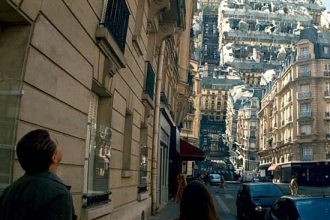
Inception (2010), Paris dream construct screen shot, April 27, 2012. (http://dpmlicious.com). Qualifies as fair use under US Copyright laws because of poor resolution of shot, not intended for distribution.

Inception (2010), Paris dream construct screen shot, April 27, 2012. (http://dpmlicious.com). Qualifies as fair use under US Copyright laws because of poor resolution of shot, not intended for distribution.

That doesn’t even count my more frequent forays into the city, not to do anything or be anything. I wasn’t working for my father anymore, and after he repeatedly called me a “Faggat” in August ’86 and tried to set me up with a prostitute in December ’86, I hardly went to see him at all until the last few weeks before leaving for Pitt. I didn’t even take Darren down to Midtown Manhattan, the Upper West Side, Harlem or Flatbush with me. That’s what I did with the spare hours I started stealing from my Mom on weekends during that year. I’d go down to the city, maybe buy a few tapes at Tower Records on 66th and Broadway (usually not, since most of my tapes came via Terra Haute, Indiana). Sometimes if I had a few dollars, I’d go to MOMA or Radio City or some other place and go into escape/observation mode there. Mostly, I walked and people watched for an hour or so, and then take the long way home between the 2 train, 241st Street and the heart of Mount Vernon.

All the while, my music was on, often at full blast. It was a coping strategy, a pain and stress reliever, my sword and my shield. It took my Phyllis obsession and my freshman year at the University of Pittsburgh to break the link between music, Walkman, and the need to escape. It took the pain of rejection, removal from an anti-Donald environment, and a bout of homelessness to make music about enjoyment and education. When that happened, sometime in ’88, I knew I couldn’t escape anymore.


EWF, A Reminder That I Did Have a Childhood

06 Saturday Feb 2016

Posted by decollins1969 in 1, Boy @ The Window, culture, earth, wind & fire, Eclectic, eclectic music, High Rise Buildings, Mount Vernon New York, music, New York City, Pop Culture, race, Religion, Youth

≈ Leave a comment

Tags

EWF, Funk, Hebrew-Israelite, Humanities, Imagination, Jazz, Maurice Eugene Washington, Maurice Washington, Maurice White, Pop, R&B, Self-Awareness, Self-Discovery


Earth, Wind & Fire's All 'N All (1977) album cover, February 6, 2016. (http://www.allmusic.com).

Earth, Wind & Fire’s All ‘N All (1977) album cover, February 6, 2016. (http://www.allmusic.com).

I’m still reeling over Maurice White. Yeah, I still have my Earth, Wind & Fire on my CDs, my iPod, my iPhone, on three laptops and a desktop. Phillip Bailey and White’s brothers-in-arts are still here. Their music will always be with me and with us. But it feels like a little piece of my relative (if not contrived) innocence from my pre-Humanities, pre-Hebrew-Israelite days died with White Wednesday night.

Here’s what I wrote about those days of deliberately-induced blissful naiveté, Earth, Wind & Fire included, in my memoir:

“For me, this boy, this tweener, an active imagination and an even more animated dream life was critical. Living in between the hustle and bustle of “The City,” — Manhattan and the other four boroughs of New York — and the relative quiet of the ritzy suburbs immediately north of it was everything and everyone I knew before the age of twelve. Just three blocks after the elevated 2 Subway line ended at East 241st Street in the Bronx was where “Mount Vernon, New York” began. From the hard concrete sidewalks and green street signs of New York to the crumbling light blue slate and dark blue signs were my only indications that I had truly left the city. This despite the claims of so many I knew that upstate New York began somewhere above 125th or 207th Street in Manhattan. I knew by the time I was twelve that, sleepy bedroom suburb or not, Mount Vernon had more features in common with the Bronx and upper Manhattan than most city folk were willing to recognize.

“My only links to the great metropolis to the south were WNBC-TV (Channel 4), Warner Wolf — with his famous “Let’s go to the video tape line — doing sports on WCBS-TV (Channel 2), and WABC-AM 77 and WBLS-FM 107.5 on the radio. I found the AM station more fun to listen to, but I also liked listening to the sign-off song WBLS played at the end of the evening, Moody’s Mood for Love, with that, ‘There I go, There I go, The-ere I go…’ start. Music had been an important part of my imagination in ’79, with acts like Earth, Wind & Fire, Christopher Cross, Billy Joel and The Commodores. Not to mention Frank Sinatra, Queen, Donna Summer and Michael Jackson’s Off The Wall album. The music also made me feel like I was as much a part of New York as I was a part of Mount Vernon. It left me thinking of the ozone and burnt rubber smell that I noticed as soon as I would walk down into the Subway system in Manhattan. But aside from my occasional slip of the tongue — ‘warda’ for ‘water’ and ‘bawwgt’ for ‘bought’ — I didn’t sound or act much like a New Yawker. Still, I discovered something about New York from afar. I could sneak up to the rooftop of my apartment building, 616 East Lincoln, a five-story complex of three connected brick buildings with Tudor-style facades and a concrete-stone foundation. I’d find the exit to the roof unlocked and see the tops of the Twin Towers floating over some low-lying clouds on an otherwise sunny day. The symbols of the greatest city on Earth seemed to float toward the heavens on those days, and me with them.

“Besides the occasional reminder of life outside of my world, of Mount Vernon, I was the center of my own universe. Mount Vernon was but a stage on which my life played out, a place I hoped would stay this way forever. I was an eleven-year-old who thought that my world was the world. I lived my life like Philip Bailey and Maurice White would’ve wanted me to. I came to see ‘victory in a life [sic] called fantasy’ as my own life, living as if my imagination and dreams could be made into reality. All I had to do was wish it so.”

Because of what I went through during the Boy @ The Window years, I had to learn to get over my idiot ex-stepfather’s abuse to continue listening to Earth, Wind & Fire between ’82 and ’89. The late Maurice Eugene Washington was a fan as well, and I didn’t want us to both like the same music. Who the heck knew what was going on in his head when he heard “Fantasy” or “After The Love Is Gone,” anyway?

All I know is, there won’t be another group like the one Maurice White founded in ’69, the year I was born. All I can do is hold on to my precious Earth, Wind & Fire music, and the imagination that it helped spark. All I can do now is hope that someone can even begin to approach the kind of ethereal and powerfully Black-and-proud mix of music that White, Bailey, et al. were able to construct for nearly a decade. One can fantasize, right?


American Racism: “Same As It Ever Was”

14 Saturday Nov 2015

Posted by decollins1969 in 1, culture, Eclectic, eclectic music, music, New York City, Politics, Pop Culture, race

≈ Leave a comment

Tags

"Once In A Lifetime" (1983), Beatings, Ben Fields, Booker T. Washington, Central Park, Death, Ida B. Wells, Institutional Racism, James Blake, James Frascatore, Morning Oregon, NYPD, Police Brutality, Racial Harassment, Racial Incidents, Racism, Spring Valley High School, Talking Heads, University of Missouri, White Vigilantism, Yale University


Ida B. Wells-Barnett, age 32, photographed by Mary Garrity, c. 1893, cropped and restored, September 8, 2013. (Adam Cuerden via Wikipedia). In public domain.

Ida B. Wells-Barnett, age 32, photographed by Mary Garrity, c. 1893, cropped and restored, September 8, 2013. (Adam Cuerden via Wikipedia). In public domain.

A young African American woman refuses to leave her seat. Authority figures arrive to demand that she leaves. She refuses again. One authority charged with “upholding the law” then picks the young woman up and drags her from her seat. But this isn’t Spring Valley High School near Columbia, South Carolina. Nor is it 2015. This incident involved the anti-lynching journalist Ida B. Wells, who sat in a first-class ladies car on the segregated Memphis and Charleston Railroad train rolling through Tennessee. It occurred on May 4, 1884. Except it was three White men, who dragged and threw the then not-quite-twenty-two year-old off the train for refusing to give up a seat she paid for.

Just like with the Black teenager whom Ben Fields assaulted in the name of the law, I’m sure one of the things Wells might have thought was, “This is 1884. Why is this still happening?” The circumstances that led to both incidents were obviously different, but the racism that led to these violent responses was not.

With all that has occurred to break the illusion that Americans live in a twenty-first-century, post-racial utopia, Americans still bring up the times in which we live whenever racism rears its ugly head. Whether it’s the NYPD tackling ex-tennis star James Blake in September, the Black teenager at Spring Valley HS in October, or the responses to Black students at the University of Missouri or Yale in the past week, the need for temporal incredulousness is often present in the midst of these racist incidents. “You would think at some point they would get the memo that this isn’t okay, but it seems that there’s no stopping it,” Blake said after the incident with Officer James Frascatore.

At what point or time? As if saying “Why is this happening in 2015?” has anything to do with bringing systemic, institutional, individual, and internalized racism to an end. If there had been truth and reconciliation commissions at the end of Jim Crow in the South in the 1960s and 1970s, maybe then Americans can quote the year as evidence of irrational racial dissonance. If the federal government had provided reparations after Emancipation in 1865 or after Congress passed the Civil Rights Act of 1964, perhaps then what year this is would matter. Racism and racists have never cared about the year or the supposedly multicultural, progressive times in which Americans lived.

Harris & Ewing photo of Booker T. Washington, circa 1905-1915, Library of Congress, Washington, DC, January 18, 2010. (Cantheasswonder via Wikipedia). In public domain.

Harris & Ewing photo of Booker T. Washington, circa 1905-1915, Library of Congress, Washington, DC, January 18, 2010. (Cantheasswonder via Wikipedia). In public domain.

Before his death in 1915, Tuskegee Institute founder Booker T. Washington experienced something all too many Americans of color face year after year. Washington delivered two speeches at churches in Manhattan on Sunday, March 19, 1911. That same evening, Washington went to an apartment building on West 63rd Street near Central Park, allegedly to meet up with a friend of his accountant on business. After attempting to find this mystery person at the building twice, Henry Ulrich, a 40-year-old White male, confronted Washington and punched him in the head. A White bystander handed Ulrich a walking stick and together, the two men chased Washington toward Central Park, hitting him with the stick on his head and face at least a dozen times. It wasn’t until Washington fell into the arms of NYPD Officer Chester Hagan, at a southwest entrance to Central Park, that the attack came to an end. After his initial arrest, Washington produced his identification papers. Only then was he released, allowed to press charges against Ulrich, and taken to a hospital to get 16 stitches and recover from his head bashing.

Morning Oregon headline on Booker T. Washington trial, November 7, 1911.

Morning Oregon headline on Booker T. Washington trial, November 7, 1911.

Despite having the support of Andrew Carnegie, former New York City mayor Seth Low and President William Taft, Washington’s assault charge was destined to fail. The New York and national press — yellow journalism at its best in 1911 — tried Washington on their front pages from March 20 on. Laura Alverez did a wonderful job in misrepresenting herself as “Mrs. Ulrich” in defense of her paramour at the trial. Alverez accused Washington of saying, “Hello, Sweetheart” to her — a dog whistle back then for the ultimate taboo of interracial sex — when Washington was outside the apartment building. Two of the three judges voted on Monday, November 6, 1911, to acquit Ulrich of the assault charge, news the national press gleefully reported. Among them was the Morning Oregonian, which had “‘Beating Up’ Darky Brings No Punishment to Man” as part of its headline.

All this took its toll on an already sick 55-year-old Washington, a man already suffering from hypertension and high-blood pressure. The result was a physically and emotionally diminished Washington after 1911. Booker T. Washington died on November 16, 1915. The power Washington had exercised as an advisor to Presidents Theodore Roosevelt and Taft and as a racial accommodationist (some would say, an apologist) who befriended White philanthropists, it didn’t matter. His poor health may have been the symptom, but racism in all its forms was the ultimate cause.

It does not matter what year it is. Racists don’t care. It doesn’t matter if African Americans and White progressives hold die-ins in Ferguson, Cleveland and New York. Blacks and other people of color don’t have the same right to breathe without a racist’s say-so. It doesn’t matter if respectable Blacks wear nice suits and ties, attend Harvard, establish a university, or serve as President of the United States. Americans of color are all criminals and playthings in the eyes of racists, and the power structures for which they work have been set up to preserve racial inequality for centuries. And it doesn’t matter if liberals Black, White and Brown call for healing. Racists don’t want healing, and calling for it without acknowledging a flesh-eating, bacterial-infested wound like racism doesn’t do Americans any good. Booker T. Washington learned that lesson in 1911, and Ida B. Wells learned it in 1884. Millions of other Americans of color have learned that lesson all too well today.

← Older posts
Newer posts →

Boy @ The Window: A Memoir

Boy @ The Window: A Memoir

Places to Buy/Download Boy @ The Window

There's a few ways in which you can read excerpts of, borrow and/or purchase and download Boy @ The Window. There's the trade paperback edition of Boy @ The Window, available for purchase via Amazon.com at http://www.amazon.com/Boy-Window-Donald-Earl-Collins/dp/0989256138/

There's also a Kindle edition on Amazon.com. The enhanced edition can be read only with Kindle Fire, an iPad or a full-color tablet. The links to the enhanced edition through Apple's iBookstore and the Barnes & Noble NOOK edition are below. The link to the Amazon Kindle version is also immediately below:

scr2555-proj697-a-kindle-logo-rgb-lg

Boy @ The Window on Amazon.com: http://www.amazon.com/Boy-The-Window-Memoir-ebook/dp/B00CD95FBU/

iBookstore-logo-300x100

Boy @ The Window on Apple's iBookstore: https://itunes.apple.com/us/book/boy-the-window/id643768275?ls=1

Barnes & Noble (bn.com) logo, June 26, 2013. (http://www.logotypes101.com).

Boy @ The Window on Barnes & Noble: http://www.barnesandnoble.com/w/boy-the-window-donald-earl-collins/1115182183?ean=2940016741567

You can also add, read and review Boy @ The Window on Goodreads.com. Just click on the button below:

Boy @ The Window

Twitter Updates

Tweets by decollins1969
  • RSS - Posts
  • RSS - Comments

Archives

  • June 2025
  • April 2023
  • September 2022
  • August 2022
  • July 2022
  • June 2022
  • May 2022
  • April 2022
  • March 2022
  • January 2022
  • December 2021
  • November 2021
  • October 2021
  • September 2021
  • August 2021
  • July 2021
  • June 2021
  • April 2021
  • March 2021
  • February 2021
  • January 2021
  • December 2020
  • November 2020
  • October 2020
  • September 2020
  • August 2020
  • July 2020
  • May 2020
  • April 2020
  • March 2020
  • January 2020
  • December 2019
  • November 2019
  • August 2019
  • July 2019
  • June 2019
  • May 2019
  • April 2019
  • March 2019
  • February 2019
  • January 2019
  • December 2018
  • November 2018
  • October 2018
  • September 2018
  • August 2018
  • July 2018
  • June 2018
  • May 2018
  • March 2018
  • February 2018
  • January 2018
  • December 2017
  • November 2017
  • October 2017
  • September 2017
  • August 2017
  • July 2017
  • June 2017
  • May 2017
  • April 2017
  • March 2017
  • February 2017
  • January 2017
  • December 2016
  • November 2016
  • October 2016
  • September 2016
  • August 2016
  • July 2016
  • June 2016
  • May 2016
  • April 2016
  • March 2016
  • February 2016
  • January 2016
  • December 2015
  • November 2015
  • October 2015
  • September 2015
  • August 2015
  • July 2015
  • June 2015
  • May 2015
  • April 2015
  • March 2015
  • February 2015
  • January 2015
  • December 2014
  • November 2014
  • October 2014
  • September 2014
  • August 2014
  • July 2014
  • June 2014
  • May 2014
  • April 2014
  • March 2014
  • February 2014
  • January 2014
  • December 2013
  • November 2013
  • October 2013
  • September 2013
  • August 2013
  • July 2013
  • June 2013
  • May 2013
  • April 2013
  • March 2013
  • February 2013
  • January 2013
  • December 2012
  • November 2012
  • October 2012
  • September 2012
  • August 2012
  • July 2012
  • June 2012
  • May 2012
  • April 2012
  • March 2012
  • February 2012
  • January 2012
  • December 2011
  • November 2011
  • October 2011
  • September 2011
  • August 2011
  • July 2011
  • June 2011
  • May 2011
  • April 2011
  • March 2011
  • February 2011
  • January 2011
  • December 2010
  • November 2010
  • October 2010
  • September 2010
  • August 2010
  • July 2010
  • June 2010
  • May 2010
  • April 2010
  • March 2010
  • February 2010
  • January 2010
  • December 2009
  • November 2009
  • October 2009
  • September 2009
  • August 2009
  • July 2009
  • June 2009
  • May 2009
  • April 2009
  • March 2009
  • February 2009
  • January 2009
  • December 2008
  • November 2008
  • October 2008
  • September 2008
  • August 2008
  • July 2008
  • June 2008
  • May 2008
  • April 2008
  • March 2008
  • February 2008
  • January 2008
  • December 2007
  • November 2007
  • October 2007
  • September 2007
  • August 2007
  • July 2007
  • June 2007

Recent Comments

decollins1969's avatardecollins1969 on No Good Teaching Deed Goes…
Mary Rose O’Connell's avatarMary Rose O’Connell on No Good Teaching Deed Goes…
Lyndah McCaskill's avatarLyndah McCaskill on The Raunchiest of Them Al…

NetworkedBlogs on Facebook

NetworkedBlogs
Blog:
Notes From a Boy @ The Window
Topics:
My Life, Culture & Education, Politics & Goofyness
 
Follow my blog

616 616 East Lincoln Avenue A.B. Davis Middle School Abuse Academia Academy for Educational Development AED Afrocentricity American Narcissism Authenticity Bigotry Blackness Boy @ The Window Carnegie Mellon University Child Abuse Class of 1987 CMU Coping Strategies Crush #1 Crush #2 Death Disillusionment Diversity Domestic Violence Economic Inequality Education Family Friendship Friendships Graduate School Hebrew-Israelites High-Stakes Testing Higher Education History Homelessness Humanities Humanities Program Hypocrisy Internalized Racism Jealousy Joe Trotter Joe William Trotter Jr. K-12 Education Love Manhood Maurice Eugene Washington Maurice Washington Misogyny Mother-Son Relationship Mount Vernon High School Mount Vernon New York Mount Vernon public schools Multiculturalism MVHS Narcissism NFL Pitt Pittsburgh Politics of Education Poverty President Barack Obama Race Racial Stereotypes Racism Relationships Self-Awareness Self-Discovery Self-Reflection Sexism Social Justice Teaching and Learning University of Pittsburgh Violence Whiteness Writing

Top Rated

Blog at WordPress.com.

  • Subscribe Subscribed
    • Notes from a Boy @ The Window
    • Join 103 other subscribers
    • Already have a WordPress.com account? Log in now.
    • Notes from a Boy @ The Window
    • Subscribe Subscribed
    • Sign up
    • Log in
    • Report this content
    • View site in Reader
    • Manage subscriptions
    • Collapse this bar
 

Loading Comments...