• About Me
  • Other Writings
  • Interview Clips
  • All About Me: American Racism, American Narcissism, and the Conversation America Can’t Have
  • Video Clips
  • Boy @ The Window Pictures
  • Boy @ The Window Theme Music

Notes from a Boy @ The Window

~

Notes from a Boy @ The Window

Category Archives: Carnegie Mellon University

The Cruel Lure of Academia

22 Saturday Apr 2017

Posted by decollins1969 in 1, Academia, Boy @ The Window, Carnegie Mellon University, culture, Eclectic, High Rise Buildings, Jimme, Mount Vernon New York, My Father, New York City, Pittsburgh, Politics, Pop Culture, race, Upper East Side, Upper West Side, Work, Youth

≈ Leave a comment

Tags

Academia, Academic Culture, Academic Jobs, Barbara Lazarus, Bruce Anthony Jones, Burnout, CMU, Contingent Faculty, Faculty, False Gods, Family Issues, job search, Joe William Trotter Jr., Meritocracy, Pitt, Politics of Academia, Publish-or-Perish, Teachers College, Tenure-Stream Positions


Rihanna as Medusa, GQ Magazine cover, December 2013. (http://pinterest.com).

Twenty years ago on this date, I took the call that would help define my last two decades professionally. It was a call from Teachers College, Columbia University. I had made a final cut of interviewees “out of more than 300 applicants,” for a tenure-track assistant professorship in the history of education, the administrative assistant to the ed foundations department chair’s office had told me. It was my first post-PhD job call, one at the time that I hoped would be the only one I’d need.

It wasn’t my first interview for an academic position, though. That distinction went to Illinois State University, in April ’94. Two of their history professors were at the American Educational Research Association annual meeting in New Orleans, screening applicants for a lecturer and a non-tenured assistant professor position. I dared not tell my advisor Joe Trotter or anyone else about the screening invite. I went, I met the two youngish professors, both of whom told me to finish my PhD before applying for another job, because they thought my work “too promising” for non-tenure-stream positions. I had also interviewed for two education nonprofit positions, both in Pittsburgh, and both only offering me only a few thousand more than the US Postal Service offered me in ’92, when my name for a job finally came up.

Burned out 40w light bulb, April 27, 2010. (http://www.iamtonyang.com).

Now I had gotten a call from one of the most prestigious education schools in the world. A school within the same university that wanted to hire a private investigator ten years earlier because they didn’t want to give a poor Black kid a four-year free-ride. Despite the irony, I was happy, nervous, and apprehensive. I was happy for the opportunity, nervous about my prospects, and apprehensive about the possibility of moving back to New York. But, most important, I was also burned out emotionally and psychologically from the dissertation process, though not as burned out as I would become in the six weeks that followed.

The interview itself three weeks later was one of the best I’ve ever done for anything. I gave my job talk on multiculturalism and Black education, and for once, professors and graduate students in the audience didn’t look at me like I was speaking Vulcan. I actually had fun on that eight-hour interview day. As much fun as eight hours of scrutiny and answering the same questions over and over again could bring.

But, I remained apprehensive. Because I knew that I had a lot of big decisions ahead if I didn’t get this position, and just as many or more if I did.

Could I pay rent or eat through the summer if I didn’t get the job? Should I go groveling back to Carnegie Mellon, so that I could teach the required World History course for the 1997-98 school year? Could I pick up an adjunct gig at Pitt, Duquesne, or one of the other universities for next year, or what if it’s already too late to reach out? Could I get help from Bruce Anthony Jones, or beyond my dissertation committee, people like Barbara Lazarus, in securing my future? These were the normal questions that an army of PhDs in fields like history faced every single year.

For me, though, the idea of being an assistant professor twelve miles from where I grew up and thirty blocks from one of the buildings I helped my alcoholic father clean made my brain twist in knots. Heck, Teachers College had put me up at the Hotel Beacon on Broadway, between 74th and 75th Street, just three blocks from a high-rise me, my older brother Darren, and my father had cleaned the carpets and floors of regularly between 1984 and 1986. Did I really want to go back to a place with so many bad and embarrassing memories?

Plus, it wasn’t just my past I worried about. Living in subsidized faculty housing wasn’t ideal for me and my soon-to-be-wife. My younger siblings could reach me by catching the 1 or 2 train, and with the recent fire at 616 and the trauma that had caused, their visits were likely to be a regular part of my routine. I had given Mom something like $5,000 in the three years before the possibility of this job, as a graduate student. As a professor, she would likely expect me to do so much more.

Charging Bull of Wall Street (or a false god), cropped, January 19, 2016. (Sam Valadi/Flickr, via http://www.atlasobscura.com/)

Looking back, if Teachers College had offered me the job and I’d of course taken it, I likely wouldn’t have earned tenure. Oh, I would’ve been a fine classroom professor, and most of my students would’ve liked, loved, or learned from me. But between me having not dealt with my Mount Vernon/NY past, my Mom and siblings and family issues, and trying to turn my dissertation into a book and churn out academic pieces, I would’ve needed psychotherapy after three or six years. But Teachers College rejected me two months later. It supposedly came down to me and one other person.

This is what academia does to its own. With too few tenure-stream jobs and way too many qualified candidates, each job interview or job earned becomes magnified, to the point where taking a position can close as many doors as receiving a rejection for a job. Combine that with the false gods of meritocracy and academic freedom, and you have a recipe for a world of competitive disappointment. Academia is a world full highly educated people working for working-class wages but with elitist expectations of themselves and of those lucky few with tenure-stream positions. Add race, class, gender, family, and intersectionality to this brew, and it’s a wonder more of us don’t experience depression or some other mental illness.

I wouldn’t have been able to write this twenty years ago, even if I subconsciously suspected or consciously knew this to be true. I was tempted by the brass ring, only to find it was really a rusty old nail bent to look like something valuable.

Michael Clayton, My Writing, and 20 Years of Sinai-Wandering

16 Thursday Mar 2017

Posted by decollins1969 in 1, Academia, Boy @ The Window, Carnegie Mellon University, culture, Eclectic, Pittsburgh, Pop Culture, race, Religion, University of Pittsburgh, Work, Youth

≈ 2 Comments

Tags

Academia, Academic Writing, CMU, Dan Resnick, Falsehoods, Gene Clayton, George Clooney, Lies, Michael Clayton, Michael Clayton (2007), Mythology, Pitt, Politics of Academia, Publish-or-Perish, Richard J. Altenbaugh, Scholarship, Sean Cullen, Unwritten Rules, Writing, Writing Career


George Clooney and Sean Cullen in Michael Clayton (2007), March 15, 2017. (http://bbc.co.uk).

My favorite scene from Michael Clayton (2007) is when the title character’s brother Gene (played by Sean Cullen) confronts Michael (played by George Clooney) about the past seventeen years of his career as a fixer.

You got these cops thinking you’re a lawyer. You got these lawyers thinking you’re a cop. You got everybody fooled, don’t you? Everybody but you. You know exactly what you are.

About a year and a half ago, I figured I could insert the words “writer” and “scholar” in those lines, with twenty years of my career(s) for context, and maybe some of the meaning would be correct. I am a writer’s version of Michael Clayton. I’ve got academicians thinking I’m a unscholarly writer, and journalists and editors who think I’ve only written for scholarly audiences. What a mess!

Last year, after receiving a rejection for a version of my article about American narcissism, American racism, and why real conversations on race (whether through Clinton’s Race Initiative or via Ferguson) are all but impossible, I decided no more. I will not seek to submit another scholarly piece to a peer-reviewed scholarly journal ever again. And if asked, unless it’s something I truly feel passionate about, I will say no.

Do not think of this as sour grapes. I have published two full-length journal articles in my career, not to mention a bunch of the standard book reviews, and an op-ed for Teachers College Record in the past. Technically, I am 3-for-11 in publishing academic articles over the past two decades, not great, but hardly abysmal.

My issue is with the elitism and implicit bias that is rampant in the publish-or-perish world of academia. While some folks could argue it is the same in publishing in general, it really isn’t. The unwritten rules in publishing, if not followed, may well still lead to published articles, even if a person is starving and homeless in between. In academic publishing, not following the rules leads to ostracism, and a career dead before it ever begins.

Keep in mind, no scholarly journal pays authors for their articles. It takes about two years to go from submission to publication in most history and education journals. If twenty people read your article, that’s icing on a protein-powder cake. If you aren’t in the tenure-stream, though, it really doesn’t matter how many articles you publish, because it doesn’t provide job stability or security. As a former nonprofit administrator, it scared most of my supervisors whenever and wherever I published, so no benefits there either. For those in tenure-stream positions, it does matter, no matter how crappy the research or how densely unreadable the writing.

After twenty years in the publishing struggle, it’s time to face the truth. I simply wasn’t good enough to publish in academic journals. I’m not talking about my writing ability or research skills. I’m pointing out my eclectic career path, my lack of tenure at an elite university, with few to vouch for me when I was younger and an up-and-comer. My interdisciplinary research on race, on multiculturalism, on education, meant that I was a misfit from day one. Heck, I know for sure in at least one case, a journal editor held my race and age against me.

Sinai Desert, where Moses, the Israelites (and I) wandered for a generation, Egypt, March 9, 2010. (Tommy from Arad via Wikipedia). Released to public domain via CC-BY-SA 2.0.

I know most of the academic writing rat-race is a system of exploitation based in part on fears of joblessness, loss of prestige, and elitism based on class, race, gender, and whether one teaches at an elite university or at a community college. It is based on an academician’s ability to blame themselves and themselves alone for their failings, and not the oppressive publishing system itself. Kind of like the poor blaming themselves for their poverty. Or Whites and Blacks blaming other Blacks for a degenerative culture instead of looking at systemic racism as the real culprit for racial inequality. Academia is very much in and of this wider world of social injustice and oppression, no matter how university presidents attempt to spin it.

Truly, I find the idea of a cold, objective, dispassionate, dense writing style as more serious and scholarly than any other form to be high-grade bullshit. It’s what folks in academia tell each other. Just like many a journalist and editor is a frustrated writer looking for creative and book manuscript-length outlets, many a writer in academia believes their writing (and as often as not, their research) to be much more than it is.

But the biggest issue for me was my elitist and naive attempt to straddle the fence between academic publishing and writing for wider audiences. This living in two worlds began for me during my heady days, my grad school years at both the University of Pittsburgh and Carnegie Mellon. Some of my history professors, like Paula Baker, Kate Lynch, and Joe Trotter, all tried with a considerable amount of frustration to get me to write in more scholarly tones. Others seemed to be fine with my writing style. I had a tone that was too “journalistic,” according to my racial paternalistic professor Dan Resnick, who meant it as an insult.

Between 1997 and 2002, I churned out eight full-length pieces (in the 20-35-page-range) on multiculturalism and Black education/history meant for peer-reviewed scholarly journals, four of them between February and December 1997 alone. None of them were ever published. One, an admittedly ambitious state-of-the-subfield piece on multicultural education and its history in American education, elicited a response from the History of Education Quarterly’s editor-in-chief. He was my one-time professor during my first year of graduate school at Pitt, Dick Altenbaugh. Him and his managing editor met with me for nearly an hour and a half in March 1998.

Some of the meeting was about the deficiencies in my article and in my argument. But most of the time was about my writing style, my ambitiousness, and quite frankly, my age and race. I wrote about some of this in Fear of a “Black” America. Apparently, at twenty-eight, I needed to be in my mid-40s to write a grand essay on multicultural education. Allegedly, I needed long-retired (and in one case, dying) White scholars to support my arguments, no matter what evidence I brought to bear. I needed, most of all, to stop being so ambitious about my work, and stick to more objective, run-of-mill, 181-variations-on-a-theme topics in the education field. Like what Karl Marx or John Dewey would have to say about ability grouping.

I gave up on academic publishing in 2002, at least on the topic of Black education/history and multiculturalism. I tried to write articles on everything from social justice movements to the fallacies of the liberal-conservative construct, on education, poverty and mythology of American social mobility, even on intersectionality. Only, I had worked so hard to make myself more of a scholarly writer. So much so that I now had to relearn how to write for more than fifteen people, and really, to write for myself. It took about a year to drop the 40, 50, and 60-word compound sentences, the use of inappropriately complex language, and the mask of dispassionate objectivity in my writing. Ironically, this was also when I published my first scholarly piece, on multicultural conservatism and Derrick Bell’s “Rules of Racial Standing,” in 2003. I also published my first solo op-ed, in the Washington Post, around the same time.

By this time, I saw myself as a recovering academic. I also had some unfinished personal business, around how I got to my mid-thirties, to this place in my life where I had “made it,” sort of, but I hadn’t escaped my past. This was where the story of Boy @ The Window took over, and why I have a memoir and nearly ten years of blog posts.

But because of my nonprofit work on college access and retention, two professors invited me and my team to submit a piece for publication in their journal. It was a four-person piece with me as the primary author (I wrote about 90 percent of it, so there’s that). The original invite was in June 2007, and the article came out in mid-October 2009. I had stopped working for the Academy for Educational Development, and found writing the article like a strait-jacket and a time-gobbler.

Michael Clayton (George Clooney) and a horse, a moment of truth, screen shot and crop, 2007. (http://chud.com).

After Boy @ The Window in 2013, I decided to write articles for a broader audience again. This time, I made the decision to take my memoir-writing experiences and apply them to my writing. I started writing about K-12 and corporate education reform, the problems in higher education, about racism in the Obama era, about poverty and its connections to race, gender, and current issues. And over the past two years, I’ve published more and reached more people than I could ever have done with an award-winning article in the Journal of American History.

So academia, you win. I give up.

Seasons Change for Us

08 Wednesday Feb 2017

Posted by decollins1969 in 1, Boy @ The Window, Carnegie Mellon University, culture, Eclectic, Marriage, Youth

≈ Leave a comment

Tags

Angelia, Happy 50th Birthday, My Wife, Through the Years, Turning 50


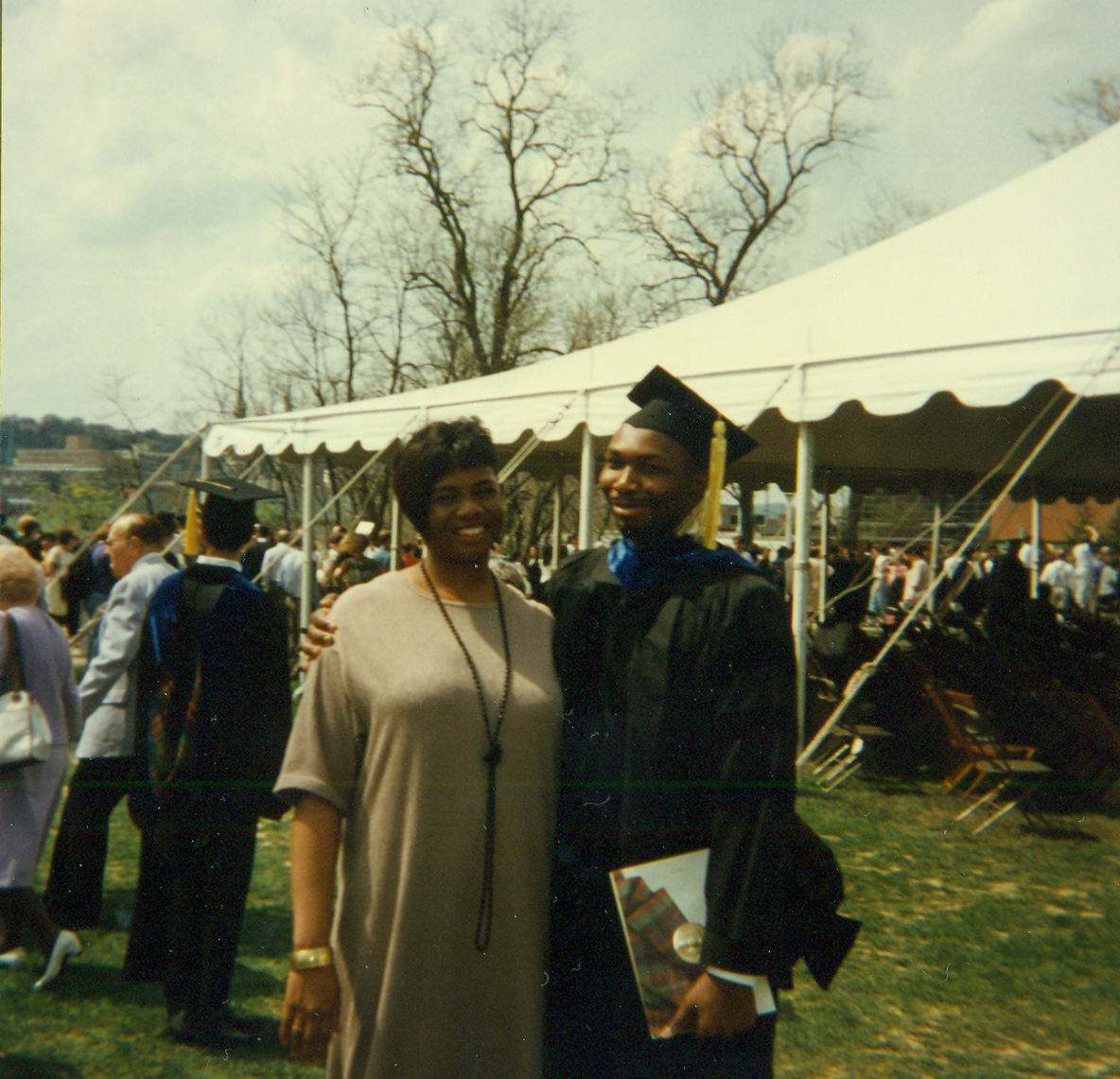
Angelia & me at my PhD graduation, Carnegie Mellon University, Pittsburgh, PA, May 18, 1997.

Angelia & me at my PhD graduation, Carnegie Mellon University, Pittsburgh, PA, May 18, 1997.

Yesterday, my wife of nearly seventeen years turned fifty years old (Happy Birthday! Love you! Mwah!). I still have nearly three years before I’ll be able to say the same. Yet through her, I can experience fifty at forty-seven. I have known of my wife since a month after her twenty-third birthday, met her for the first time in April ’90, became friends with her in May ’95, and began dating in December ’95. Sure, I have friends and family I’ve known longer. With my Mom being only twenty-two years older than me, I have memories of her from her late-20s onward. But I didn’t marry my Mom, thankfully.

Angelia at road stop in South Carolina during vacation, August 30, 2007. (Donald Earl Collins).

Angelia at road stop in South Carolina during vacation, August 30, 2007. (Donald Earl Collins).

I don’t have much to say here. I just want to share a few pictures of my better half from the 7s – 1997 (the year of her at 30), 2007 (when she was 40), and ~2017 (she wouldn’t let me take a photo of her yesterday for number 50). The problem with still looking young is that people seldom take your aging seriously. Whether it’s people just a few years older telling you your knees can’t hurt from years of basketball, running, and other sports because you’re “still young.” Or it’s doctors telling you your ailments are minor because you don’t look like you’re anemic or going through menopause. For my wife, though, the biggest bugaboo about how she looks at fifty is that she still gets carded at liquor stores or when ordering a drink at a restaurant. Oh well!

Angelia in year 50 (selfie), May 2016.

Angelia in year 50 (selfie), May 2016.

A Story of My Life

24 Thursday Nov 2016

Posted by decollins1969 in 1, Academia, Boy @ The Window, Carnegie Mellon University, Christianity, culture, Eclectic, Pittsburgh, Politics, Pop Culture, race, Religion, University of Pittsburgh, Work, Youth

≈ Leave a comment

Tags

American Exceptionalism, CMU, Doctorate, Giving Thanks, Homelessness, Horatio Nelson Stories, Joe Trotter, Pitt, Ron Slater, Scars, Thanksgiving, Thanksgiving 1988


One of dozen of rags-to-riches falsehoods from Gilded Age author Horatio Nelson (1832-1899). (http://www.pavillionpress.com).

One of dozen of rags-to-riches falsehoods from Gilded Age author Horatio Nelson (1832-1899). (http://www.pavillionpress.com).

That one of the not-so-small miracles of my young adult life from ’88 and me completing my dissertation process in ’96 are just a day apart on the November calendar every year is a story unto itself. Between a month before my nineteen birthday and a month before my twenty-seventh, I went from a semester of homelessness, lack of money for food and rent and living in a firetrap to finishing up a doctorate in history. If this were someone else’s story, I’d think that amazing, even almost unbelievable. At the time, I was so worn out and beat up by Joe Trotter, my dissertation committee, and the scars accumulated over that eight-year — really, twenty-year — period, that the idea of seeing myself as an American example of a Horatio Nelson story would’ve likely made me angry enough to spit blood.

Even now, I don’t and won’t see myself as exceptional. That’s that American bullshit about rags-to-riches stories, about being-a-credit-to-my-race tropes, that I’d be subscribing to here. What I really was back then was young and hungry. So young that I was willing to put up with all kinds of people’s baggage, taking near-minimum wage jobs, allowing people to call me out of my name, excusing racist comments and actions. All because I wanted the brass ring, for myself and for my family. I was already hungry, from years in poverty, from years without friendship bonds, from years of people not recognizing my, dare I say, brilliance. I had a chip on my shoulder, but it wasn’t because I was mad. I was after a righteous reckoning.

Two decades removed from those Carnegie Mellon days, and approaching thirty years since Ron Slater and my band of new friends kept me in money and food during Thanksgiving ’88 and beyond, and I am thankful. I am thankful that I am no longer either of those versions of myself. The one too afraid to ask for help, and the one too naive to realize that the America I believed in for so long never existed. I am thankful that I know more about asking for and providing help, about understanding that in this America, help might never arrive, at least when folks most need it. I am thankful mostly that I still have optimism, I still have drive, and I still have people who like and love me enough to remind me that a few of America’s giga-pixels are worth savoring.

David Wolf, A Teacher I Hope To Never Become

27 Thursday Oct 2016

Posted by decollins1969 in 1, Academia, Boy @ The Window, Carnegie Mellon University, culture, Eclectic, Jimme, Mount Vernon High School, Mount Vernon New York, My Father, New York City, Pop Culture, race, Sports, University of Pittsburgh, Youth

≈ Leave a comment

Tags

1986 World Series, 616, 616 East Lincoln Avenue, AP Physics, Bad Teaching Habits, David Wolf, Escapism, Humanities, Jesse Orosco, Mets, Mother-Son Relationship, MVHS, New York Mets, Senioritis, Teaching and Learning


Film critic Gene Shalit (closest approximation I could find to David Wolf), circa 1980. (http://imdb.com).

Film critic Gene Shalit (closest approximation I could find to David Wolf), circa 1980. (http://imdb.com).

This date was one of the great ones during my Boy @ The Window years. It was a day (and evening) that almost made me forget the role I’d been in since the spring of ’81. One as the sometimes adult male with adult responsibilities on the one hand, and as the nearly ostracized emotional equivalent of a twelve-year-old on the other. But yes, even small miracles (at least in my mind at the time) did happen. The New York Metropolitans, my Mets, won Game 7 of the 1986 World Series thirty years ago on this date 8-5, a biting cold Monday night at the end of October! My Giants beat and beat up the Redskins that same evening 27-24, on their way to a 14-2 record and their first Super Bowl. My underdogs weren’t anymore.

Within three days of that ultimate day of vicarious escapism, the reality of having neglected my studies had sunk in. Or, to be completely honest, the reality of needing much more time to study than I could’ve ever devoted, even without the distractions of senioritis, my Mets and Giants winning or on their way to championships, set in. Because that’s what it would’ve taken for me to have a successful senior year at Mount Vernon High School academically. A greater commitment to AP Physics C, AP English, and AP Calculus AB than my bifurcated life would have allowed. Between four siblings ages two to seven, college applications, and constant errands and chores for my Mom, my weekends of tracking down my father at one watering hole or another, I should’ve gone off to college after my junior year. I should’ve used the summer of ’86 to take gym or something to get the one-quarter credit I needed to graduate.

Instead, here I was with the one teacher who was probably the one most ill-equipped to handle any students other than near-genius devotees to AP Physics. I had David Wolf the year before in high school Physics, so I knew how intolerant he could be toward students who were unprepared, or “just [didn’t] get it.” Or, at least I thought I knew. The week before the Mets’ Game 7 win, Wolf had given us our end-of-marking-period exam on mechanics, and the day after was when we received our exams back with grades. I had the fourth highest score out of seven students, a 22 out of 100. You can look at any grades I’d earned prior to and since this exam in any course between kindergarten and doctorate, and none come close to a 22.

But it obviously wasn’t just me.

David Wolf was another character who was sometimes funny but otherwise sucked as a teacher. It would’ve been hard for me to know what Butler had been like as a teacher when he was happily married. Wolf was a mediocre teacher on his best days because he simply didn’t care if we learned anything in his class. Of course that didn’t make him much different from most of our other teachers. What made Wolf different was the fact that he went out of his way to embarrass students, as if the shock of being outed by him would somehow make us better.

Wolf “taught” us the more difficult AP Physics C version of this Physics course, involving mechanics, electricity and magnetism. It was the equivalent of second semester Physics right from the start, and most of us needed at least a semester of Calculus to keep up with him. Had I known this was Wolf’s plan, I may well have taken my former classmate Laurell’s advice (eight years too late) and switched to AP Biology. Instead, I chose to see this as a new challenge I could take on and will myself through, just like I had in every other difficult class I’d taken up to that point. But after the first two months of the year, it crossed my mind that struggling through this course wasn’t worth it.

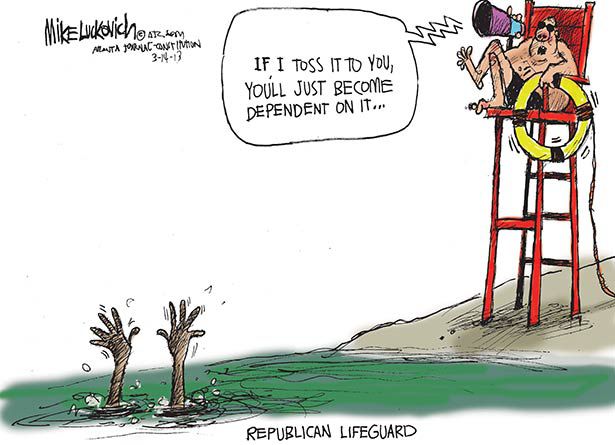
Sink or Swim Republican Lifeguard Cartoon, Mike Luckovich, March 14, 2013. (Luckovich/Atlanta Journal-Constitution; http://luckovich.blog.ajc.com).

Sink or Swim Republican Lifeguard Cartoon, Mike Luckovich, March 14, 2013. (Luckovich/Atlanta Journal-Constitution; http://luckovich.blog.ajc.com).

When I wrote in Boy @ The Window, “Laurell was practically using third-semester Calculus to build the Great Pyramids by comparison,” it was hyperbole, of course. Partly because Egyptian calculus was likely more complicated. And partly because Laurell had done something that I couldn’t do. She had gone to Wolf at the end of eleventh grade and borrowed from him a copy of the AP Physics textbook. She had devoted much of her summer to studying up on AP Physics and AP Calculus BC (once the harder version of AP Calculus) before day one of twelfth grade. So Laurell was going to do well, no matter what. Dozens of hours to study wasn’t sometime I had at chaotic 616, textbook weeks ahead of time or otherwise.

However, me doing well or terribly wasn’t my issue with Wolf. It was his sink-or-swim approach, with no attempt to help struggling students in any way. It was his dickish attitude, where he would literally lean on his stool or against the chalkboard insulting us as we attempted to answer a Physics problem.

Wolf’s class remained the most painful academic experience I’d have in Humanities. Period…Wolf continued to berate and belittle us, wondering, ‘Why are you still here?,’ or exclaiming ‘You decided to show up today!’ On the rare occasions I managed to solve a problem at the chalkboard, he gave me a Bronx cheer, the kind good Yankees fans gave when their team was down ten runs and a Yankee hit a home run to close the gap to nine.

Now, some would say this was good preparation for college. Where? While I certainly have known indifferent professors regarding my own abilities or their distance from other students in general, I’ve only known a few who even threw out the rare bit of sarcasm in the classroom. Plus, for courses like Physics, there were TAs who could walk students through problems better than Khan Academy. Even saying that Wolf was good preparation for graduate school would be a stretch. Quiet exclusion, rather than insults and ostracism, is the rule at the doctoral level. And having an advisor like Wolf would’ve led to blood, and not my own, plain and simple.

After years in the classroom with high school, undergrad, and grad students, I understand that being a professor isn’t the same as being a K-12 teacher. Most of the time, I’m not dealing with parents (except as students), I don’t teach five days a week, and I have the expectation that my students should behave as college students. All the more reason that as I have grown older and more experienced as an educator, the more I’ve found Wolf’s behavior objectionable, even almost unforgivable. In all seriousness, why even show up to teach if your primary form of solace at work is yelling insults at students while standing in the hallway in between class periods?

Academia’s Racist Expectations

13 Thursday Oct 2016

Posted by decollins1969 in 1, Academia, Boy @ The Window, Carnegie Mellon University, culture, Eclectic, Mount Vernon High School, Pittsburgh, Politics, Pop Culture, race, University of Pittsburgh, Youth

≈ Leave a comment

Tags

Academic Job Market, CMU, Daniel P. Resnick, Hardship, Joe William Trotter Jr., Laurence Glasco, Pitt, Racism, Racism in Academia, Richard Oestreicher


The long wall that separates Morningside Park (and Harlem) from Columbia University, New York, circa 2008. (http://Biking-in-Manhattan.com).

The long wall that separates Morningside Park (and Harlem) from Columbia University, New York, circa 2008. (http://Biking-in-Manhattan.com).

I found myself back again. After reading Marybeth Gasman’s follow-up Washington Post article on her findings about academia’s hostility toward faculty diversity and the low expectations of the mostly White and male search committees in hiring faculty of color, I remembered. Seymour Drescher, George Reid Andrews, Van Beck Hall, Richard Smethurst, Dick Oestreicher, Larry Glasco, Paula Baker, Joe Trotter, John Modell, Steve Schlossman, Wendy Goldman, Kate Lynch, Dan Resnick, Bruce Anthony Jones, and Peter Stearns. Everyone on this list was either my advisor, a professor for a graduate course I took while in the history departments at Pitt and Carnegie Mellon, on my dissertation committee, the department chair, or someone I TA’d for between January 1990 (when I was a junior at Pitt) and May 1997. And nearly all of them either had super-high expectations of me — really, weight-of-the-world expectations — or expected me to choke on my own vomit intellectually while in grad school.

It wasn’t as if I hadn’t seen this before. With select folk while in Humanities in middle school or in high school, like Doris Mann in seventh and eighth grade art, Sylvia Fasulo as my guidance counselor while at Mount Vernon High School, and most notably, with David Wolf in AP Physics my senior year (more on him soon). At Pitt, I had an elderly White professor in a constitutional law class who regularly expressed his displeasure over affirmative action in his lectures and gave all four Black students in the course a C+ on every assignment. But generally, if faculty did have low expectations of me because of their racism, it was more of a feeling, a sense that creeped up on me but couldn’t quite grasp, and not obvious because of their statements and actions.

Headwinds, July 2011. (http://forbes.com).

Headwinds, July 2011. (http://forbes.com).

Until I decided to go for an MA in history in 1990. Everything from discouraging statements to half-baked letters of recommendation brought headwinds meant to slam me up against rocky shoals. Professors like Smethurst or Hall who assumed I didn’t work hard enough because I took time to recharge and hang out with friends. A couple like Oestreicher and Resnick who believed that I actually plagiarized material because the quality of my writing was higher than they had seen from a grad student in years. Some like Andrews, who couldn’t believe I was well into my dissertation, much less having made it into another PhD program at all. That doesn’t even count the assumptions about my basketball prowess, or about what I did in my spare time. Nor does it include the overlooking of alternative perspectives on Marxism, on Whiteness, on multiculturalism, on American poverty, on religion, on a host of historical issues I brought to one seminar after another. Because in my spare time, I read more than what was on a syllabus, and given my upbringing, I had already lived a good portion of what the privileged class had only studied.

Add to this the expectations from Baker and Glasco, or Trotter and Jones. All had high expectations of me. So high, in fact, that their expectations were about more than me. It was about what I should or could represent, a graduate student of color who could compete successfully with the so-called geniuses in the field. With Trotter as my dissertation advisor, of course, it became a balancing act between his paranoia born out of his own experiences with graduate school, the job market, and academic racism, and working with me to make me a better scholar. We never had a conversation about why Trotter was the way he was with me, but as I have noted here over the years, Head Negro In Charge syndrome (HNIC) was certainly part of this equation. It’s one thing to meet one’s own high expectations. It’s another when folks who are pulling for you expect you to outperform yourself because of race.

There were so many expectations of me because of my race and relatively young age that I rebelled, mostly unconsciously, my last two years of graduate school at Carnegie Mellon. I wasn’t sure I wanted a professorship of any kind by 1996. But I was so close to being done with the dissertation, with Trotter, and with my mixed-signals dissertation committee. So I finished, and put myself into a job market, hoping that it wasn’t going to be so bad to look for tenure-track positions.

I was wrong, of course. Search committees couldn’t even meet the minimal expectation of at least evaluating my applications based on my qualifications. I interviewed for seven academic jobs between 1997 and 2000 before my first full-time professorship offer from Howard University. In at least three cases — including Tufts and NYU — the search committee chair’s friend was the person whom ended up with the job. With Teacher’s College, who knows? Slippery Rock canceled their search altogether. I didn’t even care to find out what happened with UNC-Charlotte or Colgate. I can say with absolute certainty, based on yawns, stupid questions, racist comments, and strange looks, that racism played a role in the Slippery Rock cancelation, and in my interviews at NYU and Colgate. Those people simply did not want me there, period.

Israeli armored car patrolling barrier wall between it and Palestinian West Bank, June 17, 2016. (http://presstv.ir).

Israeli armored car patrolling barrier wall between it and Palestinian West Bank, June 17, 2016. (http://presstv.ir).

In all, I have applied for 350 academic positions over the past two decades (keep in mind, I applied for 250 of these between 1997 and 2001, and hardly any during my nonprofit work years between 2001 and 2011). Other than adjunct or term faculty work — sometimes, even well-paying positions — going for academic jobs has confirmed my worst expectations of an institution that prides itself on the myths of meritocracy, scholarship, and objectivity. If I had to do it all over again, I would have not pushed myself through two revisions of my dissertation to get this degree. It wasn’t worth the $24,000 in student loans, the thousands of hours of reading boring ass dense writers, all the stupid hypotheses and theories, and the half-assed people I sat in front of in classrooms who claimed the title professor.

That’s how I feel sometimes. But I’ve also had a full slate of courses at my current gig for the past eight years, worked with thousands of high school, undergraduate, and graduate students since 1996, written dozens of recommendation letters, and worked myself into a writer who has dropped nearly all the trappings of academe. Had I not faced the racist failings of academia head-on, I might have bought into this world’s hypocrisies and reproduced them for my students over the years. In this, at least, I can be thankful for academia’s low expectations of me.

Lifetimes of Hypocrisy

08 Wednesday Jun 2016

Posted by decollins1969 in 1, Academia, Carnegie Mellon University, culture, Eclectic, Pittsburgh, Politics, Pop Culture, race, University of Pittsburgh, Work, Youth

≈ Leave a comment

Tags

"Hard Habit to Break" (1984), Academia, Academy for Educational Development, AED, Capitalism, Chicago, CMU, Contradictions, Disillusionment, Hypocrisy, Illusions, Ironic, Irony, Leftists, Liberals, New Voices, Nonprofit Organizations, Nonprofit World, Pitt, Progressives, Social Justice, Worker Exploitation, Working-Class History Seminar


Twitter conversation on labor historian job and irony, May 26, 2016. (screen shot Donald Earl Collins).

Twitter conversation on labor historian job and irony, May 26, 2016. (screen shot Donald Earl Collins).

Irony/Ironic is a word that we in the West use a bit too often. It is ironic, for instance, that I left the job insecurity and financial instability of the nonprofit world after a decade, only to find myself part of the unstable world that is academia these days. But it isn’t ironic that nonprofit organizations working for a better world exist only because their leaders have the task of constantly raising money for their work. The best of these leaders make high-six-figure incomes and their nonprofits make billions, in organizations like Educational Testing Service, College Board, and my former organization, Academy for Educational Development. This isn’t an example of irony, at least not just. It’s maybe a contradiction, it’s maybe hypocrisy, it’s maybe even straight-up bullcrap.

A week and a half ago, a colleague became part of a Twitter conversation about a labor historian job at Rutgers University. (Full disclosure: I’d already seen the job a week earlier on Rutgers’ website, so no surprises for me). The job was for a non-tenure track position teaching a 4/3 load (four undergraduate courses one semester, three the other, with no summer courses, at least), the position potentially renewable after one year. The standard teaching load at most four-year institutions is between five and six courses (counting summers) per year. The ironic punch line was that it was the Labor Studies & Employment Relations Department that advertised this position, a department that ought to “know better.”

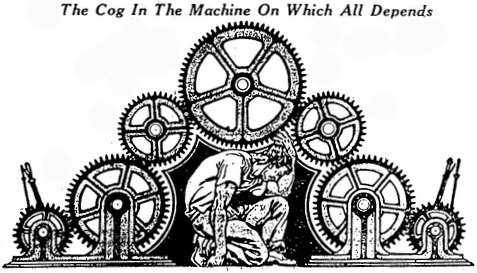
The Cog in the Machine, June 8, 2016. (http://catholicreadingproject.blogspot.com).

The Cog in the Machine, June 8, 2016. (http://catholicreadingproject.blogspot.com).

The problem for me is that this isn’t ironic at all. This department exists within the Rutgers School of Management and Labor Relations. These schools are not exactly incubators for “workers of the world unite” types, and would be most likely to take advantage of the weak job market to hire a labor historian desperately in need of a one-year or more gig. This is naked exploitation to be sure, but I find no irony in this job search at all. This is typical of the majority of jobs in higher education these days.

It is definitely hypocrisy, at least on the level of academia at large. Especially in considering that supposed bastions of liberal ideals (which universities really aren’t — they’re capitalist business enterprises which sometimes house some leftist leaning faculty) have turned the secure work of the professoriate into non-tenured service industry work. That this has coincided with the plunge in the number of full-time positions and in the number of living-wage positions in the US labor force in general is telling. It says that academia is nothing special beyond the expensive education, that it isn’t some sacred place for intellectual exchange and political mobilization. It is as firmly tied to capitalist pursuits as Wall Street and K Street.

I learned this lesson a quarter-century ago, thanks to the working-class history seminars at the University of Pittsburgh and Carnegie Mellon University. Between Dick Oestreicher, Bill Chase, Reid Andrews, Joe Trotter, and Joel Tarr (among others), the level of hypocrisy was enough to make me sick. The distance between what these people wrote regarding leftist movements, ideas, ideals, and exploited workers and how they treated students and colleagues sometimes was breathtaking. It was like the distance between the Terran system (Earth) and Alpha Centauri (roughly 25 trillion miles).

Hammer & Sickle & Pitt Flag [symbolic of Pitt's history department], December 13, 2012. (Donald Earl Collins).

Hammer & Sickle & Pitt Flag [symbolic of Pitt’s history department], December 13, 2012. (Donald Earl Collins).

Sure, it’s all “let’s start a communist revolution” when discussing the 180th nuanced on E. P. Thompson’s The Making of the English Working-Class. But when graduate students wanted to unionize to have their work recognized as workers, then these leftists suddenly became capitalists. “No, you’re not workers,” they said. “You’re students.” In the face of virulent racism, they said, “Get use to it. Shit happens.” Heck, some of these so-called bleeding-heart-liberals were themselves harassing students, exploiting their work for prestige and profit, and playing favorites to promote yes-men and yes-women while keeping others from pursuing their doctorates.

I saw the same distance between noble liberal ideals and center-right realities in my decade in the nonprofit world, mostly working in social justice. Yes, some of the very people who had made it their calling to ameliorate racism and combat injustices were also knee-deep in their own contradictions. Gender-based, race-based, and intersectional harassment wasn’t exactly uncommon. Exploitative labor practices like working two people full-time for the price of one, denying promotions based on gender or racial bias, even paranoia over power within a social justice organization. They all were the usual things I witnessed or experienced in the years between 1997 and 2008.

Wolf in sheep's clothing, a false prophet (a symbol of my ex-stepfather), November 2008. (Source/flickr.com)

Wolf in sheep’s clothing, a false prophet (a symbol of my ex-stepfather), November 2008. (Source/flickr.com)

There is nothing sacred and no safe space for those of us looking for such things. This belief in academia as being so different from the rest of the working world is an illusion cooked up by neo-conservatives who’ve made millions selling the idea that academia is a liberal bastion. We should all look for positions and places in which our work can thrive and we as individuals or even groups of people can grow. Those obviously still exist. But believe me, it’s been years since I thought that academia was a place where being far left-of-center was a good thing. It’s only good if you’re good at acting like this is so. It’s another illusion that others have chosen to create to cover up their hypocrisies. The irony is that people still believe in these ideals anyway.

← Older posts
Newer posts →

Boy @ The Window: A Memoir

Boy @ The Window: A Memoir

Places to Buy/Download Boy @ The Window

There's a few ways in which you can read excerpts of, borrow and/or purchase and download Boy @ The Window. There's the trade paperback edition of Boy @ The Window, available for purchase via Amazon.com at http://www.amazon.com/Boy-Window-Donald-Earl-Collins/dp/0989256138/

There's also a Kindle edition on Amazon.com. The enhanced edition can be read only with Kindle Fire, an iPad or a full-color tablet. The links to the enhanced edition through Apple's iBookstore and the Barnes & Noble NOOK edition are below. The link to the Amazon Kindle version is also immediately below:

scr2555-proj697-a-kindle-logo-rgb-lg

Boy @ The Window on Amazon.com: http://www.amazon.com/Boy-The-Window-Memoir-ebook/dp/B00CD95FBU/

iBookstore-logo-300x100

Boy @ The Window on Apple's iBookstore: https://itunes.apple.com/us/book/boy-the-window/id643768275?ls=1

Barnes & Noble (bn.com) logo, June 26, 2013. (http://www.logotypes101.com).

Boy @ The Window on Barnes & Noble: http://www.barnesandnoble.com/w/boy-the-window-donald-earl-collins/1115182183?ean=2940016741567

You can also add, read and review Boy @ The Window on Goodreads.com. Just click on the button below:

Boy @ The Window

Twitter Updates

Tweets by decollins1969
  • RSS - Posts
  • RSS - Comments

Archives

  • June 2025
  • April 2023
  • September 2022
  • August 2022
  • July 2022
  • June 2022
  • May 2022
  • April 2022
  • March 2022
  • January 2022
  • December 2021
  • November 2021
  • October 2021
  • September 2021
  • August 2021
  • July 2021
  • June 2021
  • April 2021
  • March 2021
  • February 2021
  • January 2021
  • December 2020
  • November 2020
  • October 2020
  • September 2020
  • August 2020
  • July 2020
  • May 2020
  • April 2020
  • March 2020
  • January 2020
  • December 2019
  • November 2019
  • August 2019
  • July 2019
  • June 2019
  • May 2019
  • April 2019
  • March 2019
  • February 2019
  • January 2019
  • December 2018
  • November 2018
  • October 2018
  • September 2018
  • August 2018
  • July 2018
  • June 2018
  • May 2018
  • March 2018
  • February 2018
  • January 2018
  • December 2017
  • November 2017
  • October 2017
  • September 2017
  • August 2017
  • July 2017
  • June 2017
  • May 2017
  • April 2017
  • March 2017
  • February 2017
  • January 2017
  • December 2016
  • November 2016
  • October 2016
  • September 2016
  • August 2016
  • July 2016
  • June 2016
  • May 2016
  • April 2016
  • March 2016
  • February 2016
  • January 2016
  • December 2015
  • November 2015
  • October 2015
  • September 2015
  • August 2015
  • July 2015
  • June 2015
  • May 2015
  • April 2015
  • March 2015
  • February 2015
  • January 2015
  • December 2014
  • November 2014
  • October 2014
  • September 2014
  • August 2014
  • July 2014
  • June 2014
  • May 2014
  • April 2014
  • March 2014
  • February 2014
  • January 2014
  • December 2013
  • November 2013
  • October 2013
  • September 2013
  • August 2013
  • July 2013
  • June 2013
  • May 2013
  • April 2013
  • March 2013
  • February 2013
  • January 2013
  • December 2012
  • November 2012
  • October 2012
  • September 2012
  • August 2012
  • July 2012
  • June 2012
  • May 2012
  • April 2012
  • March 2012
  • February 2012
  • January 2012
  • December 2011
  • November 2011
  • October 2011
  • September 2011
  • August 2011
  • July 2011
  • June 2011
  • May 2011
  • April 2011
  • March 2011
  • February 2011
  • January 2011
  • December 2010
  • November 2010
  • October 2010
  • September 2010
  • August 2010
  • July 2010
  • June 2010
  • May 2010
  • April 2010
  • March 2010
  • February 2010
  • January 2010
  • December 2009
  • November 2009
  • October 2009
  • September 2009
  • August 2009
  • July 2009
  • June 2009
  • May 2009
  • April 2009
  • March 2009
  • February 2009
  • January 2009
  • December 2008
  • November 2008
  • October 2008
  • September 2008
  • August 2008
  • July 2008
  • June 2008
  • May 2008
  • April 2008
  • March 2008
  • February 2008
  • January 2008
  • December 2007
  • November 2007
  • October 2007
  • September 2007
  • August 2007
  • July 2007
  • June 2007

Recent Comments

MaryPena's avatarMaryPena on My Day of Atonement/Bitter Hat…
decollins1969's avatardecollins1969 on No Good Teaching Deed Goes…
Mary Rose O’Connell's avatarMary Rose O’Connell on No Good Teaching Deed Goes…

NetworkedBlogs on Facebook

NetworkedBlogs
Blog:
Notes From a Boy @ The Window
Topics:
My Life, Culture & Education, Politics & Goofyness
 
Follow my blog

616 616 East Lincoln Avenue A.B. Davis Middle School Abuse Academia Academy for Educational Development AED Afrocentricity American Narcissism Authenticity Bigotry Blackness Boy @ The Window Carnegie Mellon University Child Abuse Class of 1987 CMU Coping Strategies Crush #1 Crush #2 Death Disillusionment Diversity Domestic Violence Economic Inequality Education Family Friendship Friendships Graduate School Hebrew-Israelites High-Stakes Testing Higher Education History Homelessness Humanities Humanities Program Hypocrisy Internalized Racism Jealousy Joe Trotter Joe William Trotter Jr. K-12 Education Love Manhood Maurice Eugene Washington Maurice Washington Misogyny Mother-Son Relationship Mount Vernon High School Mount Vernon New York Mount Vernon public schools Multiculturalism MVHS Narcissism NFL Pitt Pittsburgh Politics of Education Poverty President Barack Obama Race Racial Stereotypes Racism Relationships Self-Awareness Self-Discovery Self-Reflection Sexism Social Justice Teaching and Learning University of Pittsburgh Violence Whiteness Writing

Top Rated

Blog at WordPress.com.

  • Subscribe Subscribed
    • Notes from a Boy @ The Window
    • Join 103 other subscribers
    • Already have a WordPress.com account? Log in now.
    • Notes from a Boy @ The Window
    • Subscribe Subscribed
    • Sign up
    • Log in
    • Report this content
    • View site in Reader
    • Manage subscriptions
    • Collapse this bar
 

Loading Comments...