• About Me
  • Other Writings
  • Interview Clips
  • All About Me: American Racism, American Narcissism, and the Conversation America Can’t Have
  • Video Clips
  • Boy @ The Window Pictures
  • Boy @ The Window Theme Music

Notes from a Boy @ The Window

~

Notes from a Boy @ The Window

Tag Archives: Self-Awareness

My Muhammad Ali

05 Sunday Jun 2016

Posted by decollins1969 in 1, Boy @ The Window, culture, Eclectic, High Rise Buildings, Jimme, Mount Vernon New York, My Father, New York City, Politics, Pop Culture, race, Religion, Youth

≈ Leave a comment

Tags

"Impact", Blackness, Bonds, Boxing, Closed-Circuit TV, Death, HBO, Legacy, Life, Maurice Eugene Washington, Meaning, Muhammad Ali, Parkinson's Disease, Robert Farmer, Roots (1977), Self-Awareness, Self-Discovery, The Greatest (1977)


Meme of Muhammad Ali quote on "impossible" combined with iconic photo of Ali in 1st Round of first fight with Sonny Liston, February 25, 1964. (Getty Images via Twitter).

Meme of Muhammad Ali quote on “impossible” combined with iconic photo of Ali in 1st Round of first fight with Sonny Liston, February 25, 1964. (Getty Images via Twitter).

There is so much I could say about Muhammad Ali. His greatness. His contradictions. His imperfections and frailness. And all of them would be true. He was both a great man and a deeply flawed man at the same time. But, from 1964 through 1980, Muhammad Ali was the most recognizable person on the planet, with every aspect of his complicated onion on display in every corner of the world.

I have a few childhood memories of Ali’s headier days and nights. One was in ’74. It was the “Rumble in the Jungle” fight between Ali and George Forman. My father Jimme took me and my brother Darren over to his drinking buddy Robert Farmer’s house to watch the fight on closed-circuit TV (yep, Mr. Farmer spent good money on this fight). I do remember seeing bits and pieces of the fight, with Ali using the ropes around the ring like they were a trampoline. But mostly, I remember my dad and Farmer and Lo and others drinking and smoking away while watching the fight. October 30, 1974 was also the night that I learned my first colloquialism, the “rope-a-dope.” I know that the “dope” was Foreman, but I’ve seen lots of people as dopes in the four decades since that fight.

The Rumble in the Jungle poster, October 29, 1974. (Armbrust via Wikipedia). Qualifies as fair use because of low resolution for reproduction.

The Rumble in the Jungle poster, October 29, 1974. (Armbrust via Wikipedia). Qualifies as fair use because of low resolution for reproduction.

I remember watching the “Thrilla in Manila” nearly a year later between Ali and Joe Frazier, either at Mr. Farmer’s place or at a bar, I’m not sure. Again, smoke, drinks, beer cans, sunflower seeds and cigars, all in the midst of two fellas knocking the hella outta each other. My father sure knew how to show his two young sons (I was five and Darren was seven at the time) a good time.

These two fights became vague but embedded memories, perhaps two of the greatest bouts of all time. Although, Jack Johnson-James Jeffries, Joe Louis-Max Schmeling I and II, and Ali (née Cassius Clay)-Sonny Lister also come to mind in terms of historical significance.

But where I remember seeing Ali in a context beyond the right was in this movie The Greatest in May 1977. Believe it or not, my soon-to-be idiot stepfather Maurice took us to see this mediocre docudrama of a biopic on Muhammad Ali’s through 1974. (So I guess I was wrong when I said my stepfather had only done two good things for me growing up). At seven, there was no way I could know how bad the film was, between scenery chewers Ernest Borgnine and James Earl Jones. Still, the movie put those hazy memories from ages four and five in better perspective. After having seen Roots a few months earlier, I was really conscious of the wider world, of race, and of Muhammad Ali’s importance for the first time.
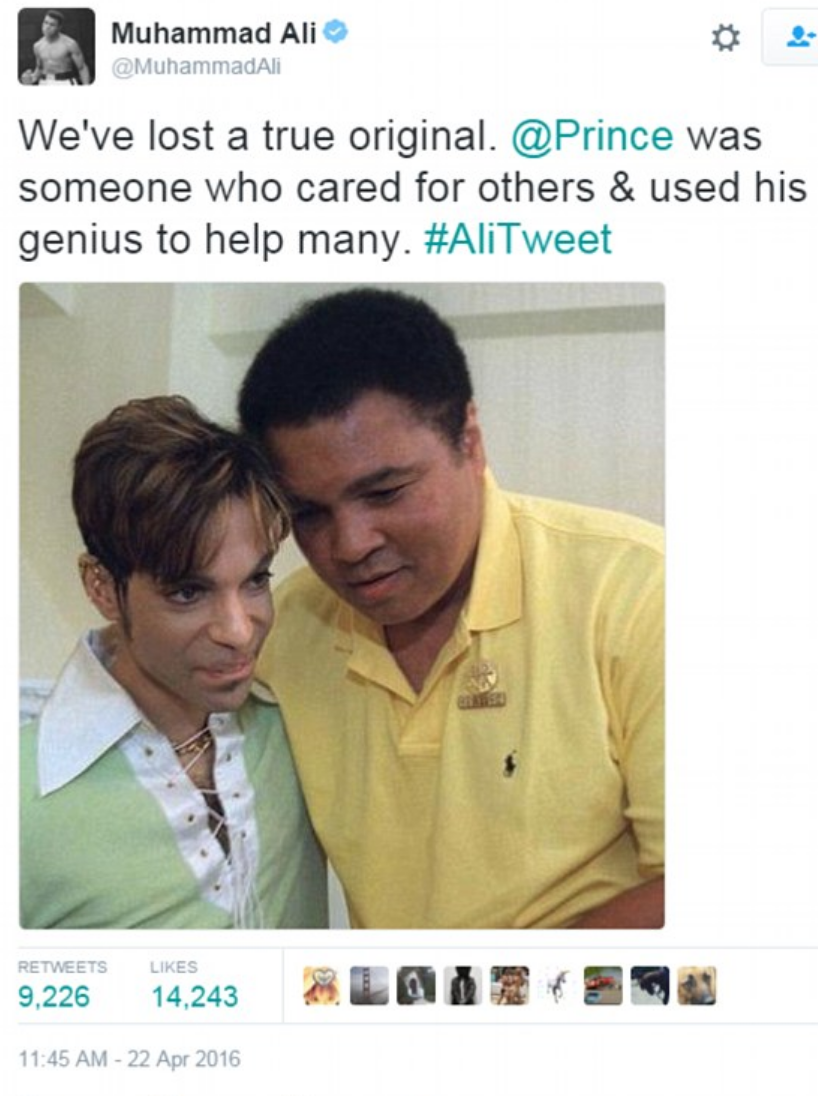
Muhammad Ali tweet re: Prince's death (pic is from their first meeting in 1997), April 22, 2016. (Twitter).

Muhammad Ali tweet re: Prince’s death (pic is from their first meeting in 1997), April 22, 2016. (Twitter).

Unlike Natalie Cole, David Bowie, Prince, and going back before 2016, Michael Jackson, I’ve been expecting Ali’s death for quite some time. His Parkinson’s wasn’t just Parkinson’s, but likely brain damage the likes of which NFL players have come to fear. That it took Ali until 1984 to announce what millions had suspected as far back as 1978 told us that he had taken a long time to come to grips with what would become his second act, his new reality. That Ali became a symbol of philanthropy, activism, and humanitarianism during this second act suggests that his strong will and support system deserves way more credit for the quality of his life than anything he did in the ring.

“Show me a hero, and I’ll write you a tragedy” comes from the 1920 mind of F. Scott Fitzgerald. If he were to write Muhammad Ali’s story, it would likely read as a tragedy. Luckily for us, Fitzgerald isn’t around to do so.

We have glossed over a few things in our millions of small eulogies for Ali this weekend. His sexism and occasional misogyny and abuse, both in words and deeds. His obvious colorism, calling Joe Foreman a “gorilla” and most of his somewhat darker skinned opponents “ugly” as a euphemism for their failure to pass the brown-paper-bag test. His rejection of Malcolm X at the very time when Malcolm needed him the most. Ali in the years between his biggest bouts and his mostly silent second life expressed regret about these -ism words and actions.

Despite this, Ali was still a father, a husband, a Muslim, a three-time heavyweight champion of the world, an author, a poet, an actor, an anti-war activist, a civil rights advocate, a social justice leader, a humanitarian, a hostage negotiator, and a Parkinson’s survivor. Ali was a fighter, in the most panoramic sense of the word. And yes, he was a Black man, in the narrowest and most intersectional senses of that two-word phrase. And all of that made him an icon. RIP.

Striking members of Memphis Local 1733 hold signs whose slogan symbolized the sanitation workers' 1968 campaign, March 1968. (Richard L. Copley/http://dlxs.lib.wayne.edu/).

Striking members of Memphis Local 1733 hold signs whose slogan symbolized the sanitation workers’ 1968 campaign, March
1968. (Richard L. Copley/http://dlxs.lib.wayne.edu/).

A Little Diddy About Madison Jack

08 Friday Apr 2016

Posted by decollins1969 in 1, Academia, Carnegie Mellon University, culture, Eclectic, New York City, Pittsburgh, Pop Culture, race, Youth

≈ Leave a comment

Tags

Academic Competition, Academic Conferences, AERA, American Educational Research Association, Burnout, CMU, Collegiality, Conferences, Harvey Kantor, Jack, Joe William Trotter Jr., Michael Fultz, Milford Plaza, Mom, Narcissism, Obsequious, Self-Awareness, Spencer Foundation, University of Wisconsin-Madison, Yonkers


Jack-In-The-Box 3D model, April 5, 2016. (http://turbosquid.com).

Jack-In-The-Box 3D model, April 5, 2016. (http://turbosquid.com).

Jack-o’-Lantern, Jack-in-the-Box, Monterey Jack, Colby Jack, and jackknife all have something in common with the Jack I’m writing about in this post. They’re all the kinds of Jacks that I’m not a fan of or outright dislike. They also tend to surprise me at precisely the wrong place and at precisely the wrong time. My Jack, the Jack who finished a doctorate in the School of Education at UWisconsin-Madison in the late-1990s, was one of the most competitive and obsequious humans I had ever met. What made my knowing him worse was that he never had to be cutthroat in the first place.

I first “met” Madison Jack the summer of ’95, via telephone and email. My favorite benefactor at the Spencer Foundation in Catherine Lacey had provided Jack my information. It made sense at the time. Both Jack’s dissertation and my own discussed the process of Black migration, White flight, and school desegregation, though his work involved Milwaukee and mine was on DC. Jack had gotten a small Spencer grant, and I had a Spencer Dissertation Fellowship.

Most importantly, Madison Jack wanted to put together a panel presentation for the April 1996 American Educational Research Association (AERA) Annual Meeting in New York. The panel would involve a group of Spencer-funded folk working on various angles of school desegregation, involving community control, racial discrimination, White anti-desegregation protests, and ideas like my own on multiculturalism and diversity. Over a three-week period between mid-July and early August ’95, we put together a panel of five presenters and a moderator. The moderator was none other than Jack’s dissertation advisor Michael Fultz. Two presenters were 1995 Spencer Dissertation Fellows (including me), and two others would become Dissertation Fellows in 1996 (including Madison Jack).

It could’ve been a powerful panel under the right set of conditions. But it was to be underwhelming by default. We had at least two too many people on the panel. Our panel’s presentation date and time in New York was on the last day of the conference, Friday, April 12th, at 8:15 am, both too early and too late at the same time. With my own troubles with my HNIC advisor in Joe Trotter — not to mention a dissertation nearly complete — AERA wasn’t exactly my primary focus. Plus, visiting my home area with my family living in temporary housing in Yonkers post-616 fire didn’t exactly help with my concentration.

A five-inch folding jackknife, perfect for ingratiating back-stabbers, April 5, 2016. (http://www.lifesupportintl.com/).

A five-inch folding jackknife, perfect for ingratiating back-stabbers, April 5, 2016. (http://www.lifesupportintl.com/).

But it was Madison Jack’s obsessive competition that reared its ugly head and left a raw horseradish taste in my mouth. It was that much more disgusting because I knew it would be my last conference presentation as a graduate student. Jack and I had agreed that all five of us would have twelve minutes apiece for our presentations, leaving time for audience questions. On that brisk spring morning after a rough night at the Milford Plaza, I began the panel with my talk timed for exactly twelve minutes. With my Mom having not yet arrived and only six people in the room to start, I muddled through as if I needed a cup of coffee just to know that I needed to wake up. Mom arrived five minutes into the second presentation, one by my fellow 1995 Spencer Dissertation Fellow, where she used the term “a cacophony of voices” in describing the different sides involved in the 1968 Ocean Hill-Brownsville (Queens) controversy over community control and racial inequality. Two scholars I knew well were in the audience — including one who was a one-time professor at Carnegie Mellon’s Heinz School (now Heinz College). She said to Harvey Kantor, “This presentation’s ‘caca’ all right” and they both laughed, loud enough for my sleep-deprived mind to notice.

Madison Jack was the last to present. My co-organizer broke our agreed-upon rules. He spoke for more than twenty minutes, all to garner more attention for his work over myself and the other three panelists. Jack also used a slide show, another thing that we had agreed we wouldn’t do, mostly because of the time constraints on the panel. It was a classic example of narcissistic behavior at the doctoral level. By the time Jack had finished — combined with his advisor’s ten minutes of droning commentary — there were only six minutes left for questions from an audience of nearly twenty people, most of whom had missed the first four presentations. Jack fielded all but one of the audience’s questions. If I’d been in my right frame of mind, I would’ve jammed a slide down Jack’s obsequious throat.

Fast-forward nearly a decade to the 2004 AERA conference in San Diego. It was my first time attending the conference since grad school. I decided to go to the Spencer-sponsored talk (an annual tradition), to see if any of my fellow Fellows from 1995 would also be there. A couple of them did show up, which was the good part about this gathering. But so did Madison Jack. He made a bee-line toward me. I made a point of not making eye contact until he was nearly in my face with his grizzly beard and outstretched hand. I shook it as hard as I could, feeling my right hand squeeze his knuckles into each other.

A block of Monterey Jack in all its bland whiteness, January 13, 2015. (Mitch Mandel via http://menshealth.com).

A block of Monterey Jack cheese in all its bland whiteness, January 13, 2015. (Mitch Mandel via http://menshealth.com).

After I let him talk for three minutes about his professorship at some small New England liberal arts college, about his first book, and after introducing me to his wife, he wanted to know how I was doing. Or rather, if I had bested him in my career up to that point. I didn’t take the bait. Knowing that a couple of big wigs had just walked into the room, I started with small talk about my wife and newborn son. I knew. Madison Jack being Madison Jack, I knew he would walk away, with me in mid-sentence, seeking to soak wisdom and advancement out of his next unknowing victims.

With colleagues and friends like Madison Jack, who needed enemies? What made his sycophantic displays and overt attempts at dominance so pitiful was that I never cared. I was too ambivalent about my place in academia and too much in turmoil about myself as a writer to ever care. Fighting over a job or a book with a scholarly publisher? To me in 1996 and in 2004, it was a waste of time and energy.

To me in 2016, it’s also a waste of potential friendships and connections beyond the “what’s in it for me?” perspective. I know lots of folks, but few I count as friends, and only a small number of those are in academia. While much of my work is independent of others, it isn’t work I do or think about alone. Madison Jack probably knows tons of folk in high places. But with an approach to career that is me first, me foremost, and me last, I’m pretty sure that he repels more true connections in his world than he attracts. Kind of like smelling week-old Monterey Jack that’s been left out in the sun too long.

On My Own Narcissism

19 Saturday Mar 2016

Posted by decollins1969 in 1, Academia, Boy @ The Window, culture, Eclectic, Mount Vernon New York, Patriotism, Politics, Pop Culture, race, Religion, Youth

≈ Leave a comment

Tags

American Narcissism, Donald Trump, Humanities, Jean W. Twenge, Narcissism, NPD, NPI, Self-Awareness, Ted Bundy, W. Keith Campbell


You are from God, little children, and have overcome them; because greater is He who is in you than he who is in the world.

— 1 John 4:4 (New American Standard Bible)

For those who regularly read my blog, you’ve probably noticed the increased focus over the past year on the issue of American obsession with individualism and its own greatness mythology. At least, the parts of which I’ve roughly translated into a collective American narcissism, or a collective American absorption with itself. It has become the latest idea, my latest potential project, but still too early to tell what, if anything, will come out of this so far. Most Americans remain blissfully unaware of anything that doesn’t involve winners, losers, vicarious living, and America always being seen as #1 at everything (even though in most cases it isn’t).

This post, though, isn’t about how the world’s #1 nation is deeply flawed by a narcissism that runs nearly as deep as the center of a black hole. No, this post is all about me. Really, it’s about the fact that even as I recognize America’s narcissism — both historical and current — that I myself am not inoculated from that narcissism.

Expanding red giant stars will engulf too-close planets before turning into white dwarfs, August 13, 2013. (James Gitlin/STScI AVL via http://www.space.com/).

Expanding red giant stars will engulf too-close planets before turning into white dwarfs, August 13, 2013. (James Gitlin/STScI AVL via http://www.space.com/).

My first bout with narcissism began at the end of elementary school at William H. Holmes in Mount Vernon, New York. It was the spring of ’81. I’d just finished up three years as a straight-A student, been made into a Hebrew-Israelite, came in second for a city-wide essay contest, and been granted the honor of introducing the keynote speaker at my graduation. Even with fighting my best friend Starling, my family’s slow but steady fall into grinding poverty, and the next six years of Humanities in front of me, who wouldn’t have a head as inflated as the Sun at its red-giant stage?

As I wrote in Boy @ The Window

I firmly believed that no one in the world was smarter than me. It wouldn’t have been any funnier if I’d pretended I was Mr. October himself, Reggie Jackson, saying his words, ‘Sometimes I underestimate the magnitude of me.’

It took a year of relative mediocrity while in seventh-grade Humanities for my march toward narcissistic personality disorder to end at the cliff of disillusionment. I wasn’t the “smartest kid in the whole world.” But as I also discovered in my time in this magnet program, neither were any of my classmates.

Perhaps the biggest lesson here was that I was all of eleven and twelve years old when America’s narcissism with individual achievement had caught me in a tangled web of lies and myths. No success or failure or anything in between occurs in a vacuum. No individual’s success happens purely on her or his own, without support, context, and in many cases, an advantage of one sort or another. It took years to learn this lesson, between Humanities and graduate school, the nonprofit world and academia, to learn to give up on the bullshit that is the American meritocracy.

That’s not to say that one can eliminate selfishness (which isn’t the same as narcissism, by the way), or shouldn’t strive for success or a better life for themselves or their kids or their families. But we should always ask ourselves why, in what context, how should we measure our victories, and even if running over others to achieve those victories is the right way to live? Most Americans don’t ask, don’t tell, don’t verify, and don’t think about their lives in this way, because most of us have been taught by this culture that the empathetic lens is a loser’s way of viewing the world.

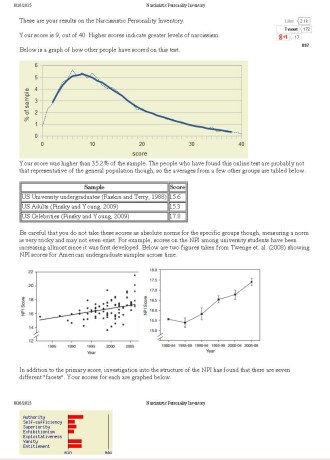
My NPI Score, done August 20, 2015. (http://personality-testing.info/tests/NPI.php).

My NPI Score, done August 20, 2015. (http://personality-testing.info/tests/NPI.php).

I have taken a read — actually, several in the past year — of Jean M. Twenge and W. Keith Campbell’s book The Narcissism Epidemic: Living in the Age of Entitlement (2009). Theirs is a good base to begin to view American society as one so obsessed with individualism that it renders us all anywhere between a little narcissistic to borderline Donald Trumps and Ted Bundys. The psychologists and psychiatrists in this niche have a test for narcissistic personality disorder or NPD, the Narcissistic Personality Index. It consists of 40 questions, seeking to determine whether one is low, medium, or high in narcissism within the index.

I took the NPI last August, and scored a 9 out of 40. It meant that I have some narcissistic tendencies, but only scored higher than 35 percent of those who’ve taken the NPI. I wasn’t even close to being an average American narcissist! Not really a surprise, as those seeking to take such an index are likely less narcissistic than their navel-gazing neighbors.

So, I am in this world and mostly of it, if only because it’s hard to divorce one’s existence from the world in which they live. But I am self-aware enough to know my own narcissism, and empathetic enough to see the narcissism in others.

Great. It still means that as a nation, our narcissism goes as far back as the mind can imagine. It still means that in a couple of centuries, historians will lament about the America that was. Those historians will see a country and a people so busy in building themselves up that they stomped on the oppressed and crushed the downtrodden in the process. A US with so many myths and ideals, but so few attempts at making any of them true.

EWF, A Reminder That I Did Have a Childhood

06 Saturday Feb 2016

Posted by decollins1969 in 1, Boy @ The Window, culture, earth, wind & fire, Eclectic, eclectic music, High Rise Buildings, Mount Vernon New York, music, New York City, Pop Culture, race, Religion, Youth

≈ Leave a comment

Tags

EWF, Funk, Hebrew-Israelite, Humanities, Imagination, Jazz, Maurice Eugene Washington, Maurice Washington, Maurice White, Pop, R&B, Self-Awareness, Self-Discovery


Earth, Wind & Fire's All 'N All (1977) album cover, February 6, 2016. (http://www.allmusic.com).

Earth, Wind & Fire’s All ‘N All (1977) album cover, February 6, 2016. (http://www.allmusic.com).

I’m still reeling over Maurice White. Yeah, I still have my Earth, Wind & Fire on my CDs, my iPod, my iPhone, on three laptops and a desktop. Phillip Bailey and White’s brothers-in-arts are still here. Their music will always be with me and with us. But it feels like a little piece of my relative (if not contrived) innocence from my pre-Humanities, pre-Hebrew-Israelite days died with White Wednesday night.

Here’s what I wrote about those days of deliberately-induced blissful naiveté, Earth, Wind & Fire included, in my memoir:

“For me, this boy, this tweener, an active imagination and an even more animated dream life was critical. Living in between the hustle and bustle of “The City,” — Manhattan and the other four boroughs of New York — and the relative quiet of the ritzy suburbs immediately north of it was everything and everyone I knew before the age of twelve. Just three blocks after the elevated 2 Subway line ended at East 241st Street in the Bronx was where “Mount Vernon, New York” began. From the hard concrete sidewalks and green street signs of New York to the crumbling light blue slate and dark blue signs were my only indications that I had truly left the city. This despite the claims of so many I knew that upstate New York began somewhere above 125th or 207th Street in Manhattan. I knew by the time I was twelve that, sleepy bedroom suburb or not, Mount Vernon had more features in common with the Bronx and upper Manhattan than most city folk were willing to recognize.

“My only links to the great metropolis to the south were WNBC-TV (Channel 4), Warner Wolf — with his famous “Let’s go to the video tape line — doing sports on WCBS-TV (Channel 2), and WABC-AM 77 and WBLS-FM 107.5 on the radio. I found the AM station more fun to listen to, but I also liked listening to the sign-off song WBLS played at the end of the evening, Moody’s Mood for Love, with that, ‘There I go, There I go, The-ere I go…’ start. Music had been an important part of my imagination in ’79, with acts like Earth, Wind & Fire, Christopher Cross, Billy Joel and The Commodores. Not to mention Frank Sinatra, Queen, Donna Summer and Michael Jackson’s Off The Wall album. The music also made me feel like I was as much a part of New York as I was a part of Mount Vernon. It left me thinking of the ozone and burnt rubber smell that I noticed as soon as I would walk down into the Subway system in Manhattan. But aside from my occasional slip of the tongue — ‘warda’ for ‘water’ and ‘bawwgt’ for ‘bought’ — I didn’t sound or act much like a New Yawker. Still, I discovered something about New York from afar. I could sneak up to the rooftop of my apartment building, 616 East Lincoln, a five-story complex of three connected brick buildings with Tudor-style facades and a concrete-stone foundation. I’d find the exit to the roof unlocked and see the tops of the Twin Towers floating over some low-lying clouds on an otherwise sunny day. The symbols of the greatest city on Earth seemed to float toward the heavens on those days, and me with them.

“Besides the occasional reminder of life outside of my world, of Mount Vernon, I was the center of my own universe. Mount Vernon was but a stage on which my life played out, a place I hoped would stay this way forever. I was an eleven-year-old who thought that my world was the world. I lived my life like Philip Bailey and Maurice White would’ve wanted me to. I came to see ‘victory in a life [sic] called fantasy’ as my own life, living as if my imagination and dreams could be made into reality. All I had to do was wish it so.”

Because of what I went through during the Boy @ The Window years, I had to learn to get over my idiot ex-stepfather’s abuse to continue listening to Earth, Wind & Fire between ’82 and ’89. The late Maurice Eugene Washington was a fan as well, and I didn’t want us to both like the same music. Who the heck knew what was going on in his head when he heard “Fantasy” or “After The Love Is Gone,” anyway?

All I know is, there won’t be another group like the one Maurice White founded in ’69, the year I was born. All I can do is hold on to my precious Earth, Wind & Fire music, and the imagination that it helped spark. All I can do now is hope that someone can even begin to approach the kind of ethereal and powerfully Black-and-proud mix of music that White, Bailey, et al. were able to construct for nearly a decade. One can fantasize, right?


Aside

Leaving Mount Vernon

26 Wednesday Aug 2015

Posted by decollins1969 in 1, Boy @ The Window, Christianity, culture, Eclectic, eclectic music, High Rise Buildings, Jimme, Mount Vernon High School, Mount Vernon New York, music, My Father, New York City, Pittsburgh, Politics, Pop Culture, race, Religion, University of Pittsburgh, Work, Youth

≈ Leave a comment

Tags

"Emotion (Ain't Nobody)" Remix (2014), "Swimming Pools (Drank)" (2012), Child Abuse, College, Domestic Violence, Emotions, Family, Kendrick Lamar, Leaving, Loneliness, Maverick Sabre, Moving, Pitt, Politics of Respectability, Poverty, Respectability Politics, Self-Awareness, Self-Discovery


I left for Pittsburgh and for the University of Pittsburgh on this day/date twenty-eight years ago, my first trip on my own. It was my first trip out-of-state since my Mom took me and my brother Darren on a bus trip to Pennsylvania Amish country in June ’78, nine years earlier. At 5:51 am on the last Wednesday in August ’87, with my older brother Darren’s help — and with my Mom and three of four younger siblings watching us from the living room window — I packed my luggage, Army sack, and two boxes of bedding and materials into a Reliable Taxi. We headed for East 241st to meet up with my dad. From there, we took the 2 Subway all the way to Penn Station, with enough time to board and get all of my stuff on the 7:50 am Pennsylvanian train to the ‘Burgh. For the second time in a row, my dad was sober, and gave me a glassy-eyed hug and shoulder squeeze. Darren was both sad and happy to see me go.

Amtrak's Pennsylvanian train pulling out of Altoona, PA station, heading east for Philly, NYC, uploaded February 2013. (Dustin F.; http://www.northeastrailfans.com/).

Amtrak’s Pennsylvanian train pulling out of Altoona, PA station, heading east for Philly, NYC, uploaded February 2013. (Dustin F.; http://www.northeastrailfans.com/).

I’ve gone over the trip to Pittsburgh and my transformation from a seventeen-year-old with the pent-up emotions of someone who hadn’t left May 31, 1982 behind throughout my eight years of blogging and through my memoir. I’ve written about moving on to Pittsburgh before. What I haven’t really written about fully is how I thought and felt in leaving Mount Vernon, New York behind. The short answer is, I was somewhere between terrified, joyous, embittered, and sad to go, and all at once.

I was terrified. It was my first trip on my own, to a city I’d never been to before, to a university I never visited prior to saying yes. I could meet people who might catch on that I was someone who had spent the previous six years with few acquaintances, much less friends. I was hopeful, but had zero idea what to expect.

But I really was happy to leave. Between my decade living at 616, the abuse, the poverty, the Hebrew-Israelite years, the constant ridicule, the years in Humanities, the constant work of watching after Mom, my dad, my siblings, I was through. Throw in a summer of obsession with and emasculation by Phyllis, and five years of realizing that I needed to get out, and going to Pittsburgh was a no-brainer. Heck, if I’d been a bit smarter about my application process, I could’ve just as easily applied to the University of Washington, Stanford, Northwestern, Georgetown, Michigan, University of Toronto and UPenn and almost certainly gotten in. It didn’t matter where I was going, really. I just needed to go and find my myself, and my education with that.

That last year or so in Mount Vernon had let me know that even with an academic scholarship (after a private investigation) from Columbia, staying would’ve been a huge mistake. Between the silent disdain and snickering of Black teachers at Mount Vernon High School around my sullen presence and the whole Estelle Abel episode at the end of four years of torment. Add to that the years of Black middle class folk talking at me about how my life was so much better because they marched or protested somewhere before I was conceived, or because they prayed for me. Add to that this insistence that I “give back to the community.” As if Black Mount Vernon had given me anything but a hard way to go since I was knee-high to a boil weevil.

Viewing and wake service for Heavy D, Grace Baptist Church, Mount Vernon, NY, November 17, 2011. (Mike Coppola/Getty Images; https://cbsnewyork.files.wordpress.com/).

Viewing and wake service for Heavy D, Grace Baptist Church, Mount Vernon, NY, November 17, 2011. (Mike Coppola/Getty Images; https://cbsnewyork.files.wordpress.com/).

As I saw it, the only difference between the vapid, seething facade of White liberalism among paternalistic White Mount Vernonites and the false smiles and frequent excoriations of Mount Vernon’s Black middle class was skin color. They drank deep from swimming pools full of what we now call respectability politics, born out of a need to be good examples to the world, like Kendrick Lamar described in “Swimming Pools” (2012). (Pour up [drank], head shot [drank]…faded [drank]). This isn’t the same as doing the right thing at the right time or speaking truth to power. You make money, wear nice clothes, drive a nice car, stand up straight, look a White man in the eye while firmly grasping his hand. And apologize for not being as assimilable as you pretend. It was 100%, USDA-approved bullshit, and it smelled like it a lot of days, too.

I was sad to leave, too. There was a part of me that still wanted to fit in, out of loneliness, if nothing else. I still liked Clover Donuts and some of the breakfast places on the South Side. I longed for some sort of acceptance, an acknowledgment that I was a real person, even though that would’ve required being around real people at 616, and in Humanities, and in the rest of Mount Vernon. I knew that I’d miss the close proximity to The City. I’d put my hopes and dreams in a place in which I knew I couldn’t afford to stay, literally and figuratively. That longing would come to haunt me in the coming year, but I’d eventually learn, I could always visit New York.

Didn’t We Never Have It All

04 Thursday Jun 2015

Posted by decollins1969 in 1, Boy @ The Window, Christianity, culture, Eclectic, eclectic music, Hebrew-Israelite, Marriage, Mount Vernon New York, My Father, New York City, Pop Culture, race, Religion, Work, Youth

≈ Leave a comment

Tags

"Why Women Still Can't Have It All", Anne-Marie Slaughter, Arkansas, Black Migration, Bradley Arkansas, Conservatism, Evangelical Christianity, Hats, Judah ben Israel, Maurice Eugene Washington, Melissa Harris-Perry, Mother-Son Relationship, Mount Vernon Hospital, MSNBC, Perfectionism, Self-Awareness, Self-Loathing, Self-Sufficiency, Self-Worth, Strikebreaker, Tenant Farming, Vanity, Wear and Tear, Welfare, Welfare Poverty, Xenophobia


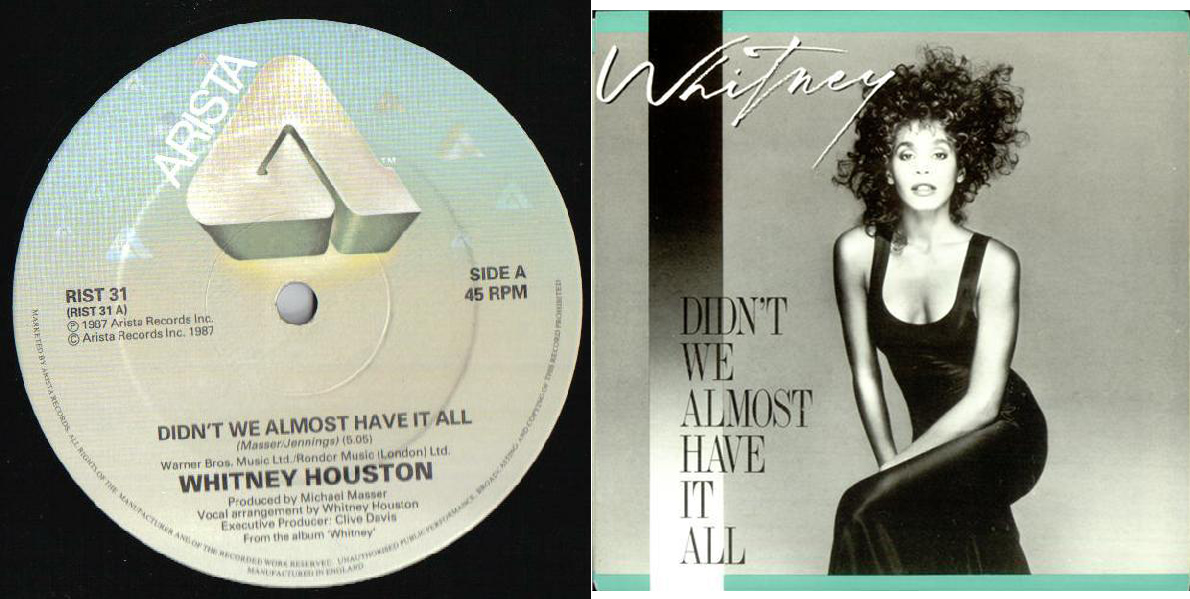
Whitney Houston, "Didn't We Almost Have It All" (released August 1987) Single 45rpm, from 2nd Whitney album (not exactly a favorite), June 4, 2015. (combined/cropped by Donald Earl Collins; http://musicstack.com and http://rapgenius.com).

Whitney Houston, “Didn’t We Almost Have It All” (released August 1987) Single 45rpm, from 2nd Whitney album (not exactly a favorite), June 4, 2015. (combined/cropped by Donald Earl Collins; http://musicstack.com and http://rapgenius.com).

I’ve been thinking about this for nearly a year. It started for me last August. Melissa Harris-Perry had a segment on her MSNBC show regarding the multiple hats women of color have worn over the years in taking care of their families, immediate, extended and non-biological. In response to Anne-Marie Slaughter’s July/August 2012 piece in The Atlantic about “Why Women Still Can’t Have It All,” Harris-Perry and her guests made the point that feminism for women of color has been about far more than having a successful, sexist-free career. That throughout American history, women of color have found themselves wearing multiple hats as primary breadwinners, primary caretakers and primary childrearers, often in ways that traditional feminists don’t discuss or recognize. All without fanfare and with many setback along the way.

What I’ve witnessed and been a part of in my own life reflects much of the conversation that Harris-Perry led on her show. The physical, mental and psychological scars from caring for family, friends and children, while struggling financially and dealing with racism and misogyny often manifests in disease and depression for so many women of color. There’s so much more, though, in terms of how my own mother’s multiple hats and habits led me to so many of my own. All initially to help her, but in the end, helping myself become self-sufficient. Not to mention making myself more understanding of where all the wear, tear and lack of care that wearing so much for so long can lead.

My Mom’s Hats and Habits:

The Anne-Marie Slaughter image of multitasking/wearing multiple hats (just think what this is like for poor, low-income, women of color), February 4, 2015. (ALAMY; http://telegraph.co.uk).

The Anne-Marie Slaughter image of multitasking/wearing multiple hats (just think what this is like for poor, low-income, women of color), February 4, 2015. (ALAMY; http://telegraph.co.uk).

Before I turned thirteen years old, my mother had been far more than my Mom. She’d been a dietary supervisor at Mount Vernon Hospital, just outside New York City, since 1968, the year before I was born. She had been a high school basketball player, a caregiver to her eleven brothers and sisters, and a cotton-picking breadwinner for her family in segregated southwestern Arkansas, an area located in the Red River Valley, part of the larger Mississippi Delta region. She had become our family’s primary breadwinner in the years after she gave birth to my older brother and me. Not to mention a married young woman now living a thirty-minute train ride from Midtown Manhattan, between the Hudson and Hutchinson Rivers, on the border between affluent Westchester County and the Bronx.

Life didn’t treat my Mom too kindly once she married my alcoholic father in 1971. And it actually went from bad to worse as she divorced him for my stepfather in 1978. By then, she had become a cigarette smoker, a one-time adulterer, and an abuse survivor. My Mom did everything she could to shield my older brother and me from her habits and the realities of our tough life in Mount Vernon in the 1970s and early 1980s. But by the end 1982, as I turned thirteen, all the hats my Mom had worn began to fall to the ground. In taking on the role of a strikebreaker, all of our lives would change forever.

In response to concessions made to the union, who left her unprotected, Mount Vernon Hospital cut her from full-time to part-time. My Mom became the besieged one. She was the old woman in the shoe, with six kids — including four under the age of five — and a cheating, abusive, unemployed, sometimes-at-home husband. It was my Mom’s job to take care of us all. Yet no longer was she a breadwinner. My Mom had become one of Reagan’s alleged welfare queens, pulling in $16,600 in AFDC payments per year from April 1983 until I left for college in August 1987. With all of that, I became a hat juggler myself.

Once Her Hats Became My Own:

For a while during my teenage years, my Mom had been my friend, one in which I could usually confide, albeit out of anger and frustration. All while taking on more and more of what had been her duties, including the brunt of her second husband’s rage and fists. I’d become an everyday grocery shopper, a frequent family cook, and a sometimes provider, the last mostly through tracking down my own father for a few extra dollars every Friday or Saturday at one of his favorite bars. Or, by the time I was sixteen, through working part-time. I provided childcare on afternoons, evenings and weekends. I washed clothes with my older brother on Saturdays or Sundays every week without fail from October 1982 on.

Hat stall at a Sunday fair, Amsterdam, The Netherlands, August 31, 2008. (Jorgeroyan via Wikipedia). Released to public domain via CC BY-SA 3.0.

Hat stall at a Sunday fair, Amsterdam, The Netherlands, August 31, 2008. (Jorgeroyan via Wikipedia). Released to public domain via CC BY-SA 3.0.

By the end of high school, I realized too who my Mom wasn’t, maybe for the first time. She wasn’t an encourager, a person who pushed her kids to pursue their dreams. With so many “Are you sure…?” questions my last two years of high school, it’s a wonder I applied to any colleges at all. Mom wasn’t a nurturer either, especially after I became a teenager. My Mom had only said “I love you” to me two times between my twelfth and nineteenth birthdays, including at my high school graduation ceremony in June 1987. She also wasn’t easygoing. Any mistake with money or my time would get a “Serves you right…” sermon about never screwing up.

The Toll Caring For Others Can Take:

All of this has made my Mom a conservatively cautious perfectionist, one living with depression and in constant denial about our shared past. I guess that it was all too much for her, like reaching the Jordan River, but not being allowed to cross it. Our shared experiences had also made me cautious and perfectionistic in my dealings with myself and the world, as I had to wear so many of my Mom’s hats and cross so many of those rivers with her. My mother tried to be all things to me and my older brother especially, and failed more than she succeeded in the process. For that and so many other reasons, despite her mistakes, I love her very much.

It’s been more than twenty-seven years since I moved away for the greener pastures of the University of Pittsburgh. Yet it’s only been in the past decade that I’ve learned to stop striving for perfection in all the things I say and do. It ultimately takes a lifetime to unlearn all the bad habits and prejudices and give up on juggling all the ideas and roles that our parents have put on us. My journey with and without my Mom has been no different. Now that my Mom’s in her late sixties, I just hope that the only hat she tries to wear these days is one to keep her head warm on the coldest of days.

The Long Road Home

19 Tuesday May 2015

Posted by decollins1969 in 1, Academia, Boy @ The Window, Carnegie Mellon University, culture, Eclectic, Jimme, Pittsburgh, Politics, Pop Culture, race, Work, Youth

≈ Leave a comment

Tags

"Thriving as a Freelance Academic", Academia, Academic Writing, Bruce Anthony Jones, Career, Career Decisions, Career Development, Career Options, CMU, Disillusionment, Joe William Trotter Jr., Katie Rose Guest Pryal, Peter Stearns, Politics of Academia, Politics of the Foundation World, Self-Awareness, Self-Determination, Self-Discovery, Social Justice, Teaching and Learning, The Chronicle of Higher Education, Troublemaker, Writing


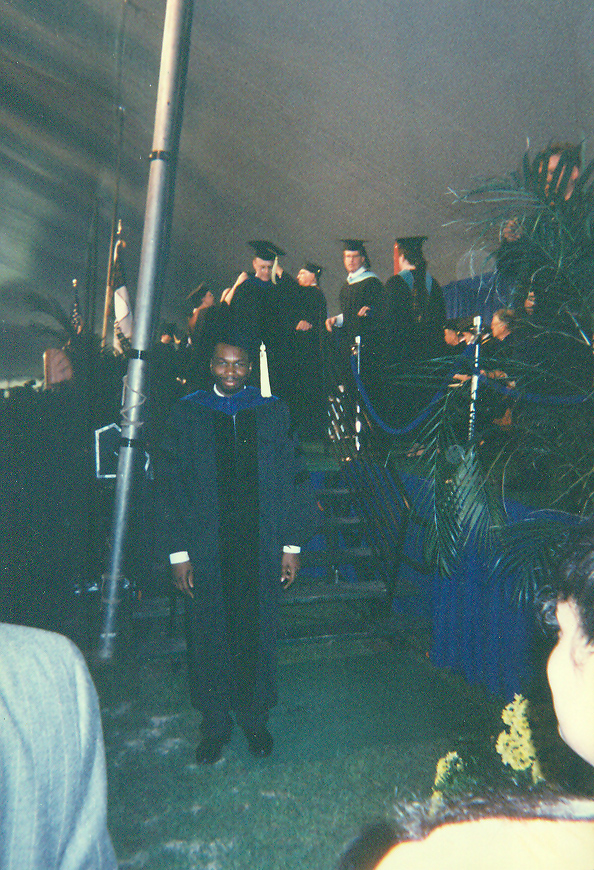
My stressed-out PhD walk photo, Carnegie Mellon University, May 18, 1997. (Angelia N. Levy).

My stressed-out PhD walk photo, Carnegie Mellon University, May 18, 1997. (Angelia N. Levy).

It’s been eighteen years and nearly a day since I had to shake then Carnegie Mellon Dean Peter Stearns’ hand on stage as part of the PhD portion of the 100th commencement ceremony for graduates, that third sweltering Sunday in May ’97. I’ve talked about the ceremony, my Mom’s jealousy and issues about my degree, Peter Stearns, Joe Trotter, Bruce Anthony Jones, and what happened before and after the degree ceremonies on that fateful day.

But time and enlightenment — especially the latter — has allowed me to take a step back from the events leading to a new wave of disillusionment in my life. If I really think about it, my struggles with where I wanted to go with my career go as far back as ’81, in the months after my first accolades as a writer, to the time when at eleven, I already had an encyclopedic knowledge of history, basic science, and technology. Heck, I already knew some of the historiography around World War II, the Cold War, American slavery and civil rights, long before I ever knew the definition for historiography. Not to mention, I was already living what we now call migration studies, thanks to my Mom and dad.

But my Boy @ The Window years did their damage to me. By the time I turned twenty at the end of the ’80s, I wasn’t fully clear of the array of choices I had for a career or set of careers. I knew I could write, and often write well. Yet I had stopped seeing myself as a writer by the time I went through my summer of abuse in ’82. I knew that I was a historian, because I asked the kinds of questions about history that only trained historians would. Yet I hated the idea that I was supposed to write only one way, using words like synergistic and interstitial (at an esoteric minimum) along the way. I toyed with the idea of going to law school in ’90, even going so far as to take the LSAT, scoring a then-50th percentile 31 on the exam in my one-and-only try.

Arthur Wesley Dow (1857-1922), The Long Road--Argilla Road, Ipswich, circa 1898, April 28, 2010. (BrooklynMuseumBot via Wikipedia). In public domain.

Arthur Wesley Dow (1857-1922), The Long Road–Argilla Road, Ipswich, circa 1898, April 28, 2010. (BrooklynMuseumBot via Wikipedia). In public domain.

I struggled for years with my fundamental question: “Am I an academic historian who’s also a writer? Am I a writer who’s also a historian? Can I be both?” I realized about a decade ago the question was moot. I am both. The real question really has been, will the working world allow me to operate as both without giving me grief and a hard way to go? (By the way, if I ever were to do a second, post-Boy @ The Window memoir, this would be one of that book’s big themes.)

I can safely say as a mildly successful freelance writer that the answer for many in this world of singularities is no. The working world puts up a fight, has and will continue to try to force me and others with multiple talents to choose one path, to do one thing, and one thing only, ideally for all time.

Academicians only think about each other via teaching duties or well-placed articles and books in scholarly journals and scholarly publishing houses. Higher education administrators believe that the only way to understand their work is through the lens of their specific university, as if universities and colleges aren’t similar from a management standpoint. Nonprofit organizations

A male mallard duck, a bird's triple threat (can walk, swim under water and fly), Saint-Eustache, Quebec, Canada, November 19, 2007. (Acarpentier via Wikipedia). Released to public domain via CC-SA-3.0.

A male mallard duck, a bird’s triple threat (can walk, swim under water and fly), Saint-Eustache, Quebec, Canada, November 19, 2007. (Acarpentier via Wikipedia). Released to public domain via CC-SA-3.0.

discount teaching and higher education administrator positions because finding money or managing students isn’t exactly the same as managing staff. Foundations who use your salary history instead of your scope of programs developed, people reached, and money raised as a barometer for even granting you an interview. All would prefer that you be quiet about injustices, especially ones in which their institution, organization, or foundation might well be complicit.

For me in the past couple of decades, though, I’ve worked in and with academicians, higher education administrators, nonprofit organizations, and private foundations. I’ve helped raise $3 million over the years, managed as many as twenty-five staff members, organized four-day conferences with a couple hundred attendees, worked with as many as 500 students at any given time, and taught undergraduate and graduate courses. I’ve written scholarly articles, published in scholarly journals, presented at a couple dozen conferences, and consulted for nonprofit organizations and foundations. To think of myself as only one thing is beyond ridiculous given my by-necessity-and-neglect careers so far.

Yesterday, The Chronicle of Higher Education posted the article “Thriving as a Freelance Academic” by Katie Rose Guest Pryal. In it, Pryal interviewed three White women about their experiences freelancing in the academic world. The women interviewed found a singular niche, found steady work through that niche, and otherwise didn’t question the idea of freelancing in a world in which freelancing is a rare career choice.

A square peg hammered into a round hole, May 2014. (http://joshbrahm.com/).

A square peg hammered into a round hole, May 2014. (http://joshbrahm.com/).

All that is fine. Except there was little soul-searching in Pryal’s piece. The women interviewed might as well have decided to go on a global trek or rock climbing, given their lack of ambivalence about academia or deliberate lack of specifics and dryness about the work they actually do. I don’t doubt that one can freelance in academia. I doubt, though, that one can do it without personal relationships with a specific university or alma mater, or with a specific higher education administrator or prominent professor. Why pick on this piece? Because there are far more people like me in and out of academia, who’ve consulted and freelanced and worked and stitched together a career, then there are the people represented in Pryal’s boutique article.

There is a lesson here besides the reality that life is a journey, and to get it right, we need to understand that it can and will be a roller-coaster-ride of a journey. The lesson, for me at least, is that while being true to myself has sometimes had consequences in terms of immediate victories and easy financial gains, it does mean I get to have success, and sometimes, even lasting success.

← Older posts
Newer posts →

Boy @ The Window: A Memoir

Boy @ The Window: A Memoir

Places to Buy/Download Boy @ The Window

There's a few ways in which you can read excerpts of, borrow and/or purchase and download Boy @ The Window. There's the trade paperback edition of Boy @ The Window, available for purchase via Amazon.com at http://www.amazon.com/Boy-Window-Donald-Earl-Collins/dp/0989256138/

There's also a Kindle edition on Amazon.com. The enhanced edition can be read only with Kindle Fire, an iPad or a full-color tablet. The links to the enhanced edition through Apple's iBookstore and the Barnes & Noble NOOK edition are below. The link to the Amazon Kindle version is also immediately below:

scr2555-proj697-a-kindle-logo-rgb-lg

Boy @ The Window on Amazon.com: http://www.amazon.com/Boy-The-Window-Memoir-ebook/dp/B00CD95FBU/

iBookstore-logo-300x100

Boy @ The Window on Apple's iBookstore: https://itunes.apple.com/us/book/boy-the-window/id643768275?ls=1

Barnes & Noble (bn.com) logo, June 26, 2013. (http://www.logotypes101.com).

Boy @ The Window on Barnes & Noble: http://www.barnesandnoble.com/w/boy-the-window-donald-earl-collins/1115182183?ean=2940016741567

You can also add, read and review Boy @ The Window on Goodreads.com. Just click on the button below:

Boy @ The Window

Twitter Updates

Tweets by decollins1969
  • RSS - Posts
  • RSS - Comments

Archives

  • June 2025
  • April 2023
  • September 2022
  • August 2022
  • July 2022
  • June 2022
  • May 2022
  • April 2022
  • March 2022
  • January 2022
  • December 2021
  • November 2021
  • October 2021
  • September 2021
  • August 2021
  • July 2021
  • June 2021
  • April 2021
  • March 2021
  • February 2021
  • January 2021
  • December 2020
  • November 2020
  • October 2020
  • September 2020
  • August 2020
  • July 2020
  • May 2020
  • April 2020
  • March 2020
  • January 2020
  • December 2019
  • November 2019
  • August 2019
  • July 2019
  • June 2019
  • May 2019
  • April 2019
  • March 2019
  • February 2019
  • January 2019
  • December 2018
  • November 2018
  • October 2018
  • September 2018
  • August 2018
  • July 2018
  • June 2018
  • May 2018
  • March 2018
  • February 2018
  • January 2018
  • December 2017
  • November 2017
  • October 2017
  • September 2017
  • August 2017
  • July 2017
  • June 2017
  • May 2017
  • April 2017
  • March 2017
  • February 2017
  • January 2017
  • December 2016
  • November 2016
  • October 2016
  • September 2016
  • August 2016
  • July 2016
  • June 2016
  • May 2016
  • April 2016
  • March 2016
  • February 2016
  • January 2016
  • December 2015
  • November 2015
  • October 2015
  • September 2015
  • August 2015
  • July 2015
  • June 2015
  • May 2015
  • April 2015
  • March 2015
  • February 2015
  • January 2015
  • December 2014
  • November 2014
  • October 2014
  • September 2014
  • August 2014
  • July 2014
  • June 2014
  • May 2014
  • April 2014
  • March 2014
  • February 2014
  • January 2014
  • December 2013
  • November 2013
  • October 2013
  • September 2013
  • August 2013
  • July 2013
  • June 2013
  • May 2013
  • April 2013
  • March 2013
  • February 2013
  • January 2013
  • December 2012
  • November 2012
  • October 2012
  • September 2012
  • August 2012
  • July 2012
  • June 2012
  • May 2012
  • April 2012
  • March 2012
  • February 2012
  • January 2012
  • December 2011
  • November 2011
  • October 2011
  • September 2011
  • August 2011
  • July 2011
  • June 2011
  • May 2011
  • April 2011
  • March 2011
  • February 2011
  • January 2011
  • December 2010
  • November 2010
  • October 2010
  • September 2010
  • August 2010
  • July 2010
  • June 2010
  • May 2010
  • April 2010
  • March 2010
  • February 2010
  • January 2010
  • December 2009
  • November 2009
  • October 2009
  • September 2009
  • August 2009
  • July 2009
  • June 2009
  • May 2009
  • April 2009
  • March 2009
  • February 2009
  • January 2009
  • December 2008
  • November 2008
  • October 2008
  • September 2008
  • August 2008
  • July 2008
  • June 2008
  • May 2008
  • April 2008
  • March 2008
  • February 2008
  • January 2008
  • December 2007
  • November 2007
  • October 2007
  • September 2007
  • August 2007
  • July 2007
  • June 2007

Recent Comments

MaryPena's avatarMaryPena on My Day of Atonement/Bitter Hat…
decollins1969's avatardecollins1969 on No Good Teaching Deed Goes…
Mary Rose O’Connell's avatarMary Rose O’Connell on No Good Teaching Deed Goes…

NetworkedBlogs on Facebook

NetworkedBlogs
Blog:
Notes From a Boy @ The Window
Topics:
My Life, Culture & Education, Politics & Goofyness
 
Follow my blog

616 616 East Lincoln Avenue A.B. Davis Middle School Abuse Academia Academy for Educational Development AED Afrocentricity American Narcissism Authenticity Bigotry Blackness Boy @ The Window Carnegie Mellon University Child Abuse Class of 1987 CMU Coping Strategies Crush #1 Crush #2 Death Disillusionment Diversity Domestic Violence Economic Inequality Education Family Friendship Friendships Graduate School Hebrew-Israelites High-Stakes Testing Higher Education History Homelessness Humanities Humanities Program Hypocrisy Internalized Racism Jealousy Joe Trotter Joe William Trotter Jr. K-12 Education Love Manhood Maurice Eugene Washington Maurice Washington Misogyny Mother-Son Relationship Mount Vernon High School Mount Vernon New York Mount Vernon public schools Multiculturalism MVHS Narcissism NFL Pitt Pittsburgh Politics of Education Poverty President Barack Obama Race Racial Stereotypes Racism Relationships Self-Awareness Self-Discovery Self-Reflection Sexism Social Justice Teaching and Learning University of Pittsburgh Violence Whiteness Writing

Top Rated

Blog at WordPress.com.

  • Subscribe Subscribed
    • Notes from a Boy @ The Window
    • Join 103 other subscribers
    • Already have a WordPress.com account? Log in now.
    • Notes from a Boy @ The Window
    • Subscribe Subscribed
    • Sign up
    • Log in
    • Report this content
    • View site in Reader
    • Manage subscriptions
    • Collapse this bar
 

Loading Comments...