• About Me
  • Other Writings
  • Interview Clips
  • All About Me: American Racism, American Narcissism, and the Conversation America Can’t Have
  • Video Clips
  • Boy @ The Window Pictures
  • Boy @ The Window Theme Music

Notes from a Boy @ The Window

~

Notes from a Boy @ The Window

Tag Archives: Mount Vernon New York

Musical ‘Mates and Matters

24 Saturday Dec 2011

Posted by decollins1969 in 1, Boy @ The Window, culture, earth, wind & fire, Eclectic, eclectic music, Mount Vernon High School, Mount Vernon New York, music, New York City, Pop Culture, race, Youth

≈ Leave a comment

Tags

Common Language, Cultural Divide, Cultural Eclectic-ness, Diversity, Eclectic Music, Mount Vernon High School, Mount Vernon New York, Mount Vernon public schools, Music, Musical Tastes, Race


The "A" Note, February 5, 2008. (Pearson Scott Foresman, via Wikipedia). In public domain.

If someone asked me what was the one thing that me and my classmates had in common during my middle school and high school years in Mount Vernon, New York, it would be a love of and for music. I wouldn’t have been able to draw this rather obvious conclusion five years ago. But, in the course of interviewing folks and writing and rewriting my Boy @ The Window manuscript since ’06, music seems to be the one common denominator that connected us all.

Take the fact that so many of my Class of ’87 classmates found their way into the underground or mainstream music scene over the past twenty-four years. At least one was a producer, a bunch rapped, played, sang, and danced their way into the industry, even if they’re not household names. Others did studio work, and at least two are doing music/sound work for the small and big screen.

These folks are Black, White, Afro-Caribbean and Latino, so, no, race doesn’t seem to be a factor. Was it something that was in the water or in Mount Vernon’s lead water pipes? Not likely. It really couldn’t have been instilled in us by Humanities, or going to Davis, Nichols or Mount Vernon High School, right? The official doctrine of the powers that were would’ve made our favorite music somewhere between Sinatra and Tchaikovsky.

It could be as simple and as complicated as the times we grew up in, the fellow travelers to which we were

Culture Club "Club Sandwich Tour" poster, September 27, 2011. (Wikipedia). Qualifies as fair use under US Copyright laws because of low resolution and subject of blog post.

exposed, the constant noise that was Mount Vernon public schools in the 1970s and 1980s. Living in a city in the early stages of decline, within shouting distance of Manhattan and a short walk to the Bronx. Having the level of Black and Brown diversity that we had, with a decent sized White minority in the school system, may be all that was needed to create the conditions for music to be our one common language.

It wasn’t just in my class, as the classes of ’85 and ’86 turned out the late Heavy D and Al B. Sure. Nor was it just in Mount Vernon’s public schools. There was something about Mount Vernon itself, a painful place for some, a cool and pleasureful one for others, that made music both a code for coolness and an escape from reality.

For my specific groups of Humanities nerds, renaissance folks and generally sharp classmates, though, the tastes ranged and even mingled. For the guidos and guidettes whom I labeled “The Italian Club,” the music was decidedly “White.” From “A” serenading 7S with The Police’s “Roxanne” ala Eddie Murphy, to the frequent blaring of Billy Idol, Bruce Springsteen and Foreigner from turbo-charged Camaros and Mustangs.

The Time promotional poster, circa 1990, July 6, 2006. (Mista Tee, via Wikipedia). Qualifies as fair use under US Copyright laws because of low resolution and subject matter for blog post.

Then the was the obviously cool Black and Afro-Caribbean, with a clique for every occasion, whose music was also obviously “Black.” Teena Marie, pre-“Material Girl” Madonna, Phyllis Hyman, Prince, Luther Vandross, Doug E. Fresh, Lisa Lisa & Cult Jam, Run-DMC, if it was Black and cool, they listened to it, and knew the exact date the new album would hit the stores. They drove around in their Nissan Maximas, Audis and old Cadillacs with this mesh of R&B, early rap and hip-hop, and crossover pop pumping out of their tinted windows.

Of course, that left the rest of us, the few who seemed to like a bit of everything. Crush #1 and Depeche Mode. Brandie Weston and her clique’s love of Boy George and Culture Club. V’s commitment to Billy Joel, at least a decade and a half too young to understand the full meaning of what we’d now call adult contemporary. Not to mention The Police, Sting, The Who, Rolling Stones, Thompson Twins, Duran Duran, ABC, Tears for Fears, a-ha, and so many others. But it didn’t stop there. For we, too, liked Luther, and Billy Idol, and John Coltrane, and Lisa Lisa, and Run.

I don’t know if my musical tastes were the most eclectic of all, or if mine remain so. But I can say this. I ran 4.75 miles yesterday, listening to Genesis’ “Tonight, Tonight, Tonight” (album version), Sounds of Blackness’ “Optimistic,” U2’s “Beautiful Day,” Grover Washington Jr’s “Summer Chill,” Stevie Wonder’s “As,” Sting’s “A Thousand Years,” and Enigma’s “Silence Must Be Heard” along the way. It seems that I’ve always had a song in my head and theme music in my heart for every situation and every period of my life. For better and for worse, I have to give Mount Vernon credit for that, if for nothing else.
Reinventing the Writing Wheel

17 Saturday Dec 2011

Posted by decollins1969 in 1, Academia, Boy @ The Window, culture, Eclectic, eclectic music, Hebrew-Israelite, music, Pop Culture, race, Religion, Youth

≈ Leave a comment

Tags

"Children's Crusade", 616, 616 East Lincoln Avenue, Coping Strategies, Historian, Mount Vernon New York, Paul Riggs, Pitt, Re-Discovery, Reinventing the Wheel, Scholar, Self-Discovery, Sting, The Dream of the Blue Turtles, University of Pittsburgh, Western Civilization II, World War I, Writer, Writing


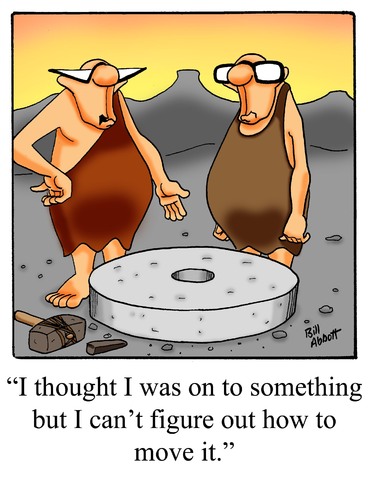
Inventing the Wheel cartoon, October 2, 2009. (Bill Abbott/http://www.toonpool.com/).

One of the side effects of having lived through the hell of my family struggles at 616 in Mount Vernon, New York between ’81 and ’89 was that I’d forgotten about the person I was before we became Hebrew-Israelites. As great as I am at recalling faces, smells, conversations, exact facts and phrases based on images and songs, I’ve been almost equally as good at blocking out whole sections of my personality. All in an effort to cope with the emotional pain and psychological trauma that is betrayal, abuse and neglect.

I have the unfortunate distinction of having seen myself as a writer in ’81 at the age of eleven, only to take nearly twenty years to see myself that way again. There were a few sign posts in the dark forest of confusion about my calling that I found on my way to getting back on the writing road. One of those sign posts was my teaching assistant and friend during my undergraduate years at the University of Pittsburgh in Paul Riggs.

Paul Riggs, Professor and Department Chair, Department of History, Valdosta State University (GA), December 17, 2011. (http://www.valdosta.edu).

Paul was the TA for my section of the Western Civilization II course taught by his advisor in Sy Drescher in the Spring semester of ’88. He was a second-year history grad student, a nice looking White guy for a nerd. Already in his mid-twenties with, his blonde-brown hair and around six-feet, Paul was a rarity on campus. So was his class. Paul found a way to do more than ask us a bunch of questions that were meant to quiz us on the textbook. We debated the significance of things like a richer diet and its impact on population growth and the expansion of European imperialism, the connections between Charles Darwin, evolution, and the advent of scientific racism at the end of the nineteenth century, and so many other things that allowed us to connect the dots.

Paul was also the first teacher I had at Pitt who assumed that I could do the work without acting as if I shouldn’t have been in their classroom. It helped that he occasionally indulged me. When our weekly discussion turned to the killing fields that had been northern France and Belgium for the bulk of the four years of World War I, I allowed my imagination to get the better of me. I made a comment that connected the tragedy of deadly trench warfare to a song by Sting called “Children’s Crusade.” I started quoting lyrics, like “virgins with rifles, a game of charade,” “the flower of England, faced down in the mud, and stained in the blood of a whole generation,” and “corpulent generals safe behind lines.”

I related it all to the documents book and Drescher’s lectures on the war that wiped out a generation of

Sting, The Dream of the Blue Turtle CD Cover (1985), December 17, 2011. (Donald Earl Collins).

young men in Western Europe. It took me two minutes of class time to draw all of the different connections. Paul, shaking his head at the end, got this incredulous smile on his face. All he said was, “um, you know Sting’s overrated?”

But Paul proved to be much more helpful a year and a half later. By then I was in my junior year at Pitt, no longer living in constant worry that I’d have to return to 616 to bury my mother and press charges against my idiot stepfather. By then, Maurice was my ex-stepfather, and thankfully so. For the first time in eight years, I kept a journal, putting together a series of stories based on my worst experiences at 616, on welfare, with my family, and in Mount Vernon.

All of it made me think about writing a book that looked at the sociological and psychological dimensions of the welfare system, for both recipients and for case managers charged with providing benefits. I wanted to make Westchester County Department of Social Services the centerpiece for such a book. I decided to talk to Paul about all of my ideas, not wanting to give away how personal this issue was for me. Paul asked me the questions that it would take another eleven years to answer. “What kind of writer do you want to be?,” and “How is history related to what you want to write about?,” he asked over the course of our conversation.

I really didn’t know the answers to either question. I wasn’t even sure that I wanted to pursue an advanced degree, become a professor, or become a writer. But I knew that I needed to find out.

Still, one thing that I decided to do that would determine most of my career travels over the next decade is to make myself into the semi-dispassionate scholar I knew I needed to become in order to be a better historian, which I presumed would make me a better writer. Only to spend this past decade reconnecting to my emotions and passion, which has made me the writer I once hoped to become.

If Boy @ The Window Were A Movie…

10 Saturday Dec 2011

Posted by decollins1969 in 1, Boy @ The Window, culture, Eclectic, Mount Vernon High School, Mount Vernon New York, Movies, My Father, Pop Culture, Youth

≈ Leave a comment

Tags

Acting, Actors, Alison Arngrim, Boy @ The Window, Brad Dourif, Brian Dennehy, Clarke Peters, Gabrielle Union, Harold Perrineau, Humanities, James Avery, Jesse L. Martin, Khandi Alexander, Mount Vernon New York, Movies, Nathan Fillion, Ray Liotta, Rita Moreno, Rob Brown, Thandie Newton, TV Shows


Not So Young Man @ His Window, December 10, 2011. (Donald Earl Collins).

…who would I hire to play the characters in my memoir? Especially if I could reach across space and time to pick actors with the range necessary to play complicated characters, like yours’ truly, for instance. Hmm. I have a few ideas:

Rob Brown, ala Finding Forrester (2000) – He’d been a perfect character to play me during my high school years, between the blank stare and face, his height, and his ability to show awkwardness around Whites in authority.

Rob Brown as Jamal Wallace in Finding Forrester (2000) Screen Shot. (http://filmdope.com).

Khandi Alexander, ala The Corner (2000) – While she isn’t nearly as tall and is a bit chestier than my mother, her affect as the down-and-out West Baltimore mother on the groundbreaking HBO miniseries fits here.

James Avery – He would be in the role of my idiot ex-stepfather, with his bulging eyes and belly, and with his flashes of rage, yeah, he’d been perfect.

Clarke Peters, ala The Wire, Treme – I thought about someone like Sammy Davis, Jr. playing the role of my father, Jimme, but Davis’ acting range wouldn’t have been enough to capture both my father’s drunken rage and the comedy that often served as an overlay to my encounters with my father growing up.

Clarke Peters at Edinburgh Festival 2010, August 6, 2010. (Ausir). Released to public domain via GNU Free Documentation License.

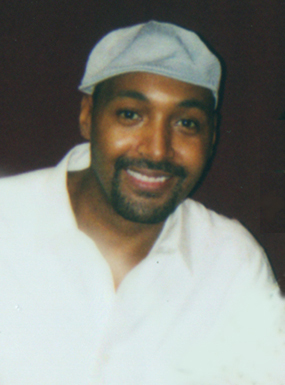
Jesse L. Martin – The man’s acting range is enormous, and would capture the complexities of playing someone like my older brother Darren, a super-shy kid who himself played the role of someone mentally retarded while also having taught himself to read at the age of three. Only, Darren didn’t know how to stop.

Jesse L. Martin at Annual Flea Market and Grand Auction hosted by Broadway Cares/Equity Fights AIDS, September 26, 2006. (Insomniacpuppy). Released to public domain via Wikipedia.

Harold Perrineau, ala Oz – His face alone captures a lot of emotion, and show does the way he says his lines, something that I’d want from someone playing my best friend from elementary school. Perrineau’s face would also capture duplicity, a necessary ingredient for betraying a friendship. Just like many of the characters in the HBO series Oz.

Thandie Newton – This was a tough one, as I also thought about Rosario Dawson in the role of Crush #1. But Newton has quirkiness as an actor that Dawson lacks at times, and for all of the wonderful traits of the character known as Crush #1, quirkiness is key.

Thandie Newton at the 2007 Toronto International Film Festival, September 2007. (http://www.flickr.com/photos/gdcgraphics/1639139527/in/set-72157602744288487/). Released to public domain via Creative Commons Attribution 2.0.

Ray Liotta – Not nearly as tough, this despite the fact that the real “A” had blondish hair when we were kids. Liotta’s meanness, his laugh, his Italian coldness easily capture what “A” was like as my tormentor in seventh grade.

Nathan Fillion, ala Firefly (2002-03), Serenity(2005) – the near-perfect actor to play the contrarian one, “JD” (see my post “The Contrarian One” from February ’11), his aloofness, his sense of superiority, his maverick affect throughout our years in Humanities together.

Nathan Fillion as Capt. Malcolm Reynolds, Firefly (2002-02). (Wikipedia.org).

Alison Arngrim, ala Little House on the Prairie (1974-82) – She played Nellie Olson on the show, a bratty, well-off girl who only knew how to view the world through her own selfish lens. She could play any number of my former White classmates, especially many of the ones who left Humanities between the end of eighth and the beginning of tenth grade.

Little House on the Prairie's Nellie Olson as played by Alison Arngirm, circa 1977. (http://www.flickr.com/3595/3433153010_b5f3cae12a.jpg).

Gabrielle Union – as this actor has done the affect of pissed off and Black preppie well over the years, she’d be great for the role of Crush #2, the one the main character (me) becomes obsessed with in the six months after graduating high school. Like the character, Union can crush hearts.

Rita Moreno – A fixture in the acting business for more than sixty years, one of a handful to win an Oscar, an Emmy, and a Tony Award, she could easily slip on the role of a guidance counselor like the chain-smoking, stereotyping bigot Sylvia Fasulo. The only other person who’d fit this role is Callie Thorne from the USA show, Necessary Roughness.

Brian Dennehy – There aren’t many actors who could play my late AP US History teacher Harold Meltzer. You see, you’d need to be able to spit, to tell long and strange stories, to have moment of macabre laughter and moments of bitter rage. Dennehy, though, has experience doing all of those things, though not in one role. Plus, he’s tall and rotund enough for the part.

Brad Dourif, ala Dune (1984), Lord of the Rings: The Two Towers (2002) – He’s weird enough to play the role of Regis, one of my older friends from my undergraduate days at the University of Pittsburgh, someone who was there for me the semester I went through homeless and three months without money.

Brad Dourif at the Lord of the Rings-Convention Ring*Con in Bonn, Germany, November 23, 2002. (Diane Krauss). Released to public domain via GNU Free Documentation.

I could go on and on. But that’s unnecessary here. This ensemble cast, with the right script — and a time machine — would make Boy @ The Window come alive, and have me blushing and crying over and over again.

The Last Mugging

06 Tuesday Dec 2011

Posted by decollins1969 in 1, Boy @ The Window, culture, Hebrew-Israelite, Jimme, Marriage, Mount Vernon New York, Politics, race, Religion, Youth

≈ 1 Comment

Tags

616, 616 East Lincoln Avenue, Acts of Kindness, Arthur Treatcher's Fish & Chips, Disillusionment, Mount Vernon High School, Mount Vernon New York, Mugging, Self-Defense, Self-Discovery, Suicide, Waldbaum's, Welfare


East Prospect, Mount Vernon, New York, where Foodtown (once Waldbaum’s) and Rite Aid (formerly Genovese) are today – about 30m from where I was mugged in ’83. (http://maps.google.com).

Twenty-eight years ago yesterday was the last time I was mugged, the last time I had to fend off wannabe thugs. As important as the challenges I face in my life are now, the ones I faced just before my fourteenth birthday were a thousand times more intense, if for no other reason than I nearly took the path of suicide back then.

For whatever the reason, December ’83 was spent without food at 616, this time in the welfare and food stamps era. My mother hadn’t received her welfare check on time. She went to Maurice for money to buy groceries, a necessarily rare move. I’d rather had gone to A (see “The Legend of ‘Captain Zimbabwe‘” post from May ’09) for grocery money than to my stepfather. He came to me and gave me twenty dollars to go to the store.

“Donald, do not lose this money. I don’t want no excuses. I want all my change back. If you have to, catch the bus,” Maurice said to me. I had already missed the last 7 bus going into Mount Vernon, and I knew that by the time I’d finish shopping that I would miss the last 7 for the return.

After shopping for Great Northern beans and rice and some beef neck bones and spinach at the Waldbaum’s on East Prospect — which cost $6.50 by the way —  I walked out with the intent of cutting down Park Avenue to East Lincoln and avoiding most of the potential for a mugging. But it seemed that Maurice’s God had other plans for me. I barely got to the poorly lit corner of Prospect and Park before I was ambushed by four guys, all around my age and size. Part of it was my fault, as the Arthur Treacher’s Fish & Chips that held that corner had closed the year before, a casualty of the recent recession. I saw other people around, but none came to my aid.

So here it was that I was jumped by a bunch of dumb kids with dumb parents trying to beat me up and take thirteen dollars from me. Apparently I must’ve learned something from my idiot stepfather, because I was able to kick, punch, and bite my way out of the mugging at first. I kicked one dumb ass in the balls, bit another’s arm, punched someone else in the jaw. I kept going until someone was able to hold me long enough to reach into my pocket and take the money. Then they took off, running across one of the bridges into the South Side.

Grocery bag torn to shreds, food on the ground, shirttail hanging out, I took off after them, now thinking only about what I’d face at home if I didn’t come in with Maurice’s money. They went east up First Street, turned right up South Fulton, and then left on East Third. With groceries in tow, I just couldn’t keep up.

It was after 9 by the time I got back from Waldbaum’s and my mugging. Mom was worried, actually worried, while Maurice was just pissed.

My mother was more concerned about what happened during the actual fight. I told her about what happened.

“You see someone you know?”

“I think one of them’s named C,” I said.

C and his older brother lived in the equally impoverished building next door, 630 East Lincoln. C’s older brother was in fourth, fifth, and sixth grade with me at Holmes. I hadn’t seen either of them much since elementary school, but I recognized him immediately as the one who said, “Give me the money, muthafucka!” Those were some ugly kids, inside and out.

In an unbelievable turn, my mother took me the next morning to the Mount Vernon Police Station, its juvenile division, to have me press charges, look at mug shots and ID my attackers. It didn’t take me long to ID C and his henchmen, all of whom had juvenile records. Before I left, they had hauled C into the station for booking. I was glad to see that my fists had done some damage to his face.

I went to school that day with my mother and ended up signing in around sixth period. One of my classmates saw me as I was leaving Vice Principal Carapella’s office, on my way to gym. We talked for several minutes about what had happened. He gave me a high-five. It was maybe the second or third time in three years that anyone cared to ask me about what was going on with me outside of school.

That whole twenty-four-hour period was overwhelming. I spent most of that evening at 616 asleep. I spent the rest of the month until my fourteenth birthday considering how to off myself. I spent part of my birthday standing thirteen feet over the Hutchinson River Parkway, on top of the stone facing looking down at the traffic while tears streamed down my cheeks.

All because I had lost hope, and my life was filled with contradiction. Luckily, I found a reason to live, and a reason to begin to see good in others, at least outside of 616.

Finding My Father for the First Time

30 Wednesday Nov 2011

Posted by decollins1969 in 1, Boy @ The Window, culture, Eclectic, Jimme, Mount Vernon New York, My Father, New York City, Work, Youth

≈ Leave a comment

Tags

Alcoholism, Father-Son Relationships, Jacksonville, Jimme, Mount Vernon New York, My Father, New York City, Redemption


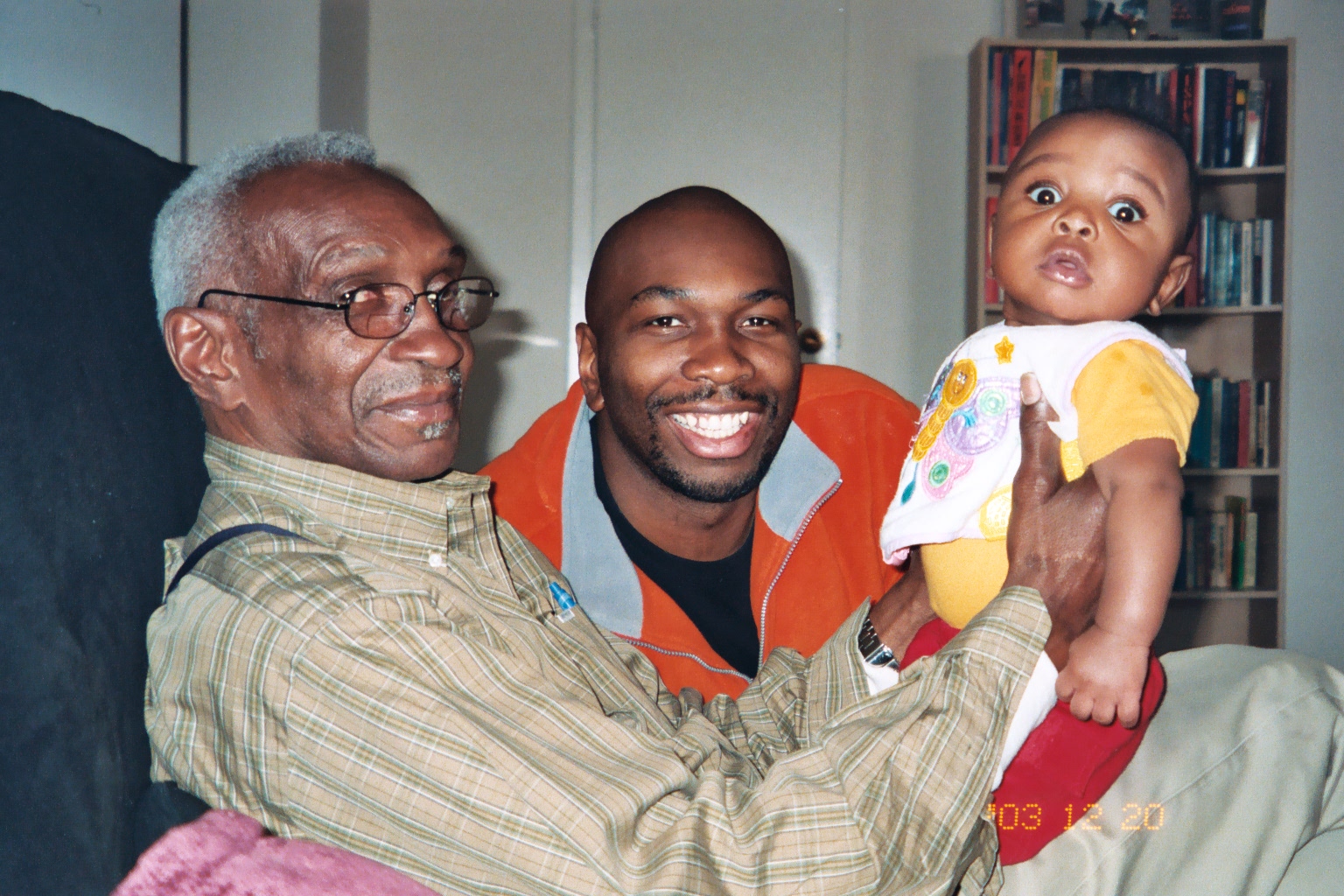
Noah meeting his grandpa for the first time, December 21, 2003. (Angelia N. Levy).

It’s a funny thing to realize that it’s only been about thirteen years since my relationship with my father Jimme became a father-son relationship. That I was a month away from turning twenty-nine before I could say that I’d had a conversation with my father that lasted for more than ten minutes, that didn’t revolve mostly around his job and how many “muddafuckas” he could “buy an’ sell.” That, finally, finally, at the age of fifty-eight, he’d admitted his failings as my father and to being an alcoholic.

The last time I had talked with Jimme before the ’98 holiday season was in the summer of ’96. He’d been living with his boss’ family, the Levi’s, on Long Island because his last drinking binge had led to his landlord Mrs. Small finally evicting him from his South 10th Avenue boarding room. Even though he was with the Levi family (for more on this, read my “New York, New York” post from October ’09), his bosses were about to go out of business. Turned out that one of the Levi brothers made the mistake of talking to an undercover federal agent about doing a contract killing on a competitor. Sounded like fiction at the time, but life is stranger than fiction.

In any case, on that last call, my father seemed lost. Not because he’d been drinking. But because he had nothing left in New York to cling to anymore. A few months later, my father, unemployed and no longer enabled by his former bosses, finally left New York for the family home in Georgia at the invitation of one of his sisters. By the end of ’97, I heard that he had cleaned up his act and moved to Jacksonville. Throughout ’98 and into ’99, I began to get calls from Jimme about how he was finally sober, had found God, and was getting married, to another woman named Mary.

Right after Thanksgiving ’98, though, was the first time I returned one of his calls, just to see if the number worked, to see if he was sane and sober. I wasn’t ready to talk, as I’d heard my father’s song and dance about turning his life around since The Brady Bunch was still on the air with new episodes. But, the fact that he sounded sober for the first time in at least fifteen years was an encouraging sign.

Still, I thought long and hard about blowing him off, keeping my father at the distance of a light-year. All my life, and certainly all of my older brother Darren’s, Jimme had been an evil drunk, verbally abusive and incapable of staying sober for more than three weeks at a time. But he had also been there for me growing up during my Humanities and Hebrew-Israelite years. He helped keep Darren and me from starving or walking around barefoot in ’82 and ’83. He kept the example of hard work in front of us even as the other parent figures in our lives went on dreaded welfare and laid around as if our lives were over. His money was the reason I was able to stay in school after five days of homelessness my sophomore year at Pitt.

So I called him again, deciding to give him a second chance. That was February ’99, a two-hour conversation about how he managed to become a recovering alcoholic, a church-goer, and a married man. He admitted that he had made many mistakes, that he was an alcoholic, that he loved me and my brother. It was a conversation, a real conversation, an unbelievable change of relationship. After twenty-nine years and two months, I finally had a father that I really could call father.

Thirteen years later, and I’m still amazed that I’m able to talk to my father as my father, and not as the person I used to have to drag out of bars on 241st Street or in Midtown Manhattan growing up. I tracked Jimme down many times for money or to save him from himself between ’82 and ’93. And yet, I only found my father once he became so lost he had to leave New York to find himself for the first time.

The Beatdown

05 Saturday Nov 2011

Posted by decollins1969 in 1, Boy @ The Window, culture, Eclectic, eclectic music, Hebrew-Israelite, Mount Vernon New York, music, Pop Culture, race, Religion, Youth

≈ Leave a comment

Tags

7S, A.B. Davis Middle School, Anti-Bullying, Bullying, Captain Zimbabwe, Hebrew-Israelite, Humanities, Italian Club, Mount Vernon New York, Mount Vernon public schools, Race, Racism, Religion


Ironing out balled up paper, a bullying symbol, November 4, 2011. (Donald Earl Collins)

An anti-bullying video’s been trending in the social media sphere this week, in which a teacher demonstrates to her class the effects of bullying on a student’s psyche. All courtesy of balled up, stomped on and unfolded yet crumpled pieces of paper. It’s a good, though incomplete description, because it doesn’t address the great feeling of superiority that those dispensing the verbal, physical and psychological abuse get from bullying their classmates.

Though I seldom have thought of myself as someone who was bullied, by today’s definition, that’s exactly what happened to me for the better part of five months of seventh grade, from November ’81 through February ’82 and late-May to early June ’82 (see my post “The Legend of Captain Zimbabwe” from May ’09 for much more). I guess I’d been called so many names by so many people in 7S so first few months — and, to be truthful, did the same in response to a fair number of classmates myself — that I didn’t think too much of it as November ’81 began.

About two weeks after my fight with Brandie (see “Adverbs and A-Holes” post from last month), I experienced a serious physical bullying altercation (there were one or two attempts by neighborhood kids while I went to Nathan Hale and Holmes Elementary, and a couple of attempts in high school). The best way to describe it is that I got jumped and then beat-down after the end of the school day on the first Friday in November ’81.

It wasn’t a random jumping or beat-down, and not one that involved Davis’ Black or Latino students, who were always described to us super-nerds as “dangerous.” No, the perps in this case were from what I euphemistically called the “Italian Club,” a full two years before we had an official Italian Club in high school. They’d been on me in 7S homeroom and in Italian class with nearly constant verbal abuse for the two weeks or so since my scuffle with Brandie. Apparently, my decision to ignore them didn’t work well enough.

The leader of this pack of uncouth Italian or White working-class preteen Humanities boys was “A,” who presented himself as between John Travolta’s character on Welcome Back, Kotter and Arthur Fonzerelli from Happy Days. A’s favorite move those Humanities middle school years was to walk into our homeroom and belt out The Police’s “Roxanne” refrain, as if he were Eddie Murphy in 48 Hours. The way his band of Italian or Italian-esque brothers hung around him, you would’ve thought he was a rock star, someone like his fave, Mr. “White Wedding” himself, Billy Idol.

A Christmas Story (1982) screen shot of bunny suit kid, December 11, 2009. (http://myhealthypassion.wordpress.com). Qualifies as fair use under US copyright laws, between low resolution, cropping, and intent of use.

Led by A, about ten 7S classmates attacked me after school as I was on my way out the school’s side door closest to the Humanities wing to walk home. They grabbed, punched, and kicked me, and called me everything but a child of God. A, of course, wasn’t actually involved in any of the dirty work of beating on me. Like a about half a dozen other 7S classmates, A watched as he directed his gang.

That was my third A Christmas Story moment. Except I’d been better off wearing the pink bunny suit over my kufi! Bullying is a funny thing, even when you’re one being bullied.

But unlike the piece of trampled, stomped, balled up paper, I wasn’t scarred in the sense that my self-esteem was shattered. Far from it, my self-absorption and delusions of academic grandeur shielded me, made it possible for me to iron out most of the wrinkles in my psyche from being jumped that day. It took my grades, a crush, and events that played out at home, at 616, to shatter my childhood.

Of course, being called a “dumb ass” as if it were my nickname, or “Captain Zimbabwe,” as a proxy for “Negro” or the N-word, wasn’t exactly besides the point. Nor was the idea that a bunch of White kids could decide that they could gang up on me essentially because I was an enigma to them. Like me being weird, uncool and smart was too much for their pubervescent heads to handle.

The best revenge, though, was going through puberty myself, to find myself growing ten inches in twenty months, between March ’82 and December ’83. That, and taking care of my body, mind and spirit over the past thirty years. Not that I have a dart board of my tormentors or anything, but I think it would be hilarious if any of them attempted to bully the 225-pound me today. Of course, I’d probably laugh so hard that they’d get a couple of licks in, at least before my sense of righteous rage would kick in.

The moral here, I guess, is to have a sense of how to deal with bullying if and when it does occur, to not shrug it off as “boys just being boys” or, for that matter, “cliquish girls being cliquish girls.” By middle school, though, it’s not just about reporting it to teachers or parents. It’s about other students stepping in, and students the subject of bullies’ discontent defending themselves. And that is what I’m instilling in my son. Of course, I’ll step in when necessary, too.

Flexing muscles, as in too bad I didn't have these 30 years ago, November 4, 2011 (Donald Earl Collins).

Trick or Trick

31 Monday Oct 2011

Posted by decollins1969 in 1, Boy @ The Window, culture, Eclectic, Hebrew-Israelite, Mount Vernon New York, race, Religion, Youth

≈ Leave a comment

Tags

616, 616 East Lincoln Avenue, A.B. Davis Middle School, Clear View School, Con Edison, Fasting, Food, Grilled Ham & Cheese Sandwich, Halloween, Hebrew-Israelites, Humanities, Ice Cream Sandwich, Maurice Washington, Mount Vernon New York, Poverty, The Clearview School


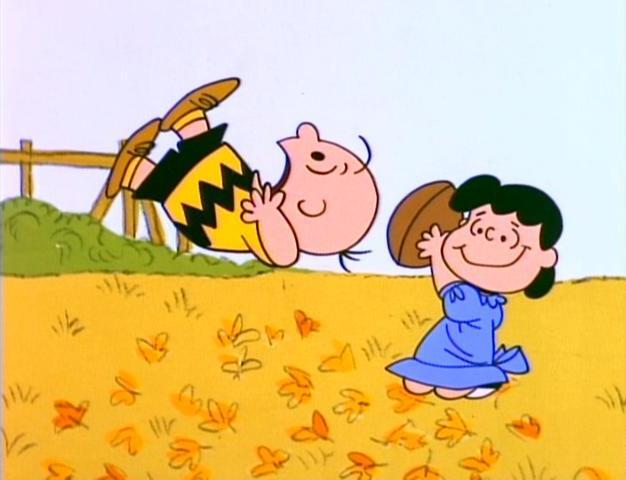
Charlie Brown fooled by Lucy and the football, again, October 30, 2011. (http://www.flickr.com).

I’ve never really liked Halloween. Probably because most of my Octobers growing up in Mount Vernon, New York were pretty horrible ones. The worst of those late Octobers were in the early 80s, starting in ’81.

That year, Halloween was a forbidden holiday in my life anyway. But the trick was on me. On a day just before Halloween, my day’s meal consisted of an ice cream sandwich as hard as a rock. The lunch at A.B. Davis Middle School that Friday — as it was most Fridays back then — was a grilled ham and cheese sandwich with fries, not exactly a Hebrew-Israelite’s diet. It was also about thirty degrees outside and partly cloudy, unusually cold for early fall in New York. So I stood near the steps leading down to the back of Davis, which led to the athletic field below. The field had turned a dirty yellow-green, the color of mid-fall. It matched how I felt about my life on that day.

The only reason I even had a rock-hard ice cream sandwich for lunch was because I’d won one of our seventh grade social studies teacher Mr. Court’s bets. He’d made an incorrect historical assertion in class, and I caught it, collecting a quarter from him that morning. Still, I learned, fully and truly for the first time, how

A Single Vanilla Ice Cream Sandwich, 1994. (Renee Comet/National Cancer Institute). In public domain.

poor me and my family had become, all while bitterly jamming the ice cream sandwich down my throat. So much for discovering my inner Hebrew-Israelite self through fasting and eating kosher foods!

I very quickly grew to hate hearing the words Hebrew-Israelite, especially since I’d never been to a traditional synagogue, much less Israel, Palestine, or even Ethiopia. Our Hebrew-Israelite ways had left us with little to eat when I was at home. There was a benefit to all of this. It made the fasting part of fasting and prayer easier. Not easy, just easier. My first Yom Kippur ceremony was difficult. We fasted on fruit for three days, and I barely made it through school each of those days. I almost passed out from the lack of food.

My older brother Darren, meanwhile, had decided that “the day of atonement” and all things Torah didn’t include his stomach. By the end of October, I would watch him take his kufi off as he boarded his bus for The Clear View School (see “About My Brother” from December ’07). I caught Darren walking near our apartment building with the last of a Hostess’ Apple Pie and its wrapper during Yom Kipper. He had snuck around the building to eat his contraband. What made this transgression worse was that Hostess used lard to create its desserts. And Darren, once caught, just stared at me and smiled.

My Mom was too busy and tired for me to think about complaining to her about this or about the issues I faced during my first days of Humanities. For more than three years, my Mom’s income had dropped so much compared to rising food and energy prices that we didn’t have food in the house for the last ten days of every month. Sometimes we didn’t have heat either, because we were usually two or three weeks behind on

Anthracite coal (like the lump of coal that was my life in '81), March 7, 2007. (United States Geological Survey). In public domain.

the Con Edison bill. I also knew that we were consistently behind on rent. I felt as isolated as a kidnapped tweener chained to a radiator in a walled-off-window basement.

Lack of food and heat at home weren’t the only problems. My Mom had popped out two of my younger brothers in the previous three years. We lived at 616 in a 1,200 square-foot, two bedroom and one bathroom apartment, so overcrowding had become an issue. Me and Darren were sharing a bedroom with our two siblings.

Not only did I start to believe that my then idiot stepfather Maurice Washington — oops, Judah ben Israel — had colluded with his version of God to play a cruel trick on my mother and my family. Not only did it finally dawn on me that we had slid into poverty somewhere between beginning on ’79 and Halloween ’81. But I knew that we were in a family crisis, financial, material and spiritual. And there was nothing, absolutely nothing, I knew to do about it. Not even asking for candy would’ve helped.

← Older posts
Newer posts →

Boy @ The Window: A Memoir

Boy @ The Window: A Memoir

Places to Buy/Download Boy @ The Window

There's a few ways in which you can read excerpts of, borrow and/or purchase and download Boy @ The Window. There's the trade paperback edition of Boy @ The Window, available for purchase via Amazon.com at http://www.amazon.com/Boy-Window-Donald-Earl-Collins/dp/0989256138/

There's also a Kindle edition on Amazon.com. The enhanced edition can be read only with Kindle Fire, an iPad or a full-color tablet. The links to the enhanced edition through Apple's iBookstore and the Barnes & Noble NOOK edition are below. The link to the Amazon Kindle version is also immediately below:

scr2555-proj697-a-kindle-logo-rgb-lg

Boy @ The Window on Amazon.com: http://www.amazon.com/Boy-The-Window-Memoir-ebook/dp/B00CD95FBU/

iBookstore-logo-300x100

Boy @ The Window on Apple's iBookstore: https://itunes.apple.com/us/book/boy-the-window/id643768275?ls=1

Barnes & Noble (bn.com) logo, June 26, 2013. (http://www.logotypes101.com).

Boy @ The Window on Barnes & Noble: http://www.barnesandnoble.com/w/boy-the-window-donald-earl-collins/1115182183?ean=2940016741567

You can also add, read and review Boy @ The Window on Goodreads.com. Just click on the button below:

Boy @ The Window

Twitter Updates

Tweets by decollins1969
  • RSS - Posts
  • RSS - Comments

Archives

  • June 2025
  • April 2023
  • September 2022
  • August 2022
  • July 2022
  • June 2022
  • May 2022
  • April 2022
  • March 2022
  • January 2022
  • December 2021
  • November 2021
  • October 2021
  • September 2021
  • August 2021
  • July 2021
  • June 2021
  • April 2021
  • March 2021
  • February 2021
  • January 2021
  • December 2020
  • November 2020
  • October 2020
  • September 2020
  • August 2020
  • July 2020
  • May 2020
  • April 2020
  • March 2020
  • January 2020
  • December 2019
  • November 2019
  • August 2019
  • July 2019
  • June 2019
  • May 2019
  • April 2019
  • March 2019
  • February 2019
  • January 2019
  • December 2018
  • November 2018
  • October 2018
  • September 2018
  • August 2018
  • July 2018
  • June 2018
  • May 2018
  • March 2018
  • February 2018
  • January 2018
  • December 2017
  • November 2017
  • October 2017
  • September 2017
  • August 2017
  • July 2017
  • June 2017
  • May 2017
  • April 2017
  • March 2017
  • February 2017
  • January 2017
  • December 2016
  • November 2016
  • October 2016
  • September 2016
  • August 2016
  • July 2016
  • June 2016
  • May 2016
  • April 2016
  • March 2016
  • February 2016
  • January 2016
  • December 2015
  • November 2015
  • October 2015
  • September 2015
  • August 2015
  • July 2015
  • June 2015
  • May 2015
  • April 2015
  • March 2015
  • February 2015
  • January 2015
  • December 2014
  • November 2014
  • October 2014
  • September 2014
  • August 2014
  • July 2014
  • June 2014
  • May 2014
  • April 2014
  • March 2014
  • February 2014
  • January 2014
  • December 2013
  • November 2013
  • October 2013
  • September 2013
  • August 2013
  • July 2013
  • June 2013
  • May 2013
  • April 2013
  • March 2013
  • February 2013
  • January 2013
  • December 2012
  • November 2012
  • October 2012
  • September 2012
  • August 2012
  • July 2012
  • June 2012
  • May 2012
  • April 2012
  • March 2012
  • February 2012
  • January 2012
  • December 2011
  • November 2011
  • October 2011
  • September 2011
  • August 2011
  • July 2011
  • June 2011
  • May 2011
  • April 2011
  • March 2011
  • February 2011
  • January 2011
  • December 2010
  • November 2010
  • October 2010
  • September 2010
  • August 2010
  • July 2010
  • June 2010
  • May 2010
  • April 2010
  • March 2010
  • February 2010
  • January 2010
  • December 2009
  • November 2009
  • October 2009
  • September 2009
  • August 2009
  • July 2009
  • June 2009
  • May 2009
  • April 2009
  • March 2009
  • February 2009
  • January 2009
  • December 2008
  • November 2008
  • October 2008
  • September 2008
  • August 2008
  • July 2008
  • June 2008
  • May 2008
  • April 2008
  • March 2008
  • February 2008
  • January 2008
  • December 2007
  • November 2007
  • October 2007
  • September 2007
  • August 2007
  • July 2007
  • June 2007

Recent Comments

decollins1969's avatardecollins1969 on No Good Teaching Deed Goes…
Mary Rose O’Connell's avatarMary Rose O’Connell on No Good Teaching Deed Goes…
Lyndah McCaskill's avatarLyndah McCaskill on The Raunchiest of Them Al…

NetworkedBlogs on Facebook

NetworkedBlogs
Blog:
Notes From a Boy @ The Window
Topics:
My Life, Culture & Education, Politics & Goofyness
 
Follow my blog

616 616 East Lincoln Avenue A.B. Davis Middle School Abuse Academia Academy for Educational Development AED Afrocentricity American Narcissism Authenticity Bigotry Blackness Boy @ The Window Carnegie Mellon University Child Abuse Class of 1987 CMU Coping Strategies Crush #1 Crush #2 Death Disillusionment Diversity Domestic Violence Economic Inequality Education Family Friendship Friendships Graduate School Hebrew-Israelites High-Stakes Testing Higher Education History Homelessness Humanities Humanities Program Hypocrisy Internalized Racism Jealousy Joe Trotter Joe William Trotter Jr. K-12 Education Love Manhood Maurice Eugene Washington Maurice Washington Misogyny Mother-Son Relationship Mount Vernon High School Mount Vernon New York Mount Vernon public schools Multiculturalism MVHS Narcissism NFL Pitt Pittsburgh Politics of Education Poverty President Barack Obama Race Racial Stereotypes Racism Relationships Self-Awareness Self-Discovery Self-Reflection Sexism Social Justice Teaching and Learning University of Pittsburgh Violence Whiteness Writing

Top Rated

Blog at WordPress.com.

  • Subscribe Subscribed
    • Notes from a Boy @ The Window
    • Join 103 other subscribers
    • Already have a WordPress.com account? Log in now.
    • Notes from a Boy @ The Window
    • Subscribe Subscribed
    • Sign up
    • Log in
    • Report this content
    • View site in Reader
    • Manage subscriptions
    • Collapse this bar
 

Loading Comments...