Covfefe Plaza

Tags

, , , , , , , , , , , , , , , , , ,


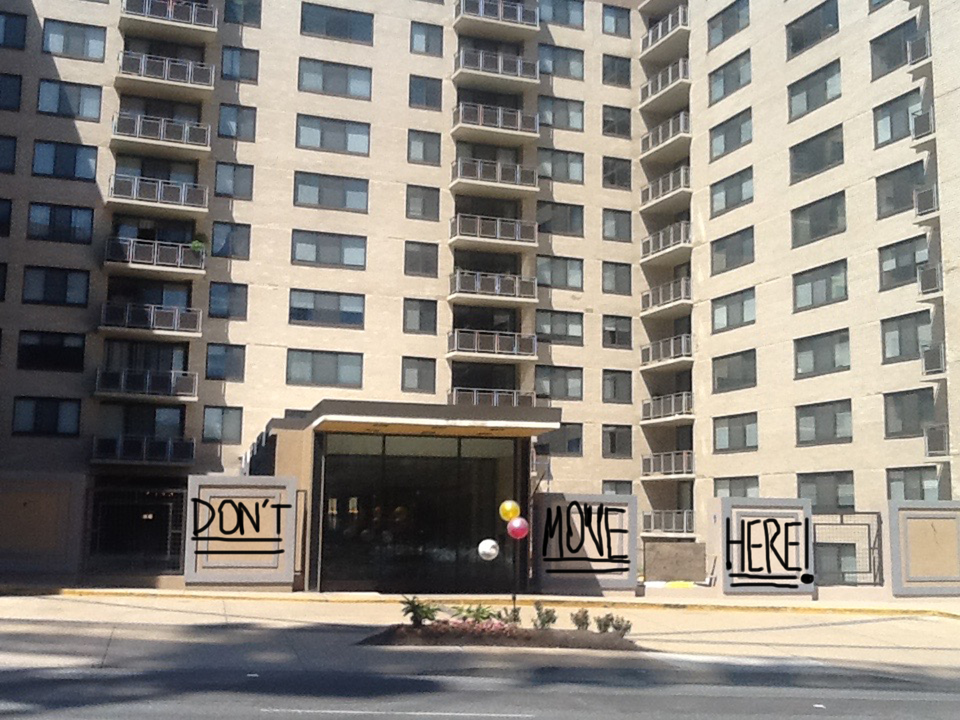
Cole Spring Plaza (w/atrium in permanent renovation) with Photoshopped spray paint, July 9, 2017. (Donald Earl Collins).

Well, actually, this post is about Cole Spring Plaza, the luxury apartment high-rise that me and my pregnant wife moved into in 2003, and recently moved out of with our nearly 14-year-old son at the end of June 2017. In all, we lived in the building in downtown Silver Spring for fourteen years and a month, or 5,144 days. For half of those days, it was a pretty good to solid place to live. Although there were a decreasing number of luxuries in our two-bedroom, two-bathroom flat on the eleventh floor, the apartment was a roomy one and our neighbors were friendly. And I could get a good night’s sleep many nights (when I wasn’t sleep-deprived from the first 1,859 days of Noah’s life, 2003-2008). Or, short of that, I could count on getting an afternoon nap, a short after-work nap, or weekend naps to recover.

By the winter of 2011-12, I couldn’t count on that anymore. Not with United Therapeutics and their endless construction projects, underway off and on since 2005. They had torn down their old headquarters adjacent to the Montgomery County Public Parking garage on 1200 Spring Street to build a state-of-the-art solar and geothermal powered monstrosity, including an underground garage. For seven weeks between December 2011 and February 2012, the construction workers pounded away with jackhammers on granite boulders as I attempted to work and teach online at home. I nearly lost my sanity.

Cole Spring Plaza, circa spring 2012 (before new double-paned windows; with trees & bushes in atrium), Silver Spring, MD. (http://www.australiansquashtour.org/).

This, of course, was not Ross Management’s fault, the property managers for Cole Spring Plaza. Nor was the onsite property manager to blame, seeing that they had nothing to do with the jackhammers. What was their fault was that no one in the building had double-paned windows, ones that could seal the noise of downtown Silver Spring and of major construction sites out of our flats. Ross finally replaced our windows in July 2012, but only after it became obvious that more tenants than usual had started moving out.

The granite boulders ordeal was but a symbol of the accumulation of the problems with our living arrangement at Cole Spring Plaza. None of these problems would’ve been a deal breaker for us when we first moved in back in May 2003. After four years in our previous luxury apartment, a 700-square-foot, one-bedroom place, the 1,350-square-footer that was our flat in Cole Spring Plaza seemed spacious. Sure, we knew that it didn’t have a washer and dryer in the unit, or valet parking, or a dry cleaning service on the premises, or a community gym or business office. But it did have the space we needed.

It only became obvious after a few years why the “luxury” part of the sell to us regarding Cole Spring Plaza was a lie. The developers had built the high-rise in 1967, apparently with the idea that it would be a hotel at first. But with Silver Spring not exactly a business or tourist attraction a half-century ago, they settled on the luxury high-rise idea. In the thirty-six years before we moved in, little to no work had been done to replace old plumbing, to repair the central ventilation system, to make washers and dryers available in each flat, or to give each apartment its own central air and heating. This Oscar Madison-Felix Unger setup may have been the definition of a luxury high-rise back in 1973. But in 2017, was a higher end version of my time at 616 (a bit of an exaggeration — the rent was/is way too damn high!). The result of what we did know, combined with the numerous little things we didn’t know, meant a gradual decrease in the quality of living in our place over fourteen years.

The plumbing issues meant for hard water stains that messed up our clothes when we washed them in the building, so by 2011, we were washing them off site. The lack of central ventilation exacerbated my sleep apnea and asthma symptoms, meaning less sleep over time. By 2012, there were two full months out of the year that we didn’t use our HVAC, one month because it was too warm for heat, the other because it was too cool outdoors for air conditioning. It was clear to me by the time our son had finished elementary school that it was time to move.

Spring Colesville public parking (the garage we used off-on for 12 years), Silver Spring, MD, January 23, 2016. (Donald Earl Collins).

But, move where, exactly? Did we want to stay in the area, or, especially with most of my job interviews taking me to Boston, California, Philly, and Baltimore, did we want to move out-of-town? Would we end up moving, but would I be stuck in long-distance marriage and fatherhood? That was always the main issue for me.

Aside from that, so much had changed since the spring of 2003. A large reason for the choice that we made in Cole Spring Plaza was because we didn’t own a car in 2003. We had looked at the Nissan Xterra and Volvo XC90, but because we lived so close to a Metro stop, we hadn’t seriously considered buying one. That is, until our son came along. We hadn’t looked at other options because for us, there didn’t seem to be that many.

United Therapeutics project after removal of last of garage, Silver Spring, MD, October 27, 2016. (Donald Earl Collins).

Finally, after Cole Spring Plaza decided that the best way to attract new tenants was to tear down fifty-year-old trees and decades’ old bushes and build a new atrium in June 2015 (which still isn’t complete), me and my wife both knew it was time. That, and United Therapeutics getting another sweet deal from Montgomery County Council Executive Ike Leggett and the Silver Spring Chamber of Commerce. After six years of negotiation, the county sold them the parking garage conveniently located across the street from Cole Spring Plaza for $10.2 million. In the twelve months since, Whiting-Turner tore down this garage and has mostly laid the foundation for a six-story, 120,000-square-foot building. That, and the electrical and water and sewage work around the building, left us — and especially mostly working-from-home me — feeling under siege.

United Therapeutics project, Silver Spring, MD, June 19., 2017. (Donald Earl Collins).

So we looked, at places in Baltimore, but mostly, between Rockville, Silver Spring, Takoma Park, and even in Bethesda (whose lily-Whiteness I can’t stand), and settled for a town home a couple of miles from our old place. Here, the loudest thing I’ve heard so far is a garbage truck and birds fighting over food.

I wouldn’t recommend Cole Spring Plaza to anyone except to college students, especially if five of them want to room in a two-bed, two-bath flat (I met at least two groups of students doing exactly that). The building, like the rest of downtown Silver Spring, has changed, and not for the better. The building is in disrepair, and will likely get bought out by United Therapeutics in the coming decade.

This isn’t a story of gentrification, for Silver Spring has been a mix of upwardly mobile ethnicities for decades, especially in downtown. No, this is another story of cash-strapped municipalities, the lobbying of Chambers of Commerce, sweet deals for politicians lining their pockets, and corporations encroaching on residential areas. And the story of a family who should’ve moved into a town home three years sooner.

Americans, Frequently Polite, But Almost Never Nice

Tags

, , , , , , , , , , , , , , , ,


Shaking Hands clipart, July 4, 2017. (http://hiveminer.com).

On this July 4th, I want to challenge the idea that Americans consider themselves a good-natured, warm-hearted, giving people. Or a wonderfully nice people, in other words. This, like so many other accepted clichés about American society, is nearly complete bullshit. Sure, many Americans are polite, or at least try to be. My former dissertation advisor Joe Trotter was very polite. Many of his colleagues and students said as much. But, as my couple dozen blog posts about Trotter can attest, he was hardly a nice person, or warm-hearted, or giving, or caring. Heck, at times, especially in my final year as a student and PhD candidate, Trotter wasn’t even professional or polite.

Polite is when a person doesn’t comment on one’s sudden fall into poverty or homelessness. Polite is holding open a door for someone loaded down with bags of groceries. Polite is an important person availing themselves to meeting with another important person for networking purposes. None of these things are nice, indicative of a good nature, a warm heart, or a giving person. Because, being polite is an obligation, and in American customs and laws, even obligatory. Four cars stopping at all four all-way stop signs at an intersection and going in the order of which one stopped the soonest is both polite and a traffic law. One may smile at another driver as one passes through the intersection, but this is a polite nicety, and not really a sign of a nice American at all.

Here’s where the difference between American politeness and truly being nice hits a brick wall. Our culture, our politics, our religious beliefs, our proclaiming of every holiday as a celebration of military personnel allegedly “fighting for our freedom.” They reflect this obligatory American politeness. As a nation, Americans claim to want to do something about poverty, and want to wish away racism, sexism, and homophobia. Yet in how Americans vote and in the music Americans listen to, there is almost nothing nice about Americans in action.

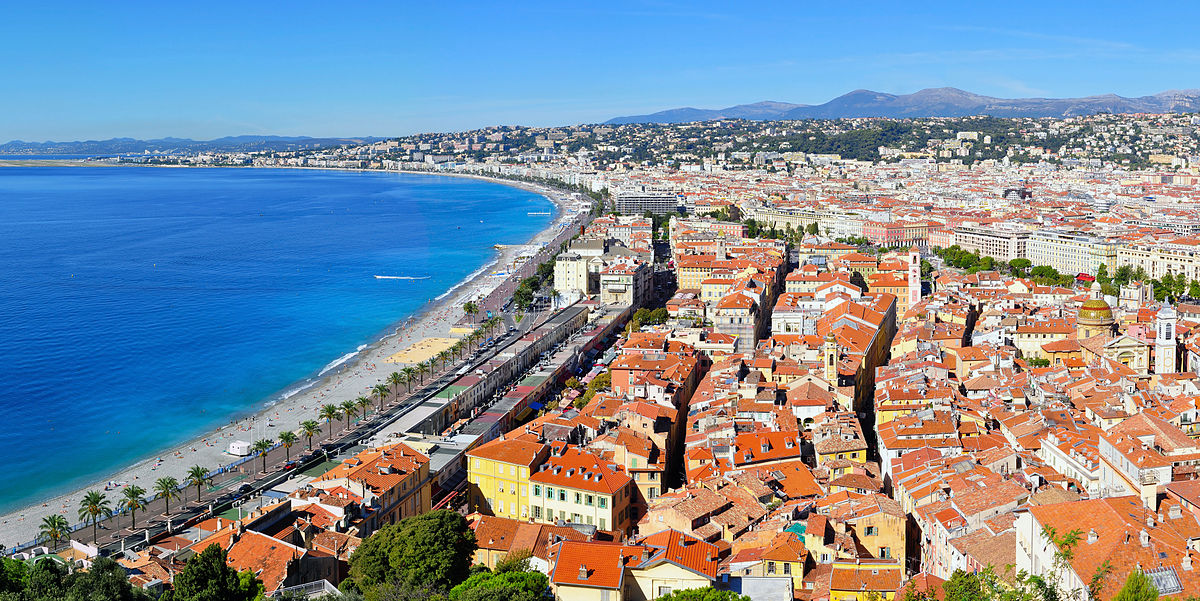
Nice, France is a city on the French Riviera (and not an American practice), September 21, 2011. (Tobi 87 via Wikipedia). Released to public domain via CC-SA-3.0.

This is not just about 45 and the GOP majorities in Congress. In locale after locale, actions like acquitting police officers for murdering Black men and women, reducing the number of abortion clinics, and cutting taxes so the poor and homeless don’t have enough food, shows how un-nice the American people are. American un-niceness exists in the policies drawn up or enacted by those for whom millions voted, from repealing Obamacare to the Muslim Ban. These policies may reflect an American politeness, but they also reflect a cruelty that has all too often been a part of American culture.

As someone who once considered himself “a nice guy,” I recognize that the correct term was always polite. For being “a nice guy” merely meant not revealing my true thoughts toward and about women, all while being polite enough to hold a door open or to try to help a damsel-in-distress. What I was being was a sexist asshole, having not yet challenged my assumptions about women and about myself and my views about women and the rampant sexism and misogyny in American culture.

There are far too many Americans who think that their Christian politeness is so much more than obligatory and vapid gestures that mean little-to-nothing in reality. For this July 4th, the idea of honoring the military with absolutist statements about freedom as so automatic that it sickens me. Especially considering the number of active duty service people and veterans suffering from PTSD, addiction, or whom commit domestic violence. Americans don’t act nice around these ugly issues. Americans don’t volunteer, don’t call 911, and don’t pressure city councils, county commissioners, and state legislatures enough to deal with these issues holistically. It would be nice if more Americans did.

Americans ought to ban being polite. Polite perpetuates racism and economic inequalities. But being nice means doing something about it, protesting, volunteering, speaking truth to power, using America’s alleged freedoms to confront folks in one’s life about their comfortability with various forms of oppression. How nice would that be!

High School, When 30 Makes You Old(ish)

Tags

, , , , , , , , , , ,


Réunion Island’s (French department, off Madagascar) Piton de la Fournaise, lava flow, February 26, 2005. (Samuel A. Hoarau via Wikipedia). Released to public domain via CC-SA-3.0.

Today I am thirty years removed from my Mount Vernon High School graduation. Yay me (and 500+ others, I suppose)! But at forty-seven and a half years old, this also means I’m in my late forties, older than the age of many of my teachers on the day I wore my cap and gown on Memorial Field.

What I am still young and old enough to remember is the distance between me and my classmates, acquaintances (since I really didn’t have any friends back then), and family. Putting up a good front, a mostly blank front with an occasional laugh or smile, was what I did in public back then, enough to make it appear I wasn’t an outcast. Except that I was. But it wasn’t just the silent-treatment folks who reminded me that I was nothing and meant nothing to them within days of the MVHS graduation. I felt it, knew it, and wanted to escape it, every single day back in ’87.

There have been at least two high school reunions since Thursday, June 18, 1987. One was in September 1997, way too early to do a get-together from where I sit. Not to mention, I was coming off of three months of post-PhD unemployment, and wouldn’t have wanted to spend money I didn’t have to impress people with whom I could’ve never shared good times a decade earlier. The other was five years ago, a more appropriate frame for a reunion, but it was part of a group of reunions between 1985 and 1989 (or more even). I barely knew half my classmates in the Class of ’87, a couple dozen from ’86, and a few from ’85 and ’88. All together, it would’ve felt like a room full of strangers to me.

But at thirty or more years, would I want to go to a reunion now or in the future? I really don’t know. Part of the problem with reunions is the same problem I had in Humanities and in MVHS. I would have to fit someone’s predetermined mold or role. If I went in as Donald Earl Collins, would anyone actually remember me or acknowledge me as my true self? Could I be Donald Earl Collins the writer or historian or educator? Could I be the disillusioned Christian, the anti-racist American, or the middle-aged athlete who does yoga and can still hit threes despite my IT-band issues? Or, will I just fall into my role as the super-smart but enigmatic loser, the wack-ass weird mofo that scores saw me as three decades ago?

I know one thing my ex-mates wouldn’t see me as — a father (after all, today is Father’s Day). I guarantee you, some of the folks in my class took bets as to whether I was straight, gay, asexual, or if I’d have sex with another human before the Rapture! Yet I’ve been married for more than seventeen years, and a father for almost fourteen. Much longer than I was ever in high school, Humanities, or Mount Vernon’s public schools. This is what makes me old and keeps me young. Family, love, parenting, and making pancakes, bacon, and eggs for Sunday brunch.

Memorial Field in complete disrepair, locked up (and like me in 1987, locked out), April 2, 2017. (Mark Lungariello/The Journal News).

The day of graduation in 1987 was a trip in itself, between an 87-year-old graduating with our class, the sudden hugs and immediate ostracisms that occurred, the triple-H evening in polyester in the middle of Memorial Field, and my father’s drunken attendance. It was a clash of White Italian Mount Vernon, Black elite Mount Vernon, and stereotypically ghetto Mount Vernon, with a splash of affluence, Afro-Caribbean, and other Mount Vernons. That’s what made it a strange ceremony, a last look at my hometown’s population as a teenager, good and bad.

There’s someone on Facebook who runs the page “I grew up in Mount Vernon.” My former classmate frequently blocks or admonishes participants for negative posts or negative portrayals of Mount Vernon. His defense: he wants the page to be “a place of positivity.” It’s his page, and he should be able to do what he wants with it (within reason). However, “positivity” is not the same thing as “positive posts only.” You should be able to generally like Mount Vernon and occasionally discuss issues affecting people in town that aren’t positive ones. Like poverty. Like the need for more social justice activism and more political participation. Like the need for a donut shop on par with the former Clover Donuts.

Bill Cosby in midst of his “Pound Cake” speech (with Rev. Jesse Jackson in background), NAACP 50th Anniversary of Brown decision gala, Washington, DC, May 17, 2004. (http://blackpast.com).

Really, I find this “I grew up in Mount Vernon” Facebook page yet another example of how a privileged group of folk get to frame a conversation for people who can’t or won’t speak for themselves. Middle-class, one-way-thinking, Black respectability politics folk whose Christian ethics blind them to history, racism, poverty, misogyny, homophobia/heterosexism, and other -isms and -obias that affect their neighbors. The page is smug, elitist, and exclusionary. I rarely look at the page, and I’ve posted to it maybe three times in seven or eight years. “I grew up in Mount Vernon” is a reminder that I share little in common with these Mount Vernonites, even as my socioeconomic and educational status has changed over the years.

As a father, though, I am reminded about the need to protect and to nurture, balanced with the need to give my son room to grow and learn. I may not be able to stop a cop from exercising his/her lethal racism with a badge, but I can prepare my son as best I can to be in public anyway. When it comes to Mount Vernon, MVHS, or any future reunion I may decide to attend, maybe, just maybe, my ex-classmates should be as ready to see all sides of me. At least as much as I have granted that their version of Mount Vernon is one that is real for them, if not for me and many others.

On the Levi Brothers and Trump-esque People

Tags

, , , , , , , , , , , , ,


Darth Sidious, Star Wars VI (The Return of the Jedi) screen shot, 1983/1997. (LusoEditor via Wikipedia). Qualifies as fair use due to lower resolution and subject matter.

There are a plethora of people to pick from in making comparisons between President 45 and examples of narcissistic evil operating in positions of leadership. Andrew Jackson, Adolf Hitler, Benito Mussolini, 45’s hero Vladimir Putin, Jacob Zuma, and Recep Erdoğan all have served as examples in op-eds and other articles over the past couple of years. And these are all potentially good picks. Mercurial, vengeful, and even erratic actions, combined with dehumanizing speeches and screeds, all characterize this cabal of soft despots and fascist dictators, and match 45 well.

But the level of ostentatious stupidity that 45 has exhibited as President and a presidential candidate has made think of people closer to home. After all, 45 has always been a New Yorker, a crass rich White guy who has spent his entire adult life attempting to make himself look even more wealthy and powerful than his relative position in elite circles would’ve otherwise justified. He’s also always seen himself as the most important person in the room, maybe in the world. So much so that he has also seen himself as the smartest person in any context, even as everything 45 has touched has been tarnished or turned to shit by his callous, narcissistic stupidity.

In totality, this could describe any upper-crust New Yorker I encountered growing up looking to own more, buy more, be more than they already were. But in light of all things 45, I am thinking of two folks from my teenage years, the Levi brothers. They owned cleaners in Midtown Manhattan and ran a building-cleaning company, and my father worked for them all through the 1980s. The Levi brothers were two of a kind, some of the most flashy people with wealth that I would ever meet.

As I described them in Boy @ The Window

I can confirm with absolute certainty that the Levi brothers wore not-so-thin gold chains. I can also remember how uneasy my encounters with them made me feel. It wasn’t just the fact that they often questioned my intelligence. For nearly all of the years my father worked for the Levi brothers, they paid him under the table. They enabled his alcoholism, in exchange for $500 a week, for eighteen years. No retirement plan, no raises, no sick or annual leave, no unemployment insurance, in exchange for no child support payments and no tax payments. A Faustian deal if there ever was one.

King of New York (1990) with Christopher Walken screen shot. (http://www.electricsheepmagazine.co.uk/).

That my father knew who Paul Milstein was — the late real estate mogul for whom a program within the Columbia Business School is named — is amazing to consider in hindsight. It meant that he was privy to many conversations between the Levi brothers about their master plan for generational wealth. It meant that the Levi brothers believed themselves to be kings, or at least princes, of New York. But only because they cut corners in their shops and business, and looked for ways to literally get rid of their competition. Things that would later lead to alleged criminal activities and the loss of their businesses.

If I could interview them in their mid-1980s milieu now, I would’ve ask them, “Who were you trying to emulate, John Gotti?” But given those Lifestyles of the Rich and Famous times, I suspect the person the Levi brothers were most trying to ape was Donald Trump. Only, 45 came from more money, and wanted to do more than corner the market on cleaners and cleaning contracts for Manhattan high-rises. Beyond the differences in a couple of zeros, the braggadocio, the seeing of people not like them as “others” or “not human,” the need to show the world their wealth, their stunning stupidity in their attempts to monopolize their market. It’s as typical a New York story as I ever got the chance to see. And with 45, I get to see it again, this time on a massive scale, a crash-and-burn that the universe of intelligent beings won’t be able to ignore.

I’ve Been Blogging For a Decade, And…

Tags

, , , , , , , , , ,


Me comatose on my MacBook keyboard, March 29, 2013. (Donald Earl Collins).

This was what I wrote for my first blog post on my former Fear of a “Black” America website on Monday, June 4, 2007.

It had taken me a month of brushing up on my HTML and a week of negotiating the code between Blogger.com and my former website (hosted by Earthlink) to embed my blog page. All so that I could post for the first time.

I was transitioning from being the writer and “recovering academician” on multiculturalism to the writer I am now, I guess. But I didn’t want to lose a website I’d spent months of self-taught HTML time and energy developing, and years of additions to attract views, comments, and the occasional interview. At the time, FearofaBlackAmerica.com averaged 1,200 unique visitors a month, after a high of 4,000 per month through 2004 and 2005, mostly the result of pumping my first book. Or possibly, the confusion between my book title and PE’s 1990 album, Fear of a Black Planet, but given the feedback, it was much more the former than the latter.

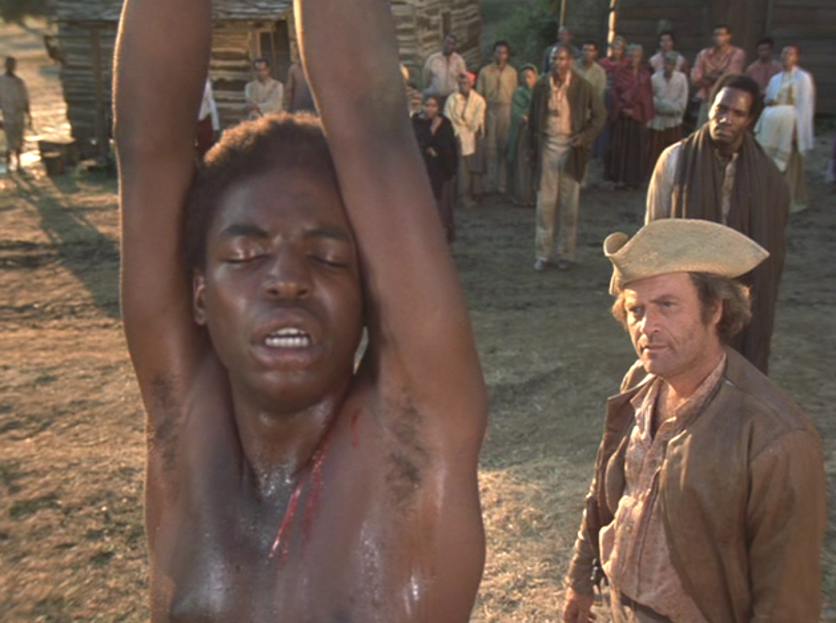
Kunta Kinte being whipped, Roots (1977) screenshot, July 6, 2012. (http://irvine.wikis.gdc.georgetown.edu). Qualifies as fair use under US Copyright laws because of screenshot’s low resolution.

So I went for it, not knowing if anyone would read any of my words, feel any of my emotions, or ever express a thought in support, solidarity, or disagreement. Once I started writing about poverty, racism, and child abuse while growing up in Mount Vernon, New York, though, it didn’t take long for random folks to start sending me missives about how I “deserved” my stepfather beating me up, or how grateful I should be for growing up in a city where Denzel Washington once lived. The kind of respectability politics bullshit that writing about a childhood full of pain tends to attract.

It wasn’t until I moved my blog to WordPress in 2010 that the work of writing and adding multimedia to my musings really took off. It helped that I managed to use contemporary events to tell my story, to provide commentary on human depravity beyond the world of research. By 2012, I was averaging more than 12,000 views a month, and had more comments from folks about my blogs than I could respond to in a timely manner. Excerpts from some of my blogs even made it into social and mainstream media.

Overall, there have been over 250,000 unique visitors to and 300,000 views of my blog off both the Blogger and WordPress platforms over the past decade. With this one, I’ve written 944 total posts, about 900,000 words since June 2007. Among my most popular are

Standing ovation, opera house unknown, May 21, 2012.(http://www.thelmagazine.com).

I think that this is a good representation of what my blog has offered me as a writer and, hopefully, the tens of thousands of folks who read my musings every year. I have no idea what this blog will turn into over the next couple of years, as I continue to pursue more and more freelance writing projects, and maybe even, another book. But I thank all of you for your support, your criticisms, and your reads and views over the years. May I never take this for granted.

Prom Toking

Tags

, , , , , , , , , , , , ,


Me at Prom Dinner, White Plains, NY, May 21, 1987. (Suzanne Johnson neè DeFeo).

I can say with absolute honesty that I have never rolled, smelled, or smoked a joint. No weed, not ever, as I approach my late forties. I have, however, gotten a contact high on at least a dozen occasions, over the past thirty years. Heck, I’ve probably been high a few times off of burnt oregano and gasoline fumes, as infrequently as I’ve exposed myself to endorphin catalysts in my life.

My first contact high happened in the vestibule of 616 East Lincoln Avenue, on the night of my senior prom, the third Thursday in May ’87. As with all things in my life at seventeen, this was unexpected, uncomfortable, and underappreciated on my part. I had just called to find out when the limousine was coming to pick me up before swinging across town to pick up the other four people with whom I was to ride. I had done myself up as well as my sinewy bean-pole ass could. With my father’s funds, I rented a well-fitting tux with a white shirt and peach cummerbund. I’d bought my friendly date Dara a white carnation, matching the once pinned on my tux jacket. My idiot stepfather tied my peach bow-tie. Unusual for me, I lotioned myself from head to toe, greased my hair down, and otherwise made sure I smelled as clean as a Carolina pine forest. Not that I usually smelled bad, but I couldn’t look like a po’ boy tonight.

It was almost 6:30 pm before I walked downstairs to wait for the limo. Right on the steps leading into the vestibule were my C-building neighbors and two guys I didn’t recognize. They were all smoking joints, and the smoke had filled a good portion of the semi-enclosed lobby leading to the front doors. My elementary school classmate Valerie was in this group, across the lap of one of the unknown young men, all as he felt up Valerie’s ass like it was his own. Part of her thong underwear was visible, as Valerie’s boyfriend gave one of her butt cheeks a good slap while she giggled. Her brother Ernie was also there, fully blazed up, apparently without a care in the world. I don’t think he went by Ernie by ’87, though. He was a low-level drug dealer at this point, and had bulked up a bit over the previous couple of years, to protect himself in his line of work, I guessed.

Screen shot from video, Mako, “Smoke Filled Room” (2015). (http://beautifulbuzzz.com).

Ernie asked me if I wanted a puff. I said, “Naw, man, I’m fine.” Him and his sister and crew just laughed like I told the funniest joke. But I knew why they were laughing. In the half-minute or so of standing around waiting for the limo, I was already high. So much so that I didn’t sound like the proper English-speaking teen I often was in public. I sounded like one of them, in slow motion even to me. A full hydro hit would’ve left me ready to do anything else other than go to the prom.

The limo arrived, and not a moment too soon. Even though I’d been in the lobby and vestibule less than two minutes, even I could smell that the weed was a bit stronger than my deodorant, lotion, and cologne combined. The one guy already in the limo with me asked if I was “okay.” I knew what he meant. “I just have a contact high, that’s all,” I responded.

I would’ve hated to admit this thirty years ago, but I needed to be a little high and a little more relaxed, and not just that prom night. It actually helped to be under the influence, even though the contact high only lasted for thirty or forty minutes. By that time, I had noticed that the non-alcoholic drinks in the back of our limo were alcoholic. My date and a couple of the guys, after they became little buzzed, asked me how I knew. I said, maybe for the first time in public, that, “I know from experience. My father’s an alcoholic.”

White Castle, 550 East Fordham Road, Bronx, NY, circa 2015. (http://zomato.com).

In between, me, my date Dara, classmates Allison and Gina, and two MVHS upperclassmen now in college, went to White Plains for the prom dinner and dance, then to Midtown for Copacabana on West 34th, and somewhere around 2 am, for the White Castle on Fordham Road in the Bronx. I didn’t get home until 3 am.

I went to the prom mostly because I didn’t want to look back at my time in high school years later and feel regret about not attending. But the fact is, other than a feigned attempt at social protest during the prom dinner, there was little particularly memorable about the event. Not the rubber chicken or overcooked salmon. Not the music or the overextended small talk. Nor should I have gone on a friendly date to the prom. I should’ve either found someone I did like to go out with, and months earlier, gone in solo, or not gone at all.

But really, the main event for me prom night occurred in the two minutes before I walked out to get into the limo. I didn’t want to smoke weed, feel up a one-time classmate, or risk years of imprisonment in New York State. But even in the midst of a living hell, sometimes it’s best to relax a little. I have five 616 folks to thank for that reminder.

The #45 Mix Tape

Tags

, , , , , , , , , , , , , , , , , , , , ,


Then candidate 45 hugging US flag at campaign rally (remember, he’s the anti-Midas, everything he touches turns to crap), Tampa, FL, June 11, 2016. (Chris O’Meara/AP, Times Free Press).

I’m changing it up a bit this weekend. With so much focus on the apocalypse that is 45 and his band of greedy, racist, misogynistic, Islamophobia, and Russia-helping yes-men, I have something goofy and meaningful to say. There are already several comprehensive syllabi on Donald J. Trump out, though, so adding my scholarly musings and sources to this almost inexhaustible topic would be a futile exercise. Instead, I have a mix tape (sort of), one that highlights the changes in my music tastes over time and a group of songs that I mostly despise. Just like I loath most of America’s knee-jerk arguments over 45 and his minions from the past two years.

1. “Little Lies” (Fleetwood Mac, 1987). From their Tango In The Night album. Christine McVie sounds like a shot dog on this song (and Lindsey Buckingham doesn’t sound much better). But this was a Top-5 hit on Billboard in 1987, around the same time Trump was likely being turned by Vladimir Putin and the KGB in the former USSR. And, the song’s theme is pretty obvious.

2. “Live to Tell” (Madonna, 1986). Not exactly my favorite artist, but a one-time favorite song from the one-time “Material Girl” for me three decades ago. After several sources quoting the deposed Michael Flynn, “he has a story to tell,” I remembered Madonna’s lyrics, “I have a tale to tell.” Come to think of it, doesn’t Jared Kushner have a tale to tell about his and 45’s “thousand lies?”

3. “Spies Like Us” (Paul McCartney, 1985-86). Proof positive that Baby Boomers will vote for anything, this piece of poop was a Top-10 hit in January 1986. It’s also emblematic of the theme of ineptitude and macabre humor that runs through the song, representing the movie by the same title, and Flynn, Kushner, Carter Page, Roger Stone, and the rest of the monolithic bloc of 45’s White men.

4. “Russians” (Sting, 1985-86). Why? Because Russians (maybe with the exception of Josef Stalin and Putin) “love their children too” — didn’t you know? But they love messing with our corrupt democracy even more.

5. “Oops!…I Did It Again” (Britney Spears, 2000). God, I have no idea why anyone would’ve ever liked this zit-popper. But the then-eighteen-year-old Spears was prescient with the line “I’m not that innocent.” Neither is 45. He made be a narcissistic buffoon who can’t put two coherent sentences together with a pen, two pieces of paper, Scotch tape, and a flashlight. But he knows where his money’s coming from, no?

6. “Just A Friend” (really, “Jus’ a Friend,” Biz Markie, 1989-90). Same theme as Britney Spears’, with a twist of crossover appeal, a ridiculous baroque get-up, and off-key singing that could only be topped by NBA Hall-of-Famer (and internalized racist) Charles Barkley. But it captures perfectly the love affair between ditto-headed supremacist Americans and 45 (it doesn’t go the other way, of course).

7. “White, Discussion” (Live, 1994). A bit of my favorite grunge, which I have used before. It applies to the folks, the so-called American liberals ready to blame non-voters, third-party voters, and Trump supporters for the rise of 45. Still, many of them are to blame also, because most of them aren’t liberal. If you supported Hillary Clinton in 2016 based on principles, and not out of pragmatism, you are not a liberal, and have been voting in center-right candidates for decades. As the song goes, “look where all this talking got us, baby.”

8. “Stranger In Moscow” (Michael Jackson, 1996-97). Jackson’s introspective song applies here as well, because, well, he uses Russia and the theme of isolation throughout. Except in 45’s case, he likes it that way. And apparently, so does Russia.

9. “Lies” (En Vogue, 1990). Trust me, it fits! (s/o to Dawn Robinson).

10. “Thug Paradise” (Capone-N-Noreaga/Tragedy Khadafi, 1997). The lyrics below say it all:

I twist the truth, I rule the world, my crown is called deceit
I am the emperor of lies, you grovel at my feet
I rob you and I slaughter you, your downfall is my gain
And still you play the sycophant and revel in my pain
And all my promises are lies, all my love is hate
I am the politician, and I decide your fate

Supporters and sycophants beware: 45 is coming for you, in a steamroller with a 700-horsepower engine going one hundred.

11. “Fake Love” (Drake, 2017). I’m a Aubrey Graham fan. I can’t stand Drake. Still, this release from More Life should be required listening from 45 supporters who think they’re not racist, misogynistic, xenophobic, or narcissistic. He also has a song on this album titled “Portland,” though I seriously doubt he was thinking about this weekend or Richard Collins III.

12. “Waterfalls” (TLC, 1995). Yep, yep, yep. Both 45 and MAGA-types have been chasing illusory rainbows and torrents off jagged edges, and damning everyone who they perceive as a threat along the way. And they’re both on a one-way trip.

13. “Don’t Forget Me When I’m Gone” (Glass Tiger, 1986). This is the song 45 should play whenever he finally leaves office, whether by resignation, impeachment, and/or force. As everything 45 touches turns into crap, Glass Tiger’s Top-10 schlock cannot be made any worse. Plus, not even Glass Tiger would complain about 45 using their crappy music.

14. (Bonus Track) “No Bravery” (James Blunt, 2006). 45 is part of a continuum, one that stretches through all of American history. On the international stage, though, it has been one of constant chest-thumping while killing innocents in the name of freedom or national security. Though Blunt’s was about fighting for the UK, the song has much more applicability in the US. We have so much blood on our hands, and 45 means to add to this fetid river on the domestic and international frThe #45 Mix Tapeonts.