If I Could Redo Time…

Tags

, , , , , , , , , , , , , , , , ,


Show art from SyFy’s 12 Monkeys (the home of alternative timelines), March 2016. (http://syfy.com).

Mother’s Day Week 1997 was one of triumph, betrayal, and deep self-reflection, helping to shape my last two decades. On that fateful Sunday, I finished preparing my transparencies for the overhead projector that I would need to use for my job talk on multiculturalism, race, and education at Teachers College the next day. My then-girlfriend Angelia came over around 1 pm, helped me pack as we talked about the job, my research, her missing me for the next few days, and my wishing I could take her with me to New York. Then we called a cab, went out to Pittsburgh International Airport, and I boarded my 6 pm flight bound for La Guardia.

The next day, that second Monday in May 1997, went well despite barely six hours of sleep (a typical night for me now). I met with Teachers College faculty, graduate students, a department chair, an assistant dean, and the dean. I gave my all-important job talk, fielded questions, and otherwise felt that I brought my heat in this potentially life-changing interview. By 4 pm, it was over, I was exhausted, but I was more than content. I figured I made myself a tough out at worst, and gave myself a real chance at this assistant professor job at best.

I spent the night in Manhattan at the Hotel Beacon, and ordered room service, instead of going out to Barnes & Noble or Tower Records. I had to rest up before going to see my family at their temporary apartment in Yonkers. Refreshed and with my old blank-faced-Donald mask on, I checked out and took the 1 train up to Van Cortlandt, then the Bee-Line bus into Yonkers, where my Mom and younger siblings had been living for a year and a half.
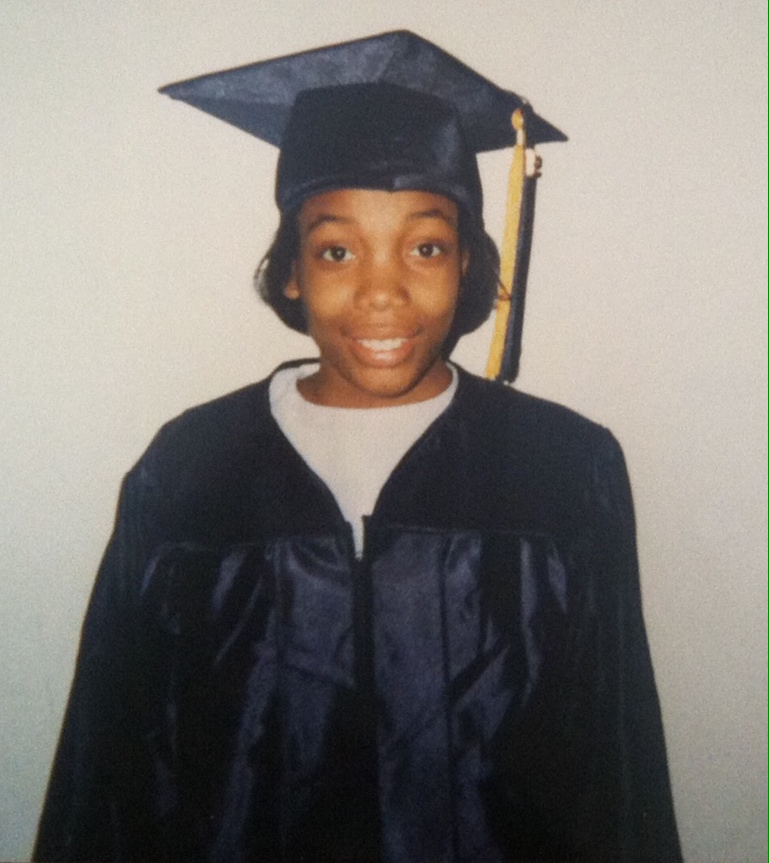
My sister Sarai (1983-2010) in Mom’s cap-and-gown, May 14, 1997. (Donald Earl Collins).

Tuesday was Mom’s graduation day from Westchester Business Institute. After ten years of on-and-off-again enrollment, Mom had finished her associate’s degree in accounting. I was really happy for her. That day from 10 am on was about getting Mom and Maurice, Yiscoc, Sarai, and Eri cleaned up and ready for the long bus trip up Broadway to White Plains, Westchester County Center, and hundreds of other WBI graduates. Of all of us, I think my sister Sarai had the best time. After Mom tossed her cap in the air (and caught it), Sarai begged to put on Mom’s graduation digs. My fourteen-year-old sister walked around for the rest of the night as if she had graduated from college!

Wednesday was a difficult day. I had a noon-ish flight to catch out of La Guardia back to the ‘Burgh, as my own PhD graduation was four days away. Though Mom and I agreed that I didn’t have the funds to fly her out and put her up in Pittsburgh, I didn’t agree that my teenager siblings (all between nearly eighteen and thirteen at this point) couldn’t watch over themselves for two or three days. “Are you kiddin’?,” Mom said when I suggested this, and added, “the kids would tear this mutha up while I’m gone.”

But then, as I was getting packed up to do the Bee-Line Bus, 1 train to Times Square, Shuttle to Grand Central, and cab to LGA, Mom said something that made me happy we decided she wouldn’t be at my graduation. “You know, you were in school so long, you could’ve had another high school diploma.” The scorn with which she said it, it was like someone suddenly stabbed me in the stomach. It was the first time I truly saw Mom’s vanity, possibly even, her jealousy. After I said my goodbyes, promising my brother Maurice that I’d come to his Mount Vernon High School graduation in June, Mom’s sentence of sneering envy was all I thought about on the trip back.

“Maybe it’s a good thing you didn’t invite your mom,” Angelia said after I told her about Mom and her brooding behavior Wednesday evening. “But, this means she will have never seen me at any graduation, seen where I’ve lived the past ten years, seen how hard I worked,” I cried. Angelia got up from her dining room table, walked around to my side, sat in my lap, and gave me a hug. I’m so glad she didn’t let go, and let me cry myself out on her shoulder and chest for a few minutes.

I woke up in Angelia’s bed Thursday morning, having slept past 9 am. It was the most sleep I’d had in five days. I was remarkably refreshed. I rarely stayed over at Angelia’s because the back of her third-floor flat was practically an urban wildlife reserve, between the raccoons, squirrels, pigeons, cardinals, blue jays, rabbits, and the occasional deer. Not this morning. They seemed to know I needed not to hear them that morning.

The next three days were a blur. I ran around Pittsburgh and Carnegie Mellon and Pitt saying formal goodbyes to a few colleagues and former professors, something I wouldn’t have had time for if Mom had been in Pittsburgh with me. Angelia and I spend most of Saturday with her mommy, and then with my friend Laurell, Laurell’s sister Naomi, and their charge Archie. It would be the only time anyone from my Humanities days would witness me graduate with one of my Pittsburgh degrees.

That Sunday, May 18, was going to be a scorcher of a day. I was to be on stage as part of the tent-revival-as-graduation ceremony at CMU (as they did for all the PhD graduates). But there was no way I’d wear a full suit. So I compromised. I put on a shirt and tie under my gown, wore my baggy basketball shorts for bottoms, and put on shoes and dress socks to complete this goofy yet comfortable picture. I marched across the stage and shook Peter Stearns‘ hand, as he was the dean of humanities and social sciences at CMU then. Too bad I didn’t say what I thought about his fast food approach to teaching and learning to him in that moment.

But, after that first ceremony, the individual and group pictures, a bunch of folks had to leave. Laurell, Naomi, and Archie had to get back to Virginia for yet another week of school — that’s what happens between two school teachers and an eighth-grader for graduation attendees. My friends Ed and James had errands to run, and Angelia’s mom had some church-related affairs to get to. So, for the moment, it was just me and Angelia, walking from CMU to The University Club, by Pitt’s Thackeray Hall.

We get there, in this quiet room, with seven burgundy diploma holders, sitting on a table that staff had covered in this dark blue velvet cloth. My now former advisor, Joe Trotter, arrived a few minutes later. I’d only seen him once in the six months since he finally approved my dissertation, ending what had been a two-year ordeal of betrayal, slights, and threats while writing my 505-page tome. Yet, all I was thinking was, “Why are we doing the departmental ceremony in a building in the middle of Pitt’s campus?”

CMU leather diploma album, May 17, 2017. (Donald Earl Collins).

Steve Schlossman, the history department chair, was this ceremony’s emcee. He introduced each of us, our research, any awards we may have won, and our dissertation advisors, all as he handed us our doctorates. I was second on the list to go up and receive my diploma, shake hands with Schlossman and Trotter. I did say a few words, mostly about hard work and perseverance. “With God and faith, and of course, my girlfriend Angelia, even though that word ‘girlfriend’ hardly defines who you are to me, I wouldn’t be standing here right now. Thank you.” That was how I ended my three-and-a-half minute speech.

There was a small reception afterward, and like most CMU ceremonies I’d been a part of since 1993, this one was nearly blindly boring. Except that my friend James did show up and gave me a pat on the back and a handshake. Except that my dear friend and mentor Barbara Lazarus came and gave me a big hug. Except that Angelia had insisted on taking pictures of me from the time I got up to get my degree until the moment we left.

We were out around 6:30 pm. It had rained and poured, as thunderstorms had rolled through during the second ceremony. I wish Mom could’ve been there, seen what I had seen, felt what I was feeling. But, knowing what I knew now, the personal triumph that this graduation day was couldn’t be diminished. I had long since stopped living for what Mom wanted me to be — a sounding board, a babysitter, an extra source of income. For the first time, I no longer felt guilt about not going back to New York after my undergraduate years at Pitt, ready to bail my family out of poverty on a $25,000-a-year salary. For the first time, I realize Mom’s burdens were never mine to carry.

NOT “Only In America”

Tags

, , , , , , ,


Daily Show with Trevor Noah’s Hasan Minhaj speaking at White House Correspondents’ Dinner, Washington, DC, April 29, 2017. (http://complex.com)

Once again, I made myself into a gullible dupe for the American press. I watched the White House Correspondents’ Dinner last night when I had so many other choices. I could’ve watched the Pittsburgh Penguins dismantle the playoff adverse Washington Capitals 6-2. Or slept through an NBA playoff game or rerun. Or watched the last four episodes of season one of This Is Us, or the season-ender to The Expanse. Instead, I chose to watch those smug, not-so-objective elites with pens, notepads, microphones, cameras, laptops, and press passes gaze longingly at each other. I sat and watched them talk about the freedom of the press as if it was still 1974 and the nation could still believe it was a just one.

The narcissistic navel-gazing continued even as Hasan Minhaj took the stage and began to roast the press for its ineptitude, and 45 for his voluminous idiocies. It was a pretty good roasting, but compared to Stephen Colbert in ’06 and Larry Wilmore last year, Minhaj was underwhelming. Then, Minhaj said something at the end of his speech that momentary kept me from REM sleep.

And it’s the same position a lot of minority kids feel in this country. You know—do I come up here and just try to fit in, and not ruffle any feathers? Or do I say how I really feel?

Because this event is about celebrating the First Amendment and free speech. Free speech is the foundation of an open and liberal democracy. From college campuses to the White House, only in America can a first-generation, Indian-American Muslim kid get on this stage and make fun of the president.

Really? “Only in America?” An Indian American Muslim couldn’t do what Minhaj did in, say, Canada, or in the UK, where Sadiq Khan, a British Pakistani, is London’s mayor, or even, say, in India?  This statement alone answered Minhaj’s question for me. Sir, wasn’t this an attempt to “just try to fit in, and not ruffle any features?” You just told every America elite to the left of the Islamophobic set exactly what they wanted to hear!

There are two other problems with the refrain, “Only in America,” especially in the context of Minhaj and free speech, free expression, and freedom of the press. One is that none of the First Amendment is free. Sure, if one narrowly means free from government coercion and persecution, then what Minhaj highlighted is mostly true. But given the platform Minhaj had last night, his truth was a lie for most of us. Because for most of us, the connections and money isn’t readily available to have such a lofty platform to proclaim America as uniquely free.

“Only in America” also assumes that anyone who couldn’t be Hasan Minhaj is a loser. Millions of Americans of color and tens of millions of poor and low-income Whites, you simply have worked hard enough, been extroverted enough, or told enough off-color jokes. Apparently, that’s what it takes to make “Only in America” true for us all. Despite his calling 45 the “orange man behind the Muslim ban,” in this one fundamental area of belief, Minhaj is no different from 45. For “Only in America” may be the most narcissistic, hypocritical, and fact-denying thing anyone can say about themselves and the US.

In·ter·sec·tion·al·i·ty

Tags

, , , , , , , , , , , , , , , , , , , , ,


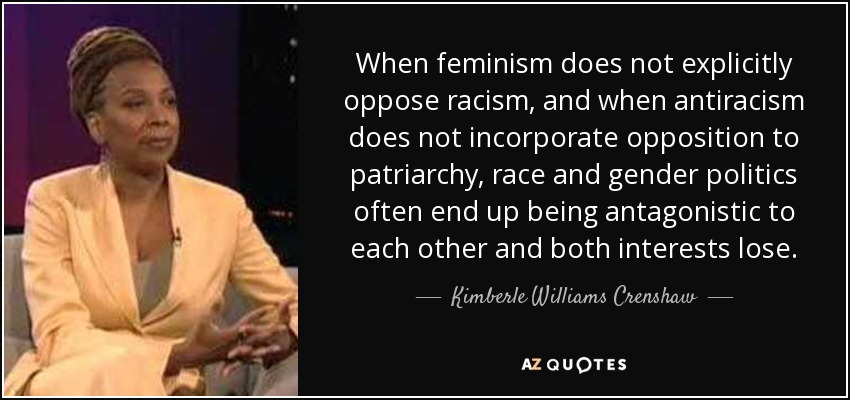
Kimberlè Crenshaw quote, from “Whose Story Is It Anyway?: Feminist and Anti-Racist Appropriations of Anita Hill,” in Toni Morrison’s Race-ing Justice, En-gendering Power, 1992, p. 403. (http://azquotes.com).

In truth, I’ve considered the issue of intersectionality as a historian and writer since 1993, when I wrote my quantitative methods requirement-fulfilling paper, “The Dying of Black Women’s Children.” Except that, for me and for most of my colleagues, the term was barely in use. Matter of fact, in five and half years of graduate school and in my first three years after finishing the doctorate, I may have heard the term used only once or twice. It’s not like I didn’t think about the unique issues facing women of color — especially Black women — in the context of US history and African American history. Sometimes as a historian, how leading Black men and White women marginalized African American women in education movements, in the suffrage movement, and in the Civil Rights Movement was all I could think about. In the context of understanding American education and the role of Black women as teachers and education, it made me reconsider the notion of education as a form of social control versus it as a form of social liberation as an and-both, and not an either-or proposition.

But, as with all other issues, I’m not perfect. I remember getting into an argument with an African American women at a joint Carnegie Mellon-University of Pittsburgh conference on diversity in 1992. She was a second-year master’s student in the public policy program at CMU’s Heinz School (now Heinz College) to my second year as a grad student and first as a PhD student. I had talked about my initial research on multiculturalism and Black education, and what that research could mean in terms of diversity in higher education. Over lunch, I barely got three sentences out about the implications before this student pounced on me for not taking a more Afrocentric approach to my research, all but calling me an Uncle Tom. She also pointed out that while I had accounted for race and gender in my work, I hadn’t accounted for them together. I was already used to middle class Black folk who only radicalized at the ripe young age of twenty-two telling me that my research was too conservative and too White. But on the second part, not accounting enough for Black women in my research, I did take to heart.

In 1999, at my “Black Brahmins” presentation on W. E. B. Du Bois, Carter G. Woodson, and Alain Locke and their ideas around multiculturalism and connections to Harvard at the Organization of American Historians conference in Toronto, I got a cold shoulder from the panel’s moderator, Stephanie Shaw. She barely said a word to me the entire time, and barely commented on my paper. I figured that Shaw thought I should’ve found a way to make the paper more inclusive of Black women graduates of Harvard and multiculturalism, even though Harvard didn’t allow any women to attend. I could’ve included Black women who attended Radcliffe College around the turn of the twentieth century, but even then, those women did not earn graduate degrees or become proponents of pluralism or what we’d call multiculturalism today. I followed up at OAH in Los Angeles in 2001 with my “Multicultural Sisters” paper, but by then, I no longer had an interest in multiculturalism as a historian.

Times Square intersection time-lapse, August 2014. (http://shutterstock.com).

On this day and date in 2000, though, was the argument I had with a colleague at Presidential Classroom, one that would keep me conscious about intersectionality and womanism from that point on. Sev had been brought on by my racist boss Jay Wickliff to help out with the international recruitment for the weekly civic education programs we had for high school juniors and seniors. Sev was Canadian, had been an intern with the program the summer before, and had recently finished up a master’s in history. She had stopped by my office to ask about some revisions I’d been making to parts of our upcoming summer programs, especially the one on media and democracy, which was a new program for Presidential Classroom. Somehow the conversation swung toward women’s rights and issues that Sev thought were important to women. I kept correcting her, saying that some of these issues were “only important to White women.” She took offense, telling me that I shouldn’t be correcting her, that her master’s made her as much an expert on the topic as me. I remember actually chuckling at that assertion, which miffed Sev even more. The common refrain, “Just because you have a PhD…,” was how she responded.

But I did take a few minutes to break down the differences between second-wave and third-wave feminism (or womanism). I went on about the history of exclusion that Black women in particular had faced from Black men in civil rights movements and White women around suffrage and reproductive rights. I said, “maybe it’s because you’re Canadian, but here in the US, these issues you’re bringing up mostly concern middle class White women.” She didn’t like that at all. Before Sev responded, Wickliff, having overheard our argument, came by and said, “Slavery was a hoax” as a joke. That was the moment I knew my days working for this group of Whiteness folks were numbered.

A few months later, in my new job at AED with New Voices, I picked up and read Kimberlè Crenshaw’s essay “Demarginalizing the Intersection of Race and Sex” (1989) for the first time. I knew that I already understood intersectionality for Black women, how misogyny, sexism, and racism constantly confer a double marginalization, discrimination, and violation on Black women. Now, between Crenshaw and my own experiences, I also realized that I could experience intersectionality as a Black man, between White men and White women. Especially middle class ones, where their well-meaning color-blind racism had served to put me in a box as well. It was an and-both box, where I was a historian who didn’t write about intersectionality enough and a professional who had also experienced race and gender-based marginalization, albeit differently from women or color. What I did learn, finally, was that the intersection of race, class, and gender made Times Square look like Walden Pond by comparison.

The Cruel Lure of Academia

Tags

, , , , , , , , , , , , , , , , , ,


Rihanna as Medusa, GQ Magazine cover, December 2013. (http://pinterest.com).

Twenty years ago on this date, I took the call that would help define my last two decades professionally. It was a call from Teachers College, Columbia University. I had made a final cut of interviewees “out of more than 300 applicants,” for a tenure-track assistant professorship in the history of education, the administrative assistant to the ed foundations department chair’s office had told me. It was my first post-PhD job call, one at the time that I hoped would be the only one I’d need.

It wasn’t my first interview for an academic position, though. That distinction went to Illinois State University, in April ’94. Two of their history professors were at the American Educational Research Association annual meeting in New Orleans, screening applicants for a lecturer and a non-tenured assistant professor position. I dared not tell my advisor Joe Trotter or anyone else about the screening invite. I went, I met the two youngish professors, both of whom told me to finish my PhD before applying for another job, because they thought my work “too promising” for non-tenure-stream positions. I had also interviewed for two education nonprofit positions, both in Pittsburgh, and both only offering me only a few thousand more than the US Postal Service offered me in ’92, when my name for a job finally came up.

Burned out 40w light bulb, April 27, 2010. (http://www.iamtonyang.com).

Now I had gotten a call from one of the most prestigious education schools in the world. A school within the same university that wanted to hire a private investigator ten years earlier because they didn’t want to give a poor Black kid a four-year free-ride. Despite the irony, I was happy, nervous, and apprehensive. I was happy for the opportunity, nervous about my prospects, and apprehensive about the possibility of moving back to New York. But, most important, I was also burned out emotionally and psychologically from the dissertation process, though not as burned out as I would become in the six weeks that followed.

The interview itself three weeks later was one of the best I’ve ever done for anything. I gave my job talk on multiculturalism and Black education, and for once, professors and graduate students in the audience didn’t look at me like I was speaking Vulcan. I actually had fun on that eight-hour interview day. As much fun as eight hours of scrutiny and answering the same questions over and over again could bring.

But, I remained apprehensive. Because I knew that I had a lot of big decisions ahead if I didn’t get this position, and just as many or more if I did.

Could I pay rent or eat through the summer if I didn’t get the job? Should I go groveling back to Carnegie Mellon, so that I could teach the required World History course for the 1997-98 school year? Could I pick up an adjunct gig at Pitt, Duquesne, or one of the other universities for next year, or what if it’s already too late to reach out? Could I get help from Bruce Anthony Jones, or beyond my dissertation committee, people like Barbara Lazarus, in securing my future? These were the normal questions that an army of PhDs in fields like history faced every single year.

For me, though, the idea of being an assistant professor twelve miles from where I grew up and thirty blocks from one of the buildings I helped my alcoholic father clean made my brain twist in knots. Heck, Teachers College had put me up at the Hotel Beacon on Broadway, between 74th and 75th Street, just three blocks from a high-rise me, my older brother Darren, and my father had cleaned the carpets and floors of regularly between 1984 and 1986. Did I really want to go back to a place with so many bad and embarrassing memories?

Plus, it wasn’t just my past I worried about. Living in subsidized faculty housing wasn’t ideal for me and my soon-to-be-wife. My younger siblings could reach me by catching the 1 or 2 train, and with the recent fire at 616 and the trauma that had caused, their visits were likely to be a regular part of my routine. I had given Mom something like $5,000 in the three years before the possibility of this job, as a graduate student. As a professor, she would likely expect me to do so much more.

Charging Bull of Wall Street (or a false god), cropped, January 19, 2016. (Sam Valadi/Flickr, via http://www.atlasobscura.com/)

Looking back, if Teachers College had offered me the job and I’d of course taken it, I likely wouldn’t have earned tenure. Oh, I would’ve been a fine classroom professor, and most of my students would’ve liked, loved, or learned from me. But between me having not dealt with my Mount Vernon/NY past, my Mom and siblings and family issues, and trying to turn my dissertation into a book and churn out academic pieces, I would’ve needed psychotherapy after three or six years. But Teachers College rejected me two months later. It supposedly came down to me and one other person.

This is what academia does to its own. With too few tenure-stream jobs and way too many qualified candidates, each job interview or job earned becomes magnified, to the point where taking a position can close as many doors as receiving a rejection for a job. Combine that with the false gods of meritocracy and academic freedom, and you have a recipe for a world of competitive disappointment. Academia is a world full highly educated people working for working-class wages but with elitist expectations of themselves and of those lucky few with tenure-stream positions. Add race, class, gender, family, and intersectionality to this brew, and it’s a wonder more of us don’t experience depression or some other mental illness.

I wouldn’t have been able to write this twenty years ago, even if I subconsciously suspected or consciously knew this to be true. I was tempted by the brass ring, only to find it was really a rusty old nail bent to look like something valuable.

Psalm 23 and Christian-isms I Don’t Understand

Tags

, , , , , , , , , , ,


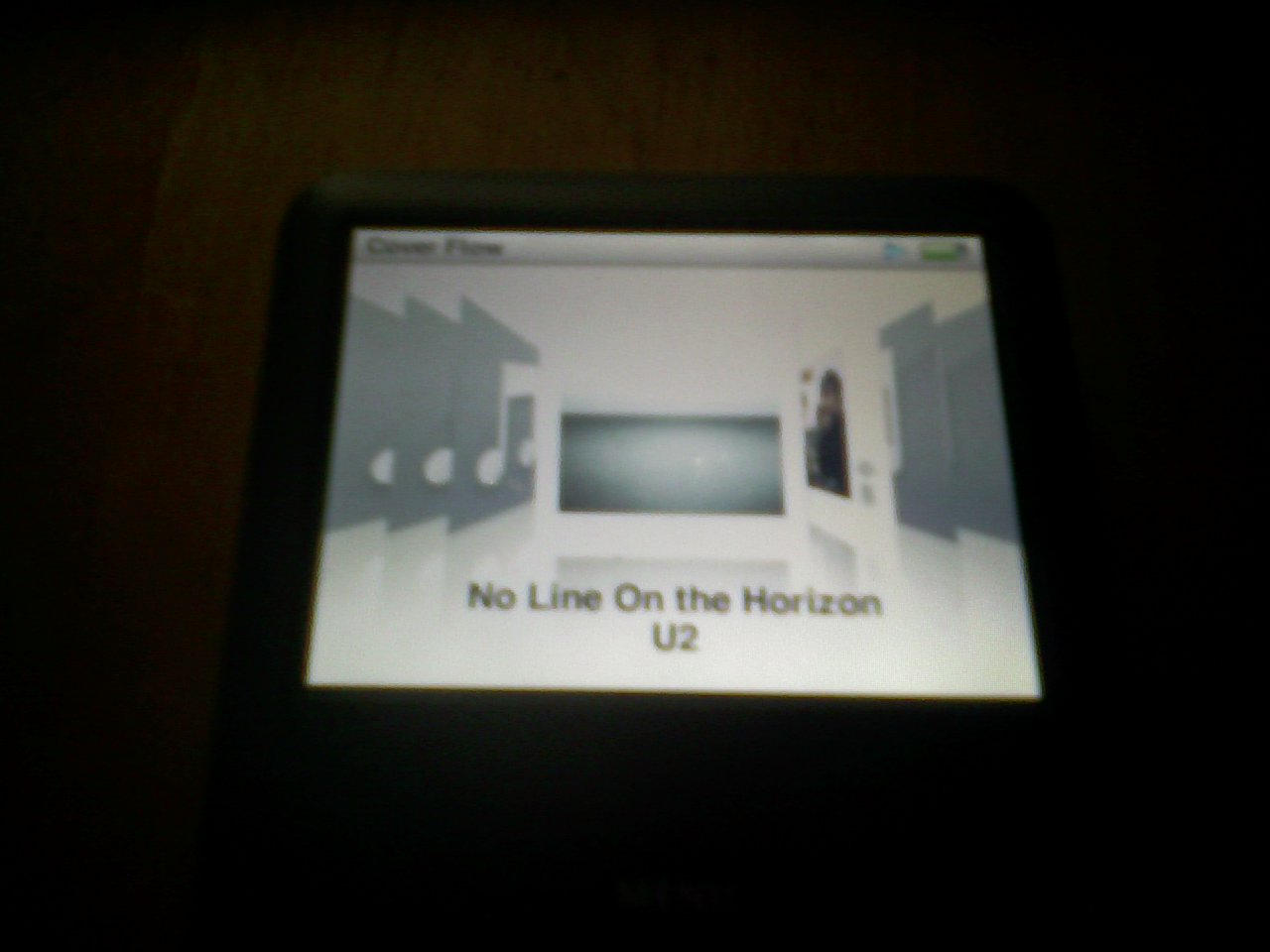
My iPod w/ U2, November 13, 2010. (Donald Earl Collins)

It’s Easter Week for 2017, and year 33 since I became a follower of Christ. I’ve written at length about my conversion and my evolution as a Christian. I’ve also posted about my problems with Christians and the way many impose — or at least, attempt to impose — their racism, sexism, misogyny, hyper-masculinity, heterosexism, homophobia, transphobia, Islamophobia, and anti-Black respectability politics on the world.

For me, it shows most American Christians to be hypocrites as best, and full of shit at worse, when it comes to following the two most basic rules of Christianity. To have “no other gods but God,” and “to do unto others as you would have others do unto you.” For most American Christians (if not Western Christians in general), money is god, Whiteness is god, and the two go together better than the chocolate and peanut butter in a Reese’s peanut butter cup. Both assert that others are but dirty pieces of gum on one’s shoe, that hatred, violence, and permanent superiority in the name of these gods supersedes following any important teaching or practice of Jesus and his disciples.

But that’s not all. After all these years, I still don’t quite get even some of the more mundane Christian practices and assumptions. The most basic one is Psalm 23. For the life of me, I don’t understand why pastors, priests, and parishioners seem to only read the psalm after a person has died. The psalm reads as:

The Lord is my shepherd; I shall not want.
He maketh me to lie down in green pastures; He leadeth me beside the still waters.
He restoreth my soul; He leadeth me in the paths of righteousness for His name’s sake.
Yea, though I walk through the valley of the shadow of death, I will fear no evil; for Thou art with me; Thy rod and Thy staff, they comfort me.
Thou preparest a table before me in the presence of mine enemies; Thou anointest my head with oil; my cup runneth over.
Surely goodness and mercy shall follow me all the days of my life; and I will dwell in the house of the Lord for ever.

The Bajoran Wormhole screenshot (or the entrance to the Celestial Temple), Star Trek DS9. June 18, 2011. (Donald Earl Collins).

It has always seemed to me that the living have needed the verses around “I shall not want,” lying down “in green pastures,” and walking “through the valley of the shadow of death” far more than the dead. No one has explained what Psalm 23 has to do with wakes and funerals to my satisfaction. The way people use Psalm 23 assumes so much about what occurs after we die — something none of us could ever fully comprehend — and completely neglects the reality that the living need rest, peace, and strength in our walk through a corrupt world. Kind of like the way many American Christians value embryos, cats, and dogs over Black and Brown babies, toddlers, and adults.

In 2005, I picked up evangelical Jim Wallis’ book God’s Politics in an attempt to expand my knowledge of the intersection between social justice activism and Christianity. Wallis’ book was supposed to be a primer on how to fight for the rights of the most vulnerable while also standing for “traditional” American Christian values. The book was a hot mess, as it did little more than insist on the right of those who weren’t Christian or following evangelical values (e.g., openly LGBT, pro-choice, womanist, and anti-racist) to exist and to be tolerated. Wallis wasn’t exactly calling for a revolution in God’s Politics. Certainly not when he insisted that many Black play “the race card” in identifying American racism in its myriad forms.

Where I stopped reading, though, was in Wallis’ description of U2 lead singer Bono’s activism and religiosity. Wallis saw Bono as someone “who has become a serious and well-informed activist,” and as a “spiritual man, though not a churchy person.” That was a back-handed compliment. But then Wallis expressed surprise to learn that Bono would get “on his knees” to pray for guidance, as this image of this rock superstar for Wallis was “humbling and heartening.” That came from pages 198-99 of God’s Politics, and that was where I stopped reading. The self-aggrandizement and name-dropping. The assumption that Bono couldn’t possibly be thinking in both social justice and Christian terms because of his profession. And the most obvious fact of all: Wallis likely had never listened to or read a single verse of a U2 song going back to the October album (1980). There are enough Christian and biblical allusions in U2’s catalog to keep most preachers in sermons for a generation. But yeah, let’s assume that anyone other than a devout evangelical Christian is living in sin or isn’t serious about combating Whiteness or poverty or any host of manmade plagues!

Religion in general isn’t the issue. Christianity at its heart is a belief system based on forgiveness, reconciliation, embracing of diverse peoples and differences, and of course, eternal salvation. What people do with religion is what they do with everything else. It can occasionally become a catalyst for spiritual freedom and social change, even revolution. But, much more often, institutionalized religion is a spiritual yoke, a way to control the way multitudes of millions see themselves and the world around them. Funny, then, that American Christianity represents everything that America is, and very little of the basic tenets of Jesus’ teachings in practice. Promoting blind patriotism, a lover’s embrace of money changers — a.k.a., capitalism, a hatred of vulnerable populations, and a tendency to racially self-segregate. This is the American way.

American Christians have let me down in so many ways. We have let our individual -isms and individualism overwhelm whatever it is that supposedly makes us Christian in the first place. If evangelicals want to look for someone to blame for America’s decline since the 1970s, they need only to stand fully unclothed in front of a full-length mirror. Maybe Bono as quoted by Wallis was right when he said that maybe “God [was] on his knees praying” for us to get it together in eradicating poverty, systemic racism, homophobia, HIV-AIDS, and climate change. Too bad most of us aren’t listening.

Forty Years of 616

Tags

, , , , , , , , , , , ,


Screen shot of 616 East Lincoln Avenue, Mount Vernon, NY, June 2016. (http://maps.google.com)

This past weekend marked four decades since my Mom and my late one-time stepfather (though not quite in 1977) Maurice moved me and my older brother from South Side Mount Vernon to an apartment complex three blocks from the Mount Vernon-Pelham border. This is much more a memorial of remembrance than of anything to celebrate.

For me, it was part of an endless series of storms. Mom had filed for divorce with my father and had decided to move in with her allegedly new boyfriend Maurice (who wasn’t so new, as I’d learn years later). My father Jimme’s alcoholism had gotten worse. He had drowned my Mom’s clothes in a bathtub, thrown a color TV out of our second-floor window, and stomped in a glass coffee table during dinner after my seventh birthday in response to the cheating and the divorce. My Mom ended up in the hospital for two months due to the stress and her kidneys, which had almost shut down due to her nonexistent diet. Add to all this the sexual abuse that I had suffered while Mom and Jimme were going at it during the centennial summer of ’76. My world was upside down, in shambles, as shattered as glass blown out of a skyscraper by well-placed plastic explosives.

A week ago, my thirteen-year-old son asked me, “Did you ever live in a house?” Even though I had talked about my life before the move to 616 East Lincoln Avenue before, it had been a few years. I think my son asked because of our plans to move out of our “luxury” high-rise after fourteen years. The truth is, I have lived in four homes over the years. But in my first seven years (with 240 East Third as a notable exception during my Mom’s illness), I grew up in three houses: 24 Adams Street, 48 Adams Street, and 425 South Sixth Avenue. We lived in one-bedroom flats in the first two homes, where we shared a kitchen and a bathroom with one other family. I have memories of playing in the front yards of both, of older neighbors (by toddler standards) hosing down their cars, of older kids and teenagers at the Adams Street Park on monkey bars and shooting hoops. I even remember the day my Mom told me we were moving to 425 South Sixth, August 12, 1974. It was the same week I burned my knee on an over door, the same week Richard Nixon announced his resignation from the presidency.

48 Adams Street, Mount Vernon, NY, November 22, 2006. (Donald Earl Collins)

At 425, we had a two-bedroom, one-bath flat, on the second floor, with a separate entrance. It was as close to owning a home as we got during those years. And boy did my Mom and Jimme blow it! Between the sexual abuse incident and my unconscious attempts at self-erasure, even suicide, 425 never quite felt like home.

The move to 616 occurred about a week after my Uncle Sam clotheslined my father like he was the late Deacon Jones and Jimme was a running back whose career was coming to a crashing halt. I remember it being the second Friday in April, near Easter Sunday time. It had warmed up from the frozen winter of ’77 to the light chills of early spring. But I didn’t feel particularly warmed up inside.

It didn’t help that where we end up moving didn’t look at all like the newer — if more impoverished — series of apartment complexes down the street on Pearsall Drive. It wasn’t the first time I’d been in an apartment building. But from the first time I walked into the A section of 616, I didn’t like it. The vestibule was too dark, the elevator too slow, and the building too smelly for my tastes. Plus, because of the haste of the move and the damage my father had done to our furniture, me and my older brother Darren didn’t even have a bed. From April to December ’77, we slept on the floor or on the couch in the new living room or in our eventual bedroom, with Mom and Maurice staying up sometimes until Johnny Carson time watching sitcoms and the news. So many times in those first months, I felt like I was a rag doll that had been hurriedly thrown into a box marked “Miscellaneous.” I was along for whatever ride Mom and Maurice were on, a permanent reminder of yesterday’s marital storms, a yoke on whatever future they had in mind.

I acted out repeatedly the first twenty months after the move. I chewed on a red-and-blue-striped t-shirt until I had swallowed about a third of it. I began biting and eating my nails until I made the skin underneath bleed. I stuffed sandwiches into the holes I made in my coats, and ate every booger my nose could expel as a substitute for lunch. That’s how much I hated Mom, Maurice, myself, my life, and 616 forty years ago.

Mom and Maurice tried to explain it away as simple selfish jealousy, that as a soft mama’s boy, I wanted Mom to myself. That’s only about twenty or twenty-five percent accurate. What I did know was that Maurice wasn’t my dad, yet Mom foisted him on us as if Jimme had died and none of us had any other choice. What I did know was that I was hurting, and since I was getting an ass-whuppin’ about once a week, I couldn’t lash out. What I did know was that not a single neighbor or kid in the building, especially the Bagleys, welcomed our presence in the building or my existence at 616.

Danger Keep Out sign, April 9, 2017. (http://www.safetysign.com/).

With what I’ve learned about Mom, Maurice, Jimme, myself, and my neighbors since ’77, it’s a wonder I didn’t go up to the roof and just throw myself off it those first two years, or in ’82, ’83, or ’84. God knows I ran away enough, got beat up enough times, and was called “faggot” often enough to see slamming myself into the slate sidewalk leading to 616’s front stairs as a better alternative to living. College was the first opportunity I got to get away from this living hell, and I took full advantage.

Mom and my two youngest siblings still live at 616. The youngest barely remembers the end of the abuse and chaos that I lived through and Mom put up with. The other sibling has horrible memories of his own. After the fire at 616 in ’95, when Mom asked me for advice about where to move after the renovations, I told her, “Anywhere but back to 616.” Mom, as nearly always, didn’t listen to me. I guess misery is as addicting as anything else.

Racial Privilege Matters Most

Tags

, , , , , , , , , , , , , ,


World War Z gif of horde climbing a wall (much like the way Americans see immigrants regardless of status), March 26, 2017. (http://reddit.com).

I’m sure I’m not the only one who noticed the stark, sad, and anger-inducing contrast between two events in the past couple of weeks. One involved the alleged rape of a 14-year-old girl by two undocumented immigrants (ages 18 and 17) at Rockville High School. The press gave this incident coverage on a local and national scale. So much so that xenophobic, anti-Latino Twitter trolls got involved.

Screen shot of tweets regarding Rockville High School rape, March 26, 2017. (http://twitter.com)

The proverbial “they” used the arrests as evidence of an immigration form of World War Z, in which angry hordes of the undocumented pour through America’s border with Mexico, raping, pillaging, and drugging up White (and mostly female) innocents. “Build the wall,” “illegals,” and “liberals” all became a cabal of iniquity in the (White) America First camp. What about the 14-year-old girl, the counseling she may need, or security issues at Rockville High School in general? Instead, two almost adult teenagers are a stand-in for immigration policies and 11 million undocumented persons. But what else is new?

On the other end of the spectrum has been the lack of coverage of missing Black and Latina girls in the DC area — in fact, in many parts of the US. So little has been even the local coverage that it took a tweet (one that I retweeted myself) two weeks ago for DC affiliates to pay closer attention.

Screen shot of retweet on 8 missing Black girls in Washngton, DC, March 12, 2017. (Twitter via @BlackMarvelGirl).

National coverage only kicked in when someone erroneously posted on Instagram that 14 Black and Latino girls had gone missing in the DC area in a 24-hour-period. True or not, there was no corresponding outrage over even the mere possibility that girls of color could have been kidnapped, trafficked, raped, or murdered as part of a crime spree. Though the facts of this particular Instagram posting were skewed, there’s no debate or daily concern for what happens to youth of color, especially girls of color, in the US. When confronted with the fact that 37 percent of America’s missing children are Black (Blacks are 12.4 percent of the US population), the excuse has been that most of them are “runaways.” And with that kicks in all kinds of racist and misogynistic assumptions. “The poverty and crime and drugs” got to be too much. “They’ve been exposed to more,” and therefore, can handle being on their own. “They’re sexually promiscuous” anyway, so let them run off with older men.

No one considers the why. In this case, why would these girls run away? Physical and sexual abuse at home, leading to vulnerability outside the home to human trafficking, rape, prostitution, or run-of-the-mill homelessness and poverty. No matter how one looks at this, this should be national news. That is, if America wasn’t primed to see only White kids as innocent.

Which brings me back to Rockville High School. No one knows the identity of the 14-year-old rape victim. But based on the Twitter trolls and the Washington Post comments section, most assume the girl is White. It proves a few things, especially for me as a Montgomery County (MD) resident. One, that my upper middle-class neighbors would turn on me in a second if I met anything approaching a criminal stereotype. For them, I would represent the alleged cultural deficiencies of 44 million other Blacks. Two, that for all their so-called liberal ideology, most White Americans are center-right, no matter where they live. They will turn a tragic incident into a racial or xenophobic referendum on millions of people faster than you can say “white on rice.” Three, only White lives matter and always matter to Whites, especially when put in contrast to the lives of people of color, immigrant or native-born or otherwise.

Show me you’re a liberal by embracing the truth of your own racial privilege. Show me you’re a liberal when you have to risk ostracism from your neighbors about defending the rights of undocumented immigrants as alleged rapists or decrying how the media doesn’t cover missing, exploited, and abused Black and Latina girls. Don’t tell me you’re a liberal, when it’s obvious your racism, sexism, and xenophobia is showing.