• About Me
  • Other Writings
  • Interview Clips
  • All About Me: American Racism, American Narcissism, and the Conversation America Can’t Have
  • Video Clips
  • Boy @ The Window Pictures
  • Boy @ The Window Theme Music

Notes from a Boy @ The Window

~

Notes from a Boy @ The Window

Category Archives: University of Pittsburgh

Toronto and Miscellaneous Items

26 Sunday May 2019

Posted by decollins1969 in 1, Academia, culture, Eclectic, Mount Vernon New York, Patriotism, Pittsburgh, Politics, Pop Culture, race, Religion, Sports, University of Pittsburgh, Youth

≈ Leave a comment

Tags

Canada, College Graduation, Columbine, Freedom, Pitt, Self-Reflection, Toronto, Toronto Raptors


Yonge Street in downtown Toronto, ON, Canada, March 20, 2017. (https://torontostoreys.com).

I meant to write about this a month ago, but after the Toronto Raptors’ not-so-surprising Game 6 win against the Milwaukee Bucks to make it to the NBA Finals for the first time, it’s still relevant. Last month made 20 years since the last time I’ve been north of the border (but not in Alaska, as I was in 2001). Last month was also the 28th anniversary of me finishing my bachelor’s degree at the University of Pittsburgh, and the subsequent decision to spend my first post-baccalaureate summer in Pittsburgh working and securing funding for my first year of graduate school. April 20 also marked two decades since Columbine, something that was very much on my mind during that Toronto trip and presentation at OAH there in 1999.

I can say that there are only a handful of times in my life since the end of first grade and being sexually assaulted in the summer of ’76 that I have felt “free.” By that, I mean free from the toxicity that is the US, on race, on gender, on class, on religion, on family, on friendships, on breathing, on eating, on walking, on daydreaming, on talking, on being contemplative, on laughing, on merely being myself. Those five days in Toronto to present my research on multiculturalism, to meet up with a couple of friends, to hang out in different neighborhoods and catch their subway. That was one of those times. Maybe the six months my Mom and my deceased idiot ex-stepfather Maurice spent separated between October 2, 1980 and April 13, 1981 was one of those times. Certainly when I proposed to my wife and then moved to DC and Silver Spring later on in 1999 was another. And, how can I forget the sheer ecstasy of watching my son emerge from my wife’s womb in 2003 at Sibley Hospital?

But while all of those and more experiences brought happiness, even orgasmic joy, I’ve spent more than 40 years of nearly 50 looking over my shoulder. In the back of my mind, the idea that the other shoe’s going to drop is never that far away. Even with the lack of American toxicity during my times in Toronto, I knew that this cosmopolitan city had its own unique edge. This despite the poutine, maple syrup, and Molson’s.

Plus, even with going to vegan restaurants, confirming my 1994 research on public housing policies in Toronto, seeing the diversity and freedom of movement sans the gaze of American Whites, it was still a very White city. And that Canadian Whiteness left room for a different (or really, indifferent) kind of gaze. It meant dealing with questions about Columbine and gun violence as if I could explain the actions of narcissistic White males steeped in patriarchy and entitlement. It meant remembering in subtle ways that while Canadians I met were both far nicer and kinder than most Whites in the US, they were still White. And Whiteness, like Arya Stark’s many-faced god, takes numerous forms.

I was free in ways that I couldn’t have been in the States. I walked in White neighborhoods without police following me around. I noticed how most folks didn’t lock their doors at night. I sensed that no one looked over their shoulders for a mugger. Everything was written in metric-system English, which I was happy to use in real life for the first time. It was just different, as if White Canadians hadn’t spent four centuries sitting around and figuring out even more ways to grind down Black people. I sensed that this wasn’t the case with White Canadians and First Nation tribes, though.

I didn’t feel anywhere near this free when I graduated with Degree #1 in April 1991. The immediate need of reporting to my $5.20 per hour job at Western Psych, three weeks of starvation, and the miracle that Dr. Jack Daniel performed meant that I was pensive and then relieved by May 26. I knew more twists and turns awaited me.

I want to visit again, this time with my son, and hopefully before the Fall Semester begins. I want him to see Caribana there, to breathe freer air, and to get away from the Lower 48, if only for a few days. But that’s not all. I want him to go overseas, to visit South Africa, and Nigeria, and Tanzania, and Ghana, and Mali, to see himself in everyone around him.

As for the Raptors, congrats on drudging your way to the Finals! Your organization is finally free to play for an NBA title. With Kawhi Leonard, I wouldn’t bet against you. But I’m not exactly rooting for you, either. Know that win or lose, I love your city, and the questions about freedom that it generates for me.

On Arrogance and Opinions

18 Saturday May 2019

Posted by decollins1969 in 1, Academia, Carnegie Mellon University, culture, Eclectic, Pittsburgh, Politics, race, University of Pittsburgh, Work, Youth

≈ Leave a comment

Tags

American University, Arrogance, CMU, Duquesne University College of Education, Evidence, Gender Bias, George Washington University, Howard University, Interpretation, Opinion, Personal Opinion, Pitt, Racial Bias, Racism, SETs, Student Evaluations, Student Evaluations of Teaching, UDC, UMUC


“No, fear and arrogance, you hayseed.” Kevin Costner and Tim Robbins characters in Bull Durham (1988), screenshot, May 18, 2019. (https://getyarn.io).

I received my latest evaluations from my AU students this spring. Really, I shouldn’t complain. Overall, my scores met or exceeded most metrics in all three of my courses this semester, even as some students thought there was “too much reading” or that I needed to “provide more guidance” on the readings I assigned. As an instructor, I have to sort of compartmentalize or even mentally toss out the personal attacks in such surveys. From students thinking I’m sexist because I used “#TimesUp” to get their attention after saying “Time’s up” multiple times during a small group discussion, to students saying I lack “emotional intelligence” because of email miscommunications (mostly on their part, though I took the blame) over a dramatic event. I’m hardly perfect, have never claimed to be, and expect that in dealing with human beings, especially young adults, that these things and their sometimes petty responses are bound to occur.

But some responses have been consistent across time and institution since my TAing days at the University of Pittsburgh. At some point since Fall 1992, a student or two will decide that I’m “arrogant” and that “[I] only care about [my] opinions,” that somehow, I never gave them room to express their opinions or somehow failed to validate their opinions. I don’t think I’ll ever overcome these critiques, nor should I try, especially after so many years of teaching. As the research has indicated for at least a decade, student evaluations of faculty are not reliable sources of data. Barely four out of 10 students at most colleges and universities will actually take the 10 to 20 minutes to complete one. Most negative evaluations correlate to an actual or an anticipated grade that is lower than what the student wanted for themselves in the course.

But the data for faculty of color, especially women faculty of color, and even more especially for Black women faculty, shows measurable racial and gender biases. Complaints about language, how one dresses, speech patterns, and other ticks and foibles become heightened. And not just among White students. Students of color, and Black students in particular, hold the Black faculty who have served as their instructors to a standard that could only be met by a parent of a newborn baby, something akin to perfection. I have felt this last bit during classes and other times at AU this semester more than others.

Still, on the broader issue of arrogance, I have changed my lecture style, the amount I lecture, the kinds of discussions I have run, the tactics for getting students to bond in the classroom, and (where I could) the types of readings I have assigned, just so students are more comfortable and willing to learn. None of this has mattered for the students who expect me to validate every idea they express in the classroom. None of this matters when I go in front of the classroom and lecture and facilitate discussion to this small but very vocal minority.

I used to think it was my age back in the 1990s. So I tried to be more objective, less animated, and gave up some degree of authority in the classroom. That worked for a couple of semesters at Duquesne College of Education and at GW. Mostly. But, even there, one student who told me day one she “hated history” and two students at GW wrote about my so-called classroom arrogance in their evals.

In teaching undergrads for a couple of semesters at the University of the District of Columbia and at Howard in 2006 and 2007, though, not one student had that issue with me. They didn’t complain when I poked holes in their analysis, or when I asked them to back up their opinions with evidence. It was refreshing, actually, to have students who didn’t assume that their opinions and that my years of interpreting and writing about history were equal in weight. Could it be that the racial dynamics of UDC and Howard made for a different interpretation of my demeanor and conveying of knowledge in the classroom (as one is a predominantly Black institution and the other is a flagship HBCU)? Probably.

Since my second year of teaching at UMUC, though, and with this first year at AU, this allegation of arrogance via my opinions has been constant with my evaluations, no matter how well students did and how positive my evaluations were otherwise. At this point, I have figured out a few tendencies of students who lodge this complaint. They are typically not comfortable with the material or with me as their instructor. I am frequently sarcastic, sometimes tongue-in-cheek, and gesticulate while using some of the skills I picked up from acting-as-public-speaking classes to lecture. In other words, lecturing with skill for me is a performance, one that conveys information, and it must be done with a high degree of confidence and seriousness, balanced with levity. That I have also decided to not treat history in a truly objective manner was deliberate, because history is a living subject, and thus cannot be taught objectively. Fairness and truth are far more important. That doesn’t make me arrogant. That makes me a confident instructor, but one with humanity and empathy.

As for opinions, I have sometimes said to my students, “As the saying goes, opinions are like assholes — nearly everyone has one.” That has usually gotten a few laughs (you gotta read the room before saying something like this — my AU students are too serious on the use of colorful language from what I’ve found so far). But even when I say that “this particular interpretation comes from me,” I am still expressing more than a personal opinion or insight. I am expressing an idea or interpretation based on years of study, observation, reading, and writing, for scholarly and mainstream publications. So when I insist on students backing up their opinions with evidence, or literally have to say, “No, that not correct,” and then explain why it isn’t, this is me doing the job of an instructor with years of knowledge and even expertise on a wide variety of topics, not just some random person on the Red Line train to Shady Grove.

Even with all of these caveats about the differences between opinion and interpretation, about my level of expertise, and about my approach to the classroom, there are some small number of students who will say, “He’s arrogant,” “He doesn’t value my opinion.” Or, as one student emailed me four years ago, “Sir, you are a dickhead.” I realize that these specific comments, like the ones I wrote about for The Washington Post last year about the rejection of Black history and racism as central parts of US history, were about my difference, not my indifference. Being a Black man teaching mostly White students, or teaching Black students who expect me to consistently validate their unsubstantiated opinions, does not have its privileges. Especially on a student evaluation form.

My Life as a Scrambler

10 Wednesday Apr 2019

Posted by decollins1969 in 1, Academia, Boy @ The Window, Carnegie Mellon University, culture, Jimme, Marriage, Mount Vernon High School, Mount Vernon New York, My Father, Pittsburgh, Politics, Pop Culture, race, University of Pittsburgh, Youth

≈ 2 Comments

Tags

"Comin' From Where I'm From", 616, 616 East Lincoln Avenue, Academia, Anthony Hamilton, Burnout, CMU, Contingent Faculty, Football, Graduate School, Humanities, Hustlin', Joe Montana, Life, MVHS, NFL, Nonprofit World, Publishing, Russell Wilson, Scrambling, Shawshank Redemption Quote


I wish I could say that it was different. I wish I could say that the key to success in my life was crafting plans, developing rubrics, and building out scale models of every step, move, and smile toward achieving Points A, B, and Z on my life-sized to-do list. I wish that life was like being Tom Brady (not really). Or really, like being every White male statue that’s ever stood behind a bruising, blocking, dynamic offensive line in American professional football. One where even a mediocre quarterback like Trent Dilfer or Jim McMahon could stand behind and take as many as ten seconds to find an open receiver for a first down or a long touchdown on their way to a Super Bowl championship.

But, with some notable exceptions, my life, and the successes I’ve garnered in my life, have come from scrambling out of the pocket, usually because my proverbial offensive line couldn’t block the pass rushers in my life. It’s hustlin’ really, but not the kind of hustlin’ that would bring me notoriety. My life has been mostly Joe Montana and Russell Wilson, with occasional periods of Warren Moon half-standing in the pocket and half-scrambling in between.

Graduate school was the one exception that almost ruined me. I took the lesson I learned about keeping my schedule of work, social life (however ill-defined in 1991), and classes and transferred it to my five and a half years of working toward a doctorate. After a straight-A first semester and finishing my master’s in two semesters, I took it as a sign that this drawing up plans and executing them with brutal efficiency was the best way for me.

Keep in mind, I scrambled all through middle school and high school, for all six years I was in my Humanities Program. I scrambled because I had to. I couldn’t make concrete plans to study at 616, to read books by a specific date, to just have a day to myself just to work on me. Not with my abusive ass, idiot stepfather Maurice/Judah/Maurice there. Not with my younger siblings running around. Not with my Mom going through welfare and depression. Not with having to track down my alcoholic father on weekends for work and money.

San Francisco 49er QB Joe Montana scrambling to make a throw, Super Bowl XIX, Stanford Stadium, Palo Alto, CA, January 20, 1985. (http://youtube.com).

And yet with all that, I finished 14th in my graduating class of White, Black, Afro-Caribbean, and Latinx hyperachievers. I received scholarship offers from every school I got into (with Columbia withholding only because they couldn’t believe I came from a family of eight with a $16,600 per year income in New York). Scrambling worked, even though it didn’t feel like it at the time.

Which was why I went the other way. And so, for my graduate school years, and the baker’s dozen of years that followed, I stayed in the pocket. I drew up plans like an architect for my career and life, and followed those plans as if I’d gotten them from God him/herself. And the truth was, most of my plans worked to perfection. I earned a two-year master’s degree in one, earned a big-time dissertation fellowship without overwhelming support from my advisor and committee, published articles, presented at conferences, and, once fully immersed in nonprofit work, job after job, promotion after promotion, more publications and teaching opportunities.

Or so I thought. I hadn’t realized that while my 150-PowerPoint-slide gameplan seemed to be working, that I was still scrambling every chance I got, and hustlin’ myself in the process. I only completed my doctorate in November 1996 because I scrambled, and left my advisor little choice but to approve my dissertation. This after lobbying my other committee members, documenting every comment from my advisor on my dissertation going back a full year, and otherwise turning the academic politics of Carnegie Mellon to my favor that summer and fall. That, and having a complete, 505-page manuscript, sealed the deal.

I scrambled for work all the while, went the summer of 1997 without work before hustlin’ my way into nonprofit work by lying about only having a master’s degree that year. I scrambled into my jobs at Presidential Classroom, both of my positions at Academy for Educational Development, and every single teaching position I’ve held since 1998, AU included.

It just took me until 2008 to realize that I wasn’t the figurative pocket passer. I ran myself and those who’ve been there to catch my publishing, teaching, and working passes open. I’ve never had a good offensive line, because America stacks their lines for privileged White men and White women first, second, and third. Sometimes I’ve had to take the proverbial ball to the end zone or for a first down myself, because there hasn’t been anyone else who can help. Sometimes, too, I have to take the hit, also because I don’t know what I don’t know, and I’ve fought against the mantra “It’s not what you know, it’s who you know” for most of my 49-plus years on this Earth.

I’ve come to accept that this is my life. I don’t have to like that despite all the article publications, conference and public presentations, grant money raised, students taught, students now in prominent positions themselves, book manuscripts produced, friends made, and so many other measurables, I am a bad six months away from career collapse. And with that, maybe my marriage, my status as a dad, and  my health and life would be at risk as well.

But I do not intend to be a contingent faculty member and an older man pretending to be a youngish freelance writer with fresh ideas (with the rare consulting opportunity) for the rest of my most productive working days. Either all this works out, somehow, or I’m driving as the Uber professor/Trader Joe’s stock boy/MCPS bus driver (ala Steven Salaita) down the line. Anyway, Red from Shawshank Redemption put it best. “Get busy livin’, or get busy dyin’.” My mantra for the past four and a half years.

What If You’ve Never Really Had a Crew?

01 Friday Feb 2019

Posted by decollins1969 in 1, Academia, Boy @ The Window, Carnegie Mellon University, culture, Eclectic, Hebrew-Israelite, Mount Vernon High School, Pittsburgh, Politics, Pop Culture, race, Religion, University of Pittsburgh, Work, Youth

≈ Leave a comment

Tags

#ThickTheBook, Academia, CMU, Collaborations, Community, Crew, Envy, Family, Friendships, Hebrew-Israelite Years, Homies, Loneliness, Loner, Misfit, Nonprofit World, Pitt, Posse, Starling, Support Systems, Tressie McMillan Cottom


My copy of Tressie McMillan Cottom’s #ThickTheBook, January 12, 2019 (Donald Earl Collins)

Tressie McMillan Cottom’s book Thick: And Other Essays, like so many of the books I’ve chosen to read over the past six years, will stay with me a while. She is brilliant, period. I feel blessed having been on the journey of reading about her experiences, her views of the world, and her Blackness and Black feminism. There are so many nuggets and witticisms in Cottom’s Thick that I should sit down and plan out a way to mine her book for actual gold and platinum. It’s rich and thick like hot chocolate with hits of cinnamon and nutmeg, something to imbibe while taking a bite of a New York-style blondie (which I specialize in cooking-wise) or slice of chocolate torte cake here and there.

But there was one sentence that stood out, before I even began reading the book in earnest. As I randomly flipped through the pages after first getting Thick, this sentence hit me hard, dazing me like the day my one-time stepfather punched me in the jaw for the first time. “Everybody needs a crew,” Cottom wrote to start her “The Price of Fabulousness” essay, adding that she has “many because I am extremely fortunate.” Yeah, no kidding!, I thought immediately after reading that sentence. For a moment, maybe even 0.68 seconds, I was envious. Not like, “Oh my God, the arrogance of this one here!” kind of jealous. Nor was I the “I wish I was her!” green-eyed monster, either. I realized that since the last weeks of sixth grade and the beginning of three and a half years as a Hebrew-Israelite, I hadn’t really had a crew as Cottom defined it at all. That was the spring of 1981, when I was eleven years old, nearly 38 years ago, by the way.

From the day I let my one-time best friend Starling beat me in a fight over my alleged decision to join the Hebrew-Israelite cult and walk into William H. Holmes ES with a white kufi on my head, I had no crew. There’s a reason I consistently refer to my middle school and high school Humanities classmates as either “classmates” or “acquaintances.” They weren’t my friends, some were genuine bullies and assholes to me and to each other, and lacked in most forms of what grown folk would call social graces. They were my academic and (sometimes) athletic competitors, they were friends with each other, but only to a point. But one thing they could never, ever be was my crew or posse or homies or anything close to what Cottom meant. That Wu-Tang Clan-level of professional collaboration and possibly personal friendship didn’t exist in the cauldron that was that magnet program within an even more hostile public school system in Mount Vernon, New York.

College at the University of Pittsburgh was where I’d find friendships again, and maybe at times, the primordial beginnings of a crew. But these proto-crews never quite came together for more than a night on the town here or there. Quite frankly, the other thing my eclectic groups of friends and acquaintances had in common was knowing me. At least, the parts of me I was willing to show folks at the time. I knew most of them weren’t ready for the real me, because I wasn’t ready for the real me. Not at nineteen, twenty, or twenty-one.

Spencer Foundation Dissertation Fellows Retreat, Berkeley, CA, February 17, 1996. (Donald Earl Collins)

Graduate school me, though, was more ready. My times at Pitt and Carnegie Mellon earning my doctorate were the closest I got to having a crew. At one point in 1994-95, I probably knew at least half of the Blacks, Africans, Afro-Caribbeans, and Latinxs on Pitt’s campus, and all of the Black diaspora students at CMU (the latter because there were so few of us there). But despite the common interests around campus climate, student and faculty diversity, mistreatment on the basis of race, class, gender, and sexual orientation, the fact remained that my crews were eclectic and transitory ones. Masters students would be gone in two or three years. My warp-drive, single-minded race toward the doctorate made certain that any bonds I forged during those years wouldn’t last. There would be no collaborations or calls for career help or advice with these disparate groups. Not even when I lived off the fumes of my last grad school stipend check the summer of 1997.

Working in the nonprofit world and as contingent faculty has often meant being on the inside, but still feeling like an outsider, anyway. Or really, a fraud, because I never fully embraced the norms of nonprofit capitalism or academia as intellectual capitalism and exploitation. I became friends with a fairly eclectic bunch in these spaces, too. But none of them shared my passion for creative nonfiction writing, or have wanted an alignment between career goals and social justice fights, or even, have had a taste for basketball as a spectator or player.

I guess one could say that my wife and son and two of my closest friends are my crew, but that’s not how a crew works. They are family, a very supportive family to be sure, but family is muck thicker than blood or a crew.

So, maybe Cottom is right. I really, really, really need a crew. I’ve made it pretty far in parts of my life without one. I’m not sure how much more Sisyphus I can do on my own, though.

The Sweet Consolation of Suicide

27 Thursday Dec 2018

Posted by decollins1969 in 1, Academia, Boy @ The Window, Carnegie Mellon University, Christianity, culture, Eclectic, eclectic music, Hebrew-Israelite, Mount Vernon High School, Mount Vernon New York, music, Pittsburgh, Pop Culture, race, Religion, University of Pittsburgh, Youth

≈ Leave a comment

Tags

"I Still Haven't Found What I'm Looking For" (1987), Birthday, Brittney Cooper, Contemplation, Darnell Moore, Depression, Eloquent Rage (2018), God, Heavy (2018), Kiese Laymon, Living, No Ashes in the Fire (2017), Questioning, Self-Policiing, Self-Reflection, Self-Revelation, Suicidal Ideations, Suicide, Suicide Attempt, The Joshua Tree (1987), U2


Sweet-and-sour-chicken, 2011. Source: http://www.foodnetwork.com

Well, not exactly sweet to be thinking about what you have thought about and attempted to act out in the past. In the next few hours, I turn 49, which is to say that I begin year fifty on Planet Earth. “Yay me!,” right?

Not so much this time 35 years ago. My suicidal ideations had gone on in December 1983 for nearly three weeks before my fourteenth birthday, in the aftermath of my fourth mugging in four years. That Tuesday, December 27, at 2:30 pm, coming home from C-Town in Pelham, standing on the parapet of that stone bridge overlooking the Hutchinson River Parkway, I had every intention of jumping. I played it out in my head all the different possibilities. At first, it was going to be like the second between taking a deep breath plunging myself underwater and holding my breath while feeling the pressure build up all around my head, eyes, and ears. Except that I imagined a screech, a pop of a hit, and the world turning into stars before I escaped into eternal darkness.

But then, I thought about the plausibility of surviving the 13-foot jump, only to get hit by a car or truck flying down the parkway at 60 or more. Paralyzed, brain-damaged, trapped for days, months, years, decades even, in a body that defied me once again. At this point, my knees were already bent, pretty much ready to push off the stones I stood upon anyway. The possibility of survival and suffering, though, stopped me short of taking that leap. That, and wanting sweet revenge on the stepfather and others who had driven me to this moment.

It’s all in Boy @ The Window. What isn’t in the book is that I couldn’t imagine living past my thirtieth birthday, much less to 49. What isn’t in the book is that I have had other episodes where I either attempted to take my own life via car accident or had suicidal ideations (anywhere between 1982 and 1988, as well as in the late-1990s). This isn’t the same as contemplating my own mortality or considering how much more I may be worth dead than alive (at least I think it isn’t the same, anyway). If someone had put a gun to my head, and asked me why I should keep living, I probably would’ve told them to pull the trigger. I really didn’t have any answers when I got low enough to consider best suicidal practices.

Sure, in the process of working through my own trauma while in progress, I found God, I found Jesus, I read my Bible, I embraced the Holy Spirit. But as the U2 song goes, “I still haven’t found what I’m looking for,” at least not during my Boy @ The Window years, or in the years after my doctorate, or even after a decade in the nonprofit world. Heck, I’m still a work in progress, and not quite sure what’s around the corner for me (although I’m cautiously hopeful, with fingers and toes crossed, and knocking on wood in my mind’s eye as I type this). But a focus on escape isn’t enough. Striving for perfection — including perfect chastity — wasn’t enough. Even writing my fifty-to-100-pages-too-long memoir wasn’t enough.

Two things in the past decade have been enough. One was to admit, and not for the first time, that I controlled nothing, not even my own body, and certainly not all of my thoughts. For a person who’s policed himself as much as I have over the years, this was a hard truth to finally and fully accept, and that was a little more than four years ago. Two was that I needed to let out my thoughts and feelings, no matter how fucked up or how revealing or embarrassing they could be for me. Some of that has worked through this blog and Boy @ The Window. The rest has been as a result of social media, freelance writing, and otherwise remembering that though I may be truly weird, I am also truly human.

Maybe that’s why in the past couple of years I’ve mostly read Black women writers on their trauma and intersectional experiences, between Brittney Cooper, Morgan Jerkins, Roxane Gay, Crystal Fleming, Patricia J. Williams, and a host of others. Maybe that’s why I found more solace in Kiese Laymon’s Heavy than I ever did with any of my history monographs. Maybe this is why I’m convinced that to be a better writer, I had to become an even better reader, and read across genres and disciplines like I never had before. Maybe, too, this is why I as an educator have committed to use a wider variety of materials to reach my students, even if one or two want to only read mainstream history texts and don’t want to engage in “literary analysis.”

I finished Darnell Moore’s No Ashes in the Fire two days ago. Despite his stepping out of narrative to preach “Black radical love” at least three too many times, Moore’s book reminded me of what all the other wonderful books I’ve read in the past three years have told me. Share your truth, so that others may see, hear, or react to it. Tell your story, ‘cuz ain’t no one else gonna tell it for ya. Talk about it, if only to yourself, so that you know you’re not crazy. There’s bravery in putting in words your pain, your joy, your sense of the world and sense of self, your need for a higher power (or lack thereof). There’s courage in pointing to your unique sameness relative to humanity, and your need to crystallize the dominance of systemic racism, heteronormative patriarchy, and narcissistic worshipping of dollars and billionaire elitism that is this warped-assed world.

None of this may convince someone from taking their own life. I don’t pretend that I have any specific answers, because I don’t. But many times, living begins with one question, then another, then another. Living for me is about finding the best questions to answer, to turn the embers of what was once a wall of bullshit into a forest fire of questions, for me and others. This world will never give us the right to question it, which is why we who might want to live another day must wrest that right for ourselves, every single day.

Viewing World AIDS Day From the Cheap Seats

01 Saturday Dec 2018

Posted by decollins1969 in 1, Boy @ The Window, Christianity, culture, Eclectic, eclectic music, High Rise Buildings, Jimme, Marriage, Mount Vernon High School, Mount Vernon New York, My Father, New York City, Pittsburgh, Politics, Pop Culture, race, University of Pittsburgh, Youth

≈ Leave a comment

Tags

"Shout" (1985), 616, ACT UP, Greyhound, Hard Luck Life, HIV/AIDS, Homophobia, Hypermasculinity, Misogyny, NYPD, Port Authority, Prostitution, Sex Work, STDs, Systemic Racism, Tears for Fears, World AIDS Day


World AIDS Day 2018 logo, November 30, 2018. (http://hiv.gov).

Today and this weekend mark 30 years since the first World AIDS Day. Unlike three decades ago, I seldom give HIV/AIDS any thought at all. Where did it go? Has anyone actually died from AIDS recently? Do people still have to worry about HIV/AIDS? I know the answers are, nowhere, yes, most definitely, and hell yes, dumb ass.

But 30 years ago, I worried about HIV/AIDS the same way I worried about the Soviet nuclear threat, my Mom still living with my idiot stepfather, and dying if I wasn’t part of some evangelical Christian rapture. I pretty much worried about everything back then. In the context of my heterosexuality and mostly burying it for fear of intimacy, pregnancy, and bodily fluids, though, I worried that with my luck, any sex at all would lead to the STD to beat all STDs.

So when my dad went out of his way to get me a prostitute (we didn’t use the term “sex worker” then, I think) for my seventeenth birthday in December 1986, a young woman I knew to have been a fellow Mount Vernon High School student the year before, I didn’t hesitate to say no. I preferred Jimme calling me “faggat” to doing the equivalent of Spike Lee’s character in School Daze, a form of meat-market sex approaching (but not quite) rape.

I knew, down to my bones, despite the ACT UP crowd of relatively well-off gay White male activists on MTV and elsewhere, despite the dome of Black hypermasculine homophobia found in Mount Vernon and in the city, that HIV/AIDS wasn’t a “gay disease.” Basic biology would dictate that viruses don’t make left turns based on sexual orientation, class, gender, or race. So, hell yes, I was scared, for quite some time, from the prospect of living with a disease that has killed more than 35 million people worldwide since 1979.

The dangers of sex work, of casual unprotected sex, and of HIV/AIDS were made clear to me on my trip to Pittsburgh in August 1990 to secure what would be my studio apartment living for the next eight and a half years. It started at the Port Authority Bus Terminal on 41st on Friday night, August 3. It was going to be my second trip ever on Greyhound, catching the 11 pm red-eye, nonstop bus from Manhattan to downtown Pittsburgh. As the 40 of us stood in line to catch the bus, I saw a woman around my age wandering between the men’s room and the waiting areas, talking to different guys, with one or two jumping out of line for a few minutes.

Port Authority Bus Terminal entrance, New York, NY, October 22, 2015. (Ilana Gold/CBS2; https://newyork.cbslocal.com/2015/10/22/port-authority-bus-terminal-plan/).

As she drew closer to my line, I recognized her. She was someone I knew to be the cousin of one of my neighbors on the third floor of 616. By then, I also saw a Black guy in his mid or late-twenties, standing near the men’s room, keeping a close eye on her. It was like the cogs of my mind moved in slow motion as it became clear that this person I knew was a sex worker and the guy was her pimp.

A few minutes later, the pimp bellowed, “Five-O! Five-O!.” The all-too-familiar woman took off. She booked out the terminal doors and toward the streets around Times Square. The Port Authority police and two NYPD cops had grabbed the pimp, put him on the ground, handcuffed him, and took him away.

I was so surprised and sad after that, at least as we boarded the bus and weaved our way through New Jersey. I hadn’t seen this woman since 1986 or 1987, when I was a senior in high school. Over the years, she had come over to her cousin’s place to visit, and maybe to stay (at least temporarily). She had mostly teased me about my “White music,” except for Tears for Fears in the summer of 1985 (their “Shout” had been turned into some hip-hop urban mix on WBLS).

She had asked me on more than one occasion, “Do you like girls?” I mostly ignored her, saw her as just another person at 616 and in Mount Vernon who saw me as something to kick around. I didn’t consider her attractive because of how she talked to me, but looking back, she was. At five-seven or five-nine, she was a yellowish-brown skinned woman, with some freckles, a nice smile, shortish hair, and a nice proportionate shape. She could be witty, in a New Yorker’s sarcastic sort of way. But between Wendy, Phyllis, and my march to college, nothing and no one in Mount Vernon could compete for my attention in that way back then.

A week later, I came back from my Pittsburgh trip, on another Greyhound non-stopper, only to realize at 8:30 on Saturday, August 11 that I needed to take a dump. As I’ve said elsewhere, I tried and failed to take one at Grand Central, as the basement restrooms were full of broken toilets, boarded up stalls, and at least one person with obvious signs of Kaposi’s Sarcoma, a sign of full-blown AIDS. I don’t know how I managed to hold my shit until I made it back to 616.

I learned from my Mom twelve or thirteen years ago that my former neighbor and teaser had died from AIDS-related complications, leaving two children behind. Even though I didn’t know her very well — didn’t want to know her, really — I was still heartbroken for her and her kids. All I could think was, what an awful life, what an awful way to die! Who’s going to raise her kids?

But really, I couldn’t help but go back to that Friday night in August 1990. I observed from up close, what the limited choices in a world of capitalism, patriarchy, misogynoir, and racism left people like this young woman. I observed, from afar, how this world can make something as destructive as HIV/AIDS a movement for gay White males, and a silent way of killing Black women at the same time.

Thanks, Away From Home

27 Tuesday Nov 2018

Posted by decollins1969 in 1, Academia, Boy @ The Window, Christianity, culture, Eclectic, Mount Vernon New York, Movies, Pittsburgh, Politics, Pop Culture, Religion, University of Pittsburgh, Youth

≈ Leave a comment

Tags

American University, Away From Home, Beverly, Depression, Family, Financial Woes, Food, Friends, Grinding Poverty, hunger, Kindness of Strangers, Loneliness, Malnourishment, Melissa, Pitt, Ron Slater, Thanksgiving


Thank You — paying it forward, March 3, 2017. (Catlane/iStock; http://digital.vpr.net/)

Yet another Thanksgiving has come and gone. The holiday is problematic for so many reasons, between the erasure, cultural exploitation, and dehumanizing mythology of indigenous Americans and the climate-change-defying national pig-out that begins every late-November Thursday, and continues for weeks afterward, year after year. But the fact that the days off around Thanksgiving gives us worker bees time to spend with family, friends, and those we seriously like and love can’t be ignored.

Sure. At least for those of us who have such people in our lives with whom to share our time off from work, school, and life’s constant treadmill. My American University students reminded me of the allegedly normal ritual of returning home to eat and spend time with family, et al., this past week. Half of them contacted me to let me know they weren’t going to attend the two classes immediately before Thanksgiving, even after learning I wasn’t granting them an excused absence for the holiday week. All so that they could have a few extra days away from the stresses of higher education and the classroom. I envied them, just an iota, if only because they presumably had good reason to spend time with their families and loved ones. I also figured that not everyone in my class was going home to a welcoming environment, or really, going home at all.

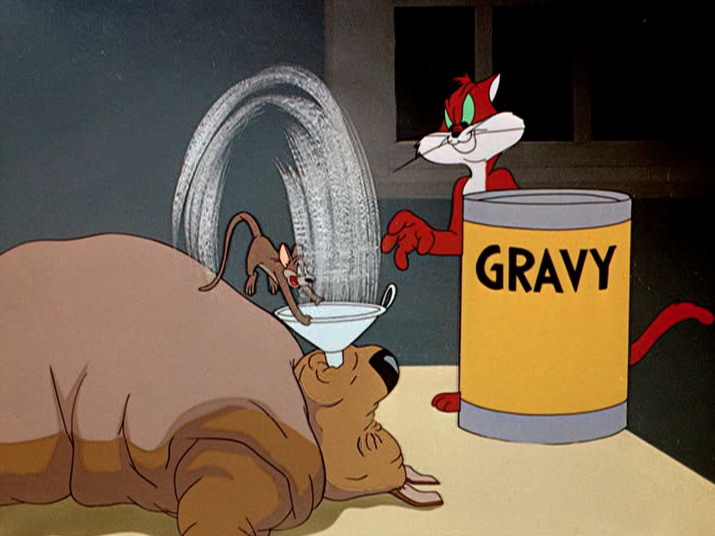
“And this time, we didn’t forget the gravy” Looney Tunes “Chow Hound” episode of bullying, greed, and gluttony, originally aired June 16, 1951. (WB; http://tralfaz.blogspot.com/).

That last one was certainly the case for me during my student days. Growing up the way we grew up, in Mount Vernon, at 616, a good Thanksgiving was one where we had a regular meal to eat. Even before the Hebrew-Israelite years of 1981-84, our Thanksgivings weren’t seven-course eat-a-thons. We were lucky if my Uncle Sam came over to eat with us (which after 1978, was pretty rare), and we didn’t spend time around my Mom’s friends once we dived into being Black Jews and fell into grinding welfare poverty.

After I went off to the University of Pittsburgh in August 1987, I only came home to Mount Vernon and 616 one time for Thanksgiving, three months later. My Mom made the biggest Thanksgiving meal I’d seen her make since 1975. I remember mostly the mashed potatoes and gravy. But it wasn’t a family affair, not really. I was home mostly because I had grown used to the well-worn grooves of poverty, abuse, and adult-level responsibilities that had been my life since the fall of 1982. The food, while the first home-cooked meal I’d eaten in three months, was an escape from my normal attempts at escape.

Twelve months later, after six weeks of depression, getting over my Phyllis obsession, a semester of graduate school-like concentration, a summer of unemployment, a week of homelessness, and three months of financial woes and malnourishment, Thanksgiving 1988 had arrived. Between Ron Slater, Beverly, and finally having enough money to not worry about eating or bills for the first time in almost a year, it felt weird, only having gratitude as my companion for a few years.

But life got even weirder for me, as my friend Melissa had invited me to her father’s house for Thanksgiving. This was not a date of any kind, certainly not from my perspective. I think that Melissa sensed how rough my year had been, knew that I wasn’t going home to New York to see family, and did the Christian thing of looking after one’s neighbors. This even though things weren’t exactly great for her and her father at the time. Melissa’s father was an ailing contractor in his early sixties. I really don’t remember much about that Thanksgiving in terms of the food. I think there may have been dinner rolls or candied yams. What I do remember is the two-and-a-half hours I talked with Melissa and her father, about politics, the “Stillers,” Christianity, and Pitt. It was the most thankful holiday I’d ever experienced, and my first Thanksgiving seeing what Thanksgiving was like for family members who enjoyed each other’s company.

It was the first of seven straight Thanksgivings either spent with friends like Melissa, Howard, Kenny, the Gants and their families, or by myself. The “by myself” Thanksgiving was in 1990. It was a cold and rainy day, where I did nothing but watch football, made myself two double cheeseburgers, and found a nearly usable director’s chair outside a vintage furniture gallery in East Liberty. Even then, folks looked out for me. The next day, two of my older Swahili classmates swung by my apartment to bring me Thanksgiving leftovers. They brought me cornbread, dinner rolls, ham, turkey, mashed potatoes, dressing and stuffing, greens, and candied yams with marshmallows. I had tried to say no, but neither of the women would let me. It was really hard for me not to cry while being thankful for such generosity.

It seems like it’s been a lifetime since those naive and cynical days, where I didn’t trust anyone in my life. The bout with homelessness and the financial straits that followed changed my life in ways that I notice even today. Even with the years of working long hours and fighting for my career as a writer and an educator, I realize that I wouldn’t be here doing any of what I’m able to do today without the kindness of strangers and friends, the ability to weigh, sift, and analyze myself and my past or the sense that God had a purpose for me, a reason for living and being. Even after 30 years, I have this and so much else to be thankful for.

← Older posts
Newer posts →

Boy @ The Window: A Memoir

Boy @ The Window: A Memoir

Places to Buy/Download Boy @ The Window

There's a few ways in which you can read excerpts of, borrow and/or purchase and download Boy @ The Window. There's the trade paperback edition of Boy @ The Window, available for purchase via Amazon.com at http://www.amazon.com/Boy-Window-Donald-Earl-Collins/dp/0989256138/

There's also a Kindle edition on Amazon.com. The enhanced edition can be read only with Kindle Fire, an iPad or a full-color tablet. The links to the enhanced edition through Apple's iBookstore and the Barnes & Noble NOOK edition are below. The link to the Amazon Kindle version is also immediately below:

scr2555-proj697-a-kindle-logo-rgb-lg

Boy @ The Window on Amazon.com: http://www.amazon.com/Boy-The-Window-Memoir-ebook/dp/B00CD95FBU/

iBookstore-logo-300x100

Boy @ The Window on Apple's iBookstore: https://itunes.apple.com/us/book/boy-the-window/id643768275?ls=1

Barnes & Noble (bn.com) logo, June 26, 2013. (http://www.logotypes101.com).

Boy @ The Window on Barnes & Noble: http://www.barnesandnoble.com/w/boy-the-window-donald-earl-collins/1115182183?ean=2940016741567

You can also add, read and review Boy @ The Window on Goodreads.com. Just click on the button below:

Boy @ The Window

Twitter Updates

Tweets by decollins1969
  • RSS - Posts
  • RSS - Comments

Archives

  • June 2025
  • April 2023
  • September 2022
  • August 2022
  • July 2022
  • June 2022
  • May 2022
  • April 2022
  • March 2022
  • January 2022
  • December 2021
  • November 2021
  • October 2021
  • September 2021
  • August 2021
  • July 2021
  • June 2021
  • April 2021
  • March 2021
  • February 2021
  • January 2021
  • December 2020
  • November 2020
  • October 2020
  • September 2020
  • August 2020
  • July 2020
  • May 2020
  • April 2020
  • March 2020
  • January 2020
  • December 2019
  • November 2019
  • August 2019
  • July 2019
  • June 2019
  • May 2019
  • April 2019
  • March 2019
  • February 2019
  • January 2019
  • December 2018
  • November 2018
  • October 2018
  • September 2018
  • August 2018
  • July 2018
  • June 2018
  • May 2018
  • March 2018
  • February 2018
  • January 2018
  • December 2017
  • November 2017
  • October 2017
  • September 2017
  • August 2017
  • July 2017
  • June 2017
  • May 2017
  • April 2017
  • March 2017
  • February 2017
  • January 2017
  • December 2016
  • November 2016
  • October 2016
  • September 2016
  • August 2016
  • July 2016
  • June 2016
  • May 2016
  • April 2016
  • March 2016
  • February 2016
  • January 2016
  • December 2015
  • November 2015
  • October 2015
  • September 2015
  • August 2015
  • July 2015
  • June 2015
  • May 2015
  • April 2015
  • March 2015
  • February 2015
  • January 2015
  • December 2014
  • November 2014
  • October 2014
  • September 2014
  • August 2014
  • July 2014
  • June 2014
  • May 2014
  • April 2014
  • March 2014
  • February 2014
  • January 2014
  • December 2013
  • November 2013
  • October 2013
  • September 2013
  • August 2013
  • July 2013
  • June 2013
  • May 2013
  • April 2013
  • March 2013
  • February 2013
  • January 2013
  • December 2012
  • November 2012
  • October 2012
  • September 2012
  • August 2012
  • July 2012
  • June 2012
  • May 2012
  • April 2012
  • March 2012
  • February 2012
  • January 2012
  • December 2011
  • November 2011
  • October 2011
  • September 2011
  • August 2011
  • July 2011
  • June 2011
  • May 2011
  • April 2011
  • March 2011
  • February 2011
  • January 2011
  • December 2010
  • November 2010
  • October 2010
  • September 2010
  • August 2010
  • July 2010
  • June 2010
  • May 2010
  • April 2010
  • March 2010
  • February 2010
  • January 2010
  • December 2009
  • November 2009
  • October 2009
  • September 2009
  • August 2009
  • July 2009
  • June 2009
  • May 2009
  • April 2009
  • March 2009
  • February 2009
  • January 2009
  • December 2008
  • November 2008
  • October 2008
  • September 2008
  • August 2008
  • July 2008
  • June 2008
  • May 2008
  • April 2008
  • March 2008
  • February 2008
  • January 2008
  • December 2007
  • November 2007
  • October 2007
  • September 2007
  • August 2007
  • July 2007
  • June 2007

Recent Comments

MaryPena's avatarMaryPena on My Day of Atonement/Bitter Hat…
decollins1969's avatardecollins1969 on No Good Teaching Deed Goes…
Mary Rose O’Connell's avatarMary Rose O’Connell on No Good Teaching Deed Goes…

NetworkedBlogs on Facebook

NetworkedBlogs
Blog:
Notes From a Boy @ The Window
Topics:
My Life, Culture & Education, Politics & Goofyness
 
Follow my blog

616 616 East Lincoln Avenue A.B. Davis Middle School Abuse Academia Academy for Educational Development AED Afrocentricity American Narcissism Authenticity Bigotry Blackness Boy @ The Window Carnegie Mellon University Child Abuse Class of 1987 CMU Coping Strategies Crush #1 Crush #2 Death Disillusionment Diversity Domestic Violence Economic Inequality Education Family Friendship Friendships Graduate School Hebrew-Israelites High-Stakes Testing Higher Education History Homelessness Humanities Humanities Program Hypocrisy Internalized Racism Jealousy Joe Trotter Joe William Trotter Jr. K-12 Education Love Manhood Maurice Eugene Washington Maurice Washington Misogyny Mother-Son Relationship Mount Vernon High School Mount Vernon New York Mount Vernon public schools Multiculturalism MVHS Narcissism NFL Pitt Pittsburgh Politics of Education Poverty President Barack Obama Race Racial Stereotypes Racism Relationships Self-Awareness Self-Discovery Self-Reflection Sexism Social Justice Teaching and Learning University of Pittsburgh Violence Whiteness Writing

Top Rated

Blog at WordPress.com.

  • Subscribe Subscribed
    • Notes from a Boy @ The Window
    • Join 103 other subscribers
    • Already have a WordPress.com account? Log in now.
    • Notes from a Boy @ The Window
    • Subscribe Subscribed
    • Sign up
    • Log in
    • Report this content
    • View site in Reader
    • Manage subscriptions
    • Collapse this bar
 

Loading Comments...