• About Me
  • Other Writings
  • Interview Clips
  • All About Me: American Racism, American Narcissism, and the Conversation America Can’t Have
  • Video Clips
  • Boy @ The Window Pictures
  • Boy @ The Window Theme Music

Notes from a Boy @ The Window

~

Notes from a Boy @ The Window

Category Archives: Religion

Neoliberals, Neocons, and Other Useless Labels

04 Tuesday Nov 2014

Posted by decollins1969 in 1, Academia, Christianity, culture, Eclectic, Marriage, Patriotism, Politics, Pop Culture, race, Religion, University of Pittsburgh, Work

≈ Leave a comment

Tags

1964 Election, Academic Jargon, Arthur Schlesinger Jr., Barry Goldwater, Classism, Corruption, Cycles of American History (1986), Definitions, Democrats, Election 2014, Fascism, Graduate School, Homophobia, Labels, LBJ, Midterm Elections, Neoconservatism, Neoconservative, Neoliberal, Neoliberalism, President Lyndon Baines Johnson, Racism, Republicans, Richard Nixon, Right-Wingers, Sexism, Silent Majority, Southern Strategy, Time on the Cross (1974)


The Matrix, Path of Neo, November 4, 2014. (http://comic.com).

The Matrix, Path of Neo, November 4, 2014. (http://comicvine.com).

I’ve never really had much patience for technical academic jargon, even in my wide-eyed grad school days twenty years ago. And my patience for terms like post-structuralism, post-modern, neo-Marxist and eschatological has grown government-paper-stock-thin as I’ve approached middle-age. Lately, terms like neoliberal and neoconservative have found their way into my sniper sights, especially with the ’14 midterm elections upon us. These terms may have meant something very separate and distinctive fifty or sixty years ago, but they darn sure don’t now. Except, maybe, to academicians and the elite literati, people who somehow believe that these terms are as useful as food, drink and water.

It wasn’t until grad school at the University of Pittsburgh when I became aware of these terms. Back then, I saw neoliberal or neoliberalism in everything I read about race and economic concerns. Whether it was about Robert Fogel and Stanley Engerman’s ridiculous statistical depiction of slavery in Time on the Cross (1974), or Arthur Schlesinger, Jr.’s work on twentieth-century political shifts in his Cycles of American History (1986), they and the reviewers of their books used the term neoliberal like it was parsley for making pesto.

Neoconservative hasn’t been around as long, a term about a decade younger than it’s post-World War II counterpart. It’s definition has evaded most academicians and the vast majority of lay-folk over the last half-century. Sometimes it’s used interchangeably with conservative or politically conservative, sometimes it’s used in the same sentence as right-wing or the religious right or evangelicals.

Asteroid Eros, a near-Earth object, or NEO, June 16, 2014. (http://jpl.nasa.gov). In public domain.

Asteroid Eros, a near-Earth object, or NEO, June 16, 2014. (http://jpl.nasa.gov). In public domain.

Though it’s definition is elusive, it’s history isn’t. Barry Goldwater’s gigantic loss to President Lyndon Baines Johnson in the ’64 Presidential Election led to a host of disaffected Democrats, old-money Republicans and other political misfits getting together and hatching a plan to dismantle the Democratic Party’s New Deal coalition. They took advantage of the racism and roiling, boiling resentment of Southern Democrats — Dixiecrats, really — toward their party, the federal government and its growing support for Blacks and civil rights. They also took advantage of wealthy Republicans and the ages-old cry of corporations desperate for lower taxes and ever-higher profit margins. All of this came together in Richard Nixon’s ’68 presidential campaign with the Southern Strategy, turning Southern voters from Democrat to Republican. Not to mention with LBJ and Vietnam, the so-called Silent Majority, and their resentment toward rebellious, privileged college students and protestors.

We know it all worked, because fifty years later, to talk of the South as a Democratic bloc today is almost as ludicrous as it was to talk about the South as being ripe for a Republican takeover in ’64. Beyond that, though, with the inclusion of evangelical Christians and other religious and social conservatives came the inclusion of traditional conservatism, neoconservatism, and neoliberalism in the Republican Party, the Democratic Party, and in the US’ cultural mainstream by the late-1980s.

By then, these terms neoliberal and neoconservative had lost their original meaning, if they were really that different in meaning to begin with. The Republicans had married the terms and allowed the coupling to have kids and then grandkids with names like smaller government, deregulation, lower taxes for the wealthy (so-called “job creators”) and for corporations, prison-industrial complex, ending abortion, welfare reform, education reform, and voter disenfranchisement. This combination of war hawks, an unfettered version of free-market capitalism, with low government regulation and taxes on the rich and corporation, combined with high government regulation of nonconformist activities and peoples (people of color, LGBT marriage rights, women’s reproductive rights, everyone who isn’t Christian or Christian-sounding)? I don’t understand why we don’t call it what it really is.

Quote from Henry A. Wallace, Vice-President of the nited States, 1944. (http://meetville.com).

Quote from Henry A. Wallace, Vice-President of the United States, 1944. (http://meetville.com).

Ladies and gentlemen and transgender, what we have in the US today — and have had in increasing measure for more than four decades — is a mild form of fascism, plain and simple. Yes, you can still vote, but the process is rigged from start to finish by greed and corruption and legal barriers to benefit the rich, the greedy and the corrupt. Yes, we have representation, through gerrymandered districts and hundreds of candidates with lined pockets running unopposed. Yes, we still have a Congress, a group who has done nothing to support ordinary Americans without also benefiting the top 1% in more than thirty years. A group who, in recent years, has done next to nothing at all other than raise more money to run for reelection in the past four years. As for the presidency, despite Congress’ control of the purse strings, every president since FDR’s third term has found a way to increase their political power, even as their influence on the legislative branch has decreased.

With all this, I have no use for the terms neoliberal and neoconservative. Not when all roads have led us to oligarchy, plutocracy and fascism.
Can Family and Friends Ever Understand The Why Behind a Memoir?

20 Monday Oct 2014

Posted by decollins1969 in 1, Boy @ The Window, culture, Eclectic, Jimme, Mount Vernon New York, My Father, Pop Culture, race, Religion, Work, Youth

≈ Leave a comment

Tags

"Dirty Laundry", Catharsis, Charles M. Blow, Child Abuse, Core Friends, Extended Family, Family, Father-Son Relationships, Fire Shut Up in My Bones (2014), Friends, Memoirs, Mother-Son Relationship, Neglect, Poverty, Sexual Assault, Sexuality, Writing


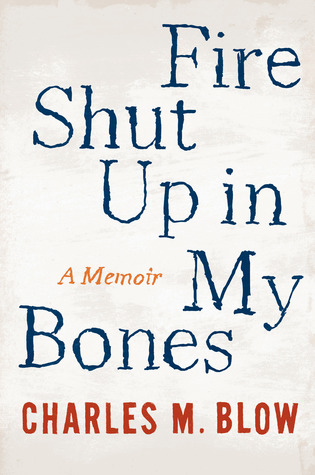
Front cover, Fire Shut Up in My Bones, Charles M. Blow, September 23, 2014. (http://goodreads.com).

Front cover, Fire Shut Up in My Bones, Charles M. Blow, September 23, 2014. (http://goodreads.com).

I started reading New York Times columnist Charles M. Blow’s memoir Fire Shut Up In My Bones two weeks ago. Like many who have read it, I have found it a good read, a revealing read, even a powerful read at times. I have been able to put it down, though. Mostly because as someone who’s recently written a memoir about my own painful and trying experiences with abuse and neglect, about confusion, distrust and occasional rage, Blow’s book has been a reminder of how difficult it was for me to relive those experiences enough to write them down in words and revise them into a book of my own.

Still, as I do intend to finish Fire before the holidays, I do have a couple of questions. One is really basic. Had Blow ever heard of the Kinsey Report (1948), the first one about the sexual experiences and habits of men, particularly gay and bisexual men, prior to turning thirty? The one thing I learned from reading this report twenty years ago is that there’s a lot of gray between heterosexual, gay and bisexual. That you can be heterosexual, and still have a small level of attraction to those of your same gender simultaneously.

256 shades of gray (cropped), October 20, 2014. (http://cs.dartmouth.edu).

256 shades of gray (cropped), October 20, 2014. (http://cs.dartmouth.edu).

But this is a minor question, more about his curious road to understanding his sexuality — not to mention my own road — than it is about Fire itself. My second question is a much more important one. How have Blow’s family and friends received his book since he decided to write it? How have they received Fire in the months since he announced it was coming out in September? How have they received him and Fire since it officially hit the shelves last month?

If his immediate and extended family was/is anything like mine (and from reading Fire so far, it is), then my best guess is their reaction’s been mixed at best. In the year since I released Boy @ The Window in paperback, my siblings have liked the book, but my mother and father haven’t exactly been happy about me writing it. My mother hasn’t said one word about Boy @ The Window since I put it out last year. Nor did she ask any questions about the book in the six and half years that I toiled in writing and rewriting it.

My father, meanwhile, showed interest in the book right from the moment I told him I planned to write Boy @ The Window. That was, until the paperback edition came out during the holidays last year. At that point, he said, “I don’t wanna talk to you no more.” We’ve talked several times since, but he’s still pissed with me about including him in my memoir, even though I never hid this from him at any point in the process.

Among my friends, most of my core group has bought and read Boy @ The Window. Most have given me positive feedback, some very extensive. Yet I found myself mildly surprised how few friends outside of this core group have bought or read the book. I take that back. Actually, I’m surprised by the negative feedback I’ve gotten from folks who’ve claimed to be friends of mine, who’ve never read a word of Boy @ The Window. But this feedback hasn’t been about the memoir. It’s really about their wanting to deny facts about me or about them that they’ve assumed are in Boy @ The Window, as if my job in this instance was to only be truthful when it felt good for them.

Dirty laundry in a basket, October 20, 2014. (http://plus.google.com).

Dirty laundry in a basket, October 20, 2014. (http://plus.google.com).

My platform is tiny when compared with Blow’s, so I imagine that the reaction to Fire in terms of both praise and condemnation has been more extreme, even as the praise has been much more public. I suppose if I was the perpetrator whom sexually assaulted Blow, I’d likely want to shut him up. I’m not so sure that anyone in his family, proud of him as they may be, wants what they’d likely consider “dirty laundry” out there for anyone to read. You don’t grow up in a family as traditional as Blow’s and expect everyone to be alright with their character’s characterization in a bestseller.

This I do know, and I suspect Blow has known for a while, too. That writing a memoir like Fire isn’t about seeking revenge or outing family secrets per se. Bottom line — it ain’t about the proverbial you! In some respects, as cathartic as writing a memoir like my Boy @ The Window or Blow’s Fire may be, it’s not so much about the authors,’ really, at least after the tenth edit.

There are so many stories that never see the light of day, because the fire for telling them burned out a long time ago. Or the window became a rubber room or a jail cell. It’s about telling a story that needs to be told, regardless of whether family’s happy about it, or whether some of your friends can relate to it or not. Because there’s always, always, an audience who needs to read it, hear it, see it and learn from it themselves.


Teaching Migration, In Song

17 Friday Oct 2014

Posted by decollins1969 in 1, Academia, Boy @ The Window, culture, Eclectic, eclectic music, High Rise Buildings, Jimme, Marriage, Mount Vernon New York, music, My Father, New York City, Politics, Pop Culture, race, Religion, Upper East Side, Upper West Side, Work, Youth

≈ Leave a comment

Tags

"(Sittin' On) The Dock of the Bay" (1968), "Living For The City" (1973), African American History, Africana Studies, Arrested Development, Black Boy (1945), Black History, Black Migration, Bruce Springsteen, Cities, Gil Scott-Heron, Gladys Knights and The Pips, Great Migration, Isabel Wilkerson, James Grossman, Joblessness, John Mellencamp, Kate Bush, Land of Hope (1989), Marvin Gaye, Mary Patillo, Migration, Nas, Nicholas Lemann, Nina Simone, Otis Redding, Peter Gabriel, Poverty, Richard Wright, Stevie Wonder, Teaching and Learning, The Promised Land (1991), The Warmth of Other Suns (2010), Tracy Chapman, Tupac, Urban America, urban blight


Stevie Wonder and Wonderlove, live performance of "Living For The City," circa 1974.  (http://youtube.com).

Stevie Wonder and Wonderlove, live performance of “Living For The City,” circa 1974. (http://youtube.com).

If I ever had the chance to teach a course specifically on the history of Black migration in America, I already know what books I’d use. Isabel Wilkerson’s The Warmth of Other Suns (2010); Nicholas Lemann’s The Promised Land (1991); James Grossman’s Land of Hope (1989); Mary Patillo’s Black Picket Fences (1999); even Richard Wright’s Black Boy (1945) and Maya Angelou’s I Know Why the Caged Bird Sings (1969). All have moved beyond the statistics of some seven or eight million Blacks moving from the rural Jim Crow South to America’s cities, North, Midwest, West and South for the first three-quarters of the twentieth century.

Falsas Promesas Broken Promises, taken by John Fekner, Charlotte Street Stencils, South Bronx, New York. 1980. (Liftarn via Wikipedia). Released to public domain via CC-SA-3.0.

Falsas Promesas Broken Promises, taken by John Fekner, Charlotte Street Stencils, South Bronx, New York. 1980. (Liftarn via Wikipedia). Released to public domain via CC-SA-3.0.

But that wouldn’t be near enough to communicate the range of emotions, the psychological states and the pressures that these people faced in leaving their homes for the not-so-bright lights of America’s big cities, not to mention what they faced in the days and years after they arrived. I should know. I’m the nearly forty-five year-old son of a mother originally from Bradley, Arkansas (population 500) and a father from Harrison, Georgia. They moved to New York City in the ’60s (specifically, the Tremont section of the Bronx), then to the South Side of Mount Vernon, New York (just outside the Bronx), hooked up, and sired me and my older brother Darren between December 1967 and January 1970.

That short summary is hardly the story, though. For me — like with so many other things in my life — music tells the story, emotions and psychology beyond what words on a page alone can approximate, but not fully duplicate. Music communicates the stories, emotions and psychology of those who migrated and stayed (or didn’t) in cities across the US better than Census data or a hypothesis on proletarianization. I wanted music from my own lifetime (or at least, within a few years of it) — not just folk songs or Blind Willie Johnson or Duke Ellington — music that fit my family’s transition from migration to our current times of racism and urban poverty.

Easily the top two songs on my list to play in class would be:

Trade ad for Otis Redding's single "Try a Little Tenderness," January 7, 1967. (Viniciusmc via Wikipedia/Billboard Magazine, page 7). In public domain).

Trade ad for Otis Redding’s single “Try a Little Tenderness,” January 7, 1967. (Viniciusmc via Wikipedia/Billboard Magazine, page 7). In public domain).

1. Otis Redding, “(Sittin’ On) the Dock of the Bay,” (1968), released after Redding’s death in a plane crash in Madison, Wisconsin; and

2. Stevie Wonder, “Living For The City,” (1973).

Both songs run the full emotional and psychological gamut. From hopefulness to oblivion, from delusion to despair, from rage and anger to resignation. The melancholy of Redding’s “It’s two thousand miles I roamed/Just to make this dock my home” (in reference to the distance from Georgia to San Francisco Bay) juxtaposed with Wonder’s bitterness and anger:

“His hair is long, his feet are hard and gritty
He spends his life walkin’ the streets of New York City
He’s almost dead from breathin’ in air pollution
He tried to vote but to him there’s no solution…”

It communicates so much beyond the lyrics and liner notes, a reminder for those of us who find America and its cities unforgiving today just how relentless it must’ve been for our parents and uncles and aunts and grandparents forty or more years ago.

There are other songs that I’d put on this playlist. Some are directly related to Black migration, some try to bridge the gap between the abundance of music on “the ghetto” and urban poverty and chaos and the lack of music from my own lifetime on migration.

3. Gladys Knight and the Pips, “Midnight Train to Georgia” (1973).
4. Marvin Gaye, “Inner City Blues” (1971).
5. Gil Scott-Heron, “95 South (All of The Places We’ve Been)” (1977).
6. Tracy Chapman, “Fast Car” (1987).
7. Nas (featuring Olu Dara, his father), “Bridging the Gap” (2004).

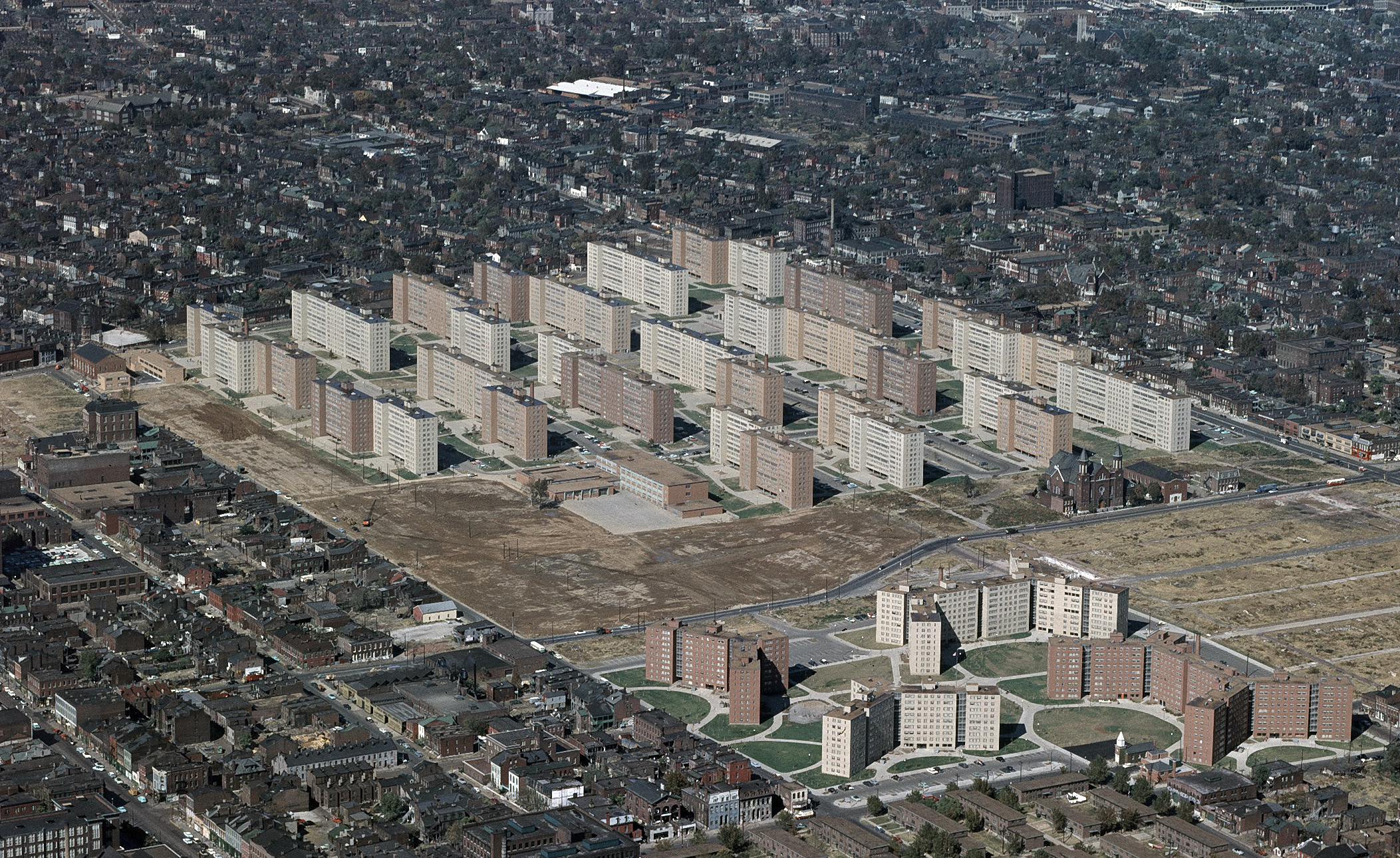
Pruitt–Igoe public housing projects, St. Louis, Missouri, circa 1967. This late-1950s "urban renewal" project was built, but  failed and was razed in the 1970s. (Cadastral via Wikipedia/US Geological Survey). In public domain.

Pruitt–Igoe public housing projects, St. Louis, Missouri, circa 1967. This late-1950s “urban renewal” project was built, but failed and was razed in the 1970s. (Cadastral via Wikipedia/US Geological Survey). In public domain.

That most of these songs come from the period between 1967 and 1974 isn’t an accident. It was the height of the Civil Rights Movement, combined with the Black Power Movement and the “Black is Beautiful” campaign, the beginning of the White backlash against civil rights — including Dr. Martin Luther King, Jr.’s assassination — and the Anti-War Movement was in full swing. It was a good time to take a look at the present and recent past to reconnect with hopes and dreams in the midst of the nightmare of urban poverty.

After ’73 was the beginning of the dance and disco era, as well as a focus on the urban, on crime, on drugs, on poverty  — but not in a “let’s try to solve it” kind of way. This was where rap, hip-hop, some R&B and early forms of what we now call neo-soul picked up, with little reflection on this once prominent past.

Still, there would be some honorable mentions for this migration course, music that could evoke some aspect of the Black migration, of the hope that took a downward turn, of the poverty and joblessness that have permeated America, Black and White and Brown, since the ’70s.

8.  Arrested Development, “Tennessee” (1992).
9. Tina and Ike Turner (and Credence Clearwater Revival), “Proud Mary” (1970).
10. Nina Simone, “The Backlash Blues” (1967).
11. NWA, “Straight Outta Compton” (1989).
12. Tupac, “Cradle 2 the Grave” (1994).
13. John Mellencamp, “Pink Houses” (1983).
14. Bruce Springsteen, “Born In The U.S.A..” (1984). [the song’s release was thirty years ago this month, by the way]
15. Peter Gabriel and Kate Bush, “Don’t Give Up” (1986)

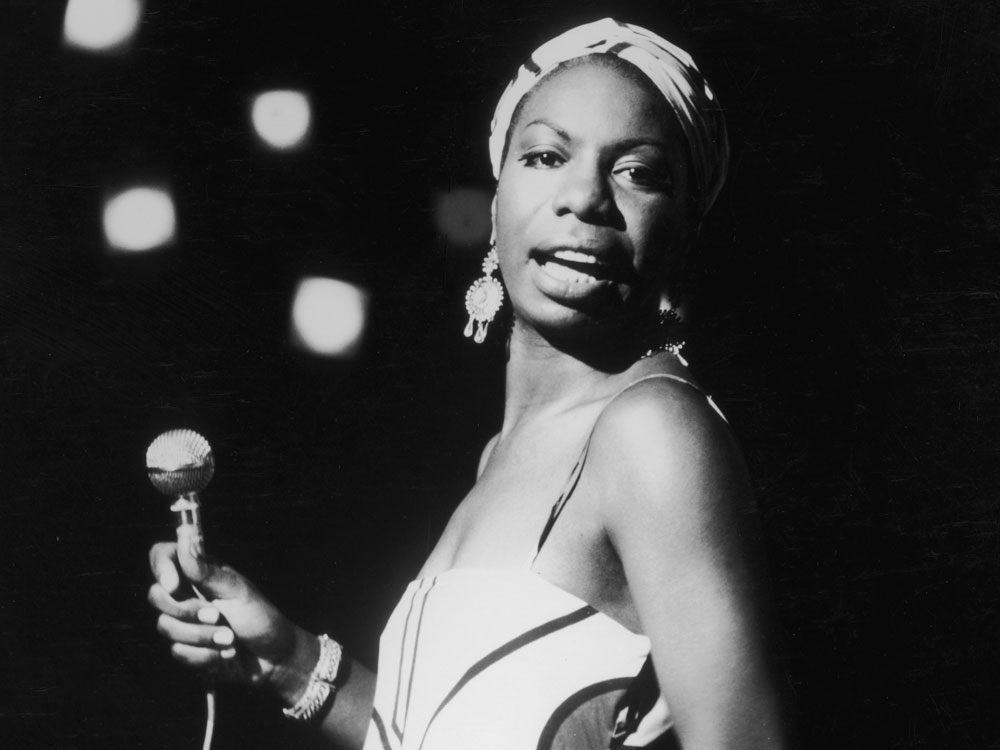
Nina Simone performs at a concert in 1964. (http://npr.org, via Hulton Archive/Stringer/Getty Images).

Nina Simone performs at a concert in 1964. (http://npr.org, via Hulton Archive/Stringer/Getty Images).

Through music, I’d hope to have a course and discussion about Black migration that reaches beyond the words origin and destination, that migration has merely been a physical manifestation of a difficult and seemingly unending cultural and spiritual journey in the US. That Black migration can also easily include the parallel journeys of those of the African or Afro-Caribbean diaspora, not to mention those from Latin America.

For me, though, a course like this would be a personal foray into all the things that have made me who I’ve been for nearly four and a half decades — a person better than the sum of America’s parts and racist, sexist, homophobic and evangelical assumptions.

Whiteness, Where “That’s So Raven” Meets “Real Time”

11 Saturday Oct 2014

Posted by decollins1969 in 1, Academia, culture, Eclectic, Patriotism, Politics, Pop Culture, race, Religion, Youth

≈ Leave a comment

Tags

"New Black", African-American, American Narcissism, Atheism, Ben Affleck, Bill Maher, Black, Blackness, Claude Steele, Culture of Poverty, Culture of Violence, Daniel Patrick Moynihan, Disidentification Hypothesis, Islamophobia, Labels, Narcissism, Pharrell Williams, Racism, Raven-Symoné, Real Time with Bill Maher, Reza Aslan, Stereotype Threat, unspecial American, Whiteness, Xenophobia


Black square, or Black is the new Black, June 2014. (http://kennyali.com/).

Black square, or Black is the new Black, June 2014. (http://kennyali.com/).

Why we ever give voice to the vapid and vain I still don’t fully understand. In the past week, we’ve allowed Raven-Symoné (of The Cosby Show and That’s So Raven fame) and Bill Maher (host of HBO’s Real Time with Bill Maher and a mediocre stand-up political comedian) to determine our discourse on race, racism, Islam, atheism and terrorism. Proving once again the power of Whiteness in our racially narcissistic nation.

Raven-Symoné certainly isn’t the first Black celebrity or entertainer to declare herself “not African-American” or Black, to Oprah or to the rest of the world. Morgan Freeman’s been making statements rejecting labels like “Black actor,” the term “African American,” and even Black History Month, going as far back as interviews in support of Glory (1989) and Shawshank Redemption (1994) (of course, he also was making the point that he’s an American first). Raven-Symoné isn’t even the first Black entertainer to say they’re “not Black” or “not African American” in 2014. Pharrell Williams holds this distinction, as he allegedly represents the “New Black,” whatever colorblind racist nonsense this is.

Raven-Symoné on Oprah's Where Are They Now, October 5, 2014. (http://www.billboard.com). Qualifies as fair use - picture directly related to subject matter, and of low resolution.

Raven-Symoné on Oprah’s Where Are They Now, October 5, 2014. (http://www.billboard.com). Qualifies as fair use – picture directly related to subject matter, and of low resolution.

It all points to a phenomenon I’ve been calling the “unspecial American” over the past twelve years. The idea that we can discard labels, histories and cultures in an effort to make ourselves unique or special individuals. All of this is born out of a racial narcissism, one which afflicts the most vulnerable to this psychosis — the famous and the wannabe famous. Maybe there’s a bit of internalized racism to this, too — that’s clearly speculation to be sure. But that obsession to be unique, to declare oneself above constructs and labels, but then to latch on to the term “American” as if the world might forget? It reflects on some level stereotype threat, not to mention the defensive posture of someone like Raven-Symoné attempting to preserve their income and elite social status.

Maher’s take on religion, especially Islam, isn’t unique. The idea that he can claim this his Islamophobia has nothing to do with race — his own Whiteness/Jewishness or that of his brown-skinned Semitic cousins — is what makes Maher’s xenophobic argument a specious one. Maher’s is a culture of violence argument, one that attempts to combine the foundational tenets of Islam with the actions of terroristic jihadists in a sweeping indictment of at least half a billion people. HBO and Maher’s friends and fans have let him get away with this ridiculous line of thinly veiled racism and Islamophobia for years. Yet if Maher made the same kind of argument about Blacks, poverty and crime — the culture of poverty hypothesis proposed by the likes of the late Daniel Patrick Moynihan in the 1960s — he’d probably lose his show.

"Violence is not our culture," 2011. (Wendy Harcourt via http://http://www.ips.org/).

“Violence is not our culture,” 2011. (Wendy Harcourt via http://http://www.ips.org/).

That Maher has no sense of history or understanding of human nature isn’t surprising. He’s a stinking comedian, not a historian, political scientist, religious studies professor or philosopher. At this stage of his career, I’d make a better stand-up comic than Maher would a critic of any culture or religion. That Maher has found himself in arguments with Ben Affleck and Reza Aslan is telling. Maher in his late-fifties has become Ronald Reagan — an arrogant White male who firmly believes in the primacy of his brand of White culture above all others.

Both Maher and Raven-Symoné should take a long look at history and learn from it. Raven-Symoné should learn that Black celebrities who deny the existence of racial constructs tend to crash into a few barriers during their lifelong journeys. Maher should look at violent examples of atheism — the French Revolution, the Spanish Civil War, Stalinism, among others — and ask if these were the product of narcissism and violent repression or the product of a culture of violence based too heavily on the reliance on the scientific method for ultimate truths. And we should continue to ask ourselves why we ever take people like Raven-Symoné and Maher seriously at all.

“Stupid Atheist” Meets Truly Stupid Christian

06 Monday Oct 2014

Posted by decollins1969 in 1, Boy @ The Window, Christianity, culture, Eclectic, Mount Vernon High School, Mount Vernon New York, Politics, Pop Culture, race, Religion, Youth

≈ Leave a comment

Tags

Acting, Activism, AP American History, AP US History, Arrogance, Atheism, Atheists, Christianity, Contradictions, Doing, Evangelical Christianity, Faith, Giving, Hope, Hypocrisy, Jay Sekulow, Mary Zini, Masturbation, Pat Robertson, Prayer in Schools, Stupidity, Teenage Angst, Teenagers, Televangelism, Televangelists, Trust, World History


Screenshot from HBO show The Leftovers title sequence, September 5, 2014. ( yU+co via http://news.creativecow.net). Qualifies as fair use under US copyright laws -- low resolution and relevance to subject matter.

Screenshot from HBO show The Leftovers title sequence, September 5, 2014. ( yU+co via http://news.creativecow.net). Qualifies as fair use under US copyright laws — low resolution and relevance to subject matter.

I’ve written about Mary Zini and our classroom incidents before, here and in Boy @ The Window. It’s been thirty years since she was my tenth-grade World History teacher. Yet most of what I remember from this class has little to do with Plato, NATO, or anything in between. It’s mostly Zini’s condescending personality, my new Christian arrogance, and that people’s personalities and actions are often walking and talking contradictions.

It was the beginning of October ’84 when we had our first incident. It occurred after what was the first of an endless cycle of fill-in-the-bubble Scan-Tron exams.

Screen shot 2014-10-05 at 5.59.18 PM

Honestly, I had no idea at that moment why I said what I said. I supposed that a summer of Jay Sekulow and the American Center for Law and Justice, all via Pat Robertson and The 700 Club had done the trick in making me a one-time prayer-in-public-schools advocate. I knew that Zini was raised a Catholic, so on some level, didn’t that make me a stupid Christian for calling her a stupid “atheist?”

That incident was also the beginning of seven months of starting to figure out how to be me and be a follower of Christ at the same time. I approached it the same way I approached how to be me in my first few months of seventh grade and Humanities at A.B. Davis Middle School in the fall of ’81. With the naiveté of a child, the hubris of a teenager, and the callousness of a human with alien superpowers.

Jay Sekulow lecturing, Regent University, December 15, 2006. (Juda Engelmayer via Wikipedia). Released to public domain via GFDL.

Jay Sekulow lecturing, Regent University, December 15, 2006. (Juda Engelmayer via Wikipedia). Released to public domain via GFDL.

It was evident in my outward actions. I packed my red-pleather-covered King James Bible every day. For school. For Subway trips down into Midtown Manhattan when me and my older brother Darren worked for our father Jimme. For when we washed clothes every Saturday or Sunday at the laundromat on the Mount Vernon-Pelham border (it’s a yoga studio now). The Bible was my constant companion, my shield protecting me from this mad world of almost bottomless sin.

In the process, I read everything from Genesis to Revelations at least twice. (some books, like the Gospels, as many as four times). I learned a lot from  reading all sixty-six books of the Old and New Testaments. That the Israelite God Yahweh was stern and pretty unforgiving. That Jesus was a radical, not just spiritually, but politically as well. And that Paul was not exactly the most enlightened of the apostles when it came to women, children and slaves.

Mostly what I learned was that readings and understanding The Bible wasn’t like living out my beliefs at all. I was still a teenager, a fifteen-year-old living in the midst of welfare poverty, at 616 with an abusive womanizer, a wounded mother and a gaggle of siblings between the ages of eight months and five-and-a-half years. Not to mention my alcoholic cuss-factory of a father that I had to hunt down for money nearly every weekend. What all that meant was feeling lust for a young woman one minute, hate toward my idiot stepfather Maurice the next, and imitating Jimme’s slurred language and mannerisms the minute after that.

This new walk was very confusing, so much so that I often hid my emotions in much the same way I’d already been doing to protect myself from yet another abuse episode with Maurice. My emotions couldn’t stay bottled up, though. I frequently humped my way to sleep once our living room at 616 had become my bedroom during and after the months in which Balkis Makeda had lived with us.

Screen shot 2014-10-05 at 6.06.59 PM

By the spring of ’85, when Zini granted me her full support in getting me into AP US History for eleventh grade (this despite my 84 average in her class at the time), I was flabbergasted. I couldn’t stand being in the same room with Zini much of the time. Yet she did for me what few in my life had done — she opened up a door for me to walk through, albeit a relatively small one.

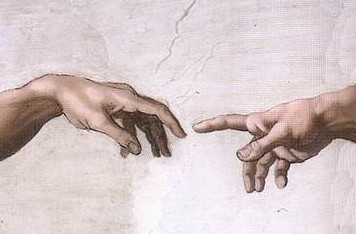
Hands of God & Adam, fingers about to touch, Sistine Chapel ceiling, Vatican, Michelangelo, 1508-1512 (via Wikipedia). In public domain.

Hands of God & Adam, fingers about to touch, Sistine Chapel ceiling, Vatican, Michelangelo, 1508-1512 (via Wikipedia). In public domain.

What did it all mean? That devoutness is meaningless without action, without giving and receiving, without trust, without taking risks. That even supposed atheists can act and give in ways that should shame many arrogant Christians. That Christianity isn’t a transactional relationship or process, but a journey with many pitfalls and lots of contradictions along the way. That who I/we say God is, well, at best an infinitesimal guess, because God and this universe is so much more that I as a human male living in the context of Western culture can only begin to understand.

Most of all, I had just begun to learn that spiritual liberation wasn’t supposed to be a yoke, but an opening to see the world and myself stripped bare of narrative and pretense. A strict adherence to the principles of Pat Robertson would bring me no closer to enlightenment and no further out of poverty than wishing on a star or avoiding cracks on Mount Vernon’s blue-slate sidewalks. Work, trust, opportunities, and not just Romans 8:28, was the beginning of the key for me.

Ass Whuppins and NFL Fanatics

18 Thursday Sep 2014

Posted by decollins1969 in 1, Boy @ The Window, culture, Eclectic, Mount Vernon New York, Politics, Pop Culture, race, Religion, Sports

≈ Leave a comment

Tags

616, 616 East Lincoln Avenue, Adrian Peterson, Anheuser Busch, Arizona Cardinals, Ass-Whuppin', Belts, CBS, Child Abuse, Denial, Deniers, Domestic Violence, ESPN 980, Extension Cords, Hannah Storm, James Brown, Jonathan Dwyer, Maurice Washington, Minnesota Vikings, Racism, Ray Rice, Religion, Roger Goodell, Spanking, Steve Czaban, Switches, Violence, Whiteness


Collage of Houston PD pics of cut/contusion marks on Adrian Peterson's four-year-old son, September 12, 2014. (http://atlantablackstar.com).

Collage of Houston PD pics of cut/contusion marks on Adrian Peterson’s four-year-old son, September 12, 2014. (http://atlantablackstar.com).

I’ve been irritated by what I’ve seen in the media and in social media over the past week. First, the idea that Minnesota Vikings’ running back Adrian Peterson’s alleged crime was the spanking of his four-year-old kid back in May, one that left cuts and contusions all over his body, including the kid’s scrotum. In Peterson’s world, in the world in which I grew up, and in the world of millions of Americans, we didn’t and don’t use the term spanking at all — ass-whuppin’  (or a beating) is what constitutes corporal punishment.

Second has been the response of sports talk radio and many NFL fans — especially including the less enlightened and more entitled of the sports media — to public criticism and how teams have reacted to recent domestic violence and child abuse revelations. Their response to CBS’ Thursday Night Football host James Brown speaking up about men needing to take more responsibility for their actions vis-a-vis domestic violence: “Shut the hell up! You’re ruining my mood for the game! This isn’t the right time or the place to talk about domestic violence, just before my football game!”

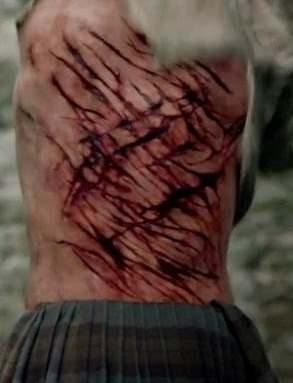
Outlander character Jamie Fraser in midst of second 100-slashes punishment, screenshot (cropped) from S1:Episode 06 "The Garrison Commander," September 13, 2014. (http://plus.google.com).

Outlander character Jamie Fraser in midst of punishment, screenshot (cropped) from S1:Episode 06 “The Garrison Commander,” September 13, 2014. (http://plus.google.com).

Both reflect the insularity of the elitism that is mainstream media and the denier-resentment that is Whiteness in America as reflected in sports and especially football. To call what Peterson did to his son a spanking, well, it defies all logic. It was an ass-whuppin’, plain and simple. Journalists, bloggers and tweeters dedicated many posts and articles over the past six days to the issue of spanking and why so many wee common folk accept spanking as a form of discipline for their children. I have yet to see an article that makes the correct distinction between a spanking — the use of a hand or a light paddle to smack the butt of a child — and an ass-whuppin’.

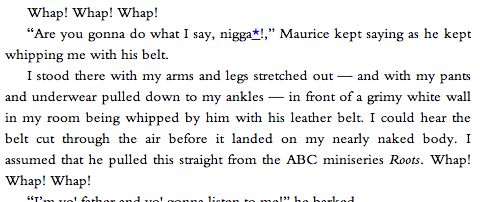
See, between the ages of three and thirteen, my Mom, my father Jimme, and my idiot stepfather Maurice Washington gave me between twenty-five and thirty ass-whuppins, but only two or three spankings. Here’s the last ass-whuppin’ I got from Maurice before he transitioned to upper cuts and kicks to my stomach:

Screen shot 2014-09-18 at 5.48.27 AM

This wasn’t the first time I had to strip down to nothing to have my butt, back and legs beaten to the point of welts and contusions, though this ass-whuppin’ led to my second incident of severe abuse. Over the years, my Mom and my babysitter Ida (she died recently at eighty-six — RIP) had whupped me and my older brother Darren with a switch (though with one far more prepared for beating a child without marking up skin than what Peterson allegedly used). They and Maurice had also used the standard leather belt, an extension cord (the type that you plug into a wall socket), and a shoe (my Mom did that in front of a crowd at a July 4th picnic in ’79).

Over those years, my parents and my somewhat legal guardians slapped me, smacked me, kicked me in the eye, and put me in a head-lock, all before my summer of abuse in ’82. Not once did anyone responsible for disciplining me call it a spanking. Based on my own experience and the experiences of people I’ve met and known over the years, I can pretty much guarantee Peterson didn’t call it a spanking either.

Screen shot 2014-09-18 at 6.07.15 AM

Steve Czaban, host of The Drive, ESPN Radio 980 Washington DC, November 2013. (http://www.theczabe.com/).

Steve Czaban, host of The Drive, ESPN Radio 980 Washington DC, November 2013. (http://www.theczabe.com/).

Then there’s been the NFL’s reaction to the gigantic PR hit it has taken over commissioner Roger Goodell’s handling of the Ray Rice case and the Baltimore Ravens’ subsequent termination of Rice. Not to mention the Vikings’ deactivation-reactivation-deactivation of Peterson, the Carolina Panthers’ deactivation of convicted woman abuser Greg Hardy, and yesterday’s arrest of Arizona Cardinals running back Jonathan Dwyer, whom the Cardinals also deactivated. I’m more than certain that ESPN Radio 980 show host Steve Czaban wasn’t alone when he called these sanctions “overreactions” and lamented the “slippery slope” that the NFL as “moral police” has started to slide down. Czaban represents an ilk of sports show hosts and corresponding listeners and fans who want sports to remain a “diversion” from “real life,” to not have someone’s “politics” like James Brown’s ruin their spectator experience.

To that, I say, good! Men shouldn’t be comfortable living in a bubble in which the athletic “freaks” who entertain them in sports should then be excused when accused of committing crimes. Nor should they be called  “animals” when the law proves that they are guilty of such crimes. White men especially often act as if it’s their world and they have the right to a relaxing day without dealing with issues of racism, misogyny, patriarchy, homophobia and other forms of inequality from which they benefit every day.

To that I say, we need more statements during sports programs from James Brown and Hannah Storm, more advertisers (even ones as hypocritical as Anheuser Busch, as their beers help fuel domestic violence and child abuse) “venting their spleen,” more people taking a stand against people who like their spectator entitlements a bit too much. To those denialists, especially Czaban, I say, kiss my abused Black ass.

Why My Mom Stayed

11 Thursday Sep 2014

Posted by decollins1969 in 1, Boy @ The Window, culture, Eclectic, Hebrew-Israelite, Jimme, Marriage, Mount Vernon New York, My Father, Pop Culture, race, Religion, Youth

≈ Leave a comment

Tags

#WhyIStayed, 616, 616 East Lincoln Avenue, Battered Women's Syndrome, Beverly Gooden, Child Abuse, Domestic Violence, DV, Hypermasculinity, Isshin-ryu Karate, Janay Palmer Rice, Judah ben Israel, Maurice Eugene Washington, Maurice Washington, Misogyny, Ray Rice, Self-Worth, Sexism, Social Media, Twitter


My Mom at 48 years old, Yonkers, NY, December 23, 1995. (Donald Earl Collins).

My Mom at 48 years old, Yonkers, NY, December 23, 1995. (Donald Earl Collins).

I planned to write something about my Mom on her birthday again this October, focusing on her multiple roles as mother, breadwinner, domestic violence victim and evangelical Christian in that post. With the TMZ-released video of Ray Rice and the public response to the NFL’s misogynistic hypocrisy making the issue of domestic violence front and center this week, it makes sense for me to talk about my experience and my observations via my Mom this week as well.

First off, thanks to all the brave women who’ve tweeted, posted on Instagram, Facebook, WordPress and other places their experiences with domestic violence. Thanks especially to Beverly Gooden (@bevtgooden) for creating and using the hashtag #WhyIStayed in response to the barrage of criticism leveled at Janay Palmer Rice for marrying Ray Rice after his brutal act of violence against her. I know domestic violence and child abuse firsthand, as I watched my Mom experience the Isshin-ryu-Karate version of a knockout and concussion on Memorial Day ’82 at the hands of my then stepfather Maurice Washington.

Screen shot 2014-09-11 at 7.54.54 AM

Ivy_Mike_test.ogg.160p

Ivy_Mike_test.ogg.160p

This wasn’t the first time Maurice had hit my Mom, as I’d learn years later, but it was the first time I witnessed it. I’d seen my Mom attacked before, by my own father when I was little. My father was often drunk and equally incompetent during his attacks, so any physical damage that was done was from my Mom beating him up. The psychological and emotional damage, though, flowed right from her first marriage to my father to her second one with Maurice.

For seven years and sixteen days after the day my childhood ended, my Mom and Maurice lived together as husband and wife at 616. I can say with one hundred percent clarity that there wasn’t a day between Memorial Day ’82 and the final fight that led to my late ex-stepfather moving out that I didn’t feel some sort of dread, a cloud of lethargy hanging over my head, even while at college at Pitt. That was partly because I’d made a point of running interference and taking abuse to make up for not calling the police on that day of days.

I didn’t know why my Mom couldn’t find the strength to kick Maurice to the curb, at least not before the middle of ’89. But there was an incident between me and Maurice about a year before he finally moved out, one where what he said afterward gave me additional insight into my Mom’s inaction.

Screen shot 2014-09-11 at 12.52.50 PM

At least, I had to believe that, right? It just seemed we’d been through too much with a man who’d never paid a month’s rent, a phone bill, a Con Ed bill, a cable bill, and only bought Great Northern beans, rice and cabbage for his kids (my younger siblings) on the handful of days he decided to contribute to our malnourished family.

So finally, in the months after he left 616 for good, I asked. My Mom’s first answer was, “He fooled me. He fooled us all!” Her answer was completely unsatisfying, considering that I ran away from home to get away from Maurice when I was nearly nine years old.

The summer of ’89 wouldn’t be the last time I’d ask. Over the years, my Mom has given various explanations. “I thought he was a changed me,” she’d say, referencing their six-month separation in ’80-’81 and Maurice becoming a Hebrew-Israelite and “Judah ben Israel” in the interim. “What good would that done?,” my Mom would ask me in response, implying that she wanted to avoid a physical confrontation.

Really, I spent thirteen years reading in between the lines, asking relatives questions about my Mom, doing research and boning up on domestic violence and child abuse from a social science perspective, all for more substantial answers. Really, my Mom’s domestic violence experience, our fall into welfare poverty, and my child abuse experiences were the first reasons for me wanting to write what would become Boy @ The Window in the first place.

"Divorced at last" layer cake, or "Broken Marriage," March 2014. (http://www.nigeriancurrent.com/).

“Divorced at last” layer cake, or “Broken Marriage,” March 2014. (http://www.nigeriancurrent.com/).

By the time I did the family intervention in January ’02, I knew why. I knew that despite my Mom not remembering much from the beating, knockout and concussion she took in May ’82, she lived in fear. If for no other reason than from seeing the look of hurt on my face whenever the subject of her beating came up. Maybe not a constant, shaking-in-her-shoes fear, but the idea of having to force a six-one and overweight yet powerful man out of 616 probably scared my Mom. But that wasn’t her only fear. As I wrote in Boy @ The Window, “[w]e were already the children of one divorce, and I wasn’t sure if I wanted to see another one so soon.” I’m more than sure that my Mom felt the same way about herself and her relationships with my father Jimme and Maurice as well.

I also know with certainty my Mom would never want me to write about her, especially about her as a victim of domestic violence. But she wasn’t the only one to experience it. I may be able to live my life successfully despite it, but I’ll never be able to un-see what I saw nearly thirty-two and half years ago. It put me on a very long road, one that involved my own conflicting feminism and sexism (though with zero tolerance for violence against women). Or, what I call damsel-in-distress syndrome, where I always want to help, even when that help is unwelcome.

There are millions of reasons why women get married or stay in relationships and marriages, some of them rational, some based in fear, many who stay because abuse does untold damage to self-worth. I may not fully understand what it’s like to be a woman who’s been abused, but I do understand what it’s like to be the son of one. Most of us who don’t know of these horrors need to be quiet, read, and listen more.

← Older posts
Newer posts →

Boy @ The Window: A Memoir

Boy @ The Window: A Memoir

Places to Buy/Download Boy @ The Window

There's a few ways in which you can read excerpts of, borrow and/or purchase and download Boy @ The Window. There's the trade paperback edition of Boy @ The Window, available for purchase via Amazon.com at http://www.amazon.com/Boy-Window-Donald-Earl-Collins/dp/0989256138/

There's also a Kindle edition on Amazon.com. The enhanced edition can be read only with Kindle Fire, an iPad or a full-color tablet. The links to the enhanced edition through Apple's iBookstore and the Barnes & Noble NOOK edition are below. The link to the Amazon Kindle version is also immediately below:

scr2555-proj697-a-kindle-logo-rgb-lg

Boy @ The Window on Amazon.com: http://www.amazon.com/Boy-The-Window-Memoir-ebook/dp/B00CD95FBU/

iBookstore-logo-300x100

Boy @ The Window on Apple's iBookstore: https://itunes.apple.com/us/book/boy-the-window/id643768275?ls=1

Barnes & Noble (bn.com) logo, June 26, 2013. (http://www.logotypes101.com).

Boy @ The Window on Barnes & Noble: http://www.barnesandnoble.com/w/boy-the-window-donald-earl-collins/1115182183?ean=2940016741567

You can also add, read and review Boy @ The Window on Goodreads.com. Just click on the button below:

Boy @ The Window

Twitter Updates

Tweets by decollins1969
  • RSS - Posts
  • RSS - Comments

Archives

  • June 2025
  • April 2023
  • September 2022
  • August 2022
  • July 2022
  • June 2022
  • May 2022
  • April 2022
  • March 2022
  • January 2022
  • December 2021
  • November 2021
  • October 2021
  • September 2021
  • August 2021
  • July 2021
  • June 2021
  • April 2021
  • March 2021
  • February 2021
  • January 2021
  • December 2020
  • November 2020
  • October 2020
  • September 2020
  • August 2020
  • July 2020
  • May 2020
  • April 2020
  • March 2020
  • January 2020
  • December 2019
  • November 2019
  • August 2019
  • July 2019
  • June 2019
  • May 2019
  • April 2019
  • March 2019
  • February 2019
  • January 2019
  • December 2018
  • November 2018
  • October 2018
  • September 2018
  • August 2018
  • July 2018
  • June 2018
  • May 2018
  • March 2018
  • February 2018
  • January 2018
  • December 2017
  • November 2017
  • October 2017
  • September 2017
  • August 2017
  • July 2017
  • June 2017
  • May 2017
  • April 2017
  • March 2017
  • February 2017
  • January 2017
  • December 2016
  • November 2016
  • October 2016
  • September 2016
  • August 2016
  • July 2016
  • June 2016
  • May 2016
  • April 2016
  • March 2016
  • February 2016
  • January 2016
  • December 2015
  • November 2015
  • October 2015
  • September 2015
  • August 2015
  • July 2015
  • June 2015
  • May 2015
  • April 2015
  • March 2015
  • February 2015
  • January 2015
  • December 2014
  • November 2014
  • October 2014
  • September 2014
  • August 2014
  • July 2014
  • June 2014
  • May 2014
  • April 2014
  • March 2014
  • February 2014
  • January 2014
  • December 2013
  • November 2013
  • October 2013
  • September 2013
  • August 2013
  • July 2013
  • June 2013
  • May 2013
  • April 2013
  • March 2013
  • February 2013
  • January 2013
  • December 2012
  • November 2012
  • October 2012
  • September 2012
  • August 2012
  • July 2012
  • June 2012
  • May 2012
  • April 2012
  • March 2012
  • February 2012
  • January 2012
  • December 2011
  • November 2011
  • October 2011
  • September 2011
  • August 2011
  • July 2011
  • June 2011
  • May 2011
  • April 2011
  • March 2011
  • February 2011
  • January 2011
  • December 2010
  • November 2010
  • October 2010
  • September 2010
  • August 2010
  • July 2010
  • June 2010
  • May 2010
  • April 2010
  • March 2010
  • February 2010
  • January 2010
  • December 2009
  • November 2009
  • October 2009
  • September 2009
  • August 2009
  • July 2009
  • June 2009
  • May 2009
  • April 2009
  • March 2009
  • February 2009
  • January 2009
  • December 2008
  • November 2008
  • October 2008
  • September 2008
  • August 2008
  • July 2008
  • June 2008
  • May 2008
  • April 2008
  • March 2008
  • February 2008
  • January 2008
  • December 2007
  • November 2007
  • October 2007
  • September 2007
  • August 2007
  • July 2007
  • June 2007

Recent Comments

MaryPena's avatarMaryPena on My Day of Atonement/Bitter Hat…
decollins1969's avatardecollins1969 on No Good Teaching Deed Goes…
Mary Rose O’Connell's avatarMary Rose O’Connell on No Good Teaching Deed Goes…

NetworkedBlogs on Facebook

NetworkedBlogs
Blog:
Notes From a Boy @ The Window
Topics:
My Life, Culture & Education, Politics & Goofyness
 
Follow my blog

616 616 East Lincoln Avenue A.B. Davis Middle School Abuse Academia Academy for Educational Development AED Afrocentricity American Narcissism Authenticity Bigotry Blackness Boy @ The Window Carnegie Mellon University Child Abuse Class of 1987 CMU Coping Strategies Crush #1 Crush #2 Death Disillusionment Diversity Domestic Violence Economic Inequality Education Family Friendship Friendships Graduate School Hebrew-Israelites High-Stakes Testing Higher Education History Homelessness Humanities Humanities Program Hypocrisy Internalized Racism Jealousy Joe Trotter Joe William Trotter Jr. K-12 Education Love Manhood Maurice Eugene Washington Maurice Washington Misogyny Mother-Son Relationship Mount Vernon High School Mount Vernon New York Mount Vernon public schools Multiculturalism MVHS Narcissism NFL Pitt Pittsburgh Politics of Education Poverty President Barack Obama Race Racial Stereotypes Racism Relationships Self-Awareness Self-Discovery Self-Reflection Sexism Social Justice Teaching and Learning University of Pittsburgh Violence Whiteness Writing

Top Rated

Blog at WordPress.com.

  • Subscribe Subscribed
    • Notes from a Boy @ The Window
    • Join 103 other subscribers
    • Already have a WordPress.com account? Log in now.
    • Notes from a Boy @ The Window
    • Subscribe Subscribed
    • Sign up
    • Log in
    • Report this content
    • View site in Reader
    • Manage subscriptions
    • Collapse this bar
 

Loading Comments...