• About Me
  • Other Writings
  • Interview Clips
  • All About Me: American Racism, American Narcissism, and the Conversation America Can’t Have
  • Video Clips
  • Boy @ The Window Pictures
  • Boy @ The Window Theme Music

Notes from a Boy @ The Window

~

Notes from a Boy @ The Window

Category Archives: Pop Culture

Today Was A Good Day (sometimes)…

04 Wednesday Jul 2018

Posted by decollins1969 in 1, Boy @ The Window, culture, Eclectic, High Rise Buildings, Mount Vernon New York, music, Pop Culture, Sports, Work, Youth

≈ Leave a comment

Tags

"Dr. K", "It Was A Good Day", 4th of July, 7 Train, AP US History Exam, Ass-Whuppin', Dwight Gooden, Ice Cube, Maturity, Metro-North, Mets, Mrs. Ralph, Shea Stadium


Shea Stadium, second level, behind visitors dugout, Flushing Meadow, Queens, NY, 2008. (http://www.bloggingmets.com/)

Of all my Independence Days growing up, two stand out above the rest. One was Friday, July 4, 1986. It was the grand re-opening of the Statue of Liberty, courtesy of one-time Chrysler head Lee Iacocca and The Statue of Liberty-Ellis Island Foundation, which had raised hundreds of millions to restore both symbols of American inclusion (via European immigrants, at least) to museum-quality glory.

Not so for me. I took my older brother Darren, and my then near-seven year-old brother Maurice and nearly five year-old brother Yiscoc to Shea Stadium to watch the Mets play. It was either a 1:05 pm or 1:35 pm start, I don’t remember. It was a beautiful eighty-five degree afternoon, beautiful because it wasn’t particularly humid, and there were no storm clouds to be found that Friday. Dwight Gooden was on the mound for the Mets, starting against the all-time great Nolan Ryan. It was built up to be a duel, and it was.

Keith Hernandez drove in a run in the first, and that was it until the top of the seventh inning, when Dr. K gave up a home run to Kevin Bass. Other than that, fly balls, walks, double-plays, and strikeouts were the order of the day. Lenny Dykstra drove in the game-winning run with a double to right-center field at the bottom of the seventh inning off of a reliever, as Ryan was out after beginning the bottom of the sixth giving up a walk and a hit. Despite giving up five walks and only striking out four, Gooden got a complete-game, 2-1 win, and 30,000 saw the Mets go to 54-21, well on their way toward their World Series title for 1986.

NYC’s MTA 7 train rolling into Queens (Wikipedia), July 4, 2018. (http://amsterdamnews.com).

But that day was so much better with three of my brothers there, away from 616 and Mount Vernon, hanging out, without an adult to supervise, or rather, abuse us in some way. It was one of the first times I actually felt like a fully responsible adult. I took the four of us down to the city on Metro-North at the Pelham stop, rode into grimy Grand Central, took the Shuttle train to Times Square, and then the 7 Subway to Shea. Maurice and Yiscoc were so enamored with the trains and the city that it seemed all they did was stare out at skyscrapers and out of train windows when we weren’t at the game. Darren, though mostly quiet, at least wasn’t staring off into space plotting some revenge on me for my “5” on the AP US History Exam while doing the Wave.

It was so cheap to do what we did that day. The four upper-deck, slightly left-of-home plate tickets we bought cost $4 each, but each hot dog was $3, and the sodas were $2. apiece Given my $3.40-per-hour job with Technisort, though, the $50 excursion wasn’t so cheap that I wasn’t thinking about sneaking a Sabrett hot dog from a street vendor in before we got to the stadium. To be sure, the hot dogs at Shea were better than my usual fare on the street or at Gray’s Papaya.

It was probably the best day I had during my Boy @ The Window years. There were others to be sure, especially in 1986, including my Mets winning the World Series that October and my AP US History exam results. But on this day, I was with innocent family members, watching my favorite team and one of my favorite players. I was lost in the humongous human mob of New York on a double-whammy of an Independence Day weekend. I slept well that evening, knowing that I’d drawn a 10 am-2 pm shift that Saturday. I planned on buying a new Walkman at the Cross County Mall in Yonkers that afternoon. A normal three-day weekend for many sixteen-year-olds was a small eye-wall in the chaotic hurricane that was my life back then.

Contrast this with Wednesday, July 4th, 1979. My mom’s friend Mrs. Ralph was hosting a 4th of July party at her house off Wilson’s Woods in Mount Vernon, with kids included. She had hamburgers and hot dogs on the grill, tons of ice cream and drinks, and an ice cream cake to top it all off.

I just couldn’t help myself. I became a nine-year-old version of Pac-Man. I devoured two hamburgers and two hot dogs, had some red drink, and a slice or two of the vanilla ice cream cake. All within the first half-hour of us getting to Ms. Ralph’s house.

I couldn’t have been higher if they had injected me with heroin and then had me snort some Oxycodone. I was running around the house and laughing for no reason whatsoever, my older brother Darren staring at me like I was an alien. My mom had grabbed me by my shoulders at one point. “Stop acting up!” she said.

Looney Tunes’ Tazmanian Devil in the midst of an eat-a-thon, July 4, 2018. (Catherine Babey
via http://pinterest.com).

But I didn’t stop. At least not until I ran into one of Ms. Ralph’s dividers in her living room, knocking it down along with some half-empty cups and plates on an adjacent table.

My mom took off one of her square-heeled flats and proceeded to beat my ass with it for the next minute, in front of a crowd of twenty or twenty-five guests. The ass-whuppin’ hurt, of course. The fact that it was a public one hurt even more. I was crying well after the party went back to normal. Ms. Ralph, though, came over to me later, reminded me that what I did was wrong, and then gave me a hug and told me that she loved me.

Looking back, I definitely deserved some punishment, maybe even an ass-whuppin’. The public spectacle and the shoe was probably a bit excessive. Was it a good day? No. But it was a day that made the 4th of July 1986 and so many other days easier to appreciate and savor.


On Wet Rags and Crocodile Tears

30 Saturday Jun 2018

Posted by decollins1969 in 1, Boy @ The Window, culture, Eclectic, Mount Vernon High School, Mount Vernon New York, Pittsburgh, Politics, Pop Culture, race, University of Pittsburgh, Youth

≈ Leave a comment

Tags

Academia, Allison Ettel, Black Feminism, Brittney Cooper, Caitriona Balfe, Claire, Crocodile Tears, Femininity, Feminism, Hypermasculinity, Kyle Stephens, Legitimate Tears, Lifetime, Misogyny, Outlander, Pitt, Racism, Ruby Hamad, Sexism, Shay Stewart Bouley, Wet Rags, White Women's Tears, White-Girl Tears, Workplace Issues


The tears of Allison Ettel, a.k.a., #PermitPatty, NBC’s The Today Show (cropped), June 26, 2018. (http://bet.com).

I’ve been thinking about this post for a while, probably for at least two years. But it does help when others closer to the subject write about it as well. Between @ProfessorCrunk Brittney Cooper’s chapter “White-Girl Tears” in her hard-hitting Black feminist primer Eloquent Rage (2018), @blackgirlinmain Shay Stewart Bouley’s recent blog post “Weapon of lass destruction: The tears of a white woman,” and Ruby Hamad’s piece in The Guardian, “How white women use strategic tears to silence women of colour,” what can I really add? (Everyone who believes in feminism and wants to support women of color writers ought to read these essays, by the way). Oh, just the idea that men of color deal with White women’s/girl’s tears as well. And that some of us have been just anti-sexist enough to recognize how our Whiteness and patriarchal-dominated society privileges and legitimizes such tears, often to our detriment.

Over the years, I’ve taken to calling those who cry over the least amount of adversity and stress wet rags, and those instances in which sobbing becomes a central theme “wet-rag episodes.” This started for me in the late-1990s, when my then girlfriend (now wife of eighteen years) would spent upwards of 12 hours of her Saturdays watching Lifetime movies (some of which were originally NBC, ABC, or CBS specials, before the dominant return of reality TV in the double aughts). At first, I did a play on Lifetime‘s slogan back then, “Lifetime: Television for Women,” adding, “not for men” whenever the tag line appeared during commercials.

But Lifetime is an addiction, if you sit there long enough watching the ups and downs of romances, the constant threat of stalkers, date rape, teenage pregnancy, and drugs, and the upbeat endings and vindication at the end of every two-hour movie. What I noticed most of all, though, were the waterworks. Everyone from Lynda Carter to Lindsay Wagner, from Elizabeth Montgomery to Jaclyn Smith could cry at the sound of a book drop!

Cartoon character from Fairly Odd Parents crying an ocean of tears (cropped), June 30, 2018. (http://fairlyoddfanon.wikia.com).

Admittedly, I cry very easily while watching emotional and gut-wrenching scenes. I cried when I saw Viola Davis take on Denzel Washington’s character in Fences (2016) over his years of cheating and his secret family. Especially when Davis blew a snot bubble in the middle of the scene. I was through for the next three minutes!

With Lifetime movies, though, I stopped crying for these White women over the twists and turns in their lives. I watched one scene in one movie where the main character broke out and cried at her dining room table in her laid-out, five-bedroom home when she realized she only had $10,000 left in her bank account. I didn’t just laugh. I howled. As someone for whom poverty and financial struggles have been a constant companion, having that much money in any account at any time has always been a time of celebration. “You shouldn’t laugh. Poverty is relative,” Angelia said while also laughing. “No, it isn’t. She’s a wet rag!” I responded. I’ve spent a good portion of my career proving this point, too.

That scene took me back to so many wet-rag episodes in my life. Like when my high school valedictorian classmate cried angry tears over a 67 on an English essay exam our junior year, losing 25 points because she didn’t underline James Baldwin’s book title Notes from a Native Son in her essay. I didn’t feel sorry for her, Ms. 5.45 GPA, not one bit (it’s all in Boy @ The Window).

Or, during my second year in grad school at Pitt, when a student in one of my US History to 1877 sections tried to proposition me to raise her C- average. When that didn’t work, a fountain of tears poured out. I handed her a tissue, but said, “Your tears in no way are a substitute for studying and working harder in this class.” She didn’t exactly give me 5’s on her evaluations of me in the course at the end of that semester.

Ten years later, I had White women as co-workers and students who could cry about almost anything. My one-time boss Ken blamed me for making a former co-worker cry because I refused to take her “I hope you had a wonderful vacation!” the week after 9/11 in stride. Yeah, sure. It was a week in which I was stuck in Atlanta for four days after a one-day work trip and had to take Greyhound for 15 hours back to DC, not knowing if my older brother was dead or alive. I said as much to my co-worker, and she ran away from me crying.

A student in my History of American Education Reform graduate course cried when I refused to change her grade from an A- to an A. I was in the middle of explaining how she could revise her research paper and still end up with an A. It was just before Thanksgiving, and until that moment, I had thought that this was one of the best courses I’d ever taught, with one of the best group of students I had had in one of my courses. Her sudden sobbing actually pissed me off. I tried not to show it. But I did say, “What are you crying about? There’s nothing about your standing in this course for you to be crying about.” I said it in a tone that I’d only find again once my son became a preteen.

Caitriona Balfe as Claire wailing over the loss of Jamie and the Battle of Culloden, July 9, 2016. (http://www.bookbub.com).

It’s to the point now that I don’t even watch wet-rag shows anymore, at least once the character becomes one. For example, I watched the split first season of Starz’s Outlander with Caitriona Balfe as Claire, and found it mostly enjoyable. Until she began turning on the waterworks in practically every episode. My wife continues to watch, but laughs every time I ask, “What happened on Wet Rag this week?”

I know that White women and White girls, like all human beings, have plenty good reason to cry. Every time I saw video of Kyle Stephens‘ sentencing-phase testimony about what convicted rapist and felon Larry Nassar starting doing to her when she was five years old, I cried for her and with her. Trauma and tragedy are good reasons to cry, wail, sob, and weep. But, so many wet-rag tears are drop-of-the-hat, crocodile tears. About getting caught in lies, about making racist and anti-poverty and anti-women-of-color statements that don’t go over well, about anything that would otherwise paint them as narcissistic and not-so-smart brats.

While I know I don’t have as difficult a row to hoe as so many women of color in the public sphere, one thing I know I’m not allowed to do in a hyper-masculine world of Whiteness and patriarchy is cry. I got hit with the f-bomb so many times growing up, from Black boys, Black men, and Black women, and faced threats of violence as a result. I would’ve been recommended for psychotherapy if I had ever cried over an A-, and been laughed at for complaining about my workplace conditions. Women of color can lose careers over their tears. Black boys and men have lost their freedom and lives over them. One isn’t less damaged over the delegitimization of our tears, but the damage can be differential, depending on gender, class, sexual orientation, and the level of toxic hyper-masculinity surrounding you.

That is why I can’t stand wet rags. Their tears fill the world with concern and fear, and marginalize and dehumanize the rest of us. I have no sympathy for crocodile tears. I don’t know if I’ve ever had sympathy for them.

ICE is America’s Gestapo, the White House the Waffen SS

18 Monday Jun 2018

Posted by decollins1969 in 1, Boy @ The Window, Christianity, culture, Eclectic, Mount Vernon High School, Movies, Patriotism, Politics, Pop Culture, race, Religion, Youth

≈ 2 Comments

Tags

45, Abetting, American Indian Boarding Schools, Asylum, Children in Detention, Fascism, Fugitive Slave Act, Gestapo, ICE, Immigration, Jane Crow, Kidnapping, Kizzy, Leslie Uggams, Migration, Poverty, Roots, Secret Police, Separating Families, SS, State Violence, Systemic Racism, Trump, US Immigration and Customs Enforcement, Waffen SS, Welfare, Xenophobia


Two pictures: ICE raid to arrest foreign nationals. February 6, 2017, (Charles Reed/ICE; http://amsterdamnews.com); Gestapo in midst of a raid, circa 1939-40. (http://www.encyclopediaofukraine.com). Both in public domain.

I may have developed my sense of thinking on the issue of inclusion and migration from the ostracism I experienced via the cool class of Black classmates from Mount Vernon High School. Maybe. Maybe not. But, it was on this date 31 years ago that the Class of 1987 graduated. And, within minutes of us tossing our mortar-board caps in the air, people who were the “cool ones” in the graduating class began ignoring my greetings and staring through me like I was invisible whenever and wherever I saw them. A silent treatment that I went through for two summers with this group.

This is not unlike the way the media and this 45 presidency deals with most marginalized Americans and the daily indignities and atrocities from which they suffer. Especially those who migrate without papers and those would-be-migrants and asylum-seekers. The amping up of a policy that separates parents from children at the US-Mexico border is nothing short of kidnapping and taking hostages. However, the policy isn’t entirely new, and the media coverage of it until a week and a half ago was scant. President 45 and his minions had truly believed that they could keep something like this under wraps, because undocumented migrants and asylum-seekers have no representatives, no voice, and no support among many Americans.

The cries of outrage across this country have proven them partly wrong. Still, the “cooler” — really, crueler — class of Americans, White, White privilege, White patriarchy, Whiteness-is-always-right-thinking Americans (which unfortunately also includes Americans of color) remain all for body snatching. They have either been silent or have made some lame-ass excuses for fuckery worthy only of superficially-cool high school graduates.

I’m reminded of the first time I saw America’s cruelty in kidnapping kids and tearing apart families. For me, it started with Roots in 1977. I watched through Kunta Kinte’s  capture and Middle Passage across the Atlantic, his arrival in colonial Virginia, and later, the selling off of his daughter Kizzy to a slave owner who raped and impregnated her with Chicken George. Kizzy (played by Leslie Uggams) never saw her father alive again (she’s somehow able to visit her father’s grave, though), and her mother Bell is sold off to some Deep South plantation.

Leslie Uggams as Kizzy Kente in Roots (screen shot), 1977. (http://roots.wikia.com).

At seven, I cried at least three times watching this. At ten, when I saw all of this a second time, I cried and got angry. Especially at Sandy Duncan’s character, Missy Anne. Because Kizzy had the audacity to have a boyfriend and attempted to help him escape, Missy Anne shunned Kizzy and put up no protest as her father sold off her childhood playmate. And I learned that this is how nice people do people like me, especially the times when we need their help the most.

Later, I learned about the Fugitive Slave Laws. I learned how Congress, starting in 1793, passed a series of laws making it possible for every White American to act as a secret police. Whites were on the lookout for runaway African slaves in places as far-flung as Charleston, South Carolina, Bangor, Maine, Buffalo, New York, and, by the 1850s, Arizona Territory and California. The assumption of African enslavement was so pervasive that thousands of free and freed Blacks could end up being sold and re-sold into slavery, merely because some random White person wanted to make an extra $10 in the 1830s (12 Years a Slave comes to mind here).

Later, I’d learn about the Trail of Tears, Indian Removal, and the long, bitter march of indigenous peoples onto reservations between the late-1820s and 1890. A population of perhaps three million Native Americans reduced to 250,000 by the time of the 1900 Census. All federal policies as the US Army executed them. All so that mining interests could get to gold and coal, all so that railroads could be built. In the process of assimilating “the savages,” the federal government also snatched thousands of Native American children from their tribes and families and put them in boarding schools. With White families all too willing to teach them to forget about their long and proud histories, languages, and peoples.

But before learning all this, I also learned through my mom’s years on welfare just how easy it could be for a government and willing neighbors to have children and parents separated. More than once, a social worker swung by in the years between 1983 and 1990 to inspect my younger siblings, to make sure there wasn’t a man in the house, to ensure that my family’s deep poverty was real. More than once, a neighbor would threaten to call Social Services on my mom (and at least once, on me when I was a teenager) because my four younger sibling kept up too much noise. The policies that now comprise what some experts call “Jane Crow,” of separating allegedly neglectful and abusing parents (mostly Black women) in the name of protecting children, were very much alive and well during my teenage and early adulthood years. Because of course, poverty in America to the point of needing a few dollars and some Food Stamps is illegal.

Signs and protesters at “Families Belong Together March,” Los Angeles, June 14, 2018. (Robyn Beck/AFP/Getty Images).

With all this history of breaking up families to control African slaves, free Blacks, Native Americans, and poor people, why would the sudden ramping up of separating children from their parents at the US-Mexico border surprise anyone? It doesn’t surprise me. ICE has been brazen in their modern-day execution of its Fugitive-Slave-Act-esque charge to “round up all the illegals.” The White House has 45 and an army of minions who spend every waking moment of every day figuring out ways to quash dissent and foment support for policies that would make the US a Whites-only country.

But for all this to work, there have to be millions of Americans willing to help them. And there are. Some out of pure ignorance, some out of willful ignorance and denial, and some because they are racist sociopaths. All, though, are fully steeped in the idea that America would be better off if Whites remain the majority, if White men and White women sire most of America’s kids, and if all the Black and Brown people submit to their rule and oppression with bright smiles.

People, America isn’t becoming a fascist state. For so many of us, America has always hung in the balance between freedom and fascism. Fascism for Americans of color, and freedom for good, Christian-as-racism White folks. This. Is. America.

Mrs. Bryant and the Beginning of Donald 1.5

03 Sunday Jun 2018

Posted by decollins1969 in 1, Boy @ The Window, Christianity, culture, Eclectic, Hebrew-Israelite, Mount Vernon New York, Politics, Pop Culture, race, Religion, Youth

≈ Leave a comment

Tags

Diversity, Education, K-12 Education, Lessons, Mrs. Bryant, Mrs. Della Bryant, Public Speaking, Self-Determination, Self-Doubt, Sixth Grade, Teaching and Learning, William H. Holmes Elementary, Writing


A bright blue sky, just before the long storm, February 19, 2011. (http://www.photos-public-domain.com). In public domain.

We’ve reached the end of yet another school year, number 32 for me overall, between my twenty-two years between kindergarten and doctorate and my son’s ten years of K-9 (this doesn’t included the 13 years of overlap, in which my primary job has been as an instructor, or my wife’s two years of grad school). The end of sixth grade was not particularly violent. But it was a rough transition to nearly eight years of bumps, bruises, grinding poverty and psychological torture, and a constant struggle for my true self.

The one strong and calming influence in the midst of this gathering storm system was my sixth grade teacher at William H. Holmes ES, Mrs. Della Bryant. She was the fourth of my four Black teachers between first grade and middle school. Mrs. Bryant was as important to me on the cusp of becoming a teenager as Ms. Griffin was to my grounding as a student in first grade, and the crush I had on Mrs. Shannon in third. Because Mrs. Bryant didn’t just aspire for us to do well and get A’s. She wanted us to think big picture, and not just about high school or college. Mrs. Bryant encouraged us to think in larger, worldly terms, to take politics and religion and literature and the stuff of intellectuals seriously.

She indulged us, especially me and my then best friend Starling. So many times that year, Mrs. Bryant allowed us to debate current event topics in class, whether we had sufficient facts or not. The Iran hostage crisis, the 1980 election cycle and why Ronald Reagan would be worse than President Jimmy Carter (no one in our class played devil’s advocate), the legality of Israel unilaterally bombing an Iraqi nuclear weapons centrifuge site.

Those were among the moments I lived for in Mrs. Bryant’s class that school year. I lived for them not just because I liked showing off my knowledge. I already knew I was smart. I spent the following year saying “I am the smartest kid in the whole world!” to myself, and occasionally, to Humanities classmates who made me feel inferior.

No, those debates weren’t about my raw analytic power and great ability to remember. They were about discovering what I thought I knew about a topic, understanding what I didn’t know, and being able to articulate it all without losing my thoughts in the ether. And in all that, I discovered parts of myself. My forthrightness. My New York-style sarcasm. My sense of righteous anger. My ability to summarize a situation in order to derive or intuit possible responses, even solutions.

That was what Mrs. Bryant with her light but steady touch helped me get to in sixth grade. A sense of enlightenment that could survive the false gods of Hebrew-Israelite-ism, the false father of my then idiot stepfather “Judah ben Israel” née Maurice Washington, and the fallacy that I had any control over my world.

But that wasn’t all Mrs. Bryant helped me do that year. She encouraged me to take on other projects, especially contests. Like posters for Dental Health Month, or participating in Election 1980 activities, and journaling and writing down my thoughts about virtually everything. Mrs. Bryant did me the honor of having me introduce our graduation speaker at the end of sixth grade, nearly 37 years ago. It was a two-minute speech, but it was also in front of a couple hundred people. I don’t think I’ve even been as nervous being on radio or television. Most of that stuck with me for years, somehow surviving through years of crumpled neglect.

Mrs. Bryant was the one who shepherded me into the Humanities Program, something that I’d only heard about once before, inadvertently through Brandie Weston (who was a student at Pennington-Grimes) the year before. With my grades and test scores, I probably could’ve made into the Grimes Center a year or two earlier. That is, if my teachers Ms. Pierce and Mrs. O’Daniel had thought of me that way. But in the big scheme, it wasn’t that important. Mrs. Bryant did think of me that way, and went out of her way to say as much. “Mrs. Bryant’s encouragement, her insistence that I was ‘one of the best students’ she ‘ever had,’ made sixth grade a joyful time,” I wrote in my memoir.

Now, despite Mrs. Bryant, I wasn’t prepared for going to school every day with 150 other know-it-all’s, many of whom would never have to worry about Con Edison bills being overdue or having no food to eat for three or four days at time. Or, the constant threat of domestic violence and abuse at home. Heck, between Humanities’ decided demographic affluence and ideological Whiteness, I doubt that most of my eventual classmates worried about anything other than getting A’s until puberty took full hold.

As I wrote in Boy @ The Window, “Mrs. Bryant never warned me that Humanities would be overwhelming because my social skills outside of Holmes were as well developed as a spoiled seven-year old’s.” I simply didn’t handle the transition from a 98-percent-Black elementary school to the mostly White Humanities program very well. Then again, with so much going wrong at home, I didn’t handle much of anything well in the 16 months after sixth grade.

But one thing I carried from my year with Mrs. Bryant was that I could survive and succeed despite it all. To observe and listen, and not just speak off the cuff. To be patient, and keep working. Frankly, it was likely because of teachers like Mrs. Bryant that I discovered my first superpower, my ability to think, remember, and write. And in that discovery, bury the pains of earlier abuses that would’ve surely killed me (or at least, led to a successful suicide) by the time I turned fourteen. Mrs. Bryant, wherever you are, and whatever you’re up to, I say, with love, many, many thanks!

“Sweet Christmas”

26 Saturday May 2018

Posted by decollins1969 in 1, Boy @ The Window, culture, Eclectic, Mount Vernon New York, New York City, Politics, Pop Culture, Youth

≈ Leave a comment

Tags

616, 616 East Lincoln Avenue, Criticisms, Judah ben Israel, Maurice Eugene Washington, Personal Attacks, Public Criticism, Silence, Writing


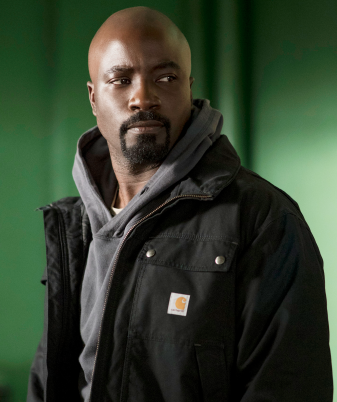
Luke Cage, as played by Mike Colter (cropped), August 29, 2017. (https://refinery29.com; Myles Aronowitz/Netflix.

For the past eleven years, I’ve worked on this blog (albeit, not so much the past couple of years) to talk about my past and how it made me, well me, warts, lesions, and all. That has meant putting as many aspects of my upbringing under an electron microscope as I could bear. Everything from physical and sexual assault to ostracism and bullying. It has meant looking at my friends, acquaintances, enemies, classmates, my mother, father, idiot ex-stepfather, my older brother, and my younger siblings and trying to understand them. Most important, it has meant me constantly interrogating myself, my motivations, my challenges, my -isms, and my other bullshit. I’ve taken nothing for granted since my first post in June 2007, and for as long as I continue to blog and write, I hope that this attitude remains.

But since my blog’s second month, one group of people have consistently poo-pooed my blog and the experiences I’ve talked about here. Mount Vernonites, especially the ones who saw me, but from a distance, during my Boy @ The Window years. Not necessarily my immediate classmates or family (although I know a couple of siblings have had issues with a post here or there). Mostly, it’s been folks who grew up around me, ones who obviously saw me as strange, and used that as an excuse for never attempting to get to know me.

I accepted long ago that this group of Mount Vernonites would be a group I could never placate. But it’s been surprising over the past eleven years how so many have come out of the woodwork to complain about me publicly airing my experiences. About two-dozen in all have found fault with my blog. Their complaints have come in several forms:

1. “Mount Vernon’s a great city with a rich history — how dare YOU (of all people) ever type a word that shows us in a negative light!”

2. “You should never say anything bad about [so-and-so]. He/she was a great person to me — how dare you!”

3. “Donald, it wasn’t that bad. You wouldn’t be the person you are today without Mount Vernon and Denzel Washington.”

4. “You have no right to talk about [x-person]! You should never say anything in public about your experiences with them!”

As I noted in talking about my blog’s tenth anniversary last June, the first missive I ever received was from someone about how I “deserved” my stepfather beating me up. Given the specificity with which the person spoke about my “defiance,” it was likely my late ex-stepfather Maurice responding to my first post about his abuse of me. Too bad I never saved that comment!

This week I received a new comment on an eight-year-old blog post about the man from one of his other kids (from one of his other unions). I won’t post the comment, because her complaint doesn’t really deserve a full airing. “What ever you have with my father should be kept private…No one should be exploited like this. It’s unethical and childish. Seek therapy and consult God for your pain and issues,” she wrote. I guess she doesn’t get that I mostly write non-fiction. At 48, I’m also too old to be told what to do by someone who’s a stranger to me.

But that’s not my main point here. Silence kills people from the inside out, often long before the blood stops pumping through our veins. Bringing abuse to the light of day isn’t exploitation, it’s necessary. Especially if it helps us move on. If a writer like me cannot be honest about the people who were in my life growing up, why bother writing at all?

For the Mount Vernonites who’ve expressed their issues with my blog, let me say this one last time. This blog has never been for you. In so many ways, this blog hasn’t been for me, either. It hasn’t been cathartic, nor has it helped me exact revenge or a pound of righteous vindication. It’s been about the hundreds of comments and emails I’ve received over the years from people I don’t know and will likely never meet. The ones who’ve had similar experiences with abuse, poverty, systemic racism, not fitting in, graduate school, their parents, and in their marriages and parenting. The kids who decided to give college another try. The adults who’ve found their way to a career, or who’ve worked out some problem in their life. The ones who’ve occasionally found their way to God, or conversely, decided that God wasn’t for them.

After nearly 300,000 views and 970 posts, I’m secure in the fact that whatever I’ve said here over the years, my words have done far more good than harm. Or, at least, they have made folks think about a variety of issues differently than they would have otherwise.

It would be all too easy for me to wish that life at 616, in Mount Vernon, and in New York had treated me much more gently between 1969 and 1989. But it didn’t. It would’ve been easier to write everything I’ve typed here over the years as mystery novels or horror graphic novels. But that’s not me (at least, not yet). I don’t regret a single word. On the other hand, I do regret my dropped words (and dropped “s”s) and other grammatical errors.

What Being #1 Is and Isn’t

24 Thursday May 2018

Posted by decollins1969 in 1, Academia, Boy @ The Window, culture, Eclectic, Politics, Pop Culture, race, Youth

≈ Leave a comment

Tags

American Narcissism, Augusta Uwamanzu, Being #1, College Acceptances, Elite Colleges and Universities, Harold Ekeh, Higher Education, Ivy League Schools, Jealousy, Kelley Williams-Bolar, Micheal Brown, Obsessive Individualism, Racism, Rigged System, Winners and Losers


#1 (cropped), May 24, 2018. (http://www.modern-senior.com).

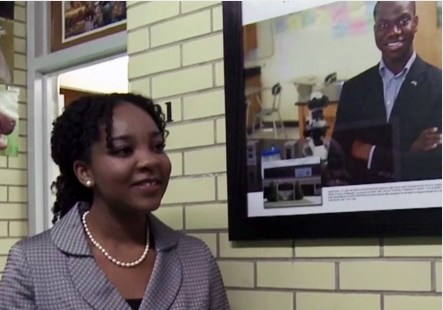
Augusta Uwamanzu-Nna, Harold Ekeh, Micheal Brown, Elmont Memorial High School, and Mirabeau B. Lamar High School must be very proud of themselves these days. And they all should be. After all, Ms. Uwamanzu-Nna joined Mr. Ekeh as being the only two students in the history of this high school to gain acceptance to all eight Ivy League universities — in back-to-back years, in 2015 and 2016. Mr. Brown was four-for-four in his quest for Ivy League admissions at Harvard, Yale, Princeton, and the University of Pennsylvania in 2017-18, and went 20-for-20 in college admissions overall. Uwamanza-Nna and Ekeh each went 13 for 13 in their applications to colleges ranging from Johns Hopkins and New York University to Harvard, Yale, and Princeton.

They are among a very short list of above-the-rim, high-achieving high school students who have the distinction of winning the college entrance lottery. They have credentials (and with full rides, the means) to attend any and every elite institution in the US. That’s just it, though. In so many ways, this narrative of American education as one of  “winners and losers” merely reinforces a society of haves and have-nots narcissistically competing for limited and segregated resources.

With a closer look at Uwamanzu-Nna’s, Ekeh’s, and Brown’s backgrounds, it becomes obvious that despite their amazing achievements, their success was predestined. Both Uwamanzu-Nna and Ekeh’s families are from Nigeria, and both moved to the US when they were of elementary school age. Uwamanzu-Nna’s father remained a physical therapist after moving to the US, while Ekeh’s parents “left comfortable lives in Nigeria” to take jobs at a Target store in Queens to provide opportunities for their five children. Both families picked places within the Sewanhaka Central High School District to live. The district is made up of a group of Long Island bedroom suburban towns within Nassau County, including Elmont.

Augusta Uwamanzu-Nna standing next to a picture of 2015 graduate, Harold Ekeh (cropped), Elmont Memorial High School, Elmont, NY, April 5, 2016. (CBS2).

This decision for the two Nigerian families could not have occurred by accident. The Sewanhaka Central High School District and especially Elmont Memorial High School has long had a reputation of providing an atmosphere of academic excellence and being a welcoming environment to students from immigrant families. Uwamanzu-Nna and Ekeh both benefited from such an environment and from families willing to sacrifice in order to push their children to win the academic lottery. In the US, getting into any Ivy League institution — much less all eight — is the pinnacle of being #1.

Brown’s case is a little less obvious in terms of advantages. But clearly Brown’s mother’s continuous efforts to enrich her life and her son’s life academically and socially were critical to his high-flying success. “When I was in elementary school, I saw my mom graduate from community college and that just meant a lot to me,”  Brown said to USA Today last month. Involvement in extracurricular activities in school and year-round after school programs like “QuestBridge, Emerge Fellowship and Breakthrough Collaborative,” where Brown got to mingle with students of color with college aspirations, must’ve helped with both his academic motivations and preparations. This more than made up for whatever deficiencies Brown faced in his education because of growing up in the Third Ward in Houston (where several of my uncles and cousins on my mother’s side lived between the mid-1970s and the early ’00s).

There are a couple of ways to look at Uwamanzu-Nna’s, Ekeh’s, and Brown’s success. One is to take the route of racist jealousy. “It’s a little obnoxious because you can only go to one, you can only take one full ride, and you are taking a spot from someone else who worked really hard,” co-anchor Holly Morris said on her FOX5 DC morning show. There was a huge backlash in response. The response implied that Brown’s achievement was a sign of showboating, that Brown was merely an attention-seeker. Keep in mind, the media sought Brown out, not the other way around. Keep in mind, Americans obsess over obvious measures of success. But somehow, if you’re Black, you can’t be joyful and in the moment over such success, even when the press is shining a floodlight on you.

Micheal Brown and his mother Berthinia Rutledge-Brown sharing the news of him getting into all 20 schools to which he applied, Houston, TX, March 31, 2018. (https://www.rawstory.com/).

Another way to look at Uwamanzu-Nna’s, Ekeh’s, and Brown’s achievements, though, would be to see their stories as a positive for them as individuals, but a negative for our society as a whole. With the increased emphasis on standardized curricula, standardized testing, and standardized individual teacher evaluations based on this testing has come an obsessive focus on the individual in education. The savior teacher as superhuman, somehow able to make every student into a proficient test-taker. The grinding student, ready to score a proficient or higher score on every school district, state-level, and national standardized test. The tiger mom-esque parent, willing at a moment’s notice to spend money that most Americans do not have to tutor and drill their child into excellent test scores. All involved in education for the greater good, but more and more, for their greater good. All without knowing about what their children have really learned, whether their students can really work in unison on a common goal, or if their kids can create, innovate, or think independently of a test-taking script.

I’m sure that Uwamanzu-Nna, Ekeh, and Brown’s have learned a lot in their respective journeys to Harvard, Yale, and Stanford. But what does this measure of achievement mean for them down the line? Is it merely their ability to meet the right people and find job opportunities looking for them around every corner as a result of their academic achievements? Or do their achievements mean anything beyond the material, for them and for the rest of us?

The “winners and losers” narrative also plays itself out in insidious ways for parents at the have-nots end of the scale. Because America’s educational resources are unevenly segregated by race and social class across its 14,000 school districts, the opportunities for winning this competition are also segregated. School district boundary hopping has become more prevalent in recent years. This as the competition for better-resourced schools has become more intense, all in the wake of the Great Recession and the resulting reduction in education budgets.

Unlevel playing field (soccer in this case), August 5, 2013. (http://funatico.com).

One famous case of boundary hopping occurred in 2011. Kelley Williams-Bolar, an African American, Akron, Ohio-area mother, was arrested for and convicted of falsifying records to enable her two daughters to attend a more affluent school district in the area for two years. (Williams-Bolar’s now deceased father Edward L. Williams was a legal resident of the Copley Township district at the time.) The real crime here is that a patchwork public education system based on income and place of residence exists at all. That it also promotes an obsession with competition and mostly pre-selects students to be #1 in the line for the elite university is worse still. That is why Uwamanzu-Nna’s, Ekeh’s, and Brown’s achievements look so remarkable. They won an educational game that in so many ways our society had rigged for them to lose.

Augusta Uwamanzu-Nna, Harold Ekeh, and Micheal Brown are among a truly lucky handful. Their parents found a welcoming home in a diverse suburban community with well-resourced (if somewhat segregated) schools, or enriched their child with resources not available to most kids in poorer and segregated urban school districts. They won the competition for #1. For most Americans, though, the education game is rigged, as the system reproduces and reinforces residential, racial, income, and academic inequality. Not to mention, the American idea that there should be winners, losers, and a grinding competition to show who won and lost.

It’s Been A While Since I’ve Been a Sports “Fan”

03 Thursday May 2018

Posted by decollins1969 in 1, Boy @ The Window, culture, Eclectic, Mount Vernon New York, New York City, Pittsburgh, Politics, Pop Culture, race, Sports, University of Pittsburgh, Youth

≈ Leave a comment

Tags

DC, Disillusionment, DMV, Escapism, Evolution, Fandom, Misogyny, Narcissism, Pitt, Politics and Sports, Racism, Sports


Cropped image of seven year-old Linus Van Pelt sucking his thumb and holding his security blanket (like the average American sports fan), May 3, 2018. (http://amazon.com).

If my 25 year-old self and my 48 year-old self met in the same hotel bar on Rolling Rock Beer and Wings night in Pittsburgh, Buffalo, or Cleveland, they would have so much in common (or explode space-time). But they would have one hell of a disagreement about the quality, purpose, and feeling of being a sports fanatic. We’d both be ex-baseball fans, courtesy of the sports’ over-inflated view of itself, its long history of racism, exclusion, and paternalism, and George Will’s ludicrous books on America’s so-called pastime. We’d both watch NBA basketball, NHL hockey, a fútbol match or a tennis tournament or a golf major here and there. But the reasons for watching, the rationale for whom to root for and why, the purpose for either of us to indulge in such athletic delights? We would be at an obtuse angle, at least 120 degrees apart.

My history of sports fandom began pretty much in middle school, even though I’d been exposed to all of New York’s underdog teams from the womb. Mets, Jets, and Knicks (Mom still doesn’t watch or understand hockey, by the way) were her teams by the time she and my dad conceived me. But me being me, I reinvented the wheel between the end of ’81 and the spring of ’84. I watched/listened to Yankees and Mets games, as well as the Knicks and Nets, the Islanders, Rangers, and Devils, and the Jets and Giants.

I picked my childhood teams based on low expectations, the balance between them being underdogs and being doormats, the players I’d most likely would want to emulate if I ever wanted to be a professional athlete. And, mostly important, based on that team’s ability to help me forget about all that was wrong in my world, for at least three hours per day (in baseball), or six hours a week (between the other sports combined).

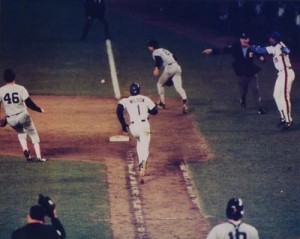
The Mookie Wilson-Bill Buckner connection, Game 6, 1986 World Series, Bottom 10th, Shea Stadium, Queens, NY, October 25, 1986. (http://halloffamememorabilia.net).

That gradually began to change once my teams started winning championships, or at least, regularly competing for them. The change accelerated once I left the New York area for Pittsburgh and its Western Pennsylvania ways. Between my Mets winning a World Series and my Giants winning two Super Bowls between ’86 and ’91, I found myself no longer a fan of hometown underdog teams. Sports weren’t an escape from my reality anymore. Especially as I began regularly working out and playing sports myself.

But I still saw sports fandom as a good thing, something that could unite people and cross the barriers of racism, classism, and even sexism (depending on the sport). That was my next phase of fandom, beginning around ’93. This view was what fueled my divorce from baseball after the ’94 MLB strike and lockout, and what caused me to begin watching more golf and international soccer, and not just falling asleep to it.

I still rooted for my Giants, Rangers, and especially the Knickerbockers. Too bad only the Rangers broke through in the ’90s, although the Knicks had their chances between ’93 and ’99. With living in Pittsburgh, though, I also began to cheer for the Steelers, the Penguins (except when they played the Rangers), and sometimes the Pirates.

But even in this phase of my fandom, I recognized the basic truth. I was cheering for athletes and their talent and will to shine in competition. That they happened to be a linebacker for the Giants or a pitcher for the Mets was a bonus, but I would’ve enjoyed their talent on other teams and in other athletic contexts anyway. I recognized this already with Reggie Jackson and Dave Winfield in the ’80s, and I saw another glimpse of it in ’96, when Dwight Gooden, at this point with the Yankees, finally threw a no-hitter. I wasn’t even a baseball fan anymore, but I was so happy for the diminished Gooden to achieve this feat.

Venus hitting a backhand against Elise Mertens in 1st round of Wimbledon, Wimbledon, England, UK, July 3, 2017. (https://www.telegraph.co.uk/; John Walton/PA).

I think that’s why I started rooting for Venus (who does not get nearly enough credit for being an elite athlete and tennis player) and Serena Williams, Tiger Woods, Kevin Garnett, LeBron James, and so many others while they were still in their teens. I’m sure that’s why I stopped putting up with cockamamie excuses from other fans about too much money in professional sports, about free agency, about the difficulties of running a franchise, when I’d see the same teams losing year after year. It didn’t help that the athletes I rooted for growing up or in the ’90s began to retire, often with a vocal and unappreciative fan base trying to shove them out to door.

Most importantly, I saw the greed and narcissism and conservative politics and racism and misogyny and homophobia that is embedded in the ownership of teams and in the building of franchises. That sports are no more divorced from the politics and malignancies in society than our choices in food and clothing, or the decision of most Americans to berate the poor for their poverty. That sports teams and franchises are about as “clean” and “merit-based” as legacies in college admissions (the ultimate form of affirmative action) and the American election process at any and all levels. Despite this, a hundred million people still entertain this naive view that sports fandom is an essential good, a form of escape, a place for camaraderie. It is not. It’s escapism, a form a narcissism that allows millions to feel a bit better about their lives without doing anything to change their lives and the lives of untold others for the better.

Maybe my jadedness comes from nearly two decades in the DC area, where I regularly root for the local teams to fail, because I love it when the fans here are disillusioned. Maybe it’s because of the poor quality of most of the sports I watch (or in the case of the NFL, have stopped watching for going on three years now). Or, maybe it’s because my Knicks haven’t a title since Nixon was president! Whatever it is, I will continue to root for athletes, but not for teams. Especially those who take a stand, those who have a purpose beyond their athleticism, those whose bodies make me a bit envious, but only envious enough to keep working out, to keep running, to keep draining Js. Also, the NFL is still blackballing Colin Kaepernick!


← Older posts
Newer posts →

Boy @ The Window: A Memoir

Boy @ The Window: A Memoir

Places to Buy/Download Boy @ The Window

There's a few ways in which you can read excerpts of, borrow and/or purchase and download Boy @ The Window. There's the trade paperback edition of Boy @ The Window, available for purchase via Amazon.com at http://www.amazon.com/Boy-Window-Donald-Earl-Collins/dp/0989256138/

There's also a Kindle edition on Amazon.com. The enhanced edition can be read only with Kindle Fire, an iPad or a full-color tablet. The links to the enhanced edition through Apple's iBookstore and the Barnes & Noble NOOK edition are below. The link to the Amazon Kindle version is also immediately below:

scr2555-proj697-a-kindle-logo-rgb-lg

Boy @ The Window on Amazon.com: http://www.amazon.com/Boy-The-Window-Memoir-ebook/dp/B00CD95FBU/

iBookstore-logo-300x100

Boy @ The Window on Apple's iBookstore: https://itunes.apple.com/us/book/boy-the-window/id643768275?ls=1

Barnes & Noble (bn.com) logo, June 26, 2013. (http://www.logotypes101.com).

Boy @ The Window on Barnes & Noble: http://www.barnesandnoble.com/w/boy-the-window-donald-earl-collins/1115182183?ean=2940016741567

You can also add, read and review Boy @ The Window on Goodreads.com. Just click on the button below:

Boy @ The Window

Twitter Updates

Tweets by decollins1969
  • RSS - Posts
  • RSS - Comments

Archives

  • June 2025
  • April 2023
  • September 2022
  • August 2022
  • July 2022
  • June 2022
  • May 2022
  • April 2022
  • March 2022
  • January 2022
  • December 2021
  • November 2021
  • October 2021
  • September 2021
  • August 2021
  • July 2021
  • June 2021
  • April 2021
  • March 2021
  • February 2021
  • January 2021
  • December 2020
  • November 2020
  • October 2020
  • September 2020
  • August 2020
  • July 2020
  • May 2020
  • April 2020
  • March 2020
  • January 2020
  • December 2019
  • November 2019
  • August 2019
  • July 2019
  • June 2019
  • May 2019
  • April 2019
  • March 2019
  • February 2019
  • January 2019
  • December 2018
  • November 2018
  • October 2018
  • September 2018
  • August 2018
  • July 2018
  • June 2018
  • May 2018
  • March 2018
  • February 2018
  • January 2018
  • December 2017
  • November 2017
  • October 2017
  • September 2017
  • August 2017
  • July 2017
  • June 2017
  • May 2017
  • April 2017
  • March 2017
  • February 2017
  • January 2017
  • December 2016
  • November 2016
  • October 2016
  • September 2016
  • August 2016
  • July 2016
  • June 2016
  • May 2016
  • April 2016
  • March 2016
  • February 2016
  • January 2016
  • December 2015
  • November 2015
  • October 2015
  • September 2015
  • August 2015
  • July 2015
  • June 2015
  • May 2015
  • April 2015
  • March 2015
  • February 2015
  • January 2015
  • December 2014
  • November 2014
  • October 2014
  • September 2014
  • August 2014
  • July 2014
  • June 2014
  • May 2014
  • April 2014
  • March 2014
  • February 2014
  • January 2014
  • December 2013
  • November 2013
  • October 2013
  • September 2013
  • August 2013
  • July 2013
  • June 2013
  • May 2013
  • April 2013
  • March 2013
  • February 2013
  • January 2013
  • December 2012
  • November 2012
  • October 2012
  • September 2012
  • August 2012
  • July 2012
  • June 2012
  • May 2012
  • April 2012
  • March 2012
  • February 2012
  • January 2012
  • December 2011
  • November 2011
  • October 2011
  • September 2011
  • August 2011
  • July 2011
  • June 2011
  • May 2011
  • April 2011
  • March 2011
  • February 2011
  • January 2011
  • December 2010
  • November 2010
  • October 2010
  • September 2010
  • August 2010
  • July 2010
  • June 2010
  • May 2010
  • April 2010
  • March 2010
  • February 2010
  • January 2010
  • December 2009
  • November 2009
  • October 2009
  • September 2009
  • August 2009
  • July 2009
  • June 2009
  • May 2009
  • April 2009
  • March 2009
  • February 2009
  • January 2009
  • December 2008
  • November 2008
  • October 2008
  • September 2008
  • August 2008
  • July 2008
  • June 2008
  • May 2008
  • April 2008
  • March 2008
  • February 2008
  • January 2008
  • December 2007
  • November 2007
  • October 2007
  • September 2007
  • August 2007
  • July 2007
  • June 2007

Recent Comments

MaryPena's avatarMaryPena on My Day of Atonement/Bitter Hat…
decollins1969's avatardecollins1969 on No Good Teaching Deed Goes…
Mary Rose O’Connell's avatarMary Rose O’Connell on No Good Teaching Deed Goes…

NetworkedBlogs on Facebook

NetworkedBlogs
Blog:
Notes From a Boy @ The Window
Topics:
My Life, Culture & Education, Politics & Goofyness
 
Follow my blog

616 616 East Lincoln Avenue A.B. Davis Middle School Abuse Academia Academy for Educational Development AED Afrocentricity American Narcissism Authenticity Bigotry Blackness Boy @ The Window Carnegie Mellon University Child Abuse Class of 1987 CMU Coping Strategies Crush #1 Crush #2 Death Disillusionment Diversity Domestic Violence Economic Inequality Education Family Friendship Friendships Graduate School Hebrew-Israelites High-Stakes Testing Higher Education History Homelessness Humanities Humanities Program Hypocrisy Internalized Racism Jealousy Joe Trotter Joe William Trotter Jr. K-12 Education Love Manhood Maurice Eugene Washington Maurice Washington Misogyny Mother-Son Relationship Mount Vernon High School Mount Vernon New York Mount Vernon public schools Multiculturalism MVHS Narcissism NFL Pitt Pittsburgh Politics of Education Poverty President Barack Obama Race Racial Stereotypes Racism Relationships Self-Awareness Self-Discovery Self-Reflection Sexism Social Justice Teaching and Learning University of Pittsburgh Violence Whiteness Writing

Top Rated

Blog at WordPress.com.

  • Subscribe Subscribed
    • Notes from a Boy @ The Window
    • Join 103 other subscribers
    • Already have a WordPress.com account? Log in now.
    • Notes from a Boy @ The Window
    • Subscribe Subscribed
    • Sign up
    • Log in
    • Report this content
    • View site in Reader
    • Manage subscriptions
    • Collapse this bar
 

Loading Comments...