• About Me
  • Other Writings
  • Interview Clips
  • All About Me: American Racism, American Narcissism, and the Conversation America Can’t Have
  • Video Clips
  • Boy @ The Window Pictures
  • Boy @ The Window Theme Music

Notes from a Boy @ The Window

~

Notes from a Boy @ The Window

Category Archives: New York City

Out There In The World

13 Saturday Dec 2014

Posted by decollins1969 in 1, Boy @ The Window, culture, Eclectic, eclectic music, Jimme, Mount Vernon New York, music, My Father, New York City, Pop Culture, University of Pittsburgh, Youth

≈ Leave a comment

Tags

616, 616 East Lincoln Avenue, Alcoholism, Camping, Camping Trip, Drug Abuse, Drugs, Father-Son Relationships, Mother-Son Relationship, Overnight Stays, Pam, Walks


Last week, my son went with his classmates on his first overnight trip without me or his mother, a middle school “camping” trip in the forests of Montgomery County, Maryland. He was gone fifty-two hours, just a bit more than two days, checking out wildlife and sitting around a campfire. My son came back on his bus, worn out with equally worn out sneakers and clothes, smelling of river and bad cafeteria food. Boy did I miss him. But at least I knew where he was, more or less.
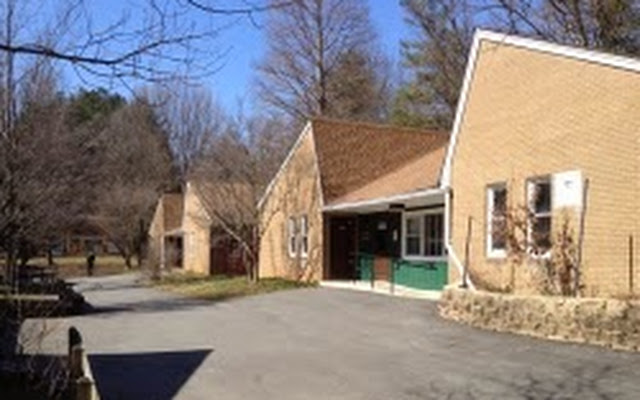
Some of the dorms at Lathrop E. Smith Environmental Education Center, Rockville, MD, December 12, 2014. (http://www.montgomeryschoolsmd.org/).

Some of the dorms at Lathrop E. Smith Environmental Education Center, Rockville, MD, December 12, 2014. (http://www.montgomeryschoolsmd.org/).

I did no such trips like the one my son did until the day I went off to Pittsburgh and college, some twenty-seven years ago. Let me repeat. Not one overnight trip on my own or with my classmates growing up. The closest I came to being out in the world, other than my 10,000 walks to the store or up Route 22 or down in the Bronx, was in the years my father Jimme would take me and my older brother Darren for a day, only for it to turn into a weekend. With a couple of exceptions, all of these extended excursions occurred before we started working with our father in the city in the fall of ’84. Most of them happened before I turned thirteen and had to resort to hunting down my father every Friday or Saturday for a few extra dollars, for me and for helping out my Mom.

At least a dozen times between April ’79 and September ’84, we ended up with Jimme overnight. In the days without cellphones and with my father never having his own landline, he’d and we’d have to call my Mom from a pay phone to let her know how we were. There were plenty of those nights in which I didn’t want to call my Mom or go home.
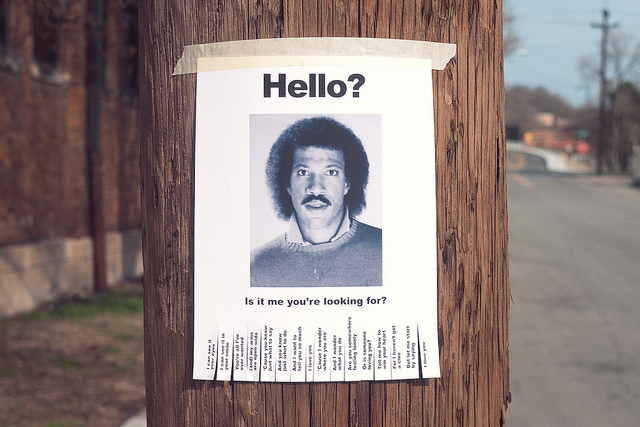
Lionel Richie on a mock-missing-person's flyer, March 20, 2011. (Chris Glass/Flickr.com).

Lionel Richie on a mock-missing-person’s flyer, March 20, 2011. (Chris Glass/Flickr.com).

This despite the fact that every time we did an overnight or, on three occasions, back-to-back overnights, Jimme was lit. How it happened depended on at what point during the weekend he’d pick us up. If my father came over early enough on a Friday evening to take us out for a pizza or Mickey D’s or a movie, he’s sometimes have a Miller or a Schlitz with him, in his coat pocket, ready to drink after the sober version of himself had picked us up from 616. Or, much more often, Jimme would fulfill his Saturday fatherly duties by picking us up, usually between 10 am and 1 pm, take us out to eat, and then swing by one or more of his drinking buddy’s places, where he could get his fill of beer or malt liquor, move on to stronger stuff, and lose track of time.

Ida’s place, Lo’s stoop, Pam’s den, it really didn’t seem to matter to our father. These were his easy places to drink, to hang out, to tell the world how much of “a big shot” he was. All the while, money would spill out of his pocket, scooped up by his hosts to cover groceries, rent, mortgages, car notes, and street drugs. But we didn’t really notice that until I hit thirteen.

Our last extended weekend with Jimme was in August ’84, right after my j.v. football tryouts, just before the start of tenth grade. We went over to Pam’s apartment off South Fulton, just a couple of blocks away from Adams Street, where we had lived as a family before I started kindergarten. Those days were long off by now. Instead, I saw my father in a completely sloshed state, really, for the first time, with the mind of an adult. Pam, for her part, was wasted, on some form of cocaine, crack or powdered, I didn’t know for sure.

Daniel Day-Lewis in There Will Be Blood (2009), screen shot of him drinking, drooling, December 3, 2010 (http://dudleydoody.com).

Daniel Day-Lewis in There Will Be Blood (2007), screen shot of him drinking, drooling, December 3, 2010 (http://dudleydoody.com).

By the end of the day that last Saturday in August, he could barely stand up. Pam had some music on, Lionel Richie’s “Hello,” as it was in the middle of the bridge portion. While it was playing, Jimme tried to dance to it, with a thick string of drool hanging from him bottom lip and all the way to his right pant leg. He stumbled to his left, then his right, as the song went, “dun-dun-dun, dun-dun-dun, du-du-dat-dat-dun-dun-dun,” via a guitar string and a synthesizer. We had to sit him down on Pam’s ’70-style couch to let him snore and drool for an hour and a half before taking him back to his place that Saturday evening. On the way out, we bumped into my classmate Dahlia and her grandmother. They lived in an apartment complex across the street. How embarrassing!

We didn’t call my Mom to let her know what was going on. So when we came home late that Sunday afternoon, she was pissed. But she didn’t seem that concerned about her safety. Instead, it was all about, “What? You think Jimme’s a good father now?” and “I need someone around here to go to the store.”

As much as I loved my Mom, she didn’t realize that we needed moments to escape, even if it meant being with our alcoholic father and being around his equally drug-addled friends. Those were our overnights before we reached adulthood.


We Didn’t Start The Fire…But…

07 Sunday Dec 2014

Posted by decollins1969 in 1, Boy @ The Window, culture, Eclectic, eclectic music, music, New York City, Politics, Pop Culture, race, University of Pittsburgh, Youth

≈ Leave a comment

Tags

"We Didn't Start The Fire" (1989), #BlackLivesMatter, #ICantBreathe, Abdication, Anti-Racism, Baby Boom Generation, Baby Boomers, Billy Joel, Colorblind Racism, Denial, Derrick Rose, Die-Ins, Irresponsibility, Jesus, Pontius Pilate, Protests, Racism, Social Justice, Structural Racism, Systemic Racism, Verizon Center, Whiteness


Billy Joel, "We Didn't Start The Fire" (video screen shot), 1989. (http://denverlibrary.org/).

Billy Joel, “We Didn’t Start The Fire” (video screen shot), 1989. (http://denverlibrary.org/).

As the rest of this sentence goes, “we poured gasoline and kerosene all over it.” And by “we,” I mean everyone who has been or remains in denial of the role poverty, greed and systemic racism plays in our lives. Every. Single. Moment. Every. Single. Day.

As an eclectic music lover, as a historian and as an educator, there are few songs I hate more than Billy Joel’s “We Didn’t Start The Fire.” Well, maybe Biz Markie’s “Just A Friend” (1990) or anything by Chicago after Peter Cetera quit the group in ’85. The song was released in the fall of ’89, during my junior year at Pitt, when I’d become a history major. Every time I heard the song, I wanted to strangle Joel with it. This is the same man who wrote “Just The Way You Are” (1977) and “New York State of Mind” (1976), right? First, he wasn’t even singing in most of the song. “Einstein, James Dean, Brooklyn’s got a winning team?” Wow, I bet the coked-up songwriters for Thompson Twins wasn’t booked that weekend Joel wrote these lyrics, no?

State of Denial (2006) front cover, by Bob Woodward, December 6, 2014. (http://amazon.com).

State of Denial (2006) front cover, by Bob Woodward, December 6, 2014. (http://amazon.com).

There’s one big beef I have with the song more than any other, one that’s relevant even a quarter century later. The issue of denying responsibility. Yeah, those poor White Baby Boomers, how terrible it must’ve been for so much to happen in your lives, with so little that you could do about it, too! It’s true, though. Whether it was “JFK” being “blown away,” or the “Russians in Afghanistan,” the song is about fucked-up shit that happened between the late-1940s and when the Baby Boomers approached middle-age by the end of the 80s.

The problem was and remains the reality that they’ve been putting fuel on this fire that’s allegedly been “always burning since the world was turning.” I mean, who voted for Nixon in ’72 or Reagan in ’80 or ’84? Who’s blindly supported every Israeli policy for as long as they’ve been able to vote, policies that have helped incite terrorism? Who’s been in constant denial of American violence and racism as a generation, despite contributing to it their whole lives? The very same generation whom Billy Joel and his idiotic lyrics represents, that’s who!

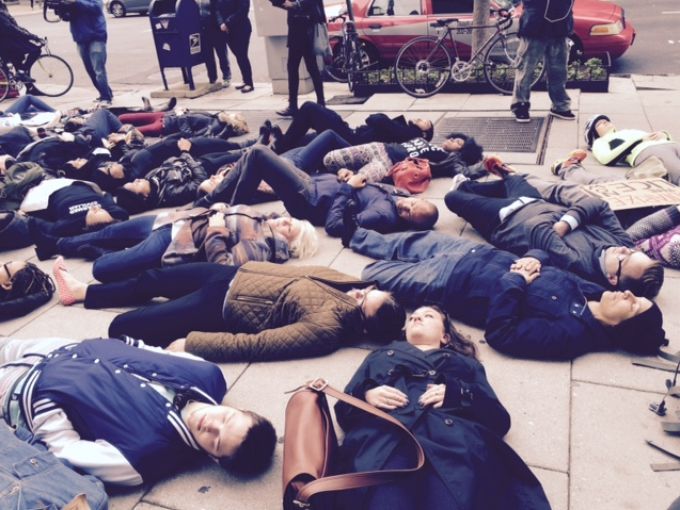
Die-in in front of Verizon Center, Washington, DC, December 5, 2014. (Samuel Corum, @corumphoto, via Twitter).

Die-in in front of Verizon Center, Washington, DC, December 5, 2014. (Samuel Corum, @corumphoto, via Twitter).

So now in 2014, with America and the world the way it is, with daily protests now over grand jury denials of indictments for police killing unarmed Blacks, with Gaza and Nigeria and Kenya and Ukraine, with wealth so heavily concentrated in so few hands, what do these “We Didn’t Start The Fire” types have to say now? “Trayvon, Michael Brown, Garner in a chokehold?” “Hawking, Gaza, twerking from Azalea?” As if we wee Americans can abdicate responsibility for their deaths, like Pontius Pilate did in effectively condemning Jesus to crucifixion, but washed his hands of his role in the process. Who’s been front and center in supporting a police state, in advocating policies that criminalize Black and Brown bodies for taking a breath, in turning the American Dream of a middle class into a get-rich-quick scheme? Hmm, let me think about this one…

Outside of the small minority of Whites who are truly upset about and are actively involved in protests against this latest round of American injustice, many Whites have expressed how enraged they are. About die-ins in front of the Verizon Center before a Washington Wizards game. About delays in getting to their destination because the Beltway or the Lincoln Tunnel or some other thoroughfare’s been blocked by protestors with “Black Lives Matter” and “I Can’t Breathe” signs. For this very-much-not-silent majority, these protests and the outrage and yearning for social justice they represent are major inconveniences.

Chicago Bulls guard Derrick Rose in pre-game warm-ups, dressed in his "I Can't Breathe" protest shirt, United Center, Chicago, December 6, 2014. (http://chicagotribune.com).

Chicago Bulls guard Derrick Rose in pre-game warm-ups, dressed in his “I Can’t Breathe” protest shirt, United Center, Chicago, December 6, 2014. (http://chicagotribune.com).

Well, that’s too effing bad! You spend your life in denial, in assuming that anything racial isn’t your fault. You deserve inconvenience, you deserve to get smacked in the face with reality while drinking your beer at a basketball game, expecting Black players to stay in their entertainer role. You don’t want to think about the real world and your role in maintaining stereotypes and oppression in it? Oh well! Grow a pair! Not of balls, though. Grow a pair of lobes! Because none of us wide-awake, “Black Lives Matter” types are going anywhere.

The Art of Interviewing Killer Cops and Other Whites on the Prowl

04 Thursday Dec 2014

Posted by decollins1969 in 1, Academia, culture, Eclectic, New York City, Politics, Pop Culture, race, Youth

≈ Leave a comment

Tags

#BlackLivesMatter, Civil Rights, Daniel Pantaleo, Darren Wilson, Eric Garner, Grand Jury, Human Rights, Indictment, Interviewing, John Crawford, Jonathan Ferrell, Jordan Davis, Journalism, Media, Michael Brown, Murder, No Charges, NYPD, Police Brutality, Qualitative Research, Renisha McBride, Tamir Rice, Trayvon Martin, White Vigilantism


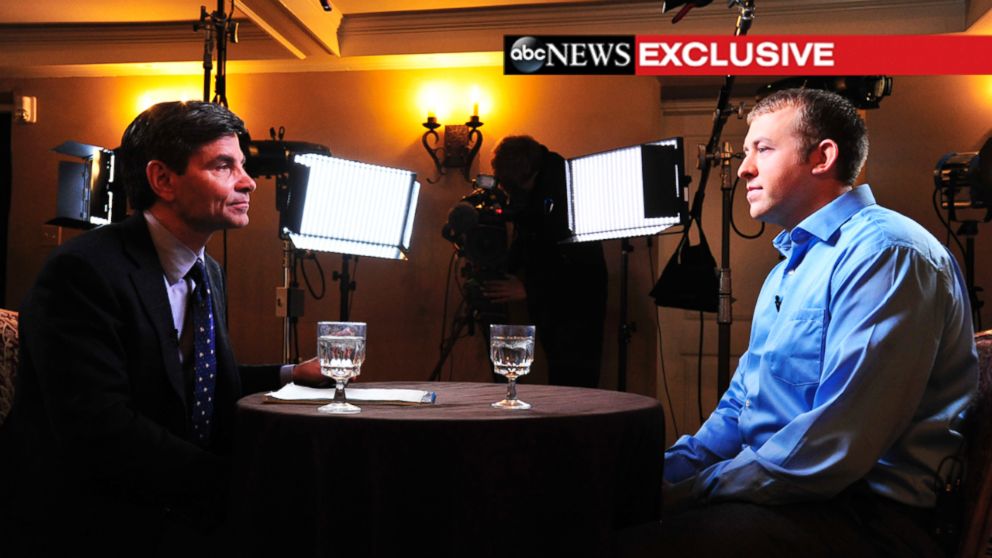
Dumb-assed George Stephanopoulos of ABC News interviewing Michael Brown murderer, former Officer Darren Wilson, November 25, 2014. (http://abcnews.go.com).

Dumb-assed George Stephanopoulos of ABC News interviewing Michael Brown murderer, former Officer Darren Wilson, November 25, 2014. (http://abcnews.go.com).

I think it would be interesting if I applied my qualitative research skills and did a sociohistorical study of the killer cops and White vigilantes who’ve gotten away or almost gotten away with murdering African Americans over the past few years. We know so much about Trayvon Martin, Eric Garner, Michael Brown, Renisha McBride, Jordan Davis, Tamir Rice, John Crawford and Jonathan Ferrell, including their arrest records, their blood-alcohol levels, their drug use, even their family members’ criminal records, if any. The media always performs a pseudo-social science-y qualitative research study on Black and Latino victims and their families and friends, in search for the perfect victim, someone to justify the outrage and anguish over state-sanctioned, cold-blooded murder.

It’s time to flip the script. I’d conduct a group interview process, bringing in the cabal of murderers, alleged and convicted, for a two-hour-long sit down. I’d ask questions about their upbringing, about the influence of popular culture in their lives, about facing down dangerous criminals carrying cigarettes, Skittles and broken toy guns. Only, my overeducated Black ass wouldn’t make it to my first question. I’d get choke-held or shot the moment I’d reach in my book bag for my digital tape recorder, even if we were conducting the interview in a public place, like the Children’s Room at New York Public Library on West 41st and Fifth Avenue. So I’d have to find one of my privileged White colleagues to interview these men on my behalf.

———————————————–

Overseer Daniel Pantaleo, 2014. (http://nydailynews.com).

Overseer Daniel Pantaleo, 2014. (http://nydailynews.com).

Narrator: Today we have George Zimmerman, Daniel Pantaleo, Darren Wilson, Theodore Wafer, Michael Dunn, Tim Loehmann, David Darkow, Sean Williams and Randall Kerrick here to talk about what it takes to be a White man fighting hard to protect the world from unarmed African Americans.

Pantaleo: Shut da [expletive] up, dumb ass! Where’d ya earn that PhD, Harlem?

Dunn: Yeah, that’s telling him! I respect the law, too. Even if it has me in chains.

Narrator: Okay, everyone. We’re taping here, so wait for me to ask my questions, please.

Loehmann: I’ll give you two seconds to ask your questions. After that, I’m not promising you anything.

Narrator: My first question is about your backgrounds. Can any of you tell me how your background impacted your decision to become either a police officer or vigilante?

Wafer: I’m deeply offended by the idea that you’re calling me a vigilante. I was defending myself. I live in a bad neighborhood. I mean, who bangs on my [expletive] door at three in the morning? You come to my door that late at night, I put you in a body bag!

Zimmerman: Dude, I couldn’t agree with you more. But I wouldn’t wait. I’d hunt these assholes down first!

(Laughter rises up from group)

Darkow: I’m feeling you there, dude!

Wilson: You asked about our background. I grew up as part of a hunting and fishing family. My old man took us out to take down elk and deer every year. It made me a good shot. I could shoot a doe in the head from fifty yards away.

(Group breaks out in laughter again)

Narrator: So, Mr. Wilson, are you saying that when you shot at Michael Brown, you saw him the same way you see a young female deer?

Wilson: Uh, absolutely not. As I said in my report, the perp was like Donkey Kong, like Hulk Hogan, angry, unresponsive and dangerous, more like a giant bear than a doe.

Pantaleo: Man, it’s all right to say it, because I’m thinking it, too. These [expletive] n—-s are dangerous — they all need to be put down!

Narrator: Why’s that, Mr. Pantaleo? Would you say–

Williams: Will you listen to this egghead? Questioning how we do our jobs. Like that guy in Godfather said, n—-s are animals! We have to control them, so that they only destroy themselves!

(Dunn and Wafer raise their hands to show their handcuffs)

Zimmerman (to Dunn and Wafer): Y’all were just stupid enough to get caught snorting and drinking after you defended yourselves!

(Group breaks out in laughter again)

Narrator: Mr. Pantaleo, what about your background?

Pantaleo: The best training I had for the NYPD was from Tarzan and Wild Kingdom. I learned my hand-to-hand fighting skills from them. Also, WWE prepared me good, too.

Narrator: So, when you put Eric Garner in a choke-hold—

Pantaleo: It was like taking down a bull or buffalo! My heart was pumping so hard, I could feel the blood flowing inside my head! That fool should had just fallen to the ground so I could cuff his Black ass!

Wilson: And that’s what these suspects don’t get. When they see us coming, don’t walk, don’t run, don’t grab for anything, don’t hold your hands up. Lay down like you’re dead, and we won’t have to put you down.

Narrator: Mr. Kerrick, you haven’t joined the conversation yet. Do you have anything to add?

Kerrick: Just that my case is still pending. I can’t talk about it much.

Narrator: You shot and killed Jonathan Ferrell, correct?

Kerrick: I can’t talk about that. I–

Zimmerman: Dude, you got a raw deal!

Pantaleo: You should work for the NYPD. Police never get indicted for going hunting here!

(Group breaks out in laughter again)

————————————————–

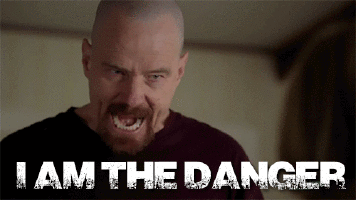
Bryan Cranston as Walter White, Breaking Bad, Season 4, 2013, "I am the danger!" (not the only White as danger, either). (http://www.giphy.com).

Bryan Cranston as Walter White, Breaking Bad, Season 4, 2013, “I am the danger!” (not the only White as danger, either). (http://www.giphy.com).

On second thought, maybe we don’t need to apply social science thinking to these White men (in thought, if not entirely in genetics). We have a century’s worth of studies of White supremacy and systemic racism already, showing that vile men grow out of a vile system.

For What It’s Worth, My Life Matters, Our Lives Matter

27 Thursday Nov 2014

Posted by decollins1969 in 1, Boy @ The Window, Christianity, culture, Eclectic, eclectic music, Mount Vernon High School, Mount Vernon New York, music, New York City, Pittsburgh, Politics, Pop Culture, race, Religion, University of Pittsburgh, Youth

≈ Leave a comment

Tags

"For What It's Worth" (1970), Bob McCullough, Buffalo Springfield, Darren Wilson, Double-Consciousness, Faith, Ferguson, Michael Brown, Police Brutality, Police Harassment, Racism, Rudy Giuliani, Self-Awareness, Self-Worth, Souls of Black Folk (1903), Systemic Racism, W. E. B. Du Bois, White Vigilantism, White Violence


Protestors hold a die-in at 14th and I St NW, Washington, DC, November 25, 2014.  (Andrea McCarren/WUSA via http://www.wusa9.com)

(For What It’s Worth) Protestors hold a die-in at 14th and I St NW, Washington, DC, November 25, 2014. (Andrea McCarren/WUSA via http://www.wusa9.com)

Between Bob McCullough, Darren Wilson, the grand jury in Ferguson, Missouri, the NYPD, Rudy Giuliani, the Cleveland PD, and 100 million other sources, I could easily draw the conclusion that the lives of Americans of color are only worth as much as three cigarillos or a toy gun. Or, with it being 2014, that we’re just characters in a video game in which scared Whites get to kill us for sport or out of spite. Heck, I wouldn’t be surprised if the Ferguson PD allows Wilson to mount Michael Brown’s skull above his mantle after he returns from his long-delayed honeymoon, the poor racist!

But my life, your life, all of our lives are worth more than what any racist asshole or system places on us. I had to learn this lesson a long time ago. It’s the lesson that is the raison d’etre for my blog Notes from a Boy @ The Window, not to mention my book Boy @ The Window. There are literally millions of messages we as Americans of color take in over the course of our lives that for so many, our lives don’t matter. Counterintuitively, it means our lives really must matter. Why would anyone or any system expend so much time and effort excluding people on the basis of race and social status in the first place?

Café Crème cigarillos, Denmark, October 21, 2011.  (PeddderH via Wikipedia). Released to public domain via CC-SA-3.0.

Café Crème cigarillos, Denmark, October 21, 2011. (PeddderH via Wikipedia). Released to public domain via CC-SA-3.0.

Still, learning that I mattered began at home, in Mount Vernon, New York, from folks who treated me every day as if I mattered not at all. Between my Humanities and Mount Vernon High School experiences and the abuse I suffered at home, I didn’t need the additional dimension of police harassment or White vigilantism to remind me that those of us without standing, who refused to conform to acceptable ways of thinking and speaking, were discardable. Maybe that’s why I turned to nondenominational Christianity in the first place. To realize that despite it all, that I mattered to God, to a universe much bigger and much more mysterious and powerful than the fists of my stepfather or the denigration and ostracism I received at school. It all gave me reasons to live.

So when my first encounters with police harassment and White vigilantism did occur (beginning right after my seventeen birthday), I had faith in God, and with that, faith in myself as a foundation from which to draw strength. Whether at Tower Records or in Pittsburgh or in Los Angeles, and regardless of how scared I might have felt during those moments, I remained outwardly calm. I remained myself.

Yes, I was lucky. Maybe my weirdness, my proper speech, my faith, maybe even God and the universe, kept me from getting beat up or shot on sight by police, security guards or by groups of drunken White guys in pickup trucks. But really, by the time Whites (and some Black cops, to be sure) started profiling me in earnest, I had made the decision that I had worth, that my existence, creativity, analytical ability, critical reasoning, all mattered.

It helped that I had victories in my life, big and small and somewhere in between, to draw on, too. Not just my advanced education or my first publications. By the time I’d hit thirty, I’d learned how to love again, to feel again, to write again, to have fun again, to even feel pain and recover again. All of that made my life much sweeter, filled my world with color and sound and texture, with words and deeds that mattered to me and everyone who’d become important to me.

W.E.B. Du Bois in duality (double-consciousness), original picture circa 1903, November 26, 2014. (http://www.storify.com/ozunamartin).

W.E.B. Du Bois in duality (double-consciousness), original picture circa 1903, November 26, 2014. (http://www.storify.com/ozunamartin).

While there are moments that I can go there, because of the likes of Wilson, McCullough and Giuliani, the fact is, I refuse to allow dumb-assed racists to determine my life’s worth. That those folk who devalue the lives of other folk because of their -isms (racism, misogyny, homophobia, imperialism, capitalism) and ish are in fact making their own lives worth less and worthless.

While W.E.B. Du Bois was right about this “peculiar sensation…this sense of always looking at one’s self through the eyes of others,” I don’t think I live my life in a constant state of double-consciousness. If I did, I would’ve jumped off that bridge over the Hutchinson River Parkway long before adulthood. No, up or down, I know my life has meaning, my existence is worth more than a 9mm bullet, that every sentient life matters. And like Michelle Alexander’s talk with her son this week, I’ve made sure that my son knows that his life matters, and should matter, to him, his mother, and to me.

A Diarrhea Football Sunday

23 Sunday Nov 2014

Posted by decollins1969 in 1, Boy @ The Window, culture, earth, wind & fire, Eclectic, High Rise Buildings, Jimme, Mount Vernon New York, My Father, New York City, Pop Culture, Sports, Work, Youth

≈ Leave a comment

Tags

616, 616 East Lincoln Avenue, Come-From-Behind Victory, Coping Strategies, Diarrhea, East Rutherford New Jersey, Football, G/I Tract, Gastrointestinal Illness, Giants, Giants Stadium, Kansas City Chiefs, New York Giants, NFL, Phil Simms, Pizza Shop, Pressures, Sicilian Pizza Pie, Stress, Stressors, Zeke Mowatt


Porthcawl, Wales takes a battering from a fierce Atlantic storm, February 5, 2014. (Getty Images, via http://www.express.co.uk).

Porthcawl, Wales takes a battering from a fierce Atlantic storm, February 5, 2014. (Getty Images, via http://www.express.co.uk).

I’m probably going to disgust a few of you who read this post. I promise I won’t go into a slurry of detail about this particular experience. It’s just that after years of gastrointestinal issues, I’ve learned a thing or two about triggers and coping strategies that may be helpful to folks.

Haagen-Dazs specialty milkshakes (my son had the $7 cookies and cream yesterday), November 23, 2014 (posted June 10, 2011). (http://www.qsrmagazine.com/).

Haagen-Dazs specialty milkshakes (my son had the $7 cookies and cream yesterday), November 23, 2014 (posted June 10, 2011). (http://www.qsrmagazine.com/).

This weekend thirty years ago, I learned for the first time that my body handled stress in a unique and painful way. I should’ve been aware of this much sooner than a month before my fifteenth birthday, and should’ve figured out how to counteract this long before my mid-thirties. I’d seen signs of it. The mugging I suffered from when I was nine in ’79. The recent broken toilet incident at 616. My inability to drink a chocolate milkshake from Carvel’s without the need to find a bathroom within forty-five minutes of my first sip.

But it wasn’t until the Sunday after Thanksgiving ’84, November 25th, that I recognized the link between the constant stress I felt and my G/I tract issues. It was a brisk late November day, like so many that time of year. The Giants were playing a big game in East Rutherford, against the Kansas City Chiefs. With a 7-5 record at the time, the Giants were fighting with both the Cowboys and Redskins for playoff position. They’d been on a roll of late, having won three of their previous four, including one on the road against Danny White’s Cowboys.

That’s what I thought about as the 1 pm game time approached. It wasn’t the only thing on my mind, though. It had been a long and stressful couple of months prior to this semi-break of a Thanksgiving weekend. This stretch included arguments with my Mom, including one in which I almost moved out. It included incidents with my teachers, especially Ms. Zini. It also included too many weekends of tracking down my father for money — including money that he owed us for working down in the city with him since the end of September. And washing clothes, and grocery shopping, and watching after Maurice, Yiscoc, Sarai and Eri, and cleaning the apartment.

Somewhere in all of this, I must’ve picked up a stomach bug, from either my younger siblings or from something I ate. At least that’s what I thought at the time. The toilet became my constant companion throughout that afternoon, as a stepfather-free Sunday gave me and my older brother Darren the opportunity to watch the Giants game without interruption. That was, except from my stomach.

Flour water in a jar, November 23, 2014. (Donald Earl Collins).

Flour water in a jar, November 23, 2014. (Donald Earl Collins).

I really didn’t know why I’d been on the toilet five times in two hours, but between that and Phil Simms’ lousy play in the first three quarters of the game (three interceptions, no touchdown passes), I felt really ill. My Mom suggested that I should drink flour water to settle my stomach. “Yuck” was the only thing I thought of her idea. The flour water thought had crossed my own mind, too though.

After Kansas City scored to take a 27-14 lead with a bit more than ten minutes left, I finally had an idea much more pleasant than flour water. I hadn’t eaten all day, and barely anything the night before. So I took five dollars of my Jimme money and went down the street to the local pizza shop. I order a slice of Sicilian with extra cheese. As thick as this shop made their Sicilians, I figured that would plug up my intestines.

While I waited for them to warm up my slice, I listened to the Giants game, which they had on their TV in the back of the shop. Simms had rallied the team and driven them down the field for a touchdown by the time I paid for my Sicilian slice. That actually lifted my spirits a bit.

I was hurting, so I didn’t wait. After I walked out of the shop, I took two big bites of my slice to see if it would help. By the time I made it to the front of 616, I let out a gigantic belch, and then my stomach, which had felt like a nor’easter in the middle of the Atlantic Ocean for hours, had finally calmed.

A good-looking Sicilian slice (my shop would've wrapped it in aluminum, though), November 23, 2014. (http://slice.seriouseats.com).

A good-looking Sicilian slice (my shop would’ve wrapped it in aluminum, though), November 23, 2014. (http://slice.seriouseats.com).

After I made it back upstairs to our place, the Giants had the ball again with less than three minutes in the game. They were driving on the Chiefs’ side of the field, in a two-minute drill. As I sat, ate and belched, Simms actually drove all the way down field for game-winning touchdown, a short pass to Zeke Mowatt. They won the game 28-27! I was stunned!

I learned a lot on that diarrhea football Sunday. For me, even watching a football game was stress-inducing. That sleeplessness and running myself down, the pressures of 616 and school, the pressure I put on myself, all manifested physiologically in my G/I tract. Sometimes escaping into comfort food, being pleasantly surprised by success, even someone’s else success, could calm my stomach. Sometimes not. Becoming fully aware of how my body responded to stress, though, would turn out to be a blessing, saving me from many moments of embarrassment over the years.

Last Gasps, Anita Baker’s “Sweet Love,” and My ’86 Mets

26 Sunday Oct 2014

Posted by decollins1969 in 1, Boy @ The Window, culture, Eclectic, eclectic music, Mount Vernon High School, Mount Vernon New York, music, My Father, New York City, Pittsburgh, Pop Culture, race, Sports, University of Pittsburgh, Youth

≈ 1 Comment

Tags

"Sweet Love" (1986), 1986 World Series, Alcoholism, Anita Baker, Bill Buckner, Billboard Pop Chart, Cameo, Child Abuse, Club Nouveau, Coping Strategies, Domestic Violence, Drug Abuse, Giants, Grammys, Hip-Hop, Joe Morris, Living Vicariously, Mets, Mookie Wilson, R&B, Rap, Rapture album, Singing, Super Bowl XXI, WFAN


The Mookie Wilson-Bill Buckner connection, Game 6, 1986 World Series, Bottom 10th, Shea Stadium, Queens, NY, October 25, 1986. (http://halloffamememorabilia.net).

The Mookie Wilson-Bill Buckner connection, Game 6, 1986 World Series, Bottom 10th, Shea Stadium, Queens, NY, October 25, 1986. (http://halloffamememorabilia.net).

Sunday, October 26, 1986 was part of a great three days for me, perhaps the three best days during my Boy @ The Window years. My Mets had pulled off a miracle. They survived being within a strike of losing the ’86 World Series because Mookie Wilson put a ball between Boston Red Sox 1st baseman Bill Buckner’s rickety legs the night before. Anita Baker’s “Sweet Love” was #1 or #2 on the R&B charts and was near the top of Billboard’s Top 40 on this day twenty-eight years ago. Within the next thirty-eight hours, my Mets would complete the comeback, and win their second (and last, to this point anyway) World Series after falling behind 3-0 through the first six innings. Meanwhile, my Giants would run through the Deadskins at home in East Rutherford, NJ, as Joe Morris rushed for 185 yards in a 27-21 victory, on their own march to a championship title.

GoGurt, Yoplait's squeeze -in-mouth, portable yogurt, October 26, 2014. (http://freehotsamples.com).

GoGurt, Yoplait’s squeeze -in-mouth, portable yogurt, October 26, 2014. (http://freehotsamples.com).

My coping mechanisms were at their peaks, though, and had nothing else to do but crash down into the Earth. It was also my senior year in high school, a time of too many AP courses, too many college-going pressures, too many haters and doubters among my classmates, and too much of the grinding poverty and chaos that was living at 616. Within two weeks of my Mets, my Giants and Anita Baker’s first big hits, I’d discover my idiot stepfather’s pornography collection, nearly got set up with a prostitute because of my father, and face humiliation at the hands of my AP Physics teacher David Wolf and his boss Estelle Abel for the first time.

It took me almost two years to recover from the happenings of the mid-fall of ’86. In the process, I faced betrayal, ostracism, humiliation, broken-heartedness, and homelessness, but somehow managed to not make every song and every Mets and Giants (and Knicks and Rangers) victory a vicarious signpost for my own life. It helped that I started to think of Pitt — if not Pittsburgh — as my home, with concerns beyond living and dying with my New York teams and with relatively unknown but talented music artists.

Giants' RB Joe Morris running through Deadskins again, RFK Stadium, Washington, DC, December 7, 1986. (http://sikids.com).

Giants’ RB Joe Morris running through Deadskins again, RFK Stadium, Washington, DC, December 7, 1986. (http://sikids.com).

I learned other things along the way, too. That my Mets and Giants weren’t the perfect teams I thought they were. Between the alcohol and drug issues of Darryl Strawberry, Dwight Gooden, Len Dykstra, Lawrence Taylor, Kevin Mitchell, not to mention their and other teammates’ domestic violence issues, it was obvious to me that talent and winning were more important than living by a consistent code. Listening to the new 24/7 sports radio station WFAN when it began its run in the summer of ’87 showed me the hearts and minds of most fans. They obviously weren’t using sports as a coping strategy for dealing with the emotional grind of poverty and threats of abuse and domestic violence at home. Mostly White and male, their constant barrage of vitriol and disparaging racial commentary about my favorite athletes at that time — Mike Tyson in particular — actually made me wary of White sports fans for years afterward.

I also learned that with artists like Anita Baker and Luther was really the last gasp of R&B as I’d known it to be in the US. R&B was already too much like ’80s pop and a bit too mixed up with rock at times, but with Cameo’s “Word Up” and Club Nouveau’s cover of Bill Withers’ “Lean On Me,” R&B was already beginning its merge with hip-hop, and not in a good way, either. Yeah, there were some exceptions, like Levert, or Regina Belle, but the process of R&B devolving into some Yoplait GoGurt version of itself — with Autotunes, bad rap lyrics and worse rhyme spitters, and assembly-line hip-hop beats — had already begun.

Anita Baker, Rapture phase, circa 1986. (http://projects.latimes.com).

Anita Baker, Rapture phase, circa 1986. (http://projects.latimes.com).

Some of you may say, R&B’s still alive in the US, specifically in our churches, but that’s not true, thanks in large measure to Kirk Franklin. His work in the ’90s made it so that it’s taken longer for jazz to catch on in bands and choirs than rap and hip-hop. No, if you want to find R&B with actual singers these days, try the United Kingdom of Great Britain, try France, try Senegal, try Nigeria. But don’t try the US. Nicki Minaj is no Aretha, no matter how imaginative her videos and her clothes. For that matter, Iggy Azalea’s no Teena Marie, as the former doesn’t understand the difference between cultural appropriation and authenticity. Hip-hop sprang in part from the roots and branches of R&B, but like a parasitic vine, it has cannibalized those roots.

Still, it’s good to remember days like the ones I lived through twenty-eight years ago, with Anita Baker in my ear, my Mets in victory formation, my Giants lined up right beside them. Those days are gone, like the coping strategies I used to get through every one of those days. Not to mention the R&B that was more a part of my life than the hip-hop that my contemporaries were supposedly raised on.

Teaching Migration, In Song

17 Friday Oct 2014

Posted by decollins1969 in 1, Academia, Boy @ The Window, culture, Eclectic, eclectic music, High Rise Buildings, Jimme, Marriage, Mount Vernon New York, music, My Father, New York City, Politics, Pop Culture, race, Religion, Upper East Side, Upper West Side, Work, Youth

≈ Leave a comment

Tags

"(Sittin' On) The Dock of the Bay" (1968), "Living For The City" (1973), African American History, Africana Studies, Arrested Development, Black Boy (1945), Black History, Black Migration, Bruce Springsteen, Cities, Gil Scott-Heron, Gladys Knights and The Pips, Great Migration, Isabel Wilkerson, James Grossman, Joblessness, John Mellencamp, Kate Bush, Land of Hope (1989), Marvin Gaye, Mary Patillo, Migration, Nas, Nicholas Lemann, Nina Simone, Otis Redding, Peter Gabriel, Poverty, Richard Wright, Stevie Wonder, Teaching and Learning, The Promised Land (1991), The Warmth of Other Suns (2010), Tracy Chapman, Tupac, Urban America, urban blight


Stevie Wonder and Wonderlove, live performance of "Living For The City," circa 1974.  (http://youtube.com).

Stevie Wonder and Wonderlove, live performance of “Living For The City,” circa 1974. (http://youtube.com).

If I ever had the chance to teach a course specifically on the history of Black migration in America, I already know what books I’d use. Isabel Wilkerson’s The Warmth of Other Suns (2010); Nicholas Lemann’s The Promised Land (1991); James Grossman’s Land of Hope (1989); Mary Patillo’s Black Picket Fences (1999); even Richard Wright’s Black Boy (1945) and Maya Angelou’s I Know Why the Caged Bird Sings (1969). All have moved beyond the statistics of some seven or eight million Blacks moving from the rural Jim Crow South to America’s cities, North, Midwest, West and South for the first three-quarters of the twentieth century.

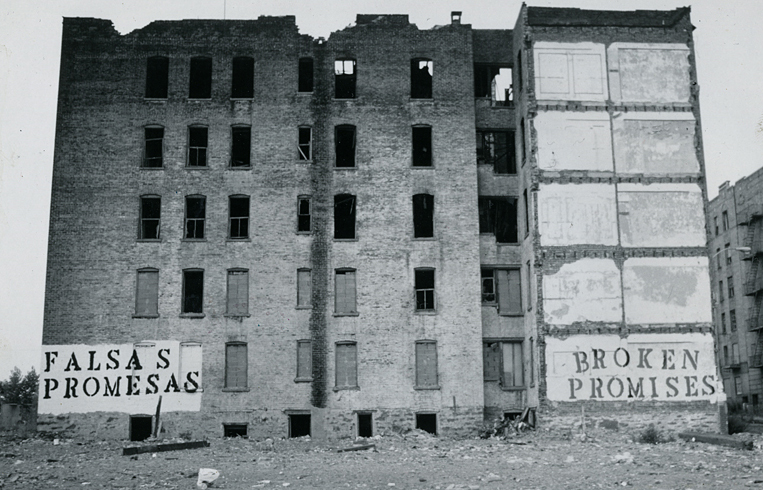
Falsas Promesas Broken Promises, taken by John Fekner, Charlotte Street Stencils, South Bronx, New York. 1980. (Liftarn via Wikipedia). Released to public domain via CC-SA-3.0.

Falsas Promesas Broken Promises, taken by John Fekner, Charlotte Street Stencils, South Bronx, New York. 1980. (Liftarn via Wikipedia). Released to public domain via CC-SA-3.0.

But that wouldn’t be near enough to communicate the range of emotions, the psychological states and the pressures that these people faced in leaving their homes for the not-so-bright lights of America’s big cities, not to mention what they faced in the days and years after they arrived. I should know. I’m the nearly forty-five year-old son of a mother originally from Bradley, Arkansas (population 500) and a father from Harrison, Georgia. They moved to New York City in the ’60s (specifically, the Tremont section of the Bronx), then to the South Side of Mount Vernon, New York (just outside the Bronx), hooked up, and sired me and my older brother Darren between December 1967 and January 1970.

That short summary is hardly the story, though. For me — like with so many other things in my life — music tells the story, emotions and psychology beyond what words on a page alone can approximate, but not fully duplicate. Music communicates the stories, emotions and psychology of those who migrated and stayed (or didn’t) in cities across the US better than Census data or a hypothesis on proletarianization. I wanted music from my own lifetime (or at least, within a few years of it) — not just folk songs or Blind Willie Johnson or Duke Ellington — music that fit my family’s transition from migration to our current times of racism and urban poverty.

Easily the top two songs on my list to play in class would be:

Trade ad for Otis Redding's single "Try a Little Tenderness," January 7, 1967. (Viniciusmc via Wikipedia/Billboard Magazine, page 7). In public domain).

Trade ad for Otis Redding’s single “Try a Little Tenderness,” January 7, 1967. (Viniciusmc via Wikipedia/Billboard Magazine, page 7). In public domain).

1. Otis Redding, “(Sittin’ On) the Dock of the Bay,” (1968), released after Redding’s death in a plane crash in Madison, Wisconsin; and

2. Stevie Wonder, “Living For The City,” (1973).

Both songs run the full emotional and psychological gamut. From hopefulness to oblivion, from delusion to despair, from rage and anger to resignation. The melancholy of Redding’s “It’s two thousand miles I roamed/Just to make this dock my home” (in reference to the distance from Georgia to San Francisco Bay) juxtaposed with Wonder’s bitterness and anger:

“His hair is long, his feet are hard and gritty
He spends his life walkin’ the streets of New York City
He’s almost dead from breathin’ in air pollution
He tried to vote but to him there’s no solution…”

It communicates so much beyond the lyrics and liner notes, a reminder for those of us who find America and its cities unforgiving today just how relentless it must’ve been for our parents and uncles and aunts and grandparents forty or more years ago.

There are other songs that I’d put on this playlist. Some are directly related to Black migration, some try to bridge the gap between the abundance of music on “the ghetto” and urban poverty and chaos and the lack of music from my own lifetime on migration.

3. Gladys Knight and the Pips, “Midnight Train to Georgia” (1973).
4. Marvin Gaye, “Inner City Blues” (1971).
5. Gil Scott-Heron, “95 South (All of The Places We’ve Been)” (1977).
6. Tracy Chapman, “Fast Car” (1987).
7. Nas (featuring Olu Dara, his father), “Bridging the Gap” (2004).

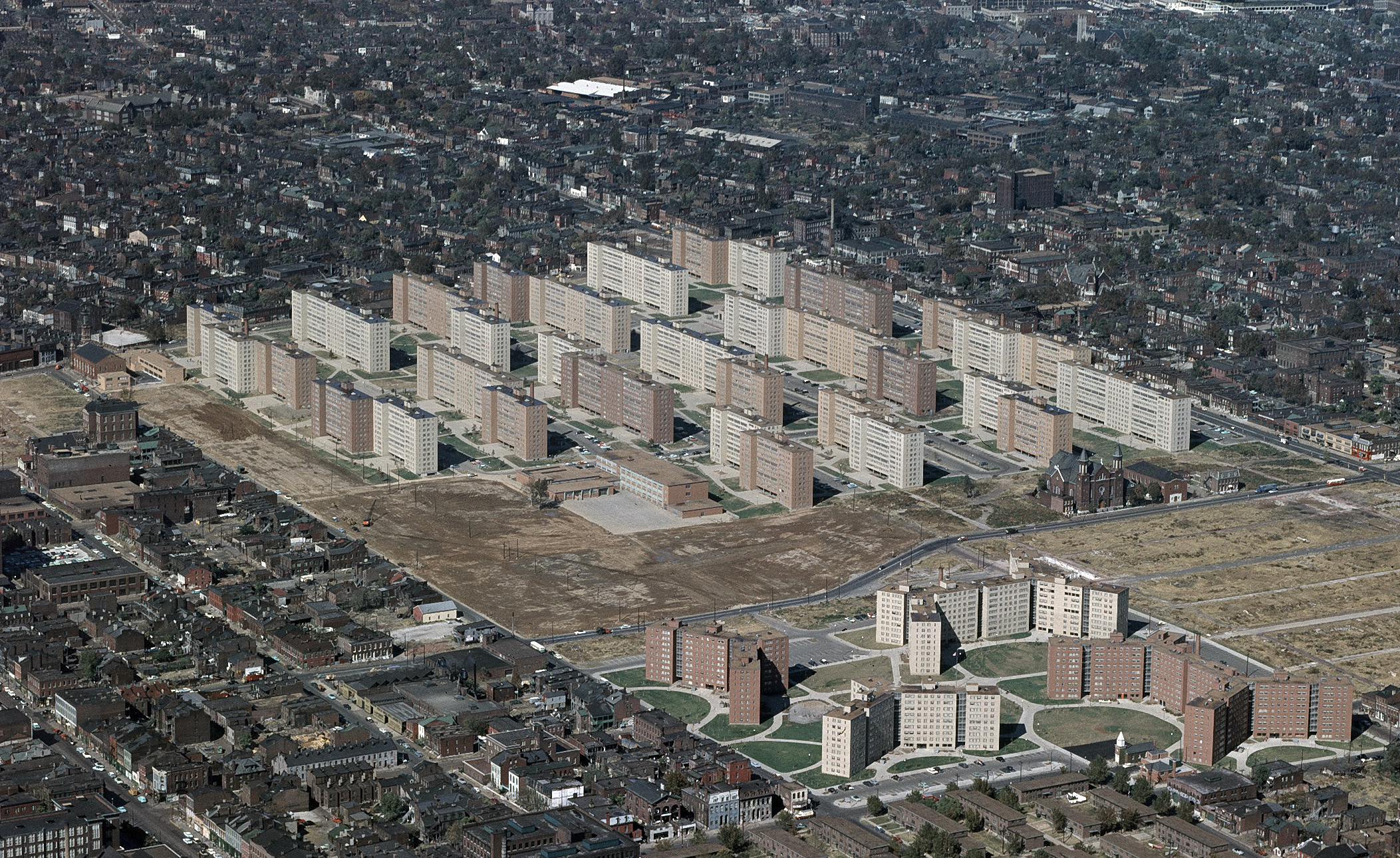
Pruitt–Igoe public housing projects, St. Louis, Missouri, circa 1967. This late-1950s "urban renewal" project was built, but  failed and was razed in the 1970s. (Cadastral via Wikipedia/US Geological Survey). In public domain.

Pruitt–Igoe public housing projects, St. Louis, Missouri, circa 1967. This late-1950s “urban renewal” project was built, but failed and was razed in the 1970s. (Cadastral via Wikipedia/US Geological Survey). In public domain.

That most of these songs come from the period between 1967 and 1974 isn’t an accident. It was the height of the Civil Rights Movement, combined with the Black Power Movement and the “Black is Beautiful” campaign, the beginning of the White backlash against civil rights — including Dr. Martin Luther King, Jr.’s assassination — and the Anti-War Movement was in full swing. It was a good time to take a look at the present and recent past to reconnect with hopes and dreams in the midst of the nightmare of urban poverty.

After ’73 was the beginning of the dance and disco era, as well as a focus on the urban, on crime, on drugs, on poverty  — but not in a “let’s try to solve it” kind of way. This was where rap, hip-hop, some R&B and early forms of what we now call neo-soul picked up, with little reflection on this once prominent past.

Still, there would be some honorable mentions for this migration course, music that could evoke some aspect of the Black migration, of the hope that took a downward turn, of the poverty and joblessness that have permeated America, Black and White and Brown, since the ’70s.

8.  Arrested Development, “Tennessee” (1992).
9. Tina and Ike Turner (and Credence Clearwater Revival), “Proud Mary” (1970).
10. Nina Simone, “The Backlash Blues” (1967).
11. NWA, “Straight Outta Compton” (1989).
12. Tupac, “Cradle 2 the Grave” (1994).
13. John Mellencamp, “Pink Houses” (1983).
14. Bruce Springsteen, “Born In The U.S.A..” (1984). [the song’s release was thirty years ago this month, by the way]
15. Peter Gabriel and Kate Bush, “Don’t Give Up” (1986)

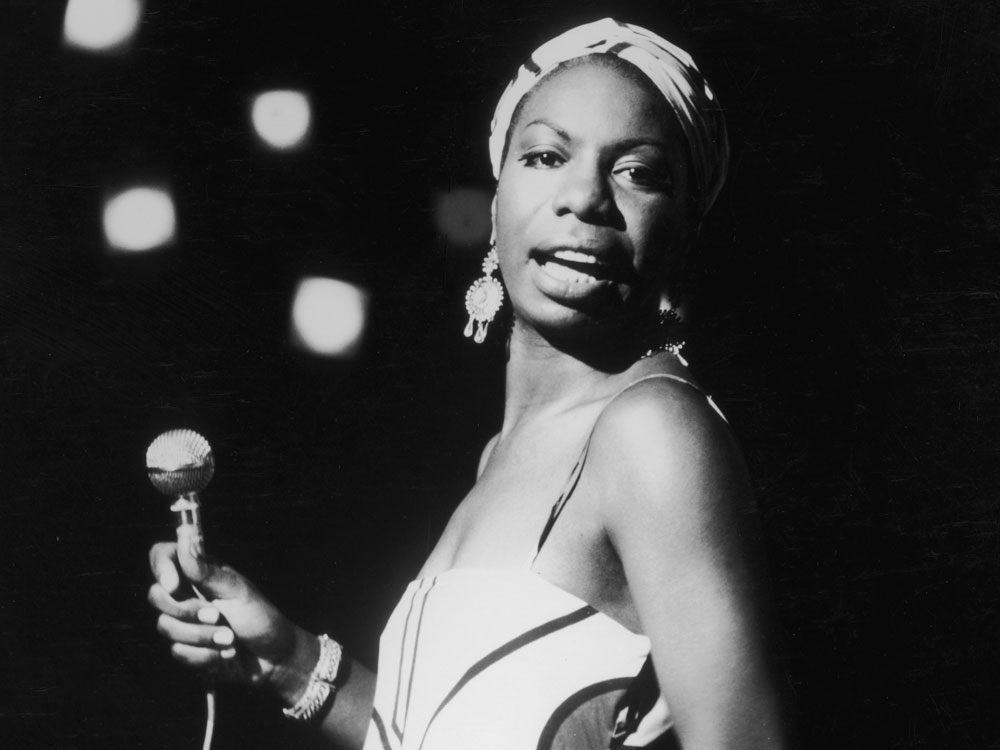
Nina Simone performs at a concert in 1964. (http://npr.org, via Hulton Archive/Stringer/Getty Images).

Nina Simone performs at a concert in 1964. (http://npr.org, via Hulton Archive/Stringer/Getty Images).

Through music, I’d hope to have a course and discussion about Black migration that reaches beyond the words origin and destination, that migration has merely been a physical manifestation of a difficult and seemingly unending cultural and spiritual journey in the US. That Black migration can also easily include the parallel journeys of those of the African or Afro-Caribbean diaspora, not to mention those from Latin America.

For me, though, a course like this would be a personal foray into all the things that have made me who I’ve been for nearly four and a half decades — a person better than the sum of America’s parts and racist, sexist, homophobic and evangelical assumptions.

← Older posts
Newer posts →

Boy @ The Window: A Memoir

Boy @ The Window: A Memoir

Places to Buy/Download Boy @ The Window

There's a few ways in which you can read excerpts of, borrow and/or purchase and download Boy @ The Window. There's the trade paperback edition of Boy @ The Window, available for purchase via Amazon.com at http://www.amazon.com/Boy-Window-Donald-Earl-Collins/dp/0989256138/

There's also a Kindle edition on Amazon.com. The enhanced edition can be read only with Kindle Fire, an iPad or a full-color tablet. The links to the enhanced edition through Apple's iBookstore and the Barnes & Noble NOOK edition are below. The link to the Amazon Kindle version is also immediately below:

scr2555-proj697-a-kindle-logo-rgb-lg

Boy @ The Window on Amazon.com: http://www.amazon.com/Boy-The-Window-Memoir-ebook/dp/B00CD95FBU/

iBookstore-logo-300x100

Boy @ The Window on Apple's iBookstore: https://itunes.apple.com/us/book/boy-the-window/id643768275?ls=1

Barnes & Noble (bn.com) logo, June 26, 2013. (http://www.logotypes101.com).

Boy @ The Window on Barnes & Noble: http://www.barnesandnoble.com/w/boy-the-window-donald-earl-collins/1115182183?ean=2940016741567

You can also add, read and review Boy @ The Window on Goodreads.com. Just click on the button below:

Boy @ The Window

Twitter Updates

Tweets by decollins1969
  • RSS - Posts
  • RSS - Comments

Archives

  • June 2025
  • April 2023
  • September 2022
  • August 2022
  • July 2022
  • June 2022
  • May 2022
  • April 2022
  • March 2022
  • January 2022
  • December 2021
  • November 2021
  • October 2021
  • September 2021
  • August 2021
  • July 2021
  • June 2021
  • April 2021
  • March 2021
  • February 2021
  • January 2021
  • December 2020
  • November 2020
  • October 2020
  • September 2020
  • August 2020
  • July 2020
  • May 2020
  • April 2020
  • March 2020
  • January 2020
  • December 2019
  • November 2019
  • August 2019
  • July 2019
  • June 2019
  • May 2019
  • April 2019
  • March 2019
  • February 2019
  • January 2019
  • December 2018
  • November 2018
  • October 2018
  • September 2018
  • August 2018
  • July 2018
  • June 2018
  • May 2018
  • March 2018
  • February 2018
  • January 2018
  • December 2017
  • November 2017
  • October 2017
  • September 2017
  • August 2017
  • July 2017
  • June 2017
  • May 2017
  • April 2017
  • March 2017
  • February 2017
  • January 2017
  • December 2016
  • November 2016
  • October 2016
  • September 2016
  • August 2016
  • July 2016
  • June 2016
  • May 2016
  • April 2016
  • March 2016
  • February 2016
  • January 2016
  • December 2015
  • November 2015
  • October 2015
  • September 2015
  • August 2015
  • July 2015
  • June 2015
  • May 2015
  • April 2015
  • March 2015
  • February 2015
  • January 2015
  • December 2014
  • November 2014
  • October 2014
  • September 2014
  • August 2014
  • July 2014
  • June 2014
  • May 2014
  • April 2014
  • March 2014
  • February 2014
  • January 2014
  • December 2013
  • November 2013
  • October 2013
  • September 2013
  • August 2013
  • July 2013
  • June 2013
  • May 2013
  • April 2013
  • March 2013
  • February 2013
  • January 2013
  • December 2012
  • November 2012
  • October 2012
  • September 2012
  • August 2012
  • July 2012
  • June 2012
  • May 2012
  • April 2012
  • March 2012
  • February 2012
  • January 2012
  • December 2011
  • November 2011
  • October 2011
  • September 2011
  • August 2011
  • July 2011
  • June 2011
  • May 2011
  • April 2011
  • March 2011
  • February 2011
  • January 2011
  • December 2010
  • November 2010
  • October 2010
  • September 2010
  • August 2010
  • July 2010
  • June 2010
  • May 2010
  • April 2010
  • March 2010
  • February 2010
  • January 2010
  • December 2009
  • November 2009
  • October 2009
  • September 2009
  • August 2009
  • July 2009
  • June 2009
  • May 2009
  • April 2009
  • March 2009
  • February 2009
  • January 2009
  • December 2008
  • November 2008
  • October 2008
  • September 2008
  • August 2008
  • July 2008
  • June 2008
  • May 2008
  • April 2008
  • March 2008
  • February 2008
  • January 2008
  • December 2007
  • November 2007
  • October 2007
  • September 2007
  • August 2007
  • July 2007
  • June 2007

Recent Comments

MaryPena's avatarMaryPena on My Day of Atonement/Bitter Hat…
decollins1969's avatardecollins1969 on No Good Teaching Deed Goes…
Mary Rose O’Connell's avatarMary Rose O’Connell on No Good Teaching Deed Goes…

NetworkedBlogs on Facebook

NetworkedBlogs
Blog:
Notes From a Boy @ The Window
Topics:
My Life, Culture & Education, Politics & Goofyness
 
Follow my blog

616 616 East Lincoln Avenue A.B. Davis Middle School Abuse Academia Academy for Educational Development AED Afrocentricity American Narcissism Authenticity Bigotry Blackness Boy @ The Window Carnegie Mellon University Child Abuse Class of 1987 CMU Coping Strategies Crush #1 Crush #2 Death Disillusionment Diversity Domestic Violence Economic Inequality Education Family Friendship Friendships Graduate School Hebrew-Israelites High-Stakes Testing Higher Education History Homelessness Humanities Humanities Program Hypocrisy Internalized Racism Jealousy Joe Trotter Joe William Trotter Jr. K-12 Education Love Manhood Maurice Eugene Washington Maurice Washington Misogyny Mother-Son Relationship Mount Vernon High School Mount Vernon New York Mount Vernon public schools Multiculturalism MVHS Narcissism NFL Pitt Pittsburgh Politics of Education Poverty President Barack Obama Race Racial Stereotypes Racism Relationships Self-Awareness Self-Discovery Self-Reflection Sexism Social Justice Teaching and Learning University of Pittsburgh Violence Whiteness Writing

Top Rated

Blog at WordPress.com.

  • Subscribe Subscribed
    • Notes from a Boy @ The Window
    • Join 103 other subscribers
    • Already have a WordPress.com account? Log in now.
    • Notes from a Boy @ The Window
    • Subscribe Subscribed
    • Sign up
    • Log in
    • Report this content
    • View site in Reader
    • Manage subscriptions
    • Collapse this bar
 

Loading Comments...