• About Me
  • Other Writings
  • Interview Clips
  • All About Me: American Racism, American Narcissism, and the Conversation America Can’t Have
  • Video Clips
  • Boy @ The Window Pictures
  • Boy @ The Window Theme Music

Notes from a Boy @ The Window

~

Notes from a Boy @ The Window

Category Archives: culture

Racial Privilege Matters Most

26 Sunday Mar 2017

Posted by decollins1969 in 1, culture, Eclectic, Politics, Pop Culture, race, Youth

≈ Leave a comment

Tags

#BlackLivesMatter, #MissingBlackGirls, #MissingDCGirls, #WhiteLivesMatter, Contrast, Girls of Color, Intersectionality, Marginalization, Montgomery County MD, News Coverage, Racial Privilege, Rape, Rockville High School, Trolls, Twitter


World War Z gif of horde climbing a wall (much like the way Americans see immigrants regardless of status), March 26, 2017. (http://reddit.com).

I’m sure I’m not the only one who noticed the stark, sad, and anger-inducing contrast between two events in the past couple of weeks. One involved the alleged rape of a 14-year-old girl by two undocumented immigrants (ages 18 and 17) at Rockville High School. The press gave this incident coverage on a local and national scale. So much so that xenophobic, anti-Latino Twitter trolls got involved.

Screen shot of tweets regarding Rockville High School rape, March 26, 2017. (http://twitter.com)

The proverbial “they” used the arrests as evidence of an immigration form of World War Z, in which angry hordes of the undocumented pour through America’s border with Mexico, raping, pillaging, and drugging up White (and mostly female) innocents. “Build the wall,” “illegals,” and “liberals” all became a cabal of iniquity in the (White) America First camp. What about the 14-year-old girl, the counseling she may need, or security issues at Rockville High School in general? Instead, two almost adult teenagers are a stand-in for immigration policies and 11 million undocumented persons. But what else is new?

On the other end of the spectrum has been the lack of coverage of missing Black and Latina girls in the DC area — in fact, in many parts of the US. So little has been even the local coverage that it took a tweet (one that I retweeted myself) two weeks ago for DC affiliates to pay closer attention.

Screen shot of retweet on 8 missing Black girls in Washngton, DC, March 12, 2017. (Twitter via @BlackMarvelGirl).

National coverage only kicked in when someone erroneously posted on Instagram that 14 Black and Latino girls had gone missing in the DC area in a 24-hour-period. True or not, there was no corresponding outrage over even the mere possibility that girls of color could have been kidnapped, trafficked, raped, or murdered as part of a crime spree. Though the facts of this particular Instagram posting were skewed, there’s no debate or daily concern for what happens to youth of color, especially girls of color, in the US. When confronted with the fact that 37 percent of America’s missing children are Black (Blacks are 12.4 percent of the US population), the excuse has been that most of them are “runaways.” And with that kicks in all kinds of racist and misogynistic assumptions. “The poverty and crime and drugs” got to be too much. “They’ve been exposed to more,” and therefore, can handle being on their own. “They’re sexually promiscuous” anyway, so let them run off with older men.

No one considers the why. In this case, why would these girls run away? Physical and sexual abuse at home, leading to vulnerability outside the home to human trafficking, rape, prostitution, or run-of-the-mill homelessness and poverty. No matter how one looks at this, this should be national news. That is, if America wasn’t primed to see only White kids as innocent.

Which brings me back to Rockville High School. No one knows the identity of the 14-year-old rape victim. But based on the Twitter trolls and the Washington Post comments section, most assume the girl is White. It proves a few things, especially for me as a Montgomery County (MD) resident. One, that my upper middle-class neighbors would turn on me in a second if I met anything approaching a criminal stereotype. For them, I would represent the alleged cultural deficiencies of 44 million other Blacks. Two, that for all their so-called liberal ideology, most White Americans are center-right, no matter where they live. They will turn a tragic incident into a racial or xenophobic referendum on millions of people faster than you can say “white on rice.” Three, only White lives matter and always matter to Whites, especially when put in contrast to the lives of people of color, immigrant or native-born or otherwise.

Show me you’re a liberal by embracing the truth of your own racial privilege. Show me you’re a liberal when you have to risk ostracism from your neighbors about defending the rights of undocumented immigrants as alleged rapists or decrying how the media doesn’t cover missing, exploited, and abused Black and Latina girls. Don’t tell me you’re a liberal, when it’s obvious your racism, sexism, and xenophobia is showing.

From One Starving Writer to Another

19 Sunday Mar 2017

Posted by decollins1969 in 1, Boy @ The Window, culture, Eclectic, Mount Vernon High School, Mount Vernon New York, Pop Culture, University of Pittsburgh, Youth

≈ Leave a comment

Tags

"The Raven", AP English, Columbia, Crush #2, Edgar Allen Poe, MVHS, Phyllis, Poverty, Rosemary Martino, Self-Discovery, Teaching and Learning, The Starving Artist, UMUC, Writing Career


Raven eating a hand (in my case, the writer’s dead hand), March 19, 2017. (creativeuncut.stfi.re via http://pinterest.com).

Six years ago, a student of mine made a reference that very much reminded me of, well, me, the person I was my senior year at Mount Vernon High School. It was as part of a conversation about looking for work. She didn’t want to be another starving artist, living in some basement apartment somewhere, “smearing paint on a canvas” while waiting for a big break. I thought at the time that the idea of a starving artist had all but died out in the era of bling-bling.

But it made me think for a while about the choices I’ve made with my life and career in the years since the middle of my senior year at MVHS. I once said to my AP English teacher Rosemary Martino that I didn’t want to be a starving artist “like Edgar Allen Poe” all those years ago. Now a student had made a similar — although better developed — reference. I think I understood better the momentary look of shock on my former teacher’s face after that conversation.

My student made me think about what Martino saw in my writing so many years ago. I certainly wasn’t focused on it. The same week she commented on making myself into a writer was also the week I had my Ivy League dilemma, between Columbia and the University of Pittsburgh for undergrad. I was waist-deep into my obsession with Phyllis, or really, my obsession with my crush on Phyllis. So much so that I wrote my creative writing assignment for Martino about me and my Crush #2, switching the names to “Donna” and “Phil” to barely cover up the truth of this otherwise short fictional work. Martino returned it without comment. She did comment heavily, though, on my assessment of Henrik Ibsen’s A Doll’s House, a series of redundant paragraphs in search for a coherent sentence.

But my wack “The Way It Is” title was as much an indication that I was as far away from seeing myself as a writer as Earth is for Alpha Centauri without a faster-than-light-speed vehicle. And I was starving on so many levels back then. For food. For attention. For love. For a connection with anything or anyone who didn’t remind me of my poverty. Martino’s encouragement, though she obviously meant well, sent me scurrying in my mind for something a bit more comfortable than Poe’s indebted and untimely death.

My own student’s commentary made me wonder if the quality of my life and career would be better these days if I had embraced the promise Martino saw in my writing back then. I mean, I was already a slightly malnourished six-foot-one and 160-pounder at that point anyway. The inner struggle to put thoughts to paper creatively would’ve been much easier at seventeen than it is as a married forty-seven year-old with a contrarian teenager and bills to pay.

Maybe so. But until Noah or one of his progeny designs a time machine, I can’t rewrite my history in order to make me embrace what I now see as my calling. All I know is that those words I uttered in March ’87 have stayed with me for three decades. The question of finding and following my calling has always been juxtaposed with my need to eat and pay the rent and other bills. How do I do both without dropping one of the balls that I’m juggling?

The issue for more than half of my adult life was finding my calling. Along the way, I spent the summer of ’88 unemployed, the first week of my sophomore year at Pitt homeless and three weeks in May ’91 losing sixteen pounds for lack of food. Not to mention six weeks of unemployment in ’93, walking to Carnegie Mellon many a time in the snow with holes in my sneakers in ’94, and two and a half years of underemployment from December ’96 to June ’99. I was a starving writer long before I saw myself foremost as one. In all, I’ve probably made about $2,500 in direct net income as an author and writer since 2003 (half through Fear of a “Black” America, the other half in the past two years), not counting consultancies or giving talks based on my writing. If I depended on my writing income, I maybe could pay the cable bill or treat us to a night of Cheesecake Factory and a movie. Two or three times a year. When one doesn’t follow their calling and doesn’t follow a typical path to making a buck, the tendency is insufficient funds.

Creative abilities, even genius, may well drive people mad, but most folks in pursuit of their calling aren’t fools. No one, including the starving artist, wants to starve. Some of us, though, have a desire for much more than the ability to get a job, any job, and hold one long enough to see our own kids graduate from college and meet someone they truly love. Even with the responsibilities of adulthood, we shouldn’t give up on our own aspirations, for it’s those things that we reach for (although not at all costs) that will help others — including the most important folks — in our lives pursue their own calling.

Michael Clayton, My Writing, and 20 Years of Sinai-Wandering

16 Thursday Mar 2017

Posted by decollins1969 in 1, Academia, Boy @ The Window, Carnegie Mellon University, culture, Eclectic, Pittsburgh, Pop Culture, race, Religion, University of Pittsburgh, Work, Youth

≈ 2 Comments

Tags

Academia, Academic Writing, CMU, Dan Resnick, Falsehoods, Gene Clayton, George Clooney, Lies, Michael Clayton, Michael Clayton (2007), Mythology, Pitt, Politics of Academia, Publish-or-Perish, Richard J. Altenbaugh, Scholarship, Sean Cullen, Unwritten Rules, Writing, Writing Career


George Clooney and Sean Cullen in Michael Clayton (2007), March 15, 2017. (http://bbc.co.uk).

My favorite scene from Michael Clayton (2007) is when the title character’s brother Gene (played by Sean Cullen) confronts Michael (played by George Clooney) about the past seventeen years of his career as a fixer.

You got these cops thinking you’re a lawyer. You got these lawyers thinking you’re a cop. You got everybody fooled, don’t you? Everybody but you. You know exactly what you are.

About a year and a half ago, I figured I could insert the words “writer” and “scholar” in those lines, with twenty years of my career(s) for context, and maybe some of the meaning would be correct. I am a writer’s version of Michael Clayton. I’ve got academicians thinking I’m a unscholarly writer, and journalists and editors who think I’ve only written for scholarly audiences. What a mess!

Last year, after receiving a rejection for a version of my article about American narcissism, American racism, and why real conversations on race (whether through Clinton’s Race Initiative or via Ferguson) are all but impossible, I decided no more. I will not seek to submit another scholarly piece to a peer-reviewed scholarly journal ever again. And if asked, unless it’s something I truly feel passionate about, I will say no.

Do not think of this as sour grapes. I have published two full-length journal articles in my career, not to mention a bunch of the standard book reviews, and an op-ed for Teachers College Record in the past. Technically, I am 3-for-11 in publishing academic articles over the past two decades, not great, but hardly abysmal.

My issue is with the elitism and implicit bias that is rampant in the publish-or-perish world of academia. While some folks could argue it is the same in publishing in general, it really isn’t. The unwritten rules in publishing, if not followed, may well still lead to published articles, even if a person is starving and homeless in between. In academic publishing, not following the rules leads to ostracism, and a career dead before it ever begins.

Keep in mind, no scholarly journal pays authors for their articles. It takes about two years to go from submission to publication in most history and education journals. If twenty people read your article, that’s icing on a protein-powder cake. If you aren’t in the tenure-stream, though, it really doesn’t matter how many articles you publish, because it doesn’t provide job stability or security. As a former nonprofit administrator, it scared most of my supervisors whenever and wherever I published, so no benefits there either. For those in tenure-stream positions, it does matter, no matter how crappy the research or how densely unreadable the writing.

After twenty years in the publishing struggle, it’s time to face the truth. I simply wasn’t good enough to publish in academic journals. I’m not talking about my writing ability or research skills. I’m pointing out my eclectic career path, my lack of tenure at an elite university, with few to vouch for me when I was younger and an up-and-comer. My interdisciplinary research on race, on multiculturalism, on education, meant that I was a misfit from day one. Heck, I know for sure in at least one case, a journal editor held my race and age against me.

Sinai Desert, where Moses, the Israelites (and I) wandered for a generation, Egypt, March 9, 2010. (Tommy from Arad via Wikipedia). Released to public domain via CC-BY-SA 2.0.

I know most of the academic writing rat-race is a system of exploitation based in part on fears of joblessness, loss of prestige, and elitism based on class, race, gender, and whether one teaches at an elite university or at a community college. It is based on an academician’s ability to blame themselves and themselves alone for their failings, and not the oppressive publishing system itself. Kind of like the poor blaming themselves for their poverty. Or Whites and Blacks blaming other Blacks for a degenerative culture instead of looking at systemic racism as the real culprit for racial inequality. Academia is very much in and of this wider world of social injustice and oppression, no matter how university presidents attempt to spin it.

Truly, I find the idea of a cold, objective, dispassionate, dense writing style as more serious and scholarly than any other form to be high-grade bullshit. It’s what folks in academia tell each other. Just like many a journalist and editor is a frustrated writer looking for creative and book manuscript-length outlets, many a writer in academia believes their writing (and as often as not, their research) to be much more than it is.

But the biggest issue for me was my elitist and naive attempt to straddle the fence between academic publishing and writing for wider audiences. This living in two worlds began for me during my heady days, my grad school years at both the University of Pittsburgh and Carnegie Mellon. Some of my history professors, like Paula Baker, Kate Lynch, and Joe Trotter, all tried with a considerable amount of frustration to get me to write in more scholarly tones. Others seemed to be fine with my writing style. I had a tone that was too “journalistic,” according to my racial paternalistic professor Dan Resnick, who meant it as an insult.

Between 1997 and 2002, I churned out eight full-length pieces (in the 20-35-page-range) on multiculturalism and Black education/history meant for peer-reviewed scholarly journals, four of them between February and December 1997 alone. None of them were ever published. One, an admittedly ambitious state-of-the-subfield piece on multicultural education and its history in American education, elicited a response from the History of Education Quarterly’s editor-in-chief. He was my one-time professor during my first year of graduate school at Pitt, Dick Altenbaugh. Him and his managing editor met with me for nearly an hour and a half in March 1998.

Some of the meeting was about the deficiencies in my article and in my argument. But most of the time was about my writing style, my ambitiousness, and quite frankly, my age and race. I wrote about some of this in Fear of a “Black” America. Apparently, at twenty-eight, I needed to be in my mid-40s to write a grand essay on multicultural education. Allegedly, I needed long-retired (and in one case, dying) White scholars to support my arguments, no matter what evidence I brought to bear. I needed, most of all, to stop being so ambitious about my work, and stick to more objective, run-of-mill, 181-variations-on-a-theme topics in the education field. Like what Karl Marx or John Dewey would have to say about ability grouping.

I gave up on academic publishing in 2002, at least on the topic of Black education/history and multiculturalism. I tried to write articles on everything from social justice movements to the fallacies of the liberal-conservative construct, on education, poverty and mythology of American social mobility, even on intersectionality. Only, I had worked so hard to make myself more of a scholarly writer. So much so that I now had to relearn how to write for more than fifteen people, and really, to write for myself. It took about a year to drop the 40, 50, and 60-word compound sentences, the use of inappropriately complex language, and the mask of dispassionate objectivity in my writing. Ironically, this was also when I published my first scholarly piece, on multicultural conservatism and Derrick Bell’s “Rules of Racial Standing,” in 2003. I also published my first solo op-ed, in the Washington Post, around the same time.

By this time, I saw myself as a recovering academic. I also had some unfinished personal business, around how I got to my mid-thirties, to this place in my life where I had “made it,” sort of, but I hadn’t escaped my past. This was where the story of Boy @ The Window took over, and why I have a memoir and nearly ten years of blog posts.

But because of my nonprofit work on college access and retention, two professors invited me and my team to submit a piece for publication in their journal. It was a four-person piece with me as the primary author (I wrote about 90 percent of it, so there’s that). The original invite was in June 2007, and the article came out in mid-October 2009. I had stopped working for the Academy for Educational Development, and found writing the article like a strait-jacket and a time-gobbler.

Michael Clayton (George Clooney) and a horse, a moment of truth, screen shot and crop, 2007. (http://chud.com).

After Boy @ The Window in 2013, I decided to write articles for a broader audience again. This time, I made the decision to take my memoir-writing experiences and apply them to my writing. I started writing about K-12 and corporate education reform, the problems in higher education, about racism in the Obama era, about poverty and its connections to race, gender, and current issues. And over the past two years, I’ve published more and reached more people than I could ever have done with an award-winning article in the Journal of American History.

So academia, you win. I give up.

A Viable GOP Alternative to Obamacare – But It’ll Never Happen

08 Wednesday Mar 2017

Posted by decollins1969 in 1, culture, Eclectic, Politics, Pop Culture

≈ Leave a comment

Tags

Affordable Care Act, Alternate Universe, American Healthcare Act, GOP Alternative, Obamacare, Plagiarism, Republican Party


Speaker of the House Paul Ryan (R-WI) and GOP leadership with a copy of the American Health Care Act at a news conference, Washington, DC, March 7, 2017. (Chip Somodevilla/Getty Images via http://www.dolphnsix.com/).

Here’s the one and only way the GOP can put together a plausible alternative to the Affordable Care Act, a.k.a., Obamacare. At least, a plan that wouldn’t actually move healthcare left politically and build the path toward universal healthcare, leaving GOP leadership melting in their own clothes.

It’s pretty simple. They should hire a copy editor and a proofreader, ideally, someone who has ghostwritten books for the conservative rich and shameless. House Speaker Paul Ryan should give them a copy of the ACA, and give them three weeks to rewrite it, phrase for phrase, and sentence by sentence. They should replace words like “exchanges” with “alternative swaps,” and “individual mandate” with “personal responsibility.” The editor and proofreader should look out for specific references to coverage for preexisting conditions, the poverty thresholds for qualifying for Medicaid, and coverage of women’s reproductive healthcare costs. The two of them should make a point of burying them into subsections, using the term “other persons” (just like in the US Constitution) or, in the case of women, the female symbol ♀, which few GOP members or their constituents would know.

The biggest issue after a thorough rewriting and review would be how to repackage the old plan as new. This is where Ryan can reach out to retired GOP leadership like John Boehner or Newt Gingrich. They were so good at boiling complex issues down to three words for their conservative and far-right conservative comrades. “Tax-and-spend,” “cap-and-trade,” and “drill, baby, drill,” are among their top 40 hits since the 1980s. With help from the old heads, Ryan can come up with “more-for-less” (really “more or less,” and for Spanish speakers, “mas o menos”) in boiling down the essentials of the new-old bill. The official name of the bill would be the Alternative Healthcare Act, or the AHA. But with 45 as president, it would likely remain either Trumpcare or MAGACare.

The bill would be immensely popular, even with non-Republicans, and would pass Congressional Budget Office muster, not to mention the news media’s. And despite reporting from Rachel Maddow and Chris Hayes at MSNBC, Vice News on HBO, and Mother Jones and The Atlantic, most will not notice that the GOP bill is exactly the same as Obamacare. Certainly not the dunderheads at FOX News or Breitbart.

There’s just one problem. There’s no way Ryan’s oversized ego would allow for this nefarious, new-wine-in-old-wine-skins plan to go forward. Nearly a third of the GOP members in the House just want to repeal Obamacare without providing any replacement at all, not even if it were only for their grandparents, kids, and grandkids. Mostly, the plan would die because someone would leak its details before the copy editor finished word-smithing the first ten pages of the ACA.

Hundreds of alligators at a watering hole, Myakka River State Park, Florida, March 6, 2017. (Lee Dalton via http://www.dailymail.co.uk/).

Bottom line: the GOP is caught between a roiling river full of hungry alligators and a rocky shoreline with a pride of starving lions who cannot believe their luck. The GOP as a party deserves to be eaten for lunch, starting with their guts, and all while being suffocated. And their last thoughts should be, “pain and gain.”

How Libraries Got Me Through

07 Tuesday Mar 2017

Posted by decollins1969 in 1, Academia, Boy @ The Window, Christianity, culture, Eclectic, Hebrew-Israelite, Mount Vernon New York, Pittsburgh, Pop Culture, race, Religion, University of Pittsburgh, Youth

≈ Leave a comment

Tags

Books, Carnegie Library of Pittsburgh, Charles Schulz, Hillman Library, Learning, Libraries, Montgomery County Public Libraries, Mount Vernon Public Library, MVPL, New York Public Library, NYPL, Peanuts, Pitt, Self-Discovery, Transformation


Mount Vernon Public Library’s east entrance, Mount Vernon, NY, July 2, 2016. (http://maps.google.com).

I’ve been enthralled with books since my brother Darren helped me decipher the code of the English language during Christmas ’74. Going to the library for most of my life — especially my growing up years — was always a break from the Grade II bone bruise that my life often seemed to be. I remember the first time my Mom took us to Mount Vernon Public Library, in August ’74. It was only a few blocks from our old place, 48 Adams Street, and about seven blocks from 425 South Sixth. I was too young to get a library card, though, and I started complaining. “May-wa! May-wa!” — that’s what I used to call my Mom (a combination of her name Mary and Mama) — “Why can’t I get a card?,” I cried on my way out the door.

A New Rochelle Public Library card (a close approximation to my first card from 1975), March 1987. (http://flickr.com).

I got my first library card in first grade. It was a class trip, as me and the rest of Ms. Griffin’s class walked to and from Nathan Hale ES to Mount Vernon Public Library. The librarians gave us a tour, during which a thunderstorm erupted. It was sometime in September ’75, a Friday I think. But feeling that small, round-edged MVPL card in my hand with that stamped metal plate on it made my otherwise rainy day. That it had my name typed on it helped as well.

I spend many hours at Mount Vernon Public Library over the years. I needed to. I had so much to learn, more than the 28-volume World Book Encyclopedia set from 1978 could teach me. And certainly more than what my parents and idiot ex-stepfather Maurice knew, much less what they decided not to share. MVPL got me through my spiritual crisis of 1983-84, because I had access to the Qur’an, Torah, and other spiritual texts from which I could make a decision and move on from the cultish Hebrew-Israelites in my family and life. I wouldn’t have considered majoring in history if I hadn’t been able to check out dozens of dusty World War II books between 1980 and 1982. My love for all things Charles Schulz and Peanuts couldn’t have developed without the help of MVPL’s weekly Bookmobile visits at Nathan Hale on Tuesdays or William H. Holmes ES on Wednesdays, usually between 1:30 and 2 pm.

But by the summer of ’80, I began to realize that not all libraries were like the enormity of Mount Vernon’s. Nearby Pelham Library was on the ground floor of Hutchinson Elementary School. It was the size of a small bookstore, with maybe two tables and six chairs to sit in (they didn’t move into their own building until 1995). New Rochelle’s library was 1970s-style modern, with ugly shapes and colors. But both had more air conditioning and bathrooms that didn’t smell or weren’t under repair half the time.

From high school on, I used libraries mostly as a form of escape from my then-idiot stepfather and a gaggle of younger siblings. Or to escape the desperate poverty and chaos that enveloped my life at 616, and to a lesser extent, parts of Mount Vernon and other parts of the New York area. I first got the courage to go into the vastness that was the New York Public Library’s main branch on 42nd and Fifth in the fall of ’84. I infrequently went to White Plains’ public library. At least once between 1984 and 1988, I went to nearly all of the libraries between Wakefield in the Bronx and the various tiny libraries in southern Westchester County. But no library outside of NYPL’s main branch had both the collection and as easy access to the stacks as the one in Mount Vernon.

Carnegie Library of Pittsburgh, Oakland (Main) Branch, front entrance, Pittsburgh, PA, April 5, 2008. (HoboJones via Wikipedia). Released to public domain via CC-BY-SA-3.0.

I had more appreciation for one of the few pleasures offered by my original hometown during my twelve years in Pittsburgh. Within 230 yards of each other were the University of Pittsburgh’s Hillman Library and Carnegie Library of Pittsburgh’s main Oakland branch. If it weren’t for their extensive collections and my alumni status after the spring of ’91, I couldn’t have attended graduate school. Pitt’s policies toward alumni alone saved me $3,000 in book and printing costs, as well as from an additional year of dissertation research. And as many times I could pick up a book, any book, go to the African American Literature section of Hillman, put two lounge chairs together, read, fall asleep, and read some more? The only other thing I could’ve asked for was a blanket and room service!

Since moving to suburban Maryland and DC in ’99, I have been struck by the lack of in libraries around here. Lack of books, lack of extensive interlibrary networks, and a lack of substances over style. The Montgomery County library system had two new ones built in Silver Spring and in Rockville. Each has enough space for a half million volumes, it seems as if their designers built them on the assumption that everyone uses a tablet or an iPhone to read books these days. If it’s nonfiction and a bestseller, they likely don’t have it. Though DC Public Library’s main branch in Gallery Place — the Martin Luther King, Jr. Library — has an extensive collection of DC artifacts and histories, and African American nonfiction and scholarly volumes, patrons cannot borrow these volumes at all. Like the Library of Congress, the MLK library is mostly a museum with books. And by the way, the main branch is now closed for the next three years for modernization, leaving the homeless, researchers, and book lovers like me with even fewer DC area options.

Silver Spring Air & Space Museum, er, Public Library, Silver Spring, MD, June 2016 (http://www.adtekengineers.com/).

Georgetown and Johns Hopkins both have wonderful main libraries with friendly security guards and extra-helpful librarians. But they’re not Hillman. Even as a professor, if I fell asleep in a lounge chair, I’d likely get kicked out. Plus, in our era of smartphones and tablets, most patrons are stuck in social media in between hectic moments for exam cramming and last-minute paper writing. This, though, is still way better than George Washington’s main library, or NYU’s and Columbia’s, for that matter. You can’t walk into either without a form from a staff or faculty member giving you permission to walk through the door.

The building that houses MVPL, built interestingly enough with Andrew Carnegie’s money between 1897 and 1904, is in serious disrepair. The men’s bathroom is nearly always out-of-order, and the collection of Mount Vernon history materials has been closed for years. A friend recently commented on the fact that an older man relieved himself in the snow after leaving the library before going back in to do his whatevers. The money is simply not there to build a brand-new home for one of the largest collections in New York State.

Still, I know how good a library Mount Vernon has. It carries the first three of my former advisor Joe Trotter’s books. I have to go to a university library for that around here. It also has my memoir, and it may have Fear of a “Black” America as well (not so sure about that). I just know that the affluent of Montgomery County have never put that much in resources into the library system I frequent now. I hope and pray that the folks raising the money MVPL so desperately needs for a major renovation, maybe even a new building, are able to meet their goals before my son is old enough to remember when libraries actually held bound books in their collections.

What Do We Tell Them Now?

23 Thursday Feb 2017

Posted by decollins1969 in 1, culture, Eclectic, Patriotism, Politics, Pop Culture, race, Religion, Work

≈ Leave a comment

Tags

45, American Mythology, American Racism, Civic Education, Critical Thinking, Edutainment, High School Students, Hypocrisy, Independent Thinking, Jay Wickliff, Meritocracy, Political Corruption, Presidential Classroom


One version of Presidential Classroom logo, January 27, 2014. (http://congressionalaward.org).

One version of Presidential Classroom logo, January 27, 2014. (http://congressionalaward.org).

In all of my professional work experiences, I’ve had two stints outside of academia and more traditional nonprofit settings in which I worked with high school students. One was during my two summers as a consultant with the Junior Statesmen Foundation, where I co-taught and co-prepared an accelerated version of AP US History for students attending the JSA summer program that Princeton University hosted, in 2008 and 2009. I loved those summers with those students, even though it meant not seeing my family for a few weeks at a time.

The other one was during my time as Director of Curriculum for Presidential Classroom. Presidential Classroom, by the way, was never affiliated with the White House. Nor was it an actual classroom. From 1968 to 2011, it was a civic education program that made money by getting schools and parents to cough off dollars to send their high school kids to Washington, DC for a week. Presidential Classroom’s purpose was for students to learn about how the center of American power works from an up-close-and-personal perspective, to serve as a possible way to inspire teenagers to take up public service as adults. It was so influenced by the exaggerated sense Baby Boomers had of themselves and of their activism that was “the ’60s.”

Except that by the time I came on board as a staff person, those lofty purposes were no longer Presidential Classroom’s raison d’être. Like any small nonprofit, it was trying to make more money and compete successfully in a crowded market. Close Up had caught up with and surpassed the organization ten years before I accepted the position. As my one-time boss reminded our staff of twelve continuously, Close Up cleared 20,000 students through their programs in DC every year, while Presidential Classroom struggled to attract 4,000 students in its programs. The board of directors had decided a few years before my time at Presidential Classroom that the organization’s programming had to be more entertaining, and not just about being on Capitol Hill or asking undersecretaries of state and education cogent policy questions.

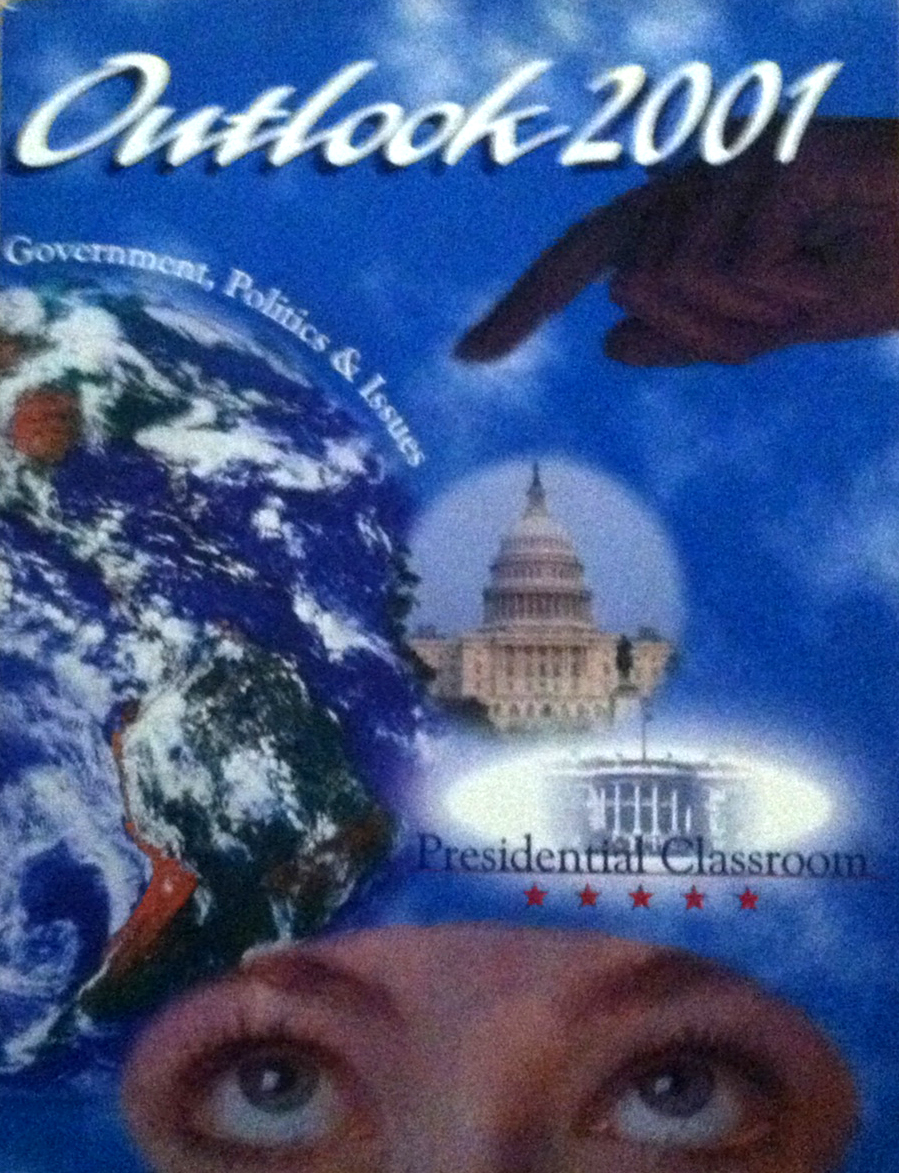
Outlook 2001, my second and last time on the Presidential Classroom annual resource guide, December 1, 2000. (Donald Earl Collins).

Outlook 2001, my second and last time on the Presidential Classroom annual resource guide, December 1, 2000. (Donald Earl Collins).

Across two summer cycles and one winter/spring cycle between June 1999 and December 2000, I worked with high school juniors and seniors as part of what I called “edutainment.” I held up the education end. One of my main jobs before groups of 300-400 students arrived for their week of civic education was to revise the organization’s resource book Outlook. It was my job to cover the various ideological and policy topics of the day using primary and secondary sources in the resource book. Even though the organization only expected me to cover two sides to any policy-based issue or political perspective, I knew that this was too simplistic. I often had three points of view for each topic in the resource book.

It was all to make sure that when the high school students got together to debate each other on immigration reform, reproductive rights, affirmative action, or climate change, they didn’t sound like they just quoted Jack Van Impe or Jimmy Swaggart. It was supposed to help them ask well-thought out questions when meeting with representatives and senators, or during a Q-and-A session with a cabinet member, senior Pentagon official, or an editor from The Washington Post or USA Today.

Unfortunately, what little bit of learning students gained during their week in DC translated into a confirmation of their existing ideas about American politics and civic engagement. Plus, it didn’t help that I was working for Presidential Classroom at the end of President Bill Clinton’s impeachment debacle and throughout the 2000 Presidential Election cycle. Arguments about the articles of impeachment turned into whether Monica Lewinsky seduced Clinton or whether the president used his power to obtain sexual favors from a then-twenty-three year-old intern. Six-year-old Elián González became either a proverbial poster child for “illegals” or a symbol of America’s broken promise as a melting pot. Every White student had a story about their dad or brother being screwed out of a job because of affirmative action, of course without actual evidence.

As for the three branches of government, checks and balances, and the bicameral chamber, or more importantly, the process of how a bill became law, who really cared? The students and some staff were more interested in comedy troupes in Georgetown or attracting more “Orientals” to program than in the distance between how government in DC was supposed to work and the Hill’s sorry-ass reality.

What remains of Presidential Classroom, a broken link on the Miller Center website, February 22, 2017. (Donald Earl Collins).

What remains of Presidential Classroom, a broken link on the Miller Center website, February 22, 2017. (Donald Earl Collins).

As hard and difficult as that job was at the turn of the twenty-first century, it would be impossible now. There’s absolutely no way I could do that Presidential Classroom job in the era of 45. I couldn’t keep a straight face while discussing meritocracy, the distinctions between the Democratic and Republican parties, or in believing that we were really exposing high school juniors and seniors to how Washington actually works. In order to do a proper debate, each group of high school students we had back then would need the full week to just focus on learning how to debate, forget about meeting folks on the Hill or engaging appointees in Q-and-A sessions. We’d have to take away their smartphones and cut off their access to wi-fi and TV to get them to concentrate. Most of all, how could I, how could any of us, have explained the ascendancy of 45 to the presidency without hundreds of center-right parents calling us for weeks afterward complaining about how often we brought American racism to John and Becky’s attention?

If Presidential Classroom existed in 2017, and I found myself unlucky enough to be its executive director, I would forever refocus it away from Capitol Hill. I would have students meet up with policy analysts and lobbyists from K Street, Northwest and the Massachusetts Avenue corridor between D Street, Northeast (the National Republican Committee and the Heritage Foundation) and 18th Street, Northwest (where the American Enterprise Institute, Carnegie Endowment for International Peace, and Johns Hopkins SAIS are located). I would bring in journalists from across the center-right ideological spectrum. But only after I got the so-called liberal ones to admit that their first duty is to sell a story, not objectivity and certainly not truth, and with that, exposing their center-right perspective.

Most of all, I’d show them the rest of DC. The parts of the area that have gentrified in the past twenty years. The parts of Wards 7 and 8 that have concentrated poverty and the ills that result from it. I would introduce them to the nonprofit and social justice organizations that truly give a shit about neighborhood displacement and homelessness, mass incarceration, and political corruption. In all of this, I would want the students to see not only how DC really works, but what good people who care about civic participation and public service must do to put a dent into this out-of-control, money-drenched machine.

My Olivia of Our Future

11 Saturday Feb 2017

Posted by decollins1969 in 1, Academia, culture, Eclectic, High Rise Buildings, New York City, Politics, Pop Culture

≈ Leave a comment

Tags

Allegory, Climate Change, Dystopia, End of Western Civilization, Fringe (2008-13), Future, Jasika Nicole, Narcissism, Olivia, Olivia Pope, Racism


Cropped front cover of Olivia Saves the Circus (1994), by Ian Falconer, February 11, 2017. (http://amazon.com).

Cropped front cover of Olivia Saves the Circus (1994), by Ian Falconer, February 11, 2017. (http://amazon.com).

I’m imagining that the year is 2347. My great-great-great-great granddaughter is Olivia Levy-Collins. She’s in her mid-thirties. After reading my only moderately successful manuscript on the history of American narcissism as a preteen, she becomes interested in the social sciences. A resident of Africa’s southern cone, Olivia does her undergrad at the University of Botswana, double majoring in Archaeology and Ecology. She goes off to the world-renown Universidade de São Paulo (University of São Paulo) in the Brazilian zone, where she earns her master’s degree in Western Civilization (with a focus on 20th and 21st-century American history), and a doctorate in cultural anthropology, with a focus on historical social psychology.

Olivia does her dissertation on the causes of the collapse of the Western world. This is not a new topic in the 24th-century world. Every one of the six billion people on the planet knows the broad story. How, after centuries of dominance, the economic and political structures of Western Europe and the United States underwent long-term decline in the midst of growing economic inequality, continued oppression of already vulnerable groups, undue influence of corporations on governance, and climate change beyond their abilities to comprehend. The proxy wars with terrorism and quasi-nation-states that later led to right-wing revolutions within Europe and the US. The full-blown civil wars and climate degradation that followed.

The US destroyed itself, as anarchists launched a cyberattack that took out the one-time superpower’s entire electrical grid. The groups once known as White supremacists retaliated, and used stolen nuclear weapons on six US cities, including the capital, Washington, DC, to take out the cyberterrorists, most of whom had been rumored to be Arab Muslim and Latina. The riots, famine, starvation, and consequences of climate change ensued, and ensured that the US would not be ever again. Europe also went through many of these convolutions. If it were not for the collective work of scientists in Brazil, India, China, Canada, and Southern Africa to remove the buildup of carbon dioxide and methane gases from the atmosphere and oceans, full-blown nuclear war may have occurred.

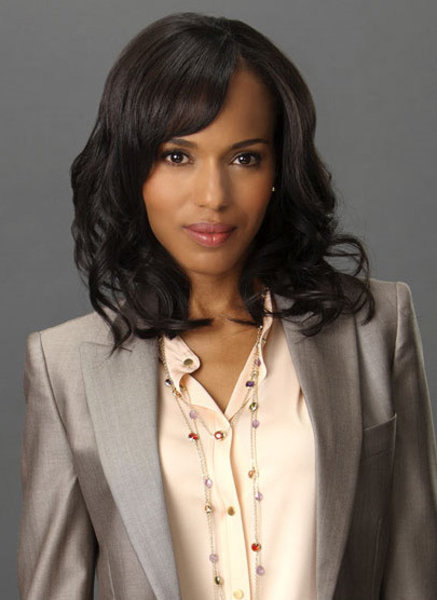
Kerry Washington as Olivia Pope from Scandal, a show about damage control, controlling the narrative, September 15, 2011. (http://scandal.wikia.com).

Kerry Washington as Olivia Pope from Scandal, a show about damage control, controlling the narrative, September 15, 2011. (http://scandal.wikia.com).

Olivia, though, like a new generation of her colleagues, wanted to understand what would cause people from the most powerful nations on the planet to collectively lose their minds. Why would they, after overwhelming success to subdue the earth, then turn on each other to kill the very things that gave them enormous power in the first place? My book from so many generations ago gave Olivia one possible clue. She found my book on the shelf of an ancient library in Walvis Bay, in the country that used to be Namibia. It was part of a school trip that Olivia was a part of while in primary school, to give students an appreciation for ancient attempts to preserve knowledge in depositories for books made of wood pulp, glue, and toner ink. She’d heard about the book from her great-grandmother, who had heard about it from her grandmother. The latter whom had read the book numerous times, as my son had moved his family from the US to South Africa as the occasional American unrests turned deadlier in the mid-21st century.

But, even after that field trip, even after getting her mother to get her a rare electronic copy of my book from the United Nations’ central archives in Aleppo, even after reading it, Olivia didn’t fully believe it. She couldn’t comprehend a culture that would waste vast quantities of natural resources, including human ones. She’s didn’t understand how a society in which everyone thought that becoming wealthy was their birthright could possibly function. She didn’t get how a nation as powerful as the US was always so fragile as an idea, not to mention in actuality.

Olivia’s dissertation work took her to the abandoned city of New York in 2347. With the exception of its crumbling skyscrapers, most of the city was covered by tens of meters of dirt (some of which remained radioactive). Other parts, like the area once known as Wall Street and Battery Park in Manhattan, or Park Slope in Brooklyn, were also partly underwater. She and her fellow group of two-dozen anthropologists, archaeologists, and other scientists, descended on the abandoned city, along with military commandos, all trained to expect the unexpected. In the case of the military, their training included scenarios for exploring exoplanets, which many saw as less dangerous than the exploration of a relatively recently dead civilization.

They went to two sites to conduct their studies. One, the New York Public Library on West 42nd Street and 5th Avenue. The other, two hundred meters away, was this recently excavated place in the old city, something the world once called Times Square. Olivia’s team explored the unearthed library, or at least, what was left of it. Fighting, flooding, dirt, and earth had left the main branch of one of the largest libraries in the Western world a shell of itself. It did have books and other collections still. Mostly self-help books, political memoirs, and recordings of one of the last US presidents, Donald J. Trump.

A partially buried car on Governor's Island, NY, September 13, 2009. (http://scoutingny.com).

A partially buried car on Governor’s Island, NY, September 13, 2009. (http://scoutingny.com).

Olivia, though, unlike her younger counterparts, knew that as self-centered as the remaining collection appeared, it wasn’t the whole story. She knew from my book and from the other books of the 20th and 21st centuries that there were numerous intellectuals and writers who tried to warn the world that the facade of narcissism would lead billions to their deaths. That cannibalizing selfishness could even possibly destroy the world, certainly the Western world.

But she did find it interesting that after the fall of the West, in one of its greatest cities, only the most narcissistic of preserved materials remained. It told her one thing. The narcissism was real, that millions had fallen prey to it. That in an age in which the world didn’t have the technology to use energy-matter converters to replicate food, clothing, shelter, and medicine for 7.3 billion people, millions once lived as if there was no tomorrow, like life was one big party. To the point where these Westerners made significantly more copies of their homages to themselves than they did of anything else.

So Olivia took this knowledge, and the knowledge gained from the Times Square dig. She titled her dissertation, “How Western Civilization Cannibalized Itself: Reproduction, Capitalism, and Narcissism, 1750-2100.” That same year, Olivia turned it into a book, an interplanetary must-read, Runaway Narcissism and How the Sun Set on the Western World. It raised lots of questions about how humanity overcame its own narcissism, but at great cost. It would be one of the great books of the 24th century. That’s my Olivia!

← Older posts
Newer posts →

Boy @ The Window: A Memoir

Boy @ The Window: A Memoir

Places to Buy/Download Boy @ The Window

There's a few ways in which you can read excerpts of, borrow and/or purchase and download Boy @ The Window. There's the trade paperback edition of Boy @ The Window, available for purchase via Amazon.com at http://www.amazon.com/Boy-Window-Donald-Earl-Collins/dp/0989256138/

There's also a Kindle edition on Amazon.com. The enhanced edition can be read only with Kindle Fire, an iPad or a full-color tablet. The links to the enhanced edition through Apple's iBookstore and the Barnes & Noble NOOK edition are below. The link to the Amazon Kindle version is also immediately below:

scr2555-proj697-a-kindle-logo-rgb-lg

Boy @ The Window on Amazon.com: http://www.amazon.com/Boy-The-Window-Memoir-ebook/dp/B00CD95FBU/

iBookstore-logo-300x100

Boy @ The Window on Apple's iBookstore: https://itunes.apple.com/us/book/boy-the-window/id643768275?ls=1

Barnes & Noble (bn.com) logo, June 26, 2013. (http://www.logotypes101.com).

Boy @ The Window on Barnes & Noble: http://www.barnesandnoble.com/w/boy-the-window-donald-earl-collins/1115182183?ean=2940016741567

You can also add, read and review Boy @ The Window on Goodreads.com. Just click on the button below:

Boy @ The Window

Twitter Updates

Tweets by decollins1969
  • RSS - Posts
  • RSS - Comments

Archives

  • June 2025
  • April 2023
  • September 2022
  • August 2022
  • July 2022
  • June 2022
  • May 2022
  • April 2022
  • March 2022
  • January 2022
  • December 2021
  • November 2021
  • October 2021
  • September 2021
  • August 2021
  • July 2021
  • June 2021
  • April 2021
  • March 2021
  • February 2021
  • January 2021
  • December 2020
  • November 2020
  • October 2020
  • September 2020
  • August 2020
  • July 2020
  • May 2020
  • April 2020
  • March 2020
  • January 2020
  • December 2019
  • November 2019
  • August 2019
  • July 2019
  • June 2019
  • May 2019
  • April 2019
  • March 2019
  • February 2019
  • January 2019
  • December 2018
  • November 2018
  • October 2018
  • September 2018
  • August 2018
  • July 2018
  • June 2018
  • May 2018
  • March 2018
  • February 2018
  • January 2018
  • December 2017
  • November 2017
  • October 2017
  • September 2017
  • August 2017
  • July 2017
  • June 2017
  • May 2017
  • April 2017
  • March 2017
  • February 2017
  • January 2017
  • December 2016
  • November 2016
  • October 2016
  • September 2016
  • August 2016
  • July 2016
  • June 2016
  • May 2016
  • April 2016
  • March 2016
  • February 2016
  • January 2016
  • December 2015
  • November 2015
  • October 2015
  • September 2015
  • August 2015
  • July 2015
  • June 2015
  • May 2015
  • April 2015
  • March 2015
  • February 2015
  • January 2015
  • December 2014
  • November 2014
  • October 2014
  • September 2014
  • August 2014
  • July 2014
  • June 2014
  • May 2014
  • April 2014
  • March 2014
  • February 2014
  • January 2014
  • December 2013
  • November 2013
  • October 2013
  • September 2013
  • August 2013
  • July 2013
  • June 2013
  • May 2013
  • April 2013
  • March 2013
  • February 2013
  • January 2013
  • December 2012
  • November 2012
  • October 2012
  • September 2012
  • August 2012
  • July 2012
  • June 2012
  • May 2012
  • April 2012
  • March 2012
  • February 2012
  • January 2012
  • December 2011
  • November 2011
  • October 2011
  • September 2011
  • August 2011
  • July 2011
  • June 2011
  • May 2011
  • April 2011
  • March 2011
  • February 2011
  • January 2011
  • December 2010
  • November 2010
  • October 2010
  • September 2010
  • August 2010
  • July 2010
  • June 2010
  • May 2010
  • April 2010
  • March 2010
  • February 2010
  • January 2010
  • December 2009
  • November 2009
  • October 2009
  • September 2009
  • August 2009
  • July 2009
  • June 2009
  • May 2009
  • April 2009
  • March 2009
  • February 2009
  • January 2009
  • December 2008
  • November 2008
  • October 2008
  • September 2008
  • August 2008
  • July 2008
  • June 2008
  • May 2008
  • April 2008
  • March 2008
  • February 2008
  • January 2008
  • December 2007
  • November 2007
  • October 2007
  • September 2007
  • August 2007
  • July 2007
  • June 2007

Recent Comments

MaryPena's avatarMaryPena on My Day of Atonement/Bitter Hat…
decollins1969's avatardecollins1969 on No Good Teaching Deed Goes…
Mary Rose O’Connell's avatarMary Rose O’Connell on No Good Teaching Deed Goes…

NetworkedBlogs on Facebook

NetworkedBlogs
Blog:
Notes From a Boy @ The Window
Topics:
My Life, Culture & Education, Politics & Goofyness
 
Follow my blog

616 616 East Lincoln Avenue A.B. Davis Middle School Abuse Academia Academy for Educational Development AED Afrocentricity American Narcissism Authenticity Bigotry Blackness Boy @ The Window Carnegie Mellon University Child Abuse Class of 1987 CMU Coping Strategies Crush #1 Crush #2 Death Disillusionment Diversity Domestic Violence Economic Inequality Education Family Friendship Friendships Graduate School Hebrew-Israelites High-Stakes Testing Higher Education History Homelessness Humanities Humanities Program Hypocrisy Internalized Racism Jealousy Joe Trotter Joe William Trotter Jr. K-12 Education Love Manhood Maurice Eugene Washington Maurice Washington Misogyny Mother-Son Relationship Mount Vernon High School Mount Vernon New York Mount Vernon public schools Multiculturalism MVHS Narcissism NFL Pitt Pittsburgh Politics of Education Poverty President Barack Obama Race Racial Stereotypes Racism Relationships Self-Awareness Self-Discovery Self-Reflection Sexism Social Justice Teaching and Learning University of Pittsburgh Violence Whiteness Writing

Top Rated

Blog at WordPress.com.

  • Subscribe Subscribed
    • Notes from a Boy @ The Window
    • Join 103 other subscribers
    • Already have a WordPress.com account? Log in now.
    • Notes from a Boy @ The Window
    • Subscribe Subscribed
    • Sign up
    • Log in
    • Report this content
    • View site in Reader
    • Manage subscriptions
    • Collapse this bar
 

Loading Comments...