• About Me
  • Other Writings
  • Interview Clips
  • All About Me: American Racism, American Narcissism, and the Conversation America Can’t Have
  • Video Clips
  • Boy @ The Window Pictures
  • Boy @ The Window Theme Music

Notes from a Boy @ The Window

~

Notes from a Boy @ The Window

Category Archives: Academia

How Libraries Got Me Through

07 Tuesday Mar 2017

Posted by decollins1969 in 1, Academia, Boy @ The Window, Christianity, culture, Eclectic, Hebrew-Israelite, Mount Vernon New York, Pittsburgh, Pop Culture, race, Religion, University of Pittsburgh, Youth

≈ Leave a comment

Tags

Books, Carnegie Library of Pittsburgh, Charles Schulz, Hillman Library, Learning, Libraries, Montgomery County Public Libraries, Mount Vernon Public Library, MVPL, New York Public Library, NYPL, Peanuts, Pitt, Self-Discovery, Transformation


Mount Vernon Public Library’s east entrance, Mount Vernon, NY, July 2, 2016. (http://maps.google.com).

I’ve been enthralled with books since my brother Darren helped me decipher the code of the English language during Christmas ’74. Going to the library for most of my life — especially my growing up years — was always a break from the Grade II bone bruise that my life often seemed to be. I remember the first time my Mom took us to Mount Vernon Public Library, in August ’74. It was only a few blocks from our old place, 48 Adams Street, and about seven blocks from 425 South Sixth. I was too young to get a library card, though, and I started complaining. “May-wa! May-wa!” — that’s what I used to call my Mom (a combination of her name Mary and Mama) — “Why can’t I get a card?,” I cried on my way out the door.

A New Rochelle Public Library card (a close approximation to my first card from 1975), March 1987. (http://flickr.com).

I got my first library card in first grade. It was a class trip, as me and the rest of Ms. Griffin’s class walked to and from Nathan Hale ES to Mount Vernon Public Library. The librarians gave us a tour, during which a thunderstorm erupted. It was sometime in September ’75, a Friday I think. But feeling that small, round-edged MVPL card in my hand with that stamped metal plate on it made my otherwise rainy day. That it had my name typed on it helped as well.

I spend many hours at Mount Vernon Public Library over the years. I needed to. I had so much to learn, more than the 28-volume World Book Encyclopedia set from 1978 could teach me. And certainly more than what my parents and idiot ex-stepfather Maurice knew, much less what they decided not to share. MVPL got me through my spiritual crisis of 1983-84, because I had access to the Qur’an, Torah, and other spiritual texts from which I could make a decision and move on from the cultish Hebrew-Israelites in my family and life. I wouldn’t have considered majoring in history if I hadn’t been able to check out dozens of dusty World War II books between 1980 and 1982. My love for all things Charles Schulz and Peanuts couldn’t have developed without the help of MVPL’s weekly Bookmobile visits at Nathan Hale on Tuesdays or William H. Holmes ES on Wednesdays, usually between 1:30 and 2 pm.

But by the summer of ’80, I began to realize that not all libraries were like the enormity of Mount Vernon’s. Nearby Pelham Library was on the ground floor of Hutchinson Elementary School. It was the size of a small bookstore, with maybe two tables and six chairs to sit in (they didn’t move into their own building until 1995). New Rochelle’s library was 1970s-style modern, with ugly shapes and colors. But both had more air conditioning and bathrooms that didn’t smell or weren’t under repair half the time.

From high school on, I used libraries mostly as a form of escape from my then-idiot stepfather and a gaggle of younger siblings. Or to escape the desperate poverty and chaos that enveloped my life at 616, and to a lesser extent, parts of Mount Vernon and other parts of the New York area. I first got the courage to go into the vastness that was the New York Public Library’s main branch on 42nd and Fifth in the fall of ’84. I infrequently went to White Plains’ public library. At least once between 1984 and 1988, I went to nearly all of the libraries between Wakefield in the Bronx and the various tiny libraries in southern Westchester County. But no library outside of NYPL’s main branch had both the collection and as easy access to the stacks as the one in Mount Vernon.

Carnegie Library of Pittsburgh, Oakland (Main) Branch, front entrance, Pittsburgh, PA, April 5, 2008. (HoboJones via Wikipedia). Released to public domain via CC-BY-SA-3.0.

I had more appreciation for one of the few pleasures offered by my original hometown during my twelve years in Pittsburgh. Within 230 yards of each other were the University of Pittsburgh’s Hillman Library and Carnegie Library of Pittsburgh’s main Oakland branch. If it weren’t for their extensive collections and my alumni status after the spring of ’91, I couldn’t have attended graduate school. Pitt’s policies toward alumni alone saved me $3,000 in book and printing costs, as well as from an additional year of dissertation research. And as many times I could pick up a book, any book, go to the African American Literature section of Hillman, put two lounge chairs together, read, fall asleep, and read some more? The only other thing I could’ve asked for was a blanket and room service!

Since moving to suburban Maryland and DC in ’99, I have been struck by the lack of in libraries around here. Lack of books, lack of extensive interlibrary networks, and a lack of substances over style. The Montgomery County library system had two new ones built in Silver Spring and in Rockville. Each has enough space for a half million volumes, it seems as if their designers built them on the assumption that everyone uses a tablet or an iPhone to read books these days. If it’s nonfiction and a bestseller, they likely don’t have it. Though DC Public Library’s main branch in Gallery Place — the Martin Luther King, Jr. Library — has an extensive collection of DC artifacts and histories, and African American nonfiction and scholarly volumes, patrons cannot borrow these volumes at all. Like the Library of Congress, the MLK library is mostly a museum with books. And by the way, the main branch is now closed for the next three years for modernization, leaving the homeless, researchers, and book lovers like me with even fewer DC area options.

Silver Spring Air & Space Museum, er, Public Library, Silver Spring, MD, June 2016 (http://www.adtekengineers.com/).

Georgetown and Johns Hopkins both have wonderful main libraries with friendly security guards and extra-helpful librarians. But they’re not Hillman. Even as a professor, if I fell asleep in a lounge chair, I’d likely get kicked out. Plus, in our era of smartphones and tablets, most patrons are stuck in social media in between hectic moments for exam cramming and last-minute paper writing. This, though, is still way better than George Washington’s main library, or NYU’s and Columbia’s, for that matter. You can’t walk into either without a form from a staff or faculty member giving you permission to walk through the door.

The building that houses MVPL, built interestingly enough with Andrew Carnegie’s money between 1897 and 1904, is in serious disrepair. The men’s bathroom is nearly always out-of-order, and the collection of Mount Vernon history materials has been closed for years. A friend recently commented on the fact that an older man relieved himself in the snow after leaving the library before going back in to do his whatevers. The money is simply not there to build a brand-new home for one of the largest collections in New York State.

Still, I know how good a library Mount Vernon has. It carries the first three of my former advisor Joe Trotter’s books. I have to go to a university library for that around here. It also has my memoir, and it may have Fear of a “Black” America as well (not so sure about that). I just know that the affluent of Montgomery County have never put that much in resources into the library system I frequent now. I hope and pray that the folks raising the money MVPL so desperately needs for a major renovation, maybe even a new building, are able to meet their goals before my son is old enough to remember when libraries actually held bound books in their collections.

My Olivia of Our Future

11 Saturday Feb 2017

Posted by decollins1969 in 1, Academia, culture, Eclectic, High Rise Buildings, New York City, Politics, Pop Culture

≈ Leave a comment

Tags

Allegory, Climate Change, Dystopia, End of Western Civilization, Fringe (2008-13), Future, Jasika Nicole, Narcissism, Olivia, Olivia Pope, Racism


Cropped front cover of Olivia Saves the Circus (1994), by Ian Falconer, February 11, 2017. (http://amazon.com).

Cropped front cover of Olivia Saves the Circus (1994), by Ian Falconer, February 11, 2017. (http://amazon.com).

I’m imagining that the year is 2347. My great-great-great-great granddaughter is Olivia Levy-Collins. She’s in her mid-thirties. After reading my only moderately successful manuscript on the history of American narcissism as a preteen, she becomes interested in the social sciences. A resident of Africa’s southern cone, Olivia does her undergrad at the University of Botswana, double majoring in Archaeology and Ecology. She goes off to the world-renown Universidade de São Paulo (University of São Paulo) in the Brazilian zone, where she earns her master’s degree in Western Civilization (with a focus on 20th and 21st-century American history), and a doctorate in cultural anthropology, with a focus on historical social psychology.

Olivia does her dissertation on the causes of the collapse of the Western world. This is not a new topic in the 24th-century world. Every one of the six billion people on the planet knows the broad story. How, after centuries of dominance, the economic and political structures of Western Europe and the United States underwent long-term decline in the midst of growing economic inequality, continued oppression of already vulnerable groups, undue influence of corporations on governance, and climate change beyond their abilities to comprehend. The proxy wars with terrorism and quasi-nation-states that later led to right-wing revolutions within Europe and the US. The full-blown civil wars and climate degradation that followed.

The US destroyed itself, as anarchists launched a cyberattack that took out the one-time superpower’s entire electrical grid. The groups once known as White supremacists retaliated, and used stolen nuclear weapons on six US cities, including the capital, Washington, DC, to take out the cyberterrorists, most of whom had been rumored to be Arab Muslim and Latina. The riots, famine, starvation, and consequences of climate change ensued, and ensured that the US would not be ever again. Europe also went through many of these convolutions. If it were not for the collective work of scientists in Brazil, India, China, Canada, and Southern Africa to remove the buildup of carbon dioxide and methane gases from the atmosphere and oceans, full-blown nuclear war may have occurred.

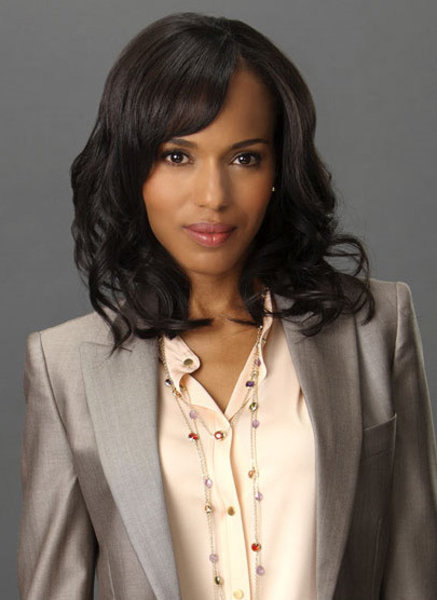
Kerry Washington as Olivia Pope from Scandal, a show about damage control, controlling the narrative, September 15, 2011. (http://scandal.wikia.com).

Kerry Washington as Olivia Pope from Scandal, a show about damage control, controlling the narrative, September 15, 2011. (http://scandal.wikia.com).

Olivia, though, like a new generation of her colleagues, wanted to understand what would cause people from the most powerful nations on the planet to collectively lose their minds. Why would they, after overwhelming success to subdue the earth, then turn on each other to kill the very things that gave them enormous power in the first place? My book from so many generations ago gave Olivia one possible clue. She found my book on the shelf of an ancient library in Walvis Bay, in the country that used to be Namibia. It was part of a school trip that Olivia was a part of while in primary school, to give students an appreciation for ancient attempts to preserve knowledge in depositories for books made of wood pulp, glue, and toner ink. She’d heard about the book from her great-grandmother, who had heard about it from her grandmother. The latter whom had read the book numerous times, as my son had moved his family from the US to South Africa as the occasional American unrests turned deadlier in the mid-21st century.

But, even after that field trip, even after getting her mother to get her a rare electronic copy of my book from the United Nations’ central archives in Aleppo, even after reading it, Olivia didn’t fully believe it. She couldn’t comprehend a culture that would waste vast quantities of natural resources, including human ones. She’s didn’t understand how a society in which everyone thought that becoming wealthy was their birthright could possibly function. She didn’t get how a nation as powerful as the US was always so fragile as an idea, not to mention in actuality.

Olivia’s dissertation work took her to the abandoned city of New York in 2347. With the exception of its crumbling skyscrapers, most of the city was covered by tens of meters of dirt (some of which remained radioactive). Other parts, like the area once known as Wall Street and Battery Park in Manhattan, or Park Slope in Brooklyn, were also partly underwater. She and her fellow group of two-dozen anthropologists, archaeologists, and other scientists, descended on the abandoned city, along with military commandos, all trained to expect the unexpected. In the case of the military, their training included scenarios for exploring exoplanets, which many saw as less dangerous than the exploration of a relatively recently dead civilization.

They went to two sites to conduct their studies. One, the New York Public Library on West 42nd Street and 5th Avenue. The other, two hundred meters away, was this recently excavated place in the old city, something the world once called Times Square. Olivia’s team explored the unearthed library, or at least, what was left of it. Fighting, flooding, dirt, and earth had left the main branch of one of the largest libraries in the Western world a shell of itself. It did have books and other collections still. Mostly self-help books, political memoirs, and recordings of one of the last US presidents, Donald J. Trump.

A partially buried car on Governor's Island, NY, September 13, 2009. (http://scoutingny.com).

A partially buried car on Governor’s Island, NY, September 13, 2009. (http://scoutingny.com).

Olivia, though, unlike her younger counterparts, knew that as self-centered as the remaining collection appeared, it wasn’t the whole story. She knew from my book and from the other books of the 20th and 21st centuries that there were numerous intellectuals and writers who tried to warn the world that the facade of narcissism would lead billions to their deaths. That cannibalizing selfishness could even possibly destroy the world, certainly the Western world.

But she did find it interesting that after the fall of the West, in one of its greatest cities, only the most narcissistic of preserved materials remained. It told her one thing. The narcissism was real, that millions had fallen prey to it. That in an age in which the world didn’t have the technology to use energy-matter converters to replicate food, clothing, shelter, and medicine for 7.3 billion people, millions once lived as if there was no tomorrow, like life was one big party. To the point where these Westerners made significantly more copies of their homages to themselves than they did of anything else.

So Olivia took this knowledge, and the knowledge gained from the Times Square dig. She titled her dissertation, “How Western Civilization Cannibalized Itself: Reproduction, Capitalism, and Narcissism, 1750-2100.” That same year, Olivia turned it into a book, an interplanetary must-read, Runaway Narcissism and How the Sun Set on the Western World. It raised lots of questions about how humanity overcame its own narcissism, but at great cost. It would be one of the great books of the 24th century. That’s my Olivia!

Yes, I’m A Sexist Feminist

27 Tuesday Dec 2016

Posted by decollins1969 in 1, Academia, Boy @ The Window, Christianity, culture, Eclectic, eclectic music, Hebrew-Israelite, High Rise Buildings, Jimme, Marriage, Mount Vernon New York, My Father, Politics, Pop Culture, race, Religion, Youth

≈ Leave a comment

Tags

Black Masculinity, Chivalry, Contradictions, Dahlia, Damsel-in-Distress Syndrome, Father-Son Relationship, Feminism, Masculinity, Misogyny, Mother-Son Relationship, Nice Guy, Owning Imperfection, Patriarchy, Phyllis, Sexism, Womanism


Hostile vs. Benevolent Sexism, March 10, 2015. (http://www.dailymail.co.uk).

Hostile vs. Benevolent Sexism, March 10, 2015. (http://www.dailymail.co.uk).

I finished up a chapter in Boy @ The Window with the closest approximation to my contemporaneous thoughts about Phyllis (a.k.a., “Crush #2” at times on this blog) in August 1988:

screen-shot-2016-12-27-at-7-43-51-am

I must’ve rewritten these two paragraphs at least a half-dozen times before putting the book out for limited consumption. The thought process that I went through at eighteen years old bothered me then, and looking at the words even today leaves me wanting. Probably because there is more than a bit of sexism contained within these words.

But I wasn’t wrong, of course, not in ’88, not when I wrote and rewrote these paragraphs between 2007 and 2011, and not now, at least in terms of how I perceived things then. While I believed in reproductive rights, in equal pay for equal work, and in passing the Equal Rights Amendment growing up, I also believed in saving damsels from distress and in distinguishing between “ladies” and “bitches.” Or, as my father put it when he argued with my Mom in front of me when I was four years old, “You’s a black bit’!” Or, my contradiction could’ve fully formed when my father tried to set me up with a prostitute a couple of weeks before my seventeenth birthday, in December 1986.

There was no way in 1988 I could’ve understood the contradictions between the idea of feminism (in any form) and the notion of “being a nice guy.” I hadn’t been exposed, or, rather, exposed myself to Paula Giddings, Elsa Barkley Brown, Evelyn Brooks Higginbotham, bell hooks, Maya Angelou, Angela Davis, and Zora Neale Hurston. I hadn’t yet been engaged in the hundreds of conversations I’d eventually have with women folk I’d become friends with, people with whom I bonded because of their suffering, people from whom I’d hidden my own suffering during those years. Date rape, physical abuse, the more typical abuse of serial cheating, among other issues. With many of these women, I recognized the sexism and misogyny I saw in myself in 1988, and saw them again when I wrote down my contemporaneous thoughts in Boy @ The Window. It didn’t occur to me until the mid-1990s that women could be just as sexist and misogynistic as men, and often could pass down their notions of masculinity and patriarchy to their children. And that thought scared me.

Imprisoned brain (or, maybe, Culture Club and "Church of the Poison Mind" [1983]), December 27, 2016. (http://mdjunction.com).

Imprisoned brain (or, maybe, Culture Club and “Church of the Poison Mind” [1983]), December 27, 2016. (http://mdjunction.com).

It scared me because I realized I may have learned more of my contradictions from my Mom than from my father or idiot ex-stepfather. After all, she was the one constant in my parenting, the one person who engaged me in ideas like chivalry and manliness, who through her acquiescence to Maurice might have made it okay for me to see women, especially Black women (and to a lesser extent, Latina women) as ones in need of help, even when they decide not to take it.

And it may have made it okay for me to see myself as the victim in my incident with Dahlia in June 1987, when I accidentally (the first time), and later deliberately smacked her on her left butt cheek. Maybe I was the victim in a way, at least of my own deluded thought process. And there hasn’t been a time in the past twenty-nine and a half years in which I haven’t regretted that second, deliberate slap, in response to Dahlia accusing of thoughts I didn’t have, because my only obsession in 1987 was Phyllis. I’ve said and written this before, including in Boy @ The Window. To Dahlia, I am so sorry.

Beijing smog alert, Beijing, China, December 6, 2016. (http://ibtimes.com).

Beijing smog alert, Beijing, China, December 6, 2016. (http://ibtimes.com).

I may never be the perfect intersectional womanist feminist I’ve tried to be since I told my Mom to abort my future (and since deceased) sister in 1982. I still believe that professional women’s tennis players should play best-of-five-set matches at the Gram Slam tournaments. I think more women — particularly White women — should stop calling themselves feminists if their feminism stops when dealing with women of color or poor women in general. I think that most men who aren’t feminists are assholes. But I also know that, just like with racism (as now well noted by Ibram Kendi) and with narcissism (my next project, maybe), sexist ideas are as pervasive as smog in L.A. and Beijing. I don’t have to like it or accept it, but I do have to accept that I am a man, and I will make mistakes, including sexist ones. I will have to own up, and keep trying to do better.

A Story of My Life

24 Thursday Nov 2016

Posted by decollins1969 in 1, Academia, Boy @ The Window, Carnegie Mellon University, Christianity, culture, Eclectic, Pittsburgh, Politics, Pop Culture, race, Religion, University of Pittsburgh, Work, Youth

≈ Leave a comment

Tags

American Exceptionalism, CMU, Doctorate, Giving Thanks, Homelessness, Horatio Nelson Stories, Joe Trotter, Pitt, Ron Slater, Scars, Thanksgiving, Thanksgiving 1988


One of dozen of rags-to-riches falsehoods from Gilded Age author Horatio Nelson (1832-1899). (http://www.pavillionpress.com).

One of dozen of rags-to-riches falsehoods from Gilded Age author Horatio Nelson (1832-1899). (http://www.pavillionpress.com).

That one of the not-so-small miracles of my young adult life from ’88 and me completing my dissertation process in ’96 are just a day apart on the November calendar every year is a story unto itself. Between a month before my nineteen birthday and a month before my twenty-seventh, I went from a semester of homelessness, lack of money for food and rent and living in a firetrap to finishing up a doctorate in history. If this were someone else’s story, I’d think that amazing, even almost unbelievable. At the time, I was so worn out and beat up by Joe Trotter, my dissertation committee, and the scars accumulated over that eight-year — really, twenty-year — period, that the idea of seeing myself as an American example of a Horatio Nelson story would’ve likely made me angry enough to spit blood.

Even now, I don’t and won’t see myself as exceptional. That’s that American bullshit about rags-to-riches stories, about being-a-credit-to-my-race tropes, that I’d be subscribing to here. What I really was back then was young and hungry. So young that I was willing to put up with all kinds of people’s baggage, taking near-minimum wage jobs, allowing people to call me out of my name, excusing racist comments and actions. All because I wanted the brass ring, for myself and for my family. I was already hungry, from years in poverty, from years without friendship bonds, from years of people not recognizing my, dare I say, brilliance. I had a chip on my shoulder, but it wasn’t because I was mad. I was after a righteous reckoning.

Two decades removed from those Carnegie Mellon days, and approaching thirty years since Ron Slater and my band of new friends kept me in money and food during Thanksgiving ’88 and beyond, and I am thankful. I am thankful that I am no longer either of those versions of myself. The one too afraid to ask for help, and the one too naive to realize that the America I believed in for so long never existed. I am thankful that I know more about asking for and providing help, about understanding that in this America, help might never arrive, at least when folks most need it. I am thankful mostly that I still have optimism, I still have drive, and I still have people who like and love me enough to remind me that a few of America’s giga-pixels are worth savoring.

David Wolf, A Teacher I Hope To Never Become

27 Thursday Oct 2016

Posted by decollins1969 in 1, Academia, Boy @ The Window, Carnegie Mellon University, culture, Eclectic, Jimme, Mount Vernon High School, Mount Vernon New York, My Father, New York City, Pop Culture, race, Sports, University of Pittsburgh, Youth

≈ Leave a comment

Tags

1986 World Series, 616, 616 East Lincoln Avenue, AP Physics, Bad Teaching Habits, David Wolf, Escapism, Humanities, Jesse Orosco, Mets, Mother-Son Relationship, MVHS, New York Mets, Senioritis, Teaching and Learning


Film critic Gene Shalit (closest approximation I could find to David Wolf), circa 1980. (http://imdb.com).

Film critic Gene Shalit (closest approximation I could find to David Wolf), circa 1980. (http://imdb.com).

This date was one of the great ones during my Boy @ The Window years. It was a day (and evening) that almost made me forget the role I’d been in since the spring of ’81. One as the sometimes adult male with adult responsibilities on the one hand, and as the nearly ostracized emotional equivalent of a twelve-year-old on the other. But yes, even small miracles (at least in my mind at the time) did happen. The New York Metropolitans, my Mets, won Game 7 of the 1986 World Series thirty years ago on this date 8-5, a biting cold Monday night at the end of October! My Giants beat and beat up the Redskins that same evening 27-24, on their way to a 14-2 record and their first Super Bowl. My underdogs weren’t anymore.

Within three days of that ultimate day of vicarious escapism, the reality of having neglected my studies had sunk in. Or, to be completely honest, the reality of needing much more time to study than I could’ve ever devoted, even without the distractions of senioritis, my Mets and Giants winning or on their way to championships, set in. Because that’s what it would’ve taken for me to have a successful senior year at Mount Vernon High School academically. A greater commitment to AP Physics C, AP English, and AP Calculus AB than my bifurcated life would have allowed. Between four siblings ages two to seven, college applications, and constant errands and chores for my Mom, my weekends of tracking down my father at one watering hole or another, I should’ve gone off to college after my junior year. I should’ve used the summer of ’86 to take gym or something to get the one-quarter credit I needed to graduate.

Instead, here I was with the one teacher who was probably the one most ill-equipped to handle any students other than near-genius devotees to AP Physics. I had David Wolf the year before in high school Physics, so I knew how intolerant he could be toward students who were unprepared, or “just [didn’t] get it.” Or, at least I thought I knew. The week before the Mets’ Game 7 win, Wolf had given us our end-of-marking-period exam on mechanics, and the day after was when we received our exams back with grades. I had the fourth highest score out of seven students, a 22 out of 100. You can look at any grades I’d earned prior to and since this exam in any course between kindergarten and doctorate, and none come close to a 22.

But it obviously wasn’t just me.

David Wolf was another character who was sometimes funny but otherwise sucked as a teacher. It would’ve been hard for me to know what Butler had been like as a teacher when he was happily married. Wolf was a mediocre teacher on his best days because he simply didn’t care if we learned anything in his class. Of course that didn’t make him much different from most of our other teachers. What made Wolf different was the fact that he went out of his way to embarrass students, as if the shock of being outed by him would somehow make us better.

Wolf “taught” us the more difficult AP Physics C version of this Physics course, involving mechanics, electricity and magnetism. It was the equivalent of second semester Physics right from the start, and most of us needed at least a semester of Calculus to keep up with him. Had I known this was Wolf’s plan, I may well have taken my former classmate Laurell’s advice (eight years too late) and switched to AP Biology. Instead, I chose to see this as a new challenge I could take on and will myself through, just like I had in every other difficult class I’d taken up to that point. But after the first two months of the year, it crossed my mind that struggling through this course wasn’t worth it.

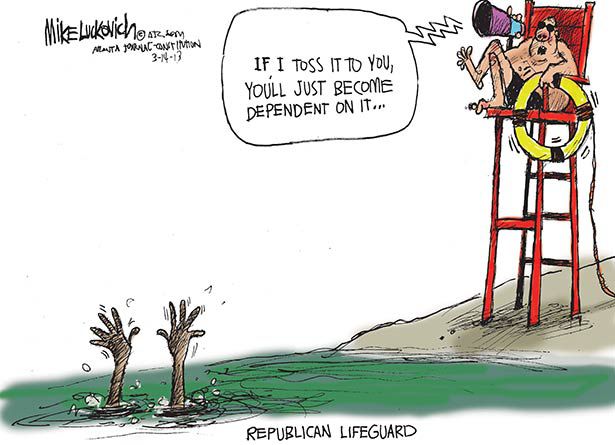
Sink or Swim Republican Lifeguard Cartoon, Mike Luckovich, March 14, 2013. (Luckovich/Atlanta Journal-Constitution; http://luckovich.blog.ajc.com).

Sink or Swim Republican Lifeguard Cartoon, Mike Luckovich, March 14, 2013. (Luckovich/Atlanta Journal-Constitution; http://luckovich.blog.ajc.com).

When I wrote in Boy @ The Window, “Laurell was practically using third-semester Calculus to build the Great Pyramids by comparison,” it was hyperbole, of course. Partly because Egyptian calculus was likely more complicated. And partly because Laurell had done something that I couldn’t do. She had gone to Wolf at the end of eleventh grade and borrowed from him a copy of the AP Physics textbook. She had devoted much of her summer to studying up on AP Physics and AP Calculus BC (once the harder version of AP Calculus) before day one of twelfth grade. So Laurell was going to do well, no matter what. Dozens of hours to study wasn’t sometime I had at chaotic 616, textbook weeks ahead of time or otherwise.

However, me doing well or terribly wasn’t my issue with Wolf. It was his sink-or-swim approach, with no attempt to help struggling students in any way. It was his dickish attitude, where he would literally lean on his stool or against the chalkboard insulting us as we attempted to answer a Physics problem.

Wolf’s class remained the most painful academic experience I’d have in Humanities. Period…Wolf continued to berate and belittle us, wondering, ‘Why are you still here?,’ or exclaiming ‘You decided to show up today!’ On the rare occasions I managed to solve a problem at the chalkboard, he gave me a Bronx cheer, the kind good Yankees fans gave when their team was down ten runs and a Yankee hit a home run to close the gap to nine.

Now, some would say this was good preparation for college. Where? While I certainly have known indifferent professors regarding my own abilities or their distance from other students in general, I’ve only known a few who even threw out the rare bit of sarcasm in the classroom. Plus, for courses like Physics, there were TAs who could walk students through problems better than Khan Academy. Even saying that Wolf was good preparation for graduate school would be a stretch. Quiet exclusion, rather than insults and ostracism, is the rule at the doctoral level. And having an advisor like Wolf would’ve led to blood, and not my own, plain and simple.

After years in the classroom with high school, undergrad, and grad students, I understand that being a professor isn’t the same as being a K-12 teacher. Most of the time, I’m not dealing with parents (except as students), I don’t teach five days a week, and I have the expectation that my students should behave as college students. All the more reason that as I have grown older and more experienced as an educator, the more I’ve found Wolf’s behavior objectionable, even almost unforgivable. In all seriousness, why even show up to teach if your primary form of solace at work is yelling insults at students while standing in the hallway in between class periods?

Academia’s Racist Expectations

13 Thursday Oct 2016

Posted by decollins1969 in 1, Academia, Boy @ The Window, Carnegie Mellon University, culture, Eclectic, Mount Vernon High School, Pittsburgh, Politics, Pop Culture, race, University of Pittsburgh, Youth

≈ Leave a comment

Tags

Academic Job Market, CMU, Daniel P. Resnick, Hardship, Joe William Trotter Jr., Laurence Glasco, Pitt, Racism, Racism in Academia, Richard Oestreicher


The long wall that separates Morningside Park (and Harlem) from Columbia University, New York, circa 2008. (http://Biking-in-Manhattan.com).

The long wall that separates Morningside Park (and Harlem) from Columbia University, New York, circa 2008. (http://Biking-in-Manhattan.com).

I found myself back again. After reading Marybeth Gasman’s follow-up Washington Post article on her findings about academia’s hostility toward faculty diversity and the low expectations of the mostly White and male search committees in hiring faculty of color, I remembered. Seymour Drescher, George Reid Andrews, Van Beck Hall, Richard Smethurst, Dick Oestreicher, Larry Glasco, Paula Baker, Joe Trotter, John Modell, Steve Schlossman, Wendy Goldman, Kate Lynch, Dan Resnick, Bruce Anthony Jones, and Peter Stearns. Everyone on this list was either my advisor, a professor for a graduate course I took while in the history departments at Pitt and Carnegie Mellon, on my dissertation committee, the department chair, or someone I TA’d for between January 1990 (when I was a junior at Pitt) and May 1997. And nearly all of them either had super-high expectations of me — really, weight-of-the-world expectations — or expected me to choke on my own vomit intellectually while in grad school.

It wasn’t as if I hadn’t seen this before. With select folk while in Humanities in middle school or in high school, like Doris Mann in seventh and eighth grade art, Sylvia Fasulo as my guidance counselor while at Mount Vernon High School, and most notably, with David Wolf in AP Physics my senior year (more on him soon). At Pitt, I had an elderly White professor in a constitutional law class who regularly expressed his displeasure over affirmative action in his lectures and gave all four Black students in the course a C+ on every assignment. But generally, if faculty did have low expectations of me because of their racism, it was more of a feeling, a sense that creeped up on me but couldn’t quite grasp, and not obvious because of their statements and actions.

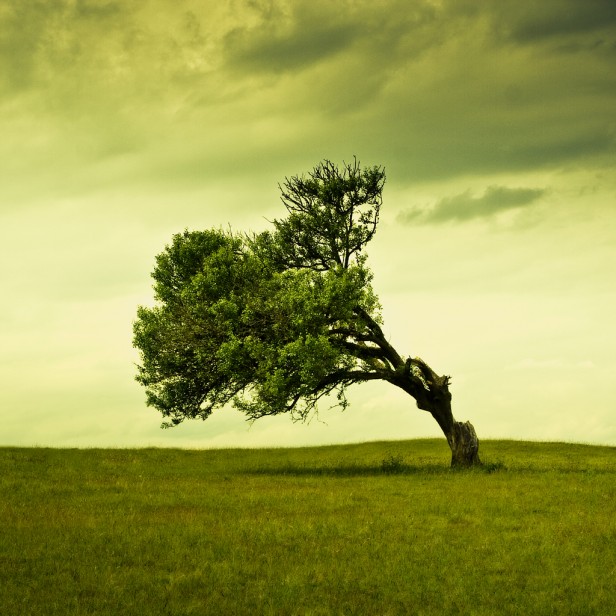
Headwinds, July 2011. (http://forbes.com).

Headwinds, July 2011. (http://forbes.com).

Until I decided to go for an MA in history in 1990. Everything from discouraging statements to half-baked letters of recommendation brought headwinds meant to slam me up against rocky shoals. Professors like Smethurst or Hall who assumed I didn’t work hard enough because I took time to recharge and hang out with friends. A couple like Oestreicher and Resnick who believed that I actually plagiarized material because the quality of my writing was higher than they had seen from a grad student in years. Some like Andrews, who couldn’t believe I was well into my dissertation, much less having made it into another PhD program at all. That doesn’t even count the assumptions about my basketball prowess, or about what I did in my spare time. Nor does it include the overlooking of alternative perspectives on Marxism, on Whiteness, on multiculturalism, on American poverty, on religion, on a host of historical issues I brought to one seminar after another. Because in my spare time, I read more than what was on a syllabus, and given my upbringing, I had already lived a good portion of what the privileged class had only studied.

Add to this the expectations from Baker and Glasco, or Trotter and Jones. All had high expectations of me. So high, in fact, that their expectations were about more than me. It was about what I should or could represent, a graduate student of color who could compete successfully with the so-called geniuses in the field. With Trotter as my dissertation advisor, of course, it became a balancing act between his paranoia born out of his own experiences with graduate school, the job market, and academic racism, and working with me to make me a better scholar. We never had a conversation about why Trotter was the way he was with me, but as I have noted here over the years, Head Negro In Charge syndrome (HNIC) was certainly part of this equation. It’s one thing to meet one’s own high expectations. It’s another when folks who are pulling for you expect you to outperform yourself because of race.

There were so many expectations of me because of my race and relatively young age that I rebelled, mostly unconsciously, my last two years of graduate school at Carnegie Mellon. I wasn’t sure I wanted a professorship of any kind by 1996. But I was so close to being done with the dissertation, with Trotter, and with my mixed-signals dissertation committee. So I finished, and put myself into a job market, hoping that it wasn’t going to be so bad to look for tenure-track positions.

I was wrong, of course. Search committees couldn’t even meet the minimal expectation of at least evaluating my applications based on my qualifications. I interviewed for seven academic jobs between 1997 and 2000 before my first full-time professorship offer from Howard University. In at least three cases — including Tufts and NYU — the search committee chair’s friend was the person whom ended up with the job. With Teacher’s College, who knows? Slippery Rock canceled their search altogether. I didn’t even care to find out what happened with UNC-Charlotte or Colgate. I can say with absolute certainty, based on yawns, stupid questions, racist comments, and strange looks, that racism played a role in the Slippery Rock cancelation, and in my interviews at NYU and Colgate. Those people simply did not want me there, period.

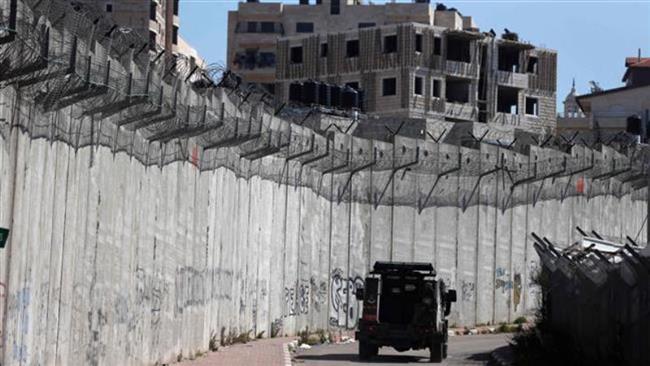
Israeli armored car patrolling barrier wall between it and Palestinian West Bank, June 17, 2016. (http://presstv.ir).

Israeli armored car patrolling barrier wall between it and Palestinian West Bank, June 17, 2016. (http://presstv.ir).

In all, I have applied for 350 academic positions over the past two decades (keep in mind, I applied for 250 of these between 1997 and 2001, and hardly any during my nonprofit work years between 2001 and 2011). Other than adjunct or term faculty work — sometimes, even well-paying positions — going for academic jobs has confirmed my worst expectations of an institution that prides itself on the myths of meritocracy, scholarship, and objectivity. If I had to do it all over again, I would have not pushed myself through two revisions of my dissertation to get this degree. It wasn’t worth the $24,000 in student loans, the thousands of hours of reading boring ass dense writers, all the stupid hypotheses and theories, and the half-assed people I sat in front of in classrooms who claimed the title professor.

That’s how I feel sometimes. But I’ve also had a full slate of courses at my current gig for the past eight years, worked with thousands of high school, undergraduate, and graduate students since 1996, written dozens of recommendation letters, and worked myself into a writer who has dropped nearly all the trappings of academe. Had I not faced the racist failings of academia head-on, I might have bought into this world’s hypocrisies and reproduced them for my students over the years. In this, at least, I can be thankful for academia’s low expectations of me.

No Time For Jealousy

30 Friday Sep 2016

Posted by decollins1969 in 1, Academia, Boy @ The Window, culture, Eclectic, Mount Vernon High School, Mount Vernon New York, My Father, New York City, Politics, Pop Culture, race, University of Pittsburgh, Youth

≈ Leave a comment

Tags

616, 616 East Lincoln Avenue, Class, Coveting, Envy, Erika, General Foods, Humanities, JD, Jealousy, Love Canal, Mother-Son Relationship, Mount Vernon Hospital, MVHS, Smorgasbord, Target, Wendy


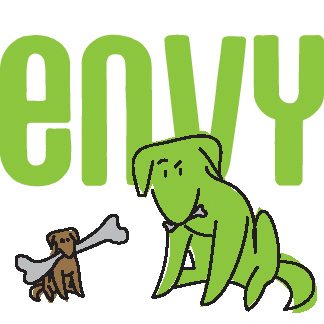
Envy, June 2009. (http://psychologytoday.com).

Envy, June 2009. (http://psychologytoday.com).

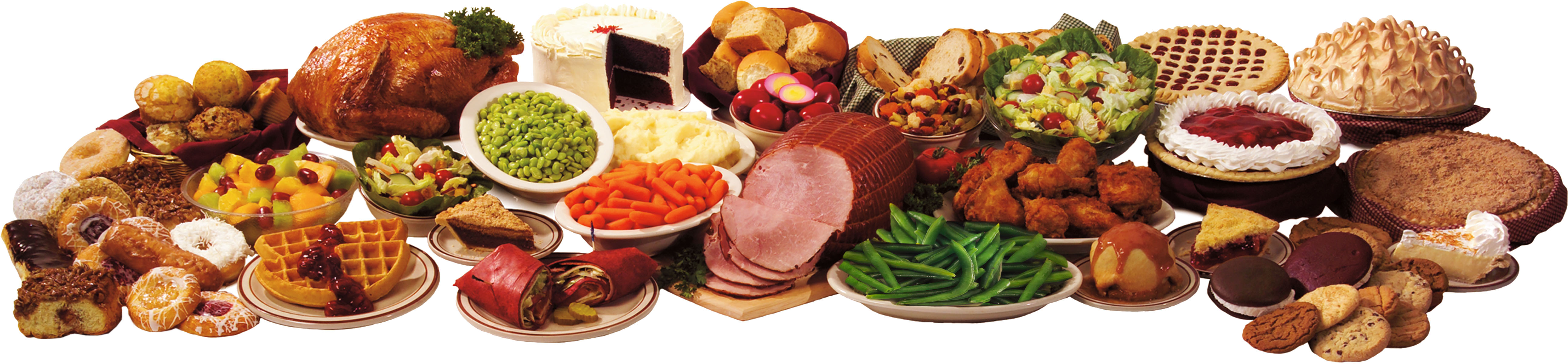
There are some emotions and human actions in which I don’t allow myself to partake. I usually don’t follow the herd. I don’t get caught up in what’s popular at the moment, no matter how many cool people in my life are riding the wave. I don’t build someone up in order to tear them down. And I don’t allow myself more than a flash of envy or jealousy.

Sometimes, these choices are rather easy, like with me having never watched an episode of Scandal or Empire. Sometimes, the choice to not virtually excoriate someone is difficult, given the narcissisms and moralisms that make up American culture. Sometimes, my path less traveled is one that has become easier over time. With jealousy, I’ve learned over the past thirty-five years that it’s a waste of time, neurons, and quantum energy to peer into the lives of those allegedly better off.

But this was hardly an easy process. I had so many reasons to be jealous when I was a preteen and teenager. My middle school and high school Humanities years were ones of constant, albeit momentary, jealousy. I was envious of classmates whose parents made more in a month than my Mom made working all year at Mount Vernon Hospital. I felt envy whenever I saw a classmate chow down on a smorgasbord of a lunch every day, especially on all the days I couldn’t eat because I either didn’t have the money to buy lunch or because the Hebrew-Israelite no-pork rule prevented me from eating the Friday grilled ham and cheese sandwich. Jealousy would come along when I’d see the mini-cliques of former Grimes and Pennington Elementary classmates getting along like the best of friends. Or, when my classmates would come to school wearing the latest and best of ’80s fashion while I walked around in sneakers with holes in the bottoms.

Smorgasbord, from breakfast to dinner, September 2010. (http://web2printexperts.com).

Smorgasbord, from breakfast to dinner, September 2010. (http://web2printexperts.com).

These first bouts with jealousy quickly turned inward toward my own insecurities and inadequacies, and outward toward my parents’ inability to do anything to make my life better materially. For years after the shock of preteen and early adolescent jealousy, I never saw myself as worthy of my classmates, not even worthy enough to befriend someone whose life, though maybe materially blessed, might have been unstable in other areas.

My first realization of seeing myself as being jealous, though, was toward the end of tenth grade at Mount Vernon High School. That’s when my secret first love Wendy and the contrarian one JD had begun to date. I didn’t feel this sense of love or weird emotional trepidation regarding Wendy by the time we were in tenth grade, though. I sensed as early as seventh grade this particular eventuality. No, I was more jealous of the reality that Wendy and JD could connect with each other in a way that I knew for me was beyond my reach. I didn’t really have any friends, so dating would’ve been like building a bridge over the Pacific Ocean by comparison.

But I learned something as well. Because theirs was an interracial relationship, I got a first-row seat to the stares, the whispers, and the occasional ignorant-ass comments from the other high schoolers about them dating. Seeing that, hearing that, made me aware of the fact that jealousy is a dangerous emotion, and give the life of deficits I had to make up, I didn’t have time or gray matter to waste in the matter of woe-is-me-as-outsider in 1985 or in the foreseeable future.

Public Enemy logo (note the crosshairs target), September 30, 2016. (http://twitter.com).

Public Enemy logo (note the crosshairs target), September 30, 2016. (http://twitter.com).

A year later, when I sensed on some level that some of my classmates were actually jealous of me, I balked at the idea. I thought, “I have nothing that anyone should be jealous of.” To me, this was literally true. With some of the cool kids literally laughing at me as I walked by them in the hallways, I couldn’t foresee a situation in which anyone would ever be jealous of me.

And yet I was wrong. My academic success, my fierce insistence to fight isolation by making myself independent of fads, trends, and conventional wisdom, had already made me a target of other’s envy. It wasn’t until the summer after I graduated when a co-worker at my General Foods job, one who was one year behind me at Mount Vernon High School, cut through the psychology for me. Erika cleared up so many things for me about the nature of friendships, relationships, and jealousy. I owe her big time for that, then and now.

Love Canal, suburban community turned EPA Superfund site, circa 1980. (http://buffalonews.com).

Love Canal, suburban community turned EPA Superfund site, circa 1980. (http://buffalonews.com).

Nearly thirty years later, and I am still surprised when I discover that someone is jealous of me. Really, I am. I guess it’s because I operate by the moment-of-envy rule. Meaning that I allow myself to feel jealous, but only for a moment, and remind myself of my own path, my own destination, and the work I must do to get there. After all, I don’t really want someone’s else job, promotion, salary, status, car, or house. That’s their life, and only God truly knows if their life would be one I’d want to have. And then I move on, knowing that the green grass on the other side of the tracks can often obscure the Love Canal underneath. I move on, because there’s always more work to do, for me, my wife, and my son. I move on, because after all these years, that’s all I know how to do.

← Older posts
Newer posts →

Boy @ The Window: A Memoir

Boy @ The Window: A Memoir

Places to Buy/Download Boy @ The Window

There's a few ways in which you can read excerpts of, borrow and/or purchase and download Boy @ The Window. There's the trade paperback edition of Boy @ The Window, available for purchase via Amazon.com at http://www.amazon.com/Boy-Window-Donald-Earl-Collins/dp/0989256138/

There's also a Kindle edition on Amazon.com. The enhanced edition can be read only with Kindle Fire, an iPad or a full-color tablet. The links to the enhanced edition through Apple's iBookstore and the Barnes & Noble NOOK edition are below. The link to the Amazon Kindle version is also immediately below:

scr2555-proj697-a-kindle-logo-rgb-lg

Boy @ The Window on Amazon.com: http://www.amazon.com/Boy-The-Window-Memoir-ebook/dp/B00CD95FBU/

iBookstore-logo-300x100

Boy @ The Window on Apple's iBookstore: https://itunes.apple.com/us/book/boy-the-window/id643768275?ls=1

Barnes & Noble (bn.com) logo, June 26, 2013. (http://www.logotypes101.com).

Boy @ The Window on Barnes & Noble: http://www.barnesandnoble.com/w/boy-the-window-donald-earl-collins/1115182183?ean=2940016741567

You can also add, read and review Boy @ The Window on Goodreads.com. Just click on the button below:

Boy @ The Window

Twitter Updates

Tweets by decollins1969
  • RSS - Posts
  • RSS - Comments

Archives

  • June 2025
  • April 2023
  • September 2022
  • August 2022
  • July 2022
  • June 2022
  • May 2022
  • April 2022
  • March 2022
  • January 2022
  • December 2021
  • November 2021
  • October 2021
  • September 2021
  • August 2021
  • July 2021
  • June 2021
  • April 2021
  • March 2021
  • February 2021
  • January 2021
  • December 2020
  • November 2020
  • October 2020
  • September 2020
  • August 2020
  • July 2020
  • May 2020
  • April 2020
  • March 2020
  • January 2020
  • December 2019
  • November 2019
  • August 2019
  • July 2019
  • June 2019
  • May 2019
  • April 2019
  • March 2019
  • February 2019
  • January 2019
  • December 2018
  • November 2018
  • October 2018
  • September 2018
  • August 2018
  • July 2018
  • June 2018
  • May 2018
  • March 2018
  • February 2018
  • January 2018
  • December 2017
  • November 2017
  • October 2017
  • September 2017
  • August 2017
  • July 2017
  • June 2017
  • May 2017
  • April 2017
  • March 2017
  • February 2017
  • January 2017
  • December 2016
  • November 2016
  • October 2016
  • September 2016
  • August 2016
  • July 2016
  • June 2016
  • May 2016
  • April 2016
  • March 2016
  • February 2016
  • January 2016
  • December 2015
  • November 2015
  • October 2015
  • September 2015
  • August 2015
  • July 2015
  • June 2015
  • May 2015
  • April 2015
  • March 2015
  • February 2015
  • January 2015
  • December 2014
  • November 2014
  • October 2014
  • September 2014
  • August 2014
  • July 2014
  • June 2014
  • May 2014
  • April 2014
  • March 2014
  • February 2014
  • January 2014
  • December 2013
  • November 2013
  • October 2013
  • September 2013
  • August 2013
  • July 2013
  • June 2013
  • May 2013
  • April 2013
  • March 2013
  • February 2013
  • January 2013
  • December 2012
  • November 2012
  • October 2012
  • September 2012
  • August 2012
  • July 2012
  • June 2012
  • May 2012
  • April 2012
  • March 2012
  • February 2012
  • January 2012
  • December 2011
  • November 2011
  • October 2011
  • September 2011
  • August 2011
  • July 2011
  • June 2011
  • May 2011
  • April 2011
  • March 2011
  • February 2011
  • January 2011
  • December 2010
  • November 2010
  • October 2010
  • September 2010
  • August 2010
  • July 2010
  • June 2010
  • May 2010
  • April 2010
  • March 2010
  • February 2010
  • January 2010
  • December 2009
  • November 2009
  • October 2009
  • September 2009
  • August 2009
  • July 2009
  • June 2009
  • May 2009
  • April 2009
  • March 2009
  • February 2009
  • January 2009
  • December 2008
  • November 2008
  • October 2008
  • September 2008
  • August 2008
  • July 2008
  • June 2008
  • May 2008
  • April 2008
  • March 2008
  • February 2008
  • January 2008
  • December 2007
  • November 2007
  • October 2007
  • September 2007
  • August 2007
  • July 2007
  • June 2007

Recent Comments

MaryPena's avatarMaryPena on My Day of Atonement/Bitter Hat…
decollins1969's avatardecollins1969 on No Good Teaching Deed Goes…
Mary Rose O’Connell's avatarMary Rose O’Connell on No Good Teaching Deed Goes…

NetworkedBlogs on Facebook

NetworkedBlogs
Blog:
Notes From a Boy @ The Window
Topics:
My Life, Culture & Education, Politics & Goofyness
 
Follow my blog

616 616 East Lincoln Avenue A.B. Davis Middle School Abuse Academia Academy for Educational Development AED Afrocentricity American Narcissism Authenticity Bigotry Blackness Boy @ The Window Carnegie Mellon University Child Abuse Class of 1987 CMU Coping Strategies Crush #1 Crush #2 Death Disillusionment Diversity Domestic Violence Economic Inequality Education Family Friendship Friendships Graduate School Hebrew-Israelites High-Stakes Testing Higher Education History Homelessness Humanities Humanities Program Hypocrisy Internalized Racism Jealousy Joe Trotter Joe William Trotter Jr. K-12 Education Love Manhood Maurice Eugene Washington Maurice Washington Misogyny Mother-Son Relationship Mount Vernon High School Mount Vernon New York Mount Vernon public schools Multiculturalism MVHS Narcissism NFL Pitt Pittsburgh Politics of Education Poverty President Barack Obama Race Racial Stereotypes Racism Relationships Self-Awareness Self-Discovery Self-Reflection Sexism Social Justice Teaching and Learning University of Pittsburgh Violence Whiteness Writing

Top Rated

Blog at WordPress.com.

  • Subscribe Subscribed
    • Notes from a Boy @ The Window
    • Join 103 other subscribers
    • Already have a WordPress.com account? Log in now.
    • Notes from a Boy @ The Window
    • Subscribe Subscribed
    • Sign up
    • Log in
    • Report this content
    • View site in Reader
    • Manage subscriptions
    • Collapse this bar
 

Loading Comments...