• About Me
  • Other Writings
  • Interview Clips
  • All About Me: American Racism, American Narcissism, and the Conversation America Can’t Have
  • Video Clips
  • Boy @ The Window Pictures
  • Boy @ The Window Theme Music

Notes from a Boy @ The Window

~

Notes from a Boy @ The Window

Tag Archives: Diversity

James and the PAGPSA

29 Thursday Nov 2012

Posted by decollins1969 in 1, Academia, Boy @ The Window, culture, Eclectic, eclectic music, Hebrew-Israelite, Politics, Pop Culture, race, Religion, Youth

≈ 1 Comment

Tags

Activism, Afrocentric, Afrocentricity, Authentic Blackness, Black Action Society, Campus Climate, Carnegie Mellon University, Community, Diversity, Friendships, Graduate School, GSPIA, Isolation, PAGPSA, Pan African Graduate and Professional Student Association, Pitt, Pittsburgh, Politics of Graduate School, Retention, Self-Discovery, University of Pittsburgh


James and the Giant Peach photo art (1996), November 29, 2012. (http://disneymania.com.br).

About this time twenty years ago, perhaps for the first time in my life, I found myself around like-minded individuals, folks who seemed to understand me on an intellectual level. The fact that these were fellow graduate students, all at Pitt and all willing to form an association that would enable us to develop real connections across the campus, was inspiring to me. After four years of off-and-on involvement in the Black Action Society, not to mention my first year in the History grad program, I’d almost given up on the idea that I could form good friendships and acquaintance-ships through any formal gatherings.

But this was especially true regarding my thinking about my fellow Black students and other students of color. For the most part, I’d been around two kinds of students of color during my first five years at the University of Pittsburgh. One group was the semi-nerdy set, folks who cared deeply about their academic performance, but were also late-bloomers socially — people like me in more than a few ways. They tended to care little, though, about campus activism around diversity, retention or campus climate issues.

The other group was the Afrocentric set, people who often reminded me of my one-time Hebrew-Israelite brethren, whose views of Blackness were so limiting that I would’ve been a traitor just for listening to Chicago or Phil Collins. Those folks had virtually taken over the Black Action Society by my senior year. Forget mentioning popular folks, like sorors, frat guys, football, basketball and track guys and gals, or those fully invested in Pitt’s Honors College. I mingled with them all, and found little in common with them, intellectually or economically.
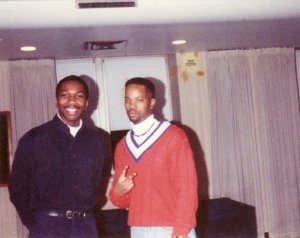
Me with Mark James, PAGPSA meeting, GSPH building, University of Pittsburgh, February 26, 1993 (Lois Nembhard).

That changed a bit my first year of grad school. Often in my walking and running across campus, I’d bump into a Black grad student here or there. At Hillman Library, the Cathedral of Learning, William Pitt Union, the SLIS building or other places. We’d recognize each other, we said hello, we even exchanged our names. Two of them in particular — Ed and Hayley — reached out to me at the end of the Spring ’92 semester, because they wanted to put together an organization that would represent our interests as grad students of color.

In mid-August, the emails began to go back and forth in earnest to establish what we’d end up calling the Pan African Graduate and Professional Student Association (PAGPSA) that fall. Through Jack Daniel’s office (see my post “The Miracle of Dr. Jack Daniel” from May ’11), we obtained the start-up funds necessary to make the new association go.

At our founding meeting that September, there were eight of us, all highly motivated to be as inclusive as possible, all feeling suddenly less isolated than we had felt a week, month or semester earlier. We decided on the “Pan African” part of the association’s name because we wanted to welcome as many graduate students of color as possible, particularly African and Afro-Caribbean students. The terms “Black” and “African American,” we agreed, wouldn’t be inclusive enough.

We also decided that despite the political implications of our new name, that this association would primarily be about bringing students together for social gatherings, for additional information and education beyond their course work and dissertations, but not to be campus activists. So many of the Black, African and Afro-Caribbean grad students at Pitt were in fact working on master’s or other professional degrees, and wouldn’t be on campus long enough to make lasting changes through activism, strictly speaking. Plus, there was the risk that activism would be so all-consuming — especially on issues like campus climate, long-term support for research and retention rates — that folks would fail to complete the work they came to Pitt to do in the first place.
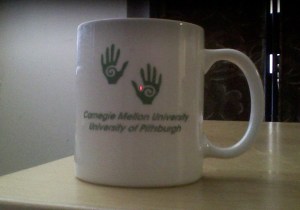
CMU-Pitt mug, from joint PAGPSA/BGSO meeting on diversity and grad school, October 1992, November 29, 2012. (Donald Earl Collins).

By the time that first meeting broke up, I was content to have met folks like Mark, Hayley, Lois, Errol, Ed, and a couple of others, to find us all on the same page about something as serious as starting a new association of a significant cross-section of Pitt’s graduate students of color. But in the process, I’d made a new friend that fall through our meetings and our joint gatherings with Carnegie Mellon’s Black Graduate Student Organization (BGSO).

James came along and challenged PAGPSA in October and November regarding our campus activism stance, arguing that being a part of any organization of students of color meant being active. Of course the leadership disagreed, but that’s how I met the man. He was a charismatic Black Iowan preacher’s son, and more politically active than anyone I’d known under the age of thirty. James had ideas about everything, from the future of hip-hop to the implications of my research on multiculturalism and Black Washington, DC.

Though he was a GSPIA (Graduate School of Public and International Affairs) master’s student and ultimately finished his degree in ’94, we would remain friends through the rest of the ’90s. Between him and Matt (see my post “My Friend Matt” from September) and PAGPSA, I remained grounded even as I became buried in the minutia of US, African American and educational policy historiography over the next half-decade. Thankfully, I no longer felt like a lone wolf. Thankfully, I knew that I wasn’t alone in a sea of graduate school and faculty White maleness after that fall.


In-Abel-ed

10 Sunday Jun 2012

Posted by decollins1969 in 1, Academia, Boy @ The Window, culture, Eclectic, Mount Vernon High School, Mount Vernon New York, Politics, Pop Culture, race, Youth

≈ Leave a comment

Tags

Being Black, Black Teachers, Blackness, Class of '87, Class of 1987, Diversity, Estelle Abel, Harold Meltzer, HBCUs, Intelligence, Lessons, Mentoring, MVHS, Oreo Cookies, Race, Teaching, Un-Black, Uncle Ruckus


“Murder of Cain by Abel,” Ghent Altarpiece painting (1432), Jan van Eyck, January 6, 2007. (Paunaro via Wikipedia). In public domain.

I’ve written about the infamous Estelle Abel in my blog on this date (or at least, this time of year) for each of the previous five years (see “My Last Day,” “The Last Class,” “AP Exam Blues,” “Honors Coronation,” and “Twenty Years in a Week” for the full scoop). She was the chair of Mount Vernon High School’s Science Department while I was a student there, and remain so for years afterward.

As anyone should be able to tell from my previous posts on Abel, I have a bit of an ax to grind. More like a samurai sword, actually. The woman and her ten or fifteen minutes of berating me as both a student and as an un-Black young adult Black male ruined my last day of high school. Forgive me, then, for not being completely objective when it comes to the subject of Estelle Abel and her methods of teaching, motivation, and guidance on issues of academic achievement and race.

Though I’ve also forgiven her, I’m not God, and with my memory, I can hardly forget. But if there had been any chance at forgetting, I lost that opportunity in a conversation I had with my late AP US History teacher Harold Meltzer back in the ’89-’90 school year. Estelle Abel came up as a topic because of something that had occurred with one of his AP students. Apparently, this particular student, a female basketball player, had made the decision to apply to some predominantly White institutions, and had left HBCUs off her application plate. And apparently, Abel had gone after this student for doing so, all but calling her a traitor to her race by taking the route that a majority of traditional African American students have been taking since the ’70s.

Two Oreo Cookies, February 7, 2011. (Evan-Amos via Wikipedia). In public domain.

In all, it took Meltzer about twenty minutes to tell what would’ve been a five or seven-minute-story for the long-winded. That’s how much he could meander in the forests of his stories sometimes. Then I told Meltzer my Estelle Abel story from my last day of school. It sparked a conversation that I wasn’t quite prepared to have. One not only about Estelle Abel, but about the African American faculty at Mount Vernon High School in general.

For most of the rest of the conversation, Meltzer was in full gossip mode, telling me things about individual teachers that I shouldn’t have known, and mostly have forgotten, thankfully. But I did say to him early on in this part of the conversation that I really didn’t know much about the Black teachers at MVHS. The reason was simple. I didn’t have a single Black teacher as my teacher in four years of high school. Humanities classes — particularly the Level 0 and Level 1 classes — had few, if any, Black teachers, much less any teachers of color.

I didn’t say that exactly, but it was the essence of what I said and thought about while Meltzer yammered on about the disunity among MVHS teachers. To think that from Ms. Simmons’ math class in seventh grade at A.B. Davis Middle School until my history and Black Studies classes my junior year at Pitt, I’d gone without a single African American teacher or professor. I knew that some of the blame fell squarely on the shoulders of my guidance counselor Sylvia Fasulo, Humanities coordinators, MVHS’ leadership and the Italian Civic Association.

But how much of this was my fault, being so myopically focused on grades, college and getting away from 616 and Mount Vernon, I didn’t know. After all, I learned in the middle of my senior year that Dr. Spruill taught a Black history class, that there had been efforts to bring in more Black teachers and other teachers of color at Mount Vernon High School dating back at least four years.

Uncle Ruckus screenshot, from Aaron McGruder’s animated TV series The Boondocks, July 4, 2011. (Grapesoda22 via Wikipedia). Qualifies as fair use under US Copyright laws because of picture’s low resolution.

Still, none of that really mattered to me that year. I had already and unsuccessfully attempted to thread the needle between a cushy senior year and a year that prepared me for the rigors of college. Anything else, whether it was Black history, a trip to West Africa or a visit to some HBCU campuses, was hardly on my radar.

Whatever my lack of focus could be construed as in ’86-’87, it wasn’t because I wasn’t Black enough, or ashamed of being Black, as folks like Estelle Abel implied or accused me of in their thoughts and words, and with their eyeballs that year. Sure, I was weird, and readily admit to being weird, aloof, and emotionless in my MVHS days. But given the hell that I lived with at home and in that community in my last years in Mount Vernon, weirdness and a focus on getting out through college should’ve been applauded, or at least tolerated, without teachers like Abel staring at me as if I was demon-possessed.

That it wasn’t tolerated was the real shame. It took me years to get over it, that uncomfortability of being judged by other Blacks as too smart, too weird, too un-Black in their eyes for my own good.

Diversity Isn’t As Simple As Reaching Out To HBCUs

25 Wednesday Apr 2012

Posted by decollins1969 in 1, Academia, Boy @ The Window, culture, Eclectic, Politics, race, Work, Youth

≈ Leave a comment

Tags

Academy for Educational Development, Admissions, Black Students, Carnegie Mellon University, Center for American Progress, Diversity, Diversity Solutions, Enrollement, Graduation, HBCUs, Hiring Process, Historically Black Colleges and Universities, Latino Students, Montgomery County MD, Montgomery County Public Schools, Panacea, Predominantly White Institutions, PWIs, STEM Fields, Tokenism, University of Pittsburgh, White House Initiative on Historically Black Colleges and Universities


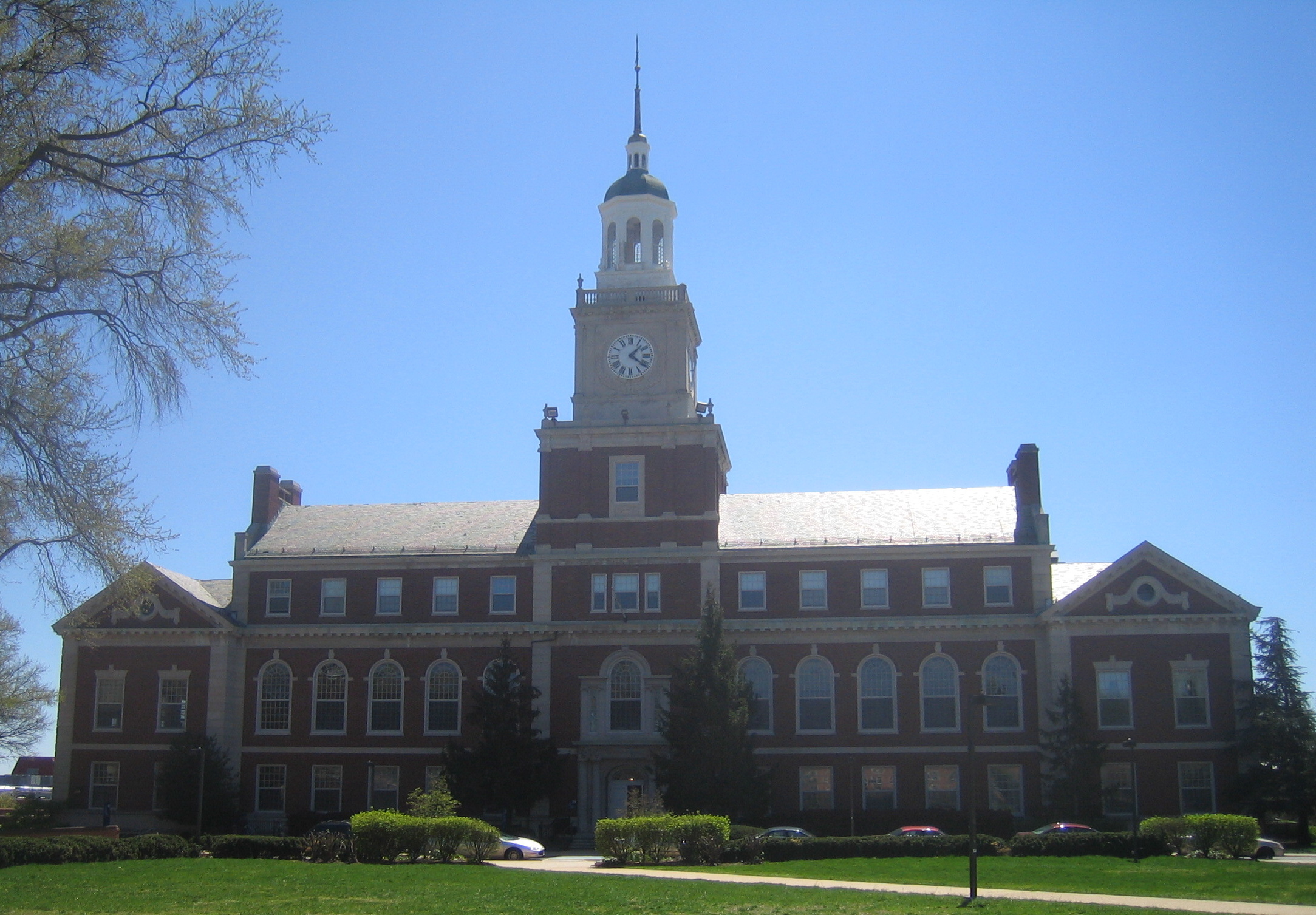
Founders Library, Howard University, Washington, DC, April 9, 2006. (David Monack via Wikipedia). Released to public domain.

There were many things that made me want to holler during my graduate school days two decades ago. One of them was constantly hearing that there were no students or faculty of color to be found because no one Black or Brown was qualified, or “in the pipeline,” or interested in this field or that field. I’d hear this at meetings on Pitt’s campus, at meetings on Carnegie Mellon’s campus, at conferences like the American Education Research Association’s annual meeting, at other academic conferences and settings.

Thank goodness those days are over. Now most of us realize there’s a few folks Black and Latino to find in almost every career option. But a new excuse for lack of diversity in higher education and on the job front has come up in meetings, at conferences, and in conversations, at least in terms of solutions. In job interviews, at local meetings regarding Montgomery County Public Schools, at Center for American Progress conferences on K-12 reform, at my previous jobs with the Academy for Educational Development and in other settings. The way to solve the diversity problem seems to come down to one prescriptive. “We need to reach out to HBCUs.”

So, it all comes down to the 110 or so Historically Black Colleges and Universities to solve the lack of diversity problem facing K-12 education, higher education, STEM careers, social justice nonprofits, public service, civic education, journalism, international development and foreign service, among other sectors? Really? Statistics over the past twenty years have shown that about twenty percent of all African American undergraduate students attend HBCUs. Statistics also show that about eleven percent of all Blacks who complete a four-year degree do so at a HBCU. According to the latest data from the US Department of Education (in conjunction with the White House Initiative on Historically Black Colleges and Universities), nearly 30,000 Blacks graduated with either a two-year or four-year degree from an HBCU in 2011.

The interesting thing about this initiative is that it has existed in some form or another since President Jimmy Carter signed the original executive order creating it in 1980, with every president contributing to it or strengthening it since then. This White House initiative has always been about helping HBCUs build their capacities for admitting, enrolling and graduating more African American students. Yet there’s a huge snag around the capacity of HBCUs to meet the goal to bring the number of undergraduate degrees produced on par with the overall 2020 goal of making the US the number one producer of college graduates again. It would mean that HBCUs would be responsible for graduating 166,713 students a year by 2020.

Besides the reality that this is a near-impossible goal for most HBCUs– most lack the resources necessary

Old New York City Subway token, phased out (like notion of token Black ought to be), May 30, 2005. (Jessamyn West via Wikipedia). Released to public domain.

to admit and enroll so many students — there’s a couple of trends being ignored by the worlds of work and academia. HBCUs aren’t some untapped resource that folks at predominantly White institutions and in various fields suddenly discovered in the late-1990s and the ’00s. HBCU graduates have been working in all of these fields that have lacked diversity in terms of demographics and ideas for years.

With only eleven percent of all Black graduates, few, if any, fields will benefit from the one-shot solution they hope HBCUs will provide. Unless the goal of a school district, a social justice organization or a business is only to hire one, a ’70s-era goal in the 2010s that’s hardly worth a sentence of my time.

The other trend is the overall trend of the kinds of higher institutions African Americans attend. About half of all Black undergraduates — traditional students, adult learners and first-generation students — enroll at two-year schools, community colleges and for-profit institutions (the last a black hole if one’s expecting students to actually graduate). Which means that about thirty percent of all African American students — about 600,000 in all — attend predominantly White four-year institutions.

It’s not as if folks in leading positions propose that to increase the number of Latinos in certain fields, the answer would somehow lie in the couple of dozen Hispanic-Serving Institutions (HSIs), right? Or that to bring more women into the STEM fields, that a singular strategy would involve outreach to Sarah Lawrence, Spelman, Bryn Mawr, and Vassar? At least one would hope not.

It seems that a multi-pronged approach to addressing diversity issues for a school district, a technical field, the nonprofit sector or academia needs to be in order. One that starts much earlier, like in elementary school. One that doesn’t treat Black students at predominantly White institutions as a foregone conclusion, and HBCUs as a panacea.

But somehow, I’ll find myself at another meeting in the near future, hearing from some leader or official about their efforts to address diversity by contacting HBCUs as their one and only solution. A conversation that I find myself dreading more and more.

My First Vacation, Valedictorian Included

10 Saturday Mar 2012

Posted by decollins1969 in 1, Academia, Boy @ The Window, High Rise Buildings, Mount Vernon High School, Mount Vernon New York, Politics, race

≈ 3 Comments

Tags

Arlington Virginia, Class of '87, Class of 1987, Diversity, Family, Friendship, Georgetown University, Humanities, Metrorail, Mount Vernon New York, MVHS, Pitt, Pittsburgh, Spring Break, Suitland High School, University of Pittsburgh, Vacation, Valedictorian


Ballston high-rise (on right), Arlington, VA, where I stayed with "V" and her roommate during first DC area visit, June 26, 2008. (http://therealestatedirt.com).

I’ve lived in the DC area now for nearly thirteen years, but it was this time two decades ago that I came to the DC area for the first time. This was my first vacation ever as an adult, and the first time I’d gone on a vacation of any kind since my mother took me and my older brother Darren on a day trip to Amish country in Pennsylvania at the end of third grade, in June ’78. The visit had as many layers to it as a Vidalia onion, as it involved my past, present and future, and all at once.

At the center of my visit was spending time with my Humanities classmate and friend “V,” the valedictorian of Mount Vernon High School’s Class of ’87. I crashed at her and her roommate’s place in the Ballston section of Arlington, Virginia for a week during my spring break in March ’92. As I said in a previous post (see my “A Friendship Changing Lanes” post from October ’11), I’m not sure how our acquaintanceship ever became a friendship. Somewhere between having circumstances in which our fathers weren’t around consistently, or at least being able to relate to Billy Joel, or both of us scoring “5”s on the AP US History exam.

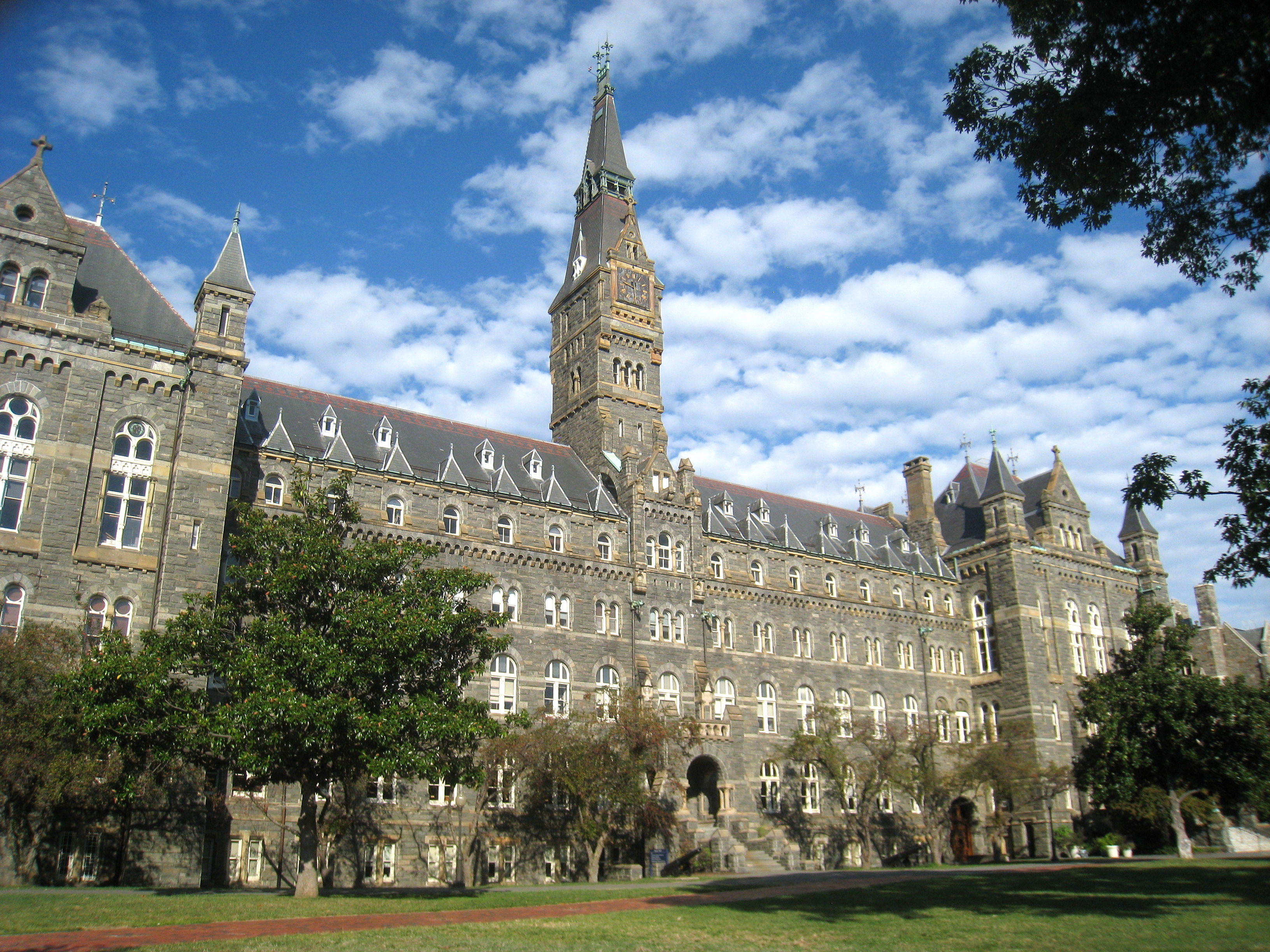
Healey Hall (front gate perspective), Georgetown University, Washington, DC, September 19, 2010. (Daderot via Wikipedia). In public domain.

The fact that we went our respective ways, to Pitt and Johns Hopkins, helped. The fact that we wrote each other about some of our social triumphs and challenges helped more. Most importantly, it helped a lot that we both were more honest about our family troubles. Everything from my mother’s need to divorce my idiot ex-stepfather and the issues with my younger siblings to V’s mother’s health issues and her struggling with burnout trying to watch over her family while going to school. So, by the time I began my second semester of grad school, we’d become fairly close.

I hadn’t seen V since the day before New Years Eve ’88, the last Friday of that year. I hadn’t planned to visit V at the start of the year, but by the middle of February, I needed a break from Pitt and graduate school (see my “Paula Baker and The 4.0 Aftermath” post from January ’12). As I knew that I was two months away from finishing my master’s, I had begun to check out some alternatives to doing my history PhD at Pitt.

Key Bridge, connecting Georgetown area with Rosslyn section of Arlington, VA, at sunset (picture taken from west), September 18, 2008. (Jersey JJ via Flickr.com). In public domain.

Through Dr. Transatlantic Studies himself, Marcus Rediker — he was a Georgetown University history professor who somehow had been given an empty office in Pitt’s history department — I made arrangements to do some informational interviews at Georgetown during my early March spring break.

As soon as I told V of my opportunity to check out Georgetown, she offered me a place to stay for the week. I made arrangements through a couple of friends driving to Virginia to have them drop me at V’s that first Saturday in March.

The trip was a whole series of firsts and seconds for me. I rode Metrorail for the first time, went to Capitol Hill for the first time, and visited Howard University for the first time. I also spent one full day hanging out with V at Suitland High School in Prince George’s County, Maryland, where she was a first-year math teacher. Other than a couple of rowdy students, V was a very good teacher, and not just for a rookie.

My meeting at Georgetown went pretty well also. I managed to get a sweatshirt out of the deal, one that I still wear to this day. Aside from that, finding out from a then second-year grad student (and now and associate professor in African American history at Georgetown) that his annual stipend was only $7,500 a year in expensive DC made my decision for me. I decided that despite the name recognition, Georgetown wouldn’t be where I’d earn a PhD.

I also visited with V’s sister and mother toward the end of that week. V’s sister was in the process of transferring to Goucher, a far cry from the rising high school freshman I’d last seen a week before my freshman year at the University of Pittsburgh. V’s mother seemed happier in Virginia than in New York, but medically speaking, she had gotten worse since ’87. Her speech was slower and more slurred, and her upper body motions were even more limited than I last remembered. It was a reminder that as much as things had gone well for V over the years, she also faced the intense pressure of trying to care for a slowing dying mother and her sister, and all at twenty-two years old.

What I came away with from that week as my friends picked me up the following Saturday afternoon were two things. One, that I really liked being in an area with great diversity, with Whites, Blacks, Latinos and Asians from all walks of life, but without the rude chaos and energy that was and remains New York. Two, that V and I had truly become friends, as adults in our twenties, mostly unattached from how we saw each other when we were in Humanities and high school.

Musical ‘Mates and Matters

24 Saturday Dec 2011

Posted by decollins1969 in 1, Boy @ The Window, culture, earth, wind & fire, Eclectic, eclectic music, Mount Vernon High School, Mount Vernon New York, music, New York City, Pop Culture, race, Youth

≈ Leave a comment

Tags

Common Language, Cultural Divide, Cultural Eclectic-ness, Diversity, Eclectic Music, Mount Vernon High School, Mount Vernon New York, Mount Vernon public schools, Music, Musical Tastes, Race


The "A" Note, February 5, 2008. (Pearson Scott Foresman, via Wikipedia). In public domain.

If someone asked me what was the one thing that me and my classmates had in common during my middle school and high school years in Mount Vernon, New York, it would be a love of and for music. I wouldn’t have been able to draw this rather obvious conclusion five years ago. But, in the course of interviewing folks and writing and rewriting my Boy @ The Window manuscript since ’06, music seems to be the one common denominator that connected us all.

Take the fact that so many of my Class of ’87 classmates found their way into the underground or mainstream music scene over the past twenty-four years. At least one was a producer, a bunch rapped, played, sang, and danced their way into the industry, even if they’re not household names. Others did studio work, and at least two are doing music/sound work for the small and big screen.

These folks are Black, White, Afro-Caribbean and Latino, so, no, race doesn’t seem to be a factor. Was it something that was in the water or in Mount Vernon’s lead water pipes? Not likely. It really couldn’t have been instilled in us by Humanities, or going to Davis, Nichols or Mount Vernon High School, right? The official doctrine of the powers that were would’ve made our favorite music somewhere between Sinatra and Tchaikovsky.

It could be as simple and as complicated as the times we grew up in, the fellow travelers to which we were

Culture Club "Club Sandwich Tour" poster, September 27, 2011. (Wikipedia). Qualifies as fair use under US Copyright laws because of low resolution and subject of blog post.

exposed, the constant noise that was Mount Vernon public schools in the 1970s and 1980s. Living in a city in the early stages of decline, within shouting distance of Manhattan and a short walk to the Bronx. Having the level of Black and Brown diversity that we had, with a decent sized White minority in the school system, may be all that was needed to create the conditions for music to be our one common language.

It wasn’t just in my class, as the classes of ’85 and ’86 turned out the late Heavy D and Al B. Sure. Nor was it just in Mount Vernon’s public schools. There was something about Mount Vernon itself, a painful place for some, a cool and pleasureful one for others, that made music both a code for coolness and an escape from reality.

For my specific groups of Humanities nerds, renaissance folks and generally sharp classmates, though, the tastes ranged and even mingled. For the guidos and guidettes whom I labeled “The Italian Club,” the music was decidedly “White.” From “A” serenading 7S with The Police’s “Roxanne” ala Eddie Murphy, to the frequent blaring of Billy Idol, Bruce Springsteen and Foreigner from turbo-charged Camaros and Mustangs.

The Time promotional poster, circa 1990, July 6, 2006. (Mista Tee, via Wikipedia). Qualifies as fair use under US Copyright laws because of low resolution and subject matter for blog post.

Then the was the obviously cool Black and Afro-Caribbean, with a clique for every occasion, whose music was also obviously “Black.” Teena Marie, pre-“Material Girl” Madonna, Phyllis Hyman, Prince, Luther Vandross, Doug E. Fresh, Lisa Lisa & Cult Jam, Run-DMC, if it was Black and cool, they listened to it, and knew the exact date the new album would hit the stores. They drove around in their Nissan Maximas, Audis and old Cadillacs with this mesh of R&B, early rap and hip-hop, and crossover pop pumping out of their tinted windows.

Of course, that left the rest of us, the few who seemed to like a bit of everything. Crush #1 and Depeche Mode. Brandie Weston and her clique’s love of Boy George and Culture Club. V’s commitment to Billy Joel, at least a decade and a half too young to understand the full meaning of what we’d now call adult contemporary. Not to mention The Police, Sting, The Who, Rolling Stones, Thompson Twins, Duran Duran, ABC, Tears for Fears, a-ha, and so many others. But it didn’t stop there. For we, too, liked Luther, and Billy Idol, and John Coltrane, and Lisa Lisa, and Run.

I don’t know if my musical tastes were the most eclectic of all, or if mine remain so. But I can say this. I ran 4.75 miles yesterday, listening to Genesis’ “Tonight, Tonight, Tonight” (album version), Sounds of Blackness’ “Optimistic,” U2’s “Beautiful Day,” Grover Washington Jr’s “Summer Chill,” Stevie Wonder’s “As,” Sting’s “A Thousand Years,” and Enigma’s “Silence Must Be Heard” along the way. It seems that I’ve always had a song in my head and theme music in my heart for every situation and every period of my life. For better and for worse, I have to give Mount Vernon credit for that, if for nothing else.

Humanities: First Contact, Full Circle

09 Friday Sep 2011

Posted by decollins1969 in 1, Academia, Boy @ The Window, culture, Eclectic, Hebrew-Israelite, Mount Vernon New York, New York City, Patriotism, Politics, Pop Culture, race, Religion, Youth

≈ Leave a comment

Tags

616, 616 East Lincoln Avenue, 7S, 9/11, A.B. Davis Middle School, American Arrogance, Arrogance, Creme de la Creme, Cultural Divide, Diversity, Elistism, First Contact, Gifted Track, Hebrew-Israelite, Humanities, Humanities Program, Hyper-Patriotism, Middle School, Mount Vernon New York, Mount Vernon public schools, Naivete, Patriotism, Preteen, Racial Strife, Racial Undercurrents


Creme Anglaise in a pitcher next to a ladle, the closest thing I could find to represent my foodie image of "creme de la creme," the mantra of Humanities administrators during my six years of travails, September 9, 2011. (Source/http://recipetips.com).

It’s been thirty years exactly since I made the most horrible set of first impressions in my forty-one years of life. My first day of seventh grade at A.B. Davis Middle School in Mount Vernon, New York was also my first day in the Humanities Program, a magnet program for the gifted track (and also the way the powers that were decided to desegregate the school district in ’76).

But it was so much more than that, for better and certainly for worse, at least for me. It was the flip side of a coin that represented the worst six years of my life (the coin’s other side being my life at 616 with what can only be loosely called my family). But it was also the six years of my life that made the past three decades of success, struggle, more success, and more struggles possible.

Humanities: First Contact, Lessons

Humanities: First Contact, Lessons

After putting together Boy @ The Window — in which a large measure of text was devoted to what occurred with and around me during my time in Humanities, one question still remains. Did my time in Humanities, with my classmates, teachers, counselors and principals have to be as difficult as they were — and not just for me? There’s no real way to answer that question, because “of course” is a cold and callous answer, while “of course not” belies the important psychological changes that made me a better thinker, student, writer and person as a result. But if I could, I’d build a time machine, jump into my eleven-year-old version of myself, and make sure to have my dumb ass take my kufi off for my first day of school in 7S. At least then, I would’ve been normal-weird, instead of standoff-ish weird.

My main problem, though, was that I arrogantly believed I was the smartest person in the world. I paid dearly for having that kind of naiveté, to the point where certain classmates still see me as that idiotic preteen, and refuse to see me any other kind of way. Too bad for them, for I know I’ve long since changed.

That day, at least for the past decade, has also reminded me of another beautifully warm, powder-blue sky day that turned tragic. With two days before we reach ten years since 9/11, I think about the way I used to be, and see so many similarities to how we see ourselves as a nation. “We’re #1,” we love to say, even though we’ve long since stopped being #1 in so many respects. We have the largest economy and military, the largest debt, make the largest contribution to climate change and pollution, and complain the most about how the rest of the world isn’t like us.

Like me three decades ago, America is naive and arrogant. And unfortunately, it faces competitors — some as unfeeling as my more entitled or more unscrupulous classmates — who are clobbering us in education, economic growth, health care, social welfare, even in protecting their citizens and their citizen’s freedoms. It’s sad, because there are millions of people now experiencing the severe fall into poverty — and all of the pressures that places on marriages, parenting and children — that I faced, very unsuccessfully at first, thirty years ago.

Humanities: Full Circle, Thoughts

Humanities: Full Circle, Thoughts

I’ve come full circle. Between the struggle to find a home for Boy @ The Window and my struggle to continue to do meaningful work as a writer and educator, I find that even on my worst days, my best days thirty years ago were a thousand times worse.  My first contact with academic competition, Whiteness and diversity, racial strife, religious differences and straight-up elitism is what has given me a greater appreciation for who I’ve become since that sunny day so many years ago. As well as how much I’ve gained.

When Being An American Equals Never Having to Say Sorry

08 Friday Jul 2011

Posted by decollins1969 in 1, Academia, Boy @ The Window, culture, Eclectic, Mount Vernon High School, Politics, race, Religion

≈ Leave a comment

Tags

"Another E", A Curriculum of Inclusion, Academia, Afrocentricity, Arthur Schlesinger Jr., Asa Hilliard III, Blackness, Commissioner's Task Force on Minorities: Equity and Excellence, Cultural Pluralism, Culture Wars, Davis Middle School, Diane Ravitch, Diversity, Ethnic Studies, Ethnicity, Humanities, Humanities Program, K-12 Curriculum, K-12 Educaiton, Leonard Jeffries, Mount Vernon High School, Multicultural Education, Multiculturalism, New York State Department of Education, Race, University of Pittsburgh, Whiteness, Writing


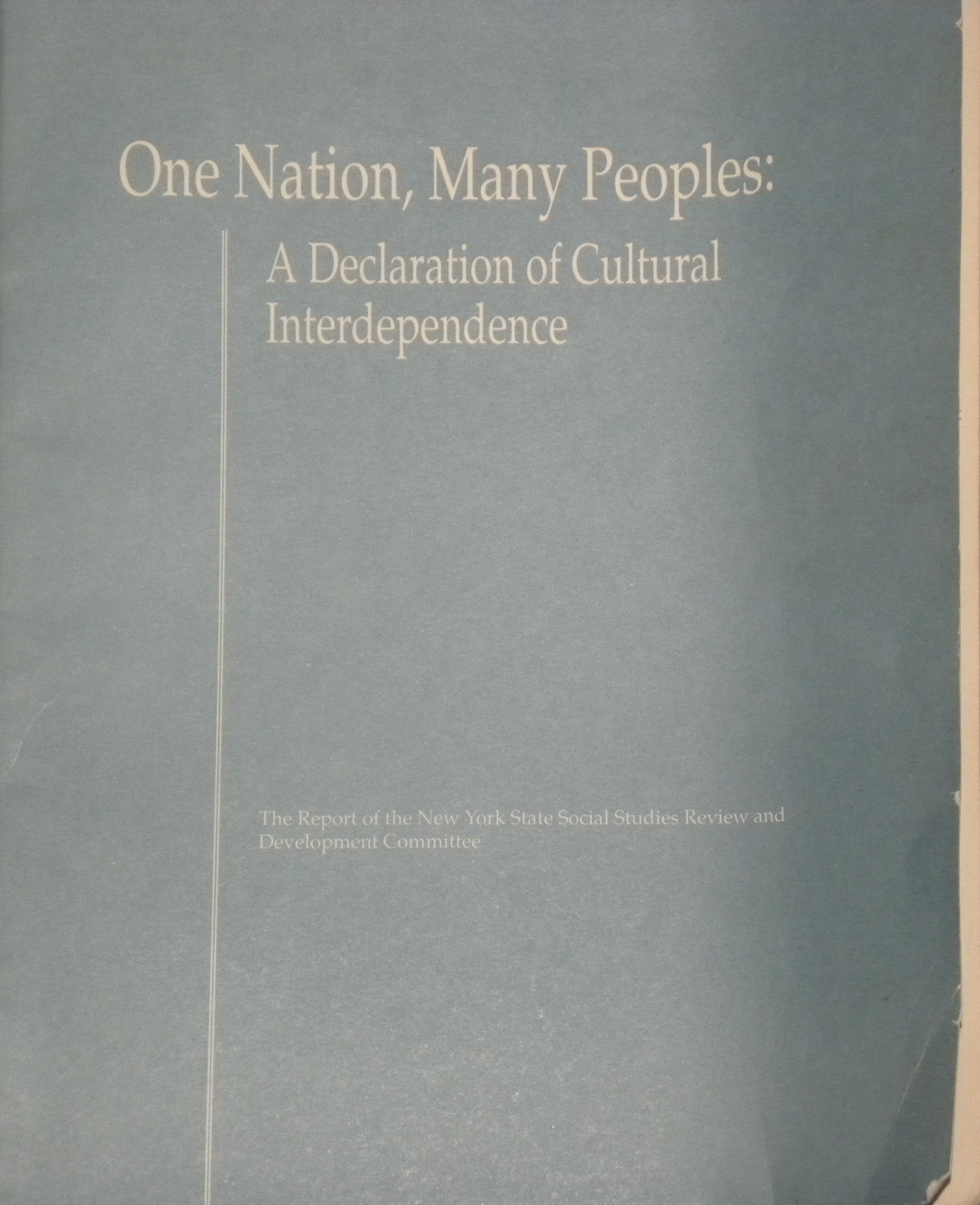
New York State Social Studies Review and Development Committee Report, June 1991 (Picture/Donald Earl Collins). One of several reports produced for the New York State Education Department and Commissioner, as part of the Commissioner's Task Force on Minorities: Equity and Excellence

Twenty years ago this week, I began writing an academic piece that would lead to my dissertation topic, doctorate and first book Fear of a “Black” America (2004). It was a topic that I’d fall in and then out of love with. Ironically, I pursued this topic because of my academic experiences in Humanities at Davis Middle and Mount Vernon High School. The topic was multiculturalism, and more specifically, multicultural education, and how to achieve this kind of curriculum reform in K-12 education. Just writing these words makes me feel both young and naive at the same time.

This whole quest started with a girl. Actually, with the young woman “Another E” (see “The Power of Another E” from April ’09 and “Beyond the Asexual Me” from last month”). She wanted to put an article together for publication, in response to what was then a major controversy involving research into the revision of New York State’s social studies and other curricula. The New York State Department of Education had given a committee the task of figuring out how to make the state’s K-12 curriculum more inclusive and representative of the state’s tremendous racial, ethnic and other forms of diversity.

By the end of September ’91, it would produce A Curriculum of Inclusion: Report of the Commissioner’s Task Force on Minorities: Equity and Excellence. But that deliverable was far from my mind when, tired from my weeks of near starvation post-graduation that April (see “Sometimes Starvation” from May ’11), I reluctantly said okay to working on this article.

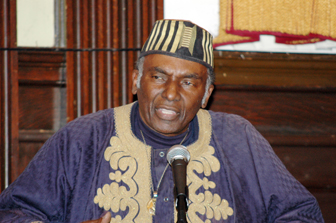
Leonard Jeffries, Newark Public Library, February 1, 2007. (http://npl.org)

Now here I was, minus the young woman in whom I no longer had an interest, now working on a piece that had become more academic than either of us had originally intended. By the time I’d written my first words on multiculturalism, I’d already learned the names Leonard Jeffries, Asa Hilliard III and Arthur Schlesinger, Jr. I’d read articles from the New York Times and the Wall Street Journal about Jeffries’ name-calling, Schlesinger’s incredulousness about calling slaves “enslaved persons,” and about the committee in general getting along like hyenas tearing at a dead wildebeest.

If I’d been just a tad bit smarter, I would’ve done an investigative piece and called and emailed the people on this task force. I would’ve asked them to divulge to me what they would eventually tell the world about their dislike of each other and of anything “multicultural,” which was in quotes for them. For Schlesinger, multicultural was the equivalent of bad ethnic studies or a kind of Afrocentrism that blamed Whites for all that has ailed America and the world for the past 500 years. For Jeffries, it was a racist attempt at appeasing Blacks and other groups of color while maintaining the main theme of Whites on top.

Although this is an oversimplification, it’s not by much. There really wasn’t anyone from the task force, the

Arthur Schlesinger, Jr., CUNY, circa 2006, months before his death on February 28, 2007. (http://www.nytimes.com)

NYS Department of Education, or anyone who spoke on the Himalayas-out-of-a-termite-mound controversy over a more inclusive K-12 curriculum without taking one of those two views. That’s what interested me the most. Schlesinger, and eventually, folks like Diane Ravitch, Mario Cuomo and others completely against revision that even approached cultural pluralism, versus Jeffries, Hilliard and others arguing beyond what they called a White multiculturalism.

I didn’t have the capacity at that stage of my life to see myself as a writer or a journalist in any way. Just two years removed from the end of my mother’s marriage to my now idiot ex-stepfather, I only saw the piece that I’d turn into a Master’s research paper, doctoral thesis and first book as an academic exercise, one where I found the philosophical middle. I hadn’t a clue as to how to make myself part of the Ground Zero issue of the first seven years of the ’90s, the Culture Wars.

But I did have one experience that provided unique insight into multiculturalism and the arguments made by scholars and pols on all sides. Six years in Humanities in Mount Vernon, New York’s public schools. A place where cultural diversity and how to deal with it within the curriculum was the elephant in the classroom. Some teachers and classes addressed it, and many didn’t, to the detriment of what was a solid program, not to mention me and the others who were my classmates.

Either way, I saw more issues of diversity crop up where a multiculturalist approach would’ve been helpful all during my time in Humanities, including with my kufi and my Hebrew-Israelite years. It was a missed opportunity, one that I unconsciously wanted to address with my research of and writing on multiculturalism.

Elephant in School, retrieved July 7, 2011. (http://teachhub.com)

← Older posts
Newer posts →

Boy @ The Window: A Memoir

Boy @ The Window: A Memoir

Places to Buy/Download Boy @ The Window

There's a few ways in which you can read excerpts of, borrow and/or purchase and download Boy @ The Window. There's the trade paperback edition of Boy @ The Window, available for purchase via Amazon.com at http://www.amazon.com/Boy-Window-Donald-Earl-Collins/dp/0989256138/

There's also a Kindle edition on Amazon.com. The enhanced edition can be read only with Kindle Fire, an iPad or a full-color tablet. The links to the enhanced edition through Apple's iBookstore and the Barnes & Noble NOOK edition are below. The link to the Amazon Kindle version is also immediately below:

scr2555-proj697-a-kindle-logo-rgb-lg

Boy @ The Window on Amazon.com: http://www.amazon.com/Boy-The-Window-Memoir-ebook/dp/B00CD95FBU/

iBookstore-logo-300x100

Boy @ The Window on Apple's iBookstore: https://itunes.apple.com/us/book/boy-the-window/id643768275?ls=1

Barnes & Noble (bn.com) logo, June 26, 2013. (http://www.logotypes101.com).

Boy @ The Window on Barnes & Noble: http://www.barnesandnoble.com/w/boy-the-window-donald-earl-collins/1115182183?ean=2940016741567

You can also add, read and review Boy @ The Window on Goodreads.com. Just click on the button below:

Boy @ The Window

Twitter Updates

Tweets by decollins1969
  • RSS - Posts
  • RSS - Comments

Archives

  • June 2025
  • April 2023
  • September 2022
  • August 2022
  • July 2022
  • June 2022
  • May 2022
  • April 2022
  • March 2022
  • January 2022
  • December 2021
  • November 2021
  • October 2021
  • September 2021
  • August 2021
  • July 2021
  • June 2021
  • April 2021
  • March 2021
  • February 2021
  • January 2021
  • December 2020
  • November 2020
  • October 2020
  • September 2020
  • August 2020
  • July 2020
  • May 2020
  • April 2020
  • March 2020
  • January 2020
  • December 2019
  • November 2019
  • August 2019
  • July 2019
  • June 2019
  • May 2019
  • April 2019
  • March 2019
  • February 2019
  • January 2019
  • December 2018
  • November 2018
  • October 2018
  • September 2018
  • August 2018
  • July 2018
  • June 2018
  • May 2018
  • March 2018
  • February 2018
  • January 2018
  • December 2017
  • November 2017
  • October 2017
  • September 2017
  • August 2017
  • July 2017
  • June 2017
  • May 2017
  • April 2017
  • March 2017
  • February 2017
  • January 2017
  • December 2016
  • November 2016
  • October 2016
  • September 2016
  • August 2016
  • July 2016
  • June 2016
  • May 2016
  • April 2016
  • March 2016
  • February 2016
  • January 2016
  • December 2015
  • November 2015
  • October 2015
  • September 2015
  • August 2015
  • July 2015
  • June 2015
  • May 2015
  • April 2015
  • March 2015
  • February 2015
  • January 2015
  • December 2014
  • November 2014
  • October 2014
  • September 2014
  • August 2014
  • July 2014
  • June 2014
  • May 2014
  • April 2014
  • March 2014
  • February 2014
  • January 2014
  • December 2013
  • November 2013
  • October 2013
  • September 2013
  • August 2013
  • July 2013
  • June 2013
  • May 2013
  • April 2013
  • March 2013
  • February 2013
  • January 2013
  • December 2012
  • November 2012
  • October 2012
  • September 2012
  • August 2012
  • July 2012
  • June 2012
  • May 2012
  • April 2012
  • March 2012
  • February 2012
  • January 2012
  • December 2011
  • November 2011
  • October 2011
  • September 2011
  • August 2011
  • July 2011
  • June 2011
  • May 2011
  • April 2011
  • March 2011
  • February 2011
  • January 2011
  • December 2010
  • November 2010
  • October 2010
  • September 2010
  • August 2010
  • July 2010
  • June 2010
  • May 2010
  • April 2010
  • March 2010
  • February 2010
  • January 2010
  • December 2009
  • November 2009
  • October 2009
  • September 2009
  • August 2009
  • July 2009
  • June 2009
  • May 2009
  • April 2009
  • March 2009
  • February 2009
  • January 2009
  • December 2008
  • November 2008
  • October 2008
  • September 2008
  • August 2008
  • July 2008
  • June 2008
  • May 2008
  • April 2008
  • March 2008
  • February 2008
  • January 2008
  • December 2007
  • November 2007
  • October 2007
  • September 2007
  • August 2007
  • July 2007
  • June 2007

Recent Comments

decollins1969's avatardecollins1969 on No Good Teaching Deed Goes…
Mary Rose O’Connell's avatarMary Rose O’Connell on No Good Teaching Deed Goes…
Lyndah McCaskill's avatarLyndah McCaskill on The Raunchiest of Them Al…

NetworkedBlogs on Facebook

NetworkedBlogs
Blog:
Notes From a Boy @ The Window
Topics:
My Life, Culture & Education, Politics & Goofyness
 
Follow my blog

616 616 East Lincoln Avenue A.B. Davis Middle School Abuse Academia Academy for Educational Development AED Afrocentricity American Narcissism Authenticity Bigotry Blackness Boy @ The Window Carnegie Mellon University Child Abuse Class of 1987 CMU Coping Strategies Crush #1 Crush #2 Death Disillusionment Diversity Domestic Violence Economic Inequality Education Family Friendship Friendships Graduate School Hebrew-Israelites High-Stakes Testing Higher Education History Homelessness Humanities Humanities Program Hypocrisy Internalized Racism Jealousy Joe Trotter Joe William Trotter Jr. K-12 Education Love Manhood Maurice Eugene Washington Maurice Washington Misogyny Mother-Son Relationship Mount Vernon High School Mount Vernon New York Mount Vernon public schools Multiculturalism MVHS Narcissism NFL Pitt Pittsburgh Politics of Education Poverty President Barack Obama Race Racial Stereotypes Racism Relationships Self-Awareness Self-Discovery Self-Reflection Sexism Social Justice Teaching and Learning University of Pittsburgh Violence Whiteness Writing

Top Rated

Blog at WordPress.com.

  • Subscribe Subscribed
    • Notes from a Boy @ The Window
    • Join 103 other subscribers
    • Already have a WordPress.com account? Log in now.
    • Notes from a Boy @ The Window
    • Subscribe Subscribed
    • Sign up
    • Log in
    • Report this content
    • View site in Reader
    • Manage subscriptions
    • Collapse this bar
 

Loading Comments...