• About Me
  • Other Writings
  • Interview Clips
  • All About Me: American Racism, American Narcissism, and the Conversation America Can’t Have
  • Video Clips
  • Boy @ The Window Pictures
  • Boy @ The Window Theme Music

Notes from a Boy @ The Window

~

Notes from a Boy @ The Window

Tag Archives: Afrocentricity

Contingent Faculty and the Cold Case of Rollo Turner

02 Thursday Oct 2014

Posted by decollins1969 in 1, Academia, culture, Eclectic, Pittsburgh, Politics, Pop Culture, race, University of Pittsburgh, Work

≈ 4 Comments

Tags

Adjunct Faculty, Africana Studies, Afrocentricity, Brenda Berrian, Buddhism, Clarence 'Rollo' Turner, Contingent Faculty, Death, Department of Black Studies, Diversity, Firing, Income Loss, J.D. O'Connor, Lawsuit, Rollo Turner, Steven Salaita, Termination, Unionization, University of Illinois Urbana-Champaign
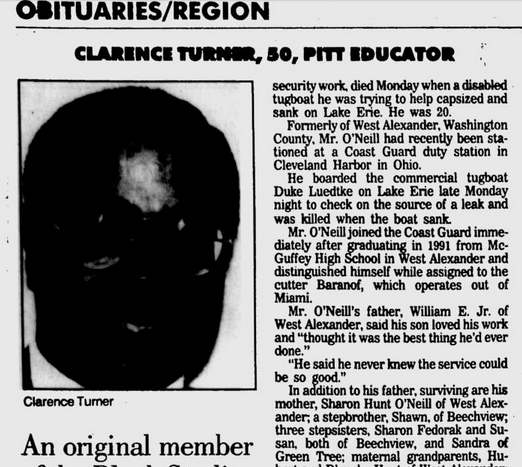

Clarence "Rollo" Turner, in Obituaries section, Pittsburgh Post-Gazette, September 24, 1993. (http://news.google.com).

Clarence “Rollo” Turner, in Obituaries section, Pittsburgh Post-Gazette, September 24, 1993. (http://news.google.com).

Two months ago, the University of Illinois Urbana-Champaign rescinded a job offer they had made to Steven Salaita (then an associate professor of English at Virginia Tech) for a tenured position in American Indian Studies over a bunch of his allegedly anti-Israel tweets. Between mainstream media and social media, the response against this attack on academic freedom and traditional hiring protocols has been tremendous. Thousands of academicians have signed petitions, penned articles and canceled speeches and events at UIUC over Chancellor Phyllis Wise and the Illinois board of trustees’ decision to take back their offer of employment. While the American Association of University Professors, the American Studies Association, the Foundation for Individual Rights in Education, and so many others have argued that Professor Salaita should be in the classroom teaching his courses this fall, this issue is about more than academic freedom and UIUC following job offer guidelines.

The fact is, non-tenure-stream faculty lack the protections and supportive outrage that academia has poured out for those in tenure-track and tenured positions like Professor Salaita. So many contingent faculty lose their jobs over far less than an impolite tweet or an excited utterance. Yet it doesn’t become a story in The New York Times or a petition letter with over 2,000 signatures. No, most contingent faculty, when they lose their jobs, often do so in obscurity, often over doing their jobs with the idea that they were free to teach as they saw fit.

The sadder fact, though, is that this isn’t a new phenomenon at all. Take the case of Clarence Rollo Turner, who passed away twenty-one years ago last month at the age of 50. He was once a veteran senior lecturer in the Department of Black Studies at the University of Pittsburgh, as well as my one-time professor for his History of Blacks in Sports course during the spring semester of 1990. I took Turner’s course in my junior year for an easy-A in the midst of taking a bunch of upper-level undergraduate (and one graduate) history courses that semester. Turner’s was a fun course, and he was a knowledgeable professor beyond its contents. Who knew that in three and a half years the politics of academia would cut short the life of a pioneer? It points to the reality that with half of all higher education instructors serving as contingent faculty, academic freedom is an oxymoron and job protections have become secondary to academic politics and fundraising efforts.

Rollo Turner’s Contingent Teaching Story:

If you’ve never heard of Rollo Turner, it’s mostly because he didn’t have the opportunity to turn himself into a household name in or out of academia, even in Pittsburgh. And, of course, because most non-tenured and non-tenure-stream faculty are seldom central figures at their universities or in their fields just because they’re very good instructors. Turner, though, was a founding member of the Black Studies Program-turned-department (now of Africana Studies) at the University of Pittsburgh. The university had hired Turner in the wake of a game-changing sit-in of Black undergraduate and graduate students in their takeover of an entire floor of the university’s central computer systems on Martin Luther King, Jr.’s birthday in 1969. It was a protest over the lack of student and faculty diversity at the University of Pittsburgh in general. But it was also a protest to demand a Black Studies program that would represent the research and experiences of Blacks on Blacks on an otherwise lily-White Campus, one engaged exclusively in research that almost always excluded Blacks.

In the process of starting this program, the university hired faculty who had yet to earn their doctorates, in some cases with barely a bachelor’s degree. This was 1969, though, when not having a PhD didn’t automatically disqualify candidates from a full-time academic position. Turner was one of several beneficiaries from this change of climate at the University of Pittsburgh, as he was finishing up a master’s degrees in Sociology at Indiana University when the University of Pittsburgh hired him (Turner, incidentally, had helped lead protests for more Black inclusion and a Black Studies program at Indiana in 1968).

Turner took on a joint appointment with the Department of Sociology and with the new Black Studies Program, teaching courses like the Sociology of the Black Family, Introduction to Black Studies and his History of Blacks in Sports along the way. Although the standard courseload for a full-time faculty member at the University of Pittsburgh was five over two semesters per year, Turner had been on a 2-2 schedule from September 1969 through December 1991. For more than twenty-two years, Turner had only taught four courses per year.

When the then-new department chair Brenda Berrian demanded that Turner take on a third course in January 1992, he refused, citing his twenty-two year history with the Black Studies Department and the last-minute nature of the request as reasons. Berrian then moved to terminate Turner. She and two Pitt police officers arrived in Turner’s classroom on the first Friday of the spring semester and had him removed from his classroom and escorted out of the building. Berrian fired him in the middle of his lecture, in front of a room full of students. This was how The Pitt News first reported the incident, and it was corroborated by everything that Rollo Turner told me a few weeks later.

The Politics of Academia:

But though it was that heavy-handed, it was hardly that simple. Turner had gotten himself caught up in a battle that involved his contingent employment status, degree completion, departmental reputation and petty ideological politics. More than twenty-two years as a non-tenured senior lecturer with only a master’s degree and a few publications that included two book-length bibliographies had caught up with Turner. As a contingent faculty member, even with over two decades put in, Turner lacked the protections afforded tenure-stream and tenured faculty members. Granted, at $37,000 a year and living in Pittsburgh at the time in 1992, Turner was a very well-paid senior lecturer. At least, that’s what many would argue today. This was also Berrian’s position as Turner’s termination turned into a $60,000 lawsuit.

Beyond the issue of compensation, contracts and contingent status was what Berrian and the other tenured faculty of the Department of Black Studies wanted for the department’s future. They wanted to bolster the department’s reputation within and outside the University of Pittsburgh. They wanted to be a full-fledged department in which students could major in Black Studies (students could only earn a minor in the subject until 1993), and perhaps, even offer a master’s degree in the field. Two things stood in the way of this progression. One was the fact that half of the department’s faculty didn’t have doctorates, now a much bigger deal in 1992 than it had ever been in 1969.

Two was that not everyone wanted to go in the ideological direction that Berrian had chosen for the Department of Black Studies. She wanted to move toward an Afrocentric approach in teaching and conducting research, something Turner openly rejected as “nonsense.” The idea of a litmus test for what was and wasn’t authentically “Black” or “African” was too extreme for Turner. As a tenured faculty member, Turner’s objections may well have cost him political clout within the department, but it wouldn’t have cost him his job.

Turner’s Final Months:

Turner sued Berrian and the University of Pittsburgh for wrongful termination – stemming in no small part from a hostile work environment – and breach of contract (his was a three-year contract with a year and a half left on it). The suit dragged on in the Civil Court division of Allegheny County Common Pleas Court well into 1993 as Turner – with two daughters in college and a son in the middle of high school – went over a year and a half without a paycheck. As late as August 1993, the month before he died, Turner told me that things on the lawsuit front had taken a turn for the better. Despite the stress of the situation, he hadn’t let Berrian or the University of Pittsburgh “steal his inner peace,” Turner said.

Yet even with years of Buddhism and meditation under his belt and a lifestyle that included biking through all parts of Pittsburgh, Turner died in late-September 1993. No doubt that between the stress of his lawsuit, the sense of betrayal, and the financial upheaval, it all caught up with him. Rollo Turner may well have become a mentor of mine because of the stand that he took, minus the strength of a union or support from a substantial number of tenured faculty. None of this was possible in the end. Precisely because contingent faculty seldom have rights that tenured faculty and university administrators are bound to respect.

Lessons, If Any:

There are so many lessons to be learned here, lessons that resonate with me more now as an adjunct professor than they did when I was a graduate student or when I worked in the nonprofit world. Contingent faculty shouldn’t rock the boat, take a controversial stance, or involve themselves in hot-button issues within their field or department. Or that anyone serving as non-tenured faculty without a doctorate should endeavor to write their dissertation at break-neck speed. Or really, if given the choice, why would anyone who could possibly do anything else with their lives in academia, especially anything that could provide more security and protection, choose a job as a contingent faculty member, whether in 1992 or 2014?

Mostly, it points to the reality that university leaders tend to see much of the talent in academia – non-tenured faculty among others – as expendable. That, and the fact that this expendability has grown with the rapid increase in contingent faculty (and graduate students, for that matter) teaching courses once reserved for tenure and tenure-stream instructors. Until contingent faculty, graduate student teaching assistants and tenured/tenure-stream professors unionize and take a collective stand on working conditions and job protections, cases like Turner’s will continue to go cold and remain tragic ones, with no end in sight.

The Road to Boy @ The Window, Part 4: Fear of a “Black” America

26 Thursday Sep 2013

Posted by decollins1969 in 1, Academia, Boy @ The Window, Carnegie Mellon University, culture, Eclectic, eclectic music, music, Patriotism, Pittsburgh, Politics, Pop Culture, race, University of Pittsburgh, Youth

≈ Leave a comment

Tags

Academia, Afrocentricity, Authentic Blackness, Authenticity, Emotion, Estelle Abel, Fear of a "Black" America, Fear Of A Black Planet, Fear of Black Males, Joe Trotter, Multicultural Education, Multiculturalism, PE, Personal Vignettes, Politics of Academia, Politics of Education, Politics of Fear, Public Enemy, Rage, Richard Altenbaugh


FearBookCover3copy

Given that Fear of a “Black” America was my first book, but one based on my doctoral dissertation, and that Boy @ The Window is a memoir, the road from one to the other may not be that obvious with an initial glance. But despite the intellectual, semi-scholarly nature of my book on Blacks and multiculturalism, there are parallel themes that run between Fear of a “Black” America and Boy @ The Window. Perhaps none are more important, though, than the challenge of authenticity, of fitting in, of being able to mesh the complicated onion that I’ve found myself to be over the years.

I think that was why I decided in November ’98 to turn my dissertation “A Substance of Things Hoped For” into a more readable book. Yes, after all that work to write a 505-page thesis, it would’ve been a shame to just let it sit on my then girlfriend’s coffee table, to be used either as a door stop or a base for her doing her nails. Yes, I still had something to prove to academia. That my scholarship as a historian and educator on the issue of multiculturalism was sound. That the conventional academic wisdom around Blacks, people of color and multiculturalism was paternalistic fear-mongering.

Public Enemy, Fear Of A Black Planet (1990) Album Cover

Public Enemy, Fear Of A Black Planet (1990) Album Cover

And in thinking that last part through, I came up with my Public Enemy-inspired title and thread for the first book. It was about fear in many forms. Elite White fears of a majority-people-of-color US within their own lifetimes. Conservative fears of a K-16 education system that included the cultural and historical perspectives of peoples of color, of the poor, of women, of the LGBT, of so many others they’d rather discard. General American skepticism that any Blacks had ever given any thought at all to cultural pluralism, intercultural education, or multiculturalism/multicultural education, at least before White theorists had thought through these ideas first.

Afrocentrists and nationalists who thought of multiculturalism as soft and utterly unrepresentative of the Black experience — or, at least, what they considered an authentic version thereof? That was as difficult a challenge as any I faced in writing both my dissertation and Fear of a “Black” America. So much so that I made a few interesting decisions along the way. I sought out an agent — yes, a literary agent — for the first book, and found one, too (things were so much easier in ’99). I wanted the book to have an impact beyond academia.

In the writing process, I decided to weave the theme of fear, skepticism, willful and inadvertent misunderstandings throughout the 200-page book. All while covering Black intellectual thought about what we now call Afrocentricity and multiculturalism, Black activism and activities around education and Negro History Week, and the so-called Culture Wars of the 1980s and 1990s. All to show that multiculturalism was/is a part of America’s evolution, even if some folks are gnashing their teeth and wearing sackcloth and ashes along the way.

One thing was missing, though, from my six chapters. Me, in a word. Yes, my argument was crystal clear, my evidence was sound, my notes and analysis lined up well enough by the summer of ’00. Yet, as my one-time agent noted, “there’s not enough of you in this manuscript.”  Bottom line: folks weren’t going to buy the book unless I made it more compelling, which meant putting something of me or about me in it.

Fear Book & The Authentic Me

Fear Book & The Authentic Me

So I did. I wrote mostly about my experiences in academia and how they paralleled with some of the critical issues in Fear of a “Black” America. I talked about my Duquesne University students in the College of Education in ’98 and ’99, most of whom were cultural conservatives. I brought up conversations I had with professors skeptical about my scholarship, like Richard Altenbaugh in March ’98 or my former dissertation advisor Joe Trotter in April ’96. I also wrote about my conversation with Estelle Abel over my lack of authenticity as a young Black man in June ’87, having thought about it for the first time in thirteen years. I wasn’t sure if that made Fear of a “Black” America any better, but it made me feel better about my first book.

By the time I’d given my agent the final draft of Fear of a “Black” America in October ’00, I was ready — maybe for the first time in years — to take a look at my life before Pitt, grad school, Spencer Fellowship and becoming Dr. Collins. I wasn’t sure if I wanted to open up the emotional side of that Pandora’s box just yet. But in some ways, I really needed to, precisely because of my experiences with people in grad school at Pitt and Carnegie Mellon. And precisely because of my occasional moments of rage and overreaction, if only because Fear of a Black “America” helped me tap into emotions I didn’t know I had.

My Day of Atonement/Bitter Hatred

14 Saturday Sep 2013

Posted by decollins1969 in 1, Boy @ The Window, culture, Eclectic, Hebrew-Israelite, Jimme, Marriage, Mount Vernon New York, My Father, Politics, Pop Culture, race, Religion, Youth

≈ 2 Comments

Tags

Afrocentricity, Day of Atonement, Disillusionment, Family, Forgiveness, Hatred, Judah ben Israel, Judaism, Love, Maurice Eugene Washington, Self-Discovery, Ten Lost Tribes, Torah, Yom Kippur


Prayer at the Wailing Wail, Second Temple, Jerusalem, February 1, 2013. (Steve Ibrom). Released by public domain by author.

Prayer at the Wailing Wail, Second Temple, Jerusalem, February 1, 2013. (Steve Ibrom). Released by public domain by author.

“Yom Kippur ’83 opened me up to understanding why I no longer put my trust in Maurice’s God. I spent part of another September fasting and going to temple to atone for my sins. The temple was on Fifth Avenue and Second Street, just down the street from Washington Elementary School. I’d gone to temple maybe a half-dozen times since the spring of ’81, three of those times to have some rabbi with a ragged beard tell me that Yahweh had forgiven me for my wicked ways.

“And it left me thinking, ‘Well, what about Maurice? His sins are many, and we get treated the same? Does he get forgiveness even if the sin is still in progress?’ It didn’t make sense to me that I needed to starve myself for three days and ask for forgiveness in a situation where a fat, greasy SOB for a stepfather could steal from, cheat on, beat up on, and lie to Mom, get forgiveness, and keep on trying to do what he’d done before Yom Kippur. I said to whoever was a higher power, ‘What did I do to deserve this?’ I didn’t get an answer, and nothing anyone at temple said gave me any answers either. I felt empty, as if everything I thought being in this faith was about was a farce, a morbid, diabolical joke that was played on me and my family. And Maurice was the devil himself.”

That’s what I wrote in Boy @ The Window about my last Yom Kippur as a Hebrew-Israelite. That Saturday, September 17, ’83, was the last time I went to temple, the last time I looked at any aspect of our bizarre and goofy mix of Judaism and Afrocentricity with a modicum of seriousness. By the time I left, I wasn’t in a forgiving mood at all. I hated my then stepfather Maurice, and hated the people who claimed that people like Maurice were descendants of one of the Ten Lost Tribes of Ancient Israelites.

Please understand. When I said, “I hated Maurice,” it wasn’t a euphemism for me in the fall of ’83. If I had access to a gun, I would’ve blown him away and gladly served time in prison for doing so. I had stomach ulcers in the fall of ’83, because I couldn’t stand the smell, sound or sight of the obese asshole. I all but prayed to Yahweh that he get hit by a Mack truck going eighty miles an hour down East Lincoln Avenue. I wanted him dead, and I wanted to piss on his ashes to boot.

Even at thirteen, though, I also understood that this kind of anger and rage wouldn’t help me in the long run between ninth grade and college. Or with sports. Or dating. Or in finding my own path to God or to anything else worth believing. My bitterness and hatred were so deep, about as deep as any love that I’d experienced up to that point in my life. Whether my Mom, my father Jimme, my Uncle Sam or my version of Wendy, all that love was nearly drowned out by my hate for my stepfather.

Even on my irony scale, this hatred broke all records. Especially on a day of atonement, where we all but sacrificed an unblemished lamb at the temple over four hours that Saturday. But I had other reasons to be bitter on this, the holiest of holy days. No bar mitzvah, no celebrations of Hanukkah, no participation in Hebrew-Israelite life for me beyond their 613 rules and regs for nearly two and a half years. I understood and yet didn’t understand this sense of pride and Blackness that came through in a near Asian religion that allowed for reincarnation and an post-Babylonian Israelite diaspora to Sub-Saharan Africa to boot. That confusion didn’t help me deal with a man who wasn’t one, but was a teenage bully who did everything he could to keep me and Mom in submission to him, with Yahweh and Torah as his excuse.

Yom Kippur 1983

Yom Kippur 1983

I knew after I left temple that Yom Kipper afternoon that it would be my last. I didn’t know how, but my days of wearing a kufi or yarmulke were on their way to an end. Still, with hatred and confusion in my heart and mind, I was also lost, more lost than the other ten ancient Israelite tribes undoubtedly were in the aftermath of the Babylonian conquest.

On Academic Entourages & Standing Apart From Them

11 Wednesday Sep 2013

Posted by decollins1969 in 1, Academia, Carnegie Mellon University, culture, Eclectic, Pittsburgh, Politics, Pop Culture, race, Religion, University of Pittsburgh, Work, Youth

≈ Leave a comment

Tags

Academia, African American Studies, Afrocentricity, Authenticity, Black Issues in Higher Education, Blackness, Entourage, Fear of a "Black" America, Followers, Loner, Marc, Molefi Asante, Multiculturalism, Politics of Academia, Publishing, Sycophants, Writing


Lil Wayne entourage, Hartford, CT, July 2011. (http://4umf.com/).

Lil Wayne entourage, Hartford, CT, July 2011. (http://4umf.com/).

This week for many is about anniversary number twelve of the 9/11 attacks, which if I hadn’t lived through them, would sound like something out of a Kurt Vonnegut novel. But because I’ve been counting my days for years, this week also represents two decades since I realized that radical “Islamic” terrorists, pro athletes and popular music artists aren’t the only ones with followers. I learned for the first time that even in the world of academia, paragons and those who allege themselves as such also have their entourages of true believers and sycophants. It was a realization that bothered the loner and the aspiring academic historian in me.

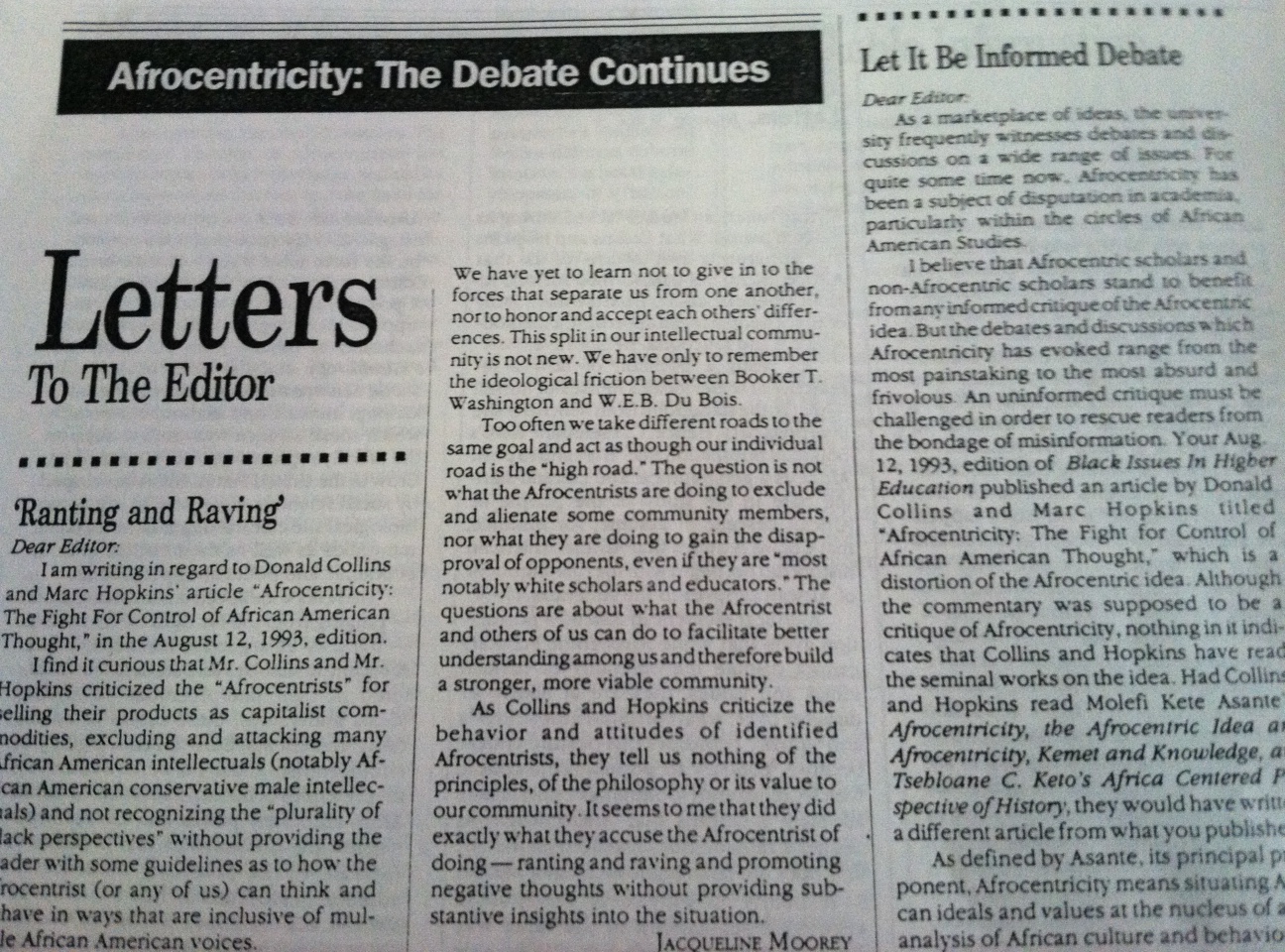
Letters to the Editor, Black Issues in Higher Education, September 9, 1993. (Donald Earl Collins)

Letters to the Editor, Black Issues in Higher Education, September 9, 1993. (Donald Earl Collins).

It all occurred in the aftermath of my first major publication, co-written with my friend Marc and published in Black Issues In Higher Education in August ’93. “Afrocentricity: The Fight for Control of African-American Thought” was our 1,200 word contribution to the debate over multicultural education and Afrocentricity in both higher education and in Black culture more generally. It was a publication that came as a surprise, because the editors at Black Issues In Higher Education (the same folks who ran Emerge Magazine, by the way) hadn’t contacted us about receiving our pitch and article, about accepting it for publication, or about when they intended to publish. And even though our article was literally in the centerfold of their August 12, ’93 issue, the folks at Black Issues in Higher Education never paid us for the publication of our work.

The reason why because clearer in their September 9 and September 23 issues. In the “Letters to the Editor” section, the editors published a dozen letters, ten of which were critical of our work. These weren’t scholarly or even logical critiques — we were wrong because we weren’t members of the Church of Afrocentric Babble, plain and simple. These were “How dare you!” or “Shame on you!” letters, not ones based on what we’d actually written.

What became obvious  to me was that Molefi Asante’s former and current students had written most of the letters. Not exactly an unbiased set of sources, as in the circle of Afrocentricity in the early ’90s, there were few people more prominent than Asante (he was the Father of Afrocentricity, after all). Once I realized this, I found myself disappointed. With Black Issues in Higher Education, with Black folks in academia — particularly at Temple University — and with academia itself. Me and Marc weren’t being challenged on our ideas, but on the idea that two alleged neophytes had the balls to challenge the orthodoxy of the early ’90s in African American studies and in high-brow Black cultural circles.

Marc pushed for a response from one of the editors about their unprofessionalism (and to find out why we weren’t being paid for our piece), which led to a conversation with one of the big-wigs. He apparently said to Marc, “We published it [the “Afrocentricity” piece] to teach you a lesson.” When Marc told me, I said, “Well, I guess we’re not gonna get paid.” (Turned out this was standard practice for the likes of Black Issues in Higher Education, Emerge, and for freelancers at BET as well). Marc, pissed and disillusioned, said, “We were just trying to help.”

Letters to the Editor, Black Issues in Higher Education, September 23, 1993. (Donald Earl Collins).

Letters to the Editor, Black Issues in Higher Education, September 23, 1993. (Donald Earl Collins).

It was the last one of many factors that pushed me to write my dissertation and my first book Fear of a “Black” America (2004) on the relationship between education, multiculturalism, and Black identity. I wanted to show that Afrocentricity wasn’t the only strain of thought that ran through the heads of Black scholars and found its way into small “c” curriculum and cultural events in Black communities. In doing so, I certainly stood apart, but I also stood alone a lot, too.

In recent years, I’ve seen numerous entourages eviscerate lone wolfs. On Twitter, in our 24/7 media coverage of the mundane and insignificant yet insane, and at academic conferences. As recently as a couple of months ago, I saw a version of this on Facebook in response to a post I wrote about Mark Anthony Neal’s Looking for Leroy (2013). The entourage makes it difficult for an up-and-comer to get off to an honest start, for conformity with only subatomic levels of independent thought seems to be the norm.

Somewhere between now and when my son (knock on wood) reaches my age of forty-three, maybe some of what I’ve written over the past twenty years will break through the ice of entourages, mad-dog and otherwise. Still, it is a damnable thing when groups get together to stomp out different voices (literally and figuratively), because that’s seems to be the only way to keep the band together.

Grad School & My Most Special Summer Reading List

31 Saturday Aug 2013

Posted by decollins1969 in 1, Academia, Boy @ The Window, culture, Eclectic, Pittsburgh, Politics, Pop Culture, race, University of Pittsburgh, Work, Youth

≈ Leave a comment

Tags

"I Have A Dream" speech, Afrocentricity, Black Culture, Black History, Blackness, Books, Carter G. Woodson, Department of HIstory, Elaine, Graduate School, Higher Education, Joe White, K-12 Education, Malcolm X, March on Washington, Multicultural Education, Pitt, Readings, Self-Discovery, Toni Morrison, W. E. B. Du Bois, Western Psych, Western Psychiatric Institute & Clinic


Just a small sample of the books I read/re-read summer before grad school in 1991, August 31, 2013. (Donald Earl Collins).

Just a small sample of the books I read/re-read summer before grad school in 1991, August 31, 2013. (Donald Earl Collins).

For me, August 28 this week was significant for any number of reasons. It wasn’t just that it was fifty years to the exact day and date that the March on Washington occurred and MLK gave his “I Have A Dream” speech. Or that is was fifty-eight years to the date that White supremacists lynched Emmett Till for allegedly whistling at some flat-butt White girl. This past Wednesday was also twenty-two years to the day and date that I began my first day of graduate school as a master’s student in the University of Pittsburgh’s Department of History.

Of course, I didn’t discuss this earlier this week (it would’ve been incredibly arrogant on my part to bring this up three days ago). My big steps for myself were infinitesimal when in measured comparison to the beginning of the two-year height of the official Civil Rights Movement. But even on an afternoon in which I attended my first course and meeting about teaching/advising assignments for the semester, it did feel like a bit of a triumph. Especially when considering what I had to do that spring and summer to get into the program with funding in the first place.

I didn’t learn that much that day. Except the low contempt Joe White and some of the other professors held toward pedagogy and teaching. “You already know more than your students,” White said as advice to us who’d be TAs that semester. I was lucky to not be among them for my first year. I was a GSA assisting in the advising of history majors, some of whom were my fellow undergrads just a few months before. But even then, I thought two minutes’ worth of advice on viewing students as empty vessels was insufficient training for learning how to lecture and facilitate conversations with upwards of 100 students spread out over several discussion sections each week.

I had other things on my mind at that moment, though, including the relief that I’d survived a summer making $5.20 per hour as a full-time employee with a Western Psychiatric Institute & Clinic project in which the project investigators were far more psychotic than the patients. Aside from that, I thought about how the previous four months had served as my preparation for the White world of grad school.

I’d done a lot of reading that late spring and summer, spurned on by boredom, disappointment in my weirdly evolving friendship with Elaine, and a sense that I needed to read to fortify myself against the neo-Marxists in my eventual field. So I read. I started off with Alex Haley’s The Autobiography of Malcolm X (1965), believe it or not, the first time I’d ever read it. Like so many before me, it made my views of the man less black and white than it had been before. I then picked up W. E. B. Du Bois’ Souls of Black Folk (1903), the first time I’d read that book since I wrote a book report on it for Mrs. O’Daniel’s class in fifth grade. Unsurprisingly, I got much more out of it in May ’91 than I did in May ’80.

I didn’t stop there, as my reading took me on three different tracks in June, July and August. One was the “I didn’t get to read this before” track, as I read Toni Morrison’s Tar Baby, Song of Solomon and Beloved (didn’t understand it then, and still don’t get the big deal about it now). Along with Alice Walker’s The Color Purple, Maya Angelou’s I Know Why The Caged Bird Sings (1969), bell hooks and several others on Black Women’s literature. Then, I decided to go back and reread some James Baldwin and Richard Wright that I’d first read for high school, and added Ralph Ellison’s Invisible Man (1952) to the mix. On the non-literature track, I ended up reading Franz Fanon, Du Bois’ Black Reconstruction (1935) — at least, I put a significant dent in it — Derrick Bell’s And We Are Not Saved (1987), and other writings on Black history and culture (broadly speaking).

But the third track would end up taking me on a path toward my dissertation topic and my first book, Fear of a “Black” America (2004). It started with articles on multicultural education that took me to James Banks’ theoretic constructions of what multicultural education ought to have been, but wasn’t. I also found myself reading books like Jonathan Kozol’s Savage Inequalities (1991), Molefi Asante’s The Afrocentric Idea (1987), Dinesh D’Souza’s Illiberal Education (completely indecipherable in a circular firing squad of a thesis kind of way) and Carter G. Woodson’s The Mis-education of the Negro (1933). I was reading anything that could inform my thinking about K-12 and higher education and how it played the role as both equalizer and oppressor for so many Black folks over the years.

Books, Grad School & Blackness

Books, Grad School & Blackness

It was easily the most reading I’d done on my own since the year before I’d gone into seventh grade, middle school and the Humanities Program. I wanted to read all I wanted to read before spending the next few years drowning my brain in hundreds of books and articles that I’d absolutely need to read as a historian. In the process, I may’ve radicalized myself a bit for the otherwise hum-drum experience of reading mind-numbing accounts of history in which the authors didn’t seem to see their own sense of high-brow White maleness.

And with all of it, I surprised myself. I realized once again that my Black classmates and 616 neighbors were wrong about me not being Black enough. Their “Black” wasn’t my “Black,” of course. But all those books confirmed for me that there were many ways to be Black that folks who didn’t read could barely understand.

Road to My Memoir, Part 2: Multiculturalism

08 Saturday Jun 2013

Posted by decollins1969 in 1, Academia, Boy @ The Window, Carnegie Mellon University, culture, Eclectic, Mount Vernon High School, Mount Vernon New York, New York City, Pittsburgh, Politics, Pop Culture, race, University of Pittsburgh, Youth

≈ Leave a comment

Tags

Ability Grouping, Academic Historian, Academic Writing, Afrocentricity, Barbara Sizemore, Comparative Slavery, Elaine, Humanities, Jeannie Oakes, Joyce Harrington, Keeping Track (1985), Multicultural Education, Multiculturalism, Pitt, Pittsburgh Public Schools, Sociology, Tracking


Why Boy @ The Window, Part 2

Why Boy @ The Window, Part 2

When I wrote about this long path to Boy @ The Window last month, I figured that it would take three posts in all to discuss the path. But the road’s shown itself to be longer — and more convoluted — than I anticipated.

So I never did write my book about being on welfare, dehumanization and welfare policy. I found a much more interesting subject to take up the following year, in the summer of ’90. I decided to take the late Barbara Sizemore’s research methods course in Black Studies that fall, to move beyond my history courses, as I’d already taken enough of them to have fulfilled my major.

I wanted to look at the re-segregation of desegregated schools through tracking or ability grouping, specifically in Mount Vernon’s public schools. The book that brought me to this topic was Jeannie Oakes’ masterpiece Keeping Track: How School Structure Inequality (1985). It had begun to turn my mind away from slavery as a long-term history project (perhaps one I would’ve pursued in doing my master’s papers or doctoral research) and toward history of education and racial inequality.

Oakes’ main argument was that school desegregation was a mixed bag of success and failure precisely because of the fact that with tracking by academic “ability,”disadvantaged Black students and advantaged White students would seldom meet in the same classrooms. That made me think of my still recent experiences with the Humanities Program in middle school and high school. After all, a school district that was three-quarters Black, Afro-Caribbean and Hispanic had a magnet program that was about sixty percent White during my six years in Humanities.

I spent that summer — when I wasn’t working — at Mount Vernon Public Library, NYU’s Bobst Library, and New York Public Library giving myself a stronger background on this topic. I met with the former MVHS Humanities coordinator Joyce Flanagan (who had become Harrington by then) about getting more specific demographic data about the program by class year and school (Pennington-Grimes ES, A.B. Davis Middle School and MVHS). Much of the data had already been destroyed, Harrington confided. The data she did give me, while informative, wasn’t enough to do even a watered down version of what Oakes did for Keeping Track (she interviewed 14,000 students and teachers in all).

I ended up doing my research project on Pittsburgh Public Schools and their International Baccalaureate programs at Schenley and Allderdice HS. It was a solid paper, an easy A compared to my comparative slavery paper for Drescher’s graduate course the semester before. But it wasn’t enough for me.

In the course of building up my knowledge on segregation, suburban schools, urban school districts, and community control, I stumbled onto books about multicultural education. I wanted to learn more, so I took a sociology course my final undergraduate semester on the sociology of race and ethnicity (there weren’t any education courses that focused on either race or multiculturalism at Pitt in ’91).

The turning point came with my friend Elaine, who knew of my interest in the topic. She was the one who had informed me of a growing controversy with New York State’s newly proposed history curriculum, one in which the ideas of multicultural education had played a key role. That work the summer before grad school, that work to understand why there was any controversy at all, led me to finding out more about cultural pluralism and its history. This then led to the role of Black intellectuals and educators in applying cultural pluralism, the differences between multiculturalism, multicultural education and Afrocentricity.

I had my dissertation topic in broad strokes before I’d taken any courses as a master’s student (not counting the comparative slavery class). But in the process of moving from re-segregation and Jeannie Oakes to multiculturalism, I’d moved from a wide-eyed student of everything that related to my life at age twenty to an aspiring academician, a historian of educational and cultural ideas.

I’d taken the first steps to bury myself in academic writing and thinking, without fully understanding why I cared about multiculturalism in the first place. It took me a decade to figure out that the lack of understanding of diversity in Humanities was part of what made it a bittersweet experience for me, an experience that drove me toward multiculturalism as a research topic. It took ten years before I realized that my pursuit of multiculturalism in Black Washington, DC was my way of dealing with my own past without any emotion. Multiculturalism took me further away from the writer (and historian) I wanted to be, even as I earned my doctorate on the topic.

Afrocentricity and the Writing Bug

15 Wednesday May 2013

Posted by decollins1969 in 1, Academia, Boy @ The Window, Carnegie Mellon University, Christianity, culture, eclectic music, Hebrew-Israelite, Mount Vernon High School, Mount Vernon New York, music, Pittsburgh, Politics, Pop Culture, race, Religion, University of Pittsburgh, Youth

≈ Leave a comment

Tags

Africana Studies, Afrocentric Education, Afrocentric Idea (1987), Afrocentricity, Authentic Blackness, Authenticity, Black Action Society, Black Issues in Higher Education, Black Studies, Blackness, Cool, Coolness, Litmus Test, Marc Hopkins, Maulana Karenga, Molefi Asante, Pitt, Temple University, Writing, Writing Bug


A ladybug, often a symbol for the writing “bug,” May 15, 2013. (http://flickr.com). In public domain.

This time two decades ago, I was already a bit desperate for work. In transferring from Pitt to Carnegie Mellon, I’d left myself without any financial coverage for the summer of ’93 (see my post “The Arrogance of Youth, Grad School Style” from June ’12). I had applied for several fellowships, summer teaching gigs, even some nonprofit work. But as of the middle of that May, nothing had come through. I’d already spent $200 on a root canal that occurred on the same day as my written PhD comps at CMU (see my post “Facing the Tooth” from May ’12).

Even before my comps and my surprise root canal, I had talked with my friend Marc about writing a joint article about the false litmus test of Blackness that Afrocentricity had come to represent in our minds. Between Molefi Asante’s students at Temple — not to mention the overtly Afrocentric turn of both the Black Action Society and the Black Studies department (which had changed its name to Africana Studies) in the previous eighteen months — both of us felt we needed to provide an alternate perspective.

On that third Saturday in May (and the day after my comps and root canal surgery), we worked for five hours in putting together what amounted to a 1,200-word opinion piece against the belief system and authenticity test that Afrocentricity (and Afrocentric education) had become. By some folks’ definition, we realized that jazz, Miles Davis and John Coltrane would fail the authentically Black test of a Molefi Asante’s wonderful Afrocentric Idea (1987) and of Maulana Karenga as well.

Frances Cress Welsing's The Isis Papers (1991), [about as authentic as auto-tunes], May 15, 2015. (http://amazon.com).

Frances Cress Welsing’s The Isis Papers (1991), [about as authentic as auto-tunes], May 15, 2015. (http://amazon.com).

Now I’m pretty sure why Marc had problems with Afrocentricity. As a Christian and a jazz aficionado, Marc likely saw Afrocentricity as something somewhere between a misguided way of thinking about Blackness and complete and utter bull crap. His goal was to “add to the debate” and “educate” those who weren’t Asante or Karenga apostles and disciples. A laudable — if somewhat naive about the politics of academia and race — goal.

As for me, beyond the academic superficiality of having a litmus test on what is and isn’t Black, I had at least two unconscious reasons for writing my first crossover piece. One had to do with my sense that too many young folks were all too interested in doing the cool thing and not the right thing. Afrocentricity was cool, just like all rap and hip-hop was cool, just like giving libations to ancestors was cool.

Being cool had always meant following a crowd and seldom saying anything that would dig more than a nanometer beyond the surface. Or saying a critical thing about the cool thing that everyone in the same crowd otherwise takes in without a critical thought. I went to a high school full of people like that, and loathed being around people like that when I’d been a part of the Black Action Society at Pitt.

Unconscious reason number two had something to do with my Hebrew-Israelite days. Again, I gave this zero direct thought during my grad school days. But the given the trauma I’d suffered through during my three years of kufi-dom, it had to affect my thinking about Afrocentricity. The Black folk I knew who were part of the Hebrew-Israelite religion were much more obvious about what they did and didn’t consider Black or kosher. Yet, it was so obvious that they constantly contradicted themselves, in terms of food or music, how they treated their wives or children. Most important for me, though, was the fact that they tried to live separate and apart from other Blacks, yet seemed no more different beyond the kufis, veils and kosher meats from other Blacks (or Jews, for that matter).

I saw Afrocentricity as bullshit, and still see the fact that so many folks who get caught up in this sense of authenticity around Blackness as folks falling for bullshit. If I hadn’t lived as a Hebrew-Israelite between the ages of eleven and fifteen, perhaps I wouldn’t see Afrocentricity this way. If I hadn’t been around the “Party All The Time” folks in high school and the “Black Panther Party” posers at Pitt, maybe Afrocentricity would’ve been more appealing to me.

Letters to the Editor, Black Issues in Higher Education, September 9, 1993. (Donald Earl Collins).

Letters to the Editor, Black Issues in Higher Education, September 9, 1993. (Donald Earl Collins).

But at twenty-three years old, I was already tired of the pursuit of coolness and authenticity. That hasn’t changed in the past two decades. I’m sure the letters that called Marc and I “Uncle Toms” after our piece was published in Black Issues in Higher Education were from folks who thought we weren’t cool, and thought they had the answers to life itself.

I wonder how those folks back then would see the academics who believe that hip-hop can explain everything in the social sciences and humanities who are prominent today. Perhaps some of these people today were the Afrocentric followers of twenty years ago. Perhaps not. All I know is, I haven’t stopped writing since that cloudy day in mid-May.

← Older posts
Newer posts →

Boy @ The Window: A Memoir

Boy @ The Window: A Memoir

Places to Buy/Download Boy @ The Window

There's a few ways in which you can read excerpts of, borrow and/or purchase and download Boy @ The Window. There's the trade paperback edition of Boy @ The Window, available for purchase via Amazon.com at http://www.amazon.com/Boy-Window-Donald-Earl-Collins/dp/0989256138/

There's also a Kindle edition on Amazon.com. The enhanced edition can be read only with Kindle Fire, an iPad or a full-color tablet. The links to the enhanced edition through Apple's iBookstore and the Barnes & Noble NOOK edition are below. The link to the Amazon Kindle version is also immediately below:

scr2555-proj697-a-kindle-logo-rgb-lg

Boy @ The Window on Amazon.com: http://www.amazon.com/Boy-The-Window-Memoir-ebook/dp/B00CD95FBU/

iBookstore-logo-300x100

Boy @ The Window on Apple's iBookstore: https://itunes.apple.com/us/book/boy-the-window/id643768275?ls=1

Barnes & Noble (bn.com) logo, June 26, 2013. (http://www.logotypes101.com).

Boy @ The Window on Barnes & Noble: http://www.barnesandnoble.com/w/boy-the-window-donald-earl-collins/1115182183?ean=2940016741567

You can also add, read and review Boy @ The Window on Goodreads.com. Just click on the button below:

Boy @ The Window

Twitter Updates

Tweets by decollins1969
  • RSS - Posts
  • RSS - Comments

Archives

  • June 2025
  • April 2023
  • September 2022
  • August 2022
  • July 2022
  • June 2022
  • May 2022
  • April 2022
  • March 2022
  • January 2022
  • December 2021
  • November 2021
  • October 2021
  • September 2021
  • August 2021
  • July 2021
  • June 2021
  • April 2021
  • March 2021
  • February 2021
  • January 2021
  • December 2020
  • November 2020
  • October 2020
  • September 2020
  • August 2020
  • July 2020
  • May 2020
  • April 2020
  • March 2020
  • January 2020
  • December 2019
  • November 2019
  • August 2019
  • July 2019
  • June 2019
  • May 2019
  • April 2019
  • March 2019
  • February 2019
  • January 2019
  • December 2018
  • November 2018
  • October 2018
  • September 2018
  • August 2018
  • July 2018
  • June 2018
  • May 2018
  • March 2018
  • February 2018
  • January 2018
  • December 2017
  • November 2017
  • October 2017
  • September 2017
  • August 2017
  • July 2017
  • June 2017
  • May 2017
  • April 2017
  • March 2017
  • February 2017
  • January 2017
  • December 2016
  • November 2016
  • October 2016
  • September 2016
  • August 2016
  • July 2016
  • June 2016
  • May 2016
  • April 2016
  • March 2016
  • February 2016
  • January 2016
  • December 2015
  • November 2015
  • October 2015
  • September 2015
  • August 2015
  • July 2015
  • June 2015
  • May 2015
  • April 2015
  • March 2015
  • February 2015
  • January 2015
  • December 2014
  • November 2014
  • October 2014
  • September 2014
  • August 2014
  • July 2014
  • June 2014
  • May 2014
  • April 2014
  • March 2014
  • February 2014
  • January 2014
  • December 2013
  • November 2013
  • October 2013
  • September 2013
  • August 2013
  • July 2013
  • June 2013
  • May 2013
  • April 2013
  • March 2013
  • February 2013
  • January 2013
  • December 2012
  • November 2012
  • October 2012
  • September 2012
  • August 2012
  • July 2012
  • June 2012
  • May 2012
  • April 2012
  • March 2012
  • February 2012
  • January 2012
  • December 2011
  • November 2011
  • October 2011
  • September 2011
  • August 2011
  • July 2011
  • June 2011
  • May 2011
  • April 2011
  • March 2011
  • February 2011
  • January 2011
  • December 2010
  • November 2010
  • October 2010
  • September 2010
  • August 2010
  • July 2010
  • June 2010
  • May 2010
  • April 2010
  • March 2010
  • February 2010
  • January 2010
  • December 2009
  • November 2009
  • October 2009
  • September 2009
  • August 2009
  • July 2009
  • June 2009
  • May 2009
  • April 2009
  • March 2009
  • February 2009
  • January 2009
  • December 2008
  • November 2008
  • October 2008
  • September 2008
  • August 2008
  • July 2008
  • June 2008
  • May 2008
  • April 2008
  • March 2008
  • February 2008
  • January 2008
  • December 2007
  • November 2007
  • October 2007
  • September 2007
  • August 2007
  • July 2007
  • June 2007

Recent Comments

MaryPena's avatarMaryPena on My Day of Atonement/Bitter Hat…
decollins1969's avatardecollins1969 on No Good Teaching Deed Goes…
Mary Rose O’Connell's avatarMary Rose O’Connell on No Good Teaching Deed Goes…

NetworkedBlogs on Facebook

NetworkedBlogs
Blog:
Notes From a Boy @ The Window
Topics:
My Life, Culture & Education, Politics & Goofyness
 
Follow my blog

616 616 East Lincoln Avenue A.B. Davis Middle School Abuse Academia Academy for Educational Development AED Afrocentricity American Narcissism Authenticity Bigotry Blackness Boy @ The Window Carnegie Mellon University Child Abuse Class of 1987 CMU Coping Strategies Crush #1 Crush #2 Death Disillusionment Diversity Domestic Violence Economic Inequality Education Family Friendship Friendships Graduate School Hebrew-Israelites High-Stakes Testing Higher Education History Homelessness Humanities Humanities Program Hypocrisy Internalized Racism Jealousy Joe Trotter Joe William Trotter Jr. K-12 Education Love Manhood Maurice Eugene Washington Maurice Washington Misogyny Mother-Son Relationship Mount Vernon High School Mount Vernon New York Mount Vernon public schools Multiculturalism MVHS Narcissism NFL Pitt Pittsburgh Politics of Education Poverty President Barack Obama Race Racial Stereotypes Racism Relationships Self-Awareness Self-Discovery Self-Reflection Sexism Social Justice Teaching and Learning University of Pittsburgh Violence Whiteness Writing

Top Rated

Blog at WordPress.com.

  • Subscribe Subscribed
    • Notes from a Boy @ The Window
    • Join 103 other subscribers
    • Already have a WordPress.com account? Log in now.
    • Notes from a Boy @ The Window
    • Subscribe Subscribed
    • Sign up
    • Log in
    • Report this content
    • View site in Reader
    • Manage subscriptions
    • Collapse this bar
 

Loading Comments...