Contingent Faculty and the Cold Case of Rollo Turner

Tags

, , , , , , , , , , , , , , , , , ,


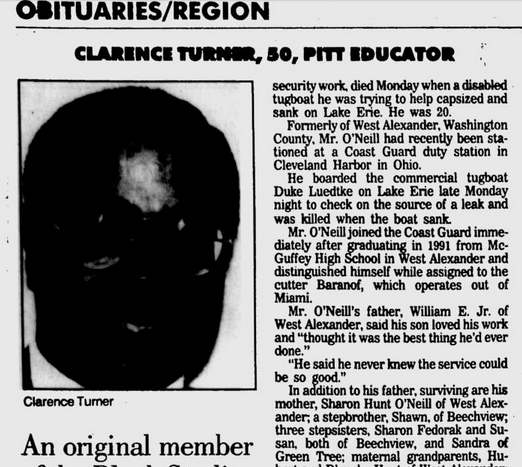
Clarence "Rollo" Turner, in Obituaries section, Pittsburgh Post-Gazette, September 24, 1993. (http://news.google.com).

Clarence “Rollo” Turner, in Obituaries section, Pittsburgh Post-Gazette, September 24, 1993. (http://news.google.com).

Two months ago, the University of Illinois Urbana-Champaign rescinded a job offer they had made to Steven Salaita (then an associate professor of English at Virginia Tech) for a tenured position in American Indian Studies over a bunch of his allegedly anti-Israel tweets. Between mainstream media and social media, the response against this attack on academic freedom and traditional hiring protocols has been tremendous. Thousands of academicians have signed petitions, penned articles and canceled speeches and events at UIUC over Chancellor Phyllis Wise and the Illinois board of trustees’ decision to take back their offer of employment. While the American Association of University Professors, the American Studies Association, the Foundation for Individual Rights in Education, and so many others have argued that Professor Salaita should be in the classroom teaching his courses this fall, this issue is about more than academic freedom and UIUC following job offer guidelines.
The fact is, non-tenure-stream faculty lack the protections and supportive outrage that academia has poured out for those in tenure-track and tenured positions like Professor Salaita. So many contingent faculty lose their jobs over far less than an impolite tweet or an excited utterance. Yet it doesn’t become a story in The New York Times or a petition letter with over 2,000 signatures. No, most contingent faculty, when they lose their jobs, often do so in obscurity, often over doing their jobs with the idea that they were free to teach as they saw fit.

The sadder fact, though, is that this isn’t a new phenomenon at all. Take the case of Clarence Rollo Turner, who passed away twenty-one years ago last month at the age of 50. He was once a veteran senior lecturer in the Department of Black Studies at the University of Pittsburgh, as well as my one-time professor for his History of Blacks in Sports course during the spring semester of 1990. I took Turner’s course in my junior year for an easy-A in the midst of taking a bunch of upper-level undergraduate (and one graduate) history courses that semester. Turner’s was a fun course, and he was a knowledgeable professor beyond its contents. Who knew that in three and a half years the politics of academia would cut short the life of a pioneer? It points to the reality that with half of all higher education instructors serving as contingent faculty, academic freedom is an oxymoron and job protections have become secondary to academic politics and fundraising efforts.

Rollo Turner’s Contingent Teaching Story:

If you’ve never heard of Rollo Turner, it’s mostly because he didn’t have the opportunity to turn himself into a household name in or out of academia, even in Pittsburgh. And, of course, because most non-tenured and non-tenure-stream faculty are seldom central figures at their universities or in their fields just because they’re very good instructors. Turner, though, was a founding member of the Black Studies Program-turned-department (now of Africana Studies) at the University of Pittsburgh. The university had hired Turner in the wake of a game-changing sit-in of Black undergraduate and graduate students in their takeover of an entire floor of the university’s central computer systems on Martin Luther King, Jr.’s birthday in 1969. It was a protest over the lack of student and faculty diversity at the University of Pittsburgh in general. But it was also a protest to demand a Black Studies program that would represent the research and experiences of Blacks on Blacks on an otherwise lily-White Campus, one engaged exclusively in research that almost always excluded Blacks.

In the process of starting this program, the university hired faculty who had yet to earn their doctorates, in some cases with barely a bachelor’s degree. This was 1969, though, when not having a PhD didn’t automatically disqualify candidates from a full-time academic position. Turner was one of several beneficiaries from this change of climate at the University of Pittsburgh, as he was finishing up a master’s degrees in Sociology at Indiana University when the University of Pittsburgh hired him (Turner, incidentally, had helped lead protests for more Black inclusion and a Black Studies program at Indiana in 1968).

Turner took on a joint appointment with the Department of Sociology and with the new Black Studies Program, teaching courses like the Sociology of the Black Family, Introduction to Black Studies and his History of Blacks in Sports along the way. Although the standard courseload for a full-time faculty member at the University of Pittsburgh was five over two semesters per year, Turner had been on a 2-2 schedule from September 1969 through December 1991. For more than twenty-two years, Turner had only taught four courses per year.

When the then-new department chair Brenda Berrian demanded that Turner take on a third course in January 1992, he refused, citing his twenty-two year history with the Black Studies Department and the last-minute nature of the request as reasons. Berrian then moved to terminate Turner. She and two Pitt police officers arrived in Turner’s classroom on the first Friday of the spring semester and had him removed from his classroom and escorted out of the building. Berrian fired him in the middle of his lecture, in front of a room full of students. This was how The Pitt News first reported the incident, and it was corroborated by everything that Rollo Turner told me a few weeks later.

The Politics of Academia:

But though it was that heavy-handed, it was hardly that simple. Turner had gotten himself caught up in a battle that involved his contingent employment status, degree completion, departmental reputation and petty ideological politics. More than twenty-two years as a non-tenured senior lecturer with only a master’s degree and a few publications that included two book-length bibliographies had caught up with Turner. As a contingent faculty member, even with over two decades put in, Turner lacked the protections afforded tenure-stream and tenured faculty members. Granted, at $37,000 a year and living in Pittsburgh at the time in 1992, Turner was a very well-paid senior lecturer. At least, that’s what many would argue today. This was also Berrian’s position as Turner’s termination turned into a $60,000 lawsuit.

Beyond the issue of compensation, contracts and contingent status was what Berrian and the other tenured faculty of the Department of Black Studies wanted for the department’s future. They wanted to bolster the department’s reputation within and outside the University of Pittsburgh. They wanted to be a full-fledged department in which students could major in Black Studies (students could only earn a minor in the subject until 1993), and perhaps, even offer a master’s degree in the field. Two things stood in the way of this progression. One was the fact that half of the department’s faculty didn’t have doctorates, now a much bigger deal in 1992 than it had ever been in 1969.

Two was that not everyone wanted to go in the ideological direction that Berrian had chosen for the Department of Black Studies. She wanted to move toward an Afrocentric approach in teaching and conducting research, something Turner openly rejected as “nonsense.” The idea of a litmus test for what was and wasn’t authentically “Black” or “African” was too extreme for Turner. As a tenured faculty member, Turner’s objections may well have cost him political clout within the department, but it wouldn’t have cost him his job.

Turner’s Final Months:

Turner sued Berrian and the University of Pittsburgh for wrongful termination – stemming in no small part from a hostile work environment – and breach of contract (his was a three-year contract with a year and a half left on it). The suit dragged on in the Civil Court division of Allegheny County Common Pleas Court well into 1993 as Turner – with two daughters in college and a son in the middle of high school – went over a year and a half without a paycheck. As late as August 1993, the month before he died, Turner told me that things on the lawsuit front had taken a turn for the better. Despite the stress of the situation, he hadn’t let Berrian or the University of Pittsburgh “steal his inner peace,” Turner said.

Yet even with years of Buddhism and meditation under his belt and a lifestyle that included biking through all parts of Pittsburgh, Turner died in late-September 1993. No doubt that between the stress of his lawsuit, the sense of betrayal, and the financial upheaval, it all caught up with him. Rollo Turner may well have become a mentor of mine because of the stand that he took, minus the strength of a union or support from a substantial number of tenured faculty. None of this was possible in the end. Precisely because contingent faculty seldom have rights that tenured faculty and university administrators are bound to respect.

Lessons, If Any:

There are so many lessons to be learned here, lessons that resonate with me more now as an adjunct professor than they did when I was a graduate student or when I worked in the nonprofit world. Contingent faculty shouldn’t rock the boat, take a controversial stance, or involve themselves in hot-button issues within their field or department. Or that anyone serving as non-tenured faculty without a doctorate should endeavor to write their dissertation at break-neck speed. Or really, if given the choice, why would anyone who could possibly do anything else with their lives in academia, especially anything that could provide more security and protection, choose a job as a contingent faculty member, whether in 1992 or 2014?

Mostly, it points to the reality that university leaders tend to see much of the talent in academia – non-tenured faculty among others – as expendable. That, and the fact that this expendability has grown with the rapid increase in contingent faculty (and graduate students, for that matter) teaching courses once reserved for tenure and tenure-stream instructors. Until contingent faculty, graduate student teaching assistants and tenured/tenure-stream professors unionize and take a collective stand on working conditions and job protections, cases like Turner’s will continue to go cold and remain tragic ones, with no end in sight.

The Poverty of One Toilet Bowl For Eight

Tags

, , , , , , , , , , , , , , , , ,


A post-1994 environmental friendly toilet, September 20, 2014. (http://greeleygov.com).

A post-1994 environmental friendly toilet, September 20, 2014. (http://greeleygov.com).

It was during the Balkis Makeda phase at 616 thirty years ago where I realized not only that we were in serious poverty, but that we as a family, as part of 616 and part of Mount Vernon, New York lived with a poverty of ideas. Not just ideas about changing the world or other grand concerns. I’m talking about simple stuff, about how to get from Point A to Point B, about how to fix things, about the idea that help can always be found when things go wrong.

It started and ended with our one toilet the third weekend in September ’84. That Friday evening, during my standard early weekend search for my father Jimme and at least $50 after school, my three-year-old brother Yiscoc managed to drop a toy into the toilet and then attempted to flush it and his waste down it at the same time. The result by the time I returned home was a stopped up toilet.

With the Hebrew-Israelite matriarch living with us, eight out of the nine humans in the apartment would need to use the one toilet at some point. Early Saturday morning, Makeda left, presumably for temple, but didn’t return to resume her occupation of my Mom and Maurice’s master bedroom until Tuesday afternoon. So much for the power of prayer!

I must’ve gone down to the bowels of 616 to search out our alcoholic Latino super a half-dozen times between Saturday morning and Sunday evening, in between all of my other more typical weekend chores. Not only wasn’t he around the entire weekend. The stench back in the apartment got worse as the weekend progressed, as my Mom, Maurice, and my younger siblings Maurice and Yiscoc continued to try to use a toilet that went from fifty-percent clogged to eighty-percent backed up.

Ancient Greek child seat and chamber pot, early 6th century BCE, Agora Museum, Athens, March 14, 2009. (Sharon Mollerus via Flickr/Wikipedia). Released to public domain.

Ancient Greek child seat and chamber pot, early 6th century BCE, Agora Museum, Athens, March 14, 2009. (Sharon Mollerus via Flickr/Wikipedia). Released to public domain.

My Mom even tried to have me plunger out this nearly overflowing cesspool Saturday evening, after another walk over to Jimme’s place for money and relief. “What, you never touch shit in a toilet before?” my Mom asked after seeing my face turn toward absolute disgust. I managed to get the sewage water down temporarily, found a way to scoop out a turd without gloves and without throwing up, and pledged to not go in the bathroom again until after the super came to fix the problem. Maurice, my idiot stepfather, left 616 that evening, most likely to carouse and for a working toilet, also not to return until Tuesday afternoon.

There weren’t any good options for toilet use beyond home. That was the Mount Vernon and New York area in which I grew up. Pelham Library and Mount Vernon Public Library were the only decent options where the public restrooms worked and the homeless and careless hadn’t ruined the toilets. Everything else required me buying food or was closed. I used Mount Vernon Public Library before it closed Saturday afternoon, back when stayed open until 5 pm on Saturdays, at least (I think it only stays open until 1 pm on Saturdays now).

I split that Sunday between washing clothes with the little bit of money we had left from my Jimme-run the previous weekend and then searching for Jimme that afternoon. I couldn’t be at 616 for another round of virtual typhoid and dysentery while splashing around in deadly toilet water and using a cleaning bucket as a chamber pot.

We reached Jimme’s, my older brother Darren and me, by 2 pm that Sunday afternoon. He was home, hung over from another weekend of gettin’ to’ up, moaning as usual about how he “cain’ do dis no mo’. Nex’ week. Gotta stop drinkin’ nex’ week.” I didn’t care what my father had left of his money that Sunday. We stayed there until after 7 pm, watched the Jets beat up on the then sucky post-Ken Anderson Cincinnati Bengals, ate a few snacks and some golden delicious apples and pears, and used the functioning attic toilet to our bowels’ content.

Electric drain cleaner with a 100-foot snake, aka, Roto-Rooter, February 7, 2010. (Pgdp123 via Wikipedia). Released to public domain via CC.SA.3.0.

Electric drain cleaner with a 100-foot snake, aka, Roto-Rooter, February 7, 2010. (Pgdp123 via Wikipedia). Released to public domain via CC.SA.3.0.

I did manage to get $30 out of Jimme, with promises of more by that Tuesday. It came with the caveat that we’d start earning our money by working for him down in the City again. But that wasn’t a big concern.

Me and Darren went to MVHS and Clear View School school that Monday morning with a still stopped up toilet and no sign of the super. So, before I came back to the apartment after school, I tracked down the man, yelled at him for not being available all weekend, and then asked politely for him to bring up his snake machine. Which he immediately did.

It took between forty-five minutes and an hour for him to clear the pipe and pull out the toy truck that Yiscoc had somehow managed to get down in the toilet on Friday. The super laughed through his mask, said something about kids in his combination of broken English and Dominican Spanish, and left us with a working toilet once again. I still didn’t sit on it to take a dump for nearly a week after the whole ordeal, though.

Ass Whuppins and NFL Fanatics

Tags

, , , , , , , , , , , , , , , , , , , , , , , , , , ,


Collage of Houston PD pics of cut/contusion marks on Adrian Peterson's four-year-old son, September 12, 2014. (http://atlantablackstar.com).

Collage of Houston PD pics of cut/contusion marks on Adrian Peterson’s four-year-old son, September 12, 2014. (http://atlantablackstar.com).

I’ve been irritated by what I’ve seen in the media and in social media over the past week. First, the idea that Minnesota Vikings’ running back Adrian Peterson’s alleged crime was the spanking of his four-year-old kid back in May, one that left cuts and contusions all over his body, including the kid’s scrotum. In Peterson’s world, in the world in which I grew up, and in the world of millions of Americans, we didn’t and don’t use the term spanking at all — ass-whuppin’  (or a beating) is what constitutes corporal punishment.

Second has been the response of sports talk radio and many NFL fans — especially including the less enlightened and more entitled of the sports media — to public criticism and how teams have reacted to recent domestic violence and child abuse revelations. Their response to CBS’ Thursday Night Football host James Brown speaking up about men needing to take more responsibility for their actions vis-a-vis domestic violence: “Shut the hell up! You’re ruining my mood for the game! This isn’t the right time or the place to talk about domestic violence, just before my football game!”

Outlander character Jamie Fraser in midst of second 100-slashes punishment, screenshot (cropped) from S1:Episode 06 "The Garrison Commander," September 13, 2014. (http://plus.google.com).

Outlander character Jamie Fraser in midst of punishment, screenshot (cropped) from S1:Episode 06 “The Garrison Commander,” September 13, 2014. (http://plus.google.com).

Both reflect the insularity of the elitism that is mainstream media and the denier-resentment that is Whiteness in America as reflected in sports and especially football. To call what Peterson did to his son a spanking, well, it defies all logic. It was an ass-whuppin’, plain and simple. Journalists, bloggers and tweeters dedicated many posts and articles over the past six days to the issue of spanking and why so many wee common folk accept spanking as a form of discipline for their children. I have yet to see an article that makes the correct distinction between a spanking — the use of a hand or a light paddle to smack the butt of a child — and an ass-whuppin’.

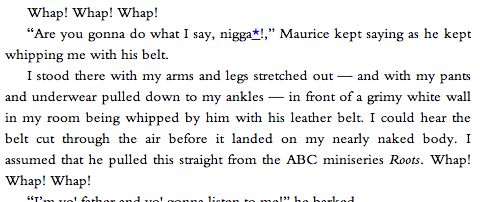
See, between the ages of three and thirteen, my Mom, my father Jimme, and my idiot stepfather Maurice Washington gave me between twenty-five and thirty ass-whuppins, but only two or three spankings. Here’s the last ass-whuppin’ I got from Maurice before he transitioned to upper cuts and kicks to my stomach:

Screen shot 2014-09-18 at 5.48.27 AM

This wasn’t the first time I had to strip down to nothing to have my butt, back and legs beaten to the point of welts and contusions, though this ass-whuppin’ led to my second incident of severe abuse. Over the years, my Mom and my babysitter Ida (she died recently at eighty-six — RIP) had whupped me and my older brother Darren with a switch (though with one far more prepared for beating a child without marking up skin than what Peterson allegedly used). They and Maurice had also used the standard leather belt, an extension cord (the type that you plug into a wall socket), and a shoe (my Mom did that in front of a crowd at a July 4th picnic in ’79).

Over those years, my parents and my somewhat legal guardians slapped me, smacked me, kicked me in the eye, and put me in a head-lock, all before my summer of abuse in ’82. Not once did anyone responsible for disciplining me call it a spanking. Based on my own experience and the experiences of people I’ve met and known over the years, I can pretty much guarantee Peterson didn’t call it a spanking either.

Screen shot 2014-09-18 at 6.07.15 AM

Steve Czaban, host of The Drive, ESPN Radio 980 Washington DC, November 2013. (http://www.theczabe.com/).

Steve Czaban, host of The Drive, ESPN Radio 980 Washington DC, November 2013. (http://www.theczabe.com/).

Then there’s been the NFL’s reaction to the gigantic PR hit it has taken over commissioner Roger Goodell’s handling of the Ray Rice case and the Baltimore Ravens’ subsequent termination of Rice. Not to mention the Vikings’ deactivation-reactivation-deactivation of Peterson, the Carolina Panthers’ deactivation of convicted woman abuser Greg Hardy, and yesterday’s arrest of Arizona Cardinals running back Jonathan Dwyer, whom the Cardinals also deactivated. I’m more than certain that ESPN Radio 980 show host Steve Czaban wasn’t alone when he called these sanctions “overreactions” and lamented the “slippery slope” that the NFL as “moral police” has started to slide down. Czaban represents an ilk of sports show hosts and corresponding listeners and fans who want sports to remain a “diversion” from “real life,” to not have someone’s “politics” like James Brown’s ruin their spectator experience.

To that, I say, good! Men shouldn’t be comfortable living in a bubble in which the athletic “freaks” who entertain them in sports should then be excused when accused of committing crimes. Nor should they be called  “animals” when the law proves that they are guilty of such crimes. White men especially often act as if it’s their world and they have the right to a relaxing day without dealing with issues of racism, misogyny, patriarchy, homophobia and other forms of inequality from which they benefit every day.

To that I say, we need more statements during sports programs from James Brown and Hannah Storm, more advertisers (even ones as hypocritical as Anheuser Busch, as their beers help fuel domestic violence and child abuse) “venting their spleen,” more people taking a stand against people who like their spectator entitlements a bit too much. To those denialists, especially Czaban, I say, kiss my abused Black ass.

Why My Mom Stayed

Tags

, , , , , , , , , , , , , , , , , , ,


My Mom at 48 years old, Yonkers, NY, December 23, 1995. (Donald Earl Collins).

My Mom at 48 years old, Yonkers, NY, December 23, 1995. (Donald Earl Collins).

I planned to write something about my Mom on her birthday again this October, focusing on her multiple roles as mother, breadwinner, domestic violence victim and evangelical Christian in that post. With the TMZ-released video of Ray Rice and the public response to the NFL’s misogynistic hypocrisy making the issue of domestic violence front and center this week, it makes sense for me to talk about my experience and my observations via my Mom this week as well.

First off, thanks to all the brave women who’ve tweeted, posted on Instagram, Facebook, WordPress and other places their experiences with domestic violence. Thanks especially to Beverly Gooden (@bevtgooden) for creating and using the hashtag #WhyIStayed in response to the barrage of criticism leveled at Janay Palmer Rice for marrying Ray Rice after his brutal act of violence against her. I know domestic violence and child abuse firsthand, as I watched my Mom experience the Isshin-ryu-Karate version of a knockout and concussion on Memorial Day ’82 at the hands of my then stepfather Maurice Washington.

Screen shot 2014-09-11 at 7.54.54 AM

This wasn’t the first time Maurice had hit my Mom, as I’d learn years later, but it was the first time I witnessed it. I’d seen my Mom attacked before, by my own father when I was little. My father was often drunk and equally incompetent during his attacks, so any physical damage that was done was from my Mom beating him up. The psychological and emotional damage, though, flowed right from her first marriage to my father to her second one with Maurice.

For seven years and sixteen days after the day my childhood ended, my Mom and Maurice lived together as husband and wife at 616. I can say with one hundred percent clarity that there wasn’t a day between Memorial Day ’82 and the final fight that led to my late ex-stepfather moving out that I didn’t feel some sort of dread, a cloud of lethargy hanging over my head, even while at college at Pitt. That was partly because I’d made a point of running interference and taking abuse to make up for not calling the police on that day of days.

I didn’t know why my Mom couldn’t find the strength to kick Maurice to the curb, at least not before the middle of ’89. But there was an incident between me and Maurice about a year before he finally moved out, one where what he said afterward gave me additional insight into my Mom’s inaction.

Screen shot 2014-09-11 at 12.52.50 PM

At least, I had to believe that, right? It just seemed we’d been through too much with a man who’d never paid a month’s rent, a phone bill, a Con Ed bill, a cable bill, and only bought Great Northern beans, rice and cabbage for his kids (my younger siblings) on the handful of days he decided to contribute to our malnourished family.

So finally, in the months after he left 616 for good, I asked. My Mom’s first answer was, “He fooled me. He fooled us all!” Her answer was completely unsatisfying, considering that I ran away from home to get away from Maurice when I was nearly nine years old.

The summer of ’89 wouldn’t be the last time I’d ask. Over the years, my Mom has given various explanations. “I thought he was a changed me,” she’d say, referencing their six-month separation in ’80-’81 and Maurice becoming a Hebrew-Israelite and “Judah ben Israel” in the interim. “What good would that done?,” my Mom would ask me in response, implying that she wanted to avoid a physical confrontation.

Really, I spent thirteen years reading in between the lines, asking relatives questions about my Mom, doing research and boning up on domestic violence and child abuse from a social science perspective, all for more substantial answers. Really, my Mom’s domestic violence experience, our fall into welfare poverty, and my child abuse experiences were the first reasons for me wanting to write what would become Boy @ The Window in the first place.

"Divorced at last" layer cake, or "Broken Marriage," March 2014. (http://www.nigeriancurrent.com/).

“Divorced at last” layer cake, or “Broken Marriage,” March 2014. (http://www.nigeriancurrent.com/).

By the time I did the family intervention in January ’02, I knew why. I knew that despite my Mom not remembering much from the beating, knockout and concussion she took in May ’82, she lived in fear. If for no other reason than from seeing the look of hurt on my face whenever the subject of her beating came up. Maybe not a constant, shaking-in-her-shoes fear, but the idea of having to force a six-one and overweight yet powerful man out of 616 probably scared my Mom. But that wasn’t her only fear. As I wrote in Boy @ The Window, “[w]e were already the children of one divorce, and I wasn’t sure if I wanted to see another one so soon.” I’m more than sure that my Mom felt the same way about herself and her relationships with my father Jimme and Maurice as well.

I also know with certainty my Mom would never want me to write about her, especially about her as a victim of domestic violence. But she wasn’t the only one to experience it. I may be able to live my life successfully despite it, but I’ll never be able to un-see what I saw nearly thirty-two and half years ago. It put me on a very long road, one that involved my own conflicting feminism and sexism (though with zero tolerance for violence against women). Or, what I call damsel-in-distress syndrome, where I always want to help, even when that help is unwelcome.

There are millions of reasons why women get married or stay in relationships and marriages, some of them rational, some based in fear, many who stay because abuse does untold damage to self-worth. I may not fully understand what it’s like to be a woman who’s been abused, but I do understand what it’s like to be the son of one. Most of us who don’t know of these horrors need to be quiet, read, and listen more.

The Long-Term Legacy of Humanities’ Soft-Bigotry

Tags

, , , , , , , , , , , , , , , , , , , , , , , , , ,


This week marks thirty-three years since my first days in the gifted-track Humanities Program, a fairly diverse group of very smart and (some) pretty creative students. Despite the common refrain among administrators of this long-gone program, me and my Humanities classmates weren’t the “crème de la crème” when it came to critical or independent thinking. In recent years, I’ve learned that their views on politics, religion, sports, entertainment, family and so many other things are so typically and sadly American.

Since the creators’ premise for the Humanities Program was to develop the whole person, and not just academic success, it seems to me that the program failed in terms of providing a holistic education. That our parents and other authority figures helped shape the opinions and beliefs we take to adulthood is part of my observation here. The disappointing part for me, though, has been the fact that these opinions have gone unadulterated over the past twenty-five or thirty years.

This isn’t an indictment of everyone I’ve ever known from Mount Vernon, New York, or from Mount Vernon public schools, or from MVHS, or even from my Humanities years. There are more than a few individuals who I am so glad to have reconnected with in person or through Facebook, Twitter and WordPress in the past decade or so. Everyone has the right to their beliefs, their ignorance, their opinions, however ill-informed or illogical. But there are consequences to never challenging one’s own beliefs, ignorance and opinions. Consequences that include victim-blaming, xenophobia, religion-as-politics, respectability politics, jingoist hyper-patriotism and colorblind racism.

What I’ve observed over the past ten or eleven years is that, when taken as a whole, it seems that I grew up around and reconnected with a group whose beliefs and opinions differ so much from my own. So much so that it really strains my memory to think that I grew up there. As my wife said to me on her first visit to Mount Vernon in Christmas ’99, after seeing a burned out Mazda smack-dab in the middle of downtown, “You sure you weren’t adopted?”

You Can’t Go Home Again to a Place That Was Never Home

I suspected some stark differences by the time I started working on Boy @ The Window in earnest in ’06. Any number of the ex-classmates I interviewed expressed opinions that I’d heard long before about “illegals,” about how Mount Vernon was some sort of middle-class haven, about our Humanities class being a faux “Benetton commercial” or a “mini-Fame.”

These were the kinds of opinions I remembered hearing from their parents and our teachers back in the ’80s. The sense of paternalism and entitlement, or the sense that MVHS was dangerous or “a jungle” or full of “animals.” It reminded me that there were many classmates who I’d met in seventh grade who’d transfer to private or parochial school or had enrolled in “better” schools in other districts by tenth grade because their parents were terrified by the so-called dangers of a mostly Black and Latino high school, with poverty and criminality being the unspoken words here.

I’ve faced off with the son of our late former principal Richard Capozzola several times on my blog and on Facebook in the past three years over this very issue, of how MVHS was run like a prison-prep program. His rationale for justifying Capozzola’s anti-Black draconian policies at MVHS consisted of “my dad was a great dad” and that I “wouldn’t have survived a day” at MVHS without his father as principal. The frame of MVHS as a war-zone or prison with students of color assumed to be criminals within this frame, this son of Capozzola couldn’t recognize even if Spock did a mind-meld to give him a dose of the Black experience.

Uncritical Melody, On Mount Vernon and the World

Neil DiCarlo, ex-classmate, right-winger, and one-time candidate for NY State Senate out of Putnam Valley, October 15, 2012. (http://archive.lohud.com/).

Neil DiCarlo, ex-classmate, right-winger, and one-time candidate for NY State Senate out of Putnam Valley, October 15, 2012. (http://archive.lohud.com/).

My observations aren’t limited to race or MVHS per se. Among my former classmates, with everything from affirmative action to Zionism, from political parties to education reform, from immigration reform to religious diversity, so many have views that range from conservative to right-wing. For some, every question can be answered with Leviticus or Ephesians, and any disagreement with a condemnation to Hell. For others, the frame for these issues are a “both sides do it” or “let’s look at both sides.” As if any issue involving climate change or social injustice is an algebraic equation, as if these issues are about finding some preposterous balance, rather than about exploitation or oppression.

But where I’ve found myself most at odds with some of my ex-classmates is the very issue of Mount Vernon itself as a city or a nurturing environment. It’s not as if I’ve never acknowledged the reality that if one didn’t grow up in poverty, or had connections to city politics, church or community leaders, or at least thirty cousins within a mile of your domicile, that Mount Vernon was a pretty good place to grow up. It wasn’t for me. It wasn’t for many people I grew up around.

Yet time and again, as I’ve told my story here and as I began to put Boy @ The Window together between ’06 and ’11, some of my former classmates and a couple of my former neighbors have opined that I have an ax to grind. Yeah, actually, I do, but not about Mount Vernon per se. About the poverty, abuse and ostracism I experienced growing up there, that shaped my experiences there, that authority figures often ignored. In those things, I do have a point that I have and will continue to hammer away at with the sledgehammer I have at my disposal. Too often, my former classmates believe that the only Mount Vernon that should be on public display is the one that emphasizes their raceless or supercool middle-class experience.

Some of My Classmates = Conservative America

Kerry Washington as Olivia Pope from Scandal, a show about damage control, controlling the narrative, September 15, 2011. (http://scandal.wikia.com).

Kerry Washington as Olivia Pope from Scandal, a show about damage control, controlling the narrative, September 15, 2011. (http://scandal.wikia.com).

Even in this, there’s a conservative perspective. One that says, “don’t rock the boat, don’t express a perspective that’s different than the narrative we want to put out to the world.” I know from experience and as an educator that sweeping truth into a dustbin and expressing only acceptable opinions — or acting as if all opinions, when expressed respectfully, are equal to each other — hurts us all, but especially those who are shut out of the conversation. I wish that so many of my ex-classmates had learned this while growing up in Mount Vernon, while in Mount Vernon public schools, while in Humanities with me.

I’ve come around to Morning Joe host Joe Scarborough’s way of thinking. America is a center-right nation, just as the Founding Fathers intended. Or, to be most precise, America’s DNA is one that has always had the “this-is-a-heterosexual-White-man’s-country” mutation baked into it, a gene that morphs to the point of virtual immutability. A fair number of my ex-classmates also have this mutation, which may explain my inability to fit in more than my kufi, Hebrew-Israelite status, or living at 616 in the midst of poverty domestic violence and child abuse.

On Tolerance and Not Wearing My Kufi Anymore

Tags

, , , , , , , , , , , , , , , ,


Mahatma Gandhi (1869-1948) quote on superiority and tolerance, September 6, 2014. (http://thousayest.wordpress.com).

Mahatma Gandhi (1869-1948) quote on superiority and tolerance, September 6, 2014. (http://thousayest.wordpress.com).

Today’s date marks three decades since I decided to stop wearing my kufi in public, my first day of tenth grade at Mount Vernon High School (NY). It also marked my coming-out party (so to speak) as a Christian and a day of defiance toward both my Mom and my idiot stepfather Maurice Washington (now deceased), all of which is well-documented here and in Boy @ The Window.

What I haven’t spent much time or space writing about was how my one-time classmates received me in terms of my kufi or the Hebrew-Israelite religion during the three years between the start of seventh grade in ’81 and the end of ninth grade in June ’84. Sure, I’ve talked about Alex and the “Italian Club,” kufi battles and other incidents involving my classmates in which bullying or attempts at bullying occurred. How much were these incidents about me, about me being poor and Black, about me being weird and Black, about me and my kufi? It wasn’t always clear.

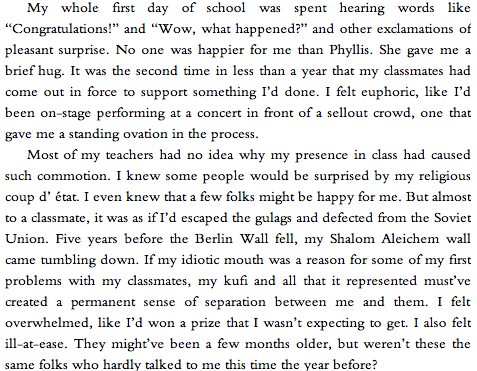
What was clear was that the vast majority of my classmates, though they may have given me weird looks or quietly snickered, said nothing to me one way or the other about my kufi or my religion. But on that first day of tenth grade, the day I stopped wearing my kufi, my classmates were hardly silent at all.

Screen shot 2014-09-06 at 1.14.44 PM

I wondered most of all about my Jewish classmates, at least the ones who actually practiced Judaism. With Josh as the one exception, they to a person never said a word or asked a single question about my religion or my kufi. This despite the fact that fundamentally, I was an Orthodox Jew between ’81 and ’84. I didn’t get an answer while I was in Humanities or at MVHS. Years later, I interviewed one of my former classmates, whose father was a rabbi at one of the largest synagogues in Westchester County. I asked him about the silence. “I thought nothing of it,” he said, as he’d been “taught to respect other people’s beliefs.”

On some level, I could accept this answer at face value. But even at the moment of the interview, I didn’t find this former classmate’s answer enlightened or satisfying at all. His answer on the surface demonstrates the very definition of tolerance. Yet tolerance through silence is the absolute minimal definition of respect for differences. Tolerance is hardly the same as accepting or embracing differences, defined by taking active steps to understand and empathize with different peoples and cultures. Not to mention taking the extra step of working to protect those people and their differences from the intolerant.

Standing ovation, opera house unknown, May 21, 2012.(http://www.thelmagazine.com).

Standing ovation, opera house unknown, May 21, 2012.(http://www.thelmagazine.com).

I knew on some level even in ’84 that many if not most of my Jewish classmates had remained silent because the idea of Blacks as Jews in terms of religion or genetics was barely in their consciousness. It’s still hard for many Jews I’ve known over the years to accept now, even with a population of Ethiopian and other East African Jews living and working in Israel. It’s difficult to embrace the mosaic that is the Jewish diaspora, even with evidence pointing to communities made up of the descendants of some of the so-called Ten Lost Tribes of ancient Israel living in southern Africa and northern India (as documented by the Discovery Channel in documentaries over the past fifteen years). Me as a kufi and yarmulke-wearing Black teenager practicing Judaism had to be weird and beyond the pale for those classmates.

The way the rest of my classmates reacted to the end of my Shalom-Aleichem-days was also an example of minimal tolerance, or really, intolerance. In six years of Humanities, I’d never gotten that many of my classmates to pay attention to me for longer than an answer to a history question unless it was for ridicule or for a presentation or an award. The fact that at least two dozen had something positive to say about my lack of a kufi, or upon further inquiry, my turn to the Christian side, told me all I needed to know about my status with my classmates for the previous three years.

I’m hardly excluding myself from this notion of intolerance. My view of myself as a Christian in those first months after I converted was one that set me apart from Catholics, Baptists, Jehovah’s Witnesses, the Nation of Islam and Jews alike. I didn’t necessarily think or say things about these different religions or the classmates who practiced them. I just ignored those differences while giving every appearance that my nondenominational view of Christianity, my Bible-quoting and toting self, was the only lens through which anyone should view themselves and the world around them. It would be another year before I recognized my own childishness regarding my views of spirituality, religion and tolerance.

First Day and Last Day of School This Week

Tags

, , , , , , , , , , , , , , , , , ,


Cecil Parker Elementary School (formerly Nathan Hale ES), Mount Vernon, NY,  November 23, 2006. (Donald Earl Collins).

Cecil Parker Elementary School (formerly Nathan Hale ES), Mount Vernon, NY, November 23, 2006. (Donald Earl Collins).

I’ve written about parts of this before, back in my first days of blogging about my life and times as a student. But this week is especially poignant. Yesterday (September 2) marked twenty years since I sat through and passed my PhD dissertation overview defense at Carnegie Mellon in Pittsburgh, making me ABD (All But Dissertation, an official PhD candidate). Tomorrow (September 4) will be forty years since my first day of school, attending kindergarten at the Nathan Hale Elementary School (now Cecil Parker ES) in Mount Vernon, New York. It was a school two buildings and an asphalt playground down from our second-floor flat, 425 South Sixth Avenue. In between was nineteen years and 363 days of time as a formal student, going from learning how to read “Dick and Jane went to the store” to writing a “book” about multiculturalism and Black Washington, DC.

I’m sure most of us don’t remember so much of what occurred in between day one and day 7,303 of student-hood. I remember plenty, though. I remember the morning being unusually cold and having to wear a windbreaker or a raincoat (according to a weather website, the high that day was only 69F, and it actually rained at some point during the day). Kindergarten was only a half-day endeavor back then, so I remember getting released to come home for lunch and spending the rest of the day playing with my Tonka toys and watching Sesame Street and The Electric Company.

Second floor of Baker Hall, Carnegie Mellon University, Pittsburgh, PA, December 2, 2010. (Daderot via Wikimedia). In public domain.

Second floor of Baker Hall, Carnegie Mellon University, Pittsburgh, PA, December 2, 2010. (Daderot via Wikimedia). In public domain.

Contrast that with a warm first Friday in September ’94, at a time when I’d met some new first-year PhD students in the History program, Carl, Jeff, Susannah and a few others, who all seemed surprisingly interested in my dissertation work. I think it was just that I was one of their first points of contact, going through something they themselves hoped to do within a few years. Either way, I’d been preparing to defend my eighty-page dissertation overview for the previous six weeks, in between working on a migration studies research project for Joe Trotter and keeping an eye out for dissertation grants that I firmly believed were necessary for me to get out of grad school with my sanity intact.

As I walked up the sloped, dark, factory-mimicking hallway on the second floor of Baker Hall to what would be two hours of interrogation from Trotter, Dan Resnick, Bruce Anthony Jones and Department Chair Steve Schlossman (among others in the conference room that morning) with my “entourage,” I had this two-decade juxtaposition in mind. I actually started thinking about the long path from kindergarten to PhD, and all the bumps, bruises and breaks along the way. About how on a September 2nd morning six years before, I’d been homeless and came within days of dropping out of college. About how none of this would have been possible without my older brother Darren, who taught me how to read on Christmas Day ’74. Or, for that matter, without my third-grade teacher Mrs. Shannon encouraging my Mom to buy the entire set of the ’78 edition of The World Book Encyclopedia, which led to me reading through that set between December ’78 and April ’79.

Even J. Anthony Lukas‘ Common Ground: A Turbulent Decade in the Lives of Three American Families (1985) was in my head as I laid out my papers and dissertation overview as references for my overview defense. I’d only read the book in the previous year. This Pulitzer Prize-winning book for nonfiction lived up to the award it earned Lukas, as he went to excruciating lengths to make the process of desegregation by busing, White fears, and Boston’s racism and racial divide come alive.

Front cover of Common Ground (1985) by J. Anthony Lukas, September 3, 2014. (http://goodreads.com).

Front cover of Common Ground (1985) by J. Anthony Lukas, September 3, 2014. (http://goodreads.com).

In reading about what the White parents did to stop busing in September ’74, it forced up a memory of watching the evening news my first two days of school about Boston’s White community rioting over busing and desegregation. The picket signs, the bottles and rocks. I remembered asking my Mom about it then, but I don’t think she gave me a direct answer. Lukas, though, did, twenty years later.

Finally, I thought about my Humanities classmates as I sat down and had gone through all of the pleasantries with my dissertation committee and other professors and grad students in the room. I thought about how classmates like Josh and Danny ridiculed me as a savant, who told me that history essentially was only trivia, that I couldn’t do anything with it other than “go on Jeopardy.” In some ways, they were right. They just weren’t correct on September 2, ’94.

All of this gave me a place to start. So when Trotter asked me, “What in your life has prepared you for this moment?,” I knew from which parts of my life’s journey to pick. Only to realize that in starting at the beginning, I was nowhere near full circle.