• Spinning Sage’s Gold: Allegories on the Western-Dominated Present and a Possible Post-Western Future (2025)
  • About Me
  • Other Writings
  • Interview Clips
  • Video Clips
  • Boy @ The Window Pictures
  • Boy @ The Window Theme Music

Notes from a Boy @ The Window

~

Notes from a Boy @ The Window

Category Archives: Boy @ The Window

Kiss From A Rose – 20 Years On

20 Wednesday May 2015

Posted by decollins1969 in 1, Boy @ The Window, Carnegie Mellon University, culture, Eclectic, eclectic music, Marriage, Movies, music, Pittsburgh, Pop Culture, race, Work, Youth

≈ Leave a comment

Tags

"Kiss From A Rose" (1994/1995), 71B, Angelia, Angelia N. Levy, Batman Forever (1995), Bruce Willis, Carnegie Library of Pittsburgh, CMU, Dating, Die Hard With A Vengeance (1995), Friendships, PAT Transit, Romance, Samuel L. Jackson, Spencer Fellowship, Val Kilmer


Twenty years ago on this date, I re-met the woman who’s now my wife of fifteen years, Angelia on a PAT-Transit bus in Pittsburgh, the old 71B-Highland Park into Oakland. It was an eighty-five degree Saturday afternoon in the ‘Burgh. I decided to treat myself to a movie, Batman Forever (1995), mostly because I knew Val Kilmer was in it. After seeing him act as well as he did in Tombstone, I figured I needed to give it a try. I needed a break, between the euphoria of the Spencer Fellowship and the depression from the fire at 616 that had rendered my family homeless.

So here it was, 3:15 in the afternoon, with me dressed in a blue t-shirt with blue basketball shorts and sneaks. I was standing at the corner of Highland Avenue and Penn Circle South, across from my apartment building, waiting for a bus. The 71B showed up first. I jumped on, sat down on the right-hand side in a front-facing seat. As soon as I sat down, I saw her, sitting right in front of me. It was “Angela with an ‘i’,” Angelia, like that Richard Marx song from ’90.

Seal's second album/CD, Seal (1994): "Kiss From A Rose" re-released as part of Batman Forever (1995) soundtrack in June/July 1995. (http://www.allmusic.com).

Seal’s second album/CD, Seal (1994): “Kiss From A Rose” re-released as part of Batman Forever (1995) soundtrack in June/July 1995. (http://www.allmusic.com).

The thing was, I had a dream that she showed up in the Saturday before this one. I hadn’t seen Angelia in more than two years, hadn’t given her any thought. But it seemed weird that she would just show up a week later in the flesh.

So I said, “Hi Angelia!,” excitedly, wondering what she was doing on the bus. She paused, said “Hi” with the heaviest, stop-bothering-me sigh I’d heard since my high school days. That didn’t deter me. I coaxed out of her the fact that she was pissed off with Carnegie Library because a book she was looking for at the East Liberty branch wasn’t there, even though the catalog said it was. It was a conversation that was one-sided, with Angelia doing most of the complaining.

I listened, and thought, “Yep, same Angelia, same weird Angelia.” But since I was weird also, I kept listening. Finally, she asked me what I was up to. I told her about school, my Spencer Fellowship, my family’s homelessness situation. I kept it brief. I mean, I hadn’t seen her in two years.

By the time we reached Oakland — me to catch one of the 61s to Squirrel Hill to catch the movie, Angelia to walk over to the main branch of Carnegie Library — we exchanged numbers, with Angelia saying, “It was really good talking to you.” I wasn’t so sure about that myself, but at least, she didn’t seem as weird as the woman she was five years earlier.

Screen with Samuel L. Jackson and Bruce Willis from Die Hard With A Vengeance (1995), posted February 28, 2013. (http://chud.com).

Screen with Samuel L. Jackson and Bruce Willis from Die Hard With A Vengeance (1995), posted February 28, 2013. (http://chud.com).

I went to see the movie, but it turned out that it wasn’t out yet. It wasn’t due out for another month! I ended up seeing Die Hard With a Vengeance with Bruce Willis and Samuel L. Jackson. Though much better than Die Hard 2 (1990; one shouldn’t really watch any feature film with John Amos taking up significant screen time, it still sucked, because Willis and Jackson spent half the movie yelling, and Jeremy Irons’ performance didn’t have Alan Rickman’s sense of social irony. I walked home, got together some grub, and through all preconceptions out the window. I gave her a call to tell her about the film mix-up. We ended up talking for more than three hours! It was the first time in a long time I had talked to a woman who wanted to hear what I thought about, well, anything, at least anything outside of sex. It was the start of a beautiful friendship.

A month later, we went to see Batman Forever, and it sucked, just like Angelia said it would. But Seal’s “Kiss From A Rose” didn’t. I bought his CD, though, and not the movie soundtrack!
The Long Road Home

19 Tuesday May 2015

Posted by decollins1969 in 1, Academia, Boy @ The Window, Carnegie Mellon University, culture, Eclectic, Jimme, Pittsburgh, Politics, Pop Culture, race, Work, Youth

≈ Leave a comment

Tags

"Thriving as a Freelance Academic", Academia, Academic Writing, Bruce Anthony Jones, Career, Career Decisions, Career Development, Career Options, CMU, Disillusionment, Joe William Trotter Jr., Katie Rose Guest Pryal, Peter Stearns, Politics of Academia, Politics of the Foundation World, Self-Awareness, Self-Determination, Self-Discovery, Social Justice, Teaching and Learning, The Chronicle of Higher Education, Troublemaker, Writing


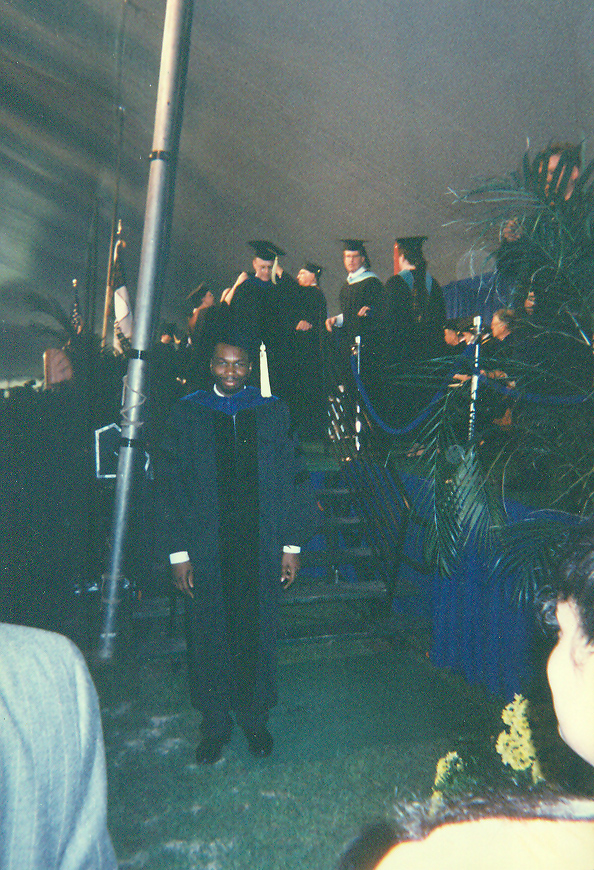
My stressed-out PhD walk photo, Carnegie Mellon University, May 18, 1997. (Angelia N. Levy).

My stressed-out PhD walk photo, Carnegie Mellon University, May 18, 1997. (Angelia N. Levy).

It’s been eighteen years and nearly a day since I had to shake then Carnegie Mellon Dean Peter Stearns’ hand on stage as part of the PhD portion of the 100th commencement ceremony for graduates, that third sweltering Sunday in May ’97. I’ve talked about the ceremony, my Mom’s jealousy and issues about my degree, Peter Stearns, Joe Trotter, Bruce Anthony Jones, and what happened before and after the degree ceremonies on that fateful day.

But time and enlightenment — especially the latter — has allowed me to take a step back from the events leading to a new wave of disillusionment in my life. If I really think about it, my struggles with where I wanted to go with my career go as far back as ’81, in the months after my first accolades as a writer, to the time when at eleven, I already had an encyclopedic knowledge of history, basic science, and technology. Heck, I already knew some of the historiography around World War II, the Cold War, American slavery and civil rights, long before I ever knew the definition for historiography. Not to mention, I was already living what we now call migration studies, thanks to my Mom and dad.

But my Boy @ The Window years did their damage to me. By the time I turned twenty at the end of the ’80s, I wasn’t fully clear of the array of choices I had for a career or set of careers. I knew I could write, and often write well. Yet I had stopped seeing myself as a writer by the time I went through my summer of abuse in ’82. I knew that I was a historian, because I asked the kinds of questions about history that only trained historians would. Yet I hated the idea that I was supposed to write only one way, using words like synergistic and interstitial (at an esoteric minimum) along the way. I toyed with the idea of going to law school in ’90, even going so far as to take the LSAT, scoring a then-50th percentile 31 on the exam in my one-and-only try.

Arthur Wesley Dow (1857-1922), The Long Road--Argilla Road, Ipswich, circa 1898, April 28, 2010. (BrooklynMuseumBot via Wikipedia). In public domain.

Arthur Wesley Dow (1857-1922), The Long Road–Argilla Road, Ipswich, circa 1898, April 28, 2010. (BrooklynMuseumBot via Wikipedia). In public domain.

I struggled for years with my fundamental question: “Am I an academic historian who’s also a writer? Am I a writer who’s also a historian? Can I be both?” I realized about a decade ago the question was moot. I am both. The real question really has been, will the working world allow me to operate as both without giving me grief and a hard way to go? (By the way, if I ever were to do a second, post-Boy @ The Window memoir, this would be one of that book’s big themes.)

I can safely say as a mildly successful freelance writer that the answer for many in this world of singularities is no. The working world puts up a fight, has and will continue to try to force me and others with multiple talents to choose one path, to do one thing, and one thing only, ideally for all time.

Academicians only think about each other via teaching duties or well-placed articles and books in scholarly journals and scholarly publishing houses. Higher education administrators believe that the only way to understand their work is through the lens of their specific university, as if universities and colleges aren’t similar from a management standpoint. Nonprofit organizations

A male mallard duck, a bird's triple threat (can walk, swim under water and fly), Saint-Eustache, Quebec, Canada, November 19, 2007. (Acarpentier via Wikipedia). Released to public domain via CC-SA-3.0.

A male mallard duck, a bird’s triple threat (can walk, swim under water and fly), Saint-Eustache, Quebec, Canada, November 19, 2007. (Acarpentier via Wikipedia). Released to public domain via CC-SA-3.0.

discount teaching and higher education administrator positions because finding money or managing students isn’t exactly the same as managing staff. Foundations who use your salary history instead of your scope of programs developed, people reached, and money raised as a barometer for even granting you an interview. All would prefer that you be quiet about injustices, especially ones in which their institution, organization, or foundation might well be complicit.

For me in the past couple of decades, though, I’ve worked in and with academicians, higher education administrators, nonprofit organizations, and private foundations. I’ve helped raise $3 million over the years, managed as many as twenty-five staff members, organized four-day conferences with a couple hundred attendees, worked with as many as 500 students at any given time, and taught undergraduate and graduate courses. I’ve written scholarly articles, published in scholarly journals, presented at a couple dozen conferences, and consulted for nonprofit organizations and foundations. To think of myself as only one thing is beyond ridiculous given my by-necessity-and-neglect careers so far.

Yesterday, The Chronicle of Higher Education posted the article “Thriving as a Freelance Academic” by Katie Rose Guest Pryal. In it, Pryal interviewed three White women about their experiences freelancing in the academic world. The women interviewed found a singular niche, found steady work through that niche, and otherwise didn’t question the idea of freelancing in a world in which freelancing is a rare career choice.

A square peg hammered into a round hole, May 2014. (http://joshbrahm.com/).

A square peg hammered into a round hole, May 2014. (http://joshbrahm.com/).

All that is fine. Except there was little soul-searching in Pryal’s piece. The women interviewed might as well have decided to go on a global trek or rock climbing, given their lack of ambivalence about academia or deliberate lack of specifics and dryness about the work they actually do. I don’t doubt that one can freelance in academia. I doubt, though, that one can do it without personal relationships with a specific university or alma mater, or with a specific higher education administrator or prominent professor. Why pick on this piece? Because there are far more people like me in and out of academia, who’ve consulted and freelanced and worked and stitched together a career, then there are the people represented in Pryal’s boutique article.

There is a lesson here besides the reality that life is a journey, and to get it right, we need to understand that it can and will be a roller-coaster-ride of a journey. The lesson, for me at least, is that while being true to myself has sometimes had consequences in terms of immediate victories and easy financial gains, it does mean I get to have success, and sometimes, even lasting success.

Middle School Teachers, Middle School Memories

14 Thursday May 2015

Posted by decollins1969 in 1, Academia, Boy @ The Window, culture, Eclectic, eclectic music, Mount Vernon New York, music, Pittsburgh, Politics, Pop Culture, race, Work, Youth

≈ 1 Comment

Tags

A.B. Davis Middle School, Algebra, Bad Teaching Habits, Duquesne University College of Education, Good Teaching Habits, Humanities, Humanities Program, Life Lessons, MCPS, Middle Schools, Montgomery County MD, Montgomery County Public Schools, Mrs. Mignone, Ms. Jeanne Longerano, Research, Science, Silver Spring Maryland, Sligo Middle School, Teacher Expectations, Teaching and Learning


A.B. Davis Middle School, Mount Vernon, NY, November 21, 2006. (Donald Earl Collins). Built in 19226, it used to be Mount Vernon High School before Black migration, the Brown decision and ending some discriminatory ability grouping practices forced the school board to build a new high school after 1954.

A.B. Davis Middle School, Mount Vernon, NY, November 21, 2006. (Donald Earl Collins). Built in 1926, it used to be Mount Vernon High School before Black migration, the Brown decision and ending some discriminatory ability grouping practices forced the school board to build a new high school after 1954.

There’s a reason why much of the recent research on middle schools has called for the elimination of middle schools long-term, that instead, K-5 or K-6 ought to become K-8. It’s a transitional period for kids, one that even with the best of parents, most preteens face mostly unprepared. It’s based on a system that educators and policy makers designed a century ago, when the average student completed their formal education in seventh or eighth grade (only one in five students living in the early twentieth century went on to high school).

The teachers traditionally prepared by schools of education really aren’t prepared specifically for sixth, seventh or eighth grade, but for secondary education. Meaning, teachers either have higher social and emotional expectations of 10-to-14-year-olds than they have prepared for, or they have higher academic expectation of their students than the students have been prepared for, or both. These are among the reasons why middle schools can easily become a black hole for students too young to be dealing with teachers trained really for high school, and a black hole for teachers who simply aren’t as prepared for tweeners and thirteen-year-olds as they like to pretend.

Sligo Middle School, Silver Spring, MD, August 2014. (http://montgomeryschoolsmd.org/).

Sligo Middle School, Silver Spring, MD, August 2014. (http://montgomeryschoolsmd.org/).

Despite the advances in teacher preparation in the past couple of decades, this reality still exists at most middle schools, including my son’s Sligo Middle School in Silver Spring. Common Core, PAARC assessments, a wide variety of fatty lunch options, all make students feel that education matters and yet it really doesn’t. My son has already had a couple of teachers whose first and second instinct for controlling their classrooms has been to yell early and often, to the point where I’m convinced that at least one of his teachers this year had Tourette’s (at least, until we had the school move him out of that class). At least two others could be accused of unconsciously labeling their students, as their expectations of their students have gone unmet.

Through meeting these teachers, I’ve re-recognized something that used to be wrong in my own teaching, back when I first started teaching in Duquesne University’s College of Education in the late-1990s. To have high expectations and standards of conduct isn’t enough. Teachers need to communicate it, through examples, through their lessons, through a rubric, quite frankly, and not just a laundry list of expectation. Simply put, given the age of the students, teachers need to positively and consistently encourage students to meet those expectations, and lay out why these expectations will help them, academically and practically.

I had precisely two teachers at A.B. Davis Middle School in Mount Vernon, New York in the early 1980s who did exactly that. My eighth-grade science teacher, Mrs. Mignone, and my first-year, eighth-grade Algebra teacher, Ms. Jeanne Longerano were the best two teachers I had in two years of middle school Humanities-style. Both were committed to the idea that every student in the classroom deserved their undivided attention, which meant that we as students — even us fidgety ones — had to give our maximum preteen attention to what was happening in the classroom as well. Both had high expectations of us, academically and otherwise. I don’t think I got away with much of anything in their classrooms that 1982-83 school year, not even as much as scratching my pubescent balls because the hair was coming in that year.

I learned a life lesson about internalized racism and having high standards for human decency from Mrs. Mignone at the end of eighth grade. Not to mention, the applications of math to science, and science to history, which I carry with me to this day. From Ms. Longerano, I renewed my love for math, began my technical understanding of computer science (we had a computer science club that she started that year), and had a neighbor that I talked to from time to time. Ms. Longerano had given us such a strong foundation in Algebra that it wasn’t until AP Calculus in twelfth grade when I ran into any serious math troubles again.

In all, though, I had twelve different teachers in two years of middle school. I had an art teacher who was also the Humanities coordinator for A.B. Davis in Doris Mann who graded us on the quality of our art, “not just for trying,” to use her words. I had a seventh-grade science teacher whom I’d based some of the nutty stories I told my son over the years, about him eating raw clams in class or coming in after being sprayed by a skunk that same morning. I had a music teacher in Mrs. Mallory for two years who was flat-out goofy to the point of seriously immature, only to find out years later that she had done her same song-and-dance when she taught second-graders. I had a seventh-grade social studies teacher in Mr. Court who was the teacher who probably made his class the most fun, but not necessarily the most educational.

In contrast, Ms. Simmons (seventh-grade math), Ms. Fleming (Italian), and Dr. Demon Travel (eighth-grade social studies), were teachers who cared more about discipline and/or quick-and-dirty rote memorization than anything else. Simmons actually intimidated me, until one day near the end of the school year, I stood next to her. Only to find that I’d grown two inches, to five-foot-four, and that I was now at least an inch taller than her curly mini-fro. Mrs. Sesay, my homeroom and seventh-grade English teacher, was the opposite, a teacher who had little control over her classroom. Almost every incident of taunting and humiliation I experienced in seventh grade had its origins in 7S homeroom or English first period.

Still, I survived, mostly because of a crush in seventh grade, more maturity in eighth, and two really wonderful teachers in that latter year. I don’t want my son, though, to look back at his middle school years and go “Meh.” Unfortunately, he can already do that for sixth grade. Seventh and eighth will have to be better, even if it means I have to home-school him.

The 8th-Grade History Award Race

06 Wednesday May 2015

Posted by decollins1969 in 1, Boy @ The Window, culture, Eclectic, eclectic music, Mount Vernon New York, music, Politics, Pop Culture, race, University of Pittsburgh, Youth

≈ Leave a comment

Tags

616 East Lincoln Avenue, 8U, A.B. Davis Middle School, Benetton Group, Cool, Demontravel, Dr. Demontravel, Exoticism, Grimes Center for Creative Education, History, History Award, Humanities, Humanities Program, Pennington-Grimes ES, Teaching and Learning


Mikhail Sergeyevich Gorbachev, last general-secretary of the Communist Party, USSR (1985-90), first and last president of the USSR (1990-91), May 6, 2015. (http://biography.com).

Mikhail Sergeyevich Gorbachev, last general-secretary of the Communist Party, USSR (1985-90), first and last president of the USSR (1990-91), May 6, 2015. (http://biography.com).

One of the worst teachers I ever had was my eighth grade history teacher at A.B. Davis Middle School between September ’82 and June ’83. His name was Mr. Demontravel, our American history teacher. Or as he preferred in the last three months of eighth grade, Dr. Demontravel (he had finished his doctoral thesis on the Civil War, on what beyond that, I wasn’t sure, and, given the way he was to me and us, I didn’t care either). Or as I liked to call him throughout that year, “Demon Travel.”

Old Scantron machine, January 24, 2012. (http://www.publicsurplus.com/).

Old Scantron machine, January 24, 2012. (http://www.publicsurplus.com/).

His was a class that sucked the life out of history for most of us. Like most teachers of K-12 social studies or history, it was a dates, names, and places class. Unlike most social studies teachers, his teaching methodology was the epitome of lazy. Every class, five days a week, Demontravel would put up five questions on the blackboard for us to copy down and answer using our textbook. At the end of every two-week period, we’d get a fifty-question multiple choice exam, helping Scantron stay in business.

Demontravel rarely stood up to lecture or do anything else. Lectures for him might as well have been appearances by Halley’s Comet, only the lectures were far less memorable. This process went on unabated for forty-weeks, four marking periods, an entire school year. Calling this boring would only get you into the door of the intellectual famine Demontravel subjected us to in eighth grade.

He wasn’t particularly helpful on the rare occasions when someone did have a question. When a classmate did ask him something, the portly Demontravel would stand up from his desk, which was to our right as we faced the chalkboard, slowly walk toward it, point to a question on the board, tell us in his best Teddy Roosevelt voice what page to turn to in looking for the answer, and then, just as slowly, return to his seat at his desk. Demontravel was truly an unremarkable and boring fifty-something man, virtually bald in all of his pink salmon-headedness, skinny and potbellied beyond belief. His shiny bald head had a Gorbachev-like spot on it.

But there was the fact that there was a prize on the line for us nerdy middle-schoolers—the eighth-grade History Award. “Something I could actually win,” I thought. And Demontravel was the sole arbiter over the award. My favorite and easiest subject was in the hands of this hack of a teacher. That made me downright angry whenever I thought about it.

Post Grape-Nuts cereal at its visual best, with milk, raspberries and blueberries, May 6, 2015. (http://plantbasednutritionlifestyle.com/).

Post Grape-Nuts cereal at its visual best, with milk, raspberries and blueberries, May 6, 2015. (http://plantbasednutritionlifestyle.com/).

I ended up not winning the award, mostly because I correctly corrected Demontravel in front of the whole class one day about key battles of World War I on the Eastern Front. And, also because after he threatened to kick me out of his classroom, I drew a naked picture of his Santa Claus-looking body with a scrotum the size of two Grape-Nuts! Though I drew it in Italian class, I’m sure my counselor told Demontravel about it.

So, 96.4 average or not, I lost the award to my classmate Jennifer, who had a 96.3 average. She was part of what I came to call the “Benetton Group.” They were a group of superficially aware, middle-class-to-affluent folks in the Humanities Program who went through the Grimes Center program (which later became Pennington-Grimes Elementary) together, who thought they were down with the cool and the exotic (with people like Wendy and Brandie being prima facie examples of both). Or, at least, Jennifer acted like she was a part of that group.

She was a bit withdrawn in eighth grade. I never fully understood why. All I knew the first half of the year was that she had set a mark that I needed to beat to have any chance at the history award. By the time I drew my post-modernist interpretation of my lazy, boring-ass history teacher, though, I cared far less about the award and a bit more about this person I only talked to after school, on our walks back to our real lives near the Mount Vernon-Pelham border.

As I wrote in Boy @ The Window:

Screen Shot 2015-05-06 at 12.57.01 PM

I guess Jennifer knew that she would no longer be a part of the grand experiment that was Humanities, the social experience that was integration in a “dangerous” majority of color high school. I bumped into Jennifer a handful of times after eighth grade, between high school and my bachelor’s degree finish at the University of Pittsburgh. Though I have no idea where life has taken her, I must admit, I enjoyed competing with her all eighth grade for an award I knew I’d never get.

Merit-hypocrisy in the Air

18 Saturday Apr 2015

Posted by decollins1969 in 1, Academia, Boy @ The Window, Carnegie Mellon University, Christianity, culture, Eclectic, Mount Vernon New York, Movies, Pittsburgh, Politics, Pop Culture, race, Religion, University of Pittsburgh, Work, Youth

≈ Leave a comment

Tags

"Who-You-Know" World, Academia, Ageism, Bruce Anthony Jones, Daniel P. Resnick, Dick Oestreicher, Envy, Hard Work, Hypocrisy, Jay Wickliff, Jealousy, Jelani Cobb, Joe William Trotter Jr., Ken Williams, Meritocracy, Nepotism, New Voices, New Voices Fellowship Program, Nonprofit World, Presidential Classroom, Racism, Wendy Goldman


Meritocracy cartoon, October 29, 2010 (Josh C. Lyman via http://www.clibsy.com/).

Meritocracy cartoon, October 29, 2010 (Josh C. Lyman via http://www.clibsy.com/).

One of the hardest ideals for me to give up on in all of my life has been the idea of meritocracy. Even when I couldn’t spell the word, much less define it or use it in a sentence, I believed in this ideal. It was the driving force behind my educational progression from the middle of fourth grade in January ’79 until I finished my doctorate in May ’97. The meritocratic ideal even guided me in my career, in both academia and in the nonprofit world. Only to realize by the end of ’09 what I suspected, but ignored, for many years. My ideal of a meritocracy is shared by only a precious few, and the rest give lip service to it before wiping it off their mouths, concealing their split lips and forked tongue with nepotism instead.

Being the historian I am — whom people like Jelani Cobb joked about on Twitter as a curse — I am programmed to look back at situations in my own life to look for root causes, to understand what I can do to not repeat my own mistakes, my not-so-well-planned decisions. I’ve thought about my advisor Joe Trotter and my dissertation committee of Trotter, Dan Resnick (husband of education researcher Lauren Resnick) and Bruce Anthony Jones. The biggest mistake I made was in putting this hodgepodge committee of a HNIC advisor, racial determinist and closeted wanderer together to help guide me through my dissertation and then into my first postdoctoral job.

Aaron Eckhart as main character in movie I, Frankenstein (2014), August 12, 2013. (http://sciencefiction.com/).

Aaron Eckhart as main character in movie I, Frankenstein (2014), August 12, 2013. (http://sciencefiction.com/).

Of course, I didn’t know enough about these men to describe them this way, certainly not until I’d graduated and couldn’t find full-time work for more than two years. The signs, though, were there. Trotter’s unwillingness to recommend me for any job before my completed first draft of my dissertation was really complete (it took me two weeks to revise my dissertation from first to final draft). Resnick calling my dissertation writing “journalistic” and saying that my nearly 2,000 endnotes and thirty pages of sources was “insufficient.” Bruce pulling back on his schedule with me even before taking the job at University of Missouri at Columbia in July ’96.

None of this had anything to with my work. It was about me, whether I as a twenty-six year-old had suffered enough, had gone through enough humiliation, to earn a simple letter of recommendation for a job. When Trotter finally decided it was time to write me a letter of recommendation, it was December ’96, and the job was University of Nebraska-Omaha, “subject to budget considerations,” meaning that it could (and it did) easily fall through. Resnick flat-out refused to share anything he wanted to write about me, with all his “confidentiality” concerns, while I wrote all my letters for myself for Bruce. It was a disaster, and none of it had anything to do with the quality of my work as a historian, educator, or academic writer.

The work I ended up getting after Carnegie Mellon was the result of my dissertation, my teaching experiences, and my networking. The idea that I’d earned my spot, though, was still lacking in the places in which I worked. Particularly at Presidential Classroom, where I was the token highly-educated Negro on staff, and working at Academy for Educational Development with the New Voices Fellowship Program. In both cases, I had bosses whose racial biases only became clear once I began working with them. The then executive director Jay Wickliff never cared about the quality of my work or my degrees. Wickliff’s only concern was that I should keep my mouth shut when he acted or spoke in a racist manner.

My immediate supervisor Ken, on the other hand, wanted all the credit for work I did under him, except in cases when he deemed my methods “not diplomatic enough.” Even before his bipolar disorder led him to a psychological breakdown, Ken regularly accused me of gunning for his position, sometimes turning red whenever he heard about my latest publication, teaching assignment or conference presentation. I had to fight to keep my job and to move on within AED in those final months of ’03 and early ’04, a fight that had zero to do with merit.

Dixie Biggs, Lip Service teapot, April 19, 2015. (http://pinterest.com).

Dixie Biggs, Lip Service teapot, April 19, 2015. (http://pinterest.com).

I say all this because the one thing that every one of these folks had in common is their lip service to the belief that hard work and results are the keys to success and career advancement. Yet for every one of them, the merit that I had earned didn’t matter. My relative youth, my age, my race, my heterosexual orientation, even my achievements, either scared them or gave them reason to have contempt for me.

I say all of this because in the past eleven years, I have been very careful about the company I keep, about the mentors I seek, about the friends I make, personally and professionally. I went from not trusting anyone as a preteen and teenager to trusting a few too many folks in my twenties and early thirties. All because I believed that my hard working nature and talent mattered more than anything else. What has always mattered more is who you know, especially in high places like academia and with large nonprofits and foundations. So, please, please, please be careful about the supposedly great people you meet. Many of them aren’t so great at all.

That’s why the idea that academia is a place full of progressive leftists is ridiculous. Yes, people like Dick Oestreicher, Wendy Goldman, Joe Trotter and so many others wrote and talked about progressive movements and ideals while I was their student. But fundamentally, they couldn’t have cared less about the actual human beings they worked with and advised, particularly my Black ass. Their ideals stopped the moment they ended their talk at a conference or wrote the last sentence of a particular book. They only cared about people that they could shape and mold into their own image. And that’s not meritocracy. That’s the ultimate form of nepotism.

Before and After Spencer

14 Tuesday Apr 2015

Posted by decollins1969 in 1, Academia, Boy @ The Window, Carnegie Mellon University, Christianity, culture, Eclectic, High Rise Buildings, Pittsburgh, Politics, Pop Culture, race, Religion, Work, Youth

≈ Leave a comment

Tags

Academia, Ambivalence, Barbara B. Lazarus, Catherine Lacey, CMU, Faith, Hypocrisy, Joe William Trotter Jr., John Hinshaw, Multiculturalism, Selection Committee, Self-Discovery, Self-Reflection, Sign from God, Spencer Foundation, Spencer Foundation Dissertation Fellowship Program


Seattle Seahawks' Jerome Kearse making great catch off tipped ball while on the ground on final drive of Super Bowl XLIV, Tucson, AZ, February 2, 2015. (http://reddit.com).

Seattle Seahawks’ Jerome Kearse making great catch off tipped ball while on the ground on final drive of Super Bowl XLIV, Tucson, AZ, February 2, 2015. (http://reddit.com).

This week marks twenty years since the now-retired Catherine Lacey called me up on a Friday morning while I was brushing my teeth to tell me that I’d been selected to be a Spencer Foundation Dissertation Fellow for the 1995-96 year.  I’d hoped and prayed for that day for more than twenty months, after my fellowship and teaching plans for the summer of ’93 fell through. But I’ve talked about Catherine Lacey and some of my Spencer experiences already, as well as about the reaction of Joe Trotter and some of my Carnegie Mellon grad school mates to this news.

This post is about the days before I received Lacey’s call, before I knew that I would be on the fast track to a doctorate. Because before I’d been selected for the Spencer Dissertation Fellowship, the selection committee had rejected me, with a 6-1-1 vote (that’s six in favor, one not in favor, and one abstaining). I knew this because Catherine had sent me a rejection letter with a handwritten note at the bottom of it, one that I received after two months away in DC doing my dissertation research. My suspicion was that most of the Fellows had received an 8-0 or 7-1 selection vote.

That was all on March 31, ’95. Catherine’s note, though, was encouraging. She said to “stay tuned,” that she was “looking into other alternatives.” So there was still a chance that I’d get the fellowship. Still, I didn’t want to do what I did two years earlier, when assumptions and hope led me to six weeks of joblessness and an eviction notice.

John Hancock Center, Downtown Chiicago - The Spencer Foundation is on the 39th Floor, April 14, 2015. (http://milenorthhotel.com).

John Hancock Center, Downtown Chiicago – The Spencer Foundation is on the 39th Floor, April 14, 2015. (http://milenorthhotel.com).

So I did what I’ve done best throughout my work experiences. I scrambled to make sure I had work during the summer and upcoming school year. I didn’t want to be stuck borrowing more in student loans or teaching more of Peter Stearns’ version of World History courses — really, World Stereotypes — for entitled CMU freshmen.

I talked with both then associate provost (and also an eventual) mentor) Barbara Lazarus and fellow but further along grad student in John Hinshaw about me taking his job as a part-time assistant to Barbara. John really wanted to finish his dissertation and move on (who could blame him, given that Trotter was his advisor as well), and Barbara would’ve liked me for the job. So I gave them both a tentative yes, knowing that the job was contingent on John’s timetable for leaving it and finding an academic job elsewhere, all while completing his dissertation.

The thought occurred to me, though, that I may need more than a 15-20-hour-per-week job to get through the dissertation stage. Especially if I was to avoid teaching for the mercurial Stearns again. So I scheduled a meeting with Trotter to see if he any research project he needed help with.

We met at 2 pm on Thursday, April 13. Trotter was as excited about us meeting as he had been when I first decided to transfer to Carnegie Mellon to work with him as my advisor two and a half years earlier. He had at least three migration studies projects with which he wanted my labor. All the projects were about extending his grand proletarianization thesis. All would be dreadfully boring drudgery compared to my dissertation, but would keep me in additional pay checks for a year or two. I faked a smile, and tentatively said yes to Trotter as well.

Dikembe Mutumbo putting the wood to the. LA Laker Andrew Bynum, April 14, 2015. (http://fortheloveofgif.tumblr.com).

Dikembe Mutumbo putting the wood to the. LA Laker Andrew Bynum, April 14, 2015. (http://fortheloveofgif.tumblr.com).

Eighteen hours later came Catherine’s call about me being offered the Spencer Fellowship! I took it as a sign from God, that at the very least, I’d finish my dissertation and my doctorate without the need for working on it an extra two or three years. Unfortunately, neither John Hinshaw nor Joe Trotter saw my great fortune the way I did. When John found out, which was a week later, he didn’t talk to me for nearly three years. And from reading my previous blog posts, you all already know how my work with Trotter devolved after the Spencer award announcement.

The one thing that fellowship did for me as a person — and not just as an academician, researcher or education — was to give me the space to question academia and my role in it. Even two decades later, I’m still ambivalent about the academic method of obtaining tenure, of the publish-or-perish paradigm, of the hypocrisy that exists in such a cloistered world. Even as I still hold a job and play a role in this world.

What I’ve come to learn is that hypocrisy is everywhere, in the nonprofit world, in romance, and in academia, too. We could all start with, “Did you hear the one joke about how merit and hard work alone can lead to a prosperous life?” That’s the hypocrisy that I had to learn to see in academia, and began to, thanks to the space that the Spencer Dissertation Fellowship gave me that year. More on that later.

The Importance of The Great Society, 50 Years Later

10 Friday Apr 2015

Posted by decollins1969 in 1, Academia, Boy @ The Window, Eclectic, Patriotism, Pittsburgh, Politics, Pop Culture, race, Work, Youth

≈ Leave a comment

Tags

13th Amendment, Appomattox, Back To The Future (1985), Claiborne Pell, Elementary and Secondary Education Act of 1965, ESEA, Great Society, HEA, Higher Education Act of 1965, Juneteenth, LBJ, Legacy, Michelle Rhee, Poverty, President Lyndon Baines Johnson, Public Education Costs, Racial Discrimination, Racism, Roland Fryer Jr., Segregation, Technocrats, The Great Society, UN Conference on Women, Vietnam War, Voting Rights Act of 1965, War on Poverty, Wendy Kopp


Cartoon about American politics and the economy during the Great Recession, May 9, 2010. (Mike Luckovich, Atlanta Journal-Constitution). Qualifies as fair use under copyright laws (low resolution, relevance to subject matter).

Cartoon about American politics and the economy during the Great Recession, May 9, 2010. (Mike Luckovich, Atlanta Journal-Constitution). Qualifies as fair use under copyright laws (low resolution, relevance to subject matter).

This weekend marks a half-century since President Lyndon Baines Johnson signed the first series of bills into law that signified his Great Society/War on Poverty work. We won’t hear much about this, though. Not with 2015 being a benchmark year for commemorating and celebrating so much else. The Voting Rights Act of 1965. The 70th anniversary of the end of World War II. Appomattox at 150, along with President Lincoln’s assassination, Juneteenth, and the ratification of the 13th Amendment to the US Constitution, ending legal slavery (except for prisoners, of course). The trench warfare of World War I, and the Battle of Gallipoli (if one’s a real war trivia buff). Even the 30th anniversary of Back To The Future and the UN Conference on Women, which gathered in Nairobi, Kenya in the fall of 1985, will likely get more air time, cyber time, and ink than the first of LBJ’s Great Society programs.

But the Great Society was supposed to be a grand experiment and experience. It was supposed to wipe out poverty, end all legal forms of discrimination and segregation, and make the opportunity to achieve the modern American Dream of a middle-class life or better a reality for almost everyone. And it would’ve worked, too, if it weren’t for those pesky kids, um, LBJ’s pesky decisions to go escalate the Vietnam War. The war cost $269 billion in 1970 dollars, or, $1.7 trillion in 2015 money.

What $1 trillion looks like,  January 2012. (http://usdebt.kleptocracy.us/ via Elsolet Joubert).

What $1 trillion looks like, January 2012. (http://usdebt.kleptocracy.us/ via Elsolet Joubert).

Yet it’s not exactly true that it would’ve worked, or that it didn’t work. You see, despite the best efforts of an elitist, right-wing and ineffectual federal government corrupted by plutocrats and its military-industrial complex, the Great Society programs are still with us. For starters, there’s the Elementary and Secondary Education Act (ESEA) of 1965 and Higher Education Act (HEA) of 1965, the first one LBJ signed into law on April 11, fifty years ago on this date.

Without these laws, the modern era of educating millions of children whom states, colleges and universities and local school districts had shut out of K-12 and higher education wouldn’t have occurred at all. With federal government dollars and regulations, not to mention a foundation in the form of the Civil Rights Act of 1964, ESEA and HEA in its initial years provided real hope for “an equal opportunity for all.”

This wasn’t and isn’t just about Jim Crow and racial discrimination and segregation, whether de jure in the South or de facto via residential segregation and redlining in cities outsider the South. This became about opening doors for whole classes of children and adults that had been steel-reinforced-concrete walls before.

Harvard Economics Professor Roland Fryer at American Enterprise Institute, Washington, DC, July 16, 2007. (http://aei.org).

Harvard Economics Professor Roland Fryer at American Enterprise Institute, Washington, DC, July 16, 2007. (http://aei.org).

Technocrats and other public education crises gurus of the likes of Michelle Rhee, Wendy Kopp, and Roland Fryer would have us think that the $600 billion that states and the federal government via ESEA spend on public education each year is all wasteful spending. They say that we have about the same number of students in schools today (about 50 million) as we did in 1970.

Of course, they don’t tell the whole story, leaving out a lot of truth for us. For in my lifetime, students with disabilities (cognitive, physical, emotional) have gone from shutout to included in public schools as part of the Americans with Disabilities Acts of 1989 and 1992, and of course, ESEA. Students with language proficiency issues became part of the public education fabric under the Lau v. Nichols Supreme Court decision in 1974, with funds provided out of ESEA. Charter schools, magnet programs, school counseling, and so many other things that have made public education more inclusive and also more expensive wouldn’t have been possible without ESEA. Meaning, technocrats, that public education was severely underfunded and exclusionary prior to 1965.

The HEA hasn’t had the same effect, primarily because we as a society tend to think of higher education as a luxury and not a right, and have fought hard to make many colleges and universities the exclusive domain of “the worthy.” Still, without HEA and the Pell Grants (named after former Sen. Claiborne Pell (D-RI, 1961-97), the Supplemental Educational Opportunity Grant, the Direct Student Loan Program, and the Supplemental Loan Program, a whole generation of low-income and middle-income families wouldn’t have been able to send their kids to college. They were often the first in their families, as Blacks, as women, as Black and Latino women, as working-class Whites with only a steel mill or automobile plant in their future. At least back then.

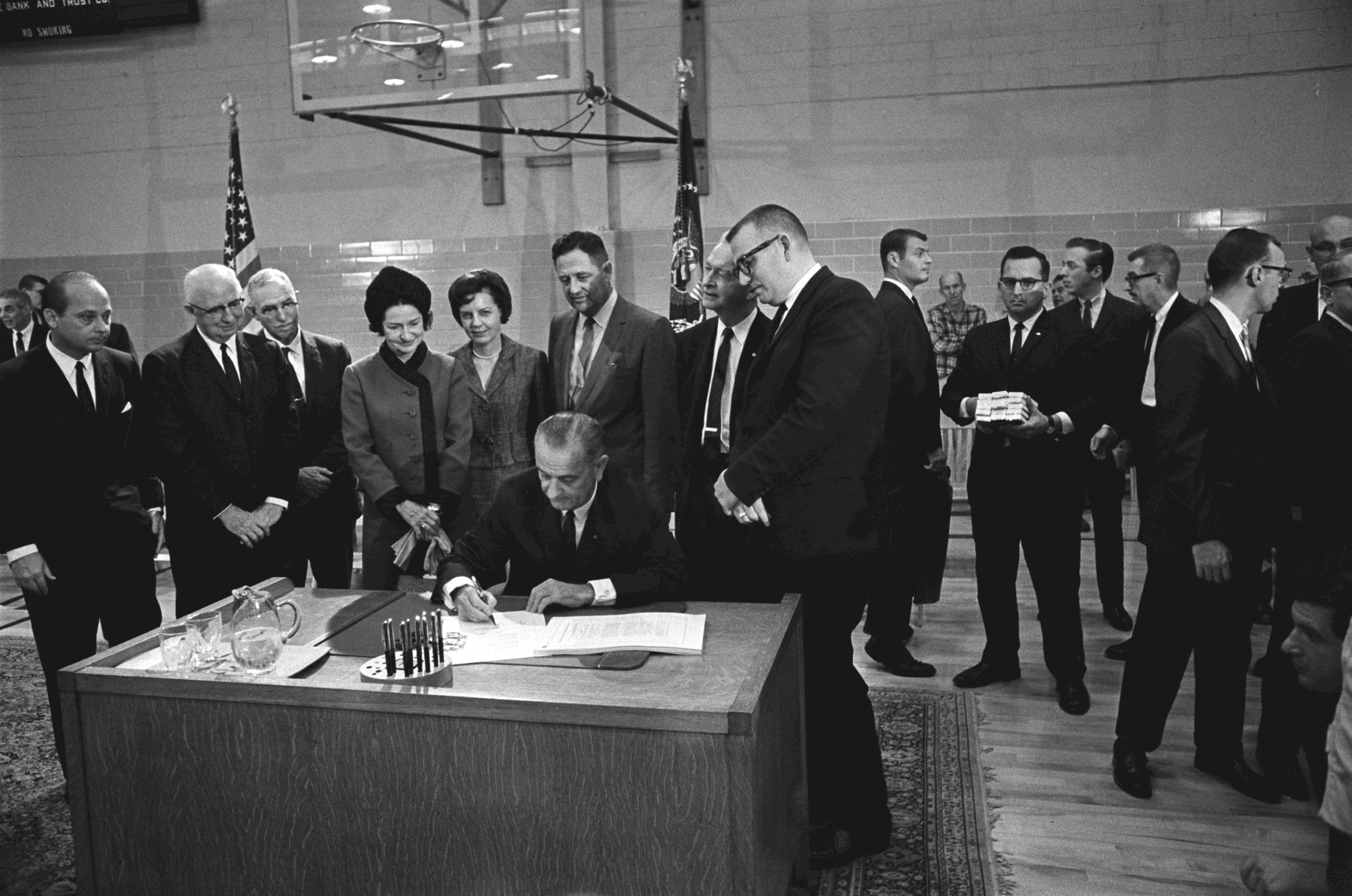
President Lyndon Johnson signing the Higher Education Act of 1965, Master's Gymnasium, Texas State University, San Marcos, TX, November 8, 1965. (http://smmercury.com/). In public domain.

President Lyndon Johnson signing the Higher Education Act of 1965, Master’s Gymnasium, Texas State University, San Marcos, TX, November 8, 1965. (http://smmercury.com/). In public domain.

There’s also the National Endowment for the Arts and the National Endowment for the Humanities, the Head Start program, and Congress passing Medicaid and Medicare, providing health coverage for the elderly and deeply poor for the first time. And all in 1965.

What does all of this mean in 2015? That despite the mountains of books written on LBJ and the failures of the War on Poverty and the Great Society, that these programs worked and work in ameliorating poverty and expanding opportunities for all, even across racial lines. Would they have been more effective with more investment, especially in those initial years, when Vietnam became more of a priority? No doubt.

That’s just it, though. Most Americans — who despite the fears of Ted Cruz and Rudy Giuliani, remain White — didn’t care about poverty and racism and the structures that supported it then, and they mostly don’t care now. They want Congress to work, just not on issues that would permanently unbalance the social hierarchy that they’ve assumed as their birthright for two centuries.

Hence the constant one-two punch of a relationship they see with poverty and those with black and brown skin. Hence the constant carping about taxes and needless spending on food stamps and welfare, even though the true face of government assistance in the US has always been a haggard White one. Hence the constant media tropes about hard work and so-called self-made men worth billions making their money without holding a college degree, who somehow can tell the rest of us how to live. The Great Society, for all of LBJ’s foibles and its weaknesses, remains a great legacy of what America could be, and at times, has been, but overall, refuses to be.

← Older posts
Newer posts →

Boy @ The Window: A Memoir

Boy @ The Window: A Memoir

Places to Buy/Download Boy @ The Window

There's a few ways in which you can read excerpts of, borrow and/or purchase and download Boy @ The Window. There's the trade paperback edition of Boy @ The Window, available for purchase via Amazon.com at http://www.amazon.com/Boy-Window-Donald-Earl-Collins/dp/0989256138/

There's also a Kindle edition on Amazon.com. The enhanced edition can be read only with Kindle Fire, an iPad or a full-color tablet. The links to the enhanced edition through Apple's iBookstore and the Barnes & Noble NOOK edition are below. The link to the Amazon Kindle version is also immediately below:

scr2555-proj697-a-kindle-logo-rgb-lg

Boy @ The Window on Amazon.com: http://www.amazon.com/Boy-The-Window-Memoir-ebook/dp/B00CD95FBU/

iBookstore-logo-300x100

Boy @ The Window on Apple's iBookstore: https://itunes.apple.com/us/book/boy-the-window/id643768275?ls=1

Barnes & Noble (bn.com) logo, June 26, 2013. (http://www.logotypes101.com).

Boy @ The Window on Barnes & Noble: http://www.barnesandnoble.com/w/boy-the-window-donald-earl-collins/1115182183?ean=2940016741567

You can also add, read and review Boy @ The Window on Goodreads.com. Just click on the button below:

Boy @ The Window

Twitter Updates

Tweets by decollins1969
  • RSS - Posts
  • RSS - Comments

Archives

  • June 2025
  • April 2023
  • September 2022
  • August 2022
  • July 2022
  • June 2022
  • May 2022
  • April 2022
  • March 2022
  • January 2022
  • December 2021
  • November 2021
  • October 2021
  • September 2021
  • August 2021
  • July 2021
  • June 2021
  • April 2021
  • March 2021
  • February 2021
  • January 2021
  • December 2020
  • November 2020
  • October 2020
  • September 2020
  • August 2020
  • July 2020
  • May 2020
  • April 2020
  • March 2020
  • January 2020
  • December 2019
  • November 2019
  • August 2019
  • July 2019
  • June 2019
  • May 2019
  • April 2019
  • March 2019
  • February 2019
  • January 2019
  • December 2018
  • November 2018
  • October 2018
  • September 2018
  • August 2018
  • July 2018
  • June 2018
  • May 2018
  • March 2018
  • February 2018
  • January 2018
  • December 2017
  • November 2017
  • October 2017
  • September 2017
  • August 2017
  • July 2017
  • June 2017
  • May 2017
  • April 2017
  • March 2017
  • February 2017
  • January 2017
  • December 2016
  • November 2016
  • October 2016
  • September 2016
  • August 2016
  • July 2016
  • June 2016
  • May 2016
  • April 2016
  • March 2016
  • February 2016
  • January 2016
  • December 2015
  • November 2015
  • October 2015
  • September 2015
  • August 2015
  • July 2015
  • June 2015
  • May 2015
  • April 2015
  • March 2015
  • February 2015
  • January 2015
  • December 2014
  • November 2014
  • October 2014
  • September 2014
  • August 2014
  • July 2014
  • June 2014
  • May 2014
  • April 2014
  • March 2014
  • February 2014
  • January 2014
  • December 2013
  • November 2013
  • October 2013
  • September 2013
  • August 2013
  • July 2013
  • June 2013
  • May 2013
  • April 2013
  • March 2013
  • February 2013
  • January 2013
  • December 2012
  • November 2012
  • October 2012
  • September 2012
  • August 2012
  • July 2012
  • June 2012
  • May 2012
  • April 2012
  • March 2012
  • February 2012
  • January 2012
  • December 2011
  • November 2011
  • October 2011
  • September 2011
  • August 2011
  • July 2011
  • June 2011
  • May 2011
  • April 2011
  • March 2011
  • February 2011
  • January 2011
  • December 2010
  • November 2010
  • October 2010
  • September 2010
  • August 2010
  • July 2010
  • June 2010
  • May 2010
  • April 2010
  • March 2010
  • February 2010
  • January 2010
  • December 2009
  • November 2009
  • October 2009
  • September 2009
  • August 2009
  • July 2009
  • June 2009
  • May 2009
  • April 2009
  • March 2009
  • February 2009
  • January 2009
  • December 2008
  • November 2008
  • October 2008
  • September 2008
  • August 2008
  • July 2008
  • June 2008
  • May 2008
  • April 2008
  • March 2008
  • February 2008
  • January 2008
  • December 2007
  • November 2007
  • October 2007
  • September 2007
  • August 2007
  • July 2007
  • June 2007

Recent Comments

MaryPena's avatarMaryPena on My Day of Atonement/Bitter Hat…
decollins1969's avatardecollins1969 on No Good Teaching Deed Goes…
Mary Rose O’Connell's avatarMary Rose O’Connell on No Good Teaching Deed Goes…

NetworkedBlogs on Facebook

NetworkedBlogs
Blog:
Notes From a Boy @ The Window
Topics:
My Life, Culture & Education, Politics & Goofyness
 
Follow my blog

616 616 East Lincoln Avenue A.B. Davis Middle School Abuse Academia Academy for Educational Development AED Afrocentricity American Narcissism Authenticity Bigotry Blackness Boy @ The Window Carnegie Mellon University Child Abuse Class of 1987 CMU Coping Strategies Crush #1 Crush #2 Death Disillusionment Diversity Domestic Violence Economic Inequality Education Family Friendship Friendships Graduate School Hebrew-Israelites High-Stakes Testing Higher Education History Homelessness Humanities Humanities Program Hypocrisy Internalized Racism Jealousy Joe Trotter Joe William Trotter Jr. K-12 Education Love Manhood Maurice Eugene Washington Maurice Washington Misogyny Mother-Son Relationship Mount Vernon High School Mount Vernon New York Mount Vernon public schools Multiculturalism MVHS Narcissism NFL Pitt Pittsburgh Politics of Education Poverty President Barack Obama Race Racial Stereotypes Racism Relationships Self-Awareness Self-Discovery Self-Reflection Sexism Social Justice Teaching and Learning University of Pittsburgh Violence Whiteness Writing

Top Rated

Blog at WordPress.com.

  • Subscribe Subscribed
    • Notes from a Boy @ The Window
    • Join 103 other subscribers
    • Already have a WordPress.com account? Log in now.
    • Notes from a Boy @ The Window
    • Subscribe Subscribed
    • Sign up
    • Log in
    • Report this content
    • View site in Reader
    • Manage subscriptions
    • Collapse this bar
 

Loading Comments...