• About Me
  • Other Writings
  • Interview Clips
  • All About Me: American Racism, American Narcissism, and the Conversation America Can’t Have
  • Video Clips
  • Boy @ The Window Pictures
  • Boy @ The Window Theme Music

Notes from a Boy @ The Window

~

Notes from a Boy @ The Window

Tag Archives: Teaching and Learning

Leaving Mom and Dad Behind

13 Thursday Jun 2019

Posted by decollins1969 in 1, Academia, Boy @ The Window, Christianity, culture, Eclectic, Hebrew-Israelite, Jimme, Marriage, Mount Vernon New York, My Father, New York City, Pittsburgh, Politics, Pop Culture, race, Religion, University of Pittsburgh, Work, Youth

≈ Leave a comment

Tags

Cleaving From Parents, Embracing Weakness, Heterosexism, Homophobia, Hotepism, Interdependence, Misogynoir, Misogyny, Needing Help, Parenting, Pitt, Respectability Politics, Teaching and Learning, UMUC, Willful Ignorance


Woodstock Leaving Home (cropped), June 13, 2019. (http://pinterest.com).

There are so many ways to write about the idea that if one is to be a grown-ass adult in this world, it requires, actually requires leaving your mother and/or father and/or any other parents and legal guardians behind. At least, dropping their worldview, their ideologies and disciplines, their ideas about life and relationships, their marital and parenting advice, the loads of abuse, baggage, and bullshit that one learned from spending so much time with them.

Yes, we should all be grateful about whatever good our parents did on our behalf to get us to adulthood and beyond. But that gratefulness should not mean a lifetime’s supply of unquestioning everything that any of us learned from those who raised us. Otherwise, any of us are but carbon copies of imperfect beings at best, total fuckups at world. Yet, somehow, so many of us present our parents to the world as if they are marble statues set on top of alabaster pedestals.

For me, it’s taken 30 years to unlearn much of the lessons and baggage I took on under my parents and legal guardian’s tutelage. My Mom “didn’t take no handouts from no one” and saw labor unions as “them bloodsuckers.” My father Jimme asked about “gettin’ [my] dict wet” from the time I was 14 until I turned 18, and called me a “faggat” everything I told him I didn’t. My idiot late ex-stepfather Maurice/Judah ben Israel talked about “making…men” out of me and Darren. He implored us to “honor thy father and thy mother, that ye may take possession of the land that the Lord thy God hath giveth thee.” Otherwise, he was “gonna whup” our “ass, jus’ like a car burn gas!” So many lessons about manliness, Black hyper-masculinity, heterosexism, homophobia, misogyny and misogynoir, about religion and child abuse, about working and self-reliance. But so many more lessons around willful ignorance as well.

By the time I went off to the University of Pittsburgh in 1987, I figured the simplest thing I could do to break free from the thinking of Mary, Maurice, and Jimme was to “just do the opposite of whatever they would do.” That’s what I would say to myself or think about whenever I had a tough-ish decision to make.

But life was never that simple. Those five days of homelessness I had at the beginning of my second year at Pitt in 1988 proved that I needed to scramble and act, and not just think differently from my parents. The most immediate lesson I learned was about needing help and learning how to ask for it. The bigger and most important lesson that took decades for me to learn was how to embrace asking for help, to not be begrudging about the process, and to be gracious when folks who could and should be helpful are not. I am still learning how to be better at embracing help and being graciousness, because, well, people are involved.

Not so with begrudging, though. We are not all on our own deserted island, each expecting to have to do everything on our own. That’s what capitalists steeped in Western individualism and my Mom would expect me to believe. We all need help, for nearly everything we want to do in life. There’s no shame in it, and there’s nothing but success, humility, being grateful and feeling recognized and loved as a result of this help.

This week is underrated in its significance to my past three decades of living this truth. This is the week my Mom and Maurice broke up for good back in 1989. The date of this year’s Father’s Day (it was a Friday in 1989) will be 30 years since the idiot feverishly packed his bags, stole some towels and frozen meats, and moved out of 616. I saw him as he packed up the last of his gear in a suitcase and an army bag. He looked scared, and looked at me with fear and shame. It was probably the only time in the nearly eleven years we lived in the same space (not counting my two years at Pitt and his separations from my Mom) where he showed how lost a person he was. Between that, and my Mom’s post-marriage spin a few months later about how Maurice had “fooled us all,” and I knew. I absolutely knew, spirit, mind, and body, that I needed to craft my own worldview, my own ideas, my own way to deal with ideology, discipline, parenting, marriage, and so many things much more complicated than putting the right amount of seasoning on my fried chicken.

Over the years, this ultimate lesson of leaving behind most of my Mom’s, Jimme’s, and Maurice ways of thinking, doing, and being in the world has made its way into my teaching and writing. It’s why I uphold no sacred cows, and can literally interrogate and question even the most cherished ideas and people in my classrooms and in my pieces. (And yes, in prayer, in between my hallelujahs and my amens, I even question God.) Which may be also why more than a few of my students might cling harder to the lessons of their parents.

A few years ago, I had a young student in one of my UMUC classes who pushed back on a lecture I gave on de-centering Western Europe from the early modern period in world history while taking a closer look at India, China, and the Ottoman Empire.

“That’s not what my parents taught me,” she said.

“Well, maybe it’s time to realize that not everything your parents taught you is true. It’s been three decades, and I’m still learning to unlearn all the things my parents taught me,” I retorted. Most of my over-24-year-old students nodded in agreement, but the not-quite 20-year-old wasn’t receptive. It showed in her evaluation of me at the end of the course.

My soon-to-be 16-year-old son, thankfully, is learning this lesson now. Although that means he will make tons of mistakes and constantly frustrates my efforts at helping him, it also means he can reach out to me and my spouse when he needs help. Being independent requires acknowledging one’s limits and one’s need for help, community, and interdependence. Learning from whom, at what time, for how much, and how deep one can go in all this is a lifelong journey. But none of it can begin without questioning one’s parent or parents, without cutting bait from their baggage and bullshit. Even if it means that we sometimes screw up in the process.

Mrs. Bryant and the Beginning of Donald 1.5

03 Sunday Jun 2018

Posted by decollins1969 in 1, Boy @ The Window, Christianity, culture, Eclectic, Hebrew-Israelite, Mount Vernon New York, Politics, Pop Culture, race, Religion, Youth

≈ Leave a comment

Tags

Diversity, Education, K-12 Education, Lessons, Mrs. Bryant, Mrs. Della Bryant, Public Speaking, Self-Determination, Self-Doubt, Sixth Grade, Teaching and Learning, William H. Holmes Elementary, Writing


A bright blue sky, just before the long storm, February 19, 2011. (http://www.photos-public-domain.com). In public domain.

We’ve reached the end of yet another school year, number 32 for me overall, between my twenty-two years between kindergarten and doctorate and my son’s ten years of K-9 (this doesn’t included the 13 years of overlap, in which my primary job has been as an instructor, or my wife’s two years of grad school). The end of sixth grade was not particularly violent. But it was a rough transition to nearly eight years of bumps, bruises, grinding poverty and psychological torture, and a constant struggle for my true self.

The one strong and calming influence in the midst of this gathering storm system was my sixth grade teacher at William H. Holmes ES, Mrs. Della Bryant. She was the fourth of my four Black teachers between first grade and middle school. Mrs. Bryant was as important to me on the cusp of becoming a teenager as Ms. Griffin was to my grounding as a student in first grade, and the crush I had on Mrs. Shannon in third. Because Mrs. Bryant didn’t just aspire for us to do well and get A’s. She wanted us to think big picture, and not just about high school or college. Mrs. Bryant encouraged us to think in larger, worldly terms, to take politics and religion and literature and the stuff of intellectuals seriously.

She indulged us, especially me and my then best friend Starling. So many times that year, Mrs. Bryant allowed us to debate current event topics in class, whether we had sufficient facts or not. The Iran hostage crisis, the 1980 election cycle and why Ronald Reagan would be worse than President Jimmy Carter (no one in our class played devil’s advocate), the legality of Israel unilaterally bombing an Iraqi nuclear weapons centrifuge site.

Those were among the moments I lived for in Mrs. Bryant’s class that school year. I lived for them not just because I liked showing off my knowledge. I already knew I was smart. I spent the following year saying “I am the smartest kid in the whole world!” to myself, and occasionally, to Humanities classmates who made me feel inferior.

No, those debates weren’t about my raw analytic power and great ability to remember. They were about discovering what I thought I knew about a topic, understanding what I didn’t know, and being able to articulate it all without losing my thoughts in the ether. And in all that, I discovered parts of myself. My forthrightness. My New York-style sarcasm. My sense of righteous anger. My ability to summarize a situation in order to derive or intuit possible responses, even solutions.

That was what Mrs. Bryant with her light but steady touch helped me get to in sixth grade. A sense of enlightenment that could survive the false gods of Hebrew-Israelite-ism, the false father of my then idiot stepfather “Judah ben Israel” née Maurice Washington, and the fallacy that I had any control over my world.

But that wasn’t all Mrs. Bryant helped me do that year. She encouraged me to take on other projects, especially contests. Like posters for Dental Health Month, or participating in Election 1980 activities, and journaling and writing down my thoughts about virtually everything. Mrs. Bryant did me the honor of having me introduce our graduation speaker at the end of sixth grade, nearly 37 years ago. It was a two-minute speech, but it was also in front of a couple hundred people. I don’t think I’ve even been as nervous being on radio or television. Most of that stuck with me for years, somehow surviving through years of crumpled neglect.

Mrs. Bryant was the one who shepherded me into the Humanities Program, something that I’d only heard about once before, inadvertently through Brandie Weston (who was a student at Pennington-Grimes) the year before. With my grades and test scores, I probably could’ve made into the Grimes Center a year or two earlier. That is, if my teachers Ms. Pierce and Mrs. O’Daniel had thought of me that way. But in the big scheme, it wasn’t that important. Mrs. Bryant did think of me that way, and went out of her way to say as much. “Mrs. Bryant’s encouragement, her insistence that I was ‘one of the best students’ she ‘ever had,’ made sixth grade a joyful time,” I wrote in my memoir.

Now, despite Mrs. Bryant, I wasn’t prepared for going to school every day with 150 other know-it-all’s, many of whom would never have to worry about Con Edison bills being overdue or having no food to eat for three or four days at time. Or, the constant threat of domestic violence and abuse at home. Heck, between Humanities’ decided demographic affluence and ideological Whiteness, I doubt that most of my eventual classmates worried about anything other than getting A’s until puberty took full hold.

As I wrote in Boy @ The Window, “Mrs. Bryant never warned me that Humanities would be overwhelming because my social skills outside of Holmes were as well developed as a spoiled seven-year old’s.” I simply didn’t handle the transition from a 98-percent-Black elementary school to the mostly White Humanities program very well. Then again, with so much going wrong at home, I didn’t handle much of anything well in the 16 months after sixth grade.

But one thing I carried from my year with Mrs. Bryant was that I could survive and succeed despite it all. To observe and listen, and not just speak off the cuff. To be patient, and keep working. Frankly, it was likely because of teachers like Mrs. Bryant that I discovered my first superpower, my ability to think, remember, and write. And in that discovery, bury the pains of earlier abuses that would’ve surely killed me (or at least, led to a successful suicide) by the time I turned fourteen. Mrs. Bryant, wherever you are, and whatever you’re up to, I say, with love, many, many thanks!

Colson Whitehead’s a Genius, But What’s Slavery to Me?

06 Saturday Jan 2018

Posted by decollins1969 in 1, Boy @ The Window, culture, Eclectic, Politics, Pop Culture, race, Religion, University of Pittsburgh

≈ Leave a comment

Tags

Colson Whitehead, Cora, DNA, Emotional Detachment, Escape, John Blassingame, Joseph Heller, Pitt, Ralph Ellison Octavia Butler, Slavery, Slavery Studies, Sterling Stuckey, Teaching and Learning, The Underground Railroad (2016), Toni Morrison, UMUC


Colson Whitehead is a genius. I am absolutely convinced of this truth. I’ve read other things by him. But his novel The Underground Railroad is one part Joseph Heller’s Catch-22 and two parts Ralph Ellison’s Invisible Man mixed with the macabre and mystical in Octavia Butler and Toni Morrison. Every sentence in Underground Railroad was written with precision, especially the first 120 pages. It was as if Whitehead put every word through a metal acid bath, every phrase was pored over with an electron microscope. I was hooked by page 24, and didn’t stop to put the book down again until page 160. I finished the book in eight hours over two days, not a record, but pretty close.

The Underground Railroad is all about escape, of course, but not just the obvious, physical escape from slavery’s asphyxiating grasp. It was a need to escape the post-traumatic stress of having been a slave. It was finding ways to use the mind and spirit to cope with torture, whippings, rapes, mangled bodies, demonic rhythms of an existence in which humans are little more than broken toys. It was escaping inhumanity to find humanity and the divine, even in the most minuscule of proportions.

I loved the main character Cora. That Whitehead made his main character female, a third-generation slave from a plantation in Georgia during the antebellum period wasn’t lost on me. As with all of his characters, Whitehead developed Cora with a full sense of imperfection, making her a nearly perfect lens for me to view the novel. She and Mabel and Ajarry fully embodied kidnapping and slavery in all its horror. Folks, if you want anyone to come close to the actual experience of what slavery was for Africans in America, Whitehead got as close as any writer I’ve read in my lifetime.

I could nitpick about Whitehead a bit, too. That Cora’s femaleness wasn’t fully explored, with everything from not having periods to how she may have experienced her development as a woman prior to her first escapes or her one almost romantic moment. Or about the mystical mashup of the last twenty to thirty pages. Or about the railroad going on to infinity, in this case, Missouri, as Cora never really escapes.

My biggest criticism, though, isn’t really a criticism at all. It’s an admission. I really didn’t want to read The Underground Railroad. I made no plans to buy it or to check it out from a library. I would’ve been content in life to have never read this masterpiece.

Why? I’m sick and tired of talking about slavery, about the physical, mental, psychic, and spiritual torture of millions of Africans so that a few Whites could profit financially and many more could profit psychologically. It feels like I’ve been talking about slavery my whole life, even though I’ve only been aware of it since Roots and its television debut in February 1977, or for 41 of my forty-eight years.

I studied slavery with deliberate disembodiment in my teens and twenties. It might’ve been through reading books by Alice Walker or Morrison. But by the Fall Semester 1989 at Pitt, I was reading and writing about slavery and American racism in earnest. I wrote my undergraduate readings paper about the slavery studies literature for my professor Larry Glasco’s class. The next semester, I took a grad course in Comparative Slavery, reading about the differences between slave systems in Brazil, Cuba, the US, and for my 34-page paper, slavery in South Africa before 1838.

Having done that, nearly every course I took through my master’s program in 1991-92 had a slavery studies component. So I read White paternalists like Ulrich B. Phillips. Racist historians like him contended that Blacks in the US should be on their knees and thankful that Whites stole them, sold them, and slaughtered their ancestors during slavery, such was the civilizing effect. I read slavery studies by not-so-obscure authors like Sterling Stuckey and John Blassingame, who made the living hell that was slavery come alive in stories and statistics. I also read White apologists like Fogel and Engerman in their Time on the Cross. I remember saying in my US history grad seminar in 1991, “so they’re saying that slavery wasn’t so harsh because the average slave received 21 lashes per year versus the standard 39?.” It was my translation of their multiple regression analysis.

By the time I started my PhD work in September 1992, I was through with studying slavery. It was too painful to be in class with White students who at their best could never really understand slavery beyond statistics and ideology. Even if it was in their DNA via an unknown African ancestor (some estimate that as many as one in eight Southern Whites carry recent African DNA, and about four percent of Whites in the US overall). That any person could and did regularly argue that slavery was a “necessary evil” or “saved” Africans in the US from “savagery” helped me move into twentieth-century US and African American history as a field of study. Still brutal, still mind-destroying, but not the complete horror show of slavery.

Whenever I touch the subject of slavery in the courses I teach these days, I still get that sense of outrage and indignation when I see students unable to deal with the bitter, devastating truth. “C’mon, slavery wasn’t that bad. They were fed and clothed. And wasn’t there White slavery for the Irish, too?” That’s what one of my White students said in a world history course I taught a couple of years ago, in response to a discussion of the differences between the American, French, and Haitian Revolutions. The latter was the first fully successful slave revolt in the Western Hemisphere, leading to the founding of Haiti as an independent nation in 1804.

I don’t know how Whitehead could write this novel and not go through hours of emotional torment at the end of each day. In my own experience, writing about any trauma has left me dazed for minutes or even an hour or two at a time, unable to sleep, and wondering why I’ve never smoked weed. I’m thankful Whitehead did, and I hope that he’s healing.

I was so uncomfortable reading Whitehead’s The Underground Railroad because I knew that the horror and pain of slavery was literally encoded in my DNA. I was uncomfortable because I knew that people like this one UMUC student would never get it, even if he did read the novel. Whitehead didn’t write the novel for him, though. I think he wrote it for me, freeing me from my discomfort with the horrible.

I’ve Been Blogging For a Decade, And…

06 Tuesday Jun 2017

Posted by decollins1969 in 1, Boy @ The Window, culture, Eclectic, Pittsburgh, Politics, Pop Culture, race, Religion, Work, Youth

≈ Leave a comment

Tags

10 Years, Blogger, Blogging, Fear of a "Black" America, Giving, Highlights, Stats, Teaching and Learning, What's Next, WordPress, Writing


Me comatose on my MacBook keyboard, March 29, 2013. (Donald Earl Collins).

This was what I wrote for my first blog post on my former Fear of a “Black” America website on Monday, June 4, 2007.

It had taken me a month of brushing up on my HTML and a week of negotiating the code between Blogger.com and my former website (hosted by Earthlink) to embed my blog page. All so that I could post for the first time.

I was transitioning from being the writer and “recovering academician” on multiculturalism to the writer I am now, I guess. But I didn’t want to lose a website I’d spent months of self-taught HTML time and energy developing, and years of additions to attract views, comments, and the occasional interview. At the time, FearofaBlackAmerica.com averaged 1,200 unique visitors a month, after a high of 4,000 per month through 2004 and 2005, mostly the result of pumping my first book. Or possibly, the confusion between my book title and PE’s 1990 album, Fear of a Black Planet, but given the feedback, it was much more the former than the latter.

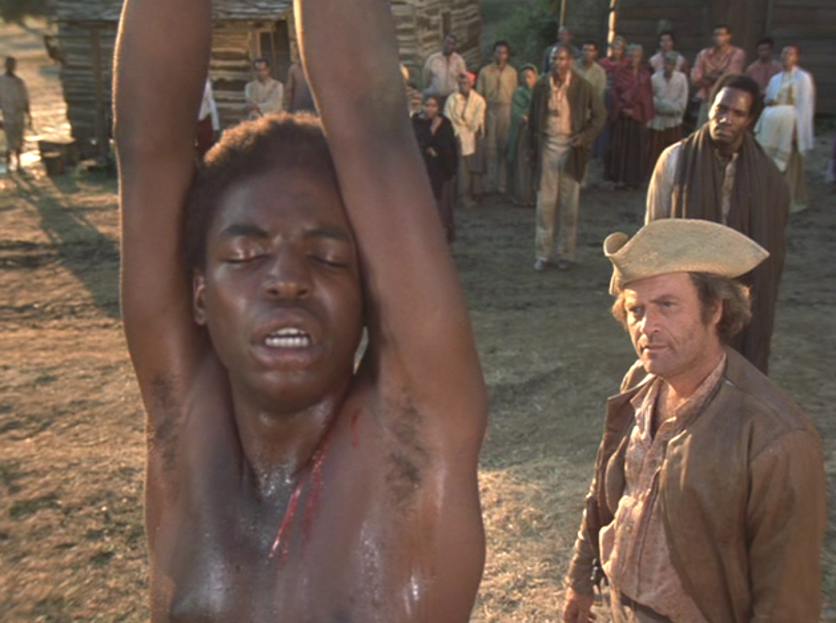
Kunta Kinte being whipped, Roots (1977) screenshot, July 6, 2012. (http://irvine.wikis.gdc.georgetown.edu). Qualifies as fair use under US Copyright laws because of screenshot’s low resolution.

So I went for it, not knowing if anyone would read any of my words, feel any of my emotions, or ever express a thought in support, solidarity, or disagreement. Once I started writing about poverty, racism, and child abuse while growing up in Mount Vernon, New York, though, it didn’t take long for random folks to start sending me missives about how I “deserved” my stepfather beating me up, or how grateful I should be for growing up in a city where Denzel Washington once lived. The kind of respectability politics bullshit that writing about a childhood full of pain tends to attract.

It wasn’t until I moved my blog to WordPress in 2010 that the work of writing and adding multimedia to my musings really took off. It helped that I managed to use contemporary events to tell my story, to provide commentary on human depravity beyond the world of research. By 2012, I was averaging more than 12,000 views a month, and had more comments from folks about my blogs than I could respond to in a timely manner. Excerpts from some of my blogs even made it into social and mainstream media.

Overall, there have been over 250,000 unique visitors to and 300,000 views of my blog off both the Blogger and WordPress platforms over the past decade. With this one, I’ve written 944 total posts, about 900,000 words since June 2007. Among my most popular are

  • Ex-Stepfather’s Balance Sheet (August 2010), 23,741 views
  • A Baseball Bat and a Father’s Absence (July 2011), 7,634 views
  • Why Ferengi Are Jewish & The Maquis Are Latino (January 2011), 4,961 views
  • World Book Encyclopedia’s Insidious Effect (March 2011), 3,555 views
  • Larry Glasco and the Suzy-Q Hypothesis (August 2011), 2,668 views

Standing ovation, opera house unknown, May 21, 2012.(http://www.thelmagazine.com).

I think that this is a good representation of what my blog has offered me as a writer and, hopefully, the tens of thousands of folks who read my musings every year. I have no idea what this blog will turn into over the next couple of years, as I continue to pursue more and more freelance writing projects, and maybe even, another book. But I thank all of you for your support, your criticisms, and your reads and views over the years. May I never take this for granted.

From One Starving Writer to Another

19 Sunday Mar 2017

Posted by decollins1969 in 1, Boy @ The Window, culture, Eclectic, Mount Vernon High School, Mount Vernon New York, Pop Culture, University of Pittsburgh, Youth

≈ Leave a comment

Tags

"The Raven", AP English, Columbia, Crush #2, Edgar Allen Poe, MVHS, Phyllis, Poverty, Rosemary Martino, Self-Discovery, Teaching and Learning, The Starving Artist, UMUC, Writing Career


Raven eating a hand (in my case, the writer’s dead hand), March 19, 2017. (creativeuncut.stfi.re via http://pinterest.com).

Six years ago, a student of mine made a reference that very much reminded me of, well, me, the person I was my senior year at Mount Vernon High School. It was as part of a conversation about looking for work. She didn’t want to be another starving artist, living in some basement apartment somewhere, “smearing paint on a canvas” while waiting for a big break. I thought at the time that the idea of a starving artist had all but died out in the era of bling-bling.

But it made me think for a while about the choices I’ve made with my life and career in the years since the middle of my senior year at MVHS. I once said to my AP English teacher Rosemary Martino that I didn’t want to be a starving artist “like Edgar Allen Poe” all those years ago. Now a student had made a similar — although better developed — reference. I think I understood better the momentary look of shock on my former teacher’s face after that conversation.

My student made me think about what Martino saw in my writing so many years ago. I certainly wasn’t focused on it. The same week she commented on making myself into a writer was also the week I had my Ivy League dilemma, between Columbia and the University of Pittsburgh for undergrad. I was waist-deep into my obsession with Phyllis, or really, my obsession with my crush on Phyllis. So much so that I wrote my creative writing assignment for Martino about me and my Crush #2, switching the names to “Donna” and “Phil” to barely cover up the truth of this otherwise short fictional work. Martino returned it without comment. She did comment heavily, though, on my assessment of Henrik Ibsen’s A Doll’s House, a series of redundant paragraphs in search for a coherent sentence.

But my wack “The Way It Is” title was as much an indication that I was as far away from seeing myself as a writer as Earth is for Alpha Centauri without a faster-than-light-speed vehicle. And I was starving on so many levels back then. For food. For attention. For love. For a connection with anything or anyone who didn’t remind me of my poverty. Martino’s encouragement, though she obviously meant well, sent me scurrying in my mind for something a bit more comfortable than Poe’s indebted and untimely death.

My own student’s commentary made me wonder if the quality of my life and career would be better these days if I had embraced the promise Martino saw in my writing back then. I mean, I was already a slightly malnourished six-foot-one and 160-pounder at that point anyway. The inner struggle to put thoughts to paper creatively would’ve been much easier at seventeen than it is as a married forty-seven year-old with a contrarian teenager and bills to pay.

Maybe so. But until Noah or one of his progeny designs a time machine, I can’t rewrite my history in order to make me embrace what I now see as my calling. All I know is that those words I uttered in March ’87 have stayed with me for three decades. The question of finding and following my calling has always been juxtaposed with my need to eat and pay the rent and other bills. How do I do both without dropping one of the balls that I’m juggling?

The issue for more than half of my adult life was finding my calling. Along the way, I spent the summer of ’88 unemployed, the first week of my sophomore year at Pitt homeless and three weeks in May ’91 losing sixteen pounds for lack of food. Not to mention six weeks of unemployment in ’93, walking to Carnegie Mellon many a time in the snow with holes in my sneakers in ’94, and two and a half years of underemployment from December ’96 to June ’99. I was a starving writer long before I saw myself foremost as one. In all, I’ve probably made about $2,500 in direct net income as an author and writer since 2003 (half through Fear of a “Black” America, the other half in the past two years), not counting consultancies or giving talks based on my writing. If I depended on my writing income, I maybe could pay the cable bill or treat us to a night of Cheesecake Factory and a movie. Two or three times a year. When one doesn’t follow their calling and doesn’t follow a typical path to making a buck, the tendency is insufficient funds.

Creative abilities, even genius, may well drive people mad, but most folks in pursuit of their calling aren’t fools. No one, including the starving artist, wants to starve. Some of us, though, have a desire for much more than the ability to get a job, any job, and hold one long enough to see our own kids graduate from college and meet someone they truly love. Even with the responsibilities of adulthood, we shouldn’t give up on our own aspirations, for it’s those things that we reach for (although not at all costs) that will help others — including the most important folks — in our lives pursue their own calling.

David Wolf, A Teacher I Hope To Never Become

27 Thursday Oct 2016

Posted by decollins1969 in 1, Academia, Boy @ The Window, Carnegie Mellon University, culture, Eclectic, Jimme, Mount Vernon High School, Mount Vernon New York, My Father, New York City, Pop Culture, race, Sports, University of Pittsburgh, Youth

≈ Leave a comment

Tags

1986 World Series, 616, 616 East Lincoln Avenue, AP Physics, Bad Teaching Habits, David Wolf, Escapism, Humanities, Jesse Orosco, Mets, Mother-Son Relationship, MVHS, New York Mets, Senioritis, Teaching and Learning


Film critic Gene Shalit (closest approximation I could find to David Wolf), circa 1980. (http://imdb.com).

Film critic Gene Shalit (closest approximation I could find to David Wolf), circa 1980. (http://imdb.com).

This date was one of the great ones during my Boy @ The Window years. It was a day (and evening) that almost made me forget the role I’d been in since the spring of ’81. One as the sometimes adult male with adult responsibilities on the one hand, and as the nearly ostracized emotional equivalent of a twelve-year-old on the other. But yes, even small miracles (at least in my mind at the time) did happen. The New York Metropolitans, my Mets, won Game 7 of the 1986 World Series thirty years ago on this date 8-5, a biting cold Monday night at the end of October! My Giants beat and beat up the Redskins that same evening 27-24, on their way to a 14-2 record and their first Super Bowl. My underdogs weren’t anymore.

Within three days of that ultimate day of vicarious escapism, the reality of having neglected my studies had sunk in. Or, to be completely honest, the reality of needing much more time to study than I could’ve ever devoted, even without the distractions of senioritis, my Mets and Giants winning or on their way to championships, set in. Because that’s what it would’ve taken for me to have a successful senior year at Mount Vernon High School academically. A greater commitment to AP Physics C, AP English, and AP Calculus AB than my bifurcated life would have allowed. Between four siblings ages two to seven, college applications, and constant errands and chores for my Mom, my weekends of tracking down my father at one watering hole or another, I should’ve gone off to college after my junior year. I should’ve used the summer of ’86 to take gym or something to get the one-quarter credit I needed to graduate.

Instead, here I was with the one teacher who was probably the one most ill-equipped to handle any students other than near-genius devotees to AP Physics. I had David Wolf the year before in high school Physics, so I knew how intolerant he could be toward students who were unprepared, or “just [didn’t] get it.” Or, at least I thought I knew. The week before the Mets’ Game 7 win, Wolf had given us our end-of-marking-period exam on mechanics, and the day after was when we received our exams back with grades. I had the fourth highest score out of seven students, a 22 out of 100. You can look at any grades I’d earned prior to and since this exam in any course between kindergarten and doctorate, and none come close to a 22.

But it obviously wasn’t just me.

David Wolf was another character who was sometimes funny but otherwise sucked as a teacher. It would’ve been hard for me to know what Butler had been like as a teacher when he was happily married. Wolf was a mediocre teacher on his best days because he simply didn’t care if we learned anything in his class. Of course that didn’t make him much different from most of our other teachers. What made Wolf different was the fact that he went out of his way to embarrass students, as if the shock of being outed by him would somehow make us better.

Wolf “taught” us the more difficult AP Physics C version of this Physics course, involving mechanics, electricity and magnetism. It was the equivalent of second semester Physics right from the start, and most of us needed at least a semester of Calculus to keep up with him. Had I known this was Wolf’s plan, I may well have taken my former classmate Laurell’s advice (eight years too late) and switched to AP Biology. Instead, I chose to see this as a new challenge I could take on and will myself through, just like I had in every other difficult class I’d taken up to that point. But after the first two months of the year, it crossed my mind that struggling through this course wasn’t worth it.

Sink or Swim Republican Lifeguard Cartoon, Mike Luckovich, March 14, 2013. (Luckovich/Atlanta Journal-Constitution; http://luckovich.blog.ajc.com).

Sink or Swim Republican Lifeguard Cartoon, Mike Luckovich, March 14, 2013. (Luckovich/Atlanta Journal-Constitution; http://luckovich.blog.ajc.com).

When I wrote in Boy @ The Window, “Laurell was practically using third-semester Calculus to build the Great Pyramids by comparison,” it was hyperbole, of course. Partly because Egyptian calculus was likely more complicated. And partly because Laurell had done something that I couldn’t do. She had gone to Wolf at the end of eleventh grade and borrowed from him a copy of the AP Physics textbook. She had devoted much of her summer to studying up on AP Physics and AP Calculus BC (once the harder version of AP Calculus) before day one of twelfth grade. So Laurell was going to do well, no matter what. Dozens of hours to study wasn’t sometime I had at chaotic 616, textbook weeks ahead of time or otherwise.

However, me doing well or terribly wasn’t my issue with Wolf. It was his sink-or-swim approach, with no attempt to help struggling students in any way. It was his dickish attitude, where he would literally lean on his stool or against the chalkboard insulting us as we attempted to answer a Physics problem.

Wolf’s class remained the most painful academic experience I’d have in Humanities. Period…Wolf continued to berate and belittle us, wondering, ‘Why are you still here?,’ or exclaiming ‘You decided to show up today!’ On the rare occasions I managed to solve a problem at the chalkboard, he gave me a Bronx cheer, the kind good Yankees fans gave when their team was down ten runs and a Yankee hit a home run to close the gap to nine.

Now, some would say this was good preparation for college. Where? While I certainly have known indifferent professors regarding my own abilities or their distance from other students in general, I’ve only known a few who even threw out the rare bit of sarcasm in the classroom. Plus, for courses like Physics, there were TAs who could walk students through problems better than Khan Academy. Even saying that Wolf was good preparation for graduate school would be a stretch. Quiet exclusion, rather than insults and ostracism, is the rule at the doctoral level. And having an advisor like Wolf would’ve led to blood, and not my own, plain and simple.

After years in the classroom with high school, undergrad, and grad students, I understand that being a professor isn’t the same as being a K-12 teacher. Most of the time, I’m not dealing with parents (except as students), I don’t teach five days a week, and I have the expectation that my students should behave as college students. All the more reason that as I have grown older and more experienced as an educator, the more I’ve found Wolf’s behavior objectionable, even almost unforgivable. In all seriousness, why even show up to teach if your primary form of solace at work is yelling insults at students while standing in the hallway in between class periods?

“Fear of The Unknown” or “Other” = Inhumanity

09 Saturday Jul 2016

Posted by decollins1969 in 1, Academia, culture, Eclectic, Politics, Pop Culture, race, Religion, Work, Youth

≈ Leave a comment

Tags

"Fear of the Other", "Fear of the Unknown", #AltonSterling, #PhiladoCastile, American Narcissism, Black Box, Dallas, Duquesne University College of Education, Empathy, History of American Education, Humanity, Inhumanity, Islamophobia, Racism, Southern and Eastern European Immigrants, Teaching and Learning, Xenophobia


A black box with question mark, a certain "fear of the unknown," July 9, 2016. (http://socialcapitalmarkets.net).

A black box with question mark, a certain “fear of the unknown,” July 9, 2016. (http://socialcapitalmarkets.net).

The phrases “fear of the unknown” or “fear of the other” has been something that I’ve been familiar with as long as I’ve been in the classroom. So many essays, so many discussions, so many presentations where these stock phrases have greeted me in my capacity as instructor, professor, facilitator, administrator, and public speaker. Ultimately, the use of these all-too-often used phrases reflects the inability of the people who speak and write them to see other people as Homo sapiens, thus diminishing their humanity in the process.

The first time I seriously encountered either phrase, though, was in my second semester of teaching History of American Education in the College of Education at Duquesne University for MAT students. It was the fall of 1998, and I was teaching a required education foundations course (I was also doing Multicultural Education that semester). To be sure, there were a couple of veteran teachers who didn’t like having a twenty-eight year-old Black man telling them about the marbled history of their profession and the institutions for which they served as K-12 teachers. Some of their bigoted evaluation responses disclosed as much.

It was the week I lectured on the Southern and Eastern European immigrant experience in America’s emerging public school systems between roughly 1880 and 1930. In going through the efforts of educators to literally beat out of these children the language of their mother countries (e.g., Italian, Yiddish, Greek, Polish, etc.) while sorting them into lower intellectual tracks within public schools, I noted the anti-immigrant xenophobia among WASPs at that time. One of my students during discussion tried to explain it away as a WASP “fear of the unknown.” I asked, “What was the unknown? Were these immigrants aliens?” — in this case, I meant “extraterrestrials.”

Data Mining/Fear of the Unknown cartoon, Adam Zyglis, Buffalo News, July 6, 2013. (http://adamzyglis.buffalonews.com/2013/07/06/data-mining/).

Data Mining/Fear of the Unknown cartoon, Adam Zyglis, Buffalo News, July 6, 2013. (http://adamzyglis.buffalonews.com/2013/07/06/data-mining/).

The student didn’t really answer my question, as if “fear of the unknown” needed no explanation. But on the paper related to the experiences of the children of Southern and Eastern European immigrants, Black migrants, and working-class women, over and over again, the phrase “fear of the unknown” kept showing up. What made this use of phrase even more disappointing was an even more sobering Western Pennsylvanian reality. Most of my students were the descendants of Southern and Eastern European immigrants, some of whom were old enough to have had contact with grandparents who must have recounted their experiences with xenophobia in public education. That these students couldn’t possibly see the inhumanity of the phrase “fear of the unknown” made me question whether these current and future teachers should be in a classroom at all.

Luckily, I did manage to reach a few of my more skeptical students around these sorts of issues as this course progressed. After all, most teachers really do want to help their students. A couple even wrote me notes after slamming me in their evaluations about how my History of American Education course had opened their eyes to inequality and social reproduction in K-12 education.

Since then, I have remained keenly aware of when students, colleagues, public speakers, and fellow administrators (specifically in the context of the nonprofit world) have said or written the “fear of the unknown” or “fear of others” phrases. Mostly, it’s not in the context of White ethnics from an era in which “White” mostly meant “White Anglo-Saxon Protestants.” Over the past fifteen years, I’ve seen and heard “fear of the unknown” in reference to Blacks, Latinos viewed only as free-loading immigrants, and Arab-Muslim Americans as US-hating terrorists. There have been students who have justified the race riots of the not-so-recent past (the ones where White mobs stormed into Black neighborhoods and burned them out while maiming and killing Black men, women, and children) with the phrase “fear of the unknown.” Or co-workers who’ve explained away their xenophobia or homophobia as a natural “fear of the other.” Or public speakers who’ve explained Islam as if it were a magical black box that churns out terrorists the way Detroit used to turn out automobiles.

Caravaggio's Narcissus (1594-96) , May 15, 2011. (Masur via Wikipedia). In public domain.

Caravaggio’s Narcissus (1594-96) , May 15, 2011. (Masur via Wikipedia). In public domain.

Stop it. Just stop it. What does “fear of the unknown” really mean? That you didn’t know that Black Americans were human beings with a need for work, education, housing, sleep, air to breathe, and food to eat? That you couldn’t conceive of Latinos as a group of folks who’ve been part of the American landscape (specifically Texas and the southwestern US) for far longer than there has been a US? That you can’t contemplate the idea that Arab Muslims have just as much right to exercise their First Amendment rights to freedom of speech, religion, and assembly as any “red-blooded American?”

Using the phrase “fear of the unknown” says more about the people using it than it does about the “others” they attempt to describe as “unknowns.” All anyone really needs to know is that the so-called others are human beings. To say “unknown” or “other” means than you think you are superior to these “unknowns.” Or, conversely, that these “other” humans are not “normal,” that they are defective or not quite your equals. When groups of humans attempt to justify inequality or their fear with phrases like “fear of the unknown” or “fear of the other,” it means they have little or no empathy for the “unknown” or “other.” And when we as humans can cut ourselves off from other humans in this way, doesn’t that make us less humane, more “other” because we believe ourselves to be normal, even special, and therefore, better, than these “unknown others?”

Of course, there are tremendous psychological and material advantages to seeing other humans as “unknowns” and “others.” This week of #AltonSterling, #PhiladoCastile, and #Dallas has been proof positive of the value of some lives versus “unknown others.” The truth is, no Homo sapiens live in black holes. Unless those with the power to cut off empathy to their psychological and material advantage make a mental home for us there.

← Older posts
Newer posts →

Boy @ The Window: A Memoir

Boy @ The Window: A Memoir

Places to Buy/Download Boy @ The Window

There's a few ways in which you can read excerpts of, borrow and/or purchase and download Boy @ The Window. There's the trade paperback edition of Boy @ The Window, available for purchase via Amazon.com at http://www.amazon.com/Boy-Window-Donald-Earl-Collins/dp/0989256138/

There's also a Kindle edition on Amazon.com. The enhanced edition can be read only with Kindle Fire, an iPad or a full-color tablet. The links to the enhanced edition through Apple's iBookstore and the Barnes & Noble NOOK edition are below. The link to the Amazon Kindle version is also immediately below:

scr2555-proj697-a-kindle-logo-rgb-lg

Boy @ The Window on Amazon.com: http://www.amazon.com/Boy-The-Window-Memoir-ebook/dp/B00CD95FBU/

iBookstore-logo-300x100

Boy @ The Window on Apple's iBookstore: https://itunes.apple.com/us/book/boy-the-window/id643768275?ls=1

Barnes & Noble (bn.com) logo, June 26, 2013. (http://www.logotypes101.com).

Boy @ The Window on Barnes & Noble: http://www.barnesandnoble.com/w/boy-the-window-donald-earl-collins/1115182183?ean=2940016741567

You can also add, read and review Boy @ The Window on Goodreads.com. Just click on the button below:

Boy @ The Window

Twitter Updates

Tweets by decollins1969
  • RSS - Posts
  • RSS - Comments

Archives

  • June 2025
  • April 2023
  • September 2022
  • August 2022
  • July 2022
  • June 2022
  • May 2022
  • April 2022
  • March 2022
  • January 2022
  • December 2021
  • November 2021
  • October 2021
  • September 2021
  • August 2021
  • July 2021
  • June 2021
  • April 2021
  • March 2021
  • February 2021
  • January 2021
  • December 2020
  • November 2020
  • October 2020
  • September 2020
  • August 2020
  • July 2020
  • May 2020
  • April 2020
  • March 2020
  • January 2020
  • December 2019
  • November 2019
  • August 2019
  • July 2019
  • June 2019
  • May 2019
  • April 2019
  • March 2019
  • February 2019
  • January 2019
  • December 2018
  • November 2018
  • October 2018
  • September 2018
  • August 2018
  • July 2018
  • June 2018
  • May 2018
  • March 2018
  • February 2018
  • January 2018
  • December 2017
  • November 2017
  • October 2017
  • September 2017
  • August 2017
  • July 2017
  • June 2017
  • May 2017
  • April 2017
  • March 2017
  • February 2017
  • January 2017
  • December 2016
  • November 2016
  • October 2016
  • September 2016
  • August 2016
  • July 2016
  • June 2016
  • May 2016
  • April 2016
  • March 2016
  • February 2016
  • January 2016
  • December 2015
  • November 2015
  • October 2015
  • September 2015
  • August 2015
  • July 2015
  • June 2015
  • May 2015
  • April 2015
  • March 2015
  • February 2015
  • January 2015
  • December 2014
  • November 2014
  • October 2014
  • September 2014
  • August 2014
  • July 2014
  • June 2014
  • May 2014
  • April 2014
  • March 2014
  • February 2014
  • January 2014
  • December 2013
  • November 2013
  • October 2013
  • September 2013
  • August 2013
  • July 2013
  • June 2013
  • May 2013
  • April 2013
  • March 2013
  • February 2013
  • January 2013
  • December 2012
  • November 2012
  • October 2012
  • September 2012
  • August 2012
  • July 2012
  • June 2012
  • May 2012
  • April 2012
  • March 2012
  • February 2012
  • January 2012
  • December 2011
  • November 2011
  • October 2011
  • September 2011
  • August 2011
  • July 2011
  • June 2011
  • May 2011
  • April 2011
  • March 2011
  • February 2011
  • January 2011
  • December 2010
  • November 2010
  • October 2010
  • September 2010
  • August 2010
  • July 2010
  • June 2010
  • May 2010
  • April 2010
  • March 2010
  • February 2010
  • January 2010
  • December 2009
  • November 2009
  • October 2009
  • September 2009
  • August 2009
  • July 2009
  • June 2009
  • May 2009
  • April 2009
  • March 2009
  • February 2009
  • January 2009
  • December 2008
  • November 2008
  • October 2008
  • September 2008
  • August 2008
  • July 2008
  • June 2008
  • May 2008
  • April 2008
  • March 2008
  • February 2008
  • January 2008
  • December 2007
  • November 2007
  • October 2007
  • September 2007
  • August 2007
  • July 2007
  • June 2007

Recent Comments

MaryPena's avatarMaryPena on My Day of Atonement/Bitter Hat…
decollins1969's avatardecollins1969 on No Good Teaching Deed Goes…
Mary Rose O’Connell's avatarMary Rose O’Connell on No Good Teaching Deed Goes…

NetworkedBlogs on Facebook

NetworkedBlogs
Blog:
Notes From a Boy @ The Window
Topics:
My Life, Culture & Education, Politics & Goofyness
 
Follow my blog

616 616 East Lincoln Avenue A.B. Davis Middle School Abuse Academia Academy for Educational Development AED Afrocentricity American Narcissism Authenticity Bigotry Blackness Boy @ The Window Carnegie Mellon University Child Abuse Class of 1987 CMU Coping Strategies Crush #1 Crush #2 Death Disillusionment Diversity Domestic Violence Economic Inequality Education Family Friendship Friendships Graduate School Hebrew-Israelites High-Stakes Testing Higher Education History Homelessness Humanities Humanities Program Hypocrisy Internalized Racism Jealousy Joe Trotter Joe William Trotter Jr. K-12 Education Love Manhood Maurice Eugene Washington Maurice Washington Misogyny Mother-Son Relationship Mount Vernon High School Mount Vernon New York Mount Vernon public schools Multiculturalism MVHS Narcissism NFL Pitt Pittsburgh Politics of Education Poverty President Barack Obama Race Racial Stereotypes Racism Relationships Self-Awareness Self-Discovery Self-Reflection Sexism Social Justice Teaching and Learning University of Pittsburgh Violence Whiteness Writing

Top Rated

Blog at WordPress.com.

  • Subscribe Subscribed
    • Notes from a Boy @ The Window
    • Join 103 other subscribers
    • Already have a WordPress.com account? Log in now.
    • Notes from a Boy @ The Window
    • Subscribe Subscribed
    • Sign up
    • Log in
    • Report this content
    • View site in Reader
    • Manage subscriptions
    • Collapse this bar
 

Loading Comments...