• About Me
  • Other Writings
  • Interview Clips
  • All About Me: American Racism, American Narcissism, and the Conversation America Can’t Have
  • Video Clips
  • Boy @ The Window Pictures
  • Boy @ The Window Theme Music

Notes from a Boy @ The Window

~

Notes from a Boy @ The Window

Tag Archives: Growing Up

Observation and Action, Before and Now

01 Wednesday Jan 2014

Posted by decollins1969 in 1, Boy @ The Window, culture, Eclectic, Mount Vernon High School, Mount Vernon New York, My Father, Pittsburgh, Pop Culture, University of Pittsburgh, Youth

≈ Leave a comment

Tags

Acceptance, Action, Activism, Coping Strategies, Growing Up, Inaction, Observation Mode, Resolutions, Self-Awareness, Self-Reflection


Michael Cerveris as The Observer, code name September, via Fringe (2008-13), January 1, 2014. (http://fringepedia.net/wiki/The_Observer).

Michael Cerveris as The Observer, code name “September,” via Fringe (2008-13), January 1, 2014. (http://fringepedia.net/wiki/The_Observer).

Believe it or not, I’m a naturally shy person. I realize that this sounds like a contradiction, especially since so much of my life is out there for the world to read and see. But shyness doesn’t necessarily mean introverted and scared of people and the world. That came later, my preteen and teenage years. The crush of cliques and ostracism that forced me into becoming a loner helped shape the way I saw people.

On the one hand, I’ve always found our tremendous capacity for love and hate, compassion and coldness, creation and destruction fascinating. On the other, I have a well-developed sense of disdain for the great human capacity for willful ignorance, bigotry and shallow thinking. It means that there are times that I love being around family, friends and people in general, and there are times I could put a good portion of humanity in a sack and drop them over Niagara Falls.

For both sides of my love-disdain relationship with my fellow humans, I developed a coping strategy more than thirty years ago that I’ve come to recognize as my “observation mode.” It was especially helpful to be an observer during my Boy @ The Window years at Davis Middle School and Mount Vernon High School. I saw so many things occur that aren’t in my memoir, but informed my thinking about people and life and myself. Things like young women yanking out hair and earrings and nails over some idiot guy. Or a Class of ’87 student giving birth near the Cosmetology Department. Or teachers driving out of the parking lot at warp factor nine within fifteen seconds of that end-of-the-school-day, 2:50 pm bell.

USS Enterprise at warp screen shot, Star Trek (2009 - alt reality), January 1, 2014. (http://static3.wikia.nocookie.net/).

USS Enterprise at warp screen shot, Star Trek (2009 – alt reality), January 1, 2014. (http://static3.wikia.nocookie.net/).

Most of all, I observed that no matter how hard I tried, no matter how smart I showed myself to be, that I would never be one of them, at home or at school. At 616, I was a brother, the usurper eldest brother who was also a bit of a father, uncle, worker, husband, and resistance leader, but not part of a functioning family. In Humanities — at Davis and MVHS — I was an underachieving smart guy who never said anything and too uncool to be around, even though I said plenty — and attempted to do plenty — while I was there.

I understood back then that my observations and my actions in response to my observations didn’t and couldn’t match up. I had very little control over my life prior to the University of Pittsburgh. I had precious little access to money, time and the physical and mental space necessary to act upon my observations. So much so that I could easily stay in observation mode in my own life for months at a time, turning one of my key coping strategies into a ball and chain, allowing opportunities to change how I saw myself and others go by in the process.

There were a few areas in which I acted beyond observation. My efforts to get into college, my constant resistance to my then idiot stepfather Maurice, taking care of my younger siblings, trying out for football and baseball, and tracking down my father Jimme for money. And though this was hardly enough for a growing young man to live on, it was enough for me to survive Mount Vernon before moving to Pittsburgh.

Artist rendering of supernova SN 2006gy, May 7, 2007. (http://science.nasa.gov).

Artist rendering of SN 2006gy, the brightest supernova observed to date, May 7, 2007. (http://science.nasa.gov).

But it would take my five days as a homeless student before I decided to be the actor I needed to be in my own life, and not just an observer. I found my way because the only other alternative I had was to go back to Mount Vernon and 616 and wait around for something to happen, and I’d long grown tired of waiting, even on God. It was beyond time for me to help myself, to come out of the bleachers and get on the playing field as the quarterback in my own life. That bout with homelessness was the supernova I needed and used to shoot myself forward to three degrees, a career as a historian, educator, nonprofit manager and writer, to dating and marriage and fatherhood.

I still have an observation mode, though. At conferences, particularly academic conferences, and especially ones in which I am not a presenter. At literary festivals and other gatherings in which I feel the brown-nosing bullshit quotient is just too high. But with Boy @ The Window now out in paperback after more than seven years of interviewing, writing and rewriting, with my son more than halfway toward adulthood, and with me within two years of the middle ages, I need to be done with observation for now.
10 Years Come and (Not) Gone

30 Tuesday Jul 2013

Posted by decollins1969 in 1, Boy @ The Window, Christianity, culture, Eclectic, eclectic music, Marriage, Movies, music, race, Religion, Youth

≈ Leave a comment

Tags

"Clocks", Child Birth, Coldplay, Father-Son Relationships, Fatherhood, Growing Up, Hopes and Dreams, Noah, The Lord of the Rings trilogy


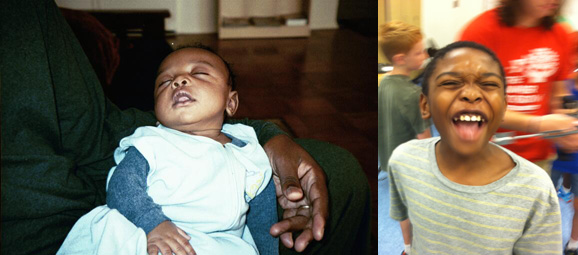
Two different Noahs, nearly 10 years apart, August 21, 2003 and July 26, 2013. (Angelia N. Levy and Donald Earl Collins).

Two different Noahs, nearly 10 years apart, August 21, 2003 and July 26, 2013. (Angelia N. Levy and Donald Earl Collins).

Today my son Noah turns ten! That’s wonderful! But it’s also a reminder of both the passing of my youthful energy and relative innocence and the path toward his adulthood and future.

I note my son’s birthday in both small and big ways. I’ve been playing Coldplay’s “Clocks” incessantly for the past week and a half, because it was the summer of Coldplay when Noah was born. Every HBO promotion of shows and movies that summer had the “Clocks” melody in it, so I couldn’t get away from it even when I wanted to.

Every time I watch the Lord of the Rings trilogy I think for a moment of the summer of ’03 and Noah’s birth, My wife was literally days away from going into labor when we watched it in a marathon session — at home and in the movie theater.

I think of seeing the crown of my son’s matted hair about five minutes before the final push on this day. I think of the fact that I basically floated on happiness and hopes, dreams fulfilled and exceeded in the year before Noah’s birth. I don’t think that I ever felt so much romantic love as the love I felt for my wife and son this time a decade ago.

But I also think of the regrets of my past and the need to ensure that my son doesn’t make the same mistakes I did. To go after what he wants for his life, for his happiness. To not refuse genuine help, friendship or love when offered. To trust with wisdom and discernment, in himself and in others, knowing that some who may call him friend may yet betray that trust. To be content with being a contrarian, but not too content. To allow himself the opportunity of failure so that no early love in his life goes unrequited, and so that even his parents know his mind and heart.

I think, too, of my son’s future, of how we keep him on the path to college, a career and calling that he doesn’t lose sight of or regret later on, of the connections he’ll need to make along the way. And of the money we’ve already spent to get him this far. A quarter million on housing, $80,000 on child care, a paid-off ’04 Honda Element and numerous other expenditures just to get him to fifth grade. With middle school and high school and high-stakes testing, sports and summer camps, more travels for vacation and family visits to come.

I’m exhausted already, and my son’s my only child. But if nothing else, with what’s left of my dwindling youth, I want to make sure that Noah never has to search for faith, for God or wisdom or hope to hold on to. That, at least, I can secure, if nothing else. Through book and other means, all is with him already.

Summer of Sound

05 Sunday Aug 2012

Posted by decollins1969 in 1, Boy @ The Window, culture, Eclectic, eclectic music, Mount Vernon New York, Movies, music, New York City, Pop Culture, race, Work, Youth

≈ Leave a comment

Tags

"End Of The Road", "Walking On Broken Glass, Annie Lennox, Boyz II Men, Garth Brooks, Grover Washington Jr., Growing Up, John Coltrane, Jon Secada, Mariah Carey, Mary J. Blige, Michael Jackson, Miles Davis, Musical Tastes, Ronny Jordan, Sounds of Blackness, U2, What's the 411?


Mary J. Blige’s What’s the 411? (1992) CD cover, August 5, 2012. (Donald Earl Collins).

One of the few great things for me about being back in Mount Vernon and New York City the summer of ’92 was that I was ahead of the slow pop cultural curve that was Pittsburgh two decades ago (although it’s still slow — just not as slow as it used to be). For one last summer, despite the turmoil of kids and my mother treating me like I was one (see my post “The Last 616 Summer” from June ’12) and the constant chaos at my job (see my “Working With Wackos, Part I” post from July ’12), I had access to all the immediate in music, movies and other forms of culture, pop or otherwise.

This was truly the summer that my tastes turned from randomly weird to eclectic. To think that just five years earlier, early Whitney Houston, Thompson Twins, Glass Tiger and ABC were all part of my regular cassette rotation for my Walkman! My tastes had grown up to the point where music had to have a mood or rhythm to it. It no longer needed to be quirky or silly in order to put me in a quirky or silly mood.

But those weren’t the only emotions available to me by the summer of ’92. I could actually feel sexy, romantic, generous, loving, caring, and not just angry, depressed and goofy in my normal life. A half-decade away from the crushing life of strife at 616 and in Mount Vernon, high school, Humanities and in general, had something to do with that. Dating off and on had brought others into my life, which meant that Crush #1 and Crush #2 had become somewhat repressed memories. The bottom line was, I no longer needed music or pop culture to block out the daily emotional pain that had been my life in the ’80s.

And that opened me up to new and more eclectic (if still occasionally goofy experiences) music experiences that year and summer. I became a big Jon Secada fan that summer (see my “Otro Dia Mas Sin Verte” post from August ’09), both in English and en Espanol. I was so glad he branched off from Gloria Estefan, as I’d had it with the Miami Sound Machine’s sound years ago.

I also became enthralled a bit with jazz and what we now call smooth jazz that summer, between Grover Washington, Jr., Ronny Jordan’s “After Hours”, John Coltrane, even some Miles Davis (who I did appreciate, but never quite understood). I had friend at Pitt who had exposed me to jazz over the previous five years, but it took graduate school for me to finally fully appreciate it. It also took working in an office with a woman who played all kinds of music all the time for me to actually go out and buy their stuff on CDs.

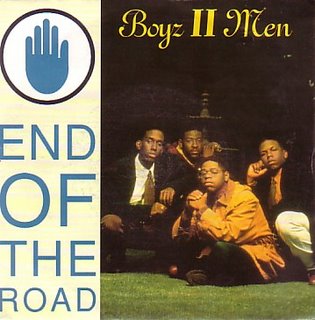
Boyz II Men’s “End Of The Road” (1992) singles cover, May 19, 2009. (Undermedveten via Wikipedia). Qualifies as fair use under US Copyright laws (low resolution picture).

The expansion of hip-hop and rap twenty summers ago to include new and fresh sounds ended up having an impact on my own music collection as well. Mary J. Blige’s What’s The 411? hit the stores and her songs the NYC-area airwaves that July and August, so raw and so new that even I the late-bloomer noticed. And who could forget Boyz II Men’s “End Of The Road.” I heard that song at least eight times a day nearly every day between the end of June and the middle of August, especially at my Mount Vernon Clinic job. I guess if I’d been divorced or in a bad relationship, I would’ve appreciated it more. As it was, any thought of buying Boyz II Men’s second album disappeared by the beginning of August. The same was true for me regarding Jodeci, the hip-hop screechers and beggars from the Upper South. They were like nails on chalkboard to me then.

Still, I incorporated music more typical of my earlier tastes into my collection that summer as well. Mariah Carey’s “I Don’t Wanna Cry” became the song I went to every time my sister Sarai started whining about me telling her to do chores at 616. Sounds of Blackness’ “Optimistic,” I discovered that summer (one summer after its release). U2’s Achtung Baby, Garth Brooks’ “The Thunder Rolls” and Michael Jackson’s “Remember The Time” rounded out my catching up to the current that summer, while Annie Lennox’s “Walking On Broken Glass” was, new, silly and serious at the same time.

There have been other times, other summer in which my tastes have taken leaps forward. I must admit, this has usually occurred after great pain or after having recovered from a major trial in my life. The summer of ’92, though, was a transition summer for me, from having to act like an adult due to stressful circumstances to just being an adult because I actually was.

The Third Armpit of Hell

27 Friday Jul 2012

Posted by decollins1969 in 1, Boy @ The Window, culture, Eclectic, High Rise Buildings, Marriage, Mount Vernon New York, My Father, New York City, Politics, Pop Culture, race, Upper East Side, Upper West Side, Work, Youth

≈ 1 Comment

Tags

Coming-of-Age, Dante's Inferno, Economic Inequality, Growing Up, Home, Metro-North, Neighborhoods, New York, New York City, NYC, Poverty, Race, Self-Discovery, Subway Trains, The City


Illustration of Dante’s Inferno, Map of Lower Hell, 16th century. (Giovanni Stradano via Wikipedia). In public domain.

During most of my Pittsburgh years, whenever someone I knew asked me what it was like to live in the New York City area, I often said two things. One, that “New York was a great place to live if you have money.” But, “if you don’t have money, New York could be like the third armpit of hell.”

I didn’t even bother to discuss Mount Vernon until I was well into graduate school. Too unknown, too complicated to explain its proximity to the Bronx and to midtown Manhattan. And from the average Pittsburgher’s perspective, it was a distinction without a difference. As far as some were concerned, Mount Vernon could’ve just as easily been outside of Buffalo as it could’ve been in the heart of Harlem.

But I definitely knew better, that my relationship with Mount Vernon and “The City” was a love-hate one, born from my growing-up experiences during the Reagan years. The lens with which I viewed the New York City area, a trifocal one of race, poverty and “outsider” status, made me ambivalent about my times growing up in Mount Vernon and all of my times in New York.

2 NYC subway train with graffiti (cropped), 1980s, December 20, 2009. (Cope2 via http://www.doobybrain.com/). Qualifies as fair use – low resolution picture.

I have my father Jimme to thank, though. Without him, I would still be afraid of New York, not just ambivalent about it. Drunk or not, working or on his way to a hole-in-the-wall bar. Jimme would take me and my older brother Darren out and down to the city often enough, to ride the Subway, to hang out with him in Harlem, Spanish Harlem, and especially Midtown. Whether it was to help him with his janitorial work on weekends, or just to hang out, we frequented Manhattan and other parts of the five boroughs off and on between ’80 and ’85, ’82 — the year of abuse — excepted.

Because of that year, the longest time I spent outside of the city growing up was between April ’81 and July ’83. After not making it down to Manhattan in all of ’82, we went to Midtown in July, where we learned about two of my father’s watering holes between 43rd and 47th. They were both near Mickey Mantle’s restaurant on 47th. He also had an Irish pub he’d like to go to around East 59th and Third, a drinking bar near his job on 64th and Columbus, and a couple of places near Macy’s on 34th Street. Because of our height and the times, when it was still legal for eighteen-year-olds to drink in public watering holes, me and Darren were allowed into these fine establishments. I learned a lot about vermouth, vodka, Cosmos and Long Island Iced Tea that summer.

Grand Central Terminal Main Concourse in New York City, March 4, 2006. (Janke and Diliff via Wikipedia). Permission granted via cc-Attribution-Share Alike 3.0 license.

I also learned a lot about the not-so-nice side of New York in those years. I recognized this as I’d board the Uptown 2 Subway from West 42nd Street and 7th Avenue in Manhattan at the tail end of rush hour. As I’d board the train, I’d notice the crunch of humanity in all of its oblivion, self-absorption, and diversity. As the doors close, I’d watch as the express train passed 50th, 59th, and 66th Street before it would grind to a halt at 72nd Street. I’d notice that a fair number of the White passengers alighted here. Between 96th and 125th Street, the load of the train would gradually lighten as about half of the passengers who’d crushed me between a tall, stale-breathed smoker and a woman who wasn’t my girlfriend were now at street level.

About three-quarters of the passengers for the rest of my trip would be Latino and Afro-Caribbean. After another hour of endless stops in the Bronx, the 2 would pull me out of my slumber as it would slowly roll into the rickety East 241st stop.

By the time I was a rising senior at Pitt, I certainly didn’t need my father to accompany on my trips into Manhattan. I also avoided the long trek from 616 across Mount Vernon to 241st to take the 2 whenever I could afford to. Metro-North was a luxurious godsend compared to the puddles of piss and infinite amounts of graffiti on the Subway I’d seen throughout the ’80s.

Toph’s “Hairy Pits” from Avatar: The Last Airbender (screenshot), July 26, 2012. (Donald Earl Collins). Qualifies as fair use — low resolution picture.

But it introduced me to other odious issues. Like Grand Central Station, which by the summer of ’90 was in desperate need of renovation. Especially the restrooms, festooned with enough garbage, feces and bodily odors and fluids to make a coroner vomit.

Off a return trip from Pittsburgh that summer, I made the mistake of having no choice but to use the almost  unusable facilities there, which in the end I couldn’t use. Meanwhile, I observed homeless males hanging out in the restroom with carts, along with an individual who looked to have Kaposi’s sarcoma, an obvious sign of full-blown AIDS.

That’s when I coined New York to be “the third armpit of hell,” the place where poverty had meant your dreams were dead on arrival. For once, it made me content that I was from a place where many smug New Yorkers disdainly considered “upstate.” Though the New York City area has changed — and mostly for the better — since ’90, it’s still a place where economic inequality can easily grind the life out of people.

The Turd Dream

24 Monday Jan 2011

Posted by decollins1969 in 1, Boy @ The Window, culture, Eclectic, Mount Vernon High School, Politics, Pop Culture, race, Religion, Youth

≈ Leave a comment

Tags

1980s culture, A.B. Davis Middle School, Board of Education, Boy @ The Window, City Hall, Coming-of-Age, Dreams, Friendship, Growing Up, Hebrew-Israelites, Interpreting Dreams, Mount Vernon public schools, Nightmares, Pittsburgh, Race, Racial Strife, Russet Potatoes, Socioeconomic Strife, University of Pittsburgh


Russet Potatoes, January 23, 2011. Source: http://www.Fotosearch.com. Qualifies as fair use under US Copyright laws because of the limited use of picture and because its use is for illustrative purposes directly related to the topic of this post.

I found myself at a party one cold and starry evening, standing in an equally cold kitchen. It was really bright in the kitchen, almost to the point of overpowering my eyes. The walls and cabinets were all-white, the counters made of formica, and the floor light blue-and-white tiled. This was in stark relief from the adjacent living room. It was in a red-brown, ’70s dimmed-light den mode, with beads hanging over the doorway leading out of the kitchen to it. It was the kind of party I never had the chance to go to in high school.

But everyone was there. Even people I hadn’t seen since my Davis Middle School days. The class valedictorian and salutatorian, the affluent and middle class types who went to Pennington Elementary, Crushes #1 and #2, members of the Italian Club, and so many others were there. Two of them were peeling potatoes and throwing them into big pots of boiling water. They started slicing and dicing them, laughing as they were throwing the pieces into the bubbling clean and clear liquid.

Except these weren’t potatoes. These were turds, each shaped like a large Russet, being peeled and chopped, looking white but quickly turning crappy-brown upon contact with the air. The two turd-peelers shared the boiled and mashed turds with my former classmates, who were smiling in glee and eating them up with delight. I then looked at this six-foot, trapezoidal pyramid of a rack in the middle of the super-bright kitchen. It was full of turds, stacked on each one of its seven levels. It was enough to feed the guests several times over.

When I sat up from this dream in my small room in a shared row house on Welsford in Pittsburgh and found myself in the present, the first Saturday of February ’90, I gave Mom a call. I told her about the dream in all of its strange details. I asked her what she thought of it. “You’re friends are full of shit,” she said. After laughing so hard that I nearly rolled out of bed, I said, “That can’t be. It’s got to be more complicated than that.”

Yet I knew that Mom was absolutely right. Most of the people I knew during my years in Humanities — classmates, teachers, administrators, family members and neighbors — were full of crap when it came to me. I certainly included myself in that category. I might’ve made sure of or accidentally given myself a couple of enemas between 7S and the University of Pittsburgh. But it would’ve been hard to stay clean around all the filth on which we dined growing up. This was thanks in large measure to our community leaders and all of the racial and socioeconomic strife that was part of everyday politics and conversations at school and at city hall.

What Mom said was ironic, too. For better and mostly for worse, Mom, father and ex-stepfather had crapped up our lives with their baggage. The turds from their lives were the reason why my dreams had grown to be so vivid, so complicated by the time I reached adulthood. Mostly, my dreams and nightmares brought me to anger, as if someone were trying to steal my life from me, which, as it turned out, was how I felt most of the time when I was awake. And that also made me resolute whenever I left my dreams for the conscious world.

This was the final break between my immediate past of Mount Vernon, the whole Hebrew-Israelite and Humanities thing, and all of the ridicule, ostracism, poverty and abuse that came with those things. My past experiences were all now a part of my dream world. It was an occasional reminder that I wasn’t really myself in the relatively recent past.

That was nearly twenty-one years ago. Except for the occasional email from an ex-teacher or ex-Humanities classmate, the only reminders I have of the time before I became myself again are my Boy @ The Window project and manuscript. And though I don’t necessarily see the people whom I grew up with and around as being full of crap these days, I do see how our collective community baggage would make it difficult for many of us to find our way, our calling. Even in the midst of the best education our city had to offer.

The Meaning of Eri’s 25th

23 Saturday May 2009

Posted by decollins1969 in 1, Boy @ The Window, Christianity, Eclectic, Hebrew-Israelite, Mount Vernon New York, race, Religion, Youth

≈ 2 Comments

Tags

616 East Lincoln Avenue, Brother, Brotherhood, Eri Washington, Growing Pains, Growing Up, Hebrew-Israelite Years, Poverty


Eri Washington (with my left arm) at 616 for Thanksgiving, Mount Vernon, New York, November 23, 2006. (Angelia N. Levy).

Yesterday, my brother Eri Washington turned twenty-five years old. He’s my youngest brother (technically, half-brother, but I don’t bother with such labels), and he’s as old now as I was when I was in the middle of my dissertation process. Wow! To think that it’s been a quarter-century since his birth makes me think about how much has happened and how much my youngest brother didn’t have or get to experience in the twenty-five years since his birth.

For starters, Eri’s birth ended a cycle of bad experiences and bad decision-making on the part of his father and my mother. I love my brother and know that the world would be a different place for me and others without him here. Yet his birth was in the middle of our fall into welfare poverty. Eri was the fourth of my younger siblings born in less than five years, between July ’79 and May ’84. He was also the third kid born during our dreaded Hebrew-Israelite years. Although his would be and remains a Hebrew name, it was also one of my family’s final acts as Hebrew-Israelites. My mother didn’t believe in abortion, nor in any form of birth control. My idiot stepfather didn’t believe in condoms. But he loved hanging out with other idiot guys bragging about how many kids he sired — I caught him once sharing cigars with these imbeciles soon after Eri’s birth.

Once again, I digress. The worst of things were over. My mother wasn’t physically abused in the final years of her so-called marriage, and I only had to face down any form of physically abuse once after Eri’s birth. Our financial status was so far below the poverty line that the only place to fall was in homelessness. Between AFDC, WIC, and FS (as my wife calls Food Stamps), we had about $16,000 coming in to feed, clothe and pay rent and other bills for a family of eight. Of course, my obese stepfather shouldn’t have been there, but oh well! There weren’t any more kids on the way, and it seemed as if my mother and I were both waking up from the illusion cast by the cult that we lived under for the previous three years. Having too many mouths to feed can do that, I guess.

There were also things that Eri would never see as he grew up, especially as he reached his tweener years. Me, my older brother Darren, and my younger brother Maurice all have memories of my mother working as a supervisor in Mount Vernon Hospital’s Dietary Department. We all knew that she worked very hard at her job and fought to keep it even though it was a losing battle. (You can’t cross your own picket line and expect to keep your job in the long run.) So Yiscoc, Sarai and especially Eri never saw my mother as a worker growing up. My mother didn’t start working again until the fall of ’97, and would work off and on as a temp for six years before getting a job with Westchester County Medical Center. Eri was nineteen years old by the time that happened.

He also never saw me slogging my way through Humanities and Mount Vernon High School to get into the University of Pittsburgh. Heck, Eri was a just a bit more than three years old when I went off to college. He took it harder than any of my siblings when I left for Pittsburgh in August ’87. When I did my family intervention in January ’02, Eri was still angry with me about it, accusing me of “abandoning the family.” In a way, I guess he was right. This despite the fact that I visited every summer through ’94 and every Christmas through ’97. My need to go away to school meant that there was little reason for Eri — or any of my other siblings for that matter — to follow my example. Of course, by ’93, none of them could have even if they had wanted to. The Humanities Program graduated its last cohort of brainiacs that year.

For better and for worse, Eri was born into an era of limited possibilities and little imagination. His first nine years of life were spent in welfare poverty during the Reagan and Bush 41 years. Not exactly a time of optimism about American innovation, social mobility, and racial harmony. Not in Mount Vernon, not in the New York City area, not for the poor and for people of color of this more conservative era. With no Humanities and living in a bedroom suburb not exactly “on the move,” Eri spent his formative years without the constant academic and familial encouragement necessary for early successes — small and big — that could provide fuel for optimism later on as a tweener or teenager.

Then the fire of April ’95 at 616 happened. It left my mother and younger siblings in a semi-homeless, semi-halfway-house state for nearly three years. They lived most of that time in Yonkers, just five blocks from the Bronx and within a half-mile or so of Van Cortlandt Park. It changed all of us. But I think it changed Eri most of all. He was always angry. Even when I visited, I could see how angry he was with me and with the rest of the world. By the Yonkers years of ’95 to ’98, he was in middle school. But instead of sending him to middle school in Yonkers, my mother made the decision to keep all of my younger siblings in Mount Vernon public schools. Only Maurice did well. Of course he did — he was a junior at MVHS when they all lived in Yonkers. Not so for Yiscoc, Sarai and especially Eri. My youngest brother spent three years and one summer in middle school, including two years at Davis in seventh grade and a summer making sure he didn’t have to repeat eighth grade.

Eri continued to behave as if his actions had little meaning after moving back into the new, insane-asylum-looking 616 in ’98. From the fall of ’99 until he dropped out in ’02, Eri was a ninth-grader at MVHS. He was a drop-in, cutting classes, hanging out with his buddies, bringing girls home apparently to hump. It wasn’t until he managed to knock up one girlfriend in the middle of ’01 that Eri realized that his life couldn’t get better without him making an effort to make it better.

By the time of my family intervention in ’02, Eri was enrolling in JobCorp in upstate New York. Still, I wanted to make sure that I gave him as strong a push as I could so that he would take the program and its possibilities seriously. Within eighteen months, Eri had completed his GED, gotten his driver’s license and earned an auto mechanic’s license. Even after not being able to find steady work, Eri made the decision to join the Army Reserve, earning him a tour of duty in Iraq in ’07-’08, not to mention a broken toe.

Not everything in Eri’s life, especially of late, has been bad. Yet when living with so much anger because the world seems like it’s against you aspiring to anything, it’s easy to just throw up your hands and say, “No mas!” The meaning that I can take from the past twenty-five years is to never give up, especially on yourself, and never let the world take your dreams from you. I hope that Eri can continue to do the same.

Newer posts →

Boy @ The Window: A Memoir

Boy @ The Window: A Memoir

Places to Buy/Download Boy @ The Window

There's a few ways in which you can read excerpts of, borrow and/or purchase and download Boy @ The Window. There's the trade paperback edition of Boy @ The Window, available for purchase via Amazon.com at http://www.amazon.com/Boy-Window-Donald-Earl-Collins/dp/0989256138/

There's also a Kindle edition on Amazon.com. The enhanced edition can be read only with Kindle Fire, an iPad or a full-color tablet. The links to the enhanced edition through Apple's iBookstore and the Barnes & Noble NOOK edition are below. The link to the Amazon Kindle version is also immediately below:

scr2555-proj697-a-kindle-logo-rgb-lg

Boy @ The Window on Amazon.com: http://www.amazon.com/Boy-The-Window-Memoir-ebook/dp/B00CD95FBU/

iBookstore-logo-300x100

Boy @ The Window on Apple's iBookstore: https://itunes.apple.com/us/book/boy-the-window/id643768275?ls=1

Barnes & Noble (bn.com) logo, June 26, 2013. (http://www.logotypes101.com).

Boy @ The Window on Barnes & Noble: http://www.barnesandnoble.com/w/boy-the-window-donald-earl-collins/1115182183?ean=2940016741567

You can also add, read and review Boy @ The Window on Goodreads.com. Just click on the button below:

Boy @ The Window

Twitter Updates

Tweets by decollins1969
  • RSS - Posts
  • RSS - Comments

Archives

  • June 2025
  • April 2023
  • September 2022
  • August 2022
  • July 2022
  • June 2022
  • May 2022
  • April 2022
  • March 2022
  • January 2022
  • December 2021
  • November 2021
  • October 2021
  • September 2021
  • August 2021
  • July 2021
  • June 2021
  • April 2021
  • March 2021
  • February 2021
  • January 2021
  • December 2020
  • November 2020
  • October 2020
  • September 2020
  • August 2020
  • July 2020
  • May 2020
  • April 2020
  • March 2020
  • January 2020
  • December 2019
  • November 2019
  • August 2019
  • July 2019
  • June 2019
  • May 2019
  • April 2019
  • March 2019
  • February 2019
  • January 2019
  • December 2018
  • November 2018
  • October 2018
  • September 2018
  • August 2018
  • July 2018
  • June 2018
  • May 2018
  • March 2018
  • February 2018
  • January 2018
  • December 2017
  • November 2017
  • October 2017
  • September 2017
  • August 2017
  • July 2017
  • June 2017
  • May 2017
  • April 2017
  • March 2017
  • February 2017
  • January 2017
  • December 2016
  • November 2016
  • October 2016
  • September 2016
  • August 2016
  • July 2016
  • June 2016
  • May 2016
  • April 2016
  • March 2016
  • February 2016
  • January 2016
  • December 2015
  • November 2015
  • October 2015
  • September 2015
  • August 2015
  • July 2015
  • June 2015
  • May 2015
  • April 2015
  • March 2015
  • February 2015
  • January 2015
  • December 2014
  • November 2014
  • October 2014
  • September 2014
  • August 2014
  • July 2014
  • June 2014
  • May 2014
  • April 2014
  • March 2014
  • February 2014
  • January 2014
  • December 2013
  • November 2013
  • October 2013
  • September 2013
  • August 2013
  • July 2013
  • June 2013
  • May 2013
  • April 2013
  • March 2013
  • February 2013
  • January 2013
  • December 2012
  • November 2012
  • October 2012
  • September 2012
  • August 2012
  • July 2012
  • June 2012
  • May 2012
  • April 2012
  • March 2012
  • February 2012
  • January 2012
  • December 2011
  • November 2011
  • October 2011
  • September 2011
  • August 2011
  • July 2011
  • June 2011
  • May 2011
  • April 2011
  • March 2011
  • February 2011
  • January 2011
  • December 2010
  • November 2010
  • October 2010
  • September 2010
  • August 2010
  • July 2010
  • June 2010
  • May 2010
  • April 2010
  • March 2010
  • February 2010
  • January 2010
  • December 2009
  • November 2009
  • October 2009
  • September 2009
  • August 2009
  • July 2009
  • June 2009
  • May 2009
  • April 2009
  • March 2009
  • February 2009
  • January 2009
  • December 2008
  • November 2008
  • October 2008
  • September 2008
  • August 2008
  • July 2008
  • June 2008
  • May 2008
  • April 2008
  • March 2008
  • February 2008
  • January 2008
  • December 2007
  • November 2007
  • October 2007
  • September 2007
  • August 2007
  • July 2007
  • June 2007

Recent Comments

decollins1969's avatardecollins1969 on No Good Teaching Deed Goes…
Mary Rose O’Connell's avatarMary Rose O’Connell on No Good Teaching Deed Goes…
Lyndah McCaskill's avatarLyndah McCaskill on The Raunchiest of Them Al…

NetworkedBlogs on Facebook

NetworkedBlogs
Blog:
Notes From a Boy @ The Window
Topics:
My Life, Culture & Education, Politics & Goofyness
 
Follow my blog

616 616 East Lincoln Avenue A.B. Davis Middle School Abuse Academia Academy for Educational Development AED Afrocentricity American Narcissism Authenticity Bigotry Blackness Boy @ The Window Carnegie Mellon University Child Abuse Class of 1987 CMU Coping Strategies Crush #1 Crush #2 Death Disillusionment Diversity Domestic Violence Economic Inequality Education Family Friendship Friendships Graduate School Hebrew-Israelites High-Stakes Testing Higher Education History Homelessness Humanities Humanities Program Hypocrisy Internalized Racism Jealousy Joe Trotter Joe William Trotter Jr. K-12 Education Love Manhood Maurice Eugene Washington Maurice Washington Misogyny Mother-Son Relationship Mount Vernon High School Mount Vernon New York Mount Vernon public schools Multiculturalism MVHS Narcissism NFL Pitt Pittsburgh Politics of Education Poverty President Barack Obama Race Racial Stereotypes Racism Relationships Self-Awareness Self-Discovery Self-Reflection Sexism Social Justice Teaching and Learning University of Pittsburgh Violence Whiteness Writing

Top Rated

Blog at WordPress.com.

  • Subscribe Subscribed
    • Notes from a Boy @ The Window
    • Join 103 other subscribers
    • Already have a WordPress.com account? Log in now.
    • Notes from a Boy @ The Window
    • Subscribe Subscribed
    • Sign up
    • Log in
    • Report this content
    • View site in Reader
    • Manage subscriptions
    • Collapse this bar
 

Loading Comments...