• About Me
  • Other Writings
  • Interview Clips
  • All About Me: American Racism, American Narcissism, and the Conversation America Can’t Have
  • Video Clips
  • Boy @ The Window Pictures
  • Boy @ The Window Theme Music

Notes from a Boy @ The Window

~

Notes from a Boy @ The Window

Tag Archives: Doctoral Thesis

When Their Lies Become The Truth

16 Monday Aug 2021

Posted by decollins1969 in 1, Academia, Carnegie Mellon University, culture, Eclectic, eclectic music, music, New York City, Pittsburgh, Pop Culture, race, Work, Youth

≈ Leave a comment

Tags

"Billie Jean", Distractions, Doctoral Thesis, Failure, Fear of a "Black" America, Michael Jackson, Plagiarism, Theft, Whose America?, Writing


Michael Jackson in the middle of his first public moonwalk while singing “Billie Jean” (cropped screen shot), Motown 25: Yesterday, Today, Forever, May 16, 1983. (NBC/Starvista; https://www.smoothradio.com/artists/michael-jackson/first-moonwalk-motown-video-1983/)

This is the third of my multi-part series on my paths as a writer. This piece is one that I’ve work on for nearly a year. Mostly because of the issue to out or not out the guy who plagiarized me in 2002. Partly because I do not really want the kind of attention this post could bring. But the more uncomfortable and painful a writing becomes all the more reason to share it with readers.


There is an ugly truth that inhabits every arena of work. Racist, misogynistic, and elitist politics make all workplaces toxic, some dangerously and lethally so. The never-ending palace intrigue, the perpetual ambitious drive and thirst for clout, the absolute must of self-promotion. All of it makes the idea of “just here to do a job” laughable.

With this toxicity comes the need to lay claim to words and works that are not one’s own. In academia, it means stealing ideas, references to primary resources, even actual words from the work of lesser known academicians. All for the lofty prize of permanent tenure and plum professorships at elite universities. All while destroying careers and breaking people.

I was a victim of such a theft. The plagiarist was one Dr. Jonathan Zimmerman, today a decently prominent full professor at the University of Pennsylvania Graduate School of Education, with a career that was undoubtedly helped along by a book about the so-called culture wars. It nearly broke me as a writer. It took nearly 15 years for me to fully recover. In some ways, I am still recovering.

My story is a case study of how easily White mediocrity can trump Black excellence unless or until the latter forces acknowledgment out of the world. But it is also my tale of an aspiring academician snuffed out in his younger years, a wonder-man who had yet to decide the kind of thinker, writer, educator, and gift-user he wanted to be.

I was only partly aware of the possibility of being plagiarized in the 1990s. Oh, I was paranoid enough. As a Black doctoral candidate at lily-White Carnegie Mellon University, I worried about losing my own work and not finishing. By the summer of 1996, I was mailing out seven 3.5-inch, not-so-floppy-disks-at-a-time to my trusted circle, because I had little trust for folks in my academic world, including my dissertation advisor. But I had no idea that I should have extended my lack of trust to trained academicians who were so devoid of ideas and so bereft of imagination that they would steal from little-old me.

My off-and-on dealings with Zimmerman was where I learned eggs should never mix with stones. In 1994, Zimmerman was an assistant professor in the subfield of social and historical foundations of education at West Chester University. I and a couple of other Black doctoral students (the latter two from the University of Pittsburgh School of Education) had promised to present our work at a conference Zimmerman had organized, but reneged at the last minute. The two thirtysomething Black students felt leery about the invitation. “This is very disappointing…I wish you’d let us know sooner…I was so looking forward to reading your work,” Zimmerman said haltingly over the phone with a tone that combined reassurance with condescension when I informed him of our cancellation. Zimmerman had me agree to send him a copy of my dissertation, “A Substance of Things Hoped For”: Multiculturalism, Desegregation, and Identity in African-American Washington, D.C., 1930–1960, once I finished it.

I bumped into Dr. Zimmerman twice at scholarly conferences after that, in 1996 and 1997. He sought me out about my dissertation, for what purpose, I wasn’t sure. I was too worn out after finishing my degree to find out. The next and last time I saw Zimmerman was at the end of April 1999. New York University invited me to their campus for a job interview in the school of education. It was for a social foundations in education opening. I learned that Zimmerman was on the search committee. He had moved on from his previous job, and was now a tenured associate professor.

I gave a seventy-five-minute job talk about my dissertation research and soon-to-be book topic, titled “Fear of a ‘Black’ America: Multiculturalism and Black Education in Washington, DC.” During the talk and Q-and-A session that followed, I noticed Zimmerman had brought with him a paperback copy of my doctoral thesis to the talk. He must have ordered a copy from ProQuest, the main depository for dissertations in the US.

“Can you tell me more about why Black parents didn’t want Little Black Sambo taught in DC Public Schools?,” Zimmerman asked. “Why do you keep using ‘multiculturalism’ to describe what happened in the past — isn’t this anachronistic?,” he inquired with a bit of disdain. “Do you have a publisher lined up for your manuscript?,” I remember him probing, as if that was really his damn business.

It should have been obvious, but at the time, I honestly wasn’t sure why Zimmerman asked me so many questions. Between a two-year-long search for full-time work, of living off fumes from the one $1,850-class I taught at Duquesne University every semester, of burnout and rage from completing my degree, my head wasn’t right. I also wanted to move on from Pittsburgh. “I’d just about have to wait for Joe or Larry [my former dissertation and graduate advisors] to die before I’d get a job that pays around here,” I said to my significant other numerous times.

I didn’t get the NYU job. Six weeks after that interview, I ended up with a job in civic education in suburban DC, working with high-potential high school juniors and seniors. Soon after, I landed a literary agent with my book proposal for Fear of a “Black” America.

Three years and two jobs later, I heard from Zimmerman again, indirectly. I had stumbled into an opportunity while already working as a nonprofit administrator for the New Voices National Fellowship Program to teach a graduate course in social foundations of education at George Washington University. In looking for books suitable for the class, I discovered Zimmerman had published Whose America?: Culture Wars in the Public Schools, his book on a century of America’s culture wars as embodied in history textbooks. I decided to buy it in case any of my students wanted to research this topic.

In those pages, Zimmerman carefully avoided referring to the book Little Black Sambo. Instead, he used the term “Sambo” in reference to mainline history textbooks from the 1940s and 1950s. But in one paragraph, Zimmerman’s skill in textual microsurgery broke down like an old and rusted-out car. Where Zimmerman had written, “[e]ven champions of so-called intergroup education in the 1950s turned a blind eye — or a disdainful frown — on black text protests,” I had written, “the Washington Post [in September 1947] published an editorial on the Little Black Sambo controversy that accused the [NAACP-DC] Branch and the…black Washington community of overreacting.”

Where he had wrapped his quote with “opined the Washington Post, denouncing blacks’ ‘humorless touchiness’ about the term ‘Sambo’ in textbooks,” I had the fuller quote, as “the Post could not ‘believe that the humorless touchiness reflected in these protests represents the attitude of Negroes in general.’” And where Zimmerman cited the original sources as the Washington Post from September 30, 1947 and some reference to papers from the Moorland-Spingarn Research Center, I also had those same references, plus additional references to the Washingtoniana Division of DC Public Library.

If this theft of ideas and research was pure coincidence, then so is the existence of systemic racism in the US. Zimmerman had access to my doctoral thesis for at least three years before the publication of his book. The likelihood that Zimmerman independently went through the same files at Moorland-Spingarn to address the specific issue of “Sambo” references in textbooks during the 1950s when the controversy over the children’s book Little Black Sambo occurred in 1947 is infinitesimally low (he doesn’t refer to Moorland-Spingarn as a place he visited to conduct research in Whose America?).

The specific Washington Post quote could be coincidental, but not when combined with the Moorland-Spingarn citation. Back in the late 1990s and early 2000s, one couldn’t just do a Google search for a then-55-year-old article. One either had to dig it out from among the thousands of files in archives like Moorland-Spingarn at Howard University, where I spent nearly two weeks in March 1995 uncovering information about issues like the 1947 Little Black Sambo controversy. Or, a researcher would have had to go through reels of newspaper microfilm at libraries looking for clues and key words, like I did for another two weeks at the Washingtoniana Division of DC Public Library’s main branch, the Martin Luther King, Jr. Library, in February 1995. My doctoral thesis was never cited as a source in these sections, either.

A couple of weeks later, I found Dr. Zimmerman’s NYU email address. I wrote to him about his erasure of my years of sweat, tears, and even blood (in the case of paper cuts) in gathering the information that had gone into my dissertation. “I don’t know who you are,” was his one-sentence response, as was and remains the typical retort from those who are caught using another’s words, work, and ideas as their own. “Fuck it,” I said to myself after that exchange. I definitely should have found a lawyer back then.

I received a note a few days after I discovered Zimmerman’s thievery from my one-time agent Claudia Menza about the acquisition editors at Random House. They had come close to accepting my book, but ultimately rejected Fear of a “Black” America for publication. It was a gut punch while walking carelessly through Central Park on a cloudless early fall day. The kind of punch that leaves one falling on their ass while exchanging pain for air, trying one’s hardest not to cry or scream for fear of embarrassment. I eventually self-published my book in 2004, a shell of the dream I originally held for this manuscript.

I hated academia and academicians. I hated myself for the desperate academic/nonacademic/non-writing writer-who-also-wanted-to-write-more it turned me into. I hated that I had earned a PhD, only to find myself working as a nonprofit administrator where the only thing people cared about was bringing in more multimillion-dollar grants. Most of all, I hated that I had never thought enough of the possibility that others would find ingenious and craven ways to steal from me, and that I couldn’t do a damn thing about it.

Fast-forward more than a decade later to 2018. I am no longer working as a nonprofit administrator chasing dollars for watered-down education and social justice efforts. I am teaching full-time as contingent faculty between two universities. My writings are now meant for the world, and not for academia. After reading a story about how a plagiarist had copied and pasted huge portions of the author Leta Hong Fincher’s words from Leftover Women, it dredged up my experiences with Dr. Zimmerman.

This is how the big dogs do it. They steal your ideas, your ideals and your soul, really. They do it while simultaneously erasing you from the public record. They violently make you into the intellectual undead, a ghost that exists, but cannot haunt. Like with Napoleon allegedly blasting away at the Sphinx’s nose for fear that the truth of ancient Egypt as a Black civilization would drown the myth of white Egypt. The big dogs make you feel the theft, the death, and the erasure, right down to them blowing your bits of graphite, wood pulp, and synthetic rubber off of history’s pages.

“And mother always told me be careful of who you love/And be careful of what you do ’cause the lie becomes the truth.” These are the last two lines of the second stanza in Michael Jackson’s “Billie Jean.” That Michael Jackson — the Black genius that he was — also was a pedophile who preyed on star-struck children and their naive parents. He lied by omission and commission, for nearly half his life. The topic of multiculturalism, and being able to profit from it, no longer matters to me. But having people like Zimmerman out there profiting from their theft and their lies does.

Boy @ The Window Origins: Meltzer Conversations

14 Saturday Mar 2015

Posted by decollins1969 in 1, Academia, Boy @ The Window, Carnegie Mellon University, Christianity, culture, Eclectic, Hebrew-Israelite, Mount Vernon High School, Mount Vernon New York, Pittsburgh, Politics, Pop Culture, race, Religion, Youth

≈ Leave a comment

Tags

Benetton Group, Black Elites, Black Identity, Black Masculinity, Black Migration, Black Washington, CMU, Colorism, Dissertation, Doctoral Thesis, Harold Meltzer, Harper Stewart, Humanities, Hypermasculinity, Inequality, Internalized Racism, Logic, Manhood, Multiculturalism, Personal Insights, Race, Racial Identity, Rationalism, Self-Discovery, Social Injustice, Taye Diggs, The Best Man (1999), Washington DC, X-Men Origins: Wolverine (2009)


X-Men Origins: Wolverine (2009) scene, where Wolverine frees mutants kept as experiments by Colonel William Stryker , March 13, 2015. (http://cdn.collider.com/).

X-Men Origins: Wolverine (2009) scene, where Wolverine frees mutants kept as experiments by Colonel William Stryker , March 13, 2015. (http://cdn.collider.com/).

Of all the tangents I took related to writing Boy @ The Window, the most direct path that got me to write a memoir about the most painful period in my life was through several conversations with my dear teacher, friend and mentor in the late Harold Meltzer. I’ve discussed bits and pieces of some of those conversations here and in longer form in Boy @ The Window. It’s still worth rehashing some of those conversations, at least in terms of what was and wasn’t good advice, as well as in explaining how some of the main themes of the memoir developed over time.

As I wrote in Boy @ The Window, though my “first interview with him was in August ’02,” the first time “we discussed the possibility of me doing Boy @ The Window went back to February ’95.” Meltzer had been retired from teaching about a year and a half, while I was beginning the heavy lifting phase of my doctoral thesis, “living in DC for a couple of months while hitting the archives and libraries up for dusty information. In need of a writing break, I gave him a call on one cold and boring Saturday afternoon.”

It was in response to a letter he sent congratulating me. I’d recently published an op-ed in my hometown and county newspaper, “Solving African American Identity Crisis.” I was writing about issues like using the n-word, hypermasculinity, and internalized racism in the short and, for me at least, dummied down piece. Somehow our discussion of that piece led to a discussion of my classmate Sam. Did I really want to spend an hour and a half talking with Meltzer about Sam and some of my other Humanities classmates and their possible identity issues, considering some of my own serious growing pains — the Hebrew-Israelite years, my suicide attempt, my Black masculinity and manhood issues? Absolutely not!

But I learned quite a bit about how I might want to approach writing Boy @ The Window through that phone call. Not because Meltzer had given me any sage advice, which he didn’t, or because he revealed things to me that I shouldn’t have come to learn during our conversation, which he definitely did.

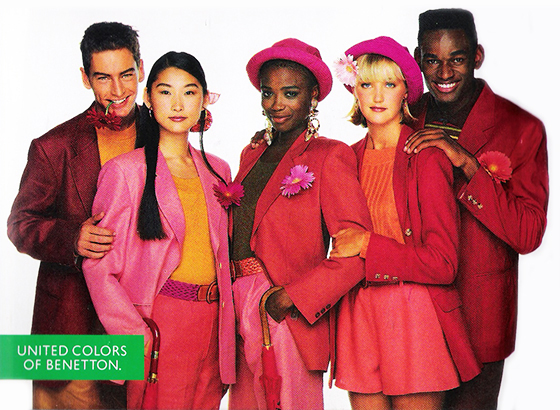
Benetton ad, 1980s, January 2013. (http://fashionfollower.com/).

Benetton ad, 1980s, January 2013. (http://fashionfollower.com/).

No, it was the idea that a lot of the things that I had pursued as a historian and researcher were things that came out of my experiences growing up. Multiculturalism as a historical phenomenon (at least if one linked it to cultural pluralism)? Can anyone say Humanities Program, or, what I used to call “Benetton Group” when we were at A.B. Davis Middle School? Writing about African American identity issues? Obviously related to living in Mount Vernon, the land where any hint of weakness translated into me being called a “faggot” or a “pussy.”

And what about any scholarly concerns with racial and socioeconomic inequality and Black migration? Anyone ever meet my Mom and my father Jimme, 1960s-era migrants from Arkansas and Georgia/Florida respectively? An examination of the Black Washingtonian elite and their looking down upon ordinary Blacks because of their own colorism or the latter’s lack of education? Come on down, Estelle Abel and any number of well-established Black Mount Vernon-ites who never gave me the time of day! As much as academia had been an escape for me, into a world of rationalism and logic, a place of dispassionate scholarship, it was all personal for me, without realizing it until that phone conversation with Meltzer.

Fast-forward to November ’02, the last interview I did with Meltzer before his death two months later. We spent the last couple of hours on that brisk fall Thursday discussing the book idea that would become Boy @ The Window. Meltzer thought that it should be a work of fiction, “based on the real flesh and blood folks in my life, but with different names of course to protect me from any potential lawsuits. He did make me rethink the project from a simple research study of my high school years into narrative nonfiction or a memoir.” 

Screen shot of fictional character Harper Stewart's bestselling novel nfinished Business, from The Best Man (1999), March 14, 2015. (hitchdied via http://s785.photobucket.com/).

Screen shot of fictional character Harper Stewart’s bestselling novel Unfinished Business, from The Best Man (1999), March 14, 2015. (hitchdied via http://s785.photobucket.com/).

Was Meltzer correct? Should I have done a Harper Stewart — played by actor Taye Diggs in The Best Man (1999)? Should I have fictionalized all of my experiences and those of my family, teachers, administrators and classmates? I’m not sure if it would’ve made a difference. Stories of fiction tend to have a tight symmetry to them. Or, the theme of “what goes around comes around” is usually a big one in any novel. You can’t leave too many loose threads or unresolved issues, even if the novel is part of a series. For my purposes, since my life remains a work in progress, a story of relative — not obvious or absolute — success, telling it as fiction would hardly ring true to me, much less to any group of readers.

Whatever else anyone wants to say about the late Harold Meltzer, the dude got me to think about difficult things until I was no longer comfortable in leaving my uncomfortable experiences and assumptions unchallenged. The very definition of a mentor, the very purpose of Boy @ The Window.

Where Audacity Meets Second-Guessing

25 Saturday May 2013

Posted by decollins1969 in 1, Academia, Boy @ The Window, Carnegie Mellon University, culture, Eclectic, Pittsburgh, Politics, Pop Culture, race, University of Pittsburgh, Youth

≈ 1 Comment

Tags

"A Substance of Things Hoped For", Ambition, Arrogance, Audacity, Boldness, CMU, Courage, Dissertation, Doctoral Thesis, Doubt, Fear, Harold Scott, Multicultural Education, Multiculturalism, Peter Stearns, PhD, Pitt, Racial Determinism, Second-Guessing


Second-guessing to the extreme, May 25, 2013. (http://pualingo.com).

Second-guessing to the extreme, May 25, 2013. (http://pualingo.com).

I’m a great second-guesser of myself (and of others). But I’m especially hard on myself in that department. Even when I know that what I’m doing is the right thing, that I’m taking the right path and proper course of action. I remind myself of what to do, what to say, how to say what I need to say, and even then, I wonder often if my move was to bold, my words too direct, my tone too know-it-all-esque.

Still, there are plenty of times as an adult where I’ve decided to not give in to my second-guessing impulses, to remain bold and aggressive despite the potential problems with a plan. Graduate school at Pitt and Carnegie Mellon was probably the longest time as an adult in which I did little second-guessing, at least when I was awake.

Something happened on my marathon march to the doctorate the week before Memorial Day ’93, one where, for once, someone did my second-guessing for me. And no, it wasn’t Joe Trotter or any of the other usual professorial suspects. This one came courtesy of Harold Scott, an acquaintance (and now friend) who was a visiting professor at Pitt’s GSPIA (Graduate School of Public and International Affairs) at the time. I met with him twenty years ago to discuss my transition from the University of Pittsburgh to Carnegie Mellon’s history department, to glean insights from a recent PhD and a man ten years my senior.

I’d met Harold a few times before, mostly in the context of joint Pitt-CMU gatherings related to issues of racial diversity and retention of grad students of color. Aside from discovering that Harold was an anti-affirmative action baby, the only other thing I knew about him was that he was the first African American to earn a doctorate from CMU’s history department.

Dick Cheney as an example of Pollyanna Principle, March 16, 2003. (http://www.veteranstoday.com/wp-content/uploads/2011/08/cheney.jpg).

Dick Cheney as an example of Pollyanna Principle, March 16, 2003. (http://www.veteranstoday.com/wp-content/uploads/2011/08/cheney.jpg).

So we both asked questions. I learned how Harold suffered at the hands of a mutual leading professor between us and the department, mostly in the form of isolation and arbitrarily bad pay as an instructor once he became ABD. He learned that I had a lot of ambition as a twenty-three year-old doctoral student. My plan at the time was to complete my PhD by the end of ’95, a little more than two and a half years from the date of our ’93 meeting.

Harold laughed, almost hysterically, as I stepped him through all my steps between late-May ’93 and December ’95. He noted that I had at least one year of coursework to complete at CMU before they’d give me their “stamp of approval” to move on to my written and oral comps, much less the dissertation. (Except that I’d already taken my written comps). Most importantly, Harold didn’t understand how I expected to write a doctoral thesis of significant research and girth in little more than a year, assuming that I’d have have to teach at some point, assuming that I had to find literally hundreds of sources.

Then we discussed my dissertation topic specifically. I talked about multiculturalism and multicultural education, about Black Washington, DC and Negro Education Week, about Carter G. Woodson and Alain Locke and W. E. B. Du Bois. I talked about the counter-literature that laid out multiculturalism as either Polyanna or as a mask for Afrocentricity without the Black nationalism that White scholars had ascribed to it.

Somehow in my discussion of the literature, between Arthur Schlesinger and Diane Ravitch, Thomas Sowell and James Banks, and Gary Nash and Cornel West, Harold had but one question. “Are you a ‘racial determinist’?,” he asked. I didn’t know exactly what that term meant, but I already knew what a cultural determinist was. I answered, “Yes and no.” I went on to describe the many situations in which I believed race played a role, if not a dominant role, in American history or culture. That’s not the definition, by the way, as it’s a variant of biological determinism, and very Nazi-like.

That’s when we really began to go back and forth. But I don’t think much of that argument was about racial determinism or where I stood on it at all. I think Harold thought that I was both arrogant and naive. It wouldn’t have been the first time I’ve left that impression, or the last. But yes, at twenty-three, I’d set my sights on a degree, a dissertation and book topic, and a career that I wanted, and had made the decision to not let my over-thinking second-guessing get the better of me. That Harold and others weren’t privy to my process likely made my bold plans and predictions seem ridiculous.

Brett Farve and yet another interception, 2009 NFC Championship Game, January 24, 2010. (Ronald Martinez/http://bleacherreport.com).

Brett Farve and yet another interception, 2009 NFC Championship Game, January 24, 2010. (Ronald Martinez/http://bleacherreport.com).

Yet there was more going on here, much of which wouldn’t become apparent to me until the end of ’95, when I was six chapters into my eight-chapter dissertation. Harold was my warning that the grad school process alone could beat the living hell out of me, that the professors at CMU — White or Black — had an old-fashioned attitude about how long it ought to take someone like me to finish. Harold went through a gauntlet to finish his doctorate in ’90, only to struggle to find work.

In being the second African American to go through the same gauntlet, I eventually realized that my speed and strength of purpose didn’t really matter in the lily-White thinking of the powers that were at CMU. And by the time I started second-guessing my decisions, I practically already had my degree.

The Audacity of Youth, Grad School Style

06 Saturday Aug 2011

Posted by decollins1969 in 1, Academia, Boy @ The Window, Eclectic, Youth

≈ Leave a comment

Tags

Audacity, Black Washington, Bruce Anthony Jones, Calling, Career, Career Options, Carnegie Mellon University, Certfication, Dan Resnick, Dissertation, Doctoral Thesis, Experience, Fudging Data, History, Joe Trotter, Joe William Trotter Jr., Multiculturalism, Naivete, Pittsburgh, Proletarianization Thesis, Teacher Education, Thesis, Wisdom, Youth


Me as Naruto, the ultimate hollerer, Noah's 7th birthday, July 30, 2010. (Source/Donald Earl Collins)

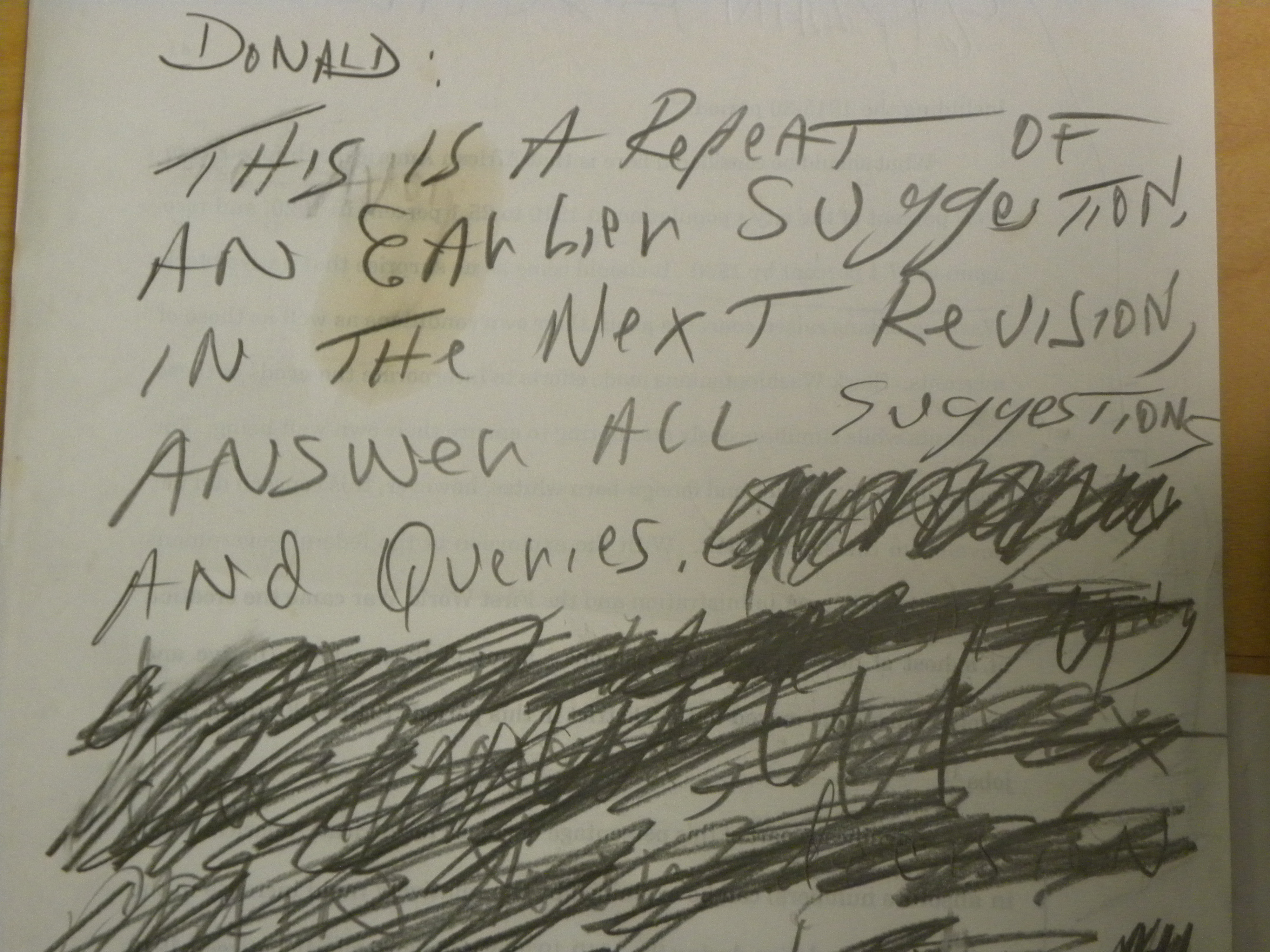
This weekend should be of significance to me. Actually it should be of more significance than anything else I’ve done professionally in the fifteen years since. For this was the weekend that I decided I was “Dr. Collins,” three and a half months before actually becoming Dr. Collins.

I was in the middle of a tumultuous time, caught between Joe Trotter and five years of graduate school, the last three of which had been at Carnegie Mellon. I had just finished revising my first draft of my dissertation, adding thirty pages to an already hefty 475-page manuscript. Me and Trotter hadn’t been getting along for four months, and after two months with my first draft, I’d received a response in mid-July that was disheartening.

Most of my dissertation, examining how multiculturalism was lived intellectually, educationally and culturally in Black Washington, DC, received no comment whatsoever. The chapters on the development of

Trotter comments, back of page 43 of first dissertation draft, July 15, 1996. Pic taken August 6, 2011. (Source/Donald Earl Collins)

the Black community in DC, particularly in the period immediately before the 1930-1960 period, had received lots of snarky comments. Like “I told you to change this already,” or “This is the third time I commented on this section,” or “Make these suggested revisions on…already,” handwritten in pencil, big, bold and rushed, as if he wanted to stab me in the neck with the pencil. Comments on writing, evidence, to sharpen analysis of my multiculturalism argument, I expected. What I, naive little me, didn’t expect was a series of comments about data and information that, quite frankly, was irrelevant.

After talking with a couple of professors who weren’t on my dissertation committee — including one whom himself had been Trotter’s advisor back in the ’70s — I finally figured out what had been eating at the man ever since I began handing him chapters. It wasn’t as if Trotter’s comments were transparent in what he wanted me to revise. He wanted me to put together a proletarianization argument for DC. Bottom line was, he was pissed with me because I had written that the Great Migration period (1910-1930) of Blacks leaving the rural South for the industrial, urban North had little effect on DC, a truly Southern city at the time.

I was incensed when I finally figured out why Trotter had been giving me a hard time since last fall and especially since April. It made me think that maybe earning a doctorate in history — especially with him as the head of my committee, along with Dan Resnick and an increasingly distant Bruce Anthony Jones — wasn’t worth it. I thought that if I had to go through another year of this, that I’d drop out of the program.

But I’d only do that after giving the revisions one more shot. I addressed every — and I mean every — comment I had from Trotter by email or written out across a page, and then documented every change in a six-page memo of my revisions. I even went so far as to rhetorically fudge the Great Migration period data, just to see how Trotter would respond. On page 100 of my dissertation, I wrote, “For Washington, a slight acceleration in black migration occurred between 1915 and 1930.” That was an obfuscation, for Blacks migration didn’t “accelerate” until the 1930s, after a twenty-year period of limited migration that only added 20,000 to a Black population of more than a 100,000. Trotter actually praised this revision.

I made a deal with myself to quit after another year if this revision didn’t work out. After receiving a response that only required four minor revisions, Trotter made an attempt to remove the one professor I did have in my corner from my committee in Bruce Jones, using Jones’ recent acceptance of a position at the University of Missouri as an excuse. From that weekend in August ’96 until the week before Thanksgiving, everything about my doctorate became a battle with Trotter.

In a way, I guess I was lucky it did work out. But now, as I did then, I wonder if it was really worth it, to fight as hard as I did for that degree. Would I be a better writer, a better educator, if I had dropped out of the program, gone back to school, and become a high school history or social studies teacher? At least my employment status would’ve been much more stable between ’96 and ’99 if I had, and I’d have an additional career option now.

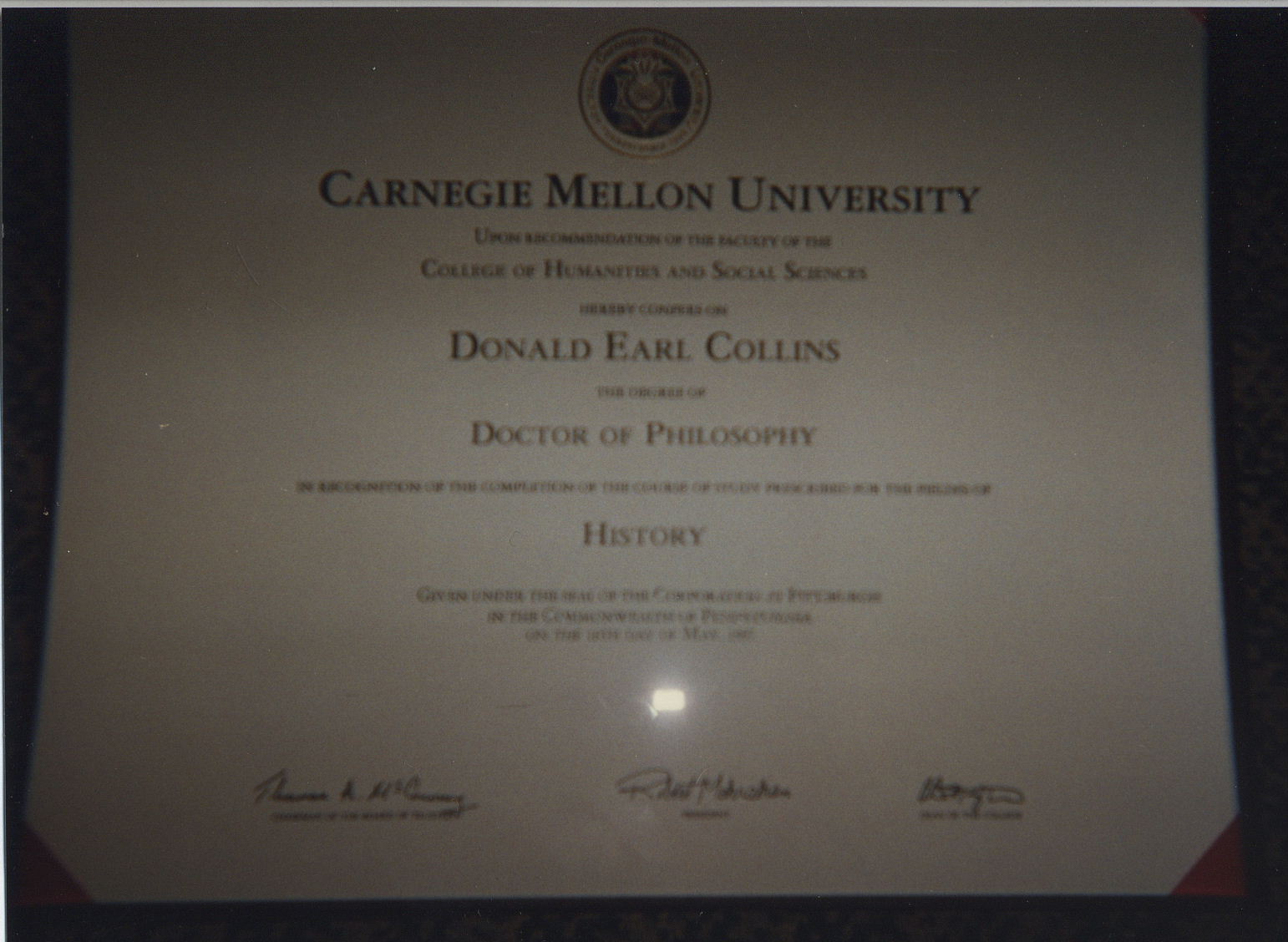
PhD Graduation - CMU Diploma, May 21, 1997. (Source/Donald Earl Collins)

Even now, thinking about what happened a decade and a half ago makes me clench my teeth, not with anger, but more with a sense of dread and latent rage. What I and at least two other male students went through (as I’d learn later on) was patently unfair. Still, I realize that while I’ve long since forgiven Trotter for his misdeeds, I can’t help but think that professionally, he aged me in my last year in graduate school. The sense of security I felt about my professional future back then was gone, and I don’t think I’ve felt that certain, that youthful, since.

I do know this. That that youthful, if somewhat naive, twenty-six year-old still resides in me. But with the mind of a forty-one year-old man, I can use both wisdom and experience to say that I wouldn’t go through that again. I’d either would’ve gone to law school or a school of education, maybe even with a focus on ed foundations and ed policy. As it is, between Boy @ The Window and my recent articles, that’s really what I’m most intellectually passionate about these days anyway.

I may be Dr. Collins or  Professor Collins, maybe for the rest of my life. But really, I’d be happiest as Donald Earl Collins, the author, educator and troublemaker I believe with all my heart I am and I will always be.

Running Interference

04 Monday Apr 2011

Posted by decollins1969 in 1, Academia, Boy @ The Window, Carnegie Mellon University, culture, Eclectic, race

≈ Leave a comment

Tags

Academia, Academic Suicide, Advising, Advisor, April 4th, Bad Mentoring, CMU, David Montgomery, Dissertation, Doctoral Thesis, Joe Trotter, Joe William Trotter Jr., Manning Marable, Mentoring, Michael Nettles, MLK Assassination, Spencer Foundation Dissertation Fellowship Program


Joe Trotter, circa 2008.

Joe Trotter, circa 2008.

Today is the forty-third anniversary of Martin Luther King’s assassination by James Earl Ray in Memphis, Tennessee. But for the past fifteen years, April 4th has also had the dubious distinction of reminding me of a big argument between me and Joe Trotter. He was my doctoral thesis advisor at Carnegie Mellon and, until that day, someone I considered a mentor in my becoming an academic historian.

Below is an excerpt from my book Fear of a “Black” America (with some minor additions) in which I recount what happened that day:

‘I’m looking out for your best interests’ was what my dissertation advisor typically said in discussing my future with me. As far as Trotter was concerned, he was in charge of the rest of my academic career, determining everything from whether I would finish my doctorate to where I would live and work after I graduated. But as I’d already discovered in the months leading to this moment, he was not nurturing my career at all. Virtually all of my achievements as a graduate student occurred despite my advisor rather than because of him.

This was because my advisor discouraged my attempts to publish, to obtain grants for my research, to participate in major conferences, and to apply for jobs when it was apparent I had nearly completed my doctoral thesis. My advisor would frequently say ‘You’re not ready’ to take on a particular project or to apply for a grant or job to hinder my efforts. Yet Trotter never pointed out what he thought I needed to do to be “ready.”

One of our last official meetings as advisor and student covered this particular issue. Six chapters into an eight-chapter dissertation, I was still being told that I was ‘not ready’ to apply for jobs or to attend major conferences. Trotter had in fact contradicted some of what he had said about my work in a previous meeting. So when he declared for the eighteenth time in this particular meeting that he was not giving me his support because he was ‘looking out for my best interests,’ I sarcastically replied ‘Yeah, right! I don’t believe you!’ I decided that I could not abide the hypocrisy of an advisor who cared little for my future while at the same time professing to care very deeply.”

There was an eerie silence. Trotter actually didn’t know what to say. Neither did I. Mostly because I wanted to strangle him with his own blue neck tie. So I did something less dramatic but far more legal. I said, “I don’t have anything else to say to you,” picked up my stuff, walked out his heavy dark wood door, and slammed it as hard as I could. “Stupid ass,” I said under my breath as I walked out of Baker Hall that day. I was talking about myself as much as I was talking about Trotter.

For any academic scholar who reads this, they’ll likely conclude that I committed academic suicide by exhibiting such defiance to my advisor that day. Not true — I have a doctorate and years teaching in academia to prove otherwise. Not having the support of an advisor — whether that support’s official or in the reality of a friendship or a mentorship — does make building a career harder. But given what I’d learned about Trotter’s lack of support for a Spencer Fellowship that I ended up receiving as an award anyway, despite him, I knew that even if everything had been okay, it wouldn’t have been after graduation.

The reality is that my former advisor and thousands like him commit a form of academic suicide every day by refusing to promote at least one student’s career development. Besides having one’s work published and obtaining grants, developing new talent is key to creating a legacy as a successful professor. It’s why I can go to any history conference and hear stories about David Montgomery, or to an education conference and hear folks discuss their wonderful mentoring relationships with Michael Nettles. Or why so many responded across all of the social networks after learning that Manning Marable had passed away on Friday, April 1st.

I’m not holding these examples up because these professors were saints. Hardly. Just pointing out the fact that when a professor maliciously and deliberately attempts to hold back students otherwise deserving of moving on out of jealousy or some other reason, it puts a pox on their house as well.

Spencer for Higher

23 Saturday Oct 2010

Posted by decollins1969 in 1, Academia, Boy @ The Window, Eclectic

≈ Leave a comment

Tags

Carnegie Mellon University, Dissertation Fellowship, Doctoral Thesis, Finding Purpose, Grant Making, Grant-seeking, Spencer Foundation, Teaching, Writing


Spenser For Hire Title Screen, February 26, 2008. Source: http://www.aolcdn.com/new_promos/dl_spenser_733x270.jpg

Higher education, that is. Sixteen years ago this weekend, I put my application in the mail for a Spencer Foundation Dissertation Fellowship. It was a $15,000, one-year award that would give me time off from teaching or doing grunt work for my advisor and other professors. I’d have a year to do nothing but do work on my doctoral thesis, to travel, do additional research and lock myself in my apartment for week on end to write what would become a 505-page document.


But don’t let me over-glamorize the moment. After all, I’d applied for fellowships and been in search for grants in the years before and after this application. The University of Pittsburgh had made me part of the first class of recipients for their Challenge Scholarship in ’87. I’d been awarded a graduate student assistantship and teaching assistantships throughout grad school. The Ford Foundation Predoctoral Fellowship — I applied for it twice, in ’91 and ’93. Soon after my Spencer application, I also applied for the Ford Foundation Dissertation Fellowship and the NEH (National Endowment for the Humanities) Dissertation Fellowship (which they disbanded the following year).

I’d later apply for a few postdoctoral fellowships in ’96 and ’97. Then, once I became part of the nonprofit sector, grant-seeking became a part of my jobs. Including letters of inquiry, concept papers, about three dozen grant proposals that I worked on in part or in whole. Not to mention meetings with foundation program officers, numerous networking opportunities at the Independent Sector and other conferences. Between them all, I directly or indirectly helped raise about $1.4 million over the past ten years, and played a role in programs that possessed about $11 million in funding overall.


Spencer Foundation Logo, October 23, 2010

But the most satisfied I ever was in putting together a proposal, or in receiving an award, or in participating in a grant-related experienced, was when I applied for the Spencer Foundation Dissertation Fellowship. You see, I’d spent nearly eighteen months preparing myself to apply. I started doing my dissertation topic research a full year before the October ’94 application deadline, months before my advisor and committee were to officially approve my topic and research.


I’d started going through microfilm of Black Washington newspapers from the 1920s, 1930s, and 1940s, looking up Census data, thinking of places to look up old records of DC Public Schools  from the segregation era, and contemplating interviewing former teachers and students who’d worked at or attending DCPS between 1920 and 1970. It was exhausting doing that and taking a full load of classes, struggling with finances so badly that I had no money for new sneakers, that I’d walk in three-year-old sneakers with holes in them to and from campus in ankle-deep snow to push this project forward. Of course, I lined the sneakers with plastic bags from Giant Eagle to keep my socks and feet dry and warm.

Yes, I was committed to the task all right, and probably should’ve been committed in the process. But it was also worth it. I felt — rather, I practically knew — that it would all work out with the Spencer Fellowship somehow. And it did, not just because of the award, and not just because of my friend and mentor, Catherine Lacey (see April 2009 post). It worked, because it helped me find my calling as a writer and teacher. It worked because it helped bring to the fore my ambivalence about academic writing and scholarship as the raison d’etre of an academically-trained historian.

The application, fellowship and that year free from Carnegie Mellon’s clutches helped put me on the right path. Even if I didn’t know it at the time.

Boy @ The Window: A Memoir

Boy @ The Window: A Memoir

Places to Buy/Download Boy @ The Window

There's a few ways in which you can read excerpts of, borrow and/or purchase and download Boy @ The Window. There's the trade paperback edition of Boy @ The Window, available for purchase via Amazon.com at http://www.amazon.com/Boy-Window-Donald-Earl-Collins/dp/0989256138/

There's also a Kindle edition on Amazon.com. The enhanced edition can be read only with Kindle Fire, an iPad or a full-color tablet. The links to the enhanced edition through Apple's iBookstore and the Barnes & Noble NOOK edition are below. The link to the Amazon Kindle version is also immediately below:

scr2555-proj697-a-kindle-logo-rgb-lg

Boy @ The Window on Amazon.com: http://www.amazon.com/Boy-The-Window-Memoir-ebook/dp/B00CD95FBU/

iBookstore-logo-300x100

Boy @ The Window on Apple's iBookstore: https://itunes.apple.com/us/book/boy-the-window/id643768275?ls=1

Barnes & Noble (bn.com) logo, June 26, 2013. (http://www.logotypes101.com).

Boy @ The Window on Barnes & Noble: http://www.barnesandnoble.com/w/boy-the-window-donald-earl-collins/1115182183?ean=2940016741567

You can also add, read and review Boy @ The Window on Goodreads.com. Just click on the button below:

Boy @ The Window

Twitter Updates

Tweets by decollins1969
  • RSS - Posts
  • RSS - Comments

Archives

  • June 2025
  • April 2023
  • September 2022
  • August 2022
  • July 2022
  • June 2022
  • May 2022
  • April 2022
  • March 2022
  • January 2022
  • December 2021
  • November 2021
  • October 2021
  • September 2021
  • August 2021
  • July 2021
  • June 2021
  • April 2021
  • March 2021
  • February 2021
  • January 2021
  • December 2020
  • November 2020
  • October 2020
  • September 2020
  • August 2020
  • July 2020
  • May 2020
  • April 2020
  • March 2020
  • January 2020
  • December 2019
  • November 2019
  • August 2019
  • July 2019
  • June 2019
  • May 2019
  • April 2019
  • March 2019
  • February 2019
  • January 2019
  • December 2018
  • November 2018
  • October 2018
  • September 2018
  • August 2018
  • July 2018
  • June 2018
  • May 2018
  • March 2018
  • February 2018
  • January 2018
  • December 2017
  • November 2017
  • October 2017
  • September 2017
  • August 2017
  • July 2017
  • June 2017
  • May 2017
  • April 2017
  • March 2017
  • February 2017
  • January 2017
  • December 2016
  • November 2016
  • October 2016
  • September 2016
  • August 2016
  • July 2016
  • June 2016
  • May 2016
  • April 2016
  • March 2016
  • February 2016
  • January 2016
  • December 2015
  • November 2015
  • October 2015
  • September 2015
  • August 2015
  • July 2015
  • June 2015
  • May 2015
  • April 2015
  • March 2015
  • February 2015
  • January 2015
  • December 2014
  • November 2014
  • October 2014
  • September 2014
  • August 2014
  • July 2014
  • June 2014
  • May 2014
  • April 2014
  • March 2014
  • February 2014
  • January 2014
  • December 2013
  • November 2013
  • October 2013
  • September 2013
  • August 2013
  • July 2013
  • June 2013
  • May 2013
  • April 2013
  • March 2013
  • February 2013
  • January 2013
  • December 2012
  • November 2012
  • October 2012
  • September 2012
  • August 2012
  • July 2012
  • June 2012
  • May 2012
  • April 2012
  • March 2012
  • February 2012
  • January 2012
  • December 2011
  • November 2011
  • October 2011
  • September 2011
  • August 2011
  • July 2011
  • June 2011
  • May 2011
  • April 2011
  • March 2011
  • February 2011
  • January 2011
  • December 2010
  • November 2010
  • October 2010
  • September 2010
  • August 2010
  • July 2010
  • June 2010
  • May 2010
  • April 2010
  • March 2010
  • February 2010
  • January 2010
  • December 2009
  • November 2009
  • October 2009
  • September 2009
  • August 2009
  • July 2009
  • June 2009
  • May 2009
  • April 2009
  • March 2009
  • February 2009
  • January 2009
  • December 2008
  • November 2008
  • October 2008
  • September 2008
  • August 2008
  • July 2008
  • June 2008
  • May 2008
  • April 2008
  • March 2008
  • February 2008
  • January 2008
  • December 2007
  • November 2007
  • October 2007
  • September 2007
  • August 2007
  • July 2007
  • June 2007

Recent Comments

decollins1969's avatardecollins1969 on No Good Teaching Deed Goes…
Mary Rose O’Connell's avatarMary Rose O’Connell on No Good Teaching Deed Goes…
Lyndah McCaskill's avatarLyndah McCaskill on The Raunchiest of Them Al…

NetworkedBlogs on Facebook

NetworkedBlogs
Blog:
Notes From a Boy @ The Window
Topics:
My Life, Culture & Education, Politics & Goofyness
 
Follow my blog

616 616 East Lincoln Avenue A.B. Davis Middle School Abuse Academia Academy for Educational Development AED Afrocentricity American Narcissism Authenticity Bigotry Blackness Boy @ The Window Carnegie Mellon University Child Abuse Class of 1987 CMU Coping Strategies Crush #1 Crush #2 Death Disillusionment Diversity Domestic Violence Economic Inequality Education Family Friendship Friendships Graduate School Hebrew-Israelites High-Stakes Testing Higher Education History Homelessness Humanities Humanities Program Hypocrisy Internalized Racism Jealousy Joe Trotter Joe William Trotter Jr. K-12 Education Love Manhood Maurice Eugene Washington Maurice Washington Misogyny Mother-Son Relationship Mount Vernon High School Mount Vernon New York Mount Vernon public schools Multiculturalism MVHS Narcissism NFL Pitt Pittsburgh Politics of Education Poverty President Barack Obama Race Racial Stereotypes Racism Relationships Self-Awareness Self-Discovery Self-Reflection Sexism Social Justice Teaching and Learning University of Pittsburgh Violence Whiteness Writing

Top Rated

Blog at WordPress.com.

  • Subscribe Subscribed
    • Notes from a Boy @ The Window
    • Join 103 other subscribers
    • Already have a WordPress.com account? Log in now.
    • Notes from a Boy @ The Window
    • Subscribe Subscribed
    • Sign up
    • Log in
    • Report this content
    • View site in Reader
    • Manage subscriptions
    • Collapse this bar
 

Loading Comments...