• About Me
  • Other Writings
  • Interview Clips
  • All About Me: American Racism, American Narcissism, and the Conversation America Can’t Have
  • Video Clips
  • Boy @ The Window Pictures
  • Boy @ The Window Theme Music

Notes from a Boy @ The Window

~

Notes from a Boy @ The Window

Tag Archives: Authenticity

Head Over Heels

03 Tuesday Dec 2013

Posted by decollins1969 in 1, Boy @ The Window, culture, earth, wind & fire, Eclectic, eclectic music, High Rise Buildings, Mount Vernon High School, Mount Vernon New York, music, Pop Culture, race, Youth

≈ Leave a comment

Tags

"Head Over Heels" (1985), Authenticity, Black Masculinity, Blackness, Crush, Crush #2, December, December to Remember, Phyllis, Self-Discovery, Snow, Snow Showers, Tears for Fears, Walking


http://vimeo.com/29807866

December is both my most and least favorite month of the year. I was born at the end of this month, but only two days after Christmas. I’ve run away from home and been mugged, suicidal and inspired this month. Not to mention burned out and homesick and heartbroken. But I’ve found myself and experienced renewal on this least sunlit of months as well.

Twenty-eight years ago today was the day my crush on Phyllis, a.k.a. “Crush #2” began. It wasn’t a crush of epic love, but it would affect how I viewed myself and the young women in my life for the next two and a half years. As I wrote in Boy @ The Window:

It was the third of December, a cold and frosty Tuesday that would make someone think twice about going outside. It was after school, and I happened to be on my way to the library. I stopped home first to grab a bite to eat, to see if Mom wanted anything from the store after my time at the library, and to listen to some music. The last song I heard before walking out the door was Tears for Fears’ “Head Over Heels,” their third major hit in the US in ’85. The hard tones of their synthesized piano were hypnotic for me. “Head Over Heels” reminded me of my own failed attempts to get past myself when it came to saying more than “Hi” to any woman or girl whom I thought interesting. Besides having a family that I saw as an embarrassment, I simply didn’t have the tools of “cool” necessary to break through with any female. My voice usually cracked under the stress of not knowing what to say, and when it didn’t crack, the slow catch in my voice made everything I said sound like it was deliberately at half-speed. My ineptitude also included my automatically taking anything a girl did say about liking me as if it were a sick and twisted joke.

Snow covers trees in Central Park after a storm, New York City, December 28, 2013. (Emmanuel Dunand/AFP/Getty Images via http://www.nydailynews.com).

Snow covers trees in Central Park after a storm, New York City, December 28, 2013. (Emmanuel Dunand/AFP/Getty Images via http://www.nydailynews.com).

That’s what “Head Over Heels” had conjured up in my mind as I walked down East Lincoln toward Lorraine. For whatever reason my thoughts turned to Phyllis. I thought about her smile, her always-wearing-a-skirt style, her standing as a popular student at MVHS. She was always nice to me, always friendly, to the point of being coy about it. The brief flash of Phyllis’ face and smile put a smile on my own as I started singing to “Head Over Heels” out loud. “I wanted to be with you alone, and talk about the weather . . .” was coming out of my mouth in high falsetto as snow started to fall. My thoughts had turned to the cold, the snow flakes and the stark bareness of the wintry landscape as I reached the corner of East Lincoln and Darwood. I was singing “something happens and I’m head over heels . . . don’t break my heart, don’t take my heart, don’t, don’t, don’t throw it away.” Just as was I was about to cross the street, a black two-door Mercury Topaz, circa ’84 or ’85, pulled up, with Phyllis’ mother driving and Phyllis in the front passenger seat. Phyllis’ sister Claudia was in the back. Phyllis mouthed a “Hi” and waved at the same time as the light turned green for their car. What I remember as they pulled away was the smile that she flashed me. It didn’t seem fake. It looked like an I-really-like-you kind of smile to me. I was caught completely off guard!

I spent the rest of the walk to the library debating whether the smile was genuine or a nicety, what the smile meant for her, and how I felt about it. By the time I got to the library, I could only reach one conclusion. I liked Phyllis, and not in an “I like her but only as a friend way.” I liked the girl, simple as that. Those lips and that smile were worth at least a thousand kisses a day!

As I’ve noted in the book and here in the blog, my instincts about Phyllis’ smile turned about to be correct on both counts. Too bad I wasn’t listening to Alexander O’Neal’s “Fake” or Mr. Mister’s “Broken Wings” when I walked out the door to our 616 apartment at 4:30 that afternoon. Still, for that moment, at least, all seemed possible in my little world.

The Road to Boy @ The Window, Part 4: Fear of a “Black” America

26 Thursday Sep 2013

Posted by decollins1969 in 1, Academia, Boy @ The Window, Carnegie Mellon University, culture, Eclectic, eclectic music, music, Patriotism, Pittsburgh, Politics, Pop Culture, race, University of Pittsburgh, Youth

≈ Leave a comment

Tags

Academia, Afrocentricity, Authentic Blackness, Authenticity, Emotion, Estelle Abel, Fear of a "Black" America, Fear Of A Black Planet, Fear of Black Males, Joe Trotter, Multicultural Education, Multiculturalism, PE, Personal Vignettes, Politics of Academia, Politics of Education, Politics of Fear, Public Enemy, Rage, Richard Altenbaugh


FearBookCover3copy

Given that Fear of a “Black” America was my first book, but one based on my doctoral dissertation, and that Boy @ The Window is a memoir, the road from one to the other may not be that obvious with an initial glance. But despite the intellectual, semi-scholarly nature of my book on Blacks and multiculturalism, there are parallel themes that run between Fear of a “Black” America and Boy @ The Window. Perhaps none are more important, though, than the challenge of authenticity, of fitting in, of being able to mesh the complicated onion that I’ve found myself to be over the years.

I think that was why I decided in November ’98 to turn my dissertation “A Substance of Things Hoped For” into a more readable book. Yes, after all that work to write a 505-page thesis, it would’ve been a shame to just let it sit on my then girlfriend’s coffee table, to be used either as a door stop or a base for her doing her nails. Yes, I still had something to prove to academia. That my scholarship as a historian and educator on the issue of multiculturalism was sound. That the conventional academic wisdom around Blacks, people of color and multiculturalism was paternalistic fear-mongering.

Public Enemy, Fear Of A Black Planet (1990) Album Cover

Public Enemy, Fear Of A Black Planet (1990) Album Cover

And in thinking that last part through, I came up with my Public Enemy-inspired title and thread for the first book. It was about fear in many forms. Elite White fears of a majority-people-of-color US within their own lifetimes. Conservative fears of a K-16 education system that included the cultural and historical perspectives of peoples of color, of the poor, of women, of the LGBT, of so many others they’d rather discard. General American skepticism that any Blacks had ever given any thought at all to cultural pluralism, intercultural education, or multiculturalism/multicultural education, at least before White theorists had thought through these ideas first.

Afrocentrists and nationalists who thought of multiculturalism as soft and utterly unrepresentative of the Black experience — or, at least, what they considered an authentic version thereof? That was as difficult a challenge as any I faced in writing both my dissertation and Fear of a “Black” America. So much so that I made a few interesting decisions along the way. I sought out an agent — yes, a literary agent — for the first book, and found one, too (things were so much easier in ’99). I wanted the book to have an impact beyond academia.

In the writing process, I decided to weave the theme of fear, skepticism, willful and inadvertent misunderstandings throughout the 200-page book. All while covering Black intellectual thought about what we now call Afrocentricity and multiculturalism, Black activism and activities around education and Negro History Week, and the so-called Culture Wars of the 1980s and 1990s. All to show that multiculturalism was/is a part of America’s evolution, even if some folks are gnashing their teeth and wearing sackcloth and ashes along the way.

One thing was missing, though, from my six chapters. Me, in a word. Yes, my argument was crystal clear, my evidence was sound, my notes and analysis lined up well enough by the summer of ’00. Yet, as my one-time agent noted, “there’s not enough of you in this manuscript.”  Bottom line: folks weren’t going to buy the book unless I made it more compelling, which meant putting something of me or about me in it.

Fear Book & The Authentic Me

Fear Book & The Authentic Me

So I did. I wrote mostly about my experiences in academia and how they paralleled with some of the critical issues in Fear of a “Black” America. I talked about my Duquesne University students in the College of Education in ’98 and ’99, most of whom were cultural conservatives. I brought up conversations I had with professors skeptical about my scholarship, like Richard Altenbaugh in March ’98 or my former dissertation advisor Joe Trotter in April ’96. I also wrote about my conversation with Estelle Abel over my lack of authenticity as a young Black man in June ’87, having thought about it for the first time in thirteen years. I wasn’t sure if that made Fear of a “Black” America any better, but it made me feel better about my first book.

By the time I’d given my agent the final draft of Fear of a “Black” America in October ’00, I was ready — maybe for the first time in years — to take a look at my life before Pitt, grad school, Spencer Fellowship and becoming Dr. Collins. I wasn’t sure if I wanted to open up the emotional side of that Pandora’s box just yet. But in some ways, I really needed to, precisely because of my experiences with people in grad school at Pitt and Carnegie Mellon. And precisely because of my occasional moments of rage and overreaction, if only because Fear of a Black “America” helped me tap into emotions I didn’t know I had.

On Academic Entourages & Standing Apart From Them

11 Wednesday Sep 2013

Posted by decollins1969 in 1, Academia, Carnegie Mellon University, culture, Eclectic, Pittsburgh, Politics, Pop Culture, race, Religion, University of Pittsburgh, Work, Youth

≈ Leave a comment

Tags

Academia, African American Studies, Afrocentricity, Authenticity, Black Issues in Higher Education, Blackness, Entourage, Fear of a "Black" America, Followers, Loner, Marc, Molefi Asante, Multiculturalism, Politics of Academia, Publishing, Sycophants, Writing


Lil Wayne entourage, Hartford, CT, July 2011. (http://4umf.com/).

Lil Wayne entourage, Hartford, CT, July 2011. (http://4umf.com/).

This week for many is about anniversary number twelve of the 9/11 attacks, which if I hadn’t lived through them, would sound like something out of a Kurt Vonnegut novel. But because I’ve been counting my days for years, this week also represents two decades since I realized that radical “Islamic” terrorists, pro athletes and popular music artists aren’t the only ones with followers. I learned for the first time that even in the world of academia, paragons and those who allege themselves as such also have their entourages of true believers and sycophants. It was a realization that bothered the loner and the aspiring academic historian in me.

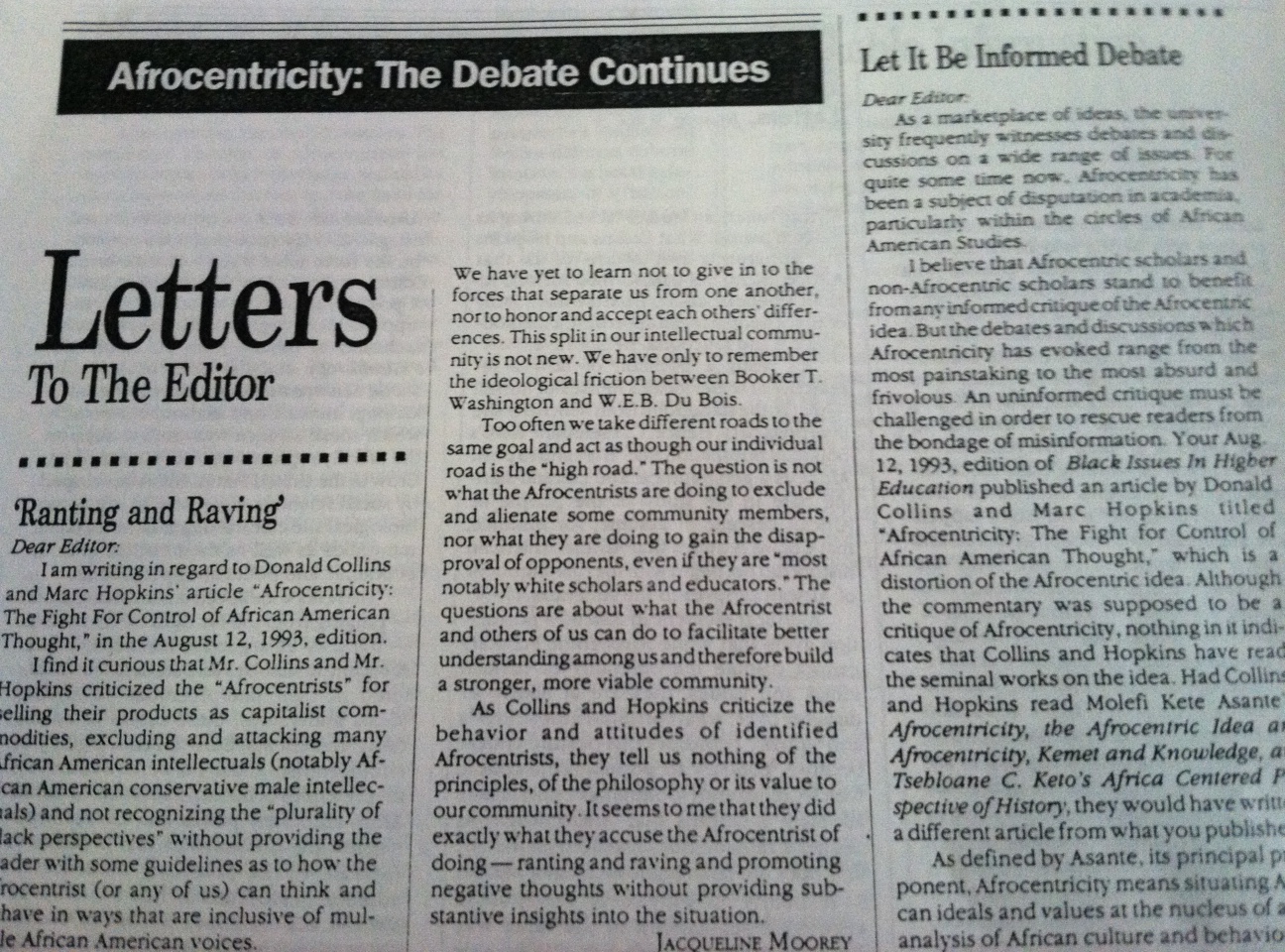
Letters to the Editor, Black Issues in Higher Education, September 9, 1993. (Donald Earl Collins)

Letters to the Editor, Black Issues in Higher Education, September 9, 1993. (Donald Earl Collins).

It all occurred in the aftermath of my first major publication, co-written with my friend Marc and published in Black Issues In Higher Education in August ’93. “Afrocentricity: The Fight for Control of African-American Thought” was our 1,200 word contribution to the debate over multicultural education and Afrocentricity in both higher education and in Black culture more generally. It was a publication that came as a surprise, because the editors at Black Issues In Higher Education (the same folks who ran Emerge Magazine, by the way) hadn’t contacted us about receiving our pitch and article, about accepting it for publication, or about when they intended to publish. And even though our article was literally in the centerfold of their August 12, ’93 issue, the folks at Black Issues in Higher Education never paid us for the publication of our work.

The reason why because clearer in their September 9 and September 23 issues. In the “Letters to the Editor” section, the editors published a dozen letters, ten of which were critical of our work. These weren’t scholarly or even logical critiques — we were wrong because we weren’t members of the Church of Afrocentric Babble, plain and simple. These were “How dare you!” or “Shame on you!” letters, not ones based on what we’d actually written.

What became obvious  to me was that Molefi Asante’s former and current students had written most of the letters. Not exactly an unbiased set of sources, as in the circle of Afrocentricity in the early ’90s, there were few people more prominent than Asante (he was the Father of Afrocentricity, after all). Once I realized this, I found myself disappointed. With Black Issues in Higher Education, with Black folks in academia — particularly at Temple University — and with academia itself. Me and Marc weren’t being challenged on our ideas, but on the idea that two alleged neophytes had the balls to challenge the orthodoxy of the early ’90s in African American studies and in high-brow Black cultural circles.

Marc pushed for a response from one of the editors about their unprofessionalism (and to find out why we weren’t being paid for our piece), which led to a conversation with one of the big-wigs. He apparently said to Marc, “We published it [the “Afrocentricity” piece] to teach you a lesson.” When Marc told me, I said, “Well, I guess we’re not gonna get paid.” (Turned out this was standard practice for the likes of Black Issues in Higher Education, Emerge, and for freelancers at BET as well). Marc, pissed and disillusioned, said, “We were just trying to help.”

Letters to the Editor, Black Issues in Higher Education, September 23, 1993. (Donald Earl Collins).

Letters to the Editor, Black Issues in Higher Education, September 23, 1993. (Donald Earl Collins).

It was the last one of many factors that pushed me to write my dissertation and my first book Fear of a “Black” America (2004) on the relationship between education, multiculturalism, and Black identity. I wanted to show that Afrocentricity wasn’t the only strain of thought that ran through the heads of Black scholars and found its way into small “c” curriculum and cultural events in Black communities. In doing so, I certainly stood apart, but I also stood alone a lot, too.

In recent years, I’ve seen numerous entourages eviscerate lone wolfs. On Twitter, in our 24/7 media coverage of the mundane and insignificant yet insane, and at academic conferences. As recently as a couple of months ago, I saw a version of this on Facebook in response to a post I wrote about Mark Anthony Neal’s Looking for Leroy (2013). The entourage makes it difficult for an up-and-comer to get off to an honest start, for conformity with only subatomic levels of independent thought seems to be the norm.

Somewhere between now and when my son (knock on wood) reaches my age of forty-three, maybe some of what I’ve written over the past twenty years will break through the ice of entourages, mad-dog and otherwise. Still, it is a damnable thing when groups get together to stomp out different voices (literally and figuratively), because that’s seems to be the only way to keep the band together.

Afrocentricity and the Writing Bug

15 Wednesday May 2013

Posted by decollins1969 in 1, Academia, Boy @ The Window, Carnegie Mellon University, Christianity, culture, eclectic music, Hebrew-Israelite, Mount Vernon High School, Mount Vernon New York, music, Pittsburgh, Politics, Pop Culture, race, Religion, University of Pittsburgh, Youth

≈ Leave a comment

Tags

Africana Studies, Afrocentric Education, Afrocentric Idea (1987), Afrocentricity, Authentic Blackness, Authenticity, Black Action Society, Black Issues in Higher Education, Black Studies, Blackness, Cool, Coolness, Litmus Test, Marc Hopkins, Maulana Karenga, Molefi Asante, Pitt, Temple University, Writing, Writing Bug


A ladybug, often a symbol for the writing “bug,” May 15, 2013. (http://flickr.com). In public domain.

This time two decades ago, I was already a bit desperate for work. In transferring from Pitt to Carnegie Mellon, I’d left myself without any financial coverage for the summer of ’93 (see my post “The Arrogance of Youth, Grad School Style” from June ’12). I had applied for several fellowships, summer teaching gigs, even some nonprofit work. But as of the middle of that May, nothing had come through. I’d already spent $200 on a root canal that occurred on the same day as my written PhD comps at CMU (see my post “Facing the Tooth” from May ’12).

Even before my comps and my surprise root canal, I had talked with my friend Marc about writing a joint article about the false litmus test of Blackness that Afrocentricity had come to represent in our minds. Between Molefi Asante’s students at Temple — not to mention the overtly Afrocentric turn of both the Black Action Society and the Black Studies department (which had changed its name to Africana Studies) in the previous eighteen months — both of us felt we needed to provide an alternate perspective.

On that third Saturday in May (and the day after my comps and root canal surgery), we worked for five hours in putting together what amounted to a 1,200-word opinion piece against the belief system and authenticity test that Afrocentricity (and Afrocentric education) had become. By some folks’ definition, we realized that jazz, Miles Davis and John Coltrane would fail the authentically Black test of a Molefi Asante’s wonderful Afrocentric Idea (1987) and of Maulana Karenga as well.

Frances Cress Welsing's The Isis Papers (1991), [about as authentic as auto-tunes], May 15, 2015. (http://amazon.com).

Frances Cress Welsing’s The Isis Papers (1991), [about as authentic as auto-tunes], May 15, 2015. (http://amazon.com).

Now I’m pretty sure why Marc had problems with Afrocentricity. As a Christian and a jazz aficionado, Marc likely saw Afrocentricity as something somewhere between a misguided way of thinking about Blackness and complete and utter bull crap. His goal was to “add to the debate” and “educate” those who weren’t Asante or Karenga apostles and disciples. A laudable — if somewhat naive about the politics of academia and race — goal.

As for me, beyond the academic superficiality of having a litmus test on what is and isn’t Black, I had at least two unconscious reasons for writing my first crossover piece. One had to do with my sense that too many young folks were all too interested in doing the cool thing and not the right thing. Afrocentricity was cool, just like all rap and hip-hop was cool, just like giving libations to ancestors was cool.

Being cool had always meant following a crowd and seldom saying anything that would dig more than a nanometer beyond the surface. Or saying a critical thing about the cool thing that everyone in the same crowd otherwise takes in without a critical thought. I went to a high school full of people like that, and loathed being around people like that when I’d been a part of the Black Action Society at Pitt.

Unconscious reason number two had something to do with my Hebrew-Israelite days. Again, I gave this zero direct thought during my grad school days. But the given the trauma I’d suffered through during my three years of kufi-dom, it had to affect my thinking about Afrocentricity. The Black folk I knew who were part of the Hebrew-Israelite religion were much more obvious about what they did and didn’t consider Black or kosher. Yet, it was so obvious that they constantly contradicted themselves, in terms of food or music, how they treated their wives or children. Most important for me, though, was the fact that they tried to live separate and apart from other Blacks, yet seemed no more different beyond the kufis, veils and kosher meats from other Blacks (or Jews, for that matter).

I saw Afrocentricity as bullshit, and still see the fact that so many folks who get caught up in this sense of authenticity around Blackness as folks falling for bullshit. If I hadn’t lived as a Hebrew-Israelite between the ages of eleven and fifteen, perhaps I wouldn’t see Afrocentricity this way. If I hadn’t been around the “Party All The Time” folks in high school and the “Black Panther Party” posers at Pitt, maybe Afrocentricity would’ve been more appealing to me.

Letters to the Editor, Black Issues in Higher Education, September 9, 1993. (Donald Earl Collins).

Letters to the Editor, Black Issues in Higher Education, September 9, 1993. (Donald Earl Collins).

But at twenty-three years old, I was already tired of the pursuit of coolness and authenticity. That hasn’t changed in the past two decades. I’m sure the letters that called Marc and I “Uncle Toms” after our piece was published in Black Issues in Higher Education were from folks who thought we weren’t cool, and thought they had the answers to life itself.

I wonder how those folks back then would see the academics who believe that hip-hop can explain everything in the social sciences and humanities who are prominent today. Perhaps some of these people today were the Afrocentric followers of twenty years ago. Perhaps not. All I know is, I haven’t stopped writing since that cloudy day in mid-May.

Touré’s Post-Blackness ≈ I’ma Be Me?

01 Monday Oct 2012

Posted by decollins1969 in 1, Academia, Boy @ The Window, Christianity, culture, Eclectic, eclectic music, Hebrew-Israelite, Mount Vernon New York, Patriotism, Politics, Pop Culture, race, Religion, Youth

≈ Leave a comment

Tags

"Pound Cake" speech, Acting White, American Identity, Authentic Blackness, Authenticity, Bill Cosby, Black Identity, Blackness, Boy @ The Window, I'ma Be Me (2009), Identity Issues, Intrarace Relations, Litmus Test, Post-Blackness, Post-Civil Rights Generation, Post-Racialism, Race, Racism, Reaching Youth, Self-Discovery, Self-Loathing, Self-Reflection, Touré, Wanda Sykes, Who's Afraid of Post-Blackness (2011)


Illustration of red wolf with dinner after a hunt, by Sandra Koch, September 29, 2012. (http://nc-es.fws.gov). In public domain.

I know, I know. Touré’s Who’s Afraid of Post-Blackness (2011) has been out for over a year, and I’ve finally, finally managed to read it in the past couple of weeks. I did not want to like this book. I found — and still find — the title to be pretentious and over the top, a perfect fit for Touré’s Twitter and TV persona. Touré values his ideas like they all are new finds of platinum or a form of safe and sustained nuclear fusion. Sometimes Touré can be cutting-edge, but many times, he goes over the edge (as was the case in August on MSNBC with his “niggerization” of Obama comment).

But in Who’s Afraid of Post-Blackness, Touré puts forward a variety of ideas and insights that I’ll be contemplating in my blogo-neighborhood off and on over the next few months. Touré’s is a very good book. It’s one that is both intellectual and yet revealing about the challenges Blacks face inter- and intraracially in the early twenty-first century.

The premise — once I got past the ridiculous term post-Blackness — is that African Americans and America has advanced just far enough in terms of race for all of our old conceptions of Blackness to have now become meaningless. That Blackness is fully infused in American — maybe even world — culture. That there was never one way to be Black in the first place. Touré himself says, “[t]here is no dogmatically narrow, authentic Blackness because the possibilities for Black identity are infinite. To say something or someone is not Black — or is inauthentically Black — is to sell Blackness short. To limit the potential of Blackness. To be a child of a lesser blackness.” (p. 5).

Litmus paper used in litmus tests, September 29, 2012. (http://chemistry.about.com).

Ironically, though, much of Touré’s book picks apart the notion that the US has become post-racial in the past couple of decades, as best exemplified by the election of President Barack Obama in 2008. Of course, Touré uses notions of Blackness and where it has expanded beyond the authenticity litmus test to show that race/racial bias/racism is still alive and well in America. At the same time, Touré shows how post-Blackness has also provided opportunities for millions of Americans White, Black and Brown to reach beyond their own misconceptions of race and themselves, to enrich our lives in politics, scholarship, the arts, not to mention through hip-hop.

One of my main criticisms of Who’s Afraid of Post-Blackness is that Touré uses a term like post-Blackness (mind you, I hate terms like post-structuralism, post-modernism, and post-racialism too) and doesn’t try in any way to provide a definition that distinguishes it from post-racial. For the purposes of this post, though, the main issue I have revolves around Touré virtually ignoring poor and struggling African Americans in his post-Blackness tour-de-force.

I get it when Touré says that he “never lived a typical Black experience.” (p. 53). At least, I think I do. That despite Touré middle class upbringing, middle-class neighborhood, private school experience, that his is but one representation of Blackness. And that Touré’s experience is as representative of Blackness as my experience of being a Hebrew-Israelite preteen in a working poor family while enrolled in Humanities in Mount Vernon, New York would’ve been thirty years ago (see my post “A Question of My Blackness, Sexuality and Masculinity” from September ’11). Or, for that matter, Wanda Sykes’ comedy special I’ma Be Me (2009) was for her.

That’s great for us, for anyone with enough intellectual power, outsider status, unusual amounts of wisdom, or just plain middle class standing to get the details of Who’s Afraid of Post-Blackness. But when Touré does bring up the twenty-five percent of Blacks who aren’t part of this post-Blackness elite, he talks at them, and not to them. Yes, I completely agree that Blackness isn’t to be defined in terms of poverty, prison, and projects. No, Blackness shouldn’t be defined by how “down” one is with an impoverished community or how “hard” someone is for beating the shit out of another person (see my “Raised on Hip-Hop?” post from April ’10).

Hakeem Olajuwon posting up Patrick Ewing, 1994 NBA Finals, June 1994. (http://rgj.com).

Still, while I stand with almost one hundred percent of what Touré says in Who Afraid of Post-Blackness in ’12, I don’t think that this book would’ve reached me thirty years ago. The way I would’ve seen it in ’82 or even ’87, a middle class Black guy telling me about how my poverty is insignificant to who I was would’ve been excommunicated from my life for eternity. It wouldn’t have helped me at all deal with the pressures I faced socially, academically and in my family (see my “The Silent Treatment” post from June ’10).

Touré wouldn’t have been able to provide for me a roadmap for how to be me and to ignore the crowd of those in my life — White and Black — who regularly told me that I wasn’t authentically Black or that I was “talkin’ White.” If mild-mannered me at twelve wouldn’t have been reached by Touré’s chapter on Black artists taking Blackness and standing it on its head, I imagine that young African Americans growing up in poverty or struggling with identity issues would find Who’s Afraid of Post-Blackness about as easy to embrace as Bill Cosby’s criticism of poor Blacks in ’04.

For me as a writer, the question of how to reach beyond the already converted is always an issue. Touré, as good as he is in his book, merely affirms the path I’ve traveled over the past thirty-one years. He doesn’t really reach those whose path of Blackness has barely begun.

On Dumb-Assed Ignorance and Race

07 Tuesday Aug 2012

Posted by decollins1969 in 1, culture, Eclectic, Politics, Pop Culture, race

≈ Leave a comment

Tags

African Americans, Anti-Intellectualism, Authenticity, Blackness, Blacks, Bringing The Pain (1996), Chris Rock, Comedians, D.L. Hughley, Gabby Douglas, Gabrielle Douglas, Hair, Ignant, Ignit, Ignorance, Intellectual, Olympics, President Barack Obama, President Obama, Stereotypes, Twitter


Gabrielle Douglas on balance beam, Olympics Women’s Gymnastics All-Around, London, August 2, 2012. (Gregory Bull/AP).

A couple of years ago, I wrote a post titled “On Being An Ignit American” (February ’10). It was about how this issue of what is and isn’t “authentically” Black often has folk Black, White, Brown and Yellow thinking and speaking in stereotypes, especially Black folk, who should know better. The past week has demonstrated well how ignit some of us are or can be on this issue of race and so-called authenticity.

The thousands of ignit tweets on Gabby Douglas’ hair in the midst of her becoming the first African American to win gold the Olympic gymnastics all-around was just dumb and shameful. I mean, who the heck cares about what Douglas’ hair looked like as she hovered a good five feet over the balance beam last Thursday? Did it keep her from winning gold? Did it suddenly mean that she was no longer Black? No! All it showed was how much better an athlete, person and woman Gabby Douglas was and is than the dumb asses who decided to take issue with her hair.

Given that Douglas was competing and practicing every day, at sixteen, in a city she can’t be familiar enough with to run to a hairdresser, why would it be necessary for her to satisfy the superficial ignit folks among the Twiterati? Seriously, we don’t expect our male athletes to “get their hair did,” even though most of them have bed head on the eve of their competitions. No, the thousands of dumb-ass comments about Douglas’ hair is a reflection on a group of people who have never been passionate enough about any dream of theirs to take risks, to sacrifice, to give everything they are and have to achieve that dream. They also lie to themselves, in that being Black and female is to care more about your hair than your goals in life.

D.L. Hughley at The Huffington Post Pre-Inaugural Ball, Washington, DC, January 20, 2009. (Carl Clifford and D.L. Hughley via Flickr.com/Wikpedia). Released via cc-Attribution 2.0 Generic license.

Then there’s D.L. Hughley, the master of the put-down. He’s the kind of guy that if I’d gone to high school with him in Mount Vernon, I’d killed myself from the constant ridicule, or beaten him half to death with a brick. What makes someone like Hughley dangerous as a comedian is that he thinks he’s much smarter than he really is. Hughley, though, is about as smart about race as Rush Limbaugh, and only slightly more funny.

Let’s face it, on the IQ scale of comedians on race, if Richard Pryor was a 225, Eddie Murphy a 190, and Chris Rock a 155, Hughley would be about a 72. Even Bill Burr would be a 99-108 on this scale. Hughley obviously has deep connections in the entertainment world. How else can anyone explain all the small screen opportunities he’s had the past two decades? Perhaps it’s because Hughley’s funny, if only in a pedestrian, what-is-and-isn’t-authentically-Black sort of way.

Which is why I bring Hughley up here. Last week, while thousands of folks made fun of Gabby Douglas’ hair, he gave an interview on SiriusXM Radio mocking President Barack Obama’s intellectual and calm response to criticism. Hughley said, President Obama “doesn’t seem to get that you have to be willing at some point to fight fire with fire. He’s closer to being a white kid. Intellectually, like his experiences are so different from mine that, I should say, he responds like an intellect as opposed to a regular guy.”

Yes, Hughley, or should I say, dumb ass, Obama’s experiences are different from yours. He went to Occidential College in California for two years before transferring to Columbia on an academic scholarship. He worked as a community organizer on social justice issues for four years before getting in to Harvard Law School. He was president of the Harvard Law Review, a state senator for eight years, a US Senator for four, a constitutional law professor, all before become POTUS. As your contemporary Chris Rock would say, “How the f— you expect him to sound?” Hughley, you are so seriously ignant about race and authenticity that it may be time for you to go back to school.

Don’t you Gabby Douglas’ haters and ignant folks like Hughley get it yet? There’s always been more than one way to be Black, to be human. Why should we choose to act the same way, think the same way, look the same way, to satisfy the limited way in which you see the world. You are people of the worst sort. Too ignant to truly understand the world around you, and too chicken to really better yourselves, to pursue your own dreams and success.

This Is No Korra-Nation

14 Saturday Jul 2012

Posted by decollins1969 in 1, culture, Eclectic, Pop Culture, Youth

≈ Leave a comment

Tags

Authenticity, Avatar, Avatar: The Last Airbender, Avatar: The Legend of Korra, Bryan Konietzko, Cultural Traditions, Disappointment, Korra, Michael DiMartino, Modernity, Nickelodeon


Avatar: The Legend of Korra – Welcome to Republic City (game screen shot), April 10, 2012. (Harryhogwarts via Wikia.com). Qualifies as fair use under US Copyright laws because image is only being used to visually identify the subject.

I wish that this was only a pun. But, Michael DiMartino and Bryan Konietzko’s Avatar: The Last Airbender spinoff The Legend Of Korra was only a legend in their own minds. It’s not that Korra’s first season wasn’t a good one. It’s that Korra could not possibly live up to what was the greatest animation series of all-time.

Any fan of Avatar: The Last Airbender couldn’t help but be disappointed with the first season of Korra. First, it took four years for them to bring Korra to Nickelodeon, and a full twenty months after they released the first stills for the new series in August ’10. They wasted two of those years making the terrible live-action The Last Airbender (2010) as directed by M. Night Shyamalan (see my “The Last Airbender, or Shyamalan’s Cynical Egg?” post from July ’10).

Korra, Avatar: The Legend of Korra (artwork), October, 2011. (http://fanpop.com). Qualifies as fair use under US Copyright laws, as image is only being used to identify blog subject.

So Korra was behind the 8-ball already when the show officially launched in April. Then the first episode began, exploding through waterbender Avatar Korra’s growing-up years in about three and a half minutes. That opening scene set the tone for all twelve of the first season’s episodes. One could sort of justify the rapid pace of Korra because she’d already mastered three of the four elements and because the spin-off had moved seventy years into the future, and a somewhat modern one at that. But the pace left little room for character development and the clear-cut personality distinctions that made Avatar: The Last Airbender the ultimate experience.

It took three episodes for me to find a good-and-honest scene that produced a personality quirk (see Bolin as a poor man’s Sokka here) and a hearty laugh. You got no sense of how Tenzin became part of Republic City’s council, or how tension-filled his life must’ve been as the responsible son of the great Avatar Aang. The elderly Katara appeared in a couple of scenes, and there was no attempt to explain the intervening years between the end of the Hundred-Year War until the last couple of episodes. Even then, these were fleeting scenes in a fast-paced, let’s-get-Korra-to-the-Avatar-State season.

The sheer lack of an attempt at authenticity with Korra, though, was what I found most disappointing. Seven decades into the future with modern technologies would create cultural tensions for sure, but it certainly wouldn’t wipe out the traditions of the four nations, even in Republic City. That, and only flashes of the spirituality that was completely infused in Avatar: The Last Airbender, made Korra a poor facsimile for whatever tensions between tradition and modernity that the main character faced in the first season.

I plan to watch Season 2, assuming that DiMartino, Konietzko and Nickelodeon plan on putting out a second season of Korra now that Season 1 is over. But I’ve lowered my expectations for the new series, especially if the creators intend to continue to rush through plots. It was as if Avatar Korra was on an out-of-control 2 Subway rumbling through Midtown Manhattan, about to flip over and derail.

← Older posts
Newer posts →

Boy @ The Window: A Memoir

Boy @ The Window: A Memoir

Places to Buy/Download Boy @ The Window

There's a few ways in which you can read excerpts of, borrow and/or purchase and download Boy @ The Window. There's the trade paperback edition of Boy @ The Window, available for purchase via Amazon.com at http://www.amazon.com/Boy-Window-Donald-Earl-Collins/dp/0989256138/

There's also a Kindle edition on Amazon.com. The enhanced edition can be read only with Kindle Fire, an iPad or a full-color tablet. The links to the enhanced edition through Apple's iBookstore and the Barnes & Noble NOOK edition are below. The link to the Amazon Kindle version is also immediately below:

scr2555-proj697-a-kindle-logo-rgb-lg

Boy @ The Window on Amazon.com: http://www.amazon.com/Boy-The-Window-Memoir-ebook/dp/B00CD95FBU/

iBookstore-logo-300x100

Boy @ The Window on Apple's iBookstore: https://itunes.apple.com/us/book/boy-the-window/id643768275?ls=1

Barnes & Noble (bn.com) logo, June 26, 2013. (http://www.logotypes101.com).

Boy @ The Window on Barnes & Noble: http://www.barnesandnoble.com/w/boy-the-window-donald-earl-collins/1115182183?ean=2940016741567

You can also add, read and review Boy @ The Window on Goodreads.com. Just click on the button below:

Boy @ The Window

Twitter Updates

Tweets by decollins1969
  • RSS - Posts
  • RSS - Comments

Archives

  • June 2025
  • April 2023
  • September 2022
  • August 2022
  • July 2022
  • June 2022
  • May 2022
  • April 2022
  • March 2022
  • January 2022
  • December 2021
  • November 2021
  • October 2021
  • September 2021
  • August 2021
  • July 2021
  • June 2021
  • April 2021
  • March 2021
  • February 2021
  • January 2021
  • December 2020
  • November 2020
  • October 2020
  • September 2020
  • August 2020
  • July 2020
  • May 2020
  • April 2020
  • March 2020
  • January 2020
  • December 2019
  • November 2019
  • August 2019
  • July 2019
  • June 2019
  • May 2019
  • April 2019
  • March 2019
  • February 2019
  • January 2019
  • December 2018
  • November 2018
  • October 2018
  • September 2018
  • August 2018
  • July 2018
  • June 2018
  • May 2018
  • March 2018
  • February 2018
  • January 2018
  • December 2017
  • November 2017
  • October 2017
  • September 2017
  • August 2017
  • July 2017
  • June 2017
  • May 2017
  • April 2017
  • March 2017
  • February 2017
  • January 2017
  • December 2016
  • November 2016
  • October 2016
  • September 2016
  • August 2016
  • July 2016
  • June 2016
  • May 2016
  • April 2016
  • March 2016
  • February 2016
  • January 2016
  • December 2015
  • November 2015
  • October 2015
  • September 2015
  • August 2015
  • July 2015
  • June 2015
  • May 2015
  • April 2015
  • March 2015
  • February 2015
  • January 2015
  • December 2014
  • November 2014
  • October 2014
  • September 2014
  • August 2014
  • July 2014
  • June 2014
  • May 2014
  • April 2014
  • March 2014
  • February 2014
  • January 2014
  • December 2013
  • November 2013
  • October 2013
  • September 2013
  • August 2013
  • July 2013
  • June 2013
  • May 2013
  • April 2013
  • March 2013
  • February 2013
  • January 2013
  • December 2012
  • November 2012
  • October 2012
  • September 2012
  • August 2012
  • July 2012
  • June 2012
  • May 2012
  • April 2012
  • March 2012
  • February 2012
  • January 2012
  • December 2011
  • November 2011
  • October 2011
  • September 2011
  • August 2011
  • July 2011
  • June 2011
  • May 2011
  • April 2011
  • March 2011
  • February 2011
  • January 2011
  • December 2010
  • November 2010
  • October 2010
  • September 2010
  • August 2010
  • July 2010
  • June 2010
  • May 2010
  • April 2010
  • March 2010
  • February 2010
  • January 2010
  • December 2009
  • November 2009
  • October 2009
  • September 2009
  • August 2009
  • July 2009
  • June 2009
  • May 2009
  • April 2009
  • March 2009
  • February 2009
  • January 2009
  • December 2008
  • November 2008
  • October 2008
  • September 2008
  • August 2008
  • July 2008
  • June 2008
  • May 2008
  • April 2008
  • March 2008
  • February 2008
  • January 2008
  • December 2007
  • November 2007
  • October 2007
  • September 2007
  • August 2007
  • July 2007
  • June 2007

Recent Comments

decollins1969's avatardecollins1969 on No Good Teaching Deed Goes…
Mary Rose O’Connell's avatarMary Rose O’Connell on No Good Teaching Deed Goes…
Lyndah McCaskill's avatarLyndah McCaskill on The Raunchiest of Them Al…

NetworkedBlogs on Facebook

NetworkedBlogs
Blog:
Notes From a Boy @ The Window
Topics:
My Life, Culture & Education, Politics & Goofyness
 
Follow my blog

616 616 East Lincoln Avenue A.B. Davis Middle School Abuse Academia Academy for Educational Development AED Afrocentricity American Narcissism Authenticity Bigotry Blackness Boy @ The Window Carnegie Mellon University Child Abuse Class of 1987 CMU Coping Strategies Crush #1 Crush #2 Death Disillusionment Diversity Domestic Violence Economic Inequality Education Family Friendship Friendships Graduate School Hebrew-Israelites High-Stakes Testing Higher Education History Homelessness Humanities Humanities Program Hypocrisy Internalized Racism Jealousy Joe Trotter Joe William Trotter Jr. K-12 Education Love Manhood Maurice Eugene Washington Maurice Washington Misogyny Mother-Son Relationship Mount Vernon High School Mount Vernon New York Mount Vernon public schools Multiculturalism MVHS Narcissism NFL Pitt Pittsburgh Politics of Education Poverty President Barack Obama Race Racial Stereotypes Racism Relationships Self-Awareness Self-Discovery Self-Reflection Sexism Social Justice Teaching and Learning University of Pittsburgh Violence Whiteness Writing

Top Rated

Blog at WordPress.com.

  • Subscribe Subscribed
    • Notes from a Boy @ The Window
    • Join 103 other subscribers
    • Already have a WordPress.com account? Log in now.
    • Notes from a Boy @ The Window
    • Subscribe Subscribed
    • Sign up
    • Log in
    • Report this content
    • View site in Reader
    • Manage subscriptions
    • Collapse this bar
 

Loading Comments...