• About Me
  • Other Writings
  • Interview Clips
  • All About Me: American Racism, American Narcissism, and the Conversation America Can’t Have
  • Video Clips
  • Boy @ The Window Pictures
  • Boy @ The Window Theme Music

Notes from a Boy @ The Window

~

Notes from a Boy @ The Window

Category Archives: Upper West Side

Why Boston U Isn’t For Me, and Shouldn’t Be For You

26 Sunday Apr 2015

Posted by decollins1969 in 1, Academia, Carnegie Mellon University, culture, Eclectic, High Rise Buildings, Jimme, Mount Vernon New York, My Father, New York City, Politics, Pop Culture, race, Upper East Side, Upper West Side, Work, Youth

≈ Leave a comment

Tags

616, 616 East Lincoln Avenue, Academic-Speak, Boston U, Boston University, BU, Checkbox, CMU, Cosmetic Diversity, Disillusionment, Institutional Racism, Jimme, Linda Sarsour, Meritocracy, Nepotism, Office of the Provost, Racism, Rev. Dr. Martin Luther King Jr., Righteous Indignation, Robert Turri Vise, Structural Racism, Suzanne C. Kennedy, Timothy Barbari, Tokenism


The main classroom buildings for the College of Arts and Sciences at Boston University, with the BU East 'T' stop in the foreground, July 18, 2010. (Fletcher6 via Wikipedia). Released to the public domain via CC-SA-3.0.

The main classroom buildings for the College of Arts and Sciences at Boston University, with the BU East ‘T’ stop in the foreground, July 18, 2010. (Fletcher6 via Wikipedia). Released to the public domain via CC-SA-3.0.

Since my first job working for my father in Manhattan in ’84, I’ve probably done over 200 interviews. By telephone, through Skype or WebEx or Adobe Connect, at conferences and in person. Probably about a third of those interviews have occurred with colleges and universities, for academic and administrator-level positions. For the most part, whether the interviews went well or when I didn’t have my “A-game,” my experiences have been pleasant ones. But, after two different interview processes five years apart with Boston University — one in October ’10, the other last month — there is a higher education institution that I will not work for, will not send my son, and will not recommend for anyone I know, under nearly any circumstances.

There are only a few institutions that have been so bad that they’ve moved from my [expletive] list to my permanently-banned-from-my-life list. Even Carnegie Mellon isn’t on the latter list, and I’ve talked about their conservatism and weirdness around diversity before here. But Boston University’s treatment of me as a potential employee, well, it took my breath away without putting me in an NYPD chokehold.

Round 1, Boston University, August-October 2010

Let me rephrase. I was never a “potential employee,” because on the two occasions I interviewed for jobs there, Boston University in the end treated me as a checkmark interviewee. In the fall of ’10, I emerged for them as a candidate for the director of their Washington, DC program. They interviewed me three times: at the American Political Science Association conference in DC in August, at their old DC program headquarters (while also showing me their new one, still under construction) in September, and in person on the main Boston University campus in late October.

For that last interview, they pulled out all the stops. They flew me in, put me up in a nearby hotel the night before, and even took me to lunch. Of course, they also had someone give me a two-hour guided tour of the campus that morning, after one morning meeting, on a day with thirty mile-per-hour winds coming off the Charles River as we walked from one end of the campus to the other. It’s funny. Up until then, I never thought of a campus tour as sinister. But then I realized, if I’m spending two hours during the heart of the workday doing a campus tour with a twenty-four year-old BU grad in forty-five degree weather, what did that mean for my real chances at that job?

My final meeting was with a professor who advised political science and history major in the DC program. That meeting ended at 5 pm on October 22, with which I knew that they were supposed to make a final decision in a week or so. Despite a thank-you email and two follow-up emails, I didn’t hear from Boston University again until November 29. Roberta Turri Vise, the point person for my interview process, didn’t explain why the final decision took more than five weeks. Nor did she explain why after six weeks of correspondence, no response from my requests were returned by her or anyone else in her office.

Round 2, Boston University, January-March 2015

I decided that this was a one-off thing, that with our generation of job searches occurring in a buyer’s market, that some folks really don’t care about being professionals in their dealing with interviewees. Boy was I wrong! Even in a market where people ignore applicant materials and send mass rejection emails without a candidate’s name on it (or worse, with someone else’s name), Boston University claimed a unique crown.
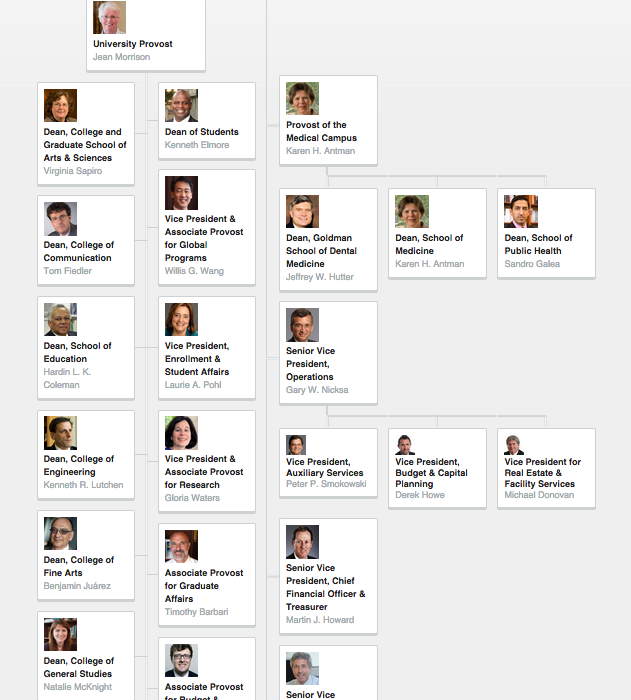
Hierarchy tree of Boston University's leadership team via the Provost's Office, April 26, 2015. (http://www.bu.edu/info/about/admin/).

Hierarchy tree of Boston University’s leadership team via the Provost’s Office, April 26, 2015. (http://www.bu.edu/info/about/admin/).

I interviewed with them again in January and at the beginning of March. This was for a position in their provost’s office, a director position managing undergraduate and graduate fellowship opportunities and advising students via those opportunities. The position was a bit beneath my experience, but they seemed interested, and I already knew from some initial research that it was a new position, so I went ahead and applied for it. My first interview was by telephone, with Suzanne Kennedy, the assistant provost for academic affairs at Boston University. It was a pleasant but underwhelming interview, and I actually didn’t expect a call back. So I kept up with my usual work of teaching, consulting, and looking for more consulting opportunities.

I received an email five weeks later asking me to come up to Boston for a second, in-person interview. I gave it the go-ahead, although the length of time between first interview and correspondence concerned me. So too, did my back and forth with Kennedy’s assistant over travel, as she had initially booked me at times that were very inconvenient for interviewing purposes. Not to mention, the major snow issues that Boston experienced in February.

The interview on March 4 was honestly one of the worst experiences I’ve ever had interviewing for any job. I’m including an interview in which I discovered the place was a sweatshop in Chinatown, during my summer of unemployment in New York in ’88. I had three meetings in all, one over lunch with Kennedy, and two with the two associate provosts at Boston University in academic affairs (one undergraduate, one graduate). Over lunch, the conversation was going well, until I asked the question about the level of diversity with applicant pools for Fulbrights, Trumans, Borens, and Rhodes’ scholarships and fellowships. I kid you not, Kennedy’s eyes literally glazed over as soon as I asked about diversity. Keep in mind, I had asked about socioeconomic diversity — I hadn’t touched racial or gender diversity yet. After lunch, I didn’t see Kennedy again for the rest of the interview process.

My second sign came from my third meeting. I met with Timothy Barbari, associate provost for graduate affairs. It was obvious that Barbari hadn’t even looked at my CV before I walked into his office. The first thing Barbari says to me, with him pushing his body into the back of his chair so far that his attempt to be at ease looked more like a rocket revving to take off — “so, you have a rather interesting CV.” I may not have earned all of my money as an academician, but I’ve been around academic-speak long enough to know that interesting can mean a lot of different things, mostly bad. In this context, interesting meant “not straightforward, not linear in progression, not typical in terms of whom we typically hire.”

I was already feeling a bit like a checkmark or token interviewee by the time I left Barbari’s office for Logan. But after USAirways canceled all their flights to DC that evening due to a snowstorm that wouldn’t drop a snowflake for another twelve hours, it got worse. I notified Kennedy through her assistant that I was stuck in Boston overnight from Logan, and left a message the next morning that the Amtrak to DC was my only option, as more flights had been canceled. No word, not even a “I’m sorry that you have to go through this” response. It wasn’t until mid-afternoon that Friday, nearly a day after I returned to DC, and after a third message about them needing to reimburse me, that I heard from Kennedy’s assistant.

At that point, I wouldn’t have taken the job even if they had offered it to me. As it was, I didn’t hear from Kennedy again until April 7, five weeks after a second interview, and despite a check-in to find out what happened with this director position. It’s this kind of calloused approach that leaves folks shaking their head.

Shaking Off The Dirt

I’ve made a few determinations based on these experiences. For one, if this is the way that treat job candidates who look like me, how well do they pay and treat their service staff, the most vulnerable people on their campus? Not well, at least from what I saw and have experienced. For two, the fact that for both interviews, their top concern seemed to be about competing with “schools across the Charles River” — i.e., Harvard, MIT, Tufts — was somewhere between disconcerting and ridiculous.

An elephant shaking off the dirt, circa 2012. JD Rucker via Pinterest.com).

An elephant shaking off the dirt, circa 2012. (JD Rucker via Pinterest.com).

The fact that with tuition, books, and room and board it would run the average BU student $60,000 per year also told me what I needed to know. Boston University is a place that wants elite status and elite students, and in pursuit of this Pollyanna goal, wants to hire people they feel fit the bill. As long as those people look like everyone else running the university — mostly White, with a few people of color lightly sprinkled in leading positions at the institution. Because Boston University has what activist Linda Sarsour (Twitter, @lsarsour) calls cosmetic diversity, a genuine attempt at diversity across socioeconomic, racial and gender lines is unnecessary, at least for the powers whom run the institution.

Aside from Martin Luther King, Jr., who earned his doctorate in divinity at Boston University in the early 1950s, I’ve known or known of only one person of color with a degree from BU. She was a neighbor at 616 East Lincoln, a few years younger. Based on her description of more than two decades ago, I’d have to say that Boston University has changed for the worst. Like most universities, they seem more interested in prestige and raising money than in fulfilling their mission.

And with that being the case, why send your kid to Boston University? Especially when, for the same amount of money or less, every other school in the Boston area is either better, or at least, cares more about diversity and learning beyond the cosmetic.

Degrees of Fakery

17 Tuesday Mar 2015

Posted by decollins1969 in 1, Academia, Boy @ The Window, Carnegie Mellon University, culture, Eclectic, Jimme, Mount Vernon High School, Mount Vernon New York, My Father, New York City, Politics, Pop Culture, race, University of Pittsburgh, Upper West Side, Youth

≈ Leave a comment

Tags

616 East Lincoln Avenue, Advanced Degrees, Ben Carson, Bill Cosby, Brian Williams, Chevy Citation, CMU, Cynicism, Doctor, Doctorate, Dr. Steve Perry, Expertise, Experts, Fake Degrees, Fakery, Father-Son Relationship, Hard Work, Henry Kissinger, Honorary Degrees, Lawyer, Maurice Eugene Washington, Michelle Malkin, Newt Gingrich, Obsequious, Opinions, PhD, William Kristol


Anne-Marie Johnson in Im Gonna Git You Sucka (1988), March 17, 2015. (http://cdn5.movieclips.com/). Qualifies as fair use under US copyright laws (low resolution and relevance to subject matter).

Anne-Marie Johnson in Im Gonna Git You Sucka (1988), March 17, 2015. (http://cdn5.movieclips.com/). Qualifies as fair use under US copyright laws (low resolution and relevance to subject matter).

All too often, there are Americans high and low who believe they can say, “That’s just your opinion!” to anyone about anything. It doesn’t matter if the person they say this to is an expert in, say, climate change or American history or twentieth-century education policy. Or, for that matter, if the person they question is a total bullshit artist. All opinions are equal, and equally discountable.

But it does matter if the opinion comes from someone rich and famous. or at least, someone Americans see on TV and/or hear on the radio nearly every day, someone they like, someone they could see themselves sharing a laugh or cry with. That’s why opinions like those of Rudy Giuliani, Bill Cosby, Michelle Malkin, even Brian Williams seem to have mattered more over the years than the expert interpretations of many a scholar, scientist or public intellectual.

On the scale of those experts, those in the media likely view me as a middle-of-the-pack expert. I went to graduate school for five and a half years, earning two advanced degrees with a focus on twentieth-century US and African American history, with an even sharper focus on history of American education, African American identity and multiculturalism.

Front and left-side view of Chevrolet Citation II (1980-1985), Clinton, MD, August 28, 2008. (IFCAR via Wikipedia). Released to public domain.

Front and left-side view of Chevrolet Citation II (1980-1985), Clinton, MD, August 28, 2008. (IFCAR via Wikipedia). Released to public domain.

Despite what my Mom, my dad and some of my more cynical former high school classmates may think, earning a PhD in history wasn’t nearly as simple as answering 1,000 Final Jeopardy questions correctly before getting a stamp of approval. Twenty-three masters and doctoral courses, more than forty paper assignments of twenty pages or more, two years as a teaching assistant, one year as an undergraduate student advisor, two summers as a research assistant, and twenty-seven months of single-minded focus researching and writing a 505-page dissertation with more citations than the number of Citations Chevrolet made between 1980 and 1985. Oh, and did I mention, nineteen months of burnout afterward?

Yet, when I take the years I’ve spent researching, writing, learning, teaching, publishing and working in the fields of history and education, and express views based on that, I get told what anyone else on the street could say. “That’s just your opinion!” Unbelievable!

I think, too, about those from a time not too long ago who could’ve and should’ve earned a doctorate, a medical degree, or a JD, yet the structures of socioeconomic privilege, racism and sexism prevent them from earning these most expert of degrees. Yet, at many an HBCU, in many a segregated classroom, in so many barbershops, we still called them “Doc,” a sign of respect, for their abilities, for their experience, for their — dare I say — expertise.

We still do this now, even for people who don’t deserve the nickname “Doc.” My father and my idiot, late ex-stepfather both at one point in their lives or another laid claim to being doctors and/or lawyers. For the first two years I knew my then stepfather Maurice, between ’77 and ’79, he carried a monogramed briefcase, always full of his “important papers,” telling me and anyone else he bumped into on the streets of Mount Vernon, New York that he was a “doctor” or a “lawyer.” When drunk, my father sometimes took it a step further, telling strangers on the Subway that he was a “big-shot doctor an’ a lawyer” on his Friday-evening paydays. Maurice drove a Reliable taxicab during his delusions-of-grandeur years, and my father was janitorial supervisor.

Given the history of education and our society’s denial of quality education to people of color and the poor in the US, though, I didn’t entirely hold it against them then, and I don’t now. What I do have much bigger problems with, though, are the people who should know better, and yet don’t do any better. Just in my lifetime alone, people with Dr. in front of their names without having earned a doctorate or a four-year medical degree. Like “Dr.” Henry Kissinger, “Dr.” Bill Cosby, and of late, “Dr.” Steve Perry (not to be confused with the former lead singer for Journey, I guess). And no, honorary doctorates for giving money to Harvard, Temple, or the University of Massachusetts don’t count! Nor does starting an outline for a dissertation without actually finishing one. Still, they insist on the “Dr.,” even when it’s obvious I could’ve sat on the stoop at 616 East Lincoln Avenue thirty years ago to get the same half-baked opinions from one of my hydro-smoking neighbors.

Stock photo of former NYC mayor Rudolph Giuliani, August 2013. (AP/New York Post).

Stock photo of former NYC mayor Rudolph Giuliani, August 2013. (AP/New York Post).

Then again, numbskulls like William Kristol and Newt Gingrich have earned doctorates from Harvard and Tulane University respectively, and Ben Carson was once one of the most respected pediatric neurosurgeons in the world! Yet, for some dumb reason, our media and most Americans think that their opinions are somehow more valuable, more consumable, than those of people who’ve spent decades understanding education, American culture, racial, gender and socioeconomic inequality, and government corruption. Or maybe, we just like listening to fake opinions from people with fake degrees and/or fake expertise on a subject in which they know nothing. Because nothing is exactly what Americans want to hear.

Pictures and Records

11 Wednesday Feb 2015

Posted by decollins1969 in 1, Boy @ The Window, culture, Eclectic, eclectic music, Hebrew-Israelite, Jimme, Marriage, Mount Vernon New York, music, My Father, New York City, Pop Culture, race, Religion, Upper West Side, Youth

≈ Leave a comment

Tags

"Method of Modern Love" (1984), "Roxanne, 45 Singles, 616, 616 East Lincoln Avenue, Brothers, Cassette Tapes, Darren, Doug E. Fresh, Father-Son Relationships, Hall & Oates, Jimme, Live Aid, Mother-Son Relationship, Nathan Hale Elementary, Photos, Pictures, Play Fighting, Polaroid, Record Player, Roxanne" (1984), Turntable, Vinyl Records, Walkman


Me & Darren at gate to  Nathan Hale ES playground, Mount Vernon, NY, February 1975. [At 425 South Sixth, we lived just two doors down from Nathan Hale and its playground area/parking lot.]  (My Mom).

Me & Darren at gate to Nathan Hale ES playground, Mount Vernon, NY, February 1975. [At 425 South Sixth, we lived just two doors down from Nathan Hale and its playground area/parking lot.] (My Mom).

There are some things that most folks — at least most in the US — take for granted that I had very little of growing up and into adulthood. Certainly love was one of those things, but I’ve told that story as a running theme many times over the past seven years and eight months. On a more materialistic note, the things that provide pleasant memories of childhood even in the midst of suffering and sorrow, like pictures and records, were also rarities for me as well. As I said in the Preface to Boy @ The Window, photos “are among those smallest and most awesome of things. Perhaps because so few of mine survived to childhood.” This lack of evidence of my existence and importance prior to college is a story of poverty, of course. But it’s also a story of what’s important to do and feel and say, even in the midst of poverty, abuse and domestic violence.

One of the five surviving photos in my possession from my childhood is a picture of me with my older brother Darren covering my mouth as we stood at the playground gate right next to Nathan Hale Elementary School. It was February ’75, and I was in the second half of kindergarten. We took this picture on a Saturday, with both our Mom and our father Jimme there. Believe it or not, we were on our way to play on the asphalt playground and basketball court, walking around the neighborhood that was Nathan Hale and South Sixth Avenue on Mount Vernon, New York’s South Side. This was a memorable event only because it was also a very rare event. That our Mom took us somewhere that didn’t have anything to do with grocery shopping, clothes’ buying or laundry washing.  That our father was also along for the event, actually sober and not arguing with or threatening our Mom.

A better picture of Darren and me, taken in April 1975, Sears, Mount Vernon, NY, July 6, 2006. (Donald Earl Collins).

A better picture of Darren and me, taken in April 1975, Sears, Mount Vernon, NY, July 6, 2006. (Donald Earl Collins).

It was also an outing where Darren and I had been horsing around, calling each other names. Just before our Mom started snapping pictures with her old Polaroid, Darren had put me in a headlock and punched me in my forehead for calling him a “dummy.” He then covered my mouth as I kept calling him a dummy, all while our Mom snapped the first picture. “Y’all keep it up, you’re gonna get your asses whupped,” Mom said to get us to stop. And we did stop fighting just long enough to snap a better picture, although it didn’t survive very long.

As far as I can remember, this was the next to last time all four of us were out together as a family. The last time came in June ’76, when my Mom introduced me to basketball, only to tell me she would “never show me how to play basketball again” because I became frustrated with getting the ball high enough to the hoop. I was six years old at the time.

Ten years after we took the Nathan Hale playground picture, Darren and I had become enamored with music to begin consuming it. Darren had bought himself a turntable at the end of ’84, for the wonderful price of $15 (it would probably be $175 in today’s money because of today’s lopsided supply and demand for vinyl in an mp3 age). But we had zero experience buying records, and our Mom’s limited collection of Al Green, Diana Ross and The Supremes and Gladys Knight and The Pips had been destroyed long ago in the midst of her breakup with our father. Our idiot stepfather Maurice had 8-track and vinyl collections (especially The Commodores and The Ohio Players) that he had given away when he converted to the Hebrew-Israelite cult in 1980-81.

Darryl Hall & John Oates, "Method of Modern Love" 45, circa 1984-85, February 11, 2015. (http://www.thespacebar.co.uk/).

Darryl Hall & John Oates, “Method of Modern Love” 45, circa 1984-85, February 11, 2015. (http://www.thespacebar.co.uk/).

So we bought whatever we heard on WBLS-107.5 or WPLJ-95.5 FM, without the benefit of music videos or without the influence of parents and classmates. Darren bought Doug E. Fresh, Grandmaster Flash, UTFO’s “Roxanne, Roxanne,” and Lisa Lisa and Cult Jam. My first purchases were to support Live Aid’s anti-famine work in Ethiopia, via “Do They Know It’s Christmas.” The first 45 I bought for us to play on Darren’s turntable, though, was Hall & Oates’ “Method of Modern Love,” which reached number five on Billboard’s pop charts about this time thirty years ago. It was an interesting foray into music beyond the radio, at least for me. Darren would tell me how “wack” my music was, and I’d say, “you don’t even like rap. You’re just listenin’ to it because you like girls now!”

This first effort at consuming music didn’t last long. It took money and weekly trips to the city to find vinyl to support it, and in early ’85, we simply didn’t have enough money to shop at Tower Records and Crazy Eddie’s for the stuff we wanted every week. At least not yet. Plus, we broke the turntable that spring, and with the rise of the Sony Walkman and cheap cassette tapes, we were on our way to truly getting into the ’80s before the ’90s arrived.

I no longer have that Hall & Oates single (although I do have it on my iPod). But I do have memories of my brother Darren, memories where we were still actually brothers to each other. Memories of rivalry, jealousy, fighting, even love. All in the time of choking poverty and emotional neglect.

Teaching Migration, In Song

17 Friday Oct 2014

Posted by decollins1969 in 1, Academia, Boy @ The Window, culture, Eclectic, eclectic music, High Rise Buildings, Jimme, Marriage, Mount Vernon New York, music, My Father, New York City, Politics, Pop Culture, race, Religion, Upper East Side, Upper West Side, Work, Youth

≈ Leave a comment

Tags

"(Sittin' On) The Dock of the Bay" (1968), "Living For The City" (1973), African American History, Africana Studies, Arrested Development, Black Boy (1945), Black History, Black Migration, Bruce Springsteen, Cities, Gil Scott-Heron, Gladys Knights and The Pips, Great Migration, Isabel Wilkerson, James Grossman, Joblessness, John Mellencamp, Kate Bush, Land of Hope (1989), Marvin Gaye, Mary Patillo, Migration, Nas, Nicholas Lemann, Nina Simone, Otis Redding, Peter Gabriel, Poverty, Richard Wright, Stevie Wonder, Teaching and Learning, The Promised Land (1991), The Warmth of Other Suns (2010), Tracy Chapman, Tupac, Urban America, urban blight


Stevie Wonder and Wonderlove, live performance of "Living For The City," circa 1974.  (http://youtube.com).

Stevie Wonder and Wonderlove, live performance of “Living For The City,” circa 1974. (http://youtube.com).

If I ever had the chance to teach a course specifically on the history of Black migration in America, I already know what books I’d use. Isabel Wilkerson’s The Warmth of Other Suns (2010); Nicholas Lemann’s The Promised Land (1991); James Grossman’s Land of Hope (1989); Mary Patillo’s Black Picket Fences (1999); even Richard Wright’s Black Boy (1945) and Maya Angelou’s I Know Why the Caged Bird Sings (1969). All have moved beyond the statistics of some seven or eight million Blacks moving from the rural Jim Crow South to America’s cities, North, Midwest, West and South for the first three-quarters of the twentieth century.

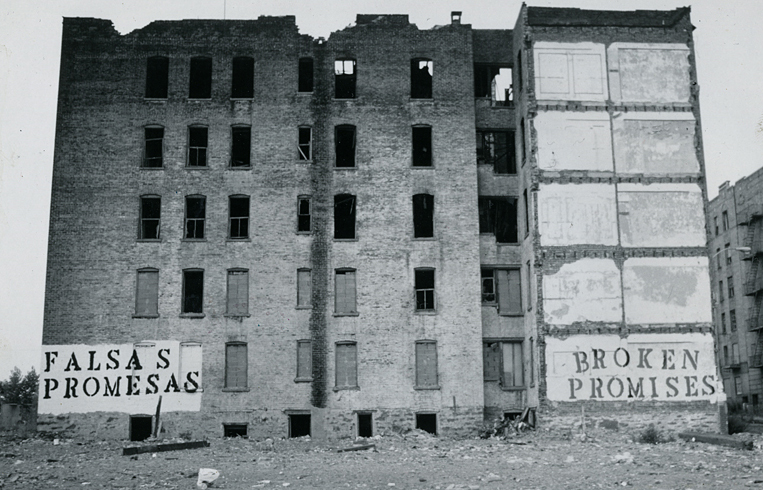
Falsas Promesas Broken Promises, taken by John Fekner, Charlotte Street Stencils, South Bronx, New York. 1980. (Liftarn via Wikipedia). Released to public domain via CC-SA-3.0.

Falsas Promesas Broken Promises, taken by John Fekner, Charlotte Street Stencils, South Bronx, New York. 1980. (Liftarn via Wikipedia). Released to public domain via CC-SA-3.0.

But that wouldn’t be near enough to communicate the range of emotions, the psychological states and the pressures that these people faced in leaving their homes for the not-so-bright lights of America’s big cities, not to mention what they faced in the days and years after they arrived. I should know. I’m the nearly forty-five year-old son of a mother originally from Bradley, Arkansas (population 500) and a father from Harrison, Georgia. They moved to New York City in the ’60s (specifically, the Tremont section of the Bronx), then to the South Side of Mount Vernon, New York (just outside the Bronx), hooked up, and sired me and my older brother Darren between December 1967 and January 1970.

That short summary is hardly the story, though. For me — like with so many other things in my life — music tells the story, emotions and psychology beyond what words on a page alone can approximate, but not fully duplicate. Music communicates the stories, emotions and psychology of those who migrated and stayed (or didn’t) in cities across the US better than Census data or a hypothesis on proletarianization. I wanted music from my own lifetime (or at least, within a few years of it) — not just folk songs or Blind Willie Johnson or Duke Ellington — music that fit my family’s transition from migration to our current times of racism and urban poverty.

Easily the top two songs on my list to play in class would be:

Trade ad for Otis Redding's single "Try a Little Tenderness," January 7, 1967. (Viniciusmc via Wikipedia/Billboard Magazine, page 7). In public domain).

Trade ad for Otis Redding’s single “Try a Little Tenderness,” January 7, 1967. (Viniciusmc via Wikipedia/Billboard Magazine, page 7). In public domain).

1. Otis Redding, “(Sittin’ On) the Dock of the Bay,” (1968), released after Redding’s death in a plane crash in Madison, Wisconsin; and

2. Stevie Wonder, “Living For The City,” (1973).

Both songs run the full emotional and psychological gamut. From hopefulness to oblivion, from delusion to despair, from rage and anger to resignation. The melancholy of Redding’s “It’s two thousand miles I roamed/Just to make this dock my home” (in reference to the distance from Georgia to San Francisco Bay) juxtaposed with Wonder’s bitterness and anger:

“His hair is long, his feet are hard and gritty
He spends his life walkin’ the streets of New York City
He’s almost dead from breathin’ in air pollution
He tried to vote but to him there’s no solution…”

It communicates so much beyond the lyrics and liner notes, a reminder for those of us who find America and its cities unforgiving today just how relentless it must’ve been for our parents and uncles and aunts and grandparents forty or more years ago.

There are other songs that I’d put on this playlist. Some are directly related to Black migration, some try to bridge the gap between the abundance of music on “the ghetto” and urban poverty and chaos and the lack of music from my own lifetime on migration.

3. Gladys Knight and the Pips, “Midnight Train to Georgia” (1973).
4. Marvin Gaye, “Inner City Blues” (1971).
5. Gil Scott-Heron, “95 South (All of The Places We’ve Been)” (1977).
6. Tracy Chapman, “Fast Car” (1987).
7. Nas (featuring Olu Dara, his father), “Bridging the Gap” (2004).

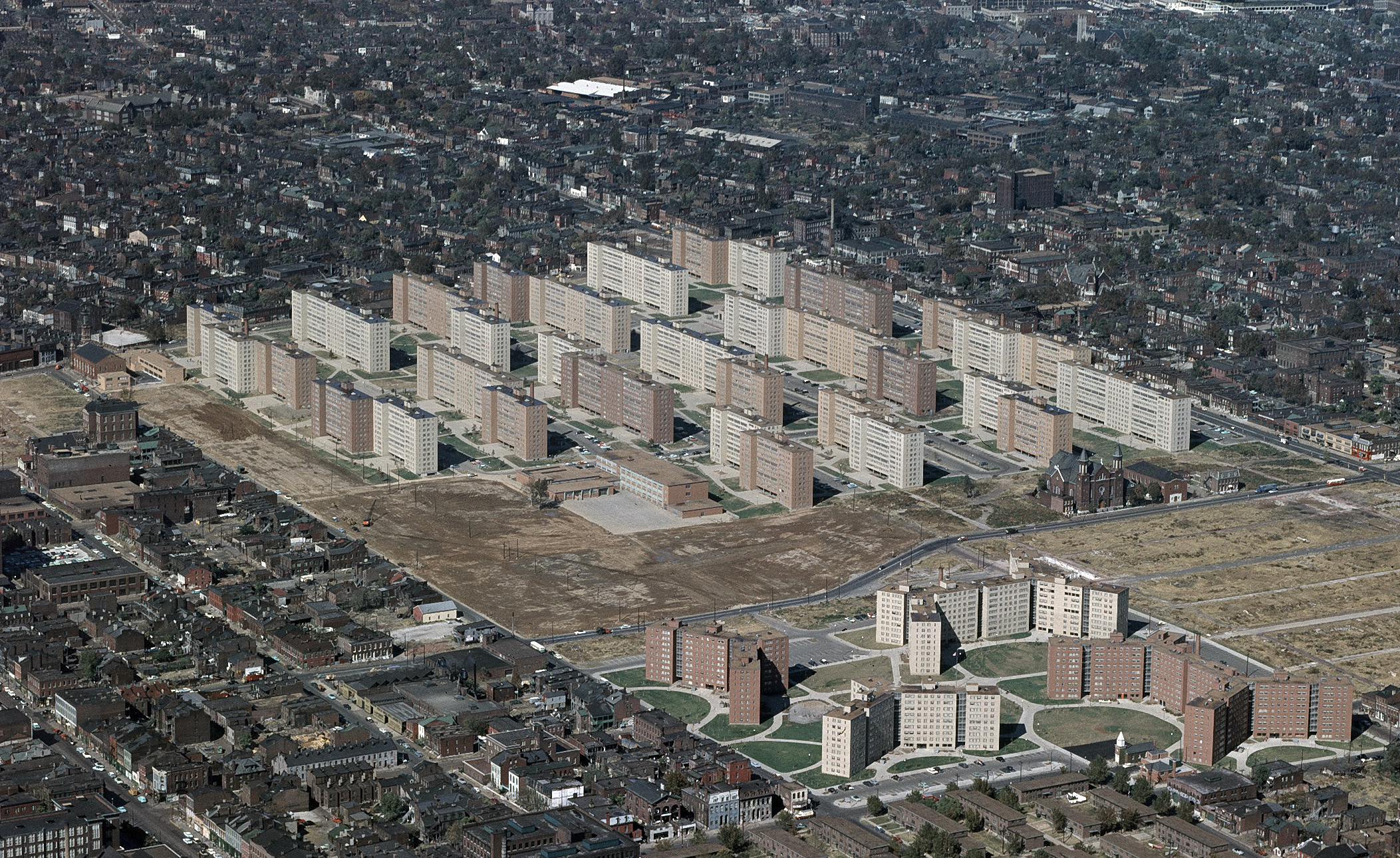
Pruitt–Igoe public housing projects, St. Louis, Missouri, circa 1967. This late-1950s "urban renewal" project was built, but  failed and was razed in the 1970s. (Cadastral via Wikipedia/US Geological Survey). In public domain.

Pruitt–Igoe public housing projects, St. Louis, Missouri, circa 1967. This late-1950s “urban renewal” project was built, but failed and was razed in the 1970s. (Cadastral via Wikipedia/US Geological Survey). In public domain.

That most of these songs come from the period between 1967 and 1974 isn’t an accident. It was the height of the Civil Rights Movement, combined with the Black Power Movement and the “Black is Beautiful” campaign, the beginning of the White backlash against civil rights — including Dr. Martin Luther King, Jr.’s assassination — and the Anti-War Movement was in full swing. It was a good time to take a look at the present and recent past to reconnect with hopes and dreams in the midst of the nightmare of urban poverty.

After ’73 was the beginning of the dance and disco era, as well as a focus on the urban, on crime, on drugs, on poverty  — but not in a “let’s try to solve it” kind of way. This was where rap, hip-hop, some R&B and early forms of what we now call neo-soul picked up, with little reflection on this once prominent past.

Still, there would be some honorable mentions for this migration course, music that could evoke some aspect of the Black migration, of the hope that took a downward turn, of the poverty and joblessness that have permeated America, Black and White and Brown, since the ’70s.

8.  Arrested Development, “Tennessee” (1992).
9. Tina and Ike Turner (and Credence Clearwater Revival), “Proud Mary” (1970).
10. Nina Simone, “The Backlash Blues” (1967).
11. NWA, “Straight Outta Compton” (1989).
12. Tupac, “Cradle 2 the Grave” (1994).
13. John Mellencamp, “Pink Houses” (1983).
14. Bruce Springsteen, “Born In The U.S.A..” (1984). [the song’s release was thirty years ago this month, by the way]
15. Peter Gabriel and Kate Bush, “Don’t Give Up” (1986)

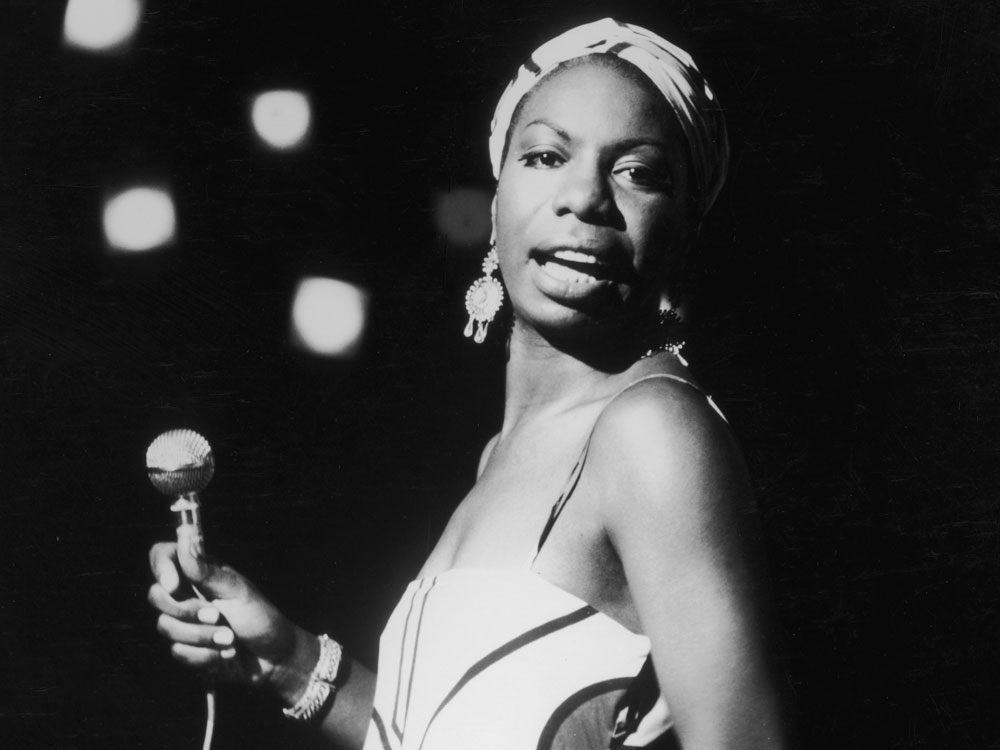
Nina Simone performs at a concert in 1964. (http://npr.org, via Hulton Archive/Stringer/Getty Images).

Nina Simone performs at a concert in 1964. (http://npr.org, via Hulton Archive/Stringer/Getty Images).

Through music, I’d hope to have a course and discussion about Black migration that reaches beyond the words origin and destination, that migration has merely been a physical manifestation of a difficult and seemingly unending cultural and spiritual journey in the US. That Black migration can also easily include the parallel journeys of those of the African or Afro-Caribbean diaspora, not to mention those from Latin America.

For me, though, a course like this would be a personal foray into all the things that have made me who I’ve been for nearly four and a half decades — a person better than the sum of America’s parts and racist, sexist, homophobic and evangelical assumptions.

There’s Know Place Like Home…

29 Friday Aug 2014

Posted by decollins1969 in 1, Academia, Boy @ The Window, Carnegie Mellon University, Cleaning, culture, Eclectic, High Rise Buildings, Jimme, Mount Vernon New York, My Father, New York City, Pop Culture, race, Upper East Side, Upper West Side, Work, Youth

≈ Leave a comment

Tags

241st Street Subway, East Side, Father-Son Relationships, Gramercy Park, Home, Levi Brothers, Manhattan, Metro-North, Sense of Direction, Street Knowledge, Subway, The Bronx, Wakefield, West Side


Dorothy's heel-clicking in screen shot from The Wizard of Oz (1939), August 29, 2014. (http://vivandlarry.com). Qualifies as fair use under US copyright laws - low resolution and relevance to subject matter.

Dorothy’s heel-clicking in screen shot from The Wizard of Oz (1939), August 29, 2014. (http://vivandlarry.com). Qualifies as fair use under US copyright laws – low resolution and relevance to subject matter.

Yes, the title’s a deliberate play on words. In no small part because of Facebook and Boy @ The Window, I am reminded every day of where I grew up, Mount Vernon, New York. But all too frequently, those who think they know me either assume that Mount Vernon’s so far from New York City that I seldom spent time there. Or, more recently, some have assumed that my experience of The Big Apple is a recent phenomenon, as if I only started spending time in the five boroughs when I hit my mid-thirties.

Neither is true, of course. In many ways, I’m as much of a child of The Bronx and Manhattan as I am of Mount Vernon. I spent countless hours catching the 2, 3, 5 and 6 trains between 241st, Dyre Avenue, 180th, Pelham Parkway, 149th, 110th, 125th, 72nd, 86th and so many other stops. I used to know where to get the best brownies in the area, in Wakefield, at a bakery near some taxi stands and between the 238th and 241st Street stops. I could tell you which bars my father Jimme frequented, which bars he didn’t, what pizza shops had slices to die for, and what places to avoid near Times Square. I’d been to Mets games, Ice Capades, the Bronx Zoo, a Puerto Rican Day and a Pulaski Day parade, concerts at Van Cortlandt Park, even MOMA before I graduated high school.

One of the reasons I could do all of this by the time I was fifteen was because of all the times Jimme had taken me and Darren down to the Bronx and Manhattan. Mostly to watch him pick up his paycheck from the Levi brothers at their cleaners on 20 West 64th or on East 59th. But between ’82 and ’85, I learned where nearly all of my father’s watering holes were, and on the most desperate of weekends, could track him to one of them in order to get money for myself and to help out my Mom at 616. While my classmates would occasionally take the Metro-North into the city to take in a Broadway play or go to a Knicks game, I was learning about the city in all of its varying inequalities and nuances by looking for and working for my father.

Screen shot 2014-08-29 at 6.28.50 AM

Fast-forward to the end of August ’93, just a few days before I began the Carnegie Mellon University phase of my grad school and doctoral journey. I had been short on money that whole summer, unemployed for six weeks after transferring from Pitt, working as an “intern” for six dollars and hour, and nearly $600 behind on rent at one point in late June. I’d survived the eviction notice and a summer in which I learned who my truest, closest friends were. I took a few days from my personal drama to visit my Mom and my siblings at 616, and in the process, decided to track down my father for a few extra dollars, as well as to see him for the first time in over a year. It had been that long because Jimme had accused me of faking my master’s degree when I lasted visited him.

Central Park, looking out toward Midtown's West Side, New York, NY, August 5, 2014. (Donald Earl Collins).

Central Park, looking out toward Midtown’s West Side, New York, NY, August 5, 2014. (Donald Earl Collins).

But I wasn’t fifteen anymore. Instead of a long walk and the Subway, I took the Metro-North down from Pelham to Grand Central, took the S (Shuttle) over to Times Square, and the 1 train to 66th, and walked over to the Levi’s cleaners on West 64th. Only to find out Jimme wasn’t in that day. I then remembered that the other Levi brother had a dry cleaner on East 59th. I walked the ten blocks over there and found the other Levi brother in the midst of arguing with clients and barking orders to his Latino and Afro-Caribbean underlings. My father was doing a cleaning job for him at some high-rises down near Gramercy Park.

I rode the 4 train down to 23rd Street, got my east-west bearings, and walked toward a set of high-rises near FDR Drive. Though I’d forgotten the address, I knew somehow that Jimme would be in the most expensive-looking high-rise or set of high-rises in the bunch. I found a guard, who sent me to the floor where Jimme and his co-worker John were working.

As soon as Jimme saw me come off the elevator, he said, “Bo’ watcha doin’ up here? How the hell yo’ find me?”

“You’re not the only one who knows The City, you know” I said.

It’s no wonder I feel a bit insulted when people either tell me I’m from upstate New York or that I’m not a New Yorker. I know the city better than at least a third of the people who live and work there every day.

My First Adult Job Interview, Teachers College

12 Monday May 2014

Posted by decollins1969 in 1, Academia, Boy @ The Window, Carnegie Mellon University, culture, Eclectic, eclectic music, Mount Vernon New York, New York City, Pittsburgh, Politics, Pop Culture, race, Upper West Side, Work, Youth

≈ Leave a comment

Tags

Barnes & Noble, Beacon Theater, Calling, CMU, Disillusionment, Finishing Second, Hotel Beacon, job interview, Job Talk, Joe William Trotter Jr., PTSD, Racial Harassment, Rage, Steven Schlossman, Teachers College, Walking While Black, Writer, Writing


Teachers College today, West 120th (between Broadway and Amsterdam), New York, NY, April 15, 2014. (http://ccnmtl.columbia.edu/).

Teachers College today, West 120th (between Broadway and Amsterdam), New York, NY, April 15, 2014. (http://ccnmtl.columbia.edu/).

Seventeen years ago this week (check the calendar – the days and dates coincide with the week of May 12-18, ’97) was perhaps one of the most euphoric and bitterly disappointing weeks in my entire adult life. It was such a strange week that it forced me into second guessing myself and my path in life for many years afterward.

But it didn’t start out that way. On Monday, May 12th, I did my very first post-doctoral interview, for an assistant professor position at Teachers College (Columbia’s school of education) in Morningside Heights (West Harlem, really). I’d flown in from Pittsburgh the evening before, and stayed at the Hotel Beacon at Teachers College’s expense, because Monday was going to be a very long day. It was loud that Sunday night, as there was some event at the Beacon Theater. But somehow, I had just enough discipline and memories of New York’s smells and sounds to fall asleep comfortably.

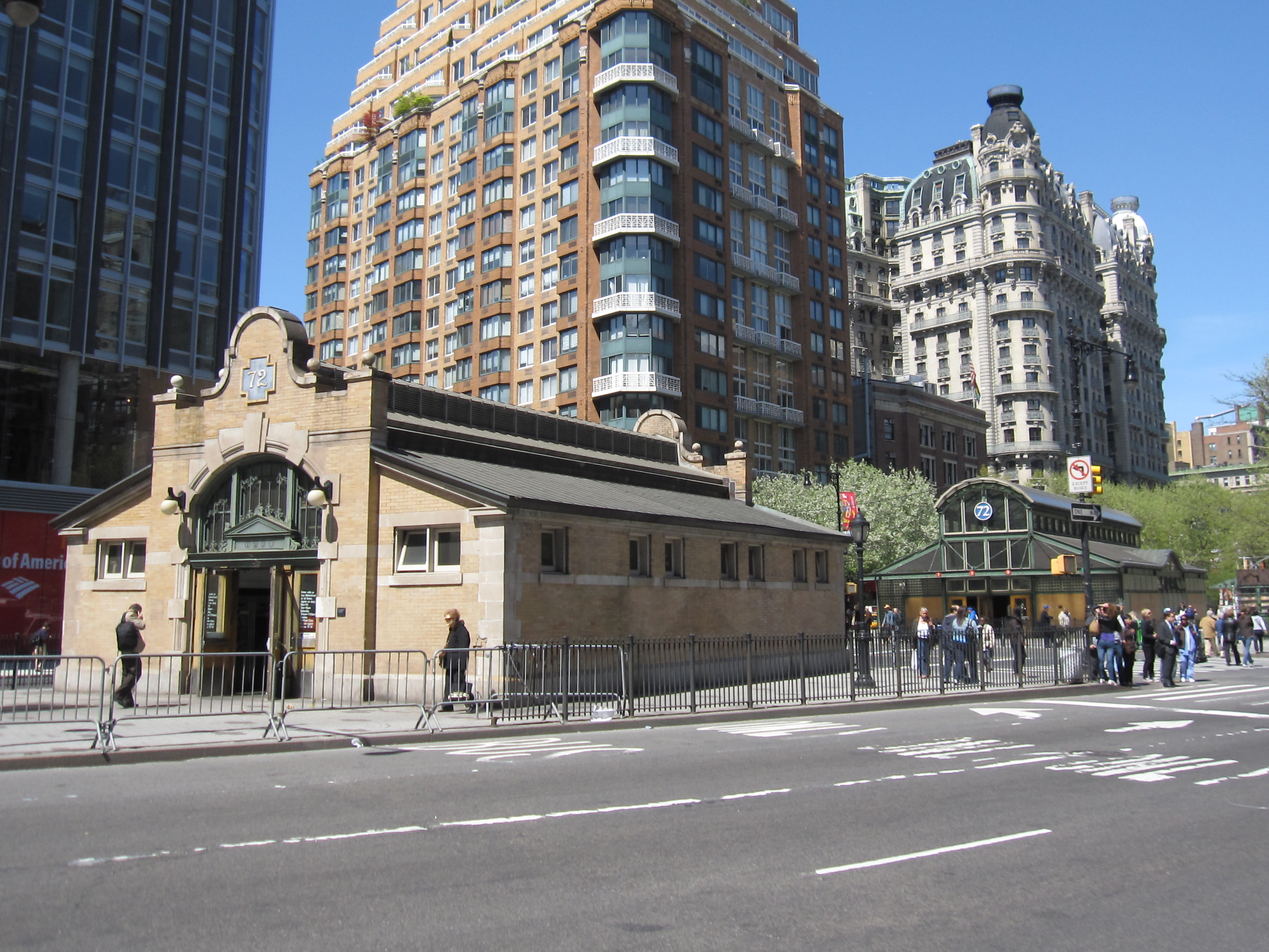
My day started at 8:30 am, so of course, I was up before seven. I put on my one and only suit — at least, the only suit I owned that fit my six-three, 215-pound frame — went over my job talk on multiculturalism, and went on my pensive way to the 72nd Street Subway entrance on Broadway. It was a meat-packed ride to 125th Street, where I had to get off (I had forgotten to walk down to 66th Street to catch the local 1 instead of the express 2 train) and walk the six or so blocks to Teachers College.

Original control house (left) and newer control house, on opposite sides of 72nd Street  (IRT Broadway – Seventh Avenue Line), New York, NY, April 13, 2010. (Gryffindor via Wikipedia). Released to public domain via CC-SA-3.0.

Original control house (left) and newer control house, on opposite sides of 72nd Street (IRT Broadway – Seventh Avenue Line), New York, NY, April 13, 2010. (Gryffindor via Wikipedia). Released to public domain via CC-SA-3.0.

After that, my day was an eight-hour blur, meeting with faculty, grad students and deans. Making sure not to eat too much while being grilled with questions over lunch. Giving my job talk and making sure to tell jokes, to bring up facts relevant to this history of education job, and, of course, to smile. Talking with grad students about how I finished my 505-page dissertation in twenty-seven months, about my teaching style and about growing up in Mount Vernon. It was as intense a process as I had expected it to be, but I felt at the end that I’d done everything possible to get the job.

I knew that I was one out of only five candidates invited to interview, out of over 500 applicants. I even had the chair of the History Department, Steve Schlossman, lobby on my behalf for the job, prior to my interview. And, despite my former advisor in Joe Trotter, I’d managed to put together a group of letters from folks that should’ve passed muster. All I could do after the interview was wait.

But life didn’t wait to intervene. After leaving the interview for the hotel, I changed into my more casual clothing, jeans and a long-sleeve t-shirt, and went off to Tower Records and Barnes & Noble on 66th and Broadway, and later, Haagan Dazs (that last one was a big gastrointestinal mistake!).  

From the moment I walked in the door at Barnes & Noble until I left a half-hour later, a Latino security guard tailed me as I perused books in the African American nonfiction, Cultural Studies and Music sections of the store, across three floors. As I walked out, I walked up to the guard and said

“While you were stalking me, you probably let half a dozen White folks slip out of here with books and CDs. Did you learn anything while you were watching me?”

“I was just doing my job,” the dumb-ass security guard said in response.

“Well, if following a Black guy around for thirty minutes is part of your job, you deserve to lose your job,” I said to him as I walked out.

It was a bit of a harbinger of things to come. I was more pissed off about these everyday slights — or, rather, microaggressions — than I’d been before Trotter and my doctorate. And I was less patient about waiting for what I wanted than I’d been as a grad student.

What your second-place prize often looks like, May 12, 2014. (http://www.wmciu.org.uk/).

What your second-place prize often looks like, May 12, 2014. (http://www.wmciu.org.uk/).

Three weeks later, I received a reimbursement check for my travel and other expenses, and within twenty-four hours, a call from the search committee chair. I’d finished second for the job. Second! To whom, I still don’t know. The chair kept telling me, “you didn’t do anything wrong…you did a very good set of interviews,” as if those compliments would pay my rent next month. I was disappointed, hopeful, but disappointed. It was my first shot, my best shot, and I’d given my best effort. “What now?,” I thought.

It’s a question that I still must ask seventeen years, two books and two careers later. I’ve long since realized that the question of what my life would’ve been like if I’d gotten the Teachers College job was moot, because my issues were about more than finding work. I still would’ve been unhappy, with a New York-esque rage to go with it.

So I counted my blessings, and I count them still. Not getting this particular job bought me the time and energy I needed. I needed that time, to see myself as the writer I also wanted to be, not just the educator and thinker I already knew I was. A better, more personable, more revealing and feeling writer than the cold and metallic one that grad school and Trotter helped turn me into by the end of ’96.

Boy @ The Window, Now in Paperback

20 Wednesday Nov 2013

Posted by decollins1969 in 1, Boy @ The Window, Christianity, Eclectic, eclectic music, Hebrew-Israelite, High Rise Buildings, Jimme, Marriage, Mount Vernon High School, Mount Vernon New York, music, My Father, New York City, Pittsburgh, Politics, Pop Culture, race, Religion, Sports, University of Pittsburgh, Upper East Side, Upper West Side, Youth

≈ 2 Comments


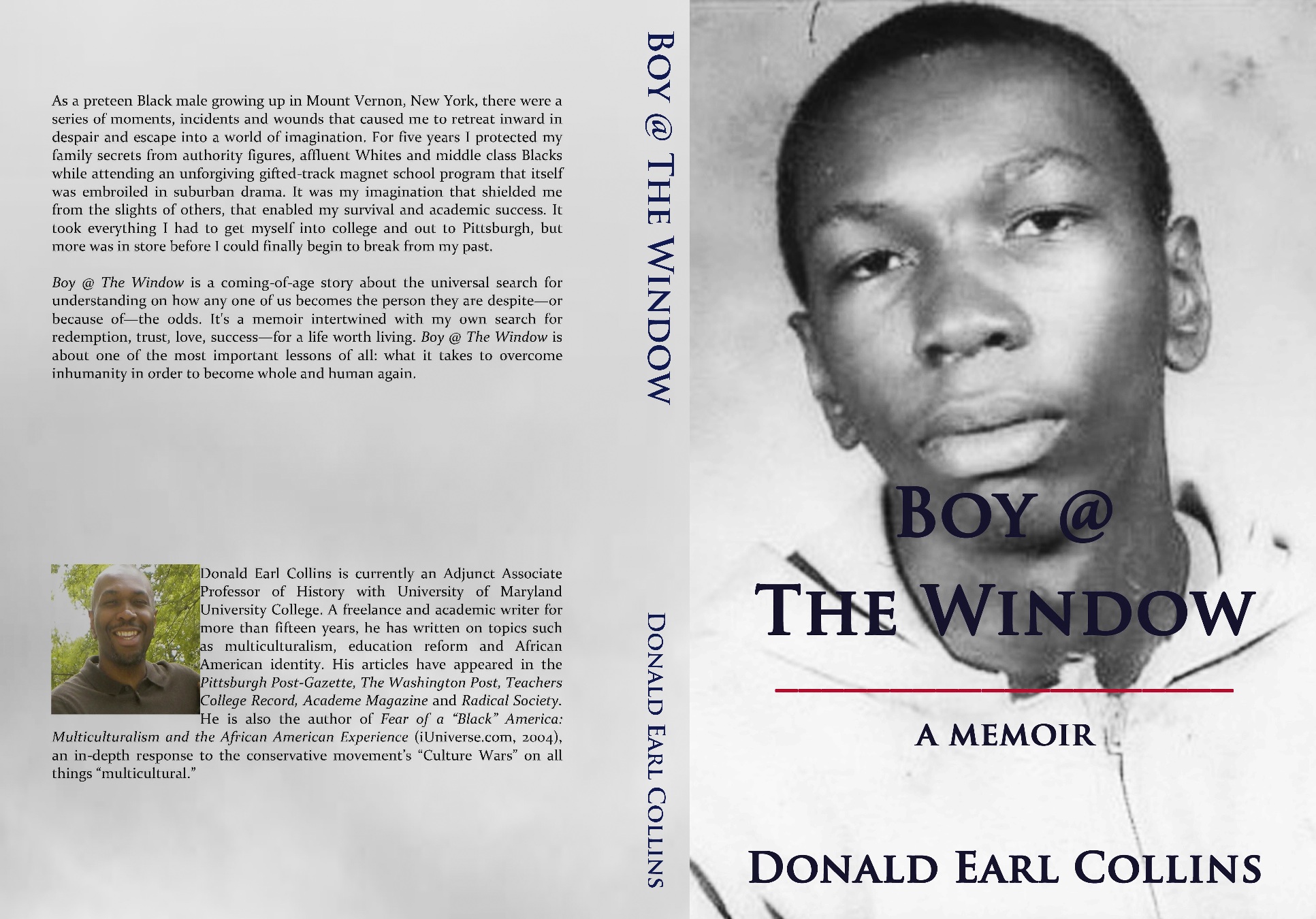
Boy @ The Window, front and back cover, and side, November 11, 2013. (Donald Earl Collins).

Boy @ The Window, front/back cover, and side, November 11, 2013. (Donald Earl Collins).

I have some really good news. My book Boy @ The Window is not just an e-book anymore. I now have a trade paperback edition, out and available through Amazon.com as of yesterday (via http://www.amazon.com/Boy-Window-Donald-Earl-Collins/dp/0989256138/). You can also order and buy Boy @ The Window the old-fashioned way — directly through your local bookstore.

Please take a look, support, buy, read, comment and share. I will post as reviews and opportunities to talk about the book arise. Thanks to all of you who’ve supported my blog and the path to Boy @ The Window over the past six years!

← Older posts
Newer posts →

Boy @ The Window: A Memoir

Boy @ The Window: A Memoir

Places to Buy/Download Boy @ The Window

There's a few ways in which you can read excerpts of, borrow and/or purchase and download Boy @ The Window. There's the trade paperback edition of Boy @ The Window, available for purchase via Amazon.com at http://www.amazon.com/Boy-Window-Donald-Earl-Collins/dp/0989256138/

There's also a Kindle edition on Amazon.com. The enhanced edition can be read only with Kindle Fire, an iPad or a full-color tablet. The links to the enhanced edition through Apple's iBookstore and the Barnes & Noble NOOK edition are below. The link to the Amazon Kindle version is also immediately below:

scr2555-proj697-a-kindle-logo-rgb-lg

Boy @ The Window on Amazon.com: http://www.amazon.com/Boy-The-Window-Memoir-ebook/dp/B00CD95FBU/

iBookstore-logo-300x100

Boy @ The Window on Apple's iBookstore: https://itunes.apple.com/us/book/boy-the-window/id643768275?ls=1

Barnes & Noble (bn.com) logo, June 26, 2013. (http://www.logotypes101.com).

Boy @ The Window on Barnes & Noble: http://www.barnesandnoble.com/w/boy-the-window-donald-earl-collins/1115182183?ean=2940016741567

You can also add, read and review Boy @ The Window on Goodreads.com. Just click on the button below:

Boy @ The Window

Twitter Updates

Tweets by decollins1969
  • RSS - Posts
  • RSS - Comments

Archives

  • June 2025
  • April 2023
  • September 2022
  • August 2022
  • July 2022
  • June 2022
  • May 2022
  • April 2022
  • March 2022
  • January 2022
  • December 2021
  • November 2021
  • October 2021
  • September 2021
  • August 2021
  • July 2021
  • June 2021
  • April 2021
  • March 2021
  • February 2021
  • January 2021
  • December 2020
  • November 2020
  • October 2020
  • September 2020
  • August 2020
  • July 2020
  • May 2020
  • April 2020
  • March 2020
  • January 2020
  • December 2019
  • November 2019
  • August 2019
  • July 2019
  • June 2019
  • May 2019
  • April 2019
  • March 2019
  • February 2019
  • January 2019
  • December 2018
  • November 2018
  • October 2018
  • September 2018
  • August 2018
  • July 2018
  • June 2018
  • May 2018
  • March 2018
  • February 2018
  • January 2018
  • December 2017
  • November 2017
  • October 2017
  • September 2017
  • August 2017
  • July 2017
  • June 2017
  • May 2017
  • April 2017
  • March 2017
  • February 2017
  • January 2017
  • December 2016
  • November 2016
  • October 2016
  • September 2016
  • August 2016
  • July 2016
  • June 2016
  • May 2016
  • April 2016
  • March 2016
  • February 2016
  • January 2016
  • December 2015
  • November 2015
  • October 2015
  • September 2015
  • August 2015
  • July 2015
  • June 2015
  • May 2015
  • April 2015
  • March 2015
  • February 2015
  • January 2015
  • December 2014
  • November 2014
  • October 2014
  • September 2014
  • August 2014
  • July 2014
  • June 2014
  • May 2014
  • April 2014
  • March 2014
  • February 2014
  • January 2014
  • December 2013
  • November 2013
  • October 2013
  • September 2013
  • August 2013
  • July 2013
  • June 2013
  • May 2013
  • April 2013
  • March 2013
  • February 2013
  • January 2013
  • December 2012
  • November 2012
  • October 2012
  • September 2012
  • August 2012
  • July 2012
  • June 2012
  • May 2012
  • April 2012
  • March 2012
  • February 2012
  • January 2012
  • December 2011
  • November 2011
  • October 2011
  • September 2011
  • August 2011
  • July 2011
  • June 2011
  • May 2011
  • April 2011
  • March 2011
  • February 2011
  • January 2011
  • December 2010
  • November 2010
  • October 2010
  • September 2010
  • August 2010
  • July 2010
  • June 2010
  • May 2010
  • April 2010
  • March 2010
  • February 2010
  • January 2010
  • December 2009
  • November 2009
  • October 2009
  • September 2009
  • August 2009
  • July 2009
  • June 2009
  • May 2009
  • April 2009
  • March 2009
  • February 2009
  • January 2009
  • December 2008
  • November 2008
  • October 2008
  • September 2008
  • August 2008
  • July 2008
  • June 2008
  • May 2008
  • April 2008
  • March 2008
  • February 2008
  • January 2008
  • December 2007
  • November 2007
  • October 2007
  • September 2007
  • August 2007
  • July 2007
  • June 2007

Recent Comments

decollins1969's avatardecollins1969 on No Good Teaching Deed Goes…
Mary Rose O’Connell's avatarMary Rose O’Connell on No Good Teaching Deed Goes…
Lyndah McCaskill's avatarLyndah McCaskill on The Raunchiest of Them Al…

NetworkedBlogs on Facebook

NetworkedBlogs
Blog:
Notes From a Boy @ The Window
Topics:
My Life, Culture & Education, Politics & Goofyness
 
Follow my blog

616 616 East Lincoln Avenue A.B. Davis Middle School Abuse Academia Academy for Educational Development AED Afrocentricity American Narcissism Authenticity Bigotry Blackness Boy @ The Window Carnegie Mellon University Child Abuse Class of 1987 CMU Coping Strategies Crush #1 Crush #2 Death Disillusionment Diversity Domestic Violence Economic Inequality Education Family Friendship Friendships Graduate School Hebrew-Israelites High-Stakes Testing Higher Education History Homelessness Humanities Humanities Program Hypocrisy Internalized Racism Jealousy Joe Trotter Joe William Trotter Jr. K-12 Education Love Manhood Maurice Eugene Washington Maurice Washington Misogyny Mother-Son Relationship Mount Vernon High School Mount Vernon New York Mount Vernon public schools Multiculturalism MVHS Narcissism NFL Pitt Pittsburgh Politics of Education Poverty President Barack Obama Race Racial Stereotypes Racism Relationships Self-Awareness Self-Discovery Self-Reflection Sexism Social Justice Teaching and Learning University of Pittsburgh Violence Whiteness Writing

Top Rated

Blog at WordPress.com.

  • Subscribe Subscribed
    • Notes from a Boy @ The Window
    • Join 103 other subscribers
    • Already have a WordPress.com account? Log in now.
    • Notes from a Boy @ The Window
    • Subscribe Subscribed
    • Sign up
    • Log in
    • Report this content
    • View site in Reader
    • Manage subscriptions
    • Collapse this bar
 

Loading Comments...