• About Me
  • Other Writings
  • Interview Clips
  • All About Me: American Racism, American Narcissism, and the Conversation America Can’t Have
  • Video Clips
  • Boy @ The Window Pictures
  • Boy @ The Window Theme Music

Notes from a Boy @ The Window

~

Notes from a Boy @ The Window

Category Archives: Hebrew-Israelite

Pictures and Records

11 Wednesday Feb 2015

Posted by decollins1969 in 1, Boy @ The Window, culture, Eclectic, eclectic music, Hebrew-Israelite, Jimme, Marriage, Mount Vernon New York, music, My Father, New York City, Pop Culture, race, Religion, Upper West Side, Youth

≈ Leave a comment

Tags

"Method of Modern Love" (1984), "Roxanne, 45 Singles, 616, 616 East Lincoln Avenue, Brothers, Cassette Tapes, Darren, Doug E. Fresh, Father-Son Relationships, Hall & Oates, Jimme, Live Aid, Mother-Son Relationship, Nathan Hale Elementary, Photos, Pictures, Play Fighting, Polaroid, Record Player, Roxanne" (1984), Turntable, Vinyl Records, Walkman


Me & Darren at gate to  Nathan Hale ES playground, Mount Vernon, NY, February 1975. [At 425 South Sixth, we lived just two doors down from Nathan Hale and its playground area/parking lot.]  (My Mom).

Me & Darren at gate to Nathan Hale ES playground, Mount Vernon, NY, February 1975. [At 425 South Sixth, we lived just two doors down from Nathan Hale and its playground area/parking lot.] (My Mom).

There are some things that most folks — at least most in the US — take for granted that I had very little of growing up and into adulthood. Certainly love was one of those things, but I’ve told that story as a running theme many times over the past seven years and eight months. On a more materialistic note, the things that provide pleasant memories of childhood even in the midst of suffering and sorrow, like pictures and records, were also rarities for me as well. As I said in the Preface to Boy @ The Window, photos “are among those smallest and most awesome of things. Perhaps because so few of mine survived to childhood.” This lack of evidence of my existence and importance prior to college is a story of poverty, of course. But it’s also a story of what’s important to do and feel and say, even in the midst of poverty, abuse and domestic violence.

One of the five surviving photos in my possession from my childhood is a picture of me with my older brother Darren covering my mouth as we stood at the playground gate right next to Nathan Hale Elementary School. It was February ’75, and I was in the second half of kindergarten. We took this picture on a Saturday, with both our Mom and our father Jimme there. Believe it or not, we were on our way to play on the asphalt playground and basketball court, walking around the neighborhood that was Nathan Hale and South Sixth Avenue on Mount Vernon, New York’s South Side. This was a memorable event only because it was also a very rare event. That our Mom took us somewhere that didn’t have anything to do with grocery shopping, clothes’ buying or laundry washing.  That our father was also along for the event, actually sober and not arguing with or threatening our Mom.

A better picture of Darren and me, taken in April 1975, Sears, Mount Vernon, NY, July 6, 2006. (Donald Earl Collins).

A better picture of Darren and me, taken in April 1975, Sears, Mount Vernon, NY, July 6, 2006. (Donald Earl Collins).

It was also an outing where Darren and I had been horsing around, calling each other names. Just before our Mom started snapping pictures with her old Polaroid, Darren had put me in a headlock and punched me in my forehead for calling him a “dummy.” He then covered my mouth as I kept calling him a dummy, all while our Mom snapped the first picture. “Y’all keep it up, you’re gonna get your asses whupped,” Mom said to get us to stop. And we did stop fighting just long enough to snap a better picture, although it didn’t survive very long.

As far as I can remember, this was the next to last time all four of us were out together as a family. The last time came in June ’76, when my Mom introduced me to basketball, only to tell me she would “never show me how to play basketball again” because I became frustrated with getting the ball high enough to the hoop. I was six years old at the time.

Ten years after we took the Nathan Hale playground picture, Darren and I had become enamored with music to begin consuming it. Darren had bought himself a turntable at the end of ’84, for the wonderful price of $15 (it would probably be $175 in today’s money because of today’s lopsided supply and demand for vinyl in an mp3 age). But we had zero experience buying records, and our Mom’s limited collection of Al Green, Diana Ross and The Supremes and Gladys Knight and The Pips had been destroyed long ago in the midst of her breakup with our father. Our idiot stepfather Maurice had 8-track and vinyl collections (especially The Commodores and The Ohio Players) that he had given away when he converted to the Hebrew-Israelite cult in 1980-81.

Darryl Hall & John Oates, "Method of Modern Love" 45, circa 1984-85, February 11, 2015. (http://www.thespacebar.co.uk/).

Darryl Hall & John Oates, “Method of Modern Love” 45, circa 1984-85, February 11, 2015. (http://www.thespacebar.co.uk/).

So we bought whatever we heard on WBLS-107.5 or WPLJ-95.5 FM, without the benefit of music videos or without the influence of parents and classmates. Darren bought Doug E. Fresh, Grandmaster Flash, UTFO’s “Roxanne, Roxanne,” and Lisa Lisa and Cult Jam. My first purchases were to support Live Aid’s anti-famine work in Ethiopia, via “Do They Know It’s Christmas.” The first 45 I bought for us to play on Darren’s turntable, though, was Hall & Oates’ “Method of Modern Love,” which reached number five on Billboard’s pop charts about this time thirty years ago. It was an interesting foray into music beyond the radio, at least for me. Darren would tell me how “wack” my music was, and I’d say, “you don’t even like rap. You’re just listenin’ to it because you like girls now!”

This first effort at consuming music didn’t last long. It took money and weekly trips to the city to find vinyl to support it, and in early ’85, we simply didn’t have enough money to shop at Tower Records and Crazy Eddie’s for the stuff we wanted every week. At least not yet. Plus, we broke the turntable that spring, and with the rise of the Sony Walkman and cheap cassette tapes, we were on our way to truly getting into the ’80s before the ’90s arrived.

I no longer have that Hall & Oates single (although I do have it on my iPod). But I do have memories of my brother Darren, memories where we were still actually brothers to each other. Memories of rivalry, jealousy, fighting, even love. All in the time of choking poverty and emotional neglect.


The Comedy of a Tragic Upbringing

10 Saturday Jan 2015

Posted by decollins1969 in 1, Academia, Boy @ The Window, Christianity, culture, Eclectic, Hebrew-Israelite, Jimme, Mount Vernon High School, Mount Vernon New York, Movies, My Father, New York City, Politics, Pop Culture, race, Religion, Youth

≈ Leave a comment

Tags

616, 616 East Lincoln Avenue, Alchemy, Alcoholism, Autobiography, Child Abuse, Comedy, D.L. Hughley, Dave Chappelle, Domestic Violence, Eddie Murphy, Evangelical Christianity, Father-Son Relationships, Fatism, Ghetto Klown (2014), John Leguizamo, Lewis Black, Mother-Son Relationship, Neglect, Physical Violence, Playwright, Poverty, Psychological Abuse, Respectability Politics, Richard Pryor, Rodney Dangerfield, Routines, Stand-Up Comedy, Tragedy, Transmutation


John Leguizamo playing 'Abuelo' in Tales from a Ghetto Klown, PBS Arts Festival, July 2012. (http://www.pbs.org).

John Leguizamo playing ‘Abuelo’ in Tales from a Ghetto Klown, PBS Arts Festival, July 2012. (http://www.pbs.org).

Over New Year’s weekend, I watched John Leguizamo’s HBO comedy special Ghetto Klown (2014), based on one of his one-man autobiographical Broadway shows. I don’t think of Leguizamo as funny in the same way I think of Lewis Black or Dave Chappelle or Eddie Murphy. The sweet spot for me in terms of what is funny or not funny is a routine that makes me think for a second or two, not just laugh out of sheer expectations for a funny delivery or line. Otherwise, I’d think of D.L. Hughley as a great comedian, instead of as a vile one with equally vile opinions on race and culture.

Leguizamo’s hardly the funniest comedian. But then again, he’s always been more than one thing. He’s essentially a playwright, an actor, and comedian, which means Leguizamo’s a very elaborate storyteller. In most of his work, a nonfiction storyteller. I’ve seen some of his other one-man work before. With Ghetto Klown, though, I saw and felt the sense of tragedy and regret that I hadn’t seen in his other plays and specials. Especially when it came to his family — specifically his father — and his closest friends.

When Leguizamo went through his routine about how his mother and father were upset with him about he had portrayed them in his plays as somewhat selfish and oftentimes neglectful and abusive, I understood. I’ve only written one book about my life, and my Mom and dad have both been offended by the idea that I could write about them without their permission or blessings. Leguizamo used them as bits for his comedy and Broadway stage routines for years. That’s a lot of courage, and it’s a lot of tragedy to expose, too.

Transmutation of lead bars into gold, March 2013. (http://quazoo.com).

Transmutation of lead bars into gold, March 2013. (http://quazoo.com).

I’ve thought about it a few times over the past fifteen years. What if I decided to do a stand-up routine that included elements of my upbringing? How would I do that? How would I make domestic violence and child abuse and poverty funny?

I’d start with my father, who I’d call Jimme and my father interchangeably, since that’s been the nature of our relationship for forty-five years. I’ve been able to imitate his language, his drunken stupor, his evil meanness and off-kilter mannerisms since I was fifteen. It would be easy enough to do all of his “po’ ass muddafucka…” insults in bar scenes, all while getting robbed and beaten up by other alcoholics.

I could also do my now deceased ex-stepfather Maurice, especially his constant threats to put me in the hospital or kill me. “Watch dat base in yo’ voice, boy, ‘fore I cave yo’ chest in!,” he started saying to me once my voice changed with puberty. I could imitate Maurice when he weighed over 400 pounds and wore size-54 Fruit-of-the-Loom briefs around 616, with enough fat and dinginess to make me wanna puke.

I could even imitate my Mom, at least on the threatening front. If I argued with her too long about something important that she didn’t want to talk about (like paying bills, for instance), she’d tell me, “Shut up o’ I’ma gonna cut the piss out of you.” Or I could run around a stage singing at the top of my lungs to evangelical Christian music while also acting like my younger brothers, who’d get into knockdown fights in the living room while my Mom was in her spiritual zone.

The fact is, some of the best comedy grows out of tragedy. It may not be funny to the respectable middle class types or the respectability politics types. They both would prefer people “forget about” their pasts and “just move on,” as if these issues are taboo. But you can’t be a very good comedian or writer without confronting your upbringing in some way.

Richard Pryor doing stand up, posted August 11, 2014. (http://deadline.com).

Richard Pryor doing stand up, posted August 11, 2014. (http://deadline.com).

I attempted at times in Boy @ The Window to inject some sarcasm or comedy in many of the tragic scenes in the book. Because they reflecting my thinking in the moments in which they occurred, whether in ’82 or ’88. The few people who commented on this aspect of the memoir didn’t like the comedy or the language. It was because they couldn’t reconcile the mild-mannered version of myself that I presented to the world in high school or in academia with the way in which I grew up.

Watching Leguizamo in Ghetto Klown reminded me of what I learned in watching Rodney Dangerfield (who himself was sexually abused and neglected by his parents growing up) and Richard Pryor (the son of an active and neglectful prostitute) over the years. We all have baggage and demons to deal with every day of our lives. We ignore that past and those evils at risk to ourselves and every person we’ve ever loved. We must turn the tragedy of our upbringing into something that isn’t just a cancer of pain. Be it through storytelling, autobiography, even the kind of comedy that those whose lives were much more stable growing up can appreciate but can never fully understand.

Why My Mom Stayed

11 Thursday Sep 2014

Posted by decollins1969 in 1, Boy @ The Window, culture, Eclectic, Hebrew-Israelite, Jimme, Marriage, Mount Vernon New York, My Father, Pop Culture, race, Religion, Youth

≈ Leave a comment

Tags

#WhyIStayed, 616, 616 East Lincoln Avenue, Battered Women's Syndrome, Beverly Gooden, Child Abuse, Domestic Violence, DV, Hypermasculinity, Isshin-ryu Karate, Janay Palmer Rice, Judah ben Israel, Maurice Eugene Washington, Maurice Washington, Misogyny, Ray Rice, Self-Worth, Sexism, Social Media, Twitter


My Mom at 48 years old, Yonkers, NY, December 23, 1995. (Donald Earl Collins).

My Mom at 48 years old, Yonkers, NY, December 23, 1995. (Donald Earl Collins).

I planned to write something about my Mom on her birthday again this October, focusing on her multiple roles as mother, breadwinner, domestic violence victim and evangelical Christian in that post. With the TMZ-released video of Ray Rice and the public response to the NFL’s misogynistic hypocrisy making the issue of domestic violence front and center this week, it makes sense for me to talk about my experience and my observations via my Mom this week as well.

First off, thanks to all the brave women who’ve tweeted, posted on Instagram, Facebook, WordPress and other places their experiences with domestic violence. Thanks especially to Beverly Gooden (@bevtgooden) for creating and using the hashtag #WhyIStayed in response to the barrage of criticism leveled at Janay Palmer Rice for marrying Ray Rice after his brutal act of violence against her. I know domestic violence and child abuse firsthand, as I watched my Mom experience the Isshin-ryu-Karate version of a knockout and concussion on Memorial Day ’82 at the hands of my then stepfather Maurice Washington.

Screen shot 2014-09-11 at 7.54.54 AM

Ivy_Mike_test.ogg.160p

Ivy_Mike_test.ogg.160p

This wasn’t the first time Maurice had hit my Mom, as I’d learn years later, but it was the first time I witnessed it. I’d seen my Mom attacked before, by my own father when I was little. My father was often drunk and equally incompetent during his attacks, so any physical damage that was done was from my Mom beating him up. The psychological and emotional damage, though, flowed right from her first marriage to my father to her second one with Maurice.

For seven years and sixteen days after the day my childhood ended, my Mom and Maurice lived together as husband and wife at 616. I can say with one hundred percent clarity that there wasn’t a day between Memorial Day ’82 and the final fight that led to my late ex-stepfather moving out that I didn’t feel some sort of dread, a cloud of lethargy hanging over my head, even while at college at Pitt. That was partly because I’d made a point of running interference and taking abuse to make up for not calling the police on that day of days.

I didn’t know why my Mom couldn’t find the strength to kick Maurice to the curb, at least not before the middle of ’89. But there was an incident between me and Maurice about a year before he finally moved out, one where what he said afterward gave me additional insight into my Mom’s inaction.

Screen shot 2014-09-11 at 12.52.50 PM

At least, I had to believe that, right? It just seemed we’d been through too much with a man who’d never paid a month’s rent, a phone bill, a Con Ed bill, a cable bill, and only bought Great Northern beans, rice and cabbage for his kids (my younger siblings) on the handful of days he decided to contribute to our malnourished family.

So finally, in the months after he left 616 for good, I asked. My Mom’s first answer was, “He fooled me. He fooled us all!” Her answer was completely unsatisfying, considering that I ran away from home to get away from Maurice when I was nearly nine years old.

The summer of ’89 wouldn’t be the last time I’d ask. Over the years, my Mom has given various explanations. “I thought he was a changed me,” she’d say, referencing their six-month separation in ’80-’81 and Maurice becoming a Hebrew-Israelite and “Judah ben Israel” in the interim. “What good would that done?,” my Mom would ask me in response, implying that she wanted to avoid a physical confrontation.

Really, I spent thirteen years reading in between the lines, asking relatives questions about my Mom, doing research and boning up on domestic violence and child abuse from a social science perspective, all for more substantial answers. Really, my Mom’s domestic violence experience, our fall into welfare poverty, and my child abuse experiences were the first reasons for me wanting to write what would become Boy @ The Window in the first place.

"Divorced at last" layer cake, or "Broken Marriage," March 2014. (http://www.nigeriancurrent.com/).

“Divorced at last” layer cake, or “Broken Marriage,” March 2014. (http://www.nigeriancurrent.com/).

By the time I did the family intervention in January ’02, I knew why. I knew that despite my Mom not remembering much from the beating, knockout and concussion she took in May ’82, she lived in fear. If for no other reason than from seeing the look of hurt on my face whenever the subject of her beating came up. Maybe not a constant, shaking-in-her-shoes fear, but the idea of having to force a six-one and overweight yet powerful man out of 616 probably scared my Mom. But that wasn’t her only fear. As I wrote in Boy @ The Window, “[w]e were already the children of one divorce, and I wasn’t sure if I wanted to see another one so soon.” I’m more than sure that my Mom felt the same way about herself and her relationships with my father Jimme and Maurice as well.

I also know with certainty my Mom would never want me to write about her, especially about her as a victim of domestic violence. But she wasn’t the only one to experience it. I may be able to live my life successfully despite it, but I’ll never be able to un-see what I saw nearly thirty-two and half years ago. It put me on a very long road, one that involved my own conflicting feminism and sexism (though with zero tolerance for violence against women). Or, what I call damsel-in-distress syndrome, where I always want to help, even when that help is unwelcome.

There are millions of reasons why women get married or stay in relationships and marriages, some of them rational, some based in fear, many who stay because abuse does untold damage to self-worth. I may not fully understand what it’s like to be a woman who’s been abused, but I do understand what it’s like to be the son of one. Most of us who don’t know of these horrors need to be quiet, read, and listen more.

The Long-Term Legacy of Humanities’ Soft-Bigotry

10 Wednesday Sep 2014

Posted by decollins1969 in 1, Boy @ The Window, Christianity, culture, Eclectic, Hebrew-Israelite, Mount Vernon High School, Mount Vernon New York, Patriotism, Politics, Pop Culture, race, Religion, Youth

≈ Leave a comment

Tags

Anti-Intellectualism, Center-Right Nation, Classmates, Colorblind Racism, Conservatism, Controlling the Narrative, Evangelical Christianity, Homophobia, Humanities, Humanities Program, Inferiority Complex, Intellectual Conservatism, Kerry Washington, Lazy Thinking, MVHS, Neil DiCarlo, Olivia Pope, Racism, Respectability Politics, Richard Capozzola, Scandal, School-to-Prison Pipeline, White Privilege, White Resentment, Whiteness, Willful Ignorance, Xenophobia


Ex-Classmates Proverbs

Ex-Classmates Proverbs

This week marks thirty-three years since my first days in the gifted-track Humanities Program, a fairly diverse group of very smart and (some) pretty creative students. Despite the common refrain among administrators of this long-gone program, me and my Humanities classmates weren’t the “crème de la crème” when it came to critical or independent thinking. In recent years, I’ve learned that their views on politics, religion, sports, entertainment, family and so many other things are so typically and sadly American.

Since the creators’ premise for the Humanities Program was to develop the whole person, and not just academic success, it seems to me that the program failed in terms of providing a holistic education. That our parents and other authority figures helped shape the opinions and beliefs we take to adulthood is part of my observation here. The disappointing part for me, though, has been the fact that these opinions have gone unadulterated over the past twenty-five or thirty years.

This isn’t an indictment of everyone I’ve ever known from Mount Vernon, New York, or from Mount Vernon public schools, or from MVHS, or even from my Humanities years. There are more than a few individuals who I am so glad to have reconnected with in person or through Facebook, Twitter and WordPress in the past decade or so. Everyone has the right to their beliefs, their ignorance, their opinions, however ill-informed or illogical. But there are consequences to never challenging one’s own beliefs, ignorance and opinions. Consequences that include victim-blaming, xenophobia, religion-as-politics, respectability politics, jingoist hyper-patriotism and colorblind racism.

What I’ve observed over the past ten or eleven years is that, when taken as a whole, it seems that I grew up around and reconnected with a group whose beliefs and opinions differ so much from my own. So much so that it really strains my memory to think that I grew up there. As my wife said to me on her first visit to Mount Vernon in Christmas ’99, after seeing a burned out Mazda smack-dab in the middle of downtown, “You sure you weren’t adopted?”

You Can’t Go Home Again to a Place That Was Never Home

I suspected some stark differences by the time I started working on Boy @ The Window in earnest in ’06. Any number of the ex-classmates I interviewed expressed opinions that I’d heard long before about “illegals,” about how Mount Vernon was some sort of middle-class haven, about our Humanities class being a faux “Benetton commercial” or a “mini-Fame.”

These were the kinds of opinions I remembered hearing from their parents and our teachers back in the ’80s. The sense of paternalism and entitlement, or the sense that MVHS was dangerous or “a jungle” or full of “animals.” It reminded me that there were many classmates who I’d met in seventh grade who’d transfer to private or parochial school or had enrolled in “better” schools in other districts by tenth grade because their parents were terrified by the so-called dangers of a mostly Black and Latino high school, with poverty and criminality being the unspoken words here.

I’ve faced off with the son of our late former principal Richard Capozzola several times on my blog and on Facebook in the past three years over this very issue, of how MVHS was run like a prison-prep program. His rationale for justifying Capozzola’s anti-Black draconian policies at MVHS consisted of “my dad was a great dad” and that I “wouldn’t have survived a day” at MVHS without his father as principal. The frame of MVHS as a war-zone or prison with students of color assumed to be criminals within this frame, this son of Capozzola couldn’t recognize even if Spock did a mind-meld to give him a dose of the Black experience.

Uncritical Melody, On Mount Vernon and the World

Neil DiCarlo, ex-classmate, right-winger, and one-time candidate for NY State Senate out of Putnam Valley, October 15, 2012. (http://archive.lohud.com/).

Neil DiCarlo, ex-classmate, right-winger, and one-time candidate for NY State Senate out of Putnam Valley, October 15, 2012. (http://archive.lohud.com/).

My observations aren’t limited to race or MVHS per se. Among my former classmates, with everything from affirmative action to Zionism, from political parties to education reform, from immigration reform to religious diversity, so many have views that range from conservative to right-wing. For some, every question can be answered with Leviticus or Ephesians, and any disagreement with a condemnation to Hell. For others, the frame for these issues are a “both sides do it” or “let’s look at both sides.” As if any issue involving climate change or social injustice is an algebraic equation, as if these issues are about finding some preposterous balance, rather than about exploitation or oppression.

But where I’ve found myself most at odds with some of my ex-classmates is the very issue of Mount Vernon itself as a city or a nurturing environment. It’s not as if I’ve never acknowledged the reality that if one didn’t grow up in poverty, or had connections to city politics, church or community leaders, or at least thirty cousins within a mile of your domicile, that Mount Vernon was a pretty good place to grow up. It wasn’t for me. It wasn’t for many people I grew up around.

Yet time and again, as I’ve told my story here and as I began to put Boy @ The Window together between ’06 and ’11, some of my former classmates and a couple of my former neighbors have opined that I have an ax to grind. Yeah, actually, I do, but not about Mount Vernon per se. About the poverty, abuse and ostracism I experienced growing up there, that shaped my experiences there, that authority figures often ignored. In those things, I do have a point that I have and will continue to hammer away at with the sledgehammer I have at my disposal. Too often, my former classmates believe that the only Mount Vernon that should be on public display is the one that emphasizes their raceless or supercool middle-class experience.

Some of My Classmates = Conservative America

Kerry Washington as Olivia Pope from Scandal, a show about damage control, controlling the narrative, September 15, 2011. (http://scandal.wikia.com).

Kerry Washington as Olivia Pope from Scandal, a show about damage control, controlling the narrative, September 15, 2011. (http://scandal.wikia.com).

Even in this, there’s a conservative perspective. One that says, “don’t rock the boat, don’t express a perspective that’s different than the narrative we want to put out to the world.” I know from experience and as an educator that sweeping truth into a dustbin and expressing only acceptable opinions — or acting as if all opinions, when expressed respectfully, are equal to each other — hurts us all, but especially those who are shut out of the conversation. I wish that so many of my ex-classmates had learned this while growing up in Mount Vernon, while in Mount Vernon public schools, while in Humanities with me.

I’ve come around to Morning Joe host Joe Scarborough’s way of thinking. America is a center-right nation, just as the Founding Fathers intended. Or, to be most precise, America’s DNA is one that has always had the “this-is-a-heterosexual-White-man’s-country” mutation baked into it, a gene that morphs to the point of virtual immutability. A fair number of my ex-classmates also have this mutation, which may explain my inability to fit in more than my kufi, Hebrew-Israelite status, or living at 616 in the midst of poverty domestic violence and child abuse.

On Tolerance and Not Wearing My Kufi Anymore

06 Saturday Sep 2014

Posted by decollins1969 in 1, Boy @ The Window, Christianity, culture, Eclectic, Hebrew-Israelite, Mount Vernon High School, Mount Vernon New York, Pop Culture, race, Religion, Youth

≈ Leave a comment

Tags

Acceptance, Discovery Channel, Diversity, East African Jews, Embracing, Genetics, Humanities, Intolerance, Jewish Diaspora, Judaism, Kufi, Multiculturalism, MVHS, Racial Assumptions, Ten Lost Tribes, Tolerance, Yarmulke


Mahatma Gandhi (1869-1948) quote on superiority and tolerance, September 6, 2014. (http://thousayest.wordpress.com).

Mahatma Gandhi (1869-1948) quote on superiority and tolerance, September 6, 2014. (http://thousayest.wordpress.com).

Today’s date marks three decades since I decided to stop wearing my kufi in public, my first day of tenth grade at Mount Vernon High School (NY). It also marked my coming-out party (so to speak) as a Christian and a day of defiance toward both my Mom and my idiot stepfather Maurice Washington (now deceased), all of which is well-documented here and in Boy @ The Window.

What I haven’t spent much time or space writing about was how my one-time classmates received me in terms of my kufi or the Hebrew-Israelite religion during the three years between the start of seventh grade in ’81 and the end of ninth grade in June ’84. Sure, I’ve talked about Alex and the “Italian Club,” kufi battles and other incidents involving my classmates in which bullying or attempts at bullying occurred. How much were these incidents about me, about me being poor and Black, about me being weird and Black, about me and my kufi? It wasn’t always clear.

What was clear was that the vast majority of my classmates, though they may have given me weird looks or quietly snickered, said nothing to me one way or the other about my kufi or my religion. But on that first day of tenth grade, the day I stopped wearing my kufi, my classmates were hardly silent at all.

Screen shot 2014-09-06 at 1.14.44 PM

I wondered most of all about my Jewish classmates, at least the ones who actually practiced Judaism. With Josh as the one exception, they to a person never said a word or asked a single question about my religion or my kufi. This despite the fact that fundamentally, I was an Orthodox Jew between ’81 and ’84. I didn’t get an answer while I was in Humanities or at MVHS. Years later, I interviewed one of my former classmates, whose father was a rabbi at one of the largest synagogues in Westchester County. I asked him about the silence. “I thought nothing of it,” he said, as he’d been “taught to respect other people’s beliefs.”

On some level, I could accept this answer at face value. But even at the moment of the interview, I didn’t find this former classmate’s answer enlightened or satisfying at all. His answer on the surface demonstrates the very definition of tolerance. Yet tolerance through silence is the absolute minimal definition of respect for differences. Tolerance is hardly the same as accepting or embracing differences, defined by taking active steps to understand and empathize with different peoples and cultures. Not to mention taking the extra step of working to protect those people and their differences from the intolerant.

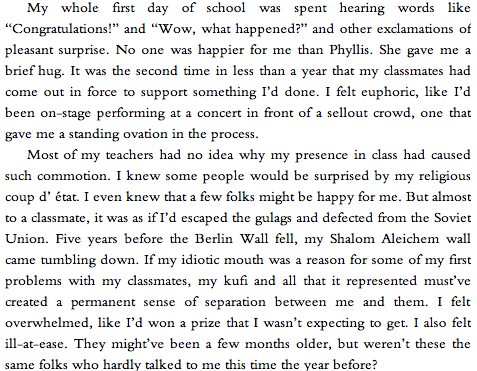
Standing ovation, opera house unknown, May 21, 2012.(http://www.thelmagazine.com).

Standing ovation, opera house unknown, May 21, 2012.(http://www.thelmagazine.com).

I knew on some level even in ’84 that many if not most of my Jewish classmates had remained silent because the idea of Blacks as Jews in terms of religion or genetics was barely in their consciousness. It’s still hard for many Jews I’ve known over the years to accept now, even with a population of Ethiopian and other East African Jews living and working in Israel. It’s difficult to embrace the mosaic that is the Jewish diaspora, even with evidence pointing to communities made up of the descendants of some of the so-called Ten Lost Tribes of ancient Israel living in southern Africa and northern India (as documented by the Discovery Channel in documentaries over the past fifteen years). Me as a kufi and yarmulke-wearing Black teenager practicing Judaism had to be weird and beyond the pale for those classmates.

The way the rest of my classmates reacted to the end of my Shalom-Aleichem-days was also an example of minimal tolerance, or really, intolerance. In six years of Humanities, I’d never gotten that many of my classmates to pay attention to me for longer than an answer to a history question unless it was for ridicule or for a presentation or an award. The fact that at least two dozen had something positive to say about my lack of a kufi, or upon further inquiry, my turn to the Christian side, told me all I needed to know about my status with my classmates for the previous three years.

I’m hardly excluding myself from this notion of intolerance. My view of myself as a Christian in those first months after I converted was one that set me apart from Catholics, Baptists, Jehovah’s Witnesses, the Nation of Islam and Jews alike. I didn’t necessarily think or say things about these different religions or the classmates who practiced them. I just ignored those differences while giving every appearance that my nondenominational view of Christianity, my Bible-quoting and toting self, was the only lens through which anyone should view themselves and the world around them. It would be another year before I recognized my own childishness regarding my views of spirituality, religion and tolerance.

Shalom Milhama, Where Do My Sympathies Lie?

21 Monday Jul 2014

Posted by decollins1969 in 1, Boy @ The Window, culture, Eclectic, Hebrew-Israelite, Mount Vernon New York, New York City, Politics, Pop Culture, race, Religion, Youth

≈ 2 Comments

Tags

Arab-Israeli Wars, Colonialism, Conflict, Gaza, Gaza City, Hamas, IDF, Intifada, Invasion, Israel, Jewishness, Judaism, Oppression, Palestine, Palestinians, Police State, Rebellion, Revolution, Settler Colonialism, Terrorism, Two-State Solution, Zionism


"Israel-Palestine peace," July 29, 2013. (Wickey-nl - Own work via Wikipedia). Licensed under CC-SA- 3.0 (converted from .svg to .jpg file).

“Israel-Palestine peace,” July 29, 2013. (Wickey-nl – Own work via Wikipedia). Licensed under CC-SA- 3.0 (converted from .svg to .jpg file).

As a Hebrew-Israelite between ’81 and ’84, I was taught in temple that we as the members of the Ten Lost Tribes of ancient Israel shared a spiritual and physical bond with the descendants of the tribes of Judah and Levi. As a Hebrew-Israelite, I was also taught that Arab, African and Black Muslims were my spiritual cousins, due respect because of the whole Abraham, Isaac and Ishmael story from the Torah. We, Black Jews, Arab Muslims and European-Jewish-Israelis, were related by blood, history, and Yahweh, and so should support each other.

There were to be no contradictions in supporting the right of Israel to exist as a nation-state, this despite the fact that the Arab states of Syria, Egypt, Saudi Arabia and Jordan had fought “to push Israel into the Mediterranean Sea” in 1948, 1956, 1967 and 1973. Israel had a Jehovah-given right to the land between the cedar forests of Lebanon and the Sinai Desert, between the river Jordan and the Mediterranean, at least, that’s what the Torah said. It was a covenant right that couldn’t be undone by anyone or anything except by El Shaddai himself.

So naturally, despite my growing knowledge of history, I supported Israel in everything it did in defense of itself. So if Mossad or an Israeli commando unit assassinated a foreign minister, it was fine. When Israel launched an air strike and destroyed an Iraqi nuclear reactor in June ’81, I was all for it. Golda Meir was among my group of female heroes as a preteen and teenager. Somehow in those three years as a Hebrew-Israelite, my political perspective on Israel merged with my religious perspective on Judaism and my understanding of the oppression that Blacks, Africans and Jews have all faced in recent centuries.

My understanding of all this, though, began to change even before I converted to Christianity in ’84. It started with an exodus of Ethiopian Jews to Israel in ’84 and ’85, during the government-imposed famine that killed nearly half a million Ethiopians. Unlike the claims of Hebrew-Israelites in the US, the claims of Ethiopian Jews could be clearly traced back to 1000 BCE, the time of King Solomon. Yet for months, Israel held up the immigration process, and then created policies that would make it even more difficult for this groups and the country’s other 120,000 Ethiopian Jews to assimilate. No doubt the fact that it took Israel until ’75 to officially recognize these Ethiopian Jews as Jews has played a role in their somewhat segregated existence in the country.

Faris Odeh throws a stone at an Israeli tank near the Israel-Gaza border, October 29, 2000, during the 2nd Palestinian Intifada (ten days before the IDF gunned him down in Gaza). (http://socialistworker.org).

Faris Odeh throws a stone at an Israeli tank near the Israel-Gaza border, October 29, 2000, during the 2nd Palestinian Intifada (ten days before the IDF gunned him down in Gaza). (http://socialistworker.org).

Then came the First Palestinian Intifada of ’87 that ran well into the ’90s, when the setting up of Palestinian self-governance zones in Gaza, the West Bank and Jericho gradually began to take shape, leading ultimately to the current state of invasion and chaos between Israel and Gaza. The Intifada began just as I was beginning to understand the full nature of oppression beyond slavery and the Civil Rights Movement. For years, it seemed like I saw the same images of Palestinian youth throwing rocks and marching in the streets while the Israeli Defense Forces responded with tanks, machine guns, tear gas and bulldozers, taking land to build new Israeli settlements in the process.

By that point, I’d become interested in South African history, or apartheid in another part of the world. Comparing and contrasting student movements against Jim Crow in the US and against apartheid in South Africa led me to one simple conclusion beyond that undergraduate research paper. That settlement for one group of people was removal, segregation and loss of rights and lands for another group. This was a process that was particularly horrible in South Africa. It led to protests nonviolent and violent, terrorist activities, extreme and ruthless counter-terrorist activities, and international outrage, protests and divestment before the Afrikaner leadership in South Africa finally moved to dismantle their ugly system.

It made me realize that what was going on in Israel wasn’t all that different from what had been going on in South Africa for nearly a century. Only, it involved a population of Palestinians only slightly larger that the population of European-born Israeli Jews and their descendants, not a nine-to-one advantage in favor of Black South Africans. Only the form of nationalism in Israel grew out of a mix of Torah-based birthright, European-based ethnocentrism (the first two otherwise known as Zionism) and post-World War I imperialism the British imposed on the crumbling Ottoman Empire, and not out of Boer nationalism and anti-Black African racism.

A Palestinian boy rests on a mattress next to the rubble of a house destroyed in an Israeli airstrike, Gaza City, July 9, 2014. (Reuters; http://www.dailymail.co.uk).

A Palestinian boy rests on a mattress next to the rubble of a house destroyed in an Israeli airstrike, Gaza City, July 9, 2014. (Reuters; http://www.dailymail.co.uk).

Aside from these unique features, the theme was the same. A democracy for a select and easily identifiable us (read race and religion here, or at least, skin color and not obviously Muslim). A refugee existence and well-policed apartheid state for those who aren’t us, an assumed group of radical terrorists, even from birth.

It’s a bit too late to be on any side that supports the dissolution of Israel as a nation-state. But to support this Israeli government, a right-wing one that responses to any act of violence toward Israelis — whether random or deliberately terrorist in nature — as if Egypt, Jordan and Syria are invading again. It strains my almost boundless imagination. To say that it’s okay to respond to homemade rockets with a military airstrike and ground invasion in an area as densely population as the island of Manhattan is ridiculous. To suggest that the demolition of Gaza isn’t about resources or is a both-sides-are-equally-guilty scenario is to either live in denial or to see Palestinians as less human than Israelis. Last I checked, Hamas doesn’t have an air force or Russian T-72 tanks.

So here’s what I see. A one-state solution, forcing Israelis and Palestinians to live together, forcing Israel to end its version of an apartheid system, and forcing both groups regardless of politics to come up with a path to full citizenship rights for Palestinians. Period. The two-state solution is a mirage, and some Israelis seem to only want one state, for Israelis only. Of course, this means that those Palestinians who support an armed struggle will eventually have to follow the path that Nelson Mandela and the ANC and Yasser Arafat and the PLO followed decades ago. Just not today, not while the IDF is destroying a city. At least not until the world and especially the US divests from the state of Israel and embargoes all arms shipments.

I wish sometimes that I could go back to that simpler time, when Israel seemed to represent what was right in this world, and the US in supporting them. But I can’t. Those Hebrew-Israelite days were my most oppressed ones as well.

Killing Joe Trotter

10 Tuesday Jun 2014

Posted by decollins1969 in 1, Academia, Boy @ The Window, Carnegie Mellon University, Christianity, culture, Eclectic, Hebrew-Israelite, Mount Vernon New York, Pittsburgh, Politics, Pop Culture, race, Religion, Youth

≈ Leave a comment

Tags

Advisor-Student Relationships, Burnout, Child Abuse, CMU, Dissertation, Dissertation Committee, Dreams, Emotional Baggage, Father Figures, Forgive and Forget, Forgiveness, Graduate School, Guerilla Warfare, Hatred, Imagination, Joe Trotter, Joe William Trotter Jr., Mental Health, Murder, Paternalism, PhD, Psychological Baggage, PTSD, Self-Awareness, Self-Defense, Un-father Figures


Yeah, I did it. I killed the man who kinged himself mentor over me. I took some piano wire, tightened it around my hands while listening to him yammer on an on about “running interference” to protect “my interests.

As the pointy-headed, smoothly bald and mahogany man gazed at my thesis, myopically gazing into nowhere, I pounced. I quickly jumped out of my seat and took Trotter from behind. He clutched at the wire with his elderly left hand as I pulled and tugged, hoping to prolong the bloody agony for as long as I could. Trotter choked for air, then choked for real, as spit, bile, blood and tongue all became his substitute for oxygen. Then, with one bicep curl and pull, I garroted his throat, and watched as his already dead eyes turned lifeless. All as his burgundy blood poured down his white shirt and gray suit. It collected into a small pond, where his pants crotch and his mahogany office chair met. Trotter’s was a chair that was now fully endowed all right. Thanks to my righteous stand.

=======================

Tired, mentally drained, battery, March 2014. (http://blog.batterysharks.com/).

Tired, mentally drained, battery, March 2014. (http://blog.batterysharks.com/).

First, a disclaimer. I am in no way advocating killing Joe Trotter, or any other professor, whether they’re a great advisor or a terrible one (except perhaps in the case of literal self-defense). This was how I imagined what I could do to Trotter in the spring and summer of ’96, as our battles over my dissertation and my future turned from typical to ugly. By mid-July ’96, after his handwritten all-caps comments telling me to disregard my evidence on Black migration to DC during the Great Migration period (1915-30) — or really, the lack of evidence — I was mentally drained. I went back to our first big arguments over my future, the “you’re not ready” meetings from November ’95 and April ’96, and thought about what I could’ve done if I’d stayed in his office five minutes longer. That’s when I imagined killing my advisor for the first time.

By the time Trotter and my dissertation committee had approved my magnum opus, the week before Thanksgiving in ’96, I’d played that scenario in my head at least a dozen times. That’s when I knew I was burned out from the whole process. I may have become Dr. Collins, but I might as well have been my younger and abused self, the one who had to wade through five years of suffering at 616 and in Mount Vernon just to get to college.

Four months ago, I actually dreamed about killing Joe Trotter, exactly as described above, in his office, on a warm spring day like I imagined eighteen years ago. Keep in mind, I don’t think about Trotter much these days, other than when I write a blog post or am in a discussion of worst dissertation advisors ever. So when I woke up from this old-imagination-turned-dream, I had a Boy @ The Window moment and revelation. Did my struggles with Trotter open up old wounds, unearth my deliberately buried past? Did I see my fight with Trotter over my dissertation in the same light as my guerrilla warfare with my abusive and manipulative ex-stepfather?

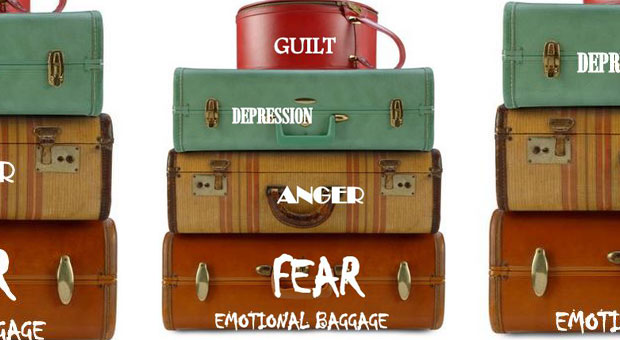
I obviously brought baggage into my doctoral process that I’d hidden from everyone, including myself, and hadn’t fully resolved. The fact that Trotter was at times tyrannical, deceitful and paternalistic didn’t help matters. In some ways, then, Trotter must’ve morphed into Maurice Washington during the dissertation process, with me only half-realizing it once I was freshly minted.

Emotional and psychological baggage, January 2014. (http://www.projecteve.com/).

Emotional and psychological baggage, January 2014. (http://www.projecteve.com/).

I actually went to Trotter’s office a few weeks after I graduated, to apologize for how our relationship devolved, and to grant him my forgiveness as well. Arrogant as my act was, I needed to make the gesture, to at least begin my healing process. I knew Trotter was beyond surprised, but he shook my hand anyway. I also knew, as I walked away from his Baker Hall office, that other than a letter of recommendation, Trotter no longer had anything to offer me. At least, anything that would help me resolve some deep, underlying issues.

It’s safe to say that of all the reasons that led to me writing Boy @ The Window, my problems with Trotter in ’95 and ’96 were near the top of the list. Still, I needed to kill the idea that Trotter was an indispensable part of my present and future, if I were to ever resolve the issues from my growing-up past.

← Older posts
Newer posts →

Boy @ The Window: A Memoir

Boy @ The Window: A Memoir

Places to Buy/Download Boy @ The Window

There's a few ways in which you can read excerpts of, borrow and/or purchase and download Boy @ The Window. There's the trade paperback edition of Boy @ The Window, available for purchase via Amazon.com at http://www.amazon.com/Boy-Window-Donald-Earl-Collins/dp/0989256138/

There's also a Kindle edition on Amazon.com. The enhanced edition can be read only with Kindle Fire, an iPad or a full-color tablet. The links to the enhanced edition through Apple's iBookstore and the Barnes & Noble NOOK edition are below. The link to the Amazon Kindle version is also immediately below:

scr2555-proj697-a-kindle-logo-rgb-lg

Boy @ The Window on Amazon.com: http://www.amazon.com/Boy-The-Window-Memoir-ebook/dp/B00CD95FBU/

iBookstore-logo-300x100

Boy @ The Window on Apple's iBookstore: https://itunes.apple.com/us/book/boy-the-window/id643768275?ls=1

Barnes & Noble (bn.com) logo, June 26, 2013. (http://www.logotypes101.com).

Boy @ The Window on Barnes & Noble: http://www.barnesandnoble.com/w/boy-the-window-donald-earl-collins/1115182183?ean=2940016741567

You can also add, read and review Boy @ The Window on Goodreads.com. Just click on the button below:

Boy @ The Window

Twitter Updates

Tweets by decollins1969
  • RSS - Posts
  • RSS - Comments

Archives

  • June 2025
  • April 2023
  • September 2022
  • August 2022
  • July 2022
  • June 2022
  • May 2022
  • April 2022
  • March 2022
  • January 2022
  • December 2021
  • November 2021
  • October 2021
  • September 2021
  • August 2021
  • July 2021
  • June 2021
  • April 2021
  • March 2021
  • February 2021
  • January 2021
  • December 2020
  • November 2020
  • October 2020
  • September 2020
  • August 2020
  • July 2020
  • May 2020
  • April 2020
  • March 2020
  • January 2020
  • December 2019
  • November 2019
  • August 2019
  • July 2019
  • June 2019
  • May 2019
  • April 2019
  • March 2019
  • February 2019
  • January 2019
  • December 2018
  • November 2018
  • October 2018
  • September 2018
  • August 2018
  • July 2018
  • June 2018
  • May 2018
  • March 2018
  • February 2018
  • January 2018
  • December 2017
  • November 2017
  • October 2017
  • September 2017
  • August 2017
  • July 2017
  • June 2017
  • May 2017
  • April 2017
  • March 2017
  • February 2017
  • January 2017
  • December 2016
  • November 2016
  • October 2016
  • September 2016
  • August 2016
  • July 2016
  • June 2016
  • May 2016
  • April 2016
  • March 2016
  • February 2016
  • January 2016
  • December 2015
  • November 2015
  • October 2015
  • September 2015
  • August 2015
  • July 2015
  • June 2015
  • May 2015
  • April 2015
  • March 2015
  • February 2015
  • January 2015
  • December 2014
  • November 2014
  • October 2014
  • September 2014
  • August 2014
  • July 2014
  • June 2014
  • May 2014
  • April 2014
  • March 2014
  • February 2014
  • January 2014
  • December 2013
  • November 2013
  • October 2013
  • September 2013
  • August 2013
  • July 2013
  • June 2013
  • May 2013
  • April 2013
  • March 2013
  • February 2013
  • January 2013
  • December 2012
  • November 2012
  • October 2012
  • September 2012
  • August 2012
  • July 2012
  • June 2012
  • May 2012
  • April 2012
  • March 2012
  • February 2012
  • January 2012
  • December 2011
  • November 2011
  • October 2011
  • September 2011
  • August 2011
  • July 2011
  • June 2011
  • May 2011
  • April 2011
  • March 2011
  • February 2011
  • January 2011
  • December 2010
  • November 2010
  • October 2010
  • September 2010
  • August 2010
  • July 2010
  • June 2010
  • May 2010
  • April 2010
  • March 2010
  • February 2010
  • January 2010
  • December 2009
  • November 2009
  • October 2009
  • September 2009
  • August 2009
  • July 2009
  • June 2009
  • May 2009
  • April 2009
  • March 2009
  • February 2009
  • January 2009
  • December 2008
  • November 2008
  • October 2008
  • September 2008
  • August 2008
  • July 2008
  • June 2008
  • May 2008
  • April 2008
  • March 2008
  • February 2008
  • January 2008
  • December 2007
  • November 2007
  • October 2007
  • September 2007
  • August 2007
  • July 2007
  • June 2007

Recent Comments

MaryPena's avatarMaryPena on My Day of Atonement/Bitter Hat…
decollins1969's avatardecollins1969 on No Good Teaching Deed Goes…
Mary Rose O’Connell's avatarMary Rose O’Connell on No Good Teaching Deed Goes…

NetworkedBlogs on Facebook

NetworkedBlogs
Blog:
Notes From a Boy @ The Window
Topics:
My Life, Culture & Education, Politics & Goofyness
 
Follow my blog

616 616 East Lincoln Avenue A.B. Davis Middle School Abuse Academia Academy for Educational Development AED Afrocentricity American Narcissism Authenticity Bigotry Blackness Boy @ The Window Carnegie Mellon University Child Abuse Class of 1987 CMU Coping Strategies Crush #1 Crush #2 Death Disillusionment Diversity Domestic Violence Economic Inequality Education Family Friendship Friendships Graduate School Hebrew-Israelites High-Stakes Testing Higher Education History Homelessness Humanities Humanities Program Hypocrisy Internalized Racism Jealousy Joe Trotter Joe William Trotter Jr. K-12 Education Love Manhood Maurice Eugene Washington Maurice Washington Misogyny Mother-Son Relationship Mount Vernon High School Mount Vernon New York Mount Vernon public schools Multiculturalism MVHS Narcissism NFL Pitt Pittsburgh Politics of Education Poverty President Barack Obama Race Racial Stereotypes Racism Relationships Self-Awareness Self-Discovery Self-Reflection Sexism Social Justice Teaching and Learning University of Pittsburgh Violence Whiteness Writing

Top Rated

Blog at WordPress.com.

  • Subscribe Subscribed
    • Notes from a Boy @ The Window
    • Join 103 other subscribers
    • Already have a WordPress.com account? Log in now.
    • Notes from a Boy @ The Window
    • Subscribe Subscribed
    • Sign up
    • Log in
    • Report this content
    • View site in Reader
    • Manage subscriptions
    • Collapse this bar
 

Loading Comments...