• About Me
  • Other Writings
  • Interview Clips
  • All About Me: American Racism, American Narcissism, and the Conversation America Can’t Have
  • Video Clips
  • Boy @ The Window Pictures
  • Boy @ The Window Theme Music

Notes from a Boy @ The Window

~

Notes from a Boy @ The Window

Category Archives: race

Death and Debt

11 Saturday Jul 2020

Posted by decollins1969 in 1, Boy @ The Window, culture, Eclectic, Mount Vernon New York, New York City, race, Youth

≈ Leave a comment

Tags

Death, Debt, Life, Life Decisions, Sarai, Sarai Washington, Student Loans


Sarai & Noah, November 2003. (Donald Earl Collins).

My post today will be short. Today marks a full decade since the Sunday morning my youngest brother Eri called me, waking me up with the news that my only sister Sarai had died overnight at Mount Vernon Hospital. It was due to complications from sickle cell anemia, the disease that denies the body sufficient oxygen for carrying out it functions, ever debilitating and ever more painful as one grows older with it, as anyone with the disease can attest. Too many blood transfusions, too many invasive procedures, not enough healing. Sarai Adar Washington, who did live, and did try her damnedest to live her life her way, died at 27 years young.

Yes, I love her, and miss her still. There isn’t a week that goes by where I don’t think about her and the life that she didn’t get to have, the life that she did live, and how my life was affected by her existing. It causes me, Sarai’s older brother — one 13-plus-years older than her when my mother gave birth to her, one at one point argued for abortion to save us and her the anguish of the disease — to let out the occasional tear or feel a sense of loss. I can only imagine how much deeper the loss is for my mom, of course, and for my three younger brothers, who truly grew up with her. My only solace today is that Sarai isn’t here to try to survive the pandemic, because she most surely would not have made it if she had contracted COVID-19.

On the other end is the week that reminds me of one of the worst best decisions I have ever made. To take out the first $2,625 of what would be over $41,000 in loans between July 1987 and October 1996. I paid out the principal of my loans at least three years ago. But Sallie Mae (and PHEAA and Marine Midland Bank before that) set the interest rates back when those rates were much higher. Eight percent on a series of loans taken out between 24 and 33 years ago would be incalculable to a 17-year-old in July 1987. But as a 50-year-old, it translates to debt peonage, more than double the actual loans themselves. Except that I know that one way or another, this debt will go away, if only because I will stop living this life, eventually.

The proverbial “they” say the only two constants in life are death and taxes. No, there are at least three constants — death, debt, and taxes. Maybe in my death I can finally see my sister again, and see my debt and taxes burn in the fiery pit in the event horizon of a black hole.

A List of the Unwritten Rules I Wish I Had Known, in 1990, 2000, and 2010

19 Tuesday May 2020

Posted by decollins1969 in 1, Academia, Boy @ The Window, Carnegie Mellon University, culture, Eclectic, Mount Vernon New York, New York City, Pittsburgh, Politics, Pop Culture, race, University of Pittsburgh, Work, Youth

≈ Leave a comment

Tags

Academia, CMU, Educated Fool, Failure, Pitt, Self-Reflection, Success, Teaching and Learning, Unwritten Rules


Me, 23 years after my PhD graduation, May 18, 2020. (Donald Earl Collins).

As a confessed educated fool, I readily admit that there are a ton of things I understood but did not act on. But I also know that there are solar system loads of unwritten rules that I didn’t and couldn’t possibly have known going into my professional future toward the end of my undergrad days at the University of Pittsburgh. And, there’s the stuff that falls in between. The rules that are not hard rules, ones that can be bent, twisted into pretzels, and/or broken or even shattered. The things that I didn’t know I knew, the ideas and principles that are ingrained or splinters in my mind, but not quite accessible until the moment I needed them, or, even worse, right after I really could’ve used that extra bit of knowledge and wisdom.

This list is merely the beginning of the most important rules I could impart to my younger self, at 20, 30, and yes, 40 years old. Donald’s 1.0, 1.5, 2.0, and 2.5 all believed that his mind, his imagination, his hard work and achievements would all carry the day, would win him a slice of prosperity, a sliver of intellectual respectability, a piece of popularity, even. All to have moments and flashes of all three, but not usually at the same time, and all to realize that talent and hard work for Black folx in a Whiteness world matter not. Not even among most Black elites. I could list 1,000 unwritten rules and other ideas that I wish I had known or — if I did somehow already know — taken advantage of. But the real theme here is that the meritocracy is a lie. Whether in the form of rugged individualism or a belief in K-16 education as a social mobility equalizer, merit through talent and hard work is an American mythology like Abraham Lincoln “freeing the slaves” and America as always good and righteous.

1. You are a writer. Whatever the job, whatever the career path, whatever the familial and relationship and marital responsibilities, you are a writer. Yes, despite it all, your calling is to write about it all. Period. It does not matter if you think most of your writing is crap. All writers think their writing is crap. It does not matter if you’re really good at organizing conferences, retreats, and learning institutes. Or, if you are excellent at curriculum design, a tough but caring history and education professor, a science nerd and a talented computer science geek. Nearly every writer has another set of jobs and careers besides writing. Just because your co-workers, colleagues, and even family might not see you as a writer first, does not mean that you are not a writer.

And, here’s the real deal. Not everyone needs to know that you are a writer. Some dumb muthafuckas will use your expressed calling against you, especially if and when they do find out about your creative side and your one troy ounce of success. Some of your enemies, nemeses, and family members and friends will literally laugh in your face when you discuss your aspirations with them. You have to know whom to trust and not trust with this truth about yourself. You will learn, in time, to keep your own counsel, to not let everyone in your world in on your not-so-secret secret.

And you will learn that to write is not just putting pen to paper or fingers and thumbs to a MacBook keyboard. It’s reading, beyond the academic tome, beyond the occasional novel or Walter Mosley detective mystery. It’s reading folx who’ve struggled with writing just like you. It’s people-watching on trains and the Metro. It’s listening in Univision or Telemundo programs while folding clothes at a laundromat with a mostly Salvadoran, Nicaraguan, Nuyorican or Dominicanyorka audience. It’s thinking of an idea while cleaning chicken thighs for dinner or on the occasions you end up jacking off for lack of sleep. It’s all the vivid dreams and nightmares — really, visions — that you’ve had of present, future, past, past-future, future-present, and ever-present, about escape, about overcoming, about being trapped. That’s all a part of the process.

2. Degrees matter, and yet, degrees don’t matter for shit. I cannot believe that your dumb-ass self believed for years that getting the “PhD would be a passport for doing what [you] wanted to do in [your] life.” You must have said this to 50 of your closest friends, acquaintances, and even a couple of folks who you eventually realized were your enemies back between 1990 and 1997. At your most stressed times, those sudden, bolting-upright-in-the-bed-at-3am moments, with your heart thumping like you were Bugs Bunny ogling Lola Bunny, you believed the doctorate was the ticket. You kept telling yourself this, even as you had doubts about what the degree meant as you finished your coursework in 1994. You cast yourself atop this hill, especially after becoming a Spencer Dissertation Fellow in 1995, even though you and many in your cohort were all obvious misfits in the grad school system.

Yes, in the narrow sense of job qualifications, degrees matter. But, you earned your master’s degrees in History in April 1992. At 22 years old! You were all-but-dissertation at 24. 24! You could’ve taken time off, earned a teaching certificate in a year, gone on to teach at public, private, or parochial school, or even earned a degree in a more practical field, like psychology, social work, education, journalism, creative nonfiction, or sociology. So admit it, damn you! You were attracted to some aspects of the tenured faculty lifestyle. Not most of it, to be sure. Yet the idea of having a schedule where you spent lots of time doing research and writing. You secretly craved being paid to write whatever you wanted to write. Even though you already knew that you could only do this if you willing to write like a cold, dispassionate White guy well-off enough to not care about reaching an audience outside of his extremely narrow field.

So you convinced yourself for nearly two decades that you could do and be both. A writer for mainstream organs and readers and a writer for academe. You weren’t wrong. Your eclectic writing style can accommodate complex scholarly ideas and personal tales and dramas, even creative techniques to transition between them. But the world of the privileged rarely allows for the crossover-dribble equivalent for writers. With a doctorate, you are an egg-headed scholar to the average editor, and cannot possibly write in any other way. For journal editors, your style was never gonna be scholarly enough. For newspaper and magazine editors, your style was always too cerebral. And, despite your degree, you had a hard time convincing others of your expertise. You only earned a PhD in History from Carnegie Mellon University, okay? Not from UCLA or Berkeley or Stanford, or certainly not from Harvard, Yale, or Princeton, or even UPenn, Georgetown, or Columbia. Your years of published works and a couple of self-published books would be barely enough to convince Ebony to take a look at your work when you hit your mid-40s. Forget about trying to bifurcate and make your degrees work for you. Get a good job, and just find more and more ways to keep writing, and hopefully, you won’t be dead before people start reading your stuff.

3. Academia, the nonprofit world, and the writing world only make room for Blacks and other people of color when then either completely conform to its -isms (tokens), or when we prove ourselves to at least be moderately successful mavericks. There is no in between, there is no best-of-both-worlds, or straddling the fence, or finding yourself as the Emissary that can cross between worlds. You are not Avatar Aang, the Last Airbender or Captain Benjamin Sisko of DS9. Even among other Black folks, like when I was offered a tenure-stream position in the Department of Africana Studies (née Afro-American Studies) at Howard University in 2000, it came with the implicit stipulation that I needed to conform, to always respect my elders — no matter how elitist and exclusionary I thought they were. At nearly every job I have held since 1996, I have been hired as a token toward diversity with the added benefit of my degree and/or specific expertise, or because I went against the grain to do or write something counterintuitively.

But if that were all, you may have figured some aspect of this out during the Reagan years. The layers of intersectional elitism, from whole institutions like lily-White, College Republican, and two-comma-kid Carnegie Mellon, to department-level beliefs of assuming that you as someone who grew up with poverty would somehow survive summer after summer without financial support. There were also the professors, who to a person assumed that “a few years of hazing will be good for you,” as if you grew up without a material care in the world. After all, how could a Black guy from Mount Vernon, New York with your familial and socioeconomic background find themselves in the hallowed halls of major universities?

Yeah, man. There are almost as many layers of elitism in the working world as there are folds in the gray matter of an alleged Mensa genius. Racial paternalistic elitism, neo-Marxist elitism, misogynist elitism, Marxist elitism, socialist elitism, misogynoir elitism, White feminist elitism, Afrocentric elitism, corporate elitism, technocratic elitism. There’s also Ivy League elitism, HBCU elitism, country-club elitism, affluent Black elitism, African Black elitism, Afro-Caribbean elitism, Puerto Rican elitism, and biracial elitism. And lest I forget, there’s that from-the-5-boroughs-New Yorker elitism, served-in-the-Peace-Corps elitism, revolutionary elitism, anti-revolutionary elitism, and even contrarian elitism. Cutting through all these layers over several decades might leave you in a rage, ready to holler at a moment’s notice, and with some bouts of exhaustion and high blood pressure. But the truth is, none of these dumb asses know how deep in The Matrix they are, putting on enough airs to crush entire cities into oblivion.

4. You will have moments of serious doubt. You will have days, weeks, months where you will be depressed. You will have “waiting for the other shoe to drop” emotions, even when everything is going well professionally. You will feel that you do not belong. Not in academia. Not in the nonprofit world. Not as a writer. Not as an American. Sometimes, not even as a Black American. You will have bouts with what we call imposter syndrome. And yes, you do not fit in easily anywhere, because you have spent so much of your life trying to learn how to cope in places and spaces that never wanted you. Your experiences with millennialist religions, with poverty, with Blackness, with growing up in Mount Vernon/New York City, will help you cope. But you will never be a fit in any place you inhabit in this lifetime.

And, you need to know that this will be perfectly fine. Fitting in never brings you the material and psychological benefits you will seek for yourself and your loved ones. Fitting in only brings you headaches on the regular, endless cycles of diarrhea and constipation, a nearly permanent insomnia. Fitting in makes you almost forget your training as an African American historian and your expertise in understanding the human condition. Fitting in nearly kills the writer you so desperately need to become before you even fully acknowledge that you are one.

So, do not ever fit in. Do not even try. Be you. Be your best you. If that isn’t enough, that’s the problem of a world full of bullies, Head-Negro-in-Charge micromanagers, White moderates, paternalistic White women, and other who would prefer brown-nosers to free thinkers. Not to mention, the armies of sycophants these assholes tend to hire.

So, the meritocracy is a neoliberal lie, and a debt-ridden deadly one. You might never break through as a writer in all the ways that matter to you. Or you just might. Or, you may fully break through, only to find out that you are so much more than the writer you will eventually become. But do not look for approval. Especially not from the US academic and literati set. Let them continue to eat their shitty cake.

Jordan Was Great, But He’s Also an All-Too-Typical American Narcissist

07 Thursday May 2020

Posted by decollins1969 in 1, culture, Eclectic, eclectic music, Movies, music, New York City, Politics, Pop Culture, race, Sports, University of Pittsburgh, Youth

≈ Leave a comment

Tags

Air Jordans, American Narcissism, American Racism, Chuck Modi(ano), Dave Zirin, Detroit Pistons, Docuseries, Donna Summer, Fandom, Isiah Thomas, John Starks, Labor Exploitation, Michael Jordan, MJ, Navel Gazing, New York Knicks, Nike, Patrick Ewing, Scottie Pippen, Self-Aggrandizement, The Last Dance


John Starks (NY Knicks) dunking on MJ, Horace Grant (Chicago Bulls) in final minute of Game 2, NBA Eastern Conference Finals, MSG, New York, May 25, 1993. (Getty Images).

I’ve been thinking on this for a few weeks now. Ever since the buildup to the first episode of the documentary The Last Dance that aired on April 19, I contemplated the idea of a docuseries on the last Chicago Bulls run for an NBA title, hoping it would be a larger commentary about Michael Jordan, about the Bulls, about basketball and the NBA, about sports and society and so much more. And, in a number of important ways, The Last Dance is a larger commentary. But mostly not in a good way. Mostly, it nakedly celebrates American racism and American narcissism, embodied in Michael Jordan, and enmeshed in every aspect of the docuseries’ text, context, and subtext.

Two of my favorite sports and society columnists have it right. Chuck Modiano writes in Deadspin that The Last Dance is “Michael Jordan’s 10-Part Nike-Approved Commercial.” And although I believe Dave Zirin is correct to describe Jordan as “showing us who he is—exactly who we thought he was” — an “antihero” — he is so much more typical than that. He is an American narcissist, one who has internalized and interpersonal racism issues, sprinkled with patriarchy (like, where are women in this series, particularly his wife and ex-wife?) and Black masculinity and gross classism to the point of zero empathy for marginalized people. All this makes Jordan all-too-typical, and all-too-ordinary, in the broader scheme.

I have written a bunch on the connections between American narcissism and American racism over the past four and a half years, on this blog and in mainstream publications. What I have not touched on much are the connections between American narcissism and American racism in popular culture. Mostly because the narcissism, racism, and cultural appropriating in pop culture is obvious. It’s more than just low-hanging fruit. It’s the fruit laying all on the ground, ripe and rotten, ready for folks to eat and to throw out, and at the same time.

Ah, but pop culture icons are by definition narcissists, no? They must be, because they self-aggrandize, they’re extroverts, they navel-gaze, they refer to themselves in the third-person, etc., right? Sure, as a general rule, whether a Hollywood actor, a bankable music artist, an over-the-top rapper, a famous out-in-the-world writer, or an athlete among the “greatest of all time,” narcissism might be a significant part of their personality matrix.

But, there’s a difference between confidence — even cockiness and bravado — and actual narcissism. For starters, narcissists tend to lack empathy, the ability to even begin to put themselves in the position of acknowledging the pain, suffering, and difficulties people who are not them face in life, some of which they may have caused themselves. So many in pop culture put on airs and take on public personas who are only a facsimile of who they are in real life. Some artists create an alter-ego in order to cope with the pressures of being in the fickle world of celebrity and fandom. It would be unfair to ascribe narcissism to every individual who has ever “made it” through movies, music, writing, or athletics.

However, so many like Jordan show us exactly who they are, and in the process, show us who we are as a society. And ours is a narcissistic society, of winners and losers, of great disparities in wealth justified with systemic and collective racism. That Jordan’s sneakers still sell for well over $100 million a year for Nike nearly two decades after his retirement says more about the US and the world, and about the narcissism we possess as a society and have exported around the globe, than anything else.

Air Jordans are as much a projection of American narcissism and racism as is the US military, a McDonald’s Big Mac and Coke, and a Starbucks’ venti latte. China has been producing Air Jordan’s at its factories for decades, where workers frequently make $120 a month to produce a pair at $16 raw value. They sell in the US and in the world for between $110 and $250 for mass-produced models, and as much as $100,000 for one-of-a-kind pairs or creations. I couldn’t afford Air Jordans in the years between 1985 and 1999, when they often sold for $150 a pair (and kids were mugging and killing each other over them). In the decades since, I have found that my feet need ergonomic support, something Jordans typically do not provide. Figures. So I am happy to say that while I have tried on a pair or two, I have never owned a pair.

But as for The Last Dance, Jordan’s fourth lap around the world is the text, but him getting in his digs at his friends’, nemeses and haters’ (real and imagined) expense is the context and subtext. His constant put-downs of former Bulls’ GM, the late Jerry Krause went quickly from funny to sad to mercilessly demeaning, all in Episode 1. Jordan’s lack of empathy and leadership, though, comes through with Episodes 2 and 3, in the side story of Scottie Pippen. Jordan, who would have zero titles without Pippen, did nothing but shake his head at Pippen’s low pay and contract woes. Seven years, and you couldn’t be bothered to use even one percent of your influence to get Jerry Reinsdorf to renegotiate for your compatriot? That alone makes Jordan not the GOAT, not in basketball, nor in terms of his humanity.

His complete ignoring of both Isiah Thomas and the Detroit Pistons in the universe of all-time great teams of his era, another example of Jordan’s narcissism, and quite frankly, racism. Pull up any quote from Jordan about the great teams he and the Bulls had to beat to get their first rings. Always “Larry and Magic,” “the Celtics and the Lakers.” Nothing about Isiah and the Pistons, not unless a reporter forces his acknowledgement, not unless Jordan can be begrudging and dismissive in the process. Hey, Jordan! The Pistons beat the Bulls three straight years in the playoffs, 1988, 1989, and 1990, on their way to three straight Finals appearances and two titles. Isiah played well in all the closeout games. Isiah may be an asshole, but he’s been far more gracious in victory and in defeat than you will ever be. But I guess that you needed to keep your distance from a man who has been calling out racism since his playing days. Because as we all know, “Republicans [really, White folx] buy sneakers too.”

As a die-hard Knicks fan, I knew there would be a snippet in an episode or two about the 1990s Knicks, Patrick Ewing, John Starks, and one-time Pitt Panther Charles Smith and their failures against Jordan and the Bulls. So I didn’t bother to watch those episodes. I mean, I lived and died by the Knicks every March, April, May (and sometimes June) between 1990 and 1999. Seeing Jordan smirk and smile in real time about my team and their blown layups, the uneven refereeing (Smith was fouled at least twice at the end of Game 5 of the Eastern Conference Finals in 1993), and the long scoring droughts mostly because of streak slumps and poor shooting choices was bad enough.

Why would I want to relive these memories via a self-serving docuseries? It would be like White men celebrating how their ancestors used to enslave Black men and rape Black women, and how their grandfathers and great-grandfathers used to lynch Blacks with impunity. Oh wait a minute — White men still do this! With idiotic protests to reopen states, with stand-your-ground laws, and by taking law enforcement jobs. And Jordan is the same way, but with a basketball and a microphone instead.

So, after watching parts of the first four episodes of The Last Dance, I am done. Jordan will never be the GOAT in basketball, as great as he was to dance between 1982 and 1999. Kareem Abdul-Jabbar and Wilt Chamberlain will always come first, with LeBron possibly somewhere in between. Objectively, MJ’s in the top three or four, but the other three have carried teams to the NBA Finals. But, more importantly, Jordan is the worst combination of American narcissist and indirect supporter of American racism the US has. Just like millions of other ordinary Americans. History will remember, because despite what autocrats think, history is as much determined by the downtrodden as it written by the victorious myth-makers.

Revealing in Cloaked Blindness/I Heart Kendzior’s Work

30 Thursday Apr 2020

Posted by decollins1969 in 1, Academia, Boy @ The Window, culture, Eclectic, eclectic music, Mount Vernon New York, music, New York City, Pittsburgh, Politics, Pop Culture, race, Religion, Work, Youth

≈ Leave a comment

Tags

American Dream, American Nightmare, Autocracy, Book Review, Both-And, Critique, George W. Bush, Glide Path, Great Writing, Hiding in Plain Sight (2020), History, Kleptocracy, Political Analysis, President Donald J. Trump, Sarah Kendzior


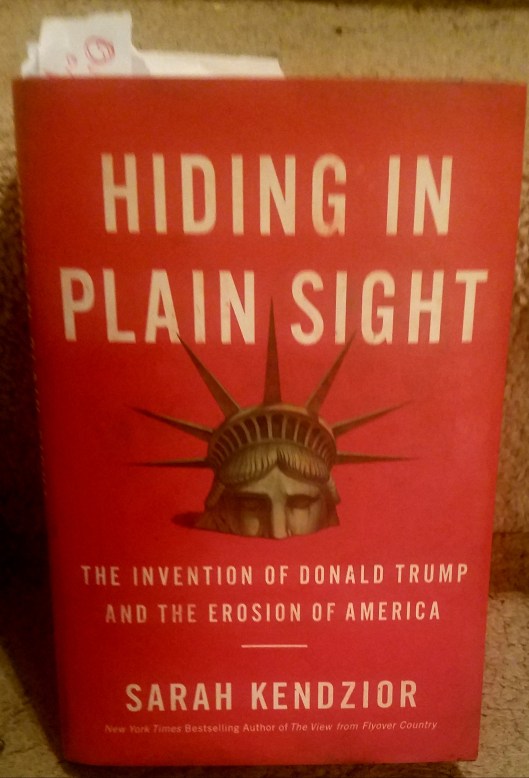
Front cover of Hiding in Plain Sight: The Invention of Donald Trump and the Erosion of America (2020), by Sarah Kendzior, April 30, 2020. (Donald Earl Collins).

In the past four years, I have read so many good and great books, fiction, nonfiction, and mixed genre. Black and Brown writers — especially Black women and Latinas — have written nearly all of them. Brittney Cooper (crunk, crunk!), Chimamanda Ngozi Adichie, Colson Whitehead (masterclass!), Crystal Marie Fleming, Darnell Moore, Bassey Ikpi (poetic masterclass!), Erica Armstrong Dunbar (literally brought together the academic with creative nonfiction) , Ijeoma Oluo, Kiese Laymon (Black abundance and excellence, of course!), Mona Eltahawy, Morgan Jerkins, Patricia J. Williams, the ever-great Roxane Gay,  Tressie McMillan Cottom, Raquel Cepeda (a New Yorker after my own heart!), Imani Perry (3 books in two years — this woman has range!), Leta Hong Fincher, Jose Antonio Vargas, Alondra Nelson, Mycheal Denzel Smith, and likely another ten or fifteen I can’t remember by name.

All of them (really, all of y’all, since I have had conversations with you all in person, on social media, or in my head since 2016) have confirmed so many of my ideas around racism and narcissism, about the use of the interdisciplinary, about the hard-nosed work of writing. They have strengthened my voice around Black feminism, critical race theory, Afrofuturism (a term I was chagrin to use about my own writing this time seven years ago), and queer studies. They all have shown what I have been teaching since I was a PhD student in 1993 — the connections between -isms-laden ideas and deliberately punitive policies meant to cower the ordinary and crush the marginalized.

Sarah Kendzior has done so much on this last theme, uncloaking the connections between the ambitions of brazenly craven rich White guys (and some women) to enrich and empower themselves while destroying the US that came to be with FDR, the New Deal, and the post-World War II superpower boom. And Kendzior does so unassumingly, with bits of memoir that parallels the US glide path toward naked autocracy since the mid-1970s.

I’ve been reading Kendzior since her freelancing days with Al Jazeera, so, somewhere around 2012 or 2013. So many of the themes in Hiding in Plain Sight are familiar, if only because those themes of a hollowed-out St. Louis, a systemically racist and autocratic government, where corrupt and unaccountable leaders are front and center in nearly everything that Kendzior writes. Plus, I am a half-century old Black man and historian who grew up in malnourished welfare poverty and around eschatological cults in Mount Vernon, New York and in New York City. Everything Kendzior has written over the years, I know down to my bones and veins.

Because of that, I wasn’t sure if I wanted to buy Hiding in Plain Sight, forget about reading it. But Kendzior uses her book to build a case better than Perry Mason and Jack McCoy (of Law & Order lore, played by Sam Waterston) could on their best days. Kendzior’s thesis is that Trump as POTUS was inevitable, as the “elite criminal network” of which Trump is a part “has been building for decades.” This network includes “right-wing Republican extremists, apocalyptic religious movements of varied faiths, social media corporations, advocacy groups like the National Rifle Association, and part of the mainstream media.” According to Kendzior, what makes them new and lethal to the US is their “transactional nature and reliance on non-state actors.” Ultimately, this cabal “will take your money, they will steal your freedom, and if they are clever, they will eliminate any structural protections you had before the majority realizes the extent of the damage.” Along the way, they are transitioning the US “from a flawed democracy to a burgeoning autocracy” (pp. 8-9).

Kendzior skillfully uses her own growing up and adult experiences and the places she’s inhabited in building the interconnections between Trump’s lifetime of enabled narcissism and criminality and the rise of the American autocracy. She starts where she usually does, in Missouri, “the bellwether state turned corruption capital, the broken heartland that got the sneak preview to the national shitshow” (p. 20). Kendzior makes the case that Missouri and St. Louis even more specifically represents well the erosion of democracy all over the US with the infusion of dark money and out-of-state money and operators in state and local elections. I do think that she oversells the assumption of Missourian and Rust Belt irrelevance here, if only because every White American actor attempts a Missourah or Midwestern accent in the standard movie, TV show, or internet series not centered in New York.

But I digress. The gutting of Missouri and the rest of the Midwest between St. Louis and Pittsburgh (although so many cities outside the Rust Belt could say the same, like my own original hometown) was a deliberate one, meant to destroy unions, to line politicians’ pockets, and to enrich already filthy-rich folk. People like one Donald J. Trump.

Kendzior again builds a Mayan-step-pyramid-of-evidence to show how Trump had aspirations toward the presidency at least since the 1980s, and had gotten away with grifting projects and Ponzi schemes since the 1970s. And with those twin motivations, how Trump could easily become comrades with Russian mobsters and the likes of the infamous Roy Cohn, with Paul Manafort, with Roger Stone, and the rest of this crew of the craven. And Kenzior ties this one up with a macabre dystopian bow, bracketing Trump’s almost inevitable rise with the story of how her mother taught her about George Orwell’s 1984, a timeline her “mother laughingly assured [her] did not exist” (p. 76). “We are living in the future Orwell warmed about” now, Kendzior wrote.

Among the more heartbreaking vignettes in Hiding in Plain Sight is the story of Kendzior’s own personal experience with the new normal of constant job and financial insecurity born from a false Great Recession recovery in the years after 2008. The collective we have often looked back at the Obama years with fondness. But all the while, the US kept rolling down the same road to autocratic perdition, chewing up everyone not affluent along the way. Kendzior’s experience is no different from my own, and no different from at least 150 million others.

For over a year I would wake up shaking. The economic nightmare I had documented for years as a journalist had finally gotten me, like a monster I had tracked but failed to slay…It made no difference what we could offer the world. We only knew what the world could take away…The rage, though — that stays with you. (pp. 133-135).

Kendzior wrote a book that few who truly understand the nature of the evil that has infected the US since the 1970s could argue is incorrect. Her analysis is nearly as excellent as the prose, to be sure.

I do have a few bones to pick. Mostly because I had a hard time figuring out the audience Kendzior was attempting to reach. Was it other journalists? The broader American public? Anyone who needs a Laurence Fishburne-style “Wake up!!!” call from School Daze?

I landed on nearly-disillusioned-White-Americans as Kendzior’s audience, the ones still clinging to the hope of the American Dream with their fingernails, the ones who all but realize that the Dream is a lie and a nightmare for almost all of us. “I am trying to show them [her children] our country was always vulnerable, always flawed, but that people fought back. We’ve survived as long as we have due to self-criticism and sacrifice, a willingness to examine our faults and try to fix them,” Kendzior wrote (p. 213).

I’m sorry, but this is the America I read about in a Harcourt, Brace and Jovanovich textbook from fifth grade in 1980, not the America in which I have lived for 50 years, worked in since I was 14, and studied for three decades. This is a part of the American mythology, this idea of self-correction. The only times the US has changed to mete out symbolic half-measures toward its ideals has been when the marginalized through years and even decades of resistance have forced it to. Full stop. To suggest otherwise would be to suggest a land that believes in anti-racism, Black feminism, reproductive rights, non-binary sexuality, and democratic socialism. Where is this US? I am still looking.

Another criticism is around Trump himself, and about the arc of the autocratic glide path of the US since 1968. Yes, just as Kendzior and others have written, I have also written that Trump was an inevitable consequence of rampant criminality and grifting, of lying in the same bed with mobsters and autocrats from Russia, Israel, Saudi Arabia, and the US. But really, in a country as racist, misogynistic, and narcissistic as the US has always been, someone like Trump was always the danger, and has happened on some level in the past (see Andrew Jackson, see James Buchanan, see Teddy Roosevelt, see even FDR’s four terms in office, as good as his New Deal policies were). The US is just two months removed from Mike “will get it done” Bloomberg running for president, a much more competent billionaire and grifter, with his own ideas for autocratic rule. It ended up being Trump, but it could have been any of a dozen aspirants we’ve seen from the top 1% over the past three decades, starting with Ross Perot.

Kendzior’s centering of Trump is disturbing because the “burgeoning autocracy” has always been an autocracy for Blacks and for indigenous Americans, going back to the days before the US even existed. In modern politics, the dividing line isn’t Trump or the Great Recession. It’s Vietnam and Richard Nixon and his “Southern Strategy” in 1968. It’s the Reaganomics and the corporate deregulation of the 1980s, followed up with gutting the social welfare state that has occurred with every president since Reagan, including Mr. “Mend it, don’t end it” himself, Bill Clinton. As Malcolm X said in his “The Ballot or the Bullet” speech at King Solomon Baptist Church in Detroit, Michigan in 1964, “Oh, I say you been misled. You been had. You been took.” But not by Trump, at least not just. Trump was the one Kendzior and so many others saw coming, but could do nothing about, because Trump wasn’t the first.

“The Bush Legacy” editorial cartoon, Nate Beeler, January 13, 2009. (https://www.dailykos.com/stories/2010/11/13/919739/-; Washington Examiner). Fair use applies due to low resolution of screen shot and subject matter.

And if Trump was inevitable, then what does that say about our first family of autocrats, George H. W. Bush and George W. Bush? The amount of international meddling in which these two presidents engaged? The trillions spent on wars, all for more access to Saudi Arabian oil, their autocracy, and their money, and all to line their pockets and the pockets of cronies, especially those within the military-industrial complex? Dubya and Cheney used 9/11 to push the Patriot Act in Congress, the single biggest autocratic move in American history since the Electoral College? The players on the US side of the table may be different in 2020, but the evidence gathered in the years since 2000 show significant foreign interference and at least one rigged election. But I’m supposed to believe that Trump’s version of autocracy is worse because his corruption is much more obvious and because his flaunts it with buffoonery and a deluge of lies? Anyone remember a Dubya presser between 2000 and 2009?

I am a big believer in both-ands. Binary either-or explanations may be simple, but they are usually incomplete. Kendzior argues that Trump’s a master of using buffoonery and deception to bamboozle an audience and distract them from his daily crimes. Most of the rest of us think Trump is as dumb as shit. But why can’t he be both? Mussolini, Stalin, and Hitler are all proof-positive that one does not need great analytical power to be savvy, brazen, and bullying enough to make one’s stupidity work for them. And when someone like Trump comes from money, it is that much easier.

There’s this song “Silent Running” by the ensemble pop/rock group Mike + The Mechanics — with Mike Rutherford of Genesis, Paul Carrack of Squeeze, B. A. Robertson, et al. — from 1985-86. Kendzior may have heard it growing up. The music is eerie and an homage to resisting totalitarianism. The lyrics, though, so poignant, both to Hiding in Plain Sight and to where my mindset has been about the US since the 1980s.

Take the children and yourself
And hide out in the cellar
By now the fighting will be close at hand
Don’t believe the church and state
And everything they tell you
Believe in me, I’m with the high command…

Swear allegiance to the flag
Whatever flag they offer
Never hint at what you really feel
Teach the children quietly
For some day sons and daughters
Will rise up and fight while we stand still

That’s what I hope my descendants (literal and figurative) will take with them, and that’s what I hope for Kendzior’s children. Anything about a primrose American past in the time before cronyism and Coronavirus, though, would belie this “Silent Running” truth. I strongly urge everyone I know to read Kendzior’s book. Just be sure to find the words “Bush,” “Dubya,” and “both-and” along the way.

Being Scared

20 Monday Apr 2020

Posted by decollins1969 in 1, Boy @ The Window, Christianity, culture, Eclectic, Politics, Pop Culture, race, Religion, University of Pittsburgh, Youth

≈ Leave a comment

Tags

Being Scared, Belief, Community, COVID-19, Faith, Family, Friends, Hypochondria, novel Coronavirus, Resistance


Me in my makeshift mask (with filter), outside a Safeway, Silver Spring, MD, April 10, 2020. (Donald Earl Collins).

As a person of faith (however one defines it), I believe in believing. I believe in ideas. I believe in a cause much greater than myself, a calling, really. I believe in God (he and she) and the universe. I believe, therefore, I am.

But I have also been scared so many times in my life. Between my sexual assault in 1976 and my full-circle with myself in 1988-89, I was scared of everything. And I mean everything. My senses were sensitive to every sound, every smell, every inflection of hurt. My mind alert at a moment’s notice to abuse and every threat of abuse. My body in knots over the possibility that no one liked me, or worse, that people secretly did but hardly shared it. It’s amazing that I ever got a good night’s sleep before my junior year at the University of Pittsburgh!

Being scared does not negate faith. Not at all. In fact, to embrace faith fully, one has to accept their fears and why those fears exist. One has to soldier on, fear and all, anyway, if one is to surpass their fears and continue to fight, to sweat, to bleed, to think, to scramble their way through life and crises.

Since teaching my last face-to-face class at American on March 4, I have been scared, more scared than I have been since my days of homelessness at the end of the Reagan Years. I have been scared of contracting COVID-19, because I know what severe bronchitis/walking pneumonia feels like. I have been scared of unknowingly passing Coronavirus on to unsuspecting people, to cashiers and store employees, to mail and package deliverers, and to my wife and son. I have been scared of dying. I have been scared of going to a hospital, only to be turned away, or, worse still, to be intubated or ventilated. I have been scared of my wife contracting the virus and watching her try to survive this. I have been scared that my son has so tuned out the pandemic news that he will end up traumatized by the reality of it when he does tune back in.

Being scared has nearly overwhelmed me at times. I caught a mild cold the week of March 16. But I turned it into five days’ of temperature checks, of breathing tests and just-in-case medications. I checked my wife and son’s temperatures at least twice a day. I hardly slept. But then, I jumped rope at a pace only Muhammad Ali himself could’ve kept up with, and realized that it was only a cold.

It wasn’t only a cold, not for a man with mild asthma who has to look out for spring and fall allergy season. Being scared made me almost miss the fact that the winter of 2019-20 was incredibly mild, with no snow accumulation since November in the DMV. Leaves began growing on our bushes at the end of February, on our flowering trees in mid-March, and the flowers by March 30, five weeks ahead of normal. If I didn’t have asthma or allergies, it would’ve have been a beautiful sight.

Being scared left me with my worst asthmatic cough in recovering from a cold while dealing with a really high pollen count in five years. And that scared me, because even without COVID-19 inflaming my lungs, asthmatic coughing fits and alveoli on fire during allergy season is still somewhat debilitating.

Thankfully, I have folx who tell me that I am a hypochondriac these days. Thankfully, I workout regularly, and would’ve noticed fatigue, chills, fevers, and abnormal body aches by now, between the jumping rope, the planks, the plyometrics, and the water rowing. Thankfully, I keep inhalers and a stock of eucalyptus oil in the house, for these just-in-case moments.

Being scared has left me fearful of going outside, at least as long as I see other people out there with me. I have been inside a store only twice since March 31 — I’m used to shopping nearly every day — and do not plan to go back again until April 24. We have enough toilet paper for a couple of weeks, but we are short on paper towels, all-purpose flour, and liquid soap. We’ll manage.

Being scared has pissed me off, because so much of what is happening is all too predictable, even as it is also all too beyond my control. And yes, callous and craven Trump and his cronies have made this pandemic lethally worse. But, for those “but, those emails” folx who believe that Hillary Clinton or Barack Obama would have handled this better, ask yourselves this. Is a better demeanor and a better mobilization of resources the equivalent of stopping a virus in its tracks, sans a vaccine? Sure, maybe 750,000 people wouldn’t be infected and 40,000 people wouldn’t be dead in the US (to date). But there would still be hundreds of thousands infected and thousands dead, because neoliberalism and neoliberals also left the US underprepared for a pandemic.

Being scared in the midst of a crisis while having predicted this while working on my Narcissism, American Style manuscript and then having the audacity to read Sarah Kendzior’s Hidden in Plain Sight actually left me more rattled. But at least I know I’m not crazy for seeing the past-present-future for what it is. This will pass. This pandemic is yet another omen that America the Empire is becoming both weaker and more obviously autocratic at the same time. And while I remain a person of faith, as a wide-awake Black man in a racist-ass US, I also know America all too well.

Fandom and the False Belief in Transcendence

31 Friday Jan 2020

Posted by decollins1969 in 1, culture, Eclectic, Politics, Pop Culture, race, Sports

≈ Leave a comment

Tags

Anti-Racism, Atonement, Black Genius, False Idols, Fandom, Greatness, Idolatry, Kobe Bryant, Michael Jordan, Misogyny, MJ, NBA, Racism, Rape, Transcendent


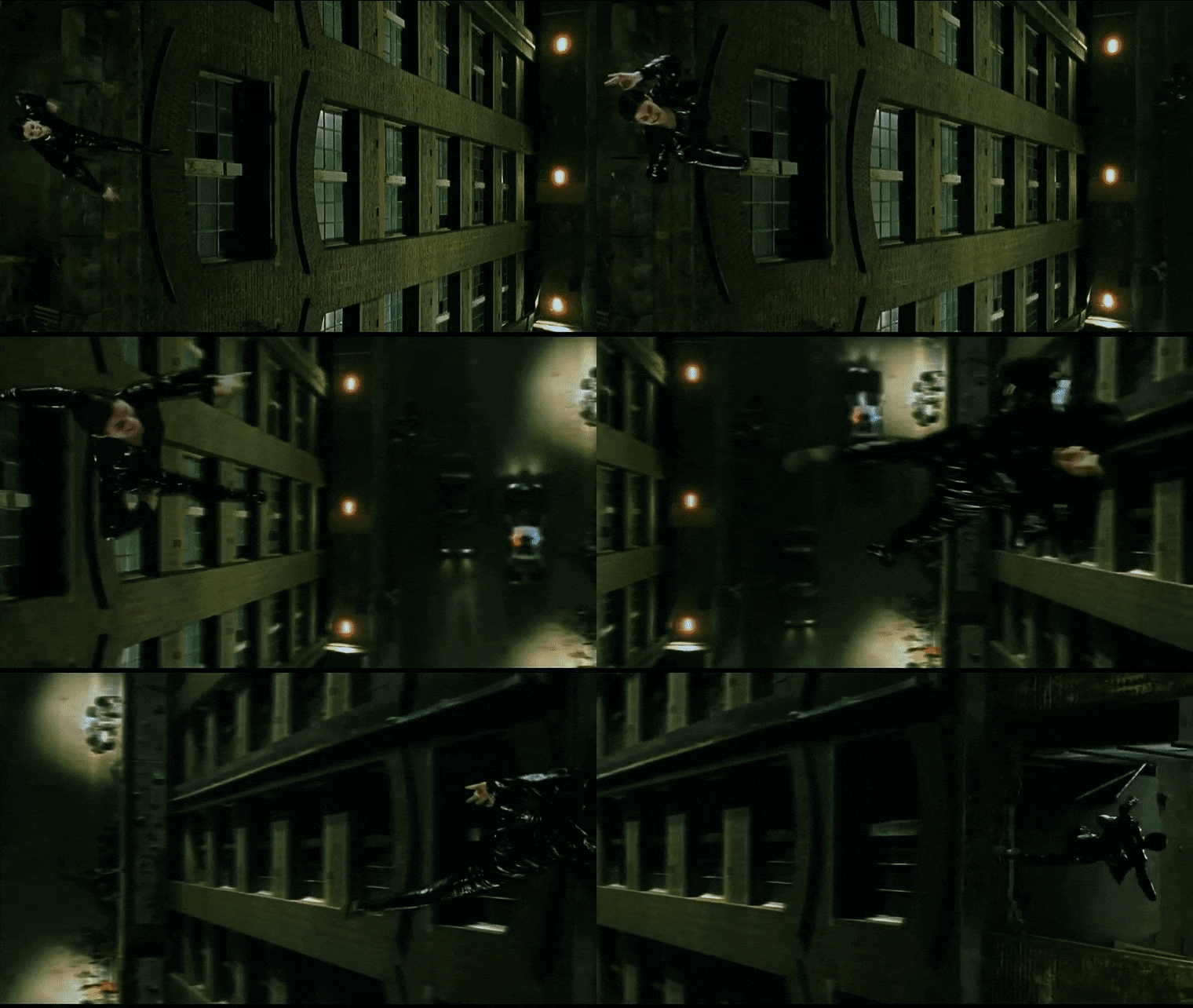
Trinity jumping across the street clip (GIF), The Matrix (1999), January 31, 2020. (https://gfycat.com/; https://youtube.com).

I don’t know who needs to read this, but no matter how talented someone is, no matter how often someone had triumphed in their field, no matter how popular they are, and no matter their level of celebrity status, that person is not necessarily transcendent. Many of these folk are assholes. Yet we Americans use the term so often that all one would have to do to transcend in this country is film themselves with an iPhone 11 in slofie mode while jumping from one building to another in The Matrix series (either as Carrie-Anne Moss’ Trinity or Keanu Reeves’ Neo) to sell themselves as such. Or, to just not talk about the realities of the ugly and oppressive world in which we all inhabit while selling sneakers and entertaining millions.

So, let me be clear. The death of former NBA player Kobe Bryant, his 13-year-old daughter Gianna Bryant, John and Keri and their teenage daughter Alyssa Altobelli, Sarah and her 13-year-old daughter Payton Chester, Christina Mauser, and the pilot Ara Zobayan is nothing short of painfully tragic. Kobe Bryant, of course, played for the Los Angeles Lakers for 20 years. He won five NBA Championships and two Olympic gold medals as part of the USA Basketball team, was an 18-time NBA All-Star, and at the time he retired in 2016, was the league’s third all-time leading scorer, at 33,643 total points. LeBron James only passed Bryant on the all-time scoring list the night before the tragic accident. At 41 years old, Bryant was only into his fourth year of post-NBA life, supporting the WNBA, investing himself in girl’s basketball, winning an Oscar for a five-minute short. This polyglot, this nerd whom experts often mention in the same breath with Michael Jordan and LeBron and other all-time greats, is truly one of the greatest professional basketball players in the history of the sport, full stop.

But, does that make Kobe Bryant “transcendent beyond his sport,” as I have heard the commentators say this week, and have read the sports and culture columnists tweet and write this week? No, absolutely not. We each all have the responsibility to put our lives and our times into perspective, to take a panoramic look at the world in which we inhabit and to dig deep into the soil and rock of that world for meaning. If not, we risk idolizing the first person who comes along to rock our world, and in the process, becoming as short-sighted and as narcissistic as the celebrities, entertainers, artists, athletes, and politicians we worship.

And that has sadly been the case with Bryant. The news and sports media has been paving over the potholes and sinkholes in Bryant’s life faster than The New York Times newspaper plant in College Point, Queens can ink and fold a million hard copies. Bryant’s semi-admitted raping of a 19-year-old in September 2004 (the “incident” was in 2003) has suddenly become a full-throated mea culpa that apparently was unprecedented in the annals of American sport and celebrity. Not one that the rape survivor or any other person who has ever experience rape or sexual violence (yours truly included) should acknowledge, or believe that it would ever make up for the rape, but hey, what do I know?

But my case against transcendence hardly begins or ends with Bryant as a one-time alleged rapist. As great a basketball player as he was, for the bulk of his career, Bryant was a selfish ball hog. By comparison, Bryant made AI’s (Allen Iverson) one-on-five scoring attempts and successes look like Iverson had no choice because he was on the court by himself a lot of those times (which for half of Iverson’s career, was pretty close to the truth). Bryant’s last game in the NBA was one where he scored 60 while taking 50 shots, and he in fact owns the most field goals attempts in any single game of any player this side of Wilt Chamberlain! If this were Rucker Park and not the NBA, maybe transcendence would apply in terms of athletic ability. But as someone who saw how MJ could regularly get 30 while taking only 13 shots (and making 15 free throws) in the second half of his career, great, but not transcendent, from even within the sport of basketball.

Speaking of, the transcendence case really breaks down in terms of cultural influence outside of basketball. Some argue that Bryant was an ambassador of the game and made it international. Really? Two words in response. Dream Team! And, two more words. Michael Jordan! Without the 1992 Summer Olympics in Barcelona, and with MJ and Magic and Larry and Patrick and Hakeem, et al. among 11 future Hall-of-Famers, Bryant’s overseas efforts would’ve been like selling the current brand of NFL football to the world (no one likes weak tea made from sewage water, by the way). Also, if one wants to know two more names from different sports who have MJ-esque transcendence or higher, try Tiger and Serena (I don’t even need to use their last names)!

How big was Jordan, and how big does Jordan remain? His Air Jordans are still among the leading earners for Nike in 2019, 16 years after MJ retired, and nearly 36 years after Nike started making them. Air Jordans went well with hip-hop gear and in rap lyrics and videos — for decades. MJ’s shaved head and goat-tee became fashion trends (one could argue the same for Bryant’s messy Afro look, I suppose) that remain with us to this day. But so does MJ’s reluctance to speak out against racism, homophobia, sexism and misogyny, something that Bryant inherited and adopted in shaping his public persona as well.

And it’s this last piece that truly makes the case that the late Bryant was not and could not be transcendent. LeBron James, for all his greatness, has also put his weight and words into Black Lives Matter, mass incarceration, police brutality, and calling out White supremacists. Certainly athletes from the recent past, from Muhammad Ali and Arthur Ashe to Jim Brown and Althea Gibson, and of course, Jackie Robinson, and Kareem Abdul-Jabbar, fought oppression with the very lives they lived and the barriers they dismantled. All of them had flaws, but none of them had PR machines in their prime to cover up their mistakes and probable crimes, either. Heck, even O.J. Simpson for better and certainly for worse in transcendent in this social justice and injustice sense.

Now, could Bryant have “transcended basketball” if he had live to, say, 60, 70, or even 80 years old? Maybe. But probably not. His image mattered too much to him. The world outside of basketball and family, not so much. And that’s okay. That doesn’t make his death and the deaths of the other eight — especially the three teenagers — on that helicopter any less tragic. This doesn’t make the pain or sadness any fan feels for him and his family any less real. But maybe, just maybe, those who are just fans and members of the media should check themselves before putting Bryant on a pedestal or altar. As tragic a death as it is, death is part of life, after all, and Bryant had as full a 41 years as anyone could expect. Just not a transcendent 41 years.

Ugly

12 Sunday Jan 2020

Posted by decollins1969 in 1, Boy @ The Window, culture, Eclectic, Mount Vernon High School, Mount Vernon New York, New York City, Politics, Pop Culture, race, University of Pittsburgh, Youth

≈ Leave a comment

Tags

616 East Lincoln Avenue, Anti-Blackness, Ari Lennox, Beauty and Truth, Blue Ivy, Bria Myles, Child Abuse, Colorism, Domestic Violence, Finding Forrester (2000), Lizzo, Moonlight (2016), Nemeses, Poverty, Racism, Self-Discovery, Self-Doubt, Self-Reflection, Suicide Attempt, Toxic Masculinity, Ugly


Me in April 1975, Sears Picture Studio, Mount Vernon, NY. (Cropped/Donald Earl Collins).

Another title for this could be “Ugly Donald,” an homage toward Ugly Betty. But one word should cover it!

All this talk over the past few weeks about who is and who isn’t “ugly,” or “fat,” or just “too dark” take me back to how I felt about myself for most of the 1980s, and sometimes even as I gotten older over the 30 years since the Reagan decade. Honestly, I don’t think I’ve been in a camp of vipers like this since my preteen and early puberty years, where I definitely had my own excited utterances toward Black boys and girls in particular (also, the occasionally flat-butt White girl and bed-headed White boy, but I digress). So I never understood the need for deliberate meanness toward people over something that they would have to spend tens of thousands of dollars to fix for a group of misogynoirist assholes who aren’t worth a nanosecond of thought.

Whether Lizzo, Blue Ivy Carter, Bria Myles, Ari Lennox, or Teyana Taylor, these mofos who made fun of their looks, or called them a “rottweiler/German shepherd mix” (sic), or told them to workout to lose weight are such boring-ass losers. These women are beautiful. Black women are beautiful. Full stop. You got time to waste running down an active entertainer over your bullshit? Your ugliness is the kind that takes years of therapy, prayer, active listening, and educational reprogramming (i.e., reading lots of books on Blackness, Black feminisms, and intersectionality) to overcome, if you overcome it at all.

I have a bit of experience with ugly over the years. Usually from family and classmates throwing it in my direction. “Whatcha makin’ that ugly face for?,” my mom would say to me many, many times growing up. “You ugly, faggot!,” I remember hearing from folx in around the 616 and 630 apartment buildings on East Lincoln in Mount Vernon from the time I was nine. “Ain’t no one gonna eva wanna be with your ugly ass!,” an older girl who once attempted to molest me said to me when I was 12. I was ugly, alright. I felt ugly, living with poverty and abuse and anti-Black ugliness in the many places I went in Mount Vernon. It was probably why I felt more comfortable around my father, especially when in the Bronx or down in Manhattan doing work. The anonymity of the city meant that for hours or even days at a time, the centrality of my ugliness could disappear.

I felt so ugly inside and out that I wanted to take my own life at 14. I was so ugly that it scared me to look at myself in the mirror for more than a few seconds, mostly to make sure toothpaste or dried drool or eye crust was off my face. I kept my face as blank as I could, like Jamal Wallace (played by Rob Brown) in Finding Forrester, just so I wouldn’t have to endure more put-downs about my tall, lanky ass and my ugly features on top of that.

Me at Prom Dinner, White Plains, NY, May 21, 1987. (Suzanne Johnson neè De Feo).

But the worst of all this was my senior year at Mount Vernon High School. My final days took an ugly turn the moment my classmates learned I was ranked 14th out of 545 students (509 of us eventually graduated in June 1987). I’ve written ad nauseam about how my White Humanities classmates responded to my ranking, as if I threatened their worldview of them being more intelligent than the Black folx they went to school with every day. Months before my soon-to-be former Black classmates began to stare through me like I was a ghost, they began to clown me. I’d blow by them in the hallways, and they’d bust out laughing. They’d comment on my ugly, brittle hair, talking about how my “hair could break picks.” They’d talk about my “cheap clothes from Taiwan” — which they were from, by the way (how did they know that?). Or, they’d simply shake their heads, as if my existence was a “shaking my head” moment on par with Raven-Symoné declaring herself “not Black.”

Clyde was among that group of Black guys and gals who made a point of telling me I was ugly throughout my senior year. He did it so many times that somewhere around February of that school year, I lost track of the number. “You ugly. There ain’t nothin’ in the world that’s gonna fix that,” Clyde said to me once. Most days, I ignored it, because what would have been the point? We were graduating, and my plans for college were bigger than any insult any asshole could muster. But, one day before winter break, Clyde just said, “You ugly, Donald. You ugly.” It took every bit of the low energy I had to not cry, and not pick up a desk and tear his fucking head off with it, like the chair revenge scene in Moonlight.

It took getting away and going to college for me to stop seeing myself and my own unique blend of Blackness as not ugly, even handsome. A bout of homelessness here and months of struggling to pay rent and eat there will begin to harden you against the bullshit of muthafuckas who would prefer to tear you down rather than build something for themselves or others. As Flavor Flav from PE would say, “Motherfuck them any damn way!”

After those days of sleeping on concrete slabs or eating tuna fish out of a can until I could eat it anymore, it didn’t matter how the Clydes, Gordons, and Tomikas saw me. I saw myself clearly, for the very first time. And I clearly saw my naysayers, too, as the short-in-body and in mind, coloristic, Blackness-but-only-so-much, racist, sexist, and homophobic pieces of shit for whom they were. Why should it have ever mattered what they thought of me?

One Saturday in early February 1989 in the shared bathroom in the Fu rowhouse on Welsford Avenue in South Oakland, I looked at myself in the mirror. I had just finished washing up. I was six-two, maybe 175 pounds, and six weeks past my 19th birthday, with barely enough facial hair to clog up my right nostril. I must’ve stood there staring at every angle of my face for two or three minutes. Then I chuckled. “You’re an okay-looking guy. You’re not Billy Dee or Denzel, but you’re not bad-looking at all.” Nor am I Idris Elba. But being me since has almost always been okay enough. The truth is, it always should been, for any of us.

← Older posts
Newer posts →

Boy @ The Window: A Memoir

Boy @ The Window: A Memoir

Places to Buy/Download Boy @ The Window

There's a few ways in which you can read excerpts of, borrow and/or purchase and download Boy @ The Window. There's the trade paperback edition of Boy @ The Window, available for purchase via Amazon.com at http://www.amazon.com/Boy-Window-Donald-Earl-Collins/dp/0989256138/

There's also a Kindle edition on Amazon.com. The enhanced edition can be read only with Kindle Fire, an iPad or a full-color tablet. The links to the enhanced edition through Apple's iBookstore and the Barnes & Noble NOOK edition are below. The link to the Amazon Kindle version is also immediately below:

scr2555-proj697-a-kindle-logo-rgb-lg

Boy @ The Window on Amazon.com: http://www.amazon.com/Boy-The-Window-Memoir-ebook/dp/B00CD95FBU/

iBookstore-logo-300x100

Boy @ The Window on Apple's iBookstore: https://itunes.apple.com/us/book/boy-the-window/id643768275?ls=1

Barnes & Noble (bn.com) logo, June 26, 2013. (http://www.logotypes101.com).

Boy @ The Window on Barnes & Noble: http://www.barnesandnoble.com/w/boy-the-window-donald-earl-collins/1115182183?ean=2940016741567

You can also add, read and review Boy @ The Window on Goodreads.com. Just click on the button below:

Boy @ The Window

Twitter Updates

Tweets by decollins1969
  • RSS - Posts
  • RSS - Comments

Archives

  • June 2025
  • April 2023
  • September 2022
  • August 2022
  • July 2022
  • June 2022
  • May 2022
  • April 2022
  • March 2022
  • January 2022
  • December 2021
  • November 2021
  • October 2021
  • September 2021
  • August 2021
  • July 2021
  • June 2021
  • April 2021
  • March 2021
  • February 2021
  • January 2021
  • December 2020
  • November 2020
  • October 2020
  • September 2020
  • August 2020
  • July 2020
  • May 2020
  • April 2020
  • March 2020
  • January 2020
  • December 2019
  • November 2019
  • August 2019
  • July 2019
  • June 2019
  • May 2019
  • April 2019
  • March 2019
  • February 2019
  • January 2019
  • December 2018
  • November 2018
  • October 2018
  • September 2018
  • August 2018
  • July 2018
  • June 2018
  • May 2018
  • March 2018
  • February 2018
  • January 2018
  • December 2017
  • November 2017
  • October 2017
  • September 2017
  • August 2017
  • July 2017
  • June 2017
  • May 2017
  • April 2017
  • March 2017
  • February 2017
  • January 2017
  • December 2016
  • November 2016
  • October 2016
  • September 2016
  • August 2016
  • July 2016
  • June 2016
  • May 2016
  • April 2016
  • March 2016
  • February 2016
  • January 2016
  • December 2015
  • November 2015
  • October 2015
  • September 2015
  • August 2015
  • July 2015
  • June 2015
  • May 2015
  • April 2015
  • March 2015
  • February 2015
  • January 2015
  • December 2014
  • November 2014
  • October 2014
  • September 2014
  • August 2014
  • July 2014
  • June 2014
  • May 2014
  • April 2014
  • March 2014
  • February 2014
  • January 2014
  • December 2013
  • November 2013
  • October 2013
  • September 2013
  • August 2013
  • July 2013
  • June 2013
  • May 2013
  • April 2013
  • March 2013
  • February 2013
  • January 2013
  • December 2012
  • November 2012
  • October 2012
  • September 2012
  • August 2012
  • July 2012
  • June 2012
  • May 2012
  • April 2012
  • March 2012
  • February 2012
  • January 2012
  • December 2011
  • November 2011
  • October 2011
  • September 2011
  • August 2011
  • July 2011
  • June 2011
  • May 2011
  • April 2011
  • March 2011
  • February 2011
  • January 2011
  • December 2010
  • November 2010
  • October 2010
  • September 2010
  • August 2010
  • July 2010
  • June 2010
  • May 2010
  • April 2010
  • March 2010
  • February 2010
  • January 2010
  • December 2009
  • November 2009
  • October 2009
  • September 2009
  • August 2009
  • July 2009
  • June 2009
  • May 2009
  • April 2009
  • March 2009
  • February 2009
  • January 2009
  • December 2008
  • November 2008
  • October 2008
  • September 2008
  • August 2008
  • July 2008
  • June 2008
  • May 2008
  • April 2008
  • March 2008
  • February 2008
  • January 2008
  • December 2007
  • November 2007
  • October 2007
  • September 2007
  • August 2007
  • July 2007
  • June 2007

Recent Comments

MaryPena's avatarMaryPena on My Day of Atonement/Bitter Hat…
decollins1969's avatardecollins1969 on No Good Teaching Deed Goes…
Mary Rose O’Connell's avatarMary Rose O’Connell on No Good Teaching Deed Goes…

NetworkedBlogs on Facebook

NetworkedBlogs
Blog:
Notes From a Boy @ The Window
Topics:
My Life, Culture & Education, Politics & Goofyness
 
Follow my blog

616 616 East Lincoln Avenue A.B. Davis Middle School Abuse Academia Academy for Educational Development AED Afrocentricity American Narcissism Authenticity Bigotry Blackness Boy @ The Window Carnegie Mellon University Child Abuse Class of 1987 CMU Coping Strategies Crush #1 Crush #2 Death Disillusionment Diversity Domestic Violence Economic Inequality Education Family Friendship Friendships Graduate School Hebrew-Israelites High-Stakes Testing Higher Education History Homelessness Humanities Humanities Program Hypocrisy Internalized Racism Jealousy Joe Trotter Joe William Trotter Jr. K-12 Education Love Manhood Maurice Eugene Washington Maurice Washington Misogyny Mother-Son Relationship Mount Vernon High School Mount Vernon New York Mount Vernon public schools Multiculturalism MVHS Narcissism NFL Pitt Pittsburgh Politics of Education Poverty President Barack Obama Race Racial Stereotypes Racism Relationships Self-Awareness Self-Discovery Self-Reflection Sexism Social Justice Teaching and Learning University of Pittsburgh Violence Whiteness Writing

Top Rated

Blog at WordPress.com.

  • Subscribe Subscribed
    • Notes from a Boy @ The Window
    • Join 103 other subscribers
    • Already have a WordPress.com account? Log in now.
    • Notes from a Boy @ The Window
    • Subscribe Subscribed
    • Sign up
    • Log in
    • Report this content
    • View site in Reader
    • Manage subscriptions
    • Collapse this bar
 

Loading Comments...