• About Me
  • Other Writings
  • Interview Clips
  • All About Me: American Racism, American Narcissism, and the Conversation America Can’t Have
  • Video Clips
  • Boy @ The Window Pictures
  • Boy @ The Window Theme Music

Notes from a Boy @ The Window

~

Notes from a Boy @ The Window

Category Archives: My Father

How Nixon’s Resignation Made Me A Self-Aware 4-Year-Old

06 Wednesday Aug 2014

Posted by decollins1969 in 1, Boy @ The Window, culture, Eclectic, eclectic music, Jimme, Marriage, Mount Vernon New York, Movies, My Father, Politics, Pop Culture, race, Youth

≈ Leave a comment

Tags

48 Adams Street, Another World, Continual Memories, Days of Our Lives, Headstart, Home Accident, Hot Oven, Hot Stove, Impeachment, Memories, Memory Cap, Mom, Mother-Son Relationship, My Mom, Nixon, President Nixon, President Richard M. Nixon, Resignation, Richard Nixon, Seared Skin, Self-Awareness, Self-Discovery, Total Recall (1990), Watergate


President Richard Nixon delivering his resignation speech (cropped screen shot) ahead of impeachment over Watergate, abuse of power, August 8, 1974. (http://washingtonpost.com). In public domain.

President Richard Nixon delivering his resignation speech (cropped screen shot) ahead of impeachment over Watergate, abuse of power, August 8, 1974. (http://washingtonpost.com). In public domain.

I have a deeply personal perspective from which I saw President Richard Nixon’s resignation forty years ago. It’s a perspective that has ordered my steps nearly every day for the past four decades. If it weren’t for a kitchen accident and his televised resignation speech, I probably wouldn’t be the person I am today, or the person I’ve been over the past 14,610 days. Nixon and my kitchen accident combined to “pop my memory cap,” to quote a line from the original Total Recall (1990) starring Arnold Schwarzenegger.

Total Recall (1990) scene where fake memories meet real ones (a.k.a., "memory cap scene"), August 5, 2014. (http://www.rellimzone.com/).

Total Recall (1990) scene where fake memories meet real ones (a.k.a., “memory cap scene”), August 5, 2014. (http://www.rellimzone.com/).

That Thursday evening, August 8, ’74, was the very first time I became continually self-aware, forming memories like a video camera records scenes, with thoughts of myself and the world around me. I didn’t understand everything I saw, of course. But I did know that I saw what I saw, and for more than just a few moments.

Seeing Nixon’s big head on my Mom’s 19-inch color Zenith wasn’t my first memory, though. I remember crawling by my Mom’s TV set in ’72 at our second-floor flat in which we shared a kitchen with another family in Mount Vernon, NY. I remember because it was the first time I’d seen numbers, the numbers being 1972 with a copyright symbol in front of it. (I told a graduate student friend of mine about this first memory once – she told me it would be impossible for me as a two-year-old to remember specific numbers. What did she know?) I also remember the closing theme song from the show that was on immediately before Another World, which I figured out in later years was NBC’s other soap opera Days of Our Lives.
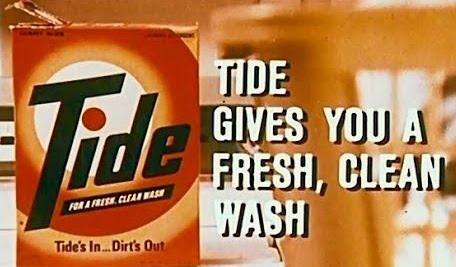
"Tide Gives You A Fresh, Clean Wash" commercial (cropped screen shot), circa 1970 (guess our babysitter took this literally), October 14, 2013. (http://article.wn.com).

“Tide Gives You A Fresh, Clean Wash” commercial (cropped screen shot), circa 1970 (guess our babysitter took this literally), October 14, 2013. (http://article.wn.com).

Two other memories prior to August 8, ’74 stand out. One was me escaping from the front yard at 48 Adams Street and walking down the block to the local asphalt playground, with basketball hoops and jungle gym included. I remember playing with much older boys, having fun, and my Mom whupping me from the playground all the way down the block back to the house. The other was when our babysitter Ida bathed me and my older brother Darren in a tub full of scolding hot water with Tide Detergent. I was so angry, I called her a “Bitch!” Angry likely because I was itching all over, the b-word likely because my Mom and my father Jimme used the word like it was a period to end a sentence. Miss Ida backhanded me like I was going cross-court as a tennis ball at the US Open. All of this happened when I was three.

The flood gates opened the following summer of ’74, though. It started because of a traumatic injury. My Mom was cooking in the shared kitchen at 48 Adams, making some kind of chicken dish. She had the oven door open, having just taken the chicken out of it and having placed it on the stove. I asked her if I could have a bite. Of course my Mom said, “No, Donald, it’s too hot!” I didn’t listen. I tried to climb up to the top of the stove by using the open oven door as a step stool, and lo and behold, I scorched my right leg when I put it on the inside of the door. I remember my Mom screaming, “Oh my God!” as I fell to the floor, screaming along with her.
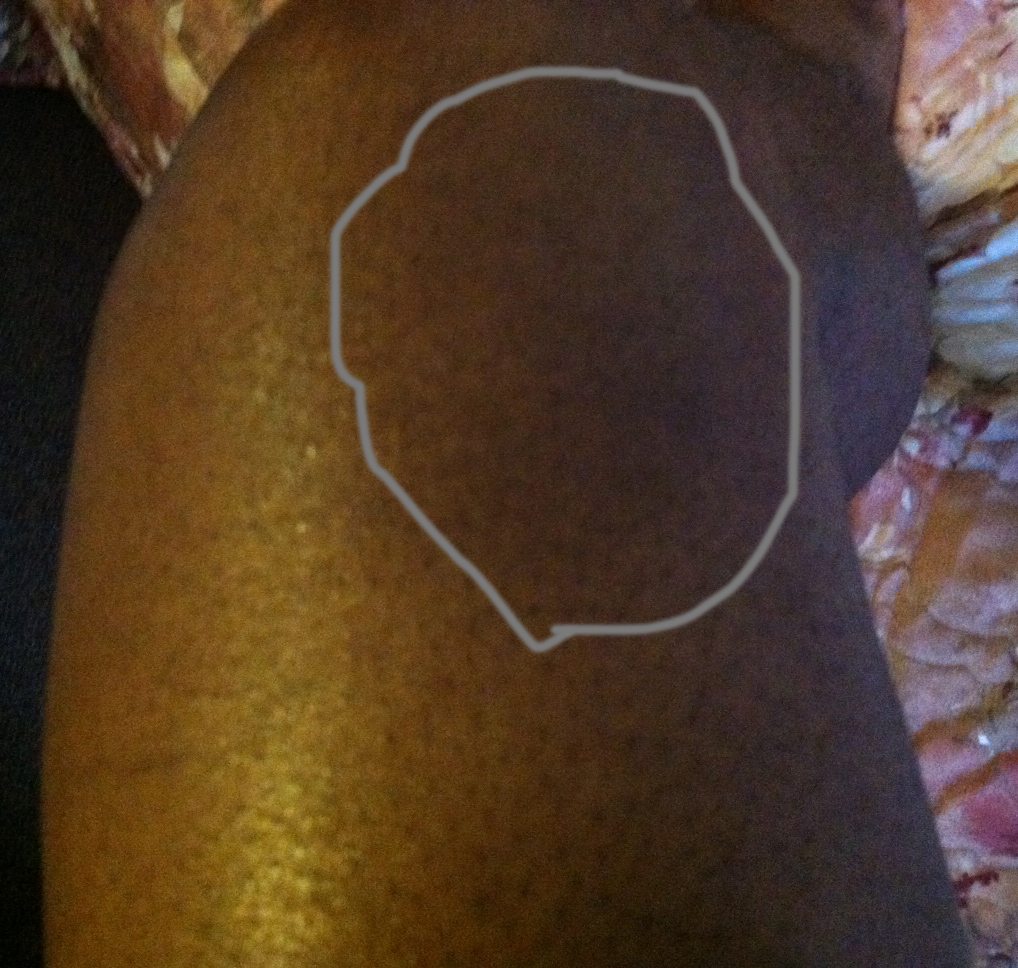
My second-degree leg burn, 40 years later - darker area circled is faded mark that was once on the right side of my right calf, August 5, 2014. (Donald Earl Collins).

My second-degree leg burn, 40 years later – darker area circled is faded mark that was once on the right side of my right calf, August 5, 2014. (Donald Earl Collins).

The skin around the burn area was gone (if it had happened today, it would’ve been a pretty good second-degree burn, and I probably would’ve ended up at the hospital), leaving a white — not pink, white — circular burn mark. My Mom applied ointment and a bandage, made me take two Bayer aspirin for the pain, and told me to calm down and be quiet. She plopped me down on the couch in the living room, which was slightly to the right of the TV.

I was still crying in pain from the shock of seeing, smelling and feeling my skin being seared in the kitchen. As my Mom sat me down, a man with a gigantic head appeared on the television screen, a man I vaguely knew as the President of the United States. I really didn’t understand much of what President Nixon said, but I do recall my Mom shaking her head, and Cronkite calling it a “sad time” for the country. Given how sad I already felt, I think I might have felt sorry for the man with the big head on the TV set.

From that moment on, I’ve had continual memories. I remember my Mom taking me to Darren’s Headstart program somewhere around South 2nd or South 3rd Avenue in Mount Vernon the next day to pick him up, seeing the man with the big head wave with his fingers sticking in the air before going on a helicopter ride, and then being dragged to Met Grocery Store on South Fulton Avenue for groceries, all with a painfully sore leg. Luckily, my Mom caught us a cab home.

And the week after that, we moved to 425 South Sixth, next to Nathan Hale Elementary, where I would go to kindergarten the following month. And the week after that, my father Jimme introduced Darren to The Clear View School, after an argument with my Mom about him “drinkin’ up all his money again.” Ah, the parallels between big historical events and key moments in my life haven’t stopped since!
Poverty, Violence and PTSD – But What About Racism?

07 Monday Jul 2014

Posted by decollins1969 in 1, Boy @ The Window, culture, Eclectic, High Rise Buildings, Jimme, Marriage, Mount Vernon New York, My Father, Politics, Pop Culture, race, Work, Youth

≈ Leave a comment

Tags

616 East Lincoln Avenue, Chicago, Child Abuse, Community Violence, Culture of Poverty, Culture of Violence, Domestic Violence, Gun Violence, July 4th, July 4th Weekend, Mainstream Media, Mental Health, Mental Illness, Post-Traumatic Stress Disorder, Poverty, PTSD, Public Health, Shooting Deaths, Soft Bigotry, Structural Racism, Uncle Sam


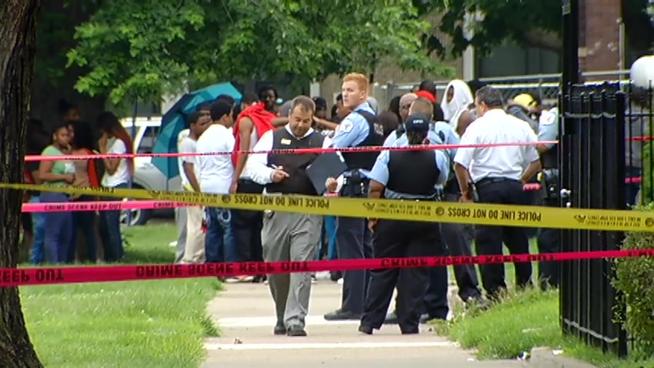
Chicago Police fatally shot a 16-year-old boy in the city’s Gresham neighborhood Saturday night and distraught family members are questioning the incident, July 6, 2014. (http://nbcchicago.com).

Chicago Police fatally shot a 16-year-old boy in the city’s Gresham neighborhood Saturday night and distraught family members are questioning the incident, July 6, 2014. (http://nbcchicago.com).

Over the past two weeks, thanks to Chris Hayes’ reporting on the state of Chicago for MSNBC, not to mention a horrific July 4th weekend, Mayor Rahm Emanuel’s lie of declining violent crime in the metropolis has been thoroughly exposed. In the past eighty-four hours, dozens of shootings in Chicago injured at least sixty people, with between nine and eleven killed. Six of these shootings involved the Chicago PD, as they killed two teenagers over the weekend. But if we leave it to the mainstream media and the moralist Black elite to explain, the Blacks on Chicago’s South Side are just immersed in a “culture of violence.” Black youth simply live careless, nihilistic lives, that “gang, drug, [and] gun violence” is the root of the problem

For those White, bright, and bi-racially White, though, there’s the knee-jerk reaction of media and caring adults that comes with it. For mass shooters apparently with much better aim than folks in Chicago, like Elliot Rodger, Adam Lanza, James Holmes, Wade Michael Page, Eric Harris and Dylan Klebold, mental health and mental illness, along with gun control, is the mainstream media’s topic of the day. Even their explicit racism and misogyny can become the media’s evidence for their mental illness. White and Black moral leaders don’t then speak of cultural deficiencies or of an enjoyment of crime and violence as reasons for their shootings.

It’s terrible that we afford one group of young men every benefit of the doubt because they were/are affluent or White, and the deny humanity of another because they were/are poor and Black or Brown. Yet recent sociological and psychological studies indicate what anyone who has lived in poverty and with violence has at least sensed throughout their lives. That many (if not most) growing up in these conditions experience post-traumatic stress disorder (PTSD), leading to more poverty and violence in adulthood.

I know this better than most. Below is a short sample of the violence I witnessed or experienced from birth through adulthood:

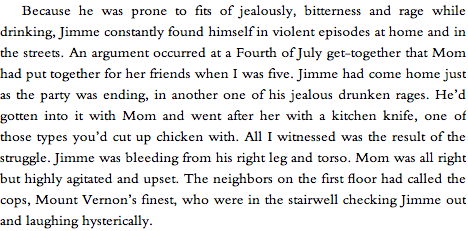
September ’70 – my father, drunk and jealous, attempted to attack my mother with a knife. My Mom with me and my brother Darren in tow, picked up a heavy quartz crystal ashtray and threw it at my father as he charged her in the kitchen. He was apparently struck in the head and knocked unconscious. The ashtray had detached the retina in his left eye, which he never had repaired. Nine years later, my father had to have his left eye removed. I don’t remember this attack or my Mom defending herself — I was all of ten months old. I do remember my father’s eye being removed, and the headache and vertigo he had prior to the surgery in the summer of ’79 The research indicates, though, that there would have been a psychological impact on me and my nearly three-year-old brother nevertheless, and not a good one at that.

July ’75 –  from Boy @ The Window

Screen shot 2014-07-07 at 1.08.28 PM

December ’76 – when my father stomped in a brand-new glass coffee table and had to go to the hospital with several serious bloody cuts in his legs.

April ’77 – when my Uncle Sam clotheslined my father after his months of psychological and abuse toward my Mom had landed her in Mount Vernon Hospital with kidney problems.

April ’82, May ’82, July-August ’82 – my then stepfather beating me up in a Karate studio in front of a group of men because I refused to call him “Dad,” beating up my Mom for not “lovin’ him,” and beating me up for the first six weeks of my summer between seventh and eighth grade for me defending my Mom.

January ’86 – the last time my stepfather actually laid a fist on me, damaging or chipping three of my front teeth and busting my lip in the process.

June ’89 – the last fight between my Mom and my stepfather, where the same crystal ashtray my Mom used in ’70 easily could’ve fractured her jaw and left cheekbone. Thankfully, my then stepfather had terrible aim.

If it were just a matter of domestic violence and child abuse for me alone, that would be tragic, but not necessarily relevant. The violence of 616 East Lincoln Avenue, sadly, wasn’t contained to A32. Domestic violence was the way of the A-building at 616, starting with our adjacent next-door neighbors. In the two-bedroom department immediately below us, the husband and wife had a violent, alcoholic relationship, so bad that it was a rare weekend in the years between ’77 and ’87 where a plate or wine glass didn’t break or the police weren’t called. Their son once pointed a gun at me on my walk up the front steps of 616 when I was a senior in high school and claimed he’d secretly pointed a gun at me in the past. Muggings and robberies, including the four that I experienced, were as common as the common cold

At the near-door apartment building, 630 East Lincoln, the drug trade had been alive and well years before the arrival of crack cocaine. Fights involving knives and baseball bats were normal, often involved a crowd of kids as spectators. Sometimes these fights would spill onto the front lawn of 616’s A-building, where I could witness it first-hand.

That violence was a frequent companion in my life wasn’t surprising. I never lived anywhere growing up where the majority of the people around me weren’t welfare-poor, working-poor or working-class Blacks, where the heating oil came in time for winter, and where maintaining mental health was a topic of conversation. To act as if employment practices, education policy, public health access, police neglect or brutality or housing policies had nothing to do with the sheer concentration of poverty and violence around me would be at the least naive. Fundamentally, it was the benign neglect in the chain between individual racial assumptions, the soft bigotry of mainstream media, and the hard concrete of structural racism in play.

What was my constant companion growing up in Mount Vernon, New York has remained the story of poverty, race and violence in Chicago’s South Side for a century. Don’t feel sorry, for me or for all of those shot up in Chicago this past July 4th weekend. Do something, say something, or don’t. But feeling sorrow without saying or doing something about shouldn’t be an option.

Mothers’ Meeting Day, 1997

17 Saturday May 2014

Posted by decollins1969 in 1, Academia, Boy @ The Window, Carnegie Mellon University, Cleaning, culture, Eclectic, Jimme, Marriage, Mount Vernon High School, Mount Vernon New York, My Father, Pittsburgh, Pop Culture, race, University of Pittsburgh, Youth

≈ Leave a comment

Tags

Abuse, Alcoholism, Baggage, Betrayal, CMU, Insomnia, LaGuardia Airport, Laurell, Misogyny, Mother's Day, Mother-in-Law, Mother-Son Relationship, PhD Graduation, Pitt, US Air, US Airways


A Mother’s Revisions

A Mother’s Revisions

Normally I do a post every May 18th on a topic related to my PhD graduation ceremony at Carnegie Mellon. They usually revolve around two subjects: Joe Trotter and my Mom, betrayal and burnout. For once, I have no intention of doing a post on the seventeenth anniversary of officially becoming “Dr. Collins” and all of the baggage that I brought/came with that. Instead, today’s post is about the day before, Saturday, May 17 ’97. It was the day that my Mom and my future mother-in-law would meet each other for the first time, during my Mom’s one-and-only visit to Pittsburgh during my twelve years there.

I covered the cost of my Mom’s round-trip flight on US Air from LaGuardia to Pittsburgh, knowing that she wouldn’t have been able — or, as it turned out, willing — to see me graduate otherwise. That Friday evening, May 16th, was my Mom’s first time on an airplane since she was pregnant with me, the summer of ’69, when she visited her family in Arkansas. She’d already missed my ceremonies at Pitt for my bachelor’s and master’s in ’91 and ’92 respectively, and, as a result, I hadn’t gone to my graduations those years either.

So I made it easy for her this time around. Or rather, me and my then girlfriend Angelia made it easy for her. I gave up my studio apartment that weekend, because my Mom wasn’t comfortable with me putting her up in a hotel. Angelia cleaned my apartment from top to bottom — including the moulding at the bottom of my apartment’s walls. The place wasn’t this clean the day I’d moved in back in ’90!

But with so many other things that week, my Mom showed little appreciation for the significance of this trip, or for what we were doing to make this trip as convenient for her as possible. I went through Friday night and Saturday at Angelia’s apartment on the edge of East Liberty, about a twelve-minute walk away, where I hadn’t done an overnight before. I spent the first half of the next day going back and forth between my Mom, Angelia, my high school friend Laurell and her sister Naomi and unofficial surrogate (who were all staying at the Downtown Marriott).  I took my Mom to both Pitt and CMU, to show her the place of my ten years’ working toward something much more important than a second high school diploma. I might as well have been taking my son to both campuses when he was a newborn!

Around 2:30 pm, I realized we needed to get to Angelia’s mother’s place in Homewood for a mid-afternoon meal. That was next on the schedule. I think we took the bus, the 71D from a block off CMU to Homewood, and walked the three blocks up a steep hill to Monticello Street. There, Angelia’s mom extended a long greeting, a hug for which my Mom hardly seemed prepared. Angelia was also there, and had bought a KFC bucket meal for the four of us to share.

After a few pleasantries, it started. How my mother and eventual mother-in-law, in their first-ever meeting, spent three hours discussing their failed marriages and the horrible nature of Black men the day before my graduation, I really don’t know. I was in a fog, worn out from a week’s worth of insomnia and from the growing realization that my Mom didn’t really care about my journey or accomplishments.

I stayed and respected my elders, maybe too much. Three hours listening to stories I already knew, between my first-hand knowledge of my father Jimme and my idiot ex-stepfather Maurice, not to mention the stories Angelia had told me about her mother’s trials (luckily, Angelia never witnessed these, because her mother’s marriage was over by the time she’d turned two). A concussion here, a bruised lip there. A broken jaw, a fractured arm. Alcoholism and abuse, and men, working or unemployed, not paying any bills. “Men are no good,” my Mom said over and over again.

Of course, I didn’t count, for as far as my Mom was concerned, I wasn’t a man, because I’d spent the previous decade as a student. But that wasn’t the worst part. My Mom did a bunch of revisionist history in telling the story of “raisin’ six kids” and her doomed two marriages, somehow writing me and Darren and the decisions she had some degree of control over out of this story.

I’d never been part of a conversation like this as an adult. As a six or ten-year-old kid on The Avenue in Mount Vernon with my Mom and her hospital friends, yes, but not since those times. I felt as if I might as well found some stoop outside, sat down with a 40, and fallen into a deep sleep.

Even Angelia’s mom wanted to change the subject by the middle of hour number three. Instead, she used her elderly-ness as a excuse to beg off more conversation on the topic of misogyny, told me that she was proud of me, said that she was excited about going to the CMU ceremony, and retired for the evening. I wish I could’ve gone upstairs with her and done the same. I instead had the distinction of dropping my Mom off at my apartment, picking up Angelia and going down to Station Square to eat dinner with Laurell, Naomi and Archie. And that was all the day before the graduation ceremony!

Boy @ The Window – 1st Anniversary!

17 Thursday Apr 2014

Posted by decollins1969 in 1, Boy @ The Window, Christianity, culture, Eclectic, Hebrew-Israelite, High Rise Buildings, Jimme, Marriage, Mount Vernon High School, Mount Vernon New York, My Father, New York City, Pittsburgh, Pop Culture, race, Religion, Sports, University of Pittsburgh, Youth

≈ Leave a comment

Tags

Book Promotions, BookExpo America 2014, Positive Feedback, Publishing Business


Boy @ The Window 1st Anniversary

Boy @ The Window 1st Anniversary

Nope, no balloons or streamers for this one, the one-year anniversary since I put out the first e-book version of Boy @ The Window on Amazon Kindle. Yay, me! It’s been a pretty good twelve months, one of a few highs and a bunch of lows in selling and promoting the book, in moving forward with a plan, only to have tossed it aside for a new set of plans for the remainder of 2014 and 2015.

The bit of encouraging news — aside from some royalties for Boy @ The Window so far — is that there are a couple of places reviewing it now (finally), and I’m finally moving along with promoting the book. Beyond that, there are few things tougher psychologically than book promotions. This is why folks hire publicists — emotional distance can be helpful in reaching out to friends and strangers.

But, from the feedback (mostly through email and Facebook) I’ve gotten so far, people really like Boy @ The Window. Trust me, when a reader tells you they couldn’t put the book down once they started to read it, that’s an emotional boost! It’s part of what has enabled me to keep going on this venture into the cyclone of the publishing world.

I’ve planned for attending BookExpo America for the first time at the end of next month in New York. It’ll likely be a gigantic sea of authors, publishers, editors and others looking for an edge. I just hope that it’s worth the money I’m about to spend there.

One thing that I should note, though, as I continue to write on my blog and proceed with Boy @ The Window promotions. There are plenty of posts here that aren’t in the memoir, and plenty of stories in Boy @ The Window that I haven’t posted here. You can get some idea of what’s in the book from reading my posts, but it would be far from a complete picture. Buy a copy. Take it for a spin. It’ll make you laugh and cry, angry and hopeful, and all at times in the same paragraph.

Bow Down to Isabel Wilkerson

27 Thursday Mar 2014

Posted by decollins1969 in 1, Academia, Boy @ The Window, Carnegie Mellon University, culture, Eclectic, Jimme, Marriage, Mount Vernon New York, My Father, New York City, Politics, Pop Culture, race, Youth

≈ Leave a comment

Tags

Academic Writing, Black Migration, Book Review, Creative Nonfiction Writing, Great Migration, Isabel Wilkerson, Joe William Trotter Jr., Proletarianization Thesis, The Warmth of Other Suns (2011)


Isabel Wilkerson, The Warmth of Other Suns, front cover (2011), Random House.

Isabel Wilkerson, The Warmth of Other Suns, front cover (2011), Random House.

I’ve finally read Isabel Wilkerson’s book The Warmth of Other Suns (2011) this month, just as I finished teaching a mini-course in post-1865 African American history. If I ever have the opportunity again to choose my own books for a survey-level course in African American history, this would be one of my cornerstone books. I know I stand at the back of a very long list when I say this, but this is a wonderfully powerful and insightful book, with language and a writing style equally as tender.

This was what I wrote regarding my first impressions on Goodreads.com:

My God – this book is a masterpiece! Wilkerson has done what historians and writers as diverse and groundbreaking as Kenneth Kusmer, David Levering Lewis, Joe William Trotter, Jr., Nicholas Lemann, Thomas Sugrue and James Grossman couldn’t (and in a couple of cases, wouldn’t) do. She put flesh, blood and bones on the Black individuals and families who migrated “up North” and out West throughout the bulk of the twentieth century. She didn’t distract with neo-Marxist, post-modern, post-structural, proletarian, or other overly academic theories for understanding the “hows” and “whys” behind Black migration between 1915 and the 1970s.

Reading Wilkerson’s The Warmth of Other Suns (2011) was like reading into my own family’s pasts (my mother and father came to New York City — specifically, the Bronx (Pelham Parkway and Wakefield) — during the 1960s from Arkansas and Georgia/Florida before moving to Mount Vernon). She captured so well the aspirations, the inspirations and the trepidations of the people who migrated, and the things they faced upon arrival. Wilkerson, most of all, grounded herself in the scholarly, but weaved it into a story that was nothing less than literary. If you’re a US or African American historian, a Black Studies, Black Women’s Studies or American Studies scholar, you must incorporate in your curriculum if you haven’t already. If you’re a writer who aspires to tell an important story — one that educates as it entertains — then The Warmth of Other Suns is a great place to start and Wilkerson a great writer to emulate.

Wilkerson called the Great Migration one of the great events of the twentieth century. But it was more than that. It was one of the great events in American history, a silent and gradual revolution on par with westward expansion and more significant than the second wave of immigration from Southern and Eastern Europe to the US between 1870 and 1914. I and millions of others like me should know. I wouldn’t be writing at all if I wasn’t a child of two Black migrants who left farms in the South for New York City.

Amateur Eugenicists: Why Smart Poor Students Have a Hard Time

05 Wednesday Mar 2014

Posted by decollins1969 in 1, Academia, Boy @ The Window, Carnegie Mellon University, culture, Eclectic, Jimme, Mount Vernon High School, My Father, Pop Culture, race, University of Pittsburgh, Youth

≈ 4 Comments

Tags

"Why Ivy League Schools Are So Bad at Economic Diversity", Bigotry, Christy2012, Elitism, Eugenics, Jerome Karabel, Meritocracy, Poverty and Intelligence, Race and Intelligence, Racial Determinism, Racism, Robin J. Hayes, Scientific Racism, Social Darwinism, The Atlantic, The Chosen (2005), Yale


Scientific racism, using "evidence" to compare the Irish to the African, by H. Strickland Constable, Harper's Weekly, 1899. (JasonAQuest via Wikipedia). In public domain.

Scientific racism, using “evidence” to compare the Irish to the African, by H. Strickland Constable, Harper’s Weekly, 1899. (JasonAQuest via Wikipedia). In public domain.

I do generally loathe reading the comments sections of most news sites (any sites, really), but the one on Robin J. Hayes’ “Why Ivy League Schools Are So Bad at Economic Diversity” in The Atlantic is a real trip. There are dozens of comments in which people are playing amateur eugenicists, as they’ve connected wealth & poverty to intelligence. For these folks, the poor perpetuate themselves because they are stupid, and when they have kids, they’ll be born stupid as well, and therefore, will remain poor. As if structural inequality and structural racism have nothing to do with creating the gaps in wealth and education for millions of Americans.

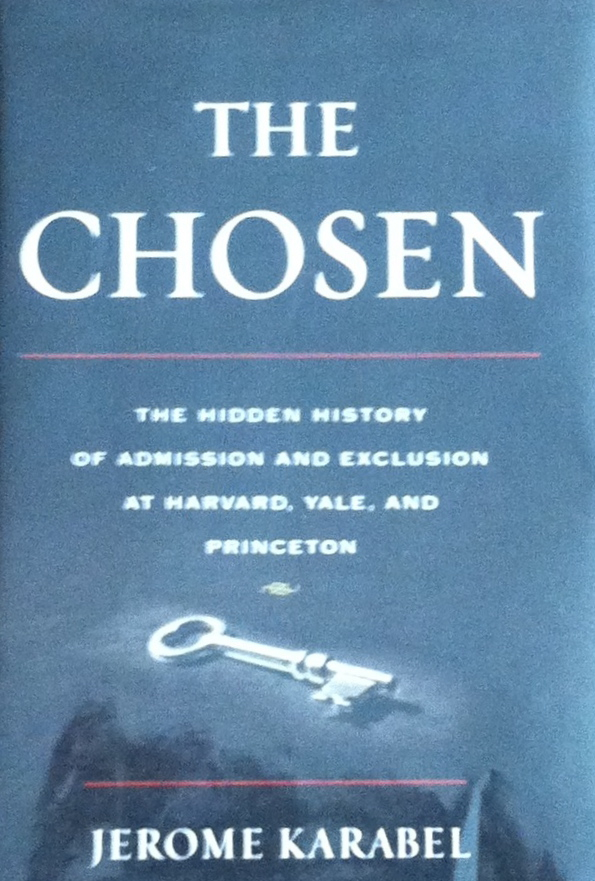
I’m sure I haven’t seen more Social Darwinist /scientific racist /pro-eugenics comments anywhere, including on neo-Nazi websites. Apparently, the only thing The Atlantic’s commentators read while in college (as this is allegedly the profile of their readers) was Charles Murray and Richard Herrnstein’s The Bell Curve (1994), as their arguments came out of studies that are now well over 100 years old. (I defy anyone to say they’ve read all 838 pages, though!) What these people should’ve been reading is Jerome Karabel’s The Chosen (2005) and Nick Lemann’s The Big Test (1999), both of which indicate the Ivy League’s long history of high racial and socioeconomic bias, not just high selectivity.

The Chosen (2005) front cover, March 5, 2014. (Donald Earl Collins).

The Chosen (2005) front cover, March 5, 2014. (Donald Earl Collins).

So I responded, using the lessons I’ve learned from my life and from writing Boy @ The Window, pointing out along the way that “Yale and the others offer what they offer to us po’ folk because they want to appear like they’re doing good, knowing full well that actually working to increase economic diversity is too much for them to fathom.” It elicited this counter-response from someone calling themselves Christy2012:

Pardon me for being so blunt, but you seem to imply that you were somehow obvious Yale material based on your top 2% status. However, you indicated on your blog that you earned a 2.6 GPA at University of Pittsburgh, a much less competitive institution, in your freshman year. Do you suppose you would have attained a higher GPA at Yale? Many rich people get turned down by Yale with even better credentials and Columbia is a fairly elite school itself. That Columbia offered you at chance and that you didn’t exactly hit it out of the park at UPitt is not exactly evidence that the schools are biased against the poor (maybe even the opposite).

Maybe there was (or is) an issue relating to how they consider deadbeat fathers in financial aid and scholarship consideration. It seems you should probably focus on that and that is probably an issue for more middle class applicants too.

It turns out that Christy2012 made these personal swipes from an extremely selective and incorrect reading of my blog because she believes all poor students and students of color really aren’t smart. I/we apparently benefited instead from “affirmative action and/or the pity of bleeding-heart White liberals,” and “not because of our abilities or because of hard work” (my translation of her other comments, by the way). Of course, Christy2012 never revealed anything personal about herself. It’s likely she never attended an elite college and has never met a poor person — especially one of color — that she didn’t feel superiority over.

From The Matrix: A sea of pods in which humans are fusion batteries (the future of the poor, as viewed by The Atlantic's amateur eugenicists), March 5, 2014. (http://www.tony5m17h.net/MatrixNet.gif).

From The Matrix: A sea of pods in which humans are fusion batteries (the future of the poor, as viewed by The Atlantic’s amateur eugenicists), March 5, 2014. (http://www.tony5m17h.net/MatrixNet.gif).

If this set of comments is any indication, it will be hard for Yale or any other school — even if they’re sincere in their efforts at racial and economic diversity — to fulfill them. So many folks even without holding positions of power or serving as gatekeepers decide before looking that poor folks and poor folks who look like me are incapable and unqualified for anything other than a mop, a broom or a jail cell. Is there any wonder that so few of America’s poor and of color have a chance at any higher education of significance, forget about getting into an elite or Ivy League institution?

What I Didn’t Know Growing Up – It Still Hurts

27 Thursday Feb 2014

Posted by decollins1969 in 1, Boy @ The Window, Christianity, culture, Eclectic, Hebrew-Israelite, Jimme, Marriage, Mount Vernon New York, My Father, New York City, Politics, Pop Culture, race, Religion, Sports, Work, Youth

≈ Leave a comment

Tags

Achievements, Ancestors, Arkansas, Basketball, Black History Month, Collins Family, Family, Gill Family, Harrison Georgia, Houston Texas, Ignorance, Jim Crow, Knowledge, Lineage, Mom, Mother, Parenting, Poverty, Segregation, Tenant Farming, Universality, Wisdom


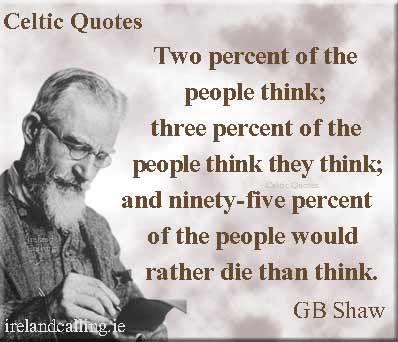
George Bernard Shaw and ignorance, June 2013. (http://www.irelandcalling.ie/).

George Bernard Shaw and ignorance, June 2013. (http://www.irelandcalling.ie/).

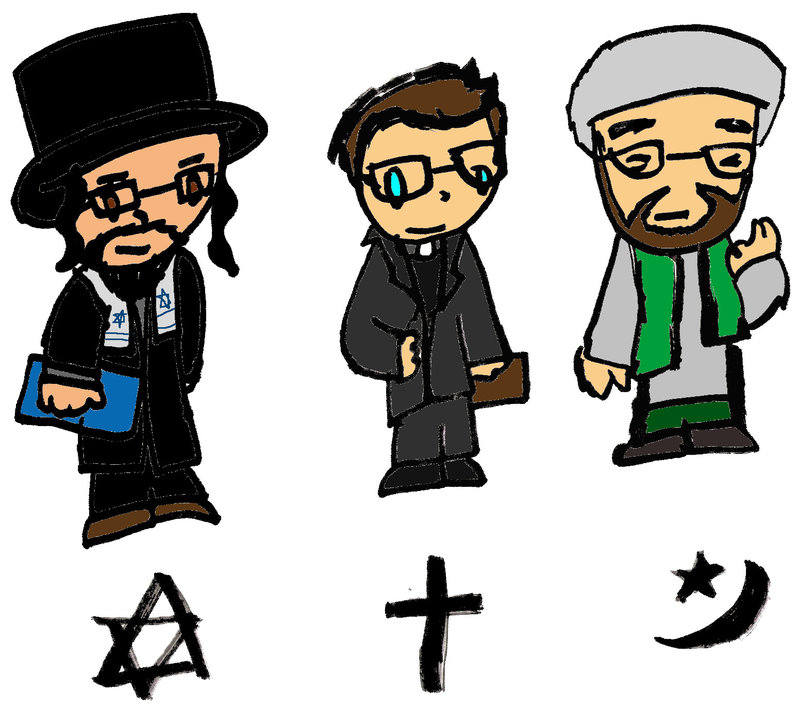
“My people perish for a lack of knowledge,” it seems, is something that anyone can find in almost any religion’s texts anywhere. Heck, depending on perspective, even atheists in general can agree with this statement (of course, the issue would be what constitutes “knowledge”). I read this verse (it’s in Hosea and Isaiah, and versions of it as well as in Jewish texts and the Qur’an) for the first time when I was fifteen in ’85, less than a year after I converted to Christianity. Boy, I had no idea how little I knew about myself, my family and my history when I first read that verse twenty-nine years ago.

In light of the end of Black History Month, I wouldn’t be me without noting how little any of us know about our families, our lineages and our ancestors. But it’s not just true of the millions of us descended from West and Central Africans kidnapped, bound, abused, raped and nearly worked to death to provide Europeans (and Arabs) wealth and comfort. Most of us don’t even know what we think we know about much more recent history and events than surviving the Middle Passage or overcoming Jim Crow.

A rabbi, a priest and an imam, 2013-2014. (PizzaSpaghetti via http://www.deviantART.com).

A rabbi, a priest and an imam, 2013-2014. (PizzaSpaghetti via http://www.deviantART.com).

For me and my family, I knew so little about us that my Mom could’ve told me that Satan had thrown us out of Hell for being too brown to burn and I would’ve accepted it as an appropriate answer. All I really knew of my mother’s side of my family was that they were from Arkansas, that my Uncle Sam (I chuckled sometimes thinking of the irony) was my Mom’s closest sibling, and that they grew up as dirt poor as anyone could get without living in a thatched root hut on less than $1 a day.

I asked for more during those rare moments when my focus wasn’t on high school, getting into college and getting as far away from 616 and Mount Vernon, New York as possible. I ended up finding out about how my Mom’s mother once beat her with the back of a wooden brush for not being ready on time for church, that there were years where her father made only $200 total from cotton farming, and that she was the oldest of twelve kids. She had done some form of work either taking care of her siblings, cooking, cleaning, washing clothes by hand, and hoeing and picking cotton, since she was five or six. Oh yeah, and she played basketball in high school.

On my father’s side, I knew a bit more, if only because Darren and me went with my father to visit the Collins farm in Harrison, Georgia in August ’75. I was five and a half then, but I do remember the fresh smoked ham and bacon, the smell of my grandfather’s Maxwell House coffee, me being too scared to ride a horse, so they put me on a sow (my brother did ride the horse, though). But what people did, how a Black family owned their own land going back to the turn of the twentieth century, I wouldn’t have known to even ask about at not quite six years old.

What I didn’t know until after high school, college, even after earning a Ph.D. in knowing (that’s what a history degree ultimately is) was so much worse than I imagined. To find out at twenty-three that my Mom was a star basketball player in high school. She played center, and led her team to Arkansas’ segregated state quarterfinals in ’65. My Uncle Sam played four sports in high school (basketball, football, baseball and track and field) and was offered college scholarships, but didn’t have the grades to move forward. I learned a year later that my Uncle Paul followed in their footsteps, and played three years at the University of Houston, left early and played for the Houston Rockets in ’82-’83 (not a good year for them, or for me, for that matter) before blowing out a knee and moving into entertainment work.

My father’s family — at least the women of the family — boasted at least three college degrees. Two of my aunts became school teachers. My uncles started businesses in Atlanta and in parts of rural Georgia, working their way well beyond the farm to the work they wanted to do.

Unidentified tenant farmer, his home, automobile, and family, Lee Wilson & Company, rural Arkansas, 1940s. (http://libinfo.uark.edu/SpecialCollections/)

Unidentified tenant farmer, his home, automobile, and family, Lee Wilson & Company, rural Arkansas, 1940s. (http://libinfo.uark.edu/SpecialCollections/)

I learned all of this by the time I turned thirty-two, just a year and a half before my own son was born. How many different decisions I would’ve made about my life if I had known that one half of my family was full of athletes, and the other half was full of business owners, not to mention three aunts with a college education? I would’ve known to try out for any sport in high school — particularly basketball — and to not be afraid to fail. I would’ve known that I was only the first person in my immediate family to take a go at college beyond a certificate in dietary science (my Mom earned that in the summer of ’75), and not the first one on either side as I once thought.

Most of all, I would’ve known that though I was lonely and played the role of a loner my last years growing up, that I wasn’t alone. There were a whole bunch of people in my lineage, some of whom were alive and well, from whom I could’ve drawn strength, found kinship, felt pride and confidence in, where I wouldn’t have seen myself as an abandoned and abused underdog anymore.

If I’d known all this growing up, I wouldn’t have felt and sometimes feel robbed now, by poverty and parenting, abuse and alcoholism. This is why having knowledge to draw from is so important.

← Older posts
Newer posts →

Boy @ The Window: A Memoir

Boy @ The Window: A Memoir

Places to Buy/Download Boy @ The Window

There's a few ways in which you can read excerpts of, borrow and/or purchase and download Boy @ The Window. There's the trade paperback edition of Boy @ The Window, available for purchase via Amazon.com at http://www.amazon.com/Boy-Window-Donald-Earl-Collins/dp/0989256138/

There's also a Kindle edition on Amazon.com. The enhanced edition can be read only with Kindle Fire, an iPad or a full-color tablet. The links to the enhanced edition through Apple's iBookstore and the Barnes & Noble NOOK edition are below. The link to the Amazon Kindle version is also immediately below:

scr2555-proj697-a-kindle-logo-rgb-lg

Boy @ The Window on Amazon.com: http://www.amazon.com/Boy-The-Window-Memoir-ebook/dp/B00CD95FBU/

iBookstore-logo-300x100

Boy @ The Window on Apple's iBookstore: https://itunes.apple.com/us/book/boy-the-window/id643768275?ls=1

Barnes & Noble (bn.com) logo, June 26, 2013. (http://www.logotypes101.com).

Boy @ The Window on Barnes & Noble: http://www.barnesandnoble.com/w/boy-the-window-donald-earl-collins/1115182183?ean=2940016741567

You can also add, read and review Boy @ The Window on Goodreads.com. Just click on the button below:

Boy @ The Window

Twitter Updates

Tweets by decollins1969
  • RSS - Posts
  • RSS - Comments

Archives

  • June 2025
  • April 2023
  • September 2022
  • August 2022
  • July 2022
  • June 2022
  • May 2022
  • April 2022
  • March 2022
  • January 2022
  • December 2021
  • November 2021
  • October 2021
  • September 2021
  • August 2021
  • July 2021
  • June 2021
  • April 2021
  • March 2021
  • February 2021
  • January 2021
  • December 2020
  • November 2020
  • October 2020
  • September 2020
  • August 2020
  • July 2020
  • May 2020
  • April 2020
  • March 2020
  • January 2020
  • December 2019
  • November 2019
  • August 2019
  • July 2019
  • June 2019
  • May 2019
  • April 2019
  • March 2019
  • February 2019
  • January 2019
  • December 2018
  • November 2018
  • October 2018
  • September 2018
  • August 2018
  • July 2018
  • June 2018
  • May 2018
  • March 2018
  • February 2018
  • January 2018
  • December 2017
  • November 2017
  • October 2017
  • September 2017
  • August 2017
  • July 2017
  • June 2017
  • May 2017
  • April 2017
  • March 2017
  • February 2017
  • January 2017
  • December 2016
  • November 2016
  • October 2016
  • September 2016
  • August 2016
  • July 2016
  • June 2016
  • May 2016
  • April 2016
  • March 2016
  • February 2016
  • January 2016
  • December 2015
  • November 2015
  • October 2015
  • September 2015
  • August 2015
  • July 2015
  • June 2015
  • May 2015
  • April 2015
  • March 2015
  • February 2015
  • January 2015
  • December 2014
  • November 2014
  • October 2014
  • September 2014
  • August 2014
  • July 2014
  • June 2014
  • May 2014
  • April 2014
  • March 2014
  • February 2014
  • January 2014
  • December 2013
  • November 2013
  • October 2013
  • September 2013
  • August 2013
  • July 2013
  • June 2013
  • May 2013
  • April 2013
  • March 2013
  • February 2013
  • January 2013
  • December 2012
  • November 2012
  • October 2012
  • September 2012
  • August 2012
  • July 2012
  • June 2012
  • May 2012
  • April 2012
  • March 2012
  • February 2012
  • January 2012
  • December 2011
  • November 2011
  • October 2011
  • September 2011
  • August 2011
  • July 2011
  • June 2011
  • May 2011
  • April 2011
  • March 2011
  • February 2011
  • January 2011
  • December 2010
  • November 2010
  • October 2010
  • September 2010
  • August 2010
  • July 2010
  • June 2010
  • May 2010
  • April 2010
  • March 2010
  • February 2010
  • January 2010
  • December 2009
  • November 2009
  • October 2009
  • September 2009
  • August 2009
  • July 2009
  • June 2009
  • May 2009
  • April 2009
  • March 2009
  • February 2009
  • January 2009
  • December 2008
  • November 2008
  • October 2008
  • September 2008
  • August 2008
  • July 2008
  • June 2008
  • May 2008
  • April 2008
  • March 2008
  • February 2008
  • January 2008
  • December 2007
  • November 2007
  • October 2007
  • September 2007
  • August 2007
  • July 2007
  • June 2007

Recent Comments

MaryPena's avatarMaryPena on My Day of Atonement/Bitter Hat…
decollins1969's avatardecollins1969 on No Good Teaching Deed Goes…
Mary Rose O’Connell's avatarMary Rose O’Connell on No Good Teaching Deed Goes…

NetworkedBlogs on Facebook

NetworkedBlogs
Blog:
Notes From a Boy @ The Window
Topics:
My Life, Culture & Education, Politics & Goofyness
 
Follow my blog

616 616 East Lincoln Avenue A.B. Davis Middle School Abuse Academia Academy for Educational Development AED Afrocentricity American Narcissism Authenticity Bigotry Blackness Boy @ The Window Carnegie Mellon University Child Abuse Class of 1987 CMU Coping Strategies Crush #1 Crush #2 Death Disillusionment Diversity Domestic Violence Economic Inequality Education Family Friendship Friendships Graduate School Hebrew-Israelites High-Stakes Testing Higher Education History Homelessness Humanities Humanities Program Hypocrisy Internalized Racism Jealousy Joe Trotter Joe William Trotter Jr. K-12 Education Love Manhood Maurice Eugene Washington Maurice Washington Misogyny Mother-Son Relationship Mount Vernon High School Mount Vernon New York Mount Vernon public schools Multiculturalism MVHS Narcissism NFL Pitt Pittsburgh Politics of Education Poverty President Barack Obama Race Racial Stereotypes Racism Relationships Self-Awareness Self-Discovery Self-Reflection Sexism Social Justice Teaching and Learning University of Pittsburgh Violence Whiteness Writing

Top Rated

Blog at WordPress.com.

  • Subscribe Subscribed
    • Notes from a Boy @ The Window
    • Join 103 other subscribers
    • Already have a WordPress.com account? Log in now.
    • Notes from a Boy @ The Window
    • Subscribe Subscribed
    • Sign up
    • Log in
    • Report this content
    • View site in Reader
    • Manage subscriptions
    • Collapse this bar
 

Loading Comments...