
• About Me
  • Other Writings
  • Interview Clips
  • All About Me: American Racism, American Narcissism, and the Conversation America Can’t Have
  • Video Clips
  • Boy @ The Window Pictures
  • Boy @ The Window Theme Music

Notes from a Boy @ The Window

~

Notes from a Boy @ The Window

Category Archives: High Rise Buildings

Head Over Heels

03 Tuesday Dec 2013

Posted by decollins1969 in 1, Boy @ The Window, culture, earth, wind & fire, Eclectic, eclectic music, High Rise Buildings, Mount Vernon High School, Mount Vernon New York, music, Pop Culture, race, Youth

≈ Leave a comment

Tags

"Head Over Heels" (1985), Authenticity, Black Masculinity, Blackness, Crush, Crush #2, December, December to Remember, Phyllis, Self-Discovery, Snow, Snow Showers, Tears for Fears, Walking


http://vimeo.com/29807866

December is both my most and least favorite month of the year. I was born at the end of this month, but only two days after Christmas. I’ve run away from home and been mugged, suicidal and inspired this month. Not to mention burned out and homesick and heartbroken. But I’ve found myself and experienced renewal on this least sunlit of months as well.

Twenty-eight years ago today was the day my crush on Phyllis, a.k.a. “Crush #2” began. It wasn’t a crush of epic love, but it would affect how I viewed myself and the young women in my life for the next two and a half years. As I wrote in Boy @ The Window:

It was the third of December, a cold and frosty Tuesday that would make someone think twice about going outside. It was after school, and I happened to be on my way to the library. I stopped home first to grab a bite to eat, to see if Mom wanted anything from the store after my time at the library, and to listen to some music. The last song I heard before walking out the door was Tears for Fears’ “Head Over Heels,” their third major hit in the US in ’85. The hard tones of their synthesized piano were hypnotic for me. “Head Over Heels” reminded me of my own failed attempts to get past myself when it came to saying more than “Hi” to any woman or girl whom I thought interesting. Besides having a family that I saw as an embarrassment, I simply didn’t have the tools of “cool” necessary to break through with any female. My voice usually cracked under the stress of not knowing what to say, and when it didn’t crack, the slow catch in my voice made everything I said sound like it was deliberately at half-speed. My ineptitude also included my automatically taking anything a girl did say about liking me as if it were a sick and twisted joke.

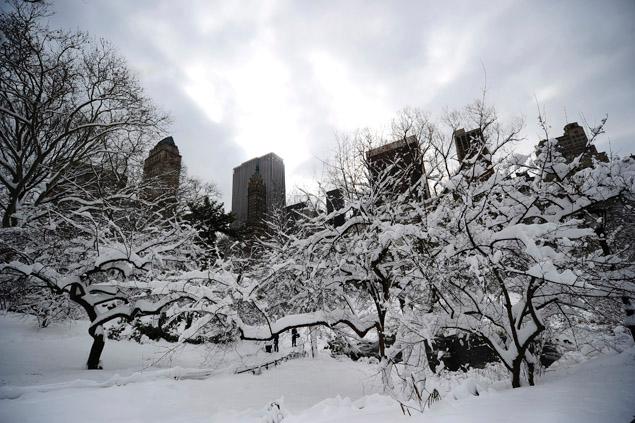
Snow covers trees in Central Park after a storm, New York City, December 28, 2013. (Emmanuel Dunand/AFP/Getty Images via http://www.nydailynews.com).

Snow covers trees in Central Park after a storm, New York City, December 28, 2013. (Emmanuel Dunand/AFP/Getty Images via http://www.nydailynews.com).

That’s what “Head Over Heels” had conjured up in my mind as I walked down East Lincoln toward Lorraine. For whatever reason my thoughts turned to Phyllis. I thought about her smile, her always-wearing-a-skirt style, her standing as a popular student at MVHS. She was always nice to me, always friendly, to the point of being coy about it. The brief flash of Phyllis’ face and smile put a smile on my own as I started singing to “Head Over Heels” out loud. “I wanted to be with you alone, and talk about the weather . . .” was coming out of my mouth in high falsetto as snow started to fall. My thoughts had turned to the cold, the snow flakes and the stark bareness of the wintry landscape as I reached the corner of East Lincoln and Darwood. I was singing “something happens and I’m head over heels . . . don’t break my heart, don’t take my heart, don’t, don’t, don’t throw it away.” Just as was I was about to cross the street, a black two-door Mercury Topaz, circa ’84 or ’85, pulled up, with Phyllis’ mother driving and Phyllis in the front passenger seat. Phyllis’ sister Claudia was in the back. Phyllis mouthed a “Hi” and waved at the same time as the light turned green for their car. What I remember as they pulled away was the smile that she flashed me. It didn’t seem fake. It looked like an I-really-like-you kind of smile to me. I was caught completely off guard!

I spent the rest of the walk to the library debating whether the smile was genuine or a nicety, what the smile meant for her, and how I felt about it. By the time I got to the library, I could only reach one conclusion. I liked Phyllis, and not in an “I like her but only as a friend way.” I liked the girl, simple as that. Those lips and that smile were worth at least a thousand kisses a day!
As I’ve noted in the book and here in the blog, my instincts about Phyllis’ smile turned about to be correct on both counts. Too bad I wasn’t listening to Alexander O’Neal’s “Fake” or Mr. Mister’s “Broken Wings” when I walked out the door to our 616 apartment at 4:30 that afternoon. Still, for that moment, at least, all seemed possible in my little world.
Boy @ The Window, Now in Paperback

20 Wednesday Nov 2013

Posted by decollins1969 in 1, Boy @ The Window, Christianity, Eclectic, eclectic music, Hebrew-Israelite, High Rise Buildings, Jimme, Marriage, Mount Vernon High School, Mount Vernon New York, music, My Father, New York City, Pittsburgh, Politics, Pop Culture, race, Religion, Sports, University of Pittsburgh, Upper East Side, Upper West Side, Youth

≈ 2 Comments


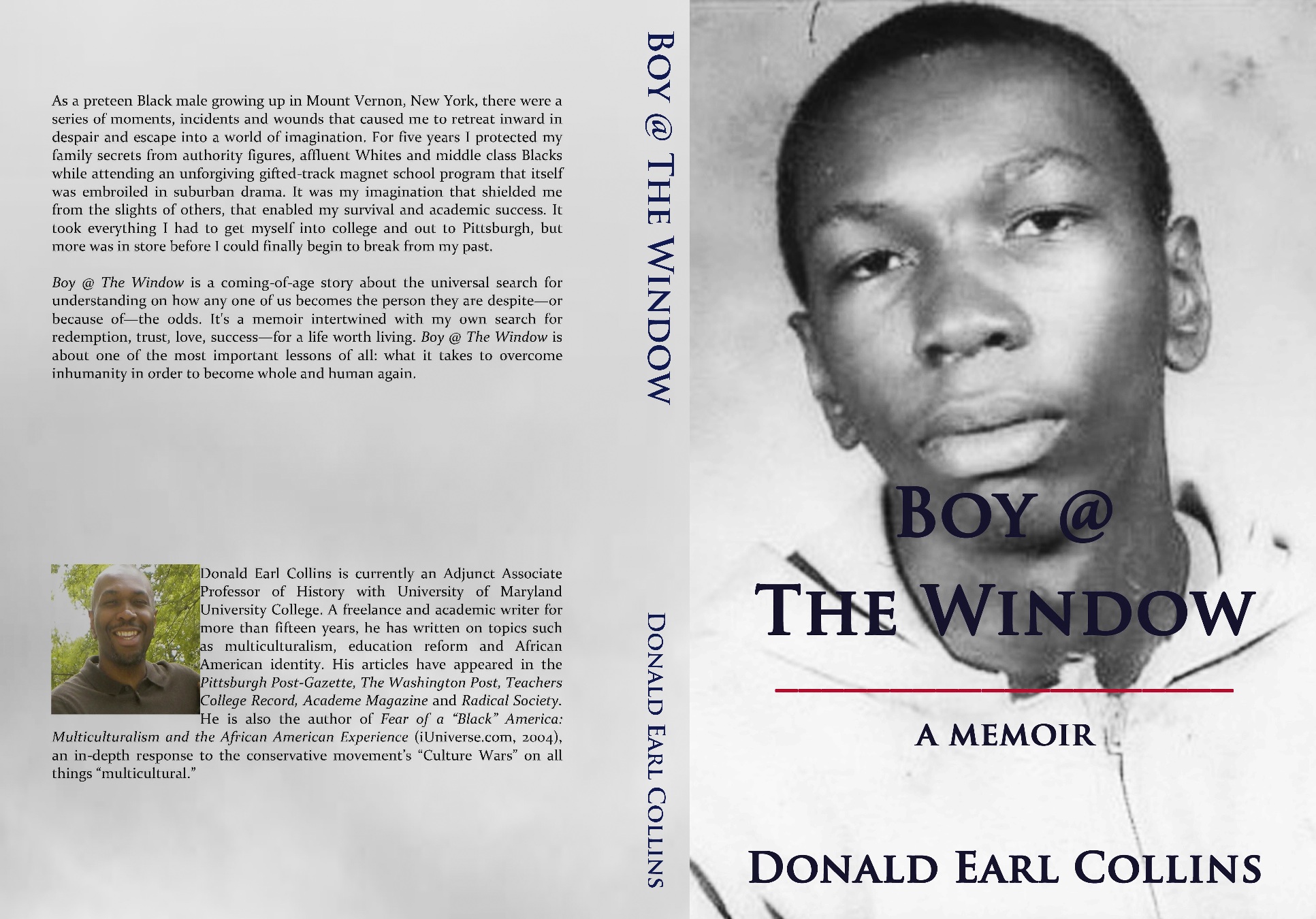
Boy @ The Window, front and back cover, and side, November 11, 2013. (Donald Earl Collins).

Boy @ The Window, front/back cover, and side, November 11, 2013. (Donald Earl Collins).

I have some really good news. My book Boy @ The Window is not just an e-book anymore. I now have a trade paperback edition, out and available through Amazon.com as of yesterday (via http://www.amazon.com/Boy-Window-Donald-Earl-Collins/dp/0989256138/). You can also order and buy Boy @ The Window the old-fashioned way — directly through your local bookstore.

Please take a look, support, buy, read, comment and share. I will post as reviews and opportunities to talk about the book arise. Thanks to all of you who’ve supported my blog and the path to Boy @ The Window over the past six years!

On Pitt’s Concrete Slab & A Labor Day Pirates Game

02 Monday Sep 2013

Posted by decollins1969 in 1, Academia, Boy @ The Window, culture, Eclectic, High Rise Buildings, Pittsburgh, Pop Culture, race, University of Pittsburgh, Youth

≈ Leave a comment

Tags

1988, Bucs, College Success, Darryl Strawberry, Forbes Quad, Forbes Quadrangle, Handouts, Homeless, Homelessness, Labor Day, Mets, New York Mets, Pittsburgh Pirates, Schenley Park, Self-Discovery, Three Rivers Stadium, Wesley V. Posvar Hall


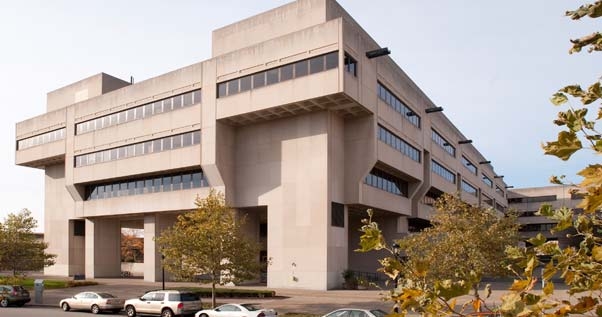
Wesley V. Posvar Hall (formerly Forbes Quadrangle, formerly Forbes Field – I would’ve been on slab in stairwell in SW corner of building 25 years ago), University of Pittsburgh, September 2, 2013. (http://www.tour.pitt.edu).

It was a quarter-century ago that I think I finally became an adult. Or, at least, was no longer stuck at the age of twelve psychologically and emotionally. I understand that five days without a permanent place to sleep, eat and shower isn’t much when compared to many who’ve lived with homelessness much longer. But it was more than enough to wake me up to the fact that my already tumultuous life was on the verge of being a full-blown nightmare if I didn’t find shelter in the form of a South Oakland firetrap.

From Boy @ The Window:

Tuesday and Wednesday were the worst two days of my life since the summer of abuse. Even with the luggage well hidden [in Schenley Park], I worried that fire ants would get a hold of my clothes or that a homeless guy would steal my stuff. But I had no choice. I saw no one from the second half of my freshman year on campus, so I didn’t ask for any other help. I kept looking and calling places for apartment availability. Whether efficiencies or studios or one-bedrooms, the response was always, “the place is taken.” I spent part of the evening at William Pitt Union, watching the news and the Pirates game, thinking all the while about where I’d sleep that night. The student union was out. Pitt Police were always prowling around and looking into the TV room. Hillman Library was still on a summer schedule, and wouldn’t open for its normal hours until after Labor Day. The other buildings were classrooms and faculty offices, better places to hide. My runaway experience in ’85 gave me that idea.

Panther Hollow Lake in Schenley Park, Pittsburgh, PA, September 2, 2013. [note the heavily wooded area behind the lake]. (http://post-gazette.com).

Panther Hollow Lake in Schenley Park, Pittsburgh, PA, September 2, 2013. [note the heavily wooded area behind the lake]. (http://post-gazette.com).

I went over to Forbes Quadrangle (formerly Forbes Field, where the Pirates used to play) and hung out at The Second Plate deli on its benches for a while, pretending to study until well after midnight. Then I looked around for a good place to sleep. Unfortunately, maintenance and security guards locked up all of the classrooms and faculty lounges at night. I settled on the stairwell in the farthest corner of the building away from its two main entrances. I walked up to the fifth floor ledge, laid down on the hard concrete on top of my clothes, and fell asleep. This wasn’t a good sleep, maybe four or five hours. The fluorescent lights were always on, the guard or students would use the stairs, and the ledge was the hardest thing that I’d ever slept on. I woke up on Wednesday and Thursday morning stiffer than I’d been the day before….Before I went to sleep Wednesday night, I got real with myself and real humble with God and started praying. I said, “God, I don’t pray nearly as much as I used to, but I could really use your help. I am your child because of Jesus, and I need you to help me find a place to stay. If you don’t help me find somewhere to live, I’ll have to go home and go to school from home.” I knew full well – and God knew, too – what would happen if I went back home. Nothing. Nothing good, anyway. I was three or four days away from buying a plane ticket back to New York and withdrawing from the university. Thoughts of going to Fordham University or Hunter College crept into my head. They were good schools for someone like me. Living at home, though, wasn’t.

Of course, I did eventually find a house with a room available, one where I’d share a kitchen and bathroom for the next two school years with other Pitt students, reputable and otherwise.

I slept away most of my Labor Day Weekend, except for spending some of my remaining money to take in a Pirates-Mets game at Three Rivers. My Mets won 7-5, on the power of two Darryl Strawberry home runs.

…After what I’d just been through, I learned something new and foreign. That everyone needs folks in their lives – friends, family, mentors and authority figures – if for no other reason than the need to ask for help. I’d come to know at least a dozen people who I could’ve called on during my five-day ordeal, but I never looked through a phone book or gave them a call. Heck, I didn’t even try to keep in touch by getting their addresses and numbers at the end of April. Not to mention contacting Jack Daniel, an Associate Provost at Pitt and the author of the Challenge Scholarship, the one that paid for half of my tuition. If anyone had any incentive to make sure I had a place to lay my head, it would’ve been him. All of these thoughts had been in my head during the week. I didn’t trust them or the instincts or wisdom from which they originated. “I’m so stupid God,” I said to myself, “I’m so incredibly stupid.”

Homeless in Pittsburgh

Homeless in Pittsburgh

Mom’s constant mantra in my head, of not depending on others for help, was a lie, at least for me. I couldn’t will myself through school. Especially when it came to money. I needed all the help I could get. Besides, my family had now been on welfare for five and a half years. If that wasn’t one of my Mom’s examples of so-called handouts, I didn’t know what was.

My approach to college changed with this revelation…I knew that all the things I shied away from talking about were now things I needed to discuss. But I also knew that I had to draw out my better, more sociable self in order to welcome others in my life with open arms. That meant taking some risks, which meant that I could get hurt emotionally or psychologically by them.

My life hasn’t been the same since, thank God.

Terri and Mr. Asexual

07 Wednesday Aug 2013

Posted by decollins1969 in 1, Boy @ The Window, culture, Eclectic, High Rise Buildings, Pittsburgh, Pop Culture, race, University of Pittsburgh, Work, Youth

≈ Leave a comment

Tags

Apartment Hunting, Asexuality, Bipolar Disorder, Biracial, Clubbing, Clubs, Dallas, Friendship, Friendships, Mother-Daughter Relationships, Night Life, Terri, Westchester County Department of Community Mental Health


Asexual pride flag, September 18, 2010. (Wikipedia). In public domain.

Asexual pride flag, September 18, 2010. (Wikipedia). In public domain.

One of my inner circle of friends during my undergraduate years at the University of Pittsburgh was Terri. She was one of the more interesting folks I met during all my years at Pitt and in Pittsburgh. She was so smart, so intriguing, so whimsical, so troubled, so much in fear of success and so flawed. I learned so much from Terri without ever really trying, because she herself was in search of something during all the years I knew her.

I first met Terri in January ’89 at Pitt’s William Pitt Student Union, in the TV room where a bunch of us were watching Dallas (the original series on CBS that Friday night).

William Pitt Union (as viewed from Cathedral of Learning), University of Pittsburgh, July 28, 2012. (Mackensen via Wikipedia).

William Pitt Union (as viewed from Cathedral of Learning), University of Pittsburgh, July 28, 2012. (Mackensen via Wikipedia).

(From Boy @ The Window) “At five-two, she had short dark-brown hair and also wore glasses. There was something about Terri that I knew was different, that she wasn’t just “Black,” whatever that meant. She was one of the first biracial women I’d come to know. It seemed like those were the first words out of her mouth. Maybe not. But Terri did tell us she was “half-Black and half-White” before the night was over….She immediately jumped into our growing conversation once they sat down and criticized Dallas as one of many examples of lily-Whiteness on TV. That launched a whole new discussion, with everything from The Cosby Show to 227.

“After about an hour of debates, jokes and wonderful conversation, we all went out into Oakland. We started at The O, the nickname for Original’s. It had already been a mainstay for students and steelworkers in need of cheap food and beer since ’60. The Pitt football team often drank and caroused there, often getting into fights with Pitt Police. This Friday it was overcrowded and dirty, and we wanted to talk. Terri had become the leader of our pack, and took us over to Hemingway’s as an alternative. The bar and restaurant was The O’s opposite, very quiet, very reserved, with a very much older and Whiter crowd. It was also the first time I’d been carded, so I couldn’t have a drink even if I wanted to.”

Terri was the one who could truly bring out my adventurous side, as she introduced me to Pittsburgh’s night life — Black and White. She didn’t seem to care that I was still only nineteen or twenty years old. Terri could talk herself — and me — into a private over-twenty-five club in Homewood or Penn Hills, or out of trouble with police like no one I knew back then. I met all kinds of Pittsburghers as a result. Gay and straight, older and younger, college educated and working-class stiff. Hanging out with her was a constant balance between a real social life and one when being out too late may have put her or us in danger.

Apartment building at corner of North Aiken & Centre Avenue in Shadyside, Pittsburgh, PA, August 7, 2013. (http://pittsburgh.olx.com).

Apartment building at corner of North Aiken & Centre Avenue in Shadyside, Pittsburgh, PA, August 7, 2013. (http://pittsburgh.olx.com).

My shift to a more regulated schedule with Terri began during the summer of ’90. I came back to the ‘Burgh the first week of August after nearly two months working at Westchester County Department of Community Mental Health. I wanted to find my first real apartment, not just a room in which I shared a kitchen and bathroom with six others in South Oakland (which I’d done in the two previous years). I stayed with Terri and her mother at their new place in Shadyside for a week, fairly close to all the neighborhoods in which I hoped to find a place.

At first, the late nights of talking and hanging out were fun. But by the third day, I was knee-deep in apartment listings and phone calls to landlords in Oakland, Shadyside, Squirrel Hill, Wilkinsburg, Bloomfield, Point Breeze, Homewood and East Liberty. Terri wasn’t exactly a happy camper, with me, her mother or her various suitors for that particular week. Terri and her mother had several arguments that week, about money, dating, even over her treatment of me. The most remarkable thing what hearing Terri call her mother a “bitch” over and over again one night, as if it was a period at the end of a sentence.

My problem, of course, was that I was “asexual” according to Terri. It wasn’t the first time someone had described me as such, and it certainly wasn’t the first time Terri had called me “asexual.” This time and week was different somehow. I guess that Terri thought that I’d look at a couple of places and then spend the rest of the week partying. But given my finances, I couldn’t just plop down money on a $400 a month one-bedroom with bay windows. I don’t think that she understood this, though, not the way Terri spent money back then.

I assumed, right or wrong, that she felt spurned by my lack of interest that week in spending my late nights out on the town with her.  For that week at least, I wasn’t into the Terri Show. As up and charming as she could be, Terri had a dark side, one in which her mother obviously faced much more than anyone else. I still considered her a friend, even a good friend. I just couldn’t be the kind of friend that could be what she wanted me to be on whim and demand. And over the next six years, I gradually also stopped being the friend that would listen to all of Terri’s gripes about life and race, identity and bad boyfriends.

The Road to My Memoir, Part 1: Welfare

07 Tuesday May 2013

Posted by decollins1969 in 1, Academia, Boy @ The Window, culture, Eclectic, High Rise Buildings, Mount Vernon New York, Pittsburgh, Politics, Pop Culture, race, University of Pittsburgh, Youth

≈ Leave a comment

Tags

Academic Writing, Adrian Nicole LeBlanc, AFDC, Case Managers, Case Workers, Criminalization, Discrimination, Emotional Detachment, Irony, Journaling, Journals, Kaaryn Gustafson, Personal Vignettes, Pitt, Public Housing, Racial Stereotypes, Racial Stigmas, Research, Rhonda Y. Williams, Scholarship, Welfare, Writing, Writing Process


Adrian LeBlanc's Random Family (2002) and Rhonda Y. Williams' The Politics of Public Housing (2005), May 7, 2013. (Donald Earl Collins).

Adrian LeBlanc’s Random Family (2002) and Rhonda Y. Williams’ The Politics of Public Housing (2005), May 7, 2013. (Donald Earl Collins).

This isn’t a straight-forward post or series of posts. I didn’t come to Boy @ The Window quickly or easily. I didn’t intend it to be a memoir, even though I’d left myself bread crumbs to turn it into a memoir years ago.

The first time I’d thought about writing a book related to my experiences was at the beginning of my junior year of college, in September and October ’89. Not even three months after my idiot stepfather had left 616 for good, and I was thinking about writing up something about the experience? A bit ambitious I was!

What I did do, though, was somehow find my old scraps of journals about what happened to me when I was twelve before I came back to Pittsburgh and Pitt for the school year. I wrote up additional experiences, about running away from 616 in August ’85, about my Mom’s experience at the feet and fists of my now ex-stepfather, about my time on a drafty Pitt stairwell the year before.

That was painful to write about, so soon after finally being rid of Maurice, too soon, really, for me to fully process it without re-living the experience. So I wrote or rewrote four of these experiences in all, and put them away in one of my Pitt notebooks.

But there was one other experience I wanted to write about, to move from a personal story to one of academic scholarship. It was the experience of my being on welfare from ’83 to ’87, covering on-the-ground perspectives from people like me and my Mom, as well as those of case workers. I thought that it would fill a void in both media coverage and in historical scholarship about the topic of welfare, particularly how it became a racial stereotype and slur.

I thought that by juxtaposing (and that’s the word I used for this back in ’89) the plight of welfare recipients and case workers, that I could show some sense of irony. That so many of the case workers and managers were only a paycheck or two away from being on welfare — and that some of them had been on welfare themselves, at least based on my limited experience — would make for an interesting story. What I hoped to show, ultimately, was the inhumanity of the welfare system itself, pitting people from similar socioeconomic backgrounds against each other because of the mix of welfare as racial and as a form of the undeserving getting their government handouts, of crumbs from America’s table being turned into a political football.

I didn’t say this exactly when I had a conversation about this topic with my former TA Paul Riggs in October ’89. The ideas and many of the sentiments, particularly about “juxtaposing,” “irony,” and “inhumanity,” though, were all part of the conversation. Riggs told me I needed to slow down, that even if I somehow were able to make this topic historical, that I’d need to much more reading on the topic, to divorce myself from my emotions around this topic.

In some ways, my late-twenties mentor was right. It’s hard to do scholarly work on a topic in which you are heavily emotionally invested. The topic wasn’t historical, given that I had just lived it and my Mom and younger siblings were still living it. And I was nineteen after all, and after seven years of seldom writing for any purpose outside of the classroom except letters to former high school classmates and college friends, a book would’ve been a daunting, almost immeasurable task.

That started me on the path to learn how to write like an academic historian, instead of writing out of emotion and irony. One that would delay my writing on anything like Boy @ The Window for the better part of a decade, even as the academic process enabled me to do the interviews and research necessary to put the memoir together.

Luckily, there are three authors whose work over the past decade has covered this topic of welfare, racial stereotypes, inhumanity, criminality and irony. Mostly in ways I would’ve covered it had I had the words and research skills to do this work twenty-four years ago. Adrian LeBlanc‘s Random Family (2002), though a sensational accounting of a Latino family in the Bronx between ’88 and ’01, does provide a glimpse (still MacArthur “genius” Award winner). Rhonda Y. Williams‘ The Politics of Public Housing: Black Women’s Struggles Against Urban Inequality (2005) is her excellent collection of research and personal vignettes about public housing, welfare, Black women and empowerment despite the odds covering the period between the 1940s and the early 1980s (with a bit on the early 1990s). All just before crack cocaine, TANF and the gentrification of previously off-limit poor neighborhoods in a city like Baltimore became bigger themes.

And now there’s Kaaryn Gustafson‘s Cheating Welfare: Public Assistance and the Criminalization of Poverty (2012). She covers in so many ways what I’d once hoped to capture in emotion and storytelling about the stain of welfare as illustrated in policies and politics. Kaaryn’s (I know her from my New Voices days) written a great book, one that I wished I could’ve read or written when I was nineteen.

Kaaryn Gustafson's Cheating Welfare (2012), May 7, 2013. (http://nyupress.org).

Kaaryn Gustafson’s Cheating Welfare (2012), May 7, 2013. (http://nyupress.org).

That wasn’t my path, though I had interests that would include welfare. No, my path was about race, diversity, education and self-discovery, not just about my Mom and family.

Sports and “The -tions”

22 Saturday Dec 2012

Posted by decollins1969 in 1, Academia, culture, Eclectic, High Rise Buildings, Politics, Pop Culture, race, Sports, Work

≈ Leave a comment

Tags

"Social Political Economic", African American History, De-industrialization, Declining Cities, Economic Inequality, Gentrification, High School Social Studies Teaching Formula, Higher Education, History, History of American Sports, History of Education, Immigration, Industrialization, Migration, social mobility, Suburbanization, Teaching History, The -tions, Urbanization, US History, World History


Gentrification via sports collage, December 22, 2012. [Includes aerial view of location of new DC baseball stadium site, June 22, 2006, http://www.wreckingcorp.com; Nationals Park Greeting Card; Baseball Stadium Price Tag cartoon, March 27, 2008 (Nate Beeler/Washington Examiner)]

Gentrification via sports collage, December 22, 2012. [Includes aerial view of location of new DC baseball stadium site, June 22, 2006, http://www.wreckingcorp.com; Nationals Park Greeting Card; Baseball Stadium Price Tag cartoon, March 27, 2008 (Nate Beeler/Washington Examiner)]

Off and on for the past twenty years, I’ve attempted to wean my students off the ridiculous high school social studies formula for addressing an essay question or writing a history paper. Thinking about history — particularly modern world history or US history — purely in social, political and economic terms misses so much. History is about patterns, trends and dynamic processes involving people and human tendencies. So in my discussion sections for US History Since 1877 in the fall of ’92, I began to discuss the idea that you can better understand history through applying what I started to call “the -tions” as a series of trends, processes and patterns.

I did this because I’d already grown tired of students who had adopted “the formula.” The formula goes something like this. First, write an introduction (usually, without mention of the need for a clear thesis statement). Then, put facts, events, ideas and evidence in the social, political and economic changes silos (it always has to be these three). Then, write a conclusion that restates the introduction, with a “my essay/paper has proven” sentence.

Steel grain silos, Ralls, Texas, October 12, 2010. (Leaflet via Wikipedia). In public domain.

Steel grain silos, Ralls, Texas, October 12, 2010. (Leaflet via Wikipedia). In public domain.

It’s a terrible way to teach history, and a terrible way to write about it. It leaves so much out, including the idea that history is a constantly evolving process, not a static picture of events involving larger-than-life individuals herding billions of people through one period of history or another. So I decided to make immigration, industrialization, urbanization, and migration (sometimes called internal migration) a bigger focus with my students my second year of graduate school at Pitt. Some liked it, some didn’t, and some just kept writing their formulaic five-paragraph essays for their midterm and final exams. Oh well.

So, in expanding my list of -tions to include de-industrialization, suburbanization, globalization and gentrification over the years, I’ve begun to see patterns beyond what I typically teach or even write about. The rise and decline of American cities are a case in point. Especially if one compares this to the rise and decline of mainstream American team sports over time. That baseball, football and basketball have all been the nation’s first or second most popular sports at one point or another since the 1890s is a reflection of the leisure activities available to ordinary Americans living in growing or declining cities.

Of course, I could also include boxing (as this was America’s most popular sport through the first four decades of the twentieth century). But as an individual sport wrought with even more racial overtones than baseball, boxing deserves a separate discussion. For team sports, though, their rise or decline in popularity seems to have followed a number of trends related to the -tions.

Baseball was the nation’s most popular team sport from the 1890s through the 1950s, mirroring the growth of American cities (urbanization) during the same period. Immigrants from Southern and Eastern Europe helped grow these cities, as they left behind rural poverty, religious persecution and pogroms for industrial exploitation here in the US. Native-born Whites, already enamored with baseball, essentially introduced these immigrant groups to the sport, which in turn made it more popular. Of course, many sons of these immigrants became great baseball players. Blacks migrating to cities such as New York, Pittsburgh, Kansas City and Chicago also adopted the pastime. Every -tion is involved, at least, that’s my argument.

As we well know, though, baseball has declined in popularity since the 1950s, as the professional game became an integrated sport, and as millions of Whites began moving to the suburbs, taking millions of jobs with them. Blacks underwent a second massive wave of migration after 1940 that grew during the 1950s and 1960s.

During this transition, basketball and football (especially the latter) became more popular sports. Both were sports whose history and records were less revered than those in baseball, and at least appeared to be more welcoming of athletes of color than baseball. In the migration of Whites from cities to suburbs and Blacks to cities, the shuffling of team sports’ popularity and their locations began.

Pittsburgh's Civic Arena under demolitiion, March 11, 2012 (AVPHOTOGRAPHICS PGH via Flickr.com). In public domain. The "Igloo" (home of the Pittsburgh Penguins) itself was built after the demolition of the Lower Hill District between 1958 and 1961, displacing thousands of Blacks in the process.

Pittsburgh’s Civic Arena under demolition, March 11, 2012. (AVPHOTOGRAPHICS PGH via Flickr.com). In public domain. The “Igloo” (home of the Pittsburgh Penguins) itself was built after the demolition of the Lower Hill District between 1958 and 1961, displacing thousands of Blacks.

Once the US economy began to decline, and then de-industrialize, in the 1970s, 1980s, and 1990, the role of declining cities attempting to hold on to their sports franchises became a new theme. Declining post-industrial cities like Baltimore, Detroit and Cleveland lost their teams entirely to other cities, or lost them to the suburbs. While Sunbelt cities like Dallas-Fort Worth, Atlanta, Phoenix, Denver and Houston have picked up some of these pieces.

Gentrification, backed by a politically conservative model for economic growth and nary a concern for the declining income of city residents, has led to a return of professional sports teams to city centers. Billions of taxpayer dollars have gone into sports arenas and stadiums in Washington, DC, Brooklyn, Seattle, Detroit, Boston, San Jose, and so many other places across the country. But with little to no benefit for the people living in these cities, especially the poor. As a result of the inflation that came with gentrification and these commercial building ventures, millions of America’s poor have been forced to move out into poorer suburban communities that often border major cities.

Maybe it’s just me. I just don’t find much to celebrate about the business side of sports today, because it reflects the trends of growing economic inequality and much more difficult social mobility. It shows how desperate the mayors of declining cities are for growing their municipalities, without regard for its poor and working-class residents. It’s emblematic of our culture’s inability to see that the shift from industrial work to service industry work has left millions without the ability to live decent lives in city or suburb, whether they migrate to Houston or stay in New York. Sports is a reflection of these trends, but they also exacerbate them as well.

The So-Called Fiscal Cliff = Obama’s Lethal Weapon

14 Wednesday Nov 2012

Posted by decollins1969 in 1, culture, Eclectic, High Rise Buildings, Movies, Politics, Pop Culture

≈ Leave a comment

Tags

Bush Tax Cuts, Federal Budget Cuts, Fiscal Cliff, Fiscal Curb, Jump Scene, Lawrence O'Donnell, Lethal Weapon (1987), Mel Gibson, Mitt Romney, MSNBC, Popular Culture Cliches, President Barack Obama, The Last Word, Thelma & Louise (1991)


Lethal Weapon Jump Scene

Lethal Weapon Jump Scene

For nearly a week, the news folks have droned on and on about the fiscal curb of expiring Bush 43 tax cuts and sequestering cuts in federal spending that will occur at the end of this year. It’s like everyone’s desperate for real news. And there won’t be any real news, unless President Obama decides to give in on the Bush 43 tax cuts or somehow decides that Romney’s fraudulent math is no longer a sign of lunacy.

The best coverage I’ve read or seen on this has been on Lawrence O’Donnell’s The Last Word on MSNBC, as he recognized early on the difference between higher taxes immediately on January 1, 2013 and gradual but steady cuts for the federal budget over a twelve-month period. Still, O’Donnell’s cliché for the alleged cliff — the final scene of Thelma & Louise (1991), in which the two commit suicide by driving off a cliff into the Grand Canyon — has been so overused that it doesn’t quite get at the mania of both the media and the neocons on this issue of taxes and budget cuts.

Hence the above — albeit low resolution — one-minute clip from Lethal Weapon (1987), where the crazy suicidal character played by Mel Gibson forces a potential suicidal jumper to jump off a building (a better clip is on YouTube – http://www.youtube.com/watch?v=BOP6uMTYaM8). Now I know that Gibson has become a punchline in recent years, an aging and raging racist drunk. But that wasn’t his persona in ’87, and certainly not in this scene, where he forces the equivalent of Boehner, Cantor and McConnell off the ledge. “Do you really wanna jump? Do you?” Mr. O’Donnell, this is the clip you should’ve ran with last week!

← Older posts
Newer posts →

Boy @ The Window: A Memoir

Boy @ The Window: A Memoir

Places to Buy/Download Boy @ The Window

There's a few ways in which you can read excerpts of, borrow and/or purchase and download Boy @ The Window. There's the trade paperback edition of Boy @ The Window, available for purchase via Amazon.com at http://www.amazon.com/Boy-Window-Donald-Earl-Collins/dp/0989256138/

There's also a Kindle edition on Amazon.com. The enhanced edition can be read only with Kindle Fire, an iPad or a full-color tablet. The links to the enhanced edition through Apple's iBookstore and the Barnes & Noble NOOK edition are below. The link to the Amazon Kindle version is also immediately below:

scr2555-proj697-a-kindle-logo-rgb-lg

Boy @ The Window on Amazon.com: http://www.amazon.com/Boy-The-Window-Memoir-ebook/dp/B00CD95FBU/

iBookstore-logo-300x100

Boy @ The Window on Apple's iBookstore: https://itunes.apple.com/us/book/boy-the-window/id643768275?ls=1

Barnes & Noble (bn.com) logo, June 26, 2013. (http://www.logotypes101.com).

Boy @ The Window on Barnes & Noble: http://www.barnesandnoble.com/w/boy-the-window-donald-earl-collins/1115182183?ean=2940016741567

You can also add, read and review Boy @ The Window on Goodreads.com. Just click on the button below:

Boy @ The Window

Twitter Updates

Tweets by decollins1969
  • RSS - Posts
  • RSS - Comments

Archives

  • June 2025
  • April 2023
  • September 2022
  • August 2022
  • July 2022
  • June 2022
  • May 2022
  • April 2022
  • March 2022
  • January 2022
  • December 2021
  • November 2021
  • October 2021
  • September 2021
  • August 2021
  • July 2021
  • June 2021
  • April 2021
  • March 2021
  • February 2021
  • January 2021
  • December 2020
  • November 2020
  • October 2020
  • September 2020
  • August 2020
  • July 2020
  • May 2020
  • April 2020
  • March 2020
  • January 2020
  • December 2019
  • November 2019
  • August 2019
  • July 2019
  • June 2019
  • May 2019
  • April 2019
  • March 2019
  • February 2019
  • January 2019
  • December 2018
  • November 2018
  • October 2018
  • September 2018
  • August 2018
  • July 2018
  • June 2018
  • May 2018
  • March 2018
  • February 2018
  • January 2018
  • December 2017
  • November 2017
  • October 2017
  • September 2017
  • August 2017
  • July 2017
  • June 2017
  • May 2017
  • April 2017
  • March 2017
  • February 2017
  • January 2017
  • December 2016
  • November 2016
  • October 2016
  • September 2016
  • August 2016
  • July 2016
  • June 2016
  • May 2016
  • April 2016
  • March 2016
  • February 2016
  • January 2016
  • December 2015
  • November 2015
  • October 2015
  • September 2015
  • August 2015
  • July 2015
  • June 2015
  • May 2015
  • April 2015
  • March 2015
  • February 2015
  • January 2015
  • December 2014
  • November 2014
  • October 2014
  • September 2014
  • August 2014
  • July 2014
  • June 2014
  • May 2014
  • April 2014
  • March 2014
  • February 2014
  • January 2014
  • December 2013
  • November 2013
  • October 2013
  • September 2013
  • August 2013
  • July 2013
  • June 2013
  • May 2013
  • April 2013
  • March 2013
  • February 2013
  • January 2013
  • December 2012
  • November 2012
  • October 2012
  • September 2012
  • August 2012
  • July 2012
  • June 2012
  • May 2012
  • April 2012
  • March 2012
  • February 2012
  • January 2012
  • December 2011
  • November 2011
  • October 2011
  • September 2011
  • August 2011
  • July 2011
  • June 2011
  • May 2011
  • April 2011
  • March 2011
  • February 2011
  • January 2011
  • December 2010
  • November 2010
  • October 2010
  • September 2010
  • August 2010
  • July 2010
  • June 2010
  • May 2010
  • April 2010
  • March 2010
  • February 2010
  • January 2010
  • December 2009
  • November 2009
  • October 2009
  • September 2009
  • August 2009
  • July 2009
  • June 2009
  • May 2009
  • April 2009
  • March 2009
  • February 2009
  • January 2009
  • December 2008
  • November 2008
  • October 2008
  • September 2008
  • August 2008
  • July 2008
  • June 2008
  • May 2008
  • April 2008
  • March 2008
  • February 2008
  • January 2008
  • December 2007
  • November 2007
  • October 2007
  • September 2007
  • August 2007
  • July 2007
  • June 2007

Recent Comments

MaryPena's avatarMaryPena on My Day of Atonement/Bitter Hat…
decollins1969's avatardecollins1969 on No Good Teaching Deed Goes…
Mary Rose O’Connell's avatarMary Rose O’Connell on No Good Teaching Deed Goes…

NetworkedBlogs on Facebook

NetworkedBlogs
Blog:
Notes From a Boy @ The Window
Topics:
My Life, Culture & Education, Politics & Goofyness
 
Follow my blog

616 616 East Lincoln Avenue A.B. Davis Middle School Abuse Academia Academy for Educational Development AED Afrocentricity American Narcissism Authenticity Bigotry Blackness Boy @ The Window Carnegie Mellon University Child Abuse Class of 1987 CMU Coping Strategies Crush #1 Crush #2 Death Disillusionment Diversity Domestic Violence Economic Inequality Education Family Friendship Friendships Graduate School Hebrew-Israelites High-Stakes Testing Higher Education History Homelessness Humanities Humanities Program Hypocrisy Internalized Racism Jealousy Joe Trotter Joe William Trotter Jr. K-12 Education Love Manhood Maurice Eugene Washington Maurice Washington Misogyny Mother-Son Relationship Mount Vernon High School Mount Vernon New York Mount Vernon public schools Multiculturalism MVHS Narcissism NFL Pitt Pittsburgh Politics of Education Poverty President Barack Obama Race Racial Stereotypes Racism Relationships Self-Awareness Self-Discovery Self-Reflection Sexism Social Justice Teaching and Learning University of Pittsburgh Violence Whiteness Writing

Top Rated

Blog at WordPress.com.

  • Subscribe Subscribed
    • Notes from a Boy @ The Window
    • Join 103 other subscribers
    • Already have a WordPress.com account? Log in now.
    • Notes from a Boy @ The Window
    • Subscribe Subscribed
    • Sign up
    • Log in
    • Report this content
    • View site in Reader
    • Manage subscriptions
    • Collapse this bar
 

Loading Comments...