• Spinning Sage’s Gold: Allegories on the Western-Dominated Present and a Possible Post-Western Future (2025)
  • About Me
  • Other Writings
  • Interview Clips
  • Video Clips
  • Boy @ The Window Pictures
  • Boy @ The Window Theme Music

Notes from a Boy @ The Window

~

Notes from a Boy @ The Window

Category Archives: culture

The Miracle of Dr. Jack Daniel

16 Monday May 2011

Posted by decollins1969 in 1, Academia, Boy @ The Window, culture, Politics, race, Youth

≈ Leave a comment

Tags

"Sometimes Starvation", Cathedral of Learning, Challenge Scholarship, Department of HIstory, Diversity, Divine Intervention, Dr. Jack Daniel, Dr. Jack L. Daniel, Grad School, Graduate Fellowships, History Department, Jack Daniel, Joe Carbone, Miracles, Pitt, Qualifications, Race, Students of Color, University of Pittsburgh, Van Beck Hall, Westchester County Department of Community Mental Health


Dr. Jack L. Daniel, University of Pittsburgh, 2004. Pitt Magazine. http://www.pittmag.pitt.edu/summer2004/feature1.html. The use of this photo falls under fair use under US Copyright laws because this blog post is in fact about the subject in this photo.

Last week I started a conversation about my three weeks of starvation in order to secure my entry into graduate school through my post, “Sometimes Starvation.” I’m continuing that conversation with today’s post. For it was that on this date twenty years ago that divine intervention came in the form of a voice inside my head, leading me to a meeting with then University of Pittsburgh Vice-Provost for Academic Affairs, Dr. Jack L. Daniel.

Even as I turned down the opportunity to go back to Mount Vernon and work up in White Plains with Joe Carbone and Westchester County Department of Community Mental Health for the summer of ’91, a name kept popping in my head. And I didn’t know why. I’d only met Jack Daniel on two occasions, both during my freshman year at Pitt. I was a Challenge Scholar, in the inaugural class of Challenge Scholars no less, a merit-based half-tuition scholarship meant to attract more students of color to Pitt, and Dr. Daniel was the author of the program.

I knew that he was a professor with expertise in Black communications. I also knew that he was one of the activists who helped bring the Black Studies Department to Pitt in ’69 by occupying the central computing system on the seventh floor of the Cathedral of Learning, back when he was a freshly minted Ph.D. Other than that, I had zero contact with the man in my four years of undergrad.

For once, I listened to the voice inside my head and, after some coaxing of Dr. Daniel’s assistant, made an appointment with him to discuss my financial options for going to Pitt for my history MA. I figured that I had nothing to lose. I really only hoped that there was an extra $1,000 or two left in his budget that would at least help to feed me through my first year of grad school.

That Thursday, the sixteenth of May, I arrived at my 2:30 pm meeting with Dr. Daniel on the eighth floor of the Cathedral of Learning, not knowing exactly what I was going to say. I walked into the Office of the Provost, where the stale stone of the super-tall building turned into the sights and smells of dark wood, cherry, mahogany even. We exchanged pleasantries, shook hands, and I sat down feeling like I was in sixth grade instead of like I’d recently finished my bachelor’s.

I started. “I’m looking for a little extra money for grad school this fall, so that I don’t have to borrow money to cover tuition and eat,” I said. Dr. Daniel then asked

“What was your GPA here?”

“A 3.4,” I said, rounding up from a 3.37 average.

“What about your GRE scores?”

“60th and 70th percentile on math and reading,” I said.

“What about your major?,” Dr. Daniel asked.

“I was a history major with a 3.82 average,” I said with a smile.

Then Dr. Daniel got this look on his face, like he was actually angry, like there was a piece to the puzzle that I was missing. “Hold on for a second, I need to make a phone call,” he said.

He called Pitt’s History Department Chair, who at the time was one of my future grad school professors, Van Beck Hall, and spent the next couple of minutes chewing him out about my record and about why I hadn’t been awarded a fellowship. I sat there with a stone face, not wanting to give away the sense of glee I felt watching Dr. Daniel on the phone while verbally beating up on a department chair. Politely, of course.

After he got off the phone, he said, “You’ve got your money for school next year.” My mouth fell open, and not just because I couldn’t believe it. I couldn’t believe how easy it was. Then Dr. Daniel explained how his office had worked with the Faculty of Arts and Sciences (and the other major schools within the university) to create a new fellowship to attract more students of color and women into Pitt’s grad programs. He also explained how some departments and programs had resisted communicating the existence of this new fellowship program to potential grad students. I apparently was another case demonstrating how some folks within the university simply refused to address Pitt’s lack of diversity at the graduate level.

I was beyond thankful. Incredulous, thankful, even speechless. I couldn’t stop shaking Dr. Daniel’s hand. Despite three weeks and a loss of twenty-plus pounds, I played basketball at Pitt’s athletic center that evening, making shots as if I’d been on an athlete’s diet for the past three weeks. I was more excited about the possibility of grad school being paid for than I was about getting my first paycheck of the summer that Friday.

The following Tuesday evening, the twenty-first of May, I saw Dr. Daniel walking down Fifth Avenue outside of the Cathedral of Learning as I was on my evening walk home from work. I told him that I’d gotten the paperwork for my full-tuition fellowship and $7,000 graduate student assistantship stipend for the ’91-’92 school year. As he walked away after I said, “Thank you!,” again, I yelled “You’re the man!” All Dr. Daniel did was stretch out his long arms, shrugging it off as if he’d given me a nickel to buy a Tootsie Roll.

No Good Teaching Deed Goes Unpunished

13 Friday May 2011

Posted by decollins1969 in 1, Academia, Boy @ The Window, culture, Eclectic, Mount Vernon High School, Politics, race, Youth

≈ 2 Comments

Tags

AP American History, AP US History, AP US History Exam, Blue Ribbon Schools, Burnout, Harold Meltzer, Mount Vernon High School, Mount Vernon New York, Politics of Education, Richard Capozzola, Student Achievement, Teacher Effectiveness, Teachers Unions, William Prattella


AP US History, Harold Meltzer & Teachers Under Assault

AP US History, Harold Meltzer & Teachers Under Assault

It’s never really been much of a surprise to me how much we don’t appreciate good teachers. I should know. A few semesters ago, a student of mine filed a complaint against me because she couldn’t see my lecture notes well enough due to some issue with the LCD projector for my classroom. Mind you, she admitted that she didn’t have her glasses that day. When I didn’t allow her to interrupt me in the middle of class over the issue, she stormed out, yelled a couple of obscenities at me, and slammed the classroom door shut.

I know, it’s much worse on the K-12 level, between incorrigible students and insolent parents, school and district administration. Not to mention the pressures of NCLB, initiatives like Race to the Top (or bottom, really) and private foundations with their own agendas. Add to that article after article blaming teachers unions for being on the wrong side of corporatized education reform that emphasizes math and science and test scores over humanities and social science and critical thinking.

Former NYC DOE Chancellor Joel Klein’s now among them, in his lengthy (really, too long) piece on “The Failure of American Schools” in this month’s Atlantic Monthly, laid much of the blame on teachers and teachers unions. Not our nation’s economic woes, an overemphasis on math and science, or a system that was created not to teach academic excellence, but to weed out the so-called weak-minded. It’s no wonder that the average career of a teacher is five years!

A quarter-century ago on this date, my former teacher Harold Meltzer’s good deeds came to fruition through our AP US History class and our AP exam that year. We learned in September ’86 —  the beginning of our senior year — that three of us (including yours truly) all scored 5’s on the AP American History exam on this date. That meant that three of us had earned six college credits a year before enrolling in any university. There were at least four others who scored a 4, guaranteeing them three college credits. Another five scored a 3, considered a passing score by colleges and the College Board.

It was the best an MVHS AP class had ever done on any AP exam up to that point in the high school’s history, and should’ve been a crowning achievement for Meltzer and the school. Yet instead of praise or at least a “Congratulations,” Meltzer was treated as if he’d shown up MVHS by his boss, Social Studies Department Chair Larry Smith, a red-headed man who looked like a character from Dune. He snickered at me every time he saw me with Meltzer. Neither Superintendent William Prattella nor Richard Capozzola saw fit to honor Meltzer or our class for our achievements. It was ironic, because MVHS won a Blue Ribbon Schools of Excellence award from the US Department of Education a few months later, off of the work of teachers like Meltzer, as well as Humanities students.

There were rumors that some of the White parents were unhappy with Meltzer’s methods of teaching, which typically involved us interpreting history rather than answering straightforward history trivia questions. More than rumors, actually, as I walked in on a meeting between Meltzer and a parent my senior year. That mother demanded an A for her daughter in Meltzer’s AP US History class. What wasn’t exactly a rumor, either was that Smith was looking for any excuse to take AP US History away from Meltzer. Especially since it was so shocking that both White and Black students did equally well on the exam that year. Of course, there were other, more deeply personal issues between the two men that likely involved jealousy and other not-so-secret secrets.

For our part, our cohort stopped talking to Meltzer altogether. Sure he was eccentric, even a bit strange and unorthodox as a teacher, but at least he cared. And by the way our scores turned out, he didn’t deserve the cold shoulders he received from most of my classmates our senior year. It bothered me when I’d see Meltzer saying “Hello” to one of us as we passed his Room 275, only for one of us to walk by as if Meltzer had phased out of our space-time continuum.

I was sure that some of it was related to Meltzer being a “confirmed bachelor.” But mostly, I thought that despite Meltzer’s lack of a normal teaching style, that my classmates were total assholes toward him. Meltzer spent the week before the AP exam after school with us going over every conceivable fact of American history for the more anal of us. It was above and beyond, and also unnecessary. Because Meltzer had taught us enough about egalitarianism, critical and independent thinking, and “coming to the point at once” in the first months of his class for all of us to do well.

Meltzer died from a number of ailments at the age of sixty-six in early January ’03. But one thing I was sure of that hastened his decline was the bitter and broken heart he had from the way he’d been treated in his last years as a teacher. I just hope that I brought a little bit of laughter to the man in his final months and weeks. Or at least, something to smile about.

On Mother’s Day and Areas of Gray

07 Saturday May 2011

Posted by decollins1969 in 1, Boy @ The Window, culture, Eclectic, race, Religion, Youth

≈ Leave a comment

Tags

616, 616 East Lincoln Avenue, Bad Mothers, Clothing, Facebook, Food, Good Mothers, Gray Areas, Love, Mother's Day, Mother-Son Relationship, Mount Vernon New York, Nurturing, Shelter, Support, Twitter


My Mother, Thanksgiving Day 2006. Donald Earl Collins

“I took care of my kids! I put food on the table, put a roof over y’all’s heads, put clothes on yo’ back! I did the best that I could, and none of y’all can tell me different…” That’s what my mother yelled to us the day before Sarai’s funeral last July. It was an excited utterance, after she had spent five days in a trance, unable to do as much as eat a piece of toast. We were in the living room of our place at 616, me, Mom, Maurice, Yiscoc and Eri, being yelled at over a lifetime of disappointment and frustration. Ours and hers.

Folks have been posting all week on Facebook and Twitter about their wonderful, loving and supportive mothers, practically requiring people like me to do the same. As if all mothers all alike. As if all mothers are either the best or the worse. As if a good mother should be put on a pedestal like a trophy or gold medal, and a bad mother to not be mentioned at all. After all, most of us prefer not to hear bad news.

My mother was neither the best nor the worst mother in the world. She ultimately was and remains a contradiction of advice and action. She told us growing up never to depend on the government for handouts, but ended up on welfare from ’83 to ’99. She’d advise us to go to school and college, yet did almost nothing to help any of us get there. She’d complain about us not getting along as a family. Then call my younger siblings “Judah babies” and tell me that I was just like my alcoholic dad.

I’d dealt with all of this, all of the awful decisions and refusals to make any decisions about family, her life, her marriage to Maurice, the abuse that I had to put up with. The intervention I did for my younger siblings, for me and for Mom back in January ’02 had in most respects put the issue of my mother’s mistakes to bed for the family. Or so I thought.

My Mother's Associate's Degree Photo, Westchester Business Institute, May 12, 1997.

All of that came back to me as I listened to my mother yell at us from seemingly out of nowhere that terribly hot and sticky Friday, the sixteenth of July last summer. I stood, then sat, on the new yet cheap beige couch in the living room, sweating next to a barely working window fan. I watched Mom’s contorted face spew its sharpen words, like arrows raining down on us. I could only think, “Not good enough, Mom! Your best wasn’t good enough.” I didn’t say it. Because I’d already said it back in ’02.

Her best hadn’t been good enough that week. Neither Sarai nor Mom had taken out life insurance, so it was either “ask Donald” or pass-the-hat time. Mom’s best hadn’t put food on the table one out of every three days between the end of ’81 and the middle of ’86. Her best left us behind in rent for nearly three years, had lost her a job with Mount Vernon Hospital, had led us to welfare. Doing the best that she could had made us Hebrew-Israelites and left us with an abusive, cheating Maurice/Judah as the alleged man of the house for most of the ’80s.

Most importantly, Mom’s fatal flaw as a mother was her lack of love and support for us as we moved from baby to toddler, toddler to little kid, kid to preteen, teenager to adulthood. We were all one group of burdens dumped onto her by a God that used us as a test of her as a mother and person. Mom said as much, multiple times, over the ’80s and ’90s.

I know that some of you will find this post offensive simply because I’m talking about my mother, the woman who gave birth to me. That’s just too bad. There’s a lot of gray between a great mother and a horrible one. My mother made a lifetime’s worth of bad decisions and path-of-least-resistance non-decisions that scarred me and my other siblings for life.

I love my mother for all the good that she did and all the good that she did teach me growing up. But that doesn’t me I should gloss over her record as a mother, provider and worker, especially during my growing up years. It means that there’s a lot I don’t like about my mother, who she was and is, and things she didn’t do well or didn’t do at all. It means that she has a limited sense of the responsibility she had when giving birth to me and to my five other siblings.

Mother’s Day 2011

Mother’s Day 2011

It also means that Mother’s Day for me remains very complicated. I’ve been buying my mother cards since ’84, and will continue to do so. And every year, finding the right card is hard, like looking for a good shoe for my nearly flat, quadruple-wide, size-fourteen feet. Still, I do the very best I can, because after all, she’s still my mother, and I love her with all of my heart.

Humanities Origins: Goofball

05 Thursday May 2011

Posted by decollins1969 in 1, Boy @ The Window, culture, Eclectic, race, Religion, Youth

≈ Leave a comment

Tags

Academic Identity, Class, Della Bryant, Friendships, Growing Pains, Hebrew-Israelites, Humanities, Humanities Program, Identity, Italian, Languages, Mount Vernon New York, Mount Vernon public schools, Ostracism, Preteen, Race, Sixth Grade, SRA Test, Straight-A Student, William H. Holmes Elementary


X-Men Origins: Wolverine Poster, May 12, 2009. http://movies.yahoo.com/photos/movie-stills/gallery/1263/xmen-origins-wolverine#photo41

This week marks thirty years since I learned that my sixth grade teacher Mrs. Della Bryant had recommended me and two other classmates into Mount Vernon public schools’ Humanities Program. It was a great achievement, but it felt bittersweet at the same time. For it came a week after the end of my friendship to Starling, and three weeks into the bizarre-ness of being a Hebrew-Israelite. It was the beginning of six long years of learning life’s lessons the hard way, like a soft-shelled crab in the middle of a hailstorm.

====================

Mrs. Bryant had pushed for my acceptance into Mount Vernon’s Humanities Program at the beginning of May. Between my SRA scores (Reading, 12th grade level; Math, 11th grade level), three years as a straight-A student and her recommendation, it was pretty much a slam dunk. This meant that I could spend as much as the next six years taking accelerated courses with the brightest students in Mount Vernon. When Mrs. Bryant told me about her recommendation, I bounced the seven blocks home to tell Mom about the opportunity. Mom asked, “Are you sure about this?,” as if I was planning to become a Catholic priest. I responded with an emphatic, sportscaster Marv Albert-esque “Yes!”

Of all the things that I was first asked to do after Mrs. Bryant told me that I was in, I had to pick a language of study — for the next four years! I didn’t think much past the next couple of weeks, except when waxing philosophic, so four years might as well have been forty. I opted for Italian over Spanish and French, mostly because of my love for spaghetti and pizza and Italian cheeses, a desire to visit Little Italy, and because the other six Holmes School classmates who had been accepted into Humanities chose the other languages.

====================

But with the loss of Starling as my best friend, it was hard to celebrate without feeling lost and loss. I hoped that, at the least, that I could connect with the other kids that would make up Humanities at A.B. Davis Middle School in seventh grade. I hoped that I would do as well as I’d done between fourth and sixth grade, that I could prove myself as among the smartest — if not the smartest — kid in the program. Most of all, I hoped that I’d be challenged in ways that fourth, fifth and sixth grade hadn’t.

A.B. Davis Middle School, Humanities Wing, November 21, 2006. Donald Earl Collins.

As it turned out, I was challenged. Thoroughly. My future and now former classmates challenged all of my assumptions about people and life, about how the world works, about relationships, tolerance and acceptance. I faced challenges that I couldn’t have possibly anticipated three decades ago.

I attended William H. Holmes Elementary, a school that was 99.8 Black and Latino, with high number of kids from poor and low-income backgrounds. I assumed that with a greater degree of intelligence came a greater degree of acceptance, but I hadn’t learned anything about eugenics or Nazism as an intellectual practice yet. (Not that Humanities was an incubator of Nazism, but it shows how poor my assumptions were.) I was arguably the highest performing student in my class, but that’s like saying that I’d won a hot-dog eating contest against a two-year-old.

But that was all to come with the transition to middle school, the economic collapse of my family and the puberty process. In the moment of origin in May ’81, I was on an academic high that I wouldn’t achieve again until my junior year at the University of Pittsburgh. I was a newborn baby, beautiful yet naive, not yet ready for the torture of the growing pains that would follow.

Noah’s Ark, Judges & Lessons Not Learned

03 Tuesday May 2011

Posted by decollins1969 in 1, Boy @ The Window, Christianity, culture, Eclectic, New York City, Patriotism, Politics, Religion

≈ Leave a comment

Tags

9/11. Celebration, American Patriotism, American psyche, Book of Revelations, Christianity, Climate Change, Culture of Imperialism, Global Warming, Hyper-Patriotism, Hypocrisy, Imperialism, Judges, Noah's Ark, Osama bin Laden, Patriotism, Politics of Religion


Celebration of Osama bin Laden's death outside of White House, May 1-2, 2011. http://cfnews13.com

One of the really cool things about having lived an eclectic life — whether by choice or parentage — is that I often see things around me very differently from most people. It may make me goofy or an oddball, but it also makes me the thinker that I am.

Even on matters of belief, I find myself at odds with most Christians. It’s made it hard for me to find a church that I’m comfortable with for more than a few services. Today’s American Christians, Protestant, Catholic, Evangelical or otherwise are for the most part a bunch of hypocritical and self-absorbed — but hardly self-reflective — imperialists who use scripture and religious traditions at every turn to thwart equality and peace. We lack the wisdom necessary for real faith, and knowledge necessary for real understanding.

In the case of global warming and climate change, this deliberate ignorance has bothered me for years. The fact that so many have been willing to ignore droughts, floods, hurricanes and tornadoes in favor of “drill, baby, drill” has been a point of disgust. Add to it the belief for many that these are the signs and wonders of the book of Revelations is somewhere between absolutely stupid and arrogance unlike few

Johan's Ark, a half-sized replica of Noah's Ark, in the port of Schagen, The Netherlands, September 3, 2006. Ceinturion (via Wikipedia), in public domain via Creative Commons Attribution-ShareAlike license versions 2.5, 2.0, and 1.0.

other than God has ever seen. Even theologians have trouble interpreting the many contradictory messages of Revelations. Yet most of us prefer this explanation to the scientific proof that our burning of oil, coal, forests and vegetation over the past 250 years has done damage to the global climate.

Fewer who claim to be Christian use the Bible as a way to understand what’s happening beyond fire, brimstone and thunderbolts, making these folks no different from Norse or Greek pagans scared of Thor or Zeus’ wrath. Take Genesis and the story of Noah. It’s ultimately a story of great faith and climate change. Noah had the unique wisdom — some would say revelation — that a great flood would eventually arrive, and dutifully prepared for it while everyone else refused to believe and conducted business as usual. Eight millennia later, with enough scientific evidence to convince a doubting Thomas of climate change, and denial and debating Revelations is all that most of us do.

Or take the historic announcement Sunday night. After nine years, seven months and twenty days, the architect of 9/11 — not to mention the embassy bombings in ’98, attacks in Indonesia, the UK, Spain, and other parts of the world — Osama bin Laden, was killed by US special forces in Pakistan. As conflicted as I can be about many things, I wasn’t conflicted about US forces capturing or killing him. Not because I’m a bloodthirsty person, and not because I believe in the cause of invading other countries to capture leaders of a global terrorist organization. But because a billionaire global terrorist leader is a danger to us all.

So relief, a little bit of vindication, even, is what I felt, followed by the thought that this helps Obama and completely invalidates Bush’s preemptive war and occupation doctrine for both Afghanistan and Iraq. Not to mention thousands of dead and $4 trillion spent. Then followed by dread, because of the idiotic giddiness and hyper-patriotic vitriol spewed Sunday night and all day Monday by my fellow Christians. I’m not arguing that some folks shouldn’t have been a bit happy, felt some relief, and shouldn’t have been in tears. It’s been a long decade of intolerance, ignorance and insecurity that’s followed 9/11. But “USA! USA! USA!”? We took out one man. Al Qaeda still exists, along with a whole bunch of other homegrown and foreign terrorists, many unaccounted for.

Many of my fellow Christians would deny a peaceful afterlife to bin Laden’s spirit because of the evil that he did while here on Earth, playing the role of judge, jury and executioner. Not entirely unlike the judges in the Old Testament, providing law in a leaderless land of lawlessness. I’m hardly suggesting that we should all forgive and forget, even though that’s what we should ideally do. I doubt, though, that expressing glee equivalent to the Pharisees after the Romans crucified Jesus is high on the Christian playbook list.

All of this also leaves me sad. Because it shows that there’s no way on what’s left of God’s green Earth that most of us American Christians can repair the damage we’ve done to ourselves, our country, and the rest of the world. We won’t admit that jobs and gas for our cars today are more important than the environmental, economic and geopolitical future of our children. That the underlying conditions that led to the rise of Osama bin Laden — US political and economic imperialism all over the rest of the world — haven’t changed enough to prevent the rise of another in his place. We might as well keep doing what we’re doing. Chanting patriotic slogans while waiting on the side of a road, bags packed, waiting for Jesus’ return. While the world around us burns.

One Good Woman

28 Thursday Apr 2011

Posted by decollins1969 in 1, Boy @ The Window, culture, Eclectic, eclectic music, Marriage

≈ Leave a comment

Tags

"Another E", "One Good Woman", "Ordinary People", Crush #1, Images, John Legend, Love, Marriage, Peter Cetera, Pitt, Pittsburgh, Romance, The Power of Another E, Understanding, University of Pittsburgh, Women


My Wife, Angelia Levy, April 2010. Angelia N. Levy

Today is our eleventh wedding anniversary. Tomorrow is a Crush #1 day. The next month covers a series of events that includes my first “date” with my now wife nearly sixteen years ago. Not to mention my last “dates” with the woman who’s the subject of my blog post, “The Power of Another E” (April ’09) from twenty years ago.

And then there’s my Mom, somewhere in the background, distant but still there, reminding me of all that made me, well, me. At least the me that wanted Crush #1, thought too highly of the twenty-two year-old version of “Another E,” and was ready to be involved with my eventual wife. Things have grown so much more complicated since the days when I couldn’t say “Hi” to a woman, much less date or be married to one.

One of my favorite adult contemporary songs about how women can inspire in relationships is Peter Cetera’s “One Good Woman” (1988). It was the first song I’d heard that really summed up the way I’d felt about my first crush back in ’82. And it provided a stark contrast to the way I felt about my second crush/obsession by the time the fall of ’88 rolled around. I bopped to the feelings in that song for much of my sophomore year at Pitt.

But I wasn’t a fool. I knew that there wasn’t anyone in my life at the time, or had been at any time, who could measure up to those lyrics. While Crush #1 definitely “brought out the best in me,” it certainly wasn’t because of her “love and understanding.” The two things I longed for in my life from others I cared for and about was love and understanding. My mother had little of either by the time I was a teenager, even though I know that she did the best she could. It just wasn’t close to good enough. So I put some of my faith in those lyrics, my romantic side in singing those words, eventually with no one in mind.

Even with dating and the ’90s, and even though I played “One Good Woman” less and less, I sought someone in my life who’d fit those lyrics. The problem with a country full of arrogant narcissists — me included — is that most of us present with DSM-IV neuroses (and in some cases, psychoses) long before we reach the stage of love and understanding. For better and certainly for worse, my mother was really the only woman who approximated any sense of the feeling Cetera releases so well in his song. And by approximate, I mean less than one-tenth of the full strength of the music and lyrics of “One Good Woman.”

This isn’t necessarily a bad thing. Sons shouldn’t really think too often of their mother in a romantic light. It certainly would’ve helped to have known how deeply or how superficially I was loved by my mother, but I had nothing in my dating life really to compare it to.

That was, until I met my eventual son’s mother. Angelia was everything in Cetera’s “One Good Woman” lyrics. She wasn’t a dream of it like Crush #1. Or an obsession like Crush #2. Or someone who could be that for a moment like “Another E” or be a trifling ass the next minute like so many women I dated between ’91 and ’96. She was a real woman, good, bad, warts and all.

So when we married eleven years ago, with the Napster era that was, I downloaded Cetera’s “One Good Woman” and made it a permanent part of the collection that would end up on my iPod in ’06. Except that in recent years, my “One Good Woman” image feels more like John Legend’s “Ordinary People,” proving that even women that inspire you to love, cherish and understand are human beings as well.

When I listen to “One Good Woman” these days, I do think of my wife. But I also think of all of the other women who’ve inspired me over the years. Including my mother. Including even some of my more trifling exs. I love my wife, and I hope things in our marriage continue to work even as we work through whatever issues we have from time to time.

Still, I need to remember that romance comes and goes, but marriage only works when people work hard to communicate when they don’t understand, despite their love for each other. If either of us were to quit, it shouldn’t diminish all of the good that I saw and see in that woman, my wife, and the life we’ve had over the past fifteen plus years.

Hail To Pitt

27 Wednesday Apr 2011

Posted by decollins1969 in 1, Academia, Boy @ The Window, culture, Eclectic, eclectic music, Mount Vernon High School, music, New York City, Pop Culture, race, Sports, Work, Youth

≈ Leave a comment

Tags

'91, 1991, Adulthood, Civic Arena, Class of 1991, Diversity, Fellowships, Financial Aid, Graduate School, Graduation, Job, Mount Vernon High School, Mount Vernon New York, NYU, Pitt, Student Loans, Uncertainty, Ungraduate Education, University of Maryland, University of Pittsburgh, Wesley Posvar, Western Psychiatric Institute & Clinic, Work


University of Pittsburgh Logo, April 27, 2011. http://www.pitt.edu

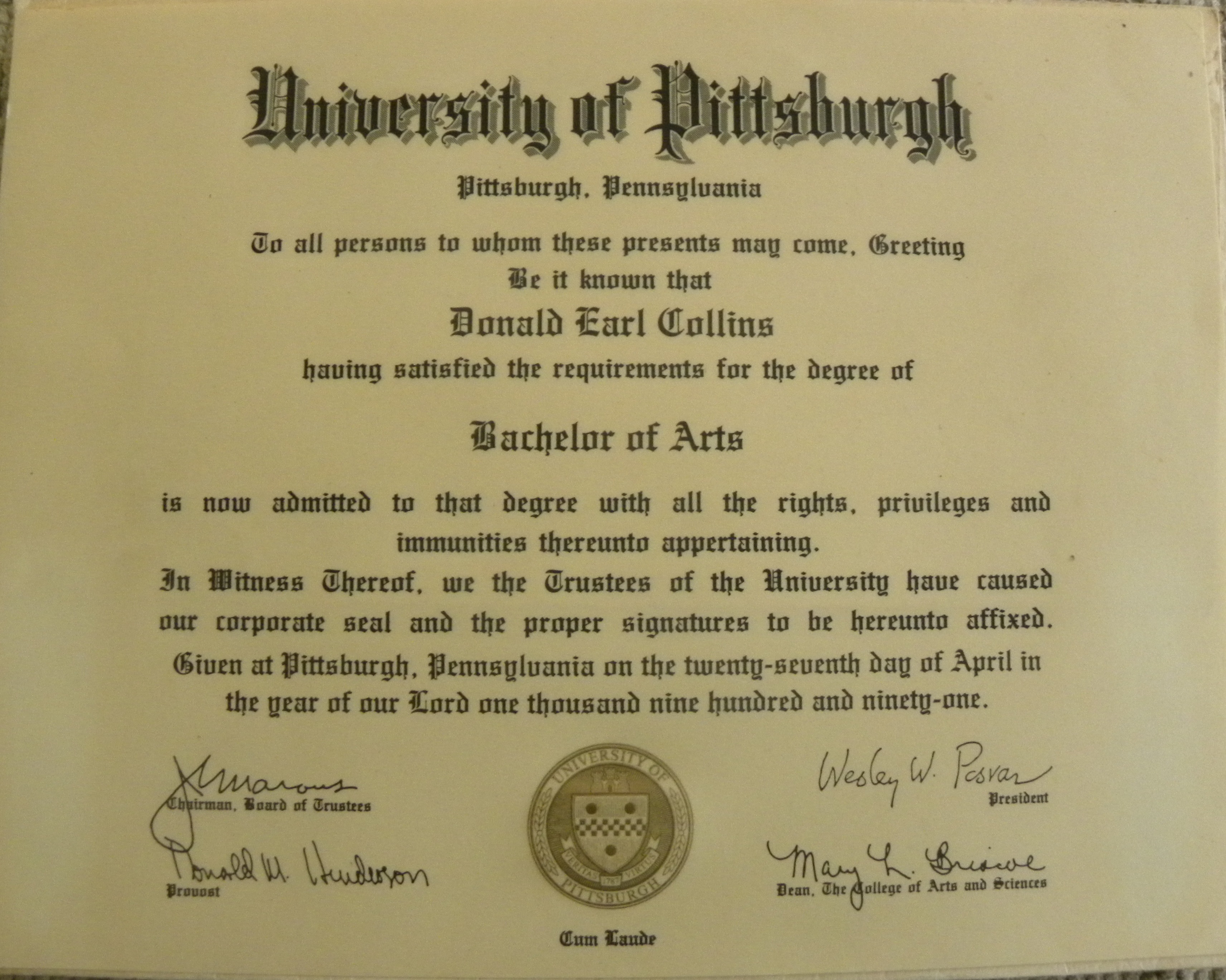
I can be hard on people, places and things, especially the ones I like and love. That’s as true of my undergraduate alma mater as anything else. Twenty years ago this date, I graduated from the University of Pittsburgh. I didn’t attend the cattle-call ceremony at the Civic Arena that Sunday in ’91. Almost none of my immediate circle of friends attended, either. My mother and my younger siblings, still in the midst of welfare, weren’t going to be there to see me anyway. The Penguins were on that day, in the middle of a dominant playoff run, with Lemieux scoring at will. And I had other things on my mind that day and weekend. Like, will I be able to go to grad school without taking out tens of thousands of dollars in student loans?

This was a time of major transition for me. Two years removed from the end of the reign of my ex-stepfather at 616, and four years after I graduated from Mount Vernon High School and my obsession

My B.A. degree, University of Pittsburgh, April 27, 2011. Note that this was Wesley Posvar's last graduation signature. The university president would retire the following month amid a $3 million golden parachute scandal.

with Crush #2. I was essentially the same person, and yet there was something inside me that had started clawing its way out over the previous year. It was a drive, a determination, a rage that I’d buried since my first year in Humanities and the summer of abuse that followed in ’82. I was going to graduate school, at least I hoped that I was. Or I was going to have to find a real job, something that made me feel like I had diarrhea.

I knew on my Pitt graduation date that the departments of history at NYU, University of Maryland and Pitt had accepted me into their masters programs. But NYU wanted me to make a signed commitment before they awarded me any financial aid. The University of Maryland conveniently lost my application packet during their graduate fellowship decision process. By the time my packet resurfaced, the department had awarded all of their fellowships, and decided to put me on provisional status. Not based on my grades, mind you, but based on how late they were in going through my application. Pitt had accepted me a couple of weeks before my graduation, but I was sixth on the alternate list for teaching fellowships that would cover my tuition and provide a stipend.

I felt a lot of anxiety about all of this uncertainty regarding my immediate future. It helped to have friends, even with my friends in the middle of their own uncertainty. My friend Marc was working at a Black newspaper, dreaming of law school but uncertain about his prospects. Three other friends, including someone I was sort of dating, were taking their last classes or unsure about grad school or law school. Even my summer job working for a project at the Western Psychiatric Institute and Clinic was shaky. It only paid $5.20 an hour, and I could’ve easily gone back to Mount Vernon and New York making $8 an hour or more doing the same work.

But as uncertain as I felt about things, this much I was certain about. The four years I spent at Pitt were ones that cocooned me in a way that none of my time growing up in Mount Vernon, New York did. I began to heal while I was there, academically, socially, emotionally. I was far from done learning how to connect to people, but I wasn’t the twelve-year-old neophyte keeping only the most rudimentary connections to humans either. My education was a valuable part of that experience. The friendships and other bonds I forms, the lessons I learned about trust, the efforts — however limited — the university made toward creating a campus climate that embraced diversity were all appreciated.

Even at the time, I felt comfortable at Pitt because it was the first place I learned to be comfortable in my own skin. It was a place where my friends, my acquaintances and others around me didn’t look at me like I was a freak because I listened to U2, sang in high-falsetto or walked at Warp Factor 3 to get across campus.

Those are the feelings, those good feelings, that I have about my four years of undergrad and two years of grad school (more on that in May) at the University of Pittsburgh. So, “Hail to Pitt,” and to my Pitt friends and folks from the classes of ’90-’94, Happy Graduation Anniversary Day.

← Older posts
Newer posts →

Boy @ The Window: A Memoir

Boy @ The Window: A Memoir

Places to Buy/Download Boy @ The Window

There's a few ways in which you can read excerpts of, borrow and/or purchase and download Boy @ The Window. There's the trade paperback edition of Boy @ The Window, available for purchase via Amazon.com at http://www.amazon.com/Boy-Window-Donald-Earl-Collins/dp/0989256138/

There's also a Kindle edition on Amazon.com. The enhanced edition can be read only with Kindle Fire, an iPad or a full-color tablet. The links to the enhanced edition through Apple's iBookstore and the Barnes & Noble NOOK edition are below. The link to the Amazon Kindle version is also immediately below:

scr2555-proj697-a-kindle-logo-rgb-lg

Boy @ The Window on Amazon.com: http://www.amazon.com/Boy-The-Window-Memoir-ebook/dp/B00CD95FBU/

iBookstore-logo-300x100

Boy @ The Window on Apple's iBookstore: https://itunes.apple.com/us/book/boy-the-window/id643768275?ls=1

Barnes & Noble (bn.com) logo, June 26, 2013. (http://www.logotypes101.com).

Boy @ The Window on Barnes & Noble: http://www.barnesandnoble.com/w/boy-the-window-donald-earl-collins/1115182183?ean=2940016741567

You can also add, read and review Boy @ The Window on Goodreads.com. Just click on the button below:

Boy @ The Window

Twitter Updates

Tweets by decollins1969
  • RSS - Posts
  • RSS - Comments

Archives

  • June 2025
  • April 2023
  • September 2022
  • August 2022
  • July 2022
  • June 2022
  • May 2022
  • April 2022
  • March 2022
  • January 2022
  • December 2021
  • November 2021
  • October 2021
  • September 2021
  • August 2021
  • July 2021
  • June 2021
  • April 2021
  • March 2021
  • February 2021
  • January 2021
  • December 2020
  • November 2020
  • October 2020
  • September 2020
  • August 2020
  • July 2020
  • May 2020
  • April 2020
  • March 2020
  • January 2020
  • December 2019
  • November 2019
  • August 2019
  • July 2019
  • June 2019
  • May 2019
  • April 2019
  • March 2019
  • February 2019
  • January 2019
  • December 2018
  • November 2018
  • October 2018
  • September 2018
  • August 2018
  • July 2018
  • June 2018
  • May 2018
  • March 2018
  • February 2018
  • January 2018
  • December 2017
  • November 2017
  • October 2017
  • September 2017
  • August 2017
  • July 2017
  • June 2017
  • May 2017
  • April 2017
  • March 2017
  • February 2017
  • January 2017
  • December 2016
  • November 2016
  • October 2016
  • September 2016
  • August 2016
  • July 2016
  • June 2016
  • May 2016
  • April 2016
  • March 2016
  • February 2016
  • January 2016
  • December 2015
  • November 2015
  • October 2015
  • September 2015
  • August 2015
  • July 2015
  • June 2015
  • May 2015
  • April 2015
  • March 2015
  • February 2015
  • January 2015
  • December 2014
  • November 2014
  • October 2014
  • September 2014
  • August 2014
  • July 2014
  • June 2014
  • May 2014
  • April 2014
  • March 2014
  • February 2014
  • January 2014
  • December 2013
  • November 2013
  • October 2013
  • September 2013
  • August 2013
  • July 2013
  • June 2013
  • May 2013
  • April 2013
  • March 2013
  • February 2013
  • January 2013
  • December 2012
  • November 2012
  • October 2012
  • September 2012
  • August 2012
  • July 2012
  • June 2012
  • May 2012
  • April 2012
  • March 2012
  • February 2012
  • January 2012
  • December 2011
  • November 2011
  • October 2011
  • September 2011
  • August 2011
  • July 2011
  • June 2011
  • May 2011
  • April 2011
  • March 2011
  • February 2011
  • January 2011
  • December 2010
  • November 2010
  • October 2010
  • September 2010
  • August 2010
  • July 2010
  • June 2010
  • May 2010
  • April 2010
  • March 2010
  • February 2010
  • January 2010
  • December 2009
  • November 2009
  • October 2009
  • September 2009
  • August 2009
  • July 2009
  • June 2009
  • May 2009
  • April 2009
  • March 2009
  • February 2009
  • January 2009
  • December 2008
  • November 2008
  • October 2008
  • September 2008
  • August 2008
  • July 2008
  • June 2008
  • May 2008
  • April 2008
  • March 2008
  • February 2008
  • January 2008
  • December 2007
  • November 2007
  • October 2007
  • September 2007
  • August 2007
  • July 2007
  • June 2007

Recent Comments

MaryPena's avatarMaryPena on My Day of Atonement/Bitter Hat…
decollins1969's avatardecollins1969 on No Good Teaching Deed Goes…
Mary Rose O’Connell's avatarMary Rose O’Connell on No Good Teaching Deed Goes…

NetworkedBlogs on Facebook

NetworkedBlogs
Blog:
Notes From a Boy @ The Window
Topics:
My Life, Culture & Education, Politics & Goofyness
 
Follow my blog

616 616 East Lincoln Avenue A.B. Davis Middle School Abuse Academia Academy for Educational Development AED Afrocentricity American Narcissism Authenticity Bigotry Blackness Boy @ The Window Carnegie Mellon University Child Abuse Class of 1987 CMU Coping Strategies Crush #1 Crush #2 Death Disillusionment Diversity Domestic Violence Economic Inequality Education Family Friendship Friendships Graduate School Hebrew-Israelites High-Stakes Testing Higher Education History Homelessness Humanities Humanities Program Hypocrisy Internalized Racism Jealousy Joe Trotter Joe William Trotter Jr. K-12 Education Love Manhood Maurice Eugene Washington Maurice Washington Misogyny Mother-Son Relationship Mount Vernon High School Mount Vernon New York Mount Vernon public schools Multiculturalism MVHS Narcissism NFL Pitt Pittsburgh Politics of Education Poverty President Barack Obama Race Racial Stereotypes Racism Relationships Self-Awareness Self-Discovery Self-Reflection Sexism Social Justice Teaching and Learning University of Pittsburgh Violence Whiteness Writing

Top Rated

Blog at WordPress.com.

  • Subscribe Subscribed
    • Notes from a Boy @ The Window
    • Join 103 other subscribers
    • Already have a WordPress.com account? Log in now.
    • Notes from a Boy @ The Window
    • Subscribe Subscribed
    • Sign up
    • Log in
    • Report this content
    • View site in Reader
    • Manage subscriptions
    • Collapse this bar
 

Loading Comments...