• About Me
  • Other Writings
  • Interview Clips
  • All About Me: American Racism, American Narcissism, and the Conversation America Can’t Have
  • Video Clips
  • Boy @ The Window Pictures
  • Boy @ The Window Theme Music

Notes from a Boy @ The Window

~

Notes from a Boy @ The Window

Category Archives: Carnegie Mellon University

What I Didn’t Know (in ’81, in ’97, in ’13)…

18 Saturday May 2013

Posted by decollins1969 in 1, Academia, Boy @ The Window, Carnegie Mellon University, Christianity, culture, Eclectic, eclectic music, Hebrew-Israelite, Mount Vernon New York, Movies, music, Pittsburgh, Politics, Pop Culture, race, Religion, University of Pittsburgh, Work, Youth

≈ Leave a comment

Tags

616 East Lincoln Avenue, Anticipation, Back Stabbers, Bruce Anthony Jones, Child Abuse, CMU, Domestic Violence, Family, Hustling, Joe Trotter, Joe William Trotter Jr., Not Knowing, O'Jays, Pitt, Poverty, Publishing, Success, The Matrix (1999), Welfare Poverty, Wisdom, Writing


Noah with me, January 3, 2004 [he was five months old]. (Angelia N. Levy).

Noah with me, February 28, 2004 [he was seven months old]. (Angelia N. Levy).

What I didn’t know across the past thirty-two years could be another book for me. I assume that would be the case for anyone would could look back across their life and second-guess themselves over that long a period of time. For me, though, the significance of today comes out of my mathematics background. You see, today’s my sixteenth PhD graduation anniversary. Not all that significant, I suppose. Except that I’m as far away from the end of my graduate school days at Carnegie Mellon today as I was from the first days of being a Hebrew-Israelite and watching my family fall into welfare poverty when I graduated in ’97.

100th Commencement Ceremony program, Carnegie Mellon University, May 18, 1997. (Donald Earl Collins).

100th Commencement Ceremony program, Carnegie Mellon University, May 18, 1997. (Donald Earl Collins).

Two things will hurt your success in this life. One is not acting on the things you know you should or must do. I learned that hard lesson from watching my mother make the decision to not make any decisions until it was too late, all while growing up at 616. Two is the enormous danger of not knowing, and therefore, not being able to act or respond to new or damaging situations as they arise. I’ve learned that lesson pretty well, too. Sometimes the hard way, through really bad experiences or decisions I didn’t play out like a game of eleventh-dimension chess. Sometimes through insight, foresight, even divine inspiration, anticipating what I didn’t know ahead of time.

And even with anticipation, you still might not be able to do anything about what you do and don’t know, simply because you’re not in any position to change things. That was especially true in ’81. I knew that my now deceased idiot ex-stepfather Maurice Washington was no good. But when my Mom decided to end her six months’ separation from him, there was nothing I could really do about it. I knew that with inflation rates of 14.5 percent in ’79 and 11.8 percent in ’80 (thank you, Scholastic Weekly Reader) and my Mom income of roughly $15,000 per year that we had less and less to work with at home. Again, not much I could do about that, either. Even paper boy jobs were drying up by the time I turned twelve!
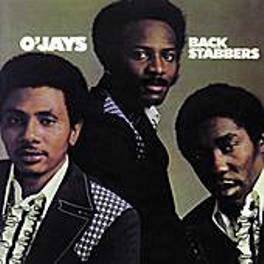
O'Jays Back Stabbers (1972) album cover, November 10, 2011. (Dan56 via Wikipedia). Qualifies as fair use as low-resolution illustration of subject matter.

O’Jays Back Stabbers (1972) album cover, November 10, 2011. (Dan56 via Wikipedia). Qualifies as fair use as low-resolution illustration of subject matter.

What I didn’t know was how quick and violent the shift into poverty would be. What I didn’t know was that Maurice would use his/our conversion as Hebrew-Israelites as justification for abusing my Mom and me. What I didn’t know was that my Mom would have three more kids by this man between July ’81 and May ’84. What I didn’t know was that I would feel so low about the loss of my best friend and my sense of self that I’d attempt to take my own life on my fourteenth birthday, at the end of ’83.

But when I looked back on this in ’97, I mostly thought about the good things that had occurred in the fifteen years between the domestic violence my Mom endured on Memorial Day ’82 and my doctoral graduation ceremony. My independent conversion to Christianity in ’84. Knocking out a 5 on my AP US History exam without ever cracking open Morison and Commager. Overcoming poverty and my lack of self-esteem to build a life at Pitt and in Pittsburgh between ’88 and ’97.

Still, I’d already been wounded, badly. By the things I knew but did nothing about. By those things I could’ve anticipated but my efforts to counteract were insufficient. By those things I couldn’t have known at all. I knew I’d have problems with my “running interference” advisor Joe Trotter coming down the dissertation stretch. Yet because of departmental politics and my need to be done sooner rather than later, I did nothing about this until I was six chapters into an eight-chapter dissertation. I knew my mentor and committee member Bruce Anthony Jones could sometimes be unreliable. Yet I had no idea that he would completely abandon me and his other doctoral students the moment he signed his name to my and their dissertations.

My dissertation's signature page, May 18, 2013. (Donald Earl Collins),

My dissertation’s signature page, May 18, 2013. (Donald Earl Collins),

Most of all, I never anticipated that my Mom would actually be jealous of me, and would spend a whole week with me at 616 and in Pittsburgh doing and saying things to completely disparage what I’d worked so hard for. For me, for her, for my family. That was hard to get over. There are times I’m not sure if I’m entirely over this yet.

What I’m sure of in ’13, though, is what I do know, don’t know, and can only anticipate with the wisdom of experience and wisdom beyond my experience. I know that I love my wife, that there’s a lot in common between her and Crush #1 (for those of you who’ve read Boy @ The Window so far, the implications should be obvious), real and from my own imagination. I didn’t know that I’d have a kid, a son who at nearly ten is both wonderful and perplexing, and hopefully, off to a much better start in life than I ever got. I suspect that one of my references for jobs and consulting gigs has been undermining my efforts over the past five years, and have thus removed her as a reference.

What I don’t know — but can only hope and work like a dog toward — is whether Boy @ The Window will be a success. I’m not sure if quantifying it would help. I sold a thousand copies of Fear of a “Black” America between August ’04 and January ’07, without the benefit of this blog, Twitter, Facebook or the e-book platforms. How long before I sell my first hundred, thousand, 5,000 or more? I have no idea. But as they say, I “must walk the path, not just know it.”

Afrocentricity and the Writing Bug

15 Wednesday May 2013

Posted by decollins1969 in 1, Academia, Boy @ The Window, Carnegie Mellon University, Christianity, culture, eclectic music, Hebrew-Israelite, Mount Vernon High School, Mount Vernon New York, music, Pittsburgh, Politics, Pop Culture, race, Religion, University of Pittsburgh, Youth

≈ Leave a comment

Tags

Africana Studies, Afrocentric Education, Afrocentric Idea (1987), Afrocentricity, Authentic Blackness, Authenticity, Black Action Society, Black Issues in Higher Education, Black Studies, Blackness, Cool, Coolness, Litmus Test, Marc Hopkins, Maulana Karenga, Molefi Asante, Pitt, Temple University, Writing, Writing Bug


A ladybug, often a symbol for the writing “bug,” May 15, 2013. (http://flickr.com). In public domain.

This time two decades ago, I was already a bit desperate for work. In transferring from Pitt to Carnegie Mellon, I’d left myself without any financial coverage for the summer of ’93 (see my post “The Arrogance of Youth, Grad School Style” from June ’12). I had applied for several fellowships, summer teaching gigs, even some nonprofit work. But as of the middle of that May, nothing had come through. I’d already spent $200 on a root canal that occurred on the same day as my written PhD comps at CMU (see my post “Facing the Tooth” from May ’12).

Even before my comps and my surprise root canal, I had talked with my friend Marc about writing a joint article about the false litmus test of Blackness that Afrocentricity had come to represent in our minds. Between Molefi Asante’s students at Temple — not to mention the overtly Afrocentric turn of both the Black Action Society and the Black Studies department (which had changed its name to Africana Studies) in the previous eighteen months — both of us felt we needed to provide an alternate perspective.

On that third Saturday in May (and the day after my comps and root canal surgery), we worked for five hours in putting together what amounted to a 1,200-word opinion piece against the belief system and authenticity test that Afrocentricity (and Afrocentric education) had become. By some folks’ definition, we realized that jazz, Miles Davis and John Coltrane would fail the authentically Black test of a Molefi Asante’s wonderful Afrocentric Idea (1987) and of Maulana Karenga as well.

Frances Cress Welsing's The Isis Papers (1991), [about as authentic as auto-tunes], May 15, 2015. (http://amazon.com).

Frances Cress Welsing’s The Isis Papers (1991), [about as authentic as auto-tunes], May 15, 2015. (http://amazon.com).

Now I’m pretty sure why Marc had problems with Afrocentricity. As a Christian and a jazz aficionado, Marc likely saw Afrocentricity as something somewhere between a misguided way of thinking about Blackness and complete and utter bull crap. His goal was to “add to the debate” and “educate” those who weren’t Asante or Karenga apostles and disciples. A laudable — if somewhat naive about the politics of academia and race — goal.

As for me, beyond the academic superficiality of having a litmus test on what is and isn’t Black, I had at least two unconscious reasons for writing my first crossover piece. One had to do with my sense that too many young folks were all too interested in doing the cool thing and not the right thing. Afrocentricity was cool, just like all rap and hip-hop was cool, just like giving libations to ancestors was cool.

Being cool had always meant following a crowd and seldom saying anything that would dig more than a nanometer beyond the surface. Or saying a critical thing about the cool thing that everyone in the same crowd otherwise takes in without a critical thought. I went to a high school full of people like that, and loathed being around people like that when I’d been a part of the Black Action Society at Pitt.

Unconscious reason number two had something to do with my Hebrew-Israelite days. Again, I gave this zero direct thought during my grad school days. But the given the trauma I’d suffered through during my three years of kufi-dom, it had to affect my thinking about Afrocentricity. The Black folk I knew who were part of the Hebrew-Israelite religion were much more obvious about what they did and didn’t consider Black or kosher. Yet, it was so obvious that they constantly contradicted themselves, in terms of food or music, how they treated their wives or children. Most important for me, though, was the fact that they tried to live separate and apart from other Blacks, yet seemed no more different beyond the kufis, veils and kosher meats from other Blacks (or Jews, for that matter).

I saw Afrocentricity as bullshit, and still see the fact that so many folks who get caught up in this sense of authenticity around Blackness as folks falling for bullshit. If I hadn’t lived as a Hebrew-Israelite between the ages of eleven and fifteen, perhaps I wouldn’t see Afrocentricity this way. If I hadn’t been around the “Party All The Time” folks in high school and the “Black Panther Party” posers at Pitt, maybe Afrocentricity would’ve been more appealing to me.

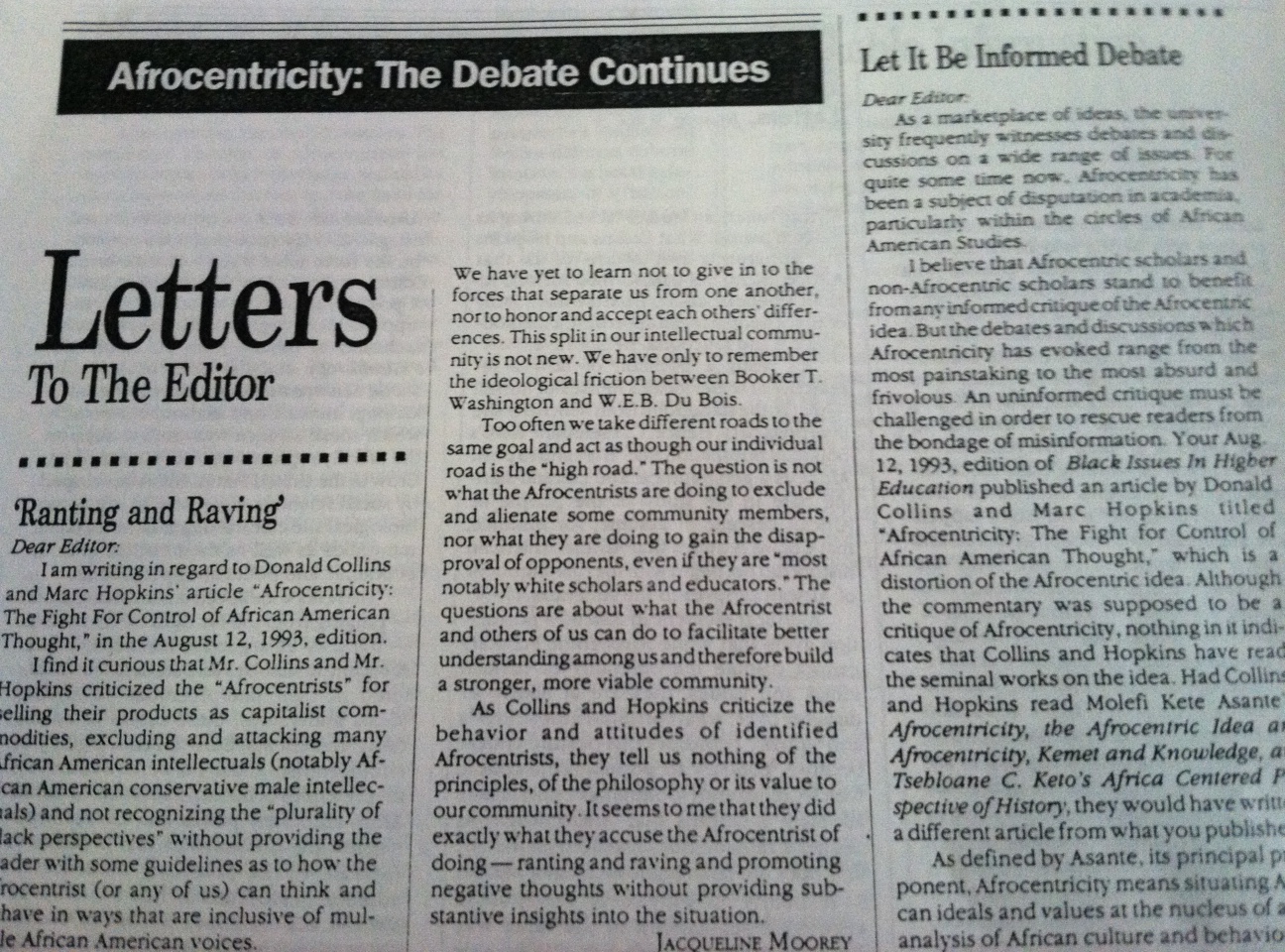
Letters to the Editor, Black Issues in Higher Education, September 9, 1993. (Donald Earl Collins).

Letters to the Editor, Black Issues in Higher Education, September 9, 1993. (Donald Earl Collins).

But at twenty-three years old, I was already tired of the pursuit of coolness and authenticity. That hasn’t changed in the past two decades. I’m sure the letters that called Marc and I “Uncle Toms” after our piece was published in Black Issues in Higher Education were from folks who thought we weren’t cool, and thought they had the answers to life itself.

I wonder how those folks back then would see the academics who believe that hip-hop can explain everything in the social sciences and humanities who are prominent today. Perhaps some of these people today were the Afrocentric followers of twenty years ago. Perhaps not. All I know is, I haven’t stopped writing since that cloudy day in mid-May.

Update on Carnegie Mellon & the “Pope Girl”

11 Saturday May 2013

Posted by decollins1969 in 1, Academia, Carnegie Mellon University, culture, Eclectic, Pittsburgh, Politics, Pop Culture, Youth

≈ Leave a comment

Tags

CMU, CMU Alumni, Freedom of Expression, King Solomon, Pope Girl, President Jared Cohon, Public Nudity, School of Arts


CMU President Jared Cohon's decision on "Pope Girl"-Gate, May 10, 2013. (Donald Earl Collins).

CMU President Jared Cohon’s decision on “Pope Girl”-Gate, May 10, 2013. (Donald Earl Collins).

Outgoing Carnegie Mellon President Jared Cohon sent out a message to CMU alumni/community yesterday afternoon revealing his rather middle-of-the-road, Solomon-esque decision on the anti-pope nudity incident at the Carnival last month. His good yet easily predictable decision: the “Pope Girl” and her male accomplice will face misdemeanor indecent exposure charges from the Allegheny County courts for exposing cross-shaped pubic hairs in their public-mockery-of-Carnival campus march on April 18. But they will face no further disciplinary action from CMU, as what they did fell well within their rights of freedom of expression.

I’m sure the majority of my fellow yet rather conservative CMU alums will take some affront to this decision, but too bad for them. If you can’t hand out condoms while mocking the pope and buggy races with your butt and vagina hairs exposed as an undergrad, then when, pray tell, do you ever plan to break free?

I’m sure this was a difficult decision for President Cohon. He’s got one foot off the campus toward retirement while making a decision that could cost CMU some donors. But as Cohon approaches his last weeks on the job, he’s also likely gained a few new donors for the university, at least of the current generation of CMU students. I will never likely be one of them.

Still, I do look forward to future CMU controversies over students and their freedom of speech and expression. It’s a welcome change from discussions of the silent Republican majority, robotics and military contracts, and alumni who were my age before I was born in ’69.

It’s funny though. Today marks nineteen years since I finished all of my coursework for my CMU History PhD. I thought that was exciting stuff then. Some things are changing for the better.

Carnegie Mellon and the “Pope Girl”

03 Friday May 2013

Posted by decollins1969 in 1, Academia, Carnegie Mellon University, culture, Eclectic, Pittsburgh, Politics, Pop Culture, Religion, Youth

≈ 4 Comments

Tags

Alumni, Anti-Gravity Downhill Derby, Birth of a Nation (1915), Bishop David Zubik, Buggy Races, Carnival, Catholic Church, Catholic Diocese of Pittsburgh, Jared Cohon, Parody, Pittsburgh Tribune-Review, Pope, Pope Girl, School of Art, Spring Carnival, Spring Carnival 2013, WPXI


Pope Girl, Carnegie Mellon University, Pittsburgh, PA, April 18, 2013. (Pittsburgh Tribune-Review).

Pope Girl, Carnegie Mellon University, Pittsburgh, PA, April 18, 2013. (Pittsburgh Tribune-Review).

A couple of days ago, outgoing Carnegie Mellon University President Jared Cohon responded to criticism from the Catholic Diocese of Pittsburgh regarding an incident during the Spring Carnival 2013 festivities in mid-April. Known primarily for buggy cart races on campus/near Schenley Park, the Spring Carnival has also been a time for alumni to gather in force on the sanitarium of a campus, to relive whatever wonderful memories they have of attending CMU (by comparison, I’ve never attended, not even when I was a graduate student at CMU).

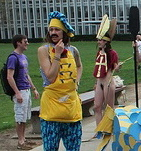
This year, though, the fourth annual spoofing of Carnival and the cart races by CMU’s School of Art — known as the Anti-Gravity Downhill Derby — involved a student dressed as the pope from the waist up. The get-up included a facsimile of the pontiff’s hat and crimson gown. From the waist down, the young woman wore nothing. Except for her vagina hair, cut in the shape of the cross. If this wasn’t bad enough, she and her compadres marched in the parade and handed out condoms during the event.

Now folks like Bishop David Zubik — and likely some deep-pocket conservative (and maybe even Catholic) alumni — want to see the CMU student the local media has called the “Pope Girl” punished. Hence, President Cohon’s emailed statement to the CMU alumni community on Wednesday:

Email message from CMU President Cohon to alumni, May 1, 2013. (Donald Earl Collins).

Email message from CMU President Cohon to alumni, May 1, 2013. (Donald Earl Collins).

I don’t find what this CMU student did “highly offensive” or even mildly offensive at all. Maybe it’s because I’d been to gay and lesbian pride parades at NYU back in the ’90s, where women and men dressed as the pope. Where women put black tape in the shape of a cross across their breasts while holding signs that said, “F— the Catholic Church.” Maybe I’m not offended because CMU’s the same university that didn’t close on the Martin Luther King holiday back in the ’90s, yet somehow thought it okay for students to show Birth of a Nation (1915) on that day.

CMU student dressed as pope (cropped, pre-parade), April 18, 2013. (http://bit.ly/109fnni for full pic).

CMU student dressed as pope (cropped, pre-parade), April 18, 2013. (http://bit.ly/109fnni for full pic).

I’m sure that exposing one’s pubic hair and butt cheeks in public violates some standards, either public nudity or lewdness in general. But beyond this, if there’s to be any punishment, it would be beyond unfair. After all, the Pope Girl is an adult, and has First Amendment rights to free speech, free expression and in this case, freedom of religion (specifically, the right to mock the pope). Yes, five centuries ago, she would’ve been declared a heretic, tortured and burned at the stake. But then again, so would’ve the 6,000 or so Catholic priests and their superiors who were involved in child molestation and rape over the years.

Face it. CMU’s only responding now because money may be involved, as in the loss of financial support from donors and potential donors. Morality, religion and decency aren’t exactly the central tenets of a university that’s dying to be seen on the same level of elite as MIT or Stanford. Still, this is the most exciting end to the Spring Carnival that I or anyone else has likely ever heard of or seen.

“The Dying of Black Women’s Children”

27 Wednesday Mar 2013

Posted by decollins1969 in 1, Academia, Boy @ The Window, Carnegie Mellon University, culture, Eclectic, eclectic music, music, Pittsburgh, Politics, Pop Culture, race, University of Pittsburgh, Youth

≈ Leave a comment

Tags

"A Substance of Things Hoped For", "Sittin' on the Dock of the Bay", "The Evidence of Things Not Seen", Black Migrants, Black Migration, C. Matthew Hawkins, Census Data, Child Mortality, Child Mortality Rates, Correlation, Infant Mortality, Infant Mortality Rates, Joe William Trotter Jr., Julie Saville, Larry Glasco, Laurence Glasco, Lotus 1-2-3, Otis Redding, Pitt Honors Convocation 1994, Public Health Records, Quantitative Analysis, Quantitative Methods, SPSS, University of Chicago, Women Studies Program Award


Infant mortality rates by country (2004), March 27, 2013. (http://www.mchb.hrsa.gov/). In public domain.

Infant mortality rates by country (2004), March 27, 2013. (http://www.mchb.hrsa.gov/). In public domain.

That was the title of a research paper I wrote for an independent study course I did with my former Pitt advisor Larry Glasco. It was a paper I wrote during my last semester at the University of Pittsburgh, undergrad and grad school. It was the last paper I would write for any professor at Pitt. But it was a paper that would address a bunch of common themes about me as a historian and scholar knowingly, and a writer unknowingly.

I began this paper without a course and on my own time in the Fall ’92 semester (see my post “December Doctoral Decisions” from last year). I had to fulfill a quantitative methods requirement in order to take my PhD comprehensive examinations at the end of my coursework, which at my pace would’ve meant taking them in the fall of ’93 at Pitt. Why they never included a qualitative methods requirement, I’ll never know. Of course, this digital humanities movement of quantifying the heretofore unquantifiable was but an embryo in the early ’90s.

With my language requirement taken care of the year before, I had no choice but to build on my existing statistical knowledge. Luckily, I’d inadvertently minored in mathematics and had been a computer science major before switching to history. I’d already decided on the topic of comparing infant/child mortality rates among White and Black Pittsburghers between 1900 and 1920, coinciding with the Great Migration period for Blacks. This meant census data from 1900, 1910 and 1920. This meant public health records from the same twenty-year stretch. It meant looking at neighborhoods like the Lower Hill District and Bloomfield, the occupations of the men and (in the case of Blacks) women living in these communities.

And it meant that I had to learn how to use SPSS, the most powerful number-crunching statistical software package on the planet. At least as far as I was concerned. It took me from September ’92 until the end of January ’93 to get comfortable enough with SPSS to plot and correlate different points of data. By then, I could generate reports and make sense of them. I knew that race, poverty/neighborhood and occupation (in that order) correlated best to the 2.5 to 1 ratio between infant/child mortality (death between child birth and the age of five) rates for Black families versus White families.

I used Lotus 1-2-3 to construct the tables, charts and graphs for my statistical correlations and data. Why Lotus 1-2-3? Their charts and graphs looked like “arts and crafts,” to steal a phrase from David Letterman. SPSS’s visuals were boring. Between the numbers crunching, the translation of correlation data into Lotus, and the actual writing of this paper, I completed my work for this independent study and quantitative methods requirement at the end of February ’93.

By then, I had two issues. One, I didn’t know what to title my paper. Most of my titles were inspired by cultural references from music, sports, TV shows, catch commercial jingles. I’d titled one paper “‘Sittin’ On The Dock of The Bay’,” an homage to Otis Redding and in reference to the topic of Black migrants finding permanent economic degradation after leaving the Jim Crow South for places like New York, Chicago and L.A. Another one, which I’d presented at several conferences, was “‘The Evidence of Things Not Seen’,” a prelude to my “‘A Substance of Things Hoped For'” dissertation (thanks to Hebrews 11:1 and James Baldwin).

Pitt Honors Convocation program, (March 1, 1994), March 27, 2013. [Ironic, given that I received this honor when I was at CMU]. (Donald Earl Collins).

Pitt Honors Convocation program, (March 1, 1994), March 27, 2013. [Ironic, given that I received this honor when I was at CMU]. (Donald Earl Collins).

I solved this title problem while simultaneously dealing with the second issue, which was that I knew I was about to transfer to Carnegie Mellon to complete the doctorate. Joe Trotter had invited me to attend the job talks of a young professor who had recently earned tenure at the University of Chicago, I believe. I remember her being fairly attractive and found her work interesting, if not fascinating. While we walked up and down the factory floor, um, second-floor corridors of Baker Hall, I walked by a flyer for an upcoming talk on “The Dying of Young Women’s Children.” I decided that this would be the scaffolding for my paper’s title, right then and there. Only, I’d change “Young” to “Black” and give a footnote of credit to the flyer title.

I submitted my paper to Larry for my independent study, which I was now taking purely as pass/fail (or satisfactory/unsatisfactory), and not for a specific grade. After Larry learned of my departure, he never gave me feedback on the paper. As the end of the semester approached — and I became short on cash — I submitted the paper to the Women’s Studies Program’s Student Research (undergraduate and graduate) contest.

Pitt's Women's Studies Program Annual Prize for Student Research on Women and Gender, June 1993, March 27, 2013. (Donald Earl Collins).

Pitt’s Women’s Studies Program Annual Prize for Student Research on Women and Gender, June 1993, March 27, 2013. (Donald Earl Collins).

Two months later, in June ’93, I learned that I’d finished second in the graduate student category, and earned a check for $75, a week’s worth of groceries! My friend Matt, upon learning of my good fortune, said, “You won that prize because of that title,” adding that I “stole it” from a flyer.

Matt was right, of course. But I also learned something important through “The Dying of Black Women’s Children.” That all writers borrow from others’ words and ideas, and then make them their own.

Running Interference

04 Monday Apr 2011

Posted by decollins1969 in 1, Academia, Boy @ The Window, Carnegie Mellon University, culture, Eclectic, race

≈ Leave a comment

Tags

Academia, Academic Suicide, Advising, Advisor, April 4th, Bad Mentoring, CMU, David Montgomery, Dissertation, Doctoral Thesis, Joe Trotter, Joe William Trotter Jr., Manning Marable, Mentoring, Michael Nettles, MLK Assassination, Spencer Foundation Dissertation Fellowship Program


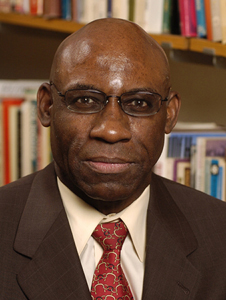
Joe Trotter, circa 2008.

Joe Trotter, circa 2008.

Today is the forty-third anniversary of Martin Luther King’s assassination by James Earl Ray in Memphis, Tennessee. But for the past fifteen years, April 4th has also had the dubious distinction of reminding me of a big argument between me and Joe Trotter. He was my doctoral thesis advisor at Carnegie Mellon and, until that day, someone I considered a mentor in my becoming an academic historian.

Below is an excerpt from my book Fear of a “Black” America (with some minor additions) in which I recount what happened that day:

‘I’m looking out for your best interests’ was what my dissertation advisor typically said in discussing my future with me. As far as Trotter was concerned, he was in charge of the rest of my academic career, determining everything from whether I would finish my doctorate to where I would live and work after I graduated. But as I’d already discovered in the months leading to this moment, he was not nurturing my career at all. Virtually all of my achievements as a graduate student occurred despite my advisor rather than because of him.

This was because my advisor discouraged my attempts to publish, to obtain grants for my research, to participate in major conferences, and to apply for jobs when it was apparent I had nearly completed my doctoral thesis. My advisor would frequently say ‘You’re not ready’ to take on a particular project or to apply for a grant or job to hinder my efforts. Yet Trotter never pointed out what he thought I needed to do to be “ready.”

One of our last official meetings as advisor and student covered this particular issue. Six chapters into an eight-chapter dissertation, I was still being told that I was ‘not ready’ to apply for jobs or to attend major conferences. Trotter had in fact contradicted some of what he had said about my work in a previous meeting. So when he declared for the eighteenth time in this particular meeting that he was not giving me his support because he was ‘looking out for my best interests,’ I sarcastically replied ‘Yeah, right! I don’t believe you!’ I decided that I could not abide the hypocrisy of an advisor who cared little for my future while at the same time professing to care very deeply.”

There was an eerie silence. Trotter actually didn’t know what to say. Neither did I. Mostly because I wanted to strangle him with his own blue neck tie. So I did something less dramatic but far more legal. I said, “I don’t have anything else to say to you,” picked up my stuff, walked out his heavy dark wood door, and slammed it as hard as I could. “Stupid ass,” I said under my breath as I walked out of Baker Hall that day. I was talking about myself as much as I was talking about Trotter.

For any academic scholar who reads this, they’ll likely conclude that I committed academic suicide by exhibiting such defiance to my advisor that day. Not true — I have a doctorate and years teaching in academia to prove otherwise. Not having the support of an advisor — whether that support’s official or in the reality of a friendship or a mentorship — does make building a career harder. But given what I’d learned about Trotter’s lack of support for a Spencer Fellowship that I ended up receiving as an award anyway, despite him, I knew that even if everything had been okay, it wouldn’t have been after graduation.

The reality is that my former advisor and thousands like him commit a form of academic suicide every day by refusing to promote at least one student’s career development. Besides having one’s work published and obtaining grants, developing new talent is key to creating a legacy as a successful professor. It’s why I can go to any history conference and hear stories about David Montgomery, or to an education conference and hear folks discuss their wonderful mentoring relationships with Michael Nettles. Or why so many responded across all of the social networks after learning that Manning Marable had passed away on Friday, April 1st.

I’m not holding these examples up because these professors were saints. Hardly. Just pointing out the fact that when a professor maliciously and deliberately attempts to hold back students otherwise deserving of moving on out of jealousy or some other reason, it puts a pox on their house as well.

On Catherine Lacey

22 Wednesday Apr 2009

Posted by decollins1969 in 1, Academia, Carnegie Mellon University, culture, Eclectic, Pittsburgh, Politics, Work, Youth

≈ Leave a comment

Tags

Catherine Lacey, Friendship, Mentoring, Self-Discovery, Spencer Foundation, Spencer Foundation Dissertation Fellowship Program


Me with Catherine Lacey at the Spencer Foundation, June 25, 2002. (Angelia N. Levy).

Me with Catherine Lacey at the Spencer Foundation, June 25, 2002. (Angelia N. Levy).

This month marks fourteen years since my plans for earning my doctorate were all but assured by a Spencer Foundation Dissertation Fellowship. It was a one-year fellowship, only $15,000, but it meant that I didn’t have to teach for a year, that I didn’t have to do grunt work for my advisor Joe Trotter, and that I wasn’t beholden to the history department at Carnegie Mellon for much of anything. It was a great triumph in my little world of graduate school. But of all the things that resulted from that award, one thing that I didn’t count on was another mentor and friend. Without a doubt, Catherine Lacey has had the longest lasting impact on my career and on my thinking, in and out of academia.

Catherine was the Senior Program Officer and Director of the Spencer Foundation Dissertation Fellowship Program when I applied for it in the fall of ’94. She had taken over the program in ’93, with the apparent charge of making the program more inclusive and more dynamic for its participants. I’m not sure what the foundation’s dissertation fellowship program was like before. All I know is that Catherine’s seven-year-long tenure running it was one in which she practiced compassion, humility, optimism, and quiet leadership. She never sounded like an academician in directing the work, although she was a bit philosophical at times. She never sounded like a bureaucrat or a senior foundation officer who practiced the power of “No,” even though that was certainly a major part of her job. Almost from my first conversation with Catherine, I realized that she was different from anyone I’d met with an academic background or in the foundation world.

Her background was as a Catholic nun who at one point was a Catholic school teacher, at least through the late ’70s, if I remember correctly. At some point she decided to go back to school, to eventually earn a doctorate in education from Harvard’s Graduate School of Education. Even though she was no longer a practicing nun (whatever I mean by that, I’m not entirely sure), I’m sure that this training and philosophical approach to life and work helped her a lot in her position at the Spencer Foundation. Maybe it was also the fact that she grew up in the Midwest, North or South Dakota I believe. Whatever the case, I think that this combination of experiences made her a more flexible and generous person than most of the foundation program officers and academic bureaucrats I’d met before and have come to know since.

The first time I ever heard from Catherine was right after a two-month research stay in Washington, DC and visit home in Mount Vernon, New York. I’d just come off of weeks in the National Archives, the Library of Congress, the Moorland-Spingarn Research collection at Howard University, the Sumner School Archives for DC Public Schools, and several other places doing research on my dissertation topic, multiculturalism in philosophy and practiced among Black Washingtonians. It was the end of March ’95, and it had been five months since I’d submitted my application packet for the Spencer fellowship. When I went to my Carnegie Mellon mailbox in the history department, there it was. A standard #10 envelope with only a one-page letter inside, which I knew because of the envelope’s thinness. I knew it was a rejection letter. Except that it wasn’t, at least not entirely. It had a handwritten note at the bottom of it from Catherine, asking me to give her a call as soon as I received the note.

So I did. Catherine did most of the talking, asking me about my research stay in DC, about my definition of multiculturalism and how it had or hadn’t changed because of my research. Then she talked to me about the selection committee. Apparently out of eight committee members, six voted in favor of awarding me the fellowship, one against, and with one in absentia. The sticking point was how I defined multiculturalism in my research proposal, putting me on the fence between award and no award. Although I would learn later that there were some academic and cultural politics involved in the two non-Yes votes, at the time Catherine told me that she would do everything she could to see if she could still fund my work. “I’m not making any promises,” she said before we got off the phone.

I didn’t know what to make of the call, other than the fact that Catherine cared about funding my work. That it wasn’t everyday that someone with her responsibilities called a student who had technically been rejected was also something I took away from that call. Two weeks passed. On Friday, April 14 of ’95, I got a call at home, right after 9:30 am. I assumed it was my mother or one of my friends. I hadn’t even taken the time to spit and rinse my toothpaste when I answered the phone. After the pleasantries, Catherine excitedly blurted out the good news. And I swallowed my toothpaste in response before asking how and saying thanks.

It turned out that Catherine thought that in addition to the 29 awards that were granted fellowships by the committee, that there were four others (including me) who should also receive the fellowship. Catherine had spent the previous two weeks asking the foundation for additional monies for the other four of us, and found that at least two of the original 29 awardees had accepted other fellowships. As a result, she could then give out four additional fellowships as part of her discretion as the director of the program. I was happy, to say the least about the award. But I was even happier that someone would fight for me and others the way Catherine did.

As a Spencer fellow, I learned a lot from my “fellow Fellows,” as I constantly called our group. That I wasn’t the only one whose advisor was acting as a roadblock toward our degree and career aspirations. That our colleagues on our campuses stared us all down with daggers in their eyes after learning about our awards. That hours upon hours of lonely research and intense writing and editing didn’t make any of our significant others or spouses particularly happy. Still, I learned as much from Catherine as I did from my fellow Fellows. About balance between life and work. About the realization that academia wasn’t our only career option, even as much as we thought it was at the time. That it was all right to feel ambivalent about pursuing an academic career.

This last one was of great importance to me, because my worries about becoming a publish-or-perish professor had always been there. I wanted to do something useful with my degree and life, something to benefit others, something that would allow me to help people who grew up like me, poor, possibly abused, and with the world thinking that I’d sooner go to jail than graduate high school. The one thing that Catherine’s work revealed to me was that it was possible to have a job and career that you could fall in love with, that helps others, and that enabled you to prosper financial. Her job allowed her to do all three, and very well at that.

It was that realization that enabled me to stumble my way into the nonprofit world, doing work on everything from community computer labs and civic education to a social justice fellowship program and education reform work on college access and success. Even after my fellowship ended in June ’96, I kept in contact with Catherine, attended Spencer gatherings and asked for advice. I even took my wife with me on a business trip to Chicago once to, among other things, have her meet Catherine at the Spencer offices in the John Hancock Building. I haven’t had quite the same luck of finding work that is as fulfilling as Catherine’s work was with Spencer. But I haven’t given up trying, and hope that what I have done and am doing does actually help others.

I haven’t talked to Catherine since the end of ’04. Not for lack of trying, though. Catherine decided after two years as a high-level administrator at the University of Pennsylvania’s Graduate School of Education that it was time for her to retire, to move back to the Dakotas, to live in seclusion, I guess. She didn’t particularly like Philly, or the grinding work that is almost pure administration. She missed Spencer, Chicago, and all of the people that she had met over the years. I think that the Bush years and 9/11 depressed her greatly

I miss Catherine. I miss asking her advice on everything from my job to whether I should turn Boy At The Window into a fiction novel instead of keeping it a memoir with narrative nonfiction elements (I know, that’s redundant) or even continue to pursue finding an agent. I miss sending her pictures of Noah or talking to her about her days at Spencer. Most of all, I miss telling her how much her friendship and unofficial mentoring have meant to me over the years. To Catherine, and really, all of my friends, many, many thanks.

Newer posts →

Boy @ The Window: A Memoir

Boy @ The Window: A Memoir

Places to Buy/Download Boy @ The Window

There's a few ways in which you can read excerpts of, borrow and/or purchase and download Boy @ The Window. There's the trade paperback edition of Boy @ The Window, available for purchase via Amazon.com at http://www.amazon.com/Boy-Window-Donald-Earl-Collins/dp/0989256138/

There's also a Kindle edition on Amazon.com. The enhanced edition can be read only with Kindle Fire, an iPad or a full-color tablet. The links to the enhanced edition through Apple's iBookstore and the Barnes & Noble NOOK edition are below. The link to the Amazon Kindle version is also immediately below:

scr2555-proj697-a-kindle-logo-rgb-lg

Boy @ The Window on Amazon.com: http://www.amazon.com/Boy-The-Window-Memoir-ebook/dp/B00CD95FBU/

iBookstore-logo-300x100

Boy @ The Window on Apple's iBookstore: https://itunes.apple.com/us/book/boy-the-window/id643768275?ls=1

Barnes & Noble (bn.com) logo, June 26, 2013. (http://www.logotypes101.com).

Boy @ The Window on Barnes & Noble: http://www.barnesandnoble.com/w/boy-the-window-donald-earl-collins/1115182183?ean=2940016741567

You can also add, read and review Boy @ The Window on Goodreads.com. Just click on the button below:

Boy @ The Window

Twitter Updates

Tweets by decollins1969
  • RSS - Posts
  • RSS - Comments

Archives

  • June 2025
  • April 2023
  • September 2022
  • August 2022
  • July 2022
  • June 2022
  • May 2022
  • April 2022
  • March 2022
  • January 2022
  • December 2021
  • November 2021
  • October 2021
  • September 2021
  • August 2021
  • July 2021
  • June 2021
  • April 2021
  • March 2021
  • February 2021
  • January 2021
  • December 2020
  • November 2020
  • October 2020
  • September 2020
  • August 2020
  • July 2020
  • May 2020
  • April 2020
  • March 2020
  • January 2020
  • December 2019
  • November 2019
  • August 2019
  • July 2019
  • June 2019
  • May 2019
  • April 2019
  • March 2019
  • February 2019
  • January 2019
  • December 2018
  • November 2018
  • October 2018
  • September 2018
  • August 2018
  • July 2018
  • June 2018
  • May 2018
  • March 2018
  • February 2018
  • January 2018
  • December 2017
  • November 2017
  • October 2017
  • September 2017
  • August 2017
  • July 2017
  • June 2017
  • May 2017
  • April 2017
  • March 2017
  • February 2017
  • January 2017
  • December 2016
  • November 2016
  • October 2016
  • September 2016
  • August 2016
  • July 2016
  • June 2016
  • May 2016
  • April 2016
  • March 2016
  • February 2016
  • January 2016
  • December 2015
  • November 2015
  • October 2015
  • September 2015
  • August 2015
  • July 2015
  • June 2015
  • May 2015
  • April 2015
  • March 2015
  • February 2015
  • January 2015
  • December 2014
  • November 2014
  • October 2014
  • September 2014
  • August 2014
  • July 2014
  • June 2014
  • May 2014
  • April 2014
  • March 2014
  • February 2014
  • January 2014
  • December 2013
  • November 2013
  • October 2013
  • September 2013
  • August 2013
  • July 2013
  • June 2013
  • May 2013
  • April 2013
  • March 2013
  • February 2013
  • January 2013
  • December 2012
  • November 2012
  • October 2012
  • September 2012
  • August 2012
  • July 2012
  • June 2012
  • May 2012
  • April 2012
  • March 2012
  • February 2012
  • January 2012
  • December 2011
  • November 2011
  • October 2011
  • September 2011
  • August 2011
  • July 2011
  • June 2011
  • May 2011
  • April 2011
  • March 2011
  • February 2011
  • January 2011
  • December 2010
  • November 2010
  • October 2010
  • September 2010
  • August 2010
  • July 2010
  • June 2010
  • May 2010
  • April 2010
  • March 2010
  • February 2010
  • January 2010
  • December 2009
  • November 2009
  • October 2009
  • September 2009
  • August 2009
  • July 2009
  • June 2009
  • May 2009
  • April 2009
  • March 2009
  • February 2009
  • January 2009
  • December 2008
  • November 2008
  • October 2008
  • September 2008
  • August 2008
  • July 2008
  • June 2008
  • May 2008
  • April 2008
  • March 2008
  • February 2008
  • January 2008
  • December 2007
  • November 2007
  • October 2007
  • September 2007
  • August 2007
  • July 2007
  • June 2007

Recent Comments

MaryPena's avatarMaryPena on My Day of Atonement/Bitter Hat…
decollins1969's avatardecollins1969 on No Good Teaching Deed Goes…
Mary Rose O’Connell's avatarMary Rose O’Connell on No Good Teaching Deed Goes…

NetworkedBlogs on Facebook

NetworkedBlogs
Blog:
Notes From a Boy @ The Window
Topics:
My Life, Culture & Education, Politics & Goofyness
 
Follow my blog

616 616 East Lincoln Avenue A.B. Davis Middle School Abuse Academia Academy for Educational Development AED Afrocentricity American Narcissism Authenticity Bigotry Blackness Boy @ The Window Carnegie Mellon University Child Abuse Class of 1987 CMU Coping Strategies Crush #1 Crush #2 Death Disillusionment Diversity Domestic Violence Economic Inequality Education Family Friendship Friendships Graduate School Hebrew-Israelites High-Stakes Testing Higher Education History Homelessness Humanities Humanities Program Hypocrisy Internalized Racism Jealousy Joe Trotter Joe William Trotter Jr. K-12 Education Love Manhood Maurice Eugene Washington Maurice Washington Misogyny Mother-Son Relationship Mount Vernon High School Mount Vernon New York Mount Vernon public schools Multiculturalism MVHS Narcissism NFL Pitt Pittsburgh Politics of Education Poverty President Barack Obama Race Racial Stereotypes Racism Relationships Self-Awareness Self-Discovery Self-Reflection Sexism Social Justice Teaching and Learning University of Pittsburgh Violence Whiteness Writing

Top Rated

Blog at WordPress.com.

  • Subscribe Subscribed
    • Notes from a Boy @ The Window
    • Join 103 other subscribers
    • Already have a WordPress.com account? Log in now.
    • Notes from a Boy @ The Window
    • Subscribe Subscribed
    • Sign up
    • Log in
    • Report this content
    • View site in Reader
    • Manage subscriptions
    • Collapse this bar
 

Loading Comments...