• About Me
  • Other Writings
  • Interview Clips
  • All About Me: American Racism, American Narcissism, and the Conversation America Can’t Have
  • Video Clips
  • Boy @ The Window Pictures
  • Boy @ The Window Theme Music

Notes from a Boy @ The Window

~

Notes from a Boy @ The Window

Tag Archives: Writing

Dwayne and Cindy

09 Monday Dec 2013

Posted by decollins1969 in 1, Boy @ The Window, culture, Eclectic, Mount Vernon New York, Pop Culture, race, Youth

≈ Leave a comment

Tags

616, 616 East Lincoln Avenue, Art, Black Identity, Black Male Identity, Comic Strips, Creativity, Depression, Genius, Identity Crisis, Infantilization, Mental Retardation, Potential, Reading, Sibling Relationship, Sibling Rivalry, The Brady Bunch (1969-75), The Clear View School, What's Happening!! (1976-79), Writing


My older brother Darren, with nephews Roshad and Noah (my son), Mount Vernon, NY, November 23, 2006. (Donald Earl Collins).

My older brother Darren, with nephews Roshad and Noah (my son), Mount Vernon, NY, November 23, 2006. (Donald Earl Collins).

My brother Darren turns forty-six years old today. With all that’s happened in our lives, it would be easy for me to forget that Darren’s my older brother, that he learned how to read on his own at three years old, that he taught me how to read right around my fifth birthday. Yet if I go back in time far enough, I can still see the Darren that was before his fourteen years at a school for the mentally retarded in Clear View at Briarcliff Manor had permanently screwed him up.

Between the ages of ten and sixteen (or, between  late ’77 and early ’84, my brother worked on his own personal comic strip series, one he called Dwayne and Cindy. I guess he got the character names from two of his favorite shows, What’s Happening!! and The Brady Bunch. Darren started slowly at first, figuring out how to draw his characters. They were both Black, kids that were about the same age as we were. They were best friends who went outside to play, went on walks or otherwise hung out at Dwayne’s place playing or watching TV.

So when Darren added his bubble captions to tell his stories, they were simple strips about life in the suburbs, about going for walks to the store, about school and homework and how their parents were always too hard on them. As with all things that required creativity, Darren drew from what he knew from living in Mount Vernon and going to school at Clear View, which back in the late-’70s was in Dobby Ferry, and not so Bruce Wayne-stately-manor-looking as it is today.

What's Happening!! (1976-79) screen shot, December 27, 2011. (http://www.sitcomsonline.com/whatshappening/whatshappseason3-1%20(Small).JPG). Qualifies as fair use -- low resolution pic without alternative image.

What’s Happening!! (1978) screen shot, December 27, 2011. (http://www.sitcomsonline.com/whatshappening/whatshappseason3-1%20(Small).JPG). Qualifies as fair use — low resolution pic without alternative image.

As Darren got older, he fleshed out Dwayne and Cindy some more. They had similar personalities, where they used each other to escape what seemed to be a harsh world outside of their bubble. But Darren would never draw nor talk about this harsh world in his strips. He wanted them to be funny and goofy, after all, not just a reflection of everything that was going on at 616 and with our parents/idiot stepfather.

At the same time, though, Darren as a comic strip writer hadn’t grown to the point where he could capture more complex issues in his form. I said as much when he asked me to look at a more mature version of Dwayne and Cindy in ’82. “Why do Dwayne and Cindy say the same thing all the time? Don’t they grow up or think about other stuff?,” I asked with some impatience, hoping that Darren would want to talk about race, or growing up, or make Dwayne and Cindy into teenagers.

And on this one, Darren didn’t immediately give up. For two more years, until the beginning of the summer of ’84, he did try to make Dwayne and Cindy more mature. But between the loss of our bedroom to younger siblings and then the whole Balkis Makeda affair in ’84, combined with the completion of the institutionalization process at Clear View, Darren no longer had the creative spirit. His psychological reserves to see himself as normal, as a whole human being, as a young Black man, were all but gone, and have never returned.

I sometimes think that Darren had a window of opportunity to pull himself out of the psychological hole that my Mom, my father and Clear View put him in between ’74 and ’88. And he did. Through me and through that Dwayne and Cindy comic strip of his. In so many ways, his was a genius with the potential of an Aaron McGruder, some of which did rub off on me.

I DRAW COMICS sketchbook, September 2012. (Matt Marrocco via http://www.kickstarter.com).

I DRAW COMICS sketchbook, September 2012. (Matt Marrocco via http://www.kickstarter.com).

But being around the severely mentally retarded and a group of teachers and psychologists who coddled and infantilized the toughness out of him, the toughness Darren needed to succeed as well as survive our ordeal at 616. That, more than anything, extinguished Dwayne and Cindy and his chances at a rich life before he was old enough to vote. Which is why on every ninth of December, I’m so sad, for him and for me. Yes, I feel guilty, and yes, I know it’s not my fault, but I still miss the promising version of my older brother. I wish that Darren could’ve published Dwayne and Cindy, even the simple versions he began to draw and write thirty six years ago.

On Academic Entourages & Standing Apart From Them

11 Wednesday Sep 2013

Posted by decollins1969 in 1, Academia, Carnegie Mellon University, culture, Eclectic, Pittsburgh, Politics, Pop Culture, race, Religion, University of Pittsburgh, Work, Youth

≈ Leave a comment

Tags

Academia, African American Studies, Afrocentricity, Authenticity, Black Issues in Higher Education, Blackness, Entourage, Fear of a "Black" America, Followers, Loner, Marc, Molefi Asante, Multiculturalism, Politics of Academia, Publishing, Sycophants, Writing


Lil Wayne entourage, Hartford, CT, July 2011. (http://4umf.com/).

Lil Wayne entourage, Hartford, CT, July 2011. (http://4umf.com/).

This week for many is about anniversary number twelve of the 9/11 attacks, which if I hadn’t lived through them, would sound like something out of a Kurt Vonnegut novel. But because I’ve been counting my days for years, this week also represents two decades since I realized that radical “Islamic” terrorists, pro athletes and popular music artists aren’t the only ones with followers. I learned for the first time that even in the world of academia, paragons and those who allege themselves as such also have their entourages of true believers and sycophants. It was a realization that bothered the loner and the aspiring academic historian in me.

Letters to the Editor, Black Issues in Higher Education, September 9, 1993. (Donald Earl Collins)

Letters to the Editor, Black Issues in Higher Education, September 9, 1993. (Donald Earl Collins).

It all occurred in the aftermath of my first major publication, co-written with my friend Marc and published in Black Issues In Higher Education in August ’93. “Afrocentricity: The Fight for Control of African-American Thought” was our 1,200 word contribution to the debate over multicultural education and Afrocentricity in both higher education and in Black culture more generally. It was a publication that came as a surprise, because the editors at Black Issues In Higher Education (the same folks who ran Emerge Magazine, by the way) hadn’t contacted us about receiving our pitch and article, about accepting it for publication, or about when they intended to publish. And even though our article was literally in the centerfold of their August 12, ’93 issue, the folks at Black Issues in Higher Education never paid us for the publication of our work.

The reason why because clearer in their September 9 and September 23 issues. In the “Letters to the Editor” section, the editors published a dozen letters, ten of which were critical of our work. These weren’t scholarly or even logical critiques — we were wrong because we weren’t members of the Church of Afrocentric Babble, plain and simple. These were “How dare you!” or “Shame on you!” letters, not ones based on what we’d actually written.

What became obvious  to me was that Molefi Asante’s former and current students had written most of the letters. Not exactly an unbiased set of sources, as in the circle of Afrocentricity in the early ’90s, there were few people more prominent than Asante (he was the Father of Afrocentricity, after all). Once I realized this, I found myself disappointed. With Black Issues in Higher Education, with Black folks in academia — particularly at Temple University — and with academia itself. Me and Marc weren’t being challenged on our ideas, but on the idea that two alleged neophytes had the balls to challenge the orthodoxy of the early ’90s in African American studies and in high-brow Black cultural circles.

Marc pushed for a response from one of the editors about their unprofessionalism (and to find out why we weren’t being paid for our piece), which led to a conversation with one of the big-wigs. He apparently said to Marc, “We published it [the “Afrocentricity” piece] to teach you a lesson.” When Marc told me, I said, “Well, I guess we’re not gonna get paid.” (Turned out this was standard practice for the likes of Black Issues in Higher Education, Emerge, and for freelancers at BET as well). Marc, pissed and disillusioned, said, “We were just trying to help.”

Letters to the Editor, Black Issues in Higher Education, September 23, 1993. (Donald Earl Collins).

Letters to the Editor, Black Issues in Higher Education, September 23, 1993. (Donald Earl Collins).

It was the last one of many factors that pushed me to write my dissertation and my first book Fear of a “Black” America (2004) on the relationship between education, multiculturalism, and Black identity. I wanted to show that Afrocentricity wasn’t the only strain of thought that ran through the heads of Black scholars and found its way into small “c” curriculum and cultural events in Black communities. In doing so, I certainly stood apart, but I also stood alone a lot, too.

In recent years, I’ve seen numerous entourages eviscerate lone wolfs. On Twitter, in our 24/7 media coverage of the mundane and insignificant yet insane, and at academic conferences. As recently as a couple of months ago, I saw a version of this on Facebook in response to a post I wrote about Mark Anthony Neal’s Looking for Leroy (2013). The entourage makes it difficult for an up-and-comer to get off to an honest start, for conformity with only subatomic levels of independent thought seems to be the norm.

Somewhere between now and when my son (knock on wood) reaches my age of forty-three, maybe some of what I’ve written over the past twenty years will break through the ice of entourages, mad-dog and otherwise. Still, it is a damnable thing when groups get together to stomp out different voices (literally and figuratively), because that’s seems to be the only way to keep the band together.

The Road to Boy @ The Window, Part 3: Spencer Fellowship

01 Monday Jul 2013

Posted by decollins1969 in 1, Academia, Boy @ The Window, Carnegie Mellon University, culture, Eclectic, Pittsburgh, Politics, Pop Culture, race, Religion, University of Pittsburgh, Youth

≈ Leave a comment

Tags

Ambivalence, Berkeley California, Catherine Lacey, Chicago, Disillusionment, Dissertation Fellowship, Epiphany, George Boudreau, Oakland California, Personal Insights, Personal Stories, Revelations, Sandra Stein, Scholarship, Self-Discovery, Spencer Foundation, Writing, Writing Craft


Why Boy @ The Window, Part 3

Why Boy @ The Window, Part 3

I’ve written before about the epiphanies that came with my status as a Spencer Foundation Dissertation  Fellow during the 1995-96 year, particularly during our retreat in the Bay Area in February ’96. What that time as a fellow and at this retreat revealed was that I had pushed much of what I thought of as ambivalence toward academia into my mind’s subconscious. But that splinter in the back of my head driving me crazy was about much more than academia and my pursuit of a doctorate and a job as a history/education professor. No, it was as much about my purpose in life, my writing gift and the need to pursue this calling despite my being within a year of becoming “Dr. Collins.”

You see, there was a civil war of sorts going on in my soul and spirit over the very nature of who I was and wanted to be. I’d spent more than four years in resistance to the idea that every sentence I wrote in academia needed to be a compound sentence. I fought over the idea of making my writing more accessible to readers who weren’t history majors, graduate students or actual history professors. I wanted to write so that what I wrote wouldn’t be forgotten in five minutes because my writing required a cryptographer’s chart to decipher its meaning.

Whether Dan Resnick or Joe Trotter, Paula Baker and a few other professors, their overarching criticism of my writing was that it didn’t sound scholarly enough. It didn’t have the heft of words like “posits,” “tropes,” “archetypes,” “eschatology,” and a thousand other words that required a minimum of a master’s degree to fully understand their meaning. I tried in my dissertation to address those concerns. But after the first few chapters, I decided to write first, and then rewrite second, third and fourth to mold my language into scholar-speak.

Luckily I had the Spencer Foundation Dissertation Fellowship by then. It saved me at least a year — and possibly as many as three — in terms of completing my doctoral thesis and degree. I didn’t have to teach for a full year, do research or work for Joe Trotter or anyone else for a year.

And it gave me time to think about the kind of career and future I wanted. Maybe too much time. For the first time, I realized the question that had been on my mind for years was about my competing interests in academia and in writing. Was I a writer first? Was I an academic historian? Would it be possible to do both? And if it were, how would I do both?

The Spencer Fellows retreat in Berkeley/Oakland in February ’96 helped broaden my horizons. Some of my fellow Spencer Fellows were struggling with the issue of their career moves as well. I had only considered teaching in schools of education in passing prior to that retreat. I knew that with my interests in diversity in education, in educational equity, in the process of getting into and through college, a traditional history program would be an uncomfortable fit for my interests and talents. The retreat revealed that much to me, at least.

It revealed far more than that, though. I realized that out of the thirty-three Fellows, I was the only one who actually understood on a personal level how difficult issues of race, poverty and the politics of education made it for someone like me to go to college, graduate, get into a grad program, and eventually finish a doctorate. Oh, my fellow Fellows knew all too well the harassment and hazing and jealousies of their professors and dissertation advisors. Still, issues like welfare poverty and magnet school programs like the one I attended in Humanities were abstractions for them. Most of them hadn’t experienced what they were actually studying. The ones who had some experiences approximating my own became my favorite Spencer Fellows to be around, for those were the greatest of conversations.

So the seed of thinking about my work in more personal terms was planted on a conscious level by the time my Spencer Fellowship ended in June ’96. I hadn’t figured out yet that I was a writer first, an academic historian and educator second, but clearly both in the end. I was too invested in earning the degree and getting away from Joe Trotter as fast as I could back then.

I did think incorporating my experiences around the importance of education, of race, of poverty, of family dynamics in my writing would make what I wrote about much more meaningful. It wouldn’t diminish the scholarship, and would provide a creative outlet beyond the mundane world of academic writing.

Boy @ The Window Update: Barnes & Noble

26 Wednesday Jun 2013

Posted by decollins1969 in 1, Boy @ The Window, culture, Eclectic, Mount Vernon High School, Mount Vernon New York, New York City, Pittsburgh, race, Religion, University of Pittsburgh, Youth

≈ Leave a comment

Tags

Barnes & Noble, NOOK, NOOK Books, Promoting/Marketing Books, Writing


Barnes & Noble (bn.com) logo, June 26, 2013. (http://www.logotypes101.com).

Barnes & Noble (bn.com) logo, June 26, 2013. (http://www.logotypes101.com).

As of yesterday, Barnes & Noble now carries a NOOK book version of Boy @ The Window on its BN.com website. It was a difficult process, actually, converting the book for Barnes & Noble’s NOOK Books purposes. Will it be worth it? I have no idea.

Still, for those of you who haven’t found or bought a Kindle or iBooks version of Boy @ The Window, but have or prefer a NOOK version, this link is for you:

http://bit.ly/138gkne (translates as http://www.barnesandnoble.com/w/boy-the-window-donald-earl-collins/1115182183?ean=2940016741567).

On another note, the free PDF version of Boy @ The Window will come down next week. Plenty of you have downloaded it, and hopefully read it as well. I will let you all know of up and coming events and other news when plans become more definitive. In the meantime, happy reading!

Harold Meltzer Appreciation Day

21 Friday Jun 2013

Posted by decollins1969 in 1, Academia, Boy @ The Window, culture, Eclectic, Mount Vernon High School, Youth

≈ Leave a comment

Tags

Advanced Placement, AP, AP Reader, AP Readings, College Preparation, CollegeBoard, Critical Thinking, Educational Testing Service, Essays, ETS, Harold Meltzer, High Schools, Historical Analysis, K-12 Education, Profit Motive, US History, World History, Writing


MVHS AP US History/Mock Trial Team visit to Mount Vernon's City Hall with Harold Meltzer and Frank Pandolfo, March 18, 1986. (Frank Pandolfo).

MVHS AP US History/Mock Trial Team visit to Mount Vernon’s City Hall with Harold Meltzer and Frank Pandolfo, March 18, 1986. (Frank Pandolfo).

Today marks twenty eight years (both day and date — the ’13 calender and the ’85 calendar are in the same sequence) since the end of tenth grade for the Class of ’87. It’s also the day that fourteen of us met Harold Meltzer in “Room 275 of the Mount Vernon High School” for the first time. We were a grumpy bunch that third Friday in June, having gone through days of Regents exams and other tests from a rather underwhelming (though well-meaning) group of teachers. Again, it’s all in Boy @ The Window. But because I’ve had some experience teaching high school students, not to mention AP reader and ETS (Educational Testing Service, the exam developers) consulting experience, my appreciation for Meltzer has grown over the years.

In all, I’ve given up forty-five days of my life to scoring AP US and World History essays over the years, in the not-so-nice towns of Louisville, Kentucky, Fort Collins, Colorado, Salt Lake City (not to mention Princeton and from my own home). Scoring exams in a factory-esque setting is about as appealing as being an antibiotic-infused chicken at a Tyson’s egg-laying factory in Arkansas. Aside from the long hours of sitting around reading documents-based question essays, comparative essays, other essays and listening to long discussions of rubrics and accuracy in “meeting the standard” for scoring exams, it’s a blast. Especially with all of the coughing, sneezing and farting that can be heard throughout the week!

AP logo, The College Board, June 21, 2013. (http://www.stjacademy.org/).

AP logo, The College Board, June 21, 2013. (http://www.stjacademy.org/).

But the one thing I’ve learned is that many of America’s best and brightest students have significant reading, writing and analyzing issues, and not just because AP exam essay questions are written to be deliberately opaque. I’ve scored about 3,500 essays for the AP folks in all, and I can honestly say I’ve never read more than ten in any session that would’ve been A-level material in any of my college courses (or when I’ve taught high school students, for that matter). My last AP read, every one of the nearly 800 essays I read made my eyeballs ache and my teeth grind.

Most of these essays lack an introduction, a thesis statement, organization of ideas, examples that provide evidence of understanding or analysis, transition sentences between paragraphs and main ideas, and a conclusion. So many students don’t even try. They spend three hours drawing, journaling, writing short stories, poems and haikus, quoting rap lyrics and theme songs, or write in detail about their terrible AP US or World History teacher.

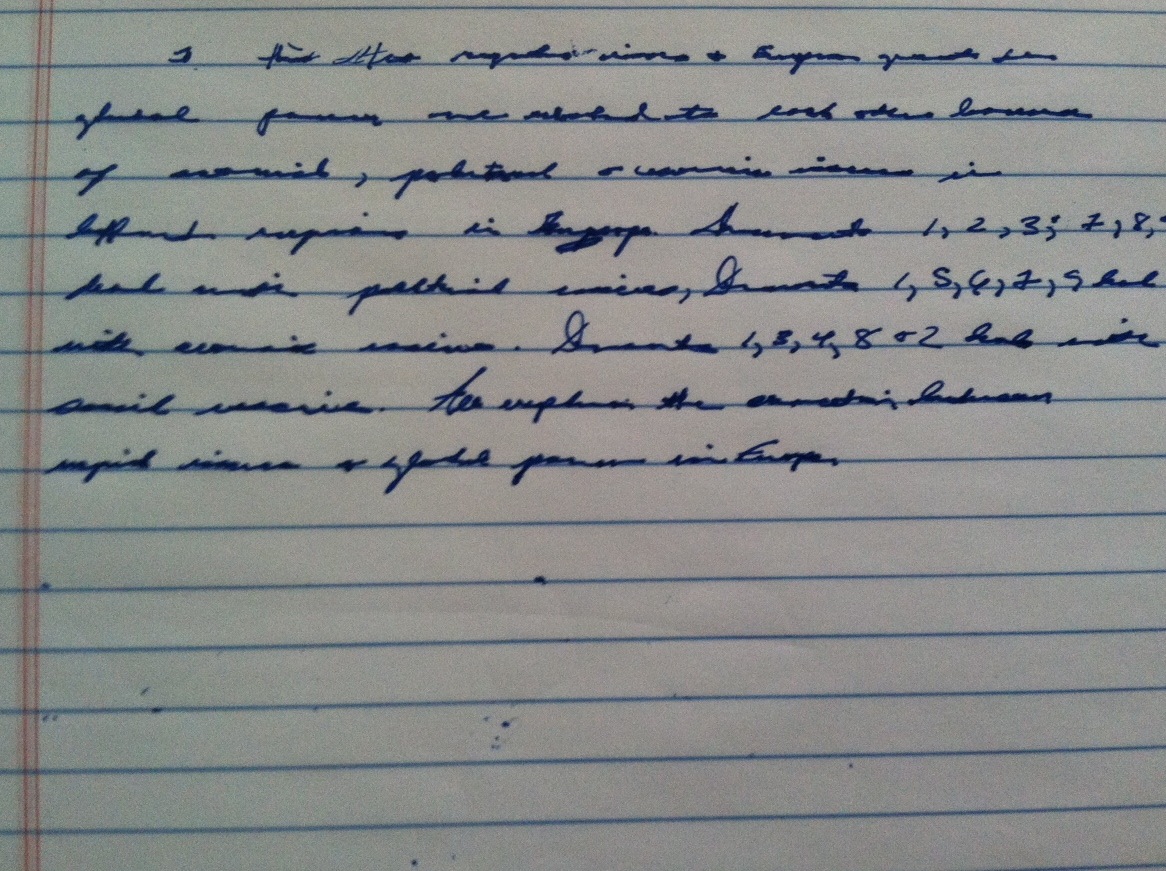
My pretend version of an introduction to a documents-based question essay for AP World History (in my best-worst handwriting), June 21, 2013. (Donald Earl Collins).

My pretend version of an introduction to a documents-based question essay for AP World History (in my best-worst handwriting), June 21, 2013. (Donald Earl Collins).

Aside from the almost indecipherable handwriting, that’s what has bothered me most in scoring these essays. That there are tens of thousands of unlucky students out their who by virtue of having a teacher unable to teach US or World History for advanced students. Or worse, teachers who don’t care to find out how best to teach these courses, to teach students how to write a proper introduction and thesis, to teach students how to bring in outside knowledge and intertwine it with documents or other materials within the actual exams. The inability of so many students to draw solid connections and to make a critical examination of the questions that these AP exams pose stems from both teacher neglect (benign and malignant), school districts hungry for ETS and College Board (the latter runs the AP program) dollars, and ETS and the College Board pushing these exams to more and more schools.

That reality makes me still appreciate all that I learned from Meltzer during the 1985-86 school year. Eccentric? Most def. Counterintuitive beyond what was necessary for AP US History? Without a doubt. Strange and somewhat meddlesome compared to our other teachers to be sure. But if any of us paid attention in his class even twenty percent of the time, we not only scored a 3 or better. We learned how to think beyond an answer, to ask “How?” and “Why?” for the first time. We learned how to read for an argument, and not just to read for understanding. We learned how to write a college essay (not just an AP essay) two full years before college.

And all of this learning began this day and date twenty-eight years ago. I can honestly say that I’ve had more than my share of life-changing teachers growing up. Meltzer, though, is at the top of my list, giving the time in which he was my teacher. May he rest in peace.

Monkey See, Baboon Do

22 Wednesday May 2013

Posted by decollins1969 in 1, Boy @ The Window, culture, Eclectic, Mount Vernon New York, Pop Culture, race, Youth

≈ Leave a comment

Tags

8U, A.B. Davis Middle School, Baboon, Beauty, Bigotry, Humanities, Italian Club, Monkey, Racism, Stereotype Threat, Teenagers, Writing, Writing Scrapheap


Monkey See Monkey Do, May 22, 2013. (http://kidsunder7.com).

Monkey See Monkey Do, May 22, 2013. (http://kidsunder7.com).

There are plenty of stories and vignettes that ended up on the Boy @ The Window scrap heap. Most because they weren’t relevant, some because a particular person or character really wasn’t a significant player in the book. In my final set of story revisions (not dialogue revisions) in ’09 and ’10, I operated under the “two or more rule.” If a person or character showed up fewer than two times in the book, I took them out, as they really weren’t as significant as I originally thought.

But in the case of the Sonya story below, it was a tough cut. I wanted to craft a book in which people felt everything I went through while not feeling sorry for me. I think and hope that I did. Though this story contained many elements of what I wanted in the rest of the book, it didn’t quite fit. Still, it serves as a good reminder of how mean even someone as polite (but certainly not always nice) as I am today could be at thirteen.

—————————

“Sonya was major fodder for Alex in eighth grade. She had a short Afro, an ‘au naturale’ to be exact. She wasn’t nearly as polished in maintaining her looks as many of the other girls in 8U. Sonya wasn’t ugly by any stretch. But by her not attempting to beautify herself in any way, she stood out for some in our class. Why would’ve she needed to anyway? She was also well-spoken, intelligent and outgoing, at least at the beginning of the year. Unfortunately for Sonya, my Italian Club classmates Alex, et al. were around to call her all kinds of names, like ‘baboon,’ and ‘monkey.’ I felt sorry for her, but I was also angry with her too. It pissed me off to see her respond to these semi-racist barbs with a blank face or even a smile.

It pissed me off so much that I ended up calling Sonya one of those names by the end of the school year. One day in homeroom, par for the course, Alex and company picked with Sonya again, calling her a ‘baboon’ among other things. She just sat there with that silly ‘Oh well’ smile on her face, as if they were telling her that she should go into professional modeling. Under my breath, I called her ‘monkey,’ and not as a joke. I just couldn’t believe that she was going to sit there like some pre-Civil Rights era Black in the South and take their crap without any response.

Except that I had called Sonya a ‘monkey’ within earshot of her and Alex. She ran out of the room, apparently to the girls bathroom, where she cried for several minutes, I later learned from Allison. I immediately tried to apologize, which Sonya eventually accepted (after my eighth grade science teacher Ms. Mignone and Allison shamed me for what I said). What I said was unacceptable to me, and the rationale was too intellectual for my own good. For Sonya, it simply came down to her looks, not her disposition. I wished that it had never happened, given what I faced from some of my classmates on a semi-regular basis.”

———————————————————-

1990s R&B/hip-hop duo Zhané from their 1994 album cover Pronounced Jah-Nay, May 22, 2013. (http://centrictv.com).

1990s R&B/hip-hop duo Zhané, from 1994 album cover Pronounced Jah-Nay, May 22, 2013. (http://centrictv.com).

The Sonya story has many of those elements, exposing me good, bad and ugly in the process. It’s about race and teenage ignorance and intellect. It’s about stereotype threat on one obvious level and trying to fit in on an unconscious one. It’s about the person I needed to become in high school as well as how I got to be that quiet yet observant person. The story is significant, yet because I only dealt with Sonya for two paragraphs in a 345-page book (in print form), it didn’t make the final cut. Because there are other and more central characters and stories in which stereotype threat and the ugly side of my immaturity both come out, I didn’t include Sonya.

Luckily, I also have a blog, where even scrap-heap stories can find the light of a new day. So, for this week, the thirtieth anniversary of my calling Sonya a “monkey,” I apologize again. I was a baboon for saying it in the first place. And Sonya, I hope you are well!

What I Didn’t Know (in ’81, in ’97, in ’13)…

18 Saturday May 2013

Posted by decollins1969 in 1, Academia, Boy @ The Window, Carnegie Mellon University, Christianity, culture, Eclectic, eclectic music, Hebrew-Israelite, Mount Vernon New York, Movies, music, Pittsburgh, Politics, Pop Culture, race, Religion, University of Pittsburgh, Work, Youth

≈ Leave a comment

Tags

616 East Lincoln Avenue, Anticipation, Back Stabbers, Bruce Anthony Jones, Child Abuse, CMU, Domestic Violence, Family, Hustling, Joe Trotter, Joe William Trotter Jr., Not Knowing, O'Jays, Pitt, Poverty, Publishing, Success, The Matrix (1999), Welfare Poverty, Wisdom, Writing


Noah with me, January 3, 2004 [he was five months old]. (Angelia N. Levy).

Noah with me, February 28, 2004 [he was seven months old]. (Angelia N. Levy).

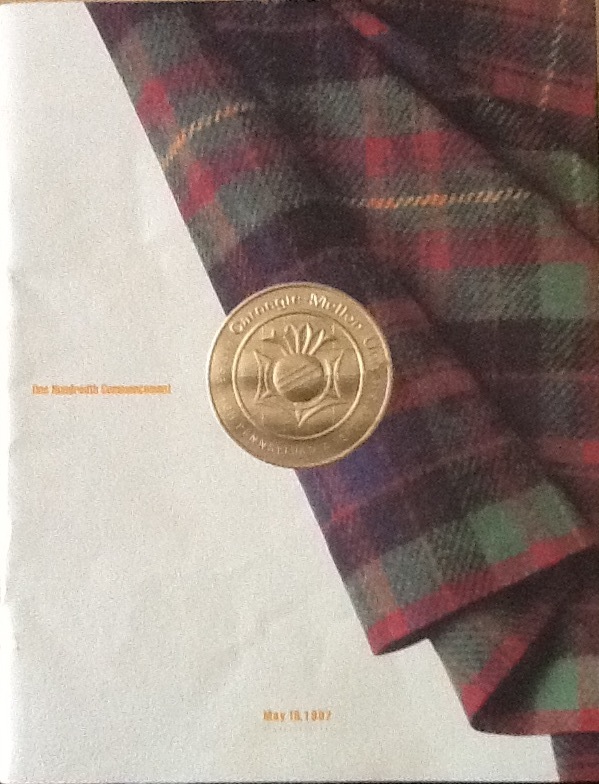
What I didn’t know across the past thirty-two years could be another book for me. I assume that would be the case for anyone would could look back across their life and second-guess themselves over that long a period of time. For me, though, the significance of today comes out of my mathematics background. You see, today’s my sixteenth PhD graduation anniversary. Not all that significant, I suppose. Except that I’m as far away from the end of my graduate school days at Carnegie Mellon today as I was from the first days of being a Hebrew-Israelite and watching my family fall into welfare poverty when I graduated in ’97.

100th Commencement Ceremony program, Carnegie Mellon University, May 18, 1997. (Donald Earl Collins).

100th Commencement Ceremony program, Carnegie Mellon University, May 18, 1997. (Donald Earl Collins).

Two things will hurt your success in this life. One is not acting on the things you know you should or must do. I learned that hard lesson from watching my mother make the decision to not make any decisions until it was too late, all while growing up at 616. Two is the enormous danger of not knowing, and therefore, not being able to act or respond to new or damaging situations as they arise. I’ve learned that lesson pretty well, too. Sometimes the hard way, through really bad experiences or decisions I didn’t play out like a game of eleventh-dimension chess. Sometimes through insight, foresight, even divine inspiration, anticipating what I didn’t know ahead of time.

And even with anticipation, you still might not be able to do anything about what you do and don’t know, simply because you’re not in any position to change things. That was especially true in ’81. I knew that my now deceased idiot ex-stepfather Maurice Washington was no good. But when my Mom decided to end her six months’ separation from him, there was nothing I could really do about it. I knew that with inflation rates of 14.5 percent in ’79 and 11.8 percent in ’80 (thank you, Scholastic Weekly Reader) and my Mom income of roughly $15,000 per year that we had less and less to work with at home. Again, not much I could do about that, either. Even paper boy jobs were drying up by the time I turned twelve!

O'Jays Back Stabbers (1972) album cover, November 10, 2011. (Dan56 via Wikipedia). Qualifies as fair use as low-resolution illustration of subject matter.

O’Jays Back Stabbers (1972) album cover, November 10, 2011. (Dan56 via Wikipedia). Qualifies as fair use as low-resolution illustration of subject matter.

What I didn’t know was how quick and violent the shift into poverty would be. What I didn’t know was that Maurice would use his/our conversion as Hebrew-Israelites as justification for abusing my Mom and me. What I didn’t know was that my Mom would have three more kids by this man between July ’81 and May ’84. What I didn’t know was that I would feel so low about the loss of my best friend and my sense of self that I’d attempt to take my own life on my fourteenth birthday, at the end of ’83.

But when I looked back on this in ’97, I mostly thought about the good things that had occurred in the fifteen years between the domestic violence my Mom endured on Memorial Day ’82 and my doctoral graduation ceremony. My independent conversion to Christianity in ’84. Knocking out a 5 on my AP US History exam without ever cracking open Morison and Commager. Overcoming poverty and my lack of self-esteem to build a life at Pitt and in Pittsburgh between ’88 and ’97.

Still, I’d already been wounded, badly. By the things I knew but did nothing about. By those things I could’ve anticipated but my efforts to counteract were insufficient. By those things I couldn’t have known at all. I knew I’d have problems with my “running interference” advisor Joe Trotter coming down the dissertation stretch. Yet because of departmental politics and my need to be done sooner rather than later, I did nothing about this until I was six chapters into an eight-chapter dissertation. I knew my mentor and committee member Bruce Anthony Jones could sometimes be unreliable. Yet I had no idea that he would completely abandon me and his other doctoral students the moment he signed his name to my and their dissertations.

My dissertation's signature page, May 18, 2013. (Donald Earl Collins),

My dissertation’s signature page, May 18, 2013. (Donald Earl Collins),

Most of all, I never anticipated that my Mom would actually be jealous of me, and would spend a whole week with me at 616 and in Pittsburgh doing and saying things to completely disparage what I’d worked so hard for. For me, for her, for my family. That was hard to get over. There are times I’m not sure if I’m entirely over this yet.

What I’m sure of in ’13, though, is what I do know, don’t know, and can only anticipate with the wisdom of experience and wisdom beyond my experience. I know that I love my wife, that there’s a lot in common between her and Crush #1 (for those of you who’ve read Boy @ The Window so far, the implications should be obvious), real and from my own imagination. I didn’t know that I’d have a kid, a son who at nearly ten is both wonderful and perplexing, and hopefully, off to a much better start in life than I ever got. I suspect that one of my references for jobs and consulting gigs has been undermining my efforts over the past five years, and have thus removed her as a reference.

What I don’t know — but can only hope and work like a dog toward — is whether Boy @ The Window will be a success. I’m not sure if quantifying it would help. I sold a thousand copies of Fear of a “Black” America between August ’04 and January ’07, without the benefit of this blog, Twitter, Facebook or the e-book platforms. How long before I sell my first hundred, thousand, 5,000 or more? I have no idea. But as they say, I “must walk the path, not just know it.”

← Older posts
Newer posts →

Boy @ The Window: A Memoir

Boy @ The Window: A Memoir

Places to Buy/Download Boy @ The Window

There's a few ways in which you can read excerpts of, borrow and/or purchase and download Boy @ The Window. There's the trade paperback edition of Boy @ The Window, available for purchase via Amazon.com at http://www.amazon.com/Boy-Window-Donald-Earl-Collins/dp/0989256138/

There's also a Kindle edition on Amazon.com. The enhanced edition can be read only with Kindle Fire, an iPad or a full-color tablet. The links to the enhanced edition through Apple's iBookstore and the Barnes & Noble NOOK edition are below. The link to the Amazon Kindle version is also immediately below:

scr2555-proj697-a-kindle-logo-rgb-lg

Boy @ The Window on Amazon.com: http://www.amazon.com/Boy-The-Window-Memoir-ebook/dp/B00CD95FBU/

iBookstore-logo-300x100

Boy @ The Window on Apple's iBookstore: https://itunes.apple.com/us/book/boy-the-window/id643768275?ls=1

Barnes & Noble (bn.com) logo, June 26, 2013. (http://www.logotypes101.com).

Boy @ The Window on Barnes & Noble: http://www.barnesandnoble.com/w/boy-the-window-donald-earl-collins/1115182183?ean=2940016741567

You can also add, read and review Boy @ The Window on Goodreads.com. Just click on the button below:

Boy @ The Window

Twitter Updates

Tweets by decollins1969
  • RSS - Posts
  • RSS - Comments

Archives

  • June 2025
  • April 2023
  • September 2022
  • August 2022
  • July 2022
  • June 2022
  • May 2022
  • April 2022
  • March 2022
  • January 2022
  • December 2021
  • November 2021
  • October 2021
  • September 2021
  • August 2021
  • July 2021
  • June 2021
  • April 2021
  • March 2021
  • February 2021
  • January 2021
  • December 2020
  • November 2020
  • October 2020
  • September 2020
  • August 2020
  • July 2020
  • May 2020
  • April 2020
  • March 2020
  • January 2020
  • December 2019
  • November 2019
  • August 2019
  • July 2019
  • June 2019
  • May 2019
  • April 2019
  • March 2019
  • February 2019
  • January 2019
  • December 2018
  • November 2018
  • October 2018
  • September 2018
  • August 2018
  • July 2018
  • June 2018
  • May 2018
  • March 2018
  • February 2018
  • January 2018
  • December 2017
  • November 2017
  • October 2017
  • September 2017
  • August 2017
  • July 2017
  • June 2017
  • May 2017
  • April 2017
  • March 2017
  • February 2017
  • January 2017
  • December 2016
  • November 2016
  • October 2016
  • September 2016
  • August 2016
  • July 2016
  • June 2016
  • May 2016
  • April 2016
  • March 2016
  • February 2016
  • January 2016
  • December 2015
  • November 2015
  • October 2015
  • September 2015
  • August 2015
  • July 2015
  • June 2015
  • May 2015
  • April 2015
  • March 2015
  • February 2015
  • January 2015
  • December 2014
  • November 2014
  • October 2014
  • September 2014
  • August 2014
  • July 2014
  • June 2014
  • May 2014
  • April 2014
  • March 2014
  • February 2014
  • January 2014
  • December 2013
  • November 2013
  • October 2013
  • September 2013
  • August 2013
  • July 2013
  • June 2013
  • May 2013
  • April 2013
  • March 2013
  • February 2013
  • January 2013
  • December 2012
  • November 2012
  • October 2012
  • September 2012
  • August 2012
  • July 2012
  • June 2012
  • May 2012
  • April 2012
  • March 2012
  • February 2012
  • January 2012
  • December 2011
  • November 2011
  • October 2011
  • September 2011
  • August 2011
  • July 2011
  • June 2011
  • May 2011
  • April 2011
  • March 2011
  • February 2011
  • January 2011
  • December 2010
  • November 2010
  • October 2010
  • September 2010
  • August 2010
  • July 2010
  • June 2010
  • May 2010
  • April 2010
  • March 2010
  • February 2010
  • January 2010
  • December 2009
  • November 2009
  • October 2009
  • September 2009
  • August 2009
  • July 2009
  • June 2009
  • May 2009
  • April 2009
  • March 2009
  • February 2009
  • January 2009
  • December 2008
  • November 2008
  • October 2008
  • September 2008
  • August 2008
  • July 2008
  • June 2008
  • May 2008
  • April 2008
  • March 2008
  • February 2008
  • January 2008
  • December 2007
  • November 2007
  • October 2007
  • September 2007
  • August 2007
  • July 2007
  • June 2007

Recent Comments

MaryPena's avatarMaryPena on My Day of Atonement/Bitter Hat…
decollins1969's avatardecollins1969 on No Good Teaching Deed Goes…
Mary Rose O’Connell's avatarMary Rose O’Connell on No Good Teaching Deed Goes…

NetworkedBlogs on Facebook

NetworkedBlogs
Blog:
Notes From a Boy @ The Window
Topics:
My Life, Culture & Education, Politics & Goofyness
 
Follow my blog

616 616 East Lincoln Avenue A.B. Davis Middle School Abuse Academia Academy for Educational Development AED Afrocentricity American Narcissism Authenticity Bigotry Blackness Boy @ The Window Carnegie Mellon University Child Abuse Class of 1987 CMU Coping Strategies Crush #1 Crush #2 Death Disillusionment Diversity Domestic Violence Economic Inequality Education Family Friendship Friendships Graduate School Hebrew-Israelites High-Stakes Testing Higher Education History Homelessness Humanities Humanities Program Hypocrisy Internalized Racism Jealousy Joe Trotter Joe William Trotter Jr. K-12 Education Love Manhood Maurice Eugene Washington Maurice Washington Misogyny Mother-Son Relationship Mount Vernon High School Mount Vernon New York Mount Vernon public schools Multiculturalism MVHS Narcissism NFL Pitt Pittsburgh Politics of Education Poverty President Barack Obama Race Racial Stereotypes Racism Relationships Self-Awareness Self-Discovery Self-Reflection Sexism Social Justice Teaching and Learning University of Pittsburgh Violence Whiteness Writing

Top Rated

Blog at WordPress.com.

  • Subscribe Subscribed
    • Notes from a Boy @ The Window
    • Join 103 other subscribers
    • Already have a WordPress.com account? Log in now.
    • Notes from a Boy @ The Window
    • Subscribe Subscribed
    • Sign up
    • Log in
    • Report this content
    • View site in Reader
    • Manage subscriptions
    • Collapse this bar
 

Loading Comments...